
Isaiah 48:5

Hebrew (Westminster Leningrad Codex) Isaiah 48:5 appears in the Hebrew Old Testament. The text above is from the Westminster Leningrad Codex. Each word links to its Strong’s number, a concise gloss, and parsing drawn from the Open Scriptures Hebrew Bible morphology. Click any word for its full Brown-Driver-Briggs (BDB) entry.
Download image
Cite this verse

Isaiah 48:5 (World English Bible). Public Domain. Lemma interlinear Bible study tool, https://lemma.gebible.app/v/isaiah/48/5.

Show BibTeX & RIS
BibTeX
RIS
English Translation
therefore I have declared it to you from of old; before it came to pass I shown it you; lest you should say, My idol has done them, and my engraved image, and my molten image, has commanded them.
World English Bible · Public Domain
Download a study sheet

One document with this verse’s original text, its word-by-word gloss line, the meaning frame, cross-references with their text, attributed commentary, and full source and license credits — printable, and it pastes into notes with its structure intact.

This verse Autodidact and up

Study sheet (.html) Plain text (.txt)

A passage Seminary Student

Up to 50 verses in one chapter. A passage sheet keeps up to 6 commentary sources and 12 cross-references per verse, in the order this page ranks them, and says so on the sheet whenever that leaves anything out. Ask for a single verse and you get the Autodidact verse sheet above.

Everything on this page stays free to read, with no account — the sheet is a download of what is already on screen, not access to it.

Want to remove ads? Support Godless Engineer
Compare translations 3

The same verse in 3 English versions, stacked beneath the original-language interlinear above. Click any original word for its lexicon entry.

Each is an independent rendering of the whole verse — the interlinear is not word-aligned to these translations.

Highlighted words mark where these versions differ — a whole-verse word diff, not a word-by-word alignment.

  • World English Bible Public Domain
    therefore I have declared it to you from of old; before it came to pass I shown it you; lest you should say, My idol has done them, and my engraved image, and my molten image, has commanded them.
  • King James Version Public Domain
    I have even from the beginning declared it to thee; before it came to pass I shewed it thee: lest thou shouldest say, Mine idol hath done them, and my graven image, and my molten image, hath commanded them.
  • unfoldingWord Literal Text CC BY-SA 4.0
    so I declared to you from then; I made you hear before it came, lest you should say, ‘My idol did them,’ or, ‘My carved figure and my cast image commanded them.’ q1

unfoldingWord Literal Text — © unfoldingWord, licensed CC BY-SA 4.0. Word-aligned USFM3 via Door43 (git.door43.org/unfoldingWord/en_ult).

Versions to compare (up to 4)

3 of 4 selected

Show all 18 translations

Every available English version of this verse, each an independent rendering of the whole verse.

  • World English Bible Public Domain
    therefore I have declared it to you from of old; before it came to pass I shown it you; lest you should say, My idol has done them, and my engraved image, and my molten image, has commanded them.
  • Berean Standard Bible Public Domain
    Therefore I declared it to you long ago; I announced it before it came to pass, so that you could not claim, ‘My idol has done this; my carved image and molten god has ordained it.’
  • Majority Standard Bible Public Domain
    Therefore I declared it to you long ago; I announced it before it came to pass, so that you could not claim, ‘My idol has done this; my carved image and molten god has ordained it.’
  • King James Version Public Domain
    I have even from the beginning declared it to thee; before it came to pass I shewed it thee: lest thou shouldest say, Mine idol hath done them, and my graven image, and my molten image, hath commanded them.
  • American Standard Version (1901) Public Domain
    therefore I have declared it to thee from of old; before it came to pass I showed it thee; lest thou shouldest say, Mine idol hath done them, and my graven image, and my molten image, hath commanded them.
  • Revised Version (1885) Public Domain
    therefore I have declared it to thee from of old; before it came to pass I shewed it thee: lest thou shouldest say, Mine idol hath done them, and my graven image, and my molten image, hath commanded them.
  • Geneva Bible (1599) Public Domain
    Therefore I haue declared it to thee of old: before it came to passe, I shewed it thee, lest thou shouldest say, Mine idole hath done them, and my carued image, and my molten image hath commanded them.
  • Douay-Rheims (1899) Public Domain
    I foretold thee of old, before they came to pass I told thee, lest thou shouldst say: My idols have done these things, and my graven and molten things have commanded them.
  • Young's Literal Translation Public Domain
    And I declare to thee from that time, Before it cometh I have caused thee to hear, Lest thou say, `Mine idol hath done them, And my graven image, And my molten image did command them.
  • Literal Standard Version CC BY-SA 4.0
    And from that time I declare [it] to you, || Before it comes I have caused you to hear, || Lest you say, My idol has done them, || And my carved image, || And my molten image commanded them.
  • Unlocked Literal Bible CC BY-SA 4.0
    therefore I declared these things to you beforehand; before they happened I informed you, so you could not say, 'My idol has done them,' or 'My carved figure and my cast metal figure has ordained these things.'
  • unfoldingWord Literal Text CC BY-SA 4.0
    so I declared to you from then; I made you hear before it came, lest you should say, ‘My idol did them,’ or, ‘My carved figure and my cast image commanded them.’ q1
  • Darby Bible Public Domain
    so I have long ago declared [them] to thee; before they came to pass I caused thee to hear [them]; lest thou shouldest say, Mine idol hath done them, and my graven image, or my molten image hath commanded them.
  • World Messianic Bible Public Domain
    therefore I have declared it to you from of old; before it came to pass I showed it to you; lest you should say, ‘My idol has done them. My engraved image and my molten image has commanded them.’
  • Webster's Bible Public Domain
    I have even from the beginning declared it to thee; before it came to pass I showed it thee: lest thou shouldst say, My idol hath done them, and my graven image, and my molten image, hath commanded them.
  • Free Bible Version CC BY-SA 4.0
    I predicted these things to you long ago, before they happened. I explained them to you so that you couldn't say “My idol did this,” or “My image and my metal god ordered this to happen.”
  • Bible in Basic English Public Domain
    For this reason I made it clear to you in the past, before it came I gave you word of it: for fear that you might say, My god did these things, and my pictured and metal images made them come about.
  • JPS Tanakh (1917) Public Domain
    Therefore I have declared it to thee from of old; before it came to pass I announced it to thee; lest thou shouldest say: 'Mine idol hath done them, and my graven image, and my molten image, hath commanded them.'

Literal Standard Version (2020), Covenant Press — licensed CC BY-SA 4.0. Text via the HelloAO Bible API (eBible.org). Unlocked Literal Bible (unfoldingWord) — licensed CC BY-SA 4.0. Text via the HelloAO Bible API (eBible.org). unfoldingWord Literal Text — © unfoldingWord, licensed CC BY-SA 4.0. Word-aligned USFM3 via Door43 (git.door43.org/unfoldingWord/en_ult). Free Bible Version, Dr. Jonathan Gallagher — licensed CC BY-SA 4.0. Text via the HelloAO Bible API (eBible.org).

Word by word

More ways to search: Search by grammar → Find every occurrence → Compare this word →

Practice this passage: Drill this verse → Learn its vocabulary →

עָצְבִּ֣י
ʻôtseb
H6090
“pain · my”
Noun, Common, Masculine, Singular, Construct + Suffix, Personal, 1st Person, Common, Singular
Part of Speech
Noun
Type
Common
Gender
Masculine
Number
Singular
State
Construct
Full BDB Definition

Origin: a variation of H6089

TWOT: 1666b , 1667b

pain, sorrow - idol
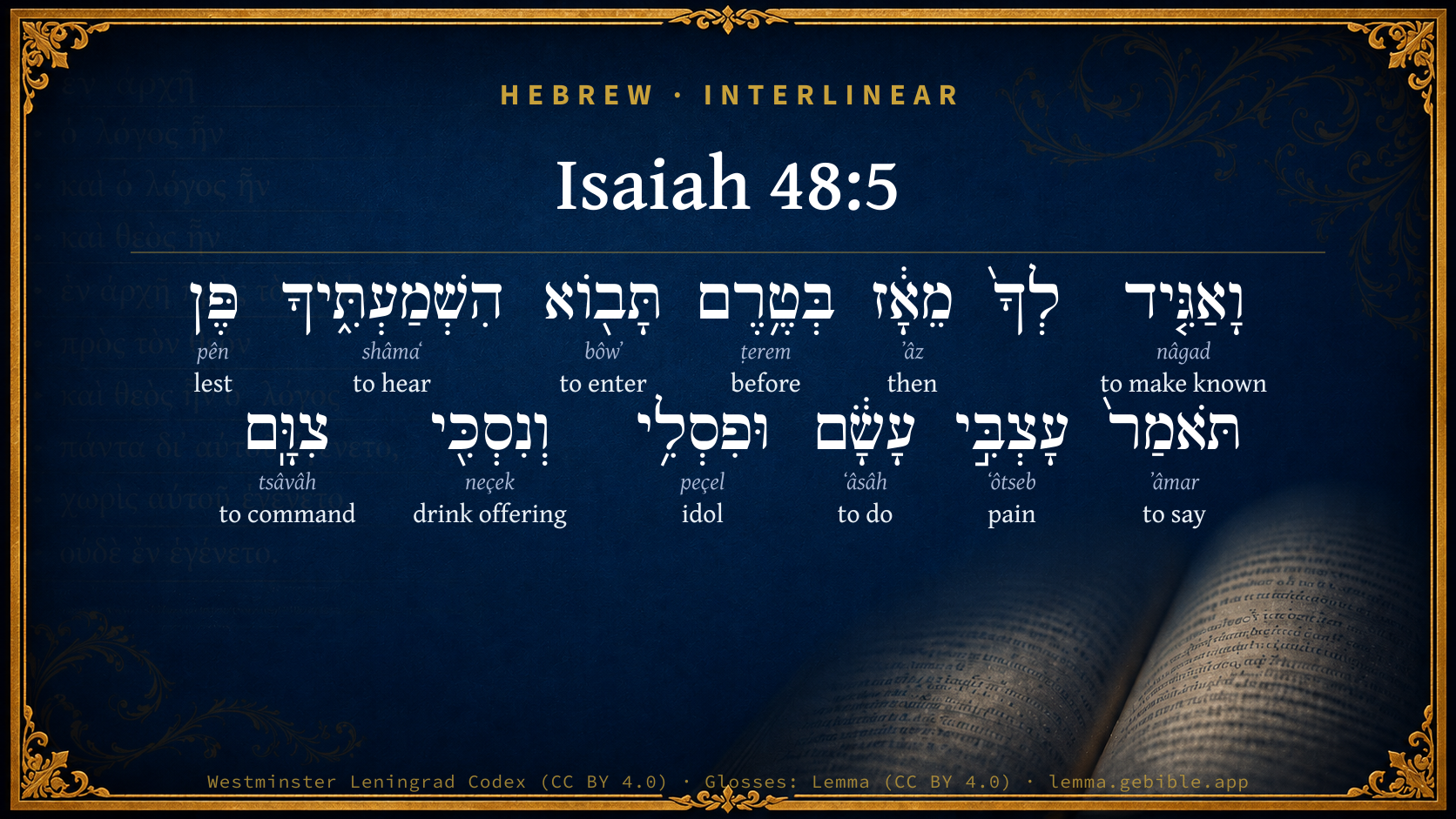
  1. וָאַגִּ֤יד nâgad H5046 “and · to make known” Conjunction + Verb, Hiphil, Sequential Imperfect, 1st Person, Common, Singular
  2. מֵאָ֔ז ʼâz H227 “from · then” Preposition + Adverb
  3. בְּטֶ֥רֶם ṭerem H2962 “in/at · before” Preposition + Adverb
  4. תָּב֖וֹא bôwʼ H935 “to enter” Verb, Qal, Imperfect, 3rd Person, Feminine, Singular
  5. הִשְׁמַעְתִּ֑יךָ shâmaʻ H8085 “to hear · you” Verb, Hiphil, Perfect, 1st Person, Common, Singular + Suffix, Personal, 2nd Person, Masculine, Singular
  6. פֶּן pên H6435 “lest” Conjunction
  7. תֹּאמַר֙ ʼâmar H559 “to say” Verb, Qal, Imperfect, 2nd Person, Masculine, Singular
  8. עָשָׂ֔ם ʻâsâh H6213 “to do · them” Verb, Qal, Perfect, 3rd Person, Masculine, Singular + Suffix, Personal, 3rd Person, Masculine, Plural
  9. וּפִסְלִ֥י peçel H6459 “and · idol · my” Conjunction + Noun, Common, Masculine, Singular, Construct + Suffix, Personal, 1st Person, Common, Singular
  10. וְנִסְכִּ֖י neçek H5262 “and · drink offering · my” Conjunction + Noun, Common, Masculine, Singular, Construct + Suffix, Personal, 1st Person, Common, Singular
  11. צִוָּֽם tsâvâh H6680 “to command · them” Verb, Piel, Perfect, 3rd Person, Masculine, Singular + Suffix, Personal, 3rd Person, Masculine, Plural

About this verse

These counts appear in no published source. They are computed here, from the morphology-tagged text and Lemma’s own curated glosses. What Lemma adds →

13
words
12
distinct lemmas
Prophets
section

Notable vocabulary

The rarest word here is עָצְבִּ֣י pain H6090 — appearing just 4 times in the whole Hebrew Bible.

Shared distinctive vocabulary

עָצְבִּ֣י pain H6090 occurs in 4 verses of the Hebrew Bible. Also found in:

Grammatical profile

  • 6 verbs
  • 3 nouns
  • 1 preposition
  • 1 conjunction
  • 2 adverbs

Verb forms

  • וָאַגִּ֤יד Hiphil · Sequential Imperfect
  • תָּב֖וֹא Qal · Imperfect
  • הִשְׁמַעְתִּ֑יךָ Hiphil · Perfect
  • תֹּאמַר֙ Qal · Imperfect
  • עָשָׂ֔ם Qal · Perfect
  • צִוָּֽם Piel · Perfect

Hebrew & Septuagint length

In English translation the verse runs 39 words from the Hebrew and 42 from the Septuagint (LXX English) — closely comparable.

A rough comparison of the two English renderings, which tokenize alike — not a word-level alignment.

Word counts can differ between the Hebrew and the Greek without any difference in meaning — e.g. the Hebrew direct-object marker אֵת has no separate Greek word, and Greek often adds the article ὁ.

Cross-references

7

Topical passages linked to Isaiah 48:5 in the Treasury of Scripture Knowledge — connected by theme and wording, ordered by reader-vote popularity; previews shown in the World English Bible.

  • Isaiah 48:3 I have declared the former things from of old; yes, they went forth out of my mouth, and I shown them: suddenly I did them, and they happened.
  • Luke 1:70 (As he spoke by the mouth of his holy prophets who have been from of old),
  • Jeremiah 44:15–18 Then all the men who knew that their wives burned incense to other gods, and all the women who stood by, a great assembly, even all the people who lived in the land of Egypt, in Pathros, answered Jeremiah, saying,
  • Acts 15:18 All his works are known to God from eternity.'
  • Isaiah 42:8–9 I am Yahweh, that is my name; and my glory will I not give to another, neither my praise to engraved images.
  • Isaiah 44:7 Who, as I, shall call, and shall declare it, and set it in order for me, since I established the ancient people? and the things that are coming, and that shall happen, let them declare.
  • Isaiah 46:10 declaring the end from the beginning, and from ancient times things that are not [yet] done; saying, My counsel shall stand, and I will do all my pleasure;

Cross-references courtesy of OpenBible.info (CC BY 4.0).

Hebrew and Greek witnesses Masoretic Hebrew ↔ Greek Septuagint

The same verse in the two great witnesses to the Old Testament, shown verse-for-verse.

These are two independent witnesses, not word-aligned to each other, and the Septuagint is shown in lemma (dictionary) form.

Hebrew Isaiah 48:5 Masoretic · Westminster Leningrad Codex

וָאַגִּ֤יד לְךָ֙ מֵאָ֔ז בְּטֶ֥רֶם תָּב֖וֹא הִשְׁמַעְתִּ֑יךָ פֶּן תֹּאמַר֙ עָצְבִּ֣י עָשָׂ֔ם וּפִסְלִ֥י וְנִסְכִּ֖י צִוָּֽם

therefore I have declared it to you from of old; before it came to pass I shown it you; lest you should say, My idol has done them, and my engraved image, and my molten image, has commanded them.

World English Bible · Public Domain

Greek LXX Isaiah 48:5 Septuagint · lemma form

καί ἀναἀγγέλλω σύ πάλαι πρίν ἔρχομαι ἐπί σύ ἀκουστός σύ ποιέω μή εἶπον ὅτι ὁ εἴδωλον ἐγώ ποιέω καί μή εἶπον ὅτι ὁ γλυπτός καί ὁ χωνευτός ἐντέλλομαι ἐγώ

And I told you of old what should be before it came upon you; I made it known to you, lest you should say, My idols have done it for me; and should say, My graven and molten images have commanded me.

LXX2012 (modern English Septuagint) · Public Domain

Hebrew: Westminster Leningrad Codex (CC BY 4.0). Greek: Septuagint (public domain); English from LXX2012 (modern English Septuagint) (Public Domain). How the Septuagint differs from the Hebrew →

Targum (Aramaic paraphrase)

1

The Targum is the ancient Jewish Aramaic paraphrase of the Hebrew Scriptures — an interpretive translation, not the Hebrew text itself. Onkelos (literal) and Pseudo-Jonathan (expansive) render the Torah, and Jonathan the Prophets. Coverage is partial: where no permissively-licensed English translation exists for a verse, only the Aramaic is shown. This is verse-level text, not a word-by-word alignment to the Hebrew.

  1. Targum Jonathan Prophets (Joshua–Malachi)
    וְחַוֵיתִי לָךְ מִבְּכַן עַד לָא יֵיתְיָן בְּסַרְתָּךְ דִלְמָא תֵימַר דְחַלְתִּי עֲבַדְתִּינוּן וְצַלְמִי וּמַתָּכִי אַתְכִינוּן:

    Therefore I have declared these things to thee from the beginning; before they came to pass I announced them unto thee: lest thou shouldest say, Mine idol hath done them, and my molten image hath prepared them.

    Targum Jonathan — Aramaic: “Mikraot Gedolot” (public domain). English: “Sefaria Community Translation” (CC0 1.0 (public-domain dedication)); “London "Chaldee Paraphrase," 1871” (public domain). Text via Sefaria.

Commentary

Notes on Isaiah 48:5 from classic Christian and Jewish commentators (each source and its license shown beneath its notes). The classic Christian expositions comment on the surrounding passage and are grouped to its opening verse, so a note may address several verses; the Jewish commentaries on the Tanakh (Rashi and others) are per-verse, so they appear only where the commentator wrote on this verse.

Lemma curates 59 commentaries, every one of them public domain or Creative Commons licensed, each selected and text-cleaned for this edition rather than reprinted as found. About our sources →

Trapp's Complete Commentary

John Trapp

Isa 48:5 I have even from the beginning declared [it] to thee; before it came to pass I shewed [it] thee: lest thou shouldest say, Mine idol hath done them, and my graven image, and my molten image, hath commanded them.

Ver. 5. I have even from the beginning, &c.] See Isa 48:3. It is probable that there were many among the Jews who, when they saw themselves to be so punished, and the heathen prospered, would be ready to think that the God of Israel either could not or would not do for his people, as those devil gods did for theirs. For their help, therefore, under such a temptation, God was pleased to foretell his people what good or evil should betide them, and accordingly to accomplish it.

John Trapp, A Commentary or Exposition upon All the Books of the Old and New Testament (1647–1656) — public domain. Text from a community e-Sword module.

Geneva Bible (1599)

Geneva Bible translators

How thou shouldest be delivered out of Babylon.

Geneva Bible (1599) marginal notes — public domain. Text via Bolls.life.

Jamieson, Fausset & Brown

Robert Jamieson, A. R. Fausset & David Brown

(See on Isa 48:1; Isa 48:3).

Jamieson, Fausset & Brown — Commentary Critical and Explanatory on the Whole Bible (1871) — public domain (CC PDM 1.0). Text via the HelloAO Bible API.

The Cambridge Bible for Schools and Colleges

gen. ed. J. J. S. Perowne

5. I have even … thee] And I announced it to thee beforehand (Isa_48:3).

lest thou shouldest say &c.] But for the predictions the appearance of Cyrus would have been attributed to the idols rather than to the God who spoke through the prophets. The prevalence of idolatry among the exiles is abundantly proved by the book of Ezekiel.

The Cambridge Bible for Schools and Colleges (gen. ed. J. J. S. Perowne; Cambridge University Press, 1878–1918) — public domain. Text from a community e-Sword module.

John Gill's Exposition

I have even from the beginning declared it to thee,.... From the beginning of their being a people, even before they were formed into a body politic; yea, from the original of them, from the time of Abraham their ancestor, as before observed:

before it came to pass I showed it thee; some hundreds of years before; first to Abraham, then to Isaac, then to Jacob, then to Joseph, and then to Moses, and by him to the children of Israel:

lest thou shouldest say, mine idol hath done them, and my graven image, and my molten image, hath commanded them; or my libation or fusion of wine, oil, or blood, by which, as by other things, they made conjectures of what was to come to pass; so Gussetius (b) interprets the last word; lest they should ascribe their deliverance out of Egypt to the idols they made and worshipped, being a people prone to idolatry; as they did when they made a golden calf, and danced about it, Exo 32:4. This the Lord knew before hand, and therefore to prevent this stupidity, or convince them of it, he foretold what should come to pass, which their idols were never able to do.

(b) Ebr. Comment. p. 517.

John Gill's Exposition of the Whole Bible (1746–1763) — public domain (CC PDM 1.0). Text via the HelloAO Bible API.

Albert Barnes' Notes on the Bible

I have even from the beginning declared it to thee - He had foretold future events, so that they had abundant demonstration thai he was the true God, and so that they could not be under a mistake in regard to the source of their deliverances from danger.

Mine idol hath done them - The idols and molten images had not foretold these events and when they came to pass, it could not, therefore, be pretended that they had been produced by idols. By predicting them, Yahweh kept up the proof that he was the true God, and demonstrated that he alone was worthy of their confidence and regard.

Albert Barnes' Notes on the Bible (1834–1885) — public domain. Text from a community e-Sword/MySword module.

Matthew Poole's English Annotations

I foretold these things, that it might be evident that they were the effects of my counsel, and not of thine idols, as I knew thou wast very inclinable to believe.

Matthew Poole's English Annotations on the Holy Bible (1683–1685) — public domain. Text from a community e-Sword/MySword module.

The Pulpit Commentary

I have even from the beginning declared it (comp. ver. 3). The declaration here made is that God rendered his prophecies more than ordinarily marvellous on account of Israel"s obstinacy, not punishing them for it, lint seeking graciously and lovingly to overcome it by adding to the weight of the evidence to which he would fain hare had it yield. Had his prophecies been less astonishing, had they in a less degree transcended ordinary human experience, Israel might conceivably have ascribed them and the accomplishment of them to the false gods. As it was, this was barely possible. Mine idol... my molten image. It has been already observed (see the comment on Isa_40:18) that there was a strong tendency to idolatry among the Jews, not only before, but during the Captivity. Ezekiel says that those among whom he lived were "polluted after the manner of their fathers, and committed whoredom after their abominations; made their sons pass through the fire, and polluted themselves with all their idols"; (Eze_20:30, Eze_20:31) nay, went so far as to declare boldly, "We will be as the heathen, as the inhabitants of the countries, to serve wood and stone". (Eze_20:32) The "prevailing tendency," as Delitzsch remarks, was "to combine the worship of Jehovah with heathenism, or else to exchange the former altogether for the latter." We cannot conclude anything concerning the mass of the community from the character of those who returned. Those who returned were the sincere worshippers of Jehovah the irreligious did not care to return. It is always to be borne in mind that it was "the great mass even of Judah," no less than of Israel, that "remained behind" (Delitzsch); and these "became absorbed into the heathen, to whom they became more and more assimilated" (ibid.). Hath commanded them; i.e. "hath caused them (the events) to take place". (comp. Psa_33:9)

The Pulpit Commentary (1880–1919), ed. H.D.M. Spence-Jones & Joseph S. Exell — public domain. Text from a community e-Sword module.

J. A. Alexander on Isaiah

Joseph Addison Alexander

“Therefore I told thee long ago.” This is often the force of the conjunction and after a conditional clause or sentence. “Because I knew thee to be such, and I told thee,” (i.e., therefore I told thee). “Before it comes I have let thee hear (it), lest thou say, My idol did them,” (i.e., did the things before referred to collectively in the singular). The Hebrew word for idol, from the double meaning of its root, suggests the two ideas of an image and a torment or vexation. “My graven image and my molten image ordered them,” (i.e., called them into being).

Joseph Addison Alexander, The Prophecies of Isaiah (1846–1847; New York: Scribner, 1870–1878) — public domain. Text from a community e-Sword module.

Ibn Ezra

Rabbi Abraham ibn Ezra

I have even from the beginning, etc. This is the explanation; I foretold thee coming events, in order that thou shouldst not say when they happened, that thy idols worshipped by thee in thy land had prepared them, that by their decree the events took place,

Hath commanded them. It is the same expression as used of the Almighty (45:12)

Ibn Ezra on the Tanakh — English translations: “Sefaria Community Translation” (CC0 1.0 (public-domain dedication)); “Yalkut, Sifsei Chachomim Chumash, Metsudah Publications, 2009” (CC BY 4.0); and “Commentary of Ibn Ezra on Isaiah - trans. by M. Friedlander, 1873” (public domain). Text via Sefaria.

Lesson kit

Teaching starters — assembled from the data on this page, not authored interpretation. Every prompt links to the verse data it draws on. Edit before teaching.

Isaiah, in the Prophets, opens this verse with 13 words (12 distinct Hebrew lemmas). Its most distinctive word is ʻôtseb (“pain”). A historical commentator’s framing appears above. Read the whole chapter for the surrounding context.

Discussion questions

  1. How does “pain” (ʻôtseb) shape what this verse is saying?
  2. 1 Chronicles 4:9 shares the word «pain» with this verse. How do the two illuminate each other?
  3. The translations on this page render this verse differently — a whole-verse word diff, not a word-by-word alignment. What might account for the different wordings?
  4. The verb «וָאַגִּ֤יד» is Hiphil Sequential Imperfect. How does its form color the action?
  5. Reading how Trapp's Complete Commentary and Geneva Bible (1599) read this verse, where do the two commentators agree and where do they part?

Things to notice

Reading settings

Reading text

Shown beneath each verse's original-language words.

Old Testament
Old Testament edition

Read the OT as the Masoretic Hebrew (MT) or the Greek Septuagint (LXX).

English shown for the Greek Septuagint (in the Hebrew ↔ Greek comparison).

Comparing translations? Open the Compare panel on any verse page to stack up to four side by side.