
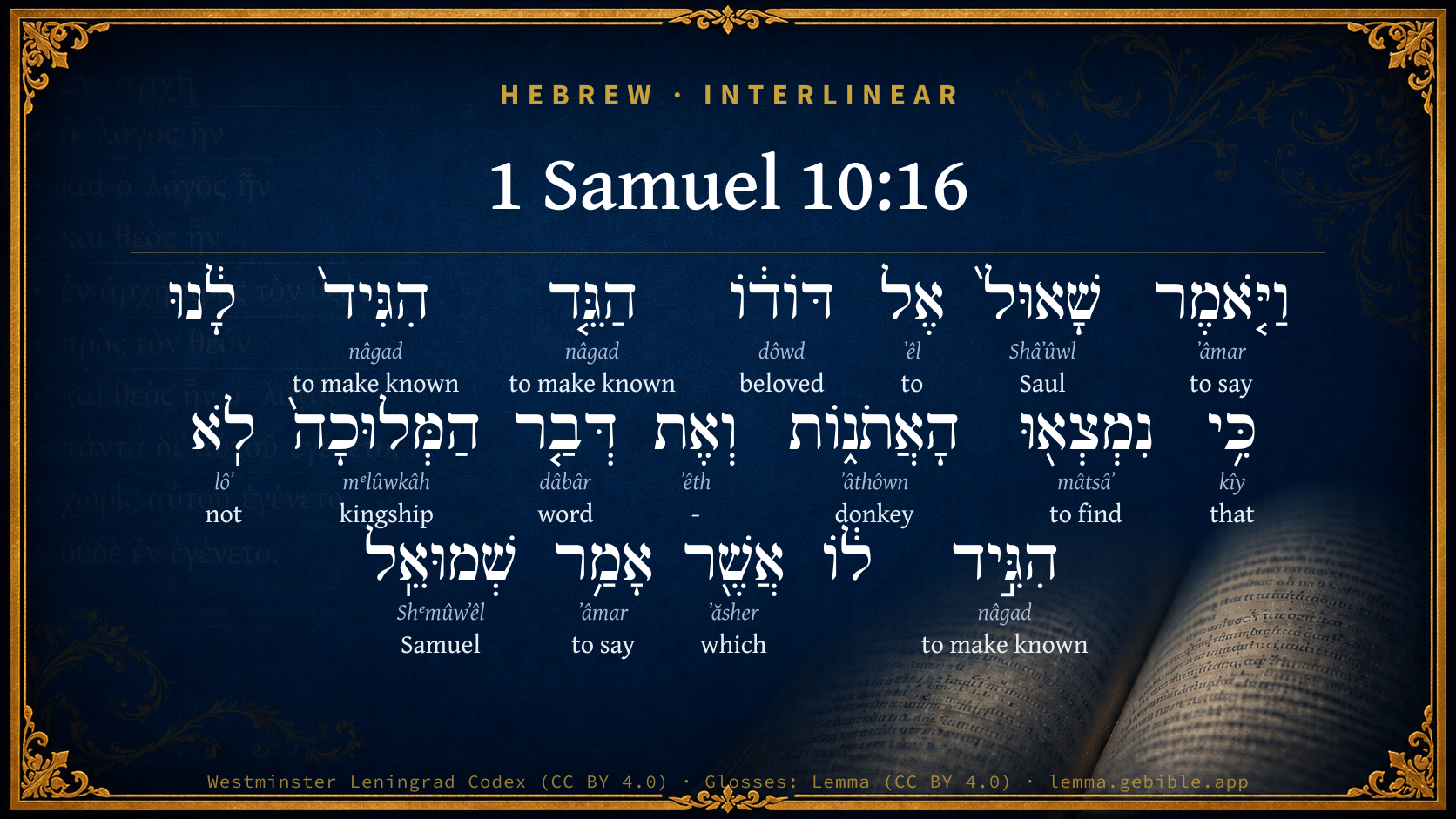
1 Samuel 10:16

Hebrew (Westminster Leningrad Codex) 1 Samuel 10:16 appears in the Hebrew Old Testament. The text above is from the Westminster Leningrad Codex. Each word links to its Strong’s number, a concise gloss, and parsing drawn from the Open Scriptures Hebrew Bible morphology. Click any word for its full Brown-Driver-Briggs (BDB) entry.
Download image
Cite this verse

1 Samuel 10:16 (World English Bible). Public Domain. Lemma interlinear Bible study tool, https://lemma.gebible.app/v/1-samuel/10/16.

Show BibTeX & RIS
BibTeX
RIS
English Translation
Saul said to his uncle, He told us plainly that the donkeys were found. But concerning the matter of the kingdom, of which Samuel spoke, he didn't tell him.
World English Bible · Public Domain
Highlights
  • 1 first appearance in the Hebrew Bible
Full analysis ↓
Download a study sheet

One document with this verse’s original text, its word-by-word gloss line, the meaning frame, cross-references with their text, attributed commentary, and full source and license credits — printable, and it pastes into notes with its structure intact.

This verse Autodidact and up

Study sheet (.html) Plain text (.txt)

A passage Seminary Student

Up to 50 verses in one chapter. A passage sheet keeps up to 6 commentary sources and 12 cross-references per verse, in the order this page ranks them, and says so on the sheet whenever that leaves anything out. Ask for a single verse and you get the Autodidact verse sheet above.

Everything on this page stays free to read, with no account — the sheet is a download of what is already on screen, not access to it.

Want to remove ads? Support Godless Engineer
Compare translations 3

The same verse in 3 English versions, stacked beneath the original-language interlinear above. Click any original word for its lexicon entry.

Each is an independent rendering of the whole verse — the interlinear is not word-aligned to these translations.

Highlighted words mark where these versions differ — a whole-verse word diff, not a word-by-word alignment.

  • World English Bible Public Domain
    Saul said to his uncle, He told us plainly that the donkeys were found. But concerning the matter of the kingdom, of which Samuel spoke, he didn't tell him.
  • King James Version Public Domain
    And Saul said unto his uncle, He told us plainly that the asses were found. But of the matter of the kingdom, whereof Samuel spake, he told him not.
  • unfoldingWord Literal Text CC BY-SA 4.0
    And Saul said to his uncle, “Declaring, he declared to us that the female donkeys had been found.” But he did not declare to him the word of the kingship that Samuel had said.

unfoldingWord Literal Text — © unfoldingWord, licensed CC BY-SA 4.0. Word-aligned USFM3 via Door43 (git.door43.org/unfoldingWord/en_ult).

Versions to compare (up to 4)

3 of 4 selected

Show all 18 translations

Every available English version of this verse, each an independent rendering of the whole verse.

  • World English Bible Public Domain
    Saul said to his uncle, He told us plainly that the donkeys were found. But concerning the matter of the kingdom, of which Samuel spoke, he didn't tell him.
  • Berean Standard Bible Public Domain
    And Saul replied, “He assured us that the donkeys had been found.” But Saul did not tell his uncle what Samuel had said about the kingship.
  • Majority Standard Bible Public Domain
    And Saul replied, “He assured us that the donkeys had been found.” But Saul did not tell his uncle what Samuel had said about the kingship.
  • King James Version Public Domain
    And Saul said unto his uncle, He told us plainly that the asses were found. But of the matter of the kingdom, whereof Samuel spake, he told him not.
  • American Standard Version (1901) Public Domain
    And Saul said unto his uncle, He told us plainly that the asses were found. But concerning the matter of the kingdom, whereof Samuel spake, he told him not.
  • Revised Version (1885) Public Domain
    And Saul said unto his uncle, He told us plainly that the asses were found. But concerning the matter of the kingdom, whereof Samuel spake, he told him not.
  • Geneva Bible (1599) Public Domain
    Then Saul saide to his vncle, He tolde vs plainely that the asses were founde: but concerning the kingdome whereof Samuel spake, tolde he him not.
  • Douay-Rheims (1899) Public Domain
    And Saul said to his uncle: He told us that the asses were found. But of the matter of the kingdom of which Samuel had spoken to him, he told him not.
  • Young's Literal Translation Public Domain
    And Saul saith unto his uncle, `He certainly declared to us that the asses were found;' and of the matter of the kingdom he hath not declared to him that which Samuel said.
  • Literal Standard Version CC BY-SA 4.0
    And Saul says to his uncle, “He certainly declared to us that the donkeys were found”; and of the matter of the kingdom he has not declared to him that which Samuel said.
  • Unlocked Literal Bible CC BY-SA 4.0
    Saul replied to his uncle, “He told us plainly that the donkeys had been found.” But he did not tell him about the matter of the kingdom, of which Samuel had spoken.
  • unfoldingWord Literal Text CC BY-SA 4.0
    And Saul said to his uncle, “Declaring, he declared to us that the female donkeys had been found.” But he did not declare to him the word of the kingship that Samuel had said.
  • Darby Bible Public Domain
    And Saul said to his uncle, He told us for certain that the asses were found. But of the matter of the kingdom, of which Samuel had spoken, he told him not.
  • World Messianic Bible Public Domain
    Saul said to his uncle, “He told us plainly that the donkeys were found.” But concerning the matter of the kingdom, of which Samuel spoke, he didn’t tell him.
  • Webster's Bible Public Domain
    And Saul said to his uncle, He told us plainly that the asses were found. But of the matter of the kingdom, of which Samuel spoke, he told him not.
  • Free Bible Version CC BY-SA 4.0
    “He promised us the donkeys had been found,” Saul replied. But Saul didn't tell his uncle what Samuel had said about him becoming king.
  • Bible in Basic English Public Domain
    And Saul, answering him, said, He gave us word that the asses had come back. But he said nothing to him of Samuel's words about the kingdom.
  • JPS Tanakh (1917) Public Domain
    And Saul said unto his uncle: 'He told us plainly that the asses were found.' But concerning the matter of the kingdom, whereof Samuel spoke, he told him not.

Literal Standard Version (2020), Covenant Press — licensed CC BY-SA 4.0. Text via the HelloAO Bible API (eBible.org). Unlocked Literal Bible (unfoldingWord) — licensed CC BY-SA 4.0. Text via the HelloAO Bible API (eBible.org). unfoldingWord Literal Text — © unfoldingWord, licensed CC BY-SA 4.0. Word-aligned USFM3 via Door43 (git.door43.org/unfoldingWord/en_ult). Free Bible Version, Dr. Jonathan Gallagher — licensed CC BY-SA 4.0. Text via the HelloAO Bible API (eBible.org).

Word by word

More ways to search: Search by grammar → Find every occurrence → Compare this word →

Practice this passage: Drill this verse → Learn its vocabulary →

הַמְּלוּכָה֙
mᵉlûwkâh
H4410
“the · kingship”
Particle, Definite Article + Noun, Common, Feminine, Singular, Absolute
Part of Speech
Particle + Noun
Type
Common
Gender
Feminine
Number
Singular
State
Absolute
Full BDB Definition

Origin: pass. participle of H4427

TWOT: 1199d

kingship, royalty, kingly office
  1. וַיֹּ֤אמֶר ʼâmar H559 “and · to say” Conjunction + Verb, Qal, Sequential Imperfect, 3rd Person, Masculine, Singular
  2. שָׁאוּל֙ Shâʼûwl H7586 “Saul” Noun, Proper
  3. אֶל ʼêl H413 “to” Preposition
  4. דּוֹד֔וֹ dôwd H1730 “beloved · his” Noun, Common, Masculine, Singular, Construct + Suffix, Personal, 3rd Person, Masculine, Singular
  5. הַגֵּ֤ד nâgad H5046 “to make known” Verb, Hiphil, Infinitive Absolute
  6. הִגִּיד֙ nâgad H5046 “to make known” Verb, Hiphil, Perfect, 3rd Person, Masculine, Singular
  7. כִּ֥י kîy H3588 “that” Conjunction
  8. נִמְצְא֖וּ mâtsâʼ H4672 “to find” Verb, Niphal, Perfect, 3rd Person, Common, Plural
  9. הָאֲתֹנ֑וֹת ʼâthôwn H860 “the · donkeys” Particle, Definite Article + Noun, Common, Feminine, Plural, Absolute
  10. וְאֶת ʼêth H853 “and · -” Conjunction + Particle, Direct Object
  11. דְּבַ֤ר dâbâr H1697 “word of” Noun, Common, Masculine, Singular, Construct
  12. לֹֽא lôʼ H3808 “not” Particle, Negative
  13. הִגִּ֣יד nâgad H5046 “to make known” Verb, Hiphil, Perfect, 3rd Person, Masculine, Singular
  14. אֲשֶׁ֖ר ʼăsher H834 “which” Particle, Relative
  15. אָמַ֥ר ʼâmar H559 “to say” Verb, Qal, Perfect, 3rd Person, Masculine, Singular
  16. שְׁמוּאֵֽל Shᵉmûwʼêl H8050 “Samuel” Noun, Proper

About this verse

These counts appear in no published source. They are computed here, from the morphology-tagged text and Lemma’s own curated glosses. What Lemma adds →

19
words
14
distinct lemmas
Historical
section

Notable vocabulary

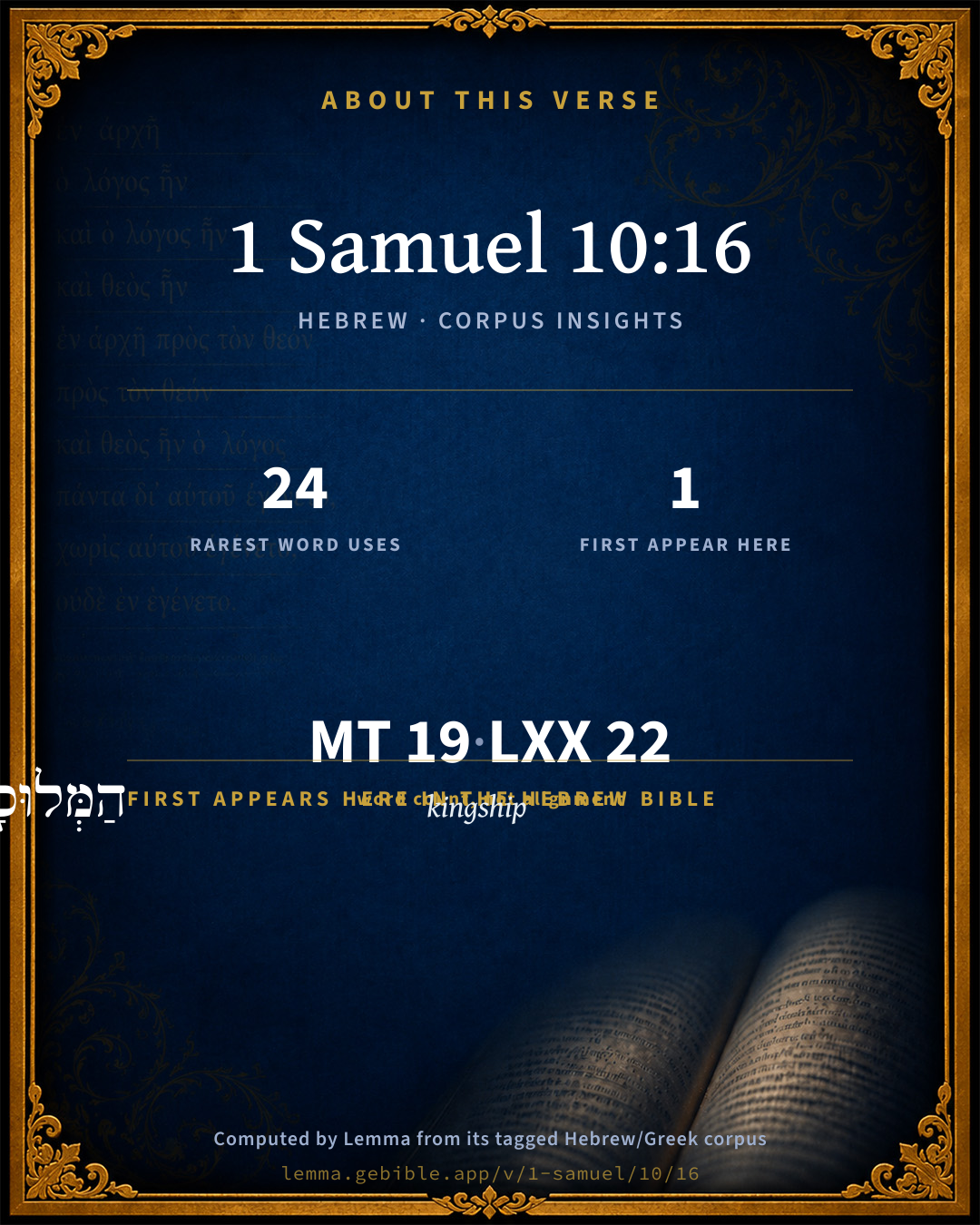
The rarest word here is הַמְּלוּכָה֙ kingship H4410 — appearing just 24 times in the whole Hebrew Bible.

First appearance in Scripture

This word makes its first canonical appearance in the Hebrew Bible here:

  • הַמְּלוּכָה֙ kingship H4410

Shared distinctive vocabulary

הַמְּלוּכָה֙ kingship H4410 occurs in 23 verses of the Hebrew Bible. Also found in:

Grammatical profile

  • 6 verbs
  • 6 nouns
  • 3 prepositions
  • 1 conjunction
  • 3 particles

Verb forms

  • וַיֹּ֤אמֶר Qal · Sequential Imperfect
  • הַגֵּ֤ד Hiphil · Infinitive Absolute
  • הִגִּיד֙ Hiphil · Perfect
  • נִמְצְא֖וּ Niphal · Perfect
  • הִגִּ֣יד Hiphil · Perfect
  • אָמַ֥ר Qal · Perfect

Repetition

Words recur within this verse — often emphatic in Hebrew:

  • הַגֵּ֤ד to make known H5046 ×3
  • וַיֹּ֤אמֶר to say H559 ×2

Hebrew & Septuagint length

In English translation the verse runs 29 words from the Hebrew and 25 from the Septuagint (LXX English) — closely comparable.

A rough comparison of the two English renderings, which tokenize alike — not a word-level alignment.

Word counts can differ between the Hebrew and the Greek without any difference in meaning — e.g. the Hebrew direct-object marker אֵת has no separate Greek word, and Greek often adds the article ὁ.

In the original languages it is 19 Hebrew tokens and 22 Greek tokens — but the two are counted differently (Hebrew bundles its prefixes and suffixes into one token; the Greek is in lemma form), so that isn’t a like-for-like length.

Cross-references

5

Topical passages linked to 1 Samuel 10:16 in the Treasury of Scripture Knowledge — connected by theme and wording, ordered by reader-vote popularity; previews shown in the World English Bible.

  • Proverbs 29:11 A fool vents all of his anger, But a wise man brings himself under control.
  • Judges 14:6 The Spirit of Yahweh came mightily on him, and he tore him as he would have torn a kid; and he had nothing in his hand: but he didn't tell his father or his mother what he had done.
  • 1 Samuel 9:20 As for your donkeys who were lost three days ago, don't set your mind on them; for they are found. For whom is all that is desirable in Israel? Is it not for you, and for all your father's house?
  • 1 Samuel 9:27 As they were going down at the end of the city, Samuel said to Saul, Bid the servant pass on before us (and he passed on), but stand you still first, that I may cause you to hear the word of God.
  • Exodus 4:18 Moses went and returned to Jethro his father-in-law, and said to him, "Please let me go and return to my brothers who are in Egypt, and see whether they are still alive." Jethro said to Moses, "Go in peace."

Cross-references courtesy of OpenBible.info (CC BY 4.0).

Hebrew and Greek witnesses Masoretic Hebrew ↔ Greek Septuagint

The same verse in the two great witnesses to the Old Testament, shown verse-for-verse.

These are two independent witnesses, not word-aligned to each other, and the Septuagint is shown in lemma (dictionary) form.

Hebrew 1 Samuel 10:16 Masoretic · Westminster Leningrad Codex

וַיֹּ֤אמֶר שָׁאוּל֙ אֶל דּוֹד֔וֹ הַגֵּ֤ד הִגִּיד֙ לָ֔נוּ כִּ֥י נִמְצְא֖וּ הָאֲתֹנ֑וֹת וְאֶת דְּבַ֤ר הַמְּלוּכָה֙ לֹֽא הִגִּ֣יד ל֔וֹ אֲשֶׁ֖ר אָמַ֥ר שְׁמוּאֵֽל

Saul said to his uncle, He told us plainly that the donkeys were found. But concerning the matter of the kingdom, of which Samuel spoke, he didn't tell him.

World English Bible · Public Domain

Greek LXX 1 Samuel 10:16 Septuagint · lemma form

καί εἶπον σαούλ πρός ὁ οἰκεῖος αὐτός ἀποἀγγέλλω ἀποἀγγέλλω ἐγώ ὅτι εὑρίσκω ὁ ὄνος ὁ δέ ῥῆμα ὁ βασιλεία οὐ ἀποἀγγέλλω αὐτός

And Saul said to his kinsman, he verily told me that the asses were found. But the matter of the kingdom he told him not.

LXX2012 (modern English Septuagint) · Public Domain

Hebrew: Westminster Leningrad Codex (CC BY 4.0). Greek: Septuagint (public domain); English from LXX2012 (modern English Septuagint) (Public Domain). How the Septuagint differs from the Hebrew →

Targum (Aramaic paraphrase)

1

The Targum is the ancient Jewish Aramaic paraphrase of the Hebrew Scriptures — an interpretive translation, not the Hebrew text itself. Onkelos (literal) and Pseudo-Jonathan (expansive) render the Torah, and Jonathan the Prophets. Coverage is partial: where no permissively-licensed English translation exists for a verse, only the Aramaic is shown. This is verse-level text, not a word-by-word alignment to the Hebrew.

  1. Targum Jonathan Prophets (Joshua–Malachi)
    וַאֲמַר שָׁאוּל לְאַח אֲבוּהִי חַוָאָה חַוֵי לָנָא אֲרֵי אִשְׁתַּכָּחָא אֲתָנַיָא וְעַל עֵיסַק מַלְכוּתָא לָא חַוֵי לֵיהּ דִי אֲמַר שְׁמוּאֵל:

    (no public-domain English translation for this verse)

    Targum Jonathan — Aramaic: “Mikraot Gedolot” (public domain). English: “Sefaria Community Translation” (CC0 1.0 (public-domain dedication)); “London "Chaldee Paraphrase," 1871” (public domain). Text via Sefaria.

Commentary

Notes on 1 Samuel 10:16 from classic Christian and Jewish commentators (each source and its license shown beneath its notes). The classic Christian expositions comment on the surrounding passage and are grouped to its opening verse, so a note may address several verses; the Jewish commentaries on the Tanakh (Rashi and others) are per-verse, so they appear only where the commentator wrote on this verse.

Lemma curates 59 commentaries, every one of them public domain or Creative Commons licensed, each selected and text-cleaned for this edition rather than reprinted as found. About our sources →

Trapp's Complete Commentary

John Trapp

1Sa 10:16 And Saul said unto his uncle, He told us plainly that the asses were found. But of the matter of the kingdom, whereof Samuel spake, he told him not.

Ver. 16. But of the matter of the kingdom.] This he prudently concealed, as being at first of a modest and humble spirit. Josephus giveth two very good reasons that might move Saul to be silent in this business: Ne res credita invidiam, non credita vanitatis opinionem ei contraheret, i.e., Lest if the matter were believed, he should be envied; as if disbelieved, he should be slighted and jeered.

John Trapp, A Commentary or Exposition upon All the Books of the Old and New Testament (1647–1656) — public domain. Text from a community e-Sword module.

The Biblical Illustrator

Joseph S. Exell

1Sa_10:16

He told him not.

An inquisitive man and how to treat him

Saul has now reached his home, and is determined to conceal the history of the past few days from the knowledge of others. If the Prophets communications were to become generally known they would render Sauls position most uncomfortable. Many would discredit them; some would envy his promotion; while others might devise measures to take his life, or prevent the realisation of his hope.

I. This mans inquisitiveness. Human biography is so interesting that, touched by its spell, men instinctively stand to inquire.

1. The Interrogator. Sauls uncle. People frequently presume upon their relationship to ask any questions they think proper. And their kinship is made a plea for unwelcome intrusions, or impudent interferences, totally incompatible with manly etiquette.

2. The inquiries made. Some relatives are always inquiring into the arrangements of other families. We can hardly move out of our doors but someone must ask, either us or our neighbours, whither we went.

3. The sources of his expected information. And Sauls uncle said unto him and to his servant (1Sa_10:14). The uncle no doubt thought that if he could not obtain the required information from Saul, that he would have little difficulty in getting it from the servant. Servants are not always the most trustworthy persons, and especially with news at all exciting, or of family interest.

II. The manner in which it was treated. Some men have not sufficient power of character to contend with inquisitive people; and the artful inquirer, without raising the slightest suspicion, gains all the information required. It requires some little art to deal successfully with such folk; and of this Saul was happily possessed.

1. Sauls reply was truthful. He told us plainly that the asses were found (1Sa_10:16). We can never be justified in telling lies, not even to silence inquisitive men. Saul recognised this fact; and while speaking the truth, withheld part of the tidings.

2. Sauls reply was discreet. But of the matter of the kingdom whereof Samuel spake, he told him not.

3. Sauls reply was modest. If such promotion had come to most young men, they would have hurried to their friends, and in a fit of excitement have communicated the whole story. But not so with Saul, he kept it in his own heart until God should read it to an assembled nation.

4. Sauls reply was short. He did not betray himself by a multitude of words; he did not by some unthinking sentence excite the suspicion of his uncle; but briefly told him about the asses. Here Saul displayed his common sense.

Lessons:--

1. Never tell people all they wish to know.

2. Do not abuse the sanctity of family relationships by petty intrusions.

3. That discretion is the only safety of a promoted life. (Joseph S. Exell, M. A.)

Reticence, not indifference

Saul preserves a remarkable reticence on all that has transpired. He first meets his uncle, who enquires how and whither he has fared.

1. Saul gives him half an answer. He tells him about the asses, but says nothing of the anointing, or of the great spiritual change that had passed upon hiself.

1. It is a lesson, first of all, in the inaccessibility of human soul to soul. How little way Sauls uncle saw into the depths of his real consciousness. He was talking about asses, but he was thinking about sovereignty. How much we are hidden from one another! Each mans heart is a walled enclosure. I am an unscaleable fortress, an insoluble enigma to you until I choose to disclose myself, and you to me. This mutual inaccessibility is sometimes almost maddening. The desire to cross the threshold of anothers consciousness and see life from his standpoint is, at times, a passion. There are occasions when we are tormented by the wish to know how another feels, or how we look in that others eyes. But we might as well wish to exchange souls with an inhabitant of Mars or Jupiter. Nothing in the universe is more impossible than such a transition, such a transfer. How solemn a thing is individuality! The heart knoweth its own bitterness, and a stranger intermeddleth not with its joys. Responsibility is measured by idiosyncrasy. The kingship was Sauls own secret. The weight of his destiny presses upon his own heart alone. In the meantime he cannot even tell it to another, though a kinsman. Yes, it is a solemn thing that, do what we will, we cannot step in between another and his destiny. Some would give worlds even to bear the hell that is anothers for that other; but there is the inexorable law, the impassable gulf between one consciousness and another. I do not know anything in life harder to bear than that impatience of helplessness which we feel in the presence of anothers sorrow or pain. We can look on at Gethsemane, but we cannot lighten the struggle. Every man shall bear his own burden. And we feel only less impatience at this same limitation with reference to the happiness of others. We cannot cross the boundary of their Paradise any more than of their Golgotha. If, then, none can tamper with my individuality, and it is my grand instrument of service in the world, let me see to it that that individuality be of the noblest, a power to lift men up, an attraction to draw them to the highest.

2. But Sauls silence on this occasion affords also a lesson in prudential reserve. It was impolitic that it should be too freely canvassed. There are times when it is the mark of a Divine wisdom to hold our tongues, even upon matters of supreme moment. Silence is sometimes the duty as well as the policy of a leader. Even truth has been injured rather than furthered by its premature and inopportune disclosure. It is not every mans duty to tell to the first man he meets all he knows and all he thinks. It is not always wise for the political leader to show his hand. The religious teacher has to judge when it is expedient to lift the veil from some larger outlook, when the fitting moment has come for replacing the old by the new. Christ would not reveal to the unfit. You cannot enlighten the world by flashes. The light must dawn, and shine more and more unto the perfect day. The time must be chosen for letting in the first ray. The development of truth may be hindered by precipitancy. There is a time to speak and a time to be silent. Saul was wise to say nothing in the meantime about the kingdom, and thus gave one evidence at least of his fitness to become a king. The man who is to rule must be capable of reticence and reserve; able to manage his tongue. Self-mastery is the grand secret of lordship over others, and in nothing is that self-mastery more shown than in the conduct of the lips.

3. Again, this incident suggests a caution against mistaking reticence for indifference. The fact that a man is silent upon a subject may mean that he is indifferent to it, but it does not necessarily mean it. Indeed, the reverse is more true. Men are often reserved in proportion to the depth and intensity of their emotions. We have a fine illustration of this in Shakespeares King Lear, in the reticence of Cordelias love for her father--a love which, because it was so deep, could not find tongue--while the unnatural daughters of the poor old king were voluble in their protestations of devotion. Unhappy that I am, I cannot heave my heart into my throat. And yet how divine was her love! It does not follow that because a man does not speak, therefore he does not feel. Saul said nothing of the matter of the kingdom, but what else was absorbing his thoughts, think you, all the while? We do not prate of our deepest love to every passer-by. The things that are most sacred are often most secret with us. We do not speak of them, because words are so poor and weak. The action of the soul, says Emerson, is oftener in that which is felt and left unsaid than in that which is said in any conversation. . . . The soul carries its choicest treasures with a kind of fastidious delicacy. The history which lies inside of the soul is a history which will never be read until it is read from Gods book. The very soul of the soul has never been spoken or printed. It is inarticulate. There is a profound reluctance in many persons, which should excite a respect as profound, to talk about their religious experience. It is wickedly unjust to interpret this reluctance as showing indifference to religion. No person has a right to ask me to unbosom myself to any miscellaneous crowd. If he presumes to do so, I show my sense of his indelicacy by retreating within the innermost keep of the castle of my own personality, and letting down drawbridge and portcullis in the face of my persecutor. Zeal for God is a noble principle, but the world is not going to be saved by bad manners. Abraham Lincoln did not generally pass for a religious man. His religion was too far in, it has been said, too deep down, for many words. Talk may be religious without being about religion. One of the most religious things you can do is to talk sensibly on all subjects. The Apostle Paul was neither by nature nor by calling reticent on religious subjects, and yet even he kept his deepest spiritual experiences to himself. There are not always state reasons for silence on matters of the kingdom. And for every idle word that men shall speak they shall give account thereof in the day of judgment.

4. Again, let this incident put us on our guard, not only against our misreading of our neighbours spiritual condition, but in our mutual judgments in general. To anyone listening to Sauls conversation, for the moment, how frivolous he would have seemed. But he was not that! The kingdom was uppermost in Pauls mind, though his speech was of other things. We wrong men in reading them from the surface only. There were those who read the divinest of all human natures superficially, and how egregiously were they mistaken! Here was a heart, the heart of the Son of Man, the depth of whose love, the passion of whose pity, was infinite. Here was a life, the very fundamental notes of which were enthusiasm and sacrifice. And yet His ignorant critics, unable to distinguish between the accidental and the essential, said, Behold a gluttonous man and a wine bibber! It was for the ears of the inner circle that He reserved the story of His agony and His passion, His certainty of martyrdom, His forebodings of the Cross, and His fixed resolution, notwithstanding, to go on unfalteringly to the tragic end. But the world which did not hear these things, and for whose ears they were not fit, misinterpreted His superficial gaiety of manner, and winsomeness of disposition, as indicating a want of moral earnestness. Who of us may not be misjudged after that? (J. Halsey.)

The piety and the modesty of Saul in his introduction to royal dignity, etc

.

1. His piety appeareth (1Sa_10:13) no sooner were his prophetic raptures over, but he resorts to the synagogue or place of Divine worship, with his fellow prophets, both to praise God for His Divine call to such an high advancement, and to pray unto Him for His protection and direction therein, etc.

2. His modesty in his taciturnity and reservedness towards his uncle, who being there present, and observing this unexpected alteration in his nephew, made him the more inquisitive about his journey, suspecting something extraordinary had happened to him that had caused this strange change. Saul answers his uncle that Samuel told him the asses were found, but not a word of his finding a kingdom (1Sa_10:14-16). Josephus renders two very good reasons of Sauls silence in this business.

(1) Lest if his uncle had believed it, Saul had then been matter of envy to his superior, seeing the nephew preferred before him.

(2) If he had not believed it, then would he have jeered Saul for a proud, ambitious, and imperious fool I add.

(3) Saul might be moved to silence in obedience to Samuel who had obliged him to secrecy (1Sa_9:25-27).

(4) This was Sauls humble modesty, as was that afterward of hiding himself behind the stuff, when chosen king (1Sa_10:22).

(5) And it was certainly Sauls prudence to be silent in such a case and on good ground, not to divulge it before the due time. (C. Ness.)

Keeping a secret

When Lord Wellington was commander of an army in India, a certain rich man offered him a hundred thousand pounds for some secret information on a very important question. Wellington looked thoughtful for a few minutes, as if he was weighing the temptation. But, he was not. He was only considering the best way to answer his tempter. At length he said: It appears that you can keep a secret, sir? Certainly, said the man, feeling sure that he had gained his point. So can I! rejoined Wellington. Good morning, sir! And the man went away with a crestfallen air. Thus Wellington was proof against, corruption. He rejected a bribe of £100,000.

The Biblical Illustrator, edited by Joseph S. Exell (c. 1880s–1900s) — public domain. Text from a community e-Sword module.

Joseph Benson's Commentary

1Sa 10:16. He told him not — In obedience to Samuel, who enjoined him to keep it secret, and from an humble modesty.

Joseph Benson's Commentary on the Old and New Testaments (1811–1818) — public domain. Text from a community e-Sword module.

Tyndale Open Study Notes

Tyndale Open Resources

10:16 Perhaps Saul didn’t tell his uncle because he had lingering uncertainty about what had transpired.

Tyndale Open Study Notes — © Tyndale Open Resources, licensed CC BY-SA 4.0. Text via the HelloAO Bible API.

Ellicott's Commentary for English Readers

(16) He told him not.—It has been suggested ingeniously that this reply was prompted by the characteristic Israelite caution—the fear of betraying prematurely an important secret. It is, however, far better to assume that Samuel had given the young Saul to understand that the revelation respecting his future, and the great state change involved in it, was, in the first instance, for him alone; no other man was as yet to share that great secret with him. In His own good time God would signify His sovereign will and pleasure to Israel; till then, Saul was strictly to keep his own counsel in this important matter. To have imparted the secret to any one would have at once opened the door to secret intrigues and party plotting; one like Abner, especially, would not have been slow in devising schemes to compass so great an end as the placing the crown of Israel on the head of one of his own family.

The modesty and humility, as well as the wisdom, of Saul in these early days of his greatness is remarkable. The “changed heart” was indeed an acknowledged fact with him. Wordsworth quotes here how, “in like manner, Samson, in the early days of his humility, told not his parents of the lion. (See Jdg_14:6.) So Saul of Tarsus spake not of his visions and revelations of the Lord till he was constrained to do so by his enemies.” (See 2Co_12:1.)

A Bible Commentary for English Readers, edited by Charles John Ellicott (1878–1897) — public domain. Text from a community e-Sword module.

The Cambridge Bible for Schools and Colleges

gen. ed. J. J. S. Perowne

16. But of the matter &c.] Modesty, humility, caution, have been variously assigned as his motive for silence. But Samuel’s manner had clearly implied that his election was to be a secret for the present, even if he had given no direct injunction to that effect.

The Cambridge Bible for Schools and Colleges (gen. ed. J. J. S. Perowne; Cambridge University Press, 1878–1918) — public domain. Text from a community e-Sword module.

John Gill's Exposition

And Saul said unto his uncle,.... In answer to his question:

he told us plainly the asses were found; or "in telling told us" (h); not only plainly in so many words, but he affirmed it with the greatest certainty that the asses were found, and we need not give ourselves further trouble about them:

but of the matter of the kingdom, whereof Samuel spake, he told him not; he said not one word about that, which is commonly ascribed to his modesty; or he might conceal it, as Josephus (i) observes, because he thought it would not be believed by his relations, or might create in them envy to him; and besides, he knew it was the pleasure of Samuel that it should be kept a secret until the election by lot was over, lest it should be thought to proceed from Samuel himself; and Saul chose it should remain so, that it might not be thought to be of his own seeking; and by keeping it from his relations and friends, it would be a clear case that he did not make interest for it.

(h) "indicando indicavit", Pagninus, Montanus, &c. (i) Ut supra. (Antiqu. l. 6. c. 4. scet. 3.)

John Gill's Exposition of the Whole Bible (1746–1763) — public domain (CC PDM 1.0). Text via the HelloAO Bible API.

Matthew Poole's English Annotations

Partly, in obedience to Samuel, who obliged him to secrecy; partly, from a humble modesty which appeared in him, 1Sa 10:22; and partly, in prudence, lest by an unseasonable publishing of it he should raise envy in some, disbelief and contempt in others, &c.

Matthew Poole's English Annotations on the Holy Bible (1683–1685) — public domain. Text from a community e-Sword/MySword module.

Whedon's Commentary on the Bible

Daniel D. Whedon

16. The matter of the kingdom — Or, the word of the kingdom; that is, the statements and counsels of Samuel respecting it.

He told him not — With becoming humility and modesty he waited the time when the developments of Providence should make it known, for as yet he was little in his own eyes. 1Sa_15:17.

Daniel D. Whedon (gen. ed.), Commentary on the Old and New Testaments (1874–1909) — public domain. Text from a community e-Sword module.

John Wesley's Explanatory Notes

Told not - In obedience to Samuel, who obliged him to secrecy: and from an humble modesty.

John Wesley, Explanatory Notes Upon the Whole Bible (1754–1765) — public domain. Text via the GEBible commentary corpus.

Rashi

Rabbi Shlomo Yitzchaki (Rashi)

But about the matter of the kingship he did not tell him. He possessed a discretionary nature.

Rashi on the Tanakh — English translations: “The Judaica Press complete Tanach with Rashi, translated by A. J. Rosenberg” (CC BY 4.0); “Pentateuch with Rashi's commentary by M. Rosenbaum and A.M. Silbermann, 1929-1934” (public domain); “The Metsudah Tanach series, Lakewood, N.J” (CC BY 4.0); and “The Book of Joshua, Metsudah Publications, 1997” (CC BY 4.0). Text via Sefaria.

Lesson kit

Teaching starters — assembled from the data on this page, not authored interpretation. Every prompt links to the verse data it draws on. Edit before teaching.

1 Samuel, in the Historical, opens this verse with 19 words (14 distinct Hebrew lemmas). Its most distinctive word is mᵉlûwkâh (“kingship”). A historical commentator’s framing appears above. Read the whole chapter for the surrounding context.

Discussion questions

  1. How does “kingship” (mᵉlûwkâh) shape what this verse is saying?
  2. The word “kingship” first appears here in Scripture. What is being introduced at this debut?
  3. 1 Samuel 10:25 shares the word «kingship» with this verse. How do the two illuminate each other?
  4. “to make known” occurs 3× in this one verse. What is the effect of the repetition?
  5. These translations render this verse differently. What is at stake in choosing one wording over another?
  6. The verb «וַיֹּ֤אמֶר» is Qal Sequential Imperfect. How does its form color the action?
  7. Reading how Trapp's Complete Commentary and The Biblical Illustrator read this verse, where do the two commentators agree and where do they part?

Things to notice

Reading settings

Reading text

Shown beneath each verse's original-language words.

Old Testament
Old Testament edition

Read the OT as the Masoretic Hebrew (MT) or the Greek Septuagint (LXX).

English shown for the Greek Septuagint (in the Hebrew ↔ Greek comparison).

Comparing translations? Open the Compare panel on any verse page to stack up to four side by side.