
2 Kings 6:11

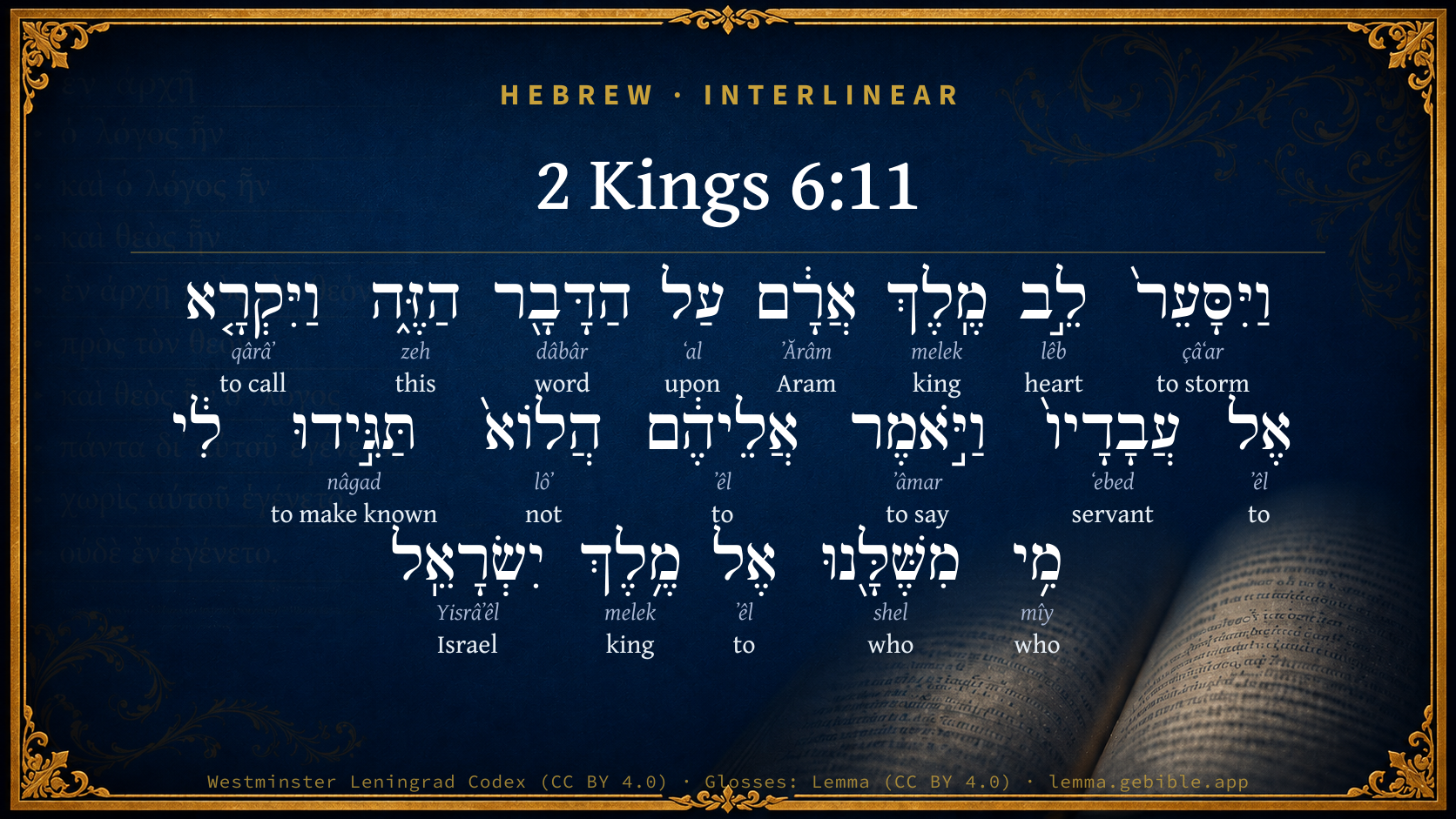
Hebrew (Westminster Leningrad Codex) 2 Kings 6:11 appears in the Hebrew Old Testament. The text above is from the Westminster Leningrad Codex. Each word links to its Strong’s number, a concise gloss, and parsing drawn from the Open Scriptures Hebrew Bible morphology. Click any word for its full Brown-Driver-Briggs (BDB) entry.
Download image
Cite this verse

2 Kings 6:11 (World English Bible). Public Domain. Lemma interlinear Bible study tool, https://lemma.gebible.app/v/2-kings/6/11.

Show BibTeX & RIS
BibTeX
RIS
English Translation
The heart of the king of Syria was sore troubled for this thing; and he called his servants, and said to them, Won't you show me which of us is for the king of Israel?
World English Bible · Public Domain
Highlights
  • 2 first appearances in the Hebrew Bible
Full analysis ↓
Download a study sheet

One document with this verse’s original text, its word-by-word gloss line, the meaning frame, cross-references with their text, attributed commentary, and full source and license credits — printable, and it pastes into notes with its structure intact.

This verse Autodidact and up

Study sheet (.html) Plain text (.txt)

A passage Seminary Student

Up to 50 verses in one chapter. A passage sheet keeps up to 6 commentary sources and 12 cross-references per verse, in the order this page ranks them, and says so on the sheet whenever that leaves anything out. Ask for a single verse and you get the Autodidact verse sheet above.

Everything on this page stays free to read, with no account — the sheet is a download of what is already on screen, not access to it.

Want to remove ads? Support Godless Engineer
Compare translations 3

The same verse in 3 English versions, stacked beneath the original-language interlinear above. Click any original word for its lexicon entry.

Each is an independent rendering of the whole verse — the interlinear is not word-aligned to these translations.

Highlighted words mark where these versions differ — a whole-verse word diff, not a word-by-word alignment.

  • World English Bible Public Domain
    The heart of the king of Syria was sore troubled for this thing; and he called his servants, and said to them, Won't you show me which of us is for the king of Israel?
  • King James Version Public Domain
    Therefore the heart of the king of Syria was sore troubled for this thing; and he called his servants, and said unto them, Will ye not show me which of us is for the king of Israel?
  • unfoldingWord Literal Text CC BY-SA 4.0
    And the heart of the king of Aram was enraged about this matter. And he called to his servants, and he said to them, “Will you not declare to me who from us for the king of Israel?”

unfoldingWord Literal Text — © unfoldingWord, licensed CC BY-SA 4.0. Word-aligned USFM3 via Door43 (git.door43.org/unfoldingWord/en_ult).

Versions to compare (up to 4)

3 of 4 selected

Show all 18 translations

Every available English version of this verse, each an independent rendering of the whole verse.

  • World English Bible Public Domain
    The heart of the king of Syria was sore troubled for this thing; and he called his servants, and said to them, Won't you show me which of us is for the king of Israel?
  • Berean Standard Bible Public Domain
    For this reason the king of Aram became enraged and called his servants to demand of them, “Tell me, which one of us is on the side of the king of Israel?”
  • Majority Standard Bible Public Domain
    For this reason the king of Aram became enraged and called his servants to demand of them, “Tell me, which one of us is on the side of the king of Israel?”
  • King James Version Public Domain
    Therefore the heart of the king of Syria was sore troubled for this thing; and he called his servants, and said unto them, Will ye not show me which of us is for the king of Israel?
  • American Standard Version (1901) Public Domain
    And the heart of the king of Syria was sore troubled for this thing; and he called his servants, and said unto them, Will ye not show me which of us is for the king of Israel?
  • Revised Version (1885) Public Domain
    And the heart of the king of Syria was sore troubled for this thing; and he called his servants, and said unto them, Will ye not shew me which of us is for the king of Israel?
  • Geneva Bible (1599) Public Domain
    And the heart of the King of Aram was troubled for this thing: therefore he called his seruants and saide vnto them, Will ye not shewe me, which of vs bewrayeth our counsel to the king of Israel?
  • Douay-Rheims (1899) Public Domain
    And the heart of the king of Syria was troubled for this thing. And calling together his servants, he said: Why do you not tell me who it is that betrays me to the king of Israel?
  • Young's Literal Translation Public Domain
    And the heart of the king of Aram is tossed about concerning this thing, and he calleth unto his servants, and saith unto them, `Do ye not declare to me who of us `is' for the king of Israel?'
  • Literal Standard Version CC BY-SA 4.0
    And the heart of the king of Aram is tossed about concerning this thing, and he calls to his servants and says to them, “Do you not declare to me who of us [is] for the king of Israel?”
  • Unlocked Literal Bible CC BY-SA 4.0
    The king of Aram was enraged about these warnings, and he called his servants and said to them, “Will you not tell me who among us is for the king of Israel?”
  • unfoldingWord Literal Text CC BY-SA 4.0
    And the heart of the king of Aram was enraged about this matter. And he called to his servants, and he said to them, “Will you not declare to me who from us for the king of Israel?”
  • Darby Bible Public Domain
    And the heart of the king of Syria was troubled because of this thing; and he called his servants, and said to them, Will ye not shew me which of us is for the king of Israel?
  • World Messianic Bible Public Domain
    The king of Syria’s heart was very troubled about this. He called his servants, and said to them, “Won’t you show me which of us is for the king of Israel?”
  • Webster's Bible Public Domain
    Therefore the heart of the king of Syria was greatly troubled for this thing; and he called his servants, and said to them, Will ye not show me which of us is for the king of Israel?
  • Free Bible Version CC BY-SA 4.0
    This made the Aramean king really mad. He summoned his officers, demanding an answer: “Tell me, which of us is on the side of the king of Israel?”
  • Bible in Basic English Public Domain
    And at this, the mind of the king of Aram was greatly troubled, and he sent for his servants and said to them, Will you not make clear to me which of us is helping the king of Israel?
  • JPS Tanakh (1917) Public Domain
    And the heart of the king of Aram was sore troubled for this thing; and he called his servants, and said unto them: 'Will ye not tell me which of us is for the king of Israel?'

Literal Standard Version (2020), Covenant Press — licensed CC BY-SA 4.0. Text via the HelloAO Bible API (eBible.org). Unlocked Literal Bible (unfoldingWord) — licensed CC BY-SA 4.0. Text via the HelloAO Bible API (eBible.org). unfoldingWord Literal Text — © unfoldingWord, licensed CC BY-SA 4.0. Word-aligned USFM3 via Door43 (git.door43.org/unfoldingWord/en_ult). Free Bible Version, Dr. Jonathan Gallagher — licensed CC BY-SA 4.0. Text via the HelloAO Bible API (eBible.org).

Word by word

More ways to search: Search by grammar → Find every occurrence → Compare this word →

Practice this passage: Drill this verse → Learn its vocabulary →

מִשֶּׁלָּ֖נוּ
shel
H7945
“from · who/which · to/for · us”
Preposition + Particle, Relative + Preposition + Suffix, Personal, 1st Person, Common, Plural
Part of Speech
Preposition + Particle + Preposition
Full BDB Definition

Origin: for the rel H834

TWOT: 184

who, which
  1. וַיִּסָּעֵר֙ çâʻar H5590 “and · to storm” Conjunction + Verb, Niphal, Sequential Imperfect, 3rd Person, Masculine, Singular
  2. לֵ֣ב lêb H3820 “heart of” Noun, Common, Masculine, Singular, Construct
  3. מֶֽלֶךְ melek H4428 “king of” Noun, Common, Masculine, Singular, Construct
  4. אֲרָ֔ם ʼĂrâm H758 “Aram” Noun, Proper
  5. עַל ʻal H5921 “upon” Preposition
  6. הַדָּבָ֖ר dâbâr H1697 “the · word” Particle, Definite Article + Noun, Common, Masculine, Singular, Absolute
  7. הַזֶּ֑ה zeh H2088 “the · this” Particle, Definite Article + Pronoun, Demonstrative, Masculine, Singular
  8. וַיִּקְרָ֤א qârâʼ H7121 “and · to call” Conjunction + Verb, Qal, Sequential Imperfect, 3rd Person, Masculine, Singular
  9. אֶל ʼêl H413 “to” Preposition
  10. עֲבָדָיו֙ ʻebed H5650 “servants · his” Noun, Common, Masculine, Plural, Construct + Suffix, Personal, 3rd Person, Masculine, Singular
  11. וַיֹּ֣אמֶר ʼâmar H559 “and · to say” Conjunction + Verb, Qal, Sequential Imperfect, 3rd Person, Masculine, Singular
  12. אֲלֵיהֶ֔ם ʼêl H413 “to · them” Preposition + Suffix, Personal, 3rd Person, Masculine, Plural
  13. הֲלוֹא֙ lôʼ H3808 “not” Particle, Interrogative + Particle, Negative
  14. תַּגִּ֣ידוּ nâgad H5046 “to make known” Verb, Hiphil, Imperfect, 2nd Person, Masculine, Plural
  15. מִ֥י mîy H4310 “who” Particle, Interrogative
  16. אֶל ʼêl H413 “to” Preposition
  17. מֶ֥לֶךְ melek H4428 “king of” Noun, Common, Masculine, Singular, Construct
  18. יִשְׂרָאֵֽל Yisrâʼêl H3478 “Israel” Noun, Proper

About this verse

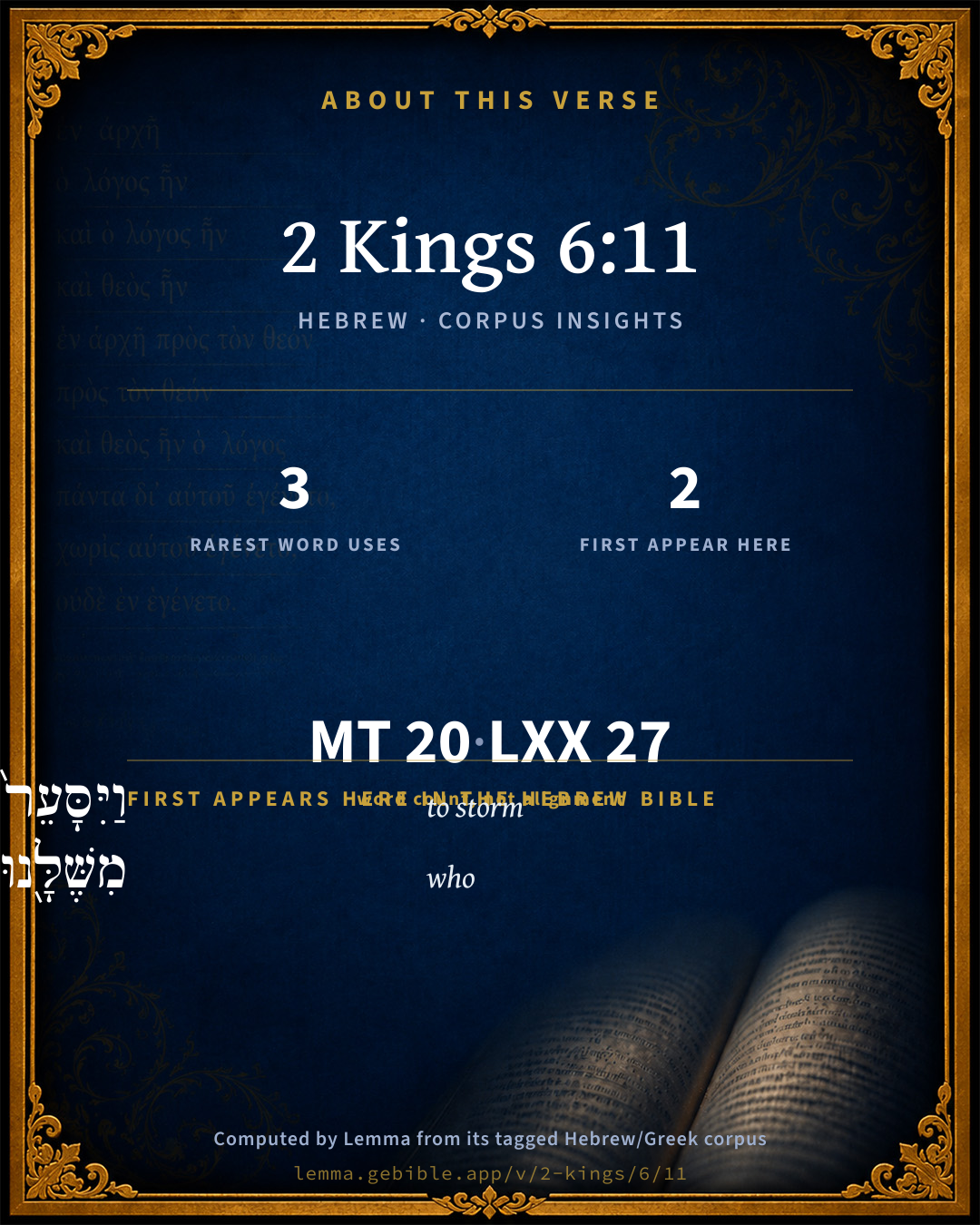
These counts appear in no published source. They are computed here, from the morphology-tagged text and Lemma’s own curated glosses. What Lemma adds →

20
words
16
distinct lemmas
Historical
section

Notable vocabulary

The rarest word here is מִשֶּׁלָּ֖נוּ who H7945 — appearing just 3 times in the whole Hebrew Bible.

First appearance in Scripture

These words make their first canonical appearance in the Hebrew Bible here:

  • וַיִּסָּעֵר֙ to storm H5590
  • מִשֶּׁלָּ֖נוּ who H7945

Shared distinctive vocabulary

מִשֶּׁלָּ֖נוּ who H7945 occurs in 3 verses of the Hebrew Bible. Also found in:

Grammatical profile

  • 4 verbs
  • 7 nouns
  • 1 pronoun
  • 6 prepositions
  • 2 particles

Verb forms

  • וַיִּסָּעֵר֙ Niphal · Sequential Imperfect
  • וַיִּקְרָ֤א Qal · Sequential Imperfect
  • וַיֹּ֣אמֶר Qal · Sequential Imperfect
  • תַּגִּ֣ידוּ Hiphil · Imperfect

Repetition

Words recur within this verse — often emphatic in Hebrew:

  • מֶֽלֶךְ king H4428 ×2
  • אֶל to H413 ×3

Hebrew & Septuagint length

In English translation the verse runs 35 words from the Hebrew and 37 from the Septuagint (LXX English) — closely comparable.

A rough comparison of the two English renderings, which tokenize alike — not a word-level alignment.

Word counts can differ between the Hebrew and the Greek without any difference in meaning — e.g. the Hebrew direct-object marker אֵת has no separate Greek word, and Greek often adds the article ὁ.

In the original languages it is 20 Hebrew tokens and 27 Greek tokens — but the two are counted differently (Hebrew bundles its prefixes and suffixes into one token; the Greek is in lemma form), so that isn’t a like-for-like length.

Cross-references

6

Topical passages linked to 2 Kings 6:11 in the Treasury of Scripture Knowledge — connected by theme and wording, ordered by reader-vote popularity; previews shown in the World English Bible.

  • 1 Samuel 22:8 that all of you have conspired against me, and there is none who discloses to me when my son makes a league with the son of Jesse, and there is none of you who is sorry for me, or discloses to me that my son has stirred up my servant against me, to lie in wait, as at this day?
  • 1 Samuel 28:21 The woman came to Saul, and saw that he was sore troubled, and said to him, Behold, your handmaid has listened to your voice, and I have put my life in my hand, and have listened to your words which you spoke to me.
  • Job 18:7–11 The steps of his strength shall be shortened, His own counsel shall cast him down.
  • Psalms 48:4–5 For, behold, the kings assembled themselves, They passed by together.
  • Isaiah 57:20–21 But the wicked are like the troubled sea; for it can't rest, and its waters cast up mire and dirt.
  • Matthew 2:3–12 When Herod the king heard it, he was troubled, and all Jerusalem with him.

Cross-references courtesy of OpenBible.info (CC BY 4.0).

Hebrew and Greek witnesses Masoretic Hebrew ↔ Greek Septuagint

The same verse in the two great witnesses to the Old Testament, shown verse-for-verse.

These are two independent witnesses, not word-aligned to each other, and the Septuagint is shown in lemma (dictionary) form.

Hebrew 2 Kings 6:11 Masoretic · Westminster Leningrad Codex

וַיִּסָּעֵר֙ לֵ֣ב מֶֽלֶךְ אֲרָ֔ם עַל הַדָּבָ֖ר הַזֶּ֑ה וַיִּקְרָ֤א אֶל עֲבָדָיו֙ וַיֹּ֣אמֶר אֲלֵיהֶ֔ם הֲלוֹא֙ תַּגִּ֣ידוּ לִ֔י מִ֥י מִשֶּׁלָּ֖נוּ אֶל מֶ֥לֶךְ יִשְׂרָאֵֽל

The heart of the king of Syria was sore troubled for this thing; and he called his servants, and said to them, Won't you show me which of us is for the king of Israel?

World English Bible · Public Domain

Greek LXX 2 Kings 6:11 Septuagint · lemma form

καί ἐκκινέω ὁ ψυχή βασιλεύς συρία περί ὁ λόγος οὗτος καί καλέω ὁ παῖς αὐτός καί εἶπον πρός αὐτός οὐ ἀναἀγγέλλω ἐγώ τίς προδίδωμι ἐγώ βασιλεύς ἰσραήλ

And the mind of the king of Syria was very much disturbed concerning this thing; and he called his servants, and said to them, Will you⌃ not tell me who betrays me to the king of Israel?

LXX2012 (modern English Septuagint) · Public Domain

On this verse, Ellicott's Commentary for English Readers discusses the Septuagint’s reading. Read the note in Commentary ↓

Hebrew: Westminster Leningrad Codex (CC BY 4.0). Greek: Septuagint (public domain); English from LXX2012 (modern English Septuagint) (Public Domain). How the Septuagint differs from the Hebrew →

Targum (Aramaic paraphrase)

1

The Targum is the ancient Jewish Aramaic paraphrase of the Hebrew Scriptures — an interpretive translation, not the Hebrew text itself. Onkelos (literal) and Pseudo-Jonathan (expansive) render the Torah, and Jonathan the Prophets. Coverage is partial: where no permissively-licensed English translation exists for a verse, only the Aramaic is shown. This is verse-level text, not a word-by-word alignment to the Hebrew.

  1. Targum Jonathan Prophets (Joshua–Malachi)
    וְאִסְתַּעַר לִבָּא דְמַלְכָּא דַאֲרָם עַל פִּתְגָמָא הָדֵין וּקְרָא לְעַבְדוֹהִי וַאֲמַר לְהוֹן הֲלָא תְחַווּן לִי מַן מִדִילָנָא גָלֵי רָזֵי לְמַלְכָּא דְיִשְׂרָאֵל:

    (no public-domain English translation for this verse)

    Targum Jonathan — Aramaic: “Mikraot Gedolot” (public domain). English: “Sefaria Community Translation” (CC0 1.0 (public-domain dedication)); “London "Chaldee Paraphrase," 1871” (public domain). Text via Sefaria.

Commentary

Notes on 2 Kings 6:11 from classic Christian and Jewish commentators (each source and its license shown beneath its notes). The classic Christian expositions comment on the surrounding passage and are grouped to its opening verse, so a note may address several verses; the Jewish commentaries on the Tanakh (Rashi and others) are per-verse, so they appear only where the commentator wrote on this verse.

Lemma curates 59 commentaries, every one of them public domain or Creative Commons licensed, each selected and text-cleaned for this edition rather than reprinted as found. About our sources →

Trapp's Complete Commentary

John Trapp

2Ki 6:11 Therefore the heart of the king of Syria was sore troubled for this thing; and he called his servants, and said unto them, Will ye not shew me which of us [is] for the king of Israel?

Ver. 11. Therefore the heart of the king of Syria was sore troubled.] Heb., Was tempested, or tossed with passions, as chaff is with whirlwinds, or the sea with counterblasts.

John Trapp, A Commentary or Exposition upon All the Books of the Old and New Testament (1647–1656) — public domain. Text from a community e-Sword module.

Joseph Benson's Commentary

2Ki 6:11-12. Will you not show me which of us is for the king of Israel? — Betrays my counsels to him: for he could not suppose that he should meet with such constant disappointments, unless it were by treachery. One of the servants said, &c. — It is likely Naaman had spread the fame of the prophet so much in this court, that some of them made further inquiry after him, and heard more of his miraculous works; and thence concluded that he could tell the greatest secrets, as well as do such wonders as were reported of him.

Joseph Benson's Commentary on the Old and New Testaments (1811–1818) — public domain. Text from a community e-Sword module.

Tyndale Open Study Notes

Tyndale Open Resources

6:11-14 When the king of Aram learned that Elisha had the ability to give advance warning to the king of Israel, he commanded his men to capture the prophet. • Dothan was situated about ten miles north of Samaria. Archaeological excavations have confirmed the city’s existence in this period.

Tyndale Open Study Notes — © Tyndale Open Resources, licensed CC BY-SA 4.0. Text via the HelloAO Bible API.

Ellicott's Commentary for English Readers

(11) Troubled.—Literally, storm-tost. The phrase is not found elsewhere in the Old Testament. (Comp. the use of the same verb in Jon_1:11; Jon_1:13; Isa_54:11.)

Which of us is for the king of Israel?—“Which of us?” is an expression only found here (mishshellânû). Pointed differently, the word would give the sense of the LXX., τίς προδίδωσί με βασιλεῖ Ίσραήλ —“Who betrays me to the king of Israel?”—malshînçnû, “our betrayer,” an Aramaic term. (Comp. Prov. XXX. 10.) Better still is Böttcher’s correction: “Who leads us astray unto the king of Israel?” (mashlçnû). This would be the natural supposition of the Syrian king when he found himself unexpectedly confronting an armed Israelitish force, and harmonises well enough with the LXX. and Vulg. The received text, which the Targum, Syriac, and Arabic support, can only mean, “Which of those who belong to us inclines to the king of Israel?” (Comp. Psa_123:2.) The Syriac follows the Hebrew exactly; the Targum and Arabic add a verb—“reveals secrets”—before “to the king of Israel.”

A Bible Commentary for English Readers, edited by Charles John Ellicott (1878–1897) — public domain. Text from a community e-Sword module.

The Cambridge Bible for Schools and Colleges

gen. ed. J. J. S. Perowne

11. Therefore [R.V. And] the heart of the king of Syria was sore troubled] Because he saw on all these occasions that the opportunity he had looked for was taken away. He appears to have been acting on information which told him of expected movements of the forces of Israel. When his design was frustrated over and over again it was natural to think of treachery among his own people.

The Cambridge Bible for Schools and Colleges (gen. ed. J. J. S. Perowne; Cambridge University Press, 1878–1918) — public domain. Text from a community e-Sword module.

John Gill's Exposition

And one of his servants said, none, my lord, O king,.... He believed everyone of his counsellors were true and faithful to him:

but Elisha the prophet, that is in Israel, telleth the king of Israel the words that thou speakest in thy bedchamber; what is said in the most private place, and in the most secret manner: this man had heard much of Elisha, by Naaman, very probably; or perhaps he had attended him in his journey to Israel for a cure, and so might have personal knowledge of Elisha, and be acquainted with the affair of Gehazi; from whence he concluded, that he, who had the thoughts of men revealed to him, had knowledge of their words and counsels, though ever so secret; see Ecc 10:20.

John Gill's Exposition of the Whole Bible (1746–1763) — public domain (CC PDM 1.0). Text via the HelloAO Bible API.

Albert Barnes' Notes on the Bible

Benhadad supposed that there must be a traitor in his camp. He asks therefore, “Will no one denounce him?”

Albert Barnes' Notes on the Bible (1834–1885) — public domain. Text from a community e-Sword/MySword module.

Whedon's Commentary on the Bible

Daniel D. Whedon

11. Sore troubled — Ben-hadad was vexed and chagrined to find that all his plans and movements were made known to the Israelites, and that they could thus treat all his stratagems with derision. He at once suspected that there were traitors in his own camp.

Daniel D. Whedon (gen. ed.), Commentary on the Old and New Testaments (1874–1909) — public domain. Text from a community e-Sword module.

The Pulpit Commentary

Therefore the heart of the King of Syria was sore troubled for this thing. Keil says, "The King of the Syrians was enraged at this;" but rs; exactly expresses "trouble," "disturbance," not "rage," being used of the tossing of the sea, in Jon_1:11. And he called his servants, and said unto them, Will ye not show me which of us is for the king of Israel? Benhadad not unnaturally suspected treachery among his own subjects. How otherwise could the King of Israel become, over and over again, aware of his intentions? Some one or other of his officers must, he thought, betray his plans to the enemy. Cannot the others point out the traitor?

The Pulpit Commentary (1880–1919), ed. H.D.M. Spence-Jones & Joseph S. Exell — public domain. Text from a community e-Sword module.

Keil & Delitzsch

C. F. Keil & F. Delitzsch

The king of the Syrians was enraged at this, and said to his servants, "Do ye not show me who of our men (leans) to the king of Israel?" i.e., takes his part. משּׁלּנוּ = לנוּ מאשׁר, probably according to an Aramaean dialect: see Ewald, 181, b., though he pronounces the reading incorrect, and would read מכּלּנוּ, but without any ground and quite unsuitably, as the king would thereby reckon himself among the traitors.

Keil & Delitzsch — Biblical Commentary on the Old Testament (1861–1891) — public domain (CC PDM 1.0). Text via the HelloAO Bible API. (Old Testament only.)

Rashi

Rabbi Shlomo Yitzchaki (Rashi)

Over this situation. Who was revealing his secret.

Rashi on the Tanakh — English translations: “The Judaica Press complete Tanach with Rashi, translated by A. J. Rosenberg” (CC BY 4.0); “Pentateuch with Rashi's commentary by M. Rosenbaum and A.M. Silbermann, 1929-1934” (public domain); “The Metsudah Tanach series, Lakewood, N.J” (CC BY 4.0); and “The Book of Joshua, Metsudah Publications, 1997” (CC BY 4.0). Text via Sefaria.

Lesson kit

Teaching starters — assembled from the data on this page, not authored interpretation. Every prompt links to the verse data it draws on. Edit before teaching.

2 Kings, in the Historical, opens this verse with 20 words (16 distinct Hebrew lemmas). Its most distinctive word is shel (“who”). A historical commentator’s framing appears above. Read the whole chapter for the surrounding context.

Discussion questions

  1. How does “who” (shel) shape what this verse is saying?
  2. 2 words here appear for the first time in Scripture. What is being introduced at this debut?
  3. Ecclesiastes 8:17 shares the word «who» with this verse. How do the two illuminate each other?
  4. “king” occurs 2× in this one verse. What is the effect of the repetition?
  5. These translations render this verse differently. What is at stake in choosing one wording over another?
  6. The verb «וַיִּסָּעֵר֙» is Niphal Sequential Imperfect. How does its form color the action?
  7. Reading how Trapp's Complete Commentary and Joseph Benson's Commentary read this verse, where do the two commentators agree and where do they part?

Things to notice

Reading settings

Reading text

Shown beneath each verse's original-language words.

Old Testament
Old Testament edition

Read the OT as the Masoretic Hebrew (MT) or the Greek Septuagint (LXX).

English shown for the Greek Septuagint (in the Hebrew ↔ Greek comparison).

Comparing translations? Open the Compare panel on any verse page to stack up to four side by side.