
Exodus 19:9

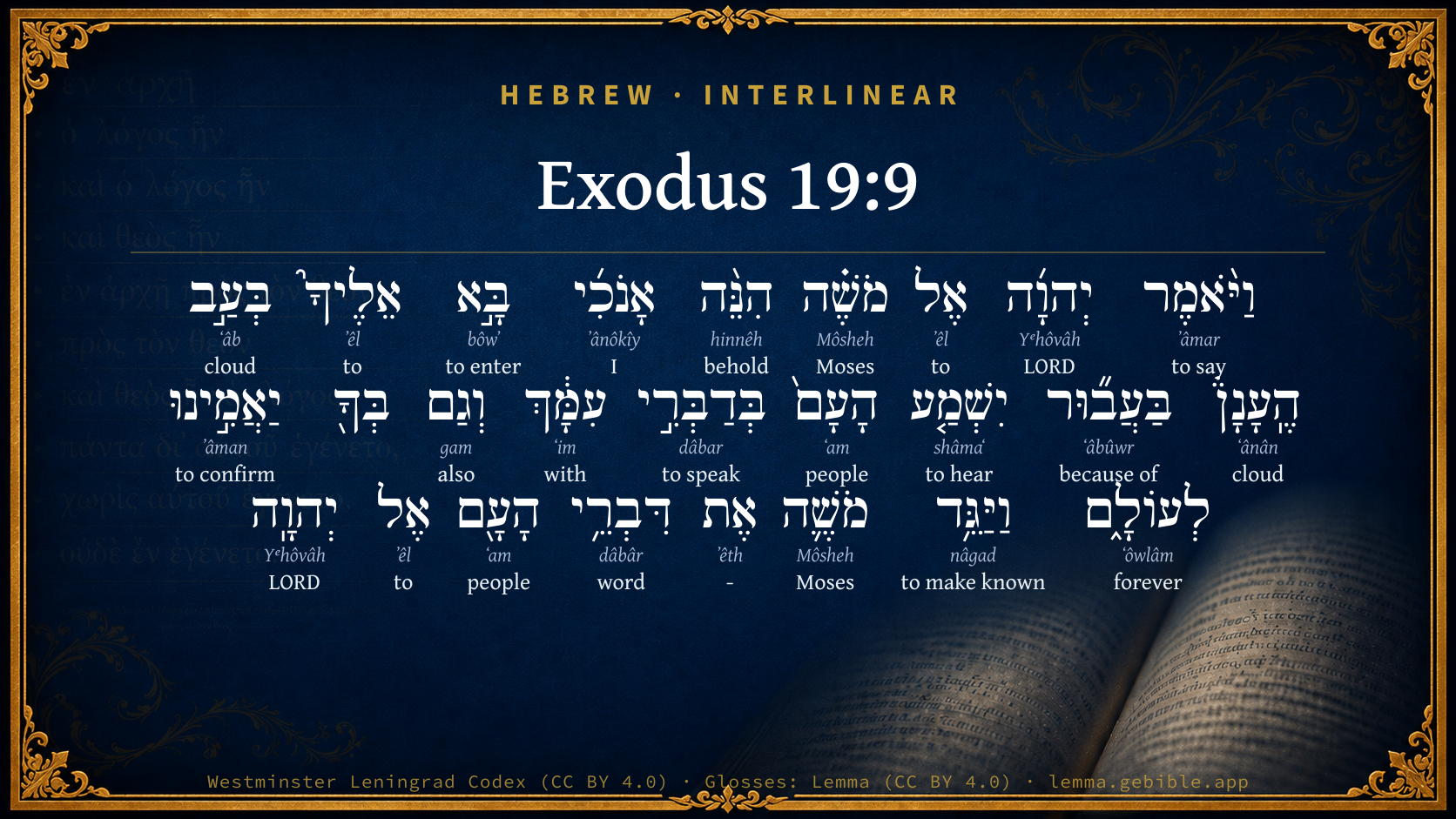
Hebrew (Westminster Leningrad Codex) Exodus 19:9 appears in the Hebrew Old Testament. The text above is from the Westminster Leningrad Codex. Each word links to its Strong’s number, a concise gloss, and parsing drawn from the Open Scriptures Hebrew Bible morphology. Click any word for its full Brown-Driver-Briggs (BDB) entry.
Download image
Cite this verse

Exodus 19:9 (World English Bible). Public Domain. Lemma interlinear Bible study tool, https://lemma.gebible.app/v/exodus/19/9.

Show BibTeX & RIS
BibTeX
RIS
English Translation
Yahweh said to Moses, "Behold, I come to you in a thick cloud, that the people may hear when I speak with you, and may also believe you forever." Moses told the words of the people to Yahweh.
World English Bible · Public Domain
Highlights
  • 1 first appearance in the Hebrew Bible
Full analysis ↓
Download a study sheet

One document with this verse’s original text, its word-by-word gloss line, the meaning frame, cross-references with their text, attributed commentary, and full source and license credits — printable, and it pastes into notes with its structure intact.

This verse Autodidact and up

Study sheet (.html) Plain text (.txt)

A passage Seminary Student

Up to 50 verses in one chapter. A passage sheet keeps up to 6 commentary sources and 12 cross-references per verse, in the order this page ranks them, and says so on the sheet whenever that leaves anything out. Ask for a single verse and you get the Autodidact verse sheet above.

Everything on this page stays free to read, with no account — the sheet is a download of what is already on screen, not access to it.

Want to remove ads? Support Godless Engineer
Compare translations 3

The same verse in 3 English versions, stacked beneath the original-language interlinear above. Click any original word for its lexicon entry.

Each is an independent rendering of the whole verse — the interlinear is not word-aligned to these translations.

Highlighted words mark where these versions differ — a whole-verse word diff, not a word-by-word alignment.

  • World English Bible Public Domain
    Yahweh said to Moses, "Behold, I come to you in a thick cloud, that the people may hear when I speak with you, and may also believe you forever." Moses told the words of the people to Yahweh.
  • King James Version Public Domain
    And the LORD said unto Moses, Lo, I come unto thee in a thick cloud, that the people may hear when I speak with thee, and believe thee for ever. And Moses told the words of the people unto the LORD.
  • unfoldingWord Literal Text CC BY-SA 4.0
    And Yahweh said to Moses, “Look, I will come to you in a thick cloud so that the people may hear when I speak with you and may also trust in you forever.” And Moses told the words of the people to Yahweh.

unfoldingWord Literal Text — © unfoldingWord, licensed CC BY-SA 4.0. Word-aligned USFM3 via Door43 (git.door43.org/unfoldingWord/en_ult).

Versions to compare (up to 4)

3 of 4 selected

Show all 18 translations

Every available English version of this verse, each an independent rendering of the whole verse.

  • World English Bible Public Domain
    Yahweh said to Moses, "Behold, I come to you in a thick cloud, that the people may hear when I speak with you, and may also believe you forever." Moses told the words of the people to Yahweh.
  • Berean Standard Bible Public Domain
    The LORD said to Moses, “Behold, I will come to you in a dense cloud, so that the people will hear when I speak with you, and they will always put their trust in you.” And Moses relayed to the LORD what the people had said.
  • Majority Standard Bible Public Domain
    The LORD said to Moses, “Behold, I will come to you in a dense cloud, so that the people will hear when I speak with you, and they will always put their trust in you.” And Moses relayed to the LORD what the people had said.
  • King James Version Public Domain
    And the LORD said unto Moses, Lo, I come unto thee in a thick cloud, that the people may hear when I speak with thee, and believe thee for ever. And Moses told the words of the people unto the LORD.
  • American Standard Version (1901) Public Domain
    And Jehovah said unto Moses, Lo, I come unto thee in a thick cloud, that the people may hear when I speak with thee, and may also believe thee for ever. And Moses told the words of the people unto Jehovah.
  • Revised Version (1885) Public Domain
    And the LORD said unto Moses, Lo, I come unto thee in a thick cloud, that the people may hear when I speak with thee, and may also believe thee for ever. And Moses told the words of the people unto the LORD.
  • Geneva Bible (1599) Public Domain
    And the Lord sayd vnto Moses, Lo, I come vnto thee in a thicke cloude, that the people may heare, whiles I talke with thee, and that they may also beleeue thee for euer. (for Moses had tolde the wordes of the people vnto the Lord)
  • Douay-Rheims (1899) Public Domain
    The Lord said to him: Lo, now will I come to thee in the darkness of a cloud, that the people may hear me speaking to thee, and may believe thee for ever. And Moses told the words of the people to the Lord.
  • Young's Literal Translation Public Domain
    And Jehovah saith unto Moses, `Lo, I am coming unto thee in the thickness of the cloud, so that the people hear in My speaking with thee, and also believe in thee to the age;' and Moses declareth the words of the people unto Jehovah.
  • Literal Standard Version CC BY-SA 4.0
    And YHWH says to Moses, “Behold, I am coming to you in the thickness of the cloud, so that the people hear in My speaking with you, and also believe in you for all time”; and Moses declares the words of the people to YHWH.
  • Unlocked Literal Bible CC BY-SA 4.0
    Yahweh said to Moses, “I will come to you in a thick cloud so that the people may hear when I speak with you and may also believe you forever.” Then Moses told the people's words to Yahweh.
  • unfoldingWord Literal Text CC BY-SA 4.0
    And Yahweh said to Moses, “Look, I will come to you in a thick cloud so that the people may hear when I speak with you and may also trust in you forever.” And Moses told the words of the people to Yahweh.
  • Darby Bible Public Domain
    And Jehovah said to Moses, Lo, I will come to thee in the cloud's thick darkness, that the people may hear when I speak with thee, and believe thee also for ever. And Moses told the words of the people to Jehovah.
  • World Messianic Bible Public Domain
    The LORD said to Moses, “Behold, I come to you in a thick cloud, that the people may hear when I speak with you, and may also believe you forever.” Moses told the words of the people to the LORD.
  • Webster's Bible Public Domain
    And the LORD said to Moses, Lo, I come to thee in a thick cloud, that the people may hear when I speak with thee, and believe thee for ever. And Moses told the words of the people to the LORD.
  • Free Bible Version CC BY-SA 4.0
    The Lord told Moses, “Look! I'm going to come to you in a thick cloud so the people will hear me speaking with you and as a result they will always trust you.” Then Moses reported to the Lord what the people had said.
  • Bible in Basic English Public Domain
    And the Lord said to Moses, See, I will come to you in a thick cloud, so that what I say to you may come to the ears of the people and they may have belief in you for ever. And Moses gave the Lord word of what the people had said.
  • JPS Tanakh (1917) Public Domain
    And the LORD said unto Moses: 'Lo, I come unto thee in a thick cloud, that the people may hear when I speak with thee, and may also believe thee for ever.' And Moses told the words of the people unto the LORD.

Literal Standard Version (2020), Covenant Press — licensed CC BY-SA 4.0. Text via the HelloAO Bible API (eBible.org). Unlocked Literal Bible (unfoldingWord) — licensed CC BY-SA 4.0. Text via the HelloAO Bible API (eBible.org). unfoldingWord Literal Text — © unfoldingWord, licensed CC BY-SA 4.0. Word-aligned USFM3 via Door43 (git.door43.org/unfoldingWord/en_ult). Free Bible Version, Dr. Jonathan Gallagher — licensed CC BY-SA 4.0. Text via the HelloAO Bible API (eBible.org).

Word by word

More ways to search: Search by grammar → Find every occurrence → Compare this word →

Practice this passage: Drill this verse → Learn its vocabulary →

בְּעַ֣ב
ʻâb
H5645
“in/at · cloud of”
Preposition + Noun, Common, Both, Singular, Construct
Part of Speech
Preposition + Noun
Type
Common
Gender
Both
Number
Singular
State
Construct
Full BDB Definition

Origin: from H5743

TWOT: 1574a

darkness, cloud, thicket - dark cloud - cloud mass - thicket (as refuge)
  1. וַיֹּ֨אמֶר ʼâmar H559 “and · to say” Conjunction + Verb, Qal, Sequential Imperfect, 3rd Person, Masculine, Singular
  2. יְהוָ֜ה Yᵉhôvâh H3068 “LORD” Noun, Proper
  3. אֶל ʼêl H413 “to” Preposition
  4. מֹשֶׁ֗ה Môsheh H4872 “Moses” Noun, Proper
  5. הִנֵּ֨ה hinnêh H2009 “behold” Particle, Demonstrative
  6. אָנֹכִ֜י ʼânôkîy H595 “I” Pronoun, Personal, 1st Person, Common, Singular
  7. בָּ֣א bôwʼ H935 “entering” Verb, Qal, Participle Active, Masculine, Singular, Absolute
  8. אֵלֶיךָ֮ ʼêl H413 “to · you” Preposition + Suffix, Personal, 2nd Person, Masculine, Singular
  9. הֶֽעָנָן֒ ʻânân H6051 “the · cloud” Particle, Definite Article + Noun, Common, Masculine, Singular, Absolute
  10. בַּעֲב֞וּר ʻâbûwr H5668 “in/at · because of of” Preposition + Noun, Common, Masculine, Singular, Construct
  11. יִשְׁמַ֤ע shâmaʻ H8085 “to hear” Verb, Qal, Imperfect, 3rd Person, Masculine, Singular
  12. הָעָם֙ ʻam H5971 “the · people” Particle, Definite Article + Noun, Common, Masculine, Singular, Absolute
  13. בְּדַבְּרִ֣י dâbar H1696 “in/at · to speak · me” Preposition + Verb, Piel, Infinitive Construct + Suffix, Personal, 1st Person, Common, Singular
  14. עִמָּ֔ךְ ʻim H5973 “with · you” Preposition + Suffix, Personal, 2nd Person, Feminine, Singular
  15. וְגַם gam H1571 “and · also” Conjunction + Particle, Accusative
  16. יַאֲמִ֣ינוּ ʼâman H539 “to confirm” Verb, Hiphil, Imperfect, 3rd Person, Masculine, Plural
  17. לְעוֹלָ֑ם ʻôwlâm H5769 “to/for · forever” Preposition + Noun, Common, Masculine, Singular, Absolute
  18. וַיַּגֵּ֥ד nâgad H5046 “and · to make known” Conjunction + Verb, Hiphil, Sequential Imperfect, 3rd Person, Masculine, Singular
  19. מֹשֶׁ֛ה Môsheh H4872 “Moses” Noun, Proper
  20. אֶת ʼêth H853 “-” Particle, Direct Object
  21. דִּבְרֵ֥י dâbâr H1697 “words of” Noun, Common, Masculine, Plural, Construct
  22. הָעָ֖ם ʻam H5971 “the · people” Particle, Definite Article + Noun, Common, Masculine, Singular, Absolute
  23. אֶל ʼêl H413 “to” Preposition
  24. יְהוָֽה Yᵉhôvâh H3068 “LORD” Noun, Proper

About this verse

These counts appear in no published source. They are computed here, from the morphology-tagged text and Lemma’s own curated glosses. What Lemma adds →

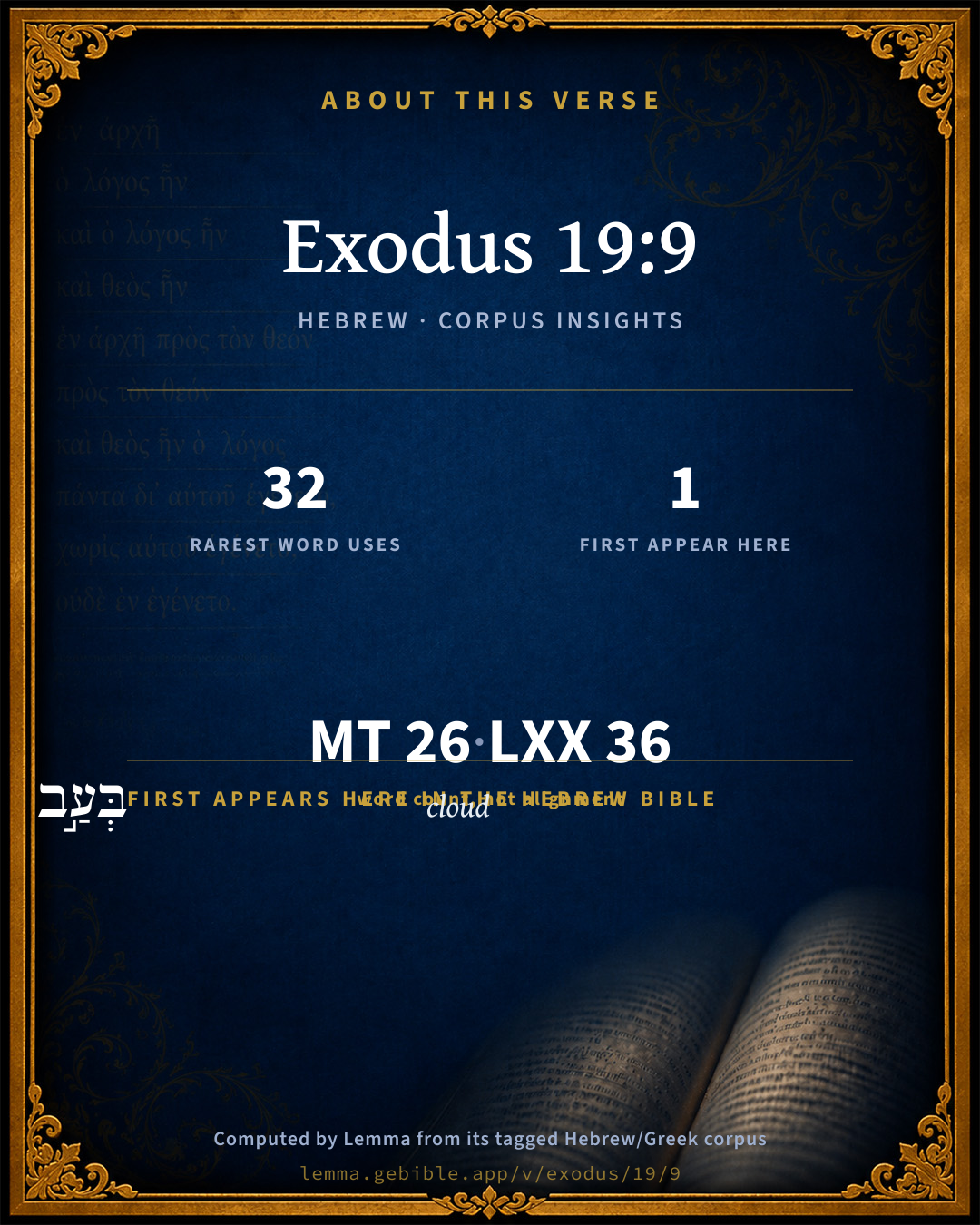
26
words
20
distinct lemmas
Pentateuch
section

First appearance in Scripture

This word makes its first canonical appearance in the Hebrew Bible here:

  • בְּעַ֣ב cloud H5645

Shared distinctive vocabulary

בְּעַ֣ב cloud H5645 occurs in 32 verses of the Hebrew Bible. Also found in:

Grammatical profile

  • 6 verbs
  • 11 nouns
  • 1 pronoun
  • 5 prepositions
  • 3 particles

Verb forms

  • וַיֹּ֨אמֶר Qal · Sequential Imperfect
  • בָּ֣א Qal · Participle Active
  • יִשְׁמַ֤ע Qal · Imperfect
  • בְּדַבְּרִ֣י Piel · Infinitive Construct
  • יַאֲמִ֣ינוּ Hiphil · Imperfect
  • וַיַּגֵּ֥ד Hiphil · Sequential Imperfect

Repetition

Words recur within this verse — often emphatic in Hebrew:

  • יְהוָ֜ה LORD H3068 ×2
  • מֹשֶׁ֗ה Moses H4872 ×2
  • הָעָם֙ people H5971 ×2
  • אֶל to H413 ×3

Hebrew & Septuagint length

In English translation the verse runs 38 words from the Hebrew and 43 from the Septuagint (LXX English) — closely comparable.

A rough comparison of the two English renderings, which tokenize alike — not a word-level alignment.

Word counts can differ between the Hebrew and the Greek without any difference in meaning — e.g. the Hebrew direct-object marker אֵת has no separate Greek word, and Greek often adds the article ὁ.

In the original languages it is 26 Hebrew tokens and 36 Greek tokens — but the two are counted differently (Hebrew bundles its prefixes and suffixes into one token; the Greek is in lemma form), so that isn’t a like-for-like length.

Cross-references

19

Topical passages linked to Exodus 19:9 in the Treasury of Scripture Knowledge — connected by theme and wording, ordered by reader-vote popularity; previews shown in the World English Bible.

  • Deuteronomy 4:36 Out of heaven he made you to hear his voice, that he might instruct you: and on earth he made you to see his great fire; and you heard his words out of the midst of the fire.
  • Exodus 19:16 It happened on the third day, when it was morning, that there were thunders and lightnings, and a thick cloud on the mountain, and the sound of an exceedingly loud trumpet; and all the people who were in the camp trembled.
  • Exodus 24:15–16 Moses went up on the mountain, and the cloud covered the mountain.
  • Exodus 14:31 Israel saw the great work which Yahweh did to the Egyptians, and the people feared Yahweh; and they believed in Yahweh, and in his servant Moses.
  • Exodus 20:21 The people stayed at a distance, and Moses drew near to the thick darkness where God was.
  • Deuteronomy 4:11–12 You came near and stood under the mountain; and the mountain burned with fire to the heart of the sky, with darkness, cloud, and thick darkness.
  • Psalms 97:2 Clouds and darkness are around him. Righteousness and justice are the foundation of his throne.
  • Matthew 17:5 While he was still speaking, behold, a bright cloud overshadowed them. Behold, a voice came out of the cloud, saying, "This is my beloved Son, in whom I am well pleased. Listen to him."
  • 1 Kings 8:12 Then spoke Solomon, Yahweh has said that he would dwell in the thick darkness.
  • 2 Chronicles 6:1 Then spoke Solomon, Yahweh has said that he would dwell in the thick darkness.
  • 2 Chronicles 20:20 They rose early in the morning, and went forth into the wilderness of Tekoa: and as they went forth, Jehoshaphat stood and said, Hear me, Judah, and you inhabitants of Jerusalem: believe in Yahweh your God, so shall you be established; believe his prophets, so shall you prosper.
  • Psalms 18:11–12 He made darkness his hiding-place, his pavilion around him, Darkness of waters, thick clouds of the skies.
  • Isaiah 7:9 and the head of Ephraim is Samaria, and the head of Samaria is Remaliah's son. If you will not believe, surely you shall not be established.'"
  • Isaiah 19:1 The burden of Egypt. Behold, Yahweh rides on a swift cloud, and comes to Egypt: and the idols of Egypt shall tremble at his presence; and the heart of Egypt shall melt in the midst of it.
  • Mark 9:7 A cloud came, overshadowing them, and a voice came out of the cloud, "This is my beloved Son. Listen to him."
  • Luke 9:34–35 While he said these things, a cloud came and overshadowed them, and they were afraid as they entered into the cloud.
  • Luke 10:16 Whoever listens to you listens to me, and whoever rejects you rejects me. Whoever rejects me rejects him who sent me."
  • John 12:29–30 The multitude therefore, who stood by and heard it, said that it had thundered. Others said, "An angel has spoken to him."
  • Revelation 1:7 Behold, he is coming with the clouds, and every eye will see him, including those who pierced him. All the tribes of the earth will mourn over him. Even so, Amen.

Cross-references courtesy of OpenBible.info (CC BY 4.0).

Hebrew and Greek witnesses Masoretic Hebrew ↔ Greek Septuagint

The same verse in the two great witnesses to the Old Testament, shown verse-for-verse.

These are two independent witnesses, not word-aligned to each other, and the Septuagint is shown in lemma (dictionary) form.

Hebrew Exodus 19:9 Masoretic · Westminster Leningrad Codex

וַיֹּ֨אמֶר יְהוָ֜ה אֶל מֹשֶׁ֗ה הִנֵּ֨ה אָנֹכִ֜י בָּ֣א אֵלֶיךָ֮ בְּעַ֣ב הֶֽעָנָן֒ בַּעֲב֞וּר יִשְׁמַ֤ע הָעָם֙ בְּדַבְּרִ֣י עִמָּ֔ךְ וְגַם בְּךָ֖ יַאֲמִ֣ינוּ לְעוֹלָ֑ם וַיַּגֵּ֥ד מֹשֶׁ֛ה אֶת דִּבְרֵ֥י הָעָ֖ם אֶל יְהוָֽה

Yahweh said to Moses, "Behold, I come to you in a thick cloud, that the people may hear when I speak with you, and may also believe you forever." Moses told the words of the people to Yahweh.

World English Bible · Public Domain

Greek LXX Exodus 19:9 Septuagint · lemma form

εἶπον δέ κύριος πρός μωυσῆς ἰδού ἐγώ παραγίγνομαι πρός σύ ἐν στῦλος νεφέλη ἵνα ἀκούω ὁ λαός λαλέω ἐγώ πρός σύ καί σύ πιστεύω εἰς ὁ αἰών ἀναἀγγέλλω δέ μωυσῆς ὁ ῥῆμα ὁ λαός πρός κύριος

And the Lord said to Moses, Behold! I come to you in a pillar of a cloud, that the people may hear me speaking to you, and may believe you for ever: and Moses reported the words of the people to the Lord.

LXX2012 (modern English Septuagint) · Public Domain

On this verse, John Gill's Exposition discusses the Septuagint’s reading. Read the note in Commentary ↓

Hebrew: Westminster Leningrad Codex (CC BY 4.0). Greek: Septuagint (public domain); English from LXX2012 (modern English Septuagint) (Public Domain). How the Septuagint differs from the Hebrew →

Targum (Aramaic paraphrase)

2

The Targum is the ancient Jewish Aramaic paraphrase of the Hebrew Scriptures — an interpretive translation, not the Hebrew text itself. Onkelos (literal) and Pseudo-Jonathan (expansive) render the Torah, and Jonathan the Prophets. Coverage is partial: where no permissively-licensed English translation exists for a verse, only the Aramaic is shown. This is verse-level text, not a word-by-word alignment to the Hebrew.

  1. Targum Onkelos Torah (Genesis–Deuteronomy)
    וַאֲמַר יְיָ לְמשֶׁה הָא אֲנָא מִתְגְלִי לָךְ בְּעֵיבָא דַעֲנָנָא בְּדִיל דְיִשְׁמַע עַמָא בְּמַלָלוּתִי עִמָךְ וְאַף בָּךְ יְהֵימְנוּן לְעָלָם וְחַוִי משֶׁה יָת פִּתְגָמֵי עַמָא קֳדָם יְיָ:

    (no public-domain English translation for this verse)

    Targum Onkelos — Aramaic: “Onkelos Genesis” (public domain); “Onkelos Exodus” (public domain); “Onkelos Leviticus” (public domain); “Onkelos Numbers” (public domain); “Onkelos Deuteronomy” (public domain). English: “Sefaria Community Translation” (CC0 1.0 (public-domain dedication)); “J.W. Etheridge. The Targums of Onkelos and Jonathan Ben Uzziel on the Pentateuch. London: Longmans, Green, 1862” (public domain). Text via Sefaria.

  2. Targum Pseudo-Jonathan Torah (Genesis–Deuteronomy)
    וַאֲמַר יְיָ לְמשֶׁה בְּיוֹמָא תְּלִיתָאָה הָא אֲנָא מִתְגְּלֵי עֲלָךְ בְּעֵיבָא דַּעֲנַן יְקָרָא מִן בִּגְלַל דְּיִשְׁמְעוּן עַמָּא בְּמַלָּלוּתִי עִמָּךְ וְאוּף בָּךְ יְהֵימְנוּן לְעָלַם וְתַנִי משֶׁה יַת פִּתְגָּמֵי עַמָּא קֳדָם יְיָ

    And the Lord said to Mosheh, Behold, on the third day I will reveal Myself to thee in the depth of the cloud of glory, that the people may hear while I speak with thee, and may believe in thee forever. And Mosheh delivered the words of the people before the Lord.

    Targum Pseudo-Jonathan — Aramaic: “Targum Jonathan on Genesis” (public domain); “Targum Jonathan on Exodus” (public domain); “Targum Jonathan on Leviticus” (public domain); “Targum Jonathan on Numbers” (public domain); “Targum Jonathan on Deuteronomy” (public domain). English: “The Targum of Jonathan ben Uzziel, trans. J. W. Etheridge, London, 1862” (public domain). Text via Sefaria.

Commentary

Notes on Exodus 19:9 from classic Christian and Jewish commentators (each source and its license shown beneath its notes). The classic Christian expositions comment on the surrounding passage and are grouped to its opening verse, so a note may address several verses; the Jewish commentaries on the Tanakh (Rashi and others) are per-verse, so they appear only where the commentator wrote on this verse.

Lemma curates 59 commentaries, every one of them public domain or Creative Commons licensed, each selected and text-cleaned for this edition rather than reprinted as found. About our sources →

Matthew Henry's Commentary

Here, I. God intimates to Moses his purpose of coming down upon mount Sinai, in some visible appearance of his glory, in a thick cloud (Exo 19:9); for he said that he would dwell in the thick darkness (Ch2 6:1), and make this his pavilion (Psa 18:11), holding back the face of his throne when he set it upon mount Sinai, and spreading a cloud upon it, Job 26:9. This thick cloud was to prohibit curious enquiries into things secret, and to command an awful adoration of that which was revealed. God would come down in the sight of all the people (Exo 19:11); though they should see no manner of similitude, yet they should see so much as would convince them that God was among them of a truth. And so high was the top of mount Sinai that it is supposed that not only the camp of Israel, but even the countries about, might discern some extraordinary appearance of glory upon it, which would strike a terror upon them. It seems also to have been particularly intended to put an honour upon Moses: That they may hear when I speak with thee, and believe thee for ever, Exo 19:9. Thus the correspondence was to be first settled by a sensible appearance of the divine glory, which was afterwards to be carried on more silently by the ministry of Moses. In like manner, the Holy Ghost descended visibly upon Christ at his baptism, and all that were present heard God speak to him (Mat 3:17), that afterwards, without the repetition of such visible tokens, they might believe him. So likewise the Spirit descended in cloven tongues upon the apostles (Act 2:3), that they might be believed. Observe, When the people had declared themselves willing to obey the voice of God, then God promised they should hear his voice; for, if any man be resolved to do his will, he shall know it, Joh 7:17.

II. He orders Moses to make preparation for this great solemnity, giving him two days' time for it.

1. He must sanctify the people (Exo 19:10), as Job, before this, sent and sanctified his sons, Job 1:5. He must raise their expectation by giving them notice what God would do, and assist their preparation by directing them what they must do. "Sanctify them," that is, "Call them off from their worldly business, and call them to religious exercises, meditation and prayer, that they may receive the law from God's mouth with reverence and devotion. Let them be ready," Exo 19:11. Note, When we are to attend upon God in solemn ordinances it concerns us to sanctify ourselves, and to get ready beforehand. Wandering thoughts must be gathered in, impure affections abandoned, disquieting passions suppressed, nay, and all cares about secular business, for the present, dismissed and laid by, that our hearts may be engaged to approach unto God. Two things particularly prescribed as signs and instances of their preparation: - (1.) In token of their cleansing themselves from all sinful pollutions, that they might be holy to God, they must wash their clothes (Exo 19:10), and they did so (Exo 19:14); not that God regards our clothes; but while they were washing their clothes he would have them think of washing their souls by repentance from the sins they had contracted in Egypt and since their deliverance. It becomes us to appear in clean clothes when we wait upon great men; so clean hearts are required in our attendance on the great God, who sees them as plainly as men see our clothes. This is absolutely necessary to our acceptably worshipping God. See Psa 26:6; Isa 1:16-18; Heb 10:22. (2.) In token of their devoting themselves entirely to religious exercises, upon this occasion, they must abstain even from lawful enjoyments during these three days, and not come at their wives, Exo 19:15. See Co1 7:5.

2. He must set bounds about the mountain, Exo 19:12, Exo 19:13. Probably he drew a line, or ditch, round at the foot of the hill, which none were to pass upon pain of death. This was to intimate, (1.) That humble awful reverence which ought to possess the minds of all those that worship God. We are mean creatures before a great Creator, vile sinners before a holy righteous Judge; and therefore a godly fear and shame well become us, Heb 12:28; Psa 2:11. (2.) The distance at which worshippers were kept, under that dispensation, which we ought to take notice of, that we may the more value our privilege under the gospel, having boldness to enter into the holiest by the blood of Jesus, Heb 10:19.

3. He must order the people to attend upon the summons that should be given (Exo 19:13): "When the trumpet soundeth long then let them take their places at the foot of the mount, and so sit down at God's feet," as it is explained, Deu 33:3. Never was so great a congregation called together, and preached to, at once, as this was here. No one man's voice could have reached so many, but the voice of God did.

Matthew Henry's Commentary on the Whole Bible (1708–1710) — public domain (CC PDM 1.0). Text via the HelloAO Bible API.

Trapp's Complete Commentary

John Trapp

Exo 19:9 And the LORD said unto Moses, Lo, I come unto thee in a thick cloud, that the people may hear when I speak with thee, and believe thee for ever. And Moses told the words of the people unto the LORD.

Ver. 9. And believe thee.] Without suspicion of an imposture; such as was that of Mohammed.

John Trapp, A Commentary or Exposition upon All the Books of the Old and New Testament (1647–1656) — public domain. Text from a community e-Sword module.

Tyndale Open Study Notes

Tyndale Open Resources

19:9 See also Deut 4:12, 33.

Tyndale Open Study Notes — © Tyndale Open Resources, licensed CC BY-SA 4.0. Text via the HelloAO Bible API.

Jamieson, Fausset & Brown

Robert Jamieson, A. R. Fausset & David Brown

The Lord said unto Moses, Lo, I come . . . in a thick cloud, &c.--The deepest impressions are made on the mind through the medium of the senses; and so He who knew what was in man signalized His descent at the inauguration of the ancient church, by all the sensible tokens of august majesty that were fitted to produce the conviction that He is the great and terrible God. The whole multitude must have anticipated the event with feelings of intense solemnity and awe. The extraordinary preparations enjoined, the ablutions and rigid abstinence they were required to observe, the barriers erected all round the base of the mount, and the stern penalties annexed to the breach of any of the conditions, all tended to create an earnest and solemn expectation which increased as the appointed day drew near.

Jamieson, Fausset & Brown — Commentary Critical and Explanatory on the Whole Bible (1871) — public domain (CC PDM 1.0). Text via the HelloAO Bible API.

Adam Clarke's Commentary

Verse 9. A thick cloud] This is interpreted by Ex 19:18: And Mount Sinai was altogether on a SMOKE-and the SMOKE thereof ascended as the SMOKE of a furnace; his usual appearance was in the cloudy pillar, which we may suppose was generally clear and luminous.

That the people may hear] See Clarke on Ex 15:9. The Jews consider this as the fullest evidence their fathers had of the Divine mission of Moses; themselves were permitted to see this awfully glorious sight, and to hear God himself speak out of the thick darkness: for before this, as Rabbi Maymon remarks, they might have thought that Moses wrought his miracles by sorcery or enchantment; but now, hearing the voice of God himself, they could no longer disbelieve nor even doubt.

Adam Clarke's Commentary on the Bible (1810–1826) — public domain. Text from a community e-Sword/MySword module.

Ellicott's Commentary for English Readers

(9) And the Lord said . . . . —The first step in the great event of the formation of a covenant between God and Israel was completed by the people’s acceptance of God’s offer. The second step was now to be taken. The terms of the covenant must be declared, and it pleased God to declare them, or, at any rate, the most important and fundamental of them, in the hearing of the people. He therefore makes the announcement of His approaching manifestation of Himself, and proceeds to give directions connected with it to Moses.

Lo, I come unto thee in a thick cloud.—Heb., in the denseness of a cloud. Though God is light—nay, because He is light, clouds and darkness are round about Him (Psa_97:2). Even when He reveals Himself. He still “dwells in the thick darkness” (2Ch_6:1). It is absolutely necessary that He should be closely veiled when He draws near to men, for otherwise they could not endure for a moment “the brightness of His presence.” (See Exo_40:35 :2Ch_5:14; 2Ch_7:2.) If even the light that remained on Moses’ face after converse with God required him thenceforth ordinarily to wear a veil before the people (Exo_34:33-35), how much more needful must it be that God should cover His face when He condescends to converse with men! In the present case, it would seem to have been “the pillar of the cloud” that had guided Israel, which served Him for a covering, and out of which He spake to Moses and the people.

That the people may hear . . . and believe thee for ever.—God’s purpose in manifesting Himself to the people was twofold :—(1) To impress them with the awful sense of His presence, and through them, their descendants; (2) to make them more ready to submit to Moses, and “believe him for ever.” On the whole, it must be said that the purpose was accomplished. God has remained to the Israelites, for more than three millennia, an awful power, real, personal, tremendous. The Law of Moses, under whatever false interpretations, has remained the guide of their life. Though the living Moses was often resisted and contemned, the dead Moses has been reverenced and obeyed from his death to the present time. His laws are still accepted and professedly obeyed by the entire Jewish community.

A Bible Commentary for English Readers, edited by Charles John Ellicott (1878–1897) — public domain. Text from a community e-Sword module.

The Cambridge Bible for Schools and Colleges

gen. ed. J. J. S. Perowne

9. Jehovah declares that He will so speak to Moses as to satisfy the people that he is His accredited messenger.

I come] more clearly, I am coming, i.e. am about to come. The first announcement of the coming theophany.

a thick cloud] Heb. the thickness of a cloud (or, of the clouds).

and may believe thee also] the pron. is emphatic. Stress is laid also on the people’s believing Moses in Exo_4:1-9; Exo_4:31, Exo_14:31 (all J).

And Moses told, &c.] The words of the people have been already reported to Jehovah in v. 8, and no other words have followed since. The clause is probably a misplaced variant of v. 8b.

The Cambridge Bible for Schools and Colleges (gen. ed. J. J. S. Perowne; Cambridge University Press, 1878–1918) — public domain. Text from a community e-Sword module.

John Gill's Exposition

And the Lord said unto Moses,.... As the Targum of Jonathan, on the third day; though Jarchi says the fourth; which seems not so well to agree with his words on the preceding verse, since it seems to be at the same time that Moses returned the words of the people to the Lord, that he said what follows to him:

lo, I come unto thee in a thick cloud; which was different from the pillar of cloud in which he went before the people, and now stood in it on the top of the mount; for he speaks not now of his present appearance to Moses, but of his appearance on the mount three days after; wherefore the Septuagint version wrongly renders it, "in a pillar of cloud": there were appearances of the divine Majesty in a cloud frequently afterwards, both in the Old and New Testament, see Exo 40:34 and so Christ, the mighty Angel, is said to be clothed with a cloud, Rev 10:1. And from such appearances as these, the Heathens have represented their deities, as Apollo (k), Venus (l), Juno (m), and others, coming in a cloud, or clothed with one:

that the people may hear when I speak with thee, and believe thee for ever; they had believed Moses already, particularly at the Red sea, when they saw what was done there, but afterwards, as it seems, returned to their unbelief again; but now, as they would be eyewitnesses of the cloud in which the Lord would appear to Moses, so they would be ear witnesses of what he said to him; for though the cloud was a thick one in which he came, so that they could not see any similitude, any likeness at all, not so much as a brightness, a shining glory, as they had seen in the pillar of cloud, see Exo 16:7, yet, the voice of God out of it was so loud, when he spoke with Moses, that this vast body of people being placed around, at the lower part of the mount, heard plainly and distinctly all that was said; so that they were sure they were not imposed upon by Moses, but that the law he delivered to them was from God, since they heard it with their own ears; and therefore they and their posterity believed it for ever, and never entertained the least distrust of the divinity and authority of it. This case was widely different from that of Numa or Mahomet, the one pretending to receive instructions from the goddess Egeria, and the other from the angel Gabriel; but all depended upon their own word, none were, nor did they pretend that any were eye or ear witnesses of what they declared; but such was the case here:

and Moses told the words of the people unto the Lord; the same which he is said to return to him in the preceding verse, and here repeated for the confirmation of it, and to lead on to what the Lord had to say further concerning them.

(k) "Nnbe et candentes humeros amictus Augur Apollo. -----" Horat. Carmin. l. 1. ode 2. (l) "Et Venus aethereos inter dea candida nimbos Dona ferens aderat ----". Virgil. Aeneid, l. 8. "prope finem". "Hoc Venus obscuro faciem circumdata nimbo Detulit. ----" Virgil. Aeneid, l. 12. (m) "Agens hyemem nimbo succincta, per auras ----". Ib. Aeneid. 10.

John Gill's Exposition of the Whole Bible (1746–1763) — public domain (CC PDM 1.0). Text via the HelloAO Bible API.

Haydock's Catholic Bible Commentary

Cloud, to veil his majesty, while he spoke to Moses in the hearing of all. (Haydock) --- Then they began to place an entire confidence in their leader. (Maimonides)

George Leo Haydock (1774–1849), Haydock's Catholic Family Bible and Commentary, 1859 edition — public domain. Excludes Psalms (Douay-Rheims chapter numbering differs from Protestant) and Deuterocanonical books (Catholic canon only).

Matthew Poole's English Annotations

I come unto thee, as to the mediator between me and them, and the interpreter of my mind to them.

In a thick cloud: Exo 19:16, and compare 1Ki 8:12; 2Ch 6:1.

The words of the people; those mentioned Exo 19:8. This is here repeated, because God’s answer to them now follows.

Matthew Poole's English Annotations on the Holy Bible (1683–1685) — public domain. Text from a community e-Sword/MySword module.

Whedon's Commentary on the Bible

Daniel D. Whedon

9. Lo, I come unto thee in a thick cloud — Or, Behold, I am coming; that is, I am about to come thus. He refers to the sublime theophany to be manifested on the third day thereafter, (Exo_19:11,) and often subsequently, when Jehovah would impress the people with an awful sense of his power and majesty. “As God knew the weakness of the sinful nation, and could not, as the Holy One, come into direct intercourse with it on account of its un-holiness, but was about to conclude the covenant with it through the mediation of Moses, it was necessary, in order to accomplish the design of God, that the chosen mediator should receive special credentials; and these were to consist in the fact that Jehovah spoke to Moses in the sight and hearing of the people, that is to say, that he solemnly proclaimed the fundamental law of the covenant in the presence of the whole nation, (Exo_19:16 to Exo_20:18,) and showed by this fact that Moses was the recipient and mediator of the revelation of God, in order that the people might believe him for ever, as the law was to possess everlasting validity. Mat_5:18.” — Keil.

And Moses told the words of the people unto the Lord — The repetition of these words from Exo_19:8 looks like the blunder of some ancient copyist. They add nothing to the passage, and have no natural connexion with what precedes or follows. To suppose, with Dillmann, that it is a sentence copied from another documentary source is no more satisfactory than to assume that the writer carelessly repeated himself. But the ancient versions contain the words, and the two sentences differ, in that Exo_19:8 employs the word returned (שׁוב) and this verse has told, (נגד.) If the words are retained it is better to connect them with what follows, thus: “When Moses told the words of the people unto the Lord, then the Lord said unto Moses,” etc.

Daniel D. Whedon (gen. ed.), Commentary on the Old and New Testaments (1874–1909) — public domain. Text from a community e-Sword module.

The Pulpit Commentary

I came unto thee in a thick cloud. Literally, "in the thickness of a cloud." God must always veil himself when he speaks with man, for man could not bear "the brightness of his presence." If he takes a human form that form is a veil; if he appears in a burning bush, the very. fire is a shroud. On the present occasion it was the more needful that he should cover himself up, as he was about to draw near to the whole congregation, among whom were many-who were impure and impenitent. It was necessary, in order that all might be convinced of the Divine mission of Moses, for all to be so near as to hear him speak out of the cloud; but sinners cannot abide the near presence of God, unless he is carefully hidden away from them. Probably, the cloud out of which he now spoke was that which had accompanied the Israelites out of Egypt, and directed their, (Exo_13:21, Exo_13:22) though this is not distinctly stated. That the people may believe thee for ever. In "the people" are included their descendants; and they are to "believe Moses for ever, because the law is in some sense of eternal obligation on all men". (Mat_5:18) And Moses told the words of the people unto the Lord. It is not easy to assign a reason for the repetition of this clause from vers. 8, in almost identical terms. There were no fresh "words of the people" to report. We can only say that such seemingly needless repetitions are in the manner of archaic writers, who seem to intend in this way to emphasise a fact. The acceptance of the covenant by the people beforehand, completed by Moses reporting it to God, is the necessary basis of all that follows the required preliminary to the giving of any covenant at all.

HOMILIES BY D. YOUNG Vers. 9-25. The manifestation of God"s glory at Sinai.

I THE PURPOSE OF THIS MANIFESTATION. God made this purpose known beforehand; and it was that the people who saw and heard these dreadful phenomena might believe Moses for ever, might permanently acknowledge his authority as a messenger and representative of God. When Moses was at Sinai before and then entrusted with a Divine message to Israel, he urged it as one of his difficulties that Israel would not believe him. "They will say, the Lord hath not appeared unto thee". (Exo_4:1) Now without appeal in any way from Moses, Jehovah provides a sublime demonstration of his presence, which he expressly mentions as being intended to establish the position of Moses. Testimony must always be chosen corresponding with the character and circumstances of those to whom it is presented. There is a time when it will do to change the rod into a serpent; and so there is a time when the same people before whom this was done must be confronted with all the terrors of Sinai. It was a great defect on the part of the people that they had no adequate sense it may almost be said they had no sense at all of the holiness of God. Upon the slightest interference with their self-indulgent desires, they broke out into reproach, almost into rebellion. Therefore, in the very midst of gracious and unfailing providences, they must be made to feel that it is a fearful thing as well as a happy thing to fall into the hands of the living God. He is ever loving and desires our good; but he is also supreme in holiness, and in all our thoughts he must be hallowed as one who, when the need appears, can make most terrible manifestations of his power. We must be alive to God"s presence in the terrible and destructive phenomena of the natural world as much as in those which are gentle, attractive, and pleasing. By the terrors of Sinai he intimated to his people, once for all, that he was a God not to be trifled with, but one who demanded careful and humble attention at all times when he expressed his will.

II THE PREPARATION FOR IT WHICH HAD TO BE MADE BY THE PEOPLE. The manifestation was not to come at once; the people had to wait for it; but waiting was not all. The waiting indeed was necessary that they might have sufficient opportunity to prepare. Even already it was being signified to them that in external things, and even in such a slight matter as the washing of the clothes, they were to be a holy people. All the defilements gathered by the way, all the dust of the conflict with Amalek had to be washed off; and short of water as they had lately been, God, we may be sure, provided an abundant supply before giving this command. He required his people through certain symbolic actions to enter into a special state of readiness for himself. Then when they were so far ready by what they did to themselves, they must take further special precautions not to enter on the holy ground. As God took from the dwellers of the earth the house of Jacob to be his holy nation, so he took these steeps of Sinai to be a holy place for himself. Evidently all these preparations being of the character they were, must have produced a state of mind full of expectation and suspense. God fixed the very day of this appearing. This is a thing he can do, sure that the reality will not fall short of the popular notion formed beforehand. But there is another great day of the Lord; and the precise point of this in time no man knoweth. It was in mercy that the date of the visitation on Sinai was made known to Israel; it is in equal mercy that the great day of the Lord yet remaining is veiled, as to its date, from us. Those who live as they ought to live, trusting in Christ and knowing the indwelling of the Spirit, are doing that which secures present profit and blessedness, makes meet for the inheritance of the saints in light, and at the same time adequate preparation for the trials of the last great day. There is no way of being ready for them except to live near to God in prayer and faith and faithfulness in little things. Believe in Christ, and show your faith by your works, and then you are ready whatever comes.

III THE MANIFESTATION ITSELF AND ITS EFFECTS. Precisely how the manifestation was to take place does not seem to have been indicated beforehand; and even as it stands described by all those terrible terms, thunder, lightning, the smoking and the quaking mount, we feel that the reality must far have transcended the power of human speech to describe. It was truly an unspeakable visitation. The word telling us most is that which says that before this visitation all the people trembled. Evidently it had an overwhelming effect upon them. It is made perfectly plain that when God cannot draw men by love, he can hold them fast by fear. If they will not go like invited children in his way, they are shaken nolentes volentes out of their own. Whatever else men may refuse to God, love, worship, service, this at all events is ensured, that they shall be terrified before him. They have no choice. The earth cannot but quake when he sets to work the mighty hidden powers underneath. And so the most atheistic life must acknowledge by its disturbed emotions that there is a power it cannot resist. The boasted discipline and sovereignty of human reason count for nothing then. The earthquake without gets its due result from the quaking heart within. Man may set up his will against God"s will; but that only means that he refuses obedience; he cannot keep God from shaking him to the very foundations of his being. Though the people in a few months left Sinai, yet Sinai in a very important sense followed them. The fire that went out from the Lord and devoured Nadab and Abihu the fire that burned at Taberah among the complaining people (Num_11:1) the opening earth and the devouring fire at the time of the conspiracy ofKorah (Nu 16) what are all these but proofs of the God of Sinai travelling in all his terror and glory along with Israel and making sharp visitations in the hour of worldliness, unbelief, and negligence? Those trained in idolatry may well become sceptical and end in utter unbelief, for they never see anything in the way of subduing power save the power of knavish priests over superstitious devotees. There are great pretensions and professions, but never anything done corresponding with them. But here as Jehovah begins to specify his requirements, he first of all shows his power in the most impressive way. As an Israelite looked back on Sinai, whatever other feelings he might have, he could not deny the terrible reality that was there. And one very remarkable thing is, that through all this thunder and lightning, smoking and quaking, there was no actual destruction. If there had been such, it would certainly have been recorded. But so far from this being the case, there were special and very earnest directions in order to avert it (ver. 12, 13, 21, 24.) So long as they kept outside the Divinely appointed barrier and observed the cleansing regulations, neither life nor property was lost. Sinai, with all its undescribed terrors, was not Vesuvius: the people beneath were not gathered in a doomed Herculaneum or Pompeii. The purpose of Jehovah was simply to manifest the reality, extent, and proximity of his destroying power. Men were made to feel what it could do, if they were so presumptuous or negligent as to come within its rightful exercise. Y.

The Pulpit Commentary (1880–1919), ed. H.D.M. Spence-Jones & Joseph S. Exell — public domain. Text from a community e-Sword module.

Rashi

Rabbi Shlomo Yitzchaki (Rashi)

בעב הענן signifies in the thickness of the cloud, and this is the ערפל, the thick darkness mentioned in Exodus 20:18 “And Moses stepped near unto the thick darkness where God was” (Mekhilta).

וגם בך AND IN THEE ALSO [WILL THEY BELIEVE] — The word “also” implies that they will believe also in the prophets who will come after thee (Mekhilta).

ויגד משה את דברי וגו׳ AND MOSES TOLD THE WORDS OF [THE PEOPLE UNTO THE LORD] on the following day which was the fourth of the month.

את דברי העם וגו׳ THE WORDS OF THE PEOPLE etc. — He said to God: “I have heard from them a reply to this statement — that their desire is to hear the commandments from You and not from me. One who hears from the mouth of a messenger is not the same (in the same position) as one who hears directly from the mouth of the King himself. It is our wish to see our King (cf. Mekhilta).

Rashi on the Tanakh — English translations: “The Judaica Press complete Tanach with Rashi, translated by A. J. Rosenberg” (CC BY 4.0); “Pentateuch with Rashi's commentary by M. Rosenbaum and A.M. Silbermann, 1929-1934” (public domain); “The Metsudah Tanach series, Lakewood, N.J” (CC BY 4.0); and “The Book of Joshua, Metsudah Publications, 1997” (CC BY 4.0). Text via Sefaria.

Ramban (Nachmanides)

Rabbi Moshe ben Nachman (Ramban / Nachmanides)

IN A THICK CLOUD. This is the thick darkness where G-d was, and all the people saw it and recognized it as such, as it is said, And the appearance of the Glory of the Eternal was like devouring fire on the top of the mount in the eyes of the children of Israel., 24:17.

IN ORDER THAT THE PEOPLE MAY HEAR WHEN I SPEAK WITH THEE. Rabbi Abraham ibn Ezra commented that there were among the Israelites people who doubted the existence of prophecy. And even though it is written, and they believed in the Eternal, and in His servant Moses, it is said there, and ‘Israel’ saw, but not “all Israel.” It is this which they said to him [after the Giving of the Torah], This day we have seen that G-d doth speak with man, and he liveth, for at first they did not believe so. This is the meaning of the verse here, in order that the people may hear when I speak with thee, the Ten Commandments, and also believe in thee forever, i.e., “that you are My prophet,” for henceforth the matter of prophecy will be confirmed to them. [Thus far the words of Ibn Ezra.]This is not correct. The children of Abraham never doubted prophecy, as they had always believed in it since the time of their forefathers. Scripture already has stated so: And the people believed, and they heard that the Eternal hath remembered the children of Israel; and they believed in the Eternal, and in His servant Moses. Even though it does not say there, “and all the people [believed]” or “all Israel believed,” neither does it say here “that ‘all the people’ may hear.”The correct interpretation appears to me to be that G-d said to Moses: “I come to thee in a thick cloud, so that you should draw near to the thick darkness in order that the people may hear when I speak. They themselves will be prophets when I speak, not [necessitating] that it should be confirmed to them through others,” just as it is said, When the Eternal said unto me: Assemble Me the people, and I will make them hear My words, that they may learn to fear Me all the days. “And they may also believe in thee forever, i.e., through all the generations. And if there will arise among them a prophet or dreamer of dreams, 13:2. to refute your words, they will deny him at once, for they have already seen with their own eyes and heard with their own ears that you have reached the highest stage in prophecy. Through you, will become clear to them that which is written: If there be a prophet among you, I the Eternal make Myself known unto him in a vision, I do speak with him in a dream. My servant Moses is not so; he is trusted in all My house; with him do I speak mouth to mouth.” It is for this reason that He said, “in order that the people may hear when I speak with thee, for they will hear when I speak out of the midst of the fire, and they will know that it is I the Eternal Who speaks to you. They will believe in My words and also in you forever.” Similarly, that which the people said, This day we have seen that G-d doth speak with man, and he liveth, was to state: “Now the thing has been confirmed to us with the sight of our own eyes, as was the wish of G-d [that we should all become prophets]. Henceforth, Go thou near, Verse 24. for we know that you have reached the great stage in prophecy, and hear all that the Eternal our G-d may say… and we will hear it from you, and do it, Verse 24. for your prophecy has been confirmed to be above that of all prophets.”Now I have seen the Mechilta where it is written: “In order that the people may hear when I speak with thee. This teaches that the Holy One, blessed be He, said to Moses: ‘Behold, I will call you from the top of the mountain, and you will come up,’ as it is said, and the Eternal called Moses to the top of the mount, and Moses went up. And they may also believe in thee forever, i.e., ‘in you and also in the prophets who are destined to arise after you.’” The words of the Mechilta incline towards the opinion of Rabbi Abraham ibn Ezra.

Ramban (Nachmanides) on the Tanakh — English translation: “Commentary on the Torah by Ramban (Nachmanides). Translated and annotated by Charles B. Chavel. New York, Shilo Pub. House, 1971-1976” (CC BY 4.0). Text via Sefaria.

Lesson kit

Teaching starters — assembled from the data on this page, not authored interpretation. Every prompt links to the verse data it draws on. Edit before teaching.

Exodus, in the Pentateuch, opens this verse with 26 words (20 distinct Hebrew lemmas). Its most distinctive word is ʻâb (“cloud”). A historical commentator’s framing appears above. Read the whole chapter for the surrounding context.

Discussion questions

  1. The word ʻâb carries the sense “cloud.” How does it shape the verse?
  2. This is the first place “cloud” appears in Scripture (first appears here). What does its debut here establish?
  3. How does Judges 5:4, which shares the word «cloud», read alongside this verse?
  4. What does the repetition of “LORD” (2× in this one verse) do in this verse?
  5. The translations on this page render this verse differently — a whole-verse word diff, not a word-by-word alignment. What might account for the different wordings?
  6. «וַיֹּ֨אמֶר» is a Qal Sequential Imperfect verb. How does that grammatical form shape the action described?
  7. Compare how Matthew Henry's Commentary and Trapp's Complete Commentary read this verse. Where do they agree or differ?

Things to notice

Reading settings

Reading text

Shown beneath each verse's original-language words.

Old Testament
Old Testament edition

Read the OT as the Masoretic Hebrew (MT) or the Greek Septuagint (LXX).

English shown for the Greek Septuagint (in the Hebrew ↔ Greek comparison).

Comparing translations? Open the Compare panel on any verse page to stack up to four side by side.