
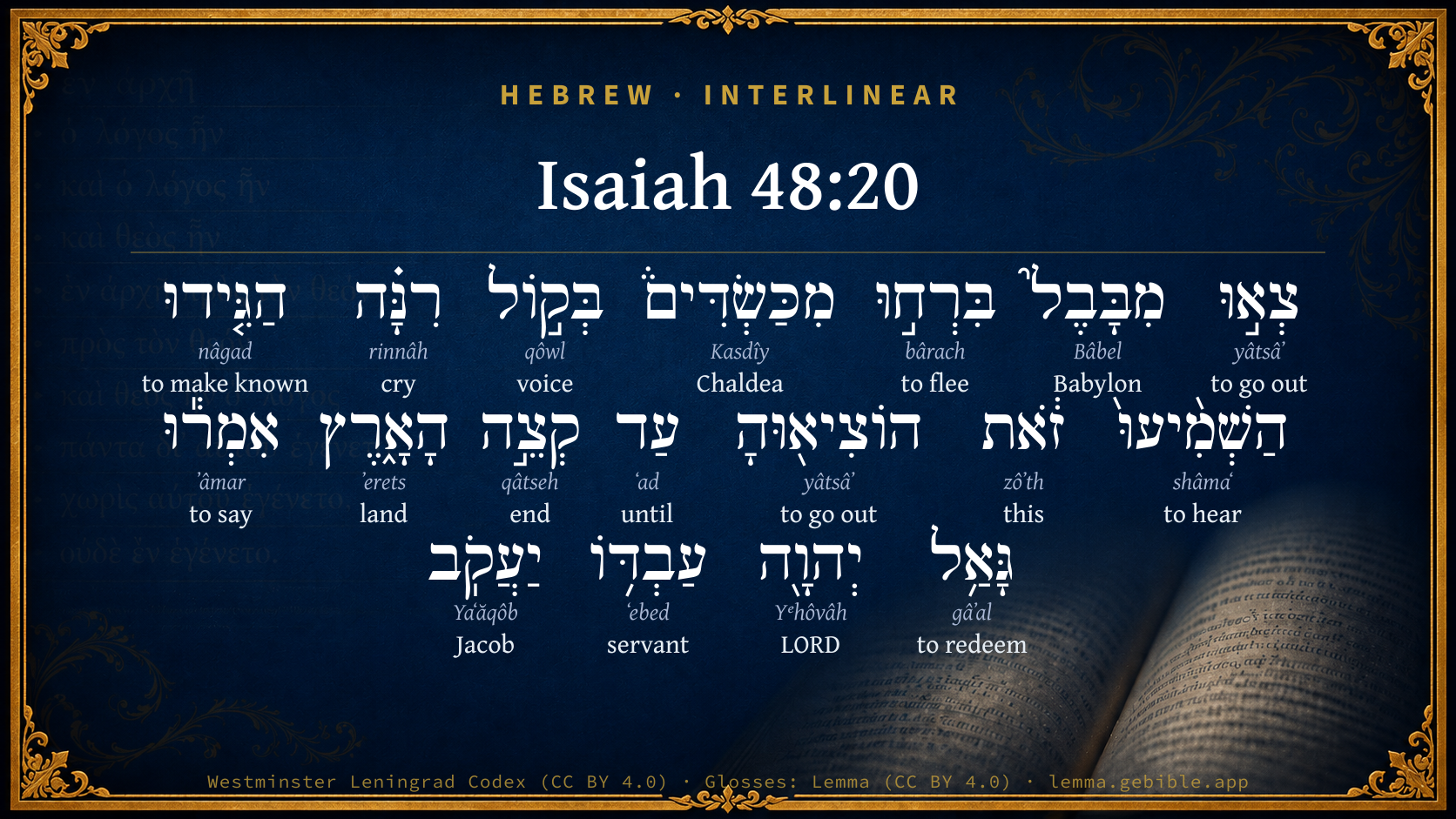
Isaiah 48:20

Hebrew (Westminster Leningrad Codex) Isaiah 48:20 appears in the Hebrew Old Testament. The text above is from the Westminster Leningrad Codex. Each word links to its Strong’s number, a concise gloss, and parsing drawn from the Open Scriptures Hebrew Bible morphology. Click any word for its full Brown-Driver-Briggs (BDB) entry.
Download image
Cite this verse

Isaiah 48:20 (World English Bible). Public Domain. Lemma interlinear Bible study tool, https://lemma.gebible.app/v/isaiah/48/20.

Show BibTeX & RIS
BibTeX
RIS
English Translation
Go you forth from Babylon, flee you from the Chaldeans; with a voice of singing declare you, tell this, utter it even to the end of the earth: say you, Yahweh has redeemed his servant Jacob.
World English Bible · Public Domain
Download a study sheet

One document with this verse’s original text, its word-by-word gloss line, the meaning frame, cross-references with their text, attributed commentary, and full source and license credits — printable, and it pastes into notes with its structure intact.

This verse Autodidact and up

Study sheet (.html) Plain text (.txt)

A passage Seminary Student

Up to 50 verses in one chapter. A passage sheet keeps up to 6 commentary sources and 12 cross-references per verse, in the order this page ranks them, and says so on the sheet whenever that leaves anything out. Ask for a single verse and you get the Autodidact verse sheet above.

Everything on this page stays free to read, with no account — the sheet is a download of what is already on screen, not access to it.

Want to remove ads? Support Godless Engineer
Compare translations 3

The same verse in 3 English versions, stacked beneath the original-language interlinear above. Click any original word for its lexicon entry.

Each is an independent rendering of the whole verse — the interlinear is not word-aligned to these translations.

Highlighted words mark where these versions differ — a whole-verse word diff, not a word-by-word alignment.

  • World English Bible Public Domain
    Go you forth from Babylon, flee you from the Chaldeans; with a voice of singing declare you, tell this, utter it even to the end of the earth: say you, Yahweh has redeemed his servant Jacob.
  • King James Version Public Domain
    Go ye forth of Babylon, flee ye from the Chaldeans, with a voice of singing declare ye, tell this, utter it even to the end of the earth; say ye, The LORD hath redeemed his servant Jacob.
  • unfoldingWord Literal Text CC BY-SA 4.0
    Go out from Babylon, flee from the Chaldeans! With a voice of singing, declare, make this heard. Bring it out to the end of the earth; say, “Yahweh has redeemed his servant Jacob.”

unfoldingWord Literal Text — © unfoldingWord, licensed CC BY-SA 4.0. Word-aligned USFM3 via Door43 (git.door43.org/unfoldingWord/en_ult).

Versions to compare (up to 4)

3 of 4 selected

Show all 18 translations

Every available English version of this verse, each an independent rendering of the whole verse.

  • World English Bible Public Domain
    Go you forth from Babylon, flee you from the Chaldeans; with a voice of singing declare you, tell this, utter it even to the end of the earth: say you, Yahweh has redeemed his servant Jacob.
  • Berean Standard Bible Public Domain
    Leave Babylon! Flee from the Chaldeans! Declare it with a shout of joy, proclaim it, let it go out to the ends of the earth, saying, “The LORD has redeemed His servant Jacob!”
  • Majority Standard Bible Public Domain
    Leave Babylon! Flee from the Chaldeans! Declare it with a shout of joy, proclaim it, let it go out to the ends of the earth, saying, “The LORD has redeemed His servant Jacob!”
  • King James Version Public Domain
    Go ye forth of Babylon, flee ye from the Chaldeans, with a voice of singing declare ye, tell this, utter it even to the end of the earth; say ye, The LORD hath redeemed his servant Jacob.
  • American Standard Version (1901) Public Domain
    Go ye forth from Babylon, flee ye from the Chaldeans; with a voice of singing declare ye, tell this, utter it even to the end of the earth: say ye, Jehovah hath redeemed his servant Jacob.
  • Revised Version (1885) Public Domain
    Go ye forth of Babylon, flee ye from the Chaldeans; with a voice of singing declare ye, tell this, utter it even to the end of the earth: say ye, The LORD hath redeemed his servant Jacob.
  • Geneva Bible (1599) Public Domain
    Goe yee out of Babel: flee yee from the Chaldeans, with a voice of ioy: tel and declare this: shewe it foorth to the ende of the earth: say yee, The Lord hath redeemed his seruant Iaakob.
  • Douay-Rheims (1899) Public Domain
    Come forth out of Babylon, flee ye from the Chaldeans, declare it with the voice of joy: make this to be heard, and speak it out even to the ends of the earth. Say: The Lord hath redeemed his servant Jacob.
  • Young's Literal Translation Public Domain
    Go out from Babylon, flee from the Chaldeans, With a voice of singing declare, Cause ye this to be heard, Bring it forth unto the end of the earth, Say, Redeemed hath Jehovah His servant Jacob.
  • Literal Standard Version CC BY-SA 4.0
    Go out from Babylon, flee from the Chaldeans, || Declare with a voice of singing, || Cause this to be heard, || Bring it forth to the end of the earth, || Say, “YHWH has redeemed His servant Jacob.”
  • Unlocked Literal Bible CC BY-SA 4.0
    Come out from Babylon! Flee from the Chaldeans! With the sound of a ringing cry announce it! Make this known, make it go out to the ends of the earth! Say, 'Yahweh has redeemed his servant Jacob.'
  • unfoldingWord Literal Text CC BY-SA 4.0
    Go out from Babylon, flee from the Chaldeans! With a voice of singing, declare, make this heard. Bring it out to the end of the earth; say, “Yahweh has redeemed his servant Jacob.”
  • Darby Bible Public Domain
    Go ye forth from Babylon, flee from the Chaldeans, with a voice of singing; declare, cause this to be heard, utter it to the end of the earth; say ye, Jehovah hath redeemed his servant Jacob.
  • World Messianic Bible Public Domain
    Leave Babylon! Flee from the Kasdim! With the sound of joyful shouting announce this, tell it even to the end of the earth; say, “The LORD has redeemed his servant Jacob!”
  • Webster's Bible Public Domain
    Go ye forth from Babylon, flee ye from the Chaldeans, with a voice of singing declare ye, tell this, utter it even to the end of the earth; say ye, The LORD hath redeemed his servant Jacob.
  • Free Bible Version CC BY-SA 4.0
    Leave Babylon! Run away from Babylonia with happy shouts! Let everyone know, telling the whole earth, “The Lord has redeemed his servant Jacob!”
  • Bible in Basic English Public Domain
    Go out of Babylon, go in flight from the Chaldaeans; with the sound of song make it clear, give the news, let the word go out even to the end of the earth: say, The Lord has taken up the cause of his servant Jacob.
  • JPS Tanakh (1917) Public Domain
    Go ye forth from Babylon, flee ye from the Chaldeans; with a voice of singing declare ye, tell this, utter it even to the end of the earth; say ye: 'The LORD hath redeemed His servant Jacob.

Literal Standard Version (2020), Covenant Press — licensed CC BY-SA 4.0. Text via the HelloAO Bible API (eBible.org). Unlocked Literal Bible (unfoldingWord) — licensed CC BY-SA 4.0. Text via the HelloAO Bible API (eBible.org). unfoldingWord Literal Text — © unfoldingWord, licensed CC BY-SA 4.0. Word-aligned USFM3 via Door43 (git.door43.org/unfoldingWord/en_ult). Free Bible Version, Dr. Jonathan Gallagher — licensed CC BY-SA 4.0. Text via the HelloAO Bible API (eBible.org).

Word by word

More ways to search: Search by grammar → Find every occurrence → Compare this word →

Practice this passage: Drill this verse → Learn its vocabulary →

רִנָּ֗ה
rinnâh
H7440
“cry”
Noun, Common, Feminine, Singular, Absolute
Part of Speech
Noun
Type
Common
Gender
Feminine
Number
Singular
State
Absolute
Full BDB Definition

Origin: from H7442

TWOT: 2179c

ringing cry - of entreaty, supplication - in proclamation, joy, praise
  1. צְא֣וּ yâtsâʼ H3318 “go out” Verb, Qal, Imperative, 2nd Person, Masculine, Plural
  2. מִבָּבֶל֮ Bâbel H894 “from · Babylon” Preposition + Noun, Proper
  3. בִּרְח֣וּ bârach H1272 “flee” Verb, Qal, Imperative, 2nd Person, Masculine, Plural
  4. מִכַּשְׂדִּים֒ Kasdîy H3778 “from · Chaldea” Preposition + Noun, Proper
  5. בְּק֣וֹל qôwl H6963 “in/at · voice of” Preposition + Noun, Common, Masculine, Singular, Construct
  6. הַגִּ֤ידוּ nâgad H5046 “make known” Verb, Hiphil, Imperative, 2nd Person, Masculine, Plural
  7. הַשְׁמִ֨יעוּ֙ shâmaʻ H8085 “hear” Verb, Hiphil, Imperative, 2nd Person, Masculine, Plural
  8. זֹ֔את zôʼth H2063 “this” Pronoun, Demonstrative, Feminine, Singular
  9. הוֹצִיא֖וּהָ yâtsâʼ H3318 “go out · her” Verb, Hiphil, Imperative, 2nd Person, Masculine, Plural + Suffix, Personal, 3rd Person, Feminine, Singular
  10. עַד ʻad H5704 “until” Preposition
  11. קְצֵ֣ה qâtseh H7097 “end of” Noun, Common, Both, Singular, Construct
  12. הָאָ֑רֶץ ʼerets H776 “the · land” Particle, Definite Article + Noun, Common, Both, Singular, Absolute
  13. אִמְר֕וּ ʼâmar H559 “say” Verb, Qal, Imperative, 2nd Person, Masculine, Plural
  14. גָּאַ֥ל gâʼal H1350 “to redeem” Verb, Qal, Perfect, 3rd Person, Masculine, Singular
  15. יְהוָ֖ה Yᵉhôvâh H3068 “LORD” Noun, Proper
  16. עַבְדּ֥וֹ ʻebed H5650 “servant · his” Noun, Common, Masculine, Singular, Construct + Suffix, Personal, 3rd Person, Masculine, Singular
  17. יַעֲקֹֽב Yaʻăqôb H3290 “Jacob” Noun, Proper

About this verse

These counts appear in no published source. They are computed here, from the morphology-tagged text and Lemma’s own curated glosses. What Lemma adds →

18
words
17
distinct lemmas
Prophets
section

Shared distinctive vocabulary

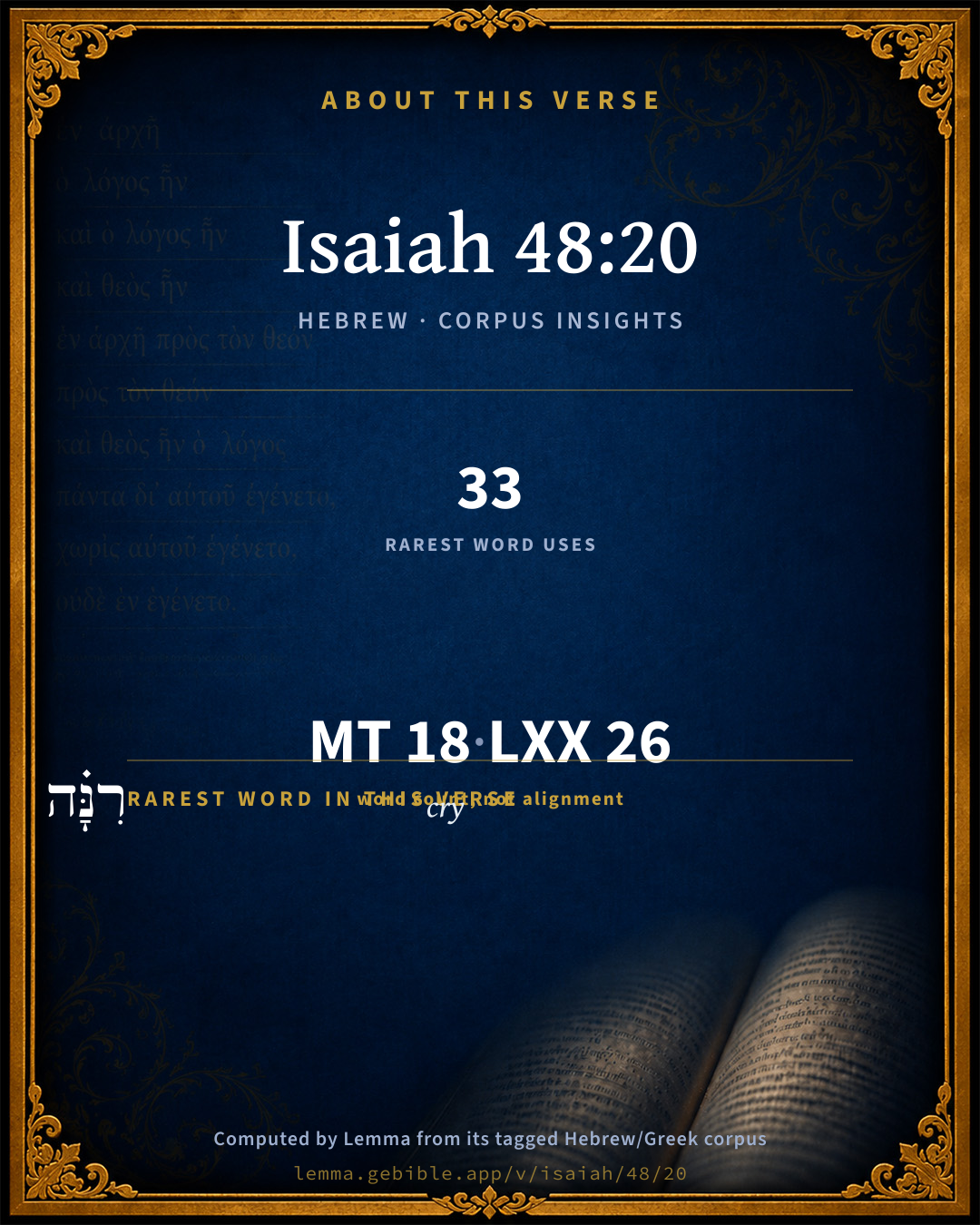
רִנָּ֗ה cry H7440 occurs in 33 verses of the Hebrew Bible. Also found in:

Grammatical profile

  • 7 verbs
  • 9 nouns
  • 1 pronoun
  • 1 preposition

Verb forms

  • צְא֣וּ Qal · Imperative
  • בִּרְח֣וּ Qal · Imperative
  • הַגִּ֤ידוּ Hiphil · Imperative
  • הַשְׁמִ֨יעוּ֙ Hiphil · Imperative
  • הוֹצִיא֖וּהָ Hiphil · Imperative
  • אִמְר֕וּ Qal · Imperative
  • גָּאַ֥ל Qal · Perfect

Repetition

A word recurs within this verse — often emphatic in Hebrew:

  • צְא֣וּ to go out H3318 ×2

Hebrew & Septuagint length

In English translation the verse runs 36 words from the Hebrew and 39 from the Septuagint (LXX English) — closely comparable.

A rough comparison of the two English renderings, which tokenize alike — not a word-level alignment.

Word counts can differ between the Hebrew and the Greek without any difference in meaning — e.g. the Hebrew direct-object marker אֵת has no separate Greek word, and Greek often adds the article ὁ.

In the original languages it is 18 Hebrew tokens and 26 Greek tokens — but the two are counted differently (Hebrew bundles its prefixes and suffixes into one token; the Greek is in lemma form), so that isn’t a like-for-like length.

Cross-references

23

Topical passages linked to Isaiah 48:20 in the Treasury of Scripture Knowledge — connected by theme and wording, ordered by reader-vote popularity; previews shown in the World English Bible.

  • Isaiah 52:9 Break forth into joy, sing together, you waste places of Jerusalem; for Yahweh has comforted his people, he has redeemed Jerusalem.
  • Jeremiah 50:8 Flee out of the midst of Babylon, and go forth out of the land of the Chaldeans, and be as the male goats before the flocks.
  • Jeremiah 51:45 My people, go you out of the midst of her, and save yourselves every man from the fierce anger of Yahweh.
  • Jeremiah 51:6 Flee out of the midst of Babylon, and save every man his life; don't be cut off in her iniquity: for it is the time of Yahweh's vengeance; he will render to her a recompense.
  • Revelation 18:4 I heard another voice from heaven, saying, "Come out of her, my people, that you have no participation in her sins, and that you don't receive of her plagues,
  • Zechariah 2:6–7 Come! Come! Flee from the land of the north,' says Yahweh; 'for I have spread you abroad as the four winds of the sky,' says Yahweh.
  • Exodus 15:1–21 Then Moses and the children of Israel sang this song to Yahweh, and said, "I will sing to Yahweh, for he has triumphed gloriously: The horse and his rider he has thrown into the sea.
  • Exodus 19:4–6 'You have seen what I did to the Egyptians, and how I bore you on eagles' wings, and brought you to myself.
  • Isaiah 26:1 In that day shall this song be sung in the land of Judah: we have a strong city; salvation will he appoint for walls and bulwarks.
  • Isaiah 45:22–23 Look to me, and be you saved, all the ends of the earth; for I am God, and there is none else.
  • Isaiah 49:13 Sing, heavens; and be joyful, earth; and break forth into singing, mountains: for Yahweh has comforted his people, and will have compassion on his afflicted.
  • Isaiah 63:9 In all their affliction he was afflicted, and the angel of his presence saved them: in his love and in his pity he redeemed them; and he bore them, and carried them all the days of old.
  • Revelation 19:1–6 After these things I heard something like a loud voice of a great multitude in heaven, saying, "Hallelujah! Salvation, power, and glory belong to our God:
  • Psalms 126:1 When Yahweh brought back those who returned to Zion, We were like those who dream.
  • Isaiah 48:6 You have heard it; see all this; and you, will you not declare it? I have shown you new things from this time, even hidden things, which you have not known.
  • Isaiah 52:11 Depart you, depart you, go you out from there, touch no unclean thing; go you out of the midst of her; cleanse yourselves, you who bear the vessels of Yahweh.
  • Jeremiah 31:10 Hear the word of Yahweh, you nations, and declare it in the isles afar off; and say, He who scattered Israel will gather him, and keep him, as shepherd does his flock.
  • Jeremiah 31:12–13 They shall come and sing in the height of Zion, and shall flow to the goodness of Yahweh, to the grain, and to the new wine, and to the oil, and to the young of the flock and of the herd: and their soul shall be as a watered garden; and they shall not sorrow any more at all.
  • Jeremiah 50:2 Declare you among the nations and publish, and set up a standard; publish, and don't conceal: say, Babylon is taken, Bel is disappointed, Merodach is dismayed; her images are disappointed, her idols are dismayed.
  • Jeremiah 51:48 Then the heavens and the earth, and all that is therein, shall sing for joy over Babylon; for the destroyers shall come to her from the north, says Yahweh.
  • Revelation 18:20 Rejoice over her, O heaven, you saints, apostles, and prophets; for God has judged your judgment on her."
  • 2 Samuel 7:23 What one nation in the earth is like your people, even like Israel, whom God went to redeem to himself for a people, and to make him a name, and to do great things for you, and awesome things for your land, before your people, whom you redeem to you out of Egypt, [from] the nations and their gods?
  • Isaiah 12:1 In that day you will say, "I will give thanks to you, Yahweh; for though you were angry with me, your anger has turned away and you comfort me.

Cross-references courtesy of OpenBible.info (CC BY 4.0).

Hebrew and Greek witnesses Masoretic Hebrew ↔ Greek Septuagint

The same verse in the two great witnesses to the Old Testament, shown verse-for-verse.

These are two independent witnesses, not word-aligned to each other, and the Septuagint is shown in lemma (dictionary) form.

Hebrew Isaiah 48:20 Masoretic · Westminster Leningrad Codex

צְא֣וּ מִבָּבֶל֮ בִּרְח֣וּ מִכַּשְׂדִּים֒ בְּק֣וֹל רִנָּ֗ה הַגִּ֤ידוּ הַשְׁמִ֨יעוּ֙ זֹ֔את הוֹצִיא֖וּהָ עַד קְצֵ֣ה הָאָ֑רֶץ אִמְר֕וּ גָּאַ֥ל יְהוָ֖ה עַבְדּ֥וֹ יַעֲקֹֽב

Go you forth from Babylon, flee you from the Chaldeans; with a voice of singing declare you, tell this, utter it even to the end of the earth: say you, Yahweh has redeemed his servant Jacob.

World English Bible · Public Domain

Greek LXX Isaiah 48:20 Septuagint · lemma form

ἐκἔρχομαι ἐκ βαβυλών φεύγω ἀπό ὁ χαλδαῖος φωνή εὐφροσύνη ἀναἀγγέλλω καί ἀκουστός γίγνομαι οὗτος ἀποἀγγέλλω ἕως ἔσχατος ὁ γῆ λέγω ῥύομαι κύριος ὁ δοῦλος αὐτός ἰακώβ

Go forth of Babylon, you that flee from the Chaldeans: utter aloud a voice of joy, and let this be made known, proclaim it to the end of the earth; say you⌃, The Lord has delivered his servant Jacob.

LXX2012 (modern English Septuagint) · Public Domain

On this verse, Adam Clarke's Commentary discusses the Septuagint’s reading. Read the note in Commentary ↓

Hebrew: Westminster Leningrad Codex (CC BY 4.0). Greek: Septuagint (public domain); English from LXX2012 (modern English Septuagint) (Public Domain). How the Septuagint differs from the Hebrew →

Targum (Aramaic paraphrase)

1

The Targum is the ancient Jewish Aramaic paraphrase of the Hebrew Scriptures — an interpretive translation, not the Hebrew text itself. Onkelos (literal) and Pseudo-Jonathan (expansive) render the Torah, and Jonathan the Prophets. Coverage is partial: where no permissively-licensed English translation exists for a verse, only the Aramaic is shown. This is verse-level text, not a word-by-word alignment to the Hebrew.

  1. Targum Jonathan Prophets (Joshua–Malachi)
    פּוּקוּ מִבָּבֶל עֲרוּקוּ מִמְדִינַת אֲרַע כַּסְדָאֵי בְּקַל תּוּשְׁבַּחְתָּא חַווּ וּבַסַרוּ דָא אַפְקוּהָא עַד סְיָפֵי אַרְעָא אֱמָרוּ פְּרַק יְיָ עַבְדוֹהִי דְבֵית יַעֲקֹב:

    Go ye forth from Babylon, flee ye from the province of the land of the Chaldeans, declare ye with a voice of singing, bring the joyful tidings of this, bring it to the ends of the earth, say ye, The Lord hath redeemed His servants of the house of Jacob.

    Targum Jonathan — Aramaic: “Mikraot Gedolot” (public domain). English: “Sefaria Community Translation” (CC0 1.0 (public-domain dedication)); “London "Chaldee Paraphrase," 1871” (public domain). Text via Sefaria.

Commentary

Notes on Isaiah 48:20 from classic Christian and Jewish commentators (each source and its license shown beneath its notes). The classic Christian expositions comment on the surrounding passage and are grouped to its opening verse, so a note may address several verses; the Jewish commentaries on the Tanakh (Rashi and others) are per-verse, so they appear only where the commentator wrote on this verse.

Lemma curates 59 commentaries, every one of them public domain or Creative Commons licensed, each selected and text-cleaned for this edition rather than reprinted as found. About our sources →

Trapp's Complete Commentary

John Trapp

Isa 48:20 Go ye forth of Babylon, flee ye from the Chaldeans, with a voice of singing declare ye, tell this, utter it [even] to the end of the earth; say ye, The LORD hath redeemed his servant Jacob.

Ver. 20. Go ye forth of Babylon.] The word among the Jews that despaired of ever returning from Babylon: but the prophet, by an unexpected alarm, commandeth them to return, showing how and why they should do so, and carrieth himself no otherwise than as if he had been a captain in the midst of those captives, &c.

John Trapp, A Commentary or Exposition upon All the Books of the Old and New Testament (1647–1656) — public domain. Text from a community e-Sword module.

The Biblical Illustrator

Joseph S. Exell

Isa_48:20-21

Go ye forth of Babylon

Summoned to an exodus

There has never been an era in which Gods people have not been face to face with a great principle of evil, embodied in a city, confederation, or conspiracy of darkness.

Always the same spirit under differing forms. This great system is as strong to-day as when the massive walls of Babylon enclosed their millions, and proudly dominated the world. Some have identified it with the Church of Rome, or the spirit of ecclesiastical assumption, but it is better to consider it as that element which is ever working through human society, which is spoken of as the world. We are therefore warranted in applying to present surroundings every item in the description given of the olden foe of Israel, and of heeding the summons to go forth.

I. SENT TO BABYLON. Gods ideal for the chosen people is set forth under a beautiful similitude (Isa_48:18). This ideal is within the reach of everyone who will hearken to Gods commandments. But if we refuse, we may have to pass, as Israel did, into the furnace of suffering in the Babylon of the world.

II. LIFE IN BABYLON. The mighty city was called the Lady of kingdoms. We must think of her with massive walls, broad spaces, colossal bulls guarding the entrances to vast temples with flights of stairs and terraces; with pyramids, towers, and hanging-gardens; her wharves receiving the freights of the Indian Ocean; her marts thronged with the merchants of the world; her streets teeming with tributary populations. But right across her splendour ran the fatal bars of cruelty, luxury, wickedness, and devil-worship. Amid such scenes the Jews spent the weary years of their captivity. But through this awful discipline there was slowly emerging a nobler, loftier ideal, which was fostered by the ancient words that foretold their destiny. It was not possible that they should be long holden by their captors. Were they not the elect people of God, destined to bless the world? Yes, they might be in Babylon, like many another captive people, but they had a great hope at their heart. And in the light of that hope, under the searching fires of their anguish, they for ever abandoned their love for idolatry. Some are now in their Babylon. They look back to a sunny past, which might have continued had they not stepped out of the narrow path of obedience. Let such still hope in God: they shall still praise Him; let them repent of their sins and put them away; let them learn the deep lessons which Gods Spirit is endeavouring to teach; let them dare to praise God for the discipline of pain. Presently the clarion call of the exodus will ring out.

III. EXODUS FROM BABYLON. The old order was changing and giving place to the new. From the ruins of the mightiest city that, perhaps, the world has ever seen, the Jews are bidden to go forth. The summons for an exodus rings out to the Church of the living God. (F. B. Meyer, B. A.)

The Biblical Illustrator, edited by Joseph S. Exell (c. 1880s–1900s) — public domain. Text from a community e-Sword module.

Joseph Benson's Commentary

Isa 48:20-21. Go ye forth of Babylon — The imperative is here, as it is very frequently, put for the future, ye shall go forth, &c. For the words do not so much contain a command as a promise. This form of speaking, however, may be the rather used to intimate, that it was their duty to go forth, as well as God’s promise to carry them forth. Flee ye from the Chaldeans — Not silently and sorrowfully, but with a voice of singing — With joy, and songs of praise to the Lord. Declare ye, &c., even to the end of the earth — Publish God’s wonderful works on your behalf to all nations. A figure this of the publishing of the gospel to all the world. And they thirsted not, &c. — This is part of the matter which the Jews are here commanded to declare to all people, as they had opportunity, namely, that God took the same care of them in their return from Babylon to Canaan, which was through many dry and desolate places, as he did of their forefathers, in their march from Egypt to Canaan. They thirsted not, &c. — That is, They shall not thirst. He speaks of things to come, as if they were already present or past, as the prophets commonly did. He caused the waters to flow out of the rock, &c. — “If this prophecy,” says Kimchi, “relate to the return from the Babylonish captivity, as it seems to do, it is to be wondered how it comes to pass, that in the book of Ezra, in which he gives an account of their return, no mention is made, that such miracles were wrought for them; as, for instance, that God clave the rock for them in the desert.” On this strange observation of the learned rabbi, Bishop Lowth remarks as follows: “It is really much to be wondered, that one of the most learned and judicious Jewish expositors of the Old Testament, having advanced so far in a large comment on Isaiah, should appear to be totally ignorant of the prophet’s manner of writing; of the parabolic style which prevails in the writings of all the prophets, and more particularly in the prophecy of Isaiah, which abounds throughout in parabolic images, from the beginning to the end: from Hear, O heavens, and give ear, O earth, to the worm and the fire in the last verse. And how came he to keep his wonderment to himself so long? Why did he not expect, that the historian should have related how, as they passed through the desert, cedars, pines, and olive-trees shot up at once on the side of the way to shade them; and that, instead of briers and brambles, the acacia and the myrtle sprang up under their feet, according to God’s promises, Isa 41:19; Isa 55:13? These, and a multitude of the like parabolical or poetical images, were never intended to be understood literally. All that the prophet designed in this place, and which he has executed in the most elegant manner, was an amplification and illustration of the gracious care and protection of God, vouchsafed to his people in their return from Babylon, by an allusion to the miraculous exodus from Egypt.”

Joseph Benson's Commentary on the Old and New Testaments (1811–1818) — public domain. Text from a community e-Sword module.

The Preacher's Complete Homiletical Commentary

Joseph S. Exell (gen. ed.)

THE RIGHT USE OF THE HISTORY OF GOD’S DEALINGS WITH HIS PEOPLE

Isa_48:20-21. Go forth from Babylon! Flee ye from the Chaldeans! With the voice of joy tell this, &c.

Isaiah had prophesied that his fellow-countrymen would be led captive into Babylon; but he was able to look forward to the termination of their captivity, and could speak thus confidently because he knew—1, that God, who was about to consign them for a time, and for corrective purposes, into bondage, also purposed to deliver them therefrom; and 2, that every purpose which God has formed is certain to be accomplished. Assured of these facts, there rises before his prophetic vision two others:—

1. He sees the gates of the prison-city thrown open; yea, the prison-city itself falling; and, standing in spirit before them, he bids them flee from the peril involved in its destruction, into the freedom which the mighty change had once more rendered possible for them. “Go forth from Babylon! Flee ye from the Chaldeans!”

2. He sees the flight accomplished, the pilgrimage from the land of captivity completed safely, and his fellow-countrymen settled down peaceably in the good land promised to their fathers, and he exhorts them to proclaim to the whole world what God has done for them, “With the voice of joy,” &c.

His exhortations are in themselves prophecies of what would happen to them, and the terms of those predictions as to what God would do for His people in the future were suggested by the history of what God had done for them in the past. Those prophecies must not be too literally interpreted; there is no record that God wrought any such miracles for His people during their march from Babylon homewards. What Isaiah wished to impress upon them was, that God would do everything necessary to perfect His deliverance of them, and to sustain them throughout it; and he did this in terms which reminded them how in all the trials through which their fathers had passed they had found God able to deliver them. How terrible was the difficulty to which he refers, and how marvellous the deliverance therefrom (Exo_17:1-6; Num_20:1-11).

Isaiah was enabled thus to instruct and cheer them, because he knew how to make a right use of the history of God’s dealings with His people. He remembered that that history is more than a history; that it is also a revelation and a prophecy—a revelation of what God will always be found to be; a prophecy of what He will always do for His people.

I. The use that Isaiah made of that history, we also ought to make. Two ways of reading the Bible—with a literary interest, with a personal interest. Geology—what it means to an earnest student; what it means to the intelligent owner of a vast estate. With like personal interests we should read the Bible, remembering that God is un changeable, and that the laws on which He has made human welfare and happiness to depend are the same in every age. Reading the Bible thus,

1. we shall love it more and more, for the fullness of its treasures will become more and more clear to us (H. E. I. 613).

2. Fears suggested to us by the difficulties of the Christian pilgrimage, and that otherwise might greatly trouble us, will be driven away; for the history will convey to us the prophetic assurance that in every stage of our pilgrim age, and in every emergency that may arise therein, the grace of God will prove sufficient for us.

II. We are reminded also of our duty in regard to our own experience of God’s dealings with His people. Isaiah here teaches that it would be the duty of redeemed “Jacob “to make known to the whole world what God had done for them. This is the duty of God’s redeemed ones in every age; collectively, and hence the necessity of mission work of various kinds; individually. Let us not forget this (Psa_66:16).

1. Gratitude should move us to do this.

2. Compassion for our fellow-men should teach us to do this.

Heaven will be eternally the realm of song, because there the redeemed of the Lord will never grow weary of making known what He has done for them. “Go forth from Babylon! Flee ye from the Chaldeans! With the voice of joy tell this,” &c.

WATER FROM THE ROCK

Isa_48:21, and Exo_17:6.

Narrate the instructive fact recorded in Exodus 17

This wonderful fact suggests—

I. That human life has its great emergencies. Abraham, Jacob, David, Paul, &c. So with us. Christianity does not exempt us from the sorest trials. Sooner or later, every Christian has his Rephidim in his way to Canaan. Secular misfortunes, family trials, personal spiritual conflicts, &c. Such emergencies are needful for the testing of our principles, and the maintenance and increase of our spiritual vigour.

“We need as much the cross we bear,

As air we breathe, or light we see:

It draws us to Thy side in prayer,

It binds us to our strength in Thee.”

II. That deliverance often comes from most unlikely and unexpected sources. Water from a flinty rock. Redemption from the carpenter’s son at Nazareth. The promulgation of the gospel by fishermen and tentmakers, and in modern times by Carey, the shoemaker; Williams and Thomas, the blacksmiths; and Moffat, the gardener, &c. [1489]

[1489] “God can bring good to His people from the most unlikely sources. Nothing seemed more unlikely to yield water than the barren rock of Horeb. So God often brings refreshing streams of comfort to His people out of hard circumstances. Paul and Silas could sing in the dungeon, and their imprisonment was made the means of adding to their converts in Philippi. The lot of John in Patmos seemed hard and dreary indeed, but at the bidding of Christ, streams of living water gushed forth there, which refreshed the soul of the Apostle at the time, and have followed the Church until the present. Out of the sufferings of the martyrs came joy to themselves and blessings to their descendants. Above all, out of the hard circumstances of the crucified Lord of glory, God has brought forth waters of everlasting life.”

Learn: To confide in God in the greatest emergency. He can help you, whatever it is—however dire. He has promised to support and deliver. Let your trust be determined, heroic, constant.—Alfred Tucker.

I. THE SOURCE OF THE WATERS.

1. Its durability and unchangeableness. It was a rock, and one of peculiar solidity and strength. Time has not been able either to destroy or materially alter it. So the Rock of Ages (Heb_13:8).

2. It was chosen by God Himself. So Jesus is a Saviour of His appointment.

3. It was opened according to Divine appointment by the hand of man. It was a smitten rock. So Jesus “gave His back to the smiters.” And man gave the blow.

II. THE STREAM THAT FLOWED FROM THE ROCK.

1. It saved Israel from perishing. This was its chief use. And it saved them when nothing else could save them. So with the gospel of Jesus Christ.

2. It did more than save. Enabling them to wash away the defilement of the desert, it cleansed the Israelites. Sin pollutes while it destroys. The blood of Jesus Christ cleanseth from all sin, because by it He obtained for His church the gift of the Holy Ghost.

3. It refreshed them. Their strength was so renewed that they rose up, and after fighting a whole day with the Amalekites, they overcame them, and passed on with fresh vigour to Canaan. In like manner the waters of life refresh the people of God.—C. Bradley.

This fact reminds us that Jehovah is the God of providence, working even miracles for the accomplishment of His purposes; while the great Apostle of the Gentiles directs us to Jehovah as the God of grace, when, pointing to it, he exclaims, “that rock was Christ.” View the occurrence—

I. As a seasonable, providential interposition.

1. A period of great distress; myriads of men and women and much cattle without water.

2. An instance of the omnipotence of God—a flinty rock yields water at His command.

3. Encouragement to hope in God, though we see no prospect or way of supply.

II. As an illustration of the grace of our Lord Jesus Christ.

1. The rock is an emblem of Christ, in solidity, strength, shelter, and duration.

2. The smiting of the rock prefigures Christ’s sufferings. He was stricken, smitten of God, that He might bear our sins and carry our sorrows. The body of Christ was indeed smitten, His soul was made an offering for sin.

3. The waters that flowed from the smitten rock represent the benefits we derive from Christ’s atoning sacrifice. How suitable was this supply, how abundant, how lasting! Let there be grateful remembrance of the smitten rock, vigorous prosecution of our journey; we drink to be refreshed and press on. Invite, and bring, our children and friends. Come sinner, thou!

“See from the Rock a fountain rise!

For you in healing streams it rolls;

Money ye need not bring, nor price,

Ye labouring, burdened, sin-sick souls.

Nothing ye in exchange shall give,

Leave all you have and are behind;

Frankly the gift of God receive,

Pardon and peace in Jesus find.”

—John Hirst: The New Evangelist, p. 185.

The Preacher's Complete Homiletical Commentary (gen. ed. Joseph S. Exell; Funk & Wagnalls, c. 1892) — public domain (pre-1929). A full-Bible homiletical/sermon-outline anthology covering 65 of 66 books (2 John is absent from the source module). Text from a community e-Sword module.

Lange's Commentary on the Holy Scriptures

5. SUMMONS TO ISRAEL TO FLEE OUT OF BABYLON

Isa_48:20-21

20          Go ye forth of Babylon.

Flee ye from the Chaldeans, with voice of singing

Declare ye, tell this,

Utter it even to the end of the earth;

Say ye, The Lord hath redeemed his servant Jacob.

21     And they thirsted not when he led them through the deserts:

He caused waters to flow out of the rock for them:

He clave the rock also, and the waters gushed out.

EXEGETICAL AND CRITICAL

Both these verses bear entirely the character of the representation in Isa_48:1-15; that is to say, the chief particulars of chaps. 40–47 are recapitulated. They especially correspond to chaps. 46, 47, which are principally occupied with Babylon. That Babylon must be destroyed, and that redeemed Israel must go free from the destroyed prison, has been variously declared in preceding chapters. It is to be especially noted that wherever the deliverance of Israel and Jehovah as their Redeemer are spoken of, it is always primarily the deliverance from Babylon that is meant (Isa_41:14; Isa_43:1; Isa_43:14; Isa_44:6; Isa_44:22; Isa_44:24 sqq.; Isa_45:13; Isa_45:17; Isa_47:4). We read in Isa_42:22 that Israel is held captive as in a prison. Babylon’s fall is specially announced Isa_43:14; Isa_46:1-2; Isa_47:1 sqq. It is said in Isa_42:10-12; Isa_44:23; Isa_45:6; Isa_45:22-24 that the praise of Jehovah’s acts of deliverance must be sounded to the end of the earth, and be to all nations a guaranty of their own salvation. That on the way the Israelites shall have water in great abundance is promised Isa_41:17-19; Isa_43:19 sq.; Isa_44:3 sq. That the return from Babylon shall not be inferior to the return out of Egypt in miraculous displays of the saving hand of God is stated Isa_42:16; Isa_43:16; Isa_44:27. Thus verses 20, 21 also bear the character of recapitulation. And hence I believe that Isa_48:16 and the verses 17–19 were originally supplements, but through misunderstanding were inserted out of place. As regards particulars, it must be noticed that what is to be proclaimed to the end of the earth begins with The Lord hath redeemed and ends with waters gushed out. The redemption of Israel and its joyful return home must be proclaimed to all nations as a pledge of their own salvation (comp. especially Isa_45:22 sqq.) And particularly this point must be emphasized, to them, that the Lord had now a second time given such a miraculous deliverance to the people Israel. For in that lies even a confirmation of His methodical willing and ability to do. And the waters gushed out occurs again Psa_78:20; Psa_105:41. Moreover see List. [“Unless we are prepared to assume an irrational confusion of language, setting all interpretation at defiance, our only alternative is to conclude, on the one hand, that Isaiah meant to foretell a miraculous supply of water during the journey from Babylon to Jerusalem, or that the whole description is a figurative one, meaning simply that the wonders of the Exodus should be renewed. Against the former is the silence of history; against the latter nothing but the foregone conclusion that this and other like passages must relate exclusively to Babylon and the return from exile.”—J. A. Alexander.]

Lange's Commentary on the Holy Scriptures (Critical, Doctrinal, and Homiletical), ed. John Peter Lange, English translation edited by Philip Schaff (1864–1880) — public domain. Text from a community e-Sword module.

Tyndale Open Study Notes

Tyndale Open Resources

48:20 Leave Babylon: See also 52:11-12; 55:12.

Tyndale Open Study Notes — © Tyndale Open Resources, licensed CC BY-SA 4.0. Text via the HelloAO Bible API.

Geneva Bible (1599)

Geneva Bible translators

After that he had forewarned them of their captivity, and of the cause thereof, he showeth them the great joy that shall come of their deliverance.

Geneva Bible (1599) marginal notes — public domain. Text via Bolls.life.

Jamieson, Fausset & Brown

Robert Jamieson, A. R. Fausset & David Brown

Go . . . forth . . . end of the earth--Primarily, a prophecy of their joyful deliverance from Babylon, and a direction that they should leave it when God opened the way. But the publication of it "to the ends of the earth" shows it has a more world-wide scope antitypically; Rev 18:4 shows that the mystical Babylon is ultimately meant.

redeemed . . . Jacob-- (Isa 43:1; Isa 44:22-23).

Jamieson, Fausset & Brown — Commentary Critical and Explanatory on the Whole Bible (1871) — public domain (CC PDM 1.0). Text via the HelloAO Bible API.

Adam Clarke's Commentary

Verse 20. Tell this - "Make it heard"] Twenty-seven MSS. of Kennicott's, (ten ancient,) many of De Rossi's, and two ancient, of my own, with the Septuagint, Syriac, Chaldee, and Arabic, and one edition, prefix to the verb the conjunction ו vau, והשמיעו vehashmiu.

Adam Clarke's Commentary on the Bible (1810–1826) — public domain. Text from a community e-Sword/MySword module.

Ellicott's Commentary for English Readers

(20) Go ye forth of Babylon . . .—The sorrow and sighing are past, and the prophet speaks to the remnant that shall return. They are to act without fear on the promises of God, on the decree of Cyrus, and to start at once on their homeward journey, and as they go, to proclaim what great things God hath done for them.

A Bible Commentary for English Readers, edited by Charles John Ellicott (1878–1897) — public domain. Text from a community e-Sword module.

John Gill's Exposition

Go ye forth of Babylon,.... Which the Jews had leave to do by the proclamation of Cyrus; and so the people of God will be called to come forth out of mystical Babylon before its destruction, to which these words are applied, Rev 18:4 perhaps this, in the figurative sense, may be a call to the Christians in Jerusalem, now become another Babylon for wickedness, to come out of it a little before its ruin; and may be applied to the call of persons, by the Gospel, from a state of confusion, sin, and darkness, in which they are:

flee ye from the Chaldeans with the voice of singing; not by stealth, or through fear, but openly and publicly, and with all the tokens and demonstrations of joy and gladness. So the Christians separated, from the unbelieving Jews; as will the followers of the Lamb from the antichristian states, Rev 19:1 and so all that are called by grace should flee from the company of wicked men:

declare ye, tell this, utter it even to the end of the earth; this shows that something more than deliverance from the Babylonish captivity is here intended; for what had all the ends of the earth to do with that? even redemption and salvation by Christ, typified by it; which the apostles and ministers of the word are here exhorted to declare, publish, and proclaim, to the ends of the earth; Christ having a people there to be called and saved by him; and accordingly such a declaration has been made, Rom 10:18,

say ye, the Lord hath deemed his servant Jacob; as the people of the Jews from the Babylonish captivity, so the people of God, his spiritual Jacob and Israel, his sons and servants, from sin, Satan, and the world, the law, its curses, and condemnation, by the precious blood of Christ, which is the sum and substance of the Gospel declaration.

John Gill's Exposition of the Whole Bible (1746–1763) — public domain (CC PDM 1.0). Text via the HelloAO Bible API.

Albert Barnes' Notes on the Bible

Go ye forth of Babylon - The prophet now directly addresses those who were in exile in Babylon, and commands them to depart from it. The design of this is, to furnish the assurance that they should be delivered, and to show them the duty of leaving the place of their long captivity when the opportunity of doing it should occur. It is also designed to show that when it should occur, it would be attended with great joy and rejoicing.

Flee ye from the Chaldeans with a voice of singing - With the utmost exultation and joy. They should rejoice that their captivity was ended; they should exult at the prospect of being restored again to their own land.

Utter it even to the end of the earth - It is an event so great and wonderful that all the nations should be made acquainted with it.

The Lord hath redeemed ... - Yahweh has rescued from captivity his people (see the notes at Isa 43:1).

Albert Barnes' Notes on the Bible (1834–1885) — public domain. Text from a community e-Sword/MySword module.

Matthew Poole's English Annotations

Go ye forth of Babylon: the imperative is here, as it is very frequently, put for the future, Ye shall go forth, &c.; for this is not so much a command as a promise; although this form of speech may be the rather used to intimate that it was their duty to go forth, as well as God’s promise to carry them forth.

With a voice of singing; with joy and songs of praise to the Lord. Declare ye; publish God’s wonderful works on your behalf to all nations.

Matthew Poole's English Annotations on the Holy Bible (1683–1685) — public domain. Text from a community e-Sword/MySword module.

Whedon's Commentary on the Bible

Daniel D. Whedon

20-22. Go ye forth of Babylon — The message closes here. The exiled but redeemed ones get orders for a march to Zion. The word flee is not a note of alarm; the speed and joy of coming deliverance is the idea; or possibly Jer_51:45, tallying with the idea in Rev_18:4, may explain this part of the message. But the call is for the voice of song loud enough for the end of the earth to hear. The redemption of Jacob is the subject of the singing.

Thirsted not… the deserts — The exodus memorial is called to mind afresh by this later deliverance; or, that is made the type of this, in that, wonderful as was the provision and supply of that departure across deserts, this shall be greatly more wonderful in these regards. All is spiritual; waters of salvation flowed forth from the smitten rock, and that rock was Christ, accompanying them with ever-living abundance of grace and prosperity. The section closes with a contrast.

No peace… unto the wicked — No shalom — no sound health, no prosperity, to the loose, irregular, undevout sons of Israel, holding adherence half with Jehovah and half with idol or world worship. No peace — no joyful, solid hope — is pronounced to such in this final remonstrance.

Thus the thrilling section ends. God is all, man in himself is nothing, idols are utter nothingness. With these truths divinely established this first series of the three concludes. It began with comfort ye, emphasized. No peace unto the wicked is its last word. Throughout, the struggle with idolatry and its effects has been a travail. This subject has been turned over and over, and viewed from every point with remonstrance and expostulation. It is now exhausted; it comes no more to the foreground. The prophet is also done with Babylon. Nor do we hear any more of Cyrus. From this on, the messages are of hope, not to redeemed sons of Jacob merely, but to all the world.

The Times of Messiah. — CHAPTERS 49-60.

Daniel D. Whedon (gen. ed.), Commentary on the Old and New Testaments (1874–1909) — public domain. Text from a community e-Sword module.

The Pulpit Commentary

Go ye forth of Babylon. A sudden transition from expostulation to exhortation. It might have seemed that no exhortation would be needed; that, as soon as the prison-doors were set open, there would be a general rush to escape. But, when the time came, it was not so. Those only availed themselves of the edict of Cyrus "whose spirit God had raised to go up and build his house". (Ezr_1:5) The wealthier classes, Josephus tells us, ("Ant. Jud:," 11:1) remained. The very poor, it is probable, could not leave. Motives of various kinds detained others. The result was that probably a larger number elected to continue in the country than to return to Palestine. Hence the exhortation to "go forth from Babylon and flee from the Chaldeans" was far from being superfluous. Flee ye from the Chaldeans. Not "flee before them", (see Isa_52:12) as enemies to be feared; but quit them hastily, as corrupters to be avoided. With a voice of singing; rather, with a voice of shouting (Delitzsch), or with a ridging cry (Cheyne). The cry was to reach even to the end of the earth. All the nations were to be informed of the great event, in which they might not feel, but in which they were, deeply interested the deliverance of Israel out of Babylon, which was "the prelude of, and a preparation for, the world"s redemption" (Kay).

The Pulpit Commentary (1880–1919), ed. H.D.M. Spence-Jones & Joseph S. Exell — public domain. Text from a community e-Sword module.

John Wesley's Explanatory Notes

Singing - With joy and songs of praise. Declare - Publish God's wonderful works.

John Wesley, Explanatory Notes Upon the Whole Bible (1754–1765) — public domain. Text via the GEBible commentary corpus.

Keil & Delitzsch

C. F. Keil & F. Delitzsch

So far the address is hortatory. In the face of the approaching redemption, it demands fidelity and faith. But in the certainty that such a faithful and believing people will not be wanting within the outer Israel, the prophecy of redemption clothes itself in the form of a summons. "Go out of Babel, flee from Chaldaea with voice of shouting: declare ye, preach ye this, carry it out to the end of the earth! Say ye, Jehovah hath redeemed Jacob His servant. And they thirsted not: He led them through dry places; He caused water to trickle out of rocks for them; He split rocks, and waters gushed out. There is no peace, saith Jehovah, for the wicked." They are to go out of Babylon, and with speed and joy to leave the land of slavery and idolatry far behind. Bârach does not mean literally to flee in this instance, but to depart with all the rapidity of flight (compare Exo 14:5). And what Jehovah has done to them, is to be published by them over the whole earth; the redemption experienced by Israel is to become a gospel to all mankind. The tidings which are to be sent forth (הוצי) as in Isa 42:1), extend from גאל to the second מים, which is repeated palindromically. Jehovah has redeemed the nation that He chose to be the bearer of His salvation, amidst displays of love, in which the miracles of the Egyptian redemption have been renewed. This is what Israel has to experience, and to preach, so far as it has remained true to its God. But there is no peace, saith Jehovah, to the reshâ‛ı̄m: this is the name given to loose men (for the primary meaning of the verbal root is laxity and looseness), i.e., to those whose inward moral nature is loosened, without firm hold, and therefore in a state of chaotic confusion, because they are without God. The reference is to the godless in Israel. The words express the same thought negatively which is expressed positively in Gal 6:16, "Peace upon the Israel of God." "Shâlōm is the significant and comprehensive name given to the coming salvation. From this the godless exclude themselves; they have no part in the future inheritance; the sabbatical rest reserved for the people of God does not belong to them. With this divine utterance, which pierces the conscience like the point of an arrow, this ninth prophecy is brought to a close; and not that only, but also the trilogy concerning "Babel" in chapters 46-49, and the whole of the first third of these 3 x 9 addresses to the exiles. From this time forth the name Kōresh (Cyrus), and also the name Babel, never occur again; the relation of the people of Jehovah to heathenism, and the redemption from Babylon, so far as it was foretold and accomplished by Jehovah, not only proving His sole deity, but leading to the overthrow of the idols and the destruction of their worshippers. This theme is now exhausted, and comes into the foreground no more. The expression איּים שׁמעוּ, in its connection with עמּי נחמוּ, points at once to the diversity in character of the second section, which commences here.

Keil & Delitzsch — Biblical Commentary on the Old Testament (1861–1891) — public domain (CC PDM 1.0). Text via the HelloAO Bible API. (Old Testament only.)

J. A. Alexander on Isaiah

Joseph Addison Alexander

“Go forth from Babel!” This is a prediction of the deliverance from Babylon, clothed in the form of an exhortation to escape from it. We have no right to assume a capricious change of subject, or a want of all coherence with what goes before. The connection may be thus stated. After the general reproof and promise of the nineteenth verse, he recurs to the great example of deliverance so often introduced before. As if he had said, Israel, notwithstanding his unworthiness, shall be preserved; even in extremity his God will not forsake him; even from Babylon he shall be delivered; and then turning in prophetic vision to the future exiles, he invites them to come forth. “Flee from the Chasdim (or Chaldees)! With a voice of joy.” The last word properly denotes a joyful shout, and not articulate song. The whole phrase means, with the sound or noise of such a shout. It has been made a question whether these words are to be connected with what goes before or with what follows. “Tell this, cause it to be heard.” The Hebrew collocation (tell, cause to be heard, this) cannot be retained in English. “Utter it (cause it to go forth) even to the end of the earth.” Compare Isa 42:10; Isa 43:6. “Say ye, Jehovah hath redeemed His servant Jacob.” The deliverance from Babylon is here referred to, only as one great example of the general truth that God saves His people.

Joseph Addison Alexander, The Prophecies of Isaiah (1846–1847; New York: Scribner, 1870–1878) — public domain. Text from a community e-Sword module.

Scofield Reference Notes

C. I. Scofield

redeemed

Heb. "goel," Redemp. (Kinsman type). (See Scofield "Isa 59:20")

The Scofield Reference Bible (1917 edition), notes by C. I. Scofield — public domain. Text from a community e-Sword module.

unfoldingWord translationNotes

Door43 World Missions Community

General Information:

Yahweh continues speaking to the people of Israel.

to the ends of the earth

The places on the earth that are very far away are spoken of as if they were the places where the earth ends. This phrase also forms a merism and refers to everywhere in between the ends. AT: "to all the farthest places of the earth" or "to the entire earth" (See: Metaphor and Merism)

his servant Jacob

This refers to the descendants of Jacob. AT: "the people of Israel, his servants" (See: Metonymy)

translationWords

Babylon

Chaldea

know

redeem

servant

Jacob

unfoldingWord translationNotes — © Distant Shores Media and the Door43 World Missions Community, licensed CC BY-SA 4.0. Source: git.door43.org/Door43/en_tn.

Ibn Ezra

Rabbi Abraham ibn Ezra

Go ye forth, etc. Now the prophet addresses those in exile.

Utter it, etc. Make it known publicly; not alone that He will redeem His people, He will do wonders to them at their return to Zion. ולא צמאו That they will not thirst in the deserts, through which God will lead them.

Ibn Ezra on the Tanakh — English translations: “Sefaria Community Translation” (CC0 1.0 (public-domain dedication)); “Yalkut, Sifsei Chachomim Chumash, Metsudah Publications, 2009” (CC BY 4.0); and “Commentary of Ibn Ezra on Isaiah - trans. by M. Friedlander, 1873” (public domain). Text via Sefaria.

Lesson kit

Teaching starters — assembled from the data on this page, not authored interpretation. Every prompt links to the verse data it draws on. Edit before teaching.

Isaiah, in the Prophets, opens this verse with 18 words (17 distinct Hebrew lemmas). Its most distinctive word is rinnâh (“cry”). A historical commentator’s framing appears above. Read the whole chapter for the surrounding context.

Discussion questions

  1. What does “cry” (rinnâh) contribute to the verse as a whole?
  2. How does 1 Kings 8:28, which shares the word «cry», read alongside this verse?
  3. What does the repetition of “to go out” (2× in this one verse) do in this verse?
  4. The translations on this page render this verse differently — a whole-verse word diff, not a word-by-word alignment. What might account for the different wordings?
  5. «צְא֣וּ» is a Qal Imperative verb. How does that grammatical form shape the action described?
  6. Compare how Trapp's Complete Commentary and The Biblical Illustrator read this verse. Where do they agree or differ?

Things to notice

Reading settings

Reading text

Shown beneath each verse's original-language words.

Old Testament
Old Testament edition

Read the OT as the Masoretic Hebrew (MT) or the Greek Septuagint (LXX).

English shown for the Greek Septuagint (in the Hebrew ↔ Greek comparison).

Comparing translations? Open the Compare panel on any verse page to stack up to four side by side.