
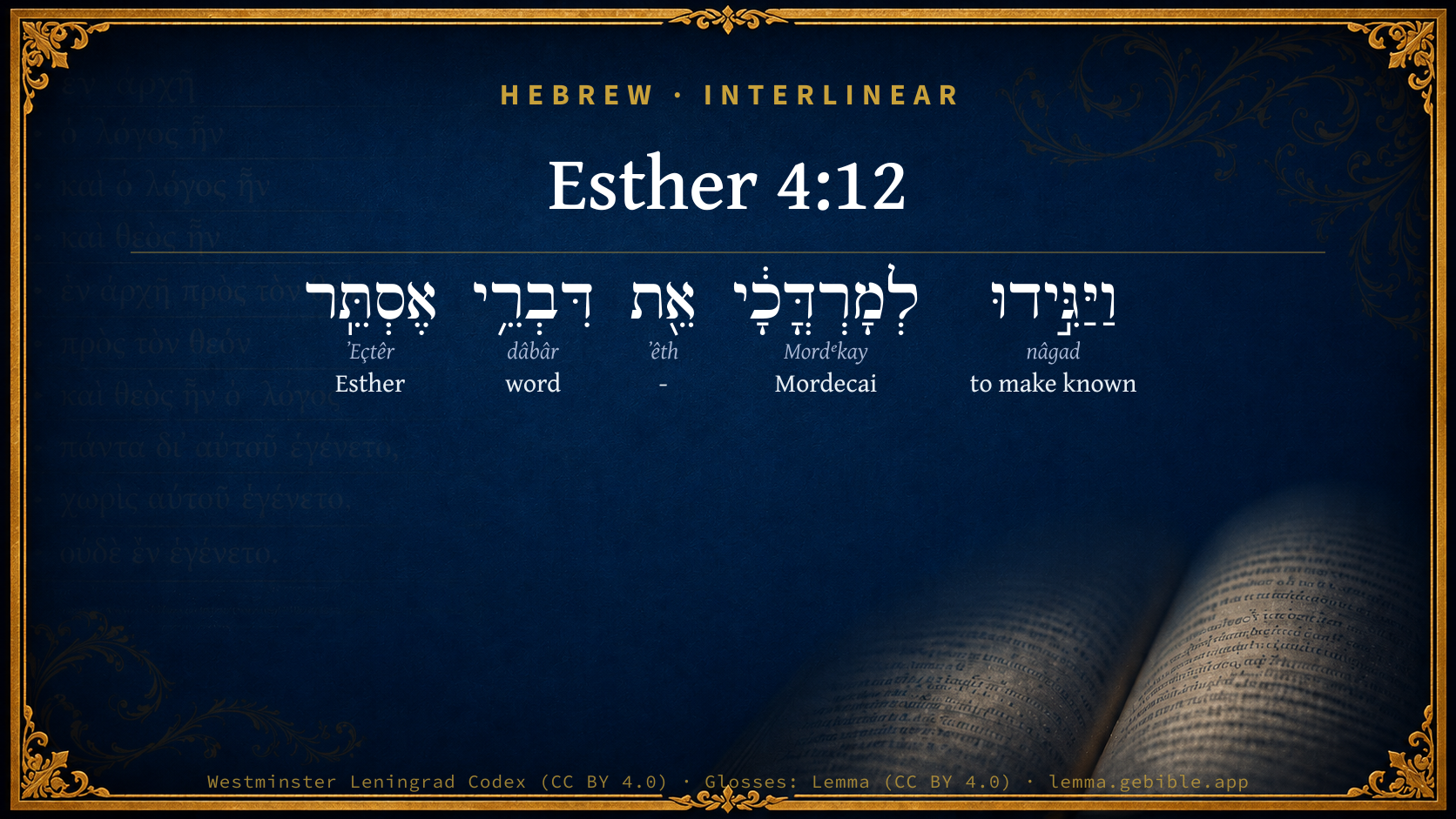
Esther 4:12

Hebrew (Westminster Leningrad Codex) Esther 4:12 appears in the Hebrew Old Testament. The text above is from the Westminster Leningrad Codex. Each word links to its Strong’s number, a concise gloss, and parsing drawn from the Open Scriptures Hebrew Bible morphology. Click any word for its full Brown-Driver-Briggs (BDB) entry.
Download image
Cite this verse

Esther 4:12 (World English Bible). Public Domain. Lemma interlinear Bible study tool, https://lemma.gebible.app/v/esther/4/12.

Show BibTeX & RIS
BibTeX
RIS
English Translation
They told to Mordecai Esther's words.
World English Bible · Public Domain
Download a study sheet

One document with this verse’s original text, its word-by-word gloss line, the meaning frame, cross-references with their text, attributed commentary, and full source and license credits — printable, and it pastes into notes with its structure intact.

This verse Autodidact and up

Study sheet (.html) Plain text (.txt)

A passage Seminary Student

Up to 50 verses in one chapter. A passage sheet keeps up to 6 commentary sources and 12 cross-references per verse, in the order this page ranks them, and says so on the sheet whenever that leaves anything out. Ask for a single verse and you get the Autodidact verse sheet above.

Everything on this page stays free to read, with no account — the sheet is a download of what is already on screen, not access to it.

Want to remove ads? Support Godless Engineer
Compare translations 3

The same verse in 3 English versions, stacked beneath the original-language interlinear above. Click any original word for its lexicon entry.

Each is an independent rendering of the whole verse — the interlinear is not word-aligned to these translations.

Highlighted words mark where these versions differ — a whole-verse word diff, not a word-by-word alignment.

  • World English Bible Public Domain
    They told to Mordecai Esther's words.
  • King James Version Public Domain
    And they told to Mordecai Esther's words.
  • unfoldingWord Literal Text CC BY-SA 4.0
    And they told to Mordecai the words of Esther.

unfoldingWord Literal Text — © unfoldingWord, licensed CC BY-SA 4.0. Word-aligned USFM3 via Door43 (git.door43.org/unfoldingWord/en_ult).

Versions to compare (up to 4)

3 of 4 selected

Show all 18 translations

Every available English version of this verse, each an independent rendering of the whole verse.

  • World English Bible Public Domain
    They told to Mordecai Esther's words.
  • Berean Standard Bible Public Domain
    When Esther’s words were relayed to Mordecai,
  • Majority Standard Bible Public Domain
    When Esther’s words were relayed to Mordecai,
  • King James Version Public Domain
    And they told to Mordecai Esther's words.
  • American Standard Version (1901) Public Domain
    And they told to Mordecai Esther's words.
  • Revised Version (1885) Public Domain
    And they told to Mordecai Esther’s words.
  • Geneva Bible (1599) Public Domain
    And they certified Mordecai of Esters wordes.
  • Douay-Rheims (1899) Public Domain
    And when Mardochai had heard this,
  • Young's Literal Translation Public Domain
    And they declare to Mordecai the words of Esther,
  • Literal Standard Version CC BY-SA 4.0
    And they declare to Mordecai the words of Esther,
  • Unlocked Literal Bible CC BY-SA 4.0
    So Hathak reported Esther's words to Mordecai.
  • unfoldingWord Literal Text CC BY-SA 4.0
    And they told to Mordecai the words of Esther.
  • Darby Bible Public Domain
    And they told Mordecai Esther's words.
  • World Messianic Bible Public Domain
    They told Esther’s words to Mordecai.
  • Webster's Bible Public Domain
    And they told to Mordecai Esther's words.
  • Free Bible Version CC BY-SA 4.0
    When Mordecai was told what Esther said,
  • Bible in Basic English Public Domain
    And they said these words to Mordecai.
  • JPS Tanakh (1917) Public Domain
    And they told to Mordecai Esther's words.

Literal Standard Version (2020), Covenant Press — licensed CC BY-SA 4.0. Text via the HelloAO Bible API (eBible.org). Unlocked Literal Bible (unfoldingWord) — licensed CC BY-SA 4.0. Text via the HelloAO Bible API (eBible.org). unfoldingWord Literal Text — © unfoldingWord, licensed CC BY-SA 4.0. Word-aligned USFM3 via Door43 (git.door43.org/unfoldingWord/en_ult). Free Bible Version, Dr. Jonathan Gallagher — licensed CC BY-SA 4.0. Text via the HelloAO Bible API (eBible.org).

Word by word

More ways to search: Search by grammar → Find every occurrence → Compare this word →

Practice this passage: Drill this verse → Learn its vocabulary →

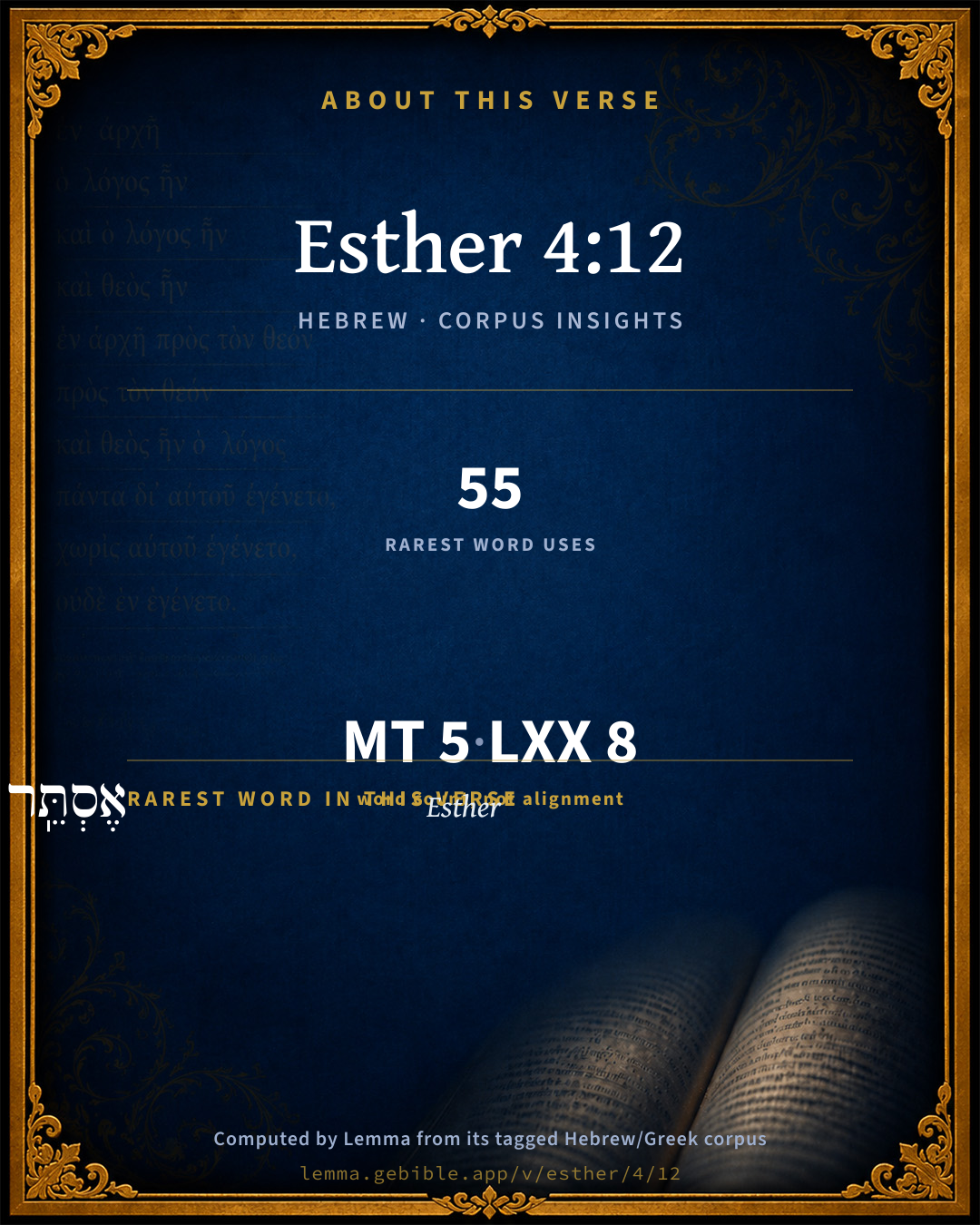
About this verse

These counts appear in no published source. They are computed here, from the morphology-tagged text and Lemma’s own curated glosses. What Lemma adds →

5
words
5
distinct lemmas
Historical
section

Shared distinctive vocabulary

אֶסְתֵּֽר Esther H635 occurs in 45 verses of the Hebrew Bible. Also found in:

Grammatical profile

  • 1 verb
  • 3 nouns
  • 1 particle

Verb forms

  • וַיַּגִּ֣ידוּ Hiphil · Sequential Imperfect

Hebrew & Septuagint length

In English translation the verse runs 6 words from the Hebrew and 10 from the Septuagint (LXX English) — the Septuagint runs noticeably longer here. See the side-by-side →

A rough comparison of the two English renderings, which tokenize alike — not a word-level alignment.

Word counts can differ between the Hebrew and the Greek without any difference in meaning — e.g. the Hebrew direct-object marker אֵת has no separate Greek word, and Greek often adds the article ὁ.

In the original languages it is 5 Hebrew tokens and 8 Greek tokens — but the two are counted differently (Hebrew bundles its prefixes and suffixes into one token; the Greek is in lemma form), so that isn’t a like-for-like length.

Hebrew and Greek witnesses Masoretic Hebrew ↔ Greek Septuagint

The same verse in the two great witnesses to the Old Testament, shown verse-for-verse.

Here the Septuagint runs noticeably longer than the Hebrew — LXX2012 (modern English Septuagint) 10 words vs World English Bible 6. A rough length comparison of the two English translations, not a word-level alignment — read both below.

These are two independent witnesses, not word-aligned to each other, and the Septuagint is shown in lemma (dictionary) form.

Hebrew Esther 4:12 Masoretic · Westminster Leningrad Codex

וַיַּגִּ֣ידוּ לְמָרְדֳּכָ֔י אֵ֖ת דִּבְרֵ֥י אֶסְתֵּֽר

They told to Mordecai Esther's words.

World English Bible · Public Domain

Greek LXX Esther 4:12 Septuagint · lemma form

καί ἀποἀγγέλλω αχραθαῖος μαρδοχαῖος πᾶς ὁ λόγος εσθηρ

And Achrathaeus reported to Mardochaeus all the words of Esther.

LXX2012 (modern English Septuagint) · Public Domain

Hebrew: Westminster Leningrad Codex (CC BY 4.0). Greek: Septuagint (public domain); English from LXX2012 (modern English Septuagint) (Public Domain). How the Septuagint differs from the Hebrew →

Commentary

Notes on Esther 4:12 from classic Christian and Jewish commentators (each source and its license shown beneath its notes). The classic Christian expositions comment on the surrounding passage and are grouped to its opening verse, so a note may address several verses; the Jewish commentaries on the Tanakh (Rashi and others) are per-verse, so they appear only where the commentator wrote on this verse.

Lemma curates 59 commentaries, every one of them public domain or Creative Commons licensed, each selected and text-cleaned for this edition rather than reprinted as found. About our sources →

Trapp's Complete Commentary

John Trapp

Est 4:12 And they told to Mordecai Esther’s words.

Ver. 12. And they told to Mordecai Esther’s words] {See Trapp on "Est 4:9"} She would have been her own messenger, but might not. The greatest are not always the happiest. The Lady Elizabeth once wished herself a merry milk maid.

John Trapp, A Commentary or Exposition upon All the Books of the Old and New Testament (1647–1656) — public domain. Text from a community e-Sword module.

John Gill's Exposition

For if thou altogether holdest thy peace at this time,.... And will not speak to the king in favour of the Jews, because of the danger she would be exposed to in doing it:

then shall there enlargement and deliverance arise to the Jews from another place; Mordecai seemed confident of it, that by some means or another the Jews would be delivered; if not through the intercession of Esther, yet from some other quarter, or by some other hand:

but thou and thy father's house shall be destroyed; for such neglect of the people of God when in distress, want of pity to them, and not exerting herself as she might in their behalf; so that seeing she and her family must perish, it was better to perish in a good cause than in a bad one:

and who knoweth whether thou art come to the kingdom for such a time as this? he intimates that he believed that the providence of God had raised her to that dignity, that she might be an instrument of saving his people in the time of their distress; and this he said to encourage her to make the experiment.

John Gill's Exposition of the Whole Bible (1746–1763) — public domain (CC PDM 1.0). Text via the HelloAO Bible API.

Keil & Delitzsch

C. F. Keil & F. Delitzsch

When what Esther said was reported to Mordochai, he sent word back to her (השׁיב): "Think not in thy soul (with thyself) to be saved in the house of the king above all the Jews; for if thou holdest thy peace at this time, recovery and deliverance will arise from another place, but thou and thy father's house shall be destroyed. And who knows if thou hast attained to royalty for a time such as this?" By the words: "Think not that thou wilt be saved in the king's house above all the Jew," i.e., alone of all the Jews, Mordochai does not reproach Esther with being indifferent to the fate of her fellow-countrymen, but rather calls her attention to the fact that her own life is in danger. This is evident from the clause: if thou hold thy peace, will not intercede with the king for thy people, help will come from some other quarter. רוח = רוחה, Exo 8:11, ἀναψύξις, deliverance from oppressive restraint. יעמוד, rise up, arise, used according to later custom for קוּם, as in Ch1 20:4. The thought is: the Jewish nation cannot perish, its continuance is guaranteed by the divine promise. If thou wilt venture nothing for its safety, God will bring deliverance, but destruction will come upon thee and thy family. Though Mordochai neither speaks of God, nor alludes directly to His assistance, he still grounds his hopes of the preservation of his people upon the word and promise of God, and Brentius pertinently remarks: habes hic excellentem ac plane heroicam Mardochaei fidem, qua in praesentissimo ac periculosissimo discrimine videt futuram liberationem. The last clause of Est 4:14 is by most expositors understood as saying: and who knows whether thou hast not for a time like this attained to royalty? This agrees with the sense, but cannot be verbally justified, for אם does not mean whether not. The sentence contains an aposiopesis. The clause depending on the conditional אם is unspoken, but understood. Besides, הגּעתּ is not in the imperfect. Hence it can only be translated: Who knows, if thou hadst not attained to royalty at or for such a time? Then the clause omitted would be: what thou then wouldst have done. יודע מי more frequently has the meaning of perhaps; and Mordochai says: perhaps thou hast attained to royalty (to the dignity of queen) for a time like this, sc. to use thy position for the deliverance of thy people. In the turn thus given to the sentence it contains the most urgent injunction to Esther to use her high position for the preservation of her fellow-countrymen.

Keil & Delitzsch — Biblical Commentary on the Old Testament (1861–1891) — public domain (CC PDM 1.0). Text via the HelloAO Bible API. (Old Testament only.)

Lesson kit

Teaching starters — assembled from the data on this page, not authored interpretation. Every prompt links to the verse data it draws on. Edit before teaching.

Esther, in the Historical, opens this verse with 5 words (5 distinct Hebrew lemmas). Its most distinctive word is ʼEçtêr (“Esther”). The Greek Septuagint runs longer here. A historical commentator’s framing appears above. Read the whole chapter for the surrounding context.

Discussion questions

  1. What does “Esther” (ʼEçtêr) contribute to the verse as a whole?
  2. Esther 2:7 shares the word «Esther» with this verse. How do the two illuminate each other?
  3. Compared with the Hebrew, the Septuagint runs longer here. What questions does that raise?
  4. These translations render this verse differently; the difference is in the English rendering, not the original. What questions does that raise?
  5. The verb «וַיַּגִּ֣ידוּ» is Hiphil Sequential Imperfect. How does its form color the action?
  6. Reading how Trapp's Complete Commentary and John Gill's Exposition read this verse, where do the two commentators agree and where do they part?

Things to notice

Reading settings

Reading text

Shown beneath each verse's original-language words.

Old Testament
Old Testament edition

Read the OT as the Masoretic Hebrew (MT) or the Greek Septuagint (LXX).

English shown for the Greek Septuagint (in the Hebrew ↔ Greek comparison).

Comparing translations? Open the Compare panel on any verse page to stack up to four side by side.