
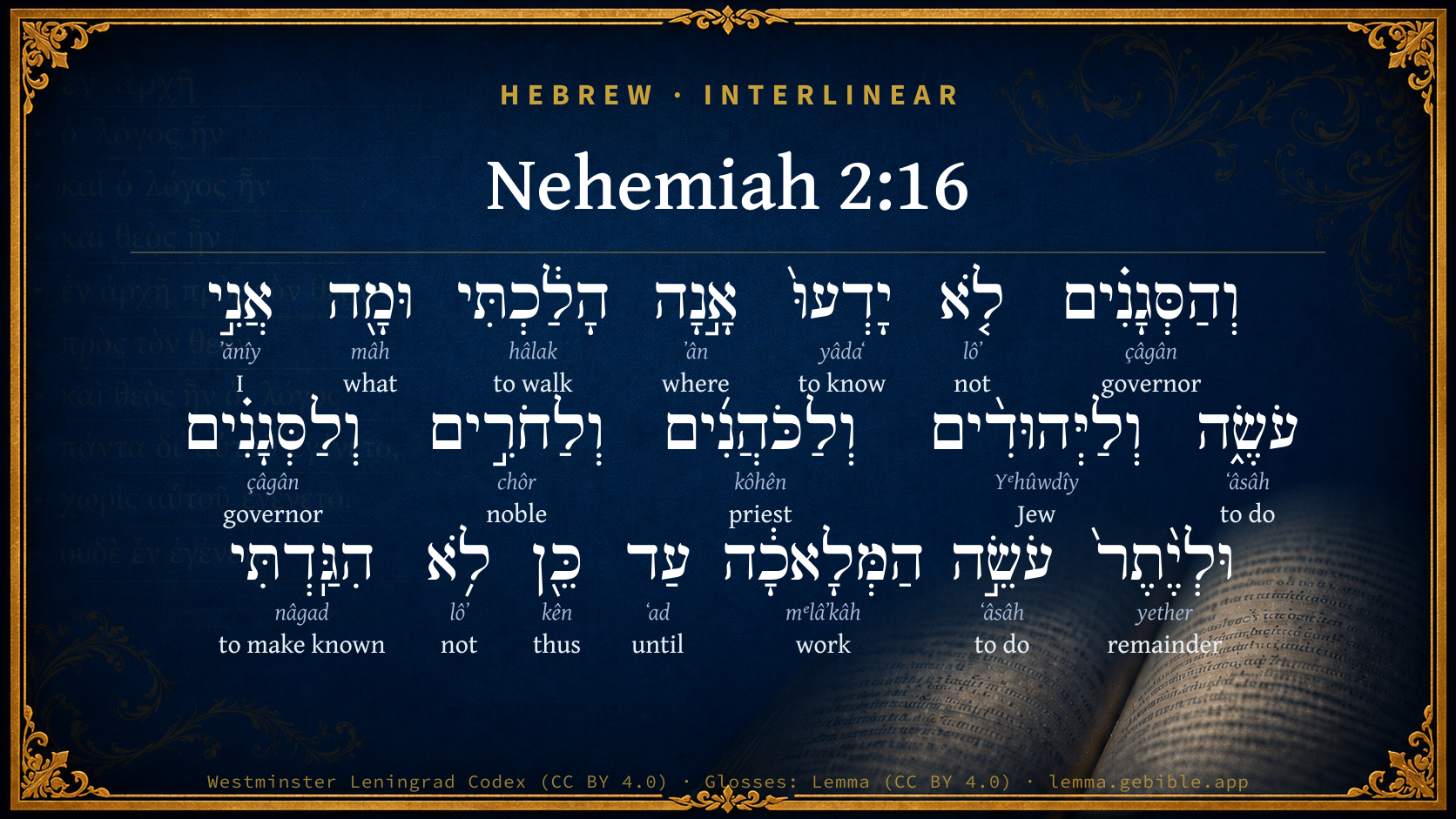
Nehemiah 2:16

Hebrew (Westminster Leningrad Codex) Nehemiah 2:16 appears in the Hebrew Old Testament. The text above is from the Westminster Leningrad Codex. Each word links to its Strong’s number, a concise gloss, and parsing drawn from the Open Scriptures Hebrew Bible morphology. Click any word for its full Brown-Driver-Briggs (BDB) entry.
Download image
Cite this verse

Nehemiah 2:16 (World English Bible). Public Domain. Lemma interlinear Bible study tool, https://lemma.gebible.app/v/nehemiah/2/16.

Show BibTeX & RIS
BibTeX
RIS
English Translation
The rulers didn't know where I went, or what I did; neither had I as yet told it to the Jews, nor to the priests, nor to the nobles, nor to the rulers, nor to the rest who did the work.
World English Bible · Public Domain
Download a study sheet

One document with this verse’s original text, its word-by-word gloss line, the meaning frame, cross-references with their text, attributed commentary, and full source and license credits — printable, and it pastes into notes with its structure intact.

This verse Autodidact and up

Study sheet (.html) Plain text (.txt)

A passage Seminary Student

Up to 50 verses in one chapter. A passage sheet keeps up to 6 commentary sources and 12 cross-references per verse, in the order this page ranks them, and says so on the sheet whenever that leaves anything out. Ask for a single verse and you get the Autodidact verse sheet above.

Everything on this page stays free to read, with no account — the sheet is a download of what is already on screen, not access to it.

Want to remove ads? Support Godless Engineer
Compare translations 3

The same verse in 3 English versions, stacked beneath the original-language interlinear above. Click any original word for its lexicon entry.

Each is an independent rendering of the whole verse — the interlinear is not word-aligned to these translations.

Highlighted words mark where these versions differ — a whole-verse word diff, not a word-by-word alignment.

  • World English Bible Public Domain
    The rulers didn't know where I went, or what I did; neither had I as yet told it to the Jews, nor to the priests, nor to the nobles, nor to the rulers, nor to the rest who did the work.
  • King James Version Public Domain
    And the rulers knew not whither I went, or what I did; neither had I as yet told it to the Jews, nor to the priests, nor to the nobles, nor to the rulers, nor to the rest that did the work.
  • unfoldingWord Literal Text CC BY-SA 4.0
    Now the prefects did not know where I had gone or what I was doing. And until this time I had not yet told the Jews, or the priests, or the nobles, or the prefects, or the rest of the doers of the work.

unfoldingWord Literal Text — © unfoldingWord, licensed CC BY-SA 4.0. Word-aligned USFM3 via Door43 (git.door43.org/unfoldingWord/en_ult).

Versions to compare (up to 4)

3 of 4 selected

Show all 18 translations

Every available English version of this verse, each an independent rendering of the whole verse.

  • World English Bible Public Domain
    The rulers didn't know where I went, or what I did; neither had I as yet told it to the Jews, nor to the priests, nor to the nobles, nor to the rulers, nor to the rest who did the work.
  • Berean Standard Bible Public Domain
    The officials did not know where I had gone or what I was doing, for I had not yet told the Jews or priests or nobles or officials or any other workers.
  • Majority Standard Bible Public Domain
    The officials did not know where I had gone or what I was doing, for I had not yet told the Jews or priests or nobles or officials or any other workers.
  • King James Version Public Domain
    And the rulers knew not whither I went, or what I did; neither had I as yet told it to the Jews, nor to the priests, nor to the nobles, nor to the rulers, nor to the rest that did the work.
  • American Standard Version (1901) Public Domain
    And the rulers knew not whither I went, or what I did; neither had I as yet told it to the Jews, nor to the priests, nor to the nobles, nor to the rulers, nor to the rest that did the work.
  • Revised Version (1885) Public Domain
    And the rulers knew not whither I went, or what I did; neither had I as yet told it to the Jews, nor to the priests, nor to the nobles, nor to the rulers, nor to the rest that did the work.
  • Geneva Bible (1599) Public Domain
    And the rulers knewe not whither I was gone, nor what I did, neither did I as yet tell it vnto the Iewes, nor to the Priestes, nor to the noble men, nor to the rulers, nor to the rest that laboured in the worke.
  • Douay-Rheims (1899) Public Domain
    But the magistrates knew not whither I went, or what I did: neither had I as yet told any thing to the Jews, or to the priests, or to the nobles, or to the magistrates, or to the rest that did the work.
  • Young's Literal Translation Public Domain
    And the prefects have not known whither I have gone, and what I am doing; and to the Jews, and to the priests, and to the freemen, and to the prefects, and to the rest of those doing the work, hitherto I have not declared `it';
  • Literal Standard Version CC BY-SA 4.0
    And the prefects have not known to where I have gone, and what I am doing; and to the Jews, and to the priests, and to the nobles, and to the prefects, and to the rest of those doing the work, until now I have not declared [it];
  • Unlocked Literal Bible CC BY-SA 4.0
    The rulers did not know where I went or what I did, and I had not yet informed the Jews, nor the priests, nor the nobles, nor the rulers, nor the rest who did the work.
  • unfoldingWord Literal Text CC BY-SA 4.0
    Now the prefects did not know where I had gone or what I was doing. And until this time I had not yet told the Jews, or the priests, or the nobles, or the prefects, or the rest of the doers of the work.
  • Darby Bible Public Domain
    And the rulers did not know whither I went or what I did, for I had not as yet told it to the Jews, nor to the priests, nor to the nobles, nor to the rulers, nor to the rest that did the work.
  • World Messianic Bible Public Domain
    The rulers didn’t know where I went, or what I did. I had not as yet told it to the Jews, nor to the priests, nor to the nobles, nor to the rulers, nor to the rest who did the work.
  • Webster's Bible Public Domain
    And the rulers knew not whither I went, or what I did; neither had I as yet told it to the Jews, nor to the priests, nor to the nobles, nor to the rulers, nor to the rest that did the work.
  • Free Bible Version CC BY-SA 4.0
    Those in charge of the city had no idea where I had gone or what I was doing, because I hadn't yet told the Jews, priests, nobles, or officials or any others about the construction plans.
  • Bible in Basic English Public Domain
    And the chiefs had no knowledge of where I had been or what I was doing; and I had not then said anything to the Jews or to the priests or the great ones or the chiefs or the rest of those who were doing the work.
  • JPS Tanakh (1917) Public Domain
    And the rulers knew not whither I went, or what I did; neither had I as yet told it to the Jews, nor to the priests, nor to the nobles, nor to the rulers, nor to the rest that did the work.

Literal Standard Version (2020), Covenant Press — licensed CC BY-SA 4.0. Text via the HelloAO Bible API (eBible.org). Unlocked Literal Bible (unfoldingWord) — licensed CC BY-SA 4.0. Text via the HelloAO Bible API (eBible.org). unfoldingWord Literal Text — © unfoldingWord, licensed CC BY-SA 4.0. Word-aligned USFM3 via Door43 (git.door43.org/unfoldingWord/en_ult). Free Bible Version, Dr. Jonathan Gallagher — licensed CC BY-SA 4.0. Text via the HelloAO Bible API (eBible.org).

Word by word

More ways to search: Search by grammar → Find every occurrence → Compare this word →

Practice this passage: Drill this verse → Learn its vocabulary →

וְלַחֹרִ֣ים
chôr
H2715
“and · to/for the · nobles”
Conjunction + Preposition, Determined + Noun, Common, Masculine, Plural, Absolute
Part of Speech
Conjunction + Preposition + Noun
Type
Common
Gender
Masculine
Number
Plural
State
Absolute
Full BDB Definition

Origin: from H2787

TWOT: 757a

a noble, freeborn one
  1. וְהַסְּגָנִ֗ים çâgân H5461 “and · the · governors” Conjunction + Particle, Definite Article + Noun, Common, Masculine, Plural, Absolute
  2. לֹ֤א lôʼ H3808 “not” Particle, Negative
  3. יָדְעוּ֙ yâdaʻ H3045 “to know” Verb, Qal, Perfect, 3rd Person, Common, Plural
  4. אָ֣נָה ʼân H575 “where” Adverb
  5. הָלַ֔כְתִּי hâlak H1980 “to walk” Verb, Qal, Perfect, 1st Person, Common, Singular
  6. וּמָ֖ה mâh H4100 “and · what” Conjunction + Particle, Interrogative
  7. אֲנִ֣י ʼănîy H589 “I” Pronoun, Personal, 1st Person, Common, Singular
  8. עֹשֶׂ֑ה ʻâsâh H6213 “doing” Verb, Qal, Participle Active, Masculine, Singular, Absolute
  9. וְלַיְּהוּדִ֨ים Yᵉhûwdîy H3064 “and · to/for the · Jews” Conjunction + Preposition, Determined + Noun, Gentilic, Masculine, Plural, Absolute
  10. וְלַכֹּהֲנִ֜ים kôhên H3548 “and · to/for the · priests” Conjunction + Preposition, Determined + Noun, Common, Masculine, Plural, Absolute
  11. וְלַסְּגָנִ֗ים çâgân H5461 “and · to/for the · governors” Conjunction + Preposition, Determined + Noun, Common, Masculine, Plural, Absolute
  12. וּלְיֶ֨תֶר֙ yether H3499 “and · to/for · remainder of” Conjunction + Preposition + Noun, Common, Masculine, Singular, Construct
  13. עֹשֵׂ֣ה ʻâsâh H6213 “doing” Verb, Qal, Participle Active, Masculine, Singular, Construct
  14. הַמְּלָאכָ֔ה mᵉlâʼkâh H4399 “the · work” Particle, Definite Article + Noun, Common, Feminine, Singular, Absolute
  15. עַד ʻad H5704 “until” Preposition
  16. כֵּ֖ן kên H3651 “thus” Particle, Demonstrative
  17. לֹ֥א lôʼ H3808 “not” Particle, Negative
  18. הִגַּֽדְתִּי nâgad H5046 “to make known” Verb, Hiphil, Perfect, 1st Person, Common, Singular

About this verse

These counts appear in no published source. They are computed here, from the morphology-tagged text and Lemma’s own curated glosses. What Lemma adds →

19
words
16
distinct lemmas
Historical
section

Notable vocabulary

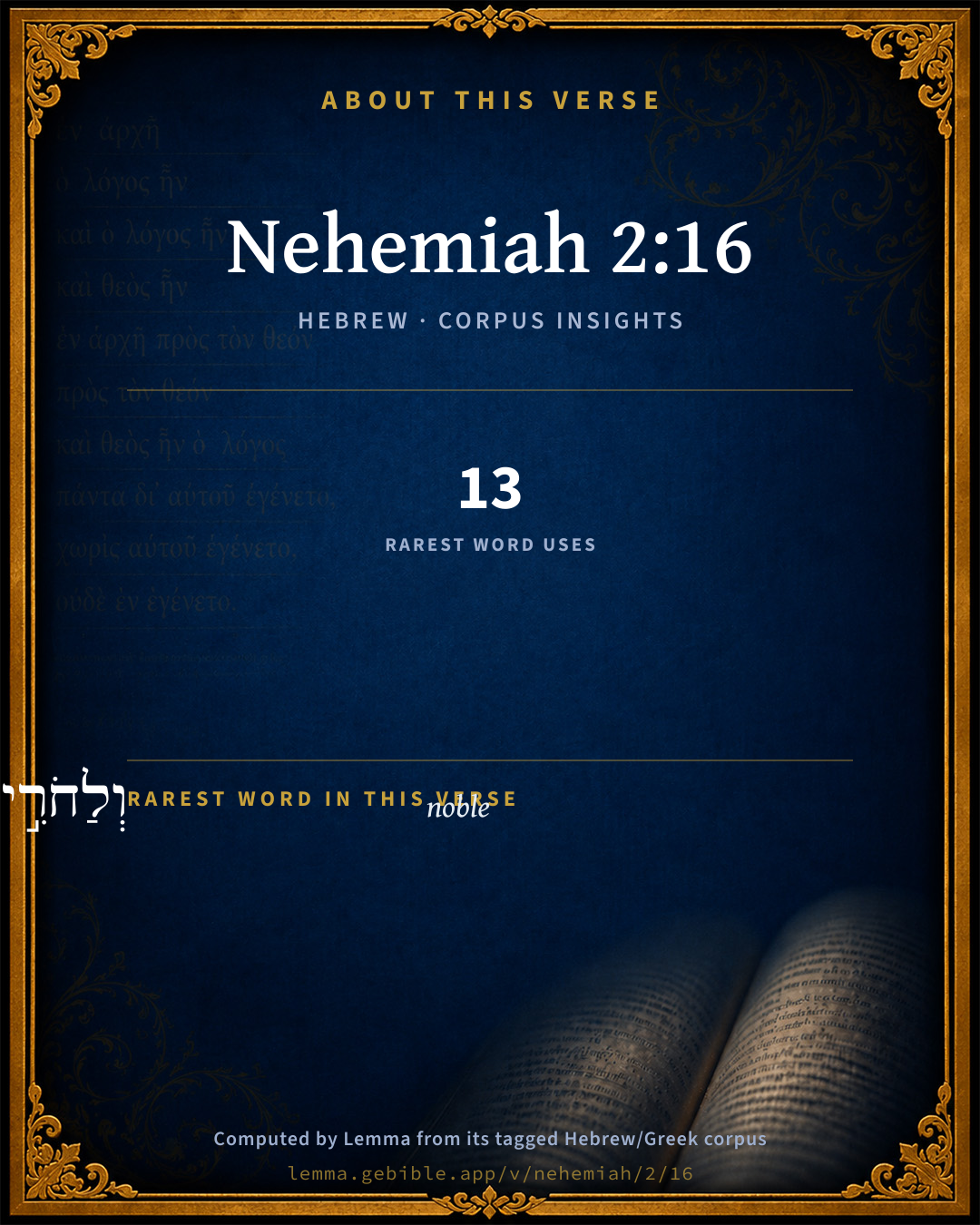
The rarest word here is וְלַחֹרִ֣ים noble H2715 — appearing just 13 times in the whole Hebrew Bible.

Shared distinctive vocabulary

וְלַחֹרִ֣ים noble H2715 occurs in 13 verses of the Hebrew Bible. Also found in:

Grammatical profile

  • 5 verbs
  • 7 nouns
  • 1 pronoun
  • 1 preposition
  • 1 adverb
  • 4 particles

Verb forms

  • יָדְעוּ֙ Qal · Perfect
  • הָלַ֔כְתִּי Qal · Perfect
  • עֹשֶׂ֑ה Qal · Participle Active
  • עֹשֵׂ֣ה Qal · Participle Active
  • הִגַּֽדְתִּי Hiphil · Perfect

Repetition

Words recur within this verse — often emphatic in Hebrew:

  • וְהַסְּגָנִ֗ים governor H5461 ×2
  • עֹשֶׂ֑ה to do H6213 ×2
  • לֹ֤א not H3808 ×2
Hebrew and Greek witnesses Masoretic Hebrew ↔ Greek Septuagint

The same verse in the two great witnesses to the Old Testament, shown verse-for-verse.

These are two independent witnesses, not word-aligned to each other, and the Septuagint is shown in lemma (dictionary) form.

Hebrew Nehemiah 2:16 Masoretic · Westminster Leningrad Codex

וְהַסְּגָנִ֗ים לֹ֤א יָדְעוּ֙ אָ֣נָה הָלַ֔כְתִּי וּמָ֖ה אֲנִ֣י עֹשֶׂ֑ה וְלַיְּהוּדִ֨ים וְלַכֹּהֲנִ֜ים וְלַחֹרִ֣ים וְלַסְּגָנִ֗ים וּלְיֶ֨תֶר֙ עֹשֵׂ֣ה הַמְּלָאכָ֔ה עַד כֵּ֖ן לֹ֥א הִגַּֽדְתִּי

The rulers didn't know where I went, or what I did; neither had I as yet told it to the Jews, nor to the priests, nor to the nobles, nor to the rulers, nor to the rest who did the work.

World English Bible · Public Domain

Greek LXX Structure differs

The Septuagint has no separate book of Nehemiah. Its Greek text is the second half of Esdras B (2 Esdras), chapters 11–23; Ezra is the first half (1–10).

A verse-for-verse comparison isn’t shown here because the chapters and verses don’t line up. Switch to the LXX edition with the MT / LXX toggle above to read the Greek directly.

On this verse, Haydock's Catholic Bible Commentary discusses the Septuagint’s reading. Read the note in Commentary ↓

Hebrew: Westminster Leningrad Codex (CC BY 4.0). Greek: Septuagint (public domain); English from a public-domain English Septuagint. How the Septuagint differs from the Hebrew →

Commentary

Notes on Nehemiah 2:16 from classic Christian and Jewish commentators (each source and its license shown beneath its notes). The classic Christian expositions comment on the surrounding passage and are grouped to its opening verse, so a note may address several verses; the Jewish commentaries on the Tanakh (Rashi and others) are per-verse, so they appear only where the commentator wrote on this verse.

Lemma curates 59 commentaries, every one of them public domain or Creative Commons licensed, each selected and text-cleaned for this edition rather than reprinted as found. About our sources →

Trapp's Complete Commentary

John Trapp

Neh 2:16 And the rulers knew not whither I went, or what I did; neither had I as yet told [it] to the Jews, nor to the priests, nor to the nobles, nor to the rulers, nor to the rest that did the work.

Ver. 16. And the rulers knew not whither I went] Taciturnity, in some cases, is a virtue; and everything is beautiful in its season. There is a time to keep silence, and a time to speak, Ecc 3:7. And he is a truly wise man that can discern his season for both. Discamus prius non loqui, saith Jerome, Let us first learn not to speak, that we may afterwards open our mouths and minds with discretion. Silence is by Solomon first set before speaking; and first takes its time and turn, as it did here in Nehemiah, the prudent. {See Trapp on "Neh 2:12"} The word here rendered rulers is rather Chaldee than Hebrew.

Nor to the nobles] Heb. White ones. Among the Jews great men affected to go in white; as among the Romans in purple or scarlet. Hence Pilate’s soldiers clad Christ in purple; Herod’s, in white, Luk 23:11 Mat 27:28.

Nor to the rest, &c.] So, as to ask their advice.

John Trapp, A Commentary or Exposition upon All the Books of the Old and New Testament (1647–1656) — public domain. Text from a community e-Sword module.

Tyndale Open Study Notes

Tyndale Open Resources

2:16-17 Nehemiah kept his inspection and rebuilding plans secret from both the Persian and Jewish leaders to prevent opposition from being organized. But now Nehemiah was effectively positioned to lead the rebuilding effort. • what trouble we are in: The broken walls brought disgrace on the city and reflected negatively on God; Jerusalem certainly did not look like the “city of the great King” (Ps 48:2).

Tyndale Open Study Notes — © Tyndale Open Resources, licensed CC BY-SA 4.0. Text via the HelloAO Bible API.

Jamieson, Fausset & Brown

Robert Jamieson, A. R. Fausset & David Brown

the rulers knew not--The following day, having assembled the elders, Nehemiah produced his commission and exhorted them to assist in the work. The sight of his credentials, and the animating strain of his address and example, so revived their drooping spirits that they resolved immediately to commence the building, which they did, despite the bitter taunts and scoffing ridicule of some influential men.

Next: Nehemiah Chapter 3

Jamieson, Fausset & Brown — Commentary Critical and Explanatory on the Whole Bible (1871) — public domain (CC PDM 1.0). Text via the HelloAO Bible API.

Adam Clarke's Commentary

Verse 16. The rulers knew not whither I went] He made no person privy to his design, that he might hide every thing as much as possible from their enemies till he had all things in readiness; lest they should take measures to defeat the work.

Adam Clarke's Commentary on the Bible (1810–1826) — public domain. Text from a community e-Sword/MySword module.

Ellicott's Commentary for English Readers

(16) The rest that did the work, that is, afterwards. The caution of this procedure is justified by subsequent events: the city teemed with elements of danger. The nobles and rulers were possessed of no substantial repressive authority.

A Bible Commentary for English Readers, edited by Charles John Ellicott (1878–1897) — public domain. Text from a community e-Sword module.

The Cambridge Bible for Schools and Colleges

gen. ed. J. J. S. Perowne

16–18. The Nation’s Resolve

16. the rulers] R.V. marg. Or deputies. ‘S’ganim’ is the title used in Ezr_9:2, and in this book (Neh_4:8; Neh_4:13, Neh_5:7, Neh_7:5, Neh_12:40) for the chief magistrates and officials of the city.

whither I went, or what I did] More literally ‘whither I had gone and what I was doing.’

neither had I as yet told it] i.e. the prospect of rebuilding the walls.

the Jews … the work] A remarkable division of the inhabitants of Jerusalem: ‘the Jews’ here are the great mass of the lay population, as distinguished from (a) the priests, (b) ‘the nobles’ ‘Khôrim’, the aristocracy, heads of houses, &c. (cf. Neh_4:13-14, Neh_5:7, Neh_6:17, Neh_7:5, Neh_13:17), (c) ‘the rulers,’ the official element (segânim), (d) ‘the rest that did the work,’ referring by anticipation to the large body who were shortly afterwards employed on ‘the work’ of building the walls.

The Cambridge Bible for Schools and Colleges (gen. ed. J. J. S. Perowne; Cambridge University Press, 1878–1918) — public domain. Text from a community e-Sword module.

John Gill's Exposition

Then said I unto them,.... The priests and princes of the Jews:

you see the distress that we are in; lie open to our enemies, and exposed to their insults:

how Jerusalem lieth waste, and the gates thereof are burnt with fire, Neh 1:3,

come, and let us build up the wall of Jerusalem that we be no more a reproach; to their neighbours about them, who scoffed at them as a defenceless people and frequently came in upon them, and spoiled and plundered them of their goods and substance.

John Gill's Exposition of the Whole Bible (1746–1763) — public domain (CC PDM 1.0). Text via the HelloAO Bible API.

Albert Barnes' Notes on the Bible

The rulers - The principal authorities of the city, in the absence of the special governor.

The rest that did the work - i. e. “the laboring class that (afterward) actually built the wall.”

Albert Barnes' Notes on the Bible (1834–1885) — public domain. Text from a community e-Sword/MySword module.

Haydock's Catholic Bible Commentary

Magistrates. Septuagint, "guards." Seganim denotes various officers. (Calmet) --- Work, or to any workmen. (Haydock) --- None were now employed. (Tirinus)

George Leo Haydock (1774–1849), Haydock's Catholic Family Bible and Commentary, 1859 edition — public domain. Excludes Psalms (Douay-Rheims chapter numbering differs from Protestant) and Deuterocanonical books (Catholic canon only).

Matthew Poole's English Annotations

Or, were to do, or should do, i.e. whom he intended to employ in the work here following, of building the walls.

Matthew Poole's English Annotations on the Holy Bible (1683–1685) — public domain. Text from a community e-Sword/MySword module.

Whedon's Commentary on the Bible

Daniel D. Whedon

16. Jews… priests… nobles… rulers — The various ranks and classes among the Jewish community. Nehemiah did not at that time make known his night journey around the walls to any one of these various classes. The Jews here means the common body of the people, the laity, as distinguished from the priests. The nobles were those who were known and honoured as descendants of the royal family of David. The rulers were the chief officers of the Jewish community living in and about Jerusalem.

Nor to the rest that did the work — The workmen among the people, as distinguished from the other classes previously mentioned. In every great public work such as Nehemiah was now contemplating, the builders, (Ezr_3:10,) and all classes of workmen, would have an important interest; yet Nehemiah means to say that while he held important papers from the king, and had come to build the walls and gates of Jerusalem, and made his night survey with this end in view, he had not as yet communicated his design to any of the people, nor to their officers and leading men, nor to the workmen upon whom would fall the chief burden of rebuilding the fallen gates and walls.

Daniel D. Whedon (gen. ed.), Commentary on the Old and New Testaments (1874–1909) — public domain. Text from a community e-Sword module.

The Pulpit Commentary

The rulers. On Nehemiah"s arrival at Jerusalem he found no single individual exercising authority, but a number of persons, a sort of town-council, whom he calls khorim and saganim. It is not clear that he made his commission known to them at first, or indeed that he divulged it before the interview mentioned in vers. 17 and 18. The rest that did the work. This seems to be said by anticipation, and to mean those who subsequently built the wall.

The Pulpit Commentary (1880–1919), ed. H.D.M. Spence-Jones & Joseph S. Exell — public domain. Text from a community e-Sword module.

John Wesley's Explanatory Notes

That did - Or, were to do, whom he intended to employ in it.

John Wesley, Explanatory Notes Upon the Whole Bible (1754–1765) — public domain. Text via the GEBible commentary corpus.

Keil & Delitzsch

C. F. Keil & F. Delitzsch

He had spoken to no one of his purpose (Neh 2:12); hence the rulers of the city knew neither whither he was going nor what he was doing (i.e., undertaking) when he rode by night out of the city gate accompanied by a few followers. As yet he had said nothing either to the Jews (the citizens of Jerusalem), the priests, the nobles, the rulers, or the rest who did the work. החרים and הסּגנים are connected, as in Ezr 9:2 השּׂרים and הסּגנים. The nobles (חרים, nobiles) or princes are the heads of the different houses or races of the people; סגנים, the rulers of the town, the authorities. המּלאכה עשׂה, the doers of the work, are the builders; comp. Ezr 3:9. When these are, in comparison with the priests, nobles, and rulers, designated as יתר, the remnant, this is explained by the fact that the priests and rulers of the people were not actively engaged in building. המּלאכה, the work in question, i.e., here the building of the walls. כּן עד, until thus, i.e., until now, until the time apparent from the context. Nehemiah then, having inspected the condition of the ruined walls, and being now persuaded of the possibility of restoring them, made known his resolution to the nobles, the rulers, and the community, i.e., to a public assembly called together for this purpose (Neh 2:17). "Ye see (have before your eyes, know from experience) the distress that we are in, that Jerusalem lieth waste: come (לכוּ), let us build up the walls of Jerusalem, that we be no more a reproach." In other words: Let us by building our walls put an end to the miserable condition which gives our adversaries occasion to reproach us.

Keil & Delitzsch — Biblical Commentary on the Old Testament (1861–1891) — public domain (CC PDM 1.0). Text via the HelloAO Bible API. (Old Testament only.)

Rashi

Rabbi Shlomo Yitzchaki (Rashi)

And the prefects who were in the city did not know where I had gone to and what I had done.

yet Heb. עַד כֵּן, until now.

Rashi on the Tanakh — English translations: “The Judaica Press complete Tanach with Rashi, translated by A. J. Rosenberg” (CC BY 4.0); “Pentateuch with Rashi's commentary by M. Rosenbaum and A.M. Silbermann, 1929-1934” (public domain); “The Metsudah Tanach series, Lakewood, N.J” (CC BY 4.0); and “The Book of Joshua, Metsudah Publications, 1997” (CC BY 4.0). Text via Sefaria.

Lesson kit

Teaching starters — assembled from the data on this page, not authored interpretation. Every prompt links to the verse data it draws on. Edit before teaching.

Nehemiah, in the Historical, opens this verse with 19 words (16 distinct Hebrew lemmas). Its most distinctive word is chôr (“noble”). A historical commentator’s framing appears above. Read the whole chapter for the surrounding context.

Discussion questions

  1. The word chôr carries the sense “noble.” How does it shape the verse?
  2. 1 Kings 21:8 shares the word «noble» with this verse. How do the two illuminate each other?
  3. “governor” occurs 2× in this one verse. What is the effect of the repetition?
  4. These translations render this verse differently. What is at stake in choosing one wording over another?
  5. The verb «יָדְעוּ֙» is Qal Perfect. How does its form color the action?
  6. Reading how Trapp's Complete Commentary and Tyndale Open Study Notes read this verse, where do the two commentators agree and where do they part?

Things to notice

Reading settings

Reading text

Shown beneath each verse's original-language words.

Old Testament
Old Testament edition

Read the OT as the Masoretic Hebrew (MT) or the Greek Septuagint (LXX).

English shown for the Greek Septuagint (in the Hebrew ↔ Greek comparison).

Comparing translations? Open the Compare panel on any verse page to stack up to four side by side.