Jeremiah 42:21

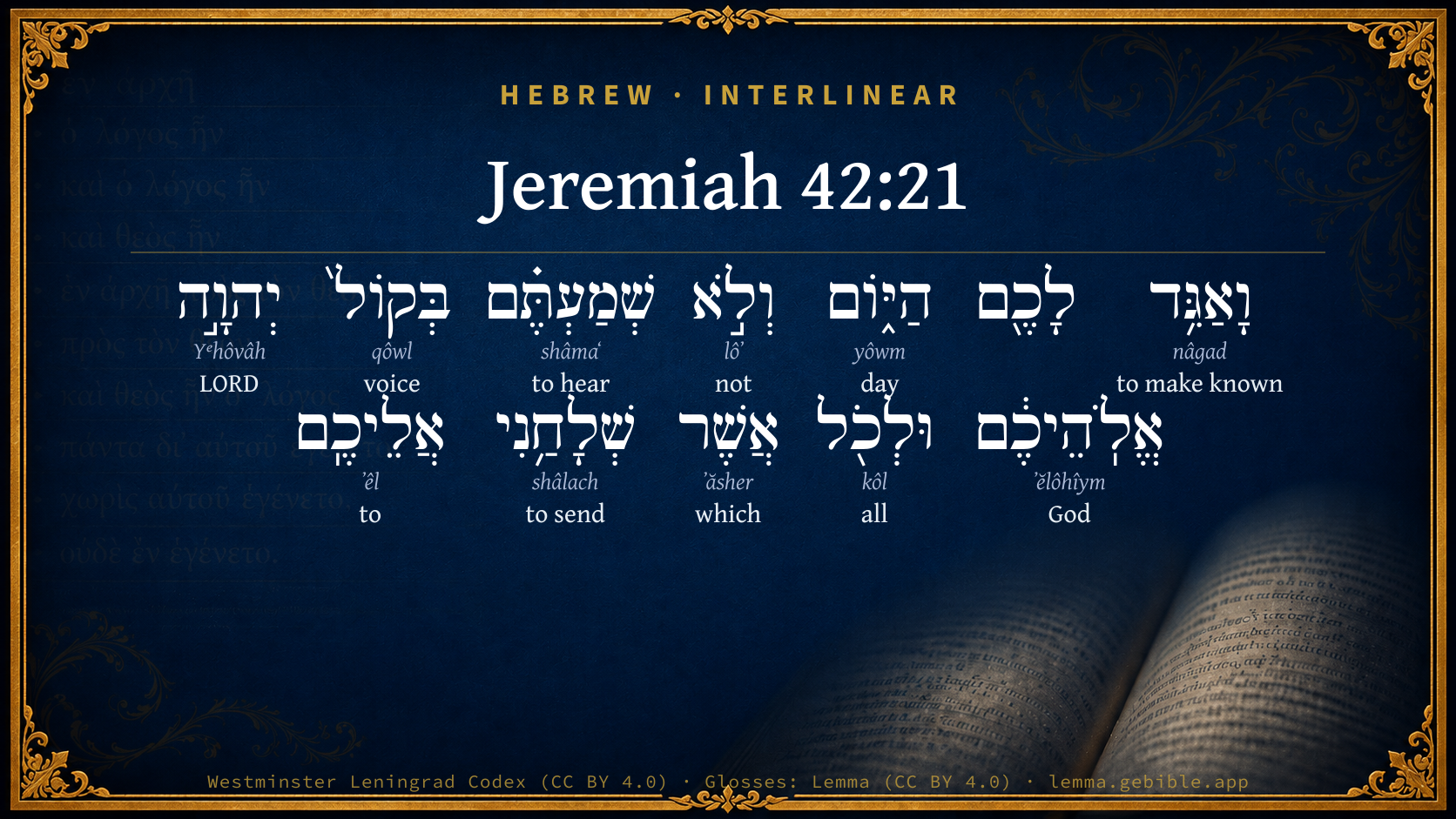
Hebrew (Westminster Leningrad Codex) Jeremiah 42:21 appears in the Hebrew Old Testament. The text above is from the Westminster Leningrad Codex. Each word links to its Strong’s number, a concise gloss, and parsing drawn from the Open Scriptures Hebrew Bible morphology. Click any word for its full Brown-Driver-Briggs (BDB) entry.
Download image
Cite this verse

Jeremiah 42:21 (World English Bible). Public Domain. Lemma interlinear Bible study tool, https://lemma.gebible.app/v/jeremiah/42/21.

Show BibTeX & RIS
BibTeX
RIS
English Translation
and I have this day declared it to you; but you have not obeyed the voice of Yahweh your God in anything for which he has sent me to you.
World English Bible · Public Domain
Download a study sheet

One document with this verse’s original text, its word-by-word gloss line, the meaning frame, cross-references with their text, attributed commentary, and full source and license credits — printable, and it pastes into notes with its structure intact.

This verse Autodidact and up

Study sheet (.html) Plain text (.txt)

A passage Seminary Student

Up to 50 verses in one chapter. A passage sheet keeps up to 6 commentary sources and 12 cross-references per verse, in the order this page ranks them, and says so on the sheet whenever that leaves anything out. Ask for a single verse and you get the Autodidact verse sheet above.

Everything on this page stays free to read, with no account — the sheet is a download of what is already on screen, not access to it.

Want to remove ads? Support Godless Engineer
Compare translations 3

The same verse in 3 English versions, stacked beneath the original-language interlinear above. Click any original word for its lexicon entry.

Each is an independent rendering of the whole verse — the interlinear is not word-aligned to these translations.

Highlighted words mark where these versions differ — a whole-verse word diff, not a word-by-word alignment.

  • World English Bible Public Domain
    and I have this day declared it to you; but you have not obeyed the voice of Yahweh your God in anything for which he has sent me to you.
  • King James Version Public Domain
    And now I have this day declared it to you; but ye have not obeyed the voice of the LORD your God, nor any thing for the which he hath sent me unto you.
  • unfoldingWord Literal Text CC BY-SA 4.0
    For I have reported to you today, but you have not listened to the voice of Yahweh your God or to anything about which he sent me to you.

unfoldingWord Literal Text — © unfoldingWord, licensed CC BY-SA 4.0. Word-aligned USFM3 via Door43 (git.door43.org/unfoldingWord/en_ult).

Versions to compare (up to 4)

3 of 4 selected

Show all 18 translations

Every available English version of this verse, each an independent rendering of the whole verse.

  • World English Bible Public Domain
    and I have this day declared it to you; but you have not obeyed the voice of Yahweh your God in anything for which he has sent me to you.
  • Berean Standard Bible Public Domain
    For I have told you today, but you have not obeyed the voice of the LORD your God in all He has sent me to tell you.
  • Majority Standard Bible Public Domain
    For I have told you today, but you have not obeyed the voice of the LORD your God in all He has sent me to tell you.
  • King James Version Public Domain
    And now I have this day declared it to you; but ye have not obeyed the voice of the LORD your God, nor any thing for the which he hath sent me unto you.
  • American Standard Version (1901) Public Domain
    and I have this day declared it to you; but ye have not obeyed the voice of Jehovah your God in anything for which he hath sent me unto you.
  • Revised Version (1885) Public Domain
    and I have this day declared it to you; but ye have not obeyed the voice of the LORD your God in any thing for the which he hath sent me unto you.
  • Geneva Bible (1599) Public Domain
    Therefore I haue this day declared it you, but you haue not obeyed the voyce of the Lord your God, nor any thing for the which he hath sent me vnto you.
  • Douay-Rheims (1899) Public Domain
    And now I have declared it to you this day, and;you have not obeyed the voice of the Lord your God, with regard to all the things for which he hath sent me to you.
  • Young's Literal Translation Public Domain
    and I declare to you to-day, and ye have not hearkened to the voice of Jehovah your God, and to anything with which He hath sent me unto you.
  • Literal Standard Version CC BY-SA 4.0
    and I declare to you today, and you have not listened to the voice of your God YHWH, and to anything with which He has sent me to you.
  • Unlocked Literal Bible CC BY-SA 4.0
    For I have reported to you today, but you have not listened to the voice of Yahweh your God or to anything about which he sent me to you.
  • unfoldingWord Literal Text CC BY-SA 4.0
    For I have reported to you today, but you have not listened to the voice of Yahweh your God or to anything about which he sent me to you.
  • Darby Bible Public Domain
    And I have this day declared [it] to you; but ye have not obeyed the voice of Jehovah your God, nor anything for which he hath sent me unto you.
  • World Messianic Bible Public Domain
    I have declared it to you today; but you have not obeyed the LORD your God’s voice in anything for which he has sent me to you.
  • Webster's Bible Public Domain
    And now I have this day declared it to you; but ye have not obeyed the voice of the LORD your God, nor any thing for which he hath sent me to you.
  • Free Bible Version CC BY-SA 4.0
    I have told you today what he said, but you have not obeyed everything the Lord your God sent me to tell you.
  • Bible in Basic English Public Domain
    And this day I have made it clear to you, and you have not given ear to the voice of the Lord your God in anything for which he has sent me to you.
  • JPS Tanakh (1917) Public Domain
    and I have this day declared it to you; but ye have not hearkened to the voice of the LORD your God in any thing for which He hath sent me unto you.

Literal Standard Version (2020), Covenant Press — licensed CC BY-SA 4.0. Text via the HelloAO Bible API (eBible.org). Unlocked Literal Bible (unfoldingWord) — licensed CC BY-SA 4.0. Text via the HelloAO Bible API (eBible.org). unfoldingWord Literal Text — © unfoldingWord, licensed CC BY-SA 4.0. Word-aligned USFM3 via Door43 (git.door43.org/unfoldingWord/en_ult). Free Bible Version, Dr. Jonathan Gallagher — licensed CC BY-SA 4.0. Text via the HelloAO Bible API (eBible.org).

Word by word

More ways to search: Search by grammar → Find every occurrence → Compare this word →

Practice this passage: Drill this verse → Learn its vocabulary →

וָאַגִּ֥ד
nâgad
H5046
“and · to make known”
Conjunction + Verb, Hiphil, Sequential Imperfect, 1st Person, Common, Singular
Part of Speech
Conjunction + Verb
Stem
Hiphil
Form
Sequential Imperfect
Person
1st Person
Gender
Common
Number
Singular
Full BDB Definition

Origin: a primitive root

TWOT: 1289

to be conspicuous, tell, make known - (Hiphil) to tell, declare - to tell, announce, report - to declare, make known, expound - to inform of - to publish, declare, proclaim - to avow, acknowledge, confess - messenger (participle) - (Hophal) to be told, be announced, be reported
  1. הַיּ֑וֹם yôwm H3117 “the · day” Particle, Definite Article + Noun, Common, Masculine, Singular, Absolute
  2. וְלֹ֣א lôʼ H3808 “and · not” Conjunction + Particle, Negative
  3. שְׁמַעְתֶּ֗ם shâmaʻ H8085 “to hear” Verb, Qal, Perfect, 2nd Person, Masculine, Plural
  4. בְּקוֹל֙ qôwl H6963 “in/at · voice of” Preposition + Noun, Common, Masculine, Singular, Construct
  5. יְהוָ֣ה Yᵉhôvâh H3068 “LORD” Noun, Proper
  6. אֱלֹֽהֵיכֶ֔ם ʼĕlôhîym H430 “God(s) · your” Noun, Common, Masculine, Plural, Construct + Suffix, Personal, 2nd Person, Masculine, Plural
  7. וּלְכֹ֖ל kôl H3605 “and · to/for · all” Conjunction + Preposition + Noun, Common, Masculine, Singular, Absolute
  8. אֲשֶׁר ʼăsher H834 “which” Particle, Relative
  9. שְׁלָחַ֥נִי shâlach H7971 “to send · me” Verb, Qal, Perfect, 3rd Person, Masculine, Singular + Suffix, Personal, 1st Person, Common, Singular
  10. אֲלֵיכֶֽם ʼêl H413 “to · you” Preposition + Suffix, Personal, 2nd Person, Masculine, Plural

About this verse

These counts appear in no published source. They are computed here, from the morphology-tagged text and Lemma’s own curated glosses. What Lemma adds →

12
words
11
distinct lemmas
Prophets
section

Grammatical profile

  • 3 verbs
  • 5 nouns
  • 2 prepositions
  • 2 particles

Verb forms

  • וָאַגִּ֥ד Hiphil · Sequential Imperfect
  • שְׁמַעְתֶּ֗ם Qal · Perfect
  • שְׁלָחַ֥נִי Qal · Perfect

Cross-references

8

Topical passages linked to Jeremiah 42:21 in the Treasury of Scripture Knowledge — connected by theme and wording, ordered by reader-vote popularity; previews shown in the World English Bible.

  • Ezekiel 2:7 You shall speak my words to them, whether they will hear, or whether they will forbear; for they are most rebellious.
  • Zechariah 7:11–12 But they refused to listen, and turned their backs, and stopped their ears, that they might not hear.
  • Acts 20:26–27 Therefore I testify to you this day that I am clean from the blood of all men,
  • Deuteronomy 11:26–27 Behold, I set before you this day a blessing and a curse:
  • Deuteronomy 29:19 and it happen, when he hears the words of this curse, that he bless himself in his heart, saying, I shall have peace, though I walk in the stubbornness of my heart, to destroy the moist with the dry.
  • Jeremiah 7:24–27 But they didn't listen nor turn their ear, but walked in [their own] counsels [and] in the stubbornness of their evil heart, and went backward, and not forward.
  • Ezekiel 3:17 Son of man, I have made you a watchman to the house of Israel: therefore hear the word at my mouth, and give them warning from me.
  • Acts 20:20 how I didn't shrink from declaring to you anything that was profitable, teaching you publicly and from house to house,

Cross-references courtesy of OpenBible.info (CC BY 4.0).

Hebrew and Greek witnesses Masoretic Hebrew ↔ Greek Septuagint

The same verse in the two great witnesses to the Old Testament, shown verse-for-verse.

These are two independent witnesses, not word-aligned to each other, and the Septuagint is shown in lemma (dictionary) form.

Hebrew Jeremiah 42:21 Masoretic · Westminster Leningrad Codex

וָאַגִּ֥ד לָכֶ֖ם הַיּ֑וֹם וְלֹ֣א שְׁמַעְתֶּ֗ם בְּקוֹל֙ יְהוָ֣ה אֱלֹֽהֵיכֶ֔ם וּלְכֹ֖ל אֲשֶׁר שְׁלָחַ֥נִי אֲלֵיכֶֽם

and I have this day declared it to you; but you have not obeyed the voice of Yahweh your God in anything for which he has sent me to you.

World English Bible · Public Domain

Greek LXX Structure differs

In the Septuagint, Jeremiah is about an eighth shorter than the Hebrew and arranges its material differently — the Oracles Against the Nations (Hebrew chapters 46–51) appear in the middle of the Greek book, after 25:13. Because the chapter and verse boundaries do not line up, a verse-for-verse comparison with the Hebrew is not shown.

A verse-for-verse comparison isn’t shown here because the chapters and verses don’t line up. Switch to the LXX edition with the MT / LXX toggle above to read the Greek directly.

Hebrew: Westminster Leningrad Codex (CC BY 4.0). Greek: Septuagint (public domain); English from a public-domain English Septuagint. How the Septuagint differs from the Hebrew →

Targum (Aramaic paraphrase)

1

The Targum is the ancient Jewish Aramaic paraphrase of the Hebrew Scriptures — an interpretive translation, not the Hebrew text itself. Onkelos (literal) and Pseudo-Jonathan (expansive) render the Torah, and Jonathan the Prophets. Coverage is partial: where no permissively-licensed English translation exists for a verse, only the Aramaic is shown. This is verse-level text, not a word-by-word alignment to the Hebrew.

  1. Targum Jonathan Prophets (Joshua–Malachi)
    וְחַוֵיתִי לְכוֹן יוֹמָא דִין וְלָא קַבֵּילְתּוּן לְמֵימְרָא דַייָ אֱלָהָכוֹן וּלְכֹל דִי שַׁלְחַנִי לְוַתְכוֹן:

    (no public-domain English translation for this verse)

    Targum Jonathan — Aramaic: “Mikraot Gedolot” (public domain). English: “Sefaria Community Translation” (CC0 1.0 (public-domain dedication)); “London "Chaldee Paraphrase," 1871” (public domain). Text via Sefaria.

Commentary

Notes on Jeremiah 42:21 from classic Christian and Jewish commentators (each source and its license shown beneath its notes). The classic Christian expositions comment on the surrounding passage and are grouped to its opening verse, so a note may address several verses; the Jewish commentaries on the Tanakh (Rashi and others) are per-verse, so they appear only where the commentator wrote on this verse.

Lemma curates 59 commentaries, every one of them public domain or Creative Commons licensed, each selected and text-cleaned for this edition rather than reprinted as found. About our sources →

Trapp's Complete Commentary

John Trapp

Jer 42:21 And [now] I have this day declared [it] to you; but ye have not obeyed the voice of the LORD your God, nor any [thing] for the which he hath sent me unto you.

Ver. 21. But ye have not obeyed the voice of the Lord.] Nay, you take a clean contrary course, as if ye would despitefully spit in the face of Heaven, and wrestle a fall with the Almighty.

John Trapp, A Commentary or Exposition upon All the Books of the Old and New Testament (1647–1656) — public domain. Text from a community e-Sword module.

Tyndale Open Study Notes

Tyndale Open Resources

42:21 Like their ancestors, this group of people from Judah trusted in the Egyptians to protect them, rather than in the Lord.

Tyndale Open Study Notes — © Tyndale Open Resources, licensed CC BY-SA 4.0. Text via the HelloAO Bible API.

Jamieson, Fausset & Brown

Robert Jamieson, A. R. Fausset & David Brown

declared it--namely, the divine will.

I . . . but ye--antithesis. I have done my part; but ye do not yours. It is no fault of mine that ye act not rightly.

Jamieson, Fausset & Brown — Commentary Critical and Explanatory on the Whole Bible (1871) — public domain (CC PDM 1.0). Text via the HelloAO Bible API.

Adam Clarke's Commentary

Verse 21. Ye have not obeyed the voice] Though ye have requested to have this particular revelation of the Divine will, and promised obedience, yet have ye not done one thing for which ye sent me to inquire of the Lord.

Adam Clarke's Commentary on the Bible (1810–1826) — public domain. Text from a community e-Sword/MySword module.

John Calvin's Commentaries

He at length adds, And I have this day declared it to you Here he sets forth his own fidelity, not for the sake of boasting, but that their impiety might be reproved, who at length despised the oracle of God, which they had boasted that they would obey. Ye have not hearkened, he says, to the voice of Jehovah your God, and according to all the things on account of which he hath sent me to you. The Prophet again confirms the truth, that it was their own fault that the Jews did not follow what was right, and also what was for their good, for he had faithfully delivered to them what God had commanded. He now adds, —

John Calvin's Commentaries (1540-1563) — public domain. Text from the Calvin Translation Society English edition (1840s-50s) via the Christian Classics Ethereal Library (ccel.org). Calvin's coverage is partial (roughly two-thirds of the Bible); uncommented books and verses are honest gaps, never fabricated. The 19th-century editor's footnotes and remarks are omitted so the notes are faithfully Calvin's own voice.

John Gill's Exposition

Now therefore know certainly,.... Or, "in knowing know" (d); they might assure themselves of this, that it would certainly come to pass, and most justly and deservedly; since it was at their own request the prophet sought the mind of the Lord for them, and had faithfully related it to them, and they had promised to observe it; wherefore, should they go into Egypt, as their inclination scented to be entirely that way, they must expect what follows:

that ye shall die by the sword, by the famine, and by the pestilence; by one or other of these, or all of them; some by one, and some by another, as before threatened; evils they thought to escape by going thither, but which should surely follow them, and overtake them:

in the place whither ye desire to go and to sojourn; that is, in Egypt, to which they had a strong inclination, where they greatly desired to be, pleased themselves with the thoughts of, and which they chose of their own will and pleasure for their habitation.

(d) "sciendo scietis", Schmidt; "sciendo sciatis", Pagninus, Montanus.

Next: Jeremiah Chapter 43

John Gill's Exposition of the Whole Bible (1746–1763) — public domain (CC PDM 1.0). Text via the HelloAO Bible API.

Matthew Poole's English Annotations

I have been faithful to you, I went according to your desire to inquire of God for you, I had his will revealed to me in your case, and now I have as faithfully told you what it is;

but ye have not obeyed. How did Jeremiah know this, for they had not yet declared their minds to him? He had either learned it from their discourses during the ten days which God had made him to wait for the revelation, or he had learned it from some contemptuous behaviour of them when he delivered it, or (which is most probable) God had aforehand told it to him.

Matthew Poole's English Annotations on the Holy Bible (1683–1685) — public domain. Text from a community e-Sword/MySword module.

Lesson kit

Teaching starters — assembled from the data on this page, not authored interpretation. Every prompt links to the verse data it draws on. Edit before teaching.

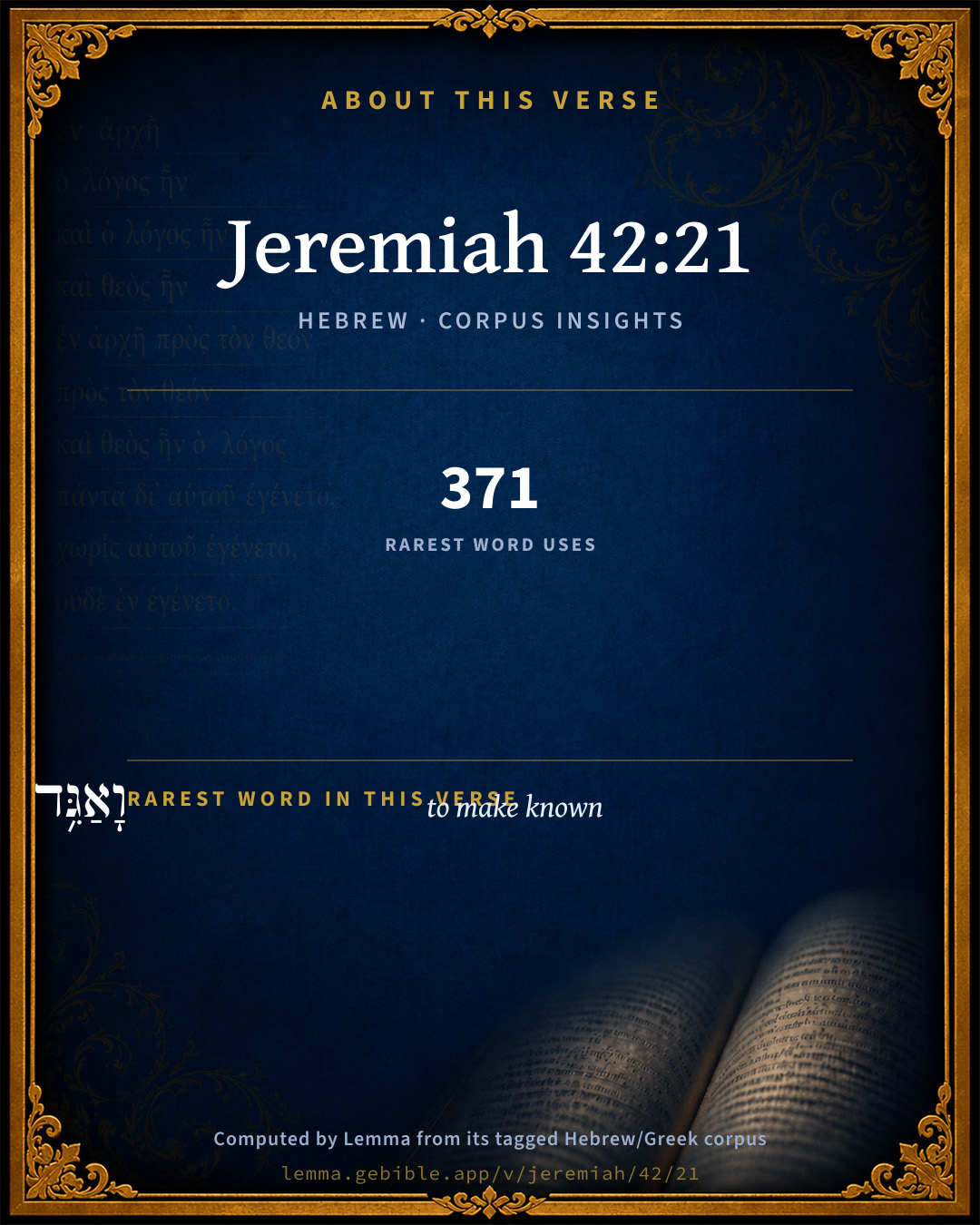
Jeremiah, in the Prophets, opens this verse with 12 words (11 distinct Hebrew lemmas). Its most distinctive word is nâgad (“to make known”). A historical commentator’s framing appears above. Read the whole chapter for the surrounding context.

Discussion questions

  1. What does “to make known” (nâgad) contribute to the verse as a whole?
  2. Ezekiel 2:7 shares this passage’s theme. How do the two illuminate each other?
  3. These translations render this verse differently. What is at stake in choosing one wording over another?
  4. The verb «וָאַגִּ֥ד» is Hiphil Sequential Imperfect. How does its form color the action?
  5. Reading how Trapp's Complete Commentary and Tyndale Open Study Notes read this verse, where do the two commentators agree and where do they part?

Things to notice

Reading settings

Reading text

Shown beneath each verse's original-language words.

Old Testament
Old Testament edition

Read the OT as the Masoretic Hebrew (MT) or the Greek Septuagint (LXX).

English shown for the Greek Septuagint (in the Hebrew ↔ Greek comparison).

Comparing translations? Open the Compare panel on any verse page to stack up to four side by side.