
Isaiah 41:23

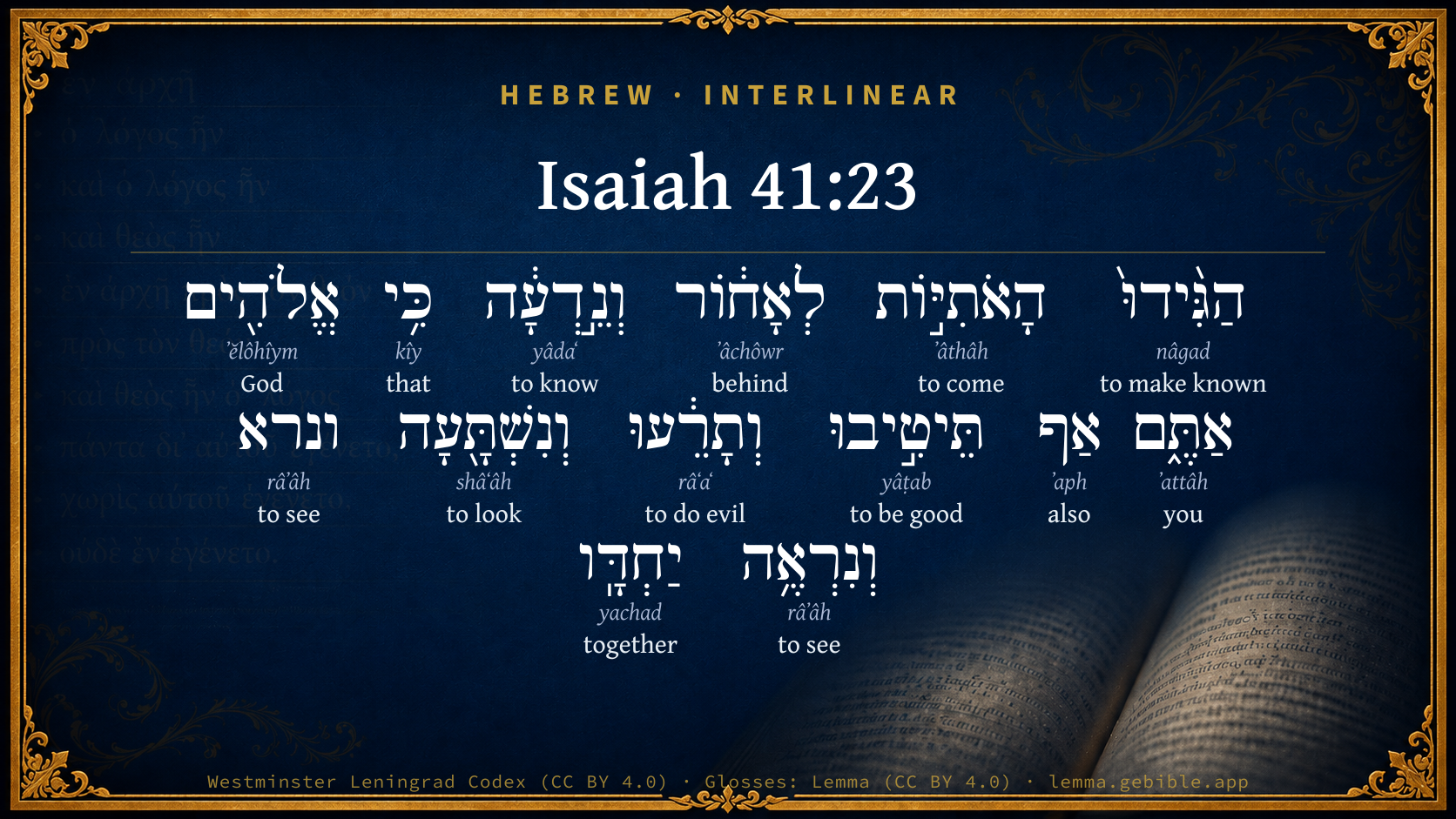
Hebrew (Westminster Leningrad Codex) Isaiah 41:23 appears in the Hebrew Old Testament. The text above is from the Westminster Leningrad Codex. Each word links to its Strong’s number, a concise gloss, and parsing drawn from the Open Scriptures Hebrew Bible morphology. Click any word for its full Brown-Driver-Briggs (BDB) entry.
Download image
Cite this verse

Isaiah 41:23 (World English Bible). Public Domain. Lemma interlinear Bible study tool, https://lemma.gebible.app/v/isaiah/41/23.

Show BibTeX & RIS
BibTeX
RIS
English Translation
Declare the things that are to come hereafter, that we may know that you are gods: yes, do good, or do evil, that we may be dismayed, and see it together.
World English Bible · Public Domain
Download a study sheet

One document with this verse’s original text, its word-by-word gloss line, the meaning frame, cross-references with their text, attributed commentary, and full source and license credits — printable, and it pastes into notes with its structure intact.

This verse Autodidact and up

Study sheet (.html) Plain text (.txt)

A passage Seminary Student

Up to 50 verses in one chapter. A passage sheet keeps up to 6 commentary sources and 12 cross-references per verse, in the order this page ranks them, and says so on the sheet whenever that leaves anything out. Ask for a single verse and you get the Autodidact verse sheet above.

Everything on this page stays free to read, with no account — the sheet is a download of what is already on screen, not access to it.

Want to remove ads? Support Godless Engineer
Compare translations 3

The same verse in 3 English versions, stacked beneath the original-language interlinear above. Click any original word for its lexicon entry.

Each is an independent rendering of the whole verse — the interlinear is not word-aligned to these translations.

Highlighted words mark where these versions differ — a whole-verse word diff, not a word-by-word alignment.

  • World English Bible Public Domain
    Declare the things that are to come hereafter, that we may know that you are gods: yes, do good, or do evil, that we may be dismayed, and see it together.
  • King James Version Public Domain
    Shew the things that are to come hereafter, that we may know that ye are gods: yea, do good, or do evil, that we may be dismayed, and behold it together.
  • unfoldingWord Literal Text CC BY-SA 4.0
    Declare the signs of the afterward, and let us know that you gods. Indeed, do good or do evil, and let us look around and let us see together.

unfoldingWord Literal Text — © unfoldingWord, licensed CC BY-SA 4.0. Word-aligned USFM3 via Door43 (git.door43.org/unfoldingWord/en_ult).

Versions to compare (up to 4)

3 of 4 selected

Show all 18 translations

Every available English version of this verse, each an independent rendering of the whole verse.

  • World English Bible Public Domain
    Declare the things that are to come hereafter, that we may know that you are gods: yes, do good, or do evil, that we may be dismayed, and see it together.
  • Berean Standard Bible Public Domain
    Tell us the things that are to come, so that we may know that you are gods. Yes, do something good or evil, that we may look on together in dismay.
  • Majority Standard Bible Public Domain
    Tell us the things that are to come, so that we may know that you are gods. Yes, do something good or evil, that we may look on together in dismay.
  • King James Version Public Domain
    Shew the things that are to come hereafter, that we may know that ye are gods: yea, do good, or do evil, that we may be dismayed, and behold it together.
  • American Standard Version (1901) Public Domain
    Declare the things that are to come hereafter, that we may know that ye are gods: yea, do good, or do evil, that we may be dismayed, and behold it together.
  • Revised Version (1885) Public Domain
    Declare the things that are to come hereafter, that we may know that ye are gods: yea, do good, or do evil, that we may be dismayed, and behold it together.
  • Geneva Bible (1599) Public Domain
    Shewe the things that are to come hereafter, that we may know that you are gods: yea, doe good or doe euill, that we may declare it, and beholde it together.
  • Douay-Rheims (1899) Public Domain
    Shew the things that are to come hereafter, and we shall know that ye are gods. Do ye also good or evil, if you can: and let us speak, and see together.
  • Young's Literal Translation Public Domain
    Declare the things that are coming hereafter, And we know that ye `are' gods, Yea, ye may do good or do evil, And we look around and see `it' together.
  • Literal Standard Version CC BY-SA 4.0
    Declare the things that are coming hereafter, || And we know that you [are] gods, || Indeed, you may do good or do evil, || And we look around and see [it] together.
  • Unlocked Literal Bible CC BY-SA 4.0
    Tell things about the future, that we may know if you are gods; do something good or evil, that we may be frightened and impressed.
  • unfoldingWord Literal Text CC BY-SA 4.0
    Declare the signs of the afterward, and let us know that you gods. Indeed, do good or do evil, and let us look around and let us see together.
  • Darby Bible Public Domain
    declare the things that are to happen hereafter, that we may know that ye are gods; yea, do good, or do evil, that we may be astonished, and behold it together.
  • World Messianic Bible Public Domain
    Declare the things that are to come hereafter, that we may know that you are gods. Yes, do good, or do evil, that we may be dismayed, and see it together.
  • Webster's Bible Public Domain
    Show the things that are to come hereafter, that we may know that ye are gods: yes, do good, or do evil, that we may be dismayed, and behold it together.
  • Free Bible Version CC BY-SA 4.0
    Predict what's coming so we can know for sure that you are gods. At least do something, good or bad, to impress us when we see it.
  • Bible in Basic English Public Domain
    Give us word of what will be after this, so that we may be certain that you are gods: yes, do good or do evil, so that we may all see it and be surprised.
  • JPS Tanakh (1917) Public Domain
    Declare the things that are to come hereafter, that we may know that ye are gods; yea, do good, or do evil, that we may be dismayed, and behold it together.

Literal Standard Version (2020), Covenant Press — licensed CC BY-SA 4.0. Text via the HelloAO Bible API (eBible.org). Unlocked Literal Bible (unfoldingWord) — licensed CC BY-SA 4.0. Text via the HelloAO Bible API (eBible.org). unfoldingWord Literal Text — © unfoldingWord, licensed CC BY-SA 4.0. Word-aligned USFM3 via Door43 (git.door43.org/unfoldingWord/en_ult). Free Bible Version, Dr. Jonathan Gallagher — licensed CC BY-SA 4.0. Text via the HelloAO Bible API (eBible.org).

Word by word

More ways to search: Search by grammar → Find every occurrence → Compare this word →

Practice this passage: Drill this verse → Learn its vocabulary →

וְנִשְׁתָּ֖עָה
shâʻâh
H8159
“and · to look”
Conjunction + Verb, Qal, Cohortative, 1st Person, Common, Plural
Part of Speech
Conjunction + Verb
Stem
Qal
Form
Cohortative
Person
1st Person
Gender
Common
Number
Plural
Full BDB Definition

Origin: a primitive root

TWOT: 2429

to look at or to, regard, gaze at or about - (Qal) to gaze at, regard, behold, look about - (Hiphil) to look away, cause gaze to turn away - (Hithpael) to look in dismay, gaze about (in anxiety)
  1. הַגִּ֨ידוּ֙ nâgad H5046 “make known” Verb, Hiphil, Imperative, 2nd Person, Masculine, Plural
  2. הָאֹתִיּ֣וֹת ʼâthâh H857 “the · coming” Particle, Definite Article + Verb, Qal, Participle Active, Feminine, Plural, Absolute
  3. לְאָח֔וֹר ʼâchôwr H268 “to/for · behind” Preposition + Noun, Common, Masculine, Singular, Absolute
  4. וְנֵ֣דְעָ֔ה yâdaʻ H3045 “and · to know” Conjunction + Verb, Qal, Cohortative, 1st Person, Common, Plural
  5. כִּ֥י kîy H3588 “that” Conjunction
  6. אֱלֹהִ֖ים ʼĕlôhîym H430 “God(s)” Noun, Common, Masculine, Plural, Absolute
  7. אַתֶּ֑ם ʼattâh H859 “you” Pronoun, Personal, 2nd Person, Masculine, Plural
  8. אַף ʼaph H637 “also” Particle, Accusative
  9. תֵּיטִ֣יבוּ yâṭab H3190 “to be good” Verb, Hiphil, Imperfect, 2nd Person, Masculine, Plural
  10. וְתָרֵ֔עוּ râʻaʻ H7489 “and · to do evil” Conjunction + Verb, Hiphil, Imperfect, 2nd Person, Masculine, Plural
  11. ונרא râʼâh H7200 “and · to see” Conjunction + Verb, Qal, Imperfect, 1st Person, Common, Plural
  12. וְנִרְאֶ֥ה râʼâh H7200 “and · to see” Conjunction + Verb, Qal, Cohortative, 1st Person, Common, Plural
  13. יַחְדָּֽו yachad H3162 “together” Adverb

About this verse

These counts appear in no published source. They are computed here, from the morphology-tagged text and Lemma’s own curated glosses. What Lemma adds →

14
words
13
distinct lemmas
Prophets
section

Notable vocabulary

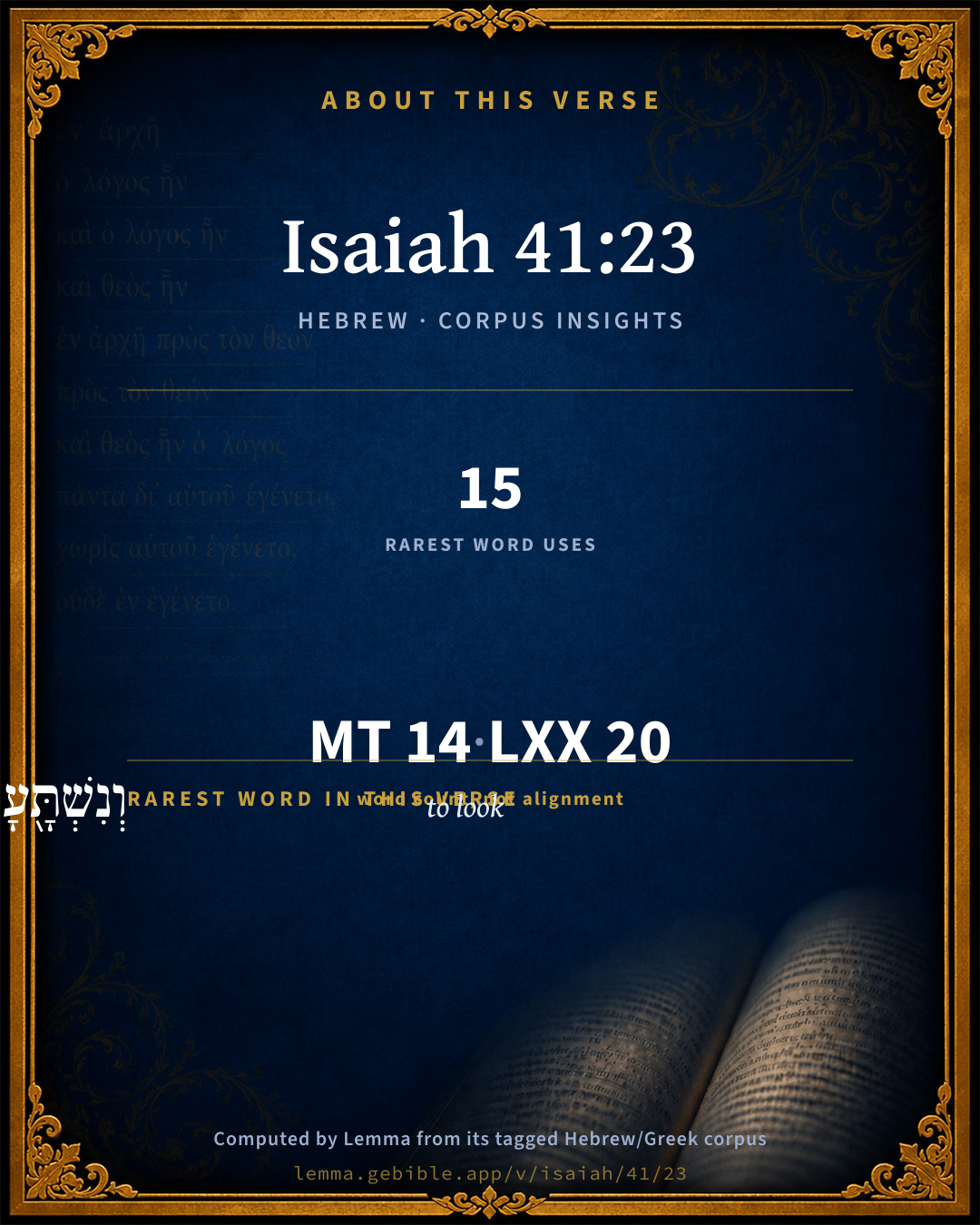
The rarest word here is וְנִשְׁתָּ֖עָה to look H8159 — appearing just 15 times in the whole Hebrew Bible.

Shared distinctive vocabulary

וְנִשְׁתָּ֖עָה to look H8159 occurs in 15 verses of the Hebrew Bible. Also found in:

Grammatical profile

  • 8 verbs
  • 2 nouns
  • 1 pronoun
  • 1 conjunction
  • 1 adverb
  • 1 particle

Verb forms

  • הַגִּ֨ידוּ֙ Hiphil · Imperative
  • הָאֹתִיּ֣וֹת Qal · Participle Active
  • וְנֵ֣דְעָ֔ה Qal · Cohortative
  • תֵּיטִ֣יבוּ Hiphil · Imperfect
  • וְתָרֵ֔עוּ Hiphil · Imperfect
  • וְנִשְׁתָּ֖עָה Qal · Cohortative
  • ונרא Qal · Imperfect
  • וְנִרְאֶ֥ה Qal · Cohortative

Repetition

A word recurs within this verse — often emphatic in Hebrew:

  • ונרא to see H7200 ×2

Hebrew & Septuagint length

In English translation the verse runs 31 words from the Hebrew and 39 from the Septuagint (LXX English) — closely comparable.

A rough comparison of the two English renderings, which tokenize alike — not a word-level alignment.

Word counts can differ between the Hebrew and the Greek without any difference in meaning — e.g. the Hebrew direct-object marker אֵת has no separate Greek word, and Greek often adds the article ὁ.

In the original languages it is 14 Hebrew tokens and 20 Greek tokens — but the two are counted differently (Hebrew bundles its prefixes and suffixes into one token; the Greek is in lemma form), so that isn’t a like-for-like length.

Cross-references

8

Topical passages linked to Isaiah 41:23 in the Treasury of Scripture Knowledge — connected by theme and wording, ordered by reader-vote popularity; previews shown in the World English Bible.

  • Isaiah 42:9 Behold, the former things have happened, and new things do I declare. Before they spring forth I tell you of them.
  • John 13:19 From now on, I tell you before it happens, that when it happens, you may believe that I AM.
  • Jeremiah 10:5 They are like a palm tree, of turned work, and don't speak: they must be carried, because they can't go. Don't be afraid of them; for they can't do evil, neither is it in them to do good."
  • Isaiah 44:7–8 Who, as I, shall call, and shall declare it, and set it in order for me, since I established the ancient people? and the things that are coming, and that shall happen, let them declare.
  • Isaiah 45:3 and I will give you the treasures of darkness, and hidden riches of secret places, that you may know that it is I, Yahweh, who call you by your name, even the God of Israel.
  • Isaiah 45:7–8 I form the light, and create darkness; I make peace, and create evil. I am Yahweh, who does all these things.
  • Isaiah 46:7 They bear it on the shoulder, they carry it, and set it in its place, and it stands, from its place it shall not move: yes, one may cry to it, yet it can not answer, nor save him out of his trouble.
  • Isaiah 46:9–10 Remember the former things of old: for I am God, and there is none else; [I am] God, and there is none like me;

Cross-references courtesy of OpenBible.info (CC BY 4.0).

Hebrew and Greek witnesses Masoretic Hebrew ↔ Greek Septuagint

The same verse in the two great witnesses to the Old Testament, shown verse-for-verse.

These are two independent witnesses, not word-aligned to each other, and the Septuagint is shown in lemma (dictionary) form.

Hebrew Isaiah 41:23 Masoretic · Westminster Leningrad Codex

הַגִּ֨ידוּ֙ הָאֹתִיּ֣וֹת לְאָח֔וֹר וְנֵ֣דְעָ֔ה כִּ֥י אֱלֹהִ֖ים אַתֶּ֑ם אַף תֵּיטִ֣יבוּ וְתָרֵ֔עוּ וְנִשְׁתָּ֖עָה ונרא וְנִרְאֶ֥ה יַחְדָּֽו

Declare the things that are to come hereafter, that we may know that you are gods: yes, do good, or do evil, that we may be dismayed, and see it together.

World English Bible · Public Domain

Greek LXX Isaiah 41:23 Septuagint · lemma form

ἀναἀγγέλλω ἐγώ ὁ ἐπιἔρχομαι ἐπί ἔσχατος καί γιγνώσκω ὅτι θεός εἰμί εὖ ποιέω καί κακόω καί θαυμάζω καί ὁράω ἅμα

tell us, declare you⌃ to us the things that are coming on at the last time, and we shall know that you⌃ are gods: do good, and do evil, and we shall wonder, and see at the same time

LXX2012 (modern English Septuagint) · Public Domain

Hebrew: Westminster Leningrad Codex (CC BY 4.0). Greek: Septuagint (public domain); English from LXX2012 (modern English Septuagint) (Public Domain). How the Septuagint differs from the Hebrew →

Targum (Aramaic paraphrase)

1

The Targum is the ancient Jewish Aramaic paraphrase of the Hebrew Scriptures — an interpretive translation, not the Hebrew text itself. Onkelos (literal) and Pseudo-Jonathan (expansive) render the Torah, and Jonathan the Prophets. Coverage is partial: where no permissively-licensed English translation exists for a verse, only the Aramaic is shown. This is verse-level text, not a word-by-word alignment to the Hebrew.

  1. Targum Jonathan Prophets (Joshua–Malachi)
    חֲווֹ דְאַתְיָן לְסוֹפָא וְנִדַע אִם לְטַעֲוָן דְאִית בְּהוֹן צְרוֹךְ אַתּוּן פָּלְחִין אִם יָכְלִין אִינוּן לְאֵיטָבָא וּלְאַבְאָשָׁא וְנִסְתַּכֵּיל וְנֵידוֹן כַּחֲדָא:

    Declare the things that are to come hereafter, that we may know whether ye worship idols in which there is any profit, whether they are able to do good, or to do evil; that we may consider and argue together.

    Targum Jonathan — Aramaic: “Mikraot Gedolot” (public domain). English: “Sefaria Community Translation” (CC0 1.0 (public-domain dedication)); “London "Chaldee Paraphrase," 1871” (public domain). Text via Sefaria.

Commentary

Notes on Isaiah 41:23 from classic Christian and Jewish commentators (each source and its license shown beneath its notes). The classic Christian expositions comment on the surrounding passage and are grouped to its opening verse, so a note may address several verses; the Jewish commentaries on the Tanakh (Rashi and others) are per-verse, so they appear only where the commentator wrote on this verse.

Lemma curates 59 commentaries, every one of them public domain or Creative Commons licensed, each selected and text-cleaned for this edition rather than reprinted as found. About our sources →

Trapp's Complete Commentary

John Trapp

Isa 41:23 Shew the things that are to come hereafter, that we may know that ye [are] gods: yea, do good, or do evil, that we may be dismayed, and behold [it] together.

Ver. 23. Show the things that are to come.] This first argument is much insisted on. God alone can properly predict; and Testimonium divinitatis est veritas divinationis. {a} Cato Major was wont to say, that he wondered how one diviner could look upon another and not laugh, as knowing themselves to be no better than deceivers of the people.

Yea, do good or evil.] Good to your friends, evil to your foes. This is the second argument, and it is unanswerable. If it be objected, that this the devil can do, and hath done, the answer is; (1.) that idols can do neither good nor evil, (2.) no, nor yet devils; but the good they do their clients is a mere magic, and the evil they do to any is by divine permission. See Cyprian’s Fourth Treatise, De Vanitate Idolorum. {b}

{a} Tertul. Apol., cap. 20.

{b} Vide etiam, Aug. De Civlt. Dei, lib. ii. cap. 22, 25, &c.

John Trapp, A Commentary or Exposition upon All the Books of the Old and New Testament (1647–1656) — public domain. Text from a community e-Sword module.

Jamieson, Fausset & Brown

Robert Jamieson, A. R. Fausset & David Brown

do good . . . evil--give any proof at all of your power, either to reward your friends or punish your enemies (Psa 115:2-8).

that we may be dismayed, and behold it together--MAURER translates, "That we (Jehovah and the idols) may look one another in the face (that is, encounter one another, Kg2 14:8, Kg2 14:11), and see" our respective powers by a trial. HORSLEY translates, "Then the moment we behold, we shall be dismayed." "We" thus, and in English Version, refers to Jehovah and His worshippers.

Jamieson, Fausset & Brown — Commentary Critical and Explanatory on the Whole Bible (1871) — public domain (CC PDM 1.0). Text via the HelloAO Bible API.

Adam Clarke's Commentary

Verse 23. That we may be dismayed, and behold it together - "Then shall we be struck at once with admiration and terror."] The word ונרא venere is written imperfectly in the Hebrew text; the Masoretes supply ה he at the end; and so it is read in twenty-two MSS. and four editions; that is, ונראה venireh, and we shall see. But the true reading seems to be ונירא venira, and we shall fear, with י yod supplied, from ירא yara.

Adam Clarke's Commentary on the Bible (1810–1826) — public domain. Text from a community e-Sword/MySword module.

Ellicott's Commentary for English Readers

(23) Do good, or do evil.—The challenge reminds us of Elijah’s on Mount Carmel (1Ki_18:27). Can the heathen point to any good or evil fortune which, as having been predicted by this or that deity, might reasonably be thought of as his work? It lies in the nature of the case that every heathen looked to his gods as having sent blessings, or the reverse, but it was only Jehovah who could give the proof supplied by prediction.

A Bible Commentary for English Readers, edited by Charles John Ellicott (1878–1897) — public domain. Text from a community e-Sword module.

The Cambridge Bible for Schools and Colleges

gen. ed. J. J. S. Perowne

23. do good, or do evil] i.e. “do anything whatever, good or bad” (Jer_10:5; Zep_1:12), give any sign of vitality or intelligence.

that we may be dismayed] Rather: that we may stare (in astonishment). (The same word in Isa_41:10.)

The Cambridge Bible for Schools and Colleges (gen. ed. J. J. S. Perowne; Cambridge University Press, 1878–1918) — public domain. Text from a community e-Sword module.

John Gill's Exposition

Show the things that are to come hereafter,.... From henceforward to the consummation of all things: so the Targum,

"show what shall come to the end;''

or at the end, the end of all things; or show wonderful things, which shall be hereafter; so Jarchi interprets the word; a word like this having the signification of signs and wonders:

that we may know that ye are gods; as ye are said to be; that we may own and acknowledge you to be such, there being this clear proof of it, if it can be made out, foretelling things to come, both near and far off. The Targum is,

"that we may know whether ye worship idols, in whom there is any profit;''

as if the words were spoken not to the idols, but to the worshippers of them: "yea, do good, or do evil"; not in a moral, but in a civil sense; do good to your friends, to your worshippers; bestow favours upon them, as I do on mine; or inflict punishment on your enemies, such as despise your deity, and will not worship you, as I do on those that despise me, and will not regard my service and worship:

that we may be dismayed, and behold it together: that when we see your deity, and are convinced of it by the above proofs, we may be amazed and astonished, as not expecting such proof, and be confounded, and have no more to object unto it. The Targum is,

"that we may consider and reason together;''

and bring the matter in controversy to an issue, as it is in the next verse.

John Gill's Exposition of the Whole Bible (1746–1763) — public domain (CC PDM 1.0). Text via the HelloAO Bible API.

Albert Barnes' Notes on the Bible

That we may know that ye are gods - The prediction of future events is the highest evidence of omniscience, and of course of divinity. In this passage it is admitted that if they could do it, it would prove that they were worthy of adoration; and it is demanded, that if they were gods they should be able to make such a prediction as would demonstrate that they were invested with a divine nature.

Yea, do good, or do evil - Do something; show that you have some power; either defend your friends, or prostrate your foes; accomplish something - anything, good or bad, that shall prove that you have power. This is said in opposition to the character which is usually given to idols in the Scriptures - that they were dumb, deaf, dead, inactive, powerless (see Psa 95:1-11) The command here to ‘do evil,’ means to punish their enemies, or to inflict vengeance on their foes; and the idea is, that they had no power to do anything; either to do good to their worshippers, or harm to their enemies; and that thus they showed that they were no gods. The same idea is expressed in Jer 10:3-5 : ‘They (idols) are upright as the palm-tree, but speak not; they must needs be borne, because they cannot go. Be not afraid of them, for they cannot do evil, neither also is it in them to do good.’

That we may be dismayed - (See the note at Isa 41:10). The word ‘we’ here refers to those who were the friends and worshippers of Yahweh. ‘That I, Yahweh, and my friends and worshippers, may be alarmed, and afraid of what idols may be able to do.’ God and his people were regarded as the foes of idols, and God here calls on them to prove that there is any reason why he and his people should be afraid of their power.

And behold it together - That we may all see it; that I and my people may have full demonstration of your power.

Albert Barnes' Notes on the Bible (1834–1885) — public domain. Text from a community e-Sword/MySword module.

Haydock's Catholic Bible Commentary

Good. The prescience and power of God prove his divinity. Can idols produce any thing similar? (Calmet) --- None can tell what will happen, unless God reveal it. (Worthington)

George Leo Haydock (1774–1849), Haydock's Catholic Family Bible and Commentary, 1859 edition — public domain. Excludes Psalms (Douay-Rheims chapter numbering differs from Protestant) and Deuterocanonical books (Catholic canon only).

Matthew Poole's English Annotations

That we may know that ye are gods; that we may have, if not a certain proof, yet at least a probable argument, of your deity. It may be objected that the devil hath foretold future events by idols; but it may be answered, that such predictions were but rare, and oftentimes were false, and confuted by the event; and generally were dark and doubtful, as hath been noted; and when they were verified by the event, that was only done by Divine permission and revelation, for the trial or punishment of wicked men, of which we have an instance, Deu 13:1-3, and therefore doth no more prove them to be gods than the predictions made known by God unto the prophets proved them to be gods.

Do good, or

do evil; protect and bless your worshippers whom I intend to destroy, and destroy my people whom I intend to save, and then you have some colour to assert your deity. But, alas! you can neither do good nor evil.

That we may be dismayed, and behold it together; that I and my people may be astonished, and confounded, and forced to acknowledge your godhead.

Matthew Poole's English Annotations on the Holy Bible (1683–1685) — public domain. Text from a community e-Sword/MySword module.

The Pulpit Commentary

Yea, do good, or do evil. Here the proof required of the idol-gods is changed. If they cannot prophesy, can they effect anything? Can they do either good or harm? Let them show this. It is a plain "abatement" from the first demand, and therefore properly introduced by "yea" (aph); 1Ki_8:27. That we may be dismayed; i.e. rather, perhaps, that we may look to it, or examine it; i.e. see if yon have really shown a power of doing anything.

The helplessness of idols.

Before God can hopefully intervene on behalf of man, man must have become thoroughly convinced of his own helplessness, and of the insufficiency of all on whom he is disposed to rely. In the time of the Babylonish captivity, many, surrounded day by day with idolatrous sentiments and associations, would incline to reliance on these idols, and to seeking help and deliverance from them. Therefore the prophet, by solemn warnings, by satire and taunt, strives to break God"s people away from all such vain confidences. We have some idea of the boastings of the Assyrians in the power of their idol-gods given in the Rabshakeh"s messages to Hezekiah. He glories in the superiority of the Assyrian gods over all the gods of the conquered nations; and the discouraged exiles might be tempted to say, "Even our God, Jehovah. could not stand against these Assyrian gods; then let us seek to them for help and deliverance." And if such formal idolatries belong to the past, answering spiritual idolatries belong to the present; and we also are ready enough to turn away from God, when he does not let things be "according to our mind," and we easily take up with idol-devices of our own hearts. So Israel and we may profitably be reminded that all self-made idols are vanity, and must utterly fail all who put their trust in them when the testing-day comes. In our text the idol-claimants are put to a test. Let them do something. Helpless things". A great deal is done for them; now let things be turned about, and let them do something. We need not be over-particular. If it is inconvenient for them to do something good, let them do something evil only let it be something. But they cannot. "They are of nothing, and their work of nought". (see 1Co_8:4) Cheyne says, "The Divine Speaker waives the question of foreknowledge, and makes the least requirement possible." Prove that you are alive, by performing some act whether good (for your friends) or bad (for your foes)." Or, we may empty the terms "good" and "evil" of their moral meaning, and suppose them to be used proverbially to express the one simple notion of anything, exactly as the two words "right and left" merely conveyed the idea of anywhere. " Matthew Henry paraphrases thus: "Let them do, if they can, anything extraordinary, that people may admire and be affected with. Let them either bless or curse, with power. Let us see them inflict such plagues as God brought on Egypt, or bestow such blessings as God bestowed on Israel. Let them do some great thing, and we shall be amazed when we see it, and frightened into a veneration of them, as many have been into a veneration of the true God." The point suggested for illustration is that it would be well to put nineteenth-century idols also to the test, and see whether they are worthy of confidence because they have power to do either good or evil. What may be regarded as idols must be decided by each teacher of men for himself. We can only venture to hint that the following may come under the denomination. Indeed, an idol is anything which so occupies the interest of man as to push God out of his supreme place in man"s affection and service.

I THE IDOL OF SCIENCE. Worshipped by many in our day. What can it do? What can it do towards meeting the spiritual need, the sense of sin, the soul-cry, of man? And it can do nothing if it can bear no relation to them.

II THE IDOL OF LUXURY. Pleasure has numberless votaries, who delight in her service. Yet is she but the syren, who floats on, just a little in front, luring her worshippers into headlessness of the black storms that are gathering in the sky. What can she do in the day of calamity? Then her votaries find she is "all vanity, and her works are nothing.

III THE IDOL OF SELF. Taking often very interesting shapes, as socialistic theories of man"s regeneration by man. Very attractive is the notion that all earth-woes would fade away if only men would bind themselves together in a universal "Help-Myself" Society. And yet the story of the ages is the ever-fresh illustration of the fact that it is not, and it never has been, in "man that walketh to direct his steps." Ask "Self" what it can do for our best and highest interests, and it is as dumb as any idol-block. None hear, and there is no one to answer. Only when the claims of idol Self had been thoroughly worked out, and "man by his wisdom evidently knew not God," did Divine love intervene and send the Son. The "fulness of times" was precisely the time when helpless "Self" was proved to be of nothing, and his works of nought. And yet round these and other idol-shrines men crowd to-day, and need to heat" the solemn appeal of the last of Christ"s apostles, "Little children, keep yourselves from idols. " R.T.

The Pulpit Commentary (1880–1919), ed. H.D.M. Spence-Jones & Joseph S. Exell — public domain. Text from a community e-Sword module.

John Wesley's Explanatory Notes

Do good - Protect your worshippers whom I intend to destroy, and destroy my people whom I intend to save. That - That I and my people may be astonished, and forced to acknowledge your godhead.

John Wesley, Explanatory Notes Upon the Whole Bible (1754–1765) — public domain. Text via the GEBible commentary corpus.

J. A. Alexander on Isaiah

Joseph Addison Alexander

“Show forth the (things) to come hereafter, and we will know that ye are gods; yes, ye shall do good or do evil, and we will look about and see together.” The subjunctive construction, ‘that we may know’, gives the sense of the original, but with a needless change of form. The same remark applies to the imperative translation of the futures in the next clause (do good, do evil). The use of the disjunctive, on the other hand, is rendered almost unavoidable by an entire difference of idiom, the Hebrews constantly employing ‘and’ where ‘or’ in English seems essential to the sense. ‘Look about’ has the same sense as in v. 10 above, where it seems to express the act of looking round or about upon those present, in that case with the secondary notion of alarm (as looking round for help), but in this case with that of inspection or consideration (we will look about us).

Joseph Addison Alexander, The Prophecies of Isaiah (1846–1847; New York: Scribner, 1870–1878) — public domain. Text from a community e-Sword module.

unfoldingWord translationNotes

Door43 World Missions Community

Connecting Statement:

Yahweh continues to mock the idols and the people who worship them. (See: Isaiah 41:21-22)

do something good or evil

The words "good" and "evil" form a merism and represent anything. AT: "do anything at all" (See: Merism)

the one who chooses you

Here "you" is plural and refers to the idols. AT: "the person who chooses you idols" (See: Forms of You)

translationWords

good

evil

fear

false god

works

abomination

unfoldingWord translationNotes — © Distant Shores Media and the Door43 World Missions Community, licensed CC BY-SA 4.0. Source: git.door43.org/Door43/en_tn.

Rashi

Rabbi Shlomo Yitzchaki (Rashi)

Tell the signs coming later Heb. הָאוֹתִיוֹת לְאָחוֹר, the wonders coming at the end.

let us talk Heb. וְנִשְׁתָּעָה. Let us tell your words. (Gen. 24:66) “And he told (וַיְּסַפֵּר),” the Targum renders וְאִשְׁתָּעֵי.

Rashi on the Tanakh — English translations: “The Judaica Press complete Tanach with Rashi, translated by A. J. Rosenberg” (CC BY 4.0); “Pentateuch with Rashi's commentary by M. Rosenbaum and A.M. Silbermann, 1929-1934” (public domain); “The Metsudah Tanach series, Lakewood, N.J” (CC BY 4.0); and “The Book of Joshua, Metsudah Publications, 1997” (CC BY 4.0). Text via Sefaria.

Ibn Ezra

Rabbi Abraham ibn Ezra

האתיות Theat things that are to come. Comp. אתה cometh (21:12).

לאחור hereafter it is the opposite of לפנים (Ruth 4:7). And know etc. We shall then know that you have power to do good or evil.

ונשתעה that we may relate. Comp. ואשתעי the Chaldean translation of ויספר "and he related" (Ex. 48:18). Some explain it "and we shall turn unto it," and compare it with אל תשתע do not turn away.

Ibn Ezra on the Tanakh — English translations: “Sefaria Community Translation” (CC0 1.0 (public-domain dedication)); “Yalkut, Sifsei Chachomim Chumash, Metsudah Publications, 2009” (CC BY 4.0); and “Commentary of Ibn Ezra on Isaiah - trans. by M. Friedlander, 1873” (public domain). Text via Sefaria.

Lesson kit

Teaching starters — assembled from the data on this page, not authored interpretation. Every prompt links to the verse data it draws on. Edit before teaching.

Isaiah, in the Prophets, opens this verse with 14 words (13 distinct Hebrew lemmas). Its most distinctive word is shâʻâh (“to look”). A historical commentator’s framing appears above. Read the whole chapter for the surrounding context.

Discussion questions

  1. The word shâʻâh carries the sense “to look.” How does it shape the verse?
  2. How does Genesis 4:4, which shares the word «to look», read alongside this verse?
  3. What does the repetition of “to see” (2× in this one verse) do in this verse?
  4. These translations render this verse differently. What is at stake in choosing one wording over another?
  5. «הַגִּ֨ידוּ֙» is a Hiphil Imperative verb. How does that grammatical form shape the action described?
  6. Compare how Trapp's Complete Commentary and Jamieson, Fausset & Brown read this verse. Where do they agree or differ?

Things to notice

Reading settings

Reading text

Shown beneath each verse's original-language words.

Old Testament
Old Testament edition

Read the OT as the Masoretic Hebrew (MT) or the Greek Septuagint (LXX).

English shown for the Greek Septuagint (in the Hebrew ↔ Greek comparison).

Comparing translations? Open the Compare panel on any verse page to stack up to four side by side.