
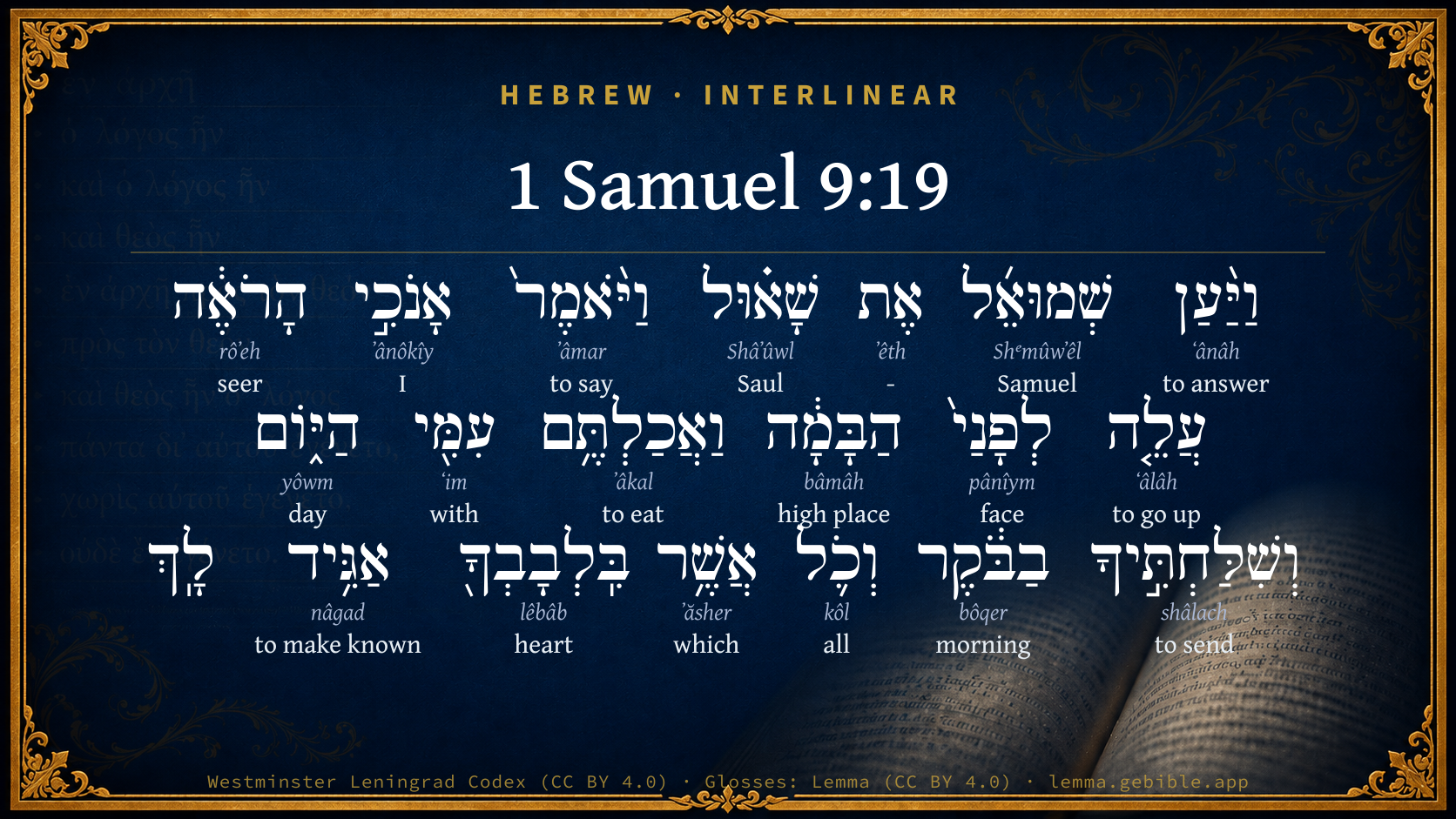
1 Samuel 9:19

Hebrew (Westminster Leningrad Codex) 1 Samuel 9:19 appears in the Hebrew Old Testament. The text above is from the Westminster Leningrad Codex. Each word links to its Strong’s number, a concise gloss, and parsing drawn from the Open Scriptures Hebrew Bible morphology. Click any word for its full Brown-Driver-Briggs (BDB) entry.
Download image
Cite this verse

1 Samuel 9:19 (World English Bible). Public Domain. Lemma interlinear Bible study tool, https://lemma.gebible.app/v/1-samuel/9/19.

Show BibTeX & RIS
BibTeX
RIS
English Translation
Samuel answered Saul, and said, I am the seer; go up before me to the high place, for you shall eat with me today: and in the morning I will let you go, and will tell you all that is in your heart.
World English Bible · Public Domain
Download a study sheet

One document with this verse’s original text, its word-by-word gloss line, the meaning frame, cross-references with their text, attributed commentary, and full source and license credits — printable, and it pastes into notes with its structure intact.

This verse Autodidact and up

Study sheet (.html) Plain text (.txt)

A passage Seminary Student

Up to 50 verses in one chapter. A passage sheet keeps up to 6 commentary sources and 12 cross-references per verse, in the order this page ranks them, and says so on the sheet whenever that leaves anything out. Ask for a single verse and you get the Autodidact verse sheet above.

Everything on this page stays free to read, with no account — the sheet is a download of what is already on screen, not access to it.

Want to remove ads? Support Godless Engineer
Compare translations 3

The same verse in 3 English versions, stacked beneath the original-language interlinear above. Click any original word for its lexicon entry.

Each is an independent rendering of the whole verse — the interlinear is not word-aligned to these translations.

Highlighted words mark where these versions differ — a whole-verse word diff, not a word-by-word alignment.

  • World English Bible Public Domain
    Samuel answered Saul, and said, I am the seer; go up before me to the high place, for you shall eat with me today: and in the morning I will let you go, and will tell you all that is in your heart.
  • King James Version Public Domain
    And Samuel answered Saul, and said, I am the seer: go up before me unto the high place; for ye shall eat with me to day, and to morrow I will let thee go, and will tell thee all that is in thine heart.
  • unfoldingWord Literal Text CC BY-SA 4.0
    And Samuel answered Saul and said, “I the seer. Go up to my face to the high place, and you shall eat with me today. And I will send you away in the morning, and I will declare to you all that in your heart.

unfoldingWord Literal Text — © unfoldingWord, licensed CC BY-SA 4.0. Word-aligned USFM3 via Door43 (git.door43.org/unfoldingWord/en_ult).

Versions to compare (up to 4)

3 of 4 selected

Show all 18 translations

Every available English version of this verse, each an independent rendering of the whole verse.

  • World English Bible Public Domain
    Samuel answered Saul, and said, I am the seer; go up before me to the high place, for you shall eat with me today: and in the morning I will let you go, and will tell you all that is in your heart.
  • Berean Standard Bible Public Domain
    “I am the seer,” Samuel replied. “Go up before me to the high place, for you shall eat with me today. And when I send you off in the morning, I will tell you all that is in your heart.
  • Majority Standard Bible Public Domain
    “I am the seer,” Samuel replied. “Go up before me to the high place, for you shall eat with me today. And when I send you off in the morning, I will tell you all that is in your heart.
  • King James Version Public Domain
    And Samuel answered Saul, and said, I am the seer: go up before me unto the high place; for ye shall eat with me to day, and to morrow I will let thee go, and will tell thee all that is in thine heart.
  • American Standard Version (1901) Public Domain
    And Samuel answered Saul, and said, I am the seer; go up before me unto the high place, for ye shall eat with me to-day: and in the morning I will let thee go, and will tell thee all that is in thy heart.
  • Revised Version (1885) Public Domain
    And Samuel answered Saul, and said, I am the seer; go up before me unto the high place, for ye shall eat with me today: and in the morning I will let thee go, and will tell thee all that is in thine heart.
  • Geneva Bible (1599) Public Domain
    And Samuel answered Saul, and saide, I am the Seer: goe vp before me vnto the hie place: for ye shall eate with me to day. and to morowe I will let thee goe, and will tell thee all that is in thine heart.
  • Douay-Rheims (1899) Public Domain
    And Samuel answered Saul, saying: I am the seer, go up before me to the high place, that you may eat with me to day, and I will let thee go in the morning: and tell thee all that is in thy heart.
  • Young's Literal Translation Public Domain
    And Samuel answereth Saul and saith, `I `am' the seer; go up before me into the high place, and ye have eaten with me to-day, and I have sent thee away in the morning, and all that `is' in thy heart I declare to thee.
  • Literal Standard Version CC BY-SA 4.0
    And Samuel answers Saul and says, “I [am] the seer; go up before me into the high place, and you have eaten with me today, and I have sent you away in the morning, and all that [is] in your heart I declare to you.
  • Unlocked Literal Bible CC BY-SA 4.0
    Samuel answered Saul and said, “I am the seer. Go up before me to the high place, for today you will eat with me. In the morning I will let you go, and I will tell you everything that is on your mind.
  • unfoldingWord Literal Text CC BY-SA 4.0
    And Samuel answered Saul and said, “I the seer. Go up to my face to the high place, and you shall eat with me today. And I will send you away in the morning, and I will declare to you all that in your heart.
  • Darby Bible Public Domain
    And Samuel answered Saul and said, I am the seer: go up before me to the high place, and ye shall eat with me to-day; and to-morrow I will let thee go, and will tell thee all that is in thy heart.
  • World Messianic Bible Public Domain
    Samuel answered Saul and said, “I am the seer. Go up before me to the high place, for you are to eat with me today. In the morning I will let you go and will tell you all that is in your heart.
  • Webster's Bible Public Domain
    And Samuel answered Saul, and said, I am the seer: go up before me to the high place; for ye shall eat with me to-day, and to-morrow I will let thee go, and will tell thee all that is in thy heart.
  • Free Bible Version CC BY-SA 4.0
    “I am the seer,” Samuel told Saul. “Go up ahead of me and we will eat together. Then in the morning I will answer all your questions and then send you on your way.
  • Bible in Basic English Public Domain
    Then Samuel said to Saul, I am the seer; go up before me to the high place and take food with me today: and in the morning I will let you go, after opening to you all the secrets of your heart.
  • JPS Tanakh (1917) Public Domain
    And Samuel answered Saul, and said: 'I am the seer; go up before me unto the high place, for ye shall eat with me to-day; and in the morning I will let thee go, and will tell thee all that is in thy heart.

Literal Standard Version (2020), Covenant Press — licensed CC BY-SA 4.0. Text via the HelloAO Bible API (eBible.org). Unlocked Literal Bible (unfoldingWord) — licensed CC BY-SA 4.0. Text via the HelloAO Bible API (eBible.org). unfoldingWord Literal Text — © unfoldingWord, licensed CC BY-SA 4.0. Word-aligned USFM3 via Door43 (git.door43.org/unfoldingWord/en_ult). Free Bible Version, Dr. Jonathan Gallagher — licensed CC BY-SA 4.0. Text via the HelloAO Bible API (eBible.org).

Word by word

More ways to search: Search by grammar → Find every occurrence → Compare this word →

Practice this passage: Drill this verse → Learn its vocabulary →

הָרֹאֶ֔ה
rôʼeh
H7203
“the · seer”
Particle, Definite Article + Verb, Qal, Participle Active, Masculine, Singular, Absolute
Part of Speech
Particle + Verb
Stem
Qal
Form
Participle Active
Gender
Masculine
Number
Singular
State
Absolute
Full BDB Definition

Origin: act part of H7200

TWOT: 2095b , 2095c

seer, prophet - (prophetic) vision
  1. וַיַּ֨עַן ʻânâh H6030 “and · to answer” Conjunction + Verb, Qal, Sequential Imperfect, 3rd Person, Masculine, Singular
  2. שְׁמוּאֵ֜ל Shᵉmûwʼêl H8050 “Samuel” Noun, Proper
  3. אֶת ʼêth H853 “-” Particle, Direct Object
  4. שָׁא֗וּל Shâʼûwl H7586 “Saul” Noun, Proper
  5. וַיֹּ֨אמֶר֙ ʼâmar H559 “and · to say” Conjunction + Verb, Qal, Sequential Imperfect, 3rd Person, Masculine, Singular
  6. אָנֹכִ֣י ʼânôkîy H595 “I” Pronoun, Personal, 1st Person, Common, Singular
  7. עֲלֵ֤ה ʻâlâh H5927 “go up” Verb, Qal, Imperative, 2nd Person, Masculine, Singular
  8. לְפָנַי֙ pânîym H6440 “to/for · face(s) · my” Preposition + Noun, Common, Both, Plural, Construct + Suffix, Personal, 1st Person, Common, Singular
  9. הַבָּמָ֔ה bâmâh H1116 “the · high place” Particle, Definite Article + Noun, Common, Feminine, Singular, Absolute
  10. וַאֲכַלְתֶּ֥ם ʼâkal H398 “and · to eat” Conjunction + Verb, Qal, Sequential Perfect, 2nd Person, Masculine, Plural
  11. עִמִּ֖י ʻim H5973 “with · me” Preposition + Suffix, Personal, 1st Person, Common, Singular
  12. הַיּ֑וֹם yôwm H3117 “the · day” Particle, Definite Article + Noun, Common, Masculine, Singular, Absolute
  13. וְשִׁלַּחְתִּ֣יךָ shâlach H7971 “and · to send · you” Conjunction + Verb, Piel, Sequential Perfect, 1st Person, Common, Singular + Suffix, Personal, 2nd Person, Masculine, Singular
  14. בַבֹּ֔קֶר bôqer H1242 “in/at the · morning” Preposition, Determined + Noun, Common, Masculine, Singular, Absolute
  15. וְכֹ֛ל kôl H3605 “and · all” Conjunction + Noun, Common, Masculine, Singular, Absolute
  16. אֲשֶׁ֥ר ʼăsher H834 “which” Particle, Relative
  17. בִּֽלְבָבְךָ֖ lêbâb H3824 “in/at · heart · your” Preposition + Noun, Common, Masculine, Singular, Construct + Suffix, Personal, 2nd Person, Masculine, Singular
  18. אַגִּ֥יד nâgad H5046 “to make known” Verb, Hiphil, Imperfect, 1st Person, Common, Singular

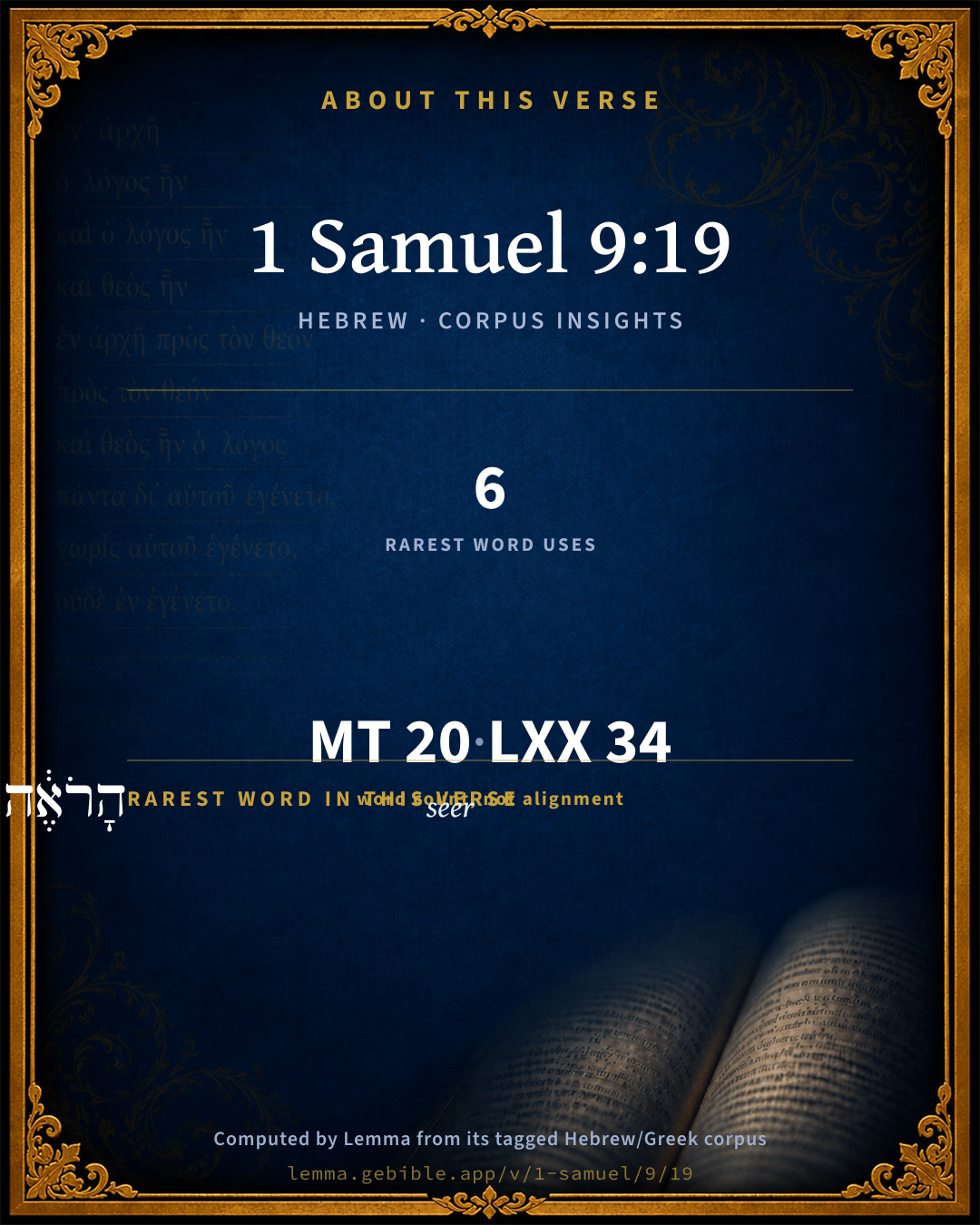
About this verse

These counts appear in no published source. They are computed here, from the morphology-tagged text and Lemma’s own curated glosses. What Lemma adds →

20
words
19
distinct lemmas
Historical
section

Notable vocabulary

The rarest word here is הָרֹאֶ֔ה seer H7203 — appearing just 6 times in the whole Hebrew Bible.

Shared distinctive vocabulary

הָרֹאֶ֔ה seer H7203 occurs in 5 verses of the Hebrew Bible. Also found in:

Grammatical profile

  • 7 verbs
  • 8 nouns
  • 1 pronoun
  • 2 prepositions
  • 2 particles

Verb forms

  • וַיַּ֨עַן Qal · Sequential Imperfect
  • וַיֹּ֨אמֶר֙ Qal · Sequential Imperfect
  • הָרֹאֶ֔ה Qal · Participle Active
  • עֲלֵ֤ה Qal · Imperative
  • וַאֲכַלְתֶּ֥ם Qal · Sequential Perfect
  • וְשִׁלַּחְתִּ֣יךָ Piel · Sequential Perfect
  • אַגִּ֥יד Hiphil · Imperfect

Hebrew & Septuagint length

In English translation the verse runs 43 words from the Hebrew and 40 from the Septuagint (LXX English) — closely comparable.

A rough comparison of the two English renderings, which tokenize alike — not a word-level alignment.

Word counts can differ between the Hebrew and the Greek without any difference in meaning — e.g. the Hebrew direct-object marker אֵת has no separate Greek word, and Greek often adds the article ὁ.

In the original languages it is 20 Hebrew tokens and 34 Greek tokens — but the two are counted differently (Hebrew bundles its prefixes and suffixes into one token; the Greek is in lemma form), so that isn’t a like-for-like length.

Cross-references

2

Topical passages linked to 1 Samuel 9:19 in the Treasury of Scripture Knowledge — connected by theme and wording, ordered by reader-vote popularity; previews shown in the World English Bible.

  • 1 Corinthians 14:25 And thus the secrets of his heart are revealed. So he will fall down on his face and worship God, declaring that God is among you indeed.
  • John 4:29 "Come, see a man who told me everything that I did. Can this be the Christ?"

Cross-references courtesy of OpenBible.info (CC BY 4.0).

Hebrew and Greek witnesses Masoretic Hebrew ↔ Greek Septuagint

The same verse in the two great witnesses to the Old Testament, shown verse-for-verse.

These are two independent witnesses, not word-aligned to each other, and the Septuagint is shown in lemma (dictionary) form.

Hebrew 1 Samuel 9:19 Masoretic · Westminster Leningrad Codex

וַיַּ֨עַן שְׁמוּאֵ֜ל אֶת שָׁא֗וּל וַיֹּ֨אמֶר֙ אָנֹכִ֣י הָרֹאֶ֔ה עֲלֵ֤ה לְפָנַי֙ הַבָּמָ֔ה וַאֲכַלְתֶּ֥ם עִמִּ֖י הַיּ֑וֹם וְשִׁלַּחְתִּ֣יךָ בַבֹּ֔קֶר וְכֹ֛ל אֲשֶׁ֥ר בִּֽלְבָבְךָ֖ אַגִּ֥יד לָֽךְ

Samuel answered Saul, and said, I am the seer; go up before me to the high place, for you shall eat with me today: and in the morning I will let you go, and will tell you all that is in your heart.

World English Bible · Public Domain

Greek LXX 1 Samuel 9:19 Septuagint · lemma form

καί ἀποκρίνω σαμουηλ ὁ σαούλ καί εἶπον ἐγώ εἰμί αὐτός ἀναβαίνω ἔμπροσθεν ἐγώ εἰς βαμα καί ἐσθίω μετά ἐγώ σήμερον καί ἐκ ἀποστέλλω σύ πρωΐ καί πᾶς ὁ ἐν ὁ καρδία σύ ἀποἀγγέλλω σύ

And Samuel answered Saul, and said, I am he: go up before me to Bama, and eat with me today, and I will send you away in the morning, and I will tell you all that is in your heart.

LXX2012 (modern English Septuagint) · Public Domain

Hebrew: Westminster Leningrad Codex (CC BY 4.0). Greek: Septuagint (public domain); English from LXX2012 (modern English Septuagint) (Public Domain). How the Septuagint differs from the Hebrew →

Targum (Aramaic paraphrase)

1

The Targum is the ancient Jewish Aramaic paraphrase of the Hebrew Scriptures — an interpretive translation, not the Hebrew text itself. Onkelos (literal) and Pseudo-Jonathan (expansive) render the Torah, and Jonathan the Prophets. Coverage is partial: where no permissively-licensed English translation exists for a verse, only the Aramaic is shown. This is verse-level text, not a word-by-word alignment to the Hebrew.

  1. Targum Jonathan Prophets (Joshua–Malachi)
    וְאָתֵיב שְׁמוּאֵל יַת שָׁאוּל וַאֲמַר אֲנָא חֶזְוַיָא סַק לָקֳדָמַי לְבֵית אַסְחֲרוּתָא וְתֵיכְלוּן עִמִי יוֹמָא דֵין וְאֶשְׁלְחִינָךְ בְּצַפְרָא וְכָל דִי בְּלִבָךְ אֲחַוֵי לָךְ:

    (no public-domain English translation for this verse)

    Targum Jonathan — Aramaic: “Mikraot Gedolot” (public domain). English: “Sefaria Community Translation” (CC0 1.0 (public-domain dedication)); “London "Chaldee Paraphrase," 1871” (public domain). Text via Sefaria.

Commentary

Notes on 1 Samuel 9:19 from classic Christian and Jewish commentators (each source and its license shown beneath its notes). The classic Christian expositions comment on the surrounding passage and are grouped to its opening verse, so a note may address several verses; the Jewish commentaries on the Tanakh (Rashi and others) are per-verse, so they appear only where the commentator wrote on this verse.

Lemma curates 59 commentaries, every one of them public domain or Creative Commons licensed, each selected and text-cleaned for this edition rather than reprinted as found. About our sources →

Trapp's Complete Commentary

John Trapp

1Sa 9:19 And Samuel answered Saul, and said, I [am] the seer: go up before me unto the high place; for ye shall eat with me to day, and to morrow I will let thee go, and will tell thee all that [is] in thine heart.

Ver. 19. And will tell thee all that is in thine heart.] And much more: for that he had dreamed of the kingdom, is but a dream of some Jewish doctors.

John Trapp, A Commentary or Exposition upon All the Books of the Old and New Testament (1647–1656) — public domain. Text from a community e-Sword module.

Geneva Bible (1599)

Geneva Bible translators

Meaning, all that thou desirest to know.

Geneva Bible (1599) marginal notes — public domain. Text via Bolls.life.

Adam Clarke's Commentary

Verse 19. I am the seer] This declaration would prepare Saul for the communications afterwards made.

Adam Clarke's Commentary on the Bible (1810–1826) — public domain. Text from a community e-Sword/MySword module.

Ellicott's Commentary for English Readers

(19) Go up before me unto the high place.—The desiring the young stranger to precede him to the public place of sacrifice was a sign of distinguished honour from one of Samuel’s rank to a young unknown wayfarer like Saul. These words of courteous respect were addressed to Saul alone: “Go thou up before me.” The prophet-judge then speaks to the two, Saul and his servant: “ye shall eat.” The verb here is in the plural, and invites both to the sacrificial banquet; and then again Samuel confines his words to Saul: “I will tell thee all”—“all that is in thine heart.” The seer informs him that on the morrow he proposes to make strange disclosures to this young man, who, all un knowing what lay before him, had just come up and accosted him, the aged judge and seer. Yes, he would on the morrow show this young Benjamite that he, Samuel, was indeed a seer; he would tell him all his secret thoughts and aspirations; as for those asses for whose fate he was so anxious, let him dismiss these from his thoughts altogether. They were already found. Far graver thoughts than the everyday weal and woe of a farm on Mount Ephraim had to be discussed on the morrow.

All the desire of Israel.—“All the desire of Israel,” or, as the Vulg. renders it, “optima quæque Israel,” “the best in Israel” (Luther). The words do not signify the desire of Israel—all that it desires—but all that it possesses of what is precious or worth desiring. The obscure dark words of the seer on this, the occasion of his first meeting with Saul, were intended to draw him away from thinking about the asses and the little matters which hitherto had filled his life, and to lift him up to higher thoughts and aspirations. The old seer’s words were vague and indefinite, certainly, but coming as they did from the lips of one so high in dignity, known to be the possessor of many a strange secret of futurity hid from the knowledge of mortal men, and holding out a prospect of undreamed of future glory for Saul, amazed the young man; and he, full of wonderment and awe, replied, “Speakest thou of such glories to me, a member of an unimportant family of the smallest of the tribes of Israel?”

A Bible Commentary for English Readers, edited by Charles John Ellicott (1878–1897) — public domain. Text from a community e-Sword module.

The Cambridge Bible for Schools and Colleges

gen. ed. J. J. S. Perowne

19. go up before me] Addressed to Saul only. The verb is in the singular. Saul is to precede Samuel as a mark of honour.

all that is in thine heart] Thine inmost thoughts and aspirations; not merely about the asses, which Samuel tells him at once. May we not suppose that Saul at his plough like Joan of Arc with her flock had been brooding over the oppression of his country, and cherishing a vague desire to liberate it?

The Cambridge Bible for Schools and Colleges (gen. ed. J. J. S. Perowne; Cambridge University Press, 1878–1918) — public domain. Text from a community e-Sword module.

John Gill's Exposition

And Samuel answered Saul, and said, I am the seer,.... For he supposed, by inquiring for his house, that his business was with him; wherefore this he said, not as boasting of his character and office, or in the pride and vanity of his mind, but merely for information sake:

go up before me unto the high place; instead of returning home with him, he invited him to go to the place of feasting, as the Targum, whither he was going to partake of the entertainment there; and he bids him go before him, either because he was an old man, and could not go his pace, or he had business to do by the way, or this was in honour to Saul, whom he knew was to be king of Israel:

for ye shall eat with me today; he and his servant, at the public feast: he insisted upon his dining, or it may be rather supping with him:

and tomorrow I will let thee go; for it being in the evening when this feast was, he could not depart that night, but must stay till morning, and then he promised to dismiss him:

and will tell thee all that is in thine heart; answer all questions he had in his mind to ask him, for which he came into the city, and inquired for his house. The Jews (l) have a tradition that it was in the heart of Saul that he should be a king, having in a vision seen himself placed on the top of a palm tree, which was a sign of royalty, and this Samuel told him.

(l) Hieron. Trad. Heb. in lib. Reg. fol. 75. G.

John Gill's Exposition of the Whole Bible (1746–1763) — public domain (CC PDM 1.0). Text via the HelloAO Bible API.

Haydock's Catholic Bible Commentary

Place, while Samuel retired, for a while, to his own house. He sends Saul to the assembly, (Calmet) where he would meet him to dine. (Haydock) --- Heart, or desirest to know. (Menochius)

George Leo Haydock (1774–1849), Haydock's Catholic Family Bible and Commentary, 1859 edition — public domain. Excludes Psalms (Douay-Rheims chapter numbering differs from Protestant) and Deuterocanonical books (Catholic canon only).

Matthew Poole's English Annotations

Either all that thou desirest to know, as concerning the asses; or rather, the secret thoughts of thy heart, or such actions as none know but God and thy own heart; that so thou mayst be assured of the truth and certainty of that which I am to acquaint thee with. And this might be done, though it be not here particularly related.

Matthew Poole's English Annotations on the Holy Bible (1683–1685) — public domain. Text from a community e-Sword/MySword module.

The Pulpit Commentary

Vers. 19, 20. Go up before me. Addressed in the singular to Saul, to whom, as the future king, Samuel pays every mark of honour. The next words, Ye shall eat, include Soul"s servant. I will tell thee all, etc. Intended not merely to set Soul"s mind at rest, but also to prepare him for the great news he was to hear. So, too, the information that the asses were found, given to him before he had even hinted at the object of his visit, would convince him of the reality of Samuel"s prophetic powers. On whom is all the desire of Israel? Rather, "To whom belongs all that is desirable in Israel? Is it not for thee, and for thy father"s house?" The words were intended to indicate to Saul, though in an obscure manner, that the supreme power in Israel would be his. Why trouble about she-asses? They might be beautiful, and a valuable property for a husbandman; but he was about to become a king, to whom would belong everything that was best and most precious.

The Pulpit Commentary (1880–1919), ed. H.D.M. Spence-Jones & Joseph S. Exell — public domain. Text from a community e-Sword module.

Lesson kit

Teaching starters — assembled from the data on this page, not authored interpretation. Every prompt links to the verse data it draws on. Edit before teaching.

1 Samuel, in the Historical, opens this verse with 20 words (19 distinct Hebrew lemmas). Its most distinctive word is rôʼeh (“seer”). A historical commentator’s framing appears above. Read the whole chapter for the surrounding context.

Discussion questions

  1. How does “seer” (rôʼeh) shape what this verse is saying?
  2. How does 1 Samuel 9:9, which shares the word «seer», read alongside this verse?
  3. The translations on this page render this verse differently — a whole-verse word diff, not a word-by-word alignment. What might account for the different wordings?
  4. «וַיַּ֨עַן» is a Qal Sequential Imperfect verb. How does that grammatical form shape the action described?
  5. Compare how Trapp's Complete Commentary and Geneva Bible (1599) read this verse. Where do they agree or differ?

Things to notice

Reading settings

Reading text

Shown beneath each verse's original-language words.

Old Testament
Old Testament edition

Read the OT as the Masoretic Hebrew (MT) or the Greek Septuagint (LXX).

English shown for the Greek Septuagint (in the Hebrew ↔ Greek comparison).

Comparing translations? Open the Compare panel on any verse page to stack up to four side by side.