
Isaiah 48:14

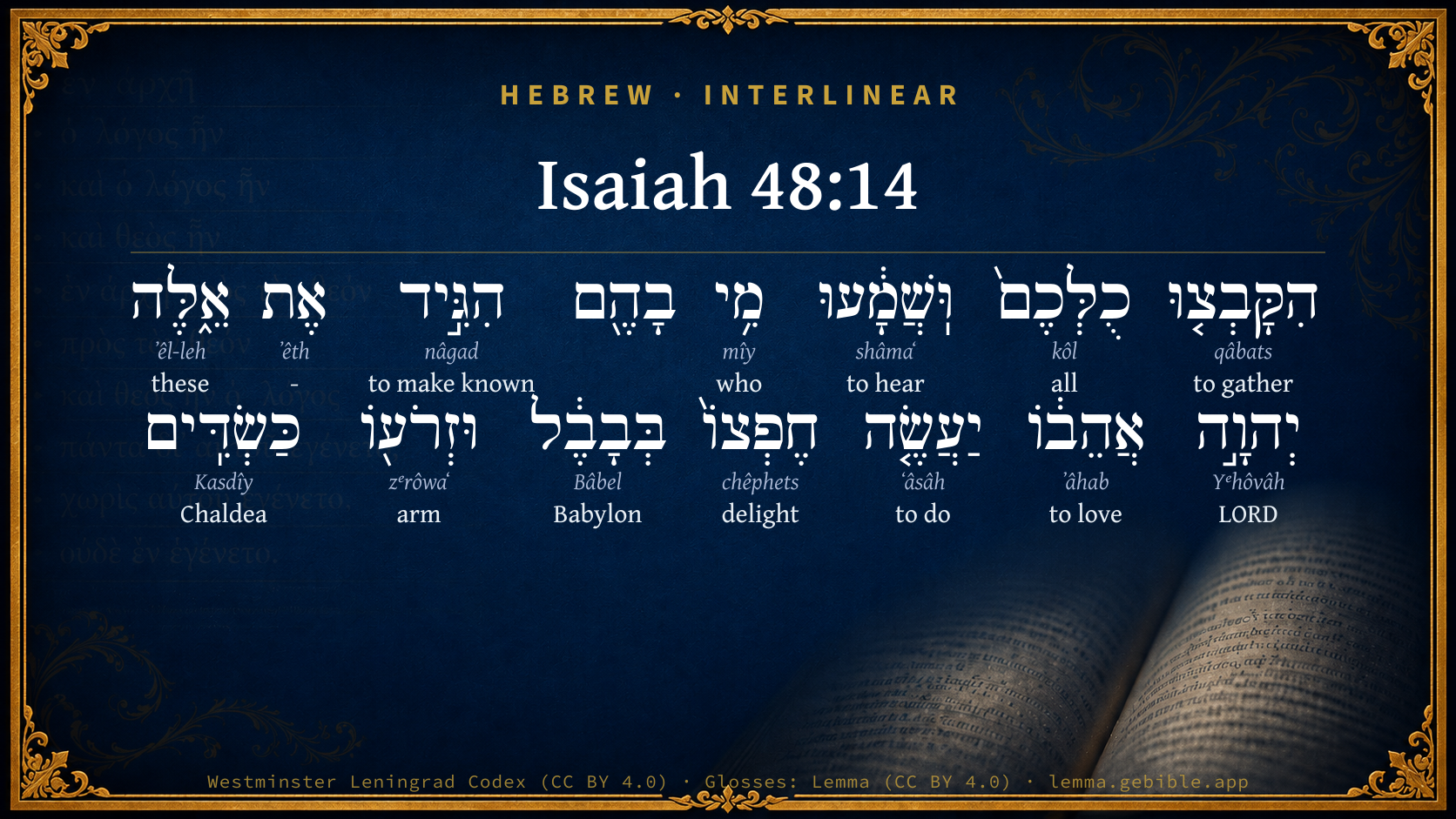
Hebrew (Westminster Leningrad Codex) Isaiah 48:14 appears in the Hebrew Old Testament. The text above is from the Westminster Leningrad Codex. Each word links to its Strong’s number, a concise gloss, and parsing drawn from the Open Scriptures Hebrew Bible morphology. Click any word for its full Brown-Driver-Briggs (BDB) entry.
Download image
Cite this verse

Isaiah 48:14 (World English Bible). Public Domain. Lemma interlinear Bible study tool, https://lemma.gebible.app/v/isaiah/48/14.

Show BibTeX & RIS
BibTeX
RIS
English Translation
Assemble yourselves, all you, and hear; who among them has declared these things? He whom Yahweh loves shall perform his pleasure on Babylon, and his arm [shall be on] the Chaldeans.
World English Bible · Public Domain
Download a study sheet

One document with this verse’s original text, its word-by-word gloss line, the meaning frame, cross-references with their text, attributed commentary, and full source and license credits — printable, and it pastes into notes with its structure intact.

This verse Autodidact and up

Study sheet (.html) Plain text (.txt)

A passage Seminary Student

Up to 50 verses in one chapter. A passage sheet keeps up to 6 commentary sources and 12 cross-references per verse, in the order this page ranks them, and says so on the sheet whenever that leaves anything out. Ask for a single verse and you get the Autodidact verse sheet above.

Everything on this page stays free to read, with no account — the sheet is a download of what is already on screen, not access to it.

Want to remove ads? Support Godless Engineer
Compare translations 3

The same verse in 3 English versions, stacked beneath the original-language interlinear above. Click any original word for its lexicon entry.

Each is an independent rendering of the whole verse — the interlinear is not word-aligned to these translations.

Highlighted words mark where these versions differ — a whole-verse word diff, not a word-by-word alignment.

  • World English Bible Public Domain
    Assemble yourselves, all you, and hear; who among them has declared these things? He whom Yahweh loves shall perform his pleasure on Babylon, and his arm [shall be on] the Chaldeans.
  • King James Version Public Domain
    All ye, assemble yourselves, and hear; which among them hath declared these things? The LORD hath loved him: he will do his pleasure on Babylon, and his arm shall be on the Chaldeans.
  • unfoldingWord Literal Text CC BY-SA 4.0
    Gather, all of you, and hear! Who among them declared these? Yahweh loves him; he will do his desire against Babylon, and his arm the Chaldeans.

unfoldingWord Literal Text — © unfoldingWord, licensed CC BY-SA 4.0. Word-aligned USFM3 via Door43 (git.door43.org/unfoldingWord/en_ult).

Versions to compare (up to 4)

3 of 4 selected

Show all 18 translations

Every available English version of this verse, each an independent rendering of the whole verse.

  • World English Bible Public Domain
    Assemble yourselves, all you, and hear; who among them has declared these things? He whom Yahweh loves shall perform his pleasure on Babylon, and his arm [shall be on] the Chaldeans.
  • Berean Standard Bible Public Domain
    Come together, all of you, and listen: Which of the idols has foretold these things? The LORD’s chosen ally will carry out His desire against Babylon, and His arm will be against the Chaldeans.
  • Majority Standard Bible Public Domain
    Come together, all of you, and listen: Which of the idols has foretold these things? The LORD’s chosen ally will carry out His desire against Babylon, and His arm will be against the Chaldeans.
  • King James Version Public Domain
    All ye, assemble yourselves, and hear; which among them hath declared these things? The LORD hath loved him: he will do his pleasure on Babylon, and his arm shall be on the Chaldeans.
  • American Standard Version (1901) Public Domain
    Assemble yourselves, all ye, and hear; who among them hath declared these things? He whom Jehovah loveth shall perform his pleasure on Babylon, and his arm `shall be on' the Chaldeans.
  • Revised Version (1885) Public Domain
    Assemble yourselves, all ye, and hear; which among them hath declared these things? The LORD hath loved him: he shall perform his pleasure on Babylon, and his arm shall be on the Chaldeans.
  • Geneva Bible (1599) Public Domain
    All you, assemble your selues, and heare: which among them hath declared these thinges? The Lord hath loued him: he wil doe his will in Babel, and his arme shalbe against the Chaldeans.
  • Douay-Rheims (1899) Public Domain
    Assemble yourselves together, all you, and hear: who among them hath declared these things? the Lord hath loved him, he will do his pleasure in Babylon, and his arm shall be on the Chaldeans.
  • Young's Literal Translation Public Domain
    Be gathered all of you, and hear, Who among them did declare these things? Jehovah hath loved him, He doth His pleasure on Babylon, And His arm `is on' the Chaldeans.
  • Literal Standard Version CC BY-SA 4.0
    Be gathered, all of you, and hear, || Who among them declared these things? YHWH has loved him, || He does His pleasure on Babylon, || And His arm [is on] the Chaldeans.
  • Unlocked Literal Bible CC BY-SA 4.0
    Assemble yourselves, all of you, and listen! Who among you has announced these things? Yahweh's ally will accomplish his purpose against Babylon. He will carry out Yahweh's will against the Chaldeans.
  • unfoldingWord Literal Text CC BY-SA 4.0
    Gather, all of you, and hear! Who among them declared these? Yahweh loves him; he will do his desire against Babylon, and his arm the Chaldeans.
  • Darby Bible Public Domain
    All ye, gather yourselves together, and hear: which among them hath declared these things? He whom Jehovah hath loved shall execute his pleasure on Babylon, and his arm [shall be on] the Chaldeans.
  • World Messianic Bible Public Domain
    “Assemble yourselves, all of you, and hear! Who among them has declared these things? He whom the LORD loves will do what he likes to Babylon, and his arm will be against the Kasdim.
  • Webster's Bible Public Domain
    All ye, assemble yourselves and hear; who among them hath declared these things? The LORD hath loved him: he will do his pleasure on Babylon, and his arm shall be on the Chaldeans.
  • Free Bible Version CC BY-SA 4.0
    Everyone gather round and listen. Which of your “gods” told you anything like this? The one the Lord loves will carry out the Lord's wishes against Babylon—he will attack the Babylonians.
  • Bible in Basic English Public Domain
    Come together, all of you, and give ear; who among you has given news of these things? the Lord's loved one will do his pleasure with Babylon, and with the seed of the Chaldaeans.
  • JPS Tanakh (1917) Public Domain
    Assemble yourselves, all ye, and hear; which among them hath declared these things? He whom the LORD loveth shall perform His pleasure on Babylon, and show His arm on the Chaldeans.

Literal Standard Version (2020), Covenant Press — licensed CC BY-SA 4.0. Text via the HelloAO Bible API (eBible.org). Unlocked Literal Bible (unfoldingWord) — licensed CC BY-SA 4.0. Text via the HelloAO Bible API (eBible.org). unfoldingWord Literal Text — © unfoldingWord, licensed CC BY-SA 4.0. Word-aligned USFM3 via Door43 (git.door43.org/unfoldingWord/en_ult). Free Bible Version, Dr. Jonathan Gallagher — licensed CC BY-SA 4.0. Text via the HelloAO Bible API (eBible.org).

Word by word

More ways to search: Search by grammar → Find every occurrence → Compare this word →

Practice this passage: Drill this verse → Learn its vocabulary →

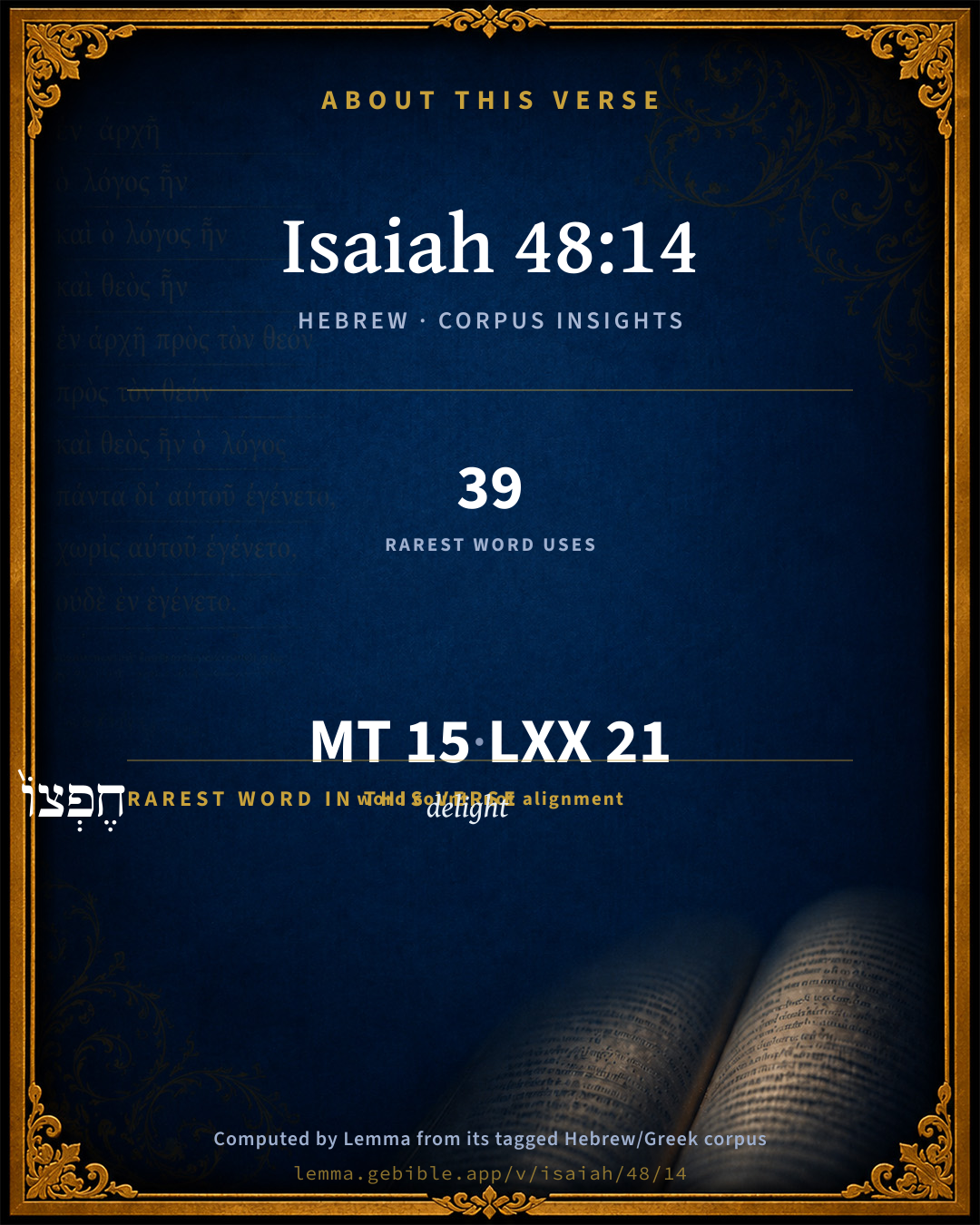
חֶפְצוֹ֙
chêphets
H2656
“delight · his”
Noun, Common, Masculine, Singular, Construct + Suffix, Personal, 3rd Person, Masculine, Singular
Part of Speech
Noun
Type
Common
Gender
Masculine
Number
Singular
State
Construct
Full BDB Definition

Origin: from H2654

TWOT: 712b

delight, pleasure - delight - desire, longing - the good pleasure - that in which one takes delight
  1. הִקָּבְצ֤וּ qâbats H6908 “gather” Verb, Niphal, Imperative, 2nd Person, Masculine, Plural
  2. כֻלְּכֶם֙ kôl H3605 “all · your” Noun, Common, Masculine, Singular, Construct + Suffix, Personal, 2nd Person, Masculine, Plural
  3. וּֽשֲׁמָ֔עוּ shâmaʻ H8085 “and · hear” Conjunction + Verb, Qal, Imperative, 2nd Person, Masculine, Plural
  4. מִ֥י mîy H4310 “who” Particle, Interrogative
  5. הִגִּ֣יד nâgad H5046 “to make known” Verb, Hiphil, Perfect, 3rd Person, Masculine, Singular
  6. אֶת ʼêth H853 “-” Particle, Direct Object
  7. אֵ֑לֶּה ʼêl-leh H428 “these” Pronoun, Demonstrative, Common, Plural
  8. יְהוָ֣ה Yᵉhôvâh H3068 “LORD” Noun, Proper
  9. אֲהֵב֔וֹ ʼâhab H157 “to love · him” Verb, Qal, Perfect, 3rd Person, Masculine, Singular + Suffix, Personal, 3rd Person, Masculine, Singular
  10. יַעֲשֶׂ֤ה ʻâsâh H6213 “to do” Verb, Qal, Imperfect, 3rd Person, Masculine, Singular
  11. בְּבָבֶ֔ל Bâbel H894 “in/at · Babylon” Preposition + Noun, Proper
  12. וּזְרֹע֖וֹ zᵉrôwaʻ H2220 “and · arm · his” Conjunction + Noun, Common, Both, Singular, Construct + Suffix, Personal, 3rd Person, Masculine, Singular
  13. כַּשְׂדִּֽים Kasdîy H3778 “Chaldea” Noun, Proper

About this verse

These counts appear in no published source. They are computed here, from the morphology-tagged text and Lemma’s own curated glosses. What Lemma adds →

15
words
14
distinct lemmas
Prophets
section

Shared distinctive vocabulary

חֶפְצוֹ֙ delight H2656 occurs in 38 verses of the Hebrew Bible. Also found in:

Grammatical profile

  • 5 verbs
  • 6 nouns
  • 1 pronoun
  • 1 preposition
  • 2 particles

Verb forms

  • הִקָּבְצ֤וּ Niphal · Imperative
  • וּֽשֲׁמָ֔עוּ Qal · Imperative
  • הִגִּ֣יד Hiphil · Perfect
  • אֲהֵב֔וֹ Qal · Perfect
  • יַעֲשֶׂ֤ה Qal · Imperfect

Hebrew & Septuagint length

In English translation the verse runs 31 words from the Hebrew and 33 from the Septuagint (LXX English) — closely comparable.

A rough comparison of the two English renderings, which tokenize alike — not a word-level alignment.

Word counts can differ between the Hebrew and the Greek without any difference in meaning — e.g. the Hebrew direct-object marker אֵת has no separate Greek word, and Greek often adds the article ὁ.

In the original languages it is 15 Hebrew tokens and 21 Greek tokens — but the two are counted differently (Hebrew bundles its prefixes and suffixes into one token; the Greek is in lemma form), so that isn’t a like-for-like length.

Cross-references

11

Topical passages linked to Isaiah 48:14 in the Treasury of Scripture Knowledge — connected by theme and wording, ordered by reader-vote popularity; previews shown in the World English Bible.

  • Isaiah 43:9 Let all the nations be gathered together, and let the peoples be assembled: who among them can declare this, and show us former things? let them bring their witnesses, that they may be justified; or let them hear, and say, It is truth.
  • Isaiah 13:17–18 Behold, I will stir up the Medes against them, who shall not regard silver, and as for gold, they shall not delight in it.
  • Jeremiah 50:21–29 Go up against the land of Merathaim, even against it, and against the inhabitants of Pekod: kill and utterly destroy after them, says Yahweh, and do according to all that I have commanded you.
  • Isaiah 13:4–5 The noise of a multitude in the mountains, as of a great people! the noise of a tumult of the kingdoms of the nations gathered together! Yahweh of Hosts is mustering the host for the battle.
  • Isaiah 41:22 Let them bring forth, and declare to us what shall happen: declare you the former things, what they are, that we may consider them, and know the latter end of them; or show us things to come.
  • Isaiah 45:20–21 Assemble yourselves and come; draw near together, you who have escaped from the nations: they have no knowledge who carry the wood of their engraved image, and pray to a god that can't save.
  • Isaiah 46:10–11 declaring the end from the beginning, and from ancient times things that are not [yet] done; saying, My counsel shall stand, and I will do all my pleasure;
  • Jeremiah 51:20–24 You are my battle-axe and weapons of war: and with you will I break in pieces the nations; and with you will I destroy kingdoms;
  • Isaiah 44:7 Who, as I, shall call, and shall declare it, and set it in order for me, since I established the ancient people? and the things that are coming, and that shall happen, let them declare.
  • Isaiah 44:28–45:3 Who says of Cyrus, [He is] my shepherd, and shall perform all my pleasure, even saying of Jerusalem, She shall be built; and of the temple, Your foundation shall be laid.
  • Mark 10:21 Jesus looking at him loved him, and said to him, "One thing you lack. Go, sell whatever you have, and give to the poor, and you will have treasure in heaven; and come, follow me, taking up the cross."

Cross-references courtesy of OpenBible.info (CC BY 4.0).

Hebrew and Greek witnesses Masoretic Hebrew ↔ Greek Septuagint

The same verse in the two great witnesses to the Old Testament, shown verse-for-verse.

These are two independent witnesses, not word-aligned to each other, and the Septuagint is shown in lemma (dictionary) form.

Hebrew Isaiah 48:14 Masoretic · Westminster Leningrad Codex

הִקָּבְצ֤וּ כֻלְּכֶם֙ וּֽשֲׁמָ֔עוּ מִ֥י בָהֶ֖ם הִגִּ֣יד אֶת אֵ֑לֶּה יְהוָ֣ה אֲהֵב֔וֹ יַעֲשֶׂ֤ה חֶפְצוֹ֙ בְּבָבֶ֔ל וּזְרֹע֖וֹ כַּשְׂדִּֽים

Assemble yourselves, all you, and hear; who among them has declared these things? He whom Yahweh loves shall perform his pleasure on Babylon, and his arm [shall be on] the Chaldeans.

World English Bible · Public Domain

Greek LXX Isaiah 48:14 Septuagint · lemma form

καί συνἄγω πᾶς καί ἀκούω τίς αὐτός ἀναἀγγέλλω οὗτος ἀγαπάω σύ ποιέω ὁ θέλημα σύ ἐπί βαβυλών ὁ αἴρω σπέρμα χαλδαῖος

And all shall be gathered, and shall hear: who has told them these things? Out of love to you I have fulfilled your desire on Babylon, to abolish the seed of the Chaldeans.

LXX2012 (modern English Septuagint) · Public Domain

On this verse, The Cambridge Bible for Schools and Colleges discusses the Septuagint’s reading. Read the note in Commentary ↓

Hebrew: Westminster Leningrad Codex (CC BY 4.0). Greek: Septuagint (public domain); English from LXX2012 (modern English Septuagint) (Public Domain). How the Septuagint differs from the Hebrew →

Targum (Aramaic paraphrase)

1

The Targum is the ancient Jewish Aramaic paraphrase of the Hebrew Scriptures — an interpretive translation, not the Hebrew text itself. Onkelos (literal) and Pseudo-Jonathan (expansive) render the Torah, and Jonathan the Prophets. Coverage is partial: where no permissively-licensed English translation exists for a verse, only the Aramaic is shown. This is verse-level text, not a word-by-word alignment to the Hebrew.

  1. Targum Jonathan Prophets (Joshua–Malachi)
    אִתְכְּנָשׁוּ כוּלְהוֹן וּשְׁמָעוּ מַן בְּהוֹן חַוִי יַת אִלֵין יְיָ דְרַחֵם לֵיהּ לְיִשְׂרָאֵל יַעְבֵּיד רְעוּתֵהּ בְּבָבֶל וּתְקוֹף דְרַע גְבוּרְתֵּהּ יַגְלֵי בְכַסְדָאֵי:

    All ye, assemble yourselves, and hear: who among them hath declared these things ever since the Lord loved Israel? He will do His pleasure on Babylon, and He will reveal the strength of His arm on the Chaldeans.

    Targum Jonathan — Aramaic: “Mikraot Gedolot” (public domain). English: “Sefaria Community Translation” (CC0 1.0 (public-domain dedication)); “London "Chaldee Paraphrase," 1871” (public domain). Text via Sefaria.

Commentary

Notes on Isaiah 48:14 from classic Christian and Jewish commentators (each source and its license shown beneath its notes). The classic Christian expositions comment on the surrounding passage and are grouped to its opening verse, so a note may address several verses; the Jewish commentaries on the Tanakh (Rashi and others) are per-verse, so they appear only where the commentator wrote on this verse.

Lemma curates 59 commentaries, every one of them public domain or Creative Commons licensed, each selected and text-cleaned for this edition rather than reprinted as found. About our sources →

Trapp's Complete Commentary

John Trapp

Isa 48:14 All ye, assemble yourselves, and hear; which among them hath declared these [things]? The LORD hath loved him: he will do his pleasure on Babylon, and his arm [shall be on] the Chaldeans.

Ver. 14. The Lord hath loved him,] i.e., Cyrus. He so loveth his people that for their sakes he loveth all their benefactors and well wishers. See Gen 12:3.

He will do his pleasure.] See Isa 43:14.

John Trapp, A Commentary or Exposition upon All the Books of the Old and New Testament (1647–1656) — public domain. Text from a community e-Sword module.

Joseph Benson's Commentary

Isa 48:14-15. All ye assemble yourselves and hear — Ye Jews, to whom he addressed his speech, (Isa 48:12,) and to whom he continues to speak; which among them hath declared these things — Which of the gods, whom any of you have served, or do now serve? The prophet gives a general challenge to the idols and their worshippers, to bring proof that ever such a remarkable turn of providence as that of the Jews’ restoration was foretold by any of the heathen oracles. The Lord hath loved him — Namely, Cyrus; that is, he hath done him this favour, this honour, to make him an instrument of the redemption of his people, and therein a type of the great Redeemer, God’s beloved Son. He will do his pleasure on Babylon — Cyrus shall execute what the Lord hath appointed for the destruction of Babylon, and the deliverance of God’s people. And his arm shall be on the Chaldeans — He shall smite and subdue them. I, even I, have spoken, &c. — Both the prediction and the execution of this great work are to be ascribed to me only. The idols had no hand therein. He shall make his way prosperous — I will give him good success in his undertaking.

Joseph Benson's Commentary on the Old and New Testaments (1811–1818) — public domain. Text from a community e-Sword module.

Tyndale Open Study Notes

Tyndale Open Resources

48:14 chosen Cyrus (literally him) as his ally: See 44:28; 45:1-2.

Tyndale Open Study Notes — © Tyndale Open Resources, licensed CC BY-SA 4.0. Text via the HelloAO Bible API.

Geneva Bible (1599)

Geneva Bible translators

Meaning, Cyrus, whom he had chosen to destroy Babylon.

Geneva Bible (1599) marginal notes — public domain. Text via Bolls.life.

Jamieson, Fausset & Brown

Robert Jamieson, A. R. Fausset & David Brown

among them--among the gods and astrologers of the Chaldees (Isa 41:22; Isa 43:9; Isa 44:7).

Lord . . . loved him; he will, &c.--that is, "He whom the Lord hath loved will do," &c. [LOWTH]; namely, Cyrus (Isa 44:28; Isa 45:1, Isa 45:13; Isa 46:11). However, Jehovah's language of love is too strong to apply to Cyrus, except as type of Messiah, to whom alone it fully applies (Rev 5:2-5).

his pleasure--not Cyrus' own, but Jehovah's.

Jamieson, Fausset & Brown — Commentary Critical and Explanatory on the Whole Bible (1871) — public domain (CC PDM 1.0). Text via the HelloAO Bible API.

Adam Clarke's Commentary

Verse 14. Which among them hath declared these things - "Who among you hath predicted these things"] For בהם bahem, "among them," twenty-one MSS., nine ancient, and two editions, one of them that of the year 1488, fourteen of De Rossi's, and one ancient of my own, have bachem, "among you;" and so the Syriac.

The Lord hath loved him: he will do his pleasure on Babylon - "He, whom JEHOVAH hath loved, will execute his will on Babylon"] That is, Cyrus; so Symmachus has well rendered it: Ὁν ὁ Κυριος ηγαπησε ποιησει το θελημα αυτου, "He whom the Lord hath loved will perform his will."

On the Chaldeans.] The preposition is lost; it is supplied in the edition of 1486, which has בכשדים bechasdim, and so the Chaldee and Vulgate.

Adam Clarke's Commentary on the Bible (1810–1826) — public domain. Text from a community e-Sword/MySword module.

Ellicott's Commentary for English Readers

(14) All ye, assemble yourselves.—The challenge is addressed as before (Isa_43:9) to the worshippers of idols.

The Lord hath loved him.—Better, He whom the Lord loveth will do his pleasure. The context leaves it uncertain whether the “pleasure” and the “arm” are those of Cyrus or Jehovah. The latter seems to give a preferable meaning. There is, perhaps, an allusive reference to the idea implied in the name of the great king of Israel (David, “beloved,” or “darling”). Cyrus was to be even as a second David, beloved of the Lord.

A Bible Commentary for English Readers, edited by Charles John Ellicott (1878–1897) — public domain. Text from a community e-Sword module.

The Cambridge Bible for Schools and Colleges

gen. ed. J. J. S. Perowne

14. All ye] The summons is addressed, not as in ch. Isa_41:1-4 &c. to the nations, but to the people of Israel; the gods of the heathen are referred to in the words which among them &c.

The Lord hath loved him] is to be construed as a relative sentence: he whom Jehovah loveth shall perform etc. A new title, similar to those in Isa_44:28, Isa_45:1, Isa_46:11, is here bestowed upon Cyrus (comp. “my friend” of Abraham in Isa_41:8). his pleasure] see on Isa_42:21.

and his arm shall be on the Chaldeans] A preposition has dropped out or must be supplied from the preceding clause; and then we may either render as E.V. (in which case “his arm” would most naturally mean the arm, i.e. the might, of Cyrus); or thus: “and (he will perform) His arm (Jehovah’s mighty judgement) on the Chaldæans” (Dillmann). But although “arm” is a symbol of might, it could hardly be used alone of judgement. The LXX. (“to destroy the seed of the Chaldeans”) obviously read zera‘ instead of zìrô‘ô; and this is probably the better text. Render simply and (on) the seed of the Chaldæans.

The Cambridge Bible for Schools and Colleges (gen. ed. J. J. S. Perowne; Cambridge University Press, 1878–1918) — public domain. Text from a community e-Sword module.

John Gill's Exposition

All ye assemble yourselves, and hear,.... That is, the people of the Jews, Jacob and Israel his called, before addressed; who are bid to gather together, and draw nigh, that they might hear what the Lord had to say to them:

which among them hath declared these things? that are future, that concern the redemption and salvation of Israel? which of all the idols among the nations, or of the priests and soothsayers among them, whom the Jews were prone to listen to, that could foretell things to come, such as these the Lord had said should be?

the Lord hath loved him; not Israel, as the Targum; but Cyrus, whom the Lord loved as a man, as he does all his creatures; and whom he distinguished from others, by bestowing excellent qualifications on him; and whom he raised to great dignity, and gave him great honour, by using him as an instrument in his hand for the deliverance of his people; and who was a type of Christ, the dear Son of God's love, in whom he is always well pleased.

He will do his pleasure on Babylon, and his arm shall be on the Chaldeans; either he shall do as he pleases with Babylon, and with his army destroy the Chaldeans; or he shall do the pleasure of God on Babylon, and destroy the inhabitants of it, and deliver his people from it. This is also true of Christ, who will do his pleasure on mystical Babylon, destroy antichrist, and all the antichristian states, with his mighty arm and power, with the breath of his mouth, and with the brightness of his coming.

John Gill's Exposition of the Whole Bible (1746–1763) — public domain (CC PDM 1.0). Text via the HelloAO Bible API.

Albert Barnes' Notes on the Bible

All ye, assemble yourselves and hear - Ye Jews who are in Babylon, gather together, and listen to the assurance that God is able to protect you, and that he will certainly restore you to your own country.

Which among them - Who among the pagan?

Hath declared these things? - The things relating to the destruction of Babylon, and the rescue of his people. This is an appeal similar to that which God has often made, that he alone can predict future events. None of the astrologers, soothsayers, or diviners of Babylon had been able to foretell the expedition and the conquests of Cyrus, and the capture of the city. If they had been able to foresee the danger, they might have guarded against it, and the city might have been saved. But God had predieted it a hundred and fifty years before it occurred, and this demonstrated, therefore, that he alone was God.

The Lord hath loved him - Lowth renders this, ‘He whom Jehovah hath loved will execute his will on Babylon.’ The Septuagint renders it, ‘Loving thee, I will execute thy will against Babylon.’ There can be no doubt that it refers to Cyrus, and that the meaning is, that he whom Yahweh had loved would accomplish his will on Babylon. It does not necessarily mean that Yahweh was pleased with his moral character, or that he was a pious man (compare the notes at Isa 41:2); but that he was so well pleased with him as an instrument to accomplish his purposes, that he chose to employ him for that end.

He will do his pleasure on Babylon - He will accomplish all his desire on that city; that is, he will take, and subdue it. The word ‘his’ here, may refer either to Cyrus or to Yahweh. Probably it means that Cyrus would do to Babylon what would be pleasing to Yahweh.

And his arm - The arm is a symbol of strength, and is the instrument by which we execute our purposes.

Albert Barnes' Notes on the Bible (1834–1885) — public domain. Text from a community e-Sword/MySword module.

Haydock's Catholic Bible Commentary

Things, as I have done respecting Cyrus? (St. Cyril, &c.) who was a figure of Christ, ver. 15.

George Leo Haydock (1774–1849), Haydock's Catholic Family Bible and Commentary, 1859 edition — public domain. Excludes Psalms (Douay-Rheims chapter numbering differs from Protestant) and Deuterocanonical books (Catholic canon only).

Matthew Poole's English Annotations

All ye; ye Jews, to whom he addressed his speech, Isa 48:12, and continueth his speech, Isa 48:16,17, &c. Assemble; I challenge you all to answer what I have said before, and am now going to say again.

Which among them hath declared these things? which of the gods whom any of you have served or do still hanker after? The Lord hath loved him, to wit, Cyrus, who might easily be understood out of the foregoing context, in which he is frequently mentioned. The pronoun is put for the noun, as is usual both in Scripture and in other authors. Now God loved Cyrus, not with a special, and everlasting, and complacential love, for he was a heathen, and had some great vices as well as virtues; but with that general love and kindness which God hath for all his creatures, as is observed, Psa 145:9; and moreover with that particular kind of love which God hath for such men as excel others in any virtues, as Cyrus did; in which sense Christ loved the young man, Mar 10:21; and with a love of good-will and beneficence. God had such a kindness for him, as to make him a most glorious and victorious general and king, and the great instrument for the deliverance of his own people; which was a singular honour and advantage to him, and might have been far greater, and extended to the eternal salvation of his soul, if he had not wanted a heart to use the price which God hereby put into his hand. And as anger being ascribed to God is not meant of the affection, for such passions are inconsistent with the perfection of God’s nature, but of the effect; so the love of God, when it is applied in Scripture to such persons as Cyrus, is not so much to be understood of an inward affection, as of the outward effects of it; and so this love is explained in the following words, by that prosperous success which God gave him against the Chaldeans.

He will do his pleasure on Babylon; Cyrus shall execute that I have appointed him to do for the destruction of Babylon, and for the redemption of my people; which was in itself a good work; and therefore this is added as the reason why God loved him.

His arm shall be on the Chaldeans; he shall smite and subdue them.

Matthew Poole's English Annotations on the Holy Bible (1683–1685) — public domain. Text from a community e-Sword/MySword module.

Whedon's Commentary on the Bible

Daniel D. Whedon

14. Assemble yourselves, and hear — A call to the people — most probably the heathen — to convene, and to consider the subject to be brought before them.

Which among them — Among the idol deities, with whom is the controversy.

Hath declared these things — The “things” heretofore predicted of Jehovah — the coming deliverance of Israel through Cyrus, and the destruction he should bring on Israel’s oppressors, the Babylonians.

He will do his pleasure — The “he” we take to refer to Cyrus, God’s agent in this work; the “his” to God himself.

His arm — That of Cyrus.

Shall be on the Chaldeans — To punish and subdue them.

Daniel D. Whedon (gen. ed.), Commentary on the Old and New Testaments (1874–1909) — public domain. Text from a community e-Sword module.

The Pulpit Commentary

All ye, assemble yourselves. "Once more the nations are challenged to say which of their deities has foretold the work that the Lord has willed to perform on Babylon" (Kay). (see above, Isa_43:9) If none has done so, will not Israel see and acknowledge the superiority of Jehovah to such blind deities? The Lord hath loved him. It had not been previously declared in so many words that Jehovah "loved" Cyrus; but it had been sufficiently indicated by the way in which he was spoken of in Isa_44:28 and Isa_45:1-5. God "loves" all who "in an honest and good heart" seek according to their lights to do his will and serve him faithfully. Nebuchadnezzar is called his "servant", (Isa_25:9 Isa_27:6 Eze_29:18, Eze_29:20) Cyrus (in Isa_45:1) his "anointed." It is but going one step further to call the latter his "loved one." He will do his pleasure; i.e. "God"s pleasure," not his own. (see Isa_44:28) His arm shall be on the Chaldeans. The Hebrew is very harsh, and perhaps requires emendation; but the meaning can scarcely be other than that expressed in our version.

The Pulpit Commentary (1880–1919), ed. H.D.M. Spence-Jones & Joseph S. Exell — public domain. Text from a community e-Sword module.

John Wesley's Explanatory Notes

Which - Which of the gods whom any of you serve. Him - Cyrus.

John Wesley, Explanatory Notes Upon the Whole Bible (1754–1765) — public domain. Text via the GEBible commentary corpus.

J. A. Alexander on Isaiah

Joseph Addison Alexander

“Assemble yourselves, all of you, and hear!” The object of address is Israel, according to the common supposition, but more probably the heathen. “Who among them, (i.e., the false gods or their prophets), hath declared (predicted) these things,” the whole series of events which had been cited to demonstrate the divine foreknowledge. “Jehovah loves him,” (i.e., Israel), and to show His love, “He will do His pleasure (execute His purpose) in Babylon, and His (Jehovah’s) arm (shall be upon) the Chaldees.” This explanation seems to answer all the conditions of the text and context. Most interpreters, however, make the clause refer to Cyrus, and translate it thus: ‘he whom Jehovah loves shall do his pleasure in Babylon, and his arm (i.e., exercise his power or his vengeance) on the Chaldees.’

Joseph Addison Alexander, The Prophecies of Isaiah (1846–1847; New York: Scribner, 1870–1878) — public domain. Text from a community e-Sword module.

unfoldingWord translationNotes

Door43 World Missions Community

General Information:

Yahweh continues speaking to the people of Israel.

Who among you has announced these things?

Yahweh uses a question to emphasize that the idols have not told them these things. AT: "None of your idols has told this to you." (See: Rhetorical Question)

Yahweh's ally will accomplish his purpose against Babylon. He will carry out Yahweh's will against the Chaldeans

Here "ally" refers to Cyrus. Both of these sentences mean the same thing and are used for emphasis. (See: Parallelism)

his purpose

"Yahweh's purpose"

I, I

The word "I" is repeated for emphasis. AT: "I myself" (See: Doublet)

translationWords

Babylon

will of God

Chaldea

unfoldingWord translationNotes — © Distant Shores Media and the Door43 World Missions Community, licensed CC BY-SA 4.0. Source: git.door43.org/Door43/en_tn.

Rashi

Rabbi Shlomo Yitzchaki (Rashi)

The Lord loves him He who will perform the will of the Holy One, blessed be He, upon Babylon.

and [show] His arm He will show in the land of the Chaldees, and concerning Cyrus he states this.

Rashi on the Tanakh — English translations: “The Judaica Press complete Tanach with Rashi, translated by A. J. Rosenberg” (CC BY 4.0); “Pentateuch with Rashi's commentary by M. Rosenbaum and A.M. Silbermann, 1929-1934” (public domain); “The Metsudah Tanach series, Lakewood, N.J” (CC BY 4.0); and “The Book of Joshua, Metsudah Publications, 1997” (CC BY 4.0). Text via Sefaria.

Ibn Ezra

Rabbi Abraham ibn Ezra

These. The coming events.

Hath loved him, namely Cyrus.

His pleasure. The pleasure of God. Cyrus will perform the will of God concerning Babylon, and show His arm against the Chaldæans. It is, however, also possible, that the possessive pronoun his (ו) in his pleasure and his arm refers to Cyrus.

Ibn Ezra on the Tanakh — English translations: “Sefaria Community Translation” (CC0 1.0 (public-domain dedication)); “Yalkut, Sifsei Chachomim Chumash, Metsudah Publications, 2009” (CC BY 4.0); and “Commentary of Ibn Ezra on Isaiah - trans. by M. Friedlander, 1873” (public domain). Text via Sefaria.

Lesson kit

Teaching starters — assembled from the data on this page, not authored interpretation. Every prompt links to the verse data it draws on. Edit before teaching.

Isaiah, in the Prophets, opens this verse with 15 words (14 distinct Hebrew lemmas). Its most distinctive word is chêphets (“delight”). A historical commentator’s framing appears above. Read the whole chapter for the surrounding context.

Discussion questions

  1. What does “delight” (chêphets) contribute to the verse as a whole?
  2. 1 Samuel 15:22 shares the word «delight» with this verse. How do the two illuminate each other?
  3. These translations render this verse differently. What is at stake in choosing one wording over another?
  4. The verb «הִקָּבְצ֤וּ» is Niphal Imperative. How does its form color the action?
  5. Reading how Trapp's Complete Commentary and Joseph Benson's Commentary read this verse, where do the two commentators agree and where do they part?

Things to notice

Reading settings

Reading text

Shown beneath each verse's original-language words.

Old Testament
Old Testament edition

Read the OT as the Masoretic Hebrew (MT) or the Greek Septuagint (LXX).

English shown for the Greek Septuagint (in the Hebrew ↔ Greek comparison).

Comparing translations? Open the Compare panel on any verse page to stack up to four side by side.