
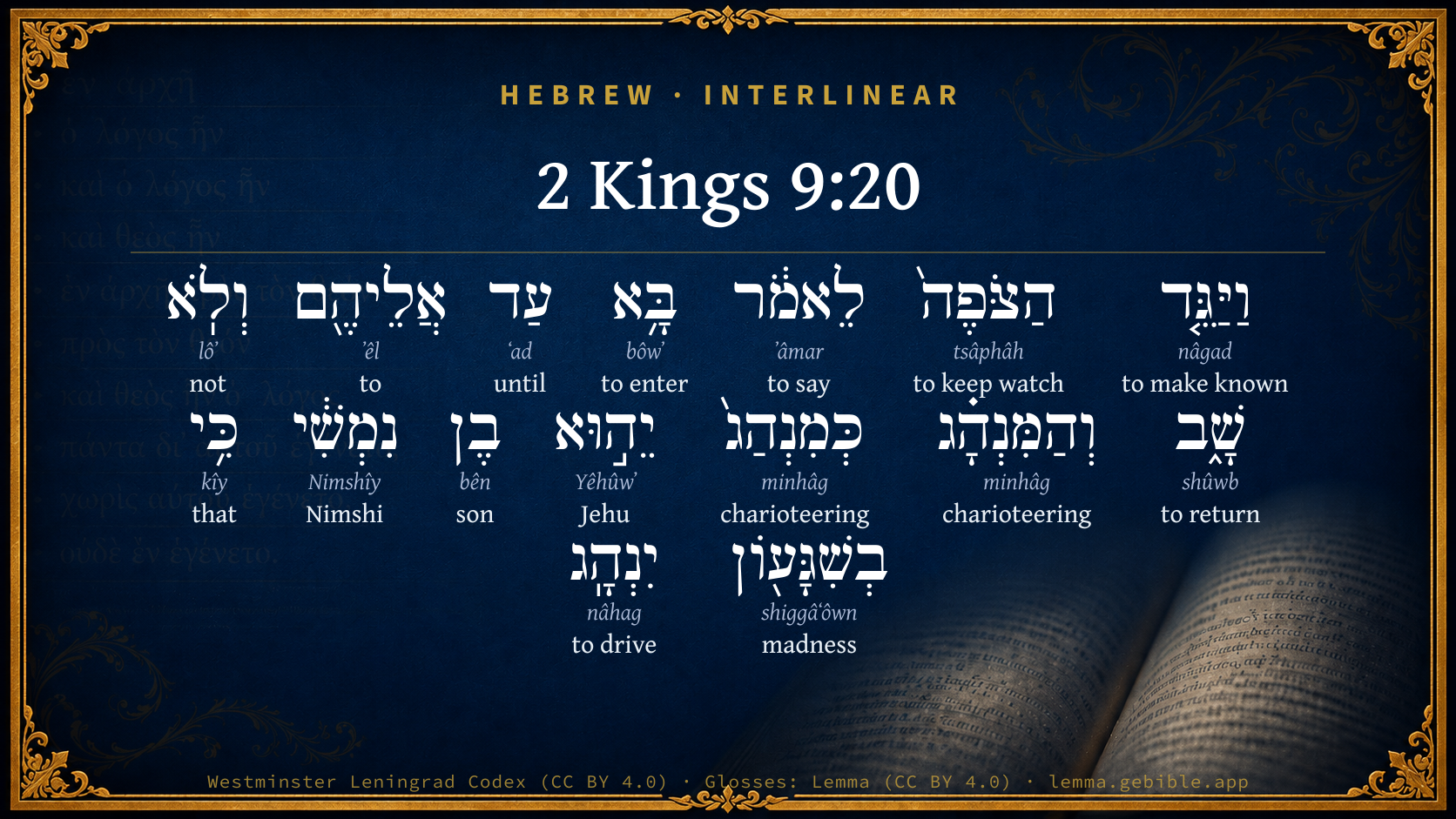
2 Kings 9:20

Hebrew (Westminster Leningrad Codex) 2 Kings 9:20 appears in the Hebrew Old Testament. The text above is from the Westminster Leningrad Codex. Each word links to its Strong’s number, a concise gloss, and parsing drawn from the Open Scriptures Hebrew Bible morphology. Click any word for its full Brown-Driver-Briggs (BDB) entry.
Download image
Cite this verse

2 Kings 9:20 (World English Bible). Public Domain. Lemma interlinear Bible study tool, https://lemma.gebible.app/v/2-kings/9/20.

Show BibTeX & RIS
BibTeX
RIS
English Translation
The watchman told, saying, He came even to them, and isn't coming back: and the driving is like the driving of Jehu the son of Nimshi; for he drives furiously.
World English Bible · Public Domain
Highlights
  • 1 first appearance in the Hebrew Bible
Full analysis ↓
Download a study sheet

One document with this verse’s original text, its word-by-word gloss line, the meaning frame, cross-references with their text, attributed commentary, and full source and license credits — printable, and it pastes into notes with its structure intact.

This verse Autodidact and up

Study sheet (.html) Plain text (.txt)

A passage Seminary Student

Up to 50 verses in one chapter. A passage sheet keeps up to 6 commentary sources and 12 cross-references per verse, in the order this page ranks them, and says so on the sheet whenever that leaves anything out. Ask for a single verse and you get the Autodidact verse sheet above.

Everything on this page stays free to read, with no account — the sheet is a download of what is already on screen, not access to it.

Want to remove ads? Support Godless Engineer
Compare translations 3

The same verse in 3 English versions, stacked beneath the original-language interlinear above. Click any original word for its lexicon entry.

Each is an independent rendering of the whole verse — the interlinear is not word-aligned to these translations.

Highlighted words mark where these versions differ — a whole-verse word diff, not a word-by-word alignment.

  • World English Bible Public Domain
    The watchman told, saying, He came even to them, and isn't coming back: and the driving is like the driving of Jehu the son of Nimshi; for he drives furiously.
  • King James Version Public Domain
    And the watchman told, saying, He came even unto them, and cometh not again: and the driving is like the driving of Jehu the son of Nimshi; for he driveth furiously.
  • unfoldingWord Literal Text CC BY-SA 4.0
    And the watchman declared, saying, “He has come to them, but he has not returned, and the driving like the driving of Jehu, the son of Nimshi, for he drives with madness.”

unfoldingWord Literal Text — © unfoldingWord, licensed CC BY-SA 4.0. Word-aligned USFM3 via Door43 (git.door43.org/unfoldingWord/en_ult).

Versions to compare (up to 4)

3 of 4 selected

Show all 18 translations

Every available English version of this verse, each an independent rendering of the whole verse.

  • World English Bible Public Domain
    The watchman told, saying, He came even to them, and isn't coming back: and the driving is like the driving of Jehu the son of Nimshi; for he drives furiously.
  • Berean Standard Bible Public Domain
    Again the watchman reported, “He reached them, but he is not coming back. And the charioteer is driving like Jehu son of Nimshi—he is driving like a madman!”
  • Majority Standard Bible Public Domain
    Again the watchman reported, “He reached them, but he is not coming back. And the charioteer is driving like Jehu son of Nimshi—he is driving like a madman!”
  • King James Version Public Domain
    And the watchman told, saying, He came even unto them, and cometh not again: and the driving is like the driving of Jehu the son of Nimshi; for he driveth furiously.
  • American Standard Version (1901) Public Domain
    And the watchman told, saying, He came even unto them, and cometh not back: and the driving is like the driving of Jehu the son of Nimshi; for he driveth furiously.
  • Revised Version (1885) Public Domain
    And the watchman told, saying, He came even unto them, and cometh not again: and the driving is like the driving of Jehu the son of Nimshi; for he driveth furiously.
  • Geneva Bible (1599) Public Domain
    And the watchman tolde, saying, He came to them also, but commeth not againe, and the marching is like the marching of Iehu the sonne of Nimshi: for he marcheth furiously.
  • Douay-Rheims (1899) Public Domain
    And the watchman told, saying: He came even to them, but returneth not: and the driving is like the driving of Jehu the son of Namsi, for he drives furiously.
  • Young's Literal Translation Public Domain
    And the watchman declareth, saying, `He came unto them, and he hath not returned, and the driving `is' like the driving of Jehu son of Nimshi, for with madness he driveth.'
  • Literal Standard Version CC BY-SA 4.0
    And the watchman declares, saying, “He came to them, and he has not returned, and the driving [is] like the driving of Jehu son of Nimshi, for he drives with madness.”
  • Unlocked Literal Bible CC BY-SA 4.0
    Again the watchman reported, “He has met them, but he is not coming back. For the way that the chariot is being driven is the way that Jehu son of Nimshi drives; he is driving wildly.”
  • unfoldingWord Literal Text CC BY-SA 4.0
    And the watchman declared, saying, “He has come to them, but he has not returned, and the driving like the driving of Jehu, the son of Nimshi, for he drives with madness.”
  • Darby Bible Public Domain
    And the watchman told saying, He came to them, and does not return. And the driving is like the driving of Jehu the son of Nimshi; for he drives furiously.
  • World Messianic Bible Public Domain
    The watchman said, “He came to them, and isn’t coming back. The driving is like the driving of Jehu the son of Nimshi, for he drives furiously.”
  • Webster's Bible Public Domain
    And the watchman told, saying, He came even to them, and doth not return? and the driving is like the driving of Jehu the son of Nimshi; for he driveth furiously.
  • Free Bible Version CC BY-SA 4.0
    The watchman reported, “The messenger has reached them, but he's not returning. The driving looks like the driving of Jehu, son of Nimshi—he's a crazy driver!”
  • Bible in Basic English Public Domain
    And the watchman gave them word, saying, He went up to them and has not come back again; and the driving is like the driving of Jehu, son of Nimshi, for he is driving violently.
  • JPS Tanakh (1917) Public Domain
    And the watchman told, saying: 'He came even unto them, and cometh not back; and the driving is like the driving of Jehu the son of Nimshi; for he driveth furiously.'

Literal Standard Version (2020), Covenant Press — licensed CC BY-SA 4.0. Text via the HelloAO Bible API (eBible.org). Unlocked Literal Bible (unfoldingWord) — licensed CC BY-SA 4.0. Text via the HelloAO Bible API (eBible.org). unfoldingWord Literal Text — © unfoldingWord, licensed CC BY-SA 4.0. Word-aligned USFM3 via Door43 (git.door43.org/unfoldingWord/en_ult). Free Bible Version, Dr. Jonathan Gallagher — licensed CC BY-SA 4.0. Text via the HelloAO Bible API (eBible.org).

Word by word

More ways to search: Search by grammar → Find every occurrence → Compare this word →

Practice this passage: Drill this verse → Learn its vocabulary →

וְהַמִּנְהָ֗ג
minhâg
H4491
“and · the · charioteering”
Conjunction + Particle, Definite Article + Noun, Common, Masculine, Singular, Absolute
Part of Speech
Conjunction + Particle + Noun
Type
Common
Gender
Masculine
Number
Singular
State
Absolute
Full BDB Definition

Origin: from H5090

TWOT: 1309a

driving, charioteering
  1. וַיַּגֵּ֤ד nâgad H5046 “and · to make known” Conjunction + Verb, Hiphil, Sequential Imperfect, 3rd Person, Masculine, Singular
  2. הַצֹּפֶה֙ tsâphâh H6822 “the · keeping watch” Particle, Definite Article + Verb, Qal, Participle Active, Masculine, Singular, Absolute
  3. לֵאמֹ֔ר ʼâmar H559 “to say” Preposition + Verb, Qal, Infinitive Construct
  4. בָּ֥א bôwʼ H935 “to enter” Verb, Qal, Perfect, 3rd Person, Masculine, Singular
  5. עַד ʻad H5704 “until” Preposition
  6. אֲלֵיהֶ֖ם ʼêl H413 “to · them” Preposition + Suffix, Personal, 3rd Person, Masculine, Plural
  7. וְלֹֽא lôʼ H3808 “and · not” Conjunction + Particle, Negative
  8. שָׁ֑ב shûwb H7725 “to return” Verb, Qal, Perfect, 3rd Person, Masculine, Singular
  9. כְּמִנְהַג֙ minhâg H4491 “like/as · charioteering of” Preposition + Noun, Common, Masculine, Singular, Construct
  10. יֵה֣וּא Yêhûwʼ H3058 “Jehu” Noun, Proper
  11. בֶן bên H1121 “son of” Noun, Common, Masculine, Singular, Construct
  12. נִמְשִׁ֔י Nimshîy H5250 “Nimshi” Noun, Proper
  13. כִּ֥י kîy H3588 “that” Conjunction
  14. בְשִׁגָּע֖וֹן shiggâʻôwn H7697 “in/at · madness” Preposition + Noun, Common, Masculine, Singular, Absolute
  15. יִנְהָֽג nâhag H5090 “to drive” Verb, Qal, Imperfect, 3rd Person, Masculine, Singular

About this verse

These counts appear in no published source. They are computed here, from the morphology-tagged text and Lemma’s own curated glosses. What Lemma adds →

16
words
15
distinct lemmas
Historical
section

Notable vocabulary

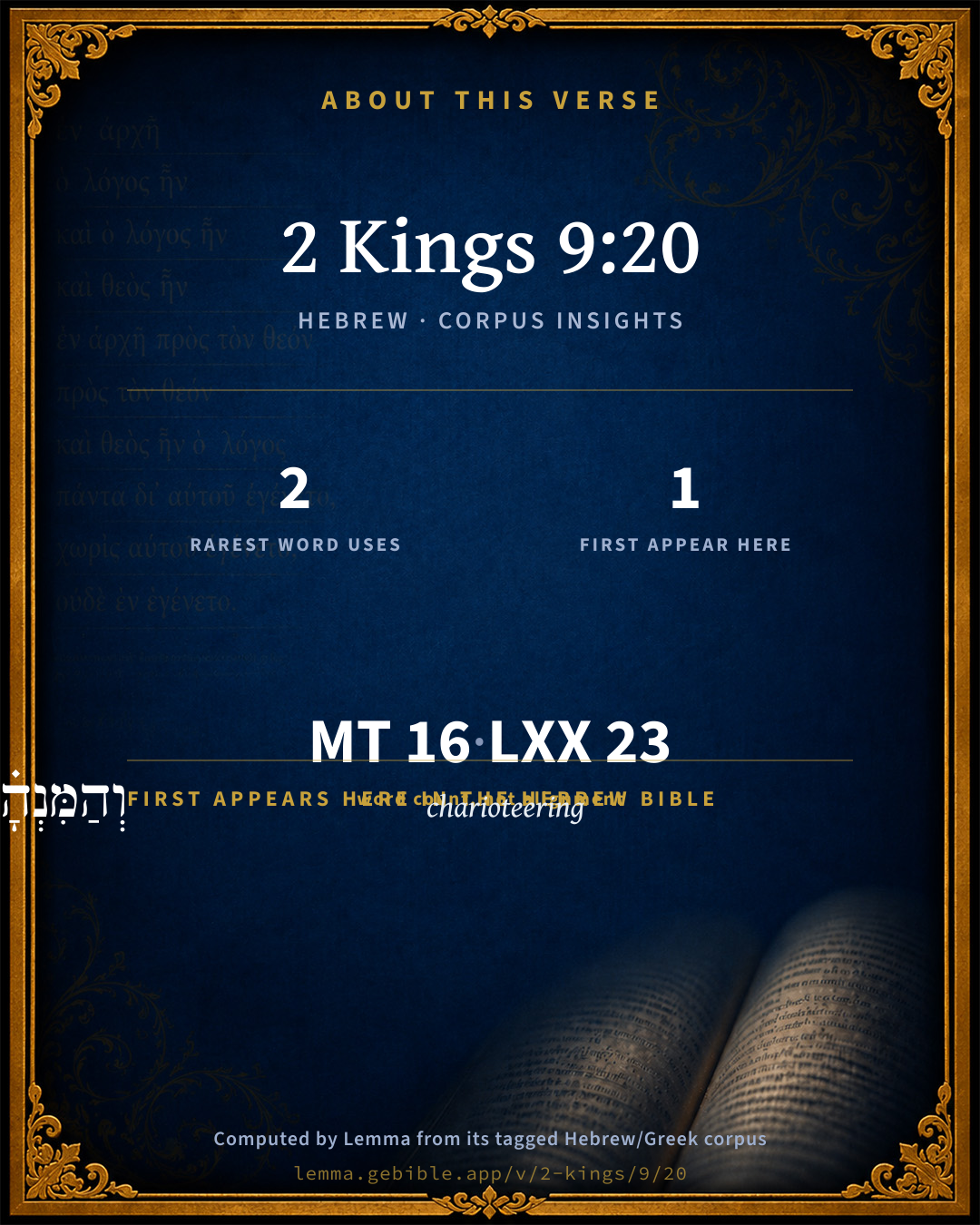
The rarest word here is וְהַמִּנְהָ֗ג charioteering H4491 — appearing just 2 times in the whole Hebrew Bible.

First appearance in Scripture

This word makes its first canonical appearance in the Hebrew Bible here:

  • וְהַמִּנְהָ֗ג charioteering H4491

Grammatical profile

  • 6 verbs
  • 6 nouns
  • 2 prepositions
  • 1 conjunction
  • 1 particle

Verb forms

  • וַיַּגֵּ֤ד Hiphil · Sequential Imperfect
  • הַצֹּפֶה֙ Qal · Participle Active
  • לֵאמֹ֔ר Qal · Infinitive Construct
  • בָּ֥א Qal · Perfect
  • שָׁ֑ב Qal · Perfect
  • יִנְהָֽג Qal · Imperfect

Repetition

A word recurs within this verse — often emphatic in Hebrew:

  • וְהַמִּנְהָ֗ג charioteering H4491 ×2

Hebrew & Septuagint length

In English translation the verse runs 30 words from the Hebrew and 29 from the Septuagint (LXX English) — closely comparable.

A rough comparison of the two English renderings, which tokenize alike — not a word-level alignment.

Word counts can differ between the Hebrew and the Greek without any difference in meaning — e.g. the Hebrew direct-object marker אֵת has no separate Greek word, and Greek often adds the article ὁ.

In the original languages it is 16 Hebrew tokens and 23 Greek tokens — but the two are counted differently (Hebrew bundles its prefixes and suffixes into one token; the Greek is in lemma form), so that isn’t a like-for-like length.

Cross-references

8

Topical passages linked to 2 Kings 9:20 in the Treasury of Scripture Knowledge — connected by theme and wording, ordered by reader-vote popularity; previews shown in the World English Bible.

  • 2 Samuel 18:27 The watchman said, I think the running of the foremost is like the running of Ahimaaz the son of Zadok. The king said, He is a good man, and comes with good news.
  • 1 Kings 19:17 It shall happen, that he who escapes from the sword of Hazael shall Jehu kill; and he who escapes from the sword of Jehu shall Elisha kill.
  • 2 Kings 10:16 He said, Come with me, and see my zeal for Yahweh. So they made him ride in his chariot.
  • Ecclesiastes 9:10 Whatever your hand finds to do, do it with your might; for there is no work, nor device, nor knowledge, nor wisdom, in Sheol, where you are going.
  • Isaiah 54:16 Behold, I have created the smith who blows the fire of coals, and brings forth a weapon for his work; and I have created the waster to destroy.
  • Daniel 11:44 But news out of the east and out of the north shall trouble him; and he shall go forth with great fury to destroy and utterly to sweep away many.
  • Habakkuk 1:6 For, behold, I raise up the Chaldeans, that bitter and hasty nation, that march through the breadth of the earth, to possess dwelling places that are not theirs.
  • Habakkuk 3:12 You marched through the land in wrath. You threshed the nations in anger.

Cross-references courtesy of OpenBible.info (CC BY 4.0).

Hebrew and Greek witnesses Masoretic Hebrew ↔ Greek Septuagint

The same verse in the two great witnesses to the Old Testament, shown verse-for-verse.

These are two independent witnesses, not word-aligned to each other, and the Septuagint is shown in lemma (dictionary) form.

Hebrew 2 Kings 9:20 Masoretic · Westminster Leningrad Codex

וַיַּגֵּ֤ד הַצֹּפֶה֙ לֵאמֹ֔ר בָּ֥א עַד אֲלֵיהֶ֖ם וְלֹֽא שָׁ֑ב וְהַמִּנְהָ֗ג כְּמִנְהַג֙ יֵה֣וּא בֶן נִמְשִׁ֔י כִּ֥י בְשִׁגָּע֖וֹן יִנְהָֽג

The watchman told, saying, He came even to them, and isn't coming back: and the driving is like the driving of Jehu the son of Nimshi; for he drives furiously.

World English Bible · Public Domain

Greek LXX 2 Kings 9:20 Septuagint · lemma form

καί ἀποἀγγέλλω ὁ σκοπός λέγω ἔρχομαι ἕως αὐτός καί οὐ ἀναστρέφω καί ὁ ἄγω ἄγω ὁ ιου υἱός ναμεσσιας ὅτι ἐν παραλλαγή γίγνομαι

And the watchman reported, saying, He came up to them, and has not returned: and the driver drives Ju the son of Namessi, for it is with furious haste.

LXX2012 (modern English Septuagint) · Public Domain

On this verse, Ellicott's Commentary for English Readers discusses the Septuagint’s reading. Read the note in Commentary ↓

Hebrew: Westminster Leningrad Codex (CC BY 4.0). Greek: Septuagint (public domain); English from LXX2012 (modern English Septuagint) (Public Domain). How the Septuagint differs from the Hebrew →

Targum (Aramaic paraphrase)

1

The Targum is the ancient Jewish Aramaic paraphrase of the Hebrew Scriptures — an interpretive translation, not the Hebrew text itself. Onkelos (literal) and Pseudo-Jonathan (expansive) render the Torah, and Jonathan the Prophets. Coverage is partial: where no permissively-licensed English translation exists for a verse, only the Aramaic is shown. This is verse-level text, not a word-by-word alignment to the Hebrew.

  1. Targum Jonathan Prophets (Joshua–Malachi)
    וְחַוִי סַכְוָאָה לְמֵימַר אֲתָא עַד לְוַתְהוֹן וְלָא תָב וְדַבָּרָא כְּדַבָּרָא דְיֵהוּא בַר נַמְשִׁי אֲרֵי בְנִיחַ מְדַבָּר:

    (no public-domain English translation for this verse)

    Targum Jonathan — Aramaic: “Mikraot Gedolot” (public domain). English: “Sefaria Community Translation” (CC0 1.0 (public-domain dedication)); “London "Chaldee Paraphrase," 1871” (public domain). Text via Sefaria.

Commentary

Notes on 2 Kings 9:20 from classic Christian and Jewish commentators (each source and its license shown beneath its notes). The classic Christian expositions comment on the surrounding passage and are grouped to its opening verse, so a note may address several verses; the Jewish commentaries on the Tanakh (Rashi and others) are per-verse, so they appear only where the commentator wrote on this verse.

Lemma curates 59 commentaries, every one of them public domain or Creative Commons licensed, each selected and text-cleaned for this edition rather than reprinted as found. About our sources →

Trapp's Complete Commentary

John Trapp

2Ki 9:20 And the watchman told, saying, He came even unto them, and cometh not again: and the driving [is] like the driving of Jehu the son of Nimshi; for he driveth furiously.

Ver. 20. For he driveth furiously.] Heb., In madness:

“ Sic Caesar in omnia praeceps,

Nil actum credens, dum quid superesset agendum,

Fertur atrox. ” - Lucan.

The Chaldee here paraphraseth, quoniam lente incedit; and Josephus hath it, he marcheth slowly with a well-ordered troop: but the Hebrew word is the same with that in 2Ki 9:11, rightly rendered mad fellow, and here madly, headlongly, as if he would kill his horses with fast riding.

John Trapp, A Commentary or Exposition upon All the Books of the Old and New Testament (1647–1656) — public domain. Text from a community e-Sword module.

The Biblical Illustrator

Joseph S. Exell

2Ki_9:20

The driving is like the driving of Jehu.

Religious fanaticism

Jehu was a religious fanatic; his whole nature was on fire with indignation against the idolatry in his country under the reign of King Joram. We may take this mans history to illustrate some of the worst features of fanaticism.

I. It driveth furiously, with a heartless disregard to the lives of all who differ from it. What eared Jehu for the lives of those who differed from him in religious opinion? Nothing. What do your religious fanatics, who often assemble in thousands to hoot Out their impious crudities, care for the bodily interests, health, or life of those who differ from them? Religious fanaticism is essentially cruel.

II. It driveth furiously, with an ostentatious spirit. Come with me, and see my zeal for the Lord (2Ki_10:16). Jehu really did not care for the Lord or for true theology. He cared only for himself--self-display, self-glory. Fanaticism is essentially ostentations. It creates a morbid hunger for the applause of men. It will itinerate the country, have preachments every day of the week, prayer-meetings all the day, and drive furiously on; but it will take good care to have the whole set forth in puffing advertisements and paraded in all the prints of the so-called Christian world. Come with me, and see my zeal for the Lord. How unlike the true ministry of heaven, which does not cause its voice to be heard in the street, which does its world silently as the sunbeam.

III. It driveth furiously under the cover of pretence. This Jehu resolved to destroy all the worshippers of Baal; but how did he set to work in order to accomplish this end? Not in a straightforward way. Inspiration tells us, Jehu did it in subtilty. There is a somewhat popular impression, that fanaticism is always sincere. This is a mistake; as a rule, it is a lying thing. As it works by falsehood, so it works under its cover. Fanaticism, says Professor Lange, dissolves all the bonds of life and love, but imputes the blame of it to faith. It leads a man to acts of betrayal, of rebellion, and of murder, while he imagines that he is offering sacrifices acceptable to God. It institutes a community of hatred, in opposition to the community of love, and treats the fire of hell as if it were sacred. It appears in the guise of religion, but for the purpose of banishing Christ and His Gospel from the earth. Conclusion:--Infer not that because a minister, a community, or a Church are driving furiously in religious work, that they are religious. Genuine religion is a life, not a passion; it is a river, silent and constant as the stars, not a flood rushing and roaring for the hour. (Homilist.)

Going ahead

Jehu has been dead many a long century now, but he has always had his successors; and probably they are more numerous to-day than ever. Among the young men of our day this go-ahead character is very common. Nor do I feel disposed to check it. Our tirades demand it. We are living in an age of lightning. It teems with revolutions every hour. Art, science, and commercial enterprises advance with inconceivable velocity. What was, not long since, the dreary journey of a week, is now a delightful excursion of a few hours; and young men feel that if they are to keep pace with the times, they must possess the go-ahead spirit of Jehu. This I do not condemn. Idleness leads to the greatest prodigality. But what I wish to do to-night is this--exhort you to mind that your zeal is guided by wisdom and prudence. You are zealous; but is your zeal directed to right ends? A misdirected zeal is like a sword in a madmans hand. There are numbers, who, with their go-ahead spirit, have found themselves in our gaols, or lying in our hospitals, with the wasting hand of disease inflicting upon them its awful torments. And, alas, they themselves are not the only sufferers. Look on those who wait on their footsteps, with muffled faces and sable garments. That is a father, and that is a mother, whose grey hairs are coming with sorrow to the grave. To all furious drivers I would say--

I. First, pull up. I have read somewhere, of a horse rushing down a country village, with nostrils distended, and with fire flashing from his heels, yet without driver or hand to guide him. He was dragging behind him a cart, in which was a child, who clung to its side in pale terror. A woman, as it passed, shot from her doorway, like an arrow from its bowstring, and followed in full pursuit, crying, Save that child! save that child! Why did she run and cry thus? Oh, you say, It was her child. No, it was not. She had left her own little ones all safe around her hearth; but she had a heart above that selfishness which would care only for its own. That child had a mother, but she was not there, the good woman would take her place--one of her children might want help some day. Imbued, I trust, with the unselfish spirit of this woman, we seek to-night to check the speed of those fiery passions which are dragging some of you to death. You are probably unknown to us; but have you not a mother who loves you, a mother who prays for you? You have been going ahead bravely of late, you think. You rightly judge life to be short, and you feel that if you are to enjoy life, you had better be quick about it; if you are to get a fortune you had better keep a sharp lookout. Yes, this is all very well, but where will this pleasure-seeking lead you? It may be, in your haste to get money, you do not scruple to be a little dishonest. Anyhow, by hook or by crook, you say, I mean to go ahead. Yes, but where will this furious driving lead you? Perhaps you have never thought of this. You dont know where you are going. I believe more young men are ruined for the want of thought, than aught else.

II. Now I want you to turn round. You feel to-night you have been going ahead on the wrong road. You have determined, as God shall help you, to pull up. But remember, pulling up is only part of the business. You have been on the wrong road; you now want the right. The first thing you need is a new heart. You need the power of the Holy Spirit to convert you. I shall have no faith in your fine resolutions to give up evil habits, evil companions, and pleasure-seeking, unless you have implanted within you new principles. Wind and tide will be against you. In your own strength you may pull until your veins stand like whipcord upon your brow, and you will go down the stream still: And even suppose you should be able to give up the grosset forms of sin, yet, without religion, you must feel when you come to die that, after all, your life has been a failure. Let me urge you, therefore, to seek salvation through Christ.

III. Now, go ahead. I must now assume that you have decided for Christ, united yourself with Christian companions and a Christian Church. At any rate, many young men here have done that; so that the advice I am about to give cannot be deemed impracticable. In common sense, Christian young men, this go-ahead spirit is very desirable; desirable even from a business point of view. We are commanded to be diligent in business. If you are in business for yourself, seek, in every true and honest way, to augment your income. In doing so, you will have Gods blessing upon you. Do not be miserly, do not be covetous; but do seek, by dint of plodding perseverance, and constant attention to business, to rise in the world. (W. Williams.)

Scorchers

The scorcher, as he is commonly understood in bicycle parlance, is a rider who is determined to have his own way and his own good time on the road, though he endanger the happiness and even life and limb of hundreds of other riders. He is certainly a nuisance and a despicable character. Alas! there are scorchers in other departments of life than bicycle riding. The scorcher in business or social or religious circles is just as mean and dangerous a character as when going at breakneck speed down the road on his wheel. The scorcher is such because of his selfishness. It is the work of Christianity to eleminate the scorcher, and bring in the brother in his place. The proverb of the scorcher is, Every man for himself, and the devil take the hindermost. The law of the brother is, Bear ye one anothers burdens and so fulfil the law of Christ. (L. A. Banks, D. D.)

The Biblical Illustrator, edited by Joseph S. Exell (c. 1880s–1900s) — public domain. Text from a community e-Sword module.

Geneva Bible (1599)

Geneva Bible translators

As one that went earnestly about his enterprise.

Geneva Bible (1599) marginal notes — public domain. Text via Bolls.life.

Adam Clarke's Commentary

Verse 20. He driveth furiously] Jehu was a bold, daring, prompt, and precipitate general. In his various military operations he had established his character; and now it was almost proverbial.

Adam Clarke's Commentary on the Bible (1810–1826) — public domain. Text from a community e-Sword/MySword module.

Ellicott's Commentary for English Readers

(20) Driving.—Correct. The margin is wrong.

The son of Nimshi.—Jehu was son of Jehoshaphat son of Nimshi. The former phrase may have fallen out of the text here. (Yet comp. 2Ki_8:26, “Athaliah daughter of Omri.”) The Syriac and Arabic call Jehu “the son of Nimshi” in 2Ki_9:2 also.

He driveth ſuriously—i.e., the foremost charioteer so drives. The word rendered “furiously” is related to that rendered “mad fellow” in 2Ki_9:11. (Comp. margin here.) Jehu’s chariot swayed unsteadily as he drove madly on. LXX., ἐν παραλλαγῇ. The Targum explains in an exactly opposite sense, “quietly;” and so Josephus: “Jehu was driving rather slowly, and in orderly fashion” (perhaps confounding shiggâ‘ôn, “madness,” Deu_28:28, with shiggâyôn, “a slow, mournful song,” or elegy).

A Bible Commentary for English Readers, edited by Charles John Ellicott (1878–1897) — public domain. Text from a community e-Sword module.

The Cambridge Bible for Schools and Colleges

gen. ed. J. J. S. Perowne

20. the driving is like the driving of Jehu] It is clear from this that Jehu was well known, and the manner in which he would lead forward his men was unmistakeable.

the son of Nimshi] Really ‘grandson’, see verse 2, and the note on chapter 2Ki_8:28.

he driveth furiously] The word rendered ‘furiously’ is from the same root as that rendered ‘mad’ in verse 11. This is the sense given by the Greek and Latin versions, but Josephsus as if explaining this word says ‘Jehu journeyed leisurely and in good order’. The Chaldee and Arabic also explain it by ‘quietly’.

The Cambridge Bible for Schools and Colleges (gen. ed. J. J. S. Perowne; Cambridge University Press, 1878–1918) — public domain. Text from a community e-Sword module.

John Gill's Exposition

And Joram turned his hand, and fled,.... Taking hold of the horses' reins with it to turn them, or by the motion of it directing the charioteer to turn them back towards Jezreel, whither he fled:

and said to Ahaziah, there is treachery, O Ahaziah; a conspiracy formed, and rebellion raised by the captains, at the head of which he supposed Jehu was.

John Gill's Exposition of the Whole Bible (1746–1763) — public domain (CC PDM 1.0). Text via the HelloAO Bible API.

Albert Barnes' Notes on the Bible

The driving ... furiously - The word translated “driving” means “leading” or “conducting” a band. The watchman observed that the “company” (or, multitude) was led forward madly, and associated this strange procedure with the known character of Jehu. It is curious that some versions, as well as Josephus, give an opposite sense: “he driveth quietly.”

Jehu was properly “the grandson” of Nimshi, who was probably a more famous person than Jehoshaphat 2Ki 9:2.

Albert Barnes' Notes on the Bible (1834–1885) — public domain. Text from a community e-Sword/MySword module.

Haydock's Catholic Bible Commentary

Furiously. The Chaldean and Arabic say, "he marcheth slowly." But the whole conduct of Jehu was marked with eagerness and severity, like that of Cato of Utica, (Grotius) and the utmost expedition was requisite.

George Leo Haydock (1774–1849), Haydock's Catholic Family Bible and Commentary, 1859 edition — public domain. Excludes Psalms (Douay-Rheims chapter numbering differs from Protestant) and Deuterocanonical books (Catholic canon only).

Matthew Poole's English Annotations

As his temper is hasty and fierce, so is his march.

Matthew Poole's English Annotations on the Holy Bible (1683–1685) — public domain. Text from a community e-Sword/MySword module.

Whedon's Commentary on the Bible

Daniel D. Whedon

20. He driveth furiously — Or, as the margin, in madness. Stanley suggests that in the Syrian and other wars of that age, when chariots and horses were so much in use, Jehu had acquired a skill and fierceness in his practice which astonished all, and made him known through the whole army and country as the mighty warrior who drove his horses like a madman.

Daniel D. Whedon (gen. ed.), Commentary on the Old and New Testaments (1874–1909) — public domain. Text from a community e-Sword module.

The Pulpit Commentary

And the watchman told, saying, He came even unto them, and cometh not again. A still stranger circumstance, and one still more suspicious. The second messenger could only have been sent out because the king disapproved the detention or the first. Whoever, therefore, had detained the second messenger must be consciously acting in opposition to the wishes of the king. And the driving is like the driving of Jehu the son of Nimshi. It is not meant that Jehu was driving his own chariot (which great men never did, (2Ki_22:3-4) and drove in a furious manner, but that the "company" was being urged forward at an unusual pace, in a reckless and hot-headed way. The watchman conjectured, therefore, that Jehu must be leading them, since he had a character for impetuosity. For he driveth furiously; or, madly a madman" (Keil) (Vatabl.). The LXX translate ejn parallagh which has, perhaps, the same meaning (comp. Eur., "Hipp.," 935; Lysias, Ft., 58).

The Pulpit Commentary (1880–1919), ed. H.D.M. Spence-Jones & Joseph S. Exell — public domain. Text from a community e-Sword module.

Lesson kit

Teaching starters — assembled from the data on this page, not authored interpretation. Every prompt links to the verse data it draws on. Edit before teaching.

2 Kings, in the Historical, opens this verse with 16 words (15 distinct Hebrew lemmas). Its most distinctive word is minhâg (“charioteering”). A historical commentator’s framing appears above. Read the whole chapter for the surrounding context.

Discussion questions

  1. How does “charioteering” (minhâg) shape what this verse is saying?
  2. This is the first place “charioteering” appears in Scripture (first appears here). What does its debut here establish?
  3. How does 2 Samuel 18:27, which shares this passage’s theme, read alongside this verse?
  4. What does the repetition of “charioteering” (2× in this one verse) do in this verse?
  5. These translations render this verse differently; the difference is in the English rendering, not the original. What questions does that raise?
  6. «וַיַּגֵּ֤ד» is a Hiphil Sequential Imperfect verb. How does that grammatical form shape the action described?
  7. Compare how Trapp's Complete Commentary and The Biblical Illustrator read this verse. Where do they agree or differ?

Things to notice

Reading settings

Reading text

Shown beneath each verse's original-language words.

Old Testament
Old Testament edition

Read the OT as the Masoretic Hebrew (MT) or the Greek Septuagint (LXX).

English shown for the Greek Septuagint (in the Hebrew ↔ Greek comparison).

Comparing translations? Open the Compare panel on any verse page to stack up to four side by side.