Isaiah 21:10

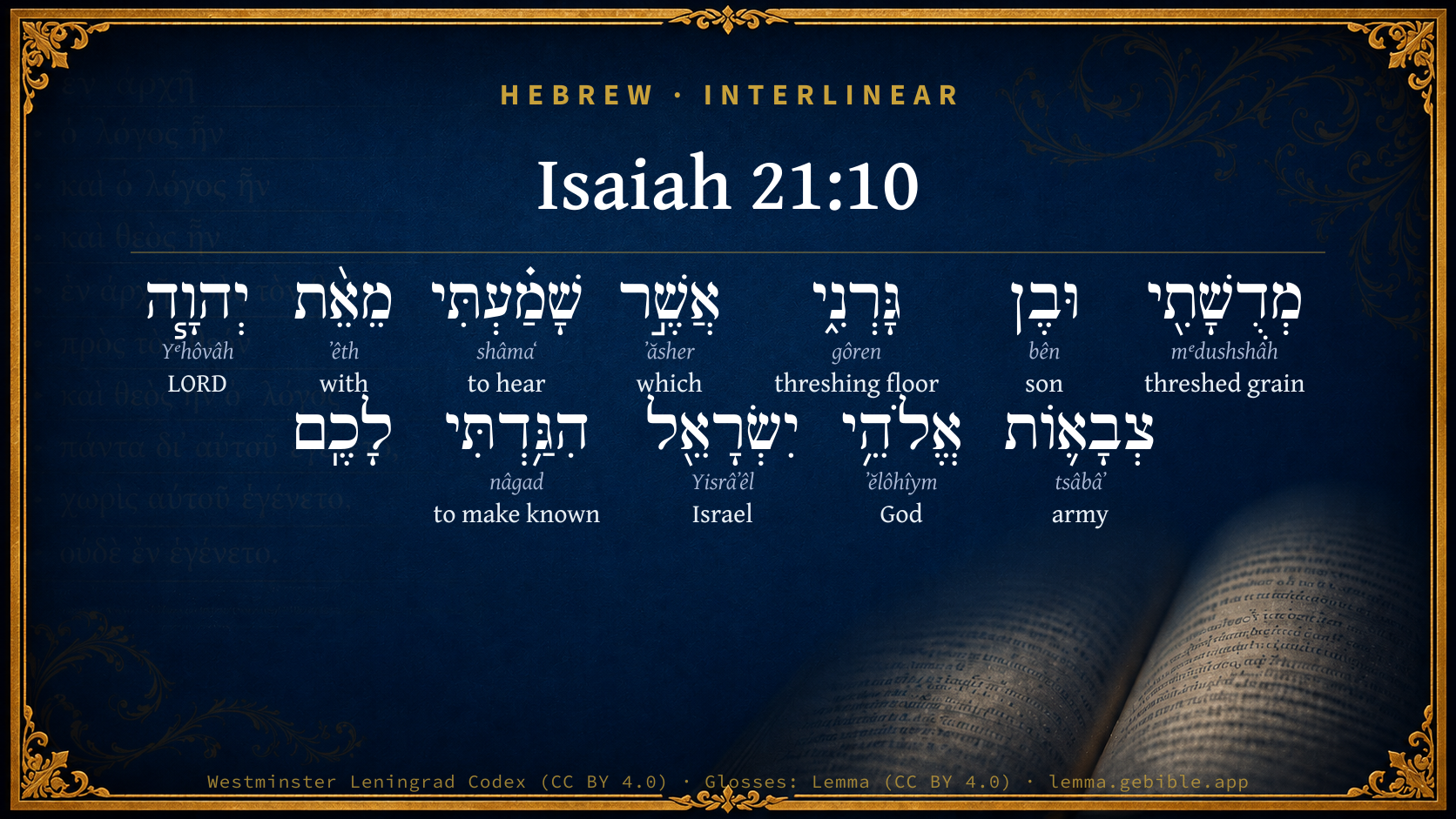
Hebrew (Westminster Leningrad Codex) Isaiah 21:10 appears in the Hebrew Old Testament. The text above is from the Westminster Leningrad Codex. Each word links to its Strong’s number, a concise gloss, and parsing drawn from the Open Scriptures Hebrew Bible morphology. Click any word for its full Brown-Driver-Briggs (BDB) entry.
Download image
Cite this verse

Isaiah 21:10 (World English Bible). Public Domain. Lemma interlinear Bible study tool, https://lemma.gebible.app/v/isaiah/21/10.

Show BibTeX & RIS
BibTeX
RIS
English Translation
You my threshing, and the grain of my floor! that which I have heard from Yahweh of hosts, the God of Israel, have I declared to you.
World English Bible · Public Domain
Highlights
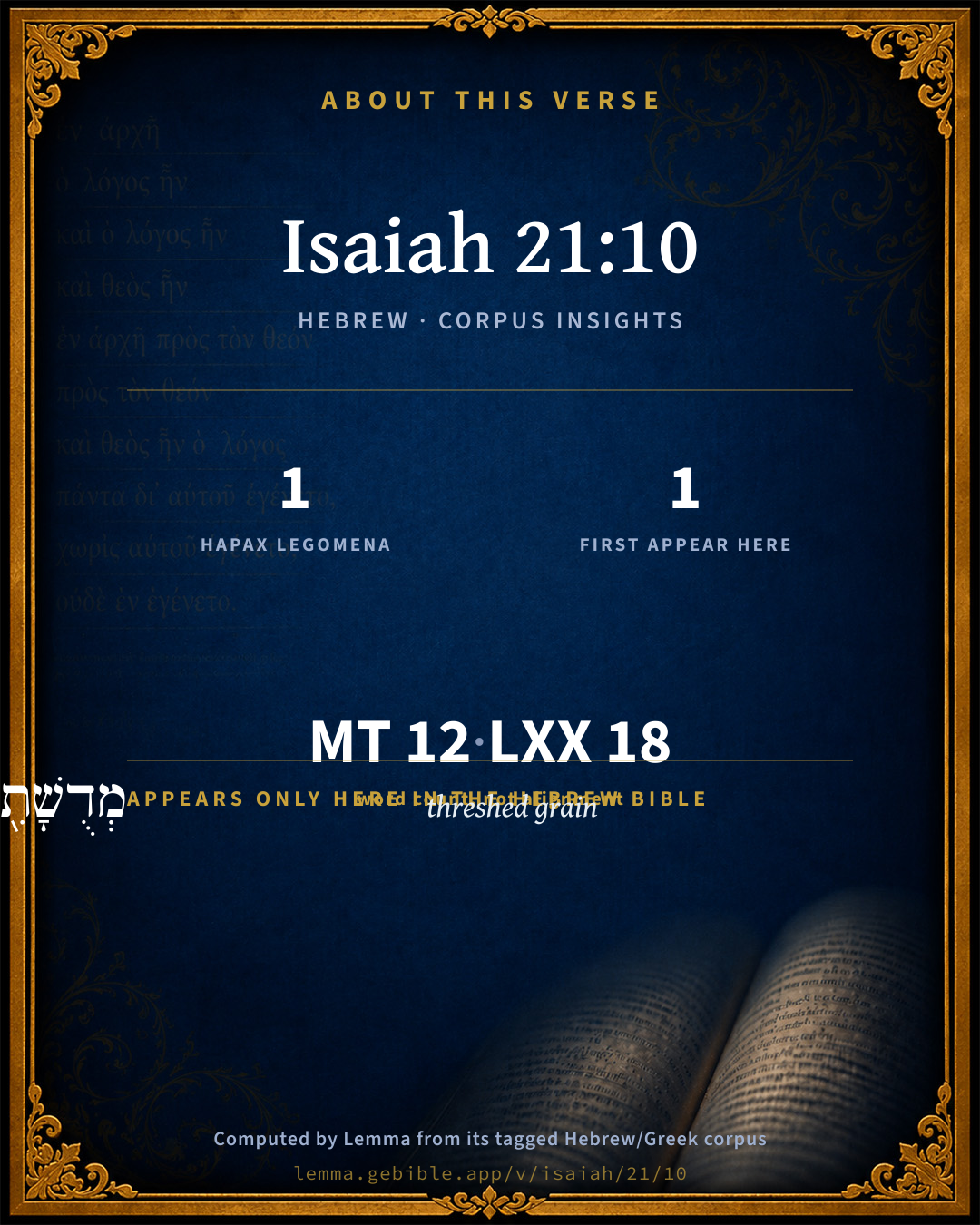
  • 1 hapax legomenon — only here in the Hebrew Bible
  • 1 first appearance in the Hebrew Bible
Full analysis ↓
Download a study sheet

One document with this verse’s original text, its word-by-word gloss line, the meaning frame, cross-references with their text, attributed commentary, and full source and license credits — printable, and it pastes into notes with its structure intact.

This verse Autodidact and up

Study sheet (.html) Plain text (.txt)

A passage Seminary Student

Up to 50 verses in one chapter. A passage sheet keeps up to 6 commentary sources and 12 cross-references per verse, in the order this page ranks them, and says so on the sheet whenever that leaves anything out. Ask for a single verse and you get the Autodidact verse sheet above.

Everything on this page stays free to read, with no account — the sheet is a download of what is already on screen, not access to it.

Want to remove ads? Support Godless Engineer
Compare translations 3

The same verse in 3 English versions, stacked beneath the original-language interlinear above. Click any original word for its lexicon entry.

Each is an independent rendering of the whole verse — the interlinear is not word-aligned to these translations.

Highlighted words mark where these versions differ — a whole-verse word diff, not a word-by-word alignment.

  • World English Bible Public Domain
    You my threshing, and the grain of my floor! that which I have heard from Yahweh of hosts, the God of Israel, have I declared to you.
  • King James Version Public Domain
    O my threshing, and the corn of my floor: that which I have heard of the LORD of hosts, the God of Israel, have I declared unto you.
  • unfoldingWord Literal Text CC BY-SA 4.0
    My threshing and the son of my threshing floor, what I have heard from Yahweh of Armies, the God of Israel, I have declared to you. p

unfoldingWord Literal Text — © unfoldingWord, licensed CC BY-SA 4.0. Word-aligned USFM3 via Door43 (git.door43.org/unfoldingWord/en_ult).

Versions to compare (up to 4)

3 of 4 selected

Show all 18 translations

Every available English version of this verse, each an independent rendering of the whole verse.

  • World English Bible Public Domain
    You my threshing, and the grain of my floor! that which I have heard from Yahweh of hosts, the God of Israel, have I declared to you.
  • Berean Standard Bible Public Domain
    O my people, crushed on the threshing floor, I tell you what I have heard from the LORD of Hosts, the God of Israel.
  • Majority Standard Bible Public Domain
    O my people, crushed on the threshing floor, I tell you what I have heard from the LORD of Hosts, the God of Israel.
  • King James Version Public Domain
    O my threshing, and the corn of my floor: that which I have heard of the LORD of hosts, the God of Israel, have I declared unto you.
  • American Standard Version (1901) Public Domain
    O thou my threshing, and the grain of my floor! that which I have heard from Jehovah of hosts, the God of Israel, have I declared unto you.
  • Revised Version (1885) Public Domain
    O thou my threshing, and the corn of my floor: that which I have heard from the LORD of hosts, the God of Israel, have I declared unto you.
  • Geneva Bible (1599) Public Domain
    O my threshing, and the corne of my floore. That which I haue heard of the Lord of hostes, the God of Israel, haue I shewed vnto you.
  • Douay-Rheims (1899) Public Domain
    O my thrashing and the children of my door, that which I have heard of the Lord of hosts, the God of Israel, I have declared unto you.
  • Young's Literal Translation Public Domain
    O my threshing, and the son of my floor, That which I heard from Jehovah of Hosts, God of Israel, I have declared to you!'
  • Literal Standard Version CC BY-SA 4.0
    O my threshing, and the son of my floor, || That which I heard from YHWH of Hosts, God of Israel, || I have declared to you!”
  • Unlocked Literal Bible CC BY-SA 4.0
    My threshed and winnowed ones, children of my threshing floor! What I have heard from Yahweh of hosts, the God of Israel, I have declared to you.
  • unfoldingWord Literal Text CC BY-SA 4.0
    My threshing and the son of my threshing floor, what I have heard from Yahweh of Armies, the God of Israel, I have declared to you. p
  • Darby Bible Public Domain
    O my threshing, and the corn of my floor! What I have heard of Jehovah of hosts, the God of Israel, have I declared unto you.
  • World Messianic Bible Public Domain
    You are my threshing, and the grain of my floor!” That which I have heard from the LORD of Hosts, the God of Israel, I have declared to you.
  • Webster's Bible Public Domain
    O my threshing, and the corn of my floor; that which I have heard from the LORD of hosts, the God of Israel, have I declared to you.
  • Free Bible Version CC BY-SA 4.0
    My poor downtrodden people, so badly mistreated, I have told you what I have heard from the Lord Almighty, the God of Israel.
  • Bible in Basic English Public Domain
    O my crushed ones, the grain of my floor! I have given you the word which came to me from the Lord of armies, the God of Israel.
  • JPS Tanakh (1917) Public Domain
    O thou my threshing, and the winnowing of my floor, that which I have heard from the LORD of hosts, the God of Israel, have I declared unto you.

Literal Standard Version (2020), Covenant Press — licensed CC BY-SA 4.0. Text via the HelloAO Bible API (eBible.org). Unlocked Literal Bible (unfoldingWord) — licensed CC BY-SA 4.0. Text via the HelloAO Bible API (eBible.org). unfoldingWord Literal Text — © unfoldingWord, licensed CC BY-SA 4.0. Word-aligned USFM3 via Door43 (git.door43.org/unfoldingWord/en_ult). Free Bible Version, Dr. Jonathan Gallagher — licensed CC BY-SA 4.0. Text via the HelloAO Bible API (eBible.org).

Word by word

More ways to search: Search by grammar → Find every occurrence → Compare this word →

Practice this passage: Drill this verse → Learn its vocabulary →

מְדֻשָׁתִ֖י
mᵉdushshâh
H4098
“threshed grain · my”
Noun, Common, Feminine, Singular, Construct + Suffix, Personal, 1st Person, Common, Singular
Part of Speech
Noun
Type
Common
Gender
Feminine
Number
Singular
State
Construct
Full BDB Definition

Origin: from H1758

TWOT: 419b

that which is threshed, thing threshed
  1. וּבֶן bên H1121 “and · son of” Conjunction + Noun, Common, Masculine, Singular, Construct
  2. גָּרְנִ֑י gôren H1637 “threshing floor · my” Noun, Common, Both, Singular, Construct + Suffix, Personal, 1st Person, Common, Singular
  3. אֲשֶׁ֣ר ʼăsher H834 “which” Particle, Relative
  4. שָׁמַ֗עְתִּי shâmaʻ H8085 “to hear” Verb, Qal, Perfect, 1st Person, Common, Singular
  5. מֵאֵ֨ת ʼêth H854 “from · with” Preposition + Preposition
  6. יְהוָ֧ה Yᵉhôvâh H3068 “LORD” Noun, Proper
  7. צְבָא֛וֹת tsâbâʼ H6635 “armies” Noun, Common, Both, Plural, Absolute
  8. אֱלֹהֵ֥י ʼĕlôhîym H430 “God(s) of” Noun, Common, Masculine, Plural, Construct
  9. יִשְׂרָאֵ֖ל Yisrâʼêl H3478 “Israel” Noun, Proper
  10. הִגַּ֥דְתִּי nâgad H5046 “to make known” Verb, Hiphil, Perfect, 1st Person, Common, Singular

About this verse

These counts appear in no published source. They are computed here, from the morphology-tagged text and Lemma’s own curated glosses. What Lemma adds →

12
words
11
distinct lemmas
Prophets
section

Notable vocabulary

1 hapax legomenon — a word that appears only here in the entire Hebrew Bible:

  • מְדֻשָׁתִ֖י threshed grain H4098

First appearance in Scripture

This word makes its first canonical appearance in the Hebrew Bible here:

  • מְדֻשָׁתִ֖י threshed grain H4098

Shared distinctive vocabulary

גָּרְנִ֑י threshing floor H1637 occurs in 37 verses of the Hebrew Bible. Also found in:

Grammatical profile

  • 2 verbs
  • 7 nouns
  • 2 prepositions
  • 1 particle

Verb forms

  • שָׁמַ֗עְתִּי Qal · Perfect
  • הִגַּ֥דְתִּי Hiphil · Perfect

Hebrew & Septuagint length

In English translation the verse runs 27 words from the Hebrew and 35 from the Septuagint (LXX English) — closely comparable.

A rough comparison of the two English renderings, which tokenize alike — not a word-level alignment.

Word counts can differ between the Hebrew and the Greek without any difference in meaning — e.g. the Hebrew direct-object marker אֵת has no separate Greek word, and Greek often adds the article ὁ.

In the original languages it is 12 Hebrew tokens and 18 Greek tokens — but the two are counted differently (Hebrew bundles its prefixes and suffixes into one token; the Greek is in lemma form), so that isn’t a like-for-like length.

Cross-references

9

Topical passages linked to Isaiah 21:10 in the Treasury of Scripture Knowledge — connected by theme and wording, ordered by reader-vote popularity; previews shown in the World English Bible.

  • Jeremiah 51:33 For thus says Yahweh of hosts, the God of Israel: The daughter of Babylon is like a threshing floor at the time when it is trodden; yet a little while, and the time of harvest shall come for her.
  • Micah 4:13 Arise and thresh, daughter of Zion; For I will make your horn iron, And I will make your hoofs brass; And you will beat in pieces many peoples: And I will devote their gain to Yahweh, And their substance to the Lord of the whole earth.
  • 2 Kings 13:7 For he didn't leave to Jehoahaz of the people save fifty horsemen, and ten chariots, and ten thousand footmen; for the king of Syria destroyed them, and made them like the dust in threshing.
  • Isaiah 41:15–16 Behold, I have made you [to be] a new sharp threshing instrument having teeth; you shall thresh the mountains, and beat them small, and shall make the hills as chaff.
  • Ezekiel 3:17–19 Son of man, I have made you a watchman to the house of Israel: therefore hear the word at my mouth, and give them warning from me.
  • Matthew 3:12 His winnowing fork is in his hand, and he will thoroughly cleanse his threshing floor. He will gather his wheat into the barn, but the chaff he will burn up with unquenchable fire."
  • 1 Kings 22:14 Micaiah said, As Yahweh lives, what Yahweh says to me, that will I speak.
  • Acts 20:26–27 Therefore I testify to you this day that I am clean from the blood of all men,
  • Habakkuk 3:12 You marched through the land in wrath. You threshed the nations in anger.

Cross-references courtesy of OpenBible.info (CC BY 4.0).

Hebrew and Greek witnesses Masoretic Hebrew ↔ Greek Septuagint

The same verse in the two great witnesses to the Old Testament, shown verse-for-verse.

These are two independent witnesses, not word-aligned to each other, and the Septuagint is shown in lemma (dictionary) form.

Hebrew Isaiah 21:10 Masoretic · Westminster Leningrad Codex

מְדֻשָׁתִ֖י וּבֶן גָּרְנִ֑י אֲשֶׁ֣ר שָׁמַ֗עְתִּי מֵאֵ֨ת יְהוָ֧ה צְבָא֛וֹת אֱלֹהֵ֥י יִשְׂרָאֵ֖ל הִגַּ֥דְתִּי לָכֶֽם

You my threshing, and the grain of my floor! that which I have heard from Yahweh of hosts, the God of Israel, have I declared to you.

World English Bible · Public Domain

Greek LXX Isaiah 21:10 Septuagint · lemma form

ἀκούω ὁ καταλείπω καί ὁ ὀδυνάω ἀκούω ὅς ἥκω παρά κύριος σαβαωθ ὁ θεός ὁ ἰσραήλ ἀναἀγγέλλω ἐγώ

Hear, you⌃ that are left, and you⌃ that are in pain, hear what things I have heard of the Lord of hosts which the God of Israel has declared to us. THE VISION OF IDUMEA.

LXX2012 (modern English Septuagint) · Public Domain

Hebrew: Westminster Leningrad Codex (CC BY 4.0). Greek: Septuagint (public domain); English from LXX2012 (modern English Septuagint) (Public Domain). How the Septuagint differs from the Hebrew →

Targum (Aramaic paraphrase)

1

The Targum is the ancient Jewish Aramaic paraphrase of the Hebrew Scriptures — an interpretive translation, not the Hebrew text itself. Onkelos (literal) and Pseudo-Jonathan (expansive) render the Torah, and Jonathan the Prophets. Coverage is partial: where no permissively-licensed English translation exists for a verse, only the Aramaic is shown. This is verse-level text, not a word-by-word alignment to the Hebrew.

  1. Targum Jonathan Prophets (Joshua–Malachi)
    מַלְכִין דְאוּמָנִין לְאַגָחָא קְרָבָא יֵיתוּן עֲלָהּ לְמִבְזָהָא כְּאִכָּרָא דְאוּמָן לְמֵידַשׁ יַת אִדְרָא אֲמַר נְבִיָא דִשְׁמַעֵית יַת קַל מֵימְרָא דַייָ צְבָאוֹת אֱלָהָא דְיִשְׂרָאֵל חַוֵיתִי לְכוֹן:

    Kings who are skillful to wage war, shall come against her to plunder her, like a husbandman who is skillful to thrash the floor. The prophet said, The voice of the WORD of the Lord of Hosts, the God of Israel, which I have heard, I have declared unto you.

    Targum Jonathan — Aramaic: “Mikraot Gedolot” (public domain). English: “Sefaria Community Translation” (CC0 1.0 (public-domain dedication)); “London "Chaldee Paraphrase," 1871” (public domain). Text via Sefaria.

Commentary

Notes on Isaiah 21:10 from classic Christian and Jewish commentators (each source and its license shown beneath its notes). The classic Christian expositions comment on the surrounding passage and are grouped to its opening verse, so a note may address several verses; the Jewish commentaries on the Tanakh (Rashi and others) are per-verse, so they appear only where the commentator wrote on this verse.

Lemma curates 59 commentaries, every one of them public domain or Creative Commons licensed, each selected and text-cleaned for this edition rather than reprinted as found. About our sources →

Trapp's Complete Commentary

John Trapp

Isa 21:10 O my threshing, and the corn of my floor: that which I have heard of the LORD of hosts, the God of Israel, have I declared unto you.

Ver. 10. O my threshing, and the corn of my floor.] That is, O my church and people, whom by so many tribulations I have hitherto been threshing, that I might sunder thee from the chaff, and make thee the "corn of the floor," or, as the Hebrew here hath it, "my son of the floor," and may lay thee up as pure grain in my garner. {a} See Isa 28:27.

That which I have heard from the Lord of hosts,] viz., That you, my poor countrymen, shall be threshed for a while, and winnowed by Babylon. See Isa 25:10; Isa 41:15 Jer 51:33 Mic 4:13. Ut cum triturando e gluma, et follibus suis utriculisque, triticum educitur, and that you shall at length be delivered from this grievous affliction; all this you may write upon as certain and infallible. I have herein told you not the dreams of mine own heart, but the very undoubted words of God himself.

{a} Non ut perdam, sed ut probem et purgem. Frumentum Dei sum, &c. - Ignat.

John Trapp, A Commentary or Exposition upon All the Books of the Old and New Testament (1647–1656) — public domain. Text from a community e-Sword module.

The Biblical Illustrator

Joseph S. Exell

Isa_21:10

O My threshing, and the corn of My floor

Gods threshing

Babylon is the instrument employed by the Divine wrath to thresh with.

But love takes part also in the work of threshing, and restrains the action of wrath. A picture likely to give comfort to the grain lying for threshing on the floor, i.e., to the people of Israel which, mowed down as it were and removed from its native son, had been banished to Babylon, and there subjected to a tyrannical rule. (F. Delitzsch.)

Comfort for Gods afflicted people

I. THE CHURCH IS GODS FLOOR, in which the most valuable fruits and products of this earth are, as it were, gathered together and laid up.

II. TRUE BELIEVERS ARE THE CORN OF GODS FLOOR. Hypocrites are but as the chaff and straw, which take up a deal of room, but are of small value, with which the wheat is now mixed, but from which it shall be shortly and forever separated.

III. THE CORN OF GODS FLOOR MUST EXPECT TO BE THRESHED by afflictions and persecutions.

IV. EVEN THEN, GOD OWNS IT FOR HIS THRESHING--it is His still; nay, the threshing of it is by His appointment and under His restraint and direction The threshers could have no power against it but what is given them from above. (M. Henry.)

The Biblical Illustrator, edited by Joseph S. Exell (c. 1880s–1900s) — public domain. Text from a community e-Sword module.

Joseph Benson's Commentary

Isa 21:10. O my thrashing, &c. — In these words, which form the conclusion of the prophecy, “the application, the end, and design of it, are admirably given in a short expressive address to the Jews, partly in the person of God, partly in that of the prophet.” The first words of the verse, O my thrashing, and the corn of my floor, are supposed to be spoken by God, in which thrashing is put for the corn thrashed, and the corn thrashed for people sorely afflicted and punished: as if he had said, “O my people, whom for your punishment I have made subject to the Babylonians, to try and to prove you, and to separate the chaff (or straw) from the corn, the bad from the good among you; hear this for your consolation: your punishment, your slavery and oppression, will have an end in the destruction of your oppressors.” The reader will observe, “the image of thrashing is frequently used by the Hebrew poets, with great elegance and force, to express the punishment of the wicked and the trial of the good, or the utter dispersion and destruction of God’s enemies.” That which I have heard, &c. — Here “the prophet abruptly breaks off the speech of God, and instead of continuing it in the form in which he had begun, and in the person of God, he changes the form of address, and adds, in his own person, That which I have heard, &c., have I declared unto you.” In which words he signifies, that he had faithfully related to them what God had revealed to him, and that the predictions which he had uttered were not his own inventions, but the very word of God, which, therefore, would be infallibly accomplished in their season. See Bishop Lowth.

Joseph Benson's Commentary on the Old and New Testaments (1811–1818) — public domain. Text from a community e-Sword module.

Tyndale Open Study Notes

Tyndale Open Resources

21:10 O my people: The focus shifted back to the people of Judah. • Judah would be oppressed (threshed and winnowed) by the Babylonians but Babylon, too, would fall. • I have told you everything: The prophet had been faithful in his duty to report what the Lord revealed to him.

Tyndale Open Study Notes — © Tyndale Open Resources, licensed CC BY-SA 4.0. Text via the HelloAO Bible API.

Geneva Bible (1599)

Geneva Bible translators

Hebrew, son.

Meaning, Babylon.

Geneva Bible (1599) marginal notes — public domain. Text via Bolls.life.

Jamieson, Fausset & Brown

Robert Jamieson, A. R. Fausset & David Brown

my threshing--that is, my people (the Jews) trodden down by Babylon.

corn of my floor--Hebrew, "my son of the floor," that is, my people, treated as corn laid on the floor for threshing; implying, too, that by affliction, a remnant (grain) would be separated from the ungodly (chaff) [MAURER]. HORSLEY translates, "O thou object of my unremitting prophetic pains." See Isa 28:27-28. Some, from Jer 51:33, make Babylon the object of the threshing; but Isaiah is plainly addressing his countrymen, as the next words show, not the Babylonians.

One out of Seir asks, What of the night? Is there a hope of the dawn of deliverance? Isaiah replies, The morning is beginning to dawn (to us); but night is also coming (to you). Compare Psa 137:7. The Hebrew captives would be delivered, and taunting Edom punished. If the Idumean wish to ask again, he may do so; if he wishes an answer of peace for his country, then let him "return (repent), come" [BARNES].

Jamieson, Fausset & Brown — Commentary Critical and Explanatory on the Whole Bible (1871) — public domain (CC PDM 1.0). Text via the HelloAO Bible API.

Adam Clarke's Commentary

Verse 10. O my threshing] "O thou, the object upon which I shall exercise the severity of my discipline; that shalt lie under my afflicting hand, like corn spread upon the floor to be threshed out and winnowed, to separate the chaff from the wheat!" The image of threshing is frequently used by the Hebrew poets, with great elegance and force, to express the punishment of the wicked and the trial of the good, or the utter dispersion and destruction of God's enemies. Of the different ways of threshing in use among the Hebrews, and the manner of performing them, see the note on Isa 28:27.

Our translators have taken the liberty of using the word threshing in a passive sense, to express the object or matter that is threshed; in which I have followed them, not being able to express it more properly, without departing too much from the form and letter of the original. "Son of my floor," Heb. It is an idiom of the Hebrew language to call the effect, the object, the adjunct, any thing that belongs in almost any way to another, the son of it. "O my threshing." The prophet abruptly breaks off the speech of God; and instead of continuing it in the form in which he had begun, and in the person of God, "This I declare unto you by my prophet," he changes the form of address, and adds, in his own person, "This I declare unto you from God."

Adam Clarke's Commentary on the Bible (1810–1826) — public domain. Text from a community e-Sword/MySword module.

Ellicott's Commentary for English Readers

(10) O my threshing, and the corn of my floor.—Literally, and child of my threshing-floor. . . The words are abrupt, and we have to read the thoughts that lie below them. The “child of the threshing-floor “is none other than Israel, thought of as the corn which is under God’s chastisements, Assyrian and Chaldæan invasions, Babylonian exile, and the like, severing the wheat from the chaff (Mic_4:12-13; Jer_51:33; Mat_3:3). The prophet looks on those chastisements with yearning pity, but he cannot “go beyond the word of the Lord” (Num_24:13), and this is all that he has to tell his people. The oppressor shall in the end be overthrown, but that which lies between the present and that far-off future is, as yet, concealed from him.

A Bible Commentary for English Readers, edited by Charles John Ellicott (1878–1897) — public domain. Text from a community e-Sword module.

The Cambridge Bible for Schools and Colleges

gen. ed. J. J. S. Perowne

10. The application to Israel, addressed as my threshing (i.e. threshed one) and my child of the threshing-floor—forcible figurative epithets of Israel as a nation crushed and down-trodden by the brutal tyranny of Babylon (cf. ch. Isa_41:15; Mic_4:12 f.; Jer_51:33, &c.).

The Cambridge Bible for Schools and Colleges (gen. ed. J. J. S. Perowne; Cambridge University Press, 1878–1918) — public domain. Text from a community e-Sword module.

John Gill's Exposition

O my threshing, and the corn of my floor,.... Which may be understood either of the Babylonians, now threshed or punished by the Lord, and whom he had made use of as instruments for the punishment of others; or rather of the people of the Jews, whom the prophet calls "his", as being his countrymen, to whom he was affected, and with whom he sympathized; and besides, he speaks in the name of the Lord; or it is the Lord that speaks by him, calling the church of the Jews his floor, and the people his corn, which were dear and valuable to him, as choice grain, wheat, and other things; and therefore, though he threshed or afflicted them, it was for their good, to purge and cleanse them, and separate the chaff from them; and indeed it was on their account, and for their good, that all this was to be done to Babylon, before predicted; where they were, as corn under the threshing instrument, greatly oppressed and afflicted, but now should be delivered; for the confirmation of which it is added:

that which I have heard of the Lord of hosts, the God of Israel, have I declared unto you; the preceding prophecy was not a dream of his, but a vision from the Lord of hosts; it was not devised by him, but told him by the Lord, and that for the good and comfort of the people of Israel, whose covenant God he was; and the prophet acted a faithful part, in delivering it just as he received it, which might be depended on.

John Gill's Exposition of the Whole Bible (1746–1763) — public domain (CC PDM 1.0). Text via the HelloAO Bible API.

Albert Barnes' Notes on the Bible

O my threshing - The words ‘to thresh,’ ‘to tread down,’ etc., are often used in the Scriptures to denote punishments inflicted on the enemies of God. An expression likes this occurs in Jer 51:33, in describing the destruction of Babylon: ‘The daughter of Babylon is like a threshing floor; it is time to thresh her.’ In regard to the mode of threshing among the Hebrews, and the pertinency of this image to the destruction of the enemies of God, see the note at Isa 28:27. Lowth, together with many others, refers this to Babylon, and regards it as an address of God to Babylon in the midst of her punishment: ‘O thou, the object on which I shall exercise the severity of my discipline; that shall lie under my afflicting hand like grain spread out upon the floor to be threshed out and winnowed, to separate the chaff from the wheat.’ But the expression can be applied with more propriety to the Jews; and may be regarded as the language of “tenderness” addressed by God through the prophet to his people when they should be oppressed and broken down in Babylon: ‘O thou, my people, who hast been afflicted and crushed; who hast been under my chastening hand, and reduced to these calamities on account of your sins; hear what God has spoken respecting the destruction of Babylon, and your consequent certain deliverance.’ Thus it is the language of consolation; and is designed, like the prophecies in Isa. 13; 14, to comfort the Jews, when they should be in Babylon, with the certainty that they would be delivered. The language of “tenderness” in which the address is couched, as well as the connection, seems to demand this interpretation.

And the corn of my floor - Hebrew, ‘The son of my threshing floor’ - a Hebraism for grain that was on the floor to be threshed. The word ‘son’ is often used in this special manner among the Hebrews (see the note at Mat 1:1).

That which I have heard ... - This shows the scope or design of the whole prophecy - to declare to the Jews the destruction that would come upon Babylon, and their own consequent deliverance. It was important that they should be “assured” of that deliverance, and hence, Isaiah “repeats” his predictions, and minutely states the manner in which their rescue would be accomplished.

Albert Barnes' Notes on the Bible (1834–1885) — public domain. Text from a community e-Sword/MySword module.

Haydock's Catholic Bible Commentary

Floor: you who must shortly be reduced to the utmost distress. Baladan was friendly to Ezechias. But Assaradon having seized Babylon, took Manasses prisoner; and the city thenceforward continued to fill up the measure of its sins. (Calmet)

George Leo Haydock (1774–1849), Haydock's Catholic Family Bible and Commentary, 1859 edition — public domain. Excludes Psalms (Douay-Rheims chapter numbering differs from Protestant) and Deuterocanonical books (Catholic canon only).

Matthew Poole's English Annotations

Threshing is here put for the corn threshed, as it is explained in the following words; the act being frequently put for the object, as captivity for the captives, fear for the thing feared, &c., as hath been noted before. And the corn threshed is here metaphorically put for people sorely afflicted and punished, which is oft expressed by threshing, as Isa 25:10; 41:15; Mic 4:13, &c. This is spoken either,

1. Of the Jews, to whom he now turneth his speech, whom God did grievously thresh and afflict by the Babylonians, and whom he here comforts with these tidings, as if he had said, Though thou wilt be threshed first, yet Babylon shall be threshed last, and most dreadfully, and their threshing shall be thy deliverance. This interpretation is thought necessary, because of the latter clause of the verse, wherewith this is to be joined. Or,

2. Of Babylon.

O my threshing; or, thou art my threshing, whom I have undertaken to thresh and punish. And so this is fitly mentioned here, to assure them that this prophecy of Babylon’s fall must necessarily be accomplished, because the Almighty was engaged in the work. And this interpretation seems not to be inconsistent with the rest of the verse, as we shall see.

The corn of my floor; the corn which I will cause to be threshed upon the floor, Heb. the son of my floor. For the title of son is oft given to lifeless things, as arrows are called the sons of the bow, or of the quiver, Job 5:7; 41:28, &c.

That which I have heard of the Lord of hosts have I declared; what I have foretold is not my own invention, but the word of God, and therefore shall infallibly come to pass.

Unto you; either,

1. Unto you my people, or hearers; for all the prophecies, even concerning other nations, were published to them, and for their use and comfort: or,

2. Unto (or concerning, as this Hebrew particle is sometimes used, as the learned know) you Babylonians, to whom this was in some sort declared, because it was published amongst the Jews, and by their means might easily come to the knowledge of other people, and consequently of the Babylonians. Nor is it unusual for the prophets, in their prophecies delivered to God’s people concerning Babylon, by an apostrophe to turn their speech to the Babylonians themselves; of which we have instances, Jer 50:24,31; 51:13,14,25,26.

Matthew Poole's English Annotations on the Holy Bible (1683–1685) — public domain. Text from a community e-Sword/MySword module.

Whedon's Commentary on the Bible

Daniel D. Whedon

10. My threshing — My crushingly oppressed ones; a sympathetic utterance from the prophet for his chastised brethren. Now appears the bearing this prophecy has on the Lord’s people.

Corn of my floor — Rather, son or child of my threshing-floor, the sanctified results of a long disciplinary affliction. The captivity in Babylon was the judicial separation of grains and husks in Israel. Babylon was the threshing floor of God; love now restrains the wrath.

That which I have heard — The revelation from God in relation to Israel’s sore providential handling.

Declared unto you — Is now made all clear.

Daniel D. Whedon (gen. ed.), Commentary on the Old and New Testaments (1874–1909) — public domain. Text from a community e-Sword module.

The Pulpit Commentary

O my threshing, and the corn of my floor. These are the words of the prophet to Israel. Her chastisements have long been "threshing" Israel, separating the grain from the chaff, and will do so still more as time goes on. The prophet"s message is for the comfort of those who shall have gone through the process and become the true "children of the threshing-floor pure wheat, fit to be gathered into the garner of Mat_3:12.

Tribulation.

There is no little tenderness in this Divine address or invocation; it reminds us that God"s love may be set upon us when there seems least reason to think so if we judge of his feeling by our outward circumstances. We think naturally of

I TRIBULATION. The instrument by which corn was threshed (tribula) has given us the word with which we are so familiar. To some it speaks of long-continued sickness, or weakness, or pain; to others of depressing disappointment; to others of bereavement and consequent desolation; to others of loss and the inevitable struggle with poverty; to others of human frailty or even treachery and of the wounded spirit which suffers from that piercing stroke. The heart knows its own bitterness, and every human soul has its own peculiar story to tell, its own especial troubles to endure. But this human suffering is only appropriately called tribulation when it is recognized that the evil which has come is sent (or allowed) of God as Divine chastening, when it is understood that the Divine Father takes a parental interest in the well-being of his children, that he is seeking their highest good, and that he is passing his threshing-instrument over "his floor" in the exercise of a benign and holy discipline.

II SEPARATION. When the "tribula" passed over the reaped corn it separated the valuable grain from the worthless chaff; one was then easily distinguishable from the other. Sorrow, persecution, trial, tribulation, is a "discerner of the thoughts and intents of the heart." Before it comes, the genuine and the pretentious may be mingled indistinguishably; after it has come, it is apparent who are the loyal and true disciples, and who are they that have nothing but "the name to live." We cannot be sure of "the spirit of our mind" or the real character of others until we, or they, have been upon the threshing-floor, and the Divine instrument of threshing has done its decisive and discriminating work. It comes, like Christ himself, "for judgment;" and then many who were supposed not to see are found to have a true vision of God and of his truth, while many who have imagined that they saw have been found to be blind indeed. (see Joh_9:39)

III SYMPATHY. Israel in Egypt may have thought itself unpitied and even forgotten of God; but it would have been wrong in so thinking. (Exo_3:7) The Jews in Babylon may have imagined themselves disregarded of Jehovah; but they were mistaken if they so thought. "0 my threshing," etc., exclaims the sympathetic voice of the Lord. When we are tempted to bewail our unpitied and forgotten condition, we must check ourselves as the psalmist had to do, (Ps 73) or we shall be unjust and even ungrateful; "for whom the Lord loveth he chasteneth." The mark of tribulation is the sign of parental love and care.

IV PREPARATION. The process of threshing prepared the corn for the granary, and so for the table, and thus for the fulfillment of its true function. When God stretches us on his floor and makes us undergo the process of tribulation, it is that we may be refined and purified; that we may be made "meet for his use" both on earth and in heaven; that we may be prepared for such higher work and such nobler spheres as we should have remained unfitted for, had he not subjected us to the treatment which is "not joyous but grievous" at the time. C.

God"s people threshed and winnowed.

Isaiah was familiar with the threshing and winnowing processes, and what was in his mind may be presented to ours. In the East, the threshing-floor is prepared upon some level spot, on high ground. The soil is beaten hard, clay is laid over it and rolled; this soon dries in the heat of the sun, and makes a firm clean floor. Sometimes horses or oxen, tied together and led round in a circle, tread out the corn-grains; but the more general plan is to use a sort of sled made of thick boards, four or five feet in length, with many pieces of flint or iron set firmly in the wood of the under surface. This is drawn over the sheaves, as they are laid on the threshing-floor, by a pail" of oxen. The winnowing is done by throwing up the heap with a largo shovel, so that the wind may separate the lighter chaff from the heavier grain. The familiar word tribulation," it will be remembered, is taken from the Latin word tribulum, a heavy threshing-roller. The comparison of severe oppression or affliction to threshing is a common one. We may work the figure out by saying Life is God"s floor; his people are the corn laid upon it; dispensations of providence are the sharp threshing-instruments; but their Working only proves how anxious God is for the final good of his people; and over their separating and refining he anxiously and lovingly presides. The reference of the text is to Judah, suffering under Babylonian oppression. Isaiah sees the fall of Babylon, and he would gladly have reported that the success of its enemies would prove a permanent relief to Judah; but alas! he only sees more trouble, and heavier trouble still, in store for his country.

I THRESHING AND WINNOWING ARE ALWAYS TRYING PROCESSES. They crush and cut and bruise; they seem to fling away as we fling away worthless things. And the answering providential dealings of God try faith, try patience, try endurance, try submission. They are trying only because they must be. No man would bruise his corn, if it could be separated from its husk in some simpler and easier way. When we think of the work God would do in us get the corn of goodness quite free from the husk of evil then the wonder is that, even with such threshing-instruments of trouble, suffering, humiliation, disappointment, as he uses, he yet can accomplish so great a result. Only Divine grace can make such means adequate to such an end. On this dwell further.

II THRESHING AND WINNOWING ARE PROCESSES HAVING A GRACIOUS END IN VIEW. That end is variously stated. It is "holiness;" it is our "sanctification;" it is knowing how rightly to use these "vessels of our bodies;" it is "likeness to Christ;" it is "meetness for the inheritance of the saints in the light;" it is the "liberty of righteousness." God would have the grain clean, free from all chaff, or dust, or straw; it must be "meet for the Master"s use." The ends of Divine threshing are the further ends sought by the Divine redemption. God forms a people for himself; by providential threshings and winnowings, he beautifies them for himself.

III THE TRYING PROCESS MAY BE BORNE IF WE KEEP THE GRACIOUS END IN VIEW. "No affliction for the present seemeth to be joyous, but grievous." Yet does the child of God yield submissively, singing his restful refrain, and saying, Our light affliction, which is but for a moment, worketh for us a far more exceeding and eternal weight of glory." Even in view of further threshing-times, Judah may be quiet; they would but be Gods threshings, with a view to final good. R.T.

The Pulpit Commentary (1880–1919), ed. H.D.M. Spence-Jones & Joseph S. Exell — public domain. Text from a community e-Sword module.

John Wesley's Explanatory Notes

Threshing - Threshing is put for the corn threshed; and the corn threshed for people sorely afflicted. This is probably spoken of Babylon. The corn - Which I will cause to be threshed upon the floor. You - Unto you my people; for all the prophecies, even concerning other nations, were published to them, and for their use and comfort.

John Wesley, Explanatory Notes Upon the Whole Bible (1754–1765) — public domain. Text via the GEBible commentary corpus.

Keil & Delitzsch

C. F. Keil & F. Delitzsch

The night vision related and recorded by the prophet, a prelude to the revelations contained in Chapters 40-60, was also intended for the consolation of Israel, which had already much to suffer, when Babylon was still Assyrian, but would have to suffer far more from it when it should become Chaldean. "O thou my threshing, and child of my threshing-floor! What I have heard from Jehovah of hosts, the God of Israel, I have declared to you." Threshing (dūsh) is a figure used to represent crushing oppression in Isa 41:15 and Mic 4:12-13; and judicial visitation in Jer 51:33 (a parallel by which we must not allow ourselves to be misled, as Jeremiah has there given a different turn to Isaiah's figure, as he very frequently does); and again, as in the present instance, chastising plagues, in which wrath and good intention are mingled together. Israel, placed as it was under the tyrannical supremacy of the imperial power, is called the medŭsshâh (for medūshah, i.e., the threshing) of Jehovah - in other words, the corn threshed by Him; also His "child of the threshing-floor," inasmuch as it was laid in the floor, in the bosom as it were of the threshing-place, to come out threshed (and then to become a thresher itself, Mic 4:12-13). This floor, in which Jehovah makes a judicial separation of grains and husks in Israel, was their captivity. Babylon is the instrument of the threshing wrath of God. But love also takes part in the threshing, and restrains the wrath. This is what the prophet has learned in the vision ("I have heard," as in Isa 28:22) - a consolatory figure for the threshing-corn in the floor, i.e., for Israel, which was now subject to the power of the world, and had been mowed off its own field and carried captive into Babylonia.

Keil & Delitzsch — Biblical Commentary on the Old Testament (1861–1891) — public domain (CC PDM 1.0). Text via the HelloAO Bible API. (Old Testament only.)

J. A. Alexander on Isaiah

Joseph Addison Alexander

“Oh my threshing and the son of my threshing-floor! What I have heard from Jehovah of hosts, the God of Israel, I have told you.” This part of the prophecy closes with an apostrophe, showing at once by whose power and for whose sake the downfall of Babylon was to be brought about. Threshing here means that which is threshed, and is synonymous with the following phrase, son of the threshing-floor, (i.e., according to the oriental idiom which uses son to signify almost any relation) threshed grain. The comparison of severe oppression or affliction to threshing is a common one, and though the terms here used are scarcely intelligible when literally rendered into English. It is clear that they mean, ‘oh my oppressed and afflicted people,’ and must therefore be addressed not to the Babylonians but the Jews, to whom the fall of Babylon would bring deliverance, and for whose consolation this prediction was originally uttered. The last clause assures them that their own God had sent this message to them.

Joseph Addison Alexander, The Prophecies of Isaiah (1846–1847; New York: Scribner, 1870–1878) — public domain. Text from a community e-Sword module.

unfoldingWord translationNotes

Door43 World Missions Community

My threshed and winnowed ones, children of my threshing floor

The people of Israel suffering because of the Babylonians is spoken of as if the people were grain that was threshed and winnowed. (See: Metaphor)

My threshed

The word "my" refers to Isaiah.

Yahweh of hosts

See how you translated this in Isaiah 1:9.

translationWords

thresh

winnow

Yahweh of hosts

Israel

declare

unfoldingWord translationNotes — © Distant Shores Media and the Door43 World Missions Community, licensed CC BY-SA 4.0. Source: git.door43.org/Door43/en_tn.

Rashi

Rabbi Shlomo Yitzchaki (Rashi)

My threshed grain and the product of my threshing floor My hallowed grain, the stack of wheat which I was commanded by the Holy Spirit to rectify you and lead you on the straight path, like a man who threshes and winnows his grain on the threshing floor.

What I heard from Him I have related to you.

Rashi on the Tanakh — English translations: “The Judaica Press complete Tanach with Rashi, translated by A. J. Rosenberg” (CC BY 4.0); “Pentateuch with Rashi's commentary by M. Rosenbaum and A.M. Silbermann, 1929-1934” (public domain); “The Metsudah Tanach series, Lakewood, N.J” (CC BY 4.0); and “The Book of Joshua, Metsudah Publications, 1997” (CC BY 4.0). Text via Sefaria.

Ibn Ezra

Rabbi Abraham ibn Ezra

My threshing. Babylon is the object of threshing; the pronoun my refers to God, to the prophet, or to the chariot of men. The meaning of the phrase is: I also threshed it, and it has become like ‘ the corn of my floor.’ It is also possible that בן גרן signifies the pure corn that is kept in the threshing-floor, and refers figuratively to Israel.

Ibn Ezra on the Tanakh — English translations: “Sefaria Community Translation” (CC0 1.0 (public-domain dedication)); “Yalkut, Sifsei Chachomim Chumash, Metsudah Publications, 2009” (CC BY 4.0); and “Commentary of Ibn Ezra on Isaiah - trans. by M. Friedlander, 1873” (public domain). Text via Sefaria.

Lesson kit

Teaching starters — assembled from the data on this page, not authored interpretation. Every prompt links to the verse data it draws on. Edit before teaching.

Isaiah, in the Prophets, opens this verse with 12 words (11 distinct Hebrew lemmas). Its most distinctive word is mᵉdushshâh (“threshed grain”). A historical commentator’s framing appears above. Read the whole chapter for the surrounding context.

Discussion questions

  1. How does “threshed grain” (mᵉdushshâh) shape what this verse is saying?
  2. 1 word here appears nowhere else in the Hebrew Bible. Why might the author reach for such rare wording?
  3. This is the first place “threshed grain” appears in Scripture (first appears here). What does its debut here establish?
  4. How does Genesis 50:10, which shares the word «threshing floor», read alongside this verse?
  5. These translations render this verse differently. What is at stake in choosing one wording over another?
  6. «שָׁמַ֗עְתִּי» is a Qal Perfect verb. How does that grammatical form shape the action described?
  7. Compare how Trapp's Complete Commentary and The Biblical Illustrator read this verse. Where do they agree or differ?

Things to notice

Reading settings

Reading text

Shown beneath each verse's original-language words.

Old Testament
Old Testament edition

Read the OT as the Masoretic Hebrew (MT) or the Greek Septuagint (LXX).

English shown for the Greek Septuagint (in the Hebrew ↔ Greek comparison).

Comparing translations? Open the Compare panel on any verse page to stack up to four side by side.