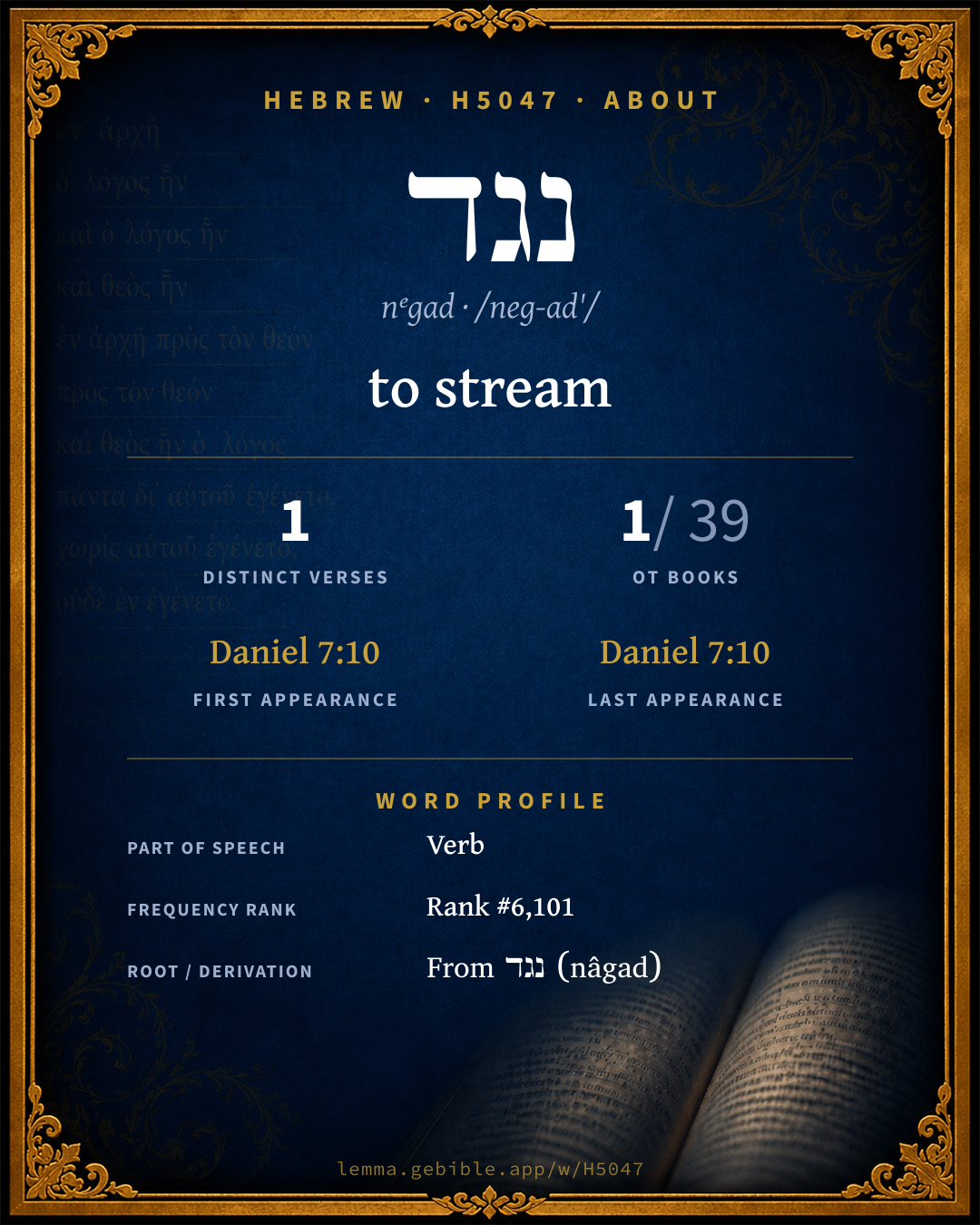
נְגַד
to stream
Full lexicon entry — Brown-Driver-Briggs (BDB)
From Brown-Driver-Briggs (BDB)
Where this word appears
Grammar key — what these labels mean
Part of speech
- Verb
- An action or state-of-being word.
Stem
- Qal
- The basic, simple active stem — the plain form of the verb (“he wrote”).
Form
- Participle Active
- A verbal adjective expressing ongoing or characteristic action (“writing / one who writes”).
State
- Absolute
- The independent form of a noun, not bound to a following word.
Gender
- Masculine
- Grammatically masculine.
Number
- Singular
- One.
Every verse where H5047 appears — 1 distinct verse across 1 book. Click any verse to open its interlinear word-by-word view. Verse text shown in the World English Bible for context — . Each verse’s Hebrew form is shown with its reference; the English is not keyword-highlighted, since the data carries no word-level English alignment. Use “Compare translations” on any verse to read it across multiple English versions. This concordance covers the Hebrew Bible; Septuagint (Greek Old Testament) occurrences are not indexed here.
Daniel 1 verse
About this entry
At a glance — auto-summarized from this page’s data, not written by a person. Every figure links to its source below. This summary describes the numbers; it doesn’t interpret them.
“to stream” is the headline sense of the Hebrew verb נגד (nᵉgad). A scarce word — 1 verse in all of the Hebrew Bible. More than three-quarters of its appearances fall in Daniel. Scripture uses it exactly once, at Daniel 7:10. It shares a root with נגד, נגד and נגיד. The sections below give every sense, occurrence, and version rendering.
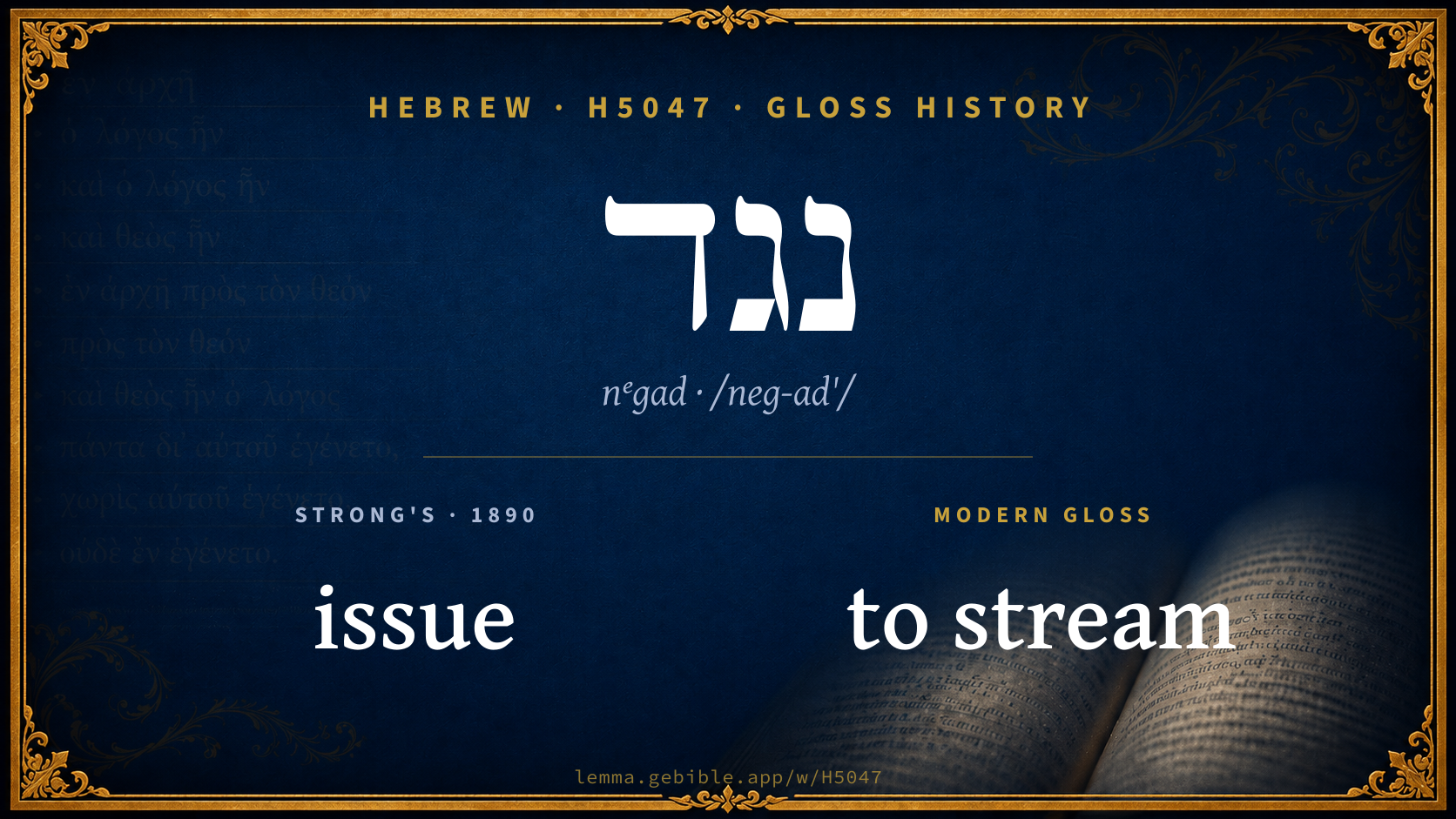
Gloss history
Strong's 1890 vs modern scholarship
About this word
Strong's H5047 catalogs a Hebrew word from the Hebrew Old Testament.
These counts are not copied from any lexicon or concordance. They are computed here, from the morphology-tagged Hebrew Old Testament. What Lemma adds →
- 1
- distinct verses
- The word appears in 1 distinct verse.
- 1 / 39
- OT books
- The word appears in 1 of 39 Old Testament books.
- #6,101
- by frequency
- Rank #6,101 (rank 6,101 of 8,640 Hebrew words by occurrence).
View all 1 occurrence in the concordance →
Most concentrated in
- Daniel 1 verse 100%
By section of the Old Testament
By traditional corpus
Conventional, traditional groupings — biblical authorship is debated, so this is a traditional corpus grouping, not an authorship claim. Each share is this word’s portion of its verses in that division of the Hebrew canon. Each figure is a share of the word’s 1 distinct verse.
- Writings (Ketuvim) 1 verse · 100%
How translations render this word
Counts come from each version’s own published word-to-Strong’s tagging or interlinear alignment — an approximate guide to how each version renders this word, not a word-level alignment the data otherwise carries. Because each total is that version’s own tagged count, the per-version totals vary from one another and need not match the appearance or distinct-verse counts above. These counts may also differ from a printed concordance because Lemma counts each distinctly tagged rendering and does not collapse phrase taggings into a single head-word total. This is a fixed set of word-tagged versions (KJV, ASV, BSB, ULT) and does not change with the reading translation you choose elsewhere. Each version’s license is shown beside its name below (and on Sources).
- King James Version: Issued 1×
- American Standard Version: Issued 1×
- Berean Standard Bible: Was flowing 1×
- unfoldingWord Literal Text: Was flowing 1×
King James Version Public Domain
Renders H5047 across 1 tagged occurrence — most commonly:
American Standard Version Public Domain
Renders H5047 across 1 tagged occurrence — most commonly:
Berean Standard Bible Public Domain
Renders H5047 across 1 tagged occurrence — most commonly:
unfoldingWord Literal Text CC BY-SA 4.0
Renders H5047 across 1 tagged occurrence — most commonly:
Senses in BDB
The 1 sense BDB distinguishes for this word, in lexicon order (not ranked by frequency or importance). The full entry — with sub-senses — is in the Lexicon Entry tab.
- (Pael) to stream, flow
Word origin
[ נְגַד ] vb. stream, flow;— Pe. Dn 7:10
— Brown-Driver-Briggs (Oxford 1906, public domain), digitized via Sefaria, supplemented by the OpenScriptures HebrewLexicon (CC BY 4.0). See Sources.
Derived from נגד (nâgad) (H5046) — to make known.
Jastrow Dictionary
A second Hebrew/Aramaic lexicon for comparison, covering Aramaic and post-biblical (Talmudic, Targumic, Midrashic) usage that the biblical-Hebrew BDB does not. Matched by lemma rather than by Strong’s number, so a lemma may carry more than one Jastrow headword (shown separately below), and the entries cover usage well beyond the Bible.
אִינְגַּד
- prolong! go further! Git. 58ᵃ א׳ פוסתא וכ׳ go one page and a half further, (and you will find it). [Rashi: a little = אִי־נְגַד, v. אי III.]
נָגַד
- (b. h.) to draw a line; denom. נֶגֶד.
- (denom. of נֶגֶד) to show; to announce, tell; to testify. Tanḥ. Tsav 13 ומשם … והִגִּידָה לאהרן from there Miriam learned it and told Aaron. Ib. מַגִּיד שהכל מודים וכ׳ this shows (intimates) that all agreed as to her beauty. Snh. IV, 5 להַגִּיד גדולתו וכ׳ to show the greatness &c. Ib. 44ᵇ, a. e. (ref. to Lev. V, 1) כיון שה׳ שוב אינו חוזר ומַגִּיד after he has once testified, he cannot again testify, i.e. is not permitted to retract; a. v. fr.—[Pes. 87ᵃ, v. אָגַד.]—V. מַגִּיד. e.g. Leviticus 5:1
- to be told, proclaimed. Yalk. Koh. 989 שה׳ לה בסיני the word which has been proclaimed at Sinai; a. e.
- to oppose. Yeb. 63ᵃ; Yalk. Gen. 23 (ref. to כנגדו, Gen. II, 18) זכה כנגדו לא זכה מְנַגַּדְתּוֹ if he is favored, she will be corresponding to (in harmony with) him, if not, she will oppose him (Rashi: ‘she will be a lash to him’, v. נִגְדָּא II); Pirké’ d’R. El. ch. XII א"ת כנגדו אלא לנגדו אם זכה תהיה לו עזר ואם לאו לנַגְּדוֹ להלחם read not k’negdo, but l’nagg’do; if he is favored, she will be a help to him, if not, ‘to oppose him’, to fight. e.g. Genesis 2:18
נְגַד
- 1. (corresp. to h. מָשַׁךְ, נָטָה a. אָרַךְ) to stretch; to draw, pull, spread. Targ. Jud. XVI, 30. Targ. Deut. XXI, 3. Targ. Jer. XLIII, 10.—Targ. Ps. LV, 4 יִיגְּדוּן ed. Lag. (ed. Wil. יגרון; h. text ימיטו). Targ. Y. Deut. XVII, 20. Targ. Y. Ex. XII, 21 נגודו ידיכון וכ׳ withdraw your hands from (v. מָשַׁךְ); a. fr.—Succ. 4ᵇ גּוּד אסיק וכ׳ stretch and raise the partitions, i.e. adopt the legal fiction that the partitions around the stand are prolonged so as to reach the ceiling (v. דּוֹפָן). Sabb. 101ᵃ גוּד אחית וכ׳ stretch and bring the partitions down, i.e. adopt the fiction that the walls are prolonged so as to reach the bottom. Erub. 4ᵇ לְגוּד, v. לָבוּד. Gitt. 68ᵇ נְגִידוּ מיניה מיכליה (Rashi: נְגוּדוּ) withdraw his food from him, reduce his rations. B. Mets. 74ᵃ למידש ולמִנְגַּד to tread the grapes and to conduct the wine into the pit. Ib. 84ᵇ נַגְדוּ מתותיה וכ׳ they drew from under him sixty &c., v. מְשִׂיכְלָא. B. Bath. 111ᵇ גוד לית וכ׳ draw (take me away from here), this man does not want to learn. Pesik. B’shall., p. 90ᵃ; Koh. R. to X, 8 גוד חמי לי lead the way, show it to me. Bekh. 44ᵇ נגדו ליה גלימא they spread for him (held up between him and the people) a cloak. Erub. 94ᵃ שקולו … נְגִידוּ בה take a cloak and spread it (as a partition); a. v. fr.—Ab. I, 13 נְגַד שמא וכ׳ he who stretches his fame (is ambitious), will lose his name.
- 2. to lash, v. Pa.
- 3. to guide, rule. Targ. Ruth I, 1 (h. text שפט).
- 4. to grow long; to be drawn, follow after; to flow. Targ. Job XXI, 33 (h. text ימשוך). Targ. Jer. VI, 4 (h. tex ינטו). Targ. Cant. I, 4 נְגִדְנָא וכ׳ we are drawn after &c. Targ. Deut. XXXIII, 13; 22; a. fr. (v. נְגַר).—B. Bath. 91ᵇ והוה נָגֵיד חוטא וכ׳ a line of honey flowed over both his arms; Y. Peah VII, 20ᵃ bot. ונ׳ מלא וכ׳ and honey flowed as much as my hands could hold; a. e.—Part. pass. נְגִיד stretched, fainting (v. Ithpe.). Targ. Ps. LXXXVIII, 16.—Sabb. 152ᵃ, v. Ithpe.
- (denom. of נִגְדָּא II) to lash, punish. Targ. Cant. VII, 5 למִינְגַּד … לנַגָּדָא.—Keth. 33ᵇ נַגְּדוּהָ, v. אִלְמָלֵא. Kidd. 12ᵇ נַגְּדֵיה כרב punish him in accordance with Rab’s practice. Pes. 52ᵃ ולִינַגְּדֵיה מר נַגּוּדֵי Ms. (ed. נגידי, corr. acc.) why do you not order him to be lashed?; a. e.
- to declare liable to lashes. Kidd. l. c.; Yeb. 52ᵃ, a. e. רב מַנְגִּיד (על) וכ׳ Rab decreed punishment for him who &c. Kidd. l. c. לא מינגיד רב (read: מנגיד, as) Yeb. l. c.
- , אִינְּגִיד, Ithpa. אִתְנַגַּד
- 1. to be drawn, to extend; to run. Targ. Is. XXXIV, 11. Targ. Y. Num. XXV, 8. Targ. Y. Gen. XLV, 19. Targ. Is. XLIV, 3; a. e.
- 2. to spread, invade. Targ. I Sam. XXVII, 10 (h. text פשט); a. e.
- 3. to be withdrawn. Targ. Josh. IV, 18; a. e.
- 4. [to stretch one’s self,] to faint, fall away, die (h. גָּוַע). Targ. Gen. XXV, 8; a. fr.—Pes. 50ᵃ חלש וא׳ כי וכ׳ was sick and fainted (seemed to be dead), and when he came to &c.; B. Bath. 10ᵇ. Snh. 39ᵃ א׳ ואתנח he became faint and sighed; Sabb. 152ᵃ נגיד ואתנח.
- 5. to be lashed. Macc. 11ᵃ; Pes. 113ᵇ מִינְּגִיד, v. זִיגּוֹד.—[Kidd. 12ᵇ מינגיד, v. supra.]
נֶגֶד
- line, direction; prep. נֶ׳, mostly כְּנֶ׳ towards, opposite, corresponding to. Sifra Tsav, Milluim, Par. 1 והלא כבר זיוג … זה נ׳ זה has not the Scripture, before this, paired the two rams, one to correspond with the other? Tam. II, 5 (29ᵃ) כנ׳ מערבית דרומית משוך וכ׳ (Mish. ed. מִכְּנֶ׳) in a line with the south-west corner of the altar continued northward to a distance of &c.; Zeb. 58ᵃ. Ib. אם שחטן כְּנֶגְדָּן בקרקע if he slaughtered them in the corresponding direction, but in the ground. Mekh. Yithro, Baḥod, s. 11 (ref. to Ex. XX, 24) כְּנֶגְדּוֹ ‘alav means in a certain direction opposite the altar (not on top of it). Ber. 10ᵃ הנהו … כנ׳ מי אמרן with reference to whom did David compose these five psalms beginning with bar’khi nafshi? Ib. 26ᵇ כנ׳ תמידין corresponding to the daily offerings. Num. R. s. 18 המחלוקת הזו אינה כְּנֶגְדֵּנוּ אלא כנ׳ וכ׳ this rebellion is not directed against us but against &c.; a. v. fr.—Yeb. 63ᵃ (ref. to Gen. II, 18) זכה … לא זכה כנגדו if he is favored, she will be his help, if not, she will be against him; ib. כתיב כנַגְּדוֹ וקרינן כְּנֶיגְדּוֹ (missing in Yalk. Gen. 23) following the writing we may read k’nagg’do (opposing him, v. נָגַד), but the Massoretic reading is k’negdo (corresponding to him); Gen. R. s. 17 זכה עזר ואם לאו כנגדו; Pirké d’R. El. ch. XII, v. נָגַד.—מִנֶּ׳ at a distance. Num. R. s. 2 (ref. to Num. II, 2) מהו מנ׳ what distance is meant by minneged?. Ib. ילפינן מנ׳ מנ׳ וכ׳ we draw an analogy between minneged (Num. l. c.) and minneged (Gen. XXI, 16) &c.; Gen. R. s. 53 הא למדנו נגד מנגד. e.g. Exodus 20:24
A Dictionary of the Targumim, the Talmud Babli and Yerushalmi, and the Midrashic Literature (Marcus Jastrow; London, Luzac, 1903) — Public Domain. Digitized via Sefaria. Digitized via Sefaria. Full attribution on Sources.
Same root — word family
Other BDB entries built from the same root as H5047, grouped by Strong’s listed origin. These share a root / origin per the lexicon — not necessarily a shared meaning. Each links to that word’s own entry.
Derives from
Shares the same root
Compare all same-root words → They share a root, not necessarily a meaning.
Septuagint verse parallels
This word appears in 1 verse that also exists in the Greek Old Testament (Septuagint), out of the 1 Hebrew verse it occurs in. You can read those verses in Greek by switching the Old Testament edition to the Septuagint.
Read these verses in the Septuagint
This is a verse-level parallel only — the same verses exist in both the Hebrew and Greek Old Testaments. No word-level Hebrew↔Greek correspondence is claimed: the data carries no such alignment, so no Greek word is shown as this Hebrew word’s translation. Coverage is not total — the Septuagint omits the deuterocanon and renumbers the Psalms, so some Hebrew verses have no direct Greek parallel.