
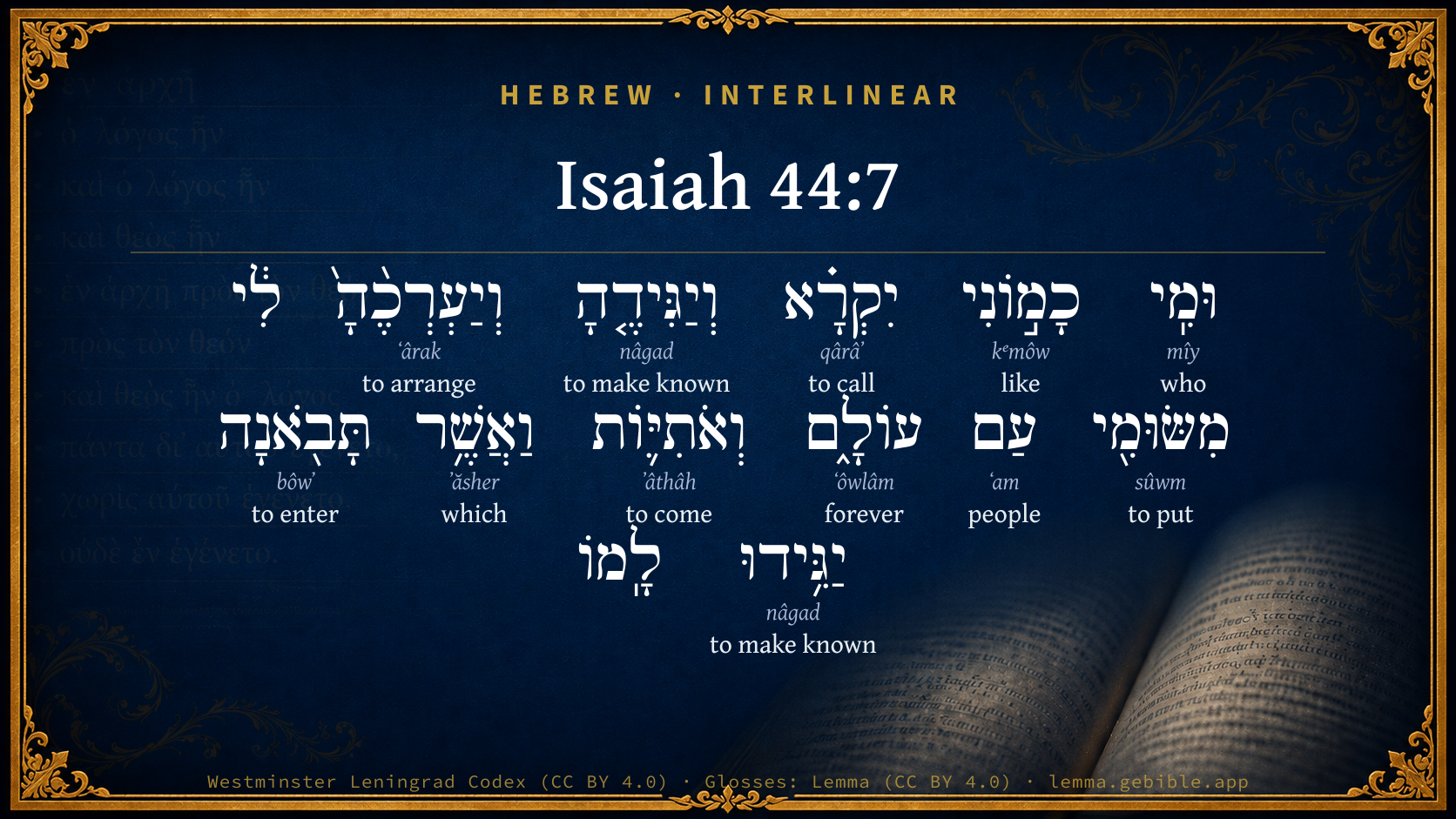
Isaiah 44:7

Hebrew (Westminster Leningrad Codex) Isaiah 44:7 appears in the Hebrew Old Testament. The text above is from the Westminster Leningrad Codex. Each word links to its Strong’s number, a concise gloss, and parsing drawn from the Open Scriptures Hebrew Bible morphology. Click any word for its full Brown-Driver-Briggs (BDB) entry.
Download image
Cite this verse

Isaiah 44:7 (World English Bible). Public Domain. Lemma interlinear Bible study tool, https://lemma.gebible.app/v/isaiah/44/7.

Show BibTeX & RIS
BibTeX
RIS
English Translation
Who, as I, shall call, and shall declare it, and set it in order for me, since I established the ancient people? and the things that are coming, and that shall happen, let them declare.
World English Bible · Public Domain
Download a study sheet

One document with this verse’s original text, its word-by-word gloss line, the meaning frame, cross-references with their text, attributed commentary, and full source and license credits — printable, and it pastes into notes with its structure intact.

This verse Autodidact and up

Study sheet (.html) Plain text (.txt)

A passage Seminary Student

Up to 50 verses in one chapter. A passage sheet keeps up to 6 commentary sources and 12 cross-references per verse, in the order this page ranks them, and says so on the sheet whenever that leaves anything out. Ask for a single verse and you get the Autodidact verse sheet above.

Everything on this page stays free to read, with no account — the sheet is a download of what is already on screen, not access to it.

Want to remove ads? Support Godless Engineer
Compare translations 3

The same verse in 3 English versions, stacked beneath the original-language interlinear above. Click any original word for its lexicon entry.

Each is an independent rendering of the whole verse — the interlinear is not word-aligned to these translations.

Highlighted words mark where these versions differ — a whole-verse word diff, not a word-by-word alignment.

  • World English Bible Public Domain
    Who, as I, shall call, and shall declare it, and set it in order for me, since I established the ancient people? and the things that are coming, and that shall happen, let them declare.
  • King James Version Public Domain
    And who, as I, shall call, and shall declare it, and set it in order for me, since I appointed the ancient people? and the things that are coming, and shall come, let them shew unto them.
  • unfoldingWord Literal Text CC BY-SA 4.0
    And who like me? Let him call out, and let him declare it and array it for me. From my establishing a people of eternity, and they will arrive, and what will come, let them declare for themselves.

unfoldingWord Literal Text — © unfoldingWord, licensed CC BY-SA 4.0. Word-aligned USFM3 via Door43 (git.door43.org/unfoldingWord/en_ult).

Versions to compare (up to 4)

3 of 4 selected

Show all 18 translations

Every available English version of this verse, each an independent rendering of the whole verse.

  • World English Bible Public Domain
    Who, as I, shall call, and shall declare it, and set it in order for me, since I established the ancient people? and the things that are coming, and that shall happen, let them declare.
  • Berean Standard Bible Public Domain
    Who then is like Me? Let him say so! Let him declare his case before Me, since I established an ancient people. Let him foretell the things to come, and what is to take place.
  • Majority Standard Bible Public Domain
    Who then is like Me? Let him say so! Let him declare his case before Me, since I established an ancient people. Let him foretell the things to come, and what is to take place.
  • King James Version Public Domain
    And who, as I, shall call, and shall declare it, and set it in order for me, since I appointed the ancient people? and the things that are coming, and shall come, let them shew unto them.
  • American Standard Version (1901) Public Domain
    And who, as I, shall call, and shall declare it, and set it in order for me, since I established the ancient people? and the things that are coming, and that shall come to pass, let them declare.
  • Revised Version (1885) Public Domain
    And who, as I, shall call, and shall declare it, and set it in order for me, since I appointed the ancient people? and the things that are coming, and that shall come to pass, let them declare.
  • Geneva Bible (1599) Public Domain
    And who is like me, that shall call, and shall declare it, and set it in order before me, since I appointed the ancient people? and what is at hand, and what things are to come? let them shewe vnto them.
  • Douay-Rheims (1899) Public Domain
    Who is like to me? let him call and declare: and let him set before me the order, since I appointed the ancient people: and the things to come, and that shall be hereafter, let them shew unto them.
  • Young's Literal Translation Public Domain
    And who as I, doth call and declare it, And arrange it for Me, Since My placing the people of antiquity, And things that are coming, And those that do come, declare they to them?
  • Literal Standard Version CC BY-SA 4.0
    And who [is] as I, call and declare it, || And arrange it for Me, || Since My placing the people of antiquity, || And things that are coming, || And those that come, they declare to them.
  • Unlocked Literal Bible CC BY-SA 4.0
    Who is like me? Let him announce it and explain to me the events that occurred since I established my ancient people, and let them declare the events to come.
  • unfoldingWord Literal Text CC BY-SA 4.0
    And who like me? Let him call out, and let him declare it and array it for me. From my establishing a people of eternity, and they will arrive, and what will come, let them declare for themselves.
  • Darby Bible Public Domain
    And who, as I, shall call, and shall declare it, and set it in order for me, since I appointed the ancient people? And the coming things, and those that shall happen, let them declare unto them.
  • World Messianic Bible Public Domain
    Who is like me? Who will call, and will declare it, and set it in order for me, since I established the ancient people? Let them declare the things that are coming, and that will happen.
  • Webster's Bible Public Domain
    And who, as I, shall call, and shall declare it, and set it in order for me, since I appointed the ancient people? and the things that are coming, and shall come, let them show to them.
  • Free Bible Version CC BY-SA 4.0
    Who is like me? Let them announce it, make a declaration, and demonstrate it before me. For I was the one who long ago established a people and predicted its future. Let them predict what's going to happen.
  • Bible in Basic English Public Domain
    If there is one like me, let him come forward and say it, let him make it clear and put it in order before me: who has made clear in the past the things to come? let him make clear the future to me.
  • JPS Tanakh (1917) Public Domain
    And who, as I, can proclaim — let him declare it, and set it in order for Me — since I appointed the ancient people? And the things that are coming, and that shall come to pass, let them declare.

Literal Standard Version (2020), Covenant Press — licensed CC BY-SA 4.0. Text via the HelloAO Bible API (eBible.org). Unlocked Literal Bible (unfoldingWord) — licensed CC BY-SA 4.0. Text via the HelloAO Bible API (eBible.org). unfoldingWord Literal Text — © unfoldingWord, licensed CC BY-SA 4.0. Word-aligned USFM3 via Door43 (git.door43.org/unfoldingWord/en_ult). Free Bible Version, Dr. Jonathan Gallagher — licensed CC BY-SA 4.0. Text via the HelloAO Bible API (eBible.org).

Word by word

More ways to search: Search by grammar → Find every occurrence → Compare this word →

Practice this passage: Drill this verse → Learn its vocabulary →

וְאֹתִיּ֛וֹת
ʼâthâh
H857
“and · coming”
Conjunction + Verb, Qal, Participle Active, Feminine, Plural, Absolute
Part of Speech
Conjunction + Verb
Stem
Qal
Form
Participle Active
Gender
Feminine
Number
Plural
State
Absolute
Full BDB Definition

Origin: a primitive root [collateral to H225 contraction]

TWOT: 188

to come, arrive - (Qal) to come (of men, time, beasts, calamity) - (Hiphil) to bring
  1. וּמִֽי mîy H4310 “and · who” Conjunction + Particle, Interrogative
  2. כָמ֣וֹנִי kᵉmôw H3644 “like · me” Preposition + Suffix, Personal, 1st Person, Common, Singular
  3. יִקְרָ֗א qârâʼ H7121 “to call” Verb, Qal, Imperfect, 3rd Person, Masculine, Singular
  4. וְיַגִּידֶ֤הָ nâgad H5046 “and · to make known · her” Conjunction + Verb, Hiphil, Imperfect, 3rd Person, Masculine, Singular + Suffix, Personal, 3rd Person, Feminine, Singular
  5. וְיַעְרְכֶ֨הָ֙ ʻârak H6186 “and · to arrange · her” Conjunction + Verb, Qal, Imperfect, 3rd Person, Masculine, Singular + Suffix, Personal, 3rd Person, Feminine, Singular
  6. מִשּׂוּמִ֖י sûwm H7760 “from · to put · me” Preposition + Verb, Qal, Infinitive Construct + Suffix, Personal, 1st Person, Common, Singular
  7. עַם ʻam H5971 “people of” Noun, Common, Masculine, Singular, Construct
  8. עוֹלָ֑ם ʻôwlâm H5769 “forever” Noun, Common, Masculine, Singular, Absolute
  9. וַאֲשֶׁ֥ר ʼăsher H834 “and · which” Conjunction + Particle, Relative
  10. תָּבֹ֖אנָה bôwʼ H935 “to enter” Verb, Qal, Imperfect, 3rd Person, Feminine, Plural
  11. יַגִּ֥ידוּ nâgad H5046 “to make known” Verb, Hiphil, Imperfect, 3rd Person, Masculine, Plural

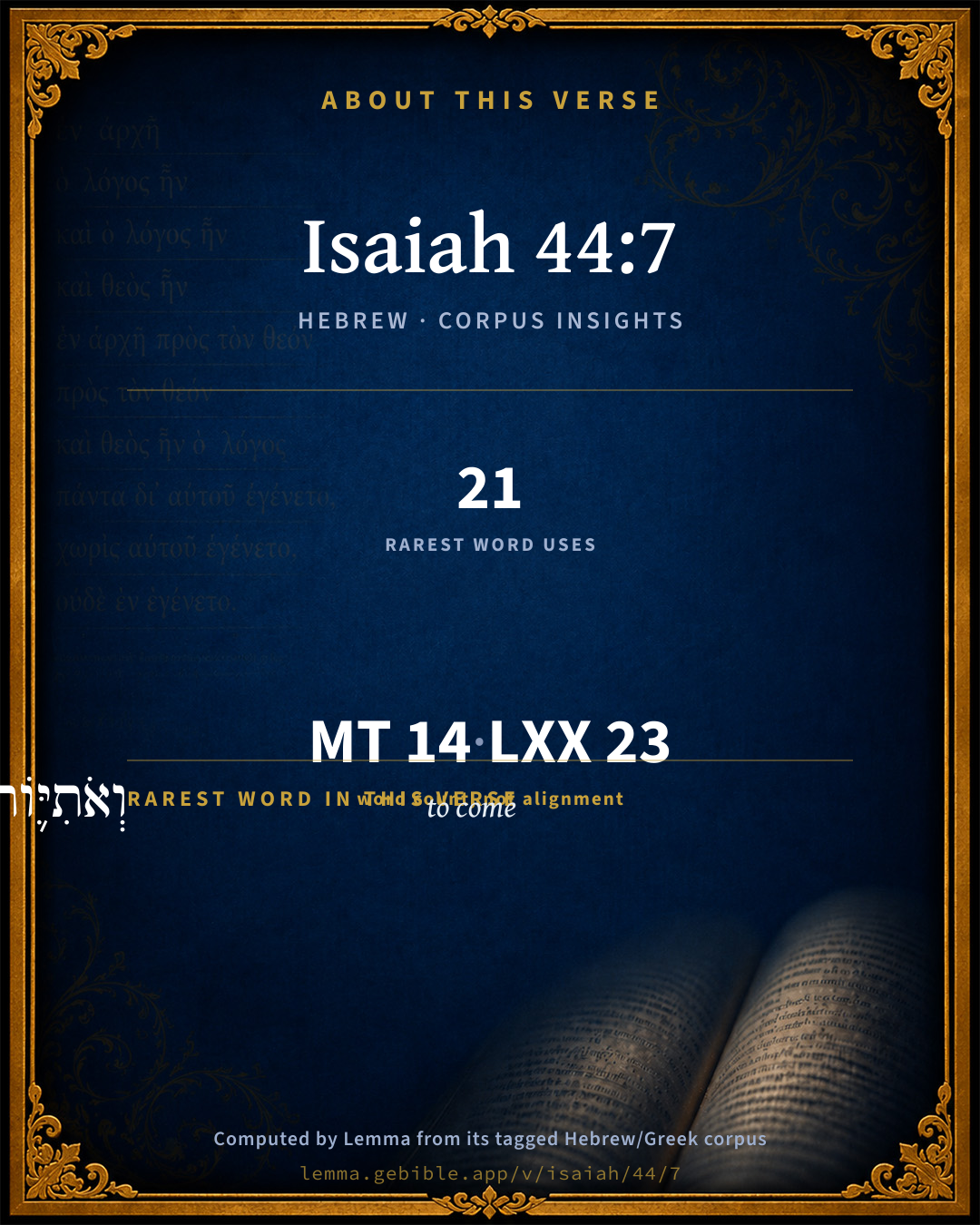
About this verse

These counts appear in no published source. They are computed here, from the morphology-tagged text and Lemma’s own curated glosses. What Lemma adds →

14
words
11
distinct lemmas
Prophets
section

Notable vocabulary

The rarest word here is וְאֹתִיּ֛וֹת to come H857 — appearing just 21 times in the whole Hebrew Bible.

Shared distinctive vocabulary

וְאֹתִיּ֛וֹת to come H857 occurs in 20 verses of the Hebrew Bible. Also found in:

Grammatical profile

  • 7 verbs
  • 2 nouns
  • 3 prepositions
  • 2 particles

Verb forms

  • יִקְרָ֗א Qal · Imperfect
  • וְיַגִּידֶ֤הָ Hiphil · Imperfect
  • וְיַעְרְכֶ֨הָ֙ Qal · Imperfect
  • מִשּׂוּמִ֖י Qal · Infinitive Construct
  • וְאֹתִיּ֛וֹת Qal · Participle Active
  • תָּבֹ֖אנָה Qal · Imperfect
  • יַגִּ֥ידוּ Hiphil · Imperfect

Repetition

A word recurs within this verse — often emphatic in Hebrew:

  • וְיַגִּידֶ֤הָ to make known H5046 ×2

Hebrew & Septuagint length

In English translation the verse runs 35 words from the Hebrew and 37 from the Septuagint (LXX English) — closely comparable.

A rough comparison of the two English renderings, which tokenize alike — not a word-level alignment.

Word counts can differ between the Hebrew and the Greek without any difference in meaning — e.g. the Hebrew direct-object marker אֵת has no separate Greek word, and Greek often adds the article ὁ.

In the original languages it is 14 Hebrew tokens and 23 Greek tokens — but the two are counted differently (Hebrew bundles its prefixes and suffixes into one token; the Greek is in lemma form), so that isn’t a like-for-like length.

Cross-references

11

Topical passages linked to Isaiah 44:7 in the Treasury of Scripture Knowledge — connected by theme and wording, ordered by reader-vote popularity; previews shown in the World English Bible.

  • Isaiah 41:26 Who has declared it from the beginning, that we may know? and before, that we may say, [He is] right? yes, there is none who declares, yes, there is none who shows, yes, there is none who hears your words.
  • Isaiah 41:22 Let them bring forth, and declare to us what shall happen: declare you the former things, what they are, that we may consider them, and know the latter end of them; or show us things to come.
  • Isaiah 46:9–10 Remember the former things of old: for I am God, and there is none else; [I am] God, and there is none like me;
  • Isaiah 45:21 Declare you, and bring [it] forth; yes, let them take counsel together: who has shown this from ancient time? who has declared it of old? Haven't I, Yahweh? and there is no God else besides me, a just God and a Savior; there is no one besides me.
  • Genesis 17:7–8 I will establish my covenant between me and you and your seed after you throughout their generations for an everlasting covenant, to be a God to you and to your seed after you.
  • Deuteronomy 32:8 When the Most High gave to the nations their inheritance, When he separated the children of men, He set the bounds of the peoples According to the number of the children of Israel.
  • Isaiah 41:4 Who has worked and done it, calling the generations from the beginning? I, Yahweh, the first, and with the last, I am he.
  • Isaiah 43:9 Let all the nations be gathered together, and let the peoples be assembled: who among them can declare this, and show us former things? let them bring their witnesses, that they may be justified; or let them hear, and say, It is truth.
  • Isaiah 43:12 I have declared, and I have saved, and I have shown; and there was no strange [god] among you: therefore you are my witnesses, says Yahweh, and I am God.
  • Isaiah 48:3–8 I have declared the former things from of old; yes, they went forth out of my mouth, and I shown them: suddenly I did them, and they happened.
  • Acts 17:26 He made from one blood every nation of men to dwell on all the surface of the earth, having determined appointed seasons, and the boundaries of their dwellings,

Cross-references courtesy of OpenBible.info (CC BY 4.0).

Hebrew and Greek witnesses Masoretic Hebrew ↔ Greek Septuagint

The same verse in the two great witnesses to the Old Testament, shown verse-for-verse.

These are two independent witnesses, not word-aligned to each other, and the Septuagint is shown in lemma (dictionary) form.

Hebrew Isaiah 44:7 Masoretic · Westminster Leningrad Codex

וּמִֽי כָמ֣וֹנִי יִקְרָ֗א וְיַגִּידֶ֤הָ וְיַעְרְכֶ֨הָ֙ לִ֔י מִשּׂוּמִ֖י עַם עוֹלָ֑ם וְאֹתִיּ֛וֹת וַאֲשֶׁ֥ר תָּבֹ֖אנָה יַגִּ֥ידוּ לָֽמוֹ

Who, as I, shall call, and shall declare it, and set it in order for me, since I established the ancient people? and the things that are coming, and that shall happen, let them declare.

World English Bible · Public Domain

Greek LXX Isaiah 44:7 Septuagint · lemma form

τίς ὥσπερ ἐγώ ἵστημι καλέω καί ἑτοιμάζω ἐγώ ἀπό ὅς ποιέω ἄνθρωπος εἰς ὁ αἰών καί ὁ ἐπιἔρχομαι πρό ὁ ἔρχομαι ἀναἀγγέλλω σύ

Who is like me? let him stand, and call, and declare, and prepare for me from the time that I made man for ever; and let them tell you the things that are coming before they arrive.

LXX2012 (modern English Septuagint) · Public Domain

On this verse, Adam Clarke's Commentary discusses the Septuagint’s reading. Read the note in Commentary ↓

Hebrew: Westminster Leningrad Codex (CC BY 4.0). Greek: Septuagint (public domain); English from LXX2012 (modern English Septuagint) (Public Domain). How the Septuagint differs from the Hebrew →

Targum (Aramaic paraphrase)

1

The Targum is the ancient Jewish Aramaic paraphrase of the Hebrew Scriptures — an interpretive translation, not the Hebrew text itself. Onkelos (literal) and Pseudo-Jonathan (expansive) render the Torah, and Jonathan the Prophets. Coverage is partial: where no permissively-licensed English translation exists for a verse, only the Aramaic is shown. This is verse-level text, not a word-by-word alignment to the Hebrew.

  1. Targum Jonathan Prophets (Joshua–Malachi)
    וּמַן כְּוָתִי דִין עַרְעִינָהּ וִיחַוִינָהּ וִיסַדְרִינָהּ קֳדָמַי מִשַׁוָיוּתִי עַמָא דְמִן עַלְמָא וּדְאָתְיָן וְדַעֲתִידִין לְמֵיתֵי יְחַווּן לָנָא:

    Who like me shall proclaim this, shall declare it, and set it in order before me, from the time that I appointed the ancient people? and let them declare unto us the things that are coming, and shall come.

    Targum Jonathan — Aramaic: “Mikraot Gedolot” (public domain). English: “Sefaria Community Translation” (CC0 1.0 (public-domain dedication)); “London "Chaldee Paraphrase," 1871” (public domain). Text via Sefaria.

Commentary

Notes on Isaiah 44:7 from classic Christian and Jewish commentators (each source and its license shown beneath its notes). The classic Christian expositions comment on the surrounding passage and are grouped to its opening verse, so a note may address several verses; the Jewish commentaries on the Tanakh (Rashi and others) are per-verse, so they appear only where the commentator wrote on this verse.

Lemma curates 59 commentaries, every one of them public domain or Creative Commons licensed, each selected and text-cleaned for this edition rather than reprinted as found. About our sources →

Trapp's Complete Commentary

John Trapp

Isa 44:7 And who, as I, shall call, and shall declare it, and set it in order for me, since I appointed the ancient people? and the things that are coming, and shall come, let them shew unto them.

Ver. 7. And who, as I, shall call, and shall declare it?] These are alleged by God as arguments or demonstrations of his deity, praedicare, et indicare et ordinare, to call his elect (styled here his ancient people, populum aeternum) to foretell them things to come, and to order all occurrences for their eternal good.

John Trapp, A Commentary or Exposition upon All the Books of the Old and New Testament (1647–1656) — public domain. Text from a community e-Sword module.

Geneva Bible (1599)

Geneva Bible translators

And appoint them that shall deliver the Church.

That is, declare unto me how I ought to proceed herein.

God calleth the Israelites ancient, because he preferred them to all others in his eternal election.

Meaning, their idols.

Geneva Bible (1599) marginal notes — public domain. Text via Bolls.life.

Jamieson, Fausset & Brown

Robert Jamieson, A. R. Fausset & David Brown

Who but God can predict future events and declare also the order and time of each (see on Isa 41:22-23; Isa 45:21)?

call--"openly proclaim" (Isa 40:6) things to come [MAURER]. Or, "call forth" the event; command that it happen (Isa 46:11; Isa 48:15), [BARNES].

set . . . in order--There is no chance or confusion; all events occur in the order best fitted to subserve God's plans.

for me--It is FOR GOD that all things exist and take place (Rev 4:11). But MAURER translates, "Let him set it forth (Job 37:19) to me."

since . . . ancient people--I have given the Jews predictions of the future ever since I appointed them as My people in ancient times; therefore they were qualified to be His witnesses (Isa 44:8). As to their being God's "ancient (everlasting) people," see Deu 32:7-9; Jer 31:3; the type of the redeemed Church (Eph 1:4).

Jamieson, Fausset & Brown — Commentary Critical and Explanatory on the Whole Bible (1871) — public domain (CC PDM 1.0). Text via the HelloAO Bible API.

Adam Clarke's Commentary

Verse 7. Let them show unto them - "Let them declare unto us."] For למו lamo, unto them, the Chaldee reads לנו lanu, unto us. The Septuagint read לכם lachem, unto you; which is preferable to the reading of the text. But למו lamo, and לנו lanu, are frequently mistaken one for the other, see Isa 10:29; Ps 80:7; Ps 64:6.

Adam Clarke's Commentary on the Bible (1810–1826) — public domain. Text from a community e-Sword/MySword module.

Ellicott's Commentary for English Readers

(7) Since I appointed the ancient people . . .—Literally, the people of the age, or of eternity. The phrase is used of the dead in Eze_26:20. Here it has been referred either to the antediluvian fathers of mankind (Job_22:15) or to the patriarchs of Israel, or, more fitly, to Israel, as having before it a far-off future as well as a far-off past, and, therefore, an everlasting people. The same phrase is used for the “perpetual covenant” of Exo_31:16. (Comp. Exo_40:15; 2Sa_7:13; 2Sa_7:16.)

A Bible Commentary for English Readers, edited by Charles John Ellicott (1878–1897) — public domain. Text from a community e-Sword module.

The Cambridge Bible for Schools and Colleges

gen. ed. J. J. S. Perowne

7. The proof of Isa_44:6 is found in the incontestable fact of prophecy (as ch. Isa_41:22 ff., Isa_43:9; Isa_43:12; &c.). The verse as translated in A.V. and R.V. reads very awkwardly; it would have to be paraphrased thus: “And which of the other gods shall call etc., as I have done since I appointed the ancient people?’ But the distance of the last clause from the “as I” on which it depends is so great as to make the construction unnatural. It is better, with most commentators, to suppose a parenthesis, and render thus: “And who, as I, proclaims (and let him declare it and set it in order before me) since I founded the people of antiquity?” But a parenthesis is always more or less suspicious in a Hebrew sentence, and this one is doubly so on account of the “and” which introduces it. The LXX. reads, “And who is like me? Let him stand and proclaim &c.” The additional verb (“stand”) is likely to be original, and the construction of the first part of the clause is faultless. The only difficulty is presented by the temporal clause, “since I appointed” etc., on which see below.

call] means proclaim or “prophesy,” as in ch. Isa_40:6.

set [it] in order] used of the arrangement of discourse, as Job_32:14; Psa_50:21, Isa_44:3.

since I appointed the …] Better: “since I founded the people of antiquity.” The most probable meaning is that prophecy has been continuous during the long period since Israel was formed into a nation. Some take the expression to denote the earliest population of the world (cf. ch. Isa_41:4); but this is less likely. Ewald applies it to Israel, but in the sense “everlasting people.” In Eze_26:20 the same phrase is used of the shades in the underworld.

Several difficulties in the verse are got rid of by an attractive emendation of Oort (followed by Duhm), which makes this clause read; “who hath announced from of old?” (מי השמיע מעולם instead of עם־עולם משמי; cf. ch. Isa_45:21). The whole verse would then be rendered: And who is like me? Let him stand and proclaim, and declare it and set in order to me. Who hath announced from of old future things? and things to come let them declare.

things that are coming and that shall come are equivalent expressions; there is no foundation for Delitzsch’s notion that the former denotes the future in general, and the latter the immediate future (see on ch. Isa_41:22).

The Cambridge Bible for Schools and Colleges (gen. ed. J. J. S. Perowne; Cambridge University Press, 1878–1918) — public domain. Text from a community e-Sword module.

John Gill's Exposition

And who as I shall call,.... Which of the idols of the Gentiles can do as the king of Israel, the Lord of hosts has done? call things that are not, as though they were? call all creatures into being? call men by their names before they were born, as Isaac; Josiah, and Cyrus, of whom mention is made in the latter end of this chapter, and call them to service and usefulness in their day and generation? and call whom he pleases by his grace to eternal glory?

and shall declare it; the end from the beginning, things future that are yet to come to pass; or the purposes and decrees of God, his counsel and covenant, his mind and will?

and set it in order for me; give an exact and orderly account of things that shall be throughout the successive ages of time; as Jehovah did with respect to the people of Israel, whose God and king he was; he foretold to Abraham their going into Egypt, and bondage there, their deliverance from thence, and settlement in the land of Canaan, and now their deliverance from Babylon, and by name who should be the instrument of it; none of the gods of the Gentiles could do this, or anything like it, or order and dispose all occurrences in providence for his own glory, and the good of men:

since I appointed the ancient people? meaning either the ancient patriarchs, Abraham, Isaac, and Jacob, and their posterity, the children of Israel, who were early formed into a body politic, and into a church state; see Deu 32:6, or rather the first man, and the first race of men that inhabited the world before the flood, called the old world; and so the sense is, who ever did the things I have done, from the time I made man, and other creatures, and placed them on the earth, or from the creation of the world? so Aben Ezra, Jarchi, and Kimchi interpret it; though it is best of all to understand this of the people of God, the church of the firstborn, whose names are written in heaven, in the Lamb's book of life, from the foundation of the world; who are, as the words may be rendered, "the people of eternity" (y); and may be so called, because they were in some sense a people that were "from eternity", as the Targum paraphrases it; not that they had an actual personal being so early, for they are but creatures of time, raised up in successive generations, and but of yesterday, and of a short continuance; yet they had from all eternity a representative being in Christ, as their federal head; they were chosen in him before the foundation of the world, and had grace given them in him before the world began, Eph 1:3 they were the people of God taken into covenant by him from everlasting, for so early was the covenant of grace made with Christ, and them in him; they stood so early related to God as his children, and to Christ as his spouse and bride; so early were they on the thoughts of God, and on his heart, and in his affections, as they were also upon Christ's, and in his hands, and their names so early registered in his book of life; so that they may be said to be indeed an "ancient people", or "a people of eternity"; and they may be called so, because they will continue for ever, as the days of heaven, and as the sun and moon, before the Lord, Psa 89:29, everlasting habitations are provided for them, and they shall be for ever with the Lord; so the Syriac version renders it, "a people for eternity": now these are appointed by the Lord to come into actual being at the time, and in the place he has fixed; they are appointed to many things in life; not unto wrath, either here or hereafter, but to afflictions, and to death itself: and they are appointed to many good things, to be called by grace, to be saved with an everlasting salvation, and to reign with Christ in the New Jerusalem state; see Isa 24:23 where they are called "ancients", as here; and to be glorified with Christ for ever; it follows:

and the things that are coming, and shall come? let them show unto them: let the idols show to their worshippers if they can, "the things that are coming"; just coming, that are near at hand, that will be tomorrow; and that "shall come", are at a greater distance, which will be in ages to come; or wonderful things, and things future, so Jarchi interprets it; a word (z) like the first being used for signs and wonders. God foretells wonderful things that shall come to pass, and which accordingly do; but the idols of the Gentiles can do nothing of this kind.

(y) "populum seculi", Munster, Pagninus, Montanus, Vatablus, Tigurine version, i.e. "qui a seculo est", Targ. "populum aeternitatis", Gataker. (z) "sigma", with the Rabbins as here.

John Gill's Exposition of the Whole Bible (1746–1763) — public domain (CC PDM 1.0). Text via the HelloAO Bible API.

Albert Barnes' Notes on the Bible

And who, as I - This verse contains an argument to prove that he is God. In proof of this, he appeals to the fact that he alone can predict future events, and certainly declare the order, and the time in which they will come to pass (see the notes at Isa 41:21-23; Isa 44:9-10).

Shall call - That is, call forth the event, or command that to happen which he wills - one of the highest possible exhibitions of power. See a similar use of the word call in Isa 46:2; Isa 48:15.

And shall declare it - Declare, or announce with certainty the future event.

And set it in order - Arrange it; secure the proper succession and place (see the notes at Isa 41:22). The word used here (ערך ‛ârak) denotes properly “to place in a row; set in order; arrange.” It is of the same signification as the Greek τάσσω tassō or τάττω tattō, and is applied to placing the wood upon the altar in a proper manner (Gen 22:9); or to placing the showbread in proper order on the table Lev 24:8; and especially to setting an army in order, or putting it in battle array Gen 14:8; Jdg 20:20, Jdg 20:22; 1Sa 17:2. Here it means, that God would arrange the events in a proper order - as an army is marshalled and arrayed for battle. There should be no improper sequences of events; no chance; no hap-hazard; no confusion. The events which take place under his government, occur in proper order and time, and so as best to subserve his plans.

For me - In order to execute my plans, and to promote my glory. The events on earth are for God. They are such as he chooses to ordain, and are arranged in the manner which he chooses.

Since I appointed the ancient people - ‘From my constituting the people of old;’ that is, God had given them intimations of future events from the very period when he in times long past, had selected and appointed them as his people. They were, therefore, qualified to be his witnesses Isa 44:8.

And the things that are coming, let them show - (See the notes at Isa 41:22-23).

Albert Barnes' Notes on the Bible (1834–1885) — public domain. Text from a community e-Sword/MySword module.

Matthew Poole's English Annotations

Who, which of all the heathen gods,

as I, shall call, and shall declare? shall by his powerful call or word cause it to be, and by his infinite foreknowledge declare that it shall be. Or, shall publish and declare; two words expressing the same thing, as is usual.

It; that which shall come to pass, whatsoever it be; which is easily understood out of the following clause.

Set it in order; orderly relate all future events in the same manner as they shall happen.

For me, Heb. to me, so as I may hear it, and thereby be convinced of their Divinity.

Since I appointed the ancient people; since the time that I appointed or called the Israelites to be my people, whom he calleth the ancient people, because they were his people long before this time; or, as the words may be rendered, the everlasting people, because he determined that he would never totally and finally cast them off and destroy them, as he would do other nations. But the words are and may well be otherwise rendered, since I constituted or made (as this word is elsewhere rendered) the people of the world since I first made man upon earth, as the LXX. and others understand it. Let them give me an account of any of their predictions of future events from the beginning of the world to this day.

The things that are coming, and shall come; such things as are near at hand, and such as are to come hereafter.

Unto them; unto their worshippers; who consult their oracles about future events, as I have told them unto thee, O Jacob, as it follows in the next verse. So the pronoun relative is put for the antecedent, which is left to be understood out of the following clause. Or, to or for themselves, in their own defence. Although these words might have been omitted in the translation, as being insignificant; such pronouns being oft redundant in the Hebrew language, as Gen 12:1, and oft elsewhere, as also in the Greek and Latin.

Matthew Poole's English Annotations on the Holy Bible (1683–1685) — public domain. Text from a community e-Sword/MySword module.

Whedon's Commentary on the Bible

Daniel D. Whedon

7, 8. Who, as I — Who, except God, the King of Israel, is sufficiently all knowing to predict events future, and to declare the time and order of each?

Shall call — That is, to proclaim openly the event, and to place its occurrence in exact order as it will occur.

For me — God overrules events, so that in the end they turn to the furtherance of his plans.

Ancient people — Either, since the first generations from Adam, or since the first covenant made with Abraham. As relates to predictive power, it makes little difference which.

Things that are coming — Probably referring to the deliverance by Cyrus.

Shall come — More remote, so commentators of highest repute; not unlikely Messiah’s coming.

Fear ye not — Ye shall be disappointed in none of these things. Is there a God (literally, a Rock) beside me — An abiding foundation. Promises resting on such a Rock can never fail.

There is no God — Not, other than me, but, none independent of me. I am the sole eternal Being.

Daniel D. Whedon (gen. ed.), Commentary on the Old and New Testaments (1874–1909) — public domain. Text from a community e-Sword module.

The Pulpit Commentary

Who, as I, shall call, etc.? i.e. "Who will do (or who can do) as I do call events into being, declare them, and set them in order beforehand who can do this for me (or, in my stead)? No one. I have done it, ever since I appointed (or, placed upon earth) the ancient people" that is, the race of men before the Flood. (see Job_22:15) The claim is that, from the first creation of mankind, God has not only prearranged the events that should happen, but has declared them by the mouth of prophets. (Gen_3:15 Gen_6:13, 17 9:12-16, etc.) No other has done the same. The things that are coming, and shall come. Not earlier and later events, but "future events," and "such as will actually come to pass" (Kay, Cheyne). Let the idol-gods declare these, if they are to be entitled to consideration.

The Pulpit Commentary (1880–1919), ed. H.D.M. Spence-Jones & Joseph S. Exell — public domain. Text from a community e-Sword module.

John Wesley's Explanatory Notes

Who - Which of all the Heathen gods. Declare - Shall by his powerful word cause it to be, and by his fore-knowledge declare that it shall be. Set in order - Orderly relate all future events in the same manner as they shall happen. Since - Since I first made man upon earth. The things - Such things as are near at hand, and such as are to come hereafter.

John Wesley, Explanatory Notes Upon the Whole Bible (1754–1765) — public domain. Text via the GEBible commentary corpus.

J. A. Alexander on Isaiah

Joseph Addison Alexander

“And who, like me, will call, and tell it, and state it to me, since I placed the ancient people; and coming things and things which are to come will tell to them (or for themselves)?” There is no reason why the interrogation should not be considered as extending through the verse, the rather as a different construction splits the sentence into several, and arbitrarily explains some of the futures as imperatives. The usual construction of the next words is, let him tell it etc.; but this imperative meaning is sufficiently implied in the strict translation of the words as interrogative futures, who will tell it etc. qara is ‘to call aloud’ or publicly announce. It differs from the next verb, if at all, by denoting an authoritative call, and suggesting the idea not only of prediction but of creation, ‘arak is a forensic term meaning to state a case. The words since I placed etc. are to be connected with nagad, ‘who can call, as I have done, ever since I placed’ etc. To place is here to constitute, create, or give existence. Instead of ‘ancient people’ some would read ‘eternal people’, but refer it simply to the divine purpose or decree of election. Others give it the sense of (everlasting) people, (i.e., a people who shall last forever). In all these senses the description is appropriate to Israel, not simply as a nation but a church, the existence and prerogatives of which are still continued in the body of Christ. It may be doubted, however, whether anything more was here intended than a reference to the origin of the human race. (See above, on Isa 42:5-6)

Joseph Addison Alexander, The Prophecies of Isaiah (1846–1847; New York: Scribner, 1870–1878) — public domain. Text from a community e-Sword module.

unfoldingWord translationNotes

Door43 World Missions Community

General Information:

Yahweh continues speaking.

Who is like me? Let him announce

Yahweh uses this rhetorical question to emphasize that there is no one like him. This question can be translated as a statement. AT: "If anyone thinks he is like me, let him announce" (See: Rhetorical Question)

translationWords

people of God

declare

unfoldingWord translationNotes — © Distant Shores Media and the Door43 World Missions Community, licensed CC BY-SA 4.0. Source: git.door43.org/Door43/en_tn.

Rashi

Rabbi Shlomo Yitzchaki (Rashi)

And who will call [that he is] like Me And who will call that he is like Me and tell and arrange for me all that transpired since I placed the ancient people and until now?

the ancient people All the creatures.

and the signs Marvelous things.

and those that will come And those destined to come, let them tell, as I do now, for the Temple has not yet been destroyed, and you have not been exiled, and neither has Cyrus been born, but I am reporting it to you.

Rashi on the Tanakh — English translations: “The Judaica Press complete Tanach with Rashi, translated by A. J. Rosenberg” (CC BY 4.0); “Pentateuch with Rashi's commentary by M. Rosenbaum and A.M. Silbermann, 1929-1934” (public domain); “The Metsudah Tanach series, Lakewood, N.J” (CC BY 4.0); and “The Book of Joshua, Metsudah Publications, 1997” (CC BY 4.0). Text via Sefaria.

Ibn Ezra

Rabbi Abraham ibn Ezra

And who is like me, that is, Who pretends to be like me.

יקרא Shall lift up his voice.

And shall declare it, namely all that has passed.

עם עולם The ancient people. עולם means here of old.

ואתיות And the things that are coming. It is like a perfect verb. למו For themselves, that is, in order to show that they know it.

Ibn Ezra on the Tanakh — English translations: “Sefaria Community Translation” (CC0 1.0 (public-domain dedication)); “Yalkut, Sifsei Chachomim Chumash, Metsudah Publications, 2009” (CC BY 4.0); and “Commentary of Ibn Ezra on Isaiah - trans. by M. Friedlander, 1873” (public domain). Text via Sefaria.

Lesson kit

Teaching starters — assembled from the data on this page, not authored interpretation. Every prompt links to the verse data it draws on. Edit before teaching.

Isaiah, in the Prophets, opens this verse with 14 words (11 distinct Hebrew lemmas). Its most distinctive word is ʼâthâh (“to come”). A historical commentator’s framing appears above. Read the whole chapter for the surrounding context.

Discussion questions

  1. How does “to come” (ʼâthâh) shape what this verse is saying?
  2. Deuteronomy 33:2 shares the word «to come» with this verse. How do the two illuminate each other?
  3. “to make known” occurs 2× in this one verse. What is the effect of the repetition?
  4. The translations on this page render this verse differently — a whole-verse word diff, not a word-by-word alignment. What might account for the different wordings?
  5. The verb «יִקְרָ֗א» is Qal Imperfect. How does its form color the action?
  6. Reading how Trapp's Complete Commentary and Geneva Bible (1599) read this verse, where do the two commentators agree and where do they part?

Things to notice

Reading settings

Reading text

Shown beneath each verse's original-language words.

Old Testament
Old Testament edition

Read the OT as the Masoretic Hebrew (MT) or the Greek Septuagint (LXX).

English shown for the Greek Septuagint (in the Hebrew ↔ Greek comparison).

Comparing translations? Open the Compare panel on any verse page to stack up to four side by side.