
Psalms 64:9

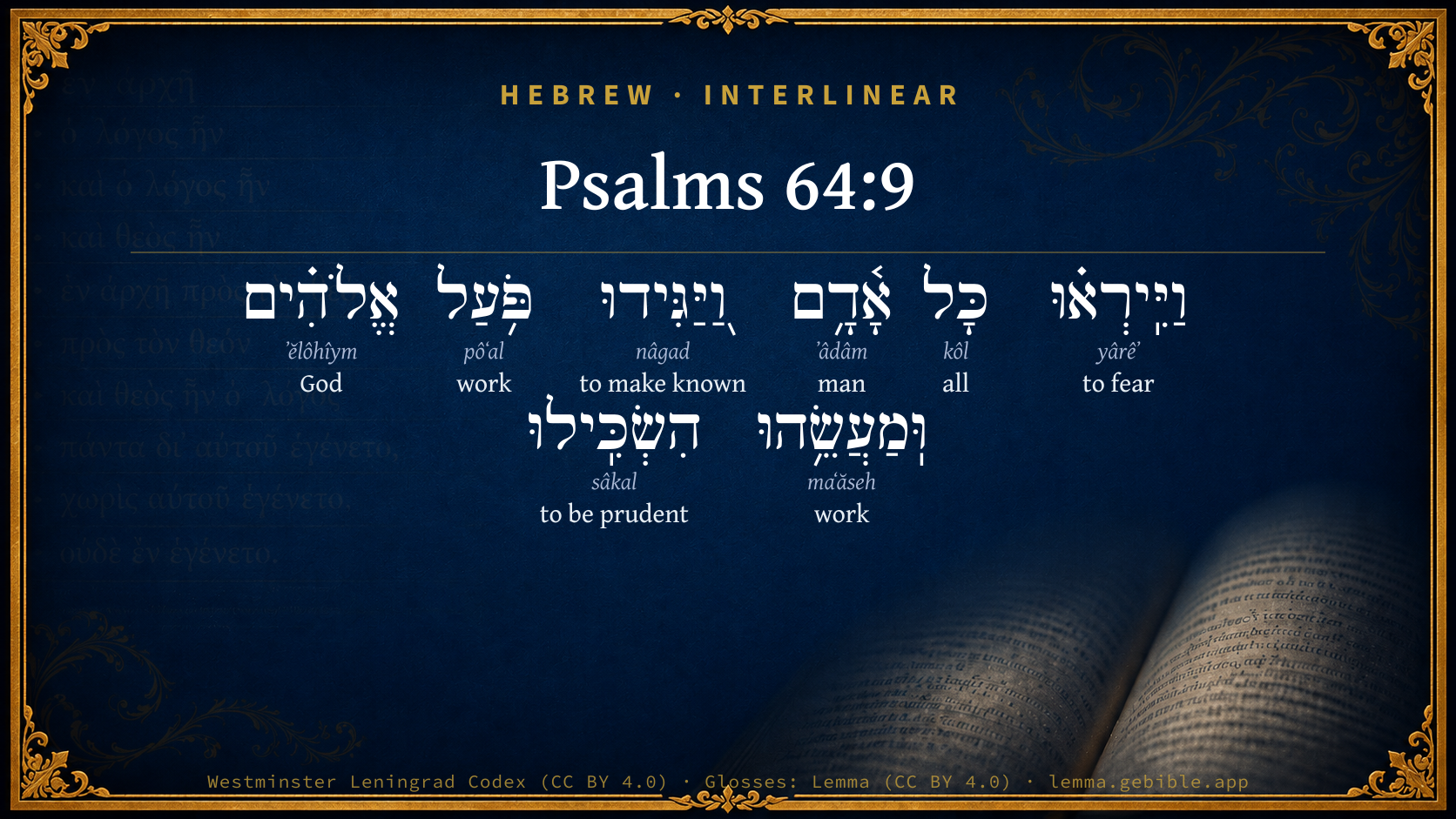
Hebrew (Westminster Leningrad Codex) Psalms 64:9 appears in the Hebrew Old Testament. The text above is from the Westminster Leningrad Codex. Each word links to its Strong’s number, a concise gloss, and parsing drawn from the Open Scriptures Hebrew Bible morphology. Click any word for its full Brown-Driver-Briggs (BDB) entry.
Download image
Cite this verse

Psalms 64:9 (World English Bible). Public Domain. Lemma interlinear Bible study tool, https://lemma.gebible.app/v/psalms/64/9.

Show BibTeX & RIS
BibTeX
RIS
English Translation
All mankind shall be afraid. They shall declare the work of God, And shall wisely ponder what he has done.
World English Bible · Public Domain
Download a study sheet

One document with this verse’s original text, its word-by-word gloss line, the meaning frame, cross-references with their text, attributed commentary, and full source and license credits — printable, and it pastes into notes with its structure intact.

This verse Autodidact and up

Study sheet (.html) Plain text (.txt)

A passage Seminary Student

Up to 50 verses in one chapter. A passage sheet keeps up to 6 commentary sources and 12 cross-references per verse, in the order this page ranks them, and says so on the sheet whenever that leaves anything out. Ask for a single verse and you get the Autodidact verse sheet above.

Everything on this page stays free to read, with no account — the sheet is a download of what is already on screen, not access to it.

Want to remove ads? Support Godless Engineer
Compare translations 3

The same verse in 3 English versions, stacked beneath the original-language interlinear above. Click any original word for its lexicon entry.

Each is an independent rendering of the whole verse — the interlinear is not word-aligned to these translations.

Highlighted words mark where these versions differ — a whole-verse word diff, not a word-by-word alignment.

  • World English Bible Public Domain
    All mankind shall be afraid. They shall declare the work of God, And shall wisely ponder what he has done.
  • King James Version Public Domain
    And all men shall fear, and shall declare the work of God; for they shall wisely consider of his doing.
  • unfoldingWord Literal Text CC BY-SA 4.0
    And all of mankind will fear, and they will declare the work of God, for they will consider his deed.

unfoldingWord Literal Text — © unfoldingWord, licensed CC BY-SA 4.0. Word-aligned USFM3 via Door43 (git.door43.org/unfoldingWord/en_ult).

Versions to compare (up to 4)

3 of 4 selected

Show all 18 translations

Every available English version of this verse, each an independent rendering of the whole verse.

  • World English Bible Public Domain
    All mankind shall be afraid. They shall declare the work of God, And shall wisely ponder what he has done.
  • Berean Standard Bible Public Domain
    Then all mankind will fear and proclaim the work of God; so they will ponder what He has done.
  • Majority Standard Bible Public Domain
    Then all mankind will fear and proclaim the work of God; so they will ponder what He has done.
  • King James Version Public Domain
    And all men shall fear, and shall declare the work of God; for they shall wisely consider of his doing.
  • American Standard Version (1901) Public Domain
    And all men shall fear; And they shall declare the work of God, And shall wisely consider of his doing.
  • Revised Version (1885) Public Domain
    And all men shall fear; and they shall declare the work of God, and shall wisely consider of his doing.
  • Geneva Bible (1599) Public Domain
    And all men shall see it, and declare the worke of God, and they shall vnderstand, what he hath wrought.
  • Douay-Rheims (1899) Public Domain
    and their tongues against them are made weak. All that saw them were troubled;
  • Young's Literal Translation Public Domain
    And all men fear, and declare the work of God, And His deed they have considered wisely.
  • Literal Standard Version CC BY-SA 4.0
    And all men fear, and declare the work of God, || And they have wisely considered His deed.
  • Unlocked Literal Bible CC BY-SA 4.0
    All people will fear and will declare God's deeds. They will wisely think about what he has done.
  • unfoldingWord Literal Text CC BY-SA 4.0
    And all of mankind will fear, and they will declare the work of God, for they will consider his deed.
  • Darby Bible Public Domain
    And all men shall fear, and shall declare God's doing; and they shall wisely consider his work.
  • World Messianic Bible Public Domain
    All mankind shall be afraid. They shall declare the work of God, and shall wisely ponder what he has done.
  • Webster's Bible Public Domain
    \\64:8\\So they shall make their own tongue to fall upon themselves: all that see them shall flee away.
  • Free Bible Version CC BY-SA 4.0
    Then everyone will be frightened. They will say that this is the work of God, and they will think about what he has done.
  • Bible in Basic English Public Domain
    And in fear men make public the works of God; and giving thought to his acts they get wisdom.
  • JPS Tanakh (1917) Public Domain
    (64-10) And all men fear; and they declare the work of God, and understand His doing.

Literal Standard Version (2020), Covenant Press — licensed CC BY-SA 4.0. Text via the HelloAO Bible API (eBible.org). Unlocked Literal Bible (unfoldingWord) — licensed CC BY-SA 4.0. Text via the HelloAO Bible API (eBible.org). unfoldingWord Literal Text — © unfoldingWord, licensed CC BY-SA 4.0. Word-aligned USFM3 via Door43 (git.door43.org/unfoldingWord/en_ult). Free Bible Version, Dr. Jonathan Gallagher — licensed CC BY-SA 4.0. Text via the HelloAO Bible API (eBible.org).

Word by word

More ways to search: Search by grammar → Find every occurrence → Compare this word →

Practice this passage: Drill this verse → Learn its vocabulary →

About this verse

These counts appear in no published source. They are computed here, from the morphology-tagged text and Lemma’s own curated glosses. What Lemma adds →

8
words
8
distinct lemmas
Wisdom
section

Shared distinctive vocabulary

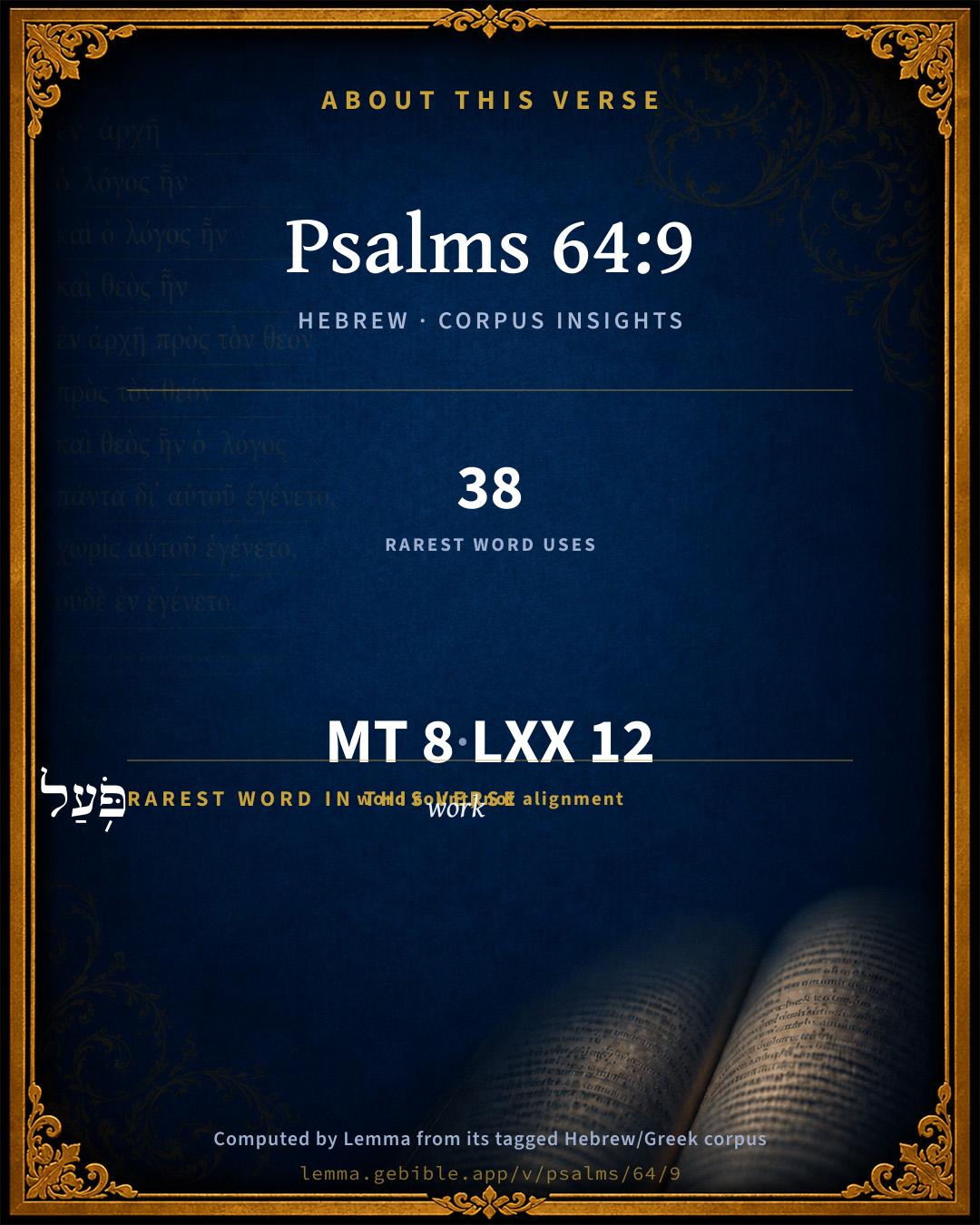
פֹּ֥עַל work H6467 occurs in 38 verses of the Hebrew Bible. Also found in:

Grammatical profile

  • 3 verbs
  • 5 nouns

Verb forms

  • וַיִּֽירְא֗וּ Qal · Sequential Imperfect
  • וַ֭יַּגִּידוּ Hiphil · Sequential Imperfect
  • הִשְׂכִּֽילוּ Hiphil · Perfect

Hebrew & Septuagint length

In English translation the verse runs 20 words from the Hebrew and 16 from the Septuagint (LXX English) — closely comparable.

A rough comparison of the two English renderings, which tokenize alike — not a word-level alignment.

Word counts can differ between the Hebrew and the Greek without any difference in meaning — e.g. the Hebrew direct-object marker אֵת has no separate Greek word, and Greek often adds the article ὁ.

In the original languages it is 8 Hebrew tokens and 12 Greek tokens — but the two are counted differently (Hebrew bundles its prefixes and suffixes into one token; the Greek is in lemma form), so that isn’t a like-for-like length.

Cross-references

11

Topical passages linked to Psalms 64:9 in the Treasury of Scripture Knowledge — connected by theme and wording, ordered by reader-vote popularity; previews shown in the World English Bible.

  • Jeremiah 51:10 Yahweh has brought forth our righteousness: come, and let us declare in Zion the work of Yahweh our God.
  • Psalms 40:3 He has put a new song in my mouth, even praise to our God. Many shall see it, and fear, and shall trust in Yahweh.
  • Jeremiah 50:28 The voice of those who flee and escape out of the land of Babylon, to declare in Zion the vengeance of Yahweh our God, the vengeance of his temple.
  • Hosea 14:9 Who is wise, that he may understand these things? Who is prudent, that he may know them? For the ways of Yahweh are right, And the righteous walk in them; But the rebellious stumble in them.
  • Psalms 58:11 So that men shall say, "Most assuredly there is a reward for the righteous. Most assuredly there is a God who judges the earth."
  • Psalms 107:42–43 The upright will see it, and be glad. All the wicked will shut their mouths.
  • Isaiah 5:12 The harp, lyre, tambourine, and flute, with wine, are at their feasts; But they don't regard the work of Yahweh, Neither have they considered the operation of his hands.
  • Psalms 53:5 There they were in great fear, where no fear was, For God has scattered the bones of him who encamps against you. You have put them to shame, Because God has rejected them.
  • Psalms 119:20 My soul is consumed with longing for your ordinances at all times.
  • Ezekiel 14:23 They shall comfort you, when you see their way and their doings; and you shall know that I have not done without cause all that I have done in it, says the Lord Yahweh.
  • Revelation 11:13 In that day there was a great earthquake, and a tenth of the city fell. Seven thousand people were killed in the earthquake, and the rest were terrified, and gave glory to the God of heaven.

Cross-references courtesy of OpenBible.info (CC BY 4.0).

Hebrew and Greek witnesses Masoretic Hebrew ↔ Greek Septuagint

The same verse in the two great witnesses to the Old Testament, shown verse-for-verse.

You’re reading Greek Psalm 63 (Hebrew Psalm 64). The Septuagint counts the superscription, so verse numbers can differ from the Hebrew — chapter-level alignment, not verse-by-verse. Numbering follows Rahlfs.

These are two independent witnesses, not word-aligned to each other, and the Septuagint is shown in lemma (dictionary) form.

Hebrew Psalms 64:9 Masoretic · Westminster Leningrad Codex

וַיִּֽירְא֗וּ כָּל אָ֫דָ֥ם וַ֭יַּגִּידוּ פֹּ֥עַל אֱלֹהִ֗ים וּֽמַעֲשֵׂ֥הוּ הִשְׂכִּֽילוּ

All mankind shall be afraid. They shall declare the work of God, And shall wisely ponder what he has done.

World English Bible · Public Domain

Greek LXX Greek Psalm 63:9 Septuagint · lemma form

καί ἐκἀσθενέω ἐπί αὐτός ὁ γλῶσσα αὐτός ταράσσω πᾶς ὁ θεωρέω αὐτός

and every man was alarmed, and they related the works of God, and understood his deeds.

LXX2012 (modern English Septuagint) · Public Domain

Hebrew: Westminster Leningrad Codex (CC BY 4.0). Greek: Septuagint (public domain); English from LXX2012 (modern English Septuagint) (Public Domain). How the Septuagint differs from the Hebrew →

Commentary

Notes on Psalms 64:9 from classic Christian and Jewish commentators (each source and its license shown beneath its notes). The classic Christian expositions comment on the surrounding passage and are grouped to its opening verse, so a note may address several verses; the Jewish commentaries on the Tanakh (Rashi and others) are per-verse, so they appear only where the commentator wrote on this verse.

Lemma curates 59 commentaries, every one of them public domain or Creative Commons licensed, each selected and text-cleaned for this edition rather than reprinted as found. About our sources →

Trapp's Complete Commentary

John Trapp

Psa 64:9 And all men shall fear, and shall declare the work of God; for they shall wisely consider of his doing.

Ver. 9. And all men shall fear] Seeing such and such banged up in gibbets, as it were, for a terror to others, Poena ad paucos, metus ad omnes.

And shall declare the work of God] viz. His power and providence, which some doubt till thus powerfully convinced, as Claudian was by the destruction of Ruffinus.

Abstulit hunc tandem Ruffini poena tumultum,

Absolvitque deos; et non iam ad culmina rerum

Iniustos crevisse queror; tolluntur in altum,

Ut lapsu graviore ruant -

John Trapp, A Commentary or Exposition upon All the Books of the Old and New Testament (1647–1656) — public domain. Text from a community e-Sword module.

The Biblical Illustrator

Joseph S. Exell

Psa_64:9-10

And all men shall fear, and shall declare the work of God; for they shall wisely consider of His doing.

Preservation from enemies

I. An act of God. His enemies were strong and powerful, but God was omnipotent, and in Him was his help and trust; they designed his utter ruin, but God turned their mischief upon their own heads.

1. The suddenness of their destruction.

2. The manner of the discovery, and prevention of his danger.

II. Its effect upon men in general.

1. Fear, which naturally arises in mens minds upon the apprehensions of Gods irresistible power and greatness; for whom has an arm like God? or who can thunder with a voice like Him? yea, who can hear His voice and not tremble? or see His hand stretched out and not be afraid? All men shall fear, but fear alone will not profit us; for the devils tremble before the power they hate, and wicked men may dread Gods vengeance, where they are unwilling to see His hand; and therefore here follows another effect, which such signal actions have upon men.

2. They shall declare the work of God. And this is an effect as general and large as the other, though upon different accounts; for even they who are unwilling to own it shall be forced to acknowledge it, and they for whose sake it is done shall rejoice to publish it.

3. They shall wisely consider of His doing. That is, they shall better understand the method of Gods proceedings, and the reasons of His dealings in the world; for these things make it plain that God takes care of the affairs of His people, and that the enemies of His Church shall not be able to prevail against her.

III. A duty resulting from all these considerations, and chiefly incumbent on good men.

1. The righteous shall be glad in the Lord. A duty no less easy than pleasant, and that which we all seem to covet most; that which we eagerly pursue as the best of this worlds satisfaction, joy and rejoicing.

2. The righteous shall trust in Him. And good reason indeed to trust in Him, of whose favour and lovingkindness we have had so large experience; well may we rely on that power which is so able to protect us; well may we depend on that providence which so remarkably takes care of us.

3. All the upright in heart shall glory. They shall glory in His strength, and triumph in His favour. But that is not all; they shall glory in the confusion of the wicked, and rejoice in the continual disappointment of such treacherous designs. (H. Dove, D. D.)

Providential deliverance

I. The necessity there is of attention and consideration, to discover the hand of God, and the manner of its working, in those events of which we are informed either by history, or our own experience.

They shall consider of His doing.

II. The wisdom of thus considering--They shall wisely consider of His doing.

III. Certain marks whereby we may at any time discern an especial providence, Diligently to mark, and carefully to treasure up in our minds, the special providences of the Almighty, is the way to preserve and nourish our faith and hope in Him; it furnishes the grounds of our thankfulness and praise; it stirs up our finest feelings and very best affections toward Him; holy joy, humble reverence, and hearty love; it supports us under all our sufferings; and affords us comfort in all our sorrows. (Bishop Horne.)

All the upright in heart shall glory.--

All the upright in heart shall glory

1. The dispositions of the persons. All the upright in heart, and then, the retribution upon these persons, They shall glory, or, they shall be celebrated, they shall be praised. In the first, the qualification of the persons, we shall pass by these steps; first, that God in His punishments and rewardings proposes to Himself persons. God does not begin at a retribution, nor begin at a condemnation, before He have persons, persons fit to be rewarded, persons fit to be condemned. God did not first make a heaven and a hell, and after think of making man, that He might have some persons to put in them; but, first for His glory He made man, and for those, who, by a good use of His grace preserved their state, heaven; and for those who, by their own fault fell, He made hell. And, in the qualifications of these persons, He proposes first a rectitude, a directness, an uprightness; declinations downward, deviations upon the wrong hand, squint-eyed men, left-handed men (in a spiritual sense), He meddles not withal. They must be direct, and upright; and then, upright in heart; for, to be good to ill ends (as, in many eases, a man may be), God accepts not, regards not. But, let him be a person thus qualified, upright, upright because he loves uprightness, upright in heart; and then, he is infallibly embraced in that general rule, and proposition, that admits no exception. All the upright in heart shall be partakers of this retribution; and in these branches we shall determine our first part, first, that God proposes to Himself persons; persons thus and thus qualified; He begins at them. Secondly, that God had rather dwell Himself, and propose to us the considerations of good persons, than bad, of His mercies, than His judgments, for He mentions no other here, but persons capable of His retributions; and then, the goodness that God considers, is rectitude, and rectitude in the root, in the heart; and from that root grows that spreading universality, that infallibility. All such are sure of the reward. And then, in our second part, in the reward itself, though it be delivered here in the whole bar, in the ingot, in the wedge, in bullion, in one single word, Gloriabuntur, Laudabuntur, they shall glory, yet it admits this mintage, and coining, and issuing in lesser pieces, that first we consider the thing itself, the metal in which God rewards us, glory, praise; and then, since Gods promise is fastened upon that (we shall be praised), as we may lawfully seek the praise of good men, so must we also willingly afford praise to good men, and to good actions. And then, since we find this retribution fixed in the future (we shall be praised, we shall be in glory), there arises this consolation, that though we have it not yet, yet we shall have it; though we be in dishonour, and contempt, and under a cloud, of which we see no end ourselves, yet there is a determined future in God, which shall be made present, we shall overcome this contempt, we shall glory, we shall be celebrated; in which future the consolation is thus much farther exalted, that it is an everlasting future; the glory, and praise, the approbation which we shall receive from good men here, shall flow out and continue to the hosannas in heaven, in the month of saints, and angels, and to the Well done, good and faithful servant, in the mouth of God Himself. (John Donne, D. D.)

Gladness in God

It is only where there is much faith and consequent love that there is much joy. If there is but little heat about the bulb of the thermometer, no wonder that the mercury marks but a low degree. If there is but small faith, there will not be much gladness. The road into Giant Despairs castle is through doubt, which doubt comes from an absence--a sinful absence--in our own experience, of the felt presence of God, and the felt force of the verities of the Gospel. (A. Maclaren, D. D.)

.

Psa_65:1-13

The Biblical Illustrator, edited by Joseph S. Exell (c. 1880s–1900s) — public domain. Text from a community e-Sword module.

J. A. Alexander on Psalms

Joseph Addison Alexander

10. (Psa 64:9). And all men fear, and pronounce (it) God's doing, and his work they understand. The conversive futures spew the dependence of the sentence upon that which goes before it, and describe the action, not as actually past, but as directly consequent upon the great catastrophe described in the preceding context. And declared the work of God, i. e. pronounced it to be such. Compare Exo 8:19. His work they understand, i.e. no longer foolishly ascribe it to mere chance or human agency.

Joseph Addison Alexander, The Psalms Translated and Explained (1850) — public domain. Text from a community e-Sword module.

Jamieson, Fausset & Brown

Robert Jamieson, A. R. Fausset & David Brown

Men, generally, will acknowledge God's work, and the righteous, rejoicing in it, shall be encouraged to trust Him (Psa 58:10).

Next: Psalms Chapter 65

Jamieson, Fausset & Brown — Commentary Critical and Explanatory on the Whole Bible (1871) — public domain (CC PDM 1.0). Text via the HelloAO Bible API.

Adam Clarke's Commentary

Verse 9. And all men shall fear] They endeavoured to hide their mischief; but God shall so punish them that all shall see it, and shall acknowledge in their chastisement the just judgment of God. The wicked, in consequence, shall fear, and,

Adam Clarke's Commentary on the Bible (1810–1826) — public domain. Text from a community e-Sword/MySword module.

John Calvin's Commentaries

9 And all men shall see, and shall declare the work of God. He insists more fully upon the good effects which would result from the judgment executed in leading such as had formerly overlooked a Divine Providence altogether, to catch a spirit of inquiry from the singularity of the spectacle; and acquaint themselves with, and speak one to another of a subject hitherto entirely new to them. He intimates, that the knowledge of what God had so signally wrought would extend far and wide — for he says, all men, etc. The Hebrew verb שכל, shachal, employed, admits either of the neuter signification, they shall understand, or of the active, they shall cause others to understand. But as it is usual with David to repeat the same thing twice, perhaps the latter or transitive sense is preferable. Another desirable consequence which would flow from the deliverance granted is mentioned in the last verse, that it would afford matter of joy, hope, and holy triumph to the saints, who would be confirmed in expecting the same help from God which he had extended to his servant David. Those formerly called the righteous are now styled the upright in heart, to teach us, that the only righteousness which proves acceptable is that which proceeds from inward sincerity. This truth I have insisted upon at large elsewhere.

John Calvin's Commentaries (1540-1563) — public domain. Text from the Calvin Translation Society English edition (1840s-50s) via the Christian Classics Ethereal Library (ccel.org). Calvin's coverage is partial (roughly two-thirds of the Bible); uncommented books and verses are honest gaps, never fabricated. The 19th-century editor's footnotes and remarks are omitted so the notes are faithfully Calvin's own voice.

Ellicott's Commentary for English Readers

(9) For they shall wisely consider.—Rather, And they understand his work.

A Bible Commentary for English Readers, edited by Charles John Ellicott (1878–1897) — public domain. Text from a community e-Sword module.

The Cambridge Bible for Schools and Colleges

gen. ed. J. J. S. Perowne

9. all men] Upon men in general (cp. Psa_58:11) this judgement produces an impression of wholesome fear, in contrast to the profane fearlessness of the ungodly (Psa_64:4).

And they declare the work of God,

And understand his operation:

publicly acknowledging that He rules in the world, and interpreting for themselves the meaning of the judgement. For ‘work,’ ‘operation,’ cp. Psa_28:5; for ‘understand,’ Psa_106:7; and generally, Hos_14:9.

The P.B.V. all men that see it presumes a slightly different and inferior reading.

The Cambridge Bible for Schools and Colleges (gen. ed. J. J. S. Perowne; Cambridge University Press, 1878–1918) — public domain. Text from a community e-Sword module.

John Gill's Exposition

And all men shall fear,.... Either God himself, or his judgments: they shall be frightened at them, learn righteousness by them, worship God, and give glory to him; they shall fear him as King of saints, his judgments being made manifest; not with a slavish fear, but with reverence and godly fear; see Rev 11:13;

and shall declare the work of God; the punishments inflicted on wicked men; his work of justice and judgment, which is his work, his strange work; for there is no evil of punishment but the Lord has done it, Isa 28:21;

for they shall wisely consider of his doings; consider that it is done by him, and done well and wisely, after the counsel of his own will; and so consider it as to be admonished, and take warning and caution by it. This is the use men in general should make of such dispensations of Providence; the use the righteous in particular make of them follows:

John Gill's Exposition of the Whole Bible (1746–1763) — public domain (CC PDM 1.0). Text via the HelloAO Bible API.

Albert Barnes' Notes on the Bible

And all men shall fear - That is, a deep impression would be made, not only on the associates and companions of the wicked, but on all that should hear of what was done. People, in view of the just punishment of the wicked, would learn to reverence God, and to stand in awe of One so powerful and so just. Judgments, punishment, wrath, are adapted and designed to make a deep impression on mankind. On this principle, the final punishment of the wicked will make a deep and salutary impression on the universe forever.

And shall declare the work of God - Shall make it known to others. It will become a subject of conversation, or they will talk about it, as illustrating the divine perfections and character. Such should always be the effect of the judgments of God, for they illustrate his true character; they make known his attributes; they convey to the world lessons of the utmost importance. Nothing is more proper than to talk about the judgments of God, and to endeavor to derive from them the instructions which they are adapted to convey about the divine nature, and the principles of the administration under which the universe is placed. Wars, pestilences, famines, earthquakes, conflagrations, inundations, diseases, all teach important lessons about God; and each one bears its own special message to mankind.

For they shall wisely consider of his doing - They shall attentively and carefully consider it; they shall endeavor to derive such lessons from his dealings as they are suited to convey. In other words, an attentive consideration of his doings will contribute to maintain a just knowledge of world in subjection to him. God is thus always speaking to human beings; and nothing is more proper for human beings than to give their minds to a careful consideration of what is really intended to be taught us by the events which are occurring in his providential dealings.

Albert Barnes' Notes on the Bible (1834–1885) — public domain. Text from a community e-Sword/MySword module.

Matthew Poole's English Annotations

All men, i.e. the greater number of those who shall see these events.

The work of God, i.e. this admirable work of Divine power, and wisdom, and faithfulness.

Wisely consider of his doing; learning wisdom by their folly and misery, and avoiding those evil courses which brought them to ruin.

Matthew Poole's English Annotations on the Holy Bible (1683–1685) — public domain. Text from a community e-Sword/MySword module.

The Treasury of David

Charles H. Spurgeon

Ver. 9. And all men shall fear. They shall be filled with awe by the just judgments of God, as the Canaanites were by the overthrow of Pharaoh at the Red Sea. Those who might have been bold in sin shall be made to tremble and to stand in awe of the righteous Judge.

And shall declare the work of God. It shall become the subject of general conversation. So strange, so pointed, so terrible shall be the Lord's overthrow of the malicious, that it shall be spoken of in all companies. They sinned secretly, but their punishment shall be wrought before the face of the sun.

For they shall wisely consider of his doing. The judgments of God are frequently so clear and manifest that men cannot misread them, and if they have any thought at all, they must extract the true teaching from them. Some of the divine judgments are a great deep, but in the case of malicious persecutors the matter is plain enough, and the most illiterate can understand.

None.

Ver. 9.

I. The subject for consideration --Judgments upon

the wicked.

1. As Judgments.

2. As judgments from God--that work of God-- his doing. II. The consideration of the subject.

1. They are intended to be considered by others.

2. They are to be considered wisely. III. The effect of this consideration.

1. Fear of God.

2. Praise to God; shall declare, etc. G. R.

Ver. 9-10.

I. An act of God; something of his doing.

II. Its effect upon men in general: All men shall

fear, and shall declare, etc.

III. A special duty resulting from it, incumbent on good

men: The righteous, etc. H. Dove.

Psalms 64:10*

Ver. 9-10.

I. An act of God; something of his doing.

II. Its effect upon men in general: All men shall

fear, and shall declare, etc.

III. A special duty resulting from it, incumbent on good

men: The righteous, etc. H. Dove.

Charles H. Spurgeon's The Treasury of David (1869–1885) — public domain. Psalms only. Text from a community e-Sword/MySword module.

Whedon's Commentary on the Bible

Daniel D. Whedon

9. All men shall fear—The wicked no less than the righteous shall recognise this judgment as of God. Psa_53:5.

And shall declare— See on Psa_58:11

Daniel D. Whedon (gen. ed.), Commentary on the Old and New Testaments (1874–1909) — public domain. Text from a community e-Sword module.

The Pulpit Commentary

And all men shall fear, and shall declare the work of God. The fate of David"s enemies shall cause widespread fear and alarm. Men shall perceive God"s hand in it, and shall be led, in consequence, to declare "God"s work." The tragic ends of Ahithophel and Absalom were certainly well calculated to impress the minds of men generally, and to strike awe into the hearts of those who had looked with indifference, or even, perhaps, with satisfaction, on the political troubles. For they shall wisely consider of his doing; rather, for they shall understand his operation. They shall understand, i.e., that God is on the side of the righteous, and, when danger presses, will interpose on their behalf, to the terrible discomfiture of the wicked.

The Pulpit Commentary (1880–1919), ed. H.D.M. Spence-Jones & Joseph S. Exell — public domain. Text from a community e-Sword module.

Rashi

Rabbi Shlomo Yitzchaki (Rashi)

That which they hoped would make him stumble, their tongue brought upon them The stumbling they planned to inflict on him, their tongue turned over upon them.

will shake their heads Heb. יתנודדו, will shake their head; all who see them should nod their head and laugh about them.

Rashi on the Tanakh — English translations: “The Judaica Press complete Tanach with Rashi, translated by A. J. Rosenberg” (CC BY 4.0); “Pentateuch with Rashi's commentary by M. Rosenbaum and A.M. Silbermann, 1929-1934” (public domain); “The Metsudah Tanach series, Lakewood, N.J” (CC BY 4.0); and “The Book of Joshua, Metsudah Publications, 1997” (CC BY 4.0). Text via Sefaria.

Lesson kit

Teaching starters — assembled from the data on this page, not authored interpretation. Every prompt links to the verse data it draws on. Edit before teaching.

Psalms, in the Wisdom, opens this verse with 8 words (8 distinct Hebrew lemmas). Its most distinctive word is pôʻal (“work”). A historical commentator’s framing appears above. Read the whole chapter for the surrounding context.

Discussion questions

  1. How does “work” (pôʻal) shape what this verse is saying?
  2. How does Deuteronomy 32:4, which shares the word «work», read alongside this verse?
  3. These translations render this verse differently. What is at stake in choosing one wording over another?
  4. «וַיִּֽירְא֗וּ» is a Qal Sequential Imperfect verb. How does that grammatical form shape the action described?
  5. Compare how Trapp's Complete Commentary and The Biblical Illustrator read this verse. Where do they agree or differ?

Things to notice

Reading settings

Reading text

Shown beneath each verse's original-language words.

Old Testament
Old Testament edition

Read the OT as the Masoretic Hebrew (MT) or the Greek Septuagint (LXX).

English shown for the Greek Septuagint (in the Hebrew ↔ Greek comparison).

Comparing translations? Open the Compare panel on any verse page to stack up to four side by side.