
1 Samuel 23:11

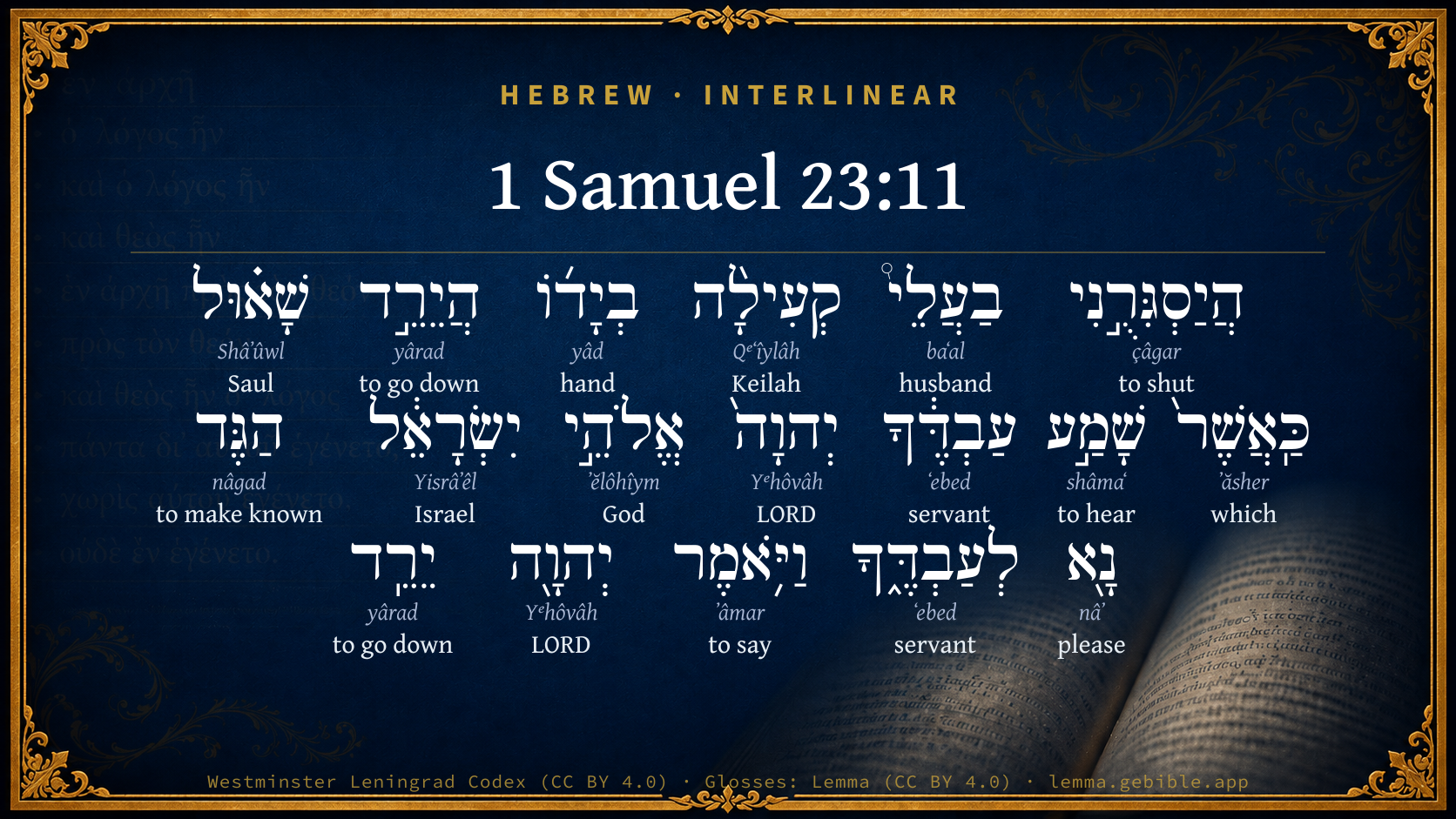
Hebrew (Westminster Leningrad Codex) 1 Samuel 23:11 appears in the Hebrew Old Testament. The text above is from the Westminster Leningrad Codex. Each word links to its Strong’s number, a concise gloss, and parsing drawn from the Open Scriptures Hebrew Bible morphology. Click any word for its full Brown-Driver-Briggs (BDB) entry.
Download image
Cite this verse

1 Samuel 23:11 (World English Bible). Public Domain. Lemma interlinear Bible study tool, https://lemma.gebible.app/v/1-samuel/23/11.

Show BibTeX & RIS
BibTeX
RIS
English Translation
Will the men of Keilah deliver me up into his hand? will Saul come down, as your servant has heard? Yahweh, the God of Israel, I beg you, tell your servant. Yahweh said, He will come down.
World English Bible · Public Domain
Download a study sheet

One document with this verse’s original text, its word-by-word gloss line, the meaning frame, cross-references with their text, attributed commentary, and full source and license credits — printable, and it pastes into notes with its structure intact.

This verse Autodidact and up

Study sheet (.html) Plain text (.txt)

A passage Seminary Student

Up to 50 verses in one chapter. A passage sheet keeps up to 6 commentary sources and 12 cross-references per verse, in the order this page ranks them, and says so on the sheet whenever that leaves anything out. Ask for a single verse and you get the Autodidact verse sheet above.

Everything on this page stays free to read, with no account — the sheet is a download of what is already on screen, not access to it.

Want to remove ads? Support Godless Engineer
Compare translations 3

The same verse in 3 English versions, stacked beneath the original-language interlinear above. Click any original word for its lexicon entry.

Each is an independent rendering of the whole verse — the interlinear is not word-aligned to these translations.

Highlighted words mark where these versions differ — a whole-verse word diff, not a word-by-word alignment.

  • World English Bible Public Domain
    Will the men of Keilah deliver me up into his hand? will Saul come down, as your servant has heard? Yahweh, the God of Israel, I beg you, tell your servant. Yahweh said, He will come down.
  • King James Version Public Domain
    Will the men of Keilah deliver me up into his hand? will Saul come down, as thy servant hath heard? O LORD God of Israel, I beseech thee, tell thy servant. And the LORD said, He will come down.
  • unfoldingWord Literal Text CC BY-SA 4.0
    Will the lords of Keilah enclose me in his hand? Will Saul come down, just as your servant has heard? Yahweh, the God of Israel, please declare to your servant.” And Yahweh said, “He will come down.”

unfoldingWord Literal Text — © unfoldingWord, licensed CC BY-SA 4.0. Word-aligned USFM3 via Door43 (git.door43.org/unfoldingWord/en_ult).

Versions to compare (up to 4)

3 of 4 selected

Show all 18 translations

Every available English version of this verse, each an independent rendering of the whole verse.

  • World English Bible Public Domain
    Will the men of Keilah deliver me up into his hand? will Saul come down, as your servant has heard? Yahweh, the God of Israel, I beg you, tell your servant. Yahweh said, He will come down.
  • Berean Standard Bible Public Domain
    Will the citizens of Keilah surrender me into his hand? Will Saul come down, as Your servant has heard? O LORD, God of Israel, please tell Your servant.” “He will,” said the LORD.
  • Majority Standard Bible Public Domain
    Will the citizens of Keilah surrender me into his hand? Will Saul come down, as Your servant has heard? O LORD, God of Israel, please tell Your servant.” “He will,” said the LORD.
  • King James Version Public Domain
    Will the men of Keilah deliver me up into his hand? will Saul come down, as thy servant hath heard? O LORD God of Israel, I beseech thee, tell thy servant. And the LORD said, He will come down.
  • American Standard Version (1901) Public Domain
    Will the men of Keilah deliver me up into his hand? will Saul come down, as thy servant hath heard? O Jehovah, the God of Israel, I beseech thee, tell thy servant. And Jehovah said, He will come down.
  • Revised Version (1885) Public Domain
    Will the men of Keilah deliver me up into his hand? will Saul come down, as thy servant hath heard? O LORD, the God of Israel, I beseech thee, tell thy servant. And the LORD said, He will come down.
  • Geneva Bible (1599) Public Domain
    Wil the lordes of Keilah deliuer me vp into his hand? and will Saul come downe, as thy seruant hath heard? O Lord God of Israel, I beseech thee, tell thy seruant. And the Lord sayde, He will come downe.
  • Douay-Rheims (1899) Public Domain
    Will the men of Ceila deliver me into his hands? and will Saul come down, as thy servant hath heard? O Lord God of Israel, tell thy servant. And the Lord said: He will come down.
  • Young's Literal Translation Public Domain
    Do the possessors of Keilah shut me up into his hand? doth Saul come down as Thy servant hath heard? Jehovah, God of Israel, declare, I pray Thee, to Thy servant.' And Jehovah saith, `He doth come down.'
  • Literal Standard Version CC BY-SA 4.0
    Do the possessors of Keilah shut me up into his hand? Does Saul come down as Your servant has heard? YHWH, God of Israel, please declare [it] to Your servant.” And YHWH says, “He comes down.”
  • Unlocked Literal Bible CC BY-SA 4.0
    Will the men of Keilah surrender me into his hand? Will Saul come down, as your servant has heard? Yahweh, the God of Israel, I beg you, please tell your servant.” Yahweh said, “He will come down.”
  • unfoldingWord Literal Text CC BY-SA 4.0
    Will the lords of Keilah enclose me in his hand? Will Saul come down, just as your servant has heard? Yahweh, the God of Israel, please declare to your servant.” And Yahweh said, “He will come down.”
  • Darby Bible Public Domain
    Will the citizens of Keilah deliver me up into his hand? will Saul come down, as thy servant hath heard? Jehovah, God of Israel, I beseech thee, tell thy servant. And Jehovah said, He will come down.
  • World Messianic Bible Public Domain
    Will the men of Keilah deliver me up into his hand? Will Saul come down, as your servant has heard? LORD, the God of Israel, I beg you, tell your servant.” The LORD said, “He will come down.”
  • Webster's Bible Public Domain
    Will the men of Keilah deliver me up into his hand? will Saul come down as thy servant hath heard? O LORD God of Israel, I beseech thee, tell thy servant. And the LORD said, He will come down.
  • Free Bible Version CC BY-SA 4.0
    Are the town leaders of Keilah going to hand me over to him? Is Saul going to come, as I have heard? Lord, God of Israel, please tell me.” “Yes, he'll come,” the Lord replied.
  • Bible in Basic English Public Domain
    And now, is it true, as they have said to me, that Saul is coming? O Lord, the God of Israel, give ear to your servant, and say if these things are so. And the Lord said, He is coming down.
  • JPS Tanakh (1917) Public Domain
    Will the men of Keilah deliver me up into his hand? will Saul come down, as Thy servant hath heard?' O LORD, the God of Israel, I beseech Thee, tell Thy servant.' And the LORD said: 'He will come down.'

Literal Standard Version (2020), Covenant Press — licensed CC BY-SA 4.0. Text via the HelloAO Bible API (eBible.org). Unlocked Literal Bible (unfoldingWord) — licensed CC BY-SA 4.0. Text via the HelloAO Bible API (eBible.org). unfoldingWord Literal Text — © unfoldingWord, licensed CC BY-SA 4.0. Word-aligned USFM3 via Door43 (git.door43.org/unfoldingWord/en_ult). Free Bible Version, Dr. Jonathan Gallagher — licensed CC BY-SA 4.0. Text via the HelloAO Bible API (eBible.org).

Word by word

More ways to search: Search by grammar → Find every occurrence → Compare this word →

Practice this passage: Drill this verse → Learn its vocabulary →

קְעִילָ֨ה
Qᵉʻîylâh
H7084
“Keilah”
Noun, Proper
Part of Speech
Noun
Type
Proper
Full BDB Definition

Origin: perhaps from H7049 in the sense of inclosing

TWOT: None

Keilah = "fortress" - a city in the lowlands of Judah northwest of Hebron
  1. הֲיַסְגִּרֻ֣נִי çâgar H5462 “to shut · me” Particle, Interrogative + Verb, Hiphil, Imperfect, 3rd Person, Masculine, Plural + Suffix, Personal, 1st Person, Common, Singular
  2. בַעֲלֵי֩ baʻal H1167 “husbands of” Noun, Common, Masculine, Plural, Construct
  3. בְיָד֜וֹ yâd H3027 “in/at · hand · his” Preposition + Noun, Common, Both, Singular, Construct + Suffix, Personal, 3rd Person, Masculine, Singular
  4. הֲיֵרֵ֣ד yârad H3381 “to go down” Particle, Interrogative + Verb, Qal, Imperfect, 3rd Person, Masculine, Singular
  5. שָׁא֗וּל Shâʼûwl H7586 “Saul” Noun, Proper
  6. כַּֽאֲשֶׁר֙ ʼăsher H834 “like/as · which” Preposition + Particle, Relative
  7. שָׁמַ֣ע shâmaʻ H8085 “to hear” Verb, Qal, Perfect, 3rd Person, Masculine, Singular
  8. עַבְדֶּ֔ךָ ʻebed H5650 “servant · your” Noun, Common, Masculine, Singular, Construct + Suffix, Personal, 2nd Person, Masculine, Singular
  9. יְהוָה֙ Yᵉhôvâh H3068 “LORD” Noun, Proper
  10. אֱלֹהֵ֣י ʼĕlôhîym H430 “God(s) of” Noun, Common, Masculine, Plural, Construct
  11. יִשְׂרָאֵ֔ל Yisrâʼêl H3478 “Israel” Noun, Proper
  12. הַגֶּד nâgad H5046 “make known” Verb, Hiphil, Imperative, 2nd Person, Masculine, Singular
  13. נָ֖א nâʼ H4994 “please” Particle, Exhortation
  14. לְעַבְדֶּ֑ךָ ʻebed H5650 “to/for · servant · your” Preposition + Noun, Common, Masculine, Singular, Construct + Suffix, Personal, 2nd Person, Masculine, Singular
  15. וַיֹּ֥אמֶר ʼâmar H559 “and · to say” Conjunction + Verb, Qal, Sequential Imperfect, 3rd Person, Masculine, Singular
  16. יְהוָ֖ה Yᵉhôvâh H3068 “LORD” Noun, Proper
  17. יֵרֵֽד yârad H3381 “to go down” Verb, Qal, Imperfect, 3rd Person, Masculine, Singular

About this verse

These counts appear in no published source. They are computed here, from the morphology-tagged text and Lemma’s own curated glosses. What Lemma adds →

18
words
15
distinct lemmas
Historical
section

Notable vocabulary

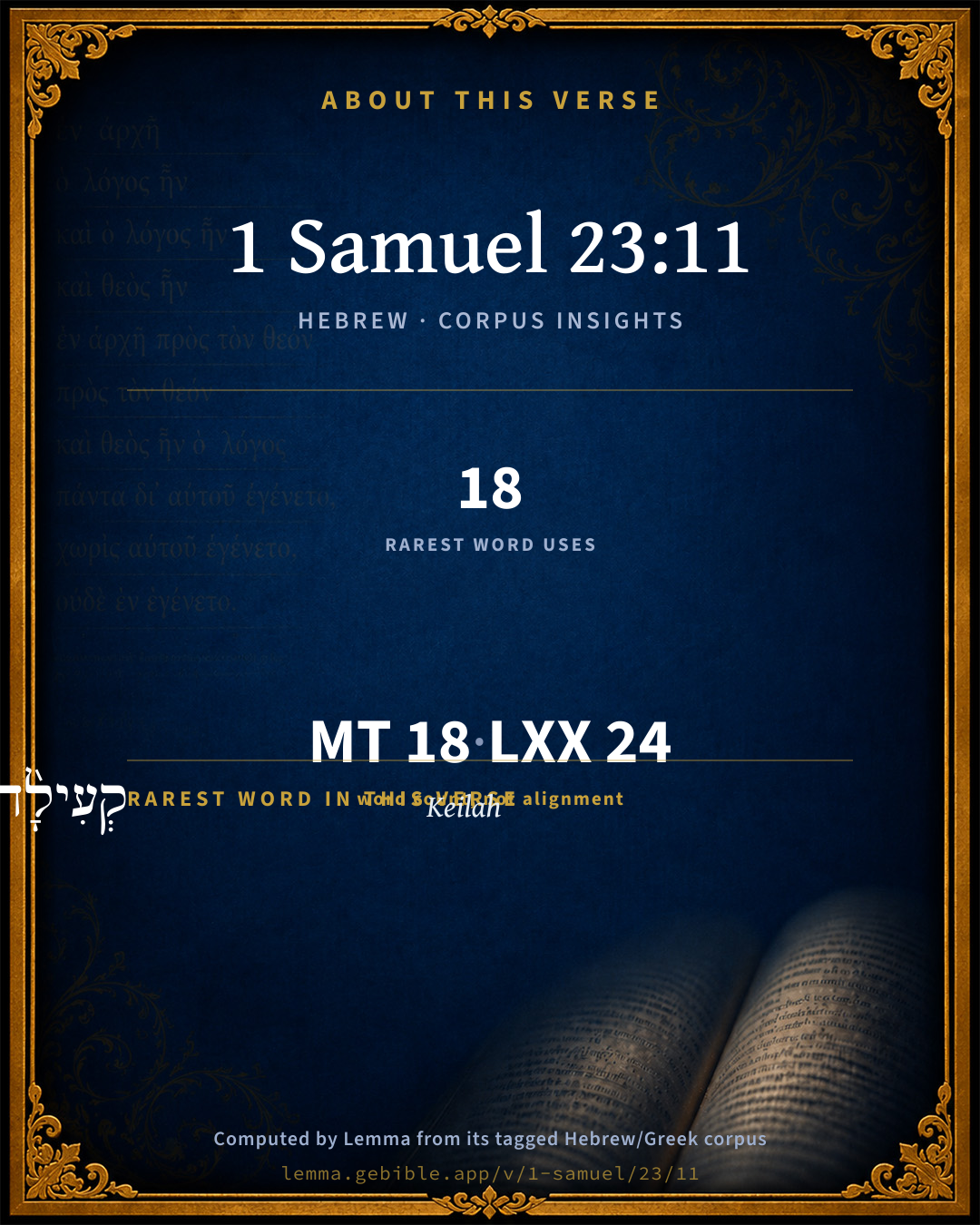
The rarest word here is קְעִילָ֨ה Keilah H7084 — appearing just 18 times in the whole Hebrew Bible.

Shared distinctive vocabulary

קְעִילָ֨ה Keilah H7084 occurs in 16 verses of the Hebrew Bible. Also found in:

Grammatical profile

  • 6 verbs
  • 10 nouns
  • 2 particles

Verb forms

  • הֲיַסְגִּרֻ֣נִי Hiphil · Imperfect
  • הֲיֵרֵ֣ד Qal · Imperfect
  • שָׁמַ֣ע Qal · Perfect
  • הַגֶּד Hiphil · Imperative
  • וַיֹּ֥אמֶר Qal · Sequential Imperfect
  • יֵרֵֽד Qal · Imperfect

Repetition

Words recur within this verse — often emphatic in Hebrew:

  • הֲיֵרֵ֣ד to go down H3381 ×2
  • עַבְדֶּ֔ךָ servant H5650 ×2
  • יְהוָה֙ LORD H3068 ×2

Hebrew & Septuagint length

In English translation the verse runs 37 words from the Hebrew and 24 from the Septuagint (LXX English) — the Septuagint runs noticeably shorter here. See the side-by-side →

A rough comparison of the two English renderings, which tokenize alike — not a word-level alignment.

Word counts can differ between the Hebrew and the Greek without any difference in meaning — e.g. the Hebrew direct-object marker אֵת has no separate Greek word, and Greek often adds the article ὁ.

In the original languages it is 18 Hebrew tokens and 24 Greek tokens — but the two are counted differently (Hebrew bundles its prefixes and suffixes into one token; the Greek is in lemma form), so that isn’t a like-for-like length.

Cross-references

3

Topical passages linked to 1 Samuel 23:11 in the Treasury of Scripture Knowledge — connected by theme and wording, ordered by reader-vote popularity; previews shown in the World English Bible.

  • Psalms 50:15 Call on me in the day of trouble. I will deliver you, and you will honor me."
  • Jeremiah 33:3 Call to me, and I will answer you, and will show you great things, and difficult, which you don't know.
  • Matthew 7:7–8 "Ask, and it will be given you. Seek, and you will find. Knock, and it will be opened for you.

Cross-references courtesy of OpenBible.info (CC BY 4.0).

Hebrew and Greek witnesses Masoretic Hebrew ↔ Greek Septuagint

The same verse in the two great witnesses to the Old Testament, shown verse-for-verse.

Here the Septuagint runs noticeably shorter than the Hebrew — LXX2012 (modern English Septuagint) 24 words vs World English Bible 37. A rough length comparison of the two English translations, not a word-level alignment — read both below.

These are two independent witnesses, not word-aligned to each other, and the Septuagint is shown in lemma (dictionary) form.

Hebrew 1 Samuel 23:11 Masoretic · Westminster Leningrad Codex

הֲיַסְגִּרֻ֣נִי בַעֲלֵי֩ קְעִילָ֨ה בְיָד֜וֹ הֲיֵרֵ֣ד שָׁא֗וּל כַּֽאֲשֶׁר֙ שָׁמַ֣ע עַבְדֶּ֔ךָ יְהוָה֙ אֱלֹהֵ֣י יִשְׂרָאֵ֔ל הַגֶּד נָ֖א לְעַבְדֶּ֑ךָ וַיֹּ֥אמֶר יְהוָ֖ה יֵרֵֽד

Will the men of Keilah deliver me up into his hand? will Saul come down, as your servant has heard? Yahweh, the God of Israel, I beg you, tell your servant. Yahweh said, He will come down.

World English Bible · Public Domain

Greek LXX 1 Samuel 23:11 Septuagint · lemma form

εἰ ἀποκλείω καί νῦν εἰ καταβαίνω σαούλ καθώς ἀκούω ὁ δοῦλος σύ κύριος ὁ θεός ἰσραήλ ἀποἀγγέλλω ὁ δοῦλος σύ καί εἶπον κύριος ἀποκλείω

Will the place be shut up? And now will Saul come down, as your servant has heard? Lord God of Israel, tell your servant.

LXX2012 (modern English Septuagint) · Public Domain

Hebrew: Westminster Leningrad Codex (CC BY 4.0). Greek: Septuagint (public domain); English from LXX2012 (modern English Septuagint) (Public Domain). How the Septuagint differs from the Hebrew →

Targum (Aramaic paraphrase)

1

The Targum is the ancient Jewish Aramaic paraphrase of the Hebrew Scriptures — an interpretive translation, not the Hebrew text itself. Onkelos (literal) and Pseudo-Jonathan (expansive) render the Torah, and Jonathan the Prophets. Coverage is partial: where no permissively-licensed English translation exists for a verse, only the Aramaic is shown. This is verse-level text, not a word-by-word alignment to the Hebrew.

  1. Targum Jonathan Prophets (Joshua–Malachi)
    הַסְבִירִין לְמִמְסְרִי יַתְבֵי קְעִילָה בִּידֵיהּ הַסְבִיר לְמֵיחַת שָׁאוּל כְּמָא דִשְׁמַע עַבְדָךְ יְיָ אֱלָהָא דְיִשְׂרָאֵל חַוֵי כְעַן לְעַבְדָךְ וַאֲמַר יְיָ סָבֵר לְמֵיחָת:

    (no public-domain English translation for this verse)

    Targum Jonathan — Aramaic: “Mikraot Gedolot” (public domain). English: “Sefaria Community Translation” (CC0 1.0 (public-domain dedication)); “London "Chaldee Paraphrase," 1871” (public domain). Text via Sefaria.

Commentary

Notes on 1 Samuel 23:11 from classic Christian and Jewish commentators (each source and its license shown beneath its notes). The classic Christian expositions comment on the surrounding passage and are grouped to its opening verse, so a note may address several verses; the Jewish commentaries on the Tanakh (Rashi and others) are per-verse, so they appear only where the commentator wrote on this verse.

Lemma curates 59 commentaries, every one of them public domain or Creative Commons licensed, each selected and text-cleaned for this edition rather than reprinted as found. About our sources →

Ellicott's Commentary for English Readers

(11) Will the men of Keilah deliver me up into his hand? will Saul come down, as thy servant hath heard?—There is a curious inversion of David’s questions here. In their logical sequence, of course the second, respecting Saul’s coming down, should have been put first, for the men of Keilah could not have delivered him into Saul’s hands if Saul had not come down. Dean Payne Smith suggests that in David’s earnest prayer “his two questions are put inversely to the logical order, but in accordance with the relative importance in his mind.” The Dean thinks “that when the ephod was brought forward, the questions were of course put, and replied to in their logical sequence.

“And the Lord said, He will come down.”

“ And the Lord said, They will deliver thee up.”

Thus the answer of the Urim and Thummin was given to the questions in their logical order. The Talmud has an interesting comment here. In consulting the Urim and Thummim, the enquirer is not to ask about two things at a time, for if he does, he will be answered about one only, and only about the one he first uttered, as it is said (1Sa_23:11-12). David asked first “Will the men of Keilah deliver me into his hands?” and then he asked also “Will Saul come down?” The answer was to the second query. “And the Lord said He will come down.” But it has just been asserted that the enquirer will be answered only about the one thing he first uttered. To this it is replied, David framed his enquiry not in good order, but the reply of the Urim and Thummim was as though the enquiry had been in proper order. Hence when David became aware that his question had not been put properly, he repeated it again in better order, as it has been said, “Then said David, Will the men of Keilah deliver me and my men into the hand of Saul? And the Lord said, They will deliver thee up.”—Treatise Yoma, fol. 73, Colossians 1.

A Bible Commentary for English Readers, edited by Charles John Ellicott (1878–1897) — public domain. Text from a community e-Sword module.

Trapp's Complete Commentary

John Trapp

1Sa 23:11 Will the men of Keilah deliver me up into his hand? will Saul come down, as thy servant hath heard? O LORD God of Israel, I beseech thee, tell thy servant. And the LORD said, He will come down.

Ver. 11. And the Lord said, He will come down,] viz., Unless thou goest hence. God knoweth future contingents: and not only those that are absolute, but those also that are conditionate: he knows a man’s "thoughts afar off," and ofttimes judgeth them accordingly. We used to destroy hemlock in the midst of winter, because we know what it will do if allowed to grow: so the Lord doth sometimes cut off people while young, out of the foresight of the evil they would do to his Church if let alone.

John Trapp, A Commentary or Exposition upon All the Books of the Old and New Testament (1647–1656) — public domain. Text from a community e-Sword module.

Adam Clarke's Commentary

Verse 11. - 12. In these verses we find the following questions and answers: - David said, Will Saul come down to Keilah? And the Lord said, He will come down. Will the men of Keilah deliver me and my men into the hand of Saul? And the Lord said, They will deliver thee up. In this short history we find an ample proof that there is such a thing as contingency in human affairs; that is, God has poised many things between a possibility of being and not being, leaving it to the will of the creature to turn the scale. In the above answers of the Lord the following conditions were evidently implied: - IF thou continue in Keilah, Saul will certainly come down; and IF Saul come down, the men of Keilah will deliver thee into his hands. Now though the text positively asserts that Saul would come to Keilah, yet he did not come; and that the men of Keilah would deliver David into his hand, yet David was not thus delivered to him. And why? Because David left Keilah; but had he stayed, Saul would have come down, and the men of Keilah would have betrayed David. We may observe from this that, however positive a declaration of God may appear that refers to any thing in which man is to be employed, the prediction is not intended to suspend or destroy free agency, but always comprehends in it some particular condition.

Adam Clarke's Commentary on the Bible (1810–1826) — public domain. Text from a community e-Sword/MySword module.

The Cambridge Bible for Schools and Colleges

gen. ed. J. J. S. Perowne

11. the men of Keilah] Lit. “the lords,” or “masters,” i.e. the governing body of citizens, as distinguished from the mass of inhabitants (1Sa_23:5). The same word is used in Jos_24:11; Jdg_9:2 ff; Jdg_20:5; 2Sa_21:12.

will Saul come down] The logical order of the questions is inverted, and the most important put first, indicating the anxiety of the questioner.

The Cambridge Bible for Schools and Colleges (gen. ed. J. J. S. Perowne; Cambridge University Press, 1878–1918) — public domain. Text from a community e-Sword module.

John Gill's Exposition

Will the men of Keilah deliver me up into his hands? will Saul come down, as thy servant hath heard?.... That is, if David continued there, which is the supposition all proceeds upon. The questions are not orderly put, as may easily be observed, the last should have been first; which shows some perturbation of mind David was in upon hearing the design of Saul against him:

O Lord God of Israel, I beseech thee, tell thy servant; give an answer by Urim and Thummim, as he did:

and the Lord said, he will come down; if David abode there; that was in his thoughts, in his purpose and design, which the Lord, being omniscient, full well knew, who knows all future contingencies: hence the Jews (n) gather, that two things are not to be asked together; and if they are asked, only answer is made to one, and the answer is only made to that which it was proper to ask first; and that which is asked out of order should be asked again, which was the case here, as follows.

(n) T. Bab. Yoma, fol. 73. 1, 2.

John Gill's Exposition of the Whole Bible (1746–1763) — public domain (CC PDM 1.0). Text via the HelloAO Bible API.

Matthew Poole's English Annotations

Will the men of Keilah deliver me up, to wit, if I continue in their city, and if Saul come down?

The Lord said. From this place it may appear that God’s answer by Urim and Thummim was not by any change in the colour or situation of the precious stones in the breastplate of the ephod, but by a voice or suggestion from God to the high priest.

He will come down, i.e. he purposeth to come, if thou continuest here; for still, as David’s question, so God’s answer, is upon supposition, as is here sufficiently implied.

Matthew Poole's English Annotations on the Holy Bible (1683–1685) — public domain. Text from a community e-Sword/MySword module.

John Wesley's Explanatory Notes

The Lord said - From this place it may appear that God's answer by Urim and Thummim, was not by any change in the colour or situation of the precious stones in the breast-plate of the Ephod, but by a voice or suggestion from God to the high-priest. He will - He purposeth to come, if thou continuest here. For still as David's question, so God's answer, is upon supposition.

John Wesley, Explanatory Notes Upon the Whole Bible (1754–1765) — public domain. Text via the GEBible commentary corpus.

Rashi

Rabbi Shlomo Yitzchaki (Rashi)

Will Keilah's residents hand me over… This teaches us that one who consults regarding two matters, receives a reply concerning only one, and that reply concerns the first one. And here, Dovid asked in an inverted order, because he should have first asked, "Will Shaul come down? Will [the residents of Keilah] hand me over?" But he was answered according to the [proper] order.

Rashi on the Tanakh — English translations: “The Judaica Press complete Tanach with Rashi, translated by A. J. Rosenberg” (CC BY 4.0); “Pentateuch with Rashi's commentary by M. Rosenbaum and A.M. Silbermann, 1929-1934” (public domain); “The Metsudah Tanach series, Lakewood, N.J” (CC BY 4.0); and “The Book of Joshua, Metsudah Publications, 1997” (CC BY 4.0). Text via Sefaria.

Lesson kit

Teaching starters — assembled from the data on this page, not authored interpretation. Every prompt links to the verse data it draws on. Edit before teaching.

1 Samuel, in the Historical, opens this verse with 18 words (15 distinct Hebrew lemmas). Its most distinctive word is Qᵉʻîylâh (“Keilah”). The Greek Septuagint runs shorter here. A historical commentator’s framing appears above. Read the whole chapter for the surrounding context.

Discussion questions

  1. How does “Keilah” (Qᵉʻîylâh) shape what this verse is saying?
  2. How does Joshua 15:44, which shares the word «Keilah», read alongside this verse?
  3. What does the repetition of “to go down” (2× in this one verse) do in this verse?
  4. The Septuagint runs shorter here than the Hebrew. What might account for the difference?
  5. These translations render this verse differently; the difference is in the English rendering, not the original. What questions does that raise?
  6. «הֲיַסְגִּרֻ֣נִי» is a Hiphil Imperfect verb. How does that grammatical form shape the action described?
  7. Compare how Ellicott's Commentary for English Readers and Trapp's Complete Commentary read this verse. Where do they agree or differ?

Things to notice

Reading settings

Reading text

Shown beneath each verse's original-language words.

Old Testament
Old Testament edition

Read the OT as the Masoretic Hebrew (MT) or the Greek Septuagint (LXX).

English shown for the Greek Septuagint (in the Hebrew ↔ Greek comparison).

Comparing translations? Open the Compare panel on any verse page to stack up to four side by side.