
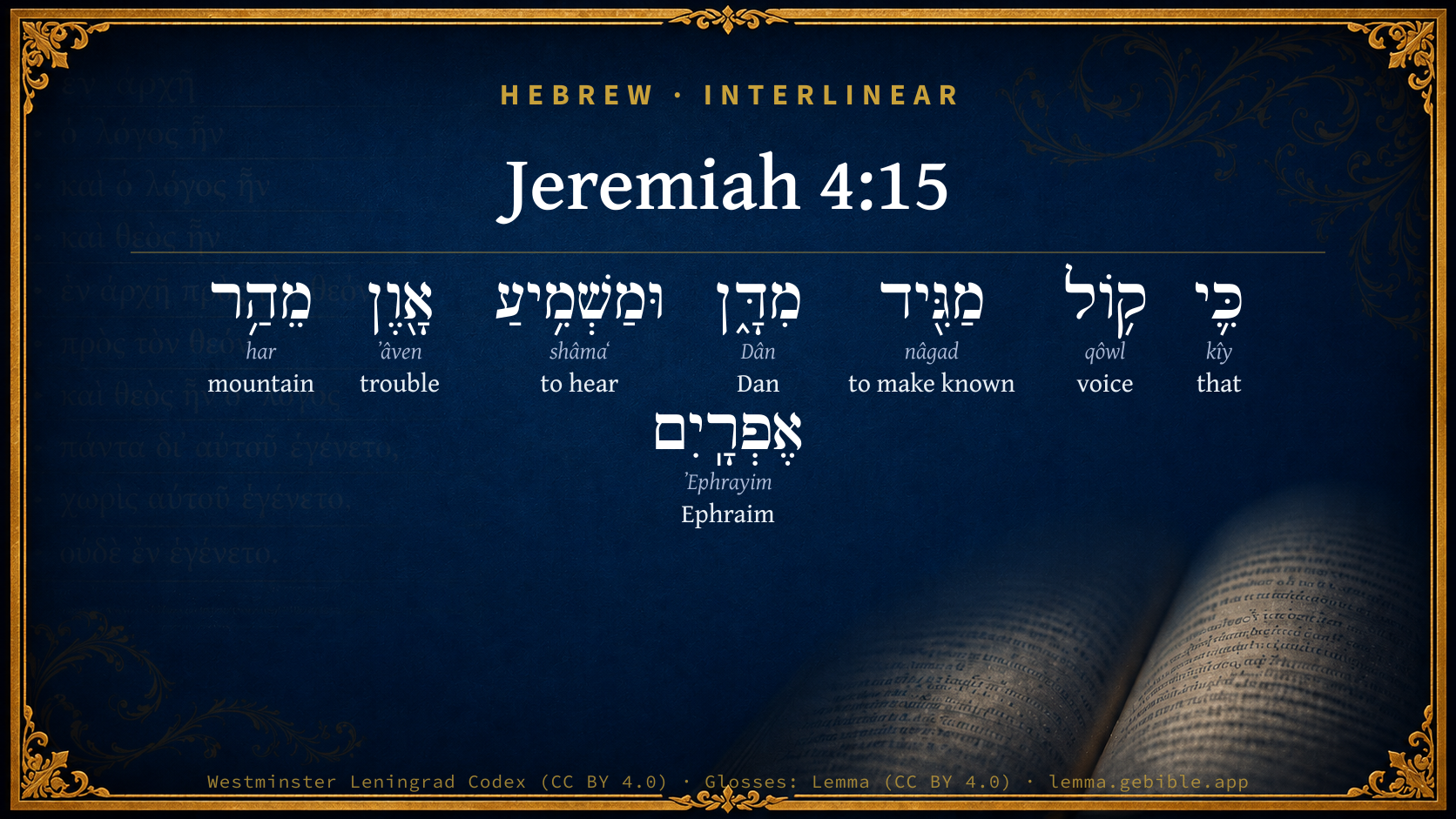
Jeremiah 4:15

Hebrew (Westminster Leningrad Codex) Jeremiah 4:15 appears in the Hebrew Old Testament. The text above is from the Westminster Leningrad Codex. Each word links to its Strong’s number, a concise gloss, and parsing drawn from the Open Scriptures Hebrew Bible morphology. Click any word for its full Brown-Driver-Briggs (BDB) entry.
Download image
Cite this verse

Jeremiah 4:15 (World English Bible). Public Domain. Lemma interlinear Bible study tool, https://lemma.gebible.app/v/jeremiah/4/15.

Show BibTeX & RIS
BibTeX
RIS
English Translation
For a voice declares from Dan, and publishes evil from the hills of Ephraim:
World English Bible · Public Domain
Download a study sheet

One document with this verse’s original text, its word-by-word gloss line, the meaning frame, cross-references with their text, attributed commentary, and full source and license credits — printable, and it pastes into notes with its structure intact.

This verse Autodidact and up

Study sheet (.html) Plain text (.txt)

A passage Seminary Student

Up to 50 verses in one chapter. A passage sheet keeps up to 6 commentary sources and 12 cross-references per verse, in the order this page ranks them, and says so on the sheet whenever that leaves anything out. Ask for a single verse and you get the Autodidact verse sheet above.

Everything on this page stays free to read, with no account — the sheet is a download of what is already on screen, not access to it.

Want to remove ads? Support Godless Engineer
Compare translations 3

The same verse in 3 English versions, stacked beneath the original-language interlinear above. Click any original word for its lexicon entry.

Each is an independent rendering of the whole verse — the interlinear is not word-aligned to these translations.

Highlighted words mark where these versions differ — a whole-verse word diff, not a word-by-word alignment.

  • World English Bible Public Domain
    For a voice declares from Dan, and publishes evil from the hills of Ephraim:
  • King James Version Public Domain
    For a voice declareth from Dan, and publisheth affliction from mount Ephraim.
  • unfoldingWord Literal Text CC BY-SA 4.0
    For a voice declares from Dan, and announces coming disaster from the mount of Ephraim.

unfoldingWord Literal Text — © unfoldingWord, licensed CC BY-SA 4.0. Word-aligned USFM3 via Door43 (git.door43.org/unfoldingWord/en_ult).

Versions to compare (up to 4)

3 of 4 selected

Show all 18 translations

Every available English version of this verse, each an independent rendering of the whole verse.

  • World English Bible Public Domain
    For a voice declares from Dan, and publishes evil from the hills of Ephraim:
  • Berean Standard Bible Public Domain
    For a voice resounds from Dan, proclaiming disaster from the hills of Ephraim.
  • Majority Standard Bible Public Domain
    For a voice resounds from Dan, proclaiming disaster from the hills of Ephraim.
  • King James Version Public Domain
    For a voice declareth from Dan, and publisheth affliction from mount Ephraim.
  • American Standard Version (1901) Public Domain
    For a voice declareth from Dan, and publisheth evil from the hills of Ephraim:
  • Revised Version (1885) Public Domain
    For a voice declareth from Dan, and publisheth evil from the hills of Ephraim:
  • Geneva Bible (1599) Public Domain
    For a voyce declareth from Dan, and publisheth affliction from mount Ephraim.
  • Douay-Rheims (1899) Public Domain
    For a voice of one declaring from Dan, and giving notice of the idol from mount Ephraim.
  • Young's Literal Translation Public Domain
    For a voice is declaring from Dan, And sounding sorrow from mount Ephraim.
  • Literal Standard Version CC BY-SA 4.0
    For a voice is declaring from Dan, || And sounding sorrow from Mount Ephraim:
  • Unlocked Literal Bible CC BY-SA 4.0
    For a voice is bringing news from Dan, and the coming disaster is heard from the mountains of Ephraim.
  • unfoldingWord Literal Text CC BY-SA 4.0
    For a voice declares from Dan, and announces coming disaster from the mount of Ephraim.
  • Darby Bible Public Domain
    For a voice declareth from Dan, and publisheth affliction from mount Ephraim.
  • World Messianic Bible Public Domain
    For a voice declares from Dan, and publishes evil from the hills of Ephraim:
  • Webster's Bible Public Domain
    For a voice declareth from Dan, and publisheth affliction from mount Ephraim.
  • Free Bible Version CC BY-SA 4.0
    News is shouted out from Dan, announcing disaster from the hills of Ephraim.
  • Bible in Basic English Public Domain
    For a voice is sounding from Dan, giving out evil from the hills of Ephraim:
  • JPS Tanakh (1917) Public Domain
    For hark! one declareth from Dan, and announceth calamity from the hills of Ephraim:

Literal Standard Version (2020), Covenant Press — licensed CC BY-SA 4.0. Text via the HelloAO Bible API (eBible.org). Unlocked Literal Bible (unfoldingWord) — licensed CC BY-SA 4.0. Text via the HelloAO Bible API (eBible.org). unfoldingWord Literal Text — © unfoldingWord, licensed CC BY-SA 4.0. Word-aligned USFM3 via Door43 (git.door43.org/unfoldingWord/en_ult). Free Bible Version, Dr. Jonathan Gallagher — licensed CC BY-SA 4.0. Text via the HelloAO Bible API (eBible.org).

Word by word

More ways to search: Search by grammar → Find every occurrence → Compare this word →

Practice this passage: Drill this verse → Learn its vocabulary →

About this verse

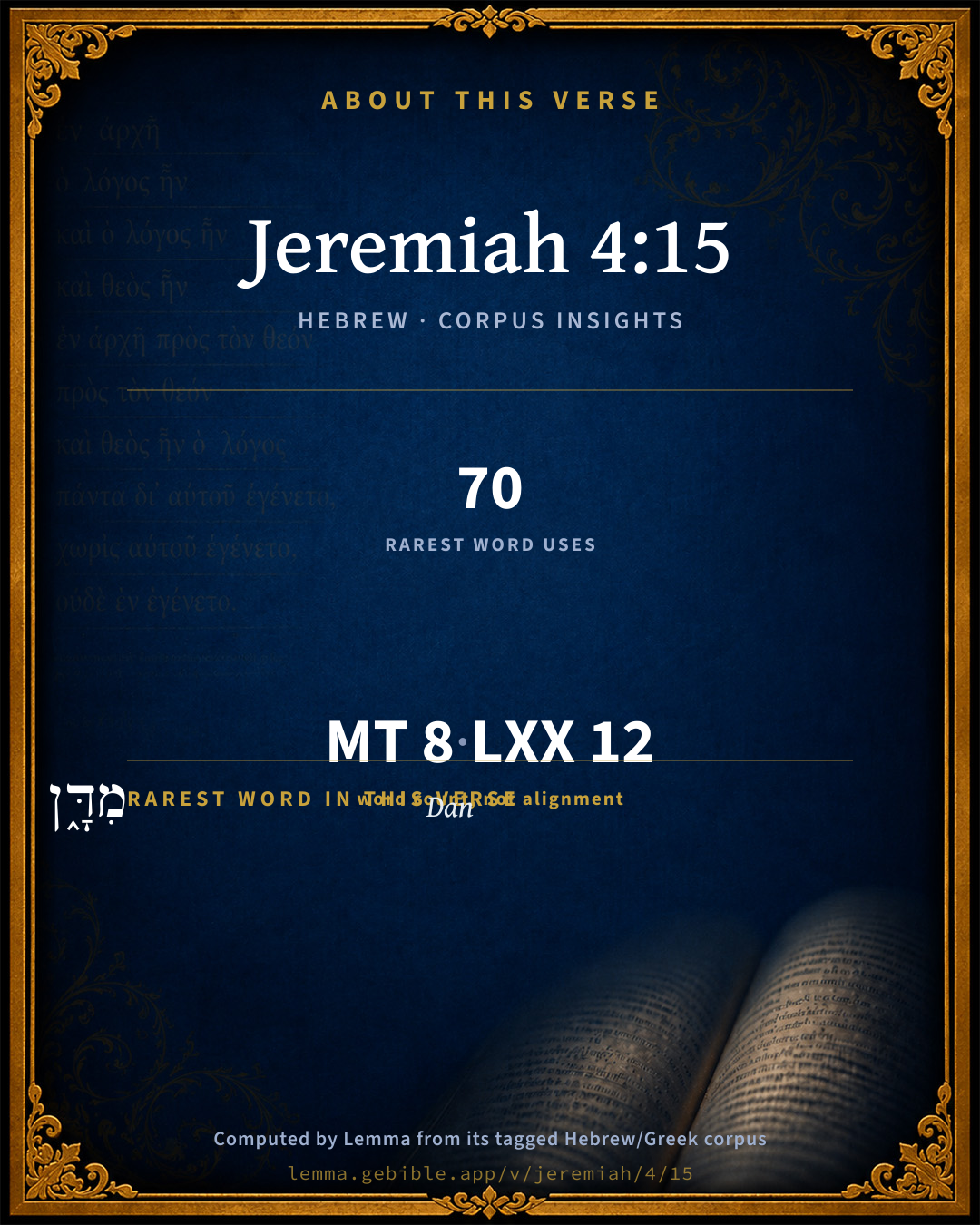
These counts appear in no published source. They are computed here, from the morphology-tagged text and Lemma’s own curated glosses. What Lemma adds →

8
words
8
distinct lemmas
Prophets
section

Grammatical profile

  • 2 verbs
  • 5 nouns
  • 1 conjunction

Verb forms

  • מַגִּ֖יד Hiphil · Participle Active
  • וּמַשְׁמִ֥יעַ Hiphil · Participle Active

Hebrew & Septuagint length

In the original languages it is 8 Hebrew tokens and 12 Greek tokens — but the two are counted differently (Hebrew bundles its prefixes and suffixes into one token; the Greek is in lemma form), so that isn’t a like-for-like length.

Cross-references

6

Topical passages linked to Jeremiah 4:15 in the Treasury of Scripture Knowledge — connected by theme and wording, ordered by reader-vote popularity; previews shown in the World English Bible.

  • Jeremiah 8:16 The snorting of his horses is heard from Dan: at the sound of the neighing of his strong ones the whole land trembles; for they are come, and have devoured the land and all that is in it; the city and those who dwell therein.
  • Joshua 17:15 Joshua said to them, If you are a great people, go up to the forest, and cut down for yourself there in the land of the Perizzites and of the Rephaim; since the hill-country of Ephraim is too narrow for you.
  • Joshua 20:7 They set apart Kedesh in Galilee in the hill-country of Naphtali, and Shechem in the hill-country of Ephraim, and Kiriath Arba (the same is Hebron) in the hill-country of Judah.
  • Judges 18:29 They called the name of the city Dan, after the name of Dan their father, who was born to Israel: however the name of the city was Laish at the first.
  • Judges 20:1 Then all the children of Israel went out, and the congregation was assembled as one man, from Dan even to Beersheba, with the land of Gilead, to Yahweh at Mizpah.
  • Jeremiah 6:1 Flee for safety, you children of Benjamin, out of the midst of Jerusalem, and blow the trumpet in Tekoa, and raise up a signal on Beth Haccherem; for evil looks forth from the north, and a great destruction.

Cross-references courtesy of OpenBible.info (CC BY 4.0).

Hebrew and Greek witnesses Masoretic Hebrew ↔ Greek Septuagint

The same verse in the two great witnesses to the Old Testament, shown verse-for-verse.

These are two independent witnesses, not word-aligned to each other, and the Septuagint is shown in lemma (dictionary) form.

Hebrew Jeremiah 4:15 Masoretic · Westminster Leningrad Codex

כִּ֛י ק֥וֹל מַגִּ֖יד מִדָּ֑ן וּמַשְׁמִ֥יעַ אָ֖וֶן מֵהַ֥ר אֶפְרָֽיִם

For a voice declares from Dan, and publishes evil from the hills of Ephraim:

World English Bible · Public Domain

Greek LXX Structure differs

In the Septuagint, Jeremiah is about an eighth shorter than the Hebrew and arranges its material differently — the Oracles Against the Nations (Hebrew chapters 46–51) appear in the middle of the Greek book, after 25:13. Because the chapter and verse boundaries do not line up, a verse-for-verse comparison with the Hebrew is not shown.

A verse-for-verse comparison isn’t shown here because the chapters and verses don’t line up. Switch to the LXX edition with the MT / LXX toggle above to read the Greek directly.

On this verse, Keil & Delitzsch discusses the Septuagint’s reading. Read the note in Commentary ↓

Hebrew: Westminster Leningrad Codex (CC BY 4.0). Greek: Septuagint (public domain); English from a public-domain English Septuagint. How the Septuagint differs from the Hebrew →

Targum (Aramaic paraphrase)

1

The Targum is the ancient Jewish Aramaic paraphrase of the Hebrew Scriptures — an interpretive translation, not the Hebrew text itself. Onkelos (literal) and Pseudo-Jonathan (expansive) render the Torah, and Jonathan the Prophets. Coverage is partial: where no permissively-licensed English translation exists for a verse, only the Aramaic is shown. This is verse-level text, not a word-by-word alignment to the Hebrew.

  1. Targum Jonathan Prophets (Joshua–Malachi)
    אֲרֵי קַל נְבִיַיָא דְמִתְנַבָּן עֲלֵיהוֹן דְיִגְלוֹן עַד דִפְלָחוּ לְעֶגְלָא דִי בְדָן וּמְבַשְׂרֵי בְשׂוֹרַן בִּישַׁן יֵיתוּן עֲלֵיהוֹן עַל דְאִשְׁתַּעְבְּדוּ לְצַלְמָא דַאֲקֵים מִיכָה בְּטוּרָא דְבֵית אֶפְרַיִם:

    (no public-domain English translation for this verse)

    Targum Jonathan — Aramaic: “Mikraot Gedolot” (public domain). English: “Sefaria Community Translation” (CC0 1.0 (public-domain dedication)); “London "Chaldee Paraphrase," 1871” (public domain). Text via Sefaria.

Commentary

Notes on Jeremiah 4:15 from classic Christian and Jewish commentators (each source and its license shown beneath its notes). The classic Christian expositions comment on the surrounding passage and are grouped to its opening verse, so a note may address several verses; the Jewish commentaries on the Tanakh (Rashi and others) are per-verse, so they appear only where the commentator wrote on this verse.

Lemma curates 59 commentaries, every one of them public domain or Creative Commons licensed, each selected and text-cleaned for this edition rather than reprinted as found. About our sources →

Trapp's Complete Commentary

John Trapp

Jer 4:15 For a voice declareth from Dan, and publisheth affliction from mount Ephraim.

Ver. 15. For a voice declareth from Dan.] Which was first called Laish, then Dan, and after that, in honour of Tiberius Caesar, Caesarea Philippi. {a} It was the utmost bound of Israel northward; and therehence came a rumour of the enemy entering and making his first impression into the land, and so, by Mount Ephraim, to the Jews of Jerusalem. This Jeremiah, by a spirit of prophecy, foretelleth long before, against their vain confidence of better.

And publisheth affliction.] The same Hebrew word signifieth vanity or iniquity in the verse aforegoing. Sin is the mother of misery and molestation.

{a} Joseph. Antiq., lib. xviii.

John Trapp, A Commentary or Exposition upon All the Books of the Old and New Testament (1647–1656) — public domain. Text from a community e-Sword module.

Geneva Bible (1599)

Geneva Bible translators

Which was in the mid-way between Dan and Jerusalem.

Which was a city in the utmost border of Israel Northward toward Babylon.

Geneva Bible (1599) marginal notes — public domain. Text via Bolls.life.

Jamieson, Fausset & Brown

Robert Jamieson, A. R. Fausset & David Brown

For . . . from Dan--The connection is: There is danger in delay; for the voice of a messenger announces the approach of the Chaldean enemy from Dan, the northern frontier of Palestine (Jer 8:16; compare Jer 4:6; Jer 1:14).

Mount Ephraim--which borders closely on Judah; so that the foe is coming nearer and nearer. Dan and Beth-el in Ephraim were the two places where Jeroboam set up the idolatrous calves (Kg1 12:29); just retribution.

Jamieson, Fausset & Brown — Commentary Critical and Explanatory on the Whole Bible (1871) — public domain (CC PDM 1.0). Text via the HelloAO Bible API.

Adam Clarke's Commentary

Verse 15. For a voice declareth from Dan] Dan was a city in the tribe of Dan, north of Jerusalem; the first city in Palestine, which occurs in the way from Babylon to Jerusalem.

Affliction from Mount Ephraim.] Between Dan and Jerusalem are the mountains of Ephraim. These would be the first places attacked by the Chaldeans; and the rumour from thence would show that the land was invaded.

Adam Clarke's Commentary on the Bible (1810–1826) — public domain. Text from a community e-Sword/MySword module.

John Calvin's Commentaries

The Prophet again repeats what he had said, — that the Jews were given up, on account of their perverseness, to final ruin; for they had so often and for so long a time provoked God, and had not attended to pious admonitions, when God by his servants the prophets offered pardon to them on their repentance. But the whole passage, which I shall now explain, gives a lively representation of the ruin that was at hand; for we see that in this verse there is a scene presented to us, as the Prophet sets before our eyes what could not be fully expressed in words.

A voice, he says, declares from Daniel This was the extreme border on the north He had before said, that an evil was coming from that quarter, that is, from the north; for God had chosen the Chaldeans as the executors of his vengeance: hence he says, “a voice is heard from Dan;” not that there was an army already prepared to attack the Jews, but Jeremiah speaks here by the prophetic spirit; and he sets the event as present before the Jews, who thought not that so grievous an evil was nigh. For we said yesterday, that when God for a time spares hypocrites, they become more hardened, and with haughty contempt deride his prophets. When, therefore, Jeremiah saw that he had to do with blocks, he deemed it necessary to use figurative language, which exhibited to them more clearly that the judgment, which the Jews imagined they had no reason to fear, was near at hand: hence he says, a voice is heard from Dan

And proclaims און, aun, that is, trouble, or punishment, or ruin. The other rendering, to which I have referred, is not suitable. The word און, aun, does indeed properly signify iniquity; but it is to be taken here for punishment. But whenever the Prophets use this term, they intimate that evil is not inflicted by God except for just causes; and they remind us that its source or fountain is to be found in the wickedness of men. Ruin then was coming from Mount Ephraim which was near the tribe of Judah and also Jerusalem. But it was the same as though Jeremiah had said, that God was now thundering from heaven, and that it would be of no avail to the Jews to close their ears: for though they were even deaf, yet God’s vengeance would soon come to light, accompanied with dreadful noise. It follows —

John Calvin's Commentaries (1540-1563) — public domain. Text from the Calvin Translation Society English edition (1840s-50s) via the Christian Classics Ethereal Library (ccel.org). Calvin's coverage is partial (roughly two-thirds of the Bible); uncommented books and verses are honest gaps, never fabricated. The 19th-century editor's footnotes and remarks are omitted so the notes are faithfully Calvin's own voice.

Ellicott's Commentary for English Readers

(15) Dan . . . Mount Ephraim.—The two places are chosen, not like Dan and Beer-sheba, as extreme limits, but as stages in the march of the invader: first Dan (as in Jer_8:16), the northernmost point (Deu_34:1; Jdg_20:1) of the whole land of Israel, then Mount Ephraim, as the northern boundary of Judaea. The verbs grow in strength with the imagined nearness, first announce, as of a rumour from a distance, then proclaim, as of a danger more imminent.

Affliction.—In the Hebrew the same word (aven) as in the “thoughts of vanity.” Playing on the two aspects of the word, the prophet says that aven comes as the penalty of aven—the “nothingness” of destruction as that of the “nothingness” of the idol.

A Bible Commentary for English Readers, edited by Charles John Ellicott (1878–1897) — public domain. Text from a community e-Sword module.

The Cambridge Bible for Schools and Colleges

gen. ed. J. J. S. Perowne

15. The connexion is, It is high time to amend, for, etc.

a voice] better, Hark! one declareth.

Dan] on the northern border of Palestine. See Deu_34:1.

the hills of Ephraim] or, Mount Ephraim, the range dividing Ephraim from Judah, eight or ten miles at most from Jerusalem itself. The language thus intimates the rapid approach of the enemy. Cp. Isa_10:28 ff.

The Cambridge Bible for Schools and Colleges (gen. ed. J. J. S. Perowne; Cambridge University Press, 1878–1918) — public domain. Text from a community e-Sword module.

John Gill's Exposition

For a voice declareth from Dan,.... The coming of the enemy, as Kimchi explains it, Nebuchadnezzar, the king of the Chaldeans; a messenger was come from Dan, which was on the border of the land of Israel to the north, on which side Babylon lay, and from whence the evil was to come predicted; who declared the enemy was approaching, just entering the land; not that this was now the case in fact, but this is represented in a prophetic manner, as what would be, in order to arouse and awaken the Jews to a sense of their sin and danger; see Jer 8:10.

and publisheth affliction from Mount Ephraim: which lay on the border of the tribe of Benjamin, and nearer to Jerusalem; and this publication represents the enemy as advancing nearer, and being just at hand. The word for "affliction" signifies "iniquity" (a); and it denotes, that the affliction spoken of, which is the destruction of the Jews, and their captivity in Babylon, were occasioned by their sins. Some think that Dan and Ephraim are mentioned, because of the calves that were worshipped in Dan, and in Bethel, which was in the tribe of Ephraim. The Targum favours this, which paraphrases the words thus,

"for the voice of the prophets that prophesied against them that go into captivity, because they worshipped the calf, which is at Dan; and they that bring evil tidings, shall come upon them, because they served the image which Micah set up in the mount of the house of Ephraim;''

and the Vulgate Latin version is,

"the voice of him that declares from Dan, and that makes known the idol from Mount Ephraim.''

(a) "iniquitatem", Vatablus, Pagninus, Montanus, Schimdt; "vanitatem", Junius & Tremellius, Cocceius.

John Gill's Exposition of the Whole Bible (1746–1763) — public domain (CC PDM 1.0). Text via the HelloAO Bible API.

Albert Barnes' Notes on the Bible

Dan - The border-town of Palestine on the north Deu 34:1.

Mount Ephraim - The northern boundary of Judaea itself. The invading army presses on so rapidly, that scarcely have the news arrived of its appearance at Dan, before fresh messengers announce that it has traversed the whole length of Galilee, and is now defiling through the mountains of Samaria.

Affliction - The same word, aven, occurs in Jer 4:14, and apparently there is a play upon its double meaning: for from a root signifying worthlessness, it is used both for wickedness and for misery. Thus, the “iniquity” of Judah proves also, to be her “affliction,” as being the cause of the ruin inflicted by the enemy.

Albert Barnes' Notes on the Bible (1834–1885) — public domain. Text from a community e-Sword/MySword module.

Haydock's Catholic Bible Commentary

Ephraim. At Bethel and Dan the calves were adored. (Calmet) --- But they were now no more. (Haydock) --- The irruption of Nabuchodonosor is announced. He set himself up for a god.

George Leo Haydock (1774–1849), Haydock's Catholic Family Bible and Commentary, 1859 edition — public domain. Excludes Psalms (Douay-Rheims chapter numbering differs from Protestant) and Deuterocanonical books (Catholic canon only).

Matthew Poole's English Annotations

A voice, i.e. either the voice of the prophets, that is still sounding it in your ears, and declaring it unto you; or rather, the rumour and noise of this army is already come through your land; you have the heavy tidings of this great affliction, Jer 8:16, to note the near approach of it.

Declareth from Dan: this is said to come from Dan and Ephraim, because Dan was the first place these Chaldeans must come to, it being the utmost boundary of Canaan northward, and Ephraim the innermost border of Israel in the north of Judea, intimating the march of the Babylonians through all Israel toward Jerusalem.

Matthew Poole's English Annotations on the Holy Bible (1683–1685) — public domain. Text from a community e-Sword/MySword module.

Whedon's Commentary on the Bible

Daniel D. Whedon

15. A voice… from Dan… mount Ephraim — Indicating the direction and marking the progress of the coming danger.

Daniel D. Whedon (gen. ed.), Commentary on the Old and New Testaments (1874–1909) — public domain. Text from a community e-Sword module.

The Pulpit Commentary

For a voice declareth, etc. There is no time to lose, for already news of the foe has arrived. He is now at Dan, the northern frontier-town, and is heard of almost as soon in the hill-country of Ephraim.

The Pulpit Commentary (1880–1919), ed. H.D.M. Spence-Jones & Joseph S. Exell — public domain. Text from a community e-Sword module.

John Wesley's Explanatory Notes

From Daniel - Daniel was the first place the Chaldeans came to, being the utmost boundary of Canaan northward. Ephraim was the innermost border of Israel in the north of Judea, intimating the march of the Babylonians thro' all Israel.

John Wesley, Explanatory Notes Upon the Whole Bible (1754–1765) — public domain. Text via the GEBible commentary corpus.

Keil & Delitzsch

C. F. Keil & F. Delitzsch

It is high time to cleanse oneself from sin, periculum in mora est; for already calamity is announced from Dan, even from the Mount Ephraim. קול מגּיד, the voice of him who gives the alarm, sc. נשׁמע, is heard; cf. Jer 3:21; Jer 31:15. That of which the herald gives warning is not given till the next clause. און, mischief, i.e., calamity. משׁמיע is still dependent on קול. "From Dan," i.e., the northern boundary of Palestine; see on Jdg 20:1. "From Mount Ephraim," i.e., the northern boundary of the kingdom of Judah, not far distant from Jerusalem. The alarm and the calamity draw ever nearer. "The messenger comes from each successive place towards which the foe approaches" (Hitz.). In Jer 4:16 the substance of the warning message is given, but in so animated a manner, that a charge is given to make the matter known to the peoples and in Jerusalem. Tell to the peoples, behold, cause to be heard. The הנּה in the first clause points forward, calling attention to the message in the second clause. A similar charge is given in Jer 4:5, only "to the peoples" seems strange here. "The meaning would be simple if we could take 'the peoples' to be the Israelites," says Graf. But since גּוים in this connection can mean only the other nations, the question obtrudes itself: to what end the approach of the besiegers of Jerusalem should be proclaimed to the heathen peoples. Jerome remarks on this: Vult omnes in circuitu nationes Dei nosse sententiam, et flagelat Jerusalem cunctos recipere disciplinam. In like manner, Chr. B. Mich., following Schmid: Gentibus, ut his quoque innotescat severitatis divinae in Judaeos exemplum. Hitz. and Gr. object, that in what follows there is no word of the taking and destruction of Jerusalem, but only of the siege; that this could form no such exemplum, and that for this the issue must be awaited. But this objection counts for little. After the description given of the enemies (cf. Jer 4:13), there can be no doubt as to the issue of the siege, that is, as to the taking of Jerusalem. But if this be so, then the warning of the heathen as to the coming catastrophe, by holding the case of Jerusalem before them, is not so far-fetched a thought as that it should be set aside by Hitz.'s remark: "So friendly an anxiety on behalf of the heathen is utterly unnatural to a Jew, especially seeing that the prophet is doubly absorbed by anxiety for his own people." Jeremiah was not the narrow-minded Jew Hitz. takes him for. Besides, there is no absolute necessity for holding "Tell to the peoples" to be a warning of a similar fate addressed to the heathen. The charge is but a rhetorical form, conveying the idea that there is no doubt about the matter to be published, and that it concerned not Jerusalem alone, but the nations too. This objection settled, there is no call to seek other interpretations, especially as all such are less easily justified. By changing the imper. הזכּירוּ and השׁמיעוּ into perfects, Ew. obtains the translation: "they say already to the peoples, behold, they come, already they proclaim in Jerusalem," etc.; but Hitz. and Graf have shown the change to be indefensible. Yet more unsatisfactory is the translation, "declare of the heathen," which Hitz. and Graf have adopted, following the lxx, Kimchi, Vat., and others. This destroys the parallelism, it is out of keeping with the הנּה, and demands the addition (with the lxx) of בּאוּ thereto to complete the sense. Graf and Hitz. have not been able to agree upon the sense of the second member of the verse. If we make לגּויםde gentibus, then 'השׁמיעוּ וגו ought to be: proclaim upon (i.e., concerning) Jerusalem. Hitz., however, translates, in accordance with the use of משׁמיע in vv. 5 and 15: Cry it aloud in Jerusalem (prop. over Jerusalem, Psa 49:12; Hos 8:1); but this, though clearly correct, does not correspond to the first part of the verse, according to Hitz.'s translation of it. Graf, on the other hand, gives: Call them (the peoples) out against Jerusalem - a translation which, besides completely destroying the parallelism of the two clauses, violently separates from the proclamation the thing proclaimed: Besiegers come, etc. Nor can השׁמיעוּ be taken in the sense: call together, as in Jer 50:29; Jer 51:27; Kg1 15:22; for in that case the object could not be omitted, those who are to be called together would need to be mentioned; and it is too much to assume גּוים from the לגּוים for an object. The warning cry to Jerusalem runs: נצרים, besiegers, (acc. to Isa 1:8) come from the far country (cf. Jer 5:15), and give their voice (cf. Kg1 2:15); i.e., let the tumult of a besieging army echo throughout the cities of Judah. These besiegers will be like field-keepers round about Jerusalem (עליה refers back to Jerus.), like field-keepers they will pitch their tents round the city (cf. Kg1 1:15) to blockade it. For against me (Jahveh) was she refractory (מרה c. acc. pers., elsewhere with ב, Hos 14:1; Psa 5:11, or with את־פּי, Num 20:24, and often). This is expanded in Jer 4:18. Thy way, i.e., they behaviour and thy doings, have wrought thee this (calamity). This is thy wickedness, i.e., the effect or fruit of thy wickedness, yea, it is bitter, cf. Jer 2:19; yea, it reacheth unto thine heart, i.e., inflicts deadly wounds on thee.

Keil & Delitzsch — Biblical Commentary on the Old Testament (1861–1891) — public domain (CC PDM 1.0). Text via the HelloAO Bible API. (Old Testament only.)

Rashi

Rabbi Shlomo Yitzchaki (Rashi)

For a voice proclaims from Dan Jonathan paraphrases: “Behold the voice of the prophets prophesy about them that they will be exiled because they worshipped the calf that was in Dan, and people bringing bad tidings will come upon them because they subordinated themselves to the image that Micah erected on the mountain of the house of Ephraim.” Although the calves had already been exiled since the days of Sennacherib, their iniquity was still existing. Sin is harsh, for it destroys [lit. breaks] before it and after it; before it, since the days of Abraham, as it is stated (Gen. 14:14): “And he pursued until Dan.” As soon as he reached Dan, he grew faint [lit. his strength was weakened], for his children would, in the future, worship idols there, and after it, in the destruction of the Temple, as it is stated: “A voice proclaims from Dan.”

and announces calamity Heb. און, a breach.

Rashi on the Tanakh — English translations: “The Judaica Press complete Tanach with Rashi, translated by A. J. Rosenberg” (CC BY 4.0); “Pentateuch with Rashi's commentary by M. Rosenbaum and A.M. Silbermann, 1929-1934” (public domain); “The Metsudah Tanach series, Lakewood, N.J” (CC BY 4.0); and “The Book of Joshua, Metsudah Publications, 1997” (CC BY 4.0). Text via Sefaria.

Lesson kit

Teaching starters — assembled from the data on this page, not authored interpretation. Every prompt links to the verse data it draws on. Edit before teaching.

Jeremiah, in the Prophets, opens this verse with 8 words (8 distinct Hebrew lemmas). Its most distinctive word is Dân (“Dan”). A historical commentator’s framing appears above. Read the whole chapter for the surrounding context.

Discussion questions

  1. The word Dân carries the sense “Dan.” How does it shape the verse?
  2. How does Jeremiah 8:16, which shares this passage’s theme, read alongside this verse?
  3. These translations render this verse differently. What is at stake in choosing one wording over another?
  4. «מַגִּ֖יד» is a Hiphil Participle Active verb. How does that grammatical form shape the action described?
  5. Compare how Trapp's Complete Commentary and Geneva Bible (1599) read this verse. Where do they agree or differ?

Things to notice

Reading settings

Reading text

Shown beneath each verse's original-language words.

Old Testament
Old Testament edition

Read the OT as the Masoretic Hebrew (MT) or the Greek Septuagint (LXX).

English shown for the Greek Septuagint (in the Hebrew ↔ Greek comparison).

Comparing translations? Open the Compare panel on any verse page to stack up to four side by side.