
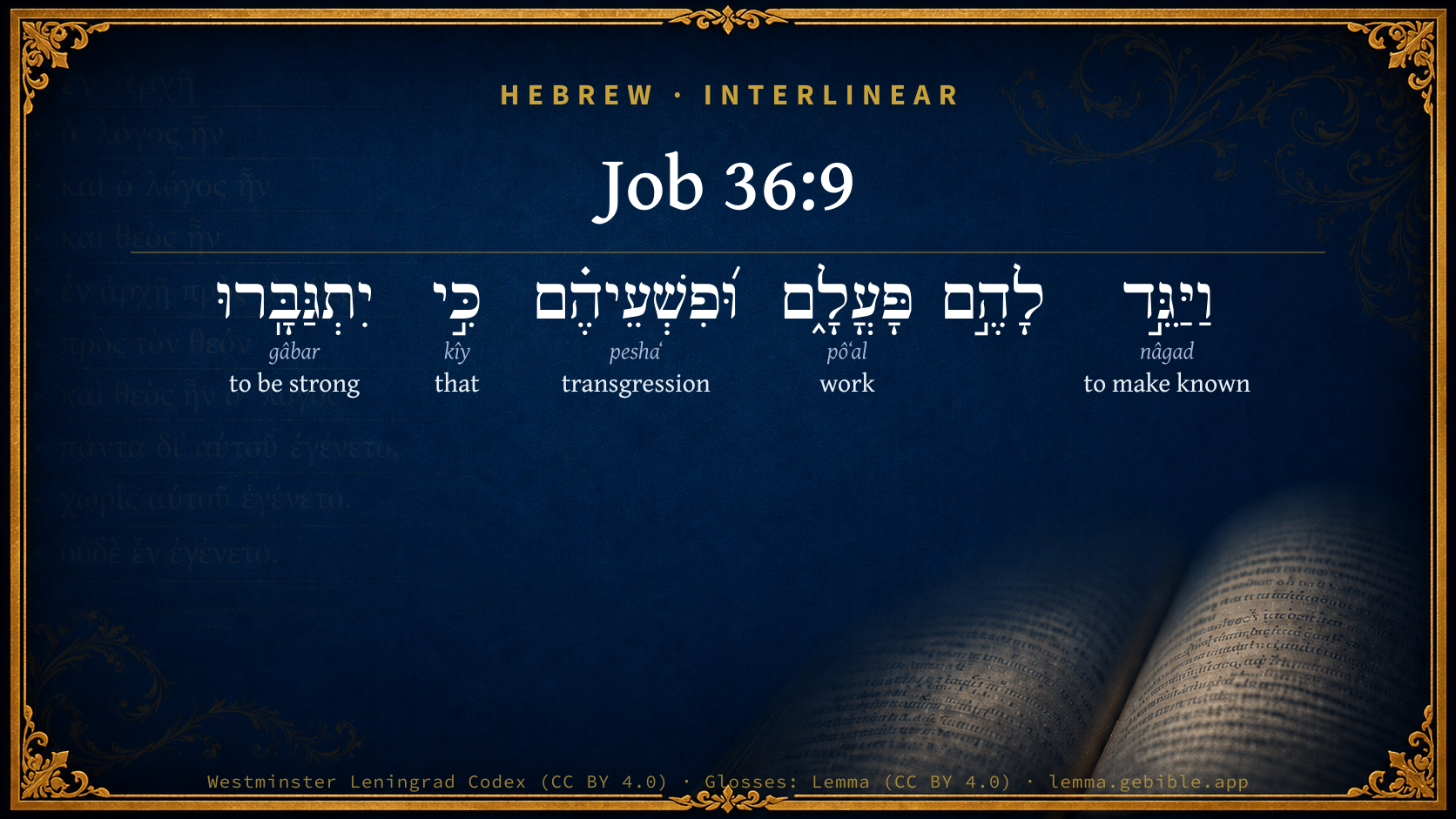
Job 36:9

Hebrew (Westminster Leningrad Codex) Job 36:9 appears in the Hebrew Old Testament. The text above is from the Westminster Leningrad Codex. Each word links to its Strong’s number, a concise gloss, and parsing drawn from the Open Scriptures Hebrew Bible morphology. Click any word for its full Brown-Driver-Briggs (BDB) entry.
Download image
Cite this verse

Job 36:9 (World English Bible). Public Domain. Lemma interlinear Bible study tool, https://lemma.gebible.app/v/job/36/9.

Show BibTeX & RIS
BibTeX
RIS
English Translation
Then he shows them their work, And their transgressions, that they have behaved themselves proudly.
World English Bible · Public Domain
Download a study sheet

One document with this verse’s original text, its word-by-word gloss line, the meaning frame, cross-references with their text, attributed commentary, and full source and license credits — printable, and it pastes into notes with its structure intact.

This verse Autodidact and up

Study sheet (.html) Plain text (.txt)

A passage Seminary Student

Up to 50 verses in one chapter. A passage sheet keeps up to 6 commentary sources and 12 cross-references per verse, in the order this page ranks them, and says so on the sheet whenever that leaves anything out. Ask for a single verse and you get the Autodidact verse sheet above.

Everything on this page stays free to read, with no account — the sheet is a download of what is already on screen, not access to it.

Want to remove ads? Support Godless Engineer
Compare translations 3

The same verse in 3 English versions, stacked beneath the original-language interlinear above. Click any original word for its lexicon entry.

Each is an independent rendering of the whole verse — the interlinear is not word-aligned to these translations.

Highlighted words mark where these versions differ — a whole-verse word diff, not a word-by-word alignment.

  • World English Bible Public Domain
    Then he shows them their work, And their transgressions, that they have behaved themselves proudly.
  • King James Version Public Domain
    Then he sheweth them their work, and their transgressions that they have exceeded.
  • unfoldingWord Literal Text CC BY-SA 4.0
    then he declares to them their deeds and their transgressions, for they magnified themselves,

unfoldingWord Literal Text — © unfoldingWord, licensed CC BY-SA 4.0. Word-aligned USFM3 via Door43 (git.door43.org/unfoldingWord/en_ult).

Versions to compare (up to 4)

3 of 4 selected

Show all 18 translations

Every available English version of this verse, each an independent rendering of the whole verse.

  • World English Bible Public Domain
    Then he shows them their work, And their transgressions, that they have behaved themselves proudly.
  • Berean Standard Bible Public Domain
    then He tells them their deeds and how arrogantly they have transgressed.
  • Majority Standard Bible Public Domain
    then He tells them their deeds and how arrogantly they have transgressed.
  • King James Version Public Domain
    Then he sheweth them their work, and their transgressions that they have exceeded.
  • American Standard Version (1901) Public Domain
    Then he showeth them their work, And their transgressions, that they have behaved themselves proudly.
  • Revised Version (1885) Public Domain
    Then he sheweth them their work, and their transgressions, that they have behaved themselves proudly.
  • Geneva Bible (1599) Public Domain
    Then will he shewe them their worke and their sinnes, because they haue bene proude.
  • Douay-Rheims (1899) Public Domain
    He shall shew them their works, and their wicked deeds, because they have been violent.
  • Young's Literal Translation Public Domain
    Then He declareth to them their work, And their transgressions, Because they have become mighty,
  • Literal Standard Version CC BY-SA 4.0
    Then He declares to them their work, || And their transgressions, || Because they have become mighty,
  • Unlocked Literal Bible CC BY-SA 4.0
    then he reveals to them what they have done, and their transgressions and their pride.
  • unfoldingWord Literal Text CC BY-SA 4.0
    then he declares to them their deeds and their transgressions, for they magnified themselves,
  • Darby Bible Public Domain
    Then he sheweth them their work, and their transgressions, because they have increased.
  • World Messianic Bible Public Domain
    then he shows them their work, and their transgressions, that they have behaved themselves proudly.
  • Webster's Bible Public Domain
    Then he showeth them their work, and their transgressions that they have exceeded.
  • Free Bible Version CC BY-SA 4.0
    then he explains to them what they've done—their arrogant sins.
  • Bible in Basic English Public Domain
    Then he makes clear to them what they have done, even their evil works in which they have taken pride.
  • JPS Tanakh (1917) Public Domain
    Then He declareth unto them their work, and their transgressions, that they have behaved themselves proudly.

Literal Standard Version (2020), Covenant Press — licensed CC BY-SA 4.0. Text via the HelloAO Bible API (eBible.org). Unlocked Literal Bible (unfoldingWord) — licensed CC BY-SA 4.0. Text via the HelloAO Bible API (eBible.org). unfoldingWord Literal Text — © unfoldingWord, licensed CC BY-SA 4.0. Word-aligned USFM3 via Door43 (git.door43.org/unfoldingWord/en_ult). Free Bible Version, Dr. Jonathan Gallagher — licensed CC BY-SA 4.0. Text via the HelloAO Bible API (eBible.org).

Word by word

More ways to search: Search by grammar → Find every occurrence → Compare this word →

Practice this passage: Drill this verse → Learn its vocabulary →

יִתְגַּבָּֽרוּ
gâbar
H1396
“to be strong”
Verb, Hithpael, Imperfect, 3rd Person, Masculine, Plural
Part of Speech
Verb
Stem
Hithpael
Form
Imperfect
Person
3rd Person
Gender
Masculine
Number
Plural
Full BDB Definition

Origin: a primitive root

TWOT: 310

to prevail, have strength, be strong, be powerful, be mighty, be great - (Qal) - to be strong, mighty - to prevail - (Piel) to make strong, strengthen - (Hiphil) - to confirm, give strength - to confirm (a covenant) - (Hithpael) - to show oneself mighty - to act proudly (toward God)
  1. וַיַּגֵּ֣ד nâgad H5046 “and · to make known” Conjunction + Verb, Hiphil, Sequential Imperfect, 3rd Person, Masculine, Singular
  2. פָּעֳלָ֑ם pôʻal H6467 “work · their” Noun, Common, Masculine, Singular, Construct + Suffix, Personal, 3rd Person, Masculine, Plural
  3. וּ֝פִשְׁעֵיהֶ֗ם peshaʻ H6588 “and · transgressions · their” Conjunction + Noun, Common, Masculine, Plural, Construct + Suffix, Personal, 3rd Person, Masculine, Plural
  4. כִּ֣י kîy H3588 “that” Conjunction

About this verse

These counts appear in no published source. They are computed here, from the morphology-tagged text and Lemma’s own curated glosses. What Lemma adds →

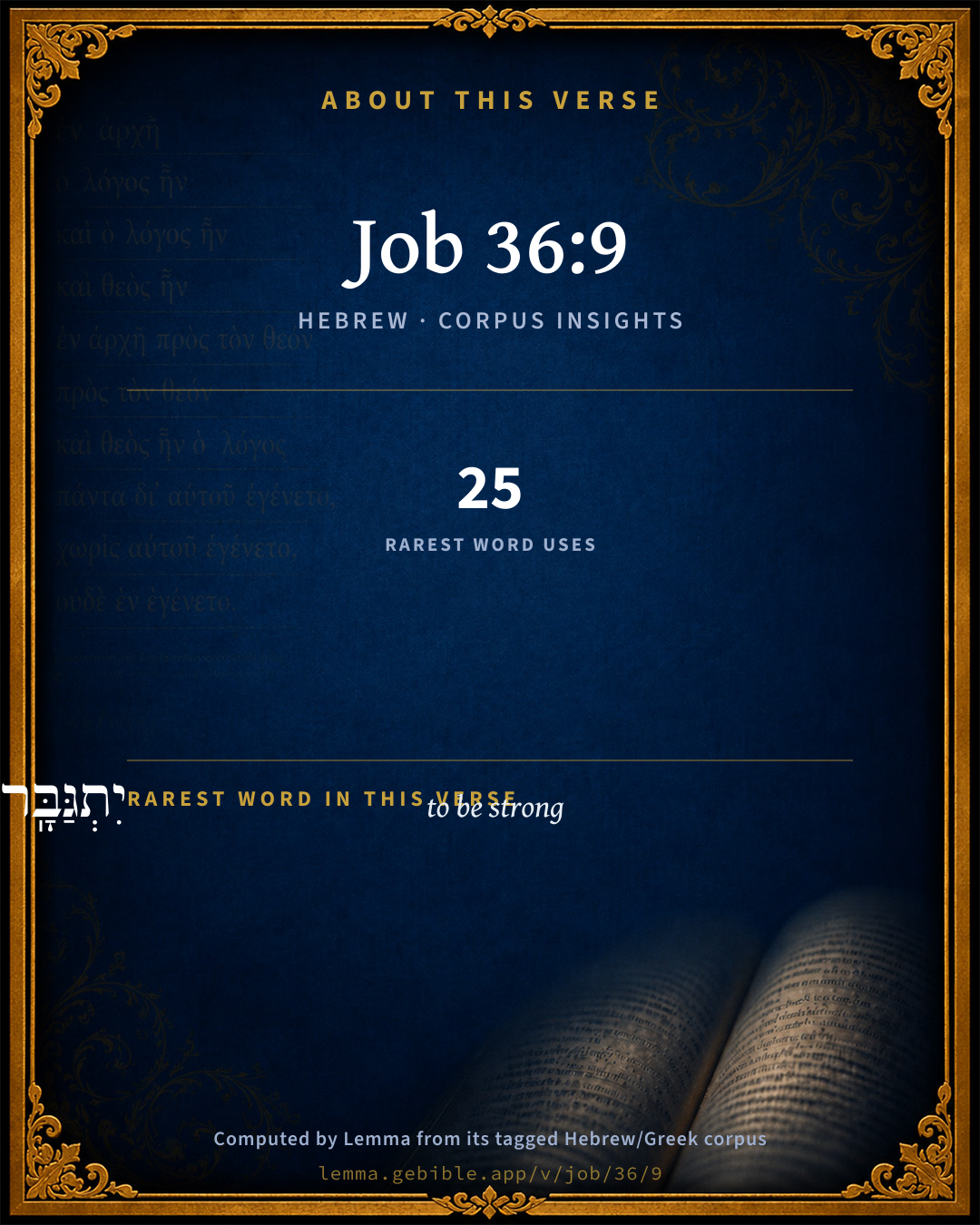
6
words
5
distinct lemmas
Wisdom
section

Notable vocabulary

The rarest word here is יִתְגַּבָּֽרוּ to be strong H1396 — appearing just 25 times in the whole Hebrew Bible.

Shared distinctive vocabulary

יִתְגַּבָּֽרוּ to be strong H1396 occurs in 24 verses of the Hebrew Bible. Also found in:

Grammatical profile

  • 2 verbs
  • 2 nouns
  • 1 preposition
  • 1 conjunction

Verb forms

  • וַיַּגֵּ֣ד Hiphil · Sequential Imperfect
  • יִתְגַּבָּֽרוּ Hithpael · Imperfect

Hebrew & Septuagint length

In English translation the verse runs 15 words from the Hebrew and 17 from the Septuagint (LXX English) — closely comparable.

A rough comparison of the two English renderings, which tokenize alike — not a word-level alignment.

Word counts can differ between the Hebrew and the Greek without any difference in meaning — e.g. the Hebrew direct-object marker אֵת has no separate Greek word, and Greek often adds the article ὁ.

Cross-references

15

Topical passages linked to Job 36:9 in the Treasury of Scripture Knowledge — connected by theme and wording, ordered by reader-vote popularity; previews shown in the World English Bible.

  • 1 Corinthians 11:32 But when we are judged, we are punished by the Lord, that we may not be condemned with the world.
  • Job 15:25 Because he has stretched out his hand against God, And behaves himself proudly against the Almighty;
  • Psalms 119:71 It is good for me that I have been afflicted, That I may learn your statutes.
  • Deuteronomy 4:21–22 Furthermore Yahweh was angry with me for your sakes, and swore that I should not go over the Jordan, and that I should not go in to that good land, which Yahweh your God gives you for an inheritance:
  • 2 Chronicles 33:11–13 Therefore Yahweh brought on them the captains of the host of the king of Assyria, who took Manasseh in chains, and bound him with fetters, and carried him to Babylon.
  • Job 10:2 I will tell God, 'Do not condemn me, Show me why you contend with me.
  • Psalms 5:10 Hold them guilty, God. Let them fall by their own counsels; Thrust them out in the multitude of their transgressions, For they have rebelled against you.
  • Psalms 94:12 Blessed is the man whom you discipline, Yah, And teach out of your law;
  • Psalms 119:67 Before I was afflicted, I went astray; But now I observe your word.
  • Isaiah 59:12 For our transgressions are multiplied before you, and our sins testify against us; for our transgressions are with us, and as for our iniquities, we know them:
  • Lamentations 3:39–40 Why does a living man complain, a man for the punishment of his sins?
  • Ezekiel 18:28–31 Because he considers, and turns away from all his transgressions that he has committed, he shall surely live, he shall not die.
  • Luke 15:17–19 But when he came to himself he said, 'How many hired servants of my father's have bread enough to spare, and I'm dying with hunger!
  • Romans 5:20 The law came in besides, that the trespass might abound; but where sin abounded, grace did abound more exceedingly;
  • 1 Timothy 1:15 The saying is faithful and worthy of all acceptance, that Christ Jesus came into the world to save sinners; of whom I am chief.

Cross-references courtesy of OpenBible.info (CC BY 4.0).

Hebrew and Greek witnesses Masoretic Hebrew ↔ Greek Septuagint

The same verse in the two great witnesses to the Old Testament, shown verse-for-verse.

These are two independent witnesses, not word-aligned to each other, and the Septuagint is shown in lemma (dictionary) form.

Hebrew Job 36:9 Masoretic · Westminster Leningrad Codex

וַיַּגֵּ֣ד לָהֶ֣ם פָּעֳלָ֑ם וּ֝פִשְׁעֵיהֶ֗ם כִּ֣י יִתְגַּבָּֽרוּ

Then he shows them their work, And their transgressions, that they have behaved themselves proudly.

World English Bible · Public Domain

Greek LXX Job 36:9 Septuagint · lemma form

καί ἀναἀγγέλλω αὐτός ὁ ἔργον αὐτός καί ὁ παράπτωμα αὐτός ὅτι ἰσχύω

And he shall recount to them their works, and their transgressions, for such will act with violence.

LXX2012 (modern English Septuagint) · Public Domain

Hebrew: Westminster Leningrad Codex (CC BY 4.0). Greek: Septuagint (public domain); English from LXX2012 (modern English Septuagint) (Public Domain). How the Septuagint differs from the Hebrew →

Commentary

Notes on Job 36:9 from classic Christian and Jewish commentators (each source and its license shown beneath its notes). The classic Christian expositions comment on the surrounding passage and are grouped to its opening verse, so a note may address several verses; the Jewish commentaries on the Tanakh (Rashi and others) are per-verse, so they appear only where the commentator wrote on this verse.

Lemma curates 59 commentaries, every one of them public domain or Creative Commons licensed, each selected and text-cleaned for this edition rather than reprinted as found. About our sources →

Trapp's Complete Commentary

John Trapp

Job 36:9 Then he sheweth them their work, and their transgressions that they have exceeded.

Ver. 9. Then he showeth them their work] By these sharp waters he cleareth up their eyesight, and gives them to see their sin, the mother of their misery. Vexatio dat intellectum, Smart makes wit. Manasseh, for instance, and the prodigal, and King Croesus, with his Nocumenta documenta, and Tullus Hostilius, with his excess of devotion, when once he had paid for his learning (Herodot. lib. 1. Liv. decad. 1, l. 5).

And their transgressions that they have exceeded] Heb. when they prevail; that before they grow too potent they may cast them away: Ne illi victi in Gehennam descendant, lest they hale them into hell (Mercer).

John Trapp, A Commentary or Exposition upon All the Books of the Old and New Testament (1647–1656) — public domain. Text from a community e-Sword module.

The Biblical Illustrator

Joseph S. Exell

Job_36:9

Then He sheweth them their work, and their transgression that they have exceeded.

Showing up our transgressions

I. General remarks on the text.

1. Sin is properly attributable to man. It is their work. If God suffers moral evil to exist, He is not the author of it. Satan may tempt, but cannot constrain to the commission of sin. The whole guilt of it lies upon the offender. It first exists as simple apprehension, is then approved, and, being conceived in the heart, it brings forth actual transgression, until it is finished in death.

2. It is the prerogative of God effectually to convince men of sin; or, to show unto them their work. No man ever saw his sinfulness in a proper light until it was thus discovered to him.

3. The Lord frequently imparts this knowledge in a season of affliction: then it shows unto men their work. It was in deep adversity that Job was made to possess the iniquities of his youth, to recollect what had been long forgotten, and to feel the burden of his guilt.

4. The knowledge of our sinfulness is necessary to true repentance, and to our believing in Christ for eternal life. Sorrow for sin, confessing and forsaking it, will be the immediate effect. An irreconcilable hatred to sin, and an earnest desire to have it mortified and subdued, will be the necessary consequence of a true conviction of its evil nature.

II. In what respects the Lord may be said to show unto men their transgressions.

1. He makes known to them the fact that they are sinners, and that their transgressions are their own.

2. The Lord convinces them not only of the fact, but also of the evil of sin, and causes them to repent of that, as well as of its consequences.

3. When persons are truly convinced Of sin, the Lord not only shows them their work end their transgression, but also that they have exceeded. They are made to see that they have sinned with a high hand. God employs various means, and accompanies them with various effects. God often renews the discovery of sin in our later experience. (B. Beddom,, M. A.)

The Biblical Illustrator, edited by Joseph S. Exell (c. 1880s–1900s) — public domain. Text from a community e-Sword module.

Geneva Bible (1599)

Geneva Bible translators

He will move their hearts to feel their sins that they may come to him by repentance as he did Manasseh.

Geneva Bible (1599) marginal notes — public domain. Text via Bolls.life.

Jamieson, Fausset & Brown

Robert Jamieson, A. R. Fausset & David Brown

work--transgression.

that . . . exceeded--"In that they behaved themselves mightily" (literally, "great"); that is, presumptuously, or, at least, self-confidently.

Jamieson, Fausset & Brown — Commentary Critical and Explanatory on the Whole Bible (1871) — public domain (CC PDM 1.0). Text via the HelloAO Bible API.

Adam Clarke's Commentary

Verse 9. He showeth them their work] He shows them the exceeding sinfulness of sin.

That they have exceeded.] יתגברו yithgabbaru, "that they have strengthened themselves," and did not trust in the living God; and therefore they would not help themselves when trouble came.

Adam Clarke's Commentary on the Bible (1810–1826) — public domain. Text from a community e-Sword/MySword module.

Ellicott's Commentary for English Readers

(9) Then he sheweth them their work.—The true nature of their conduct and their transgressions, that they have behaved themselves proudly. This is Elihu’s special doctrine, that God’s chastisements are by way of discipline, to reform the future rather than to chastise the past.

A Bible Commentary for English Readers, edited by Charles John Ellicott (1878–1897) — public domain. Text from a community e-Sword module.

The Cambridge Bible for Schools and Colleges

gen. ed. J. J. S. Perowne

9. that they have exceeded] Or, have dealt proudly, ch. Job_33:17.

9–10. The meaning of afflictions—they are a divine warning and stimulus to rouse men out of a sinful lethargy and bring their sin to their remembrance.

The Cambridge Bible for Schools and Colleges (gen. ed. J. J. S. Perowne; Cambridge University Press, 1878–1918) — public domain. Text from a community e-Sword module.

John Gill's Exposition

Then he showeth them their work,.... Either what they ought to do, so the Tigurine version; and which they have not done, their sins of omission; when they have been negligent either of the duty of prayer in private and public, or of attendance on the ordinances of the house of God; then he sends an affliction, and by it, as in a glass, presents to their view the omissions they have been guilty of: or else the work which they have done, and should not have done, their sins of commission: sin is a work at which some toil and labour, and weary themselves to commit; it is a work of the flesh; and so it is in good men; it is a man's own work, and which he can work of himself; to have a will, and to do good works, is owing to God working in his people, and it is through him strengthening them they do them; but sin fill works are their own act and deed, though tempted to them by others, and which they are able to do of their own freewill and power. Now God, in the glass of affliction, holds forth to view the sinful actions of good men, and brings them to their remembrance which they had forgotten; as the cases of Joseph's brethren, David, and others, prove: the Lord shows them that they have done such actions, and shows them the evil of them, how exceeding sinful they are; and humbles them under a sense of them, and brings them to repentance for them, and the acknowledgment of them; which sense is confirmed by the next clause, which explains what this their work is,

and their transgressions that they have exceeded. Sin is a transgression of the law, Jo1 3:4; every sin, greater or lesser, is, and even righteous persons are guilty of many; for there is not a just man that sinneth not; and these exceed the bounds set by the righteous law of God, and many of them are sadly aggravated by the light and knowledge, grace and mercy, such have been favoured with; and some of them, they are suffered to fall into, are exceeding great and exceeding sinful; such as those of David, Peter, and others; all which they are made to see, bewail, and weep over, when God by afflictions brings them to a sense of them. Or "when" or "because they have prevailed" (m); or begin to prevail: as soon as ever indwelling sin begins to be prevalent, the Lord is pleased to take measures to nip it in the bud, by sending a sharp and severe affliction; or when it has prevailed greatly, as sometimes it does, so that good is hindered from being done, and much evil is committed, then the soul is so much under the power of it, as to be carried captive with it; see Rom 7:23. Or "because they are become proud", or "behaved themselves proudly" (n); and therefore he afflicts them to humble them, and drive pride from them.

(m) "quum invalescunt", Mercerus; "quum invaluerunt", Munster, Piscator; so Drusius, Panginus, Bolducius. (n) "Quia superbierunt", Tigurine version; so Cocceius, Michaelis, Schultens.

John Gill's Exposition of the Whole Bible (1746–1763) — public domain (CC PDM 1.0). Text via the HelloAO Bible API.

Albert Barnes' Notes on the Bible

Then he showeth them their work - What their lives have been. This he does either by a messenger sent to them Job 33:23, or by their own reflections Job 33:27, or by the influences of his Spirit leading them to a proper review of their lives. The object of their affliction, Elihu says, is to bring them to see what their conduct has been, and to reform what has been amiss. It should not be interpreted either as proof that the afflicted are eminently wicked, as the friends of Job maintained, or as furnishing an occasion for severe reflections on the divine government, such as Job had indulged in. It is all consistent with an equitable and kind administration; with the belief that the afflicted have true piety - though they have wandered and erred; and with the conviction that God is dealing with them in mercy, and not in the severity of wrath. They need only recal the errors of their lives; humble themselves, and exercise true repentance, and they would find afflictions to be among even their richest blessings.

Transgressions that they have exceeded - Or, rather, “he shows them their transgressions that they have been very great”; that they have made themselves great, mighty, strong - יתגברוּ yitgâbarû. The idea is, that their transgressions had been allowed to accumulate, or to become strong, until it was necessary to interpose in this manner, and check them by severe affliction. All this was consistent, however, with the belief that the sufferer was truly pious and might find favor if he would repent.

Albert Barnes' Notes on the Bible (1834–1885) — public domain. Text from a community e-Sword/MySword module.

Haydock's Catholic Bible Commentary

Violent, while in power and on the throne, or because even in a private station, their will has risen up in rebellion against God. (Haydock) --- Poverty and afflictions are scourges, which are often inflicted by mercy, to bring us to a sense of duty. (Calmet)

George Leo Haydock (1774–1849), Haydock's Catholic Family Bible and Commentary, 1859 edition — public domain. Excludes Psalms (Douay-Rheims chapter numbering differs from Protestant) and Deuterocanonical books (Catholic canon only).

Matthew Poole's English Annotations

Their work, i.e. their evil works, as the next clause explains and limits it. By these afflictions he brings them to a sight of their sins and to repentance, which is the way and means of their recovery.

That they have exceeded; that they have greatly sinned by abusing their power and prosperity; which even good men are too prone to do.

Matthew Poole's English Annotations on the Holy Bible (1683–1685) — public domain. Text from a community e-Sword/MySword module.

Whedon's Commentary on the Bible

Daniel D. Whedon

9. That they have exceeded — The Authorized Version is ambiguous; the literal reading is, “They show themselves strong.” In other words, God declares to them that they act proudly, (against him;) — one of the dangers of extreme prosperity.

Daniel D. Whedon (gen. ed.), Commentary on the Old and New Testaments (1874–1909) — public domain. Text from a community e-Sword module.

The Pulpit Commentary

Then he sheweth them their work. God, by his chastisements, makes men see what has been faulty in their life"s work, in what respects they have been negligent, where they have lapsed into actual sin. Signal afflictions are a call to men to "consider their ways," and search out the nature of their offences. Some afflictions, as sickness and imprisonment, by depriving men of active employment, almost force them to engage in such a retrospect. And their transgressions that they have exceeded; rather, and their transgressions" wherein they have behaved themselves proudly (compare the Revised Version). In all sin, as it is a contempt of God"s Law, there is an element of pride. The temptation to pride especially besets those whose conduct is, in outward appearance, correct and virtuous.

The Pulpit Commentary (1880–1919), ed. H.D.M. Spence-Jones & Joseph S. Exell — public domain. Text from a community e-Sword module.

John Wesley's Explanatory Notes

Work - Their evil works, by these afflictions he brings them to a sight of their sins. Exceeded - That they have greatly sinned by abusing their power and prosperity; which even good men are too prone to do.

John Wesley, Explanatory Notes Upon the Whole Bible (1754–1765) — public domain. Text via the GEBible commentary corpus.

Rashi

Rabbi Shlomo Yitzchaki (Rashi)

He tells them their deed With these sufferings, He lets them know that they sinned before Him. All the words of Elihu were complete consolations and not chidings; i.e., do not worry about the sufferings if you are righteous, because they are for your good,

Rashi on the Tanakh — English translations: “The Judaica Press complete Tanach with Rashi, translated by A. J. Rosenberg” (CC BY 4.0); “Pentateuch with Rashi's commentary by M. Rosenbaum and A.M. Silbermann, 1929-1934” (public domain); “The Metsudah Tanach series, Lakewood, N.J” (CC BY 4.0); and “The Book of Joshua, Metsudah Publications, 1997” (CC BY 4.0). Text via Sefaria.

Lesson kit

Teaching starters — assembled from the data on this page, not authored interpretation. Every prompt links to the verse data it draws on. Edit before teaching.

Job, in the Wisdom, opens this verse with 6 words (5 distinct Hebrew lemmas). Its most distinctive word is gâbar (“to be strong”). A historical commentator’s framing appears above. Read the whole chapter for the surrounding context.

Discussion questions

  1. How does “to be strong” (gâbar) shape what this verse is saying?
  2. How does Genesis 7:18, which shares the word «to be strong», read alongside this verse?
  3. These translations render this verse differently. What is at stake in choosing one wording over another?
  4. «וַיַּגֵּ֣ד» is a Hiphil Sequential Imperfect verb. How does that grammatical form shape the action described?
  5. Compare how Trapp's Complete Commentary and The Biblical Illustrator read this verse. Where do they agree or differ?

Things to notice

Reading settings

Reading text

Shown beneath each verse's original-language words.

Old Testament
Old Testament edition

Read the OT as the Masoretic Hebrew (MT) or the Greek Septuagint (LXX).

English shown for the Greek Septuagint (in the Hebrew ↔ Greek comparison).

Comparing translations? Open the Compare panel on any verse page to stack up to four side by side.