Job 42:3

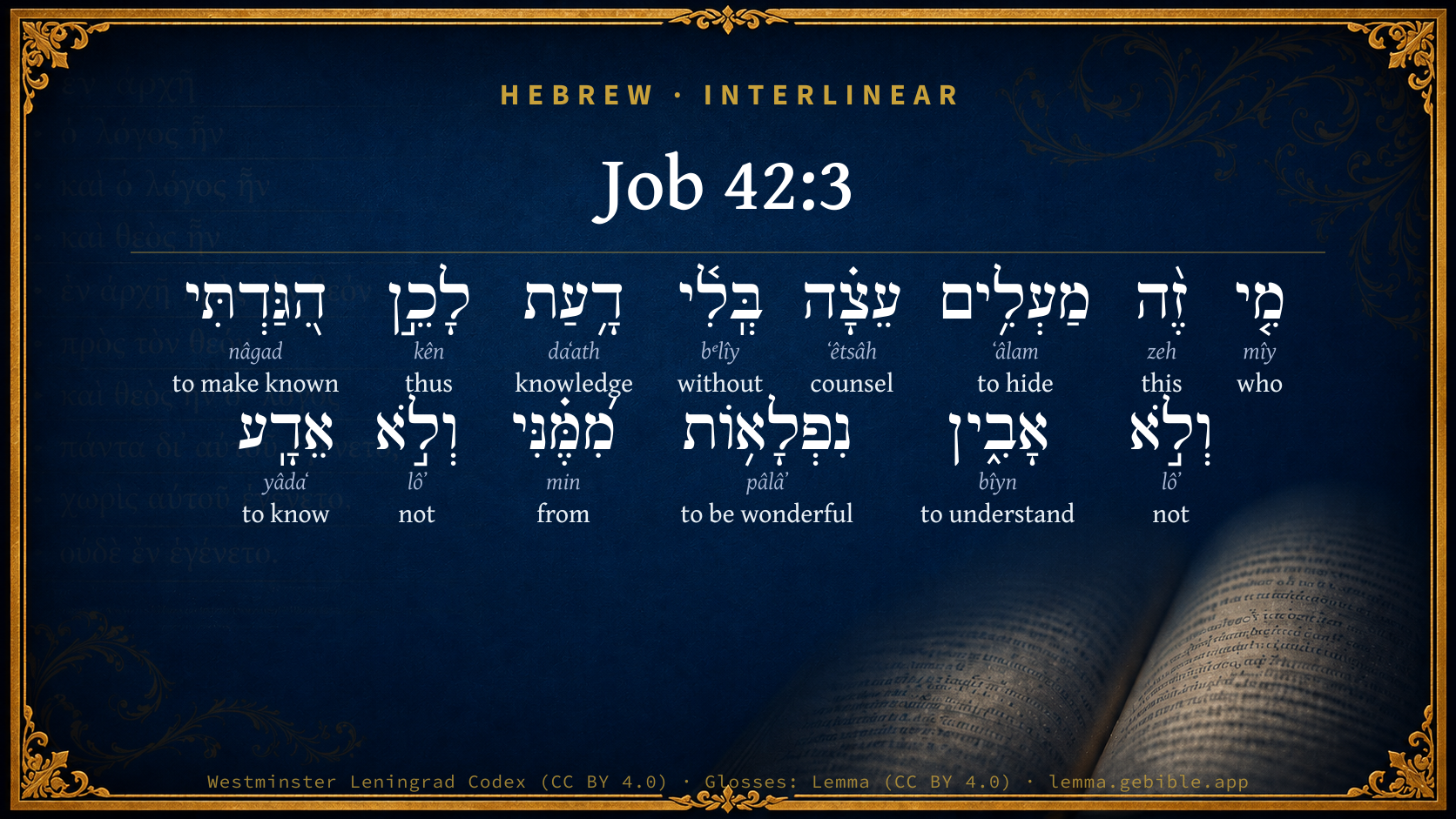
Hebrew (Westminster Leningrad Codex) Job 42:3 appears in the Hebrew Old Testament. The text above is from the Westminster Leningrad Codex. Each word links to its Strong’s number, a concise gloss, and parsing drawn from the Open Scriptures Hebrew Bible morphology. Click any word for its full Brown-Driver-Briggs (BDB) entry.
Download image
Cite this verse

Job 42:3 (World English Bible). Public Domain. Lemma interlinear Bible study tool, https://lemma.gebible.app/v/job/42/3.

Show BibTeX & RIS
BibTeX
RIS
English Translation
You asked, 'Who is this who hides counsel without knowledge?' Therefore I have uttered that which I did not understand, Things too wonderful for me, which I didn't know.
World English Bible · Public Domain
Download a study sheet

One document with this verse’s original text, its word-by-word gloss line, the meaning frame, cross-references with their text, attributed commentary, and full source and license credits — printable, and it pastes into notes with its structure intact.

This verse Autodidact and up

Study sheet (.html) Plain text (.txt)

A passage Seminary Student

Up to 50 verses in one chapter. A passage sheet keeps up to 6 commentary sources and 12 cross-references per verse, in the order this page ranks them, and says so on the sheet whenever that leaves anything out. Ask for a single verse and you get the Autodidact verse sheet above.

Everything on this page stays free to read, with no account — the sheet is a download of what is already on screen, not access to it.

Want to remove ads? Support Godless Engineer
Compare translations 3

The same verse in 3 English versions, stacked beneath the original-language interlinear above. Click any original word for its lexicon entry.

Each is an independent rendering of the whole verse — the interlinear is not word-aligned to these translations.

Highlighted words mark where these versions differ — a whole-verse word diff, not a word-by-word alignment.

  • World English Bible Public Domain
    You asked, 'Who is this who hides counsel without knowledge?' Therefore I have uttered that which I did not understand, Things too wonderful for me, which I didn't know.
  • King James Version Public Domain
    Who is he that hideth counsel without knowledge? therefore have I uttered that I understood not; things too wonderful for me, which I knew not.
  • unfoldingWord Literal Text CC BY-SA 4.0
    ‘Who is this, concealing counsel without knowledge?’ Therefore I have declared, but I did not understand, too wonderful for me, and I did not know.

unfoldingWord Literal Text — © unfoldingWord, licensed CC BY-SA 4.0. Word-aligned USFM3 via Door43 (git.door43.org/unfoldingWord/en_ult).

Versions to compare (up to 4)

3 of 4 selected

Show all 18 translations

Every available English version of this verse, each an independent rendering of the whole verse.

  • World English Bible Public Domain
    You asked, 'Who is this who hides counsel without knowledge?' Therefore I have uttered that which I did not understand, Things too wonderful for me, which I didn't know.
  • Berean Standard Bible Public Domain
    You asked, ‘Who is this who conceals My counsel without knowledge?’ Surely I spoke of things I did not understand, things too wonderful for me to know.
  • Majority Standard Bible Public Domain
    You asked, ‘Who is this who conceals My counsel without knowledge?’ Surely I spoke of things I did not understand, things too wonderful for me to know.
  • King James Version Public Domain
    Who is he that hideth counsel without knowledge? therefore have I uttered that I understood not; things too wonderful for me, which I knew not.
  • American Standard Version (1901) Public Domain
    Who is this that hideth counsel without knowledge? Therefore have I uttered that which I understood not, Things too wonderful for me, which I knew not.
  • Revised Version (1885) Public Domain
    Who is this that hideth counsel without knowledge? therefore have I uttered that which I understood not, things too wonderful for me, which I knew not.
  • Geneva Bible (1599) Public Domain
    Who is hee that hideth counsell without knowledge? therefore haue I spoken that I vnderstood not, euen things too wonderfull for me, and which I knew not.
  • Douay-Rheims (1899) Public Domain
    Who is this that hideth counsel without knowledge? Therefore I have spoken unwisely, and things that above measure exceeded my knowledge.
  • Young's Literal Translation Public Domain
    `Who `is' this, hiding counsel without knowledge?' Therefore, I have declared, and understand not, Too wonderful for me, and I know not.
  • Literal Standard Version CC BY-SA 4.0
    [You said], Who [is] this hiding counsel without knowledge? Therefore, I have declared, and do not understand, || Too wonderful for me, and I do not know.
  • Unlocked Literal Bible CC BY-SA 4.0
    'Who is this who without knowledge conceals plans?' Indeed, I have spoken things that I did not understand, things too difficult for me to understand, which I did not know about.
  • unfoldingWord Literal Text CC BY-SA 4.0
    ‘Who is this, concealing counsel without knowledge?’ Therefore I have declared, but I did not understand, too wonderful for me, and I did not know.
  • Darby Bible Public Domain
    Who is he that obscureth counsel without knowledge? therefore have I uttered what I did not understand; things too wonderful for me, which I knew not.
  • World Messianic Bible Public Domain
    You asked, ‘Who is this who hides counsel without knowledge?’ therefore I have uttered that which I didn’t understand, things too wonderful for me, which I didn’t know.
  • Webster's Bible Public Domain
    Who is he that hideth counsel without knowledge? therefore have I uttered that which I understood not; things too wonderful for me, which I knew not.
  • Free Bible Version CC BY-SA 4.0
    You asked, ‘Who is this who questions my wisdom by talking so ignorantly?’ I was speaking about things I didn't understand—things too wonderful for me to know.
  • Bible in Basic English Public Domain
    Who is this who makes dark the purpose of God by words without knowledge? For I have been talking without knowledge about wonders not to be searched out.
  • JPS Tanakh (1917) Public Domain
    Who is this that hideth counsel without knowledge? Therefore have I uttered that which I understood not, things too wonderful for me, which I knew not.

Literal Standard Version (2020), Covenant Press — licensed CC BY-SA 4.0. Text via the HelloAO Bible API (eBible.org). Unlocked Literal Bible (unfoldingWord) — licensed CC BY-SA 4.0. Text via the HelloAO Bible API (eBible.org). unfoldingWord Literal Text — © unfoldingWord, licensed CC BY-SA 4.0. Word-aligned USFM3 via Door43 (git.door43.org/unfoldingWord/en_ult). Free Bible Version, Dr. Jonathan Gallagher — licensed CC BY-SA 4.0. Text via the HelloAO Bible API (eBible.org).

Word by word

More ways to search: Search by grammar → Find every occurrence → Compare this word →

Practice this passage: Drill this verse → Learn its vocabulary →

מַעְלִ֥ים
ʻâlam
H5956
“hiding”
Verb, Hiphil, Participle Active, Masculine, Singular, Construct
Part of Speech
Verb
Stem
Hiphil
Form
Participle Active
Gender
Masculine
Number
Singular
State
Construct
Full BDB Definition

Origin: a primitive root

TWOT: 1629

to conceal, hide, be hidden, be concealed, be secret - (Qal) secret (participle) - (Niphal) - to be concealed - concealed, dissembler (participle) - (Hiphil) to conceal, hide - (Hithpael) to hide oneself
  1. מִ֤י mîy H4310 “who” Particle, Interrogative
  2. זֶ֨ה zeh H2088 “this” Pronoun, Demonstrative, Masculine, Singular
  3. עֵצָ֗ה ʻêtsâh H6098 “counsel” Noun, Common, Feminine, Singular, Absolute
  4. בְּֽלִ֫י bᵉlîy H1097 “without” Particle, Negative
  5. דָ֥עַת daʻath H1847 “knowledge” Noun, Common, Feminine, Singular, Absolute
  6. לָכֵ֣ן kên H3651 “to/for · thus” Preposition + Adverb
  7. הִ֭גַּדְתִּי nâgad H5046 “to make known” Verb, Hiphil, Perfect, 1st Person, Common, Singular
  8. וְלֹ֣א lôʼ H3808 “and · not” Conjunction + Particle, Negative
  9. אָבִ֑ין bîyn H995 “to understand” Verb, Qal, Imperfect, 1st Person, Common, Singular
  10. נִפְלָא֥וֹת pâlâʼ H6381 “being wonderful” Verb, Niphal, Participle Active, Feminine, Plural, Absolute
  11. מִ֝מֶּ֗נִּי min H4480 “from · me” Preposition + Suffix, Personal, 1st Person, Common, Singular
  12. וְלֹ֣א lôʼ H3808 “and · not” Conjunction + Particle, Negative
  13. אֵדָֽע yâdaʻ H3045 “to know” Verb, Qal, Imperfect, 1st Person, Common, Singular

About this verse

These counts appear in no published source. They are computed here, from the morphology-tagged text and Lemma’s own curated glosses. What Lemma adds →

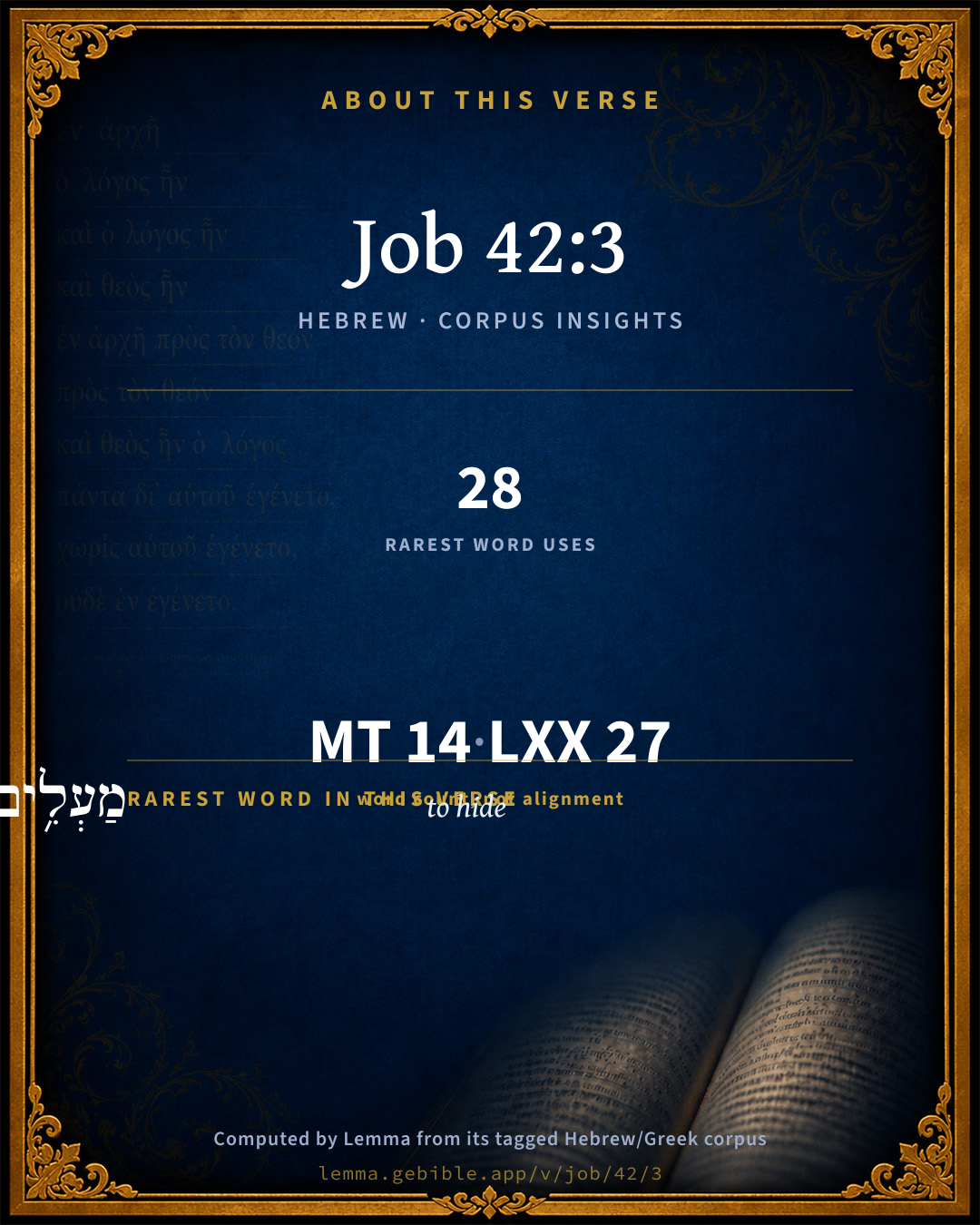
14
words
13
distinct lemmas
Wisdom
section

Shared distinctive vocabulary

מַעְלִ֥ים to hide H5956 occurs in 27 verses of the Hebrew Bible. Also found in:

Grammatical profile

  • 5 verbs
  • 2 nouns
  • 1 pronoun
  • 1 preposition
  • 1 adverb
  • 4 particles

Verb forms

  • מַעְלִ֥ים Hiphil · Participle Active
  • הִ֭גַּדְתִּי Hiphil · Perfect
  • אָבִ֑ין Qal · Imperfect
  • נִפְלָא֥וֹת Niphal · Participle Active
  • אֵדָֽע Qal · Imperfect

Repetition

A word recurs within this verse — often emphatic in Hebrew:

  • וְלֹ֣א not H3808 ×2

Hebrew & Septuagint length

In English translation the verse runs 29 words from the Hebrew and 39 from the Septuagint (LXX English) — closely comparable.

A rough comparison of the two English renderings, which tokenize alike — not a word-level alignment.

Word counts can differ between the Hebrew and the Greek without any difference in meaning — e.g. the Hebrew direct-object marker אֵת has no separate Greek word, and Greek often adds the article ὁ.

In the original languages it is 14 Hebrew tokens and 27 Greek tokens — but the two are counted differently (Hebrew bundles its prefixes and suffixes into one token; the Greek is in lemma form), so that isn’t a like-for-like length.

Cross-references

5

Topical passages linked to Job 42:3 in the Treasury of Scripture Knowledge — connected by theme and wording, ordered by reader-vote popularity; previews shown in the World English Bible.

  • Job 38:2 "Who is this who darkens counsel By words without knowledge?
  • Psalms 131:1 Yahweh, my heart isn't haughty, nor my eyes lofty; Nor do I concern myself with great matters, Or things too wonderful for me.
  • Psalms 139:6 This knowledge is beyond me. It's lofty. I can't attain it.
  • Psalms 40:5 Many, Yahweh, my God, are the wonderful works which you have done, And your thoughts which are toward us. They can't be set in order to you; If I would declare and speak of them, they are more than can be numbered.
  • Proverbs 30:2–4 "Surely I am the most ignorant man, And don't have a man's understanding.

Cross-references courtesy of OpenBible.info (CC BY 4.0).

Hebrew and Greek witnesses Masoretic Hebrew ↔ Greek Septuagint

The same verse in the two great witnesses to the Old Testament, shown verse-for-verse.

These are two independent witnesses, not word-aligned to each other, and the Septuagint is shown in lemma (dictionary) form.

Hebrew Job 42:3 Masoretic · Westminster Leningrad Codex

מִ֤י זֶ֨ה מַעְלִ֥ים עֵצָ֗ה בְּֽלִ֫י דָ֥עַת לָכֵ֣ן הִ֭גַּדְתִּי וְלֹ֣א אָבִ֑ין נִפְלָא֥וֹת מִ֝מֶּ֗נִּי וְלֹ֣א אֵדָֽע

You asked, 'Who is this who hides counsel without knowledge?' Therefore I have uttered that which I did not understand, Things too wonderful for me, which I didn't know.

World English Bible · Public Domain

Greek LXX Job 42:3 Septuagint · lemma form

τίς γάρ εἰμί ὁ κρύπτω σύ βουλή φείδομαι δέ ῥῆμα καί σύ οἴομαι κρύπτω τίς δέ ἀναἀγγέλλω ἐγώ ὅς οὐ οἶδα μέγας καί θαυμαστός ὅς οὐ ἐπιἵστημι

For who is he that hides counsel from you? or who keeps back his words, and thinks to hide them from you? and who will tell me what I knew not, great and wonderful things which I understood not?

LXX2012 (modern English Septuagint) · Public Domain

On this verse, Haydock's Catholic Bible Commentary discusses the Septuagint’s reading. Read the note in Commentary ↓

Hebrew: Westminster Leningrad Codex (CC BY 4.0). Greek: Septuagint (public domain); English from LXX2012 (modern English Septuagint) (Public Domain). How the Septuagint differs from the Hebrew →

Commentary

Notes on Job 42:3 from classic Christian and Jewish commentators (each source and its license shown beneath its notes). The classic Christian expositions comment on the surrounding passage and are grouped to its opening verse, so a note may address several verses; the Jewish commentaries on the Tanakh (Rashi and others) are per-verse, so they appear only where the commentator wrote on this verse.

Lemma curates 59 commentaries, every one of them public domain or Creative Commons licensed, each selected and text-cleaned for this edition rather than reprinted as found. About our sources →

Trapp's Complete Commentary

John Trapp

Job 42:3 Who [is] he that hideth counsel without knowledge? therefore have I uttered that I understood not; things too wonderful for me, which I knew not.

Ver. 3. Who is he that hideth counsel without knowledge?] Quis iste est, inquis. Who is he, saith thou, Job 38:2, that hideth counsel, &c., so Tremellius rendereth it. Is ego ipse sum, I am the very man that have done it, nempe ego (Tigurin.), and now would as gladly undo it again, by a humble confessing and disclaiming mine own folly therein, and by applying those words of thine to myself, with a holy indignation; for therein thou hast fully met with me, απογενομενοι, 1Pe 2:24.

Therefore have I uttered that I understood not] I have rashly and imprudently, yea, gracelessly and impudently, spoken of thy judgments, and desired to dispute with thee; daring to reprehend that which I did not comprehend, and to pass my verdict on things which I was not versed in, things too wouderful for me, which I knew not. Broughton reads thus, Therefore I tell that I had not understanding; that is, I confess I have sinned, but I did it ignorantly, Idcirco indico me non intellexisse (Merc.). And so he makes way to the ensuing petition, That God would hear him, and teach him better things.

John Trapp, A Commentary or Exposition upon All the Books of the Old and New Testament (1647–1656) — public domain. Text from a community e-Sword module.

Joseph Benson's Commentary

Job 42:3. Who is he that hideth counsel? — What am I, that I should be guilty of such madness? Therefore have I uttered that I understood not — Because my mind was without knowledge, therefore my speech was ignorant and foolish; things which I knew not — I have spoken foolishly and unadvisedly of things far above my reach. “The recollection of Job,” says Dr. Dodd, “in this and the two following verses, is inimitably fine, and begins the catastrophe of the book, which is truly worthy of what precedes. The interrogatory clause in the beginning of this verse is a repetition of what Jehovah had said; the latter part of this verse, and the fourth and fifth verses, are Job’s conclusions.”

Joseph Benson's Commentary on the Old and New Testaments (1811–1818) — public domain. Text from a community e-Sword module.

Geneva Bible (1599)

Geneva Bible translators

I confess herein mine ignorance, and that I spake I wist not what.

Is there any but I? for this God laid to his charge, Job 38:2.

Geneva Bible (1599) marginal notes — public domain. Text via Bolls.life.

Jamieson, Fausset & Brown

Robert Jamieson, A. R. Fausset & David Brown

I am the man! Job in God's own words (Job 38:2) expresses his deep and humble penitence. God's word concerning our guilt should be engraven on our hearts and form the groundwork of our confession. Most men in confessing sin palliate rather than confess. Job in omitting "by words" (Job 38:2), goes even further than God's accusation. Not merely my words, but my whole thoughts and ways were "without knowledge."

too wonderful--I rashly denied that Thou hast any fixed plan in governing human affairs, merely because Thy plan was "too wonderful" for my comprehension.

Jamieson, Fausset & Brown — Commentary Critical and Explanatory on the Whole Bible (1871) — public domain (CC PDM 1.0). Text via the HelloAO Bible API.

Adam Clarke's Commentary

Verse 3. Who is he that hideth counsel] These are the words of Job, and they are a repetition of what Jehovah said, Job 38:2: "Who is this that darkeneth counsel by words without knowledge?" Job now having heard the Almighty's speech, and having received his reproof, echoes back his words: "Who is he that hideth counsel without knowledge Alas, I am the man; I have uttered what I understood not; things too wonderful for me, that I knew not.

God had said, Job 38:3: "Gird up now thy loins like a man; I will demand of thee, and answer thou me." In allusion to this, Job exclaims to his Maker, Job 42:4: "Hear, I beseech thee, and I will speak: I will ask of THEE, and declare THOU unto ME." I acknowledge my ignorance; I confess my foolishness and presumption; I am ashamed of my conduct; I lament my imperfections; I implore thy mercy; and beg thee to show me thy will, that I may ever think, speak, and do, what is pleasing in thy sight.

Things too wonderful] I have spoken of thy judgments, which I did not comprehend.

Adam Clarke's Commentary on the Bible (1810–1826) — public domain. Text from a community e-Sword/MySword module.

Ellicott's Commentary for English Readers

XLII.

(3) Who is he that hideth counsel?—It is quite obvious that the right way of understanding these verses is, as in Isa_63:1-6, after the manner of a dialogue, in which Job and the Lord alternately reply. “Who is this that hideth counsel without knowledge?” were the words with which God Himself joined the debate in Job_38:2; and therefore, unless we assign them to Him here also, we must regard them as quoted by Job, and applied reflectively to himself; but it is far better to consider them as part of a dialogue.

A Bible Commentary for English Readers, edited by Charles John Ellicott (1878–1897) — public domain. Text from a community e-Sword module.

The Cambridge Bible for Schools and Colleges

gen. ed. J. J. S. Perowne

3. who is he that hideth] That is, that obscures counsel. The words of the Almighty (ch. Job_38:2) echo through Job’s mind, and he repeats them, speaking of himself. The rest of the verse expands the idea of “obscuring counsel,” or states its consequence. As one that obscured counsel Job had uttered that which he understood not. The reference is to his former judgments regarding God’s operations in the world, and the rashness of his own language.

The Cambridge Bible for Schools and Colleges (gen. ed. J. J. S. Perowne; Cambridge University Press, 1878–1918) — public domain. Text from a community e-Sword module.

John Gill's Exposition

Hear, I beseech thee, and I will speak,.... Not in the manner he had before, complaining of God and justifying himself, but in a way of humble entreaty of favours of him, of confession of sin before him, and of acknowledgment of his wisdom, goodness, and justice in all his dealings with him, which before he arraigned;

I will demand of thee; or rather "I will make petition to thee", as Mr. Broughton renders it; humbly ask a favour, and entreat a gracious answer; for to demand is not so agreeable to the frame and temper of soul Job was now in;

and declare thou unto me; or make him know what he knew not; he now in ignorance applies to God, as a God of knowledge, to inform him in things he was in the dark about, and to increase what knowledge he had. He was now willing to take the advice of Elihu, and pursue it, Job 34:31.

John Gill's Exposition of the Whole Bible (1746–1763) — public domain (CC PDM 1.0). Text via the HelloAO Bible API.

Albert Barnes' Notes on the Bible

Who is he that hideth counsel without knowledge? - This is repeated from Job 38:2. As used there these are the words of the Almighty, uttered as a reproof of Job for the manner in which he had undertaken to explain the dealings of God; see the notes at that verse. As repeated here by Job, they are an acknowledgment of the truth of what is there implied, that “he” had been guilty of hiding counsel in this manner, and the repetition here is a part of his confession. He acknowledges that he “had” entertained and expressed such views of God as were in fact clothing the whole subject in darkness instead of explaining it. The meaning is, “Who indeed is it, as thou saidst, that undertakes to judge of great and profound purposes without knowledge? I am that presumptuous man? Ilgen.”

Therefore have I uttered that I understood not - I have pronounced an opinion on subjects altogether too profound for my comprehension. This is the language of true humility and penitence, and shows that Job had at heart a profound veneration for God, however much he had been led away by the severity of his sufferings to give vent to improper expressions. It is no uncommon thing for even good people to be brought to see that they have spoken presumptuously of God, and have engaged, in discussions and ventured to pronounce opinions on matters pertaining to the divine administration, that were wholly beyond their comprehension.

Albert Barnes' Notes on the Bible (1834–1885) — public domain. Text from a community e-Sword/MySword module.

Haydock's Catholic Bible Commentary

Who. Hebrew, "Who is he that hideth counsel without knowledge?" (Protestants) This seems to allude to the words of God, chap. xxxviii. 2. Each of my friends has only rendered the ways of Providence more obscure, and I myself have not perfectly understood them. (Haydock) --- Unwisely. See chap. xxxix. 35. (Worthington) (Du Hamel) --- Hebrew, "without knowledge, thing wonderful to me, which I knew not." (Haydock) --- Now I comprehend that thou didst not afflict me, but hast given me into the hands of the enemy, as thou wilt hereafter do others of the greatest virtue, that their patience may shine the brighter, and be rewarded. I need inquire no father, now I see thy design plainly, ver. 5. He does not accuse himself of any sin or false assertion, but acknowledges his infirmity in not having understood this before, ver. 6. (Houbigant) --- Septuagint, "I have been told what I knew not, things great and wonderful, of which I was not apprized." (Haydock) --- Who can deny God’s providence? (Du Hamel)

George Leo Haydock (1774–1849), Haydock's Catholic Family Bible and Commentary, 1859 edition — public domain. Excludes Psalms (Douay-Rheims chapter numbering differs from Protestant) and Deuterocanonical books (Catholic canon only).

Matthew Poole's English Annotations

Who is he? i.e. what am I, that I should dare to do so? Ah silly audacious wretch that I am, that I should be guilty of such madness!

That hideth counsel without knowledge; which words are repeated out of Job 38:2, where they are explained.

Therefore; because my mind was without knowledge, therefore my speech was ignorant and foolish. Or, being sensible of my ignorance and rashness, I think fit to make this humble and ingenuous confession.

Things too wonderful for me, which I knew not; I have spoken foolishly and unadvisedly of things far above my reach, even of God’s infinite and sovereign majesty, and of his deep and unsearchable counsels and providence.

Matthew Poole's English Annotations on the Holy Bible (1683–1685) — public domain. Text from a community e-Sword/MySword module.

Whedon's Commentary on the Bible

Daniel D. Whedon

3. Who is he… without knowledge — He repeats God’s reproof, (Job_38:2,) as if he would say, I am the man — the man of folly, arrogance, and sin, who measured himself with the Most High, and blasphemously arraigned his ways and dispensations. Or else, such is his confusion when overwhelmed with shame and contrition, that he fails in the expression of coherent thought. He repeats with variation, (to wit, the change of מחשׁיךְ, darkeneth, into מעלים, hideth, and the omission of bemillin, “with words,”) and perhaps automatically, the first words the voice of God uttered after the storm. The reader may be reminded of the confusion of Elihu at the commencement of his first address. See Job_32:6 and p. 198. Schultens calls this reply of Job “graceful and weighty,” (venusta ac gravis,) and regards it as an acknowledgment which honours God by the use of his own language in such a manner as to turn the divine reproof into a confession on Job’s part of ignorance, and even intentional perverseness, which seems to be implied in מעלים, a word which he (Schultens) regards as more reverential. For a similar repetition, implying condemnation, see Num_16:3; Num_16:7, in which Moses repeats the words of the sons of Levi, “too much upon you.”

Daniel D. Whedon (gen. ed.), Commentary on the Old and New Testaments (1874–1909) — public domain. Text from a community e-Sword module.

The Pulpit Commentary

Who is he that hideth counsel without knowledge? As these are nearly the words of God in Job_38:2, some suppose that they must be his words again here, and imagine a short dialogue in this place between Job and the Almighty, assigning to Job ver. 2, the latter half of ver. 8, and the whole of vers. 5 and 6, while they assign to God ver. 4 and the first clause of ver. 8. But it is far more natural to regard Job as bringing up the words which God had spoken to him, to ponder on them and answer them, or at any rate to hang his reply upon them, than to imagine God twice interrupting Job in the humble confession that he was anxious to make. We must understand, then, after the word "knowledge," an ellipse of "thou sayest." Therefore have I uttered that I understood not. Therefore, because of that reproof of thine, I perceive that, in what I said to my friends, I "darkened counsel, I "uttered that I understood not," words which did not clear the matter in controversy, but obscured it. I dealt, in fact, with things too wonderful for me beyond my comprehensionwhich I knew not, of which I had no real knowledge, but only a semblance of knowledge, and on which, therefore, I had better have been silent.

The Pulpit Commentary (1880–1919), ed. H.D.M. Spence-Jones & Joseph S. Exell — public domain. Text from a community e-Sword module.

John Wesley's Explanatory Notes

Who - What am I that I should be guilty of such madness! Therefore - Because my mind was without knowledge. Knew not - I have spoken foolishly and unadvisedly of all things far above my reach.

John Wesley, Explanatory Notes Upon the Whole Bible (1754–1765) — public domain. Text via the GEBible commentary corpus.

Rashi

Rabbi Shlomo Yitzchaki (Rashi)

Who is this who concealed and covered the counsel and the wonders of the Holy One, blessed be He, without knowledge? I knew that everything is in Your hand to do, and so I related some of Your mighty deeds as were in my heart; as I knew [them].

but I did not understand But I did not understand so much, as You informed me, for many wonders are hidden and concealed from me, which I do not know.

Rashi on the Tanakh — English translations: “The Judaica Press complete Tanach with Rashi, translated by A. J. Rosenberg” (CC BY 4.0); “Pentateuch with Rashi's commentary by M. Rosenbaum and A.M. Silbermann, 1929-1934” (public domain); “The Metsudah Tanach series, Lakewood, N.J” (CC BY 4.0); and “The Book of Joshua, Metsudah Publications, 1997” (CC BY 4.0). Text via Sefaria.

Lesson kit

Teaching starters — assembled from the data on this page, not authored interpretation. Every prompt links to the verse data it draws on. Edit before teaching.

Job, in the Wisdom, opens this verse with 14 words (13 distinct Hebrew lemmas). Its most distinctive word is ʻâlam (“to hide”). A historical commentator’s framing appears above. Read the whole chapter for the surrounding context.

Discussion questions

  1. How does “to hide” (ʻâlam) shape what this verse is saying?
  2. Leviticus 4:13 shares the word «to hide» with this verse. How do the two illuminate each other?
  3. “not” occurs 2× in this one verse. What is the effect of the repetition?
  4. The translations on this page render this verse differently — a whole-verse word diff, not a word-by-word alignment. What might account for the different wordings?
  5. The verb «מַעְלִ֥ים» is Hiphil Participle Active. How does its form color the action?
  6. Reading how Trapp's Complete Commentary and Joseph Benson's Commentary read this verse, where do the two commentators agree and where do they part?

Things to notice

Reading settings

Reading text

Shown beneath each verse's original-language words.

Old Testament
Old Testament edition

Read the OT as the Masoretic Hebrew (MT) or the Greek Septuagint (LXX).

English shown for the Greek Septuagint (in the Hebrew ↔ Greek comparison).

Comparing translations? Open the Compare panel on any verse page to stack up to four side by side.