Isaiah 46:10

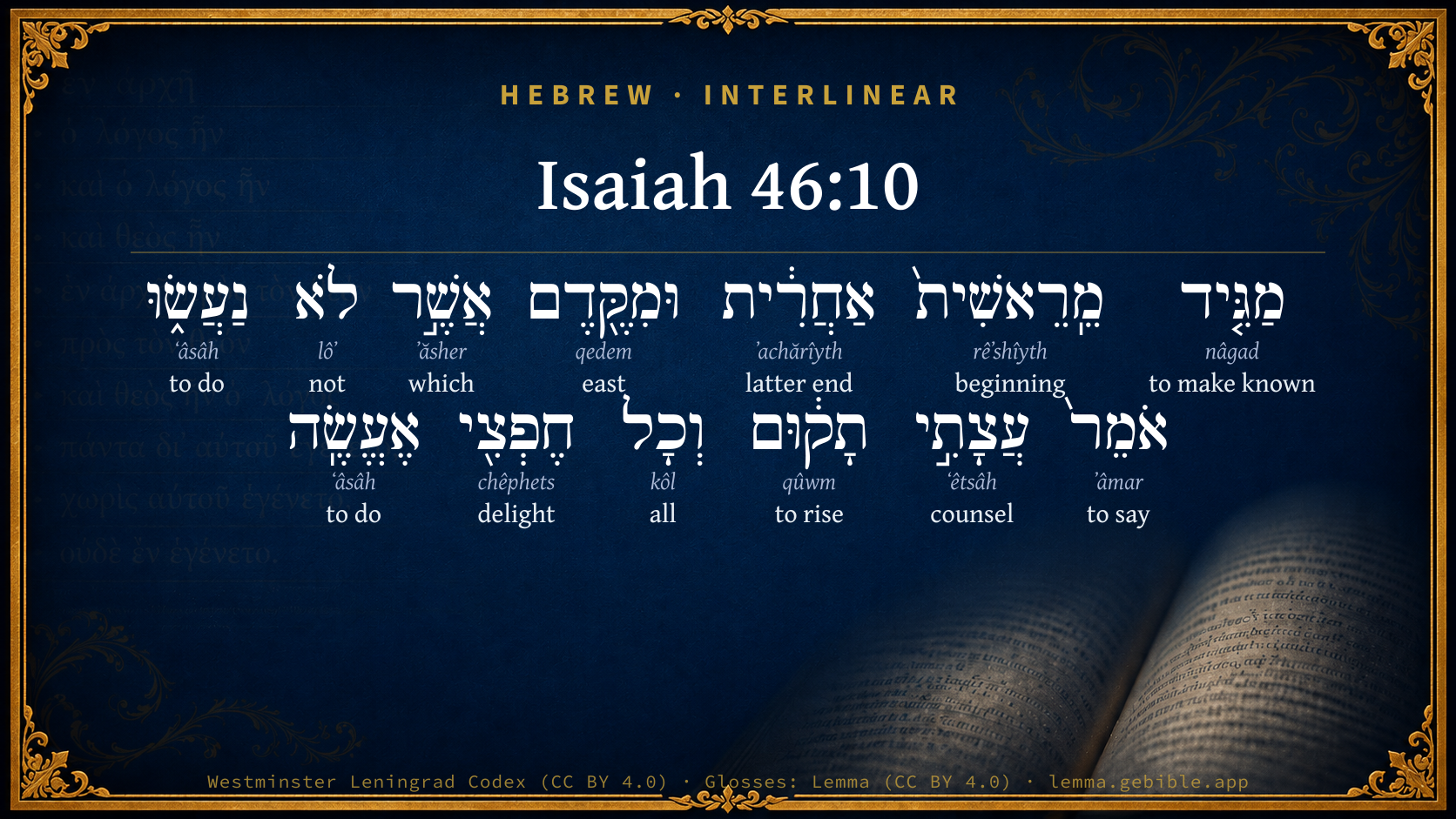
Hebrew (Westminster Leningrad Codex) Isaiah 46:10 appears in the Hebrew Old Testament. The text above is from the Westminster Leningrad Codex. Each word links to its Strong’s number, a concise gloss, and parsing drawn from the Open Scriptures Hebrew Bible morphology. Click any word for its full Brown-Driver-Briggs (BDB) entry.
Download image
Cite this verse

Isaiah 46:10 (World English Bible). Public Domain. Lemma interlinear Bible study tool, https://lemma.gebible.app/v/isaiah/46/10.

Show BibTeX & RIS
BibTeX
RIS
English Translation
declaring the end from the beginning, and from ancient times things that are not [yet] done; saying, My counsel shall stand, and I will do all my pleasure;
World English Bible · Public Domain
Download a study sheet

One document with this verse’s original text, its word-by-word gloss line, the meaning frame, cross-references with their text, attributed commentary, and full source and license credits — printable, and it pastes into notes with its structure intact.

This verse Autodidact and up

Study sheet (.html) Plain text (.txt)

A passage Seminary Student

Up to 50 verses in one chapter. A passage sheet keeps up to 6 commentary sources and 12 cross-references per verse, in the order this page ranks them, and says so on the sheet whenever that leaves anything out. Ask for a single verse and you get the Autodidact verse sheet above.

Everything on this page stays free to read, with no account — the sheet is a download of what is already on screen, not access to it.

Want to remove ads? Support Godless Engineer
Compare translations 3

The same verse in 3 English versions, stacked beneath the original-language interlinear above. Click any original word for its lexicon entry.

Each is an independent rendering of the whole verse — the interlinear is not word-aligned to these translations.

Highlighted words mark where these versions differ — a whole-verse word diff, not a word-by-word alignment.

  • World English Bible Public Domain
    declaring the end from the beginning, and from ancient times things that are not [yet] done; saying, My counsel shall stand, and I will do all my pleasure;
  • King James Version Public Domain
    Declaring the end from the beginning, and from ancient times the things that are not yet done, saying, My counsel shall stand, and I will do all my pleasure:
  • unfoldingWord Literal Text CC BY-SA 4.0
    declaring the end from the beginning, and from before, what have not been done, saying, ‘My counsel will stand, and all of my desire, I will do,’

unfoldingWord Literal Text — © unfoldingWord, licensed CC BY-SA 4.0. Word-aligned USFM3 via Door43 (git.door43.org/unfoldingWord/en_ult).

Versions to compare (up to 4)

3 of 4 selected

Show all 18 translations

Every available English version of this verse, each an independent rendering of the whole verse.

  • World English Bible Public Domain
    declaring the end from the beginning, and from ancient times things that are not [yet] done; saying, My counsel shall stand, and I will do all my pleasure;
  • Berean Standard Bible Public Domain
    I declare the end from the beginning, and ancient times from what is still to come. I say, ‘My purpose will stand, and all My good pleasure I will accomplish.’
  • Majority Standard Bible Public Domain
    I declare the end from the beginning, and from ancient times what is still to come. I say, ‘My purpose will stand, and all My good pleasure I will accomplish.’
  • King James Version Public Domain
    Declaring the end from the beginning, and from ancient times the things that are not yet done, saying, My counsel shall stand, and I will do all my pleasure:
  • American Standard Version (1901) Public Domain
    declaring the end from the beginning, and from ancient times things that are not `yet' done; saying, My counsel shall stand, and I will do all my pleasure;
  • Revised Version (1885) Public Domain
    declaring the end from the beginning, and from ancient times things that are not yet done; saying, My counsel shall stand, and I will do all my pleasure:
  • Geneva Bible (1599) Public Domain
    Which declare the last thing from the beginning: and from of olde, the things that were not done, saying, My counsell shall stand, and I will doe whatsoeuer I will.
  • Douay-Rheims (1899) Public Domain
    Who shew from the beginning the things that shall be at last, and from ancient times the things that as yet are not done, saying: My counsel shall stand, and all my will shall be done:
  • Young's Literal Translation Public Domain
    Declaring from the beginning the latter end, And from of old that which hath not been done, Saying, `My counsel doth stand, And all My delight I do.'
  • Literal Standard Version CC BY-SA 4.0
    Declaring the latter end from the beginning, || And from of old that which has not been done, || Saying, My counsel stands, || And all My delight I do.
  • Unlocked Literal Bible CC BY-SA 4.0
    I announce the end from the beginning, and beforehand what has not yet happened; I say, “My plan will happen, and I will do as I desire.”
  • unfoldingWord Literal Text CC BY-SA 4.0
    declaring the end from the beginning, and from before, what have not been done, saying, ‘My counsel will stand, and all of my desire, I will do,’
  • Darby Bible Public Domain
    declaring the end from the beginning, and from ancient times the things that are not yet done, saying, My counsel shall stand, and I will do all my pleasure;
  • World Messianic Bible Public Domain
    I declare the end from the beginning, and from ancient times things that are not yet done. I say: My counsel will stand, and I will do all that I please.
  • Webster's Bible Public Domain
    Declaring the end from the beginning, and from ancient times the things that are not yet done, saying, My counsel shall stand, and I will do all my pleasure:
  • Free Bible Version CC BY-SA 4.0
    I make known the end from the very beginning, declaring from ancient times what the future will bring. Whatever I plan will take place; I will accomplish everything I wish.
  • Bible in Basic English Public Domain
    Making clear from the first what is to come, and from past times the things which have not so far come about; saying, My purpose is fixed, and I will do all my pleasure;
  • JPS Tanakh (1917) Public Domain
    Declaring the end from the beginning, and from ancient times things that are not yet done; saying: 'My counsel shall stand, and all My pleasure will I do';

Literal Standard Version (2020), Covenant Press — licensed CC BY-SA 4.0. Text via the HelloAO Bible API (eBible.org). Unlocked Literal Bible (unfoldingWord) — licensed CC BY-SA 4.0. Text via the HelloAO Bible API (eBible.org). unfoldingWord Literal Text — © unfoldingWord, licensed CC BY-SA 4.0. Word-aligned USFM3 via Door43 (git.door43.org/unfoldingWord/en_ult). Free Bible Version, Dr. Jonathan Gallagher — licensed CC BY-SA 4.0. Text via the HelloAO Bible API (eBible.org).

Word by word

More ways to search: Search by grammar → Find every occurrence → Compare this word →

Practice this passage: Drill this verse → Learn its vocabulary →

חֶפְצִ֖י
chêphets
H2656
“delight · my”
Noun, Common, Masculine, Singular, Construct + Suffix, Personal, 1st Person, Common, Singular
Part of Speech
Noun
Type
Common
Gender
Masculine
Number
Singular
State
Construct
Full BDB Definition

Origin: from H2654

TWOT: 712b

delight, pleasure - delight - desire, longing - the good pleasure - that in which one takes delight
  1. מַגִּ֤יד nâgad H5046 “making known” Verb, Hiphil, Participle Active, Masculine, Singular, Absolute
  2. מֵֽרֵאשִׁית֙ rêʼshîyth H7225 “from · beginning” Preposition + Noun, Common, Feminine, Singular, Absolute
  3. אַחֲרִ֔ית ʼachărîyth H319 “latter end” Noun, Common, Feminine, Singular, Absolute
  4. וּמִקֶּ֖דֶם qedem H6924 “and · from · east” Conjunction + Preposition + Noun, Common, Masculine, Singular, Absolute
  5. אֲשֶׁ֣ר ʼăsher H834 “which” Particle, Relative
  6. לֹא lôʼ H3808 “not” Particle, Negative
  7. נַעֲשׂ֑וּ ʻâsâh H6213 “to do” Verb, Niphal, Perfect, 3rd Person, Common, Plural
  8. אֹמֵר֙ ʼâmar H559 “saying” Verb, Qal, Participle Active, Masculine, Singular, Absolute
  9. עֲצָתִ֣י ʻêtsâh H6098 “counsel · my” Noun, Common, Feminine, Singular, Construct + Suffix, Personal, 1st Person, Common, Singular
  10. תָק֔וּם qûwm H6965 “to rise” Verb, Qal, Imperfect, 3rd Person, Feminine, Singular
  11. וְכָל kôl H3605 “and · all of” Conjunction + Noun, Common, Masculine, Singular, Construct
  12. אֶעֱשֶֽׂה ʻâsâh H6213 “to do” Verb, Qal, Imperfect, 1st Person, Common, Singular

About this verse

These counts appear in no published source. They are computed here, from the morphology-tagged text and Lemma’s own curated glosses. What Lemma adds →

13
words
12
distinct lemmas
Prophets
section

Shared distinctive vocabulary

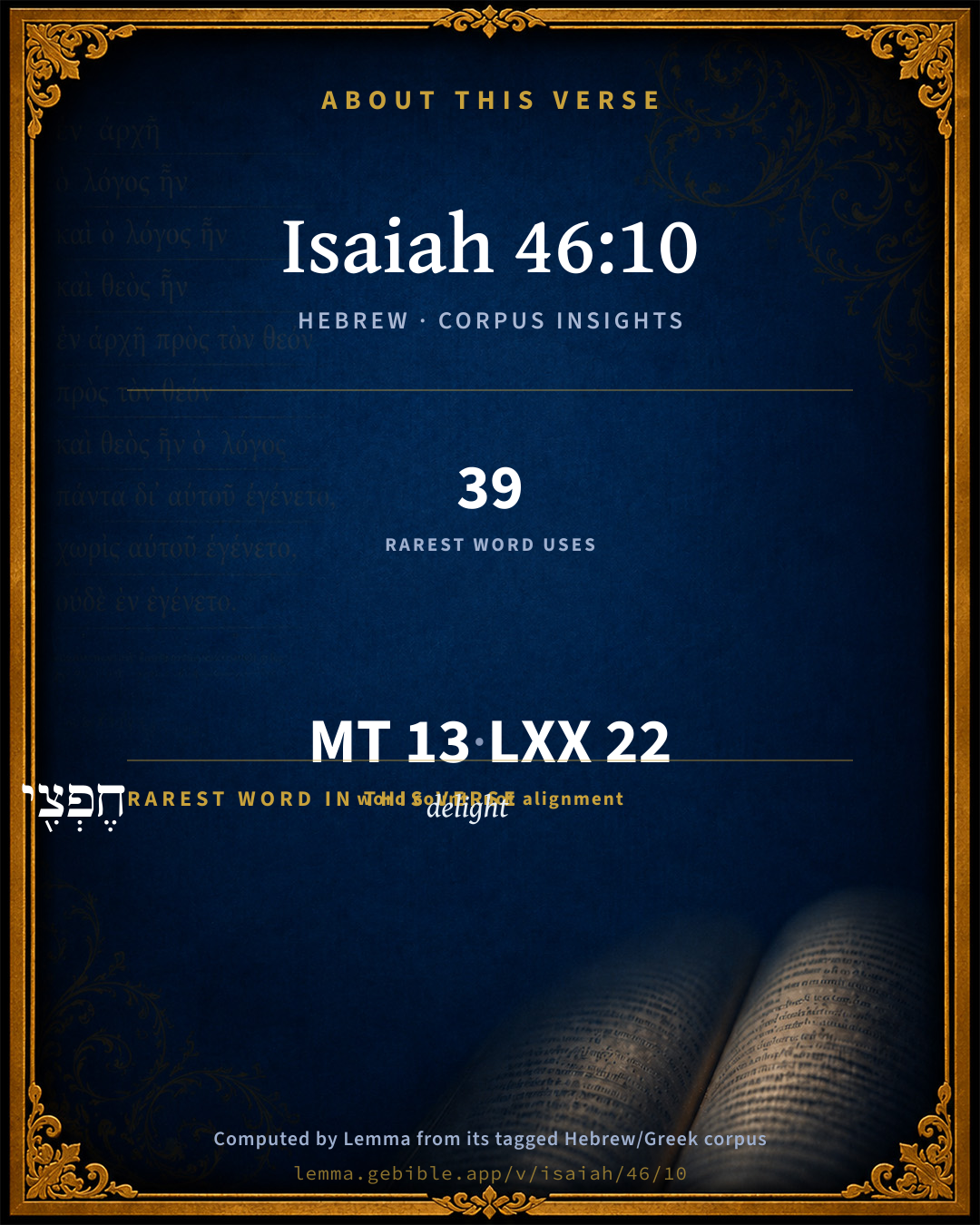
חֶפְצִ֖י delight H2656 occurs in 38 verses of the Hebrew Bible. Also found in:

Grammatical profile

  • 5 verbs
  • 6 nouns
  • 2 particles

Verb forms

  • מַגִּ֤יד Hiphil · Participle Active
  • נַעֲשׂ֑וּ Niphal · Perfect
  • אֹמֵר֙ Qal · Participle Active
  • תָק֔וּם Qal · Imperfect
  • אֶעֱשֶֽׂה Qal · Imperfect

Repetition

A word recurs within this verse — often emphatic in Hebrew:

  • נַעֲשׂ֑וּ to do H6213 ×2

Hebrew & Septuagint length

In English translation the verse runs 28 words from the Hebrew and 33 from the Septuagint (LXX English) — closely comparable.

A rough comparison of the two English renderings, which tokenize alike — not a word-level alignment.

Word counts can differ between the Hebrew and the Greek without any difference in meaning — e.g. the Hebrew direct-object marker אֵת has no separate Greek word, and Greek often adds the article ὁ.

In the original languages it is 13 Hebrew tokens and 22 Greek tokens — but the two are counted differently (Hebrew bundles its prefixes and suffixes into one token; the Greek is in lemma form), so that isn’t a like-for-like length.

Cross-references

24

Topical passages linked to Isaiah 46:10 in the Treasury of Scripture Knowledge — connected by theme and wording, ordered by reader-vote popularity; previews shown in the World English Bible.

  • Proverbs 19:21 There are many plans in a man's heart, But Yahweh's counsel will prevail.
  • Psalms 33:11 The counsel of Yahweh stands fast forever, The thoughts of his heart to all generations.
  • Ephesians 1:9–11 making known to us the mystery of his will, according to his good pleasure which he purposed in him
  • Isaiah 43:13 Yes, since the day was I am he; and there is none who can deliver out of my hand: I will work, and who can hinder it?
  • Proverbs 21:30 There is no wisdom nor understanding Nor counsel against Yahweh.
  • Isaiah 45:21 Declare you, and bring [it] forth; yes, let them take counsel together: who has shown this from ancient time? who has declared it of old? Haven't I, Yahweh? and there is no God else besides me, a just God and a Savior; there is no one besides me.
  • Psalms 135:6 Whatever Yahweh pleased, that he has done, In heaven and in earth, in the seas and in all deeps;
  • Isaiah 44:7 Who, as I, shall call, and shall declare it, and set it in order for me, since I established the ancient people? and the things that are coming, and that shall happen, let them declare.
  • Acts 5:39 But if it is of God, you will not be able to overthrow it, and you would be found even to be fighting against God!"
  • Isaiah 46:11 calling a ravenous bird from the east, the man of my counsel from a far country; yes, I have spoken, I will also bring it to pass; I have purposed, I will also do it.
  • Hebrews 6:17 In this way God, being determined to show more abundantly to the heirs of the promise the immutability of his counsel, interposed with an oath;
  • Daniel 4:35 All the inhabitants of the earth are reputed as nothing; and he does according to his will in the army of heaven, and among the inhabitants of the earth; and none can stay his hand, or tell him, What do you?
  • Acts 4:27–28 For truly, in this city against your holy servant, Jesus, whom you anointed, both Herod and Pontius Pilate, with the Gentiles and the people of Israel, were gathered together
  • Romans 11:33–34 Oh the depth of the riches both of the wisdom and the knowledge of God! How unsearchable are his judgments, and his ways past tracing out!
  • Genesis 49:10 The scepter will not depart from Judah, Nor the ruler's staff from between his feet, Until he comes to whom it belongs. To him will the obedience of the peoples be.
  • Numbers 24:17–24 I see him, but not now; I see him, but not near: There shall come forth a star out of Jacob, A scepter shall rise out of Israel, Shall strike through the corners of Moab, Break down all the sons of tumult.
  • Genesis 12:2–3 I will make of you a great nation. I will bless you, and make your name great. You will be a blessing.
  • Deuteronomy 4:24–31 For Yahweh your God is a devouring fire, a jealous God.
  • Acts 15:18 All his works are known to God from eternity.'
  • Genesis 3:15 I will put enmity between you and the woman, and between your offspring and her offspring. He will bruise your head, and you will bruise his heel."
  • Isaiah 41:22–23 Let them bring forth, and declare to us what shall happen: declare you the former things, what they are, that we may consider them, and know the latter end of them; or show us things to come.
  • Deuteronomy 28:15–68 But it shall come to pass, if you will not listen to the voice of Yahweh your God, to observe to do all his commandments and his statutes which I command you this day, that all these curses shall come on you, and overtake you.
  • Genesis 49:22–26 "Joseph is a fruitful vine, A fruitful vine by a spring; His branches run over the wall.
  • Acts 3:23 It will be, that every soul that will not listen to that prophet will be utterly destroyed from among the people.'

Cross-references courtesy of OpenBible.info (CC BY 4.0).

Hebrew and Greek witnesses Masoretic Hebrew ↔ Greek Septuagint

The same verse in the two great witnesses to the Old Testament, shown verse-for-verse.

These are two independent witnesses, not word-aligned to each other, and the Septuagint is shown in lemma (dictionary) form.

Hebrew Isaiah 46:10 Masoretic · Westminster Leningrad Codex

מַגִּ֤יד מֵֽרֵאשִׁית֙ אַחֲרִ֔ית וּמִקֶּ֖דֶם אֲשֶׁ֣ר לֹא נַעֲשׂ֑וּ אֹמֵר֙ עֲצָתִ֣י תָק֔וּם וְכָל חֶפְצִ֖י אֶעֱשֶֽׂה

declaring the end from the beginning, and from ancient times things that are not [yet] done; saying, My counsel shall stand, and I will do all my pleasure;

World English Bible · Public Domain

Greek LXX Isaiah 46:10 Septuagint · lemma form

ἀναἀγγέλλω πρότερον ὁ ἔσχατος πρίν αὐτός γίγνομαι καί ἅμα συντελέω καί εἶπον πᾶς ἐγώ ὁ βουλή ἵστημι καί πᾶς ὅσος βουλεύω ποιέω

telling beforehand the latter events before they come to pass, and they are accomplished together: and I said, all my counsel shall stand, and I will do all things that I have planned:

LXX2012 (modern English Septuagint) · Public Domain

Hebrew: Westminster Leningrad Codex (CC BY 4.0). Greek: Septuagint (public domain); English from LXX2012 (modern English Septuagint) (Public Domain). How the Septuagint differs from the Hebrew →

Targum (Aramaic paraphrase)

1

The Targum is the ancient Jewish Aramaic paraphrase of the Hebrew Scriptures — an interpretive translation, not the Hebrew text itself. Onkelos (literal) and Pseudo-Jonathan (expansive) render the Torah, and Jonathan the Prophets. Coverage is partial: where no permissively-licensed English translation exists for a verse, only the Aramaic is shown. This is verse-level text, not a word-by-word alignment to the Hebrew.

  1. Targum Jonathan Prophets (Joshua–Malachi)
    מְחַוֵי מִן אַוְלָא לְסוֹפָא וּמִלְקַדְמִין דְלָא אִתְעֲבִידָא אֲמַר מִלְכִי יִתְקַיֵם וְכָל רְעוּתִי אַעְבֵּד:

    Declaring the end from the beginning, and from ancient times the things that are not yet done, saying, My counsel shall stand, and I will do all my pleasure:

    Targum Jonathan — Aramaic: “Mikraot Gedolot” (public domain). English: “Sefaria Community Translation” (CC0 1.0 (public-domain dedication)); “London "Chaldee Paraphrase," 1871” (public domain). Text via Sefaria.

Commentary

Notes on Isaiah 46:10 from classic Christian and Jewish commentators (each source and its license shown beneath its notes). The classic Christian expositions comment on the surrounding passage and are grouped to its opening verse, so a note may address several verses; the Jewish commentaries on the Tanakh (Rashi and others) are per-verse, so they appear only where the commentator wrote on this verse.

Lemma curates 59 commentaries, every one of them public domain or Creative Commons licensed, each selected and text-cleaned for this edition rather than reprinted as found. About our sources →

Trapp's Complete Commentary

John Trapp

Isa 46:10 Declaring the end from the beginning, and from ancient times [the things] that are not [yet] done, saying, My counsel shall stand, and I will do all my pleasure:

Ver. 10. Declaring the end from the beginning.] This foretelling of things future is a precellency in God above idols that he much standeth upon.

I will do all my pleasure.] What God pleaseth to do, there is no question but he is able to do. But they are out who argue from God’s power to his will.

John Trapp, A Commentary or Exposition upon All the Books of the Old and New Testament (1647–1656) — public domain. Text from a community e-Sword module.

The Biblical Illustrator

Joseph S. Exell

Isa_46:10

Declaring the end from the beginning

God as a Worker

God is not a passive existent, resting idly in immensity.

He is essentially, incessantly, everlastingly active. He fainteth not, neither is weary. He has done wonderful things, and He will do wonders more. The text suggests four things in relation to God, as a Worker in the future.

I. HE KNOWS ALL THAT IS TO BE DONE IN THE FUTURE. Declaring the end from the beginning. When we embark in an enterprise, difficulties start up in our path that never entered into our calculation and baffle us. Not so with God. When He began the work of redemption, He saw all the infidelities, superstitions, depravities, devils, and hells that would oppose Him.

II. HE HAS REVEALED ALL THAT IS TO BE DONE IN THE FUTURE. Declaring, &c. Applying the words to redemption, He has declared in many a grand prophetic passage what will be its end, sweeping all wrongs and woes, all sins and sufferings, from this planet, and filling it with Christly virtues and heavenly blessedness. Yes, and more, peopling heaven with untold millions of souls. His declaration of the end is very explicit, very frequent, very encouraging.

III. HE WILL EXECUTE ALL THAT IS TO BE DONE IN THE FUTURE. My counsel shall stand. He will employ thousands of instrumentalities and ministries, but He will do it. They will work by His direction, and by His power. He will do it gradually and efficiently.

IV. HE HAS A PLEASURE IN ALL THAT IS TO BE DONE IN THE FUTURE. I will do all My pleasure. To re-create and re-paradise lost souls is His pleasure. He rejoices over repentant sinners. (Homilist.)

My counsel shall stand

Gods standing counsel

To form a plan and then to alter it, or to have a fixed plan and to fail in it, is one of the many sad imperfections of humanity. In the first ease, some new light springs up which was not evident before. In the second some difficulty arises, which, as a mountain, hinders the carrying out of the plan. But who can suppose any of this in God--a Being of Infinite Power? (Isa_40:15-17.) With Him thereis no difficulty. He is a Being of Infinite wisdom. Nothing escapes Him. The past, the present, the future are an everlasting now. Unchanged are His resolves, as His nature is unchangeable (Psa_33:11; Pro_19:21; Pro_21:30; Act_5:39; Heb_6:17).

I. THE DECLARATION.

1. We see this exemplified in the works of nature. Such is the regularity of all that the Great Mechanist is too usually lost sight of in the very machinery of His hands, as if it worked by its own power, regulated itself.

2. Still more distinctly do we see this declaration in the works of Providence. Wheel runs within wheel, but He is in every wheel, whatever its direction, whatever its movement. He is directly or indirectly in it. Look at Cyrus. Look at the history of Joseph. Look at Jesus Himself. (Act_2:23; Act_3:18; Act_4:26-28.)

3. But if He does all His pleasure in His works of creation and providence, how much more in the greater, infinitely greater displays of Himself in His grace, which is His glory! (2Ti_1:9.)

II. THE GROUND OF SUCH DECLARATION. I will do all My pleasure. It is His own work. True, He works by means, and most commonly by human instrumentality. But it is in all respects His own work.

1. The subject has an awful look upon any who have been trifling. My counsel shall stand, and I will do all My pleasure. Look at the fall. Look at the sin and sinfulness of this polluted world. These are but a fearful comment on My counsel shall stand. In the day that thou eatest thereof thou shalt surely die. By one man sin entered into the world, and death by sin. Look at the flood. Look at Babylon. Look at Jerusalem.

2. The subject is most encouraging to every returning sinner.

3. This is most consolatory to the tried saint.

4. Beware of any abuse of this great and glorious truth. If Gods counsel standeth fast, and He does all His pleasure, it is that God who delights in human instrumentality. (J. H. Evans, M.A.)

The Biblical Illustrator, edited by Joseph S. Exell (c. 1880s–1900s) — public domain. Text from a community e-Sword module.

Tyndale Open Study Notes

Tyndale Open Resources

46:10 God knows the future before it even happens; he has comprehensive control over all events, and all his acts match his words (41:4, 26). He is the First and the Last (44:6; 48:12).

Tyndale Open Study Notes — © Tyndale Open Resources, licensed CC BY-SA 4.0. Text via the HelloAO Bible API.

Jamieson, Fausset & Brown

Robert Jamieson, A. R. Fausset & David Brown

(Isa 45:21; Isa 41:22-23; Isa 44:26).

yet--not in the Hebrew. Translate, "What had not been done" [HORSLEY].

do all my pleasure-- (Isa 53:10; Rom 9:19).

Jamieson, Fausset & Brown — Commentary Critical and Explanatory on the Whole Bible (1871) — public domain (CC PDM 1.0). Text via the HelloAO Bible API.

The Cambridge Bible for Schools and Colleges

gen. ed. J. J. S. Perowne

10. the end from the beginning] i.e. the issue (of a particular series of events or period of history) from its origin.

the things that are not yet done] with closer reference to the events mentioned in Isa_46:11. Cf. ch Isa_48:5 (“before it has come to pass”).

My counsel shall stand] Cf. ch. Isa_14:24.

my pleasure] my purpose (see on ch. Isa_44:28).

The Cambridge Bible for Schools and Colleges (gen. ed. J. J. S. Perowne; Cambridge University Press, 1878–1918) — public domain. Text from a community e-Sword module.

John Gill's Exposition

Declaring the end from the beginning,.... The end of the Jewish state, both as a church, and a commonwealth, from the first settlement of it in the times of Moses, and by him, Deu 32:29. The end of the world, and all things in it, as early as the times of Enoch, the seventh from Adam, Jde 1:14. The end and issue of every event, at least of many very remarkable and momentous ones, before they came to pass; and particularly things relating to Christ, the beginning and end; the fulfilling end of the moral law for righteousness; the scope and design of the ceremonial law, to which that tended, and in which it issued; as well as the end of the whole Scripture, of the prophecies and promises of it: and this end was declared very early, and spoken of by all the prophets that were from the beginning of the world; and which is a full proof of the omniscience of God, and so of his true deity, Luk 1:70.

And from the ancient times the things that are not yet done; that were not at this time done, though they are since: such as the captivity of the Jews, and their return from it; also the incarnation of Christ, his obedience and sufferings, and the glory that should follow; his resurrection, ascension, and session at the right hand of God; the work of redemption by him; the effusion of the Spirit; the spread of the Gospel among the Gentiles, and their conversion; and others which are now not yet done; as the conversion of the Jews in the latter day, and the bringing in the fulness of the Gentiles; the glory of the church in those times as to knowledge, peace, purity, power, and authority; the destruction of antichrist; and the second coming of the Messiah; all which have been declared from ancient times; and as the former have been accomplished, there is reason to believe the latter will:

saying, my counsel shall stand; the purposes and decrees of God, which are within himself, wisely formed by him, eternal and not frustrable; and which shall stand, or be accomplished, being the counsels of him who is all wise, all knowing, all powerful, unchangeable, true, and faithful; whether they respect the providence of God in relation to the world in general, and the government of it, or to particular persons, and their affairs, from the time of their birth to their death; or whether they respect his grace and goodness in the salvation of men; such as his purpose according to election, the covenant of his grace, redemption by Christ, the effectual calling, and eternal glorification; all which, as they are according to the will and counsel of God; stand firm and sure, and shall have their full accomplishment; see Psa 33:11.

And I will do all my pleasure; as he has done in creation, and does in providence, so he has done, can do, and does in grace, in predestination and redemption, and in the effectual calling. And particularly this may refer to the deliverance of the Jews by Cyrus, a type of Christ, and deliverance by him, as follows:

John Gill's Exposition of the Whole Bible (1746–1763) — public domain (CC PDM 1.0). Text via the HelloAO Bible API.

Albert Barnes' Notes on the Bible

Declaring the end from the beginning - Foretelling accurately the course of future events. This is an argument to which God often appeals in proof that he is the only true God (see Isa 41:22-23; Isa 43:12; Isa 44:26).

My counsel shall stand - My purpose, my design, my will. The phrase ‘shall stand’ means that it shall be stable, settled, fixed, established. This proves:

1. That God has a purpose or plan in regard to human affairs. If he had not, he could not predict future events, since a contingent event cannot be foreknown and predicted; that is, it cannot be foretold that an event shall certainly occur in one way, when by the very supposition of its being contingent it may happen either that way, or some other way, or not at all.

2. That God’s plan will not be frustrated. He has power enough to secure the execution of his designs, and he will exert that power in order that all his plans may be accomplished. We may observe, also, that it is a matter of unspeakable joy that God has a plan, and that it will be executed. For

(1) If there were no plan in relation to human things, the mind could find no rest. If there was no evidence that One Mind presided over human affairs; that an infinitely wise plan had been formed, and that all things had been adjusted so as best to secure the ultimate accomplishment of that plan, everything would have the appearance of chaos, and the mind must be filled with doubts and distractions. But our anxieties vanish in regard to the apparent irregularities and disorders of the universe, when we feel that all things are under the direction of an Infinite Mind, and will be made to accomplish his plans, and further his great designs.

(2) If his plans were not accomplished, there would be occasion of equal doubt and dismay. If there was any power that could defeat the purposes of God; if there was any stubbornness of matter, or any inflexible perverseness in the nature of mind; if there were any unexpected and unforeseen extraneous causes that could interpose to thwart his plans, then the mind must be full of agitation and distress. But the moment it can fasten on the conviction that God has formed a plan that embraces all things, and that all things which occur will be in some way made tributary to that plan, that moment the mind can be calm in resignation to his holy will.

And I will do all my pleasure - I will accomplish all my wish, or effect all my desire. The word rendered here ‘pleasure’ (חפץ chepēts) means properly delight or pleasure 1Sa 15:22; Psa 1:2; Psa 16:3; Ecc 5:4; Ecc 12:10; then desire, wish, will Job 31:16; and then business, cause, affairs Isa 53:10. Here it means that God would accomplish everything which was to him an object of desire; everything which he wished, or willed. And why should he not? Who has power to hinder or prevent him Rom 9:19? And why should not we rejoice that he will do all that is pleasing to him? What better evidence have we that it is desirable that anything should be done, than that it is agreeable, or pleasing to God? What better security can we have that it is right, than that he wills it? What more substantial and permanent ground of rejoicing is there in regard to anything, than that it is such as God prefers, loves, and wills?

Albert Barnes' Notes on the Bible (1834–1885) — public domain. Text from a community e-Sword/MySword module.

Matthew Poole's English Annotations

Declaring the end from the beginning; foretelling from the beginning of the world, or from the beginning of your nation, those future events which should happen in succeeding ages, even to the end of the world, or to the end of your commonwealth; for such predictions we find delivered by Moses, the first founder of their commonwealth.

My counsel shall stand; as I will not, so no other power can, disappoint my purposes and predictions.

Matthew Poole's English Annotations on the Holy Bible (1683–1685) — public domain. Text from a community e-Sword/MySword module.

The Pulpit Commentary

Declaring the end from the beginning; i.e. "possessed of the very highest prophetic power, able to declare from the very beginnings of history its ultimate issues". (see Gen_3:15 Gen_16:12 Gen_21:18, etc.) My counsel; rather, my purpose, or my plan. (comp. Psa_33:11Jo Psa 23:13; and supra, Isa_14:24)

The goodness of God"s "pleasure.

"My counsel shall stand, and I will do all my pleasure." An anthropopathic expression. Care is necessary in transferring human sentiments and feelings to God. Words may come to be applied in such a way to men that they cannot be wisely used for God. A man"s "pleasure" has come to stand for his mere "self-willedness," his unreasoning and often unreasonable "wishes." A man"s "pleasure" is simply the thing that he "likes." In such senses we cannot properly apply such a word to God. In the text, the word "pleasure" is associated with the word "counsel," and the suggestion made is that the counsels of the infinite wisdom and goodness are such that God can find a personal pleasure in carrying them out. Just as he looked upon all his creation-work, called it good, and found pleasure in it, so he looks upon all the operations of his providence, for nations and individuals, and finds pleasure in watching them as they bear towards the final issue of universal good. It may be shown that every being finds its pleasure "after its kind," according to its nature; and we ought to have the utmost satisfaction in God"s getting his pleasure because of what we know of him. His pleasure must be like him, worthy of him; and that is enough.

I WHAT IS PLEASANT TO GOD MUST BE RIGHT. For men that is true which is expressed in the proverb, "Stolen waters are sweet, and bread eaten in secret is pleasant." Man finds his pleasure in that which is doubtful, and even in that which is wrong. But we have the most perfect confidence that God finds no pleasure in anything that is not through and through right. If he is well pleased, then we are sure that the thing is right. Indeed, so fixed is this relation between "God" and "right," that, for us, the right has come to be simply "God"s will.

II WHAT IS PLEASANT TO GOD MUST BE KIND. That is, it must have taken all due consideration of the well-being and the wishes of others; and it must involve a going out of God, as it were, beyond himself, to live in the feelings of others. The essence of pleasure is unselfish concern for others. And God may do all his "pleasure," because he proposes only that which secures our highest welfare. What may be spoken of as the highest pleasure God can know? We are assured that he has "no pleasure at all in the death of the wicked, but that he turn from his evil way and live." God"s supreme pleasure is found in redeeming; in all that this most suggestive and comprehensive word involves. "The Lord taketh pleasure in them that tear him, in those that hope in his mercy. R.T.

The Pulpit Commentary (1880–1919), ed. H.D.M. Spence-Jones & Joseph S. Exell — public domain. Text from a community e-Sword module.

John Wesley's Explanatory Notes

Declaring - Foretelling from the beginning of the world, future events which should happen in succeeding ages, even to the end of the world.

John Wesley, Explanatory Notes Upon the Whole Bible (1754–1765) — public domain. Text via the GEBible commentary corpus.

J. A. Alexander on Isaiah

Joseph Addison Alexander

“Declaring the last from the first”, or “the end from the beginning,” means declaring the whole series of events included between these extremes. “Thy counsel shall stand,” (i.e., my purpose shall be executed. (See Isa 7:7; Isa 8:10; Isa 14:24; Isa 44:26)). All the expressions of the ninth verse have occurred before in different combinations. (See Isa 42:14; Isa 43:18; Isa 45:21 etc.).

Joseph Addison Alexander, The Prophecies of Isaiah (1846–1847; New York: Scribner, 1870–1878) — public domain. Text from a community e-Sword module.

unfoldingWord translationNotes

Door43 World Missions Community

General Information:

Yahweh continues speaking to his people.

I announce the end from the beginning, and beforehand what has not yet happened

This basically repeats the same idea for emphasis. The verb from the first phrase may be supplied for the second. AT: "I announce the end from the beginning, and I announce beforehand what has not yet happened" (See: Parallelism and Ellipsis)

I call a bird of prey from the east

Yahweh speaks of Cyrus as if he were "a bird of prey." As a bird swiftly captures its prey, so Cyrus will swiftly accomplish Yahweh's purpose to conquer the nations. (See: Metaphor)

I have spoken; I will also accomplish it; I have purposed, I will also do it.

This repeats the same idea for emphasis. (See: Parallelism)

unfoldingWord translationNotes — © Distant Shores Media and the Door43 World Missions Community, licensed CC BY-SA 4.0. Source: git.door43.org/Door43/en_tn.

Rashi

Rabbi Shlomo Yitzchaki (Rashi)

[I] tell the end from the beginning The Egyptian exile and its redemption I announced in the Covenant between the Segments, before they came about.

Rashi on the Tanakh — English translations: “The Judaica Press complete Tanach with Rashi, translated by A. J. Rosenberg” (CC BY 4.0); “Pentateuch with Rashi's commentary by M. Rosenbaum and A.M. Silbermann, 1929-1934” (public domain); “The Metsudah Tanach series, Lakewood, N.J” (CC BY 4.0); and “The Book of Joshua, Metsudah Publications, 1997” (CC BY 4.0). Text via Sefaria.

Ibn Ezra

Rabbi Abraham ibn Ezra

Declaring the end from the beginning, that is, declaring the event before it happens; for who can annul my decree; my counsel stands for ever, and I will do all my pleasure.

Ibn Ezra on the Tanakh — English translations: “Sefaria Community Translation” (CC0 1.0 (public-domain dedication)); “Yalkut, Sifsei Chachomim Chumash, Metsudah Publications, 2009” (CC BY 4.0); and “Commentary of Ibn Ezra on Isaiah - trans. by M. Friedlander, 1873” (public domain). Text via Sefaria.

Lesson kit

Teaching starters — assembled from the data on this page, not authored interpretation. Every prompt links to the verse data it draws on. Edit before teaching.

Isaiah, in the Prophets, opens this verse with 13 words (12 distinct Hebrew lemmas). Its most distinctive word is chêphets (“delight”). A historical commentator’s framing appears above. Read the whole chapter for the surrounding context.

Discussion questions

  1. What does “delight” (chêphets) contribute to the verse as a whole?
  2. 1 Samuel 15:22 shares the word «delight» with this verse. How do the two illuminate each other?
  3. “to do” occurs 2× in this one verse. What is the effect of the repetition?
  4. The translations on this page render this verse differently — a whole-verse word diff, not a word-by-word alignment. What might account for the different wordings?
  5. The verb «מַגִּ֤יד» is Hiphil Participle Active. How does its form color the action?
  6. Reading how Trapp's Complete Commentary and The Biblical Illustrator read this verse, where do the two commentators agree and where do they part?

Things to notice

Reading settings

Reading text

Shown beneath each verse's original-language words.

Old Testament
Old Testament edition

Read the OT as the Masoretic Hebrew (MT) or the Greek Septuagint (LXX).

English shown for the Greek Septuagint (in the Hebrew ↔ Greek comparison).

Comparing translations? Open the Compare panel on any verse page to stack up to four side by side.