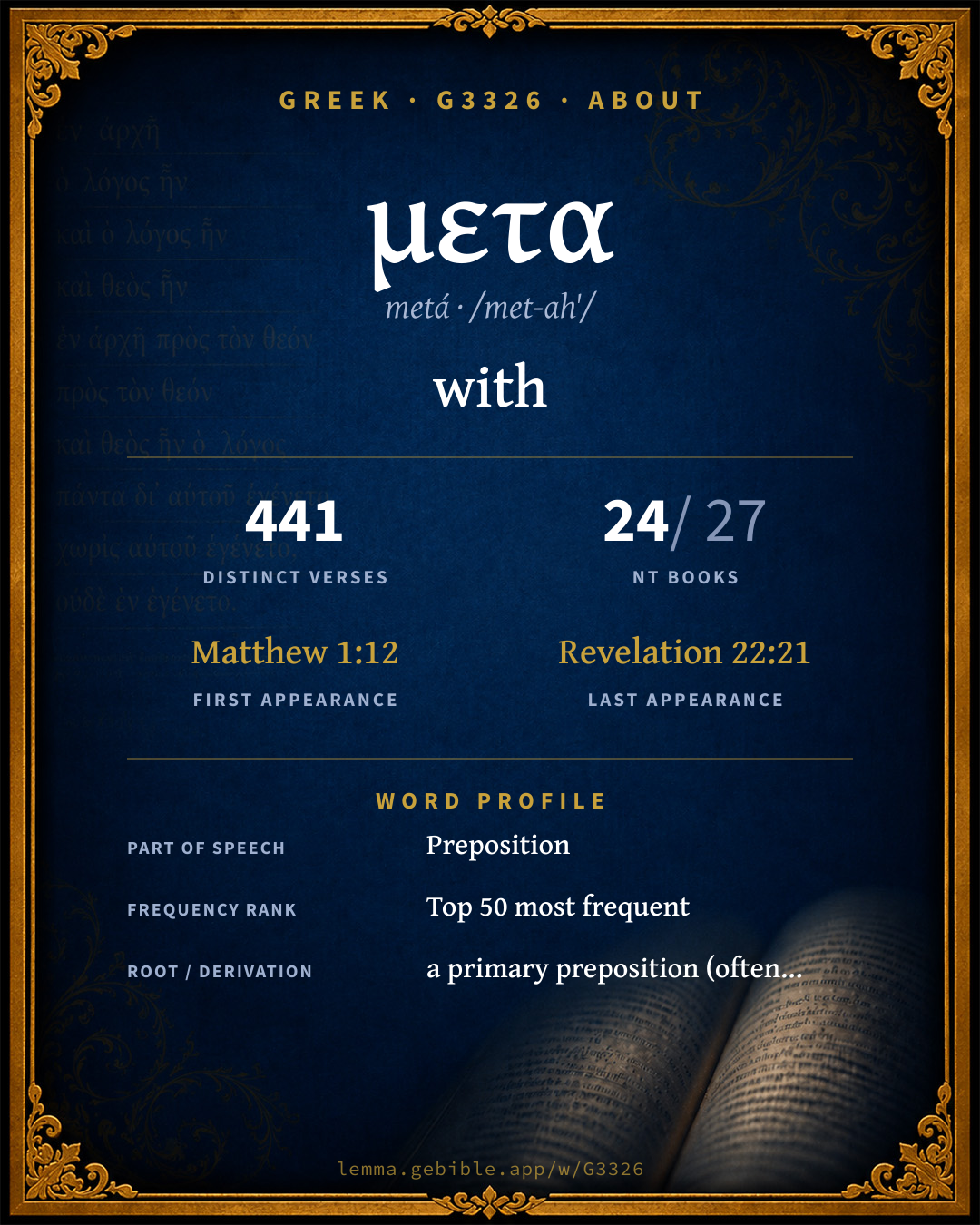
μετά
with
Full lexicon entry — Thayer's Greek Lexicon
From Thayer's Greek Lexicon
Where this word appears
Grammar key — what these labels mean
Part of speech
- Preposition
- A relational word governing a noun in a particular case.
Page 1 of 3 — showing verses 1–200 of 441 distinct verses where G3326 appears, across 24 books. Click any verse to open its interlinear word-by-word view. Verse text shown in the World English Bible for context — . Each verse’s Greek form is shown with its reference; the English is not keyword-highlighted, since the data carries no word-level English alignment. Use “Compare translations” on any verse to read it across multiple English versions. This concordance covers the Greek New Testament; Septuagint (Greek Old Testament) occurrences of this word are not indexed here.
Matthew 68 verses
- Matthew 1:12 μετὰ prep After the exile to Babylon, Jechoniah became the father of Shealtiel. Shealtiel became the father of Zerubbabel.
- Matthew 1:23 μεθ’ prep "Behold, the virgin shall be with child, And shall bring forth a son. They shall call his name Immanuel;" Which is, being interpreted, "God with us."
- Matthew 2:3 μετ’ prep When Herod the king heard it, he was troubled, and all Jerusalem with him.
- Matthew 2:11 μετὰ prep They came into the house and saw the young child with Mary, his mother, and they fell down and worshiped him. Opening their treasures, they offered to him gifts: gold, frankincense, and myrrh.
- Matthew 4:21 μετὰ prep Going on from there, he saw two other brothers, James the son of Zebedee, and John his brother, in the boat with Zebedee their father, mending their nets. He called them.
- Matthew 5:25 μετ’ prep Agree with your adversary quickly, while you are with him in the way; lest perhaps the prosecutor deliver you to the judge, and the judge deliver you to the officer, and you be cast into prison.
- Matthew 5:41 μετ’ prep Whoever compels you to go one mile, go with him two.
- Matthew 8:11 μετὰ prep I tell you that many will come from the east and the west, and will sit down with Abraham, Isaac, and Jacob in the Kingdom of Heaven,
- Matthew 9:11 μετὰ prep When the Pharisees saw it, they said to his disciples, "Why does your teacher eat with tax collectors and sinners?"
- Matthew 9:15 μετ’ prep Jesus said to them, "Can the friends of the bridegroom mourn, as long as the bridegroom is with them? But the days will come when the bridegroom will be taken away from them, and then they will fast.
- Matthew 12:3 μετ’ prep But he said to them, "Haven't you read what David did, when he was hungry, and those who were with him;
- Matthew 12:4 μετ’ prep how he entered into the house of God, and ate the show bread, which was not lawful for him to eat, neither for those who were with him, but only for the priests?
- Matthew 12:30 μετ’ μετ’ prep prep "He who is not with me is against me, and he who doesn't gather with me, scatters.
- Matthew 12:41 μετὰ prep The men of Nineveh will stand up in the judgment with this generation, and will condemn it, for they repented at the preaching of Jonah; and behold, someone greater than Jonah is here.
- Matthew 12:42 μετὰ prep The queen of the south will rise up in the judgment with this generation, and will condemn it, for she came from the ends of the earth to hear the wisdom of Solomon; and behold, someone greater than Solomon is here.
- Matthew 12:45 μεθ’ prep Then he goes, and takes with himself seven other spirits more evil than he is, and they enter in and dwell there. The last state of that man becomes worse than the first. Even so will it be also to this evil generation."
- Matthew 13:20 μετὰ prep What was sown on the rocky places, this is he who hears the word, and immediately with joy receives it;
- Matthew 14:7 μεθ’ prep Whereupon he promised with an oath to give her whatever she should ask.
- Matthew 15:30 μεθ’ prep Great multitudes came to him, having with them the lame, blind, mute, maimed, and many others, and they put them down at his feet. He healed them,
- Matthew 16:27 μετὰ prep For the Son of Man will come in the glory of his Father with his angels, and then he will render to everyone according to his deeds.
- Matthew 17:1 μεθ’ prep After six days, Jesus took with him Peter, James, and John his brother, and brought them up into a high mountain by themselves.
- Matthew 17:3 μετ’ prep Behold, Moses and Elijah appeared to them talking with him.
- Matthew 17:17 μεθ’ prep Jesus answered, "Faithless and perverse generation! How long will I be with you? How long will I bear with you? Bring him here to me."
- Matthew 18:16 μετὰ prep But if he doesn't listen, take one or two more with you, that at the mouth of two or three witnesses every word may be established.
- Matthew 18:23 μετὰ prep Therefore the Kingdom of Heaven is like a certain king, who wanted to reconcile accounts with his servants.
- Matthew 19:10 μετὰ prep His disciples said to him, "If this is the case of the man with his wife, it is not expedient to marry."
- Matthew 20:2 μετὰ prep When he had agreed with the laborers for a denarius a day, he sent them into his vineyard.
- Matthew 20:20 μετὰ prep Then the mother of the sons of Zebedee came to him with her sons, kneeling and asking a certain thing of him.
- Matthew 21:2 μετ’ prep saying to them, "Go into the village that is opposite you, and immediately you will find a donkey tied, and a colt with her. Untie them, and bring them to me.
- Matthew 22:16 μετὰ prep They sent their disciples to him, along with the Herodians, saying, "Teacher, we know that you are honest, and teach the way of God in truth, no matter who you teach, for you aren't partial to anyone.
- Matthew 24:29 μετὰ prep But immediately after the oppression of those days, the sun will be darkened, the moon will not give its light, the stars will fall from the sky, and the powers of the heavens will be shaken;
- Matthew 24:30 μετὰ prep and then the sign of the Son of Man will appear in the sky. Then all the tribes of the earth will mourn, and they will see the Son of Man coming on the clouds of the sky with power and great glory.
- Matthew 24:31 μετὰ prep He will send out his angels with a great sound of a trumpet, and they will gather together his chosen ones from the four winds, from one end of the sky to the other.
- Matthew 24:49 μετὰ prep and begins to beat his fellow-servants, and eat and drink with the drunken,
- Matthew 24:51 μετὰ prep and will cut him in pieces, and appoint his portion with the hypocrites; there is where the weeping and grinding of teeth will be.
- Matthew 25:3 μεθ’ prep Those who were foolish, when they took their lamps, took no oil with them,
- Matthew 25:4 μετὰ prep but the wise took oil in their vessels with their lamps.
- Matthew 25:10 μετ’ prep While they went away to buy, the bridegroom came, and those who were ready went in with him to the marriage feast, and the door was shut.
- Matthew 25:19 μετὰ μετ’ prep prep "Now after a long time the lord of those servants came, and reconciled accounts with them.
- Matthew 25:31 μετ’ prep "But when the Son of Man comes in his glory, and all the holy angels with him, then he will sit on the throne of his glory.
- Matthew 26:2 μετὰ prep "You know that after two days the Passover is coming, and the Son of Man will be delivered up to be crucified."
- Matthew 26:11 μεθ’ prep For you always have the poor with you; but you don't always have me.
- Matthew 26:18 μετὰ prep He said, "Go into the city to a certain person, and tell him, 'The Teacher says, "My time is at hand. I will keep the Passover at your house with my disciples."'"
- Matthew 26:20 μετὰ prep Now when evening had come, he was reclining at the table with the twelve disciples.
- Matthew 26:23 μετ’ prep He answered, "He who dipped his hand with me in the dish, the same will betray me.
- Matthew 26:29 μεθ’ prep But I tell you that I will not drink of this fruit of the vine from now on, until that day when I drink it anew with you in my Father's Kingdom."
- Matthew 26:32 μετὰ prep But after I am raised up, I will go before you into Galilee."
- Matthew 26:36 μετ’ prep Then Jesus came with them to a place called Gethsemane, and said to his disciples, "Sit here, while I go there and pray."
- Matthew 26:38 μετ’ prep Then he said to them, "My soul is exceedingly sorrowful, even to death. Stay here, and watch with me."
- Matthew 26:40 μετ’ prep He came to the disciples, and found them sleeping, and said to Peter, "What, couldn't you watch with me for one hour?
- Matthew 26:47 μετ’ μετὰ prep prep While he was still speaking, behold, Judas, one of the twelve, came, and with him a great multitude with swords and clubs, from the chief priest and elders of the people.
- Matthew 26:51 μετὰ prep Behold, one of those who were with Jesus stretched out his hand, and drew his sword, and struck the servant of the high priest, and struck off his ear.
- Matthew 26:55 μετὰ prep In that hour Jesus said to the multitudes, "Have you come out as against a robber with swords and clubs to seize me? I sat daily in the temple teaching, and you didn't arrest me.
- Matthew 26:58 μετὰ prep But Peter followed him from a distance, to the court of the high priest, and entered in and sat with the officers, to see the end.
- Matthew 26:69 μετὰ prep Now Peter was sitting outside in the court, and a maid came to him, saying, "You were also with Jesus, the Galilean!"
- Matthew 26:71 μετὰ prep When he had gone out onto the porch, someone else saw him, and said to those who were there, "This man also was with Jesus of Nazareth."
- Matthew 26:72 μετὰ prep Again he denied it with an oath, "I don't know the man."
- Matthew 26:73 μετὰ prep After a little while those who stood by came and said to Peter, "Surely you are also one of them, for your speech makes you known."
- Matthew 27:34 μετὰ prep They gave him sour wine to drink mixed with gall. When he had tasted it, he would not drink.
- Matthew 27:41 μετὰ prep Likewise the chief priests also mocking, with the scribes, the Pharisees, and the elders, said,
- Matthew 27:53 μετὰ prep and coming out of the tombs after his resurrection, they entered into the holy city and appeared to many.
- Matthew 27:54 μετ’ prep Now the centurion, and those who were with him watching Jesus, when they saw the earthquake, and the things that were done, feared exceedingly, saying, "Truly this was the Son of God."
- Matthew 27:62 μετὰ prep Now on the next day, which was the day after the Preparation Day, the chief priests and the Pharisees were gathered together to Pilate,
- Matthew 27:63 μετὰ prep saying, "Sir, we remember what that deceiver said while he was still alive: 'After three days I will rise again.'
- Matthew 27:66 μετὰ prep So they went with the guard and made the tomb secure, sealing the stone.
- Matthew 28:8 μετὰ prep They departed quickly from the tomb with fear and great joy, and ran to bring his disciples word.
- Matthew 28:12 μετὰ prep When they were assembled with the elders, and had taken counsel, they gave a large amount of silver to the soldiers,
- Matthew 28:20 μεθ’ prep teaching them to observe all things that I commanded you. Behold, I am with you always, even to the end of the age." Amen.
Mark 52 verses
- Mark 1:13 μετὰ prep He was there in the wilderness forty days tempted by Satan. He was with the wild animals; and the angels were ministering to him.
- Mark 1:14 Μετὰ prep Now after John was taken into custody, Jesus came into Galilee, preaching the Gospel of the Kingdom of God,
- Mark 1:20 μετὰ prep Immediately he called them, and they left their father, Zebedee, in the boat with the hired servants, and went after him.
- Mark 1:29 μετὰ prep Immediately, when they had come out of the synagogue, they came into the house of Simon and Andrew, with James and John.
- Mark 1:36 μετ’ prep Simon and those who were with him followed after him;
- Mark 2:16 μετὰ μετὰ prep prep The scribes and the Pharisees, when they saw that he was eating with the sinners and tax collectors, said to his disciples, "Why is it that he eats and drinks with tax collectors and sinners?"
- Mark 2:19 μετ’ μετ’ prep prep Jesus said to them, "Can the groomsmen fast while the bridegroom is with them? As long as they have the bridegroom with them, they can't fast.
- Mark 2:25 μετ’ prep He said to them, "Did you never read what David did, when he had need, and was hungry--he, and they who were with him?
- Mark 3:5 μετ’ prep When he had looked around at them with anger, being grieved at the hardening of their hearts, he said to the man, "Stretch out your hand." He stretched it out, and his hand was restored as healthy as the other.
- Mark 3:6 μετὰ prep The Pharisees went out, and immediately conspired with the Herodians against him, how they might destroy him.
- Mark 3:7 μετὰ prep Jesus withdrew to the sea with his disciples, and a great multitude followed him from Galilee, from Judea,
- Mark 3:14 μετ’ prep He appointed twelve, that they might be with him, and that he might send them out to preach,
- Mark 4:16 μετὰ prep These in like manner are those who are sown on the rocky places, who, when they have heard the word, immediately receive it with joy.
- Mark 4:36 μετ’ prep Leaving the multitude, they took him with them, even as he was, in the boat. Other small boats were also with him.
- Mark 5:18 μετ’ prep As he was entering into the boat, he who had been possessed by demons begged him that he might be with him.
- Mark 5:24 μετ’ prep He went with him, and a great multitude followed him, and they pressed upon him on all sides.
- Mark 5:37 μετ’ prep He allowed no one to follow him, except Peter, James, and John the brother of James.
- Mark 5:40 μετ’ prep They ridiculed him. But he, having put them all out, took the father of the child and her mother and those who were with him, and went in where the child was lying.
- Mark 6:25 μετὰ prep She came in immediately with haste to the king, and asked, "I want you to give me right now the head of John the Baptizer on a platter."
- Mark 6:50 μετ’ prep for they all saw him, and were troubled. But he immediately spoke with them, and said to them, "Cheer up! It is I! Don't be afraid."
- Mark 8:10 μετὰ prep Immediately he entered into the boat with his disciples, and came into the region of Dalmanutha.
- Mark 8:14 μεθ’ prep They forgot to take bread; and they didn't have more than one loaf in the boat with them.
- Mark 8:31 μετὰ prep He began to teach them that the Son of Man must suffer many things, and be rejected by the elders, the chief priests, and the scribes, and be killed, and after three days rise again.
- Mark 8:38 μετὰ prep For whoever will be ashamed of me and of my words in this adulterous and sinful generation, the Son of Man also will be ashamed of him, when he comes in the glory of his Father with the holy angels."
- Mark 9:2 μετὰ prep After six days Jesus took with him Peter, James, and John, and brought them up onto a high mountain privately by themselves, and he was changed into another form in front of them.
- Mark 9:8 μεθ’ prep Suddenly looking around, they saw no one with them any more, except Jesus only.
- Mark 9:31 μετὰ prep For he was teaching his disciples, and said to them, "The Son of Man is being handed over to the hands of men, and they will kill him; and when he is killed, on the third day he will rise again."
- Mark 10:30 μετὰ prep but he will receive one hundred times more now in this time, houses, brothers, sisters, mothers, children, and land, with persecutions; and in the age to come eternal life.
- Mark 10:34 μετὰ prep They will mock him, spit on him, scourge him, and kill him. On the third day he will rise again."
- Mark 11:11 μετὰ prep Jesus entered into the temple in Jerusalem. When he had looked around at everything, it being now evening, he went out to Bethany with the twelve.
- Mark 13:24 μετὰ prep But in those days, after that oppression, the sun will be darkened, the moon will not give its light,
- Mark 13:26 μετὰ prep Then they will see the Son of Man coming in clouds with great power and glory.
- Mark 14:1 μετὰ prep It was now two days before the feast of the Passover and the unleavened bread, and the chief priests and the scribes sought how they might sieze him by deception, and kill him.
- Mark 14:7 μεθ’ prep For you always have the poor with you, and whenever you want to, you can do them good; but you will not always have me.
- Mark 14:14 μετὰ prep and wherever he enters in, tell the master of the house, 'The Teacher says, "Where is the guest room, where I may eat the Passover with my disciples?"'
- Mark 14:17 μετὰ prep When it was evening he came with the twelve.
- Mark 14:18 μετ’ prep As they sat and were eating, Jesus said, "Most assuredly I tell you, one of you will betray me -- he who eats with me."
- Mark 14:20 μετ’ prep He answered them, "It is one of the twelve, he who dips with me in the dish.
- Mark 14:28 μετὰ prep However, after I am raised up, I will go before you into Galilee."
- Mark 14:33 μετ’ prep He took with him Peter, James, and John, and began to be greatly troubled and distressed.
- Mark 14:43 μετ’ μετὰ prep prep Immediately, while he was still speaking, Judas, one of the twelve, came--and with him a multitude with swords and clubs, from the chief priests, the scribes, and the elders.
- Mark 14:48 μετὰ prep Jesus answered them, "Have you come out, as against a robber, with swords and clubs to seize me?
- Mark 14:54 μετὰ prep Peter had followed him from a distance, until he came into the court of the high priest. He was sitting with the officers, and warming himself in the light of the fire.
- Mark 14:62 μετὰ prep Jesus said, "I AM. You will see the Son of Man sitting at the right hand of Power, and coming with the clouds of the sky."
- Mark 14:67 μετὰ prep and seeing Peter warming himself, she looked at him, and said, "You were also with the Nazarene, Jesus!"
- Mark 14:70 μετὰ prep But he again denied it. After a little while again those who stood by said to Peter, "You truly are one of them, for you are a Galilean, and your speech shows it."
- Mark 15:1 μετὰ prep Immediately in the morning the chief priests, with the elders and scribes, and the whole council, held a consultation, and bound Jesus, and carried him away, and delivered him up to Pilate.
- Mark 15:7 μετὰ prep There was one called Barabbas, bound with those who had made insurrection, men who in the insurrection had committed murder.
- Mark 15:31 μετὰ prep Likewise, also the chief priests mocking among themselves with the scribes said, "He saved others. He can't save himself.
- Mark 16:10 μετ’ prep She went and told those who had been with him, as they mourned and wept.
- Mark 16:12 Μετὰ prep After these things he was revealed in another form to two of them, as they walked, on their way into the country.
- Mark 16:19 μετὰ prep So then the Lord Jesus, after he had spoken to them, was received up into heaven, and sat down at the right hand of God.
Luke 62 verses
- Luke 1:24 μετὰ prep After these days Elizabeth, his wife, conceived, and she hid herself five months, saying,
- Luke 1:28 μετὰ prep Having come in, the angel said to her, "Rejoice, you highly favored one! The Lord is with you. Blessed are you among women!"
- Luke 1:39 μετὰ prep Mary arose in those days and went into the hill country with haste, into a city of Judah,
- Luke 1:58 μετ’ prep Her neighbors and her relatives heard that the Lord had magnified his mercy towards her, and they rejoiced with her.
- Luke 1:66 μετ’ prep All who heard them laid them up in their heart, saying, "What then will this child be?" The hand of the Lord was with him.
- Luke 1:72 μετὰ prep To show mercy towards our fathers, To remember his holy covenant,
- Luke 2:36 μετὰ prep There was one Anna, a prophetess, the daughter of Phanuel, of the tribe of Asher (she was of a great age, having lived with a husband seven years from her virginity,
- Luke 2:46 μετὰ prep It happened after three days they found him in the temple, sitting in the midst of the teachers, both listening to them, and asking them questions.
- Luke 2:51 μετ’ prep And he went down with them, and came to Nazareth. He was subject to them, and his mother kept all these sayings in her heart.
- Luke 5:27 μετὰ prep After these things he went out, and saw a tax collector named Levi sitting at the tax office, and said to him, "Follow me!"
- Luke 5:29 μετ’ prep Levi made a great feast for him in his house. There was a great crowd of tax collectors and others who were reclining with them.
- Luke 5:30 μετὰ prep Their scribes and the Pharisees murmured against his disciples, saying, "Why do you eat and drink with the tax collectors and sinners?"
- Luke 5:34 μετ’ prep He said to them, "Can you make the friends of the bridegroom fast, while the bridegroom is with them?
- Luke 6:3 μετ’ prep Jesus, answering them, said, "Haven't you read what David did when he was hungry, he, and those who were with him;
- Luke 6:4 μετ’ prep how he entered into the house of God, and took and ate the show bread, and gave also to those who were with him, which is not lawful to eat except for the priests alone?"
- Luke 6:17 μετ’ prep He came down with them, and stood on a level place, with a crowd of his disciples, and a great number of the people from all Judea and Jerusalem, and the sea coast of Tyre and Sidon, who came to hear him and to be healed of their diseases;
- Luke 7:36 μετ’ prep One of the Pharisees invited him to eat with him. He entered into the Pharisee's house, and sat at the table.
- Luke 8:13 μετὰ prep Those on the rock are they who, when they hear, receive the word with joy; but these have no root, who believe for a while, then fall away in time of temptation.
- Luke 9:28 μετὰ prep It happened about eight days after these sayings, that he took with him Peter, John, and James, and went up onto the mountain to pray.
- Luke 9:39 μετὰ prep Behold, a spirit takes him, he suddenly cries out, and it convulses him so that he foams, and it hardly departs from him, bruising him severely.
- Luke 9:49 μεθ’ prep John answered, "Master, we saw someone casting out demons in your name, and we forbade him, because he doesn't follow with us."
- Luke 10:1 Μετὰ prep Now after these things, the Lord also appointed seventy others, and sent them two by two ahead of him into every city and place, where he was about to come.
- Luke 10:17 μετὰ prep The seventy returned with joy, saying, "Lord, even the demons are subject to us in your name!"
- Luke 10:37 μετ’ prep He said, "He who showed mercy on him." Then Jesus said to him, "Go and do likewise."
- Luke 11:7 μετ’ prep and he from within will answer and say, 'Don't bother me. The door is now shut, and my children are with me in bed. I can't get up and give it to you'?
- Luke 11:23 μετ’ μετ’ prep prep "He that is not with me is against me. He who doesn't gather with me scatters.
- Luke 11:31 μετὰ prep The Queen of the South will rise up in the judgment with the men of this generation, and will condemn them: for she came from the ends of the earth to hear the wisdom of Solomon; and behold, one greater than Solomon is here.
- Luke 11:32 μετὰ prep The men of Nineveh will stand up in the judgment with this generation, and will condemn it: for they repented at the preaching of Jonah, and behold, one greater than Jonah is here.
- Luke 12:4 μετὰ prep "I tell you, my friends, don't be afraid of those who kill the body, and after that have no more that they can do.
- Luke 12:5 μετὰ prep But I will warn you whom you should fear. Fear him, who after he has killed, has power to cast into Gehenna. Yes, I tell you, fear him.
- Luke 12:13 μετ’ prep One of the multitude said to him, "Teacher, tell my brother to divide the inheritance with me."
- Luke 12:46 μετὰ prep then the lord of that servant will come in a day when he isn't expecting him, and in an hour that he doesn't know, and will cut him in two, and place his portion with the unfaithful.
- Luke 12:58 μετὰ prep For when you are going with your adversary before the magistrate, try diligently on the way to be released from him, lest perhaps he drag you to the judge, and the judge deliver you to the officer, and the officer throw you into prison.
- Luke 13:1 μετὰ prep Now there were some present at the same time who told him about the Galileans, whose blood Pilate had mixed with their sacrifices.
- Luke 14:9 μετὰ prep and he who invited both of you would come and tell you, 'Make room for this person.' Then you would begin, with shame, to take the lowest place.
- Luke 14:31 μετὰ prep Or what king, as he goes to encounter another king in war, will not sit down first and consider whether he is able with ten thousand to meet him who comes against him with twenty thousand?
- Luke 15:13 μετ’ prep Not many days after, the younger son gathered all of this together and traveled into a far country. There he wasted his property with riotous living.
- Luke 15:29 μετὰ prep But he answered his father, 'Behold, these many years I have served you, and I never disobeyed a commandment of yours, but you never gave me a goat, that I might celebrate with my friends.
- Luke 15:30 μετὰ prep But when this, your son, came, who has devoured your living with prostitutes, you killed the fattened calf for him.'
- Luke 15:31 μετ’ prep "He said to him, 'Son, you are always with me, and all that is mine is yours.
- Luke 17:8 μετὰ prep and will not rather tell him, 'Prepare my supper, clothe yourself properly, and serve me, while I eat and drink. Afterward you shall eat and drink'?
- Luke 17:15 μετὰ prep One of them, when he saw that he was healed, turned back, glorifying God with a loud voice.
- Luke 17:20 μετὰ prep Being asked by the Pharisees when the Kingdom of God would come, he answered them, "The Kingdom of God doesn't come with observation;
- Luke 18:4 μετὰ prep He wouldn't for a while, but afterward he said to himself, 'Though I neither fear God, nor respect man,
- Luke 21:27 μετὰ prep Then they will see the Son of Man coming in a cloud with power and great glory.
- Luke 22:11 μετὰ prep Tell the master of the house, 'The Teacher says to you, "Where is the guest room, where I may eat the Passover with my disciples?"'
- Luke 22:15 μεθ’ prep He said to them, "I have earnestly desired to eat this Passover with you before I suffer,
- Luke 22:20 μετὰ prep Likewise, he took the cup after supper, saying, "This cup is the new covenant in my blood, which is poured out for you.
- Luke 22:21 μετ’ prep But behold, the hand of him who betrays me is with me on the table.
- Luke 22:28 μετ’ prep But you are those who have continued with me in my trials.
- Luke 22:33 μετὰ prep He said to him, "Lord, I am ready to go with you both to prison and to death!"
- Luke 22:37 μετὰ prep For I tell you that this which is written must still be fulfilled in me: 'He was counted with the lawless.' For that which concerns me has an end."
- Luke 22:52 μετὰ prep Jesus said to the chief priests, captains of the temple, and elders, who had come against him, "Have you come out as against a robber, with swords and clubs?
- Luke 22:53 μεθ’ prep When I was with you in the temple daily, you didn't stretch out your hands against me. But this is your hour, and the power of darkness."
- Luke 22:58 μετὰ prep After a little while someone else saw him, and said, "You also are one of them!" But Peter answered, "Man, I am not!"
- Luke 22:59 μετ’ prep After about one hour passed, another confidently affirmed, saying, "Truly this man also was with him, for he is a Galilean!"
- Luke 23:12 μετ’ prep Herod and Pilate became friends with each other that very day, for before that they were enemies with each other.
- Luke 23:43 μετ’ prep Jesus said to him, "Assuredly I tell you, today you will be with me in Paradise."
- Luke 24:5 μετὰ prep Becoming terrified, they bowed their faces down to the earth. They said to them, "Why do you seek the living among the dead?
- Luke 24:29 μεθ’ prep They urged him, saying, "Stay with us, for it is almost evening, and the day is almost over." He went in to stay with them.
- Luke 24:30 μετ’ prep It happened, that when he had sat down at the table with them, he took the bread and gave thanks. Breaking it, he gave to them.
- Luke 24:52 μετὰ prep They worshiped him, and returned to Jerusalem with great joy,
John 53 verses
- John 2:12 Μετὰ prep After this, he went down to Capernaum, he, and his mother, his brothers, and his disciples; and they stayed there a few days.
- John 3:2 μετ’ prep The same came to him by night, and said to him, "Rabbi, we know that you are a teacher come from God, for no one can do these signs that you do, unless God is with him."
- John 3:22 Μετὰ μετ’ prep prep After these things, Jesus came with his disciples into the land of Judea. He stayed there with them, and baptized.
- John 3:25 μετὰ prep There arose therefore a questioning on the part of John's disciples with some Jews about purification.
- John 3:26 μετὰ prep They came to John, and said to him, "Rabbi, he who was with you beyond the Jordan, to whom you have testified, behold, the same baptizes, and everyone is coming to him."
- John 4:27 μετὰ μετ’ prep prep At this, his disciples came. They marveled that he was speaking with a woman; yet no one said, "What are you looking for?" or, "Why do you speak with her?"
- John 4:43 Μετὰ prep After the two days he went out from there and went into Galilee.
- John 5:1 Μετὰ prep After these things, there was a feast of the Jews, and Jesus went up to Jerusalem.
- John 5:14 μετὰ prep Afterward Jesus found him in the temple, and said to him, "Behold, you are made well. Sin no more, so that nothing worse happens to you."
- John 6:1 Μετὰ prep After these things, Jesus went away to the other side of the sea of Galilee, which is also called the Sea of Tiberias.
- John 6:3 μετὰ prep Jesus went up into the mountain, and he sat there with his disciples.
- John 6:43 μετ’ prep Therefore Jesus answered them, "Don't murmur among yourselves.
- John 6:66 μετ’ prep At this, many of his disciples went back, and walked no more with him.
- John 7:1 Μετὰ prep After these things, Jesus was walking in Galilee, for he wouldn't walk in Judea, because the Jews sought to kill him.
- John 7:33 μεθ’ prep Then Jesus said, "I will be with you a little while longer, then I go to him who sent me.
- John 8:29 μετ’ prep He who sent me is with me. The Father hasn't left me alone, for I always do the things that are pleasing to him."
- John 9:37 μετὰ prep Jesus said to him, "You have both seen him, and it is he who speaks with you."
- John 9:40 μετ’ prep Those of the Pharisees who were with him heard these things, and said to him, "Are we also blind?"
About this entry
At a glance — auto-summarized from this page’s data, not written by a person. Every figure links to its source below. This summary describes the numbers; it doesn’t interpret them.
“with” is the headline sense of the Greek preposition μετα (metá). Its earliest occurrence is Matthew 1:12. The Greek New Testament uses it across 441 verses — common. Related forms include μεθερμηνευω, μεθιστημι and μεθοδεια. See the sense tree, 441-verse concordance, and the renderings breakdown below.
Gloss history
Strong's 1890 vs modern scholarship

About this word
Strong's G3326 catalogs a Greek word from the Greek New Testament.
These counts are not copied from any lexicon or concordance. They are computed here, from the morphology-tagged Greek New Testament. What Lemma adds →
- 441
- distinct verses
- The word appears in 441 distinct verses.
- 24 / 27
- NT books
- The word appears in 24 of 27 New Testament books.
- #43
- by frequency
- Top 50 most frequent Greek words (rank 43 of 5,347 Greek words by occurrence).
View all 441 occurrences in the concordance →
By section of the New Testament
By traditional corpus
Conventional, traditional groupings — biblical authorship is debated, so this is a traditional corpus grouping, not an authorship claim. Some books belong to more than one corpus (Luke is in both the Gospels and the Lukan corpus, and so on), so these shares overlap and need not total 100%. Each figure is a share of the word’s 441 distinct verses.
- Gospels 235 verses · 53%
- Lukan (Luke–Acts) 125 verses · 28%
- Johannine 103 verses · 23%
- Pauline corpus 67 verses · 15%
- Revelation 43 verses · 10%
- Hebrews 23 verses · 5%
- General (Catholic) Epistles 10 verses · 2%
How translations render this word
Counts come from each version’s own published word-to-Strong’s tagging or interlinear alignment — an approximate guide to how each version renders this word, not a word-level alignment the data otherwise carries. Because each total is that version’s own tagged count, the per-version totals vary from one another and need not match the appearance or distinct-verse counts above. These counts may also differ from a printed concordance because Lemma counts each distinctly tagged rendering and does not collapse phrase taggings into a single head-word total. This is a fixed set of word-tagged versions (KJV, ASV, BSB, ULT) and does not change with the reading translation you choose elsewhere. Each version’s license is shown beside its name below (and on Sources).
- King James Version: With 307×, After 84×, Be with 20×
- American Standard Version: With 304×, After 85×, Be with 18×
- Berean Standard Bible: With 265×, After 72×, Along with 10×
- unfoldingWord Literal Text: With 329×, After 102×, Be with 20×
King James Version Public Domain
Renders G3326 across 466 tagged occurrences — most commonly:
Plus other, less common renderings. Plus 21 renderings that appear only once — usually multi-word phrases or single function words the recovered tagging swept in, not distinct renderings. Not rendered by a distinct English word in 7 further occurrences.
American Standard Version Public Domain
Renders G3326 across 458 tagged occurrences — most commonly:
Plus 29 renderings that appear only once — usually multi-word phrases or single function words the recovered tagging swept in, not distinct renderings.
Berean Standard Bible Public Domain
Renders G3326 across 413 tagged occurrences — most commonly:
Plus other, less common renderings. Plus 15 renderings that appear only once — usually multi-word phrases or single function words the recovered tagging swept in, not distinct renderings. Not rendered by a distinct English word in 43 further occurrences.
unfoldingWord Literal Text CC BY-SA 4.0
Renders G3326 across 473 tagged occurrences — most commonly:
Plus 6 renderings that appear only once — usually multi-word phrases or single function words the recovered tagging swept in, not distinct renderings.
Senses in Thayer's
The 1 sense Thayer's distinguishes for this word, in lexicon order (not ranked by frequency or importance). The full entry — with sub-senses — is in the Lexicon Entry tab.
- with, after, behind
Word origin
Origin: a primary preposition (often used adverbially)
A primary preposition (often used adverbially); properly denoting accompaniment ; amid (local or causal); modified variously according to the case (genitive case association or accusative case succession ) with which it is joined; occupying an intermediate position between G575 or G1537 and G1519 or G4314 ; less intimate than G1722 and less close than G4862)i : - after (-ward)6X that he again against among X and + follow hence hereafter in of (up-) on + our X and setting since (un-) to + together when with (+ -out). Often used in composition in substantially the same relations of participation or proximity and transfer or sequence .
— Strong’s Exhaustive Concordance (1890), public domain.
Forms in the corpus
The 4 distinct written forms G3326 takes in the Greek New Testament, most frequent first — each parse links to that case’s occurrences in the concordance.
| Form | Parsing | Example | Uses |
|---|---|---|---|
| μετὰ metà | Preposition | Matthew 1:12 | 270 |
| μετ’ met | Preposition | Matthew 2:3 | 132 |
| μεθ’ meth | Preposition | Matthew 1:23 | 43 |
| Μετὰ Metà | Preposition | Mark 1:14 | 24 |
Same root — word family
Other Thayer's entries built from the same root as G3326, grouped by Strong’s listed origin. These share a root / origin per the lexicon — not necessarily a shared meaning. Each links to that word’s own entry.
Derived from this word
- μεθερμηνευω methermēneúō G3177 to interpret
- μεθιστημι methístēmi G3179 to transfer
- μεθοδεια methodeía G3180 deceit
- μεθοριος methórios G3181 border
- μεσος mésos G3319 middle
- μεταβαινω metabaínō G3327 to pass over
- μεταβαλλω metabállō G3328 to turn around
- μεταγω metágō G3329 to transfer
- μεταδιδωμι metadídōmi G3330 to impart
- μεταιρω metaírō G3332 to remove
- μετακαλεω metakaléō G3333 to summon
- μετακινεω metakinéō G3334 to move away
- μεταλαμβανω metalambánō G3335 to partake
- μεταλλασσω metallássō G3337 to exchange
- μεταμελλομαι metaméllomai G3338 it is a care
- μεταμορφοω metamorphóō G3339 to transform
- μετανοεω metanoéō G3340 to repent
- μεταξυ metaxý G3342 between
- μεταπεμπω metapémpō G3343 to send for
- μεταστρεφω metastréphō G3344 to turn around
- μετασχηματιζω metaschēmatízō G3345 to transform
- μετατιθημι metatíthēmi G3346 to transpose
- μετεπειτα metépeita G3347 afterwards
- μετεχω metéchō G3348 to partake
+3 more words derive from G3326 (not shown).
Compare all same-root words → Showing 4 of 28 — not the complete family. They share a root, not necessarily a meaning.
Septuagint usage
The same Greek word μετα appears 1,794 times in the Greek Old Testament (Septuagint), across 1,552 verses in 36 books.
- 1,794
- LXX occurrences
- Tagged occurrences of this Greek word in the Septuagint.
- 1,552
- verses
- Distinct Septuagint verses containing this word.
- 36 / 39
- OT books
- The word appears in 36 of the 39 Old Testament books.
Sample Septuagint occurrences
- Genesis 3:6 μετά
- Exodus 1:14 μετά
- Leviticus 5:3 μετά
- Numbers 1:4 μετά
- Deuteronomy 1:4 μετά
- Joshua 1:1 μετά
- Judges 1:1 μετά
- Ruth 1:7 μετά
- 1 Samuel 1:9 μετά
- 2 Samuel 1:1 μετά
- 1 Kings 1:2 μετά
- 2 Kings 1:1 μετά
Septuagint occurrences (same lexeme)
Every verse where the same Strong’s number (G3326) appears in the Greek Septuagint — showing the first 50 of 1,552. Verse text shown in the World English Bible for context; the Greek form is the matched word — the English is not keyword-highlighted.
- Genesis 3:6 μετά When the woman saw that the tree was good for food, and that it was a delight to the eyes, and that the tree was to be desired to make one wise, she took of the fruit of it, and ate; and she gave some to her husband with her, and he ate.
- Genesis 3:12 μετά The man said, "The woman whom you gave to be with me, she gave me of the tree, and I ate."
- Genesis 4:3 μετά As time passed, it happened that Cain brought an offering to Yahweh from the fruit of the ground.
- Genesis 5:4 μετά The days of Adam after he became the father of Seth were eight hundred years, and he became the father of sons and daughters.
- Genesis 5:7 μετά Seth lived after he became the father of Enosh eight hundred seven years, and became the father of sons and daughters.
- Genesis 5:10 μετά Enosh lived after he became the father of Kenan, eight hundred fifteen years, and became the father of sons and daughters.
- Genesis 5:13 μετά Kenan lived after he became the father of Mahalalel eight hundred forty years, and became the father of sons and daughters
- Genesis 5:16 μετά Mahalalel lived after he became the father of Jared eight hundred thirty years, and became the father of sons and daughters.
- Genesis 5:19 μετά Jared lived after he became the father of Enoch eight hundred years, and became the father of sons and daughters.
- Genesis 5:22 μετά Enoch walked with God after he became the father of Methuselah three hundred years, and became the father of sons and daughters.
- Genesis 5:26 μετά Methuselah lived after he became the father of Lamech seven hundred eighty-two years, and became the father of sons and daughters.
- Genesis 5:30 μετά Lamech lived after he became the father of Noah five hundred ninety-five years, and became the father of sons and daughters.
- Genesis 6:4 μετά The Nephilim were in the earth in those days, and also after that, when God's sons came to men's daughters. They bore children to them: the same were the mighty men who were of old, men of renown.
- Genesis 6:18 μετά But I will establish my covenant with you. You shall come into the ark, you, your sons, your wife, and your sons' wives with you.
- Genesis 6:19 μετά Of every living thing of all flesh, you shall bring two of every sort into the ark, to keep them alive with you. They shall be male and female.
- Genesis 6:20 μετά Of the birds after their kind, of the cattle after their kind, of every creeping thing of the ground after its kind, two of every sort shall come to you, to keep them alive.
- Genesis 7:7 μετά Noah went into the ark with his sons, his wife, and his sons' wives, because of the waters of the flood.
- Genesis 7:10 μετά It happened after the seven days, that the waters of the flood came on the earth.
- Genesis 7:13 μετά In the same day Noah, and Shem, Ham, and Japheth, the sons of Noah, and Noah's wife, and the three wives of his sons with them, entered into the ark;
- Genesis 7:23 μετά Every living thing was destroyed that was on the surface of the ground, including man, cattle, creeping things, and birds of the sky. They were destroyed from the earth. Only Noah was left, and those who were with him in the ark.
- Genesis 8:1 μετά God remembered Noah, all the animals, and all the cattle that were with him in the ark; and God made a wind to pass over the earth. The waters subsided.
- Genesis 8:3 μετά The waters receded from off the earth continually. After the end of one hundred fifty days the waters decreased.
- Genesis 8:6 μετά It happened at the end of forty days, that Noah opened the window of the ark which he had made,
- Genesis 8:16 μετά "Go forth from the ark, you, and your wife, and your sons, and your sons' wives with you.
- Genesis 8:17 μετά Bring forth with you every living thing that is with you of all flesh, including birds, cattle, and every creeping thing that creeps on the earth; that they may breed abundantly in the earth, and be fruitful, and multiply on the earth."
- Genesis 8:18 μετά Noah went forth, with his sons, his wife, and his sons' wives with him.
- Genesis 9:8 μετά God spoke to Noah, and to his sons with him, saying,
- Genesis 9:9 μετά "As for me, behold, I establish my covenant with you, and with your offspring after you,
- Genesis 9:10 μετά and with every living creature that is with you: the birds, the cattle, and every animal of the earth with you. Of all that go out of the ark, even every animal of the earth.
- Genesis 9:12 μετά God said, "This is the token of the covenant which I make between me and you and every living creature that is with you, for perpetual generations:
- Genesis 9:28 μετά Noah lived three hundred fifty years after the flood.
- Genesis 10:1 μετά Now this is the history of the generations of the sons of Noah and of Shem, Ham, and Japheth. Sons were born to them after the flood.
- Genesis 10:18 μετά the Arvadite, the Zemarite, and the Hamathite. Afterward the families of the Canaanites were spread abroad.
- Genesis 10:32 μετά These are the families of the sons of Noah, after their generations, in their nations. Of these were the nations divided in the earth after the flood.
- Genesis 11:10 μετά This is the history of the generations of Shem. Shem was one hundred years old, and became the father of Arpachshad two years after the flood.
- Genesis 11:11 μετά Shem lived after he became the father of Arpachshad five hundred years, and became the father of sons and daughters.
- Genesis 11:13 μετά Arpachshad lived after he became the father of Shelah four hundred three years, and became the father of sons and daughters.
- Genesis 11:15 μετά and Shelah lived after he became the father of Eber four hundred three years, and became the father of sons and daughters.
- Genesis 11:17 μετά Eber lived after he became the father of Peleg four hundred thirty years, and became the father of sons and daughters.
- Genesis 11:19 μετά Peleg lived after he became the father of Reu two hundred nine years, and became the father of sons and daughters.
- Genesis 11:21 μετά Reu lived after he became the father of Serug two hundred seven years, and became the father of sons and daughters.
- Genesis 11:23 μετά Serug lived after he became the father of Nahor two hundred years, and became the father of sons and daughters.
- Genesis 11:25 μετά Nahor lived after he became the father of Terah one hundred nineteen years, and became the father of sons and daughters.
- Genesis 12:4 μετά So Abram went, as Yahweh had spoken to him. Lot went with him. Abram was seventy-five years old when he departed out of Haran.
- Genesis 12:20 μετά Pharaoh gave men charge concerning him: and they brought him on the way, and his wife, and all that he had.
- Genesis 13:1 μετά Abram went up out of Egypt: he, his wife, all that he had, and Lot with him, into the South.
- Genesis 13:5 μετά Lot also, who went with Abram, had flocks, and herds, and tents.
- Genesis 13:14 μετά Yahweh said to Abram, after Lot was separated from him, "Now, lift up your eyes, and look from the place where you are, northward and southward and eastward and westward,
- Genesis 14:2 μετά that they made war with Bera, king of Sodom, and with Birsha, king of Gomorrah, Shinab, king of Admah, and Shemeber, king of Zeboiim, and the king of Bela (the same is Zoar).
- Genesis 14:5 μετά In the fourteenth year Chedorlaomer came, and the kings who were with him, and struck the Rephaim in Ashteroth Karnaim, and the Zuzim in Ham, and the Emim in Shaveh-kiriathaim,
These are occurrences of the same Greek lexeme (G3326) in the Septuagint — not a translation of any one Hebrew word. The store carries no word-level Hebrew↔Greek alignment, so no Hebrew original is asserted here. Counts come from the recovered LXX Strong's tagging — high-frequency vocabulary is well covered, while rare or late forms may be untagged — so they reflect tagged occurrences and may slightly undercount.