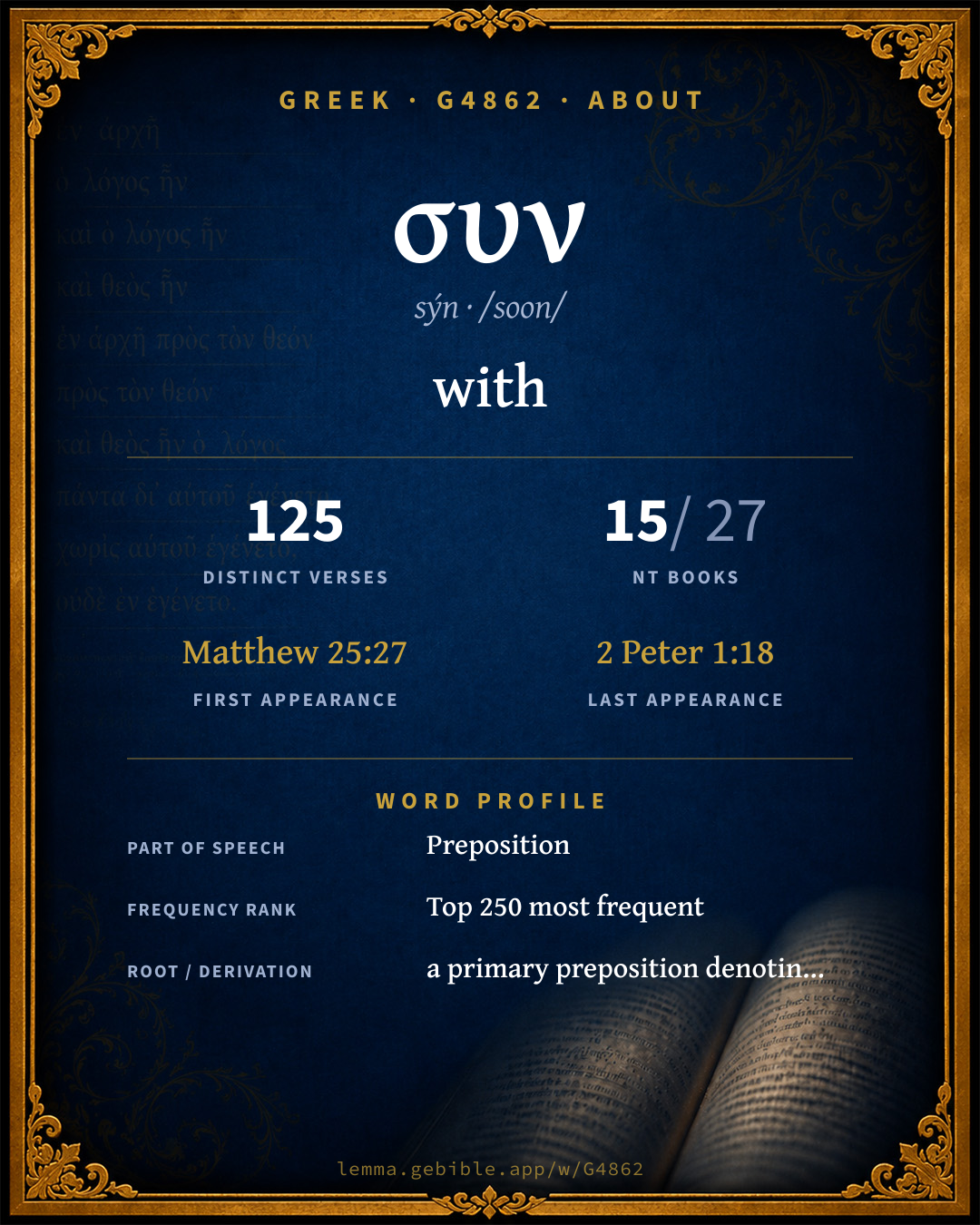
σύν
with
Full lexicon entry — Thayer's Greek Lexicon
From Thayer's Greek Lexicon
Where this word appears
Grammar key — what these labels mean
Part of speech
- Preposition
- A relational word governing a noun in a particular case.
Every verse where G4862 appears — 125 distinct verses across 15 books. Click any verse to open its interlinear word-by-word view. Verse text shown in the World English Bible for context — . Each verse’s Greek form is shown with its reference; the English is not keyword-highlighted, since the data carries no word-level English alignment. Use “Compare translations” on any verse to read it across multiple English versions. This concordance covers the Greek New Testament; Septuagint (Greek Old Testament) occurrences of this word are not indexed here.
Matthew 4 verses
- Matthew 25:27 σὺν prep You ought therefore to have deposited my money with the bankers, and at my coming I should have received back my own with interest.
- Matthew 26:35 σὺν prep Peter said to him, "Even if I must die with you, I will not deny you." All of the disciples also said likewise.
- Matthew 27:38 σὺν prep Then there were two robbers crucified with him, one on his right hand and one on the left.
- Matthew 27:44 σὺν prep The robbers also who were crucified with him cast on him the same reproach.
Mark 6 verses
- Mark 2:26 σὺν prep How he entered into the house of God when Abiathar was high priest, and ate the show bread, which it is not lawful to eat except for the priests, and gave also to those who were with him?"
- Mark 4:10 σὺν prep When he was alone, those who were around him with the twelve asked him about the parables.
- Mark 8:34 σὺν prep He called the multitude to himself with his disciples, and said to them, "Whoever wants to come after me, let him deny himself, and take up his cross, and follow me.
- Mark 9:4 σὺν prep Elijah and Moses appeared to them, and they were talking with Jesus.
- Mark 15:27 σὺν prep With him they crucified two robbers; one on his right hand, and one on his left.
- Mark 15:32 σὺν prep Let the Christ, the King of Israel, now come down from the cross, that we may see and believe him." Those who were crucified with him insulted him.
Luke 24 verses
- Luke 1:56 σὺν prep Mary stayed with her about three months, and then returned to her house.
- Luke 2:5 σὺν prep to enroll himself with Mary, who was pledged to be married to him as wife, being pregnant.
- Luke 2:13 σὺν prep Suddenly, there was with the angel a multitude of the heavenly host praising God, and saying,
- Luke 5:9 σὺν prep For he was amazed, and all who were with him, at the catch of fish which they had caught;
- Luke 5:19 σὺν prep Not finding a way to bring him in because of the multitude, they went up to the housetop, and let him down through the tiles with his cot into the midst before Jesus.
- Luke 7:6 σὺν prep Jesus went with them. When he was now not far from the house, the centurion sent friends to him, saying to him, "Lord, don't trouble yourself, for I am not worthy for you to come under my roof.
- Luke 7:12 σὺν prep Now when he drew near to the gate of the city, behold, one who was dead was carried out, the only son of his mother, and she was a widow. Many people of the city were with her.
- Luke 8:1 σὺν prep It happened soon afterwards, that he went about through cities and villages, preaching and bringing the good news of the Kingdom of God. With him were the twelve,
- Luke 8:38 σὺν prep But the man from whom the demons had gone out begged him that he might go with him, but Jesus sent him away, saying,
- Luke 8:45 σὺν prep Jesus said, "Who touched me?" When all denied it, Peter and those with him said, "Master, the multitudes press and jostle you, and you say, 'Who touched me?'"
- Luke 8:51 σὺν prep When he came to the house, he didn't allow anyone to enter in, except Peter, John, James, the father of the child, and her mother.
- Luke 9:32 σὺν prep Now Peter and those who were with him were heavy with sleep, but when they were fully awake, they saw his glory, and the two men who stood with him.
- Luke 19:23 σὺν prep Then why didn't you deposit my money in the bank, and at my coming, I might have earned interest on it?'
- Luke 20:1 σὺν prep It happened on one of those days, as he was teaching the people in the temple and preaching the Gospel, that the priests and scribes came to him with the elders.
- Luke 22:14 σὺν prep When the hour had come, he sat down with the twelve apostles.
- Luke 22:56 σὺν prep A certain servant girl saw him as he sat in the light, and looking intently at him, said, "This man also was with him."
- Luke 23:11 σὺν prep Herod with his soldiers humiliated him and mocked him. Dressing him in luxurious clothing, they sent him back to Pilate.
- Luke 23:32 σὺν prep There were also others, two criminals, led with him to be put to death.
- Luke 24:10 σὺν prep Now they were Mary Magdalene, Joanna, and Mary the mother of James. The other women with them told these things to the apostles.
- Luke 24:21 σὺν prep But we were hoping that it was he who would redeem Israel. Yes, and besides all this, it is now the third day since these things happened.
- Luke 24:24 σὺν prep Some of us went to the tomb, and found it just like the women had said, but they didn't see him."
- Luke 24:29 σὺν prep They urged him, saying, "Stay with us, for it is almost evening, and the day is almost over." He went in to stay with them.
- Luke 24:33 σὺν prep They rose up that very hour, returned to Jerusalem, and found the eleven gathered together, and those who were with them,
- Luke 24:44 σὺν prep He said to them, "This is what I told you, while I was still with you, that all things which are written in the law of Moses, the prophets, and the psalms, concerning me must be fulfilled."
John 3 verses
- John 12:2 σὺν prep So they made him a supper there. Martha served, but Lazarus was one of those who sat at the table with him.
- John 18:1 σὺν prep When Jesus had spoken these words, he went out with his disciples over the brook Kidron, where was a garden, into which he and his disciples entered.
- John 21:3 σὺν prep Simon Peter said to them, "I'm going fishing." They told him, "We are also coming with you." They immediately went out, and entered into the boat. That night, they caught nothing.
Acts 49 verses
- Acts 1:14 σὺν prep All these with one accord continued steadfastly in prayer and supplication, along with the women, and Mary the mother of Jesus, and with his brothers.
- Acts 1:22 σὺν prep beginning from the baptism of John, to the day that he was received up from us, of these one must become a witness with us of his resurrection."
- Acts 2:14 σὺν prep But Peter, standing up with the eleven, lifted up his voice, and spoke out to them, "You men of Judea, and all you who dwell at Jerusalem, let this be known to you, and listen to my words.
- Acts 3:4 σὺν prep Peter, fastening his eyes on him, with John, said, "Look at us."
- Acts 3:8 σὺν prep Leaping up, he stood, and began to walk. He entered with them into the temple, walking, leaping, and praising God.
- Acts 4:13 σὺν prep Now when they saw the boldness of Peter and John, and had perceived that they were unlearned and ignorant men, they marveled. They recognized that they had been with Jesus.
- Acts 4:14 σὺν prep Seeing the man who was healed standing with them, they could say nothing against it.
- Acts 4:27 σὺν prep For truly, in this city against your holy servant, Jesus, whom you anointed, both Herod and Pontius Pilate, with the Gentiles and the people of Israel, were gathered together
- Acts 5:1 σὺν prep But a certain man named Ananias, with Sapphira, his wife, sold a possession,
- Acts 5:17 σὺν prep But the high priest rose up, and all those who were with him (which is the sect of the Sadducees), and they were filled with jealousy,
- Acts 5:21 σὺν prep When they heard this, they entered into the temple about daybreak, and taught. But the high priest came, and those who were with him, and called the council together, and all the senate of the children of Israel, and sent to the prison to have them brought.
- Acts 5:26 σὺν prep Then the captain went with the officers, and brought them without violence, for they were afraid that the people might stone them.
- Acts 7:35 σὺν prep "This Moses, whom they refused, saying, 'Who made you a ruler and a judge?'--God has sent him as both a ruler and a deliverer by the hand of the angel who appeared to him in the bush.
- Acts 8:20 σὺν prep But Peter said to him, "May your silver perish with you, because you thought you could obtain the gift of God with money!
- Acts 8:31 σὺν prep He said, "How can I, unless someone explains it to me?" He begged Philip to come up and sit with him.
- Acts 10:2 σὺν prep a devout man, and one who feared God with all his house, who gave gifts for the needy generously to the people, and always prayed to God.
- Acts 10:20 σὺν prep But arise, get down, and go with them, doubting nothing; for I have sent them."
- Acts 10:23 σὺν prep So he called them in and lodged them. On the next day Peter arose and went out with them, and some of the brothers from Joppa accompanied him.
- Acts 11:12 σὺν prep The Spirit told me to go with them, without discriminating. These six brothers also accompanied me, and we entered into the man's house.
- Acts 13:7 σὺν prep who was with the proconsul, Sergius Paulus, a man of understanding. This man summoned Barnabas and Saul, and sought to hear the word of God.
- Acts 14:4 σὺν σὺν prep prep But the multitude of the city was divided. Part sided with the Jews, and part with the apostles.
- Acts 14:5 σὺν prep When some of both the Gentiles and the Jews, with their rulers, made a violent attempt to mistreat and stone them,
- Acts 14:13 σὺν prep The priest of Jupiter, whose temple was in front of their city, brought oxen and garlands to the gates, and would have made a sacrifice along with the multitudes.
- Acts 14:20 σὺν prep But as the disciples stood around him, he rose up, and entered into the city. On the next day he went out with Barnabas to Derbe.
- Acts 14:28 σὺν prep They stayed there with the disciples for a long time.
- Acts 15:22 σὺν σὺν prep prep Then it seemed good to the apostles and the elders, with the whole assembly, to choose men out of their company, and send them to Antioch with Paul and Barnabas: Judas called Barsabbas, and Silas, chief men among the brothers.
- Acts 15:25 σὺν prep it seemed good to us, having come to one accord, to choose out men and send them to you with our beloved Barnabas and Paul,
- Acts 16:3 σὺν prep Paul wanted to have him go out with him, and he took and circumcised him because of the Jews who were in those parts; for they all knew that his father was a Greek.
- Acts 16:32 σὺν prep They spoke the word of the Lord to him, and to all who were in his house.
- Acts 17:34 σὺν prep But certain men joined with him, and believed, among whom also was Dionysius the Areopagite, and a woman named Damaris, and others with them.
- Acts 18:8 σὺν prep Crispus, the ruler of the synagogue, believed in the Lord with all his house. Many of the Corinthians, when they heard, believed and were baptized.
- Acts 18:18 σὺν prep Paul, having stayed after this many more days, took his leave of the brothers, and sailed from there for Syria, together with Priscilla and Aquila. He shaved his head in Cenchreae, for he had a vow.
- Acts 19:38 σὺν prep If therefore Demetrius and the craftsmen who are with him have a matter against anyone, the courts are open, and there are proconsuls. Let them press charges against one another.
- Acts 20:36 σὺν prep When he had spoken these things, he knelt down and prayed with them all.
- Acts 21:5 σὺν prep When it happened that we had accomplished the days, we departed and went on our journey. They all, with wives and children, brought us on our way until we were out of the city. Kneeling down on the beach, we prayed.
- Acts 21:16 σὺν prep Some of the disciples from Caesarea also went with us, bringing one Mnason of Cyprus, an early disciple, with whom we would stay.
- Acts 21:18 σὺν prep The day following, Paul went in with us to James; and all the elders were present.
- Acts 21:24 σὺν prep Take them, and purify yourself with them, and pay their expenses for them, that they may shave their heads. Then all will know that there is no truth in the things that they have been informed about you, but that you yourself also walk keeping the law.
- Acts 21:26 σὺν prep Then Paul took the men, and the next day, purified himself and went with them into the temple, declaring the fulfillment of the days of purification, until the offering was offered for every one of them.
- Acts 21:29 σὺν prep For they had seen Trophimus, the Ephesian, with him in the city, and they supposed that Paul had brought him into the temple.
- Acts 22:9 σὺν prep "Those who were with me indeed saw the light and were afraid, but they didn't understand the voice of him who spoke to me.
- Acts 23:15 σὺν prep Now therefore, you with the council inform the commanding officer that he should bring him down to you tomorrow, as though you were going to judge his case more exactly. We are ready to kill him before he comes near."
- Acts 23:27 σὺν prep "This man was seized by the Jews, and was about to be killed by them, when I came with the soldiers and rescued him, having learned that he was a Roman.
- Acts 23:32 σὺν prep But on the next day they left the horsemen to go with him, and returned to the barracks.
- Acts 24:24 σὺν prep But after some days, Felix came with Drusilla, his wife, who was a Jewess, and sent for Paul, and heard him concerning the faith in Christ Jesus.
- Acts 25:23 σύν prep So on the next day, when Agrippa and Bernice had come with great pomp, and they had entered into the place of hearing with the commanding officers and principal men of the city, at the command of Festus, Paul was brought in.
- Acts 26:13 σὺν prep at noon, O King, I saw on the way a light from the sky, brighter than the sun, shining around me and those who traveled with me.
- Acts 27:2 σὺν prep Embarking in a ship of Adramyttium, which was about to sail to places on the coast of Asia, we put to sea; Aristarchus, a Macedonian of Thessalonica, being with us.
- Acts 28:16 σὺν prep When we entered into Rome, the centurion delivered the prisoners to the captain of the guard, but Paul was allowed to stay by himself with the soldier who guarded him.
Romans 4 verses
- Romans 6:8 σὺν prep But if we died with Christ, we believe that we will also live with him;
- Romans 8:32 σὺν prep He who didn't spare his own Son, but delivered him up for us all, how would he not also with him freely give us all things?
- Romans 16:14 σὺν prep Greet Asyncritus, Phlegon, Hermes, Patrobas, Hermas, and the brothers who are with them.
- Romans 16:15 σὺν prep Greet Philologus and Julia, Nereus and his sister, and Olympas, and all the saints who are with them.
1 Corinthians 7 verses
- 1 Corinthians 1:2 σὺν prep to the assembly of God which is at Corinth; those who are sanctified in Christ Jesus, called to be saints, with all who call on the name of our Lord Jesus Christ in every place, both theirs and ours:
- 1 Corinthians 5:4 σὺν prep In the name of our Lord Jesus Christ, you being gathered together, and my spirit, with the power of our Lord Jesus Christ,
- 1 Corinthians 10:13 σὺν prep No temptation has taken you except what is common to man. God is faithful, who will not allow you to be tempted above what you are able, but will with the temptation also make the way of escape, that you may be able to endure it.
- 1 Corinthians 11:32 σὺν prep But when we are judged, we are punished by the Lord, that we may not be condemned with the world.
- 1 Corinthians 15:10 σὺν prep But by the grace of God I am what I am. His grace which was bestowed on me was not futile, but I worked more than all of them; yet not I, but the grace of God which was with me.
- 1 Corinthians 16:4 σὺν prep If it is appropriate for me to go also, they will go with me.
- 1 Corinthians 16:19 σὺν prep The assemblies of Asia greet you. Aquila and Priscilla greet you much in the Lord, together with the assembly that is in their house.
2 Corinthians 6 verses
- 2 Corinthians 1:1 σὺν prep Paul, an apostle of Christ Jesus through the will of God, and Timothy our brother, to the assembly of God which is at Corinth, with all the saints who are in the whole of Achaia:
- 2 Corinthians 1:21 σὺν prep Now he who establishes us with you in Christ, and anointed us, is God;
- 2 Corinthians 4:14 σὺν σὺν prep prep knowing that he who raised the Lord Jesus will raise us also with Jesus, and will present us with you.
- 2 Corinthians 8:19 σὺν prep Not only so, but who was also appointed by the assemblies to travel with us in this grace, which is served by us to the glory of the Lord himself, and to show our readiness.
- 2 Corinthians 9:4 σὺν prep so that I won't by any means, if there come with me any of Macedonia and find you unprepared, we (to say nothing of you) should be disappointed in this confident boasting.
- 2 Corinthians 13:4 σὺν prep For he was crucified through weakness, yet he lives through the power of God. For we also are weak in him, but we will live with him through the power of God toward you.
Galatians 4 verses
- Galatians 1:2 σὺν prep and all the brothers who are with me, to the assemblies of Galatia:
- Galatians 2:3 σὺν prep But not even Titus, who was with me, being a Greek, was compelled to be circumcised.
- Galatians 3:9 σὺν prep So then, those who are of faith are blessed with the faithful Abraham.
- Galatians 5:24 σὺν prep Those who belong to Christ have crucified the flesh with its passions and lusts.
Ephesians 2 verses
Philippians 4 verses
- Philippians 1:1 σὺν prep Paul and Timothy, servants of Jesus Christ; To all the saints in Christ Jesus who are at Philippi, with the overseers and deacons:
- Philippians 1:23 σὺν prep But I am in a dilemma between the two, having the desire to depart and be with Christ, which is far better.
- Philippians 2:22 σὺν prep But you know the proof of him, that, as a child serves a father, so he served with me in furtherance of the Gospel.
- Philippians 4:21 σὺν prep Greet every saint in Christ Jesus. The brothers who are with me greet you.
Colossians 7 verses
- Colossians 2:5 σὺν prep For though I am absent in the flesh, yet am I with you in the spirit, rejoicing and seeing your order, and the steadfastness of your faith in Christ.
- Colossians 2:13 σὺν prep You were dead through your trespasses and the uncircumcision of your flesh. He made you alive together with him, having forgiven us all our trespasses,
- Colossians 2:20 σὺν prep If you died with Christ from the elements of the world, why, as though living in the world, do you subject yourselves to ordinances,
- Colossians 3:3 σὺν prep For you died, and your life is hidden with Christ in God.
- Colossians 3:4 σὺν prep When Christ, our life, is revealed, then you will also be revealed with him in glory.
- Colossians 3:9 σὺν prep Don't lie to one another, seeing that you have put off the old man with his doings,
- Colossians 4:9 σὺν prep together with Onesimus, the faithful and beloved brother, who is one of you. They will make known to you everything that is going on here.
1 Thessalonians 3 verses
- 1 Thessalonians 4:14 σὺν prep For if we believe that Jesus died and rose again, even so those who have fallen asleep in Jesus will God bring with him.
- 1 Thessalonians 4:17 σὺν σὺν prep prep then we who are alive, who are left, will be caught up together with them in the clouds, to meet the Lord in the air. So we will be with the Lord forever.
- 1 Thessalonians 5:10 σὺν prep who died for us, that, whether we wake or sleep, we should live together with him.
James 1 verse
2 Peter 1 verse
About this entry
At a glance — auto-summarized from this page’s data, not written by a person. Every figure links to its source below. This summary describes the numbers; it doesn’t interpret them.
The Greek preposition συν centers on the idea of “with.” Debuting at Matthew 25:27, it then recurs through the corpus. It appears 125 verses across 15 books of the Greek New Testament, among its common vocabulary. The word gravitates to Acts (39%), then Luke and 1 Corinthians. It shares a root with κοινος, συγγενης and συγγνωμη. Dig into 125-verse concordance and the renderings breakdown below.
Gloss history
Strong's 1890 vs modern scholarship

About this word
Strong's G4862 catalogs a Greek word from the Greek New Testament.
These counts are not copied from any lexicon or concordance. They are computed here, from the morphology-tagged Greek New Testament. What Lemma adds →
- 125
- distinct verses
- The word appears in 125 distinct verses.
- 15 / 27
- NT books
- The word appears in 15 of 27 New Testament books.
- #129
- by frequency
- Top 250 most frequent Greek words (rank 129 of 5,347 Greek words by occurrence).
View all 125 occurrences in the concordance →
Most concentrated in
- Acts 49 verses 39%
- Luke 24 verses 19%
- 1 Corinthians 7 verses 6%
By section of the New Testament
By traditional corpus
Conventional, traditional groupings — biblical authorship is debated, so this is a traditional corpus grouping, not an authorship claim. Some books belong to more than one corpus (Luke is in both the Gospels and the Lukan corpus, and so on), so these shares overlap and need not total 100%. Each figure is a share of the word’s 125 distinct verses.
- Lukan (Luke–Acts) 73 verses · 58%
- Gospels 37 verses · 30%
- Pauline corpus 37 verses · 30%
- Johannine 3 verses · 2%
- General (Catholic) Epistles 2 verses · 2%
How translations render this word
Counts come from each version’s own published word-to-Strong’s tagging or interlinear alignment — an approximate guide to how each version renders this word, not a word-level alignment the data otherwise carries. Because each total is that version’s own tagged count, the per-version totals vary from one another and need not match the appearance or distinct-verse counts above. These counts may also differ from a printed concordance because Lemma counts each distinctly tagged rendering and does not collapse phrase taggings into a single head-word total. This is a fixed set of word-tagged versions (KJV, ASV, BSB, ULT) and does not change with the reading translation you choose elsewhere. Each version’s license is shown beside its name below (and on Sources).
- King James Version: With 106×, Are with 5×, Were with 4×
- American Standard Version: With 102×, Are with 2×
- Berean Standard Bible: With 82×, Along with 11×, Together with 6×
- unfoldingWord Literal Text: With 117×, Along with 6×, Together with 2×
King James Version Public Domain
Renders G4862 across 124 tagged occurrences — most commonly:
Plus 5 renderings that appear only once — usually multi-word phrases or single function words the recovered tagging swept in, not distinct renderings. Not rendered by a distinct English word in 1 further occurrence.
American Standard Version Public Domain
Renders G4862 across 121 tagged occurrences — most commonly:
Plus 17 renderings that appear only once — usually multi-word phrases or single function words the recovered tagging swept in, not distinct renderings.
Berean Standard Bible Public Domain
Renders G4862 across 114 tagged occurrences — most commonly:
Plus 10 renderings that appear only once — usually multi-word phrases or single function words the recovered tagging swept in, not distinct renderings. Not rendered by a distinct English word in 14 further occurrences.
unfoldingWord Literal Text CC BY-SA 4.0
Renders G4862 across 129 tagged occurrences — most commonly:
Plus 4 renderings that appear only once — usually multi-word phrases or single function words the recovered tagging swept in, not distinct renderings.
Senses in Thayer's
The 1 sense Thayer's distinguishes for this word, in lexicon order (not ranked by frequency or importance). The full entry — with sub-senses — is in the Lexicon Entry tab.
- with
Word origin
Origin: a primary preposition denoting union
A primary preposition denoting union ; with or together (but much closer than G3326 or G3844 ) that is by association companionship process resemblance possession instrumentality addition etc.i : - beside with. In compounds it has similar applications including completeness .
— Strong’s Exhaustive Concordance (1890), public domain.
Forms in the corpus
The 2 distinct written forms G4862 takes in the Greek New Testament, most frequent first — each parse links to that case’s occurrences in the concordance.
| Form | Parsing | Example | Uses |
|---|---|---|---|
| σὺν sỳn | Preposition | Matthew 25:27 | 128 |
| σύν sýn | Preposition | Acts 25:23 | 1 |
Same root — word family
Other Thayer's entries built from the same root as G4862, grouped by Strong’s listed origin. These share a root / origin per the lexicon — not necessarily a shared meaning. Each links to that word’s own entry.
Derived from this word
- κοινος koinós G2839 common
- συγγενης syngenḗs G4773 related by blood
- συγγνωμη syngnṓmē G4774 pardon
- συγκαθημαι synkáthēmai G4775 to sit together
- συγκαθιζω synkathízō G4776 to sit together
- συγκακοπαθεω synkakopathéō G4777 to suffer together
- συγκακουχεω synkakouchéō G4778 to be ill-treated together
- συγκαλεω synkaléō G4779 to call together
- συγκαλυπτω synkalýptō G4780 to cover completely
- συγκαμπτω synkámptō G4781 to bend together
- συγκαταβαινω synkatabaínō G4782 to go down with
- συγκατατιθεμαι synkatatíthemai G4784 to deposit together
- συγκαταψηφιζω synkatapsēphízō G4785 to vote against
- συγκεραννυμι synkeránnymi G4786 to mix together
- συγκλειω synkleíō G4788 to shut up
- συγκληρονομος synklēronómos G4789 joint heir
- συγκοινωνεω synkoinōnéō G4790 to share together
- συγκοινωνος synkoinōnós G4791 joint partner
- συγκομιζω synkomízō G4792 to collect together
- συγκρινω synkrínō G4793 to join together
- συγκυπτω synkýptō G4794 to bend together
- συγκυρια synkyría G4795 by chance
- συγχαιρω synchaírō G4796 to rejoice with
- συγχεω synchéō G4797 to disturb
+126 more words derive from G4862 (not shown).
Compare all same-root words → Showing 4 of 151 — not the complete family. They share a root, not necessarily a meaning.
Septuagint usage
The same Greek word συν appears 223 times in the Greek Old Testament (Septuagint), across 205 verses in 26 books.
- 223
- LXX occurrences
- Tagged occurrences of this Greek word in the Septuagint.
- 205
- verses
- Distinct Septuagint verses containing this word.
- 26 / 39
- OT books
- The word appears in 26 of the 39 Old Testament books.
Sample Septuagint occurrences
- Genesis 12:20 συν
- Exodus 6:26 σύν
- Leviticus 1:16 σύν
- Numbers 1:3 σύν
- Deuteronomy 1:30 συν
- Joshua 6:24 σύν
- Judges 3:27 σύν
- 1 Samuel 7:9 σύν
- 2 Samuel 6:4 σύν
- 1 Chronicles 16:32 σύν
- 2 Chronicles 10:8 συν
- Ezra 4:7 σύν
Septuagint occurrences (same lexeme)
Every verse where the same Strong’s number (G4862) appears in the Greek Septuagint — showing the first 50 of 205. Verse text shown in the World English Bible for context; the Greek form is the matched word — the English is not keyword-highlighted.
- Genesis 12:20 συν Pharaoh gave men charge concerning him: and they brought him on the way, and his wife, and all that he had.
- Genesis 15:11 συν The birds of prey came down on the carcasses, and Abram drove them away.
- Genesis 18:16 συν The men rose up from there, and looked toward Sodom. Abraham went with them to see them on their way.
- Genesis 18:23 συν Abraham drew near, and said, "Will you consume the righteous with the wicked?
- Genesis 19:15 συν When the morning arose, then the angels hurried Lot, saying, "Arise, take your wife, and your two daughters who are here, lest you be consumed in the iniquity of the city."
- Genesis 19:17 συν It came to pass, when they had taken them out, that he said, "Escape for your life! Don't look behind you, neither stay anywhere in the plain. Escape to the mountain, lest you be consumed!"
- Genesis 30:8 συν Rachel said, "With mighty wrestlings have I wrestled with my sister, and have prevailed." She named him Naphtali.
- Genesis 50:7 συν Joseph went up to bury his father; and with him went up all the servants of Pharaoh, the elders of his house, all the elders of the land of Egypt,
- Genesis 50:9 συν There went up with him both chariots and horsemen. It was a very great company.
- Genesis 50:14 συν Joseph returned into Egypt--he, and his brothers, and all that went up with him to bury his father, after he had buried his father.
- Genesis 50:25 συν Joseph took an oath of the children of Israel, saying, "God will surely visit you, and you shall carry up my bones from here."
- Exodus 6:26 σύν These are that Aaron and Moses, to whom Yahweh said, "Bring out the children of Israel from the land of Egypt according to their hosts."
- Exodus 7:4 σύν But Pharaoh will not listen to you, and I will lay my hand on Egypt, and bring forth my hosts, my people the children of Israel, out of the land of Egypt by great judgments.
- Exodus 7:15 συν Go to Pharaoh in the morning. Behold, he goes out to the water; and you shall stand by the river's bank to meet him; and the rod which was turned to a serpent you shall take in your hand.
- Exodus 10:9 σύν Moses said, "We will go with our young and with our old; with our sons and with our daughters, with our flocks and with our herds will we go; for we must hold a feast to Yahweh."
- Exodus 11:1 σύν Yahweh said to Moses, "Yet one plague more will I bring on Pharaoh, and on Egypt; afterwards he will let you go. When he lets you go, he will surely thrust you out altogether.
- Exodus 12:9 σύν Don't eat it raw, nor boiled at all with water, but roasted with fire; with its head, its legs and its inner parts.
- Exodus 12:38 συν A mixed multitude went up also with them, with flocks, herds, and even very much cattle.
- Exodus 12:51 σύν It happened the same day, that Yahweh brought the children of Israel out of the land of Egypt by their hosts.
- Exodus 13:19 συν Moses took the bones of Joseph with him, for he had made the children of Israel swear, saying, "God will surely visit you, and you shall carry up my bones away from here with you."
- Exodus 14:6 συν He made ready his chariot, and took his army with him;
- Exodus 15:19 σύν For the horses of Pharaoh went in with his chariots and with his horsemen into the sea, and Yahweh brought back the waters of the sea on them; but the children of Israel walked on dry land in the midst of the sea.
- Exodus 16:16 σύν This is the thing which Yahweh has commanded: "Gather of it everyone according to his eating; an omer a head, according to the number of your persons, shall you take it, every man for those who are in his tent."
- Exodus 18:13 συν It happened on the next day, that Moses sat to judge the people, and the people stood around Moses from the morning to the evening.
- Exodus 18:22 συν Let them judge the people at all times. It shall be that every great matter they shall bring to you, but every small matter they shall judge themselves. So shall it be easier for you, and they shall share the load with you.
- Exodus 21:3 συν If he comes in by himself, he shall go out by himself. If he is married, then his wife shall go out with him.
- Exodus 23:1 συν "You shall not spread a false report. Don't join your hand with the wicked to be a malicious witness.
- Exodus 23:32 συν You shall make no covenant with them, nor with their gods.
- Exodus 24:2 συν Moses alone shall come near to Yahweh, but they shall not come near, neither shall the people go up with him."
- Exodus 29:17 σύν You shall cut the ram into its pieces, and wash its innards, and its legs, and put them with its pieces, and with its head.
- Exodus 33:2 συν I will send an angel before you; and I will drive out the Canaanite, the Amorite, and the Hittite, and the Perizzite, the Hivite, and the Jebusite:
- Exodus 33:3 συν to a land flowing with milk and honey: for I will not go up in the midst of you, for you are a stiff-necked people, lest I consume you in the way."
- Exodus 33:12 συν Moses said to Yahweh, "Behold, you tell me, 'Bring up this people:' and you haven't let me know whom you will send with me. Yet you have said, 'I know you by name, and you have also found favor in my sight.'
- Exodus 36:10 σύν He coupled five curtains to one another, and the other five curtains he coupled one to another.
- Exodus 40:33 σύν He raised up the court around the tent and the altar, and set up the screen of the gate of the court. So Moses finished the work.
- Leviticus 1:16 σύν and he shall take away its crop with its filth, and cast it beside the altar on the east part, in the place of the ashes.
- Leviticus 2:2 σύν He shall bring it to Aaron's sons the priests; and he shall take his handful of its fine flour, and of its oil, with all its frankincense; and the priest shall burn the memorial of it on the altar, an offering made by fire, of a sweet savor to Yahweh.
- Leviticus 2:16 σύν The priest shall burn as its memorial, part of its bruised grain, and part of its oil, along with all its frankincense: it is an offering made by fire to Yahweh.
- Leviticus 3:4 σύν and the two kidneys, and the fat that is on them, which is by the loins, and the cover on the liver, with the kidneys, he shall take away.
- Leviticus 3:9 σύν He shall offer from the sacrifice of peace offerings an offering made by fire to Yahweh; its fat, the entire tail fat, he shall take away close to the backbone; and the fat that covers the inwards, and all the fat that is on the inwards,
- Leviticus 3:10 σύν and the two kidneys, and the fat that is on them, which is by the loins, and the cover on the liver, with the kidneys, he shall take away.
- Leviticus 3:15 σύν and the two kidneys, and the fat that is on them, which is by the loins, and the cover on the liver, with the kidneys, he shall take away.
- Leviticus 4:9 σύν and the two kidneys, and the fat that is on them, which is by the loins, and the cover on the liver, with the kidneys, he shall take away,
- Leviticus 4:11 σύν The bull's skin, all its flesh, with its head, and with its legs, its innards, and its dung,
- Leviticus 6:8 σύν Yahweh spoke to Moses, saying,
- Leviticus 7:4 σύν and the two kidneys, and the fat that is on them, which is by the loins, and the cover on the liver, with the kidneys, shall he take away;
- Leviticus 14:31 σύν even such as he is able to afford, the one for a sin offering, and the other for a burnt offering, with the meal offering. The priest shall make atonement for him who is to be cleansed before Yahweh."
- Numbers 1:3 σύν from twenty years old and upward, all who are able to go out to war in Israel. You and Aaron shall number them by their divisions.
- Numbers 1:45 σύν So all those who were numbered of the children of Israel by their fathers' houses, from twenty years old and upward, all who were able to go out to war in Israel;
- Numbers 1:49 συν "Only the tribe of Levi you shall not number, neither shall you take a census of them among the children of Israel;
These are occurrences of the same Greek lexeme (G4862) in the Septuagint — not a translation of any one Hebrew word. The store carries no word-level Hebrew↔Greek alignment, so no Hebrew original is asserted here. Counts come from the recovered LXX Strong's tagging — high-frequency vocabulary is well covered, while rare or late forms may be untagged — so they reflect tagged occurrences and may slightly undercount.