Matthew 27:66

Greek (Tischendorf 8th ed.) Matthew 27:66 appears in the Greek New Testament. The text above is from the Tischendorf 8th edition. Each word links to its Strong’s number and a concise gloss. Click any word for its full Thayer’s Greek Lexicon entry.
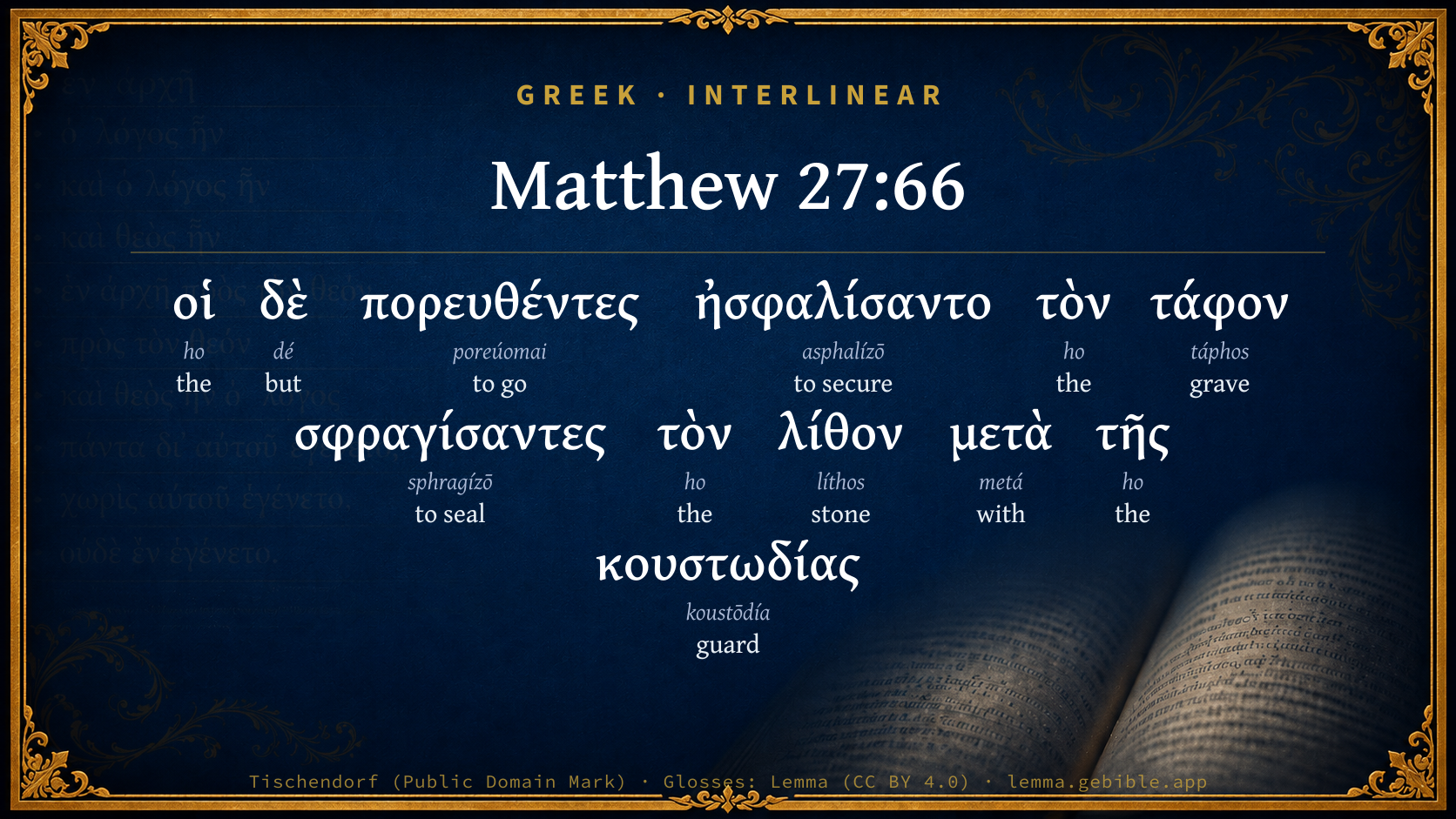
Download image
Cite this verse

Matthew 27:66 (World English Bible). Public Domain. Lemma interlinear Bible study tool, https://lemma.gebible.app/v/matthew/27/66.

Show BibTeX & RIS
BibTeX
RIS
English Translation
So they went with the guard and made the tomb secure, sealing the stone.
World English Bible · Public Domain
Highlights
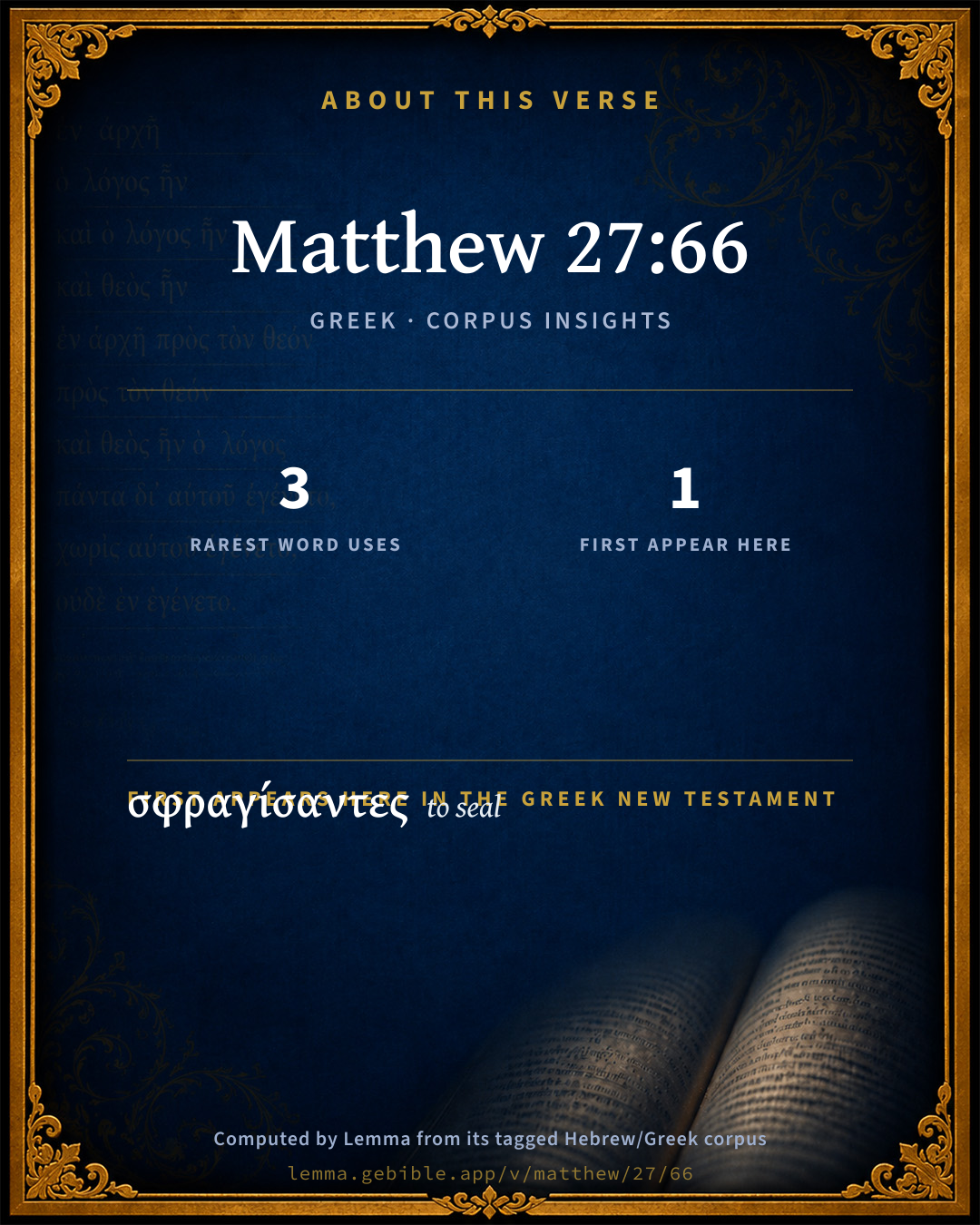
  • 1 first appearance in the Greek New Testament
Full analysis ↓
Download a study sheet

One document with this verse’s original text, its word-by-word gloss line, the meaning frame, cross-references with their text, attributed commentary, and full source and license credits — printable, and it pastes into notes with its structure intact.

This verse Autodidact and up

Study sheet (.html) Plain text (.txt)

A passage Seminary Student

Up to 50 verses in one chapter. A passage sheet keeps up to 6 commentary sources and 12 cross-references per verse, in the order this page ranks them, and says so on the sheet whenever that leaves anything out. Ask for a single verse and you get the Autodidact verse sheet above.

Everything on this page stays free to read, with no account — the sheet is a download of what is already on screen, not access to it.

Want to remove ads? Support Godless Engineer
Compare translations 3

The same verse in 3 English versions, stacked beneath the original-language interlinear above. Click any original word for its lexicon entry.

Each is an independent rendering of the whole verse — the interlinear is not word-aligned to these translations.

Highlighted words mark where these versions differ — a whole-verse word diff, not a word-by-word alignment.

  • World English Bible Public Domain
    So they went with the guard and made the tomb secure, sealing the stone.
  • King James Version Public Domain
    So they went, and made the sepulchre sure, sealing the stone, and setting a watch.
  • unfoldingWord Literal Text CC BY-SA 4.0
    And they, having gone, secured the tomb, having sealed the stone, with the guard.

unfoldingWord Literal Text — © unfoldingWord, licensed CC BY-SA 4.0. Word-aligned USFM3 via Door43 (git.door43.org/unfoldingWord/en_ult).

Versions to compare (up to 4)

3 of 4 selected

Show all 19 translations

Every available English version of this verse, each an independent rendering of the whole verse.

  • World English Bible Public Domain
    So they went with the guard and made the tomb secure, sealing the stone.
  • Berean Standard Bible Public Domain
    So they went and secured the tomb by sealing the stone and posting the guard.
  • Majority Standard Bible Public Domain
    So they went and secured the tomb by sealing the stone and posting the guard.
  • King James Version Public Domain
    So they went, and made the sepulchre sure, sealing the stone, and setting a watch.
  • American Standard Version (1901) Public Domain
    So they went, and made the sepulchre sure, sealing the stone, the guard being with them.
  • Revised Version (1885) Public Domain
    So they went, and made the sepulchre sure, sealing the stone, the guard being with them.
  • Geneva Bible (1599) Public Domain
    And they went, and made the sepulchre sure with the watch, and sealed the stone.
  • Douay-Rheims (1899) Public Domain
    And they departing, made the sepulchre sure, sealing the stone, and setting guards.
  • Young's Literal Translation Public Domain
    and they, having gone, did make the sepulchre secure, having sealed the stone, together with the watch.
  • Literal Standard Version CC BY-SA 4.0
    and they, having gone, made the grave secure, having sealed the stone, together with the guard.
  • Unlocked Literal Bible CC BY-SA 4.0
    So they went and made the tomb secure, sealing the stone and placing the guard.
  • unfoldingWord Literal Text CC BY-SA 4.0
    And they, having gone, secured the tomb, having sealed the stone, with the guard.
  • Darby Bible Public Domain
    And they went and secured the sepulchre, having sealed the stone, with the watch [besides].
  • World Messianic Bible Public Domain
    So they went with the guard and made the tomb secure, sealing the stone.
  • Webster's Bible Public Domain
    So they went, and having sealed the stone, made the sepulcher secure with a watch.
  • Free Bible Version CC BY-SA 4.0
    So they went and made the tomb secure, sealing the entrance stone and posting soldiers as guards.
  • Bible in Basic English Public Domain
    So they went, and made safe the place where his body was, putting a stamp on the stone, and the watchmen were with them.
  • Text-Critical English NT CC BY 4.0
    So they went and secured the tomb by sealing the stone and posting the guard of soldiers.
  • Tyndale New Testament (1534) Public Domain
    And they went and made the sepulcre sure with watche men and sealed the stone.

Literal Standard Version (2020), Covenant Press — licensed CC BY-SA 4.0. Text via the HelloAO Bible API (eBible.org). Unlocked Literal Bible (unfoldingWord) — licensed CC BY-SA 4.0. Text via the HelloAO Bible API (eBible.org). unfoldingWord Literal Text — © unfoldingWord, licensed CC BY-SA 4.0. Word-aligned USFM3 via Door43 (git.door43.org/unfoldingWord/en_ult). Free Bible Version, Dr. Jonathan Gallagher — licensed CC BY-SA 4.0. Text via the HelloAO Bible API (eBible.org).

Word by word

More ways to search: Search by grammar → Find every occurrence → Compare this word →

Practice this passage: Drill this verse → Learn its vocabulary →

About this verse

These counts appear in no published source. They are computed here, from the morphology-tagged text and Lemma’s own curated glosses. What Lemma adds →

12
words
9
distinct lemmas
Gospels
section

Notable vocabulary

The rarest word here is κουστωδίας guard G2892 — appearing just 3 times in the whole Greek New Testament.

First appearance in Scripture

This word makes its first canonical appearance in the Greek New Testament here:

  • σφραγίσαντες to seal G4972

Shared distinctive vocabulary

κουστωδίας guard G2892 occurs in 3 verses of the Greek New Testament. Also found in:

Repetition

A word recurs within this verse:

Cross-references

5

Topical passages linked to Matthew 27:66 in the Treasury of Scripture Knowledge — connected by theme and wording, ordered by reader-vote popularity; previews shown in the World English Bible.

  • Daniel 6:17 A stone was brought, and laid on the mouth of the den; and the king sealed it with his own signet, and with the signet of his lords; that nothing might be changed concerning Daniel.
  • Matthew 27:60 and laid it in his own new tomb, which he had hewn out in the rock, and he rolled a great stone to the door of the tomb, and departed.
  • Matthew 28:2 Behold, there was a great earthquake, for an angel of the Lord descended from the sky, and came and rolled away the stone from the door, and sat on it.
  • 2 Timothy 2:19 However God's firm foundation stands, having this seal, "The Lord knows those who are his," and, "Let every one who names the name of the Lord depart from unrighteousness."
  • Matthew 28:11 Now while they were going, behold, some of the guards came into the city, and told the chief priests all the things that had happened.

Cross-references courtesy of OpenBible.info (CC BY 4.0).

Commentary

Notes on Matthew 27:66 from classic Christian and Jewish commentators (each source and its license shown beneath its notes). The classic Christian expositions comment on the surrounding passage and are grouped to its opening verse, so a note may address several verses; the Jewish commentaries on the Tanakh (Rashi and others) are per-verse, so they appear only where the commentator wrote on this verse.

Lemma curates 59 commentaries, every one of them public domain or Creative Commons licensed, each selected and text-cleaned for this edition rather than reprinted as found. About our sources →

Bengel's Gnomon

Johann Albrecht Bengel

Mat 27:66. Ἠσφαλίσαντο, they secured) This is the whole: the parts were the seal, and the watch.

Bengel's Gnomon of the New Testament — English translation (T&T Clark, Edinburgh, 1860) — public domain. Text from a community e-Sword module.

Expositor's Greek Testament

ed. W. Robertson Nicoll

Mat 27:66 . ἠσφαλίσαντο is to be taken with the last clause μετὰ τῆς κουστωδίας , which points to the main means of securing the tomb against plunder. The participial clause σφραγίσαντες τὸν λίθον is a parenthesis pointing to an additional precaution, sealing the stone, with a thread over it and sealed to the tomb at either end. The worthy men did their best to prevent theft, and the resurrection!

The Expositor's Greek Testament, edited by W. Robertson Nicoll (1897–1910) — public domain. Text from a community e-Sword module.

Jamieson, Fausset & Brown

Robert Jamieson, A. R. Fausset & David Brown

So they went, and made the sepulchre sure, sealing the stone--which Mark (Mar 16:4) says was "very great."

and setting a watch--to guard it. What more could man do? But while they are trying to prevent the resurrection of the Prince of Life, God makes use of their precautions for His own ends. Their stone-covered, seal-secured sepulchre shall preserve the sleeping dust of the Son of God free from all indignities, in undisturbed, sublime repose; while their watch shall be His guard of honor until the angels shall come to take their place.

Next: Matthew Chapter 28

Jamieson, Fausset & Brown — Commentary Critical and Explanatory on the Whole Bible (1871) — public domain (CC PDM 1.0). Text via the HelloAO Bible API.

Adam Clarke's Commentary

Verse 66. Made the sepulchre sure, sealing the stone, and setting a watch.] Or rather, made the tomb secure by the guard, and by sealing the stone. I follow Kypke, in construing μετα της κουστωδιας, with ησφαλισαντο. The guard was to take care that the disciples should not steal him away; and the seal, which was probably the seal of the governor, was to prevent the guards from being corrupted so as to permit the theft. So every thing was done which human policy and prudence could, to prevent a resurrection, which these very precautions had the most direct tendency to authenticate and establish. How wonderful are the wisdom and goodness of God! - and how true is it, that there is neither might nor counsel against him!

1. The death of Christ was ordered, so as to be witnessed by thousands; and if his resurrection take place, it must be demonstrated; and it cannot take place without being incontestable, such are the precautions used here to prevent all imposture.

2. The more the circumstances of the death of Christ are examined, the more astonishing the whole will appear. The death is uncommon - the person uncommon - and the object uncommon; and the whole is grand, majestic, and awful. Nature itself is thrown into unusual action, and by means and causes wholly supernatural. In every part, the finger of God most evidently appears.

3. How glorious does Christ appear in his death! Were it not for his thirst, his exclamation on the cross, and the piercing of his side, we should have found it difficult to believe that such a person could ever have entered the empire of death; but the divinity and the manhood equally appear, and thus the certainty of the atonement is indubitably established.

4. But who can reflect on the state of the poor disciples, during the whole of the time in which our blessed Lord lay under the empire of death, without sharing their sorrows! When he expired on the cross their expectation was cut off; and when his body was laid in the grave their hopes were buried; and nothing but the resurrection of Christ from the dead could have given a resurrection to their hopes. It is true they had heard him say that he would rise again the third day; but in this it is evident their faith was very imperfect; and the uncertainty, perplexity, anxiety, and distress which they in consequence must have suffered, can neither be described nor imagined. Though we know the glorious result, yet who can help sympathizing with the pious father, the virgin mother, and the disconsolate disciples!

Adam Clarke's Commentary on the Bible (1810–1826) — public domain. Text from a community e-Sword/MySword module.

Ellicott's Commentary for English Readers

(66) Sealing the stone.—The opening of the tomb had been already closed by the stone which had been rolled so as to fill, or nearly fill, it. The sealing was probably effected by drawing one or more ropes across the stone and fastening either end to the rock with wax or cement of some kind.

And setting a watch.—Better, with the guard. What is meant is that the priests were not content to leave the work to the soldiers, but actually took part in it themselves.

A Bible Commentary for English Readers, edited by Charles John Ellicott (1878–1897) — public domain. Text from a community e-Sword module.

Trapp's Complete Commentary

John Trapp

66 So they went, and made the sepulchre sure, sealing the stone, and setting a watch.

Ver. 66. So they went and made the sepulchre sure] And now they seemed to dance upon Christ’s grave, as thinking themselves cock sure of him. So did those bloody tyrants of the primitive times (who proudly engraved upon pillars of marble, Nomine Christianorum deleto, qui Remp. evertebant) I destroyed the name of Christians who turned the state upside down, make no other reckoning, but to raze out the name of Christ from under heaven. Therefore also they did not only constitute laws and proclamations against Christians, but did engrave the same laws in tables of brass, meaning to make all things firm for ever and a day. But he that sat in heaven, and said, "Yet have I set my king upon my holy hill of Sion," laughed at them; Jehovah had them in derision, Psa 2:4; Psa 2:6. Look how Daniel was innocently condemned, cast into the lions’ den, had the door sealed upon him, and, to see to, no hope or means of life was left him; and yet by God’s good providence, he came forth untouched, and was made a greater man than ever. So our blessed Saviour was innocently condemned, cast into the grave, sealed up among the dead, and to common judgment left as out of mind; yet early in the morning, at the time appointed by the power of his Deity, he raised himself from death, and gloriously triumphed over it and hell. Now "thanks be unto God which also causeth us to triumph in Christ," 2Co 2:14, having as prisoners of hope, brought us "out of the pit by the blood of the covenant," Zec 9:11-12.

John Trapp, A Commentary or Exposition upon All the Books of the Old and New Testament (1647–1656) — public domain. Text from a community e-Sword module.

Albert Barnes' Notes on the Bible

Sealing the stone - The sepulchre was made sure by affixing the large stone to the entrance in such a way that it could not be removed without detection. It was sealed. In what way this was done cannot now be certainly told. The cave in which Daniel was cast was fastened in the same manner, and sealed with the king’s signet Dan 6:17, perhaps by fastening the stone in its place with cords, and bringing them together and uniting them with wax, and impressing on that the seal of the king. In this way, letters and books were anciently sealed. Possibly on the sepulchre of Jesus was impressed in this manner the seal of Pilate - the seal of office - making it doubly sure; or it may be that the stone was fitted into the tomb with clay or cement, and on that was impressed the seal of Pilate.

Setting a watch - That is, as large a number of soldiers as they judged necessary to secure the tomb.

We cannot but be struck with the wisdom of God in ordering the circumstances of the Saviour’s burial in such a manner as to avoid the possibility of deception. Had all this been done by his “friends,” it might have been said that they only pretended to secure the tomb, and only pretended that he was dead. But he was adjudged to be dead “by the Jews themselves;” Pilate was satisfied that that was the fact; they had their own way about his burial; he was buried alone; the place of his sepulchre was made sure, “expressly to prevent his being removed;” and they placed around him a guard, in their own judgment large enough to prevent his being taken away by force or strength. His very enemies, therefore, took every possible precaution to place his resurrection beyond the possibility of suspicion of fraud and imposture, and those precautions were the very means of furnishing the most striking proof that his death, burial, and resurrection were not impositions, but most affecting, awful, and yet cheering realities.

Albert Barnes' Notes on the Bible (1834–1885) — public domain. Text from a community e-Sword/MySword module.

Haydock's Catholic Bible Commentary

They departing. See how beyond the possibility of contradiction these precautions prove the reality of Christ’s resurrection, and how the inveterate enemies of Christ become unwilling witnesses of it; for, since the sepulchre was guarded, there was an impossibility of any deceit on the part of the disciples. Now, if the least deceit was utterly impracticable, then indeed Christ our Lord was infallibly risen; and to remove every, the least possibility of deceit, Pilate would not permit the soldiers alone to seal up the monument. (St. Thomas Aquinas) --- The high priests made the sepulchre sure, sealing the stone at the entrance of the monument with the public seal, Greek: sphragisantes ton lithon, proof against all fraud, either of corrupt guards or of designing followers, as Darius did, (Daniel vi. 17.) that no violence might be offered him. All this diligence, on the part of the enemies of the Christian faith, was permitted by divine Providence, that our faith in Christ’s resurrection might be more certain, his glory greater, and the minds of the people better disposed to believe. (Jansenius)

George Leo Haydock (1774–1849), Haydock's Catholic Family Bible and Commentary, 1859 edition — public domain. Excludes Psalms (Douay-Rheims chapter numbering differs from Protestant) and Deuterocanonical books (Catholic canon only).

Whedon's Commentary on the Bible

Daniel D. Whedon

66. Sealing the stone — A cord was fastened, with sealing-clay at each end, to the sepulchre, being drawn across the door. Upon the clay the seal of Pilate, or of the priests, was stamped. The door could not be opened, therefore, without breaking the seal; which was a crime against the authority of the proprietor of the seal. The guard was to prevent the duplicity of the disciples; the seal was to secure against the collusion of the guard. So in Dan_6:17 : “A stone was brought, and laid upon the mouth of the den; and the king sealed it with his own signet and with the signet of his lords.” A watch — Probably a guard of four soldiers. Such certainly was the number who watched the crucifixion. Joh_19:23.

Daniel D. Whedon (gen. ed.), Commentary on the Old and New Testaments (1874–1909) — public domain. Text from a community e-Sword module.

The Pulpit Commentary

So they (oi de , and they) went. They left the procurator"s presence, relieved at having gained their request and precluded all fear of collusion. Sealing the stone, and setting a watch (meta thv koustwdiav , with the watch; cum custodibus). The last words are variously rendered. Thus: "scaled the stone by means of the watch" (Alford); "scaling the stone, the guard being with them" (Revised Version); "as well as having the watch" (Webster and Wilkinson); "in concert with the guard" (Morison). This last expositor has best seized the complex notion contained in the evangelist"s language: "They made the sepulchre sure by sealing the stone in concert with the guard (and thereafter leaving the guard to keep watch)." The stone was sealed probably in this manner: a cord was passed round the stone that closed the mouth of the sepulchre to the two sides of the entrance; this was scaled with wax or prepared clay in the centre and at the ends, so that the stone could not be removed without breaking the seals or the cord. (comp. Dan_6:17) Thus carefully did Christ"s enemies obviate the possibility of any fraud or collusion; thus did they themselves prove unanswerably the truth and reality of the resurrection of that same Jesus whoso dead body they so carefully guarded. "Everywhere deceit recoils upon itself, and. against its will supports the truth. It was necessary for it to be believed that he died, and that he rose again, and that he was buried, and all these things are brought to pass by his enemies .... The proof of his resurrection has become incontrovertible by what ye his enemies have put forward. For because it was sealed, there was no unfair dealing. But if there was no unfair dealing, and the sepulchre was found empty, it is manifest that he is risen, plainly and incontrovertibly. Seest thou how even against their will they contend for the proof of the truth?" (St. Chrysostom, in loc. ).

The Pulpit Commentary (1880–1919), ed. H.D.M. Spence-Jones & Joseph S. Exell — public domain. Text from a community e-Sword module.

John Wesley's Explanatory Notes

They went and secured the sepulchre, sealing the stone, and setting a guard - They set Pilate's signet, or the public seal of the sanhedrim upon a fastening which they had put on the stone. And all this uncommon caution was overruled by the providence of God, to give the strongest proofs of Christ's ensuing resurrection; since there could be no room for the least suspicion of deceit, when it should be found, that his body was raised out of a new tomb, where there was no other corpse, and this tomb hewn out of a rock, the mouth of which was secured by a great stone, under a seal, and a guard of soldiers.

John Wesley, Explanatory Notes Upon the Whole Bible (1754–1765) — public domain. Text via the GEBible commentary corpus.

The People's New Testament

B. W. Johnson

66. Sealing the stone. A cord was stretched across the stone door and sealed at each end with wax. The seal would have to be broken to remove the stone.

B. W. Johnson's The People's New Testament with Notes (1889–1891) — public domain. Electronic text from the Christian Classics Ethereal Library (CCEL) ThML edition.

Cambridge Greek Testament for Schools and Colleges

66. σφραγίσαντες. ‘The sealing was by means of a cord or string passing across the stone at the mouth of the sepulchre and fastened at either end to the rock by sealing clay’ (Alford). Cp. Dan 6:17: καὶ ἐσφραγίσατο ὁ βασιλεὺς ἐν τῷ δακτυλίῳ αὐτοῦ καὶ ἐν τῷ δακτυλίῳ τῶν μεγιστάνων αὐτοῦ (sc. τὸν λίθον ὃν ἐπέθηκαν ἐπὶ τὸ στὸμα τοῦ λάκκου).

σφραγίζειν is used in various figurative senses, all more or less nearly connected with this literal signification. See Joh 3:33 and 2Co 1:2, ‘certify.’ Eph 1:13; Eph 4:30, ‘assure.’ Rom 15:28, ‘secure,’ ‘authenticate.’ Rev 10:4; Rev 22:10, ‘conceal.’ In Ecclesiastical Greek it is used of making the sign of the Cross in baptism and other rites.

Cambridge Greek Testament for Schools and Colleges (Cambridge University Press, 1896; 21 vols, various authors incl. Carr, Maclear, Plummer, Farrar, Lumby, Moule, M. R. James, Simcox) — public domain. Text from a community e-Sword module.

Alford’s Greek Testament

Henry Alford

66.] μετά belongs to ἠσφαλ., and implies the means whereby, as in reff. So Thucyd. viii. 73,—Ὑπέρβολον … ἀποκτείνουσι μετὰ Χαρμίνου ἑνὸς τῶν στρατηγῶν,—iii. 66, οὐ μετὰ τοῦ πλήθους ὑμῶν εἰσελθόντες,—v. 82, ἡ κατὰ θάλασσαν μετὰ τῶν Ἀθηναίων ἐπαγωγὴ τῶν ἐπιτηδείων. Duker, on the first of these, remarks, ‘μετά τινος fieri dicuntur, quæ alicujus voluntate, auxilio, et consilio fiunt.’ The sealing was by means of a cord or string passing across the stone at the mouth of the sepulchre, and fastened at either end to the rock by sealing-clay.

Henry Alford, The Greek Testament (1849–1861) — public domain. Text from a community e-Sword module.

Vincent's Word Studies in the New Testament

Marvin R. Vincent

Sealing the stone and setting a watch [σφραγισαντες τον λιθον, μετα της κουστωδιας] . Lit., having sealed the stone with the watch. Rev., Sealing the stone, the guard being with them. This is rather awkward, but the rendering rightly corrects the A. V. The idea is that they sealed the stone in the presence of the guard, and then left them to keep watch. It would be important that the guard should witness the sealing. The sealing was performed by stretching a cord across the stone and fastening it to the rock at either end by means of sealing clay. Or, if the stone at the door happened to be fastened with a cross beam, this latter was sealed to the rock.

Marvin R. Vincent, Word Studies in the New Testament (1887–1900) — public domain. Text from a community e-Sword/MySword module.

Lesson kit

Teaching starters — assembled from the data on this page, not authored interpretation. Every prompt links to the verse data it draws on. Edit before teaching.

Matthew, in the Gospels, opens this verse with 12 words (9 distinct Greek lemmas). Its most distinctive word is koustōdía (“guard”). A historical commentator’s framing appears above. Read the whole chapter for the surrounding context.

Discussion questions

  1. The word koustōdía carries the sense “guard.” How does it shape the verse?
  2. This is the first place “to seal” appears in Scripture (first appears here). What does its debut here establish?
  3. How does Matthew 27:65, which shares the word «guard», read alongside this verse?
  4. What does the repetition of “the” (4× in this one verse) do in this verse?
  5. These translations render this verse differently; the difference is in the English rendering, not the original. What questions does that raise?
  6. Compare how Bengel's Gnomon and Expositor's Greek Testament read this verse. Where do they agree or differ?

Things to notice

  • 1 word makes its first canonical appearance in Scripture here.
  • These translations choose different wording for 14 words in this verse.
  • “the” occurs 4× in this single verse.
  • 9 distinct Greek lemmas span 12 words in this verse.

Reading settings

Reading text

Shown beneath each verse's original-language words.

Old Testament
Old Testament edition

Read the OT as the Masoretic Hebrew (MT) or the Greek Septuagint (LXX).

English shown for the Greek Septuagint (in the Hebrew ↔ Greek comparison).

Comparing translations? Open the Compare panel on any verse page to stack up to four side by side.