Mark 15:31

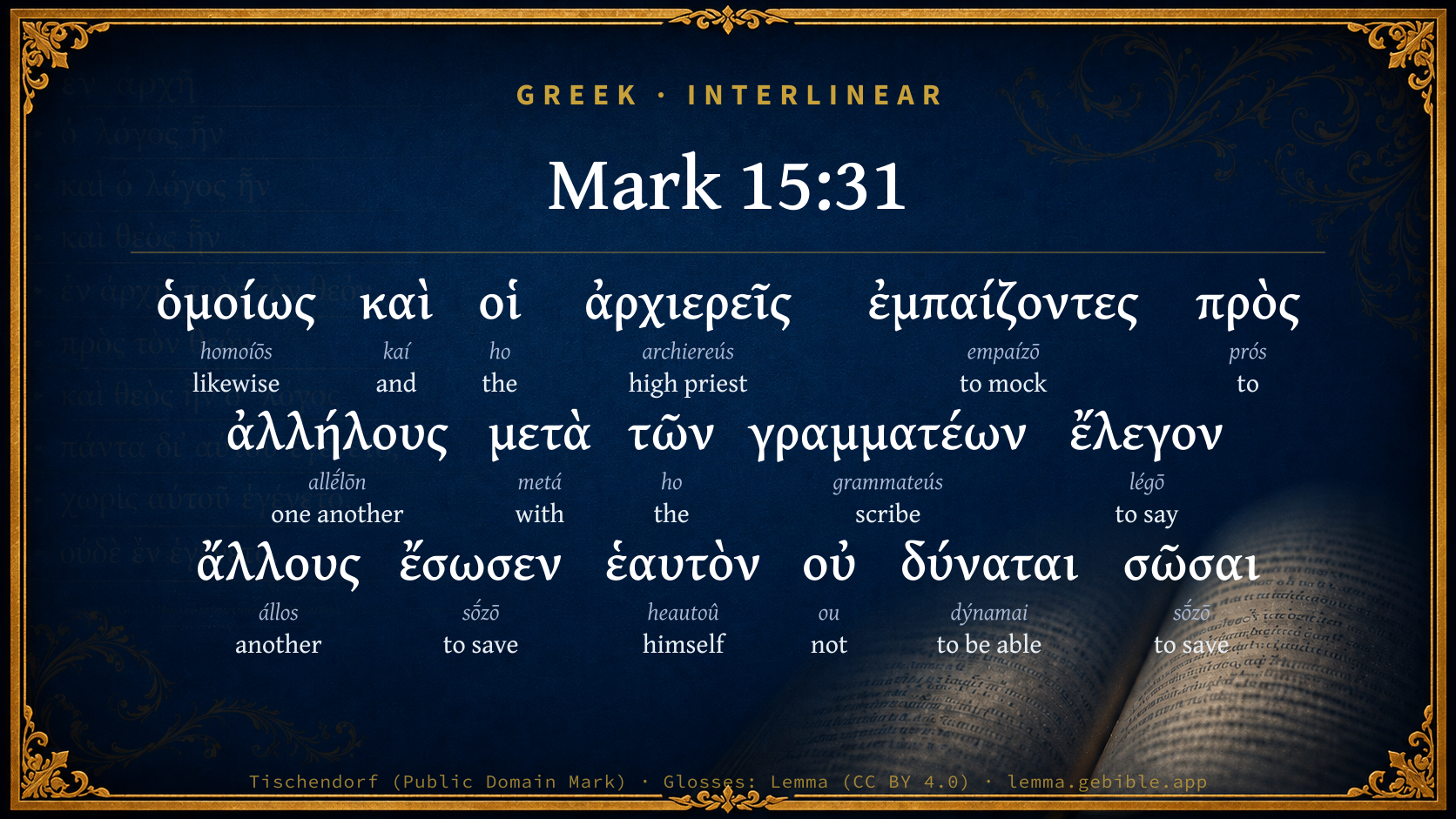
Greek (Tischendorf 8th ed.) Mark 15:31 appears in the Greek New Testament. The text above is from the Tischendorf 8th edition. Each word links to its Strong’s number and a concise gloss. Click any word for its full Thayer’s Greek Lexicon entry.
Download image
Cite this verse

Mark 15:31 (World English Bible). Public Domain. Lemma interlinear Bible study tool, https://lemma.gebible.app/v/mark/15/31.

Show BibTeX & RIS
BibTeX
RIS
English Translation
Likewise, also the chief priests mocking among themselves with the scribes said, "He saved others. He can't save himself.
World English Bible · Public Domain
Download a study sheet

One document with this verse’s original text, its word-by-word gloss line, the meaning frame, cross-references with their text, attributed commentary, and full source and license credits — printable, and it pastes into notes with its structure intact.

This verse Autodidact and up

Study sheet (.html) Plain text (.txt)

A passage Seminary Student

Up to 50 verses in one chapter. A passage sheet keeps up to 6 commentary sources and 12 cross-references per verse, in the order this page ranks them, and says so on the sheet whenever that leaves anything out. Ask for a single verse and you get the Autodidact verse sheet above.

Everything on this page stays free to read, with no account — the sheet is a download of what is already on screen, not access to it.

Want to remove ads? Support Godless Engineer
Compare translations 3

The same verse in 3 English versions, stacked beneath the original-language interlinear above. Click any original word for its lexicon entry.

Each is an independent rendering of the whole verse — the interlinear is not word-aligned to these translations.

Highlighted words mark where these versions differ — a whole-verse word diff, not a word-by-word alignment.

  • World English Bible Public Domain
    Likewise, also the chief priests mocking among themselves with the scribes said, "He saved others. He can't save himself.
  • King James Version Public Domain
    Likewise also the chief priests mocking said among themselves with the scribes, He saved others; himself he cannot save.
  • unfoldingWord Literal Text CC BY-SA 4.0
    Likewise also the chief priests, mocking to each other with the scribes, were saying, “He saved others; he is not able to save himself.

unfoldingWord Literal Text — © unfoldingWord, licensed CC BY-SA 4.0. Word-aligned USFM3 via Door43 (git.door43.org/unfoldingWord/en_ult).

Versions to compare (up to 4)

3 of 4 selected

Show all 19 translations

Every available English version of this verse, each an independent rendering of the whole verse.

  • World English Bible Public Domain
    Likewise, also the chief priests mocking among themselves with the scribes said, "He saved others. He can't save himself.
  • Berean Standard Bible Public Domain
    In the same way, the chief priests and scribes mocked Him among themselves, saying, “He saved others, but He cannot save Himself!
  • Majority Standard Bible Public Domain
    In the same way, the chief priests and scribes mocked Him among themselves, saying, “He saved others, but He cannot save Himself!
  • King James Version Public Domain
    Likewise also the chief priests mocking said among themselves with the scribes, He saved others; himself he cannot save.
  • American Standard Version (1901) Public Domain
    In like manner also the chief priests mocking `him' among themselves with the scribes said, He saved others; himself he cannot save.
  • Revised Version (1885) Public Domain
    In like manner also the chief priests mocking him among themselves with the scribes said, He saved others; himself he cannot save.
  • Geneva Bible (1599) Public Domain
    Likewise also euen the hie Priests mocking, said among themselues with the Scribes, He saued other men, himselfe he cannot saue.
  • Douay-Rheims (1899) Public Domain
    In like manner also the chief priests mocking, said with the scribes one to another: He saved others; himself he cannot save.
  • Young's Literal Translation Public Domain
    And in like manner also the chief priests, mocking with one another, with the scribes, said, `Others he saved; himself he is not able to save.
  • Literal Standard Version CC BY-SA 4.0
    And in like manner also the chief priests, mocking with one another, with the scribes, said, “He saved others; He is not able to save Himself.
  • Unlocked Literal Bible CC BY-SA 4.0
    In the same way the chief priests were mocking him with each other, along with the scribes, and said, “He saved others, but he cannot save himself.
  • unfoldingWord Literal Text CC BY-SA 4.0
    Likewise also the chief priests, mocking to each other with the scribes, were saying, “He saved others; he is not able to save himself.
  • Darby Bible Public Domain
    In like manner the chief priests also, with the scribes, mocking with one another, said, He saved others; himself he cannot save.
  • World Messianic Bible Public Domain
    Likewise, also the chief priests mocking among themselves with the scribes said, “He saved others. He can’t save himself.
  • Webster's Bible Public Domain
    Likewise also the chief priests mocking, said among themselves with the scribes, He saved others, himself he cannot save.
  • Free Bible Version CC BY-SA 4.0
    Likewise the chief priests and the religious teachers made fun of him, saying to each other, “He saved others, but he can't save himself.
  • Bible in Basic English Public Domain
    In the same way the chief priests, laughing at him among themselves with the scribes, said, A saviour of others, he has no salvation for himself.
  • Text-Critical English NT CC BY 4.0
    In the same way the chief priests also, along with the scribes, were mocking him among themselves, saying, “He saved others, but he cannot save himself.
  • Tyndale New Testament (1534) Public Domain
    Lyke wyse also mocked him the hye preestes amonge them selves with the scribes and sayde: He saved other men him sylfe he cannot save.

Literal Standard Version (2020), Covenant Press — licensed CC BY-SA 4.0. Text via the HelloAO Bible API (eBible.org). Unlocked Literal Bible (unfoldingWord) — licensed CC BY-SA 4.0. Text via the HelloAO Bible API (eBible.org). unfoldingWord Literal Text — © unfoldingWord, licensed CC BY-SA 4.0. Word-aligned USFM3 via Door43 (git.door43.org/unfoldingWord/en_ult). Free Bible Version, Dr. Jonathan Gallagher — licensed CC BY-SA 4.0. Text via the HelloAO Bible API (eBible.org).

Word by word

More ways to search: Search by grammar → Find every occurrence → Compare this word →

Practice this passage: Drill this verse → Learn its vocabulary →

ἐμπαίζοντες
empaízō
G1702
“to mock”
Verb, Present, Active, Participle, Nominative, Plural, Masculine
Part of Speech
Verb
Tense
Present
Voice
Active
Mood
Participle
Case
Nominative
Number
Plural
Gender
Masculine
Full Thayer's Definition

Origin: from G1722 and G3815

TDNT: 15:30,8

1. to play with, trifle with a. to mock b. to delude, deceive
  1. ὁμοίως homoíōs G3668 “likewise” Adverb
  2. καὶ kaí G2532 “and” Conjunction
  3. οἱ ho G3588 “the” Article, Nominative, Plural, Masculine
  4. ἀρχιερεῖς archiereús G749 “high priest” Noun, Nominative, Plural, Masculine
  5. πρὸς prós G4314 “to” Preposition
  6. ἀλλήλους allḗlōn G240 “one another” Reciprocal pronoun, Accusative, Plural, Masculine
  7. μετὰ metá G3326 “with” Preposition
  8. τῶν ho G3588 “the” Article, Genitive, Plural, Masculine
  9. γραμματέων grammateús G1122 “scribe” Noun, Genitive, Plural, Masculine
  10. ἔλεγον légō G3004 “to say” Verb, Imperfect, Active, Indicative, 3rd person, Plural
  11. ἄλλους állos G243 “another” Adjective, Accusative, Plural, Masculine
  12. ἔσωσεν sṓzō G4982 “to save” Verb, Aorist, Active, Indicative, 3rd person, Singular
  13. ἑαυτὸν heautoû G1438 “himself” Reflexive pronoun, 3rd person, Accusative, Singular, Masculine
  14. οὐ ou G3756 “not” Particle, Negative
  15. δύναται dýnamai G1410 “to be able” Verb, Present, Middle or Passive deponent, Indicative, 3rd person, Singular
  16. σῶσαι sṓzō G4982 “to save” Verb, Aorist, Active, Infinitive

About this verse

These counts appear in no published source. They are computed here, from the morphology-tagged text and Lemma’s own curated glosses. What Lemma adds →

17
words
15
distinct lemmas
Gospels
section

Notable vocabulary

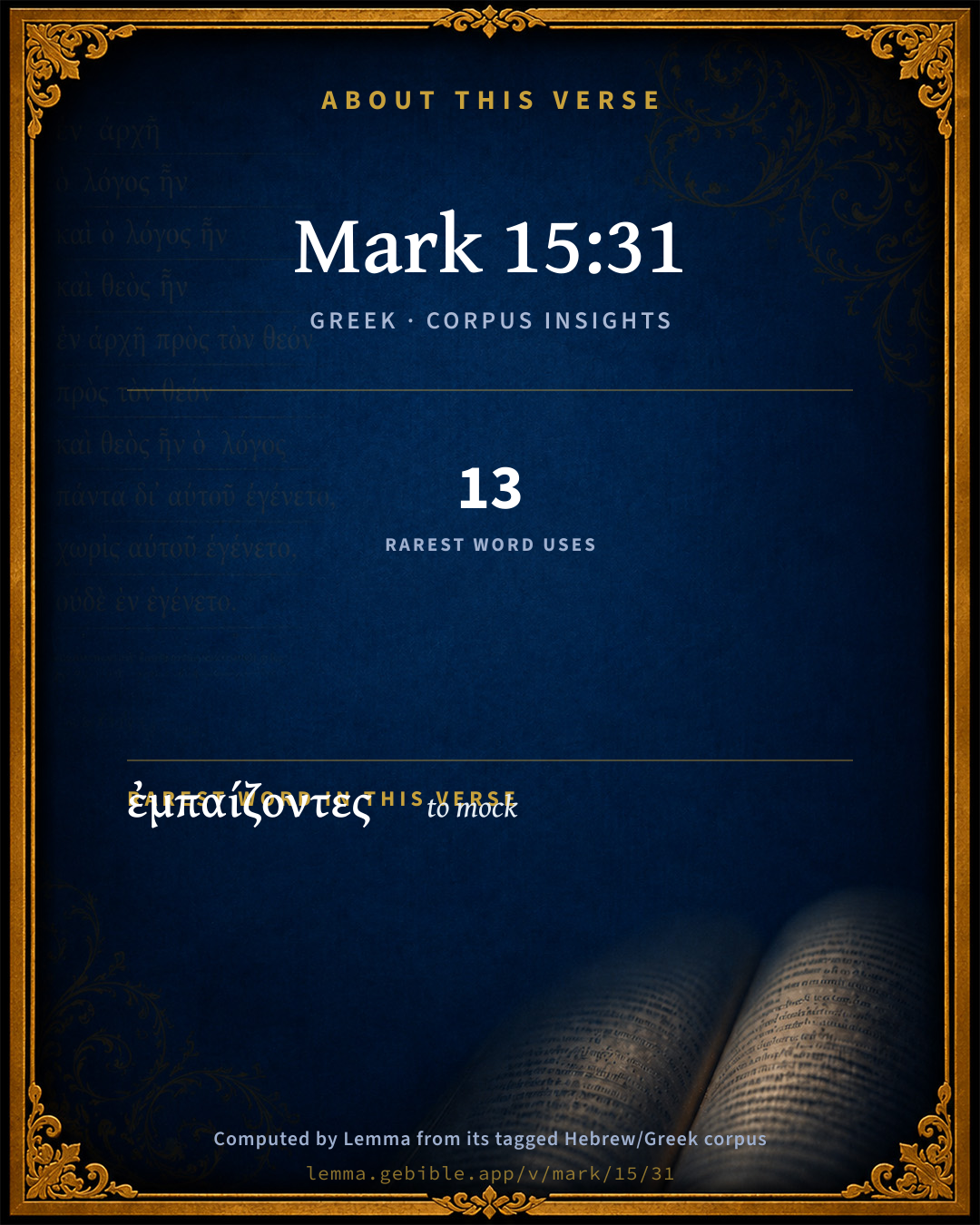
The rarest word here is ἐμπαίζοντες to mock G1702 — appearing just 13 times in the whole Greek New Testament.

Shared distinctive vocabulary

ἐμπαίζοντες to mock G1702 occurs in 13 verses of the Greek New Testament. Also found in:

Repetition

Words recur within this verse:

  • ἔσωσεν to save G4982 ×2
  • οἱ the G3588 ×2

Cross-references

7

Topical passages linked to Mark 15:31 in the Treasury of Scripture Knowledge — connected by theme and wording, ordered by reader-vote popularity; previews shown in the World English Bible.

  • John 12:23–24 Jesus answered them, "The time has come for the Son of Man to be glorified.
  • Psalms 2:1–4 Why do the nations rage, And the peoples plot a vain thing?
  • Psalms 22:16–17 For dogs have surrounded me. A company of evil-doers have enclosed me. They pierced my hands and my feet.
  • Matthew 27:41–43 Likewise the chief priests also mocking, with the scribes, the Pharisees, and the elders, said,
  • Luke 23:35–37 The people stood watching. The rulers with them also scoffed at him, saying, "He saved others. Let him save himself, if this is the Christ of God, his chosen one!"
  • John 11:47–52 The chief priests therefore and the Pharisees gathered a council, and said, "What are we doing? For this man does many signs.
  • 1 Peter 3:17–18 For it is better, if the will of God should so will, that you suffer for doing well than for doing evil.

Cross-references courtesy of OpenBible.info (CC BY 4.0).

Commentary

Notes on Mark 15:31 from classic Christian and Jewish commentators (each source and its license shown beneath its notes). The classic Christian expositions comment on the surrounding passage and are grouped to its opening verse, so a note may address several verses; the Jewish commentaries on the Tanakh (Rashi and others) are per-verse, so they appear only where the commentator wrote on this verse.

Lemma curates 59 commentaries, every one of them public domain or Creative Commons licensed, each selected and text-cleaned for this edition rather than reprinted as found. About our sources →

The Biblical Illustrator

Joseph S. Exell

Mar_15:31-32

Let Christ, the King of Israel, now descend from the cross.

A glorious reproach

In the Divinest sense He could not save Himself. Physically, of course, He could have delivered Himself, come down from the cross, and overwhelmed His enemies with destruction. But morally He could not, and His moral weakness here is His glory. He could not because He had promised to die, and He could not break His word. He could not, because the salvation of the world depended upon His death. The greatest man on earth is the man who cannot be unkind, who cannot tell a falsehood, who cannot do a dishonourable act or be guilty of a mean, selfish deed. The glory of the omnipotent God is, that He cannot lie. These men, therefore, should have honoured the weakness that they acknowledged; adored it. Their very confession condemns their conduct. (Homilist.)

The heroism of the crucified

The testimony of an enemy is always valuable. What is it that they testify? First, that He saved others: and second, that in order to save others-nay, they testify not that, yet it is implied in the assertion they make-in order to save others He was content not to save Himself. Perhaps there never was a sentence, that was in one sense so radically false, and in another sense so sublimely true, as this particular sentence. Take it in the abstract, and it contains a most outrageous and glaring falsehood. There was not a moment from beginning to end of His human career in which our blessed Lord might not have turned back from shame and suffering. Yet while these words are false absolutely, they are none the less true relatively. Relatively to the work which our blessed Lord had undertaken, it was necessary that He Himself should not be saved. Because He was the Son, there was a certain blessed, constraining influence which rendered it, in one sense, necessary that He should go forward: but the necessity was not imposed upon Him from without, but accepted from within. It was the necessity of love; love, first and foremost to His Father, and then love to thee and to me. When you look over His history, how much there was to lead Him to exercise this power which all along He possessed. How natural it would have been if He had done so. He has scarcely come into the world before He begins to meet with the worlds bad treatment. When He was born, they had no room for Him in the inn. Would it not have been most natural if our blessed Lord had even then thought better of it. These rebel sinners, these thoughtless beings, I have come into the world to save-they have not even a place whereon to lay My infant form. As He grew up to be a young man, He came unto His own: His very brethren did not believe in Him. When He found that there was cold incredulity, an absence of sympathy in His own family circle, might He not reasonably have been expected to say, Ah, well! this is not what I expected: I thought I should have been received with open arms; that every heart would have been full of sympathizing tenderness towards Me: but they have nothing but hard thoughts to think, and hard sayings to say of Me. Let them alone: from this time I give up the task: it is a hopeless one. We read that He was in the world, and the world was made by Him, and the world knew Him not. How wonderful a thing it was that Jesus Christ should have stood all this, and yet continued true to His purpose still. They laid the cross upon Him, and He faints on the way to Calvary. O, Son of God! Thy body has fainted! Weakness has done its work! Surely Thou wouldest be justified in giving in now! He might reasonably have said, Flesh and blood will bear no more; My physical strength has absolutely yielded under the terrible shock; I can carry it no further. But no, no. He may faint; but He will not yield. Is it not wonderful? What made Him stand to His purpose? What gave Him that strange stability? Well, I can only say, He loved us. Why He loved us, I do not know; but He loved us, and He loves us still; and it is because He loved us that He saved others; Himself He could not save. But we are only skimming the surface. We must endeavour, if we can, to go deeper than this. There is a mystery of sorrow here. If we are to understand what is transpiring on yonder cross, we must endeavour to look within the veil; we must try to see things as God saw them. Yet it is an awful thing to think of that world descending in that gradually lowering scale into the very jaws of darkness and death. Where are we to find the hero of humanity? Who shall fight our battle for us? Who shall avail to lift that sinking world from the very depth of doom into which it is disappearing? No angel in heaven can do it. There is only One who can do it, and there is only one way in which He can do it. By a sovereign effort of His own will, Christ might have called a new world into existence; He might have blasted this world with judgment, and caused it to disappear altogether; but in doing so He would have been stultifying-shall I say?-His own designs; He would have been withdrawing from His own eternal purposes of mercy and love. Nay, nay; the ruinous world must be saved-How is it to be done? The Son of the Fathers bosom steps into that ascending scale. Now look! He does it voluntarily. I lay down My life, He says; no man taketh it from Me; I give it; for it was His own free gift for man, for you, for me. What means this strange sense of desolation! Through all His human life, there was one thing that had sustained Him, one joy that had ever been present to Him. It was the joy of His Fathers presence. He had lived in the light of His countenance. He had refreshed Himself with His fellowship. He had drank of the brook by the way, and therefore He lifted up His head. But lo! the brook by the way seems to be dried up. It was no mere natural thirst that parched Emmanuel. That outward thirst was but the indication, the type, the symbol, of the inward thirst which burned within His soul. What means this strange sense of desolation? What is it? Is it the loss of human friends? No; something more than that. That is bad enough to bear; but it is something more than that. What is it? For the first time in His human life He finds Himself alone. The light is eclipsed; the sun has disappeared from His heaven, and the joy of existence is gone. He gazes round and round-east, and west, and north, and south. What is it? It is but a little matter that the outward sun was eclipsed; but there was a dread eclipse had taken place within the soul of Emmanuel, of which that outward darkness was but the type. What was it? Wherever sin goes it brings its own deadly shame of everlasting night along with it. And because He had taken the burden of the worlds sin upon Him, therefore the shadows of night were resting upon Him now. One shrinks from following out these words, yet one can fancy-and it is no mere fancy-what must have passed through His heart. I could have borne that My own people should treat Me thus: I could have borne that My own disciple should betray Me for thirty pence: I might have borne that Simon Peter should deny me with oaths and curses: I might have borne the outward pain, the bodily anguish: but O, My God, My God, Thy smile has been my light: Thy presence has been My joy. What have I done? How comes it to pass that instead of fellowship I have desolation; instead of Thy joyful company, Thy blessed society, I have this awful sense of loneliness? What is it? What means it? My God, why hast Thou forsaken Me? What did it all mean? It meant that He saved others: and because He saved others, Himself He could not save: and so the scale that bore the Christ descended into the deepest darkness, and the scale that bore a ruined world began to rise, and to rise. Lo! the gloom is settled on that, and the sunlight on this: that, is sinking down into the darkness of death; this, is rising into the glories of life. The angels are veiling their faces in horror as they behold the Son of God disappear beneath the cloud: the sons of God are shouting in triumph as they behold a ransomed world rising into the very sunlight of the Divine smile, the curse revoked, the doom recalled, the gates of everlasting life opened to a ruined world. So He carried it through,-that wonderful enterprise-through to the bitter end: and so He drank the cup to the last drop, and He paid the ransom to the last penny, sinner, for thee, and for me. I want to ask you, Have you accepted that which He has purchased at such a price? What is it that renders sin inexcusable? Just this glorious fact we are gazing at. Your condemnation, my friend, lies in this: that at the cost of such indescribable agony as we shall never know, until we get to the other side: and not even then, Christ has bought everlasting life for you, and you have refused to accept it. Tonight, that pierced hand seems to hold it out for you. It seems as though He pleaded with you; as if He were saying, Now, my dear brother, I have saved, not Myself, that I might save thee: I turned not my face from shame and spitting, that thy face might be irradiated with Divine glory: I wore that crown of thorns that thou mightest wear the crown of glory: I carried that cross that thou mightest sway the sceptre: I hung in agony that thou mightest sit in triumph: I fathomed the depth that thou mightest rise to the height. Men! do you think there is anything manly in trampling such love as that under your feet? Women! do you think there is anything womanlike in turning your back upon such love as that? Oh, let us be ashamed of ourselves tonight, that we have sinned against that love so long! (W. H. Aitken, M. A.)

The demand of sinners unreasonable

These words are a demand that He would prove His claims to the Messiahship by coming down from the cross, and a promise that, if He would do this, they would receive Him as the Messiah. It strikes us at once that this demand is unreasonable, even to effrontery.

I. You make demands which are unreasonable, because compliance with them would defeat the Divine plan of redemption. This was one characteristic of the unreasonable demand of the Pharisees. If Christ had come down from the cross, the work of redemption would never have been finished. Similar demands are often made by ungodly men-demands that Christ would come down from the cross-that He would save them in some other way than by His atoning sacrifice, and His blood.

II. Your demands are unreasonable, because you create for yourselves the very difficulties which you claim to have removed. Jesus was moving among the Jews, working the most convincing miracles. They seized Him, and nailed Him to the cross: then they demanded that He should undo what their own malice had done-Come down from the cross, and we will believe. A similar unreasonableness belongs to many of your demands. Is it not your own hand that has plunged your soul into this flood of worldliness, etc.? With what reason can you urge, as your apology for inaction, the chains which your own hands have fastened on your souls?

III. Demands are unreasonable which require additional evidence of the importance of religion, when sufficient has been already given. Unreasonableness of this kind characterized the demand of the Pharisees. They had seen the Saviours miracles, etc. It was unreasonable in them to propose that, if a single miracle should be added to the multitude already given, they would be ready to receive Jesus as the Christ. Precisely similar is the unreasonableness of many of your demands. You say, If I had lived in Christs day, and had seen His miracles, I should have been His disciple. Other demands exhibit the same unreasonableness. The reason most commonly given for indifference to religion, is the inconsistency of professors. I presume every one of you knows some whom he acknowledges as real Christians. You are no stranger to these triumphs of the cross, to these demonstrations of its Divine power. And yet you plead that, because A, B, and C do not live consistently with their profession, you will neglect religion, and treat it as if it were a worthless imposture. Similar are all the reasons for neglecting religion, founded on its mysteries. If men never engaged in worldly business till all who engage in it manage it wisely, honestly, and successfully; if they never acted except on certainty-never acted till everything dark was cleared up, and every objection removed, they would never act at all.

IV. It is unreasonable to demand more, when God has already done so much in your behalf, especially when you have not made improvement of what He has done. The Jews might have known, from the ancient prophecies, that Christ was to suffer an ignominious death. It was unreasonable.

V. Your demands are unreasonable, because God has proved it by testing them. You have made similar demands before; God has condescended to comply with them, and yet you did not, even then, keep the promises you had made. Time and again had the Pharisees asked Jesus to give them a sign that they might see and believe. Signs He had given them, the most stupendous and convincing; yet they were not more ready to receive Him than before. And even when He rose from the dead, they still rejected Him.

VI. Your demands are unreasonable, because, in the very act of making them, you admit what justifies your condemnation. The Pharisees said, He saved others. They admitted that He had wrought miracles. Thus, by the very justification which they attempted, they condemned themselves. So it is with you. Whatever reason you may give for neglecting religion, you admit its Divine authority, its reality, and importance. Out of thine own mouth will I judge thee, thou wicked servant.

VII. Your demands and apologies are unreasonable, because they lay the blame of your continued impenitence on God. (S. Harris.)

The sight of the Saviours suffering

Do you not know that this simple story of a Saviours kindness is to redeem all nations? The hard heart of this worlds obduracy is to be broken before that story. There is in Antwerp, Belgium, one of the most remarkable pictures I ever saw. It is The Descent of Christ from the Cross. It is one of Rubens pictures. No man can stand and look at that Descent from the Cross, as Rubens pictured it, without having his eyes flooded with tears, if he have any sensibility at all. It is an overmastering picture-one that stuns you, and staggers you, and haunts your dreams. One afternoon a man stood in that cathedral looking at Reubens Descent from the Cross. He was all absorbed in that scene of a Saviours sufferings when the janitor came in and said: It is time to close up the cathedral for the night. I wish you would depart. The pilgrim, looking at that Descent from the Cross, turned around to the janitor and said: No, no; not yet. Wait until they get Him down. O, it is the story of a Saviours suffering kindness that is to capture the world. (Dr. Talmage.)

The Biblical Illustrator, edited by Joseph S. Exell (c. 1880s–1900s) — public domain. Text from a community e-Sword module.

Expositor's Greek Testament

ed. W. Robertson Nicoll

Mar 15:31 . οἱ ἀρχιερεῖς : both in Mt. and in Mk. the priests lead in the unhallowed chuckling, scribes and elders (Mt.) being mentioned only subordinately ( μετὰ , etc.). πρὸς ἀλλήλους : a common fear gives place to a common sportiveness in this unholy brotherhood, now that the cause of their fear is removed.

The Expositor's Greek Testament, edited by W. Robertson Nicoll (1897–1910) — public domain. Text from a community e-Sword module.

The Cambridge Bible for Schools and Colleges

gen. ed. J. J. S. Perowne

31. the chief priests] whose high dignity and sacred office should have taught them better than to descend to the low passions of the mob.

mocking said] “scornynge him, ech to other, with; scribis, seiden,” Wyclif. The ordinary bystanders blaspheme (Mar_15:29), the members of the Sanhedrim mock, for they think they have achieved a complete victory.

The Cambridge Bible for Schools and Colleges (gen. ed. J. J. S. Perowne; Cambridge University Press, 1878–1918) — public domain. Text from a community e-Sword module.

John Gill's Exposition

And at the ninth hour Jesus cried with a loud voice,.... See Gill on Mat 27:46;

saying, Eloi, Eloi, lama sabachthani? in Matthew it is, "Eli, Eli", Both "Eli" and "Eloi", are Hebrew words, and signify the same; and are both used in Psa 22:1, from whence the whole is taken:

which is, being interpreted, my God, my God, why hast thou forsaken me? See Gill on Mat 27:46.

John Gill's Exposition of the Whole Bible (1746–1763) — public domain (CC PDM 1.0). Text via the HelloAO Bible API.

The Pulpit Commentary

The chief priests and the scribes are more bitter than the people. In fact they had all along endeavored to rouse the bad passions of the people against our Lord. And now they take advantage of this his present degraded condition to renew the old charge that his miracles of healing had been wrought by Beelzebub, because, if they had been wrought by God, God would have interposed in this his sore extremity and have set him free. He saved others. They cannot deny this fact. But they now try to turn this fact against him, by alleging that he who pretended to work miracles upon others, wrought them, not by the finger of God, but by Beelzebub, seeing that, if they had been wrought by a Divine power, the same power would now be exercised for his deliverance. They desired to take advantage of this public opportunity of exposing him as an impostor, and so they hoped to get rid of him, and at the same time to blot the very name of Christianity from out of the earth.

Vers. 31, 32. The Savior"s helplessness.

A paradox. The situation as regarded by those who surrounded the cross was manifestly in contradiction with the pretensions of Jesus. This prima facie impression was not accidentally produced, but belonged, so to speak, to the very essence of the gospel as a mystery; " and it had its ends to serve in the inscrutable wisdom of God. That it tended at first to conceal the true character of the Savior"s sufferings there can be no doubt; but as certainly it prepared the way for subsequent spiritual revelation. It served

I TO EXCITE ATTENTION. This apparent self-contradiction in the career of Jesus was a matter of public notoriety. Had it been overlooked by any, the enemies of the truth were eager to point it out. There is something piquant to the curiosity and speculation of men in a matter which wears such an aspect.

II AS A MEANS OF AVENGING THE TRUTH UPON ITS ADVERSARIES. How quick they were to seize upon it and turn it to the best advantage! For a little while they had it all their own way. So infatuated were they, that they put the seeming contradiction in the strongest possible form; the antithesis is all but perfect. Not quite so, however. They had to confess that he had saved others." The monuments of his work remained, and facts are hard to discredit. There was something in the very sound which would recall histories of gracious sympathy and help; miracles of saving power. It was precisely this element of stubborn matter of fact which could not be accounted for on the theory of mere pretension, and which in turn vitiated their argument. A thousand presumptions will not disprove, but must yield to, a single fact. Now, the fact of Christ"s miraculous works is certified to us by those who sought to discredit and disprove them. Out of their own mouths are they condemned.

They are self-sentenced to a vicious mill-round of mere logic. The natural man cannot understand the heavenly mystery.

III AS A MEANS OF DISCIPLINING AND REWARDING FAITH.

1. That the disciples themselves did not comprehend it at first is evident from the Gospel narrative. It must have been hard for them to see what appeared the falsification of their hopes; harder still to be taunted by those who had so cruelly slain their Master. What part may it not have had in the "cup" the Savior himself had to drink?

2. But by this very discipline it prepared them for the inner and spiritual "discerning of the Lord"s body." Their spiritual susceptibilities were awakened, and they began to realize the meaning of the mystery. Gradually they were to emerge from the bewilderment and perplexity. Peter and the rest of the disciples traveled far ere they reached Pentecost, but each step in the journey of their faith was a revelation of the secret of Jesus. It was not to human force he had submitted, but to his Father"s will. The necessity that bound him to the cross was a spiritual one. It was because he wished to save others absolutely that he would and could not save himself. M.

The Pulpit Commentary (1880–1919), ed. H.D.M. Spence-Jones & Joseph S. Exell — public domain. Text from a community e-Sword module.

unfoldingWord translationNotes

Door43 World Missions Community

In the same way

This refers to the way that the people who were walking by Jesus were mocking him.

were mocking him with each other

"were saying mocking things about Jesus among themselves"

Let the Christ, the King of Israel, come down

The leaders did not believe that Jesus is the Christ, the King of Israel. AT: "He calls himself the Christ and the King of Israel. So let him come down" or "If he is really the Christ and the King of Israel, he should come down" (See: Irony)

believe

The means to believe in Jesus. AT: "believe in him" (See: Assumed Knowledge and Implicit Information)

taunted

mocked, insulted

translationWords

chief priests

scribe

Christ

Israel

cross

crucify

unfoldingWord translationNotes — © Distant Shores Media and the Door43 World Missions Community, licensed CC BY-SA 4.0. Source: git.door43.org/Door43/en_tn.

Cambridge Greek Testament for Schools and Colleges

31. οἱ ἀρχιερεῖς … μετὰ τῶν γραμματέων. On such a day, the eve of the Passover and of the Sabbath, these priests and scribes must have come on purpose to mock. Judges capable of striking and spitting at their Prisoner (Mar 14:65) would be equally capable of making derisive remarks in His hearing. They talk at the dying Sufferer, not like the passers by, to Him. Their scornful remarks to one another are meant to be heard by Him and by others. See on Mar 10:34. But the Evangelists let the malignity of the hierarchy speak for itself; they record it without denouncing it. Loisy remarks that it is improbable that the majority of the Sanhedrin would be present at the crucifixion. Perhaps so, but Mk does not say that they were. Enough were there to justify the statement that the priests and the scribes flung about insulting words.

Ἄλλους ἔσωσεν. These words also are in all three. He healed others; Himself He cannot heal. This is a freq. meaning of the verb in the Gospels (Mar 3:4, Mar 5:23; Mar 5:28; Mar 5:34, Mar 6:56, Mar 10:52; etc.). The prince of the demons, they said, helped Him to heal others (Mar 3:22), but He can get no such help for Himself. In the Gospel of Nicodemus the saying is expanded thus: “Others He saved, others He cured, and He healed the sick, the paralytic, the lepers, the demoniacs, the blind, the lame, the dead; and Himself He cannot cure.” His enemies had never been able to deny the fact of His miraculous healings.

Cambridge Greek Testament for Schools and Colleges (Cambridge University Press, 1896; 21 vols, various authors incl. Carr, Maclear, Plummer, Farrar, Lumby, Moule, M. R. James, Simcox) — public domain. Text from a community e-Sword module.

International Critical Commentary

31. Ὁμοίως καὶ οἱ ἀρχιερεῖς ἐμπαίζοντες πρὸς ἀλλήλους—Likewise also the chief priests mocking to each other. RV. among themselves. The prep. denotes how the mocking was passed from one to another.

Omit δὲ, and, after ὁμοίως, Tisch. Treg. WH. RV. א ABC*, LPX ΓΔΠ, one ms. Lat. Vet. Vulg. Memph. Harcl.

These mocking priests and scribes were touching here upon what to all his contemporaries was the great mystery in the life of Jesus, but was really its crowning glory. The great obstacle in the way of human obedience to Divine law is the sacrifice which it involves, especially in a world where everything works the other way. And on the other hand, the value and importance of obedience are enhanced by this sacrifice. But our Lord’s sacrifice for righteousness’ sake is magnified again by the contrast stated here. His miracles were a standing proof of his power to save others and himself. But while he used that power in the behalf of others, when the crisis of his own fate came, he was apparently powerless. Evidently, there was no limitation of the power, and so, there must have been a restraint imposed upon himself. He not only would not compromise with evil, he would not resist evil by opposing force to force. The taunt of his enemies meant that here was the final test of his miraculous power, and the proof of its unreality. When that test came, it showed, as they thought, that God was not on his side, else how could his enemies triumph over him? Whereas, everything pointed the other way. His miracles were real, God was on his side, and yet neither he nor God would lift a hand to save him. And the evident reason was that he would not cheapen his righteousness by making it safe. If he lived the righteous life, but did not incur the risks of other men in such living, his righteousness would lose the power to produce righteousness in other men which he sought. And, instead of revealing and furthering God’s ways among men, it would obstruct them by introducing an alien principle at cross purposes with them. God’s way is to establish righteousness by the self-sacrifice of righteous men, and for the one unique and absolute saint to avoid that sacrifice would destroy the self propagating power of his righteousness.

International Critical Commentary — older volumes (1896–1929), various authors — public domain. Text from a community e-Sword module.

Lesson kit

Teaching starters — assembled from the data on this page, not authored interpretation. Every prompt links to the verse data it draws on. Edit before teaching.

Mark, in the Gospels, opens this verse with 17 words (15 distinct Greek lemmas). Its most distinctive word is empaízō (“to mock”). A historical commentator’s framing appears above. Read the whole chapter for the surrounding context.

Discussion questions

  1. How does “to mock” (empaízō) shape what this verse is saying?
  2. How does Matthew 2:16, which shares the word «to mock», read alongside this verse?
  3. What does the repetition of “to save” (2× in this one verse) do in this verse?
  4. The translations on this page render this verse differently — a whole-verse word diff, not a word-by-word alignment. What might account for the different wordings?
  5. Compare how The Biblical Illustrator and Expositor's Greek Testament read this verse. Where do they agree or differ?

Things to notice

  • These translations choose different wording for 9 words in this verse.
  • “to save” occurs 2× in this single verse.
  • 15 distinct Greek lemmas span 17 words in this verse.

Reading settings

Reading text

Shown beneath each verse's original-language words.

Old Testament
Old Testament edition

Read the OT as the Masoretic Hebrew (MT) or the Greek Septuagint (LXX).

English shown for the Greek Septuagint (in the Hebrew ↔ Greek comparison).

Comparing translations? Open the Compare panel on any verse page to stack up to four side by side.