Luke 23:43

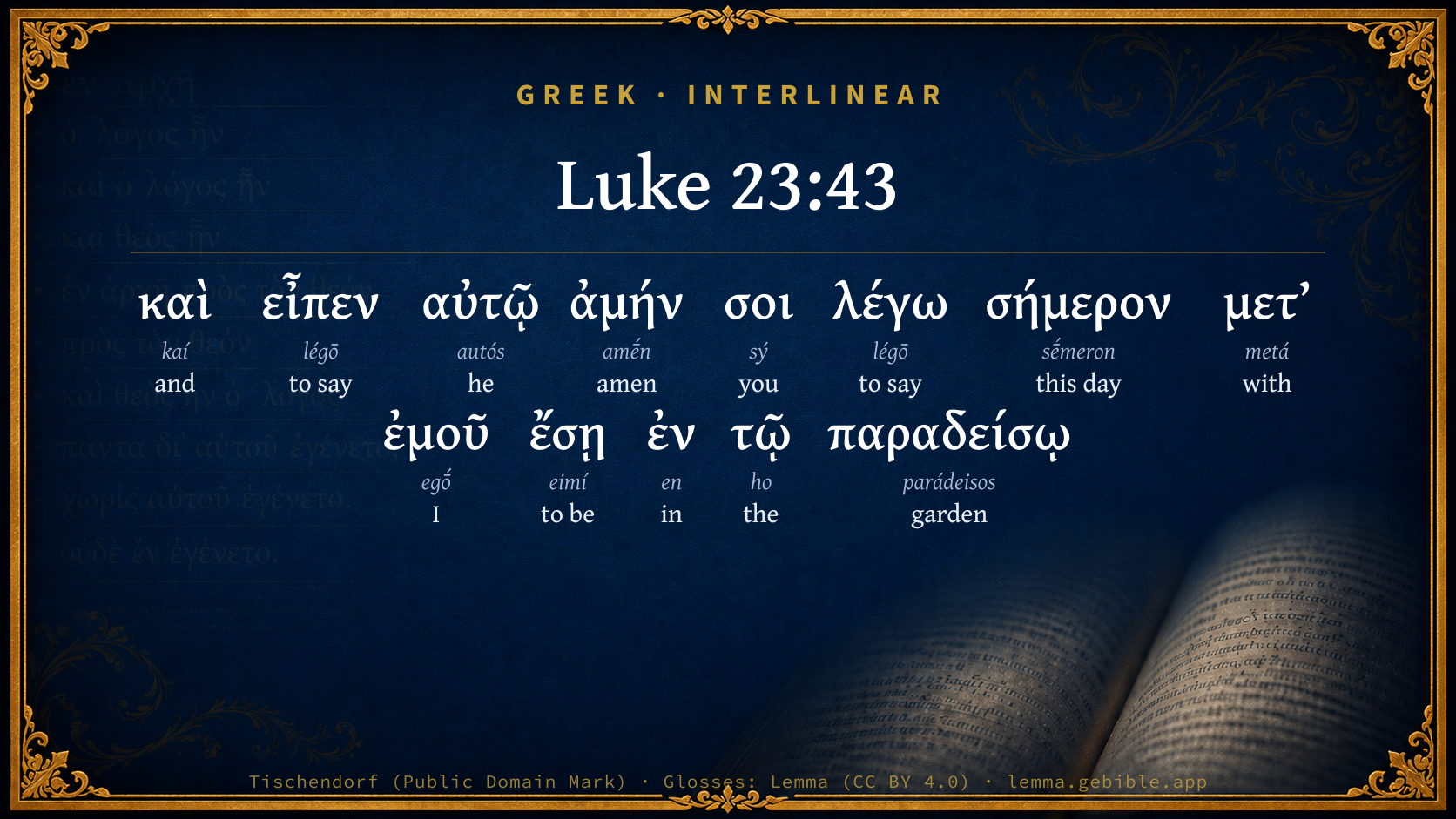
Greek (Tischendorf 8th ed.) Luke 23:43 appears in the Greek New Testament. The text above is from the Tischendorf 8th edition. Each word links to its Strong’s number and a concise gloss. Click any word for its full Thayer’s Greek Lexicon entry.
Download image
Cite this verse

Luke 23:43 (World English Bible). Public Domain. Lemma interlinear Bible study tool, https://lemma.gebible.app/v/luke/23/43.

Show BibTeX & RIS
BibTeX
RIS
English Translation
Jesus said to him, "Assuredly I tell you, today you will be with me in Paradise."
World English Bible · Public Domain
Highlights
  • 1 first appearance in the Greek New Testament
Full analysis ↓
Download a study sheet

One document with this verse’s original text, its word-by-word gloss line, the meaning frame, cross-references with their text, attributed commentary, and full source and license credits — printable, and it pastes into notes with its structure intact.

This verse Autodidact and up

Study sheet (.html) Plain text (.txt)

A passage Seminary Student

Up to 50 verses in one chapter. A passage sheet keeps up to 6 commentary sources and 12 cross-references per verse, in the order this page ranks them, and says so on the sheet whenever that leaves anything out. Ask for a single verse and you get the Autodidact verse sheet above.

Everything on this page stays free to read, with no account — the sheet is a download of what is already on screen, not access to it.

Want to remove ads? Support Godless Engineer
Compare translations 3

The same verse in 3 English versions, stacked beneath the original-language interlinear above. Click any original word for its lexicon entry.

Each is an independent rendering of the whole verse — the interlinear is not word-aligned to these translations.

Highlighted words mark where these versions differ — a whole-verse word diff, not a word-by-word alignment.

  • World English Bible Public Domain
    Jesus said to him, "Assuredly I tell you, today you will be with me in Paradise."
  • King James Version Public Domain
    And Jesus said unto him, Verily I say unto thee, To day shalt thou be with me in paradise.
  • unfoldingWord Literal Text CC BY-SA 4.0
    And he said to him, “Truly I say to you, today you will be with me in paradise.”

unfoldingWord Literal Text — © unfoldingWord, licensed CC BY-SA 4.0. Word-aligned USFM3 via Door43 (git.door43.org/unfoldingWord/en_ult).

Versions to compare (up to 4)

3 of 4 selected

Show all 19 translations

Every available English version of this verse, each an independent rendering of the whole verse.

  • World English Bible Public Domain
    Jesus said to him, "Assuredly I tell you, today you will be with me in Paradise."
  • Berean Standard Bible Public Domain
    And Jesus said to him, “Truly I tell you, today you will be with Me in Paradise.”
  • Majority Standard Bible Public Domain
    And Jesus said to him, “Truly I tell you, today you will be with Me in Paradise.”
  • King James Version Public Domain
    And Jesus said unto him, Verily I say unto thee, To day shalt thou be with me in paradise.
  • American Standard Version (1901) Public Domain
    And he said unto him, Verily I say unto thee, To-day shalt thou be with me in Paradise.
  • Revised Version (1885) Public Domain
    And he said unto him, Verily I say unto thee, Today shalt thou be with me in Paradise.
  • Geneva Bible (1599) Public Domain
    Then Iesus said vnto him, Verely I say vnto thee, to day shalt thou be with me in Paradise.
  • Douay-Rheims (1899) Public Domain
    And Jesus said to him: Amen I say to thee, this day thou shalt be with me in paradise.
  • Young's Literal Translation Public Domain
    and Jesus said to him, `Verily I say to thee, To-day with me thou shalt be in the paradise.'
  • Literal Standard Version CC BY-SA 4.0
    and Jesus said to him, “Truly I say to you, today you will be with Me in Paradise.”
  • Unlocked Literal Bible CC BY-SA 4.0
    Jesus said to him, “Truly I say to you, today you will be with me in paradise.”
  • unfoldingWord Literal Text CC BY-SA 4.0
    And he said to him, “Truly I say to you, today you will be with me in paradise.”
  • Darby Bible Public Domain
    And Jesus said to him, Verily I say to thee, To-day shalt thou be with me in paradise.
  • World Messianic Bible Public Domain
    Yeshua said to him, “Assuredly I tell you, today you will be with me in Paradise.”
  • Webster's Bible Public Domain
    And Jesus said to him, Verily I say to thee, This day shalt thou be with me in paradise.
  • Free Bible Version CC BY-SA 4.0
    Jesus replied, “I promise you today you will be with me in paradise.”
  • Bible in Basic English Public Domain
    And he said to him, Truly I say to you, Today you will be with me in Paradise.
  • Text-Critical English NT CC BY 4.0
    Jesus said to him, “Truly I say to yoʋ, today yoʋ will be with me in Paradise.”
  • Tyndale New Testament (1534) Public Domain
    And Iesus sayde vnto him: Verely I saye vnto the to daye shalt thou be with me in Paradyse.

Literal Standard Version (2020), Covenant Press — licensed CC BY-SA 4.0. Text via the HelloAO Bible API (eBible.org). Unlocked Literal Bible (unfoldingWord) — licensed CC BY-SA 4.0. Text via the HelloAO Bible API (eBible.org). unfoldingWord Literal Text — © unfoldingWord, licensed CC BY-SA 4.0. Word-aligned USFM3 via Door43 (git.door43.org/unfoldingWord/en_ult). Free Bible Version, Dr. Jonathan Gallagher — licensed CC BY-SA 4.0. Text via the HelloAO Bible API (eBible.org).

Word by word

More ways to search: Search by grammar → Find every occurrence → Compare this word →

Practice this passage: Drill this verse → Learn its vocabulary →

παραδείσῳ
parádeisos
G3857
“garden”
Noun, Dative, Singular, Masculine
Part of Speech
Noun
Case
Dative
Number
Singular
Gender
Masculine
Full Thayer's Definition

Origin: of Oriental origin cf G6508

TDNT: 17:45,8

1. among the Persians a grand enclosure or preserve, hunting ground, park, shady and well watered, in which wild animals, were kept for the hunt; it was enclosed by walls and furnished with towers for the hunters 2. a garden, pleasure ground a. grove, park 3. the part of Hades which was thought by the later Jews to be the abode of the souls of pious until the resurrection: but some understand this to be a heavenly paradise 4. the upper regions of the heavens. According to the early church Fathers, the paradise in which our first parents dwelt before the fall still exists, neither on the earth or in the heavens, but above and beyond the world 5. heaven
  1. καὶ kaí G2532 “and” Conjunction
  2. εἶπεν légō G3004 “to say” Verb, Aorist, Active, Indicative, 3rd person, Singular
  3. αὐτῷ autós G846 “he” Personal pronoun, Dative, Singular, Masculine
  4. ἀμήν amḗn G281 “amen” Hebrew transliteration
  5. σοι sý G4771 “you” Personal pronoun, 2nd person, Dative, Singular
  6. λέγω légō G3004 “to say” Verb, Present, Active, Indicative, 1st person, Singular
  7. σήμερον sḗmeron G4594 “this day” Adverb
  8. μετ’ metá G3326 “with” Preposition
  9. ἐμοῦ egṓ G1473 “I” Personal pronoun, 1st person, Genitive, Singular
  10. ἔσῃ eimí G1510 “to be” Verb, Future, Middle deponent, Indicative, 2nd person, Singular
  11. ἐν en G1722 “in” Preposition
  12. τῷ ho G3588 “the” Article, Dative, Singular, Masculine

About this verse

These counts appear in no published source. They are computed here, from the morphology-tagged text and Lemma’s own curated glosses. What Lemma adds →

13
words
12
distinct lemmas
Gospels
section

Notable vocabulary

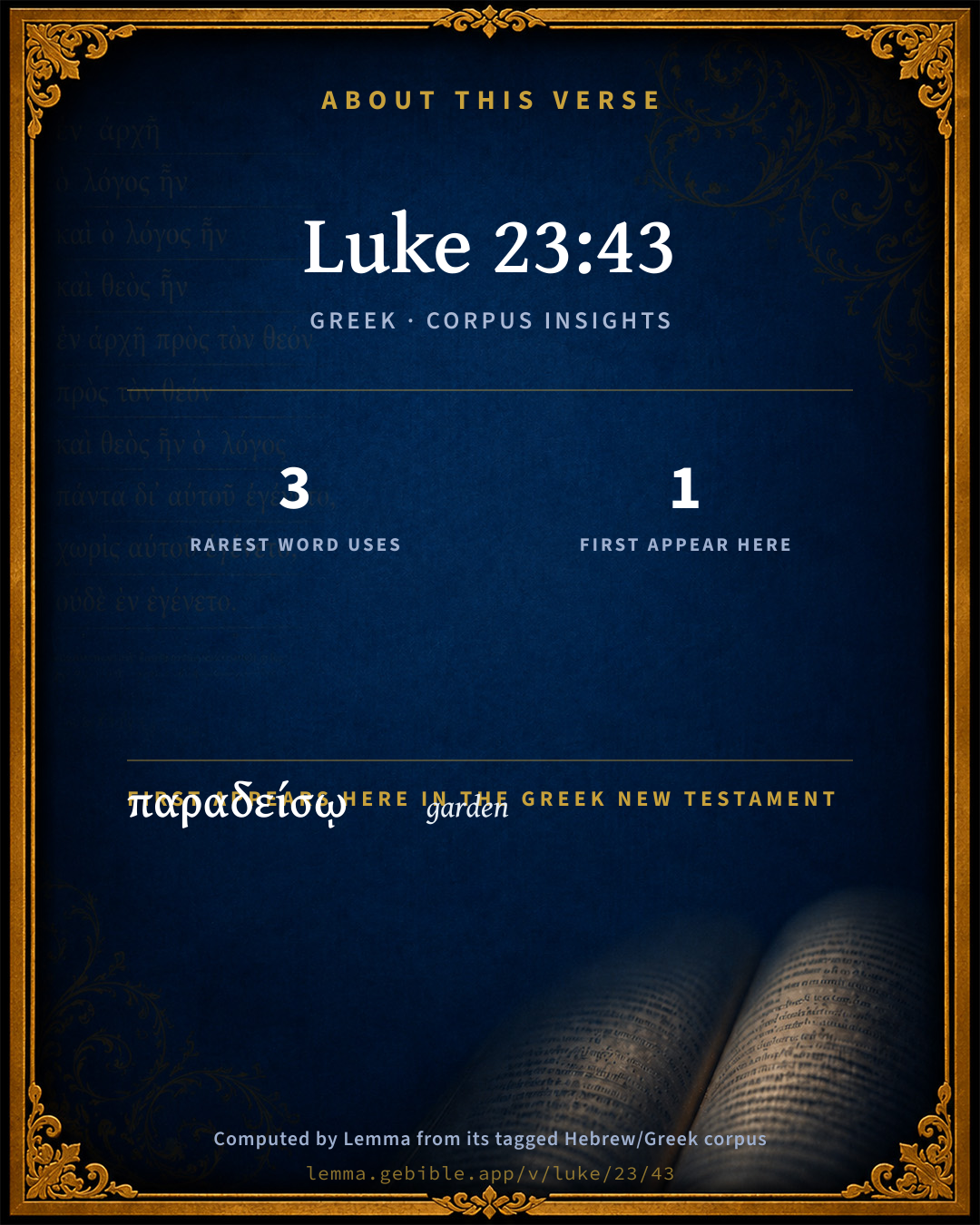
The rarest word here is παραδείσῳ garden G3857 — appearing just 3 times in the whole Greek New Testament.

First appearance in Scripture

This word makes its first canonical appearance in the Greek New Testament here:

  • παραδείσῳ garden G3857

Shared distinctive vocabulary

παραδείσῳ garden G3857 occurs in 3 verses of the Greek New Testament. Also found in:

Repetition

A word recurs within this verse:

  • εἶπεν to say G3004 ×2

Cross-references

21

Topical passages linked to Luke 23:43 in the Treasury of Scripture Knowledge — connected by theme and wording, ordered by reader-vote popularity; previews shown in the World English Bible.

  • Revelation 2:7 He who has an ear, let him hear what the Spirit says to the assemblies. To him who overcomes I will give to eat of the tree of life, which is in the Paradise of my God.
  • Psalms 50:15 Call on me in the day of trouble. I will deliver you, and you will honor me."
  • 1 Timothy 1:15–16 The saying is faithful and worthy of all acceptance, that Christ Jesus came into the world to save sinners; of whom I am chief.
  • Luke 19:10 For the Son of Man came to seek and to save that which was lost."
  • Psalms 32:5 I acknowledged my sin to you. I didn't hide my iniquity. I said, I will confess my transgressions to Yahweh, And you forgave the iniquity of my sin. Selah.
  • John 14:3 If I go and prepare a place for you, I will come again, and will receive you to myself; that where I am, you may be there also.
  • Hebrews 7:25 Therefore he is also able to save to the uttermost those who draw near to God through him, seeing he ever lives to make intercession for them.
  • John 17:24 Father, I desire that they also whom you have given me be with me where I am, that they may see my glory, which you have given me, for you loved me before the foundation of the world.
  • Philippians 1:23 But I am in a dilemma between the two, having the desire to depart and be with Christ, which is far better.
  • 2 Corinthians 12:3–4 I know such a man (whether in the body, or outside of the body, I don't know; God knows),
  • Isaiah 65:24 It shall happen that, before they call, I will answer; and while they are yet speaking, I will hear.
  • Job 33:27–30 He sings before men, and says, 'I have sinned, and perverted that which was right, And it didn't profit me.
  • Micah 7:18 Who is a God like you, who pardons iniquity, And passes over the disobedience of the remnant of his heritage? He doesn't retain his anger forever, Because he delights in loving kindness.
  • 2 Corinthians 5:8 We are of good courage, I say, and are willing rather to be absent from the body, and to be at home with the Lord.
  • Isaiah 1:18–19 "Come now, and let us reason together," says Yahweh: "Though your sins be as scarlet, they shall be as white as snow. Though they be red like crimson, they shall be as wool.
  • Luke 15:4–5 "Which of you men, if you had one hundred sheep, and lost one of them, wouldn't leave the ninety-nine in the wilderness, and go after the one that was lost, until he found it?
  • Isaiah 55:6–9 Seek you Yahweh while he may be found; call you on him while he is near:
  • Matthew 20:15–16 Isn't it lawful for me to do what I want to with what I own? Or is your eye evil, because I am good?'
  • Isaiah 53:11 He shall see of the travail of his soul, [and] shall be satisfied: by the knowledge of himself shall my righteous servant justify many; and he shall bear their iniquities.
  • Romans 5:20–21 The law came in besides, that the trespass might abound; but where sin abounded, grace did abound more exceedingly;
  • Luke 15:20–24 "He arose, and came to his father. But while he was still far off, his father saw him, and was moved with compassion, and ran, and fell on his neck, and kissed him.

Cross-references courtesy of OpenBible.info (CC BY 4.0).

Commentary

Notes on Luke 23:43 from classic Christian and Jewish commentators (each source and its license shown beneath its notes). The classic Christian expositions comment on the surrounding passage and are grouped to its opening verse, so a note may address several verses; the Jewish commentaries on the Tanakh (Rashi and others) are per-verse, so they appear only where the commentator wrote on this verse.

Lemma curates 59 commentaries, every one of them public domain or Creative Commons licensed, each selected and text-cleaned for this edition rather than reprinted as found. About our sources →

Joseph Benson's Commentary

Luk 23:43. Jesus said — In answer to his prayer; Verily I say unto thee — I, the Amen, the faithful Witness, give thee assurance, This day thou shalt be with me in paradise — As if he had said, I will not only remember thee when I come into my kingdom, but this very day; and will confer upon thee more than thou hast asked. Christ here lets us know, 1st, That he was going, not only to αδης, the invisible world, but to that part of it termed paradise. His human soul was removing to the place of separate souls; not to the place of the damned, but to the place of the blessed. This was the beginning of the joy set before him, with the prospect of which he comforted himself. He went by the cross to the crown, and we must not think of going any other way, or of being perfected save by sufferings. 2d, That when penitent believers die, they go to be with him there. He was now as a priest, purchasing this happiness for them, and is ready, as a king, to confer it upon them. Observe, reader, how the state of happiness, prepared for holy souls after death, is set forth. 1st, It is being in paradise, a garden of pleasure, the paradise of God, Rev 2:7, alluding to those gardens in which the eastern monarchs made their magnificent banquets, or rather to the garden of Eden, in which our first parents were placed, when they were innocent. It is termed Abraham’s bosom, in the story of Lazarus, and was a common expression among the Jews, for the mansion of beatified souls in their separate state. In the second Adam we are restored to all we lost in the first Adam; and more, to a heavenly paradise instead of an earthly one. 2d, It is being with Christ there. It is the happiness of paradise and of heaven, to see Christ, to be with him, and to share in his glory. Father, I will that they whom thou hast given me, be with me where I am, that they may behold my glory, &c., Joh 17:24. Thus St. Paul expected, when he departed, to be with Christ, Php 1:23; and the first Christians in general were confident, that when they were absent from the body, they should be present with the Lord. 3d, Holy souls enter this place, or state, immediately upon death. This day, that is, before six o’clock in the evening, when their day ended. “The souls of the faithful, after they are delivered from the burden of the flesh, are immediately in joy and felicity.” Observe, 1st, “That the word σημερον, to-day, is not to be connected with I say, as if the sense were this, I say to thee to-day; but with the words following, so as to contain a promise, that the thief [with respect to his soul] should even that day be in paradise, appears from the familiar phrase of the Jews, who say of the just man dying, To-day he shall sit in the bosom of Abraham. 2d, Christ doubtless spake in that sense in which the thief could, and in which Christ knew he would, understand him; now he, being a Jew, would surely understand him according to the received opinion of his nation concerning paradise, which was, that it was the place into which pious souls, separated from the body, were immediately received.”

Joseph Benson's Commentary on the Old and New Testaments (1811–1818) — public domain. Text from a community e-Sword module.

Tyndale Open Study Notes

Tyndale Open Resources

23:43 Jesus corrected the man by assuring him that today he would be vindicated in God’s presence (see also 2:11; 4:21; 5:26; 19:9). • The word translated paradise comes from a Persian word that means “garden”; it was used in Jewish literature for the Garden of Eden and also for heaven, the place of eternal bliss for God’s people (see 2 Cor 12:4; Rev 2:7; cp. Luke 16:22-23; 2 Cor 5:8).

Tyndale Open Study Notes — © Tyndale Open Resources, licensed CC BY-SA 4.0. Text via the HelloAO Bible API.

Bengel's Gnomon

Johann Albrecht Bengel

Luk 23:43. Σήμερον, to-day) On that day the converted robber could have hardly looked for death.[262] But the breaking of the legs was made subservient to this end. Thereby the Lord’s promise was fulfilled. [The marking of the time by the expression, to-day, is not to be referred (joined) to the verb, I say, as if the robber should have to wait for his entrance into Paradise during I know not how long periods of time. That the words were spoken to him on that day, is of itself evident (without it being necessary to say so). Jesus never used the expression, To-day I say; whereas He repeatedly used the expression, I say. Therefore we must read the words thus, To-day shalt thou be with Me in paradise. Thus the power and grace of the Lord, and also His own ready and immediate entrance into Paradise, is openly declared.—V. g. That was indeed to save, Luk 23:39 (which the impenitent robber had taunted Him with, as unable to effect it).—Harm., p. 570].—μετʼ ἐμοῦ, with me) Much more then did Jesus Himself come to Paradise. [A fact which must have been very consolatory to Mary, wife of Cleopas, and Mary Magdalene, against men’s bitter taunts, and to the Virgin mother and John, when communicated to them.—Harm., p. 570].—ἐν τῷ Παραδείσῳ, in Paradise) in which there are happier trees than in Golgotha (especially “the tree of life which is in the Paradise of God”), associated with immortality; Rev 2:7, note.[263] Jesus employs the most august appellation for the seat of happiness in the profoundest depth of His own suffering. Comp. note on ch. Luk 16:22, [The Jews called the good state of the dead the bosom of Abraham and the garden of Eden.] This departure to Paradise differs no doubt from the ascension to heaven, Joh 20:17 (“I am not yet ascended to My Father”), but yet it shows that His descent to ‘hell’ (the lower regions unseen) is to be explained in a good sense.

[262] So tedious a death is crucifixion.—E. and T.

[263] No other tree but “the tree of life” is mentioned there; whereas in Gen 2:9; Gen 3:3, many others grow, and it is in the midst—words not in the best MSS. of Rev 2:7—E. and T.

Bengel's Gnomon of the New Testament — English translation (T&T Clark, Edinburgh, 1860) — public domain. Text from a community e-Sword module.

Expositor's Greek Testament

ed. W. Robertson Nicoll

Luk 23:43 . σήμερον : to be connected with what follows, not with λέγω = to-day , as opposed to a boon expected at some future time (which makes for the reading ἐν τῇ β . in Luk 23:42 ). Or the point may be: this very day, not tomorrow or the next day, as implying speedy release by death, instead of a slow lingering process of dying, as often in cases of crucifixion. ἐν τῷ παραδείσῳ , in paradise; either the division of Hades in which the blessed dwell, which would make for the descensus ad inferos , or heaven; vide at Luk 16:23 , and cf. 2Co 12:4 , where it is a synonym for heaven, and Rev 2:7 , where it denotes the perfected Kingdom of God, the ideal state of bliss realised. The use of “paradise” in this sense is analogous to the various representations in Hebrews of the perfect future drawn from the primeval condition of man: lordship in the world to come, deliverance from the fear of death, a Sabbatism (Heb 2:8 ; Heb 2:14 ; Heb 4:9 ). The use of the term παράδεισος by St. Paul makes its use by our Lord credible.

The Expositor's Greek Testament, edited by W. Robertson Nicoll (1897–1910) — public domain. Text from a community e-Sword module.

Geneva Bible (1599)

Geneva Bible translators

God made the visible paradise to the East part of the world: but that which we behold with the eyes of our mind is the place of everlasting joy and salvation through the goodness and mercy of God, a most pleasant rest of the souls of the godly, and most quiet and joyful dwelling.

Geneva Bible (1599) marginal notes — public domain. Text via Bolls.life.

Jamieson, Fausset & Brown

Robert Jamieson, A. R. Fausset & David Brown

Jesus said, &c.--The dying Redeemer speaks as if He Himself viewed it in this light. It was a "song in the night." It ministered cheer to His spirit in the midnight gloom that now enwrapt it.

Verily I say unto thee--"Since thou speakest as to the king, with kingly authority speak I to thee."

To-day--"Thou art prepared for a long delay before I come into My kingdom, but not a day's delay shall there be for thee; thou shalt not be parted from Me even for a moment, but together we shall go, and with Me, ere this day expire, shalt thou be in Paradise" (future bliss, Co2 12:4; Rev 2:7). Learn (1) How "One is taken and another left"; (2) How easily divine teaching can raise the rudest and worst above the best instructed and most devoted servants of Christ; (3) How presumption and despair on a death hour are equally discountenanced here, the one in the impenitent thief, the other in his penitent fellow.

Next: Luke Chapter 24

Jamieson, Fausset & Brown — Commentary Critical and Explanatory on the Whole Bible (1871) — public domain (CC PDM 1.0). Text via the HelloAO Bible API.

Adam Clarke's Commentary

Verse 43. To-day shalt thou be with me in paradise.] Marcion and the Manichees are reported to have left this verse out of their copies of this evangelist. This saying of our Lord is justly considered as a strong proof of the immateriality of the soul; and it is no wonder that those who have embraced the contrary opinion should endeavor to explain away this meaning. In order to do this, a comma is placed after σημερον, to-day, and then our Lord is supposed to have meant, "Thou shalt be with me after the resurrection I tell thee this, TO-DAY." I am sorry to find men-of great learning and abilities attempting to support this most feeble and worthless criticism. Such support a good cause cannot need; and, in my opinion, even a bad cause must be discredited by it.

In paradise. The garden of Eden, mentioned Ge 2:8, is also called, from the Septuagint, the garden of Paradise. The word Eden, signifies pleasure and delight. Several places were thus called; see Ge 4:16; 2Kg 19:12; Isa 37:12; Eze 27:23; and Amo 1:5; and such places probably had this name from their fertility, pleasant situation, c., c. In this light the Septuagint have viewed Ge 2:8. as they render the passage thus: εφυτευσεν ὁ Θεος παραδεισον εν Εδεμ, God planted a paradise in Eden. Hence the word has been transplanted into the New Testament and is used to signify a place of exquisite pleasure and delight. From this the ancient heathens borrowed their ideas of the gardens of the Hesperides, where the trees bore golden fruit and the gardens of Adonis, a word which is evidently derived from the Hebrew עדן Eden: and hence the origin of sacred groves, gardens, and other enclosures dedicated to purposes of devotion, some comparatively innocent, others impure. The word paradise is not Greek, but is of Asiatic origin. In Arabic and Persian it signifies a garden, a vineyard, and also the place of the blessed. In the Kushuf ul Loghat, a very celebrated Persian dictionary, the [Arabic] Jenet al Ferdoos, Garden of Paradise, is said to have been "created by God out of light, and that the prophets and wise men ascend thither."

Paradise was, in the beginning, the habitation of man in his state of innocence, in which he enjoyed that presence of his Maker which constituted his supreme happiness. Our Lord's words intimate that this penitent should be immediately taken to the abode of the spirits of the just, where he should enjoy the presence and approbation of the Most High. In the Institutes of Menu, chap. OEconomics, Inst. 243, are the following words: "A man habitually pious, whose offences have been expiated, is instantly conveyed, after death, to the higher world, with a radiant form, and a body of ethereal substance." The state of the blessed is certainly what our Lord here means: in what the locality of that state consists we know not. The Jews share a multitude of fables on the subject.

Adam Clarke's Commentary on the Bible (1810–1826) — public domain. Text from a community e-Sword/MySword module.

Ellicott's Commentary for English Readers

(43) To day shalt thou be with me in paradise.—We have first to consider the word, then the thought expressed by it. The former first appears as a Persian word applied to land enclosed as a park or garden for a king or satrap. As such it meets us often in Xenophon’s Anabasis (i. 2, § 7; 4, § 9, et al.). Finding it so used, the LXX. translators used it in Son_4:13; Ecc_2:5; Neh_2:8, and, above all, in Gen_2:15, taking what we treat as a proper name as a description, and giving “the Paradise of Delight” for “the Garden of Eden.” In the figurative language in which the current Jewish belief clothed its thoughts of the unseen world, the Garden of Eden took its place side by side with “Abraham’s bosom,” as a synonym for the eternal blessedness of the righteous, presenting a vivid contrast to the foul horrors of Gehenna. It is remarkable, however, that this is the one occasion on which the word appears as part of our Lord’s teaching. In the mystical language of the Apocalypse, “the tree of life which is in the midst of the paradise of God,” is one of the promises to “him that overcometh” (Rev_2:7). St. Paul speaks of himself as having been caught up in ecstasy and vision into “paradise” (2Co_12:4). In this instance we may trace in our Lord’s use of the word a subtle tenderness of sympathy. What He said in answer to the penitent’s prayer was, in part, a contrast to it, in part, its most complete fulfilment. Not in the far-off “Coming,” but that very day; not “remembered “only, but in closest companionship; not in the tumult and battle which his thoughts had connected with the Kingdom, but in the fair garden, with its green lawns and still waters, its trees of Knowledge and of Life. No picture could meet the cravings of the tortured robber more completely than that; none, probably, could be more different from his expectations. Yet the “paradise” of Eastern lands was essentially the kingly garden, that of which the palace was the centre. The promise implied that the penitent should enter at once into the highest joy of the Kingdom. Are we right in thinking that there was no fulfilment of the words till death had released the spirit from its thraldom? May there not even then have been an ineffable joy, such as made the flames of the fiery furnace to be as a “moist whistling wind” (Song of Three Childr. Luk_23:27, in the Apocrypha), such as martyrs have in a thousand cases known, acting almost as a physical anæsthetic acts? The penitent thief is naturally prominent in the Apocryphal legends of our Lord’s descent into Hades, seen by His side as He enters Paradise (Gosp. of Nicodemus, ii. 10).

A Bible Commentary for English Readers, edited by Charles John Ellicott (1878–1897) — public domain. Text from a community e-Sword module.

The Cambridge Bible for Schools and Colleges

gen. ed. J. J. S. Perowne

43. To day] An unexpected boon,—for the crucified often lingered in agony for more than two days.

To day shalt thou be with me in paradise] Paradeisos is derived from the Persian word Pardes, meaning a king’s garden or pleasaunce. Here it is ‘a garden’ in which are more blessed trees than those in the garden of Golgotha. (Bengel.) It is used (1) for the garden of Eden (Gen_2:8, &c.); and (2) for that region of Hades (Sheol) in which the spirits of the blest await the general Resurrection, Act_2:31; 1Co_15:55; Rev_2:7. The Sapphic verse on the tomb of the great Copernicus alludes to the prayer of the Penitent Robber:

“Non parem Paulo veniam requiro

Gratiam Petri neque posco, sed quam

In crucis ligno dederis latroni

Sedulus oro.”

The Cambridge Bible for Schools and Colleges (gen. ed. J. J. S. Perowne; Cambridge University Press, 1878–1918) — public domain. Text from a community e-Sword module.

John Gill's Exposition

And all his acquaintance,.... That were related to him in a natural, or in a spiritual sense, or both, as his own mother, and beloved disciple John, who were both present, Joh 19:26 or those that were known unto him, and familiar with him, who attended on his ministry, and often conversed, and were intimately acquainted with him:

and the women that followed him from Galilee; among whom were Mary Magdalene, and Mary the mother of James, and Joses, and Salome the mother of Zebedee's children:

stood afar off; from the cross:

beholding these things; with wonder, as well as looking upon their dear suffering Lord, with aching hearts, and flowing eyes.

John Gill's Exposition of the Whole Bible (1746–1763) — public domain (CC PDM 1.0). Text via the HelloAO Bible API.

Trapp's Complete Commentary

John Trapp

43 And Jesus said unto him, Verily I say unto thee, To day shalt thou be with me in paradise.

Ver. 43. Verily I say unto thee] See the infinite love of Christ to penitent sinners, in that when he hung upon the tree, and was paying dear for man’s sin, he rejected not this malefactor’s petition. Shall he not hear us now that all is paid and finished?

Today shalt thou be with me] This is not every man’s happiness. A pardon is sometimes given to one upon the gallows; but whoso trusts to that, the rope may be his hire. It is not good to put it upon the psalm of Miserere Sorrow and the neck verse (saith one), for sometimes he proves no clerk. Most deal with repentance as country people do with physicians, -love not to have to do with them till they fear they are gasping the last breath. The mole begins not to see till he be at point of death: Oculos incipit aperire moriendo, quos clausos habuit vivendo, saith Pliny. The serpent stretcheth not himself out straight till he hath received his death’s wound. But what if God should say to such lingerers, as the crab in the fable did to the dying serpent, At oportuit sic vixisse, " It is too late now, you should have lived so?"

John Trapp, A Commentary or Exposition upon All the Books of the Old and New Testament (1647–1656) — public domain. Text from a community e-Sword module.

Albert Barnes' Notes on the Bible

Today ... - It is not probable that the dying thief expected that his prayer would be so soon answered. It is rather to be supposed that he looked to some “future” period when the Messiah would rise or would return; but Jesus told him that his prayer would be answered that very day, implying, evidently, that it would be “immediately” at death. This is the more remarkable, as those who were crucified commonly lingered for several days on the cross before they died; but Jesus foresaw that measures would be taken to “hasten” their death, and assured him that “that” day he should receive an answer to his prayer and be with him in his kingdom.

Paradise - This is a word of “Persian” origin, and means “a garden,” particularly a garden of pleasure, filled with trees, and shrubs, and fountains, and flowers. In hot climates such gardens were especially pleasant, and hence, they were attached to the mansions of the rich and to the palaces of princes. The word came thus to denote any place of happiness, and was used particularly to denote the abodes of the blessed in another world. The Romans spoke of their Elysium, and the Greeks of the gardens of Hesperides, where the trees bore golden fruit. The garden of Eden means, also, the garden of “pleasure,” and in Gen 2:8 the Septuagint renders the word “Eden by Paradise.” Hence, this name in the Scriptures comes to denote the abodes of the blessed in the other world. See the notes at 2Co 12:4. The Jews supposed that the souls of the righteous would be received into such a place, and those of the wicked cast down to Gehenna until the time of the judgment. They had many fables about this state which it is unnecessary to repeat. The plain meaning of the passage is, “Today thou shalt be made happy, or be received to a state of blessedness with me after death.” It is to be remarked that Christ says nothing about the “place where” it should be, nor of the condition of those there, excepting that it is a place of blessedness, and that its happiness is to commence immediately after death (see also Phi 1:23); but from the narrative we may learn:

That the soul will exist separately from the body; for, while the thief and the Saviour would be in Paradise, their “bodies” would be on the cross or in the grave. That immediately after death - the same day - the souls of the righteous will be made happy. They will feel that they are secure; they will be received among the just; and they will have the assurance of a glorious immortality. That state will differ from the condition of the wicked. The promise was made to but one on the cross, and there is no evidence whatever that the other entered there. See also the parable of the rich man and Lazarus, Luk 16:19-31. It is the chief glory of this state and of heaven to be permitted to see Jesus Christ and to be with him: “Thou shalt be with me.” “I desire to depart and to be with Christ,” Phi 1:23. See also Rev 21:23; Rev 5:9-14.

Albert Barnes' Notes on the Bible (1834–1885) — public domain. Text from a community e-Sword/MySword module.

Haydock's Catholic Bible Commentary

I say to thee: This day thou shalt be with me in Paradise; i.e. in a place of rest with the souls of the just. The construction is not, I say to thee this day, &c., but, thou shalt be with me this day in the paradise. (Witham) --- In paradise. That is, in the happy state of rest, joy and peace everlasting. Christ was pleased by a special privilege, to reward the faith and confession of the penitent thief with a full discharge of all his sins, both as to the guilt and punishment, and to introduce him, immediately after death, into the happy society of the saints, whose limbo (that is, the place of their confinement) was now made a paradise by our Lord’s going thither. (Challoner) --- The soul of the good thief was that same day with Jesus Christ, in the felicity of the saints, in Abraham’s bosom, or in heaven, where Jesus was always present by his divinity. (St. Augustine) --- St. Cyril, of Jerusalem, says he entered heaven before all the patriarchs and prophets. St. John Chrysostom thinks that paradise was immediately open to him, and that he entered heaven the first mankind. (Tom. v. homil. 32.)

George Leo Haydock (1774–1849), Haydock's Catholic Family Bible and Commentary, 1859 edition — public domain. Excludes Psalms (Douay-Rheims chapter numbering differs from Protestant) and Deuterocanonical books (Catholic canon only).

Whedon's Commentary on the Bible

Daniel D. Whedon

43. Today—A few interpreters have referred the phrase to-day to the verb say; making Jesus mean, Today I say unto thee. Nothing can relieve the vapidness of such a construction. It is with hardly less truth than severity that Alford says of this interpretation, “considering that it not only violates common sense, but destroys our Lord’s meaning, it is surely something worse than silly.” It would be scarce less absurd in Luk_19:9 to render the words, Jesus said unto him this day. Where did Jesus ever use the expression, I say unto thee to-day? Compare the language of the risen Samuel to Saul: “Tomorrow shalt thou and thy sons be with me.”

Paradise—The word Paradise was originally Armenian, and was thence adopted by the Arabic and later Hebrew, to signify a park planted with trees and flowers. It was then appropriated by the Greeks, and was used in the (Septuagint) Greek translation of the Old Testament. Thus the Septuagint has in Gen_2:8 : God planted a paradise in Eden. This primeval paradise was lost, and the name was transferred by the Jewish Church to the blessed section of Hades, or the intermediate state between death and the resurrection. Beyond all doubt it was the intention of Jesus to designate this, by the term Paradise, to the dying thief. The passage, therefore, presents an unanswerable proof of the existence, both of a human soul separate from the body, and a state of happy consciousness of the justified soul immediately after death and before the resurrection.

Daniel D. Whedon (gen. ed.), Commentary on the Old and New Testaments (1874–1909) — public domain. Text from a community e-Sword module.

The Pulpit Commentary

And Jesus said unto him, Verily I say unto thee, To-day shalt thou be with me in paradise. No strengthening angel could have been more welcome to the dying Redeemer than these words of intense penitence and strong faith. Very beautifully Stier suggests that the crucified King "cannot see these two criminals, cannot direct his glance to this last without adding to his own agony by movement upon the cross. But that he forgets, and turns with an impulse of joy as well as he can to the soul that speaks to him, thus making the nails more firm." With those solemn words, "Verily I say unto thee," with which he had so often in old days begun his sacred sayings, he replied to the sufferer by his side. One at least, St. John, of his disciples would have heard the well-known words from the well-known voice. What memories must they not have recalled to that disciple whom Jesus loved, as he stood hard by the cross with the Mother of sorrows! The Lord"s answer was very striking, Remember him, who could call on him with such reverent faith at the moment of his deepest humiliation! Remember him! yes; but not in the far-off "coming," but on that very day, before the sun then scorching their tortured bodies set; he would not be remembered by him only, but would be in closest companionship with him, not, as he prayed, in some far-off time in the midst of the awful tumult of the bloody and fiery dawn of the judgment advent, but almost directly in the fair garden, the quiet home of the blessed, the object of all Jewish hopes. There would he be remembered, and there, in company with his Lord, would the tortured condemned find himself in a few short hours. Are we right in thinking that there was no fulfillment of the words till death had released the spirit from its thraldom? May there not even then have been an ineffable joy, such as made the flames of the fiery furnace to be as a "moist, whistling wind" (Song of the Three Children, ver. 27), such as martyrs have in a thousand cases known, acting almost as a physical anaesthetic acts? (Dean Plumptre). "Non parem Paulo veniam require, Gratiam Petri neque posco, sed quam In crucis ligno dederis latroni Sedulus oro.

This striking verse is engraved on the tomb of the great Copernicus, and alludes to this prayer and its answer. Paradise. This is the only instance we have of our Lord"s using this well-known word. In the ordinary language used by the Jews, of the unseen world, it signifies the" Garden of Eden," or "Abraham"s bosom;" it represented the locality where the souls of the righteous would find a home, after death separated soul and body. The New Testament writers, Luke and Paul and John, use it. (Act_2:31 1Co_15:5 2Co_12:4 Rev_2:7) To Luke and Paul, probably, this was a memory of the word spoken on the cross, which they alone record in their Gospel. It may have been told Luke by the Mother of sorrows herself. John, who uses it in his Revelation, doubtless heard it himself as he stood at the foot of the cross. Paradeisos is derived from the Persian word pardes, which signifies a park or garden.

The Pulpit Commentary (1880–1919), ed. H.D.M. Spence-Jones & Joseph S. Exell — public domain. Text from a community e-Sword module.

John Wesley's Explanatory Notes

In paradise - The place where the souls of the righteous remain from death till the resurrection. As if he had said, I will not only remember thee then, but this very day.

John Wesley, Explanatory Notes Upon the Whole Bible (1754–1765) — public domain. Text via the GEBible commentary corpus.

MacLaren's Expositions of Holy Scripture

Alexander MacLaren

Luke

WORDS FROM THE CROSS

Luk 23:33 - Luk 23:46.

The calm tone of all the narratives of the Crucifixion is very remarkable. Each Evangelist limits himself to the bare recording of facts, without a trace of emotion. They felt too deeply to show feeling. It was fitting that the story which, till the end of time, was to move hearts to a passion of love and devotion, should be told without any colouring. Let us beware of reading it coldly! This passage is more adapted to be pondered in solitude, with the thought, ‘All this was borne for me,’ than to be commented on. But a reverent word or two is permissible.

Luke’s account is noticeably independent of the other three. The three sayings of Christ’s, round which his narrative is grouped, are preserved by him alone. We shall best grasp the dominant impression which the Evangelist unconsciously had himself received, and sought to convey, by gathering the whole round these three words from the Cross.

I. The first word sets Jesus forth as the all-merciful Intercessor and patient friend of sinners.

It is very significantly set in the centre of the paragraph {vs. 33-38} which recounts the heartless cruelty and mockery of soldiers and rulers. Surrounded by that whirlwind of abuse, contempt and ferocious glee at His sufferings, He gave back no taunt, nor uttered any cry of pain, nor was moved to the faintest anger, but let His heart go out in pity for all who took part in that wicked tragedy; and, while ‘He opened not His mouth’ in complaint or reviling, He did open it in intercession. But the wonderful prayer smote no heart with compunction, and, after it, the storm of mocking and savage triumph hurtled on as before.

Luke gathers all the details together in summary fashion, and piles them on one another without enlarging on any. The effect produced is like that of a succession of breakers beating on some lonely rock, or of blows struck by a battering-ram on a fortress.

‘They crucified Him,’-there is no need to say who ‘they’ were. Others than the soldiers, who did the work, did the deed. Contempt gave Him two malefactors for companions and hung the King of the Jews in the place of honour in the midst. Did John remember what his brother and he had asked? Matter-of-fact indifference as to a piece of military duty, and shameless greed, impelled the legionaries to cast lots for the clothes stripped from a living man. What did the crucifying of another Jew or two matter to them? Gaping curiosity, and the strange love of the horrible, so strong in the vulgar mind, led the people, who had been shouting Hosanna! less than a week ago, to stand gazing on the sight without pity but in a few hearts.

The bitter hatred of the rulers, and their inhuman glee at getting rid of a heretic, gave them bad preeminence in sin. Their scoff acknowledged that He had ‘saved others,’ and their hate had so blinded their eyes that they could not see how manifestly His refusal to use His power to save Himself proved Him the Son of God. He could not save Himself, just because He would save these scoffing Rabbis and all the world. The rough soldiers knew little about Him, but they followed suit, and thought it an excellent jest to bring the ‘vinegar,’ provided in kindness, to Jesus with a mockery of reverence as to a king. The gibe was double-barrelled, like the inscription over the Cross; for it was meant to hit both this Pretender to royalty and His alleged subjects.

And to all this Christ’s sole answer was the ever-memorable prayer. One of the women who bravely stood at the Cross must have caught the perhaps low-voiced supplication, and it breathed so much of the aspect of Christ’s character in which Luke especially delights that he could not leave it out. It opens many large questions which cannot be dealt with here. All sin has in it an element of ignorance, but it is not wholly ignorance as some modern teachers affirm. If the ignorance were complete, the sin would be nonexistent. The persons covered by the ample folds of this prayer were ignorant in very different degrees, and had had very different opportunities of changing ignorance for knowledge. The soldiers and the rulers were in different positions in that respect. But none were so entirely blind that they had no sin, and none were so entirely seeing that they were beyond the reach of Christ’s pity or the power of His intercession. In that prayer we learn, not only His infinite forgivingness for insults and unbelief levelled at Himself, but His exaltation as the Intercessor, whom the Father heareth always. The dying Christ prayed for His enemies; the glorified Christ lives to make intercession for us.

II. In the second saying Christ is revealed as having the keys of Hades, the invisible world of the dead.

How differently the same circumstances work on different natures! In the one malefactor, physical agony and despair found momentary relief in taunts, flung from lips dry with torture, at the fellow-sufferer whose very innocence provoked hatred from the guilty heart. The other had been led by his punishment to recognise in it the due reward of his deeds, and thus softened, had been moved by Christ’s prayer, and by his knowledge of Christ’s innocence, to hope that the same mercy which had been lavished on the inflicters of His sufferings, might stretch to enfold the partakers in it.

At that moment the dying thief had clearer faith in Christ’s coming in His kingdom than any of the disciples had. Their hopes were crumbling as they watched Him hanging unresisting and gradually dying. But this man looked beyond the death so near for both Jesus and himself, and believed that, after it, He would come to reign. We may call him the only disciple that Christ then had.

How pathetic is that petition, ‘Remember me’! It builds the hope of sharing in Christ’s royalty on the fact of having shared in His Cross. ‘Thou wilt not forget Thy companion in that black hour, which will then lie behind us.’ Such trust and clinging, joined with such penitence and submission, could not go unrewarded.

From His Cross Jesus speaks in royal style, as monarch of that dim world. His promise is sealed with His own sign-manual, ‘Verily, I say.’ It claims to have not only the clear vision of, but the authority to determine, the future. It declares the unbroken continuance of personal existence, and the reality of a state of conscious blessedness, in which men are aware of their union with Him, the Lord of the realm and the Life of its inhabitants. It graciously accepts the penitent’s petition, and assures him that the companionship, begun on the Cross, will be continued there. ‘With Me’ makes ‘Paradise’ wherever a soul is.

III. The third word from the Cross, as recorded by Luke, reveals Jesus as, in the act of dying, the Master of death, and its Transformer for all who trust Him into a peaceful surrender of themselves into the Father’s hands.

The circumstances grouped round the act of His death bring out various aspects of its significance. The darkness preceding had passed before He died, and it bore rather on His sense of desertion, expressed in the unfathomably profound and awful cry, ‘Why hast Thou forsaken Me?’ The rent veil is generally taken to symbolise the unrestricted access into the presence of God, which we have through Christ’s death; but it is worth considering whether it does not rather indicate the divine leaving of the desecrated shrine, and so is the beginning of the fulfilment of the deep word, ‘Destroy this Temple.’

But the centre-point of the section is the last cry which, in its loudness, indicated physical strength quite incompatible with the exhaustion to which death by crucifixion was generally due. It thus confirms the view which sees, both in the words of Jesus and in the Evangelist’s expression for His death, clear indications that He died, not because His physical powers were unable to live longer, but by the exercise of His own volition. He died because He chose, and He chose because He loved and would save. As St. Bernard says, ‘Who is He who thus easily falls asleep when He wills? To die is indeed great weakness, but to die thus is immeasurable power. Truly the weakness of God is stronger than men.’

Nor let us forget that, in thus dying, Jesus gave us an imitable example, as well as revealed inimitable power. For, if we trust ourselves, living and dying, to Him, we shall not be dragged reluctantly, by an overmastering grasp against which we vainly struggle, out of a world where we would fain stay, but we may yield ourselves willingly, as to a Father’s hand, which draws His children gently to His own side, and blesses them, when there, with His fuller presence.

Alexander MacLaren, Expositions of Holy Scripture (1904–1910) — public domain. Text from a community e-Sword module.

Scofield Reference Notes

C. I. Scofield

Verily

As to "paradise," cf. Luk 16:23 (See Scofield "Luk 16:23"). One thief was saved, that none need despair; but only one, that none should presume.

The Scofield Reference Bible (1917 edition), notes by C. I. Scofield — public domain. Text from a community e-Sword module.

Burkitt's Expository Notes on the New Testament

William Burkitt

These words are our Saviour’s gracious answer to the penitent thief’s humble prayer, Lord, remember me in thy kingdom, says the thief; Today shalt thou be with me in my kingdom, says our Saviour.

Where note,

1. The immortality of the souls of men is without all doubt: our desires after, and hopes for, immortality, do prove our souls immortal, and capable of that state. The souls of men die not with their bodies, but remain in a state of sensibility.

2. That there is a future and eternal state, into which souls pass at death. Death is our passage out of the swift river of time, into the boundless and bottomless ocean of eternity.

3. That the souls of all the righteous at death are immediately received into a state of happiness and glory; This day shalt thou be with me; not after the resurrection, but immediately after thy dissolution. That man’s soul is asleep, or worse, that dreams of the soul’s sleeping till the resurrection: for why should the believers’ happiness be deferred, when they are immediately capable of enjoying it? Why should their salvation slumber, when the wicked’s damnation slumbers not? How do such delays consist with Christ’s ardent desires, and his people’s vehement longing to be together?

William Burkitt's Expository Notes on the New Testament (1700–1703) — public domain. Text from a community e-Sword module.

Cambridge Greek Testament for Schools and Colleges

43. σήμερον. An unexpected boon,—for the crucified often lingered in agony for more than two days.

ἐν τῷ παραδείσῳ. παράδεισος is derived from the Persian word Pardes, meaning a king’s garden or pleasaunce. Here it is ‘a garden’ in which are more blessed trees than those in the garden of Golgotha. (Bengel.) It is used (1) for the garden of Eden (Gen 2:8, &c.); and (2) for that region of Hades (Sheol) in which the spirits of the blest await the general Resurrection, Act 2:31; 1Co 15:55; Rev 2:7. The Sapphic verse on the tomb of the great Copernicus alludes to the prayer of the Penitent Robber:

“Non parem Paulo veniam requiro

Gratiam Petri neque posco, sed quam

In crucis ligno dederis latroni

Sedulus oro.”

Cambridge Greek Testament for Schools and Colleges (Cambridge University Press, 1896; 21 vols, various authors incl. Carr, Maclear, Plummer, Farrar, Lumby, Moule, M. R. James, Simcox) — public domain. Text from a community e-Sword module.

Alford’s Greek Testament

Henry Alford

43. ἀμήν σοι λέγω …] The Lord surpasses his prayer in the answer; the ἀμήν σοι λέγω, σήμερον, is the reply to the uncertain ὅταν of the thief.

σήμερον] this day: before the close of this natural day. The attempt to join it with σοὶ λέγω, considering that it not only violates common sense, but destroys the force of our Lord’s promise, is surely something worse than silly: see below.

μετʼ ἐμοῦ ἔσῃ can bear no other meaning than thou shalt be with Me, in the ordinary sense of the words, ‘I shall be in Paradise, and thou with Me.’

ἐν τῷ παρ.] On these words rests the whole exegesis of the saying. What is this Paradise? The word is used of the garden of Eden by the LXX, Gen 2:8, &c., and subsequently became, in the Jewish theology, the name for that part of Hades, the abode of the dead, where the souls of the righteous await the resurrection. It was also the name for a supernal or heavenly abode, see reff. N.T. The former of these is, I believe, here primarily to be understood;—but only as introductory, and that immediately, to the latter. By the death of Christ only was Paradise first opened, in the true sense of the word. He Himself, when speaking of Lazarus (ch. 16:22), does not place him in Paradise, but in Abraham’s bosom—in that place which the Jews called Paradise, but by an anticipation which our Lord did not sanction. I believe the matter to have been thus. Our Lord spoke (as Grotius has remarked) to the thief so as He knew the thief would understand Him; but He spoke with a fuller and more blessed meaning than he could understand then. For that day, on that very evening, was ‘Paradise’ truly ‘regained’—opened by the death of Christ. We know (1Pe 3:18, 1Pe 3:19, where see note; 4:6) that our Lord went down into the depths of death,—announced His triumph (for His death was His triumph) to the imprisoned spirits,—and in that moment—for change of state, to the disembodied, is all that change of place implies—they perhaps were in the Paradise of God,—in the blessed heavenly place, implied by the word, 2Co_12. That this is not fulness of glory as yet, is evident;—for the glorified body is not yet joined to their spirits,—they are not yet perfect (Heb 11:40); but it is a degree of bliss compared to which their former degree was but as imprisonment.

This work of the Lord I believe to have been accomplished on the instant of His death, and the penitent to have followed Him at his death—some little time after—into the Paradise of God. That our Lord returned to take his glorified Body, was in accordance with His design, and He became thereby the first-fruits of the holy dead, who shall like Him put on the body of the resurrection, and be translated from disembodied and imperfect bliss in the Paradise of God, to the perfection of glorified humanity in His glory, and with Him, not in Paradise, but at God’s right hand.

Henry Alford, The Greek Testament (1849–1861) — public domain. Text from a community e-Sword module.

International Critical Commentary

43. Ἀμήν σοι λέγω. As usual, this introduces something of special importance, or beyond expectation: 4:24, 12:37, 18:17, 29, 21:32. B C* L have this order; others the common Ἀμὴν λέγω σοι.

σήμερον. To take this with λέγω robs it of almost all its force. When taken with what follows it is full of meaning. Jesus knows that both He and the robber will die that day, and He grants him more than he had asked or expected. Uberior est gratia quam precatio. Ille enim rogabat ut memor esset sui Dominus cum venisset in regnum suum: Dominus autem ait illi: Amen, amen dico tibi: Hodie mecum eris in paradiso. Ubi Christus, ibi vita, ibi regnum (Ambr. ad loc.).

μετʼ ἐμοῦ ἔσῃ. Not merely in My company (σὺν ἐμοι), but sharing with Me. The promise implies the continuance of consciousness after death. If the dead are unconscious, the assurance to the robber that he will be with Christ after death would be empty of consolation.

ἐν τῷ παραδείσῳ. The word, said to be of Persian origin, is used in various senses in Scripture: 1. “a park or pleasure-ground” (Neh 2:8; Son 4:13; Ecc 2:5); 2. “the garden of Eden” (Gen 2:8-10, Gen 2:15, Gen 2:16, 3:Gen 2:1-3, Gen 2:8-10, etc.); 3. “Abraham’s Bosom,” i.e. the resting-place of the souls of the just until the resurrection (the meaning here); 4. “a region in heaven,” perhaps identical with “the third heaven” (2Co 12:4). It is doubtful whether ὁ παράδεισος τοῦ Θεοῦ (Rev 2:7) is the same as 3 or 4, or is yet a fifth use. By His use of the word, Jesus neither confirms nor corrects Jewish beliefs on the subject. He assures the penitent that He will do far more than remember him at some unknown time in the future: this very day He will have him in His company in a place of security and bliss. See Wetst.

Epiphanius (317, 347) states that Marcion omitted this promise of Christ to the robber.

Origen sometimes adds τοῦ Θεοῦ to παραδείσῳ: e l r add patris. Syr-Cur. substitutes in horto Eden. See Deissmann, Bible Studies, p. 148.

International Critical Commentary — older volumes (1896–1929), various authors — public domain. Text from a community e-Sword module.

Vincent's Word Studies in the New Testament

Marvin R. Vincent

In Paradise [παραδεισω] . Originally an enclosed park, or pleasure - ground. Xenophon uses it of the parks of the Persian kings and nobles. "There (at Celaenae) Cyrus had a palace and a great park [παραδεισος] , full of wild animals, which he hunted on horseback.... Through the midst of the park flows the river Maeander (" Anabasis," 1, 2, 7). And again : "The Greeks encamped near a great and beautiful park, thickly grown with all kinds of trees" (ii. 4, 14.) In the Septuagint, Gen 2:8, of the garden of Eden. In the Jewish theology, the department of Hades where the blessed souls await the resurrection; and therefore equivalent to Abraham 's bosom (ch. 16 22, 23). It occurs three times in the New Testament : here; 2Co 12:4; Rev 2:7; and always of the abode of the blessed.

" Where'er thou roam'st, one happy soul, we know, See at thy side in woe, Waits on thy triumph - even as all the blest With him and Thee shall rest.

Each on his cross, by Thee we hang awhile, Watching thy patient smile, Till we have learn 'd to say, "Tis justly done, Only in glory, Lord, thy sinful servant own. '" KEBLE, Christian Year.

44 - 46. Compare Mt 27:45 - 50; Mr 14:33 - 37.

Marvin R. Vincent, Word Studies in the New Testament (1887–1900) — public domain. Text from a community e-Sword/MySword module.

Lesson kit

Teaching starters — assembled from the data on this page, not authored interpretation. Every prompt links to the verse data it draws on. Edit before teaching.

Luke, in the Gospels, opens this verse with 13 words (12 distinct Greek lemmas). Its most distinctive word is parádeisos (“garden”). A historical commentator’s framing appears above. Read the whole chapter for the surrounding context.

Discussion questions

  1. How does “garden” (parádeisos) shape what this verse is saying?
  2. This is the first place “garden” appears in Scripture (first appears here). What does its debut here establish?
  3. How does 2 Corinthians 12:4, which shares the word «garden», read alongside this verse?
  4. What does the repetition of “to say” (2× in this one verse) do in this verse?
  5. These translations render this verse differently; the difference is in the English rendering, not the original. What questions does that raise?
  6. Compare how Joseph Benson's Commentary and Tyndale Open Study Notes read this verse. Where do they agree or differ?

Things to notice

  • 1 word makes its first canonical appearance in Scripture here.
  • These translations choose different wording for 10 words in this verse.
  • “to say” occurs 2× in this single verse.
  • 12 distinct Greek lemmas span 13 words in this verse.

Reading settings

Reading text

Shown beneath each verse's original-language words.

Old Testament
Old Testament edition

Read the OT as the Masoretic Hebrew (MT) or the Greek Septuagint (LXX).

English shown for the Greek Septuagint (in the Hebrew ↔ Greek comparison).

Comparing translations? Open the Compare panel on any verse page to stack up to four side by side.