John 6:3

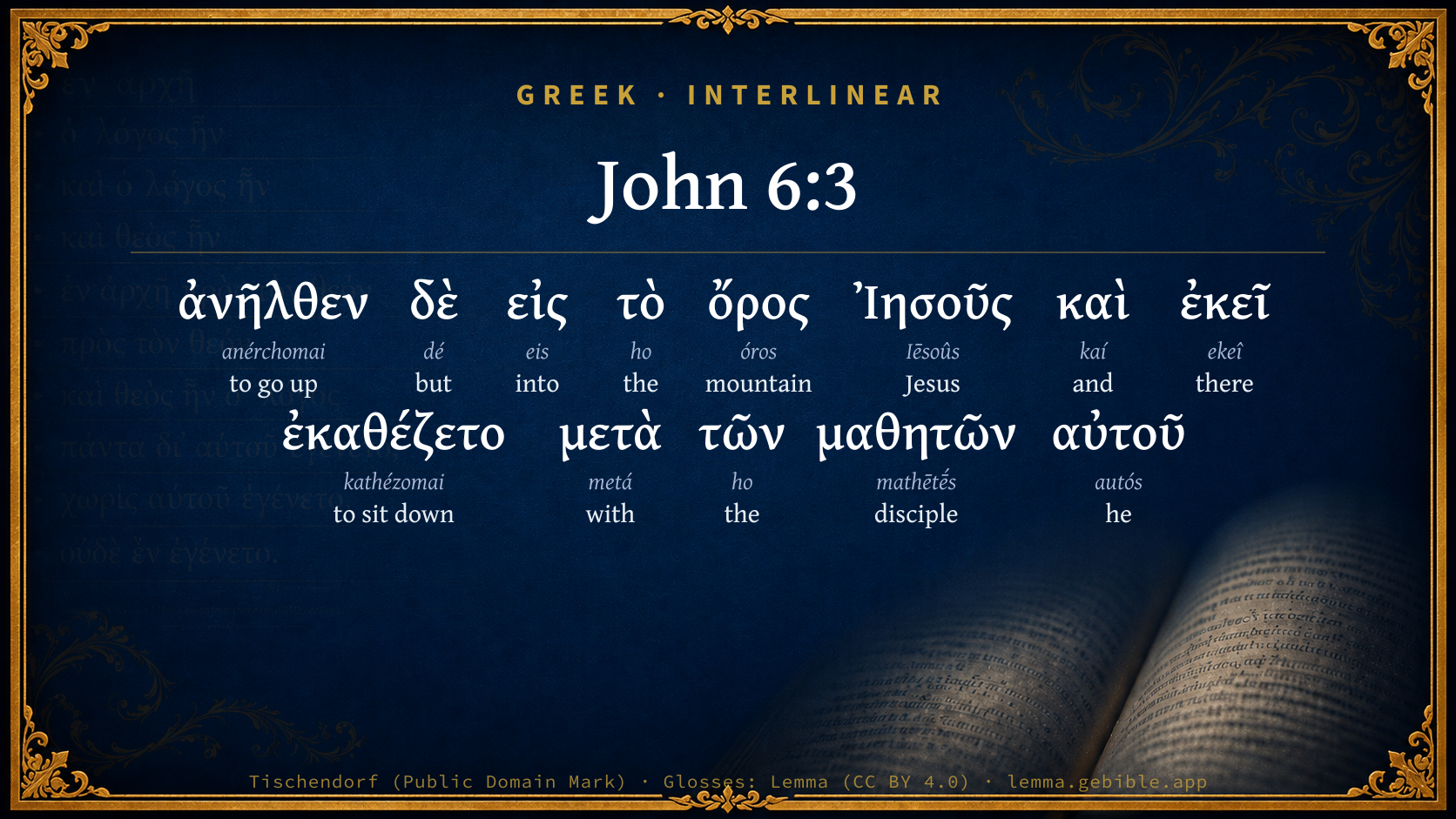
Greek (Tischendorf 8th ed.) John 6:3 appears in the Greek New Testament. The text above is from the Tischendorf 8th edition. Each word links to its Strong’s number and a concise gloss. Click any word for its full Thayer’s Greek Lexicon entry.
Download image
Cite this verse

John 6:3 (World English Bible). Public Domain. Lemma interlinear Bible study tool, https://lemma.gebible.app/v/john/6/3.

Show BibTeX & RIS
BibTeX
RIS
English Translation
Jesus went up into the mountain, and he sat there with his disciples.
World English Bible · Public Domain
Highlights
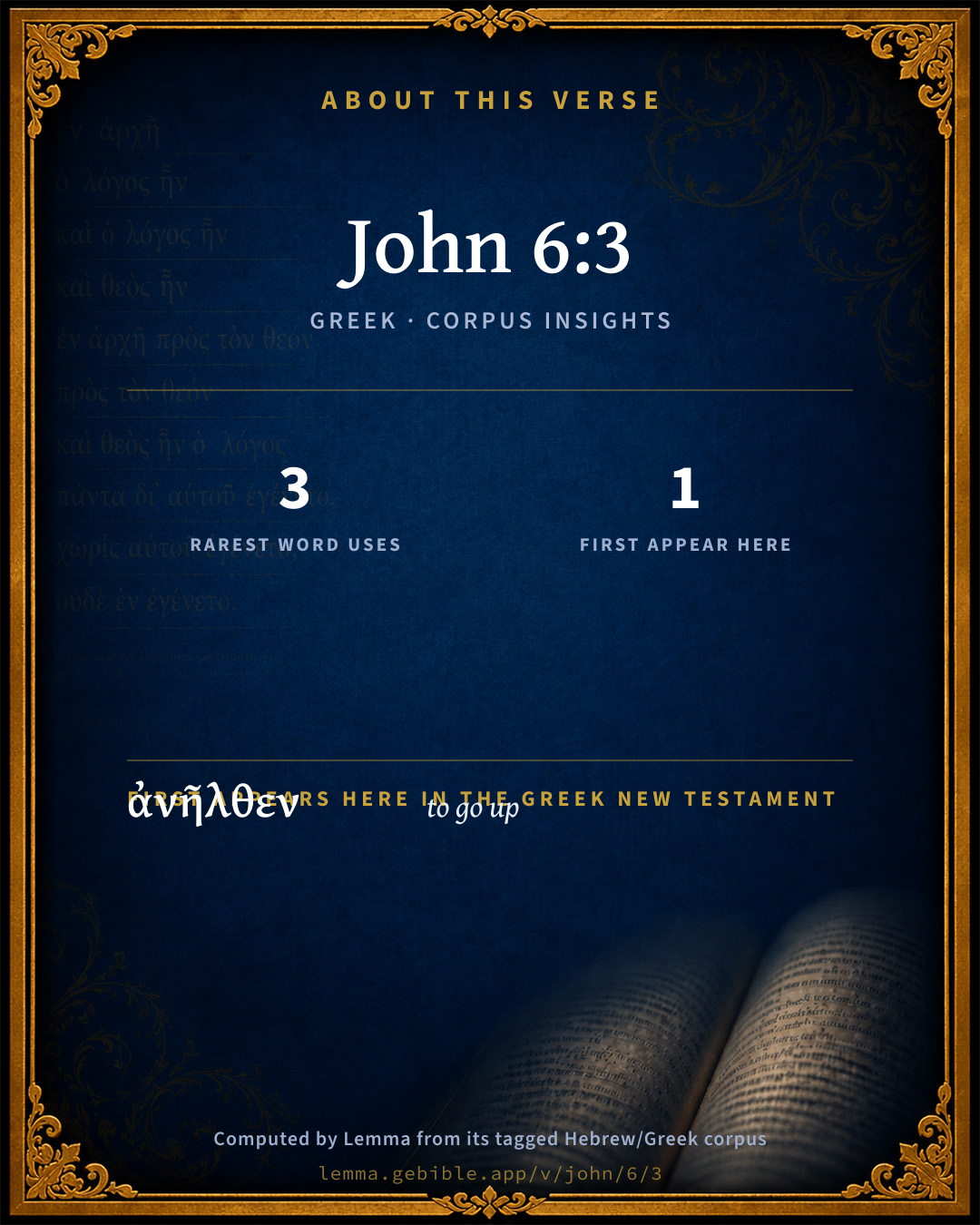
  • 1 first appearance in the Greek New Testament
Full analysis ↓
Download a study sheet

One document with this verse’s original text, its word-by-word gloss line, the meaning frame, cross-references with their text, attributed commentary, and full source and license credits — printable, and it pastes into notes with its structure intact.

This verse Autodidact and up

Study sheet (.html) Plain text (.txt)

A passage Seminary Student

Up to 50 verses in one chapter. A passage sheet keeps up to 6 commentary sources and 12 cross-references per verse, in the order this page ranks them, and says so on the sheet whenever that leaves anything out. Ask for a single verse and you get the Autodidact verse sheet above.

Everything on this page stays free to read, with no account — the sheet is a download of what is already on screen, not access to it.

Want to remove ads? Support Godless Engineer
Compare translations 3

The same verse in 3 English versions, stacked beneath the original-language interlinear above. Click any original word for its lexicon entry.

Each is an independent rendering of the whole verse — the interlinear is not word-aligned to these translations.

Highlighted words mark where these versions differ — a whole-verse word diff, not a word-by-word alignment.

  • World English Bible Public Domain
    Jesus went up into the mountain, and he sat there with his disciples.
  • King James Version Public Domain
    And Jesus went up into a mountain, and there he sat with his disciples.
  • unfoldingWord Literal Text CC BY-SA 4.0
    Now Jesus went up on the mountain, and there he sat down with his disciples.

unfoldingWord Literal Text — © unfoldingWord, licensed CC BY-SA 4.0. Word-aligned USFM3 via Door43 (git.door43.org/unfoldingWord/en_ult).

Versions to compare (up to 4)

3 of 4 selected

Show all 19 translations

Every available English version of this verse, each an independent rendering of the whole verse.

  • World English Bible Public Domain
    Jesus went up into the mountain, and he sat there with his disciples.
  • Berean Standard Bible Public Domain
    Then Jesus went up on the mountain and sat down with His disciples.
  • Majority Standard Bible Public Domain
    Then Jesus went up on the mountain and sat down with His disciples.
  • King James Version Public Domain
    And Jesus went up into a mountain, and there he sat with his disciples.
  • American Standard Version (1901) Public Domain
    And Jesus went up into the mountain, and there he sat with his disciples.
  • Revised Version (1885) Public Domain
    And Jesus went up into the mountain, and there he sat with his disciples.
  • Geneva Bible (1599) Public Domain
    Then Iesus went vp into a mountaine, and there he sate with his disciples.
  • Douay-Rheims (1899) Public Domain
    Jesus therefore went up into a mountain, and there he sat with his disciples.
  • Young's Literal Translation Public Domain
    and Jesus went up to the mount, and he was there sitting with his disciples,
  • Literal Standard Version CC BY-SA 4.0
    and Jesus went up to the mountain, and He was sitting with His disciples there,
  • Unlocked Literal Bible CC BY-SA 4.0
    Jesus went up the mountain and there he sat down with his disciples.
  • unfoldingWord Literal Text CC BY-SA 4.0
    Now Jesus went up on the mountain, and there he sat down with his disciples.
  • Darby Bible Public Domain
    And Jesus went up into the mountain, and there sat with his disciples:
  • World Messianic Bible Public Domain
    Yeshua went up into the mountain, and he sat there with his disciples.
  • Webster's Bible Public Domain
    And Jesus went upon a mountain, and there he sat with his disciples.
  • Free Bible Version CC BY-SA 4.0
    Jesus went up a hill and sat down there with his disciples.
  • Bible in Basic English Public Domain
    Then Jesus went up the mountain and was seated there with his disciples.
  • Text-Critical English NT CC BY 4.0
    So Jesus went up on the mountain and sat there with his disciples.
  • Tyndale New Testament (1534) Public Domain
    And Iesus went vp into a mountayne and there he sate with his disciples.

Literal Standard Version (2020), Covenant Press — licensed CC BY-SA 4.0. Text via the HelloAO Bible API (eBible.org). Unlocked Literal Bible (unfoldingWord) — licensed CC BY-SA 4.0. Text via the HelloAO Bible API (eBible.org). unfoldingWord Literal Text — © unfoldingWord, licensed CC BY-SA 4.0. Word-aligned USFM3 via Door43 (git.door43.org/unfoldingWord/en_ult). Free Bible Version, Dr. Jonathan Gallagher — licensed CC BY-SA 4.0. Text via the HelloAO Bible API (eBible.org).

Word by word

More ways to search: Search by grammar → Find every occurrence → Compare this word →

Practice this passage: Drill this verse → Learn its vocabulary →

About this verse

These counts appear in no published source. They are computed here, from the morphology-tagged text and Lemma’s own curated glosses. What Lemma adds →

13
words
12
distinct lemmas
Gospels
section

Notable vocabulary

The rarest word here is ἀνῆλθεν to go up G424 — appearing just 3 times in the whole Greek New Testament.

First appearance in Scripture

This word makes its first canonical appearance in the Greek New Testament here:

  • ἀνῆλθεν to go up G424

Shared distinctive vocabulary

ἀνῆλθεν to go up G424 occurs in 3 verses of the Greek New Testament. Also found in:

Repetition

A word recurs within this verse:

Cross-references

5

Topical passages linked to John 6:3 in the Treasury of Scripture Knowledge — connected by theme and wording, ordered by reader-vote popularity; previews shown in the World English Bible.

  • John 6:15 Jesus therefore, perceiving that they were about to come and take him by force, to make him king, withdrew again to the mountain by himself.
  • Luke 9:28 It happened about eight days after these sayings, that he took with him Peter, John, and James, and went up onto the mountain to pray.
  • Matthew 14:23 After he had sent the multitudes away, he went up into the mountain by himself to pray. When evening had come, he was there alone.
  • Matthew 15:29 Jesus departed there, and came near to the sea of Galilee; and he went up into the mountain, and sat there.
  • Luke 6:12–13 It happened in these days, that he went out to the mountain to pray, and he continued all night in prayer to God.

Cross-references courtesy of OpenBible.info (CC BY 4.0).

Commentary

Notes on John 6:3 from classic Christian and Jewish commentators (each source and its license shown beneath its notes). The classic Christian expositions comment on the surrounding passage and are grouped to its opening verse, so a note may address several verses; the Jewish commentaries on the Tanakh (Rashi and others) are per-verse, so they appear only where the commentator wrote on this verse.

Lemma curates 59 commentaries, every one of them public domain or Creative Commons licensed, each selected and text-cleaned for this edition rather than reprinted as found. About our sources →

Bengel's Gnomon

Johann Albrecht Bengel

Joh 6:3. Ἀνῆλθε, went up) Not after the arrival of the people, but in the meantime, whilst the people were approaching.—ἐκάθητο, He was sitting) He did not desire the people to come to Him; but He graciously received them [when they came].

Bengel's Gnomon of the New Testament — English translation (T&T Clark, Edinburgh, 1860) — public domain. Text from a community e-Sword module.

Adam Clarke's Commentary

Verse 3. Went up into a mountain] This mountain must have been in the desert of Bethsaida, in the territories of Philip, tetrarch of Galilee. Our Lord withdrew to this place for a little rest; for he and his disciples had been so thronged with the multitudes, continually coming and going, that they had not time to take necessary food. See Mr 6:31.

Adam Clarke's Commentary on the Bible (1810–1826) — public domain. Text from a community e-Sword/MySword module.

John Calvin's Commentaries

3. Jesus therefore went up into a mountain. Christ unquestionably sought a place of retirement till the feast of the Passover; and therefore it is said that he sat down on a mountain with his disciples. Such was undoubtedly the purpose which he formed as man; but the purpose of God was different, which he willingly obeyed. Although, therefore, he avoided the sight of men, yet he permits himself to be led by the hand of God as into a crowded theater; for there was a larger assembly of men in a desert mountain than in any populous city, and greater celebrity arose from the miracle than if it had happened in the open market-place of Tiberias We are therefore taught by this example to form our plans in conformity to the course of events, but in such a manner that, if the result be different from what we expected, we may not be displeased that God is above us, and regulates everything according to his pleasure.

John Calvin's Commentaries (1540-1563) — public domain. Text from the Calvin Translation Society English edition (1840s-50s) via the Christian Classics Ethereal Library (ccel.org). Calvin's coverage is partial (roughly two-thirds of the Bible); uncommented books and verses are honest gaps, never fabricated. The 19th-century editor's footnotes and remarks are omitted so the notes are faithfully Calvin's own voice.

Ellicott's Commentary for English Readers

(3) A mountain.—Better, the mountain, or, perhaps, the hill-country on the east shore of the sea. See the parallel passages.

A Bible Commentary for English Readers, edited by Charles John Ellicott (1878–1897) — public domain. Text from a community e-Sword module.

The Cambridge Bible for Schools and Colleges

gen. ed. J. J. S. Perowne

3. into a mountain] Rather, into the mountain, or, perhaps the mountainous part of the district. The definite article indicates familiarity with the locality. Comp. Joh_6:15. We have no means of determining the precise eminence.

The Cambridge Bible for Schools and Colleges (gen. ed. J. J. S. Perowne; Cambridge University Press, 1878–1918) — public domain. Text from a community e-Sword module.

John Gill's Exposition

And Jesus went up into a mountain,.... In a desert place near Bethsaida, Luk 9:10;

and there he sat with his disciples; partly for security from the cruelty of Herod, having just heard of the beheading of John; and partly for privacy, that he might have some conversation alone with his disciples, upon their return from off their journey; as also for the sake of rest and refreshment; and according to the custom of the Jewish doctors, which now prevailed; see Gill on Mat 5:1, he sat with his disciples, in order to teach and instruct them.

John Gill's Exposition of the Whole Bible (1746–1763) — public domain (CC PDM 1.0). Text via the HelloAO Bible API.

Trapp's Complete Commentary

John Trapp

3 And Jesus went up into a mountain, and there he sat with his disciples.

Ver. 3. And Jesus went up into a mount] {See Trapp on "Mat 5:1"} He would have been private till the passover and refreshed himself with his disciples; but seeing God had now put a new opportunity into his hands of benefiting many, he would not neglect it.

John Trapp, A Commentary or Exposition upon All the Books of the Old and New Testament (1647–1656) — public domain. Text from a community e-Sword module.

Matthew Poole's English Annotations

That is, the third passover after our Saviour had entered upon his public ministry; by which we may observe, that John omitted many things spoken and done by our Saviour in the year immediately following the second passover, for he giveth us no further account than what we have in the former chapter, and in this. The other evangelists give us a more full account of them. The place whither our Saviour went seemeth to have been toward the end of the lake, so as the people could go on foot, and turn at the point of the lake, and be there before the ship could cross the water.

Matthew Poole's English Annotations on the Holy Bible (1683–1685) — public domain. Text from a community e-Sword/MySword module.

The Pulpit Commentary

And Jesus went up into the mountain; i.e. the high ground which everywhere surrounded the lake. The same expression, eiv to orov , occurs very frequently in the synoptist Gospels. (Mar_3:13 Mat_5:1 Mat_14:23) This last passage is an interesting confirmation of our text. The usage implies on the part of the four evangelists familiar acquaintance with the scenery. And there he sat downwith his disciples. From this elevation they would see the gathering multitudes streaming from different points and meeting on the pebbly beach, asking each ether where was the Master? and whither had the Prophet, the Healer, fled? Women and little children are in the crowd. (Mat_14:21) Weiss, who argues that the main features of the narrative are deeply imbedded in all the traditions, summarily disposes of the later accounts of the similar event recited by Mark (Mar_8:1-11) and Matthew. (Mat_15:32-38)

The Pulpit Commentary (1880–1919), ed. H.D.M. Spence-Jones & Joseph S. Exell — public domain. Text from a community e-Sword module.

John Wesley's Explanatory Notes

Jesus went up - Before the people overtook him.

John Wesley, Explanatory Notes Upon the Whole Bible (1754–1765) — public domain. Text via the GEBible commentary corpus.

Burkitt's Expository Notes on the New Testament

William Burkitt

This miracle of our Saviour’s feeding five thousand persons with five barley loaves and two small fishes, is recorded by all the four Evangelists, and several particulars therein are very remarkable.

Observe, 1. What a poor and slender provision the Lord of the whole earth hath for his family, for himself, for his disciples, and the multitude; nothing more than five barley loaves and two fishes.

Teaching us, That these bodies of ours must be fed, not pampered. Our belly must not be our master, much less our God; and as the quality of the victuals was plain, so was the quantity small; only five loaves and two fishes. Well might the disciples say, What are they among so many? The eye of sense and reason sees an utter impossibility of those effects which faith can easily apprehend, and a divine power more easily produce. When men judge by sense and reason, and do not look to Christ’s power, if extremities come, they are soon at their wit’s end, and know not what to do.

Observe, 2. How the great Master of this miraculous feast doth marshal his guests; he commanded them to sit down. None of the people reply, "Sit down, but to what? Here’s the mouths, but where’s the meat? We may soon be set, but when shall we be served?" Not a word like this, but they obey and expect. Lord how easy it is to trust thy providence, and rely upon thy power, when there is corn in the barn, bread in the cupboard, money in the purse. But when our stores are empty, when our stock runs low, when we have nothing in hand, then to depend upon an invisible bounty, is a noble act of faith indeed.

Observe, 3. The actions performed by our blessed Saviour.

1. He blessed the loaves; teaching us by his example, never to use or receive the good creatures of God without prayer and praise, not to sit down to our food as a beast to his fodder. Christ broke the loaves: he could have mutiplied them whole, why then doth he rather chuse to do it in the breaking?

Perhaps to teach us, that we may rather expect his blessings in the distribution of his bounty, than in the reservation of it. Scattering is the way to increasing, and liberality the way to riches.

Again, 3. He gave to his disciples, that they might distribute to the multitude; he did not do it with his own hands, but by theirs; doubtless it was to gain reputation to his disciples, from the people: the same course doth Christ take in spiritual distributions. He that could feed the souls of his people immediately by the hand of his Spirit, chuses rather by the hands of his ministers to divide the bread of life among them.

Observe, 4. The reality and greatness of the miracle, They did all eat, and were filled; they did eat, not a crumb or a bit, but to satiety and fulness. All that were hungry did eat, and all that did eat were satisfied, and yet twelve baskets of fragments remain. More is left than was at first set on. It is hard to say which was the greatest miracle, the miraculous eating, or miraculous leaving. If we consider what they ate, we may wonder that they left any thing; if what they left, that they eat anything.

Observe lastly, These fragments, though of barley loaves and fish bones, must not be lost, but gathered up; we must exercise frugality in the enjoyment of the greatest plenty.

Lord! how tremendous will their account be, who, having large and plentiful estates, do consume them upon their lusts! how will they wish they had been born to poverty and necessity, when they appear to make up their accounts before God!

William Burkitt's Expository Notes on the New Testament (1700–1703) — public domain. Text from a community e-Sword module.

Cambridge Greek Testament for Schools and Colleges

3. τὸ ὅρος. The mountain, or the mountainous part, of the district: the article indicates familiarity with the neighbourhood (Joh 6:15). We cannot determine the precise eminence. The object is retirement.

Cambridge Greek Testament for Schools and Colleges (Cambridge University Press, 1896; 21 vols, various authors incl. Carr, Maclear, Plummer, Farrar, Lumby, Moule, M. R. James, Simcox) — public domain. Text from a community e-Sword module.

Alford’s Greek Testament

Henry Alford

3.] τὸ ὄρος, perhaps ‘the hill country’ on the shore of the lake = ἔρημον τόπον κατʼ ἰδίον, Matt. The expression is used by John only here and in ver. 15, but no inference can be drawn from that, for this is the only portion of the Galilæan Ministry related by him.

Henry Alford, The Greek Testament (1849–1861) — public domain. Text from a community e-Sword module.

International Critical Commentary

3. ἀνῆλθεν δὲ εἰς τὸ ὄρος Ἰη., “Jesus went up to the hill,” i.e. the hill rising out of the little plain by the shore. Mk. (6:46), followed by Mt., mentions the hill after his narrative of the miracle; but Mt. (15:29), in telling what preceded the parallel miracle of the Feeding of the Four Thousand, says, as Jn. does here, ἀναβὰς εἰς τὸ ὄρος ἐκάθητο ἐκεῖ. Perhaps Jn. has borrowed here from Mt., but this is unlikely.1

It was the habit of Jesus to sit when He taught, as the Rabbis were accustomed to do (cf. Mar 4:1, Mar 9:35, Mat 26:55, Luk 4:20, Luk 5:3 [Jn.] 8:2); and He was wont to go up to the hills, whether for teaching (Mat 5:1, Mat 24:3) or for prayer (Mar 6:46, Luk 6:12, Luk 9:28).

The verb ἀνέρχομαι occurs again in N.T. only at Gal 1:18; and give א*D give ἀπῆλθεν here.

This narrative represents Jesus and His disciples as having arrived at the eastern side of the lake before the crowd, who according to Mk. (6:33) had arrived there first. According to Mar 6:30, Luk 9:10, the disciples who were with Jesus were the “apostles”; and this is implied in Jn.’s narrative, though not explicitly stated, for the twelve baskets of fragments of v. 13 indicate that the number of disciples present was twelve. See on 2:2.

International Critical Commentary — older volumes (1896–1929), various authors — public domain. Text from a community e-Sword module.

Vincent's Word Studies in the New Testament

Marvin R. Vincent

A mountain [το ορος] . Strictly, the mountain. The writer speaks as one familiar with the district.

He sat [εκθητο] . Imperfect : was sitting, when he saw the multitude approaching (ver. 5).

Marvin R. Vincent, Word Studies in the New Testament (1887–1900) — public domain. Text from a community e-Sword/MySword module.

Godet's Commentaries

Frédéric Louis Godet

Vv. 3, 4. “And Jesus went up into the mountain, and there he sat down with his disciples. 4. Now the Passover, the feast of the Jews, was at hand.”

The expression, the mountain, denotes not a particular mountain, which was in the region (for the locality has not been designated), but the mountainous country, in contrast to the level of the shore. Jesus had sought a solitary place there, and was conversing in it with his disciples. John’s expression has some resemblance to that of Mat 15:29, immediately after the second miracle of the loaves.

What is the purpose of the remark in Joh 6:4? Is it a chronological note? In that case, it would rather have been placed at the beginning of the narrative. It occurs here incidentally, after the manner of John, as an explanatory remark (comp. Joh 1:24). But with what purpose? According to Meyer, to explain the great gathering which is spoken of in Joh 6:5. But this explanation forces him to distinguish this multitude from that of Joh 6:2, which is evidently inadmissible. Weiss acknowledges this, and sees in Joh 6:2, and Joh 6:5, the crowd of pilgrims who are about to go to Jerusalem for the Passover. But what had the caravans going up to this feast to do in this out of the way place? And is it not very clear, from Joh 6:2, that these numerous arrivals are no others than the multitudes who habitually accompanied Jesus in Galilee? The mention of the feast near at hand, must, therefore, serve to explain, not the presence of the multitudes, but the conduct of Jesus towards them.

Not being able to go to Jerusalem for the feast (Joh 7:1), Jesus, on seeing these multitudes hastening towards Him in the wilderness, recognizes in this unexpected circumstance a signal from the Father. He puts this concourse in comparison with the feast which is about to be celebrated in Jerusalem, and He says for Himself, for His disciples, for the multitude: “We also will have our Passover!” This is the thought which sets in its true light the following miracle, as the discourses which are connected with it prove. For Jesus represents Himself here as the one whose flesh and blood are designed to give life to believers, a point which undoubtedly calls to mind the sacrifice and eating of the Paschal lamb. By this fourth verse John gives us, therefore, the key of the whole narrative, as he had given us in Joh 3:1, by the words: of the Pharisees, that of the whole conversation with Nicodemus. The denials of Weiss and Keil seem to us to rest on no sufficient grounds. The term ἡ ἑορτή τ.᾿Ιουδ., the feast of the Jews, must, according to Keil, explain the word Passover, which was unknown to Greek readers, or, according to others, designate this feast as “the feast par excellence for the Jews;” but comp. Joh 2:13, and Joh 7:2. Perhaps John desires to make us understand the total separation which was more and more evident between Jesus and this people who were becoming foreign to Him. From the incident in Luk 6:1-5, and the parallel passages, we discover in the Synoptics also a spring season passed in Galilee during the course of the ministry accomplished in that province.

Frédéric Louis Godet — Commentaries on Luke, John, Romans, and 1 Corinthians — English translation (T&T Clark, Edinburgh, 1870s–1890s) — public domain. Text from a community e-Sword module.

Lesson kit

Teaching starters — assembled from the data on this page, not authored interpretation. Every prompt links to the verse data it draws on. Edit before teaching.

John, in the Gospels, opens this verse with 13 words (12 distinct Greek lemmas). Its most distinctive word is anérchomai (“to go up”). A historical commentator’s framing appears above. Read the whole chapter for the surrounding context.

Discussion questions

  1. How does “to go up” (anérchomai) shape what this verse is saying?
  2. The word “to go up” first appears here in Scripture. What is being introduced at this debut?
  3. Galatians 1:17 shares the word «to go up» with this verse. How do the two illuminate each other?
  4. “the” occurs 2× in this one verse. What is the effect of the repetition?
  5. These translations render this verse differently; the difference is in the English rendering, not the original. What questions does that raise?
  6. Reading how Bengel's Gnomon and Adam Clarke's Commentary read this verse, where do the two commentators agree and where do they part?

Things to notice

  • 1 word makes its first canonical appearance in Scripture here.
  • These translations choose different wording for 3 words in this verse.
  • “the” occurs 2× in this single verse.
  • 12 distinct Greek lemmas span 13 words in this verse.

Reading settings

Reading text

Shown beneath each verse's original-language words.

Old Testament
Old Testament edition

Read the OT as the Masoretic Hebrew (MT) or the Greek Septuagint (LXX).

English shown for the Greek Septuagint (in the Hebrew ↔ Greek comparison).

Comparing translations? Open the Compare panel on any verse page to stack up to four side by side.