Luke 10:17

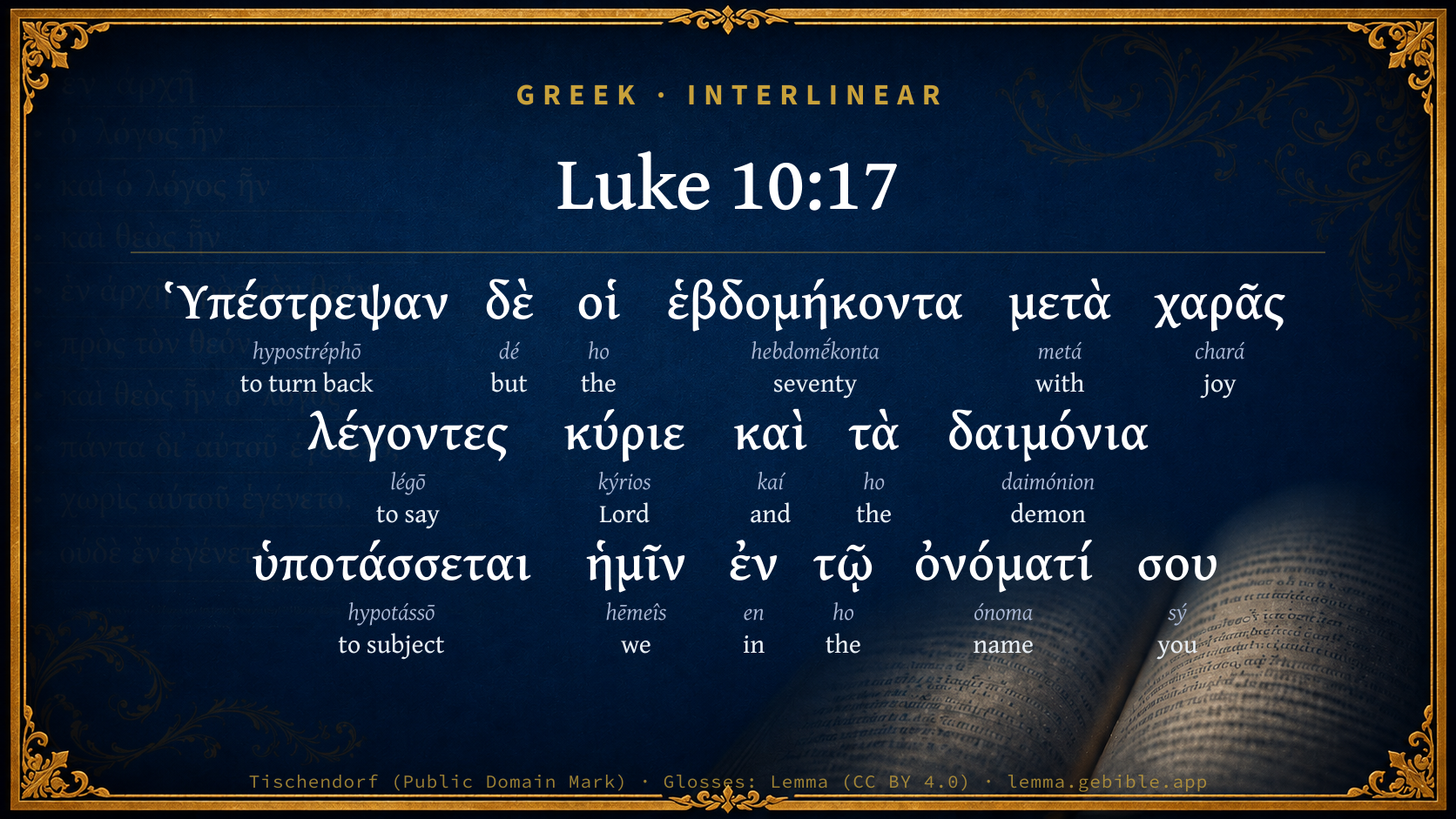
Greek (Tischendorf 8th ed.) Luke 10:17 appears in the Greek New Testament. The text above is from the Tischendorf 8th edition. Each word links to its Strong’s number and a concise gloss. Click any word for its full Thayer’s Greek Lexicon entry.
Download image
Cite this verse

Luke 10:17 (World English Bible). Public Domain. Lemma interlinear Bible study tool, https://lemma.gebible.app/v/luke/10/17.

Show BibTeX & RIS
BibTeX
RIS
English Translation
The seventy returned with joy, saying, "Lord, even the demons are subject to us in your name!"
World English Bible · Public Domain
Download a study sheet

One document with this verse’s original text, its word-by-word gloss line, the meaning frame, cross-references with their text, attributed commentary, and full source and license credits — printable, and it pastes into notes with its structure intact.

This verse Autodidact and up

Study sheet (.html) Plain text (.txt)

A passage Seminary Student

Up to 50 verses in one chapter. A passage sheet keeps up to 6 commentary sources and 12 cross-references per verse, in the order this page ranks them, and says so on the sheet whenever that leaves anything out. Ask for a single verse and you get the Autodidact verse sheet above.

Everything on this page stays free to read, with no account — the sheet is a download of what is already on screen, not access to it.

Want to remove ads? Support Godless Engineer
Compare translations 3

The same verse in 3 English versions, stacked beneath the original-language interlinear above. Click any original word for its lexicon entry.

Each is an independent rendering of the whole verse — the interlinear is not word-aligned to these translations.

Highlighted words mark where these versions differ — a whole-verse word diff, not a word-by-word alignment.

  • World English Bible Public Domain
    The seventy returned with joy, saying, "Lord, even the demons are subject to us in your name!"
  • King James Version Public Domain
    And the seventy returned again with joy, saying, Lord, even the devils are subject unto us through thy name.
  • unfoldingWord Literal Text CC BY-SA 4.0
    Then the 72 returned with joy, saying, “Lord, even the demons are subjected to us in your name.”

unfoldingWord Literal Text — © unfoldingWord, licensed CC BY-SA 4.0. Word-aligned USFM3 via Door43 (git.door43.org/unfoldingWord/en_ult).

Versions to compare (up to 4)

3 of 4 selected

Show all 19 translations

Every available English version of this verse, each an independent rendering of the whole verse.

  • World English Bible Public Domain
    The seventy returned with joy, saying, "Lord, even the demons are subject to us in your name!"
  • Berean Standard Bible Public Domain
    The seventy-two returned with joy and said, “Lord, even the demons submit to us in Your name.”
  • Majority Standard Bible Public Domain
    The seventy returned with joy and said, “Lord, even the demons submit to us in Your name.”
  • King James Version Public Domain
    And the seventy returned again with joy, saying, Lord, even the devils are subject unto us through thy name.
  • American Standard Version (1901) Public Domain
    And the seventy returned with joy, saying, Lord, even the demons are subject unto us in thy name.
  • Revised Version (1885) Public Domain
    And the seventy returned with joy, saying, Lord, even the devils are subject unto us in thy name.
  • Geneva Bible (1599) Public Domain
    And the seuentie turned againe with ioy, saying, Lord, euen the deuils are subdued to vs through thy Name.
  • Douay-Rheims (1899) Public Domain
    And the seventy-two returned with joy, saying: Lord, the devils also are subject to us in thy name.
  • Young's Literal Translation Public Domain
    And the seventy turned back with joy, saying, `Sir, and the demons are being subjected to us in thy name;'
  • Literal Standard Version CC BY-SA 4.0
    And the seventy turned back with joy, saying, “Lord, and the demons are being subjected to us in Your Name”;
  • Unlocked Literal Bible CC BY-SA 4.0
    The seventy returned with joy, saying, “Lord, even the demons submitted to us in your name.”
  • unfoldingWord Literal Text CC BY-SA 4.0
    Then the 72 returned with joy, saying, “Lord, even the demons are subjected to us in your name.”
  • Darby Bible Public Domain
    And the seventy returned with joy, saying, Lord, even the demons are subject to us through thy name.
  • World Messianic Bible Public Domain
    The seventy returned with joy, saying, “Lord, even the demons are subject to us in your name!”
  • Webster's Bible Public Domain
    And the seventy returned with joy, saying, Lord, even the demons are subject to us through thy name.
  • Free Bible Version CC BY-SA 4.0
    The seventy disciples returned in great excitement, saying, “Lord, even the demons do what we tell them in your name!”
  • Bible in Basic English Public Domain
    And the seventy came back with joy, saying, Lord, even the evil spirits are under our power in your name.
  • Text-Critical English NT CC BY 4.0
    When the seventy returned, they were joyful and said, “Lord, even the demons submit to us in yoʋr name.”
  • Tyndale New Testament (1534) Public Domain
    And the sevetie returned agayne with ioye sayinge: Lorde even the very devyls are subdued to vs thorowe thy name.

Literal Standard Version (2020), Covenant Press — licensed CC BY-SA 4.0. Text via the HelloAO Bible API (eBible.org). Unlocked Literal Bible (unfoldingWord) — licensed CC BY-SA 4.0. Text via the HelloAO Bible API (eBible.org). unfoldingWord Literal Text — © unfoldingWord, licensed CC BY-SA 4.0. Word-aligned USFM3 via Door43 (git.door43.org/unfoldingWord/en_ult). Free Bible Version, Dr. Jonathan Gallagher — licensed CC BY-SA 4.0. Text via the HelloAO Bible API (eBible.org).

Word by word

More ways to search: Search by grammar → Find every occurrence → Compare this word →

Practice this passage: Drill this verse → Learn its vocabulary →

ἑβδομήκοντα
hebdomḗkonta
G1440
“seventy”
Adjective, Numeral (indeclinable)
Part of Speech
Adjective · Numeral (indeclinable)
Full Thayer's Definition

Origin: from G1442 and a modified form of G1176

TDNT: 12:27,2

1. seventy a. the seventy disciples whom Jesus sent out in addition to the twelve apostles
  1. Ὑπέστρεψαν hypostréphō G5290 “to turn back” Verb, Aorist, Active, Indicative, 3rd person, Plural
  2. δὲ dé G1161 “but” Conjunction
  3. οἱ ho G3588 “the” Article, Nominative, Plural, Masculine
  4. μετὰ metá G3326 “with” Preposition
  5. χαρᾶς chará G5479 “joy” Noun, Genitive, Singular, Feminine
  6. λέγοντες légō G3004 “to say” Verb, Present, Active, Participle, Nominative, Plural, Masculine
  7. κύριε kýrios G2962 “Lord” Noun, Vocative, Singular, Masculine
  8. καὶ kaí G2532 “and” Conjunction
  9. τὰ ho G3588 “the” Article, Nominative, Plural, Neuter
  10. δαιμόνια daimónion G1140 “demon” Noun, Nominative, Plural, Neuter
  11. ὑποτάσσεται hypotássō G5293 “to subject” Verb, Present, Passive, Indicative, 3rd person, Singular
  12. ἡμῖν hēmeîs G2249 “we” Personal pronoun, 1st person, Dative, Plural
  13. ἐν en G1722 “in” Preposition
  14. τῷ ho G3588 “the” Article, Dative, Singular, Neuter
  15. ὀνόματί ónoma G3686 “name” Noun, Dative, Singular, Neuter
  16. σου sý G4771 “you” Personal pronoun, 2nd person, Genitive, Singular

About this verse

These counts appear in no published source. They are computed here, from the morphology-tagged text and Lemma’s own curated glosses. What Lemma adds →

17
words
15
distinct lemmas
Gospels
section

Notable vocabulary

The rarest word here is ἑβδομήκοντα seventy G1440 — appearing just 5 times in the whole Greek New Testament.

Shared distinctive vocabulary

ἑβδομήκοντα seventy G1440 occurs in 5 verses of the Greek New Testament. Also found in:

Repetition

A word recurs within this verse:

Cross-references

5

Topical passages linked to Luke 10:17 in the Treasury of Scripture Knowledge — connected by theme and wording, ordered by reader-vote popularity; previews shown in the World English Bible.

  • Mark 16:17 These signs will accompany those who believe: in my name they will cast out demons; they will speak with new languages;
  • Luke 9:1 He called the twelve together, and gave them power and authority over all demons, and to cure diseases.
  • Romans 16:20 And the God of peace will quickly crush Satan under your feet. The grace of our Lord Jesus Christ be with you.
  • Luke 10:1 Now after these things, the Lord also appointed seventy others, and sent them two by two ahead of him into every city and place, where he was about to come.
  • Luke 10:9 Heal the sick who are therein, and tell them, 'The Kingdom of God has come near to you.'

Cross-references courtesy of OpenBible.info (CC BY 4.0).

Where the printed editions differ

1 variant

Places in this verse where the major printed Greek editions disagree on the wording in a way that affects the translation — a comparison of editions, not a manuscript-by-manuscript collation. The editions are the modern critical texts (Nestlé-Aland 28/27, SBL, Westcott-Hort, Tregelles, Tyndale House) and the traditional texts behind the KJV (the Textus Receptus and the Byzantine/Majority text). It is not a claim about which reading is original.

  1. Extra text
    δύο

    “two”

    In NA28NA27SBLWH Not in TynTregTRByz

    δύο (duo) 'two' is only in older manuscripts (NA28+NA27+SBL+WH)

Textual data: Translators Amalgamated Greek New Testament (STEPBible TAGNT) · CC BY 4.0.

Commentary

Notes on Luke 10:17 from classic Christian and Jewish commentators (each source and its license shown beneath its notes). The classic Christian expositions comment on the surrounding passage and are grouped to its opening verse, so a note may address several verses; the Jewish commentaries on the Tanakh (Rashi and others) are per-verse, so they appear only where the commentator wrote on this verse.

Lemma curates 59 commentaries, every one of them public domain or Creative Commons licensed, each selected and text-cleaned for this edition rather than reprinted as found. About our sources →

Matthew Henry's Commentary

Christ sent forth the seventy disciples as he was going up to Jerusalem to the feast of tabernacles, when he went up, not openly, but as it were in secret (Joh 7:10), having sent abroad so great a part of his ordinary retinue; and Dr. Lightfoot thinks it was before his return from that feast, and while he was yet at Jerusalem, or Bethany, which was hard by (for there he was, Luk 10:38), that they, or at least some of them, returned to him. Now here we are told,

1. What account they gave him of the success of their expedition: They returned again with joy (Luk 10:17); not complaining of the fatigue of their journeys, nor of the opposition and discouragement they met with, but rejoicing in their success, especially in casting out unclean spirits: Lord, even the devils are subject unto us through thy name. Though only the healing of the sick was mentioned in their commission (Luk 10:19), yet no doubt the casting out of devils was included, and in this they had wonderful success. 1. They give Christ the glory of this: It is through thy name. Note, all our victories over Satan are obtained by power derived from Jesus Christ. We must in his name enter the lists with our spiritual enemies, and, whatever advantages we gain, he must have all the praise; if the work be done in his name, the honour is due to his name. 2. They entertain themselves with the comfort of it; they speak of it with an air of exultation: Even the devils, those potent enemies, are subject to us. Note, the saints have no greater joy or satisfaction in any of their triumphs than in those over Satan. If devils are subject to us, what can stand before us?

II. What acceptance they found with him, and how he received this account.

1. He confirmed what they said, as agreeing with his own observation (Luk 10:18): "My heart and eye went along with you; I took notice of the success you had, and I saw Satan fall as lightning from heaven." Note, Satan and his kingdom fell before the preaching of the gospel. "I see how it is," saith Christ, "as you get ground the devil loseth ground." He falls as lightning falls from heaven, so suddenly, so irrecoverably, so visibly, that all may perceive it, and say, "See how Satan's kingdom totters, see how it tumbles." They triumphed in casting devils out of the bodies of people; but Christ sees and rejoices in the fall of the devil from the interest he has in the souls of men, which is called his power in high places, Eph 6:12. He foresees this to be but an earnest of what should now be shortly done and was already begun - the destroying of Satan's kingdom in the world by the extirpating of idolatry and the turning of the nations to the faith of Christ. Satan falls from heaven when he falls from the throne in men's hearts, Act 26:18. And Christ foresaw that the preaching of the gospel, which would fly like lightning through the world, would wherever it went pull down Satan's kingdom. Now is the prince of this world cast out. Some have given another sense of this, as looking back to the fall of the angels, and designed for a caution to these disciples, lest their success should puff them up with pride: "I saw angels turned into devils by pride: that was the sin for which Satan was cast down from heaven, where he had been an angel of light I saw it, and give you an intimation of it lest you, being lifted up with pride should fall into that condemnation of the devil, who fell by pride," Ti1 3:6.

2. He repeated, ratified, and enlarged their commission: Behold I give you power to tread on serpents, Luk 10:19. Note, To him that hath, and useth well what he hath, more shall be given. They had employed their power vigorously against Satan, and now Christ entrusts them with greater power. (1.) An offensive power, power to tread on serpents and scorpions, devils and malignant spirits, the old serpent: "You shall bruise their heads in my name," according to the first promise, Gen 3:15. Come, set your feet on the necks of these enemies; you shall tread upon these lions and adders wherever you meet with them; you shall trample them under foot, Psa 91:13. You shall tread upon all the power of the enemy, and the kingdom of the Messiah shall be every where set up upon the ruins of the devil's kingdom. As the devils have now been subject to you, so they shall still be. (2.) A defensive power: "Nothing shall by any means hurt you; not serpents nor scorpions, if you should be chastised with them or thrown into prisons and dungeons among them; you shall be unhurt by the most venomous creatures," as St. Paul was (Act 28:5), and as is promised in Mar 16:18. "If wicked men be as serpents to you, and you dwell among those scorpions (as Eze 2:6), you may despise their rage, and tread upon it; it need not disturb you, for they have no power against you but what is given them from above; they may hiss, but they cannot hurt." You may play upon the hole of the asp, for death itself shall not hurt nor destroy, Isa 11:8, Isa 11:9; Isa 25:8.

3. He directed them to turn their joy into the right channel (Luk 10:20): "Notwithstanding in this rejoice not, that the spirits are subject unto you, that they have been so, and shall be still so. Do not rejoice in this merely as it is your honour, and a confirmation of your mission, and as it sets you a degree above other good people; do not rejoice in this only, or in this chiefly, but rather rejoice because your names are written in heaven, because you are chosen of God to eternal life, and are the children of God through faith." Christ, who knew the counsels of God, could tell them that their names were written in heaven, for it is the Lamb's book of life that they are written in. All believers are through grace, entitled to the inheritance of sons, and have received the adoption of sons, and the Spirit of adoption, which is the earnest of that inheritance and so are enrolled among his family; now this is matter of joy, greater joy than casting out devils. Note, Power to become the children of God is to be valued more than a power to work miracles; for we read of those who did in Christ's name cast out devils, as Judas did, and yet will be disowned by Christ in the great day. But they whose names are written in heaven shall never perish; they are Christ's sheep, to whom he will give eternal life. Saving graces are more to be rejoiced in than spiritual gifts; holy love is a more excellent way than speaking with tongues.

4. He offered up a solemn thanksgiving to his Father, for employing such mean people as his disciples were in such high and honourable service, Luk 10:21, Luk 10:22. This we had before (Mat 11:25-27), only here it is prefixed that in that hour Jesus rejoiced. It was fit that particular notice should be taken of that hour, because there were so few such, for he was a man of sorrows. In that hour in which he saw Satan fall, and heard of the good success of his ministers, in that hour he rejoiced. Note, Nothing rejoices the heart of the Lord Jesus so much as the progress of the gospel, and its getting ground of Satan, by the conversion of souls to Christ. Christ's joy was a solid substantial joy, an inward joy: he rejoiced in spirit; but his joy, like deep waters, made no noise; it was a joy that a stranger did not intermeddle with. Before he applied himself to thank his Father, he stirred up himself to rejoice; for, as thankful praise is the genuine language of holy joy, so holy joy is the root and spring of thankful praise. Two things he gives thanks for: -

(1.) For what was revealed by the Father through the Son: I thank thee, O Father, Lord of heaven and earth, Luk 10:21. In all our adorations of God, we must have an eye to him, both as the Maker of heaven and earth and as the Father of our Lord Jesus Christ, and in him our Father. Now that which he gives thanks for is, [1.] That the counsels of God concerning man's reconciliation to himself were revealed to some of the children of men, who might be fit also to teach others, and it is God that by his Son has spoken these things to us and by his Spirit has revealed them in us; he has revealed that which had been kept secret from the beginning of the world. [2.] That they were revealed to babes, to those who were of mean parts and capacities, whose extraction and education had nothing in them promising, who were but children in understanding, till God by his Spirit elevated their faculties, and furnished them with this knowledge, and an ability to communicate it. We have reason to thank God, not so much for the honour he has hereby put upon babes, as for the honour he has hereby done himself in perfecting strength out of weakness. [3.] That, at the same time when he revealed them unto babes, he hid them from the wise and prudent, the Gentile philosophers, the Jewish rabbin. He did not reveal the things of the gospel to them, nor employ them in preaching up his kingdom. Thanks be to God that the apostles were not fetched from their schools; for, First, they would have been apt to mingle their notions with the doctrine of Christ, which would have corrupted it, as afterwards it proved. For Christianity was much corrupted by the Platonic philosophy in the first ages of it, by the Peripatetic in its latter ages, and by the Judaizing teachers at the first planting of it. Secondly, If rabbin and philosophers had been made apostles, the success of the gospel would have been ascribed to their learning and wit and the force of their reasonings and eloquence; and therefore they must not be employed, lest they should have taken too much to themselves, and others should have attributed too much to them. They were passed by for the same reason that Gideon's army was reduced: The people are yet too many, Jdg 7:4. Paul indeed was bred a scholar among the wise and prudent; but he became a babe when he became an apostle, and laid aside the enticing words of man's wisdom, forgot them all, and made neither show nor use of any other knowledge than that of Christ and him crucified, Co1 2:2, Co1 2:4. [4.] That God herein acted by way of sovereignty: Even so, Father, for so it seemed good in thy sight. If God gives his grace and the knowledge of his son to some that are less likely, and does not give it to others whom we should think better able to deliver it with advantage, this must satisfy: so it pleases God, whose thoughts are infinitely above ours. He chooses to entrust the dispensing of his gospel in the hands of those who with a divine energy will give it the setting on, rather than in theirs who with human art will give it the setting off.

(2.) For what was secret between the Father and the Son, Luk 10:22. [1.] The vast confidence that the Father puts in the Son: All things are delivered to me of my Father, all wisdom and knowledge, all power and authority, all the grace and comfort which are intended for the chosen remnant; it is all delivered into the hands of the Lord Jesus; in him all fulness must dwell, and from him it must be derived: he is the great trustee that manages all the concerns of God's kingdom. [2.] The good understanding that there is between the Father and the Son, and their mutual consciousness, such as no creature can be admitted to: No man knows who the Son is, nor what his mind is, but the Father, who possessed him in the beginning of his ways, before his works of old (Pro 8:22), nor who the Father is, and what his counsels are, but the Son, who lay in his bosom from eternity, was by him as one brought up with him, and was daily his delight (Pro 8:30), and he to whom the Son by the Spirit will reveal him. The gospel is the revelation of Jesus Christ, to him we owe all the discoveries made to us of the will of God for our salvation; and here he speaks of being entrusted with it as that which was a great pleasure to himself and for which he was very thankful to his Father.

5. He told his disciples how well it was for them that they had these things revealed to them, Luk 10:23, Luk 10:24. Having addressed himself to his Father, he turned to his disciples, designing to make them sensible how much it was for their happiness, as well as for the glory and honour of God, that they knew the mysteries of the kingdom and were employed to lead others into the knowledge of them, considering, (1.) What a step it is towards something better. Though the bare knowledge of these things is not saving, yet it puts us in the way of salvation: Blessed are the eyes which see the things which we see. God therein blesseth them, and, if it be not their own fault it will be an eternal blessedness to them. (2.) What a step it is above those that went before them, even the greatest saints, and those that were most the favourites of Heaven: "Many prophets and righteous men" (so it is in Mat 13:17), many prophets and kings (so it is here), "have desired to see and hear those things which you are daily and intimately conversant with, and have not seen and heard them." The honour and happiness of the New Testament saints far exceed those even of the prophets and kings of the Old Testament, though they also were highly favoured. The general ideas which the Old Testament saints had, according to the intimations given them, of the graces and glories of the Messiah's kingdom, made them wish a thousand times that their lot had been reserved for those blessed days, and that they might see the substance of those things of which they had faint shadows. Note, The consideration of the great advantages which we have in the New Testament light, above what they had who lived in Old Testament times, should awaken our diligence in the improvement of it; for, if it do not, it will aggravate our condemnation for the non-improvement of it.

Matthew Henry's Commentary on the Whole Bible (1708–1710) — public domain (CC PDM 1.0). Text via the HelloAO Bible API.

The Biblical Illustrator

Joseph S. Exell

Luk_10:17-20

The seventy returned

The seventy

I.

COMMISSION OF THE SEVENTY.

1. They were commissioned of Christ.

2. They were commissioned of Christ to prepare the way before Him.

3. They received special directions when commissioned.

(1) Every one deeming himself commissioned of Christ should carefully study his Lords marching orders.

(2) To ignore these instructions is to prove unfitness for the Lords service.

II. ENDOWMENT OF THE SEVENTY. Miraculous and spiritual power.

III. IDENTIFICATION OF THE SEVENTY WITH CHRIST.

1. His gospel they were to preach.

2. Himself they were to represent.

(1) Such identification is true of every minister of Christ.

(2) Such identification devolves on hearers of the gospel a responsibility simply unspeakable.

IV. RETURN OF THE SEVENTY.

1. The spirit in which they returned. Rejoicing.

2. The ground of their rejoicing.

(1) The power with which they were invested.

(2) This ground not sufficient.

(3) Why?

(a) Because of its temporariness.

(b) Because of its dangerous tendency.

3. The true ground for Christian joy. Names written in heaven.

(1) More permanent.

(2) More glorious.

(3) More satisfactory.

V. CHRISTS JOY IN THE SEVENTY. Because of the honour the Father conferred on them.

Lessons:

1. Whom Christ commissions He sufficiently endows.

2. Not great power, position, or genius the true ground of the ministers joy, but a name written in heaven. (D. C. Hughes, M. A.)

Reporting to Christ

This mission and re-assembly representative for all time. This is the order of all real Christian movements and missions--from Christ to Christ.

I. THE DISCIPLES REPORT. We see them--

1. Acting under a sense of responsibility.

2. Conscious of Christs continued presence and power with them. The only universal guarantee of success.

3. Taking note only of secondary and superficial circumstances of success. A false guage. How careful we should be in our estimates of Christian work!

II. THE MASTERS RECEPTION OF IT. He awaits them with--

1. An interpretation: I was beholding. Whilst they laboured He was watching and praying. He saw Satans downthrow. He encouraged them, and all who should follow them, to take deeper and higher views of their work.

2. A promise.

3. A caution. The true source of satisfaction is acceptance with God, and conscious communion with Him. (St. John A. Frere, M. A.)

Return of the seventy

I. GOSPEL WORKERS IN LARGE NUMBERS MAY BE SPEEDILY EQUIPPED AND PROFITABLY EMPLOYED. Let the Church multiply seventies who shall go forth two by two, and will not the Lord be sure to follow?

II. FAITHFUL SERVICE FOR CHRIST BRINGS GLAD SURPRISES. Often these victories are over self. Plans for life, before worldly and selfishly ambitious, are revolutionized. Paines siren song is without power to charm, its spell broken. Wealth for its own sake ceases its fascinations. Sad memories, disappointments, defeats, that once brought shadows and heart-ache, though not forgotten, lose their power to hurt. Habits, appetites, once dominant with more than despots thrall and merciless cruelty, are exorcised; and the utter hopelessness of despair gives away to the buoyancy of glad faith. In Christian work, faculties take a wider range and greater efficiency than would otherwise have been possible. Slow lips become eloquent, intellects sluggish and unfruitful are cleared and competent, hands idle and inapt are active and dexterous.

III. A COMPLETE TRIUMPH OF HIS GOSPEL IS A VISION EVER PRESENT WITH OUR LORD.

IV. SOLDIERS IN THE LORDS ARMY ARE PROMISED A COMPLETE SAFETY FROM THE POWER OF THE ENEMY. We know that the promised power over serpents and scorpions was literally bestowed. Paul, at Melita, unharmed shook the deadly viper from his hand; but the twentieth verse means more than immunity from natural evil. To-day, the words of Paul to Timothy are true: Yea, and all that will live godly in Christ Jesus shall suffer persecution. How explain the apparent contradiction?

1. We may understand that physical protection and preservation will be given to all who are about the Lords business. Paul might be shipwrecked, but his life was safe until he had preached the gospel at Rome also.

2. The Christian has fewer points of attack open to the enemy. The pure in heart are repelled by that which allures the impure. The lowly mind does not see the high things which dazzle and intoxicate.

3. The enemy is permitted power over the children of God, only thereby to bring to himself more utter defeat.

4. To all who suffer for Christ, pain is not hurt nor loss. It brings a divine ministry, the forerunner of promotion and sure joy. Christ in the soul brings a kingdom invulnerable to the enemy. Poverty, stripes, and imprisonment, all earthly ill, are powerless to invade that domain.

V. THE DISCIPLE OF CHRIST SHOULD REJOICE MOST, NOT IN VIEW OF VICTORIES HERE, BUT BECAUSE OF COMING REWARDS IN HEAVEN. (S. L. B. Speare.)

Mission of the seventy disciples

I. THE MISSION OF THE SEVENTY DISCIPLES IS HERE IMPLIED.

1. The purpose for which they were sent.

2. The way in which they were sent.

(1) They were sent out in pairs.

(2) They were to prosecute their work without loss of time.

(3) The manner in which they were to conduct themselves in their visits, and that in reference to those who received and those who rejected them.

II. THE SUCCESS THEY MET WITH IS HERE DECLARED.

1. Exceedingly novel.

2. Preeminently strange.

3. Not by any skill or energy of their own. Through Thy name.

III. THIS FEELING WITH WHICH THEY REGARDED THEIR SUCCESS IS HERE SHOWS.

1. They rejoiced in the fact that success had attended their efforts.

2. That beings so hateful and dangerous were overcome.

3. The happiness which they had been instrumental in diffusing. 4, In the success of the great cause with which they were identified.

IV. A CONSIDERATION IS URGED WITH THE VIEW OF MODERATING THEIR JOY, AND DIRECTING IT INTO ANOTHER AND HIGHER CHANNEL. We see here the comparative estimate in which miraculous gifts and saving grace should be held. What is the former without the latter? It is possible to possess the one without the other (Mat_7:21-23). To have cast out devils, and to be ourselves at last cast out among devils, will be horrible indeed!

1. What is meant by having our names written in heaven. It signifies that we are citizens of the celestial city, that we are freemen of the New Jerusalem, and that all its honours and privileges are ours by a rightful title.

2. How the fact may be ascertained. If we are citizens of heaven our conversation is there; we are strangers and pilgrims on earth; like the patriarchs of old, we are looking for a city which hath foundations, whose builder and maker is God.

3. Those may well rejoice who have satisfactory grounds for concluding that this privilege is theirs. (Expository Outlines.)

I beheld Satan as lightning-fall from heaven

Looking back upon our earthly life

These words refer to a definite moment in Jesus life. That same hour in which He sent forth the seventy, He beheld Satan fall from Heaven. Yet that was a prophetic vision of the Lord. When He saw Satan falling, Jesus was in spirit above time, beholding as one finished whole, from the beginning to the end, the history of Gods conquest of evil. While the seventy were going forth to win their first unexpected success in His name, the Lord in prophetic anticipation was looking back upon His work and theirs as a work already accomplished; as even the devils, to their surprise, began to be subject unto them, His Spirit went forward to the final triumph of redemption, and, as one looking back from its completion, Jesus beheld Satan fallen. Throwing ourselves forward in the pure imaginations of faith into the world to come, let us seek to look back and down upon this world as though we already were beyond it.

Surrendering ourselves to our faith, and with our powers of spiritual imagination lent to the aid of our faith, let us seek humbly to imitate our Master, and look upon our world as He looked upon this earth, when, as from a position in eternity, He saw Satan fall from heaven.

I. In the first place, if we look upon our own lives as one looks back upon a way already trodden, and a work already accomplished, we shall gain a truer sense of the proportions of things. If we can succeed in transporting ourselves beyond the present, and regarding its occupations as already past; if we can draw back, as it were, in our own souls from the events of new and here, and regard our whole life, past, present, and future, as one undivided and completed whole; then we cannot fail to gain a more just estimate of the real proportions of events in our lives, and to correct, as in a large view from beyond, our present sense of the relative importance of things. And just this true sense of proportion in life is hard for us to keep in the nearness of present things; yet it is essential to large, happy living that we should gain and keep it.

II.

In the second place, in so far as we can put ourselves in the exercise of our own faiths beyond this life, we shall gain in many respects a different, and in all a more just estimate of our own real attainments.

We shall see more clearly what we may expect to win for ourselves from life.

Look down now upon what you have made, or are making, for yourselves in this world from this higher position after your own death.

Measure what you are seeking to attain by its worth as judged by that estimate from beyond.

From this point of view let us seek to determine what are the real attainments which a human being may reach in this world.

That artizan, for example, has stood up faithfully for years to his work.

He dies.

The arm loses its strength, and the hand its cunning.

What can he have gained by years of faithful work in making square-joints, honest insides, or lines true to an infinitesimal? What can the workman be conceived as keeping hereafter as the reward of all his labour under the sun? Not the eye, not the arm of flesh; yet the doctrine of the resurrection stands in the Scriptures as the pledge that our life here and hereafter is to be in all its powers one continuous life; and though this body shall return to dust, the discipline and capacity of the man, which is to be gained through the right exercise even of these bodily powers, is something which may count in the life of man for ever.

Even in the honest and best exercise of his bodily senses a man may be training himself for the quick and skilled use of those powers of spiritual embodiment which shall succeed these mortal powers. That artist, for instance, who one evening as we gained the crest of a hill, with an exclamation of delight, counted instantly five different hues upon the horizon where my duller eye had only seen at first glance one resplendence of the setting sun, may have gained in that quick sense of colour a power which shall be carried on as a possession of the soul into the spiritual body, enabling that trained artists spirit hereafter to see with instantaneous and enhanced delight the hues and harmonies of colour of the new heavens and the new earth. Hence I venture to say that the training and discipline of any power in the honest work of a lifetime may be so much real attainment for immortality--so much gain carried in the man himself through death into the world of larger opportunity. A man, therefore, should perform all his labour on this earth not as though what he does now is all of it, but as an heir of immortality. Jesus lived for two worlds at one and the same time. He was the Son of Man who was in heaven, as the Scripture says. All true, deep life must have something of the sense of heaven in it as a present fact.

III. We are led, thus, to the third remark that only as we strive to throw ourselves forward into the life beyond, and to consider our whole existence here as it is in its relation to the man and his life then and there, can we form a safe estimate of the worths of things. Such and such opportunities are brought now within reach of a young man or woman. What are they worth? Success is a safe happiness to the Christian man who can look down upon it as from out the kingdom of heaven. Success is a danger and snare of soul to that man who is not himself already in his heart above it. This position, finally, as of one looking back upon this world, which we all need sometimes to take in the Christian imaginations of faith, is the position from which in a little while we must be judging all things both in life and death. Our whole life erelong shall be one finished picture in the retrospect. And may it lie then behind us in the softening, hallowing light of Gods grace! By the grace of God, the penitent, converted man, even now judging himself from out the hereafter, as Christ did the world, may say: From my life I saw sin falling; from the heaven of my desires I beheld Satan fallen;--Behold God alone is reigning. (Newman Smyth, D. D.)

Satan lamed by his fall from heaven

There is a strangely widespread belief that Satan is lame, and that this was caused by his fall. In classical mythology we find limping Vulcan; and Hephaistes was lamed by his fall when hurled by Zeus from Olympus. Our idea of the devil always includes the clubbed or cloven foot. (Biblical Things not Generally Known.)

Power to tread on serpents and scorpions

Scorpions

Of these Tristram says: They swarm in every part of Palestine, and are found in houses, in chinks of walls, among ruins, and under stones, whether in dry or moist situations. It is always necessary before pitching tents to turn up every stone, however small, lest a scorpion should be secreted; as, when disturbed or roused by the warmth of the camp, these troublesome pests will strike at and sting any person or object within reach. So numerous are they that in the warmer parts of the country every third stone is sure to conceal one I have known an instance of a man dying from the effects of a scorpions sting, which he had received in the throat when leaning against a wall in which the creature was secreted. The scorpion is described as having much the appearance of a small lobster; it has two claws, extending from near the head, eight feet, and a long, jointed tail, terminating in the sting, which inflicts a painful and sometimes fatal wound. The largest and most dangerous species is black, and about six inches long.

Suicide of the scorpion

Mr. Allen Thomson, in a letter published in Nature, says: While residing many years ago during the summer months at the baths of Lucca, in Italy, in a somewhat damp locality, my informant, together with the rest of the family, was much annoyed by the intrusion of small black scorpions into the house, and their being secreted among the bedclothes, in shoes, and in other articles of dress. It thus became necessary to be constantly on the watch for these troublesome creatures, and to take means for their removal and destruction. Having been informed by the natives of the place that the scorpion would destroy itself if exposed to a sudden light, my informant and her friends soon became adepts in catching the scorpions and disposing of them in the manner suggested. This consisted in confining the animal under an inverted drinking-glass or tumbler, below which a card was inserted when the capture was made, and then, waiting till dark, suddenly bringing the light of a candle near to the glass in which the animal was confined. No sooner was this done than the scorpion invariably showed signs of great excitement, running round and round the interior of the troubler with reckless velocity for a number of times. This state having lasted for a minute or more, the animal suddenly became quiet, and turning its tail or the hinder part of its body over its back, brought its recurred sting down upon the middle of the head, and, piercing it forcibly, in a few seconds became quite motionless, and, in fact, quite dead. This observation was repeated very frequently; in truth it was adopted as the best plan of getting rid of the animals, and the young people were in the habit of handling the scorpions with impunity immediately after they were so killed, and of preserving many of them as curiosities.

Power of spiritual life

Brainerd, in his narrative of his work among the American Indians, confesses his great embarrassment. When I have instructed them respecting the miracles wrought by Christ, they have quickly referred to the wonders of that kind performed by their diviner;… a fatal obstruction to some of them in the way of receiving the gospel. Yet, though Brainerd could do none of these mighty works, he was the means of the conversion of that very diviner by the influence of his own life and the spiritual truths which he taught. (J. M. Buckley.)

Divine protection

Mr. Gobat, the late Bishop of Jerusalem, when engaged as a missionary in Abyssinia, retired on one occasion, in a season of deep spiritual depression and gloom, into a cavern, and there poured out his heart in earnest supplication, beseeching that God would not desert him, but encourage him in his trials. He remained in the cavern for some time. When he rose from his knees, his eyes had become accustomed to the darkness, and he saw that he had been there with a hyena and her cubs, which yet had, marvellously, not been permitted to attack him. At the very time when he deemed himself forgotten, he received this striking manifestation that the God of providence was nigh to shield and protect him. (Memoirs of Bishop Gobat.)

Immunity from snakebites

The Psylli, according to Pliny, were so characteristically endowed with this immunity (from snake-bites), that they made it a test of the legitimacy of their children; for they were accustomed to expose their new-born babes to the most venomous serpents they could find, assured chat if their paternity was pure Psyllic they would be quite unharmed. Of this tribe was the ambassador Hexagon, who, boasting of his powers before the Roman consuls, submitted to the crucial test which they suggested, of being enclosed in a vessel swarming with poisonous reptiles, which, says the legendary story, hurt him not. (Philip H. Gosse, F. R. S.)

Rejoice, because your names are written in heaven

The supreme joy

I. CHRISTIAN CITIZENSHIP IS MANS HIGHEST BLESSEDNESS. This is the first thing I have to endeavour to illustrate and impress.

1. And in the forefront of all I set this consideration, namely, that the having the name written in heaven implies the Divine acceptance of us, as attested to our consciousness. Indeed, brethren, this is a blessed thing; blessed in itself, and blessed, moreover, in all its bearings and influences upon all our life. For, to know that we are at peace with God and are now the objects of the Divine complacency, O how it bathes everything with its own sunshine l Look out upon the world with eyes purged by the euphrasy of Gods acceptance of you through Christ, and you will see it flushed with a thousand beauties never seen till now, and brightened with glancing lights and splendours where before it was all darkness and gloominess to you.

2. Emancipation from the thraldom of sin, and introduction into the glorious liberty of the children of God. Free. Free indeed. Yes, it is a glorious freedom that is conferred upon the heavenly citizen. He is the freedman whom the truth makes free; and all are slaves besides. It is not liberty merely to have no gyves upon your wrist and no clanking fetters about your feet. That is a poor thing in comparison of that inward deliverance from the tyranny of evil which enables a man to stand up in the blessed consciousness that he is now master even of himself. Besides, the freedom of the children of God has another side. It is not only a freedom from sin, it is also a freedom unto God and unto holiness.

3. Then, further, in this citizenship there is also an immunity from care. Now, I say, when a man becomes a citizen of heaven he is set free from this care, as well as from sin. The charter of the New Jerusalem assures him that having secured the highest good all lesser good shall be added unto him.

4. Then, too, in illustrating the blessedness of the Christian citizen I ought to speak of the strong consolation which is ministered to him in all times of his adversity and sorrow. An immunity from trial is not indeed among his privileges. That would not be for his real good. No; as steel acquires its fine temper in the fire, as the sweetest music issues from the darkened cage, as spices must be bruised if we would breathe their odours, so blessed are they that mourn; blessed are they that weep now. A blessedness is theirs which the always prosperous and the ever merry cannot know.

5. Last of all, and best of all, beyond all this wealth of earthly advantage and benefit there is laid up for the Christian citizen the blessedness of the life to come. To have the name written in heaven is to be able to read our titles clear to mansions in the skies.

II. And now it will not need, I think, that I should argue the point of the text, viz., that ENROLMENT IN HEAVEN SHOULD CONSTITUTE OUR MASTERJOY. For all rational beings their chief good should and must form their chief joy.

III. And so, in conclusion, and as the practical outcome of the subject for ourselves, let me say--

1. First, to those of you who can rejoice in the assurance that your names are written in heaven. Take care that this icy maintain its supremacy within you. Be sure that you allow no other joy to displace it or to overtop it. Observe it--I do not say--even as our Lord does not say in the text, rightly understood--that you are not to rejoice at all in anything save and besides your Christian felicity. That were ingratitude to God. That were an irrational asceticism. Nay, but if you have health of body and soundness of mind, rejoice in this physical blessedness, as being of priceless advantage to you.

2. And, to those of you whose names are not yet written in heaven, let me say that this supreme joy of religion, so far from extinguishing such of your earthly pleasures as are innocent and legitimate would inconceivably brighten and increase them. (T. Akroyd.)

Why may I rejoice?

I. THE JOY WHICH NEEDS MODERATING. The joy of triumph over evil spirits, the joy of having preached the gospel and wrought wonders--in a word, the joy of gifts, power, and success. This needs moderating--

1. Because it is so apt to degenerate into pride.

2. Again, this joy which needs to be moderated should be restrained by the reflection that it is no evidence of grace in the heart that we possess gifts, or that we are successful. Talents are possessed even by wicked and slothful servants. Grace without talent will save, but talent without grace will only increase our condemnation.

3. Moreover, it is very unsafe to rejoice unduly in the work which we have done, because the work after all may not turn out to be all that it appears. It is too early to begin to rejoice until the fire has passed over our lifework.

4. This joy, again, however good our work may be, is to be moderated, because it does not prove that we are any more gracious than others of far less gift and usefulness.

5. Again, this joy in success needs to be kept under tight rein because it is not an abiding joy. If thou, O man, rejoice to-day because of subject devils, what wilt thou do to-morrow, when the devils break loose again? What if He should send thee among Samaritans, who will not even hear thee, and thou shalt have to go from city to city and wipe off the dust of thy feet against them?

6. Once again, this joy, if we were to be filled with it to overflowing, would be found unable to bear the strain of trial, trouble, temptation, and especially of death.

II. THE JOY WHICH NEEDS EXCITING. Because your names are written in heaven.

1. The joy which our Lord commends is one which springs from faith, while the other joy arises alone from sight.

2. This joy consists in knowing our election--knowing, dearly beloved, your election of God, knowing that your names were written in heaven. To be Gods choice is the choicest of delights.

3. Brethren, this is a joy which can be cultivated. How are we to cultivate it? If we desire to have much of this joy we must make the fact sure. We must be certain that our names are written in heaven, or else we cannot rejoice in it.

III. Now, lastly, into this joy the Saviour enters, and we have to look, in the third place, to THE JOY OF THE LORD IN SYMPATHY with it, and so we add to our text the first sentence of the 21st verse--In that hour Jesus rejoiced in spirit. Why did He rejoice?

1. Because grace was given.

2. Jesus was also glad at the Fathers choice. He said, I thank Thee, O Father. He looks at these seventy babes out of whose mouth He has ordained strength, and He says, I thank thee, O Father, for having chosen these.

3. Notice the spirit in which Jesus puts His thanksgiving--He is satisfied with the choice because it is Gods choice. Even so, Father, said He, for so it seemed good in Thy sight.

4. Then our Saviour went on to rejoice because the grace of God given to us has revealed to us Christ, and revealed to us the Father, for He says, no man knoweth who the Son is, but the Father; and who the Father is, but the Son, and he to whom the Son will reveal Him.

5. Jesus exulted because there was a fellowship about all this, for He speaks of His knowing the Father and the Father knowing Him, and then of our knowing the Father because the Son has revealed Him unto us--all of which implies a wondrous communication and communion with the Father and with the Son. Now, this, I take it, is the cream of joy, a joy in which Christ partakes as He has fellowship with the Father and with us, and of which we partake as we have fellowship with Him and with the Father. (C. H.Spurgeon.)

The successful ministers safeguard

I. THE JUSTIFICATION OF THE REJOICING SPIRIT WHICH THE SEVENTY NOW EXHIBIT.

1. It was in spiritual matter.

2. It was with a self-renouncing disposition that they expressed it.

3. Their report is brought direct to the feet of their Master.

4. There is evidently no mistake in their report, no delusion on their part.

II. THE JUSTIFICATION OF THE CAUTION OR SUGGESTION WHICH CHRIST HERE UTTERS.

1. To rejoice genuinely, in even the very highest work done for the soul of another, must have its dangerous side. It does not guide a humbling look into oneself.

2. It may have a directly disastrous effect, feeding spiritual pride, contributing to self-confidence, and absolutely., calling off the attention of the soul from itself.

4. On the other hand, rejoicing in the conviction or in the certainty that ones own name is written in heaven, leads one to review all that is most desirable to review. (Philip C. Barker, M. A.)

The highest eulogy

Your names are written in heaven.

1. How it is to be understood.

2. How desirable it is.

3. How alone it is to be obtained. (Van Oosterzee.)

The certainty of salvation

1. Its only ground.

2. Its all-surpassing worth. (Van Oosterzee.)

The noblest source of joy

Heaven is here compared to a city or corporation, in which a list or record is kept of all the citizens or freemen who are entitled to its privileges and immunities. How may I know whether my unworthy name be written in heaven? who can open and read the records of heaven, and show me whether my name is registered there? I answer, This is a secret that may be discovered; for all that have their names written in heaven, may be distinguished by their characters, their temper, and practice, while upon earth. And their characters are such as these:

1. They are deeply sensible of the vanity of all earthly things, and that heaven alone is a sufficient portion and happiness. All that are registered as citizens of the heavenly Jerusalem, have a superlative esteem of that privilege, and count all things but loss in comparison of it (Mat_12:24-26; Mat_13:45-46).

2. All that have their names written in heaven have a heavenly nature; a nature very different from that of the men of this world, and like that of the citizens of heaven. And is this your temper? or is it earthly and sensual?

3. All that have their names written in heaven have a peculiar love for all their fellow-citizens, who are heirs of heaven. They love them as members of the same corporation with themselves (1Jn_3:14).

4. If your names are written in heaven it is the chief business and concern of your life to obtain an interest in heaven. And do you thus seek the kingdom of heaven? (Mat_10:12; Luk_16:16).

I. If your names are written in heaven, this is the greatest cause of joy you can possibly have; a joy that may swallow up every other joy.

II. If your names are not written in heaven, you can have no cause of solid, rational, and lasting joy in any thing. (President Davies.)

The true doctrine of election

This opinion is not believed by thee, but is only pretended, as a cloak for thy wickedness and idleness; for if thou dost believe that, if God hath elected, He will save thee however thou livest, why are not thy practices answerable to such principles? Why dost thou net leave thy ground unsowed, and thy calling unfollowed, and say, If God hath decreed me a crop of corn, I shall have it, whether I sow my ground or no; and if God hath decreed me an estate, I shall have it, though I never mind my calling? Why dost thou not neglect and refuse eating, and drinking, and sleeping, and say, If God hath decreed that I shall live longer, I shall do it, though I never eat, or drink, or sleep? For God hath decreed these things concerning thy ground, estate, and natural life, as well as concerning thine eternal condition in the other world. (G. Swinnock.)

Insured election

A senator related to his son the account of the book containing the names of illustrious members of the commonwealth. The son desired to see the outside. It was glorious to look upon. Oh, let me open it, said the son. Nay, said the father: its known only to the council. Then said the son, Tell me if my name is there? And that, said the father, is a secret known only to the council, and it cannot be divulged. Then he desired to know for what achievements the names were inscribed in that book. So the father told him; and related to him the achievements and noble deeds by which they had eternized their names. Such, said he, are written, and none but such are written in the book. And will my name be there? said the son. I cannot tell thee, said the father; if thy deeds are like theirs, thou shalt be written in the book; if not, thou shalt not be written. And then the son consulted with himself; and he found that his whole deeds were playing, and singing, and drinking, and amusing himself, and he found this was not noble nor temperate nor valiant. And as he could not read, as yet, his name, he determined to make his calling and election sure. And thus, by patient continuance in well-doing, the end is crowned with glory, honour, immortality, and eternal life.

The Biblical Illustrator, edited by Joseph S. Exell (c. 1880s–1900s) — public domain. Text from a community e-Sword module.

Joseph Benson's Commentary

Luk 10:17-20. And the seventy returned — The seventy disciples, having gone through the several parts of the country appointed them, returned and told their Master with great joy what they had done, saying, Lord, even the devils are subject unto us through thy name — We have not only cured diseases, according to the power thou wast pleased to give us, but, though thy commission did not directly express so much, yet even the devils themselves have been compelled to obey us, when in thy name we commanded them to go out of the persons whom they had possessed. From the manner in which they speak of this latter exertion of their power, it would appear to have been what they did not expect when they set out. For though Jesus had given them power to heal diseases, he had said nothing of their casting out devils. And he said, I beheld Satan as lightning — “I myself saw Satan, the great prince of the demons, falling like lightning from heaven, on his first transgression, and well remember how immediate and dreadful his ruin was: and I foresee, in spirit, that renewed, swift, and irresistible victory, of which this present success of yours is an earnest, and which the preaching of the gospel shall shortly gain over all these rebel powers, that, even in their highest strength and glory, were so incapable of opposing the arm of God.” Thus Doddridge, who adds, “I think this answer to the seventy loses much of its beauty and propriety, unless we suppose Satan to have been the prince of the demons they spoke of, and also allow a reference to the first fall of that rebellious spirit.” To be exalted unto heaven, signifies to be raised unto great power and privileges, and particularly to sovereign dominion. To fall from heaven, therefore, may signify to lose one’s dominion and pre-eminency. The devils, by the idolatry of the Gentiles and wickedness of the Jews, had been exalted into heaven, and had ruled mankind in opposition to the dominion of God; by the preaching of the gospel their power was to be destroyed in every country. As Christ foreknew this, so he here foretels it. Behold, I give unto you power, &c. — To prove that he had thrown down Satan from his exaltation, and that his power should, in the end, be totally destroyed; and to increase their joy, and render them more fit for their work, he here enlarges their powers. To tread on serpents, is a proverbial expression, which signifies victory over enemies; accordingly, it is added, and over all the power of the enemy; and nothing shall by any means hurt you — See note on Mar 16:18; and Act 28:5; and Psa 91:13. Notwithstanding, in this rejoice not — Rejoice not so much in this, that the spirits, namely, evil spirits, are subject unto you, and that you are enabled miraculously to control and cast them out of those possessed by them, and that you can perform other miracles, because this is but a temporary endowment and pre-eminence, sometimes granted to wicked men, whom it in no wise qualifies for heaven; but rather rejoice that your names are written in heaven — That you stand enrolled among the heirs of future glory and felicity, as the peculiar objects of the divine favour and love. This and similar passages seem to be allusions to the enrolment of citizens’ names in registers, by which their right to the privileges of citizenship was acknowledged by the community. See notes on Exo 32:32; Dan 12:1; and compare Php 4:3; Rev 3:5.

Joseph Benson's Commentary on the Old and New Testaments (1811–1818) — public domain. Text from a community e-Sword module.

Whedon's Commentary on the Bible

Daniel D. Whedon

§ 85.—RETURN OF THE SEVENTY, Luk_10:17-24.

A reference to our Historical Synopsis (vol. 1,) as well as to the Harmony on p. 101, will show that the events of the Feast of Tabernacles intervene between the departure of the Seventy and their return.

17. The seventy returned—How long their absence we know not; but the most obvious place to assign their return is at or near Jerusalem, soon after the Feast of Tabernacles. As they were formally and solemnly assembled when assigned and sent, so it is plain from the account, that they now appear in full body at the appointed occasion to resign their significant offices. As they present themselves, seventy strong our Lord may be supposed to face them at the head of his Twelve, who are in the background. See Luk_10:26.

With joy—But it is remarkable that, jubilant as they were upon this occasion, their rejoicing is not over souls or people converted, or houses or paths opened to our Lord. It does not appear that a single field of harvest was found for a divine laborer. But their joy is over a deeper success than even that. We understand that as they went forth in their respective character as symbols of a future ministry of Christ, it pleased the Father Almighty to vouchsafe to them that superior token of success which declared the complete triumph on earth of the gospel they preached.

Even the devils—Rather demons, which in Greek is properly a different word from devil. It is to be regretted that our translators have used the same word for both. The word devil is seldom used in the original in the plural, and commonly signifies Satan, the Prince; while all the inferior evil spirits are δαιμονια, demons. The demons, it was, who possessed men. The demons were held to possess the power of working evil miracles, (compare Revelation 10:21 with Joh_8:44;) to utter pagan oracles; and to lurk in the idols of the heathen which are hence called demons, 1Co_10:20; Rev_9:20; and hence the gods of the Pagan Mythology were held by the early Christians to be demons.

Are subject unto us—They are not merely cast out, but subjected, subdued, and tamed.

In thy name—It is by our act but in thy name; ours is the joy, but thine the glory. Hence, though our Lord cautioned them, he did not condemn their joy. The minister may rejoice in the happy effect of his own preaching; he may enjoy his work, if the glory be Christ’s and not his own. And when we remember that the casting out of demons was not included in their commission, and that the apostles themselves had but lately failed in their attempt to perform that work we shall easily see that there was peculiar ground of joy. But there was, perhaps, a higher meaning in the subjection of demons than they supposed. As Satan, the Prince of demons, is opposed to Christ, so these demons, his angels, were opposed to these human angels or messengers of Christ. They had, at his advent, themselves come forth as if in an abortive attempt, by possession, to rival his incarnation. And when these demons were subdued before these messengers it was as a symbol, sent from the Father, of the subjection of the powers of evil in the world to the rule of Christ. The perception of this fact by the Saviour was to him a higher joy than the Seventy knew, as will next perhaps clearly appear.

Daniel D. Whedon (gen. ed.), Commentary on the Old and New Testaments (1874–1909) — public domain. Text from a community e-Sword module.

The Pulpit Commentary

And the seventy returned again with joy, saying, Lord, even the devils are subject unto us through thy Name. How wavering and hesitating the faith of the chosen followers of Jesus was, even at this late period of his public ministry, is clear from this frank confession of surprise at their powers. They were contrasting the present with what had lately happened at the foot of the Mount of Transfiguration, where the disciples were utterly unable to heal the possessed boy. What a contrast do these true writers of the gospel story paint between themselves and their Master! They never seem to tire in their self-depreciatory descriptions. They describe with the same careful, truthful pen their slowness to understand what afterwards became so clear to them their mutual jealousies, their covetous hopes of a brilliant future, their shrinking from pain and suffering, their utter failure when they try to imitate their Master; and now we find them marvelling at their own to them unexpected success in their imitation of him.

Luk_10:17-24 and Luk_9:10-23. Utterances on the return of the twelve, and of the seventy.

These passages are separated by an interval of time. But as the missions of the apostles and of the seventy were considered together, tracing in them the great laws and principles of Christian ministry, so let us connect the utterances called forth by the reports of the two companies, tracing in them the expression of all that is to be most vividly realized by those who yield to the command, "Go work to-day in my vineyard." A threefold lesson seems to be conveyed.

1. A lesson as to the spirit of mind proper to the servant of Christ.

2. A lesson as to the ministry appointed to the servant of Christ.

3. A lesson as to the confession of him demanded from the servant of Christ.

I THE SPIRIT OF MIND PROPER TO THE TRUE SERVANT OF CHRIST. Turn, for guidance as to this, to the words contained between the seventeenth and twenty-fourth verses of the tenth chapter. The seventy have returned triumphant. They have succeeded far beyond their expectation. Healing of the sick? "Even the devils are subject to us through thy Name." What a strange new sensation! Men, hitherto utterly obscure, the custodiars of a power so marvellous, beholding, at the word which passes from them, the most marvellous results in the lives and characters of men! There is no such jubilation in the tone of the twelve when they return; perhaps the issue had fallen below their expectations. But the seventy, the special and temporary executive of Jesus, are filled with the supreme joy of the conqueror devils are subject to us." Now, there is no rebuke of this spirit. On the contrary (ver. 19), they are told that, in Christ"s strength, they shall tread on all sorts of evil spirits on the serpent and the scorpion, opposing them in serpent and scorpion-like natures on "all the power of the enemy." And the Lord shares their elation. In their tidings (ver. 18) he sees the presage of the complete victory of the good over the evil. He pours forth (ver. 21) a fervent stream of praise that, at length, and through these poor babe-like souls, his holy love has been declared as victorious over the kingdom of darkness. Was not the message brought (ver. 22) a new sign of the Father"s acceptance of the Man Christ Jesus, and of the universal sovereignty which had been assigned to him? But mark the "notwithstanding" of ver. 20. It is the interposition of a great check. Undoubtedly, nothing is more thrilling than the sense of strength. It may be tyrannous to use, but it is great to have, a giant"s strength. But there is nothing more hurtful than a complacent resting on the evidences and results of power. Many a good man is spoiled by the overweening consciousness of force; he becomes inflated with pride; and, as he does so, he loses rank before God; he is not far from the loss of power even with men. Therefore the importance of Christ"s "Notwithstanding, rejoice not that the spirits are subject to you, but rather rejoice because your names are written in heaven." "Not, i.e. in the tokens of command, but in the capacity of service; not that you rule, but that you are ruled; that God in his grace has called you to work with him, has written your name in the register of the citizenship of heaven, has allowed you a part in the heavenly life and ministry." Both in what he thus said, and in the glimpse into his own mind (vers. 21, 22), he indicates that the true disciple finds his joy, not in what he does, but in what God does by him; not in trophies of power, but in signs of Divine acceptance and anointing; not in the subjection of spirits to him, but in the subjection of his own life to, and his sympathy with, the eternal Father and the purpose of his love.

II This being the spirit of the mind, look back to the narrative from vers. 10-17 of Lu 9, and recognize in it A SYMBOL OF THE TRUE DISCIPLE-WORK the work in Which,master and scholar are at one. This work is set forth in its essential character, and its Divine order, or method.

1. Its essential character is giving. (Ver. 13) "Give ye them to eat." The most typical pictures of the Divine love are those which most purely bring out the relation of the Giver man wanting, God supplying; man"s argument, "I need," God"s argument, "I have." The babe cries, settles at once to the kindly bosom the argument being the need. The mother has, and her abundance is the life of the child. This is a reflection of God and man. So, on that grassy plain near Bethsaida, we are introduced to a scene and work most significant of the love of God in Christ. All the evangelists relate it. It is the occasion of one of the most memorable of Jesus" discourses that concerning the Bread of life. Altogether, it is a notably royal act, the picture of the ministry of the kingdom of God. How it came about we are told (vers. 10-12). The compassionate heart of Jesus is moved with pity by the sight of the great multitude which has followed him. "Send them away, Master," is the whisper. "We are here in a lonely place. They are hungry; they may become furious; let them go into the towns and villages, and lodge, and get victuals." The answer is, "Give ye them to eat." This is the manifestation of God in the flesh God in his power, no less than his will. "What! Master," exclaims Philip, "all our store consists of five loaves and two fishes: shall we go and buy meat for all the people?" Oh, it is the unbelief, the slow-heartedness of man, which thus speaks out. "Can God furnish a table in the wilderness?" Does not faith need to be reminded that the little brought to Christ is multiplied a hundredfold? "Not by might, nor by power, but by my Spirit, saith the Lord of hosts.

2. Notice the order or method of the work. Christ is always orderly. He sent the twelve, and the seventy, two by two, giving them their rules of procedure. Here, again (ver. 14), "Make the men sit down in companies of fifties." Dr. Farrar reminds us of the expression of Mark, "reclined in parterres, like a multitude of flower-beds in some well-cultivated garden." Organization is thus implied. And yet the life, the strength, is not in the organization. It is "the blessing of the Lord that maketh rich" (ver. 16). The outstretched arm, the food held up to heaven, the look, the blessing, the breaking, the giving to the Church, and, through the Church, to the world, every part of the action is sacramental, every part is expressive of some aspect of the truth as to the dispensation of the Bread of life. And then note, in ver. 17, the care as to the fragments the teaching of thrift even in the midst of abundance. The transaction, from beginning to end, is inlaid with suggestions which admit of endless applications to the changing circumstances and the varying conditions of the world and the Church.

III Finally (in vers. 18-22) we have THE RECORD OF A PRIVATE INSTRUCTION one given "as he was alone, praying, his disciples with him TO THOSE WHOM THE LORD HAD CALLED INTO HIS MINISTRY. It is the instruction which gives the third of our lessons that as to the confession of Christ which is demanded of the disciple. Observe:

1. There is the confession (vers. 15-21) which is a secret between the soul and the Lord himself that which is apart from all that men say, which is the expression of the personal loyalty and devotion. "Whom say the people that I am?" "Whom say ye that I am?" Parent, teacher, worker, pastor, is thy labor, is thy life, built on Peter"s noble testimony, "The Christ of God"?

2. There is the living out of that inward life the bold and fearless testimony for that preference as dominating all the action (vers. 22, 23). The Master lays a cross on the back of his disciple, and bids him carry that cross daily, in token of his being grafted into a suffering, sacrificed Son of man. Solemn and searching are the words about the willing to come after him, and all which this involves. May our hearts answer, Amen! amen to the daily following," amen "to the losing of life for Christ"s sake, "amen" to the sturdy witnessing for him in the midst of the crooked and perverse nation; our "amen," rising, upwards to receive his when he shall come "in his own glory, and in the Father"s, and of the holy angels."

The Pulpit Commentary (1880–1919), ed. H.D.M. Spence-Jones & Joseph S. Exell — public domain. Text from a community e-Sword module.

The Preacher's Complete Homiletical Commentary

Joseph S. Exell (gen. ed.)

CRITICAL NOTES

Luk_10:17. Returned.—The mission may not have occupied more than a few days: probably a time and place of rendezvous had been appointed. Even the devils.—Their success had exceeded the promise; for the power over evil spirits had not been formally given to them. Perhaps in their words to Christ they laid more stress upon “subject to us” than “in Thy name.”

Luk_10:18. I beheld.—It seems rather inadequate to understand by these words that Christ had witnessed with exultation the victories over evil spirits gained by the seventy during their mission. The comment of Alford on the passage is more in harmony with the remarkable character of this utterance of our Lord’s: “The truth is that in this brief speech He sums up proleptically, as so often in the discourses in St. John, the whole great conflict with and defeat of the Power of evil, from the first even till accomplished by His own victory. ‘I beheld Satan,’ etc., refers to the original fall of Satan when he lost his place as an angel of light, not keeping his first estate; which fall, however, had been proceeding ever since step by step, and shall do so, till all things be put under the feet of Jesus, who was made lower than the angels. And this ‘I beheld’ belongs to the period before the foundation of the world when He abode in the bosom of the Father. He is to be (Luk_10:22) the great Victor over the adversary, and this victory began when Satan fell from heaven.” As lightning.—The suddenness of the fall, and the brightness of the fallen angel.

Luk_10:19. I give.—Rather, “I have given” (R.V.). Power.—Rather, “authority” (R.V.); and this forbids our taking “serpents and scorpions” in a literal sense. The words doubtless are a reminiscence of Psa_91:13.

Luk_10:20. Rejoice not.—Success in doing Christ’s work is less a ground of rejoicing than the consciousness of being His servants and of being saved by Him. Written in heaven.—Cf. Exo_32:32; Psa_69:28; Php_4:3; Rev_20:12.

Luk_10:21. Rejoiced.—Or, “exulted”: this element of joy in the Saviour’s life is but little touched upon by the evangelists, and this notice of it here is therefore all the more precious. In spirit.—Rather, “in the Holy Spirit” (R.V.). The vast preponderance of MSS. is in favour of this very peculiar phrase, which forms a notable addition to the classical passages in which the doctrine of the Trinity is referred to. That thou hast hid.—The idea of the passage is, “That though thou didst hide from the wise, thou hast revealed unto babes.” The joy is not on account of truth being hid from some, but on account of its being revealed to those of susceptible hearts. Cf. Rom_6:17; Isa_12:1, for similar expressions which demand the same kind of interpretation. In Mat_11:25-27 we have the same words as here in Luk_10:21-22. It seems probable that Christ used these words on more than one occasion. Alford, who is not at all in favour of suggestions of the kind when used by harmonists to overcome difficulties, is emphatically of the opinion that the method in question is to be adopted here. The Johannine character of the passage, especially of Luk_10:22, is well worth noticing.

Luk_10:22. All things, etc.—As the margin indicates, some ancient MSS. preface the verse with the words, “And turning to His disciples He said.” This reading is not followed by the R.V.

Luk_10:24. Many prophets and kings.—Jacob, Gen_49:18; Balaam, Num_24:17; David, 2Sa_23:1-5.

MAIN HOMILETICS OF THE PARAGRAPH.—Luk_10:17-24

The Joy of the Disciples and the Joy of their Lord.—It is not easy to say whether it is for the convenience of his narrative that St. Luke omits various intermediate events and connects the return of the seventy directly with their sending forth, or whether some of them returned so speedily that the historian found nothing important to record as having happened in the interval. But, whether sooner or later, these ambassadors of Christ returned again with joy.

I. The cause of their exultation.—Our Lord had not given them, as He had given the twelve, a commission to cast out devils; but some tentative efforts of theirs, some ventures of faith in this direction, had been crowned with success. An acknowledgment that this surpassed at once their commission and their hopes seems to lie in their words: “Lord, even the devils are subject unto us.” Such exultation was most natural; yet was there in it something of peril for those who entertained it, and for their own spiritual life. They lay, it is evident, more stress upon “are subject unto us” than upon “through Thy name.” There is no more perilous moment for any man than that when he first discovers that he too can wield powers of the world to come—that these wait upon his beck; lest he should find in this a motive to self-elation, instead of giving all the glory to God. The disciples at the present moment were exposed to this temptation, as is evident from the earnest warning which the Lord presently addresses to them, suggesting to them a safer and a truer joy than that which they were now too incautiously entertaining.

II. The exultation of Jesus.—As Christ drew proofs of a victory over Satan, which must have been accomplished by Himself, from His own expelling of devils (Mat_12:28-29), so He found proofs of the same victory in like works done by His disciples. The power of the strong man could not but indeed be broken, when not merely the Stronger Himself could spoil his goods at His pleasure, but the very weaklings among His servants could do the same. These successes of theirs were tokens, but nothing more, of the triumphant progress of the work This great triumph of the kingdom of good over the kingdom of evil in their respective heads, which Christ evermore in the spirit saw, at certain moments of His life He realised with intenser vividness than at others. And this moment of the return of the seventy was one of these solemn and festal moments of His life. He employs the imperfect tense, to make clear that He had foreseen the glorious issue even when He sent them forth. This which they now announce to Him is even as He had surely expected: “I saw, as I sent you forth, Satan fall like lightning from heaven.” Already He beheld the whole idol worship of the heathen world, whereof Satan was the soul and informing principle, giving way, its splendour departing, its oracles dumb, and its temples forsaken.

III. The enlarged commission.—“Behold, I give unto you power,” etc. Hitherto He had not given them this power: they, as we have seen, had in faith anticipated some portion of it; and He, finding they were the men to make the right use of it, now imparts it to them in all its fulness, according to that law of His kingdom, “To him that hath shall be given.” The poisonous adder and stinging scorpion are symbols and representatives of all that has most power and most will to hurt and to harm—of all forms of deadliest malice exercised by Satan and his servants against the faithful. Amid all this deadliest malice of the enemy they should go, themselves unharmed; and, shod with the preparation of the gospel of peace, should tread it all under their feet; “and nothing shall by any means hurt you.”

IV. The word of warning.—“Notwithstanding in this rejoice not,” etc. They were not forbidden altogether to rejoice in these mighty powers as exercised by them—forbidden only to make them the chiefest matter of their joy. The reason is obvious. These a man might possess, and yet remain unsanctified still: for was there not a Judas among the twelve? These at best were the privilege only of a few; they could not therefore contain the essence of a Christian’s joy. There was that wherein they might rejoice with a joy which should not separate them from any, the least of all their brethren—a joy which they had in common with all. There was that in which they might rejoice without fear—namely, in the eternal love of God, who had so loved as to ordain them unto everlasting life.

The Lord has administered, where He saw this was needed, a wholesome rebuke to that pride of which He detected the germs in His disciples; but this does not hinder Him from rejoicing in this new victory of the kingdom of light over the kingdom of darkness—a matter of the greater joy, that it was these “babes” by whose hands this victory had been won; they of the household were dividing the spoil. Christ here thanks His Father for two things: first, that He has hidden from the wise and prudent; and, secondly, that what He has hidden from them He has revealed to babes—the hiding and revealing being recognised by Him as alike His Father’s work, and the judgment and the grace alike matters for which He renders thanks. For a moment, as His thoughts carry His mind up into heaven into the eternal counsels of the Father, He remains in rapt but serene meditation, and words break from His lips concerning the ineffable relations of the Father and the Son. Then turning to His disciples, He confides to them the secret that He Himself is that perfect revelation of the Father for whom all the sages and saints of the Old Testament had longed.

SUGGESTIVE COMMENTS ON Luk_10:17-24

Luk_10:17-19. The Return of the Seventy.—A beautiful and monitory conclusion to the history, full of warning, full of encouragement, for Christ’s ministers of this generation.

I. I know not if we are in any danger from the particular feeling which was their snare.—Some few of us may have been privileged to see fruits of our ministry. There have been times when it was impossible to disguise the consciousness of something really done in the great war of good and evil, of Christ and Christ’s foe, when the minister would have been an ungrateful rather than a humble man if he had not paused to thank God and take courage.

II. Christ recognises the blessed achievement, and sees in it a sure token of future triumph.—He does not correct their exultation by pointing to the small extent or the precarious nature of such successes. His word of correction takes a different turn.

III. He corrects the joy of success by the joy of safety.—Is there anything of selfishness here?—as though He said, “Care not for the sheep; think only of the shepherd: if his name is safe in the writing of the house of Israel, let the wolf wander at will, let the wolf come and seize and scatter”? Such a question may answer itself, and leave us free to read the gracious heart that spoke thus to His own. Is it not too true that these hearts and souls of ours are easily hurt and spoiled by the contemplation of even that which Christ Himself may have wrought by us? There is an enfeebling action in all standing still to erect trophies. Therefore, while his Lord recognises the work done, and goes beyond His servants in estimating its significance, He soon interposes His “notwithstanding,” and with it His gracious reminder of a joy entirely wholesome—the joy of the personal safety, and of the name written in heaven. The reproof here is not for the thinking too much, but for the not thinking enough of the self’s self of the man. It can never do us harm to dwell on what Christ has done for us. “He has written my name in heaven”—there is no self-righteousness, there is no self-complacency, in this thought. It is He who has written the name—it is He who bids me read it.

IV. But is my name written in heaven?—How am I to know it? These seventy were common men. But one thing they had, and it was their all. They had given themselves to Christ; they had left their all to follow Him. Our names were written in heaven when Christ shed for us His precious blood—when He caused us to be separately incorporated in His Church—when by the secret working of His Spirit He convinced us of sin and aroused us to flee from it. These were real acts. In all those ways the names were written. Rejoice in that writing, and it is written for you. Rejoice in it, and it is there still. Rejoice in it, and walk warily as well as thankfully in that joy.—Vaughan.

Luk_10:17. “Returned with joy.”—Had they to report that their message had been everywhere favourably received? Alas! they were not thinking so much of that as of the glory they had won. Christ had given them power to heal the sick, without specially mentioning the casting out of devils. Apparently they had exceeded the letter of His instructions, and He had graciously given them success in their enterprise. The joy of the disciples, though it almost verged upon spiritual pride, is communicated to the heart of Jesus, where it takes a nobler and purer form.

Luk_10:18. “I beheld Satan … fall.”—The victories of the disciples over Satanic power was a presage of the complete overthrow of the kingdom of evil. In the deliverance of the possessed Jesus beheld the beginning of the end, and spoke of the end as already in view. Not only would individual souls be delivered from oppression, but the nations sunk in bondage to the usurped authority of the evil one would be freed from the yoke.

“As lightning.”—Wonder not that the devils are subject to you, for their prince is fallen from heaven. Although men saw not this, I saw it, who see what is invisible. He fell as lightning, because he was a bright archangel and Lucifer, and is plunged into darkness. If then he is fallen, what will not his servants (the inferior spirits) suffer!—Theophylact.

“From heaven.”—I.e. from high estate.—Cf. Isa_14:12; Mat_11:23; Rev_12:4.

Luk_10:19. “Serpents and scorpions.”—These are ever connected in Holy Scripture with what is noxious to man. Cf. Gen_3:1; Rev_12:9; Rev_20:2; Num_21:6; Act_28:3; Psa_91:13; Rev_9:3-10, etc.

Luk_10:20. Two Kinds of Joy.—1 That inspired by a sense of power, by attainments in the spiritual life—a joy liable to be mixed with pride and self-seeking—and therefore dangerous.

2. That inspired by a sense of God’s mercy and love in Christ—a joy in which there is no danger.

“Names written in heaven.”—This mode of speech is often found in Scripture. It occurs in the law (Exo_32:32), in the Psalms (Psa_69:28), in the prophets (Isa_4:3; Dan_12:1), and in the writings of the apostles (Php_4:3; Heb_12:23; Rev_13:8).

The Book of Life.—

1. There is a book of life: an election of grace.

2. There are names written in this book: it is an election of persons.

3. We may know that our names are written in it, otherwise we could not rejoice.

4. We should give all diligence to make sure of this cause of rejoicing.

Luk_10:21. “Hid from the wise.”—The meaning is that no man can obtain faith by his own acuteness, but only by the secret illumination of the Spirit.

“Wise and prudent.”—This reference suggests the thought that these evangelistic efforts were regarded with disfavour by the refined, fastidious classes of Jewish religious society. This is in itself probable. There are always men in the Church, intelligent, wise, and even good, to whom popular religious movements are distasteful. The noise, the excitement, the extravagances, the delusions, the misdirection of zeal, the rudeness of the agents, the instability of the converts—all these things offend them. The same class of minds would have taken offence at the evangelistic work of the twelve and the seventy, for undoubtedly it was accompanied with the same drawbacks. The agents were ignorant; they had few ideas in their heads; they understood little of Divine truth; their sole qualification was that they were earnest and could preach repentance well. Doubtless, also, there was plenty of noise and excitement among the multitudes who heard them preach; and we certainly know that their zeal was both ill-informed and short-lived.—Bruce.

“Thou hast hid … hast revealed.”—This implies—

I. That all do not obey the gospel arises from no want of power on the part of God, who could easily have brought all the creatures into subjection to His government.

II. That some arrive at faith, while others remain hardened and obstinate, is accomplished by His free election; for drawing some, and passing by others, He alone makes a distinction among men, whose condition by nature is alike.—Calvin.

“Revealed … unto babes.”—There is no hard-and-fast line between the two classes; some of the “wise and prudent” may by humility become as “babes,” while some of those who are really poor and ignorant may, by being wise in their own conceit, shut themselves out from the revelation granted to “babes.” Pride of intellect is condemned to blindness, but to the simplicity of heart which longs for the truth a revelation is given.

“Hid … revealed.”—The first clause is a stepping-stone to the second. It is on the second that the Saviour’s mind rests, as exhibiting the object which He really had in view when He praised His heavenly Father. He would have rejoiced still more if the wise and intellectual, as well as the babes, had recognised His character and accepted His claims. The sense of the passage is: “I thank Thee, that though Thou hast hidden these things from the wise and prudent, Thou hast revealed them unto babes” (Morison).

Luk_10:22. “No man knoweth,” etc.

I. It is the gift of the Father, that the Son is known, because by His Spirit He opens the eyes of our mind to discern the glory of Christ, which otherwise would have been hidden from us.

II. The Father, who dwells in inaccessible light, and is in Himself incomprehensible, is revealed to us by the Son, because the Son is the lively image of Him, so that it is in vain to seek for Him elsewhere.—Calvin.

Knowledge of the Father and of the Son.—I. There is in His existence as Son a mystery which the Father alone comprehends.

II. The perfect knowledge of the Father is alone possessed by the Son.

III. No man can partake of this knowledge of the Father but by the Son.

“To whom the Son will reveal Him.”—The future conquest of the world by Jesus and His disciples rests on the relation which He sustains to God, and with which He identifies His people. The perfect knowledge of God is, in the end, the sceptre of the universe.—Godet.

Luk_10:23-24. “Blessed are the eyes,” etc.—Yet certain generations of Israel had seen very remarkable things: one had seen the wonders of the Exodus, and the sublimities connected with the law-giving at Sinai; another the miracles wrought by Elijah and Elisha; and successive generations had been privileged to listen to the not less wonderful oracles of God, spoken by David, Solomon, Isaiah, and the rest of the prophets. But the things witnessed by the twelve eclipsed the wonders of all bygone ages; for a greater than Moses, or Elijah, or David, or Solomon, or Isaiah, was here, and the promise to Nathanael was being fulfilled. Heaven had been opened, and the angels of God—the spirits of wisdom, and power, and love—were ascending and descending on the Son of man.—Bruce.

Luk_10:24. “Kings.”—Such persons as David, Solomon, and Hezekiah, some of whom were both prophets and kings. Cf. Gen_49:18, and the last words of David, a royal prophecy of Christ; 2Sa_23:1-5, especially the close, “For this is all my salvation, and all my desire, although He make it not to grow.” The blessing was not in what the disciples obtained, but in what they saw. The true knowledge of God the Father, and of Jesus Christ His Son, was the pledge of all other blessings.—Popular Commentary.

The Preacher's Complete Homiletical Commentary (gen. ed. Joseph S. Exell; Funk & Wagnalls, c. 1892) — public domain (pre-1929). A full-Bible homiletical/sermon-outline anthology covering 65 of 66 books (2 John is absent from the source module). Text from a community e-Sword module.

MacLaren's Expositions of Holy Scripture

Alexander MacLaren

Luke

CHRIST’S MESSENGERS: THEIR EQUIPMENT AND WORK

Luk 10:1 - Luk 10:11, Luk 10:17 - Luk 10:20.

The mission of the Seventy is clearly distinguished from and contrasted with that of the Twelve by the word ‘others’ in verse 1, which points back to Luk 9:1. The Twelve were prohibited from going beyond Jews; the Seventy were under no such restriction, and were probably sent to the half-Gentile districts on the east of Jordan. The number of twelve had reference to the number of the tribes; that of seventy may have referred to the number of the elders, but it has also been suggested that its reference is to the supposed number of the nations. The appointment of the Twelve was to a permanent office; that of the Seventy to a transitory mission. Much of the charge given to either is given to both, as is most natural, since they had the same message, and both were sent to prepare for Christ’s personal ministry. But though the Seventy were sent out but for a short time, permanent principles for the guidance, not only of Christian workers, but of all Christian lives, are embodied in the charge which they received.

We note, first, that all personal service should be preceded by intense realisation of the immense field, and of the inadequacy, of Christian effort, which vision will culminate in prayer for more toilers to be ‘sent forth.’ The word implies a certain measure of compulsion, for an overmastering impulse is always needed to overcome human reluctance and laziness. No man has ever done large service for God who has not felt that, like the prophet, he was laid hold of by the Spirit, and borne away, whether he would or no. ‘I must speak,’ is felt by every true messenger of God. The prayer was answered by the sending of the pray-ers, as it often is. Note how Jesus implies that He is Lord of the harvest, in that His sending them is the answer to the petition. Note, too, the authority which He claims to exercise supreme sovereignty over the lives of men. He has the right to fling them into deadly peril for no other purpose than to proclaim His name. Lambs, ringed round by wolves with white, gleaming teeth, have little chance of life. Jesus gives His servants full warning of dangers, and on the very warning builds an exhortation to quiet confidence; for, if the sentence ends with ‘lambs in the midst of wolves,’ it begins with ‘I send you forth,’ and that is enough, for He will defend them when He seeth the wolf coming. Not only so, but He will also provide for all their needs, so they want no baggage nor money, nor even a staff. A traveller without any of these would be in poor case, but they are not to carry such things, because they carry Jesus. He who sends them forth goes with them whom He sends. Now, this precept, in its literal form, was expressly abolished afterwards {Luk 22:36}, but the spirit of it is permanent. If Christ sends us, we may trust Him to take care of us as long as we are on His errands.

Energetic pursuit of their work, unimpeded by distractions of social intercourse, is meant by the prohibition of saluting by the way. That does not mean churlish isolation, but any one who has ever seen two Easterns ‘saluting’ knows what a long-drawn-out affair it is. How far along the road one might have travelled while all that empty ceremony was being got through! The time for salutations is when the journey is over. They mean something then. The great effect of the presence of Christ’s servants should be to impart the peace which they themselves possess. We should put reality into conventional courtesies. All Christians are to be peacemakers in the deepest sense, and especially in regard to men’s relations with God. The whole scope of our work may be summed up as being to proclaim and bring peace with God, with ourselves, with all others, and with circumstances. The universality of our message is implied in the fact that the salutation is to be given in every house entered, and without any inquiry whether a ‘son of peace’ is there. The reflex blessedness of Christian effort is taught in the promise that the peace, vainly wished for those who would not receive it, is not wasted like spilt water, but comes back like a dove, to the hand of its sender. If we do no other person good, we bless ourselves by all work for others.

The injunctions as to conduct in the house or city that receives the messengers carry two principles of wide application. First, they demand clear disinterestedness and superiority to vulgar appetites. Christ’s servants are not to be fastidious as to their board and lodging. They are not to make demands for more refined diet than their hosts are accustomed to have, and they are not to shift their quarters, though it were from a hovel to a palace. The suspicion that a Christian worker is fond of good living and sensuous delights robs his work of power. But the injunction teaches also that there is no generosity in those who hear the message giving, and no obligation laid on those who deliver it by their receiving, enough to live and work on. The less we obviously look for, the more shall we probably receive. A high-minded man need not scruple to take the ‘hire’; a high-minded giver will not suppose that he has hired the receiver to be his servant.

The double substance of the work is next briefly stated. The order in which its two parts stands is remarkable, for the healing of the sick is put first, and the proclamation of the nearness of the kingdom second. Possibly the reason is that the power to heal was a new gift. Its very priority in mention may imply that it was but a means to an end, a part of the equipment for the true and proper work of preaching the coming of the kingdom and its King. At all events, let us learn that Jesus wills the continual combination of regard to the bodily wants and sicknesses, and regard to the spiritual needs of men.

The solemn instructions as to what was to be done in the case of rejection breathe a spirit the reverse of sanguine. Jesus had no illusions as to the acceptance of the message, and He will send no man out to work hiding from him the difficulties and opposition probably to be encountered. Much wisdom lies in deciding when a field of labour or a method of work should be abandoned as hopeless-for the present and for the individual worker, at all events. To do it too soon is cowardice; to delay it too long is not admirable perseverance, but blindness to plain providences. To shake off the dust is equivalent to severing all connection. The messenger will not bring away the least thing belonging to the city. But whatever men’s unbelief, it does not affect the fact, but it does affect their relation to the fact. The gracious message was at first that ‘the kingdom of God is come nigh unto you,’ but the last shape of it leaves out ‘unto you’: for rejection of the word cuts off from beneficial share in the word, and the kingdom, when it comes, has no blessing for the unbelieving soul.

The return of the Seventy soon followed their being sent forth. They came back with a childish, surprised joy, and almost seem to have thought that Jesus would be as much astonished and excited as they were with the proof of the power of His name. They had found that they could not only heal the sick, but cast out demons. Jesus’ answer is meant to quiet down their excitement by teaching them that He had known what they were doing whilst they were doing it. When did He behold Satan fall from heaven? The context seems to require that it should be at the time when the Seventy were casting out demons. The contest between the personal Source of evil and Jesus was fought out by the principals, not by their subordinates, and it is already victoriously decided in Christ’s sight. Therefore, as the sequel of His victory, He enlarges His gifts to His servants, couching the charter in the words of a psalm {Psa 91:1 - Psa 91:16}. Nothing can harm the servant without the leave of the Master, and if any evil befall him in his work, the evil in the evil, the poison on the arrow-head, will be wiped off and taken away. But great as are the gifts to the faithful servant, they are less to be rejoiced in than his personal inclusion among the citizens of heaven. Gifts and powers are good, and may legitimately be rejoiced in; but to possess eternal life, and to belong to the mother-city of us all, the New Jerusalem, is better than all gifts and all powers.

Alexander MacLaren, Expositions of Holy Scripture (1904–1910) — public domain. Text from a community e-Sword module.

Godbey's Commentary on the New Testament

William B. Godbey

CHAPTER 6.

REPORT OF THE SEVENTY EVANGELISTS

Luk 10:17-24. When our Savior was at Capernaum, in Galilee, about September first, He called these Seventy, and sent them out two by two, thus constituting thirty-five evangelistic bands, to peregrinate all Israel, preaching the gospel of the kingdom, healing the sick, and casting out demons. It is now about December first, giving them three months, in which these thirty-five evangelistic forces could actually scour the whole country. This commission of the Seventy was really a magnitudinous affair. They were not like seventy preachers sent out by a Conference into a country, to wait all the week for Sunday to come round, that they may preach to the people; but they are flaming evangelists, going in lightning- winged duets throughout the whole country, preaching incessantly and indiscriminately to all the people as they go. As the Savior’s ministry was fast winding to a close, it became pre-eminently important to expedite the work, cut it short in righteousness, as a transcendent responsibility now devolves on the Jewish people, destined to seal their doom for time and eternity. Having been sent out from Capernaum, Galilee, they return to Him at Jerusalem; as, soon after they received their commission, He, winding up His ministry in Galilee, took His final departure, traveling through Samaria, and preaching on His way, arriving at Jerusalem midway of the Tabernacle Festival, and devoting the remaining six months of His ministry, to Southern Palestine. “And the Seventy returned with joy, saying, Lord, even the demons are subject to us through Thy name.” It is really indispensable that we do all of our work — pray, preach, exhort, appeal, and sing — in the name of Jesus. “And He said to them, I saw Satan, having fallen like lightning from heaven.” This is corroborated by Isaiah, “How thou art fallen, O Lucifer, the morning star!” Lucifer means light-bearer, the archangelic name which honored Satan in the celestial worlds before he fell; when, judging from his name, we conclude he was one of the brightest and most glorious of all the heavenly host. We have here the imperfect tense, etheoroun, “I was seeing [i. e., was accustomed to see] Satan, having fallen like lightning from heaven.” His cognomen, “light-bearer,” indicates extraordinary brilliancy. The fact of his falling like lightning from heaven would involve the conclusion of his brightness at the time of the fall, and the suddenness of his ejectment out of heaven. Everything in heaven is holy, bright, and glorious. When the Infallible Eye saw his deflection from the Divine administration, quickly as the lightning he was precipitated away, his glory fading in his flight, his brilliancy evanescing, a horrific transformation supervening, as down he goes, plunging with electrical velocity into the bottomless abyss, God’s penitentiary for the incarceration of the incorrigible subjects of his universal empire. You must not forget that there never was a devil in heaven. Satan, which means “adversary,” was never applied to him till after his fall; Lucifer, his heavenly name, “light- bearer,” having a very sweet and beautiful signification. Here we also see that Satan moves with the velocity of lightning — i. e., twenty thousand miles per second — competent to go round the world fifty times in a minute, thus explaining his apparent omnipresence — which is not true in case of him nor any order finite being, angelic, diabolical, or human — by his exceedingly rapid locomotion from place to place; the universal prevalence of demons being also misapprehended for the omnipresence of Satan. Now, as here we see Satan moving with the velocity of lightning, does it not follow as a logical sequence that all finite spiritual beings have the locomotive capacity of electrical velocity?

“Behold, I give unto you power to tread upon serpents and scorpions, and all the dynamite of the enemy; and nothing shall hurt you. Moreover, rejoice not in this because the spirits are subject unto you, but rejoice rather that your names are written in the heavens.” This is certainly an ineffable consolation, infinitely eclipsing all the power and availability we can possibly possess. O how wonderful to think that our names are written in heaven! Well can we afford to go through floods and flames, as here we have the blessed assurance that He will enable us to tread under foot all the dynamite of Satan, the very artillery of hell only serving to make music for us, inspiring valor on the battle-field and quickening our march to glory.

“In that hour, Jesus rejoiced in spirit, and said, I praise Thee, O Father, Lord of heaven and earth, because Thou hast hidden these things from the wise and prudent, and revealed them unto babes.” Even our Savior’s apostles and evangelists remained in the primary department of spiritual babyhood till the fires of Pentecost consumed all hereditary depravity, and led them out in the full-fledged experience of spiritual manhood. We do not wonder that the sweet, sinless spirit of Jesus leaped for joy on the reception of this glorious report from His seventy evangelists. We still see the partial blindness, here mentioned by our Lord, adhering to the “wise and prudent.” How blessed to be an innocent babe in Christ, taught by the Holy Ghost the deep things of God, rather than enjoy all the wisdom of collegiate culture and the highest prudence of social refinement, in the absence of the in- dwelling and sanctifying Comforter!

“And turning to His disciples, He said, All things have been delivered unto Me by My Father; and no one knows who the Son is except the Father, and who the Father is except the Son, and he to whom the Son may wish to reveal Him.” So you see we must be right with the Father, reverencing and obeying His law in every ramification, scrupulously recoiling from everything out of harmony with His sweet heavenly will, and in loving homogeneity with the angels and redeemed spirits, doing His will on earth as they do it in heaven, simultaneously with our eye on Jesus, our Blessed Mediator, with, out whom we would drop instantly into hell. Hence you see the Father alone can reveal the Son, by His blessed Holy Spirit, and the Son alone reveal the Father. Hence the reciprocal indwelling of the Father and Son in every saved soul. Millions of people in the world claim to worship the Father while they reject the Son. All such are deluded by Satan, who is so fond of dressing up like an angel of light, passing himself off for God, and thus deceiving the multiplied millions of devil-worshipers in the world this day. While Christ is the only way to God, it is equally true, as we here see, that God is the only way to Christ; the Holy Ghost being the Spirit of the Father and the Son, the latter giving Him to reveal the former, and the Father giving Him to reveal the Son. How fearful to contemplate the fact, “God, out of Christ, is a consuming fire!” (Heb 12:29.) One hundred and seventy-five millions of Mohammedans claim to worship the Father with great enthusiasm while they contemptuously reject the Son, scouting the very idea of the Divine Sonship. Hence they are without hope, save through the uncovenanted mercies of God; the Unitarians in Christian lands being in the same awful dilemma.

“And turning to His disciples privately, He said, Blessed are your eyes, which see those things which you do see. For I say unto you, Many prophets and kings wished to see those things which you see, and saw them not; and to hear those things which you hear, and heard them not.” Jehovah preached the first gospel sermon to Adam and Eve in the garden, before their expulsion out of paradise, whose salient truth, “The Seed of the woman shall bruise the serpent’s head,” assured them that a Deliverer should be born in their family, whose mighty arm would defeat Satan and regain paradise for them, which they should enjoy forever. Consequently they retreated out of Eden, their broken hearts cheered with the joyous anticipation of the coming deliverance and restoration. Such was their glowing enthusiasm that Mother Eve actually hailed her own first-born Son as the promised Messiah, exclaiming “I have brought forth the man- Jehovah.” Now, when we remember that Jehovah is the Old Testament name of Christ, we see how they actually hailed Cain as the Redeemer promised in Eden. How crushing the disappointment when he turned out to be a murderer! Thus the Old Testament saints lived in constant anticipation of the Messianic advent. The trend of things growing worse instead of better, evil predominating and constraining the Divine mercy to bring on the flood, in order to give grace a great victory over sin and perpetuate the hope of the world, then the post-diluvians continued to look for the promised Deliverer down through the patriarchal age. Through all the centuries of Judaism, the Scriptures, both the law and the prophets, unanimously holding up the Incarnate God, in type, symbol, and prophecy, the saints through the intervening centuries, from Moses down to John the Baptist, and especially the prophets, lived in longing anticipation to feast their eyes on the Shiloh of prophecy, and be permitted to behold with mortal vision the Redeemer of Israel, the Christ of God, and the Savior of the world. All these had lived and died in loving and longing anticipation to behold the Lord’s Christ, and ready, like old Simeon, to take the infant Redeemer in their arms and die of joy. How beautifully here Jesus adverts to those thrilling facts characteristic of the saints of the last four thousand years! The same has been true ever since He ascended into glory, having filled and thrilled the hearts of His disciples with the positive assurance of His return. One of the most cheering omens in all the world today, is the wonderfully rapid development of this universal expectancy of our coming King, illustrating the consolatory assurance that He is even now bending from the skies, and whispering to His saints, “Wash and dress My beloved, for I am coming.”

William B. Godbey, Commentary on the New Testament (1896–1900) — public domain. Text from a community e-Sword module.

Bengel's Gnomon

Johann Albrecht Bengel

Luk 10:17. Ὑπέστρεψαν, returned) one pair after another. [They had not been long away.—V. g. To wit, Luke mentions their mission and return in the one passage; for having been sent forth only a few weeks before the Lord’s passion, they could not be away very long.—Harm., p. 390.]—[μετὰ χαρᾶς, with joy) They had two most weighty and sufficient reasons for their joy: 1) because a short while before the disciples had not been able to drive a demon out of a lunatic: 2) because, in giving them His instructions, the Lord had indeed made mention in general of healing the sick, but not of casting out demons.—Harm., p. 390.]—καὶ τὰ δαιμόνια, even the demons) They experienced more things (more gifts conferred on them) in the actual effect, than Jesus had expressed.

Bengel's Gnomon of the New Testament — English translation (T&T Clark, Edinburgh, 1860) — public domain. Text from a community e-Sword module.

Meyer's Critical & Exegetical Commentary

Heinrich August Wilhelm Meyer

Luk_10:17-20. The fact that the account of the return of the Seventy follows immediately cannot prove that in the history of this journey (from Luk_9:51 onward) Luke is not holding the chronological thread (Olshausen). In accordance with the purpose of the mission (Luk_10:1), some must have returned very soon, others later, so that Jesus might anticipate the return of one portion of them before the return of those who had gone farther, and Luke might equally exclude the summary narration of the return without passing over anything of importance that intervened.

καὶ τὰ δαιμόνια κ.τ.λ.] over which He had not given to them, as He had to the Twelve (Luk_9:1), an express authority: Plura in effectu experti sunt, quam Jesus expresserat, Bengel. This is necessarily implied in καί; but it is not to be inferred, as Köstlin assumes, that Luke regarded the casting out of demons as the highest χάρισμα.

ἐν τῷ ὀνόμ. σ.] by means of Thy name, by the fact of our utterance of it. Comp. on Luk_9:49; Mat_7:22. Otherwise in Mar_16:17.

Luk_10:18. This I saw happen in this wise when I sent you forth (ἐθεώρουν, imperf.)! This your victorious agency against Satan (whose servants the demons are) was not hidden from me. I beheld at that time (in the spirit, in idea) Satan fallen like a lightning flash from heaven, i.e. I then[130] perceived the swift overthrow of Satan from his lofty power, in so lively a manner that it presented itself to me in my inward perception, as if he were like a flash of lightning (so swift, so momentary!) hurled out of heaven (ΠΕΣΌΝΤΑ, not the present). The whole reply of Jesus (comp. Luk_10:19-20) is rich in imagination, full of vivid imagery, confirming the triumphant assertion of the disciples in equally joyous excitement.[131] Comp. Rev_12:9; and on the fact itself, Joh_12:31, where no more than here is intended any allusion to the downfall of the hierarchical party (Schenkel). He does not mean to speak of a vision (von Ammon, L. J. II. p. 359), since such a thing nowhere occurs in His experience, inasmuch as in consideration of His direct perception He had no need of such intermediate helps; but He means an intuition of His knowledge, and speaks of it under a vivid, lifelike form, which the imagination is able to grasp. The relative tense ἐθεώρουν might also be referred to the time of the disciples ministry (de Wette, Bleek, Schegg; comp. Bengel, tentatively, quum egistis); yet this is the less appropriate to the assertion of the instantaneous πεσόντα, and to the comparison with the lightnings flash, that the ministry of the Seventy lasted for a time.

The representation ἘΚ ΤΟῦ ΟὐΡΑΝΟῦ ΠΕΣΌΝΤΑ[132] does not in any way presuppose Satans abode in heaven (as to Pauls representation of the abode of the demons in the atmosphere, see on Eph_2:2), but corresponds to the thought of highly exalted power, as above, Luk_10:15, and Isa_14:12; the representation, however, of its swiftness and suddenness by comparison with a flash of lightning was by reason of the τοῦ οὐρανοῦ as natural and appropriate as is the comparison of the lightning in Mat_24:27.

Luk_10:19. According to the reading ΔΈΔΩΚΑ (see the critical remarks), Jesus gives them not a mere supplementary explanation (objection by de Wette), but He explains to them what a much greater power still they had received from Him and possessed (perfect) than that which they had experienced in the subjection of the demons. This investiture with power occurred before the sending of them forth, although it is not expressly mentioned in the commission, Luk_10:2 ff.; but it was left to become clear to their consciousness through experience, and they had already partially begun to be conscious of it in the subjection of the demons to their power.

τοῦ πατεῖν ἐπάνω ὄφεων κ. σκορπ.] a figurative description (in accordance with Psa_91:13, and see the Rabbinical passages in Wetstein) of the dangerous Satanic powers, which the Seventy were to tread under their feet, as warriors do their conquered foes (Rom_16:20).

καί] and generally.

The emphasis of the discourse as it advances lies on πᾶσαν and ΟὐΔΈΝ.

ΤΟῦ ἘΧΘΡΟῦ] of the enemy, of whom our Lord is speaking, and that is none other than Satan. Comp. Test. XII. Patr. p. 657: προσέχετε ἑαυτοῖς ἀπὸ τοῦ Σατανᾶ … Κατέναντι τῆς βασιλείας τοῦ ἐχθροῦ στήσεται. Mat_13:25; 1Pe_5:8.

ΟὐΔΈΝ] is the accusative neuter: and in nothing will it (the δύναμις τοῦ ἐχθροῦ) harm you; comp. Act_25:10; Gal_4:12; Phm_1:18; Wolf, ad Dem. Lept. p. 343.

ἀδικήσει (see the critical remarks): as to the future after οὐ μή, see on Mat_26:35; Mar_14:31.

Luk_10:20. Nevertheless your rejoicing should have for its object a higher good than that authority over spirits. Theophylact well says: ΠΑΙΔΕΎΩΝ ΔῈ ΑὐΤΟῪς ΜῊ ὙΨΗΛΟΦΡΟΝΕῖΝ, ΦΗΣΊ· ΠΛῊΝ ἘΝ ΤΟΎΤῼ Κ.Τ.Λ. In accordance with his presuppositions, Baur, Evang. p. 439, thinks that the evangelist had Rev_21:14 in view, and that he in a partisan spirit referred[133] to the Seventy the absolute significance in respect of the kingdom of God which the apocalyptic writer attributes to the Twelve.

μὴ χαίρετε κ.τ.λ.] rejoice not … out rejoice. Not a relative (non tam … quam, see Kuinoel, de Wette, and many others), but an absolute negation with rhetorical emphasis (Winer, p. 439 [E. T. 620, 621]), although gaudium non vetatur, sed in ordinem redigitur, Bengel.

ὅτι τὰ ὀνόμ. κ.τ.λ.] an embodiment of the thought: that ye are destined by God to be in the future participators in the eternal Messianic life, in accordance with the poetic representation of the Book of Life kept by God (Exo_32:32 f.; Psa_69:29; Isa_4:3; Php_4:3; Rev_3:5; comp. on Mat_5:12) in which their names had been written (ἐγράφη). The predestination thereby set forth is that which occurred before the beginning of time in Christ (Eph_1:4). See on Php_4:3.

[130] Without any ground in the context, ἐθεώρουν has been dated farther back in various ways. Lange, L. J. II. 2, p. 1070 f. (comp. also Philippi, Glaubenslehre, III. p. 308), refers it to the temptation in the desert, and conceives that with the rebuke of Christ, Get thee hence from me! Satan was cast forth from the heavenly circle of Christ and His people. Gregory Nazianzen and other Fathers, Euthymius Zigabenus, Maldonatus, and others, refer it to the time of Christs incarnation, by which Satan was cast down, a result which Christ here describes as a dux belli suas narrans victorias (Maldonatus). Other Fathers, including Origen and Theophylact, Erasmus and others, refer it to the fall of the devil by sin, whereby he lost his place in heaven. Thus also Hofmann, Schriftbew. I. p. 443, who indeed would have the fall from heaven to signify only the loss of the fellowship of the supramundane life of God (p. 458). According to this, the imperfect must have its reference to a fact of which Christ was a witness when He was still the λόγος ἄσαρκος. But against the explanation of Satans fall by sin, it is decisive that with this overthrow of Satan his power on earth was not broken, but it then first began. The explanation is therefore quite opposed to the connection in which our passage stands, since Jesus is not at all desirous of warning against arrogance (the view of many Fathers), but must certainly be speaking of the destruction of the devils power, of the overthrow of the devilish strength. Hence also Hilgenfeld is quite mistaken, Evang. p. 184, in making it refer to Rev_12:9, saying that Jesus saw how the devil even now is working with special energy upon the earth, that with the near approach of the passion of Jesus (not for the first time shortly before the last day) came therefore the point of time when the devil, who had been driven out of the field, should develope his power anew. Moreover, Hahn, Theol. d. N. T. I. p. 342, rightly referring ἐθεώρουν to the time of sending out the Seventy, finds the meaning to be: I beheld Satan descend from heaven with the rapidity of lightning to hinder your work; but fear ye not, behold I give you power, etc. In accordance with the context, πεσόντα must mean the knocking down of the devil, not his descent from heaven; but the connection which Hahn makes with ver. 19 is neither intimated (in any wise by ἀλλ ̓ ἰδοὺ κ.τ.λ.), nor does it suit the correct reading δέδωκα.

[131] Against this view Hofmann objects that it is foreign to the connection (wherefore?), and that it gives to the mission an importance that does not belong to it. But was it then something of little importance to send forth seventy new combatants against Satans power? Could not the commander of this new warrior band behold, in the spirit, when He sent them forth, the devils overthrow?

[132] ἐκ τοῦ οὐρανοῦ is not to be taken with ἀστραπήν, as Schleiermacher would have it, who, moreover, takes pains in his Vorles. üb. d. L. J. p. 333 ff., with subtlety at variance with true exegesis, to exclude the doctrine of the devil from the teaching of Jesus. He says that Jesus speaks of the devil according to a current representation,just as people speak of ghosts, without believing in their reality, and as we say that the sun rises, though everybody knows that the sun does not in reality rise.

[133] Which, however, by a glance at Rev_3:5; Rev_17:8, is shown to be erroneous. Moreover, according to Weizsäcker, vv. 1820 are said to be of the latest origin.

Meyer — Critical and Exegetical Commentary on the New Testament — English translation by Peter Christie, edited by Frederick Crombie (T&T Clark, 1880) — public domain. Text from a community e-Sword module.

Expositor's Greek Testament

ed. W. Robertson Nicoll

Luk 10:17-20 . Return of the Seventy . No such report of the doings of the Twelve, and of their Master’s congratulations, is given in any of the Gospels ( cf. Mar 6:30-31 ). It seems as if Lk. attached more importance to the later mission, as Baur accused him of doing under the influence of theological tendency (Pauline universalism). But probably this report was one of the fruits of his careful research for memorabilia of Jesus: “a highly valuable tradition arising on Jewish-Christian soil, and just on account of its strangeness trustworthy” (J. Weiss in Meyer). Similarly Feine, and Resch, Agrapha , p. 414, note.

Luk 10:17 . καὶ τὰ δαιμόνια , even the demons, subject to our power; more than they had expected or been promised, hence their exultation ( μετὰ χαρᾶς ).

The Expositor's Greek Testament, edited by W. Robertson Nicoll (1897–1910) — public domain. Text from a community e-Sword module.

Godet's Commentaries

Frédéric Louis Godet

2 d. The Return: Luk 10:17-24.

Jesus had appointed a rendezvous for His disciples at a fixed place. From the word ὑπέστρεψαν, they returned (Luk 10:17), it would even appear that the place was that from which He had sent them. Did He await them there, or did He in the interval take some other direction along with His apostles? The sequel will perhaps throw some light on this question. His intention certainly was Himself to visit along with them all those localities in which they had preceded Him (Luk 10:1). This very simple explanation sets aside all the improbabilities which have been imputed to this narrative.

The return of the disciples was signalized, first of all, by a conversation of Jesus with them about their mission (Luk 10:17-20); then by an outburst, unique in the life of the Saviour, regarding the unexpected but marvellous progress of His work (Luk 10:21-24).

Vers. 17-20. The Joy of the Disciples.—“And the seventy returned again with joy, saying, Lord, even the devils are subject unto us through Thy name. 18 And He said unto them, I beheld Satan as lightning fall from heaven. 19 Behold, I give unto you power to tread on serpents and scorpions, and over all the power of the enemy: and nothing shall by any means hurt you. 20 Only in this rejoice not, that the spirits are subject unto you; but rejoice because your names are written in heaven.” The phrase, with joy, expresses the tone of the whole piece. The joy of the disciples becomes afterwards that of Jesus; and then it bursts forth from His heart exalted and purified (Luk 10:21 et seq.). Confident in the promise of their Master, they had set themselves to heal the sick, and in this way they had soon come to attack the severest malady of all—that of possession; and they had succeeded. Their surprise at this unhoped-for success is described, with the vivacity of an entirely fresh experience, by the καί, “even the devils,” and by the pres. ὑποτάσσεται, submit themselves.

The word ἐθεώρουν, I was contemplating, denotes an intuition, not a vision. Jesus does not appear to have had visions after that of His baptism. The two acts which the imperfect I was contemplating shows to be simultaneous, are evidently that informal perception, and the triumphs of the disciples recorded in Luk 10:17: “While you were expelling the subordinates, I was seeing the master fall.” On the external scene, the representatives on both sides were struggling; in the inmost consciousness of Jesus, it was the two chiefs that were face to face. The fall of Satan, which He contemplates, symbolizes the complete destruction of his kingdom, the goal of that work which is inaugurated by the present successes of the disciples; comp. Joh 12:31. Now the grand work of Satan on the earth, according to Scripture, is idolatry. Paganism throughout is nothing else than a diabolical enchantment. It has been not unjustly called “une possession en grande.” Satan sets himself up as the object of human adoration. As the ambitious experience satisfaction in the incense of glory, so he finds the savour of the same in all those impure worships, which are in reality addressed to himself (1Co 10:20). There remains nevertheless a great difference between the scriptural view of paganism and the opinion prevalent among the Jews, according to which every pagan divinity was a separate demon. Heaven denotes here, like ἐν ἐπουρανίοις, Eph 6:12, the higher sphere from the midst of which Satan acts upon human consciousness. To fall from heaven, is to lose this state of power. The figure used by our Lord thus represents the overthrow of idolatry throughout the whole world. The aor. πεσόντα, falling, denotes, under the form of a single act, all the victories of the gospel over paganism from that first preaching of the disciples down to the final dénouement of the great drama (Revelation 12). The figure lightning admirably depicts a power of dazzling brilliance, which is suddenly extinguished. This description of the destruction of paganism, as the certain goal of the work begun by this mission of the disciples, confirms the universalism which we ascribed to the number 70, to the idea of harvest, Luk 10:2, and in general to this whole piece. Hofmann refers the word of Jesus, Luk 10:18, to the devil’s original fall; Lange, to his defeat in the wilderness. These explanations proceed from a misunderstanding of the context.

Ver. 19. If we admit the Alex. reading δέδωκα, I have given you, Jesus leads His disciples to measure what they had not at first apprehended—the full extent of the power with which He has invested them; and ἰδού, behold, relates to the surprise which should be raised in them by this revelation. He would thus give them the key to the unhoped-for successes which they have just won. The pres. δίδωμι in the T. R. relates to the future. It denotes a new extension of powers in view of a work more considerable still than that which they have just accomplished, precisely that which Jesus has described symbolically, Luk 10:18; and ἰδού expresses the astonishment which they might well feel at the yet more elevated perspective. Thus understood, the sentence is much more significant. Serpents and scorpions are emblems of the physical evils by which Satan will seek to hurt the ambassadors of Jesus. The expression, all the power of the enemy, embraces all the agencies of nature, of human society, of things belonging to the spiritual order, which the prince of this world can use to obstruct the work of Jesus.—᾿Επί is dependent on ἐξουσίαν rather than on πατεῖν (Luk 9:1). In the midst of all those diabolical instruments, the faithful servant walks clothed with invulnerable armour; not that he is not sometimes subjected to their attacks, but the wounds which he receives cannot hurt him so long as the Lord has need of his ministry (the viper at Malta, Peter’s imprisonment by Herod, the messenger of Satan which buffets Paul). The same thought, with a slight difference of expression, is found Mar 16:18; comp. also Psa 91:13.

Ver. 20. Yet this victory over the forces of the enemy would be of no value to themselves, if it did not rest on their personal salvation. Think of Judas, and of those who are spoken of in Mat 7:22 et seq.!—Πλήν, only, reserves a truth more important than that which Jesus has just allowed. The word μᾶλλον, “rather rejoice,” which the T. R. reads, and which is found in the Sinaït., weakens the thought of Jesus. There is no limitation to the truth, that the most magnificent successes, the finest effects of eloquence, temples filled, conversions by thousands, are no real cause of joy to the servant of Jesus, the instrument of those works, except in so far as he is saved himself. From the personal point of view (which is that of the joy of the disciples at the moment), this ground of satisfaction is and remains the only one.

The figure of a heavenly register, in which the names of the elect are inscribed, is common in the Old Testament (Exo 32:32-33; Isa 4:3; Dan 12:1). This book is the type of the divine decree. But a name may be blotted out of it (Exo 32:33; Jer 17:13; Psa 69:29; Rev 22:19); a fact which preserves human freedom. Between the two readings, ἐγγέγραπται, is inscribed, and ἐγράφη, was written, it is difficult to decide.

Frédéric Louis Godet — Commentaries on Luke, John, Romans, and 1 Corinthians — English translation (T&T Clark, Edinburgh, 1870s–1890s) — public domain. Text from a community e-Sword module.

Geneva Bible (1599)

Geneva Bible translators

Neither the gift of miracles, neither what else soever excellent gift, but only our election giveth us occasion of true joy: and the only publishing of the Gospel is the destruction of Satan.

For Christ’s disciples used no absolute authority, but wrought such miracles as they did, by calling upon Christ’s Name.

Geneva Bible (1599) marginal notes — public domain. Text via Bolls.life.

Jamieson, Fausset & Brown

Robert Jamieson, A. R. Fausset & David Brown

returned--evidently not long away.

Lord, &c.--"Thou hast exceeded Thy promise, for 'even the devils,'" &c. The possession of such power, not being expressly in their commission, as in that to the Twelve (Luk 9:1), filled them with more astonishment and joy than all else.

through thy name--taking no credit to themselves, but feeling lifted into a region of unimagined superiority to the powers of evil simply through their connection with Christ.

Jamieson, Fausset & Brown — Commentary Critical and Explanatory on the Whole Bible (1871) — public domain (CC PDM 1.0). Text via the HelloAO Bible API.

Adam Clarke's Commentary

Verse 17. The seventy returned again with joy] Bishop PEARCE thinks they returned while our Lord was on his slow journey to Jerusalem, and that they had been absent only a few days.

Adam Clarke's Commentary on the Bible (1810–1826) — public domain. Text from a community e-Sword/MySword module.

Ellicott's Commentary for English Readers

(17) And the seventy returned again with joy.—It is obvious from the immediate sequence of the two facts that the mission of the Seventy was, as stated above, confined within narrow limits of space and time.

Lord, even the devils are subject unto us.—Better, the demons. The tone in which the disciples speak is that of a joyful surprise. They had not looked for such great and immediate results. They had thought that the power to cast out demons had been confined to our Lord’s immediate action or to that of the Twelve, and they found that they too possessed the power to rescue the spirits of men from thraldom. With them, as with others, the consciousness of a new power was attended with a new pleasure, in this case, with that of high spiritual exultation.

A Bible Commentary for English Readers, edited by Charles John Ellicott (1878–1897) — public domain. Text from a community e-Sword module.

The Cambridge Bible for Schools and Colleges

gen. ed. J. J. S. Perowne

17. returned again with joy] The success of their mission is more fully recorded than that of the Twelve.

the devils] Rather, the demons. They had been bidden (Luk_10:9) to “heal the sick;” but these are the only healings that they mention.

are subject] Rather, are being subjected.

The Cambridge Bible for Schools and Colleges (gen. ed. J. J. S. Perowne; Cambridge University Press, 1878–1918) — public domain. Text from a community e-Sword module.

John Gill's Exposition

And the seventy returned again,.... The Syriac version adds, "whom he had sent": these disciples having received orders and instructions from Christ, went as he directed them; and when they had finished their embassy, they returned again to him, and gave him an account of their journey and success. The Vulgate Latin and Persic versions read here, "the seventy two", as they do in Luk 10:1

with joy; with great joy, as read the Syriac and Persic versions; notwithstanding the difficulties that had attended them, reproaches cast upon them, the ill treatment they might have met with in some places, and the labours and fatigues of their journey, and the dangers they had been exposed to:

saying, Lord, even the devils are subject unto us through thy name: they found the miraculous power conferred on them was greater than they at first imagined, or could collect from what Christ said to them, who only bid them heal the sick, Luk 10:9, but when they came to make use of it they found they had a power of casting out devils; not in their own name and strength, but in the name, and through the power, and by the authority of Christ; and this had thrown them into an ecstasy of joy, and in a sort of a rapture: they express themselves as men astonished at the powers bestowed on them.

John Gill's Exposition of the Whole Bible (1746–1763) — public domain (CC PDM 1.0). Text via the HelloAO Bible API.

Trapp's Complete Commentary

John Trapp

17 And the seventy returned again with joy, saying, Lord, even the devils are subject unto us through thy name.

Ver. 17. And the seventy returned again with joy] We are all naturally ambitious, and desirous of vain glory. A small wind blows up a bubble. Pray down this vanity.

John Trapp, A Commentary or Exposition upon All the Books of the Old and New Testament (1647–1656) — public domain. Text from a community e-Sword module.

Albert Barnes' Notes on the Bible

The devils are subject unto us - The devils obey us. We have been able to cast them out.

Through thy name - When commanded in thy name to come out of those who are possessed.

Albert Barnes' Notes on the Bible (1834–1885) — public domain. Text from a community e-Sword/MySword module.

Matthew Poole's English Annotations

As we before read of the twelve coming back to give Christ an account of their success, so we here have the same of the seventy. Whether this joy of the seventy was more carnal than it ought, they rather rejoicing in that new power which they had received from Christ, than in the demonstration of Christ’s Divine power, and the confirmation of the doctrine of the gospel by these miraculous operations, is hard to determine; for though Christ’s reply seemeth to have a check in it, yet it is so qualified by the term rather, Luk 10:20, that we cannot from thence absolutely conclude any such thing from it. Here is a difference to be observed between Christ’s and his disciples’ casting out of devils. Christ did it in his own name, by his own word of command, power, and authority; the disciples did it in Christ’s name, and by a power and authority derived from him.

Matthew Poole's English Annotations on the Holy Bible (1683–1685) — public domain. Text from a community e-Sword/MySword module.

Kretzmann's Popular Commentary

Paul E. Kretzmann

The return and report of the seventy:

v. 17. And the seventy returned again with joy, saying, Lord, even the devils are subject unto us through Thy name.

v. 18. And He said unto them, I beheld Satan as lightning fall from heaven.

v. 19. Behold, I give unto you power to tread on serpents and scorpions, and over all the power of the enemy; and nothing shall by any means hurt you.

v. 20. Notwithstanding in this rejoice not, that the spirits are subject unto you, but rather rejoice because your names are written in heaven.

The mission of the seventy was attended with great success, as Luke here reports at once, and they returned with joy. They were especially elated over the fact that they had been able to accomplish more than they had expected or been promised. Confronted with the necessity, they had adjured demons in the name of Jesus, and through the power of this mighty name and by faith in His almighty strength they had driven them out. Not all exigencies of pastoral work can be mapped out, even in a very complete course, and therefore a pastor must, under circumstances, beg for power from on high and then use his best judgment in solving a difficulty. The report of the disciples was no news to Jesus. In His omniscience He had seen the very Satan, Satan himself, falling from heaven like lightning. As a bolt of lightning comes down from heaven in shining glory and disappears on earth, so the splendid power of Satan was thrust down out of heaven. As spirits the devil and his angels belong to the creatures above the earth, and therefore their destruction, their conquest, appears as a fall from heaven. In the casting out of the evil spirits the destruction of the power of Satan appeared. Christ Himself, as the stronger, had come upon the strong, had overcome and bound. him. The entire life of Christ, from His birth to His burial, was a victory over Satan. And this victory is transmitted to the disciples of Jesus. He gave them the power to step upon, to tread under foot, vipers and scorpions and the entire power of the enemy, and nothing should in any wise hurt them. All the dangerous, demoniac powers that attempt to harm the disciples of Jesus in their work of preaching the Gospel must be subject to them. The work of the Lord must progress and be brought to the desired conclusion, and if all the devils of hell make a league to overcome it. But this is not the most important fact for the individual Christian, and this is not his greatest cause for rejoicing, that the devils are subject to him through the name of Christ, but the happiness of the Christians rests upon; is founded upon that fact that their names are inscribed in the heavens. That is the glorious certainty of the believers, that they know God has chosen them from the beginning unto salvation, has prepared the everlasting mansions for them. This fact must remain uppermost in a Christian’s consciousness. It will keep him from putting his trust in his own gifts and works.

Paul E. Kretzmann, Popular Commentary of the Bible (1921–1924) — public domain. Text from a community e-Sword module.

Burkitt's Expository Notes on the New Testament

William Burkitt

Observe here, 1. The seventy disciples return to give Christ an account of the success of their expedition. They return as victors with joy and triumph, showing Christ the trophies of their conquest: Lord, even the devils are subject unto us through thy name; the weapons of their warfare were not carnal but spiritual, and mighty through Christ; the powers of darkness cannot stand, but must fall before the power of Christ; the devils are no match for Christ, no, not for the meanest of the ministers of Christ, who go forth in his name, armed with his authority and power.

Observe, 2. Our Saviour’s reply to the seventy disciples upon this occasion: I beheld Satan as lightning fall from heaven; a twofold interpretation is given of these words; some look upon them as a secret rebuke given by our Saviour to the seventy for that excess of joy, and mixture of vain-glory, which was found with them, upon the account of those extraordinary gifts and abilities of casting out devils, and healing diseases, which were conferred upon them.

I beheld Satan, says Christ, falling like lightning from heaven; as if Christ had said, "Take heed of being puffed up with pride, upon the account of those endowments which I have bestowed upon you: remember, Lucifer, the prince of pride, how he fell from heaven by his arrogancy, and labor you to ascend thither by humility."

The words in this sense afford this instruction;

1. That those whom Christ has bestowed the greatest measure of spiritual graces, ministerial gifts, and temporal blessings upon, ought to be very watchful against that hateful sin of pride, which has ruined and destroyed so many thousands of angels and men.

2. Some understand this fall of Satan not literally, but figuratively and mystically, of his ruin by the power and preaching of the gospel; as if Christ had said, "I know that this is no vain boast of yours, nor brag of your value, that devils are conquered by your courage; for when I first sent you forth to preach the gospel, and armed you with divine power, I easily foresaw that the devil’s kingdom would shake about his ears, and that his power would be ruined by the power of the gospel, and that wherever you preached, Satan’s strength and power would vanish like a flash of lightning, suddenly and irrecoverably."

Learn hence, that the powerful and efficacious preaching of the gospel is the special means ordained and appointed by Christ for the ruin and subversion of Satan’s kingdom in the world: as the gospel is the power of God unto salvation to them that believe and obey it, so it is the power of God unto destruction to Satan, and all that fight under his banner against it.

William Burkitt's Expository Notes on the New Testament (1700–1703) — public domain. Text from a community e-Sword module.

unfoldingWord translationNotes

Door43 World Missions Community

The seventy returned

Some languages will need to say that the seventy actually went out first as the UDB does. This is implicit information that can be made explicit. (See: Assumed Knowledge and Implicit Information)

seventy

You may want to add a footnote: "Some versions have '72' instead of '70.'" (See: Numbers)

in your name

Here "name" refers to Jesus' power and authority. (See: Metonymy)

I was watching Satan fall from heaven as lightning

Jesus used a simile to compare how God was defeating Satan when his 70 disciples were preaching in the towns to the way lightning strikes. (See: Simile)

fall from heaven as lightning

Possible meanings are 1) fell as quickly as lighting strikes, or 2) fell down from heaven as lightning strikes downward. Since both meaning are possible, it may be best to keep the image.

authority to tread on serpents and scorpions

"authority to trample on snakes and crush scorpions." Possible meanings are 1) snakes and scorpions are a metaphor for evil spirits. AT: "the right to defeat evil spirits" or 2) this refers to actual snakes and scorpions. (See: Metaphor)

tread on serpents and scorpions

This implies that they would do this and not be injured. AT: "walk on snakes and scorpions and they will not hurt you" (See: Ellipsis)

scorpions

Scorpions are small animals with two claws and a poisonous stinger on their tail.

over all the power of the enemy

"I have given you authority to crush the power of the enemy" or "I have given you authority to defeat the enemy." The enemy is Satan. (See: Ellipsis and Assumed Knowledge and Implicit Information)

do not rejoice only in this, that the spirits submit to you, but rejoice even more that your names are engraved in heaven

"do not rejoice only because the spirits submit to you" can also be stated in positive form. AT: "rejoice that your names are written in heaven even more than you rejoice that the spirits submit to you"

your names are engraved in heaven

This can be stated in active form. AT: "God has written your names in heaven" or "your names are on the list of people who are citizens of heaven" (See: Active or Passive)

translationWords

joy

lord

demon

submit

Satan

heaven

authority

serpent

power

adversary

joy

spirit

unfoldingWord translationNotes — © Distant Shores Media and the Door43 World Missions Community, licensed CC BY-SA 4.0. Source: git.door43.org/Door43/en_tn.

Cambridge Greek Testament for Schools and Colleges

1, 17. ἑβδομήκοντα. אACL, Pesh. and the best edd. ἑβδομήκοντα δύο. BD, Vulg[212] &c.

[212] Vulg. Vulgate.

17. ὑπέστρεψαν … μετὰ χαρᾶς. The success of their mission is more fully recorded than that of the Twelve.

καὶ τὰ δαιμόνια. ‘Even the demons.’ Plura in effectu experti sunt quam Jesus expresserat. Bengel. They had been bidden (Luk 10:9) to “heal the sick;” but these are the only healings that they mention.

ὑποτάσσεται. ‘Are being subjected.’

Cambridge Greek Testament for Schools and Colleges (Cambridge University Press, 1896; 21 vols, various authors incl. Carr, Maclear, Plummer, Farrar, Lumby, Moule, M. R. James, Simcox) — public domain. Text from a community e-Sword module.

Alford’s Greek Testament

Henry Alford

17-24.] Return of the Seventy. As in ch. 9:6-10, Luke attaches the return of the Seventy very closely to their mission. They probably were not many days absent. They say nothing of the reception of their message,—or it is not brought out in the Gospel, as not immediately belonging to the great central object of narration; they rejoice that more power seems to be granted to them than even His words promised, seeing that He commissioned them only to heal the sick, not to cast out devils, as He did the Apostles, ch. 9:1. That this was a ground of joy not to be prominently brought forward, is the purport of our Lord’s answer; the whole of which as far as ver. 24 incl. is in the strictest connexion, and full of most weighty and deep truth.

17.] The ἐν τῷ ὀν. σου is perhaps too much lost sight of in the ἡμῖν here; though I would not lay so much stress on this as Stier has done.

Henry Alford, The Greek Testament (1849–1861) — public domain. Text from a community e-Sword module.

International Critical Commentary

17-24. The Return of the Seventy. They would not all retrun at once, and probably did not all return to the same place, but met Jesus at different points as He followed them. Contrast the very brief account of the return of the Twelve (9:10). Trench, Studies in the Gospels, p. 225.

17. Ὑπέστρεψαν δὲ οἱ ἑδομήκοντα. Most of the authorities which add δύο in ver. 1 add it here also. By “returned” is meant that they came back to Jesus. He meanwhile had been moving. See on 4:14 and 1:56.

καὶ τὰ δαιμόνια ὑποτάσσεται. “Even the demons are being subjected.” This was more than they expected, for they had only been told to heal the sick (ver. 9); whereas the Twelve were expressly endowed with power to cast out demons (9:1). There is nothing to show that Lk. considers exorcizing evil spirits to be the highest of gifts; but the Seventy were specially elated at possessing this power. They think more of it than of their success in proclaiming the Kingdom; yet they recognize that it is derived from their Master. It is in His name that they can exorcize. His reply is partly (ver. 20) like the reply to the woman who propounced His Mother to be blessed (9:27, 28). They may admire this; but there is something much more admirable.

International Critical Commentary — older volumes (1896–1929), various authors — public domain. Text from a community e-Sword module.

Vincent's Word Studies in the New Testament

Marvin R. Vincent

The seventy. "The fuller development of the new dispensation begins with the mission of the seventy, and not with the mission of the apostles. Its ground - work, from Luke's point of sight, is the symbolic evangelization of every nation upon earth, and not the restoration of the twelve tribes of Israel. According to Jewish tradition, there were seventy or seventy - two different nations and tongues in the world. In ch. 10 1, some read seventy - two instead of seventy" (Westcott, " Int. to the Study of the Gospels ").

Marvin R. Vincent, Word Studies in the New Testament (1887–1900) — public domain. Text from a community e-Sword/MySword module.

Lesson kit

Teaching starters — assembled from the data on this page, not authored interpretation. Every prompt links to the verse data it draws on. Edit before teaching.

Luke, in the Gospels, opens this verse with 17 words (15 distinct Greek lemmas). Its most distinctive word is hebdomḗkonta (“seventy”). A historical commentator’s framing appears above. Read the whole chapter for the surrounding context.

Discussion questions

  1. How does “seventy” (hebdomḗkonta) shape what this verse is saying?
  2. Luke 10:1 shares the word «seventy» with this verse. How do the two illuminate each other?
  3. “the” occurs 3× in this one verse. What is the effect of the repetition?
  4. The translations on this page render this verse differently — a whole-verse word diff, not a word-by-word alignment. What might account for the different wordings?
  5. Reading how Matthew Henry's Commentary and The Biblical Illustrator read this verse, where do the two commentators agree and where do they part?

Things to notice

Reading settings

Reading text

Shown beneath each verse's original-language words.

Old Testament
Old Testament edition

Read the OT as the Masoretic Hebrew (MT) or the Greek Septuagint (LXX).

English shown for the Greek Septuagint (in the Hebrew ↔ Greek comparison).

Comparing translations? Open the Compare panel on any verse page to stack up to four side by side.