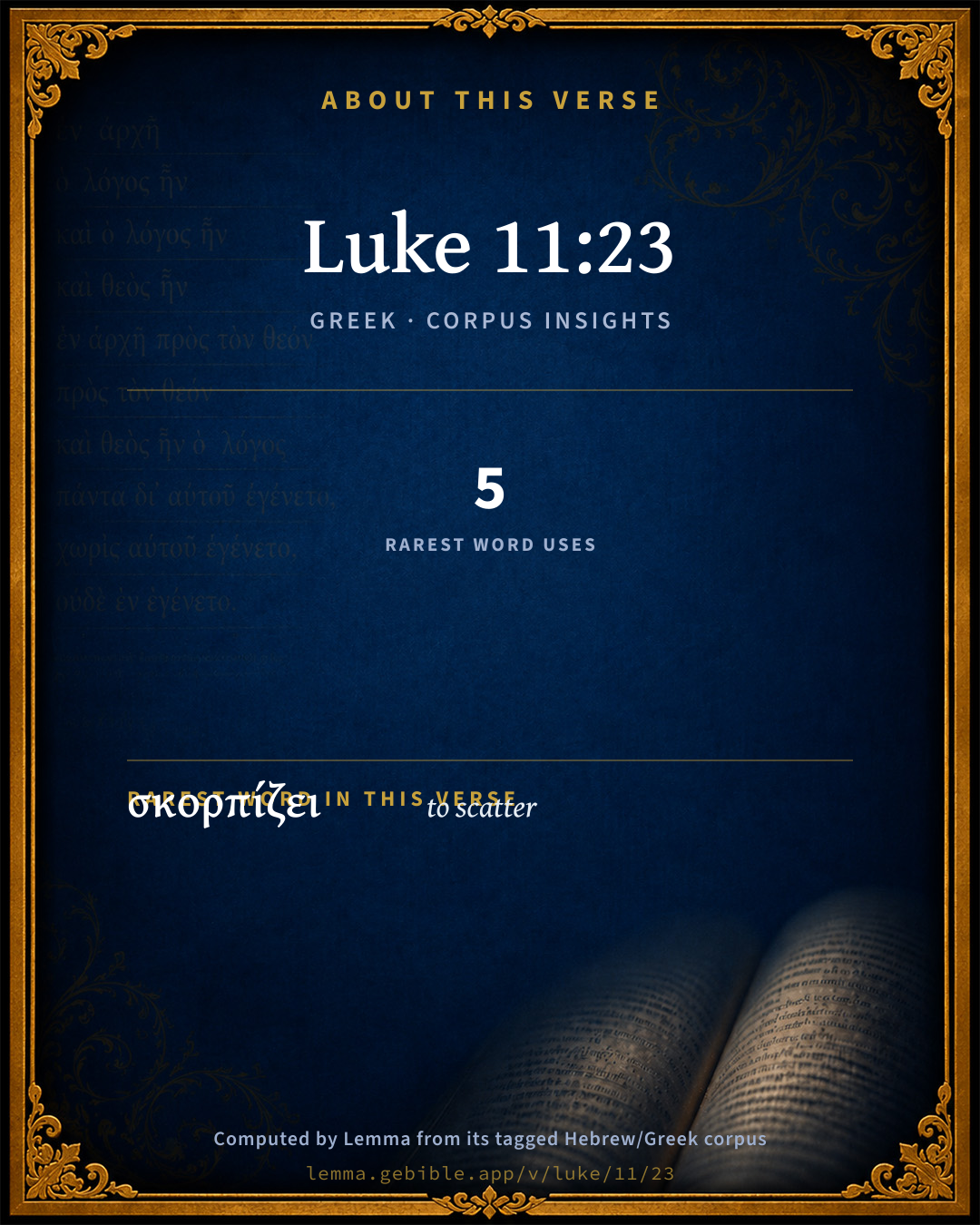
Luke 11:23

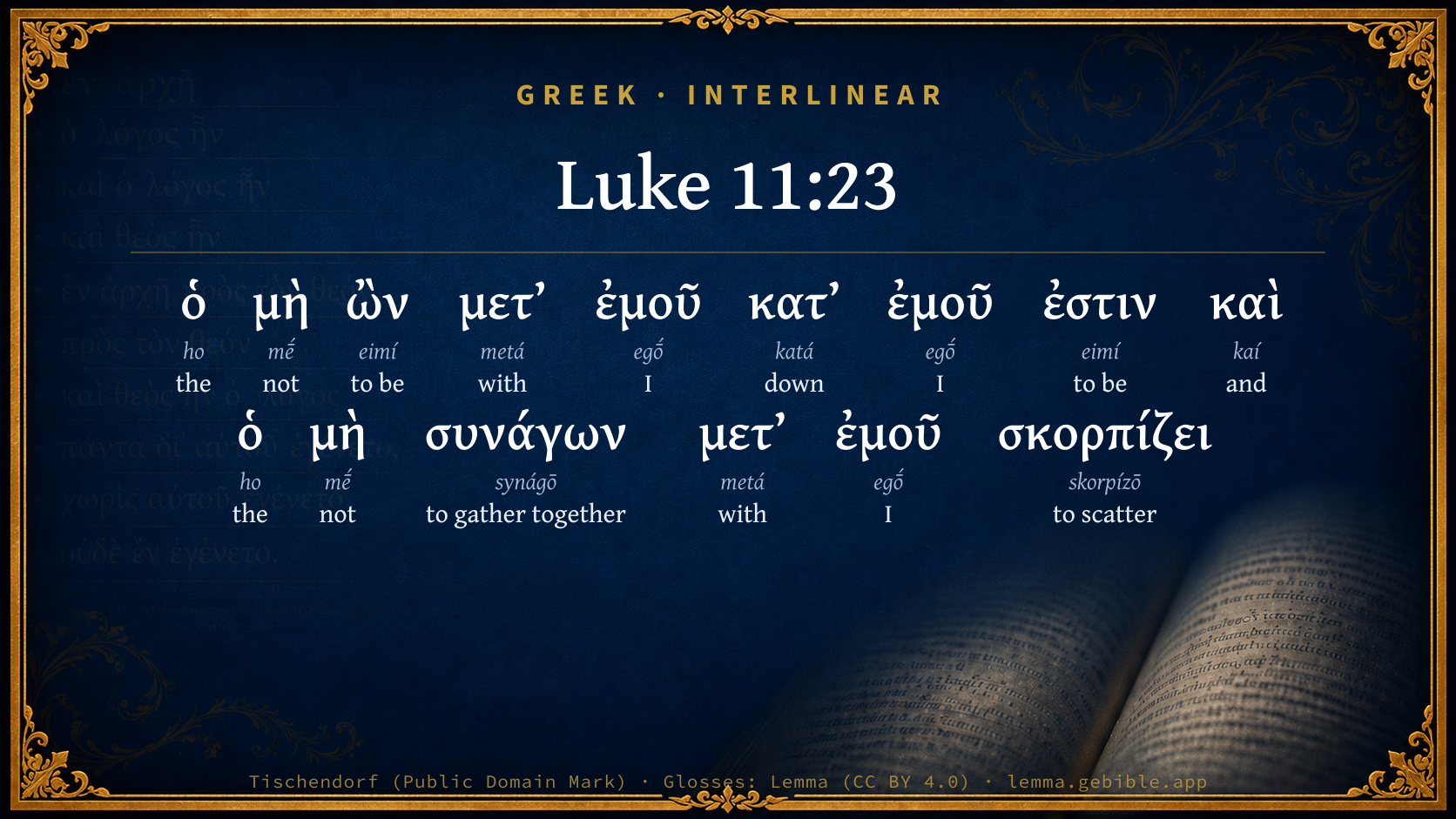
Greek (Tischendorf 8th ed.) Luke 11:23 appears in the Greek New Testament. The text above is from the Tischendorf 8th edition. Each word links to its Strong’s number and a concise gloss. Click any word for its full Thayer’s Greek Lexicon entry.
Download image
Cite this verse

Luke 11:23 (World English Bible). Public Domain. Lemma interlinear Bible study tool, https://lemma.gebible.app/v/luke/11/23.

Show BibTeX & RIS
BibTeX
RIS
English Translation
"He that is not with me is against me. He who doesn't gather with me scatters.
World English Bible · Public Domain
Download a study sheet

One document with this verse’s original text, its word-by-word gloss line, the meaning frame, cross-references with their text, attributed commentary, and full source and license credits — printable, and it pastes into notes with its structure intact.

This verse Autodidact and up

Study sheet (.html) Plain text (.txt)

A passage Seminary Student

Up to 50 verses in one chapter. A passage sheet keeps up to 6 commentary sources and 12 cross-references per verse, in the order this page ranks them, and says so on the sheet whenever that leaves anything out. Ask for a single verse and you get the Autodidact verse sheet above.

Everything on this page stays free to read, with no account — the sheet is a download of what is already on screen, not access to it.

Want to remove ads? Support Godless Engineer
Compare translations 3

The same verse in 3 English versions, stacked beneath the original-language interlinear above. Click any original word for its lexicon entry.

Each is an independent rendering of the whole verse — the interlinear is not word-aligned to these translations.

Highlighted words mark where these versions differ — a whole-verse word diff, not a word-by-word alignment.

  • World English Bible Public Domain
    "He that is not with me is against me. He who doesn't gather with me scatters.
  • King James Version Public Domain
    He that is not with me is against me: and he that gathereth not with me scattereth.
  • unfoldingWord Literal Text CC BY-SA 4.0
    The one not being with me is against me, and the one not gathering with me scatters.

unfoldingWord Literal Text — © unfoldingWord, licensed CC BY-SA 4.0. Word-aligned USFM3 via Door43 (git.door43.org/unfoldingWord/en_ult).

Versions to compare (up to 4)

3 of 4 selected

Show all 19 translations

Every available English version of this verse, each an independent rendering of the whole verse.

  • World English Bible Public Domain
    "He that is not with me is against me. He who doesn't gather with me scatters.
  • Berean Standard Bible Public Domain
    He who is not with Me is against Me, and he who does not gather with Me scatters.
  • Majority Standard Bible Public Domain
    He who is not with Me is against Me, and he who does not gather with Me scatters.
  • King James Version Public Domain
    He that is not with me is against me: and he that gathereth not with me scattereth.
  • American Standard Version (1901) Public Domain
    He that is not with me is against me; and he that gathereth not with me scattereth.
  • Revised Version (1885) Public Domain
    He that is not with me is against me; and he that gathereth not with me scattereth.
  • Geneva Bible (1599) Public Domain
    He that is not with me, is against me: and he that gathereth not with me, scattereth.
  • Douay-Rheims (1899) Public Domain
    He that is not with me, is against me; and he that gathereth not with me, scattereth.
  • Young's Literal Translation Public Domain
    he who is not with me is against me, and he who is not gathering with me doth scatter.
  • Literal Standard Version CC BY-SA 4.0
    he who is not with Me is against Me, and he who is not gathering with Me scatters.
  • Unlocked Literal Bible CC BY-SA 4.0
    The one who is not with me is against me, and the one who does not gather with me scatters.
  • unfoldingWord Literal Text CC BY-SA 4.0
    The one not being with me is against me, and the one not gathering with me scatters.
  • Darby Bible Public Domain
    He that is not with me is against me, and he that gathers not with me scatters.
  • World Messianic Bible Public Domain
    “He who is not with me is against me. He who doesn’t gather with me scatters.
  • Webster's Bible Public Domain
    He that is not with me is against me: and he that gathereth not with me scattereth.
  • Free Bible Version CC BY-SA 4.0
    Anyone who is not with me is against me, and anyone who doesn't build together with me is breaking it all apart.
  • Bible in Basic English Public Domain
    He who is not with me is against me, and he who will not give me help in getting people together is driving them away.
  • Text-Critical English NT CC BY 4.0
    Whoever is not with me is against me, and whoever does not gather with me scatters.
  • Tyndale New Testament (1534) Public Domain
    He that is not with me is agaynst me. And he that gadereth not with me scattereth.

Literal Standard Version (2020), Covenant Press — licensed CC BY-SA 4.0. Text via the HelloAO Bible API (eBible.org). Unlocked Literal Bible (unfoldingWord) — licensed CC BY-SA 4.0. Text via the HelloAO Bible API (eBible.org). unfoldingWord Literal Text — © unfoldingWord, licensed CC BY-SA 4.0. Word-aligned USFM3 via Door43 (git.door43.org/unfoldingWord/en_ult). Free Bible Version, Dr. Jonathan Gallagher — licensed CC BY-SA 4.0. Text via the HelloAO Bible API (eBible.org).

Word by word

More ways to search: Search by grammar → Find every occurrence → Compare this word →

Practice this passage: Drill this verse → Learn its vocabulary →

σκορπίζει
skorpízō
G4650
“to scatter”
Verb, Present, Active, Indicative, 3rd person, Singular
Part of Speech
Verb
Tense
Present
Voice
Active
Mood
Indicative
Person
3rd person
Number
Singular
Full Thayer's Definition

Origin: apparently from the same as G4651 (through the idea of penetrating)

TDNT: 13:58,1

1. to scatter a. of those who, routed or terror stricken or driven by some other impulses, fly in every direction b. to scatter abroad (what others may collect for themselves), or one dispensing blessings literally
  1. ὁ ho G3588 “the” Article, Nominative, Singular, Masculine
  2. μὴ mḗ G3361 “not” Particle, Negative
  3. ὢν eimí G1510 “to be” Verb, Present, Active, Participle, Nominative, Singular, Masculine
  4. μετ’ metá G3326 “with” Preposition
  5. ἐμοῦ egṓ G1473 “I” Personal pronoun, 1st person, Genitive, Singular
  6. κατ’ katá G2596 “down” Preposition
  7. ἐμοῦ egṓ G1473 “I” Personal pronoun, 1st person, Genitive, Singular
  8. ἐστιν eimí G1510 “to be” Verb, Present, Active, Indicative, 3rd person, Singular
  9. καὶ kaí G2532 “and” Conjunction
  10. ὁ ho G3588 “the” Article, Nominative, Singular, Masculine
  11. μὴ mḗ G3361 “not” Particle, Negative
  12. συνάγων synágō G4863 “to gather together” Verb, Present, Active, Participle, Nominative, Singular, Masculine
  13. μετ’ metá G3326 “with” Preposition
  14. ἐμοῦ egṓ G1473 “I” Personal pronoun, 1st person, Genitive, Singular

About this verse

These counts appear in no published source. They are computed here, from the morphology-tagged text and Lemma’s own curated glosses. What Lemma adds →

15
words
9
distinct lemmas
Gospels
section

Notable vocabulary

The rarest word here is σκορπίζει to scatter G4650 — appearing just 5 times in the whole Greek New Testament.

Shared distinctive vocabulary

σκορπίζει to scatter G4650 occurs in 5 verses of the Greek New Testament. Also found in:

Repetition

Words recur within this verse:

Cross-references

4

Topical passages linked to Luke 11:23 in the Treasury of Scripture Knowledge — connected by theme and wording, ordered by reader-vote popularity; previews shown in the World English Bible.

  • Matthew 12:30 "He who is not with me is against me, and he who doesn't gather with me, scatters.
  • Luke 9:50 Jesus said to him, "Don't forbid him, for he who is not against us is for us."
  • Mark 9:40 For whoever is not against us is on our side.
  • Revelation 3:15–16 "I know your works, that you are neither cold nor hot. I wish you were cold or hot.

Cross-references courtesy of OpenBible.info (CC BY 4.0).

Commentary

Notes on Luke 11:23 from classic Christian and Jewish commentators (each source and its license shown beneath its notes). The classic Christian expositions comment on the surrounding passage and are grouped to its opening verse, so a note may address several verses; the Jewish commentaries on the Tanakh (Rashi and others) are per-verse, so they appear only where the commentator wrote on this verse.

Lemma curates 59 commentaries, every one of them public domain or Creative Commons licensed, each selected and text-cleaned for this edition rather than reprinted as found. About our sources →

The Biblical Illustrator

Joseph S. Exell

Luk_11:23

He that Is not with Me is against Me

Neutrality in religion impossible

There is no device by which the god of this world more fatally deceives the souls of unwary men, than by leading them to suppose that they can take neutral ground in regard to the character and cause of Christ.

Now, in proof of the assertion that neutrality in regard to the character and cause of Christ is impossible, let me--

1. Adduce the testimony of the Word of God. The text is explicit. He that is not for Me is against Me, and He that gathereth not with Me scattereth abroad. The same thing is taught in language not less explicit in our Saviours sermon on the mount. No man can serve two masters: for either he will hate the one and love the other; or else he will hold to the one and despise the other; ye cannot serve God and Mammon. Take another passage equally decisive. The friendship of the world is enmity with God. Whosoever therefore will be a friend of the world is an enemy of God.

2. The same is evident from the nature of the human mind, and the laws under which it acts. Every man has some commanding principle of action, some supreme object of affection and pursuit; and he can have but one such object.

3. The truth of our doctrine is proved from the nature of the Divine requirements. These requirements are positive in their character, and cannot be satisfied with mere negative obedience.

4. The character and cause of Christ are in their nature such as render it impossible for any to feel indifferent or take neutral ground in respect to them.

5. The disclosures and decisions of the judgment day prove that neutrality in regard to Christ and religion is impossible.

In conclusion, I am led to remark--

1. It may be expected that those who assume neutral ground will take it unkindly when their deception and danger are exposed.

2. If all who are not for Christ are against him, then it is immensely important that this truth should be clearly set forth and fully known. (J. Hawes, D. D.)

Opposition to Christ

I. The DISGRACEFULNESS of being against Christ. In order to make this appear a little, you will observe--

1. Nothing shows men more than their attractions and aversions. Mark the objects of their choice and of their preference; see with whom they most readily and pleasingly associate; and then call to remembrance the adage, Tell me a mans company, and I will tell you his character. Congeniality is the inducement and the bond of union. To be against some individuals would expose you to general indignation. Which of you would like to be opposed to a Thornton, a Reynolds, a Howard, a Leighton, a Fenelon: But here we have the brightness of Gods glory, and the express image of His person.

2. Again: nothing is more unreasonable, vile, and shameful than to oppose a Benefactor and Friend, who has laid you under peculiar obligations, upon whom you had no claim, and who has yet spared no expense, no pains, in order to serve you.

II. The DANGER of befog against Christ.

1. Can you overcome Him?

2. Can you endure Him?

3. Can you escape from Him?

III. The POSSIBILITY of being against Him.

1. He has a people, and they that persecute them persecute Him.

2. He has a cause in this world: the gospel of our salvation. And how it has been opposed! It offends because it is the enemy of self and sin, and because of its sanctifying influence.

3. He has also a providential agency on earth; and the dispensations of His providence are designed to promote the purposes of His grace. Yet with some this is all in vain. They will have none of Him.

IV. The evidence of being against Him. The question is, Are you with Him? Are you with Him in sentiment, in disposition, in action, in pursuit: Are you with Him as scholars are with their teacher, as servants are with their master, as soldiers are with their commander, as subjects are with their sovereign: Does He occupy the highest place in your regard? Does He dwell in your hearts by faith: Do you say, Other lords besides Thee have had dominion over me, but henceforth will I make mention of Thy name? And do you feel what is done against Him as done against yourselves: (W. Jay.)

Christian neutrality impossible

I. THE DESIGN CHRIST IS CARRYING ON. Redemption.

II. THAT NO MAN CAN BE INDIFFERENT TOWARDS IT.

1. The design which Christ is pursuing is the greatest of all possible designs in every point of view.

(1) It is great in its origin.

(2) Great in extent.

(3) Great in duration.

2. The great design which Christ is pursuing is totally opposed to all the selfish designs of mankind.

3. Christ, in carrying on His great, comprehensive, and benevolent design, employs all mankind as instruments in promoting it.

4. None of the inhabitants of the invisible world are indifferent towards the great and interesting design which Christ has undertaken, and is determined to accomplish.

1. If none can be indifferent towards the design which Christ is carrying on, then none have any ground to imagine that they are neuters in religion.

2. If none can be indifferent towards the design which Christ is carrying on, then all who do not act for Him, act against Him. As all must be for Him or against Him in their hearts, so all must be for Him or against Him in their conduct.

3. If all who are with Christ are united to Him in His great and glorious design, then all who are united to Him are more firmly united to one another than any other persons in the world.

4. If all who are not for Christ are against Him then the most regular and amiable sinners may be as much against Him as any other sinners.

5. We learn from what has been said the great criminality of sinners. They are all against Christ in their hearts and in their conduct, without a single exception. And by opposing this great and glorious purpose they oppose the glory of God, and all the holiness and happiness in the universe. Is this a small error, or a mere venial fault: Is it not a sin of the first magnitude? Can they be guilty of a greater?

6. This subject shows the imminent danger of all who are against Christ and opposing His great and glorious design. (N. Emmons, D. D.)

No neutrality in religion

We are all either gatherers or scatterers; either workmen in the erection of a vast spiritual fabric, or destroyers who lay its honour in the dust.

1. We remind you, then, in the first place, that you are scattering Christs seed in the world, if you are not gathering it. The absence of the Christian temper in your daily conduct, the absence of Christian charitableness in your judgment of your fellow-men--nay, the mere absence of all concern for the glory and spread of the Redeemers triumphs, will all be, in effect, an absolute accession to the strength of His adversary; and that for this simple reason--that the war which Christ is carrying on is essentially aggressive. To stand still, therefore, in spiritual things is to help Satan. If you are not with Christ, you are against Him; if you gather not with Him, you are scattering abroad.

2. Again: you are scattering Christs flock in your families, if you do not gather them.

3. Again: you are scattering Christs precious gifts in your own hearts, if you are not gathering them. Consider, then, what use you are making of the gifts which Christ hath given you.

4. But this text must have a more awful illustration still. Christs scatterers and Christs gatherers must have one more meeting yet; and only one. The gathered seed shall expand and ripen, till it becomes fit for the garners and the stores of heaven. The gathered flock shall rise from earth and sea, and pass under the portals of the everlasting dome. The gathered graces of the Redeemer shall be purged from their earthly dross, forming by their clustered brightness the new name upon His brow. But the scattered seed which you did not prize, the scattered flock which you would not feed, the scattered graces that you would neither seek nor keep nor bind up, shall all rise up in judgment against you, and in their turn shall scatter you. Christ Himself will be the only gatherer then. (D. Moore, M. A.)

What it is to be with Christ

What can the words mean for us? Not actual, personal, visible fellowship with Him. That is impossible now, or so long as we are in the flesh. Yet do we say, at times, to any teacher or leader who may have won our confidence, I am with you in that, meaning that we accept the same doctrine, cherish the same convictions, have the same practical aims as he holds and is trying to reach. And that is substantially what is meant, I take it, by being with Christ: we are with Him, that is, if at all, in sympathy, in affection, and in active endeavour. Faith, love, obedience, in other words, constitute the triple cord which binds men to Christ. (J. H. Rylance, D. D.)

A half-Christian

He that is not with Me. Such is our Lords description of a half-Christian. Let us think what we are. And then let us consider why such a person not being with should be said to be against Him. Who then is not with Christ? Of course, and most obviously, he who never visits Christ, he who never seeks Christ, is not with Him. We may do both, and yet not live with Him. We may pray to Him and communicate with Him now and then, and yet not be with Him. That is quite possible. But it is too plain that, if we do not ever seriously pray to Him, or seek His presence, in our hearts by faith, we cannot be with Him. Those of us are not with Him who do not pray heartily and earnestly as well as regularly. Those of us are not with Him who, having been confirmed, do not habitually come to His holy table to have their faith strengthened and refreshed by His Holy Spirit. But this is not enough to explain the words. To be with Christ is to be on His side. It implies that there is a daily strife going on where we are, and that Christ is one of two parties in it. It implies that life, our own life, is a struggle, and that Christ is concerned in that struggle; interested in its progress, and interested in its end. And if this be the meaning of the words, He that is with Me, we can all understand the meaning of their opposite, He that is not with Me. You see that it does not necessarily imply active opposition to Christ. You need not have ever thwarted or ridiculed one of Christs servants in order to expose you to the charge of not being with Him. It is a negative expression. It implies only that you have felt no deep interest in being yourself, or in inducing others to be, such as Christ would have you and them. It implies only that you have not taken pains to cherish the thought of God with reverence and love, to claim your position as His son, and to live up to it. It implies only that it has not been a great and constant object with you to get to heaven at last, and while upon earth to live as an expectant, as an heir, of heaven. But we were to inquire why those who are thus not with Christ are said to be against Him. The two ideas seem to be different. Surely there is a difference between a want of decision and an adverse decision; between being a faint-hearted or even a cowardly soldier on the one side, and being positively enrolled and enlisted on the other? Yes, there is a difference; we do not deny it. But what the text impresses upon us is this, that, for many practical purposes, and so far as the final personal issue is concerned, the faint-hearted, cowardly, treacherous soldier of Christ is rather an enemy to Him than a friend. (Dean Vaughan.)

Spiritual waste and wealth

In spiritual affairs we find we are subject to this condition in respect to one Supreme Spirit--that if we are not serving Him we are wronging Him; if we are not gathering with Him--gathering wisdom and strength and purity and greater capacity for good and other fruit unto everlasting life--then we are wasting what belongs to Him. We are in a necessary stewardship, and this is one of its laws. The law may look exacting in the statement, but it is glorious in its operation. Neutrality, not only in the posture of our affections, but in the use of our active powers, is impossible. Not far from each of the great scenes of our Saviours ministry there was a third party, taking no apparent share in the transaction. Those that sided openly with Him and publicly confessed their loyalty, on the one hand, and those that expressly opposed Him, on the other, became, of course, conspicuous in the conflicts that sprang up about Him. By their direct opposition to each other, Apostles and Pharisees, the family at Bethany and the Council at Jerusalem, John and Judas, Zaccheus and Herod, Joseph of Arimathea and Pilate, immediately suggest to us two distinct classes of people--the friends and the enemies of the Son of God. Decided convictions always throw men into definite positions. Near by, however, you might always find another class, more numerous, probably, than either of them. They are not brought forward into notice, because no real interest or choice brought them visibly into the struggle that was going on. Other things absorbed their attention. He speaks to that large third class among you to-day. If there is any question about that position--as to its rightfulness, or its safety, or where those that are trying to hold it really belong--does He not settle that question by the text? He that gathereth not with Me scattereth. It is remarkable, in all the gospel, how invariable and how clear Christ makes this doctrine of absolute and necessary separation. There is no third party after all. There is no place for one. Non-profession does not make non-allegiance or neutrality. It makes allegiance to the enemy. It makes disloyalty. He that is not with Me is against Me. The next truth to be remembered is our dangerous liability to be deceived just at that point--i.e., to reckon as harmless or safe courses of life that are really anti-Christian. If there are any, here or elsewhere, who think they do enough because they are not positive opponents, mockers, or infidels; who think that, because they never persecute, or revile, or take a traitors silver, or meet to plot with scribes and Pharisees for Herod, therefore they are not secretly fighting against their eternal King, Christ here assigns them their place with terrible distinctness. Unlike the politic leaders of earthly kingdoms, He fearlessly casts this middle party from Him--that it may thereby become truly His. All are scatterers that are not gatherers with Him. There is a striking record, in the Book of Numbers, of-a prophet who tried, in perilous days, to be on neither side, and paltered with a double tongue between the true God and His enemies; but at last the issue between the two armies could be no longer evaded, and, after the battle, the body of this compromising neutral, Balaam, was found on the enemys side, where it fell fighting against the Lord. It is in this sense that Christ comes to put men and families of men at variance--with one another--a strange thing to be written of Him. It is not for divisions sake, but only that truth may not be confounded with a lie, darkness be called light, and the very foundations of all honour guilt. There can be no lasting harmony, no healthy peace, but in Him in whom all things in their unity consist. All is wasted then that is not done with a heart of love and that toward God; all time that is not spent for Him--these days of busy labour in trades and professions; these unsatisfying contortions of effort to be a little richer, or a little more noticed, or to climb one round more on the ladder that you will slip from the instant death touches your fingers; these plans, schemes, travels, bargains, buildings--they look like gathering, but they are only scattering, unless in the midst of them all your character is daily built up, a spiritual house, Jesus Christ Himself being the chief corner-stone. Gather with Him and all the parts of your life which are yet alien or infirm He will steadily draw into the unity of His own body, making it strong and pure and immortal, knit together and making increase by the edifying of His love. (Bishop F. D. Huntington.)

Neutrality impossible in religion

You dont mean to call me an enemy of religion, do you? said a farmer to a gentleman who was urging him to become a friend of Christ. He that is not for Me is against Me, are Christs words. Are they not decisive of your question? replied the gentleman. But I am friendly to religion, rejoined the farmer. Friendly! How? You do not revile Christ, I know; but do you serve Him? Do you avow yourself His disciple? Are you His disciple? Do you by your life and speech declare that faith in Christ is necessary to salvation? I do not profess faith in Christ, sir, said the farmer; and, of course, I cannot consistently urge that faith on others. Then, you see, replied the gentleman, that your influence is against the acceptance of Christ by others. Its voice is: Personal faith in Christ is not a very important matter; if it were, I should seek it. The farmer was silenced. He felt that his friend was right. He saw that not to be on Christs side was to be against Him; not to be marching with His pilgrims to heaven was to be marching with His enemies to hell. He was right. There was no middle course.

Impossible neutrality

Pythagoras, being asked what he was, answered that if Hiero were ever at the Olympian games, he knew the manner--that some came to try their fortune for the prizes, and some came as merchants to utter their commodities, and some came to make good cheer and meet their friends, and some came to look on; and that he was one of them that came to look on. But men must know that, in this theatre of mans life, it is reserved only for God and the angels to be lookers-on. (Lord Bacon.)

The Biblical Illustrator, edited by Joseph S. Exell (c. 1880s–1900s) — public domain. Text from a community e-Sword module.

Tyndale Open Study Notes

Tyndale Open Resources

11:23 Anyone who isn’t with me opposes me: See study note on 9:50.

Tyndale Open Study Notes — © Tyndale Open Resources, licensed CC BY-SA 4.0. Text via the HelloAO Bible API.

Meyer's Critical & Exegetical Commentary

Heinrich August Wilhelm Meyer

Luk_11:23. After Jesus has repelled the accusation: ἐν βεελζεβοὺλ κ.τ.λ., Luk_11:15, He pronounces upon the relation to Him of those men spoken of in Luk_11:15 (see on Mat_12:30), and then adds

Meyer — Critical and Exegetical Commentary on the New Testament — English translation by Peter Christie, edited by Frederick Crombie (T&T Clark, 1880) — public domain. Text from a community e-Sword module.

Expositor's Greek Testament

ed. W. Robertson Nicoll

Luk 11:23 = Mat 12:30 .

The Expositor's Greek Testament, edited by W. Robertson Nicoll (1897–1910) — public domain. Text from a community e-Sword module.

Geneva Bible (1599)

Geneva Bible translators

Against indifferent men, and such as love to have a mean, which seek means to reconcile Christ and Satan together.

Geneva Bible (1599) marginal notes — public domain. Text via Bolls.life.

Jamieson, Fausset & Brown

Robert Jamieson, A. R. Fausset & David Brown

gathereth . . . scattereth--referring probably to gleaners. The meaning seems to be, Whatever in religion is disconnected from Christ comes to nothing.

Jamieson, Fausset & Brown — Commentary Critical and Explanatory on the Whole Bible (1871) — public domain (CC PDM 1.0). Text via the HelloAO Bible API.

The Cambridge Bible for Schools and Colleges

gen. ed. J. J. S. Perowne

23. He that is not with me is against me] Neutrality is sometimes opposition, see on Luk_9:51 (where we have the complementary truth).

The Cambridge Bible for Schools and Colleges (gen. ed. J. J. S. Perowne; Cambridge University Press, 1878–1918) — public domain. Text from a community e-Sword module.

John Gill's Exposition

When the unclean spirit is gone out of a man,.... That is, the devil, who is in, and works in the children of disobedience, whether under a profession of religion or not; whose hearts are unclean like himself, wherefore there he delights to dwell; and so the Ethiopic version renders it, "the evil demon": who may be said to go out of a man in appearance, when he outwardly reforms and takes up a profession of religion.

He walketh through dry places; or "a desert", as the Ethiopic version; to which the Gentile world is sometimes compared in the Old Testament Isa 35:1 whither Satan might go, being disturbed in Judea, through the many dispossessions by Christ; or rather leaving for a while the Scribes and Pharisees, who outwardly appeared righteous before men, he went to the Gentiles;

seeking rest, and finding none; being also made uneasy among them, through the preaching of the Gospel, which was sent unto them after Christ's resurrection; and not being able to keep his place in the hearts of men, nor do the mischief he was desirous of.

He saith, I will return unto my house, whence I came out; to the Jews again, who were blinded and filled with rage and enmity to the Gospel by him, and whom he instigated to persecute the apostles of Christ, and preachers of the word, wherever they came; See Gill on Mat 12:43 and See Gill on Mat 12:44.

John Gill's Exposition of the Whole Bible (1746–1763) — public domain (CC PDM 1.0). Text via the HelloAO Bible API.

The Pulpit Commentary

He that is not with me is against me; and he that gathereth not with me scattereth. Our Lord here is referring to the exorcists, and contrasting their imperfect work with his, showing how hopeless a task it was to attempt to combat the evil one and his satellites apart from him Christ. It is particularly to be noticed that Jesus neither here nor elsewhere charges these with imposture. Pretence and ridiculous spells and incantations were doubtless constantly mixed up with their attempts to exorcise; indeed, the term used to describe them in Act_19:13 is one of contempt; but Jesus assumes in his argument here, whatwas no doubt the fact, that in these cases there was often, in the person of the physician-exorcist, earnestness and prayer mingled with the deepest pity for the unhappy sufferer, and before these there is no doubt that, in the less severe cases of possession, the evil influence or spirit yielded, and for a time at least let go his victim. "See," said the Master, "he that is not with me is against me in this dire conflict against evil;" for these would-be exorcists were utterly unable, even in those instances where they expelled the devil, to render him powerless to do mischief for the future. My power sent these dread beings to the abyss, there to wait. The would-be exorcists were unable to replace the hellish tenant which they expelled by another and a holier influence. I bring back the once-tormented soul to its old relations with its God-Friend, and replace the unclean spirit by the Holy Spirit." He goes on to say

The Pulpit Commentary (1880–1919), ed. H.D.M. Spence-Jones & Joseph S. Exell — public domain. Text from a community e-Sword module.

Bengel's Gnomon

Johann Albrecht Bengel

[23. Μετʼ ἐμοῦ, with Me) No mortal man could by his own strength (powers) have assisted Jesus, and many were fighting against Him: yet notwithstanding He performed such stupendous miracles. He is therefore ὁ ἰσχυρότερος, the stronger man, Luk 11:22.—V. g.]

Bengel's Gnomon of the New Testament — English translation (T&T Clark, Edinburgh, 1860) — public domain. Text from a community e-Sword module.

Cambridge Greek Testament for Schools and Colleges

23. ὁ μὴ ὢν μετ’ ἐμοῦ κατ’ ἐμοῦ ἐστίν. Neutrality is sometimes opposition; see on Luk 9:51 (where we have the complementary truth).

σκορπίζει. An Ionic and Hellenistic verb for which the Attics use σκεδάννυμι.

Cambridge Greek Testament for Schools and Colleges (Cambridge University Press, 1896; 21 vols, various authors incl. Carr, Maclear, Plummer, Farrar, Lumby, Moule, M. R. James, Simcox) — public domain. Text from a community e-Sword module.

Alford’s Greek Testament

Henry Alford

23.] See on Matt. ver. 30.

Henry Alford, The Greek Testament (1849–1861) — public domain. Text from a community e-Sword module.

International Critical Commentary

23. ὁ μὴ ὤν μετʼ ἐμοῦ κατʼ ἐμοῦ ἐστίν. Verbatim as Mat 12:30. The connexion with what precedes seems to be that the contest between Christ and Satan is such that no one can be neutral. But that the warning is specially addressed to those who accused Him of having Beelzebub as an ally (ver. 15), or who demanded a sign (ver. 16), is less evident. See on 9:50.

συνάγων. Comp. 3:17, 12:17, 18. But the metaphor is perhaps not from gathering seed and fruit, but from, collecting a flock of sheep, or a band of followers. Comp. συνάγει τοὺς ἐσκορπισμένους (Artem. Oneir. i. 56. 1). Hillel had said, “Whoso revileth the Name, his name perisheth; and whoso doth not increase it, diminisheth.”

σκορπίζει. Ionic and Hellenistic for the more classical σκεδάννυμι; comp. Joh 10:12, Joh 10:16:32; Joh_1 Mac. 6:54; 2Sa 22:15.

International Critical Commentary — older volumes (1896–1929), various authors — public domain. Text from a community e-Sword module.

Lesson kit

Teaching starters — assembled from the data on this page, not authored interpretation. Every prompt links to the verse data it draws on. Edit before teaching.

Luke, in the Gospels, opens this verse with 15 words (9 distinct Greek lemmas). Its most distinctive word is skorpízō (“to scatter”). A historical commentator’s framing appears above. Read the whole chapter for the surrounding context.

Discussion questions

  1. How does “to scatter” (skorpízō) shape what this verse is saying?
  2. Matthew 12:30 shares the word «to scatter» with this verse. How do the two illuminate each other?
  3. “to be” occurs 2× in this one verse. What is the effect of the repetition?
  4. These translations render this verse differently; the difference is in the English rendering, not the original. What questions does that raise?
  5. Reading how The Biblical Illustrator and Tyndale Open Study Notes read this verse, where do the two commentators agree and where do they part?

Things to notice

  • These translations choose different wording for 9 words in this verse.
  • “to be” occurs 2× in this single verse.
  • 9 distinct Greek lemmas span 15 words in this verse.

Reading settings

Reading text

Shown beneath each verse's original-language words.

Old Testament
Old Testament edition

Read the OT as the Masoretic Hebrew (MT) or the Greek Septuagint (LXX).

English shown for the Greek Septuagint (in the Hebrew ↔ Greek comparison).

Comparing translations? Open the Compare panel on any verse page to stack up to four side by side.