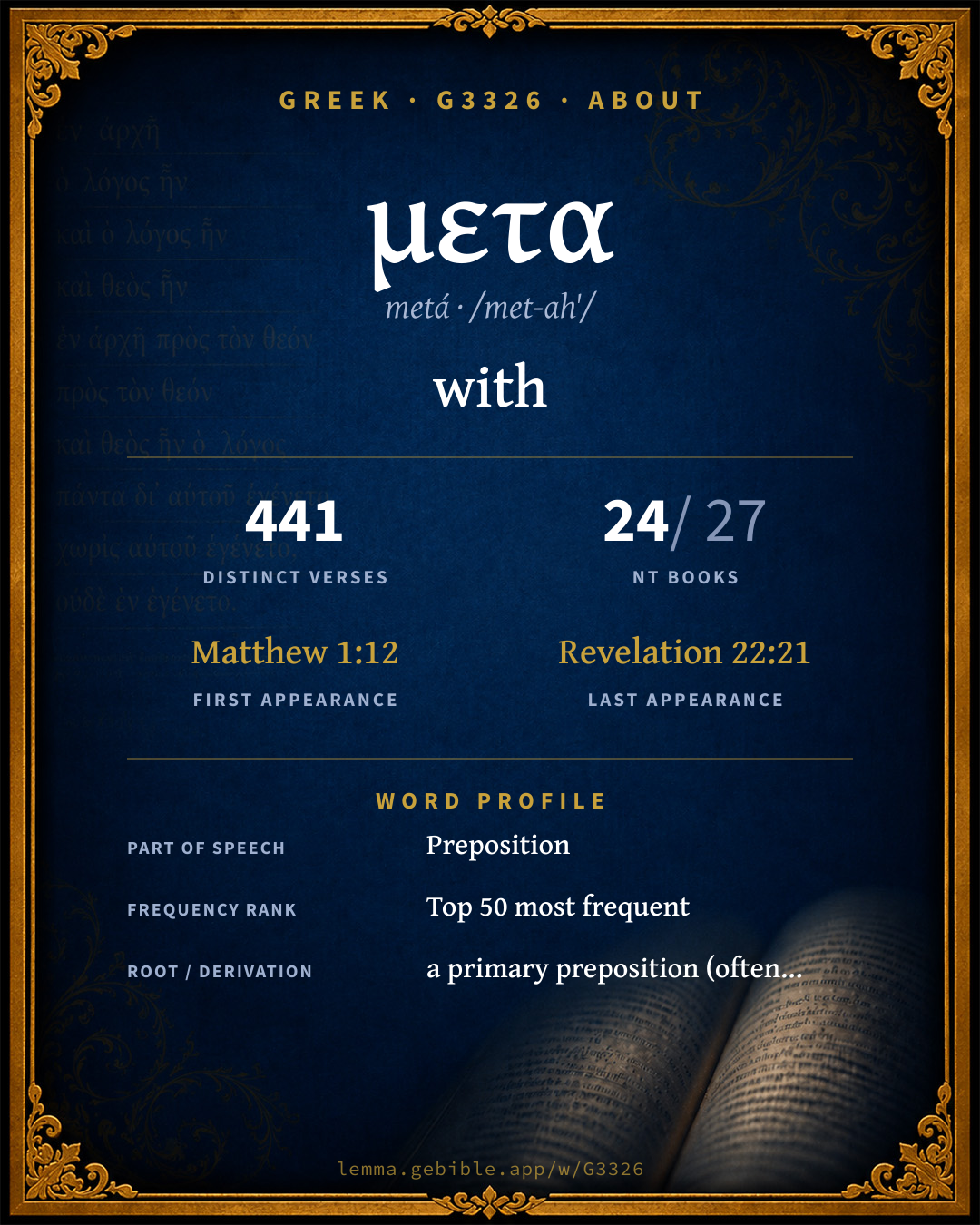
μετά
with
Full lexicon entry — Thayer's Greek Lexicon
From Thayer's Greek Lexicon
Where this word appears
Grammar key — what these labels mean
Part of speech
- Preposition
- A relational word governing a noun in a particular case.
Every verse where G3326 appears in the Book of John — 53 distinct verses. Click any verse to open its interlinear word-by-word view. Verse text shown in the World English Bible for context — . Each verse’s Greek form is shown with its reference; the English is not keyword-highlighted, since the data carries no word-level English alignment. Use “Compare translations” on any verse to read it across multiple English versions. This concordance covers the Greek New Testament; Septuagint (Greek Old Testament) occurrences of this word are not indexed here.
John
- John 2:12 Μετὰ prep After this, he went down to Capernaum, he, and his mother, his brothers, and his disciples; and they stayed there a few days.
- John 3:2 μετ’ prep The same came to him by night, and said to him, "Rabbi, we know that you are a teacher come from God, for no one can do these signs that you do, unless God is with him."
- John 3:22 Μετὰ μετ’ prep prep After these things, Jesus came with his disciples into the land of Judea. He stayed there with them, and baptized.
- John 3:25 μετὰ prep There arose therefore a questioning on the part of John's disciples with some Jews about purification.
- John 3:26 μετὰ prep They came to John, and said to him, "Rabbi, he who was with you beyond the Jordan, to whom you have testified, behold, the same baptizes, and everyone is coming to him."
- John 4:27 μετὰ μετ’ prep prep At this, his disciples came. They marveled that he was speaking with a woman; yet no one said, "What are you looking for?" or, "Why do you speak with her?"
- John 4:43 Μετὰ prep After the two days he went out from there and went into Galilee.
- John 5:1 Μετὰ prep After these things, there was a feast of the Jews, and Jesus went up to Jerusalem.
- John 5:14 μετὰ prep Afterward Jesus found him in the temple, and said to him, "Behold, you are made well. Sin no more, so that nothing worse happens to you."
- John 6:1 Μετὰ prep After these things, Jesus went away to the other side of the sea of Galilee, which is also called the Sea of Tiberias.
- John 6:3 μετὰ prep Jesus went up into the mountain, and he sat there with his disciples.
- John 6:43 μετ’ prep Therefore Jesus answered them, "Don't murmur among yourselves.
- John 6:66 μετ’ prep At this, many of his disciples went back, and walked no more with him.
- John 7:1 Μετὰ prep After these things, Jesus was walking in Galilee, for he wouldn't walk in Judea, because the Jews sought to kill him.
- John 7:33 μεθ’ prep Then Jesus said, "I will be with you a little while longer, then I go to him who sent me.
- John 8:29 μετ’ prep He who sent me is with me. The Father hasn't left me alone, for I always do the things that are pleasing to him."
- John 9:37 μετὰ prep Jesus said to him, "You have both seen him, and it is he who speaks with you."
- John 9:40 μετ’ prep Those of the Pharisees who were with him heard these things, and said to him, "Are we also blind?"
- John 11:7 μετὰ prep Then after this he said to the disciples, "Let's go into Judea again."
- John 11:11 μετὰ prep He said these things, and after that, he said to them, "Our friend, Lazarus, has fallen asleep, but I am going so that I may awake him out of sleep."
- John 11:16 μετ’ prep Thomas therefore, who is called Didymus, said to his fellow disciples, "Let's go also, that we may die with him."
- John 11:31 μετ’ prep Then the Jews who were with her in the house, and were consoling her, when they saw Mary, that she rose up quickly and went out, followed her, saying, "She is going to the tomb to weep there."
- John 11:54 μετὰ prep Jesus therefore walked no more openly among the Jews, but departed from there into the country near the wilderness, to a city called Ephraim. He stayed there with his disciples.
- John 11:56 μετ’ prep Then they sought for Jesus and spoke one with another, as they stood in the temple, "What do you think--that he isn't coming to the feast at all?"
- John 12:8 μεθ’ prep For you always have the poor with you, but you don't always have me."
- John 12:17 μετ’ prep The multitude therefore that was with him when he called Lazarus out of the tomb, and raised him from the dead, was testifying about it.
- John 13:7 μετὰ prep Jesus answered him, "You don't know what I am doing now, but you will understand later."
- John 13:8 μετ’ prep Peter said to him, "You will never wash my feet!" Jesus answered him, "If I don't wash you, you have no part with me."
- John 13:18 μετ’ prep I don't speak concerning all of you. I know whom I have chosen. But that the Scripture may be fulfilled, 'He who eats bread with me has lifted up his heel against me.'
- John 13:27 μετὰ prep After the piece of bread, then Satan entered into him. Then Jesus said to him, "What you do, do quickly."
- John 13:33 μεθ’ prep Little children, I will be with you a little while longer. You will seek me, and as I said to the Jews, 'Where I am going, you can't come,' so now I tell you.
- John 14:9 μεθ’ prep Jesus said to him, "Have I been with you such a long time, and do you not know me, Philip? He who has seen me has seen the Father. How do you say, 'Show us the Father?'
- John 14:16 μεθ’ prep I will pray to the Father, and he will give you another Counselor, that he may be with you forever,--
- John 14:30 μεθ’ prep I will no more speak much with you, for the prince of the world comes, and he has nothing in me.
- John 15:27 μετ’ prep You will also testify, because you have been with me from the beginning.
- John 16:4 μεθ’ prep But I have told you these things, so that when the time comes, you may remember that I told you about them. I didn't tell you these things from the beginning, because I was with you.
- John 16:19 μετ’ prep Therefore Jesus perceived that they wanted to ask him, and he said to them, "Do you inquire among yourselves concerning this, that I said, 'A little while, and you won't see me, and again a little while, and you will see me?'
- John 16:32 μετ’ prep Behold, the time is coming, yes, and has now come, that you will be scattered, everyone to his own place, and you will leave me alone. Yet I am not alone, because the Father is with me.
- John 17:12 μετ’ prep While I was with them in the world, I kept them in your name. Those whom you have given me I have kept. None of them is lost, except the son of destruction, that the Scripture might be fulfilled.
- John 17:24 μετ’ prep Father, I desire that they also whom you have given me be with me where I am, that they may see my glory, which you have given me, for you loved me before the foundation of the world.
- John 18:2 μετὰ prep Now Judas, who betrayed him, also knew the place, for Jesus often resorted there with his disciples.
- John 18:3 μετὰ prep Judas then, having taken a detachment of soldiers and officers from the chief priests and the Pharisees, came there with lanterns, torches, and weapons.
- John 18:5 μετ’ prep They answered him, "Jesus of Nazareth." Jesus said to them, "I AM." Judas also, who betrayed him, was standing with them.
- John 18:18 μετ’ prep Now the servants and the officers were standing there, having made a fire of coals, for it was cold. They were warming themselves. Peter was with them, standing and warming himself.
- John 18:26 μετ’ prep One of the servants of the high priest, being a relative of him whose ear Peter had cut off, said, "Didn't I see you in the garden with him?"
- John 19:18 μετ’ prep where they crucified him, and with him two others, on either side one, and Jesus in the middle.
- John 19:28 Μετὰ prep After this, Jesus, seeing that all things were now finished, that the Scripture might be fulfilled, said, "I am thirsty."
- John 19:38 Μετὰ prep After these things, Joseph of Arimathaea, being a disciple of Jesus, but secretly for fear of the Jews, asked of Pilate that he might take away Jesus' body. Pilate gave him permission. He came therefore and took away his body.
- John 19:40 μετὰ prep So they took Jesus' body, and bound it in linen cloths with the spices, as the custom of the Jews is to bury.
- John 20:7 μετὰ prep and the cloth that had been on his head, not lying with the linen cloths, but rolled up in a place by itself.
- John 20:24 μετ’ prep But Thomas, one of the twelve, called Didymus, wasn't with them when Jesus came.
- John 20:26 μεθ’ μετ’ prep prep After eight days again his disciples were inside, and Thomas was with them. Jesus came, the doors being locked, and stood in the midst, and said, "Peace be to you."
- John 21:1 Μετὰ prep After these things, Jesus revealed himself again to the disciples at the sea of Tiberias. He revealed himself this way.
About this entry
At a glance — auto-summarized from this page’s data, not written by a person. Every figure links to its source below. This summary describes the numbers; it doesn’t interpret them.
“with” is the headline sense of the Greek preposition μετα (metá). Its earliest occurrence is Matthew 1:12. The Greek New Testament uses it across 441 verses — common. Related forms include μεθερμηνευω, μεθιστημι and μεθοδεια. See the sense tree, 441-verse concordance, and the renderings breakdown below.
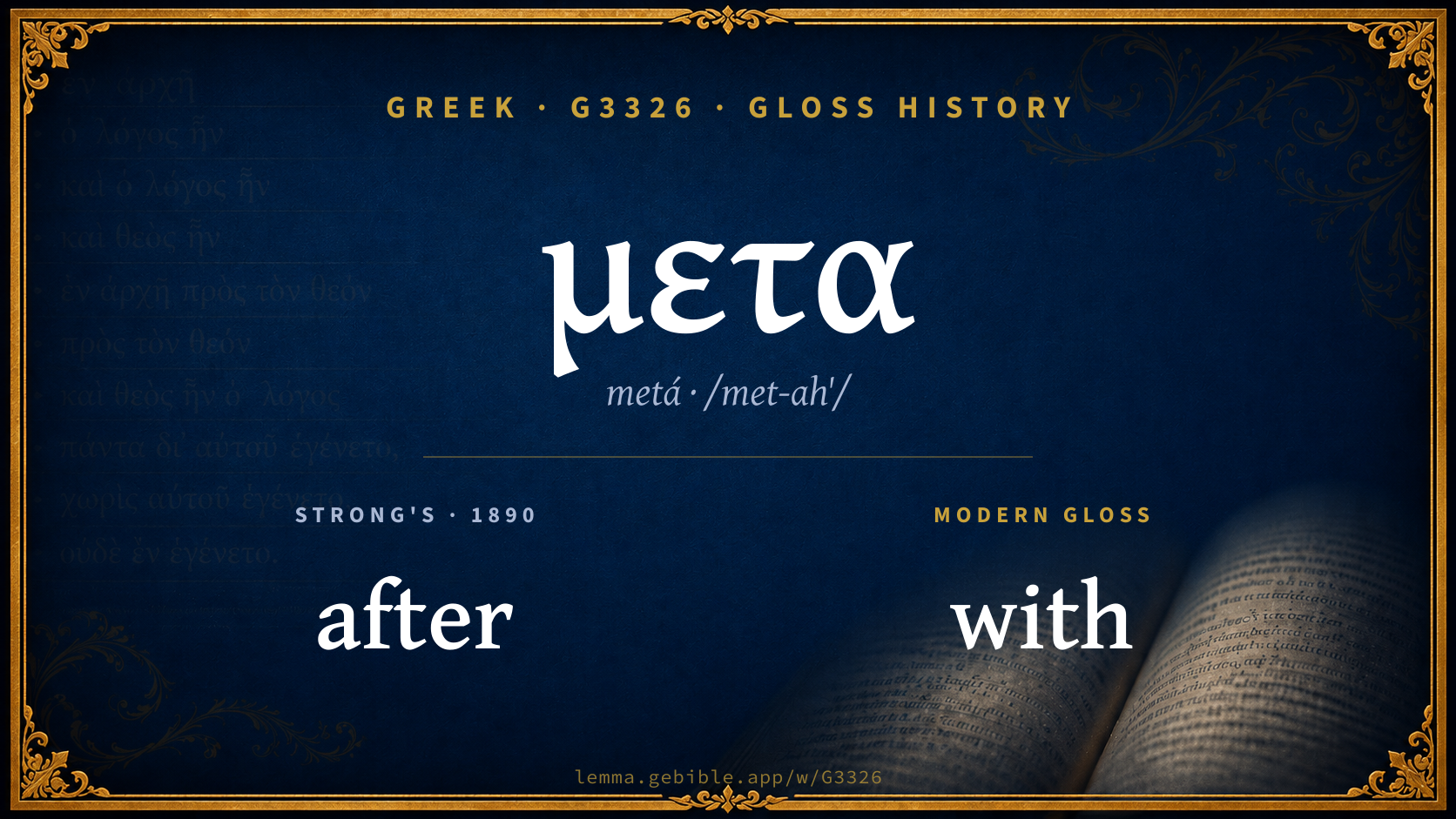
Gloss history
Strong's 1890 vs modern scholarship
About this word
Strong's G3326 catalogs a Greek word from the Greek New Testament.
These counts are not copied from any lexicon or concordance. They are computed here, from the morphology-tagged Greek New Testament. What Lemma adds →
- 441
- distinct verses
- The word appears in 441 distinct verses.
- 24 / 27
- NT books
- The word appears in 24 of 27 New Testament books.
- #43
- by frequency
- Top 50 most frequent Greek words (rank 43 of 5,347 Greek words by occurrence).
View all 441 occurrences in the concordance →
By section of the New Testament
By traditional corpus
Conventional, traditional groupings — biblical authorship is debated, so this is a traditional corpus grouping, not an authorship claim. Some books belong to more than one corpus (Luke is in both the Gospels and the Lukan corpus, and so on), so these shares overlap and need not total 100%. Each figure is a share of the word’s 441 distinct verses.
- Gospels 235 verses · 53%
- Lukan (Luke–Acts) 125 verses · 28%
- Johannine 103 verses · 23%
- Pauline corpus 67 verses · 15%
- Revelation 43 verses · 10%
- Hebrews 23 verses · 5%
- General (Catholic) Epistles 10 verses · 2%
How translations render this word
Counts come from each version’s own published word-to-Strong’s tagging or interlinear alignment — an approximate guide to how each version renders this word, not a word-level alignment the data otherwise carries. Because each total is that version’s own tagged count, the per-version totals vary from one another and need not match the appearance or distinct-verse counts above. These counts may also differ from a printed concordance because Lemma counts each distinctly tagged rendering and does not collapse phrase taggings into a single head-word total. This is a fixed set of word-tagged versions (KJV, ASV, BSB, ULT) and does not change with the reading translation you choose elsewhere. Each version’s license is shown beside its name below (and on Sources).
- King James Version: With 307×, After 84×, Be with 20×
- American Standard Version: With 304×, After 85×, Be with 18×
- Berean Standard Bible: With 265×, After 72×, Along with 10×
- unfoldingWord Literal Text: With 329×, After 102×, Be with 20×
King James Version Public Domain
Renders G3326 across 466 tagged occurrences — most commonly:
Plus other, less common renderings. Plus 21 renderings that appear only once — usually multi-word phrases or single function words the recovered tagging swept in, not distinct renderings. Not rendered by a distinct English word in 7 further occurrences.
American Standard Version Public Domain
Renders G3326 across 458 tagged occurrences — most commonly:
Plus 29 renderings that appear only once — usually multi-word phrases or single function words the recovered tagging swept in, not distinct renderings.
Berean Standard Bible Public Domain
Renders G3326 across 413 tagged occurrences — most commonly:
Plus other, less common renderings. Plus 15 renderings that appear only once — usually multi-word phrases or single function words the recovered tagging swept in, not distinct renderings. Not rendered by a distinct English word in 43 further occurrences.
unfoldingWord Literal Text CC BY-SA 4.0
Renders G3326 across 473 tagged occurrences — most commonly:
Plus 6 renderings that appear only once — usually multi-word phrases or single function words the recovered tagging swept in, not distinct renderings.
Senses in Thayer's
The 1 sense Thayer's distinguishes for this word, in lexicon order (not ranked by frequency or importance). The full entry — with sub-senses — is in the Lexicon Entry tab.
- with, after, behind
Word origin
Origin: a primary preposition (often used adverbially)
A primary preposition (often used adverbially); properly denoting accompaniment ; amid (local or causal); modified variously according to the case (genitive case association or accusative case succession ) with which it is joined; occupying an intermediate position between G575 or G1537 and G1519 or G4314 ; less intimate than G1722 and less close than G4862)i : - after (-ward)6X that he again against among X and + follow hence hereafter in of (up-) on + our X and setting since (un-) to + together when with (+ -out). Often used in composition in substantially the same relations of participation or proximity and transfer or sequence .
— Strong’s Exhaustive Concordance (1890), public domain.
Forms in the corpus
The 4 distinct written forms G3326 takes in the Greek New Testament, most frequent first — each parse links to that case’s occurrences in the concordance.
| Form | Parsing | Example | Uses |
|---|---|---|---|
| μετὰ metà | Preposition | Matthew 1:12 | 270 |
| μετ’ met | Preposition | Matthew 2:3 | 132 |
| μεθ’ meth | Preposition | Matthew 1:23 | 43 |
| Μετὰ Metà | Preposition | Mark 1:14 | 24 |
Same root — word family
Other Thayer's entries built from the same root as G3326, grouped by Strong’s listed origin. These share a root / origin per the lexicon — not necessarily a shared meaning. Each links to that word’s own entry.
Derived from this word
- μεθερμηνευω methermēneúō G3177 to interpret
- μεθιστημι methístēmi G3179 to transfer
- μεθοδεια methodeía G3180 deceit
- μεθοριος methórios G3181 border
- μεσος mésos G3319 middle
- μεταβαινω metabaínō G3327 to pass over
- μεταβαλλω metabállō G3328 to turn around
- μεταγω metágō G3329 to transfer
- μεταδιδωμι metadídōmi G3330 to impart
- μεταιρω metaírō G3332 to remove
- μετακαλεω metakaléō G3333 to summon
- μετακινεω metakinéō G3334 to move away
- μεταλαμβανω metalambánō G3335 to partake
- μεταλλασσω metallássō G3337 to exchange
- μεταμελλομαι metaméllomai G3338 it is a care
- μεταμορφοω metamorphóō G3339 to transform
- μετανοεω metanoéō G3340 to repent
- μεταξυ metaxý G3342 between
- μεταπεμπω metapémpō G3343 to send for
- μεταστρεφω metastréphō G3344 to turn around
- μετασχηματιζω metaschēmatízō G3345 to transform
- μετατιθημι metatíthēmi G3346 to transpose
- μετεπειτα metépeita G3347 afterwards
- μετεχω metéchō G3348 to partake
+3 more words derive from G3326 (not shown).
Compare all same-root words → Showing 4 of 28 — not the complete family. They share a root, not necessarily a meaning.
Septuagint usage
The same Greek word μετα appears 1,794 times in the Greek Old Testament (Septuagint), across 1,552 verses in 36 books.
- 1,794
- LXX occurrences
- Tagged occurrences of this Greek word in the Septuagint.
- 1,552
- verses
- Distinct Septuagint verses containing this word.
- 36 / 39
- OT books
- The word appears in 36 of the 39 Old Testament books.
Sample Septuagint occurrences
- Genesis 3:6 μετά
- Exodus 1:14 μετά
- Leviticus 5:3 μετά
- Numbers 1:4 μετά
- Deuteronomy 1:4 μετά
- Joshua 1:1 μετά
- Judges 1:1 μετά
- Ruth 1:7 μετά
- 1 Samuel 1:9 μετά
- 2 Samuel 1:1 μετά
- 1 Kings 1:2 μετά
- 2 Kings 1:1 μετά
Septuagint occurrences (same lexeme)
Every verse where the same Strong’s number (G3326) appears in the Greek Septuagint — showing the first 50 of 1,552. Verse text shown in the World English Bible for context; the Greek form is the matched word — the English is not keyword-highlighted.
- Genesis 3:6 μετά When the woman saw that the tree was good for food, and that it was a delight to the eyes, and that the tree was to be desired to make one wise, she took of the fruit of it, and ate; and she gave some to her husband with her, and he ate.
- Genesis 3:12 μετά The man said, "The woman whom you gave to be with me, she gave me of the tree, and I ate."
- Genesis 4:3 μετά As time passed, it happened that Cain brought an offering to Yahweh from the fruit of the ground.
- Genesis 5:4 μετά The days of Adam after he became the father of Seth were eight hundred years, and he became the father of sons and daughters.
- Genesis 5:7 μετά Seth lived after he became the father of Enosh eight hundred seven years, and became the father of sons and daughters.
- Genesis 5:10 μετά Enosh lived after he became the father of Kenan, eight hundred fifteen years, and became the father of sons and daughters.
- Genesis 5:13 μετά Kenan lived after he became the father of Mahalalel eight hundred forty years, and became the father of sons and daughters
- Genesis 5:16 μετά Mahalalel lived after he became the father of Jared eight hundred thirty years, and became the father of sons and daughters.
- Genesis 5:19 μετά Jared lived after he became the father of Enoch eight hundred years, and became the father of sons and daughters.
- Genesis 5:22 μετά Enoch walked with God after he became the father of Methuselah three hundred years, and became the father of sons and daughters.
- Genesis 5:26 μετά Methuselah lived after he became the father of Lamech seven hundred eighty-two years, and became the father of sons and daughters.
- Genesis 5:30 μετά Lamech lived after he became the father of Noah five hundred ninety-five years, and became the father of sons and daughters.
- Genesis 6:4 μετά The Nephilim were in the earth in those days, and also after that, when God's sons came to men's daughters. They bore children to them: the same were the mighty men who were of old, men of renown.
- Genesis 6:18 μετά But I will establish my covenant with you. You shall come into the ark, you, your sons, your wife, and your sons' wives with you.
- Genesis 6:19 μετά Of every living thing of all flesh, you shall bring two of every sort into the ark, to keep them alive with you. They shall be male and female.
- Genesis 6:20 μετά Of the birds after their kind, of the cattle after their kind, of every creeping thing of the ground after its kind, two of every sort shall come to you, to keep them alive.
- Genesis 7:7 μετά Noah went into the ark with his sons, his wife, and his sons' wives, because of the waters of the flood.
- Genesis 7:10 μετά It happened after the seven days, that the waters of the flood came on the earth.
- Genesis 7:13 μετά In the same day Noah, and Shem, Ham, and Japheth, the sons of Noah, and Noah's wife, and the three wives of his sons with them, entered into the ark;
- Genesis 7:23 μετά Every living thing was destroyed that was on the surface of the ground, including man, cattle, creeping things, and birds of the sky. They were destroyed from the earth. Only Noah was left, and those who were with him in the ark.
- Genesis 8:1 μετά God remembered Noah, all the animals, and all the cattle that were with him in the ark; and God made a wind to pass over the earth. The waters subsided.
- Genesis 8:3 μετά The waters receded from off the earth continually. After the end of one hundred fifty days the waters decreased.
- Genesis 8:6 μετά It happened at the end of forty days, that Noah opened the window of the ark which he had made,
- Genesis 8:16 μετά "Go forth from the ark, you, and your wife, and your sons, and your sons' wives with you.
- Genesis 8:17 μετά Bring forth with you every living thing that is with you of all flesh, including birds, cattle, and every creeping thing that creeps on the earth; that they may breed abundantly in the earth, and be fruitful, and multiply on the earth."
- Genesis 8:18 μετά Noah went forth, with his sons, his wife, and his sons' wives with him.
- Genesis 9:8 μετά God spoke to Noah, and to his sons with him, saying,
- Genesis 9:9 μετά "As for me, behold, I establish my covenant with you, and with your offspring after you,
- Genesis 9:10 μετά and with every living creature that is with you: the birds, the cattle, and every animal of the earth with you. Of all that go out of the ark, even every animal of the earth.
- Genesis 9:12 μετά God said, "This is the token of the covenant which I make between me and you and every living creature that is with you, for perpetual generations:
- Genesis 9:28 μετά Noah lived three hundred fifty years after the flood.
- Genesis 10:1 μετά Now this is the history of the generations of the sons of Noah and of Shem, Ham, and Japheth. Sons were born to them after the flood.
- Genesis 10:18 μετά the Arvadite, the Zemarite, and the Hamathite. Afterward the families of the Canaanites were spread abroad.
- Genesis 10:32 μετά These are the families of the sons of Noah, after their generations, in their nations. Of these were the nations divided in the earth after the flood.
- Genesis 11:10 μετά This is the history of the generations of Shem. Shem was one hundred years old, and became the father of Arpachshad two years after the flood.
- Genesis 11:11 μετά Shem lived after he became the father of Arpachshad five hundred years, and became the father of sons and daughters.
- Genesis 11:13 μετά Arpachshad lived after he became the father of Shelah four hundred three years, and became the father of sons and daughters.
- Genesis 11:15 μετά and Shelah lived after he became the father of Eber four hundred three years, and became the father of sons and daughters.
- Genesis 11:17 μετά Eber lived after he became the father of Peleg four hundred thirty years, and became the father of sons and daughters.
- Genesis 11:19 μετά Peleg lived after he became the father of Reu two hundred nine years, and became the father of sons and daughters.
- Genesis 11:21 μετά Reu lived after he became the father of Serug two hundred seven years, and became the father of sons and daughters.
- Genesis 11:23 μετά Serug lived after he became the father of Nahor two hundred years, and became the father of sons and daughters.
- Genesis 11:25 μετά Nahor lived after he became the father of Terah one hundred nineteen years, and became the father of sons and daughters.
- Genesis 12:4 μετά So Abram went, as Yahweh had spoken to him. Lot went with him. Abram was seventy-five years old when he departed out of Haran.
- Genesis 12:20 μετά Pharaoh gave men charge concerning him: and they brought him on the way, and his wife, and all that he had.
- Genesis 13:1 μετά Abram went up out of Egypt: he, his wife, all that he had, and Lot with him, into the South.
- Genesis 13:5 μετά Lot also, who went with Abram, had flocks, and herds, and tents.
- Genesis 13:14 μετά Yahweh said to Abram, after Lot was separated from him, "Now, lift up your eyes, and look from the place where you are, northward and southward and eastward and westward,
- Genesis 14:2 μετά that they made war with Bera, king of Sodom, and with Birsha, king of Gomorrah, Shinab, king of Admah, and Shemeber, king of Zeboiim, and the king of Bela (the same is Zoar).
- Genesis 14:5 μετά In the fourteenth year Chedorlaomer came, and the kings who were with him, and struck the Rephaim in Ashteroth Karnaim, and the Zuzim in Ham, and the Emim in Shaveh-kiriathaim,
These are occurrences of the same Greek lexeme (G3326) in the Septuagint — not a translation of any one Hebrew word. The store carries no word-level Hebrew↔Greek alignment, so no Hebrew original is asserted here. Counts come from the recovered LXX Strong's tagging — high-frequency vocabulary is well covered, while rare or late forms may be untagged — so they reflect tagged occurrences and may slightly undercount.