Luke 22:33

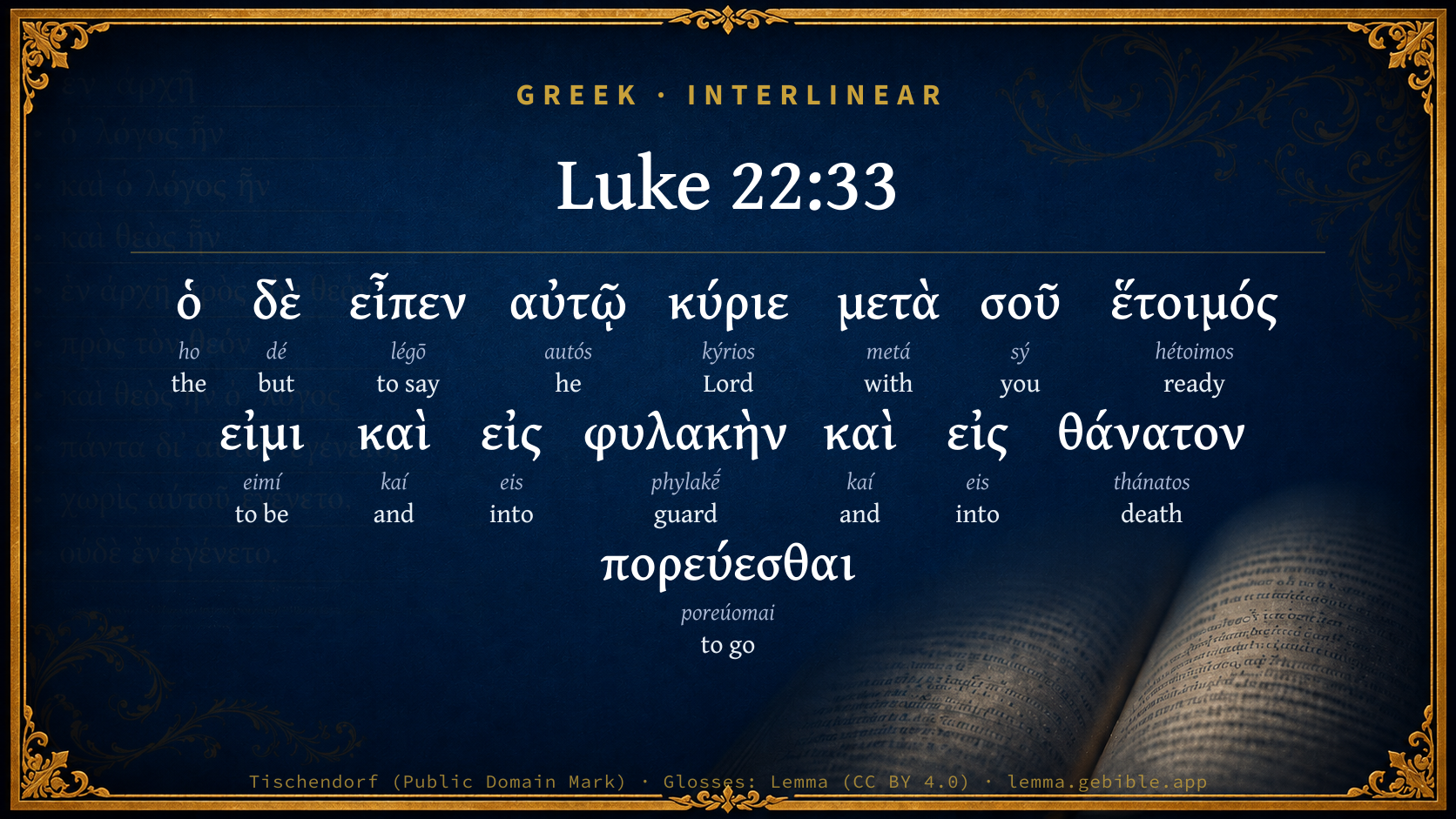
Greek (Tischendorf 8th ed.) Luke 22:33 appears in the Greek New Testament. The text above is from the Tischendorf 8th edition. Each word links to its Strong’s number and a concise gloss. Click any word for its full Thayer’s Greek Lexicon entry.
Download image
Cite this verse

Luke 22:33 (World English Bible). Public Domain. Lemma interlinear Bible study tool, https://lemma.gebible.app/v/luke/22/33.

Show BibTeX & RIS
BibTeX
RIS
English Translation
He said to him, "Lord, I am ready to go with you both to prison and to death!"
World English Bible · Public Domain
Download a study sheet

One document with this verse’s original text, its word-by-word gloss line, the meaning frame, cross-references with their text, attributed commentary, and full source and license credits — printable, and it pastes into notes with its structure intact.

This verse Autodidact and up

Study sheet (.html) Plain text (.txt)

A passage Seminary Student

Up to 50 verses in one chapter. A passage sheet keeps up to 6 commentary sources and 12 cross-references per verse, in the order this page ranks them, and says so on the sheet whenever that leaves anything out. Ask for a single verse and you get the Autodidact verse sheet above.

Everything on this page stays free to read, with no account — the sheet is a download of what is already on screen, not access to it.

Want to remove ads? Support Godless Engineer
Compare translations 3

The same verse in 3 English versions, stacked beneath the original-language interlinear above. Click any original word for its lexicon entry.

Each is an independent rendering of the whole verse — the interlinear is not word-aligned to these translations.

Highlighted words mark where these versions differ — a whole-verse word diff, not a word-by-word alignment.

  • World English Bible Public Domain
    He said to him, "Lord, I am ready to go with you both to prison and to death!"
  • King James Version Public Domain
    And he said unto him, Lord, I am ready to go with thee, both into prison, and to death.
  • unfoldingWord Literal Text CC BY-SA 4.0
    But he said to him, “Lord, I am ready to go with you both to prison and to death.”

unfoldingWord Literal Text — © unfoldingWord, licensed CC BY-SA 4.0. Word-aligned USFM3 via Door43 (git.door43.org/unfoldingWord/en_ult).

Versions to compare (up to 4)

3 of 4 selected

Show all 19 translations

Every available English version of this verse, each an independent rendering of the whole verse.

  • World English Bible Public Domain
    He said to him, "Lord, I am ready to go with you both to prison and to death!"
  • Berean Standard Bible Public Domain
    “Lord,” said Peter, “I am ready to go with You even to prison and to death.”
  • Majority Standard Bible Public Domain
    “Lord,” said Peter, “I am ready to go with You even to prison and to death.”
  • King James Version Public Domain
    And he said unto him, Lord, I am ready to go with thee, both into prison, and to death.
  • American Standard Version (1901) Public Domain
    And he said unto him, Lord, with thee I am ready to go both to prison and to death.
  • Revised Version (1885) Public Domain
    And he said unto him, Lord, with thee I am ready to go both to prison and to death.
  • Geneva Bible (1599) Public Domain
    And he said vnto him, Lord, I am ready to goe with thee into prison, and to death.
  • Douay-Rheims (1899) Public Domain
    Who said to him: Lord, I am ready to go with thee, both into prison, and to death.
  • Young's Literal Translation Public Domain
    And he said to him, `Sir, with thee I am ready both to prison and to death to go;'
  • Literal Standard Version CC BY-SA 4.0
    And he said to Him, “Lord, I am ready to go with You both to prison and to death”;
  • Unlocked Literal Bible CC BY-SA 4.0
    Peter said to him, “Lord, I am ready to go with you both to prison and to death.”
  • unfoldingWord Literal Text CC BY-SA 4.0
    But he said to him, “Lord, I am ready to go with you both to prison and to death.”
  • Darby Bible Public Domain
    And he said to him, Lord, with thee I am ready to go both to prison and to death.
  • World Messianic Bible Public Domain
    He said to him, “Lord, I am ready to go with you both to prison and to death!”
  • Webster's Bible Public Domain
    And he said to him, Lord, I am ready to go with thee both into prison, and to death.
  • Free Bible Version CC BY-SA 4.0
    Peter said, “Lord, I'm ready to go with you to prison, and to die with you!”
  • Bible in Basic English Public Domain
    And he said to him, Lord, I am ready to go with you to prison and to death.
  • Text-Critical English NT CC BY 4.0
    Peter said to him, “Lord, I am ready to go with yoʋ both to prison and to death.”
  • Tyndale New Testament (1534) Public Domain
    And he sayd vnto him. Lorde I am redy to go with the in to preson and to deth.

Literal Standard Version (2020), Covenant Press — licensed CC BY-SA 4.0. Text via the HelloAO Bible API (eBible.org). Unlocked Literal Bible (unfoldingWord) — licensed CC BY-SA 4.0. Text via the HelloAO Bible API (eBible.org). unfoldingWord Literal Text — © unfoldingWord, licensed CC BY-SA 4.0. Word-aligned USFM3 via Door43 (git.door43.org/unfoldingWord/en_ult). Free Bible Version, Dr. Jonathan Gallagher — licensed CC BY-SA 4.0. Text via the HelloAO Bible API (eBible.org).

Word by word

More ways to search: Search by grammar → Find every occurrence → Compare this word →

Practice this passage: Drill this verse → Learn its vocabulary →

ἕτοιμός
hétoimos
G2092
“ready”
Adjective, Nominative, Singular, Masculine
Part of Speech
Adjective
Case
Nominative
Number
Singular
Gender
Masculine
Full Thayer's Definition

Origin: from an old noun heteos (fitness)

TDNT: 13:44,3

1. prepare ready a. of things 1. ready at hand 2. opportune, seasonable b. of persons 1. ready prepared 1b c. to do something 1b d. to receive one coming
  1. ὁ ho G3588 “the” Article, Nominative, Singular, Masculine
  2. δὲ dé G1161 “but” Conjunction
  3. εἶπεν légō G3004 “to say” Verb, Aorist, Active, Indicative, 3rd person, Singular
  4. αὐτῷ autós G846 “he” Personal pronoun, Dative, Singular, Masculine
  5. κύριε kýrios G2962 “Lord” Noun, Vocative, Singular, Masculine
  6. μετὰ metá G3326 “with” Preposition
  7. σοῦ sý G4771 “you” Personal pronoun, 2nd person, Genitive, Singular
  8. εἰμι eimí G1510 “to be” Verb, Present, Active, Indicative, 1st person, Singular
  9. καὶ kaí G2532 “and” Conjunction
  10. εἰς eis G1519 “into” Preposition
  11. φυλακὴν phylakḗ G5438 “guard” Noun, Accusative, Singular, Feminine
  12. καὶ kaí G2532 “and” Conjunction
  13. εἰς eis G1519 “into” Preposition
  14. θάνατον thánatos G2288 “death” Noun, Accusative, Singular, Masculine
  15. πορεύεσθαι poreúomai G4198 “to go” Verb, Present, Middle or Passive deponent, Infinitive

About this verse

These counts appear in no published source. They are computed here, from the morphology-tagged text and Lemma’s own curated glosses. What Lemma adds →

16
words
14
distinct lemmas
Gospels
section

Notable vocabulary

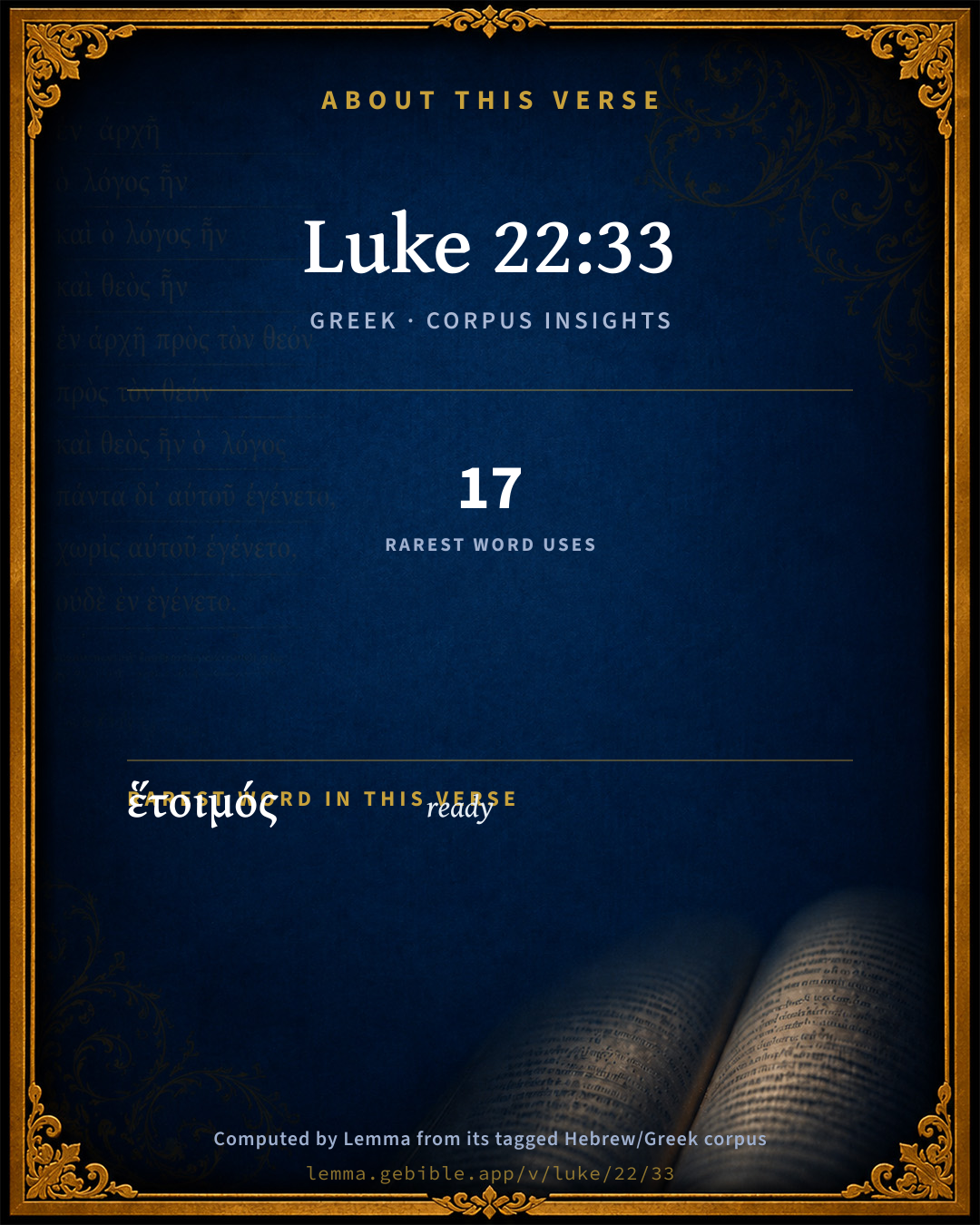
The rarest word here is ἕτοιμός ready G2092 — appearing just 17 times in the whole Greek New Testament.

Shared distinctive vocabulary

ἕτοιμός ready G2092 occurs in 17 verses of the Greek New Testament. Also found in:

Repetition

Words recur within this verse:

Cross-references

10

Topical passages linked to Luke 22:33 in the Treasury of Scripture Knowledge — connected by theme and wording, ordered by reader-vote popularity; previews shown in the World English Bible.

  • Mark 14:31 But he spoke all the more, "If I must die with you, I will not deny you." They all said the same thing.
  • Matthew 26:33–35 But Peter answered him, "Even if all will be made to stumble because of you, I will never be made to stumble."
  • Mark 14:29 But Peter said to him, "Although all will be offended, yet I will not."
  • John 13:36–37 Simon Peter said to him, "Lord, where are you going?" Jesus answered, "Where I am going, you can't follow now, but you will follow afterwards."
  • Matthew 20:22 But Jesus answered, "You don't know what you are asking. Are you able to drink the cup that I am about to drink, and be baptized with the baptism that I am baptized with?" They said to him, "We are able."
  • Matthew 26:40–41 He came to the disciples, and found them sleeping, and said to Peter, "What, couldn't you watch with me for one hour?
  • Proverbs 28:26 One who trusts in himself is a fool; But one who walks in wisdom, he is kept safe.
  • Mark 14:37–38 He came and found them sleeping, and said to Peter, "Simon, are you sleeping? Couldn't you watch one hour?
  • Acts 20:23–24 except that the Holy Spirit testifies in every city, saying that bonds and afflictions wait for me.
  • Acts 21:13 Then Paul answered, "What are you doing, weeping and breaking my heart? For I am ready not only to be bound, but also to die at Jerusalem for the name of the Lord Jesus."

Cross-references courtesy of OpenBible.info (CC BY 4.0).

Commentary

Notes on Luke 22:33 from classic Christian and Jewish commentators (each source and its license shown beneath its notes). The classic Christian expositions comment on the surrounding passage and are grouped to its opening verse, so a note may address several verses; the Jewish commentaries on the Tanakh (Rashi and others) are per-verse, so they appear only where the commentator wrote on this verse.

Lemma curates 59 commentaries, every one of them public domain or Creative Commons licensed, each selected and text-cleaned for this edition rather than reprinted as found. About our sources →

The Biblical Illustrator

Joseph S. Exell

Luk_22:33

Both to prison and to death

Religious emotion

That violent impulse is not the same as a firm determination--that men may have their religious feelings roused, without being on that account at all the more likely to obey God in practice, rather the less likely.

As a general rule, the more religious men become, the calmer they become; and at all times the religious principle, viewed by itself, is calm, sober, and deliberate. Let us review some of the accidental circumstances I speak of.

1. The natural tempers of men vary very much. Some men have ardent imaginations and strong feelings; and adopt, as a matter of course, a vehement mode of expressing themselves. No doubt it is impossible to make all men think and feel alike. Such men of course may possess deep-rooted principle. All I would maintain is, that their ardour does not of itself make their faith deeper and more genuine; that they must not think themselves better than others on account of it; that they must be aware of considering it a proof of their real earnestness, instead of narrowly searching into their conduct for the satisfactory fruits of faith.

2. Next, there are, besides, particular occasions on which excited feeling is natural, and even commendable; but not for its own sake, but on account of the peculiar circumstances under which it occurs. For instance, it is natural for a man to feel especial remorse at his sins when he first begins to think of religion; he ought to feel bitter sorrow and keen repentance. But all such emotion evidently is not the highest state of a Christians mind; it is but the first stirring of grace in him. A sinner, indeed, can do no better; bat in proportion as he learns more of the power of true religion, such agitation will wear away. The woman who had been a sinner, when she came behind our Lord wept much, and washed His feet with tears. It was well done in her; she did what she could; and was honoured with our Saviours praise. Yet it is clear this was not a permanent state of mind. It was but the first step in religion, and would doubtless wear away. It was but the accident of a season. Had her faith no deeper root than this emotion, it would soon have come to an end, as Peters zeal.

3. And further, the accidents of life will occasionally agitate us--affliction and the pain; bad news; though here, too, the Psalmist describes tile higher excellence of mind, viz., the calm confidence of the believer, who will not be afraid of any evil tidings, for his heart standeth fast, and believeth in the Lord. In times of distress religious men will speak more openly on the subject of religion, and lay bare their feelings; at other times they will conceal them. They are neither better nor worse for so doing. Now all this may be illustrated from Scripture. We find the same prayers offered, and the same resolutions expressed by good men, sometimes in a calm way, sometimes with more ardour. Observe how calm Job is in his resignation:

The Lord gave, and the Lord hath taken away; blessed be the name of the Lord. And on the other hand, how calmly that same apostle expresses his assurance of salvation at the close of his life, who, during the struggle, was accidentally agitated:--I am now ready to be offered … I have kept the faith. Henceforth there is laid up for me a crown of righteousness. These remarks may suffice to show the relation which excited feelings bear to true religious principle. They arc sometimes natural, sometimes suitable; but they are not religion itself. They come and go. They will gradually lose their place within us as our obedience becomes confirmed--partly because those men are kept in perfect peace, and sheltered from all agitating feelings, whose minds are stayed on God; partly because these feelings themselves are fixed into habits by the power of faith, and instead of coming and going, and agitating the mind from their suddenness, they are permanently retained so far as there is anything good in them, and give a deeper colour and a more energetic expression to the Christian character. Now, it will be observed, that in these remarks I have taken for granted, as not needing proof, that the highest Christian temper is free from all vehement and tumultuous feeling. But, if we wish some evidence of this, let us turn to our Great Pattern, Jesus Christ, and examine what was the character of that perfect holiness which He alone of all men ever displayed. And can we find anywhere such calmness and simplicity as marked His devotion and His obedience? When does He ever speak with fervour or vehemence? Consider the prayer He gave us; and this is the more to the purpose, for the very reason that He has given it as a model for our worship. How plain and unadorned is it! How few are the words of it! How grave and solemn the petitions? What an entire absence of tumult and feverish emotion! To conclude: Let us take warning from St. Peters fall. Let us not promise much; let us not talk much of ourselves; let us not be high-minded, nor encourage ourselves in impetuous bold language in religion. (J. H. Newman, D. D.)

The Biblical Illustrator, edited by Joseph S. Exell (c. 1880s–1900s) — public domain. Text from a community e-Sword module.

Tyndale Open Study Notes

Tyndale Open Resources

22:33 See Acts 4:3; 5:18; 12:1-9, where Peter suffered trials and was repeatedly jailed. Church tradition relates that Peter was crucified in Rome, but his declaration of loyalty here was premature.

Tyndale Open Study Notes — © Tyndale Open Resources, licensed CC BY-SA 4.0. Text via the HelloAO Bible API.

Bengel's Gnomon

Johann Albrecht Bengel

Luk 22:33. Μετὰ σοῦ, with thee) These words, especially as being put in the beginning of the sentence, are emphatic. Comp. Psa 18:30.[239] ἕτοιμος, ready) Peter has much trust in himself. [There had been need of full willingness and of no common power. It is not without good reason one may conjecture that Peter, in his so overweening self-confidence, had respect to those things which had been mentioned but a while before concerning the perseverance of the disciples and the intercession of the Lord (Luk 22:28; Luk 22:32). And no doubt both had their efficacy, but not that kind of efficacy which he at the time imagined they had.—V. g.]—εἰς, into) The most grievous of all trials are imprisonment and death [But it was not becoming that Jesus should be kept confined in a prison. From the time that He once began, He continued on, even until He breathed His last, without hindrance amidst the very bands (or “in the very hands”) of His enemies, and on the cross, to do and teach all that was good.—V. g.]

[239] Rather 29, “By thee (LXX. ἐν σοὶ) I have run through a troop, and by my God have I leaped over a wall.”—E. and T.

Bengel's Gnomon of the New Testament — English translation (T&T Clark, Edinburgh, 1860) — public domain. Text from a community e-Sword module.

Expositor's Greek Testament

ed. W. Robertson Nicoll

Luk 22:33 . εἰς φυλακὴν καὶ εἰς θάνατον : more definite reference to the dangers ahead than in any of the parallels.

The Expositor's Greek Testament, edited by W. Robertson Nicoll (1897–1910) — public domain. Text from a community e-Sword module.

Geneva Bible (1599)

Geneva Bible translators

Christ showeth that faith differeth much from a vain security, in setting before us the grievous example of Peter.

Geneva Bible (1599) marginal notes — public domain. Text via Bolls.life.

Jamieson, Fausset & Brown

Robert Jamieson, A. R. Fausset & David Brown

I am ready, &c.--honest-hearted, warmly-attached disciple, thinking thy present feelings immovable as a rock, thou shalt find them in the hour of temptation unstable as water: "I have been praying for thee," therefore thy faith shall not perish; but thinking this superfluous, thou shalt find that "he that trusteth in his own heart is a fool" (Pro 28:26).

Jamieson, Fausset & Brown — Commentary Critical and Explanatory on the Whole Bible (1871) — public domain (CC PDM 1.0). Text via the HelloAO Bible API.

Ellicott's Commentary for English Readers

(33) Lord, I am ready to go with thee.—There is something like a latent tone of indignation as well as devotion. The disciple half-resented the thought that a special prayer should be necessary for him. Here, again, the Greek order of the words is more emphatic than the English, “With Thee am I ready . . .”

A Bible Commentary for English Readers, edited by Charles John Ellicott (1878–1897) — public domain. Text from a community e-Sword module.

The Cambridge Bible for Schools and Colleges

gen. ed. J. J. S. Perowne

33. I am ready to go with thee, both into prison, and to death] Rather, even into prison, even into death, and the order and emphasis should be, ‘Lord, with Thee I am ready,’ &c. This ‘flaring enthusiasm’ is always to be suspected of weakness. Pro_28:26; 1Co_10:12.

The Cambridge Bible for Schools and Colleges (gen. ed. J. J. S. Perowne; Cambridge University Press, 1878–1918) — public domain. Text from a community e-Sword module.

John Gill's Exposition

And he said,.... "To him", as all the Oriental versions add; to Peter, as what is said shows; that is, Jesus said to him, as the Syriac and Persic versions express:

I tell thee, Peter; who knew him, and his heart, better than he did himself, as well as knew what was to come, and what would befall him; and therefore declares it, as he does with the greatest assurance and certainty, and which might be depended on, and accordingly came to pass:

the cock shall not crow this day; in this night, as in Mar 14:30 or this night, as in Mat 26:34 for it was now night; a natural day includes both night and day; a like way of speaking, see in Luk 2:8

before that thou shalt thrice deny that thou knowest me; as he did, Luk 22:57. See Gill on Mat 26:34.

John Gill's Exposition of the Whole Bible (1746–1763) — public domain (CC PDM 1.0). Text via the HelloAO Bible API.

Trapp's Complete Commentary

John Trapp

33 And he said unto him, Lord, I am ready to go with thee, both into prison, and to death.

Ver. 33. Lord, I am ready] Thus Peter overweened his own abilities; being melius semper animatus quam armatus, better affected than appointed.

John Trapp, A Commentary or Exposition upon All the Books of the Old and New Testament (1647–1656) — public domain. Text from a community e-Sword module.

Albert Barnes' Notes on the Bible

See the notes at Mat 26:33-35.

Albert Barnes' Notes on the Bible (1834–1885) — public domain. Text from a community e-Sword/MySword module.

Matthew Poole's English Annotations

This is more largely recorded by Mat 26:33-35, and by Mar 14:27-30.

Matthew Poole's English Annotations on the Holy Bible (1683–1685) — public domain. Text from a community e-Sword/MySword module.

The Pulpit Commentary

And he said unto him, Lord, I am ready to go with thee, both into prison, and to death. This kind of confident enthusiasm is usually a sign of weakness. Jesus, the Heart-reader, knew too well what such a wild protestation was worth, and went on at once to predict his friend"s and servant"s awful fall, that very night.

Vers. 33, 34 (with 55-62). The apostle"s fall.

From this most memorable incident, recorded with noticeable candour by all the evangelists, many lessons spring.

I HOW IGNORANT OF HIMSELF EVEN A GOOD MAN MAY PROVE! (Ver. 33) Peter believed himself to be capable of daring and enduring the very last extremity in the cause of his Master. He would have utterly ridiculed the idea that the sneer of a servant-girl could draw from him a denial of his Lord. The event showed how entirely he mistook himself. We ought to know ourselves well; but, in fact, we do not. We suppose ourselves to be strong and steadfast, when we are feeble and unreliable; or to be humble-minded, when we are proud of heart; or to be generous, when we are essentially self-seeking; or to be devout, when we are really unspiritual; to be near to God, when we are afar off. (Rev_3:17 1Co_10:12 Psa_19:12, 13 139:23, 24)

II How PERFECT THE KNOWLEDGE OUR MASTER HAS OF OUR HEART AND LIFE! (Ver. 34) Jesus knew how weak his disciple was, and he foresaw his speedy failure. He knows us altogether. He knows our heart; how sincere is our purpose, how frequent are our efforts, how many our disappointments, how faulty is our nature, how wounded and weak is our spirit. He knows also our life. He sees it as it lies before his all-beholding eye; he "knows the way we take," the path we are about to pursue. It is to One who has a thorough and complete knowledge of us that we belong, and it is to him we draw nigh in our best hours.

III FROM WHAT A HEIGHT a GOOD MAN MAY FALL! This erring one is no other than the Apostle Peter, the very man who had made the great confession, and upon whom or upon whose testimony Christ would build his Church. (Mat_16:13-19) It is he who had been admitted to such close fellowship with Christ, and been allowed the high privilege of rendering him constant personal service. There is no office, however high it may be in the Christian Church, which will ensure to its occupant spiritual integrity. And even he who has been "raised up to heavenly places," and has known even the raptures of an exalted spiritual experience, may fall under the power of temptation. It is not the lofty but the lowly that stand on safe ground in the kingdom of God.

IV How STEEP IS THE DESCENT OF SIN! From a presumptuous and blind self-confidence Peter fell to a half-hearted following (ver. 54); from that he fell to untruthfulness and denial of his Lord (ver. 57); from that to a more deliberate and repeated denial (vers. 58, 59), accompanied even (as Matthew tells us) with profanity. Sin is a slope which seems slight at the summit, but it becomes steeper and yet steeper as we go on our downward way. And it too often happens that we reach a point where we cannot arrest ourselves, but are compelled against our own desire to continue. Shun the first step in the downward course!

V HOW MERCIFUL IS CHRIST"S METHOD OF CONVICTION. (Ver 61) Not a blow that smote him to the ground; not even burning words of condemnation that should sound ever afterwards in his soul; but one reproachful glance the look of wounded love. So merciful and so pitiful is our Lord when we are unfaithful or disloyal to him now. He bears long with us; he seeks to win us back through added privilege and multiplied mercy; he deals very patiently and gently with us; only when other and milder methods fail does he mercifully afflict us, that in some way and by some means he may redeem us from folly and from ruin.

VI WHITHER CHRIST SEEKS TO LEAD THE ERRING. (Ver. 62) He seeks to lead us, as by his reproving glance be led his fallen disciple, to a pure and saving penitence. He would have our hearts filled with a worthy and a cleansing shame, with a purifying sorrow; that this may lead us into a condition of

(1) abiding humility, of

(2) living faith, of

(3) thorough reconsecration to himself and to his cause. C.

The Pulpit Commentary (1880–1919), ed. H.D.M. Spence-Jones & Joseph S. Exell — public domain. Text from a community e-Sword module.

MacLaren's Expositions of Holy Scripture

Alexander MacLaren

Luke

PARTING PROMISES AND WARNINGS

Luk 22:24 - Luk 22:37.

It was blameworthy, but only too natural, that, while Christ’s heart was full of His approaching sufferings, the Apostles should be squabbling about their respective dignity. They thought that the half-understood predictions pointed to a brief struggle immediately preceding the establishment of the kingdom, and they wished to have their rank settled in advance. Possibly, too, they had been disputing as to whose office was the menial task of presenting the basin for foot-washing. So little did the first partakers of the Lord’s Supper ‘discern the Lord’s body,’ and so little did His most loving friends share His sorrows.

I. Our Lord was not so absorbed in His anticipations of the near Cross as to be unobservant of the wrangling among the Apostles.

Even then His heart was enough at leisure from itself to observe, to pity, and to help. So He at once turns to deal with the false ideas of greatness betrayed by the dispute. The world’s notion is that the true use and exercise of superiority is to lord it over others. Tyrants are flattered by the title of benefactor, which they do not deserve, but the giving of which shows that, even in the world, some trace of the true conception lingers. It was sadly true, at that time, that power was used for selfish ends, and generally meant oppression. One Egyptian king, who bore the title Benefactor, was popularly known as Malefactor, and many another old-world monarch deserved a like name.

Jesus lays down the law for His followers as being the exact opposite of the world’s notion. Dignity and pre-eminence carry obligations to serve. In His kingdom power is to be used to help others, not to glorify oneself. In other sayings of Christ’s, service is declared to be the way to become great in the kingdom, but here the matter is taken up at another point, and greatness, already attained on whatever grounds, is commanded to be turned to its proper use. The way to become great is to become small, and to serve. The right use of greatness is to become a servant. That has become a familiar commonplace now, but its recognition as the law for civic and other dignity is all but entirely owing to Christianity. What conception of such a use of power has the Sultan of Turkey, or the petty tyrants of heathen lands? The worst of European rulers have to make pretence to be guided by this law; and even the Pope calls himself ‘the servant of servants.’

It is a commonplace, but like many another axiom, universal acceptance and almost as universal neglect are its fate. Ingrained selfishness fights against it. Men admire it as a beautiful saying, and how many of us take it as our life’s guide? We condemn the rulers of old who wrung wealth out of their people and neglected every duty; but what of our own use of the fraction of power we possess, or our own demeanour to our inferiors in world or church? Have all the occupants of royal thrones or presidential chairs, all peers, members of Parliament, senators, and congressmen, used their position for the public weal? Do we regard ours as a trust to be administered for others? Do we feel the weight of our crown, or are we taken up with its jewels, and proud of ourselves for it? Christ’s pathetic words, giving Himself as the example of greatness that serves, are best understood as referring to His wonderful act of washing the disciples’ feet. Luke does not record it, and probably did not know it, but how the words are lighted up if we bring them into connection with it!

II. Verses 28 to 30 naturally flow from the preceding.

They lift a corner of the veil, and show the rewards, when the heavenly form of the kingdom has come, of the right use of eminence in its earthly form. How pathetic a glimpse into Christ’s heart is given in that warm utterance of gratitude for the imperfect companionship of the Twelve! It reveals His loneliness, His yearning for a loving hand to grasp, His continual conflict with temptations to choose an easier way than that of the Cross. He has known all the pain of being alone, and feeling in vain for a sympathetic heart to lean on. He has had to resist temptation, not only in the desert at the beginning, or in Gethsemane at the end, but throughout His life. He treasures in His heart, and richly repays, even a little love dashed with much selfishness, and faithfulness broken by desertion. We do not often speak of the tempted Christ, or of the lonely Christ, or of the grateful Christ, but in these great words we see Him as being all these.

The rewards promised point onwards to the perfecting of the kingdom in the future life. We notice the profound thought that the kingdom which His servants are to inherit is conferred on them, ‘as My Father hath appointed unto Me,’-that is, that it is a kingdom won by suffering and service, and wielded by gentleness and for others. ‘If we suffer, we shall also reign with Him.’ The characteristics of the future royalty of Christ’s servants are given in highly figurative language. A state of which we have no experience can only be revealed under forms drawn from experience; but these are only far-off approximations, and cannot be pressed.

The sacred Last Supper suggested one metaphor. It was the last on earth, but its sanctity would be renewed in heaven, and sadness and separation and the following grief would not mar the perfect, perpetual, joyful feast. What dim visions of rule and delegated authority may lie in the other promise of judging the twelve tribes of Israel, we must wait till we go to that world to understand. But this is clear, that continuing with Jesus here leads to everlasting companionship hereafter, in which all desires shall be satisfied, and we shall share in His authority and be representatives of His glory.

III. But Jesus abruptly recalls Himself and the Twelve from these remoter prospects of bliss to the nearer future of trial and separation.

The solemn warning to Peter follows with startling suddenness. Why should they be fighting about precedence when they were on the verge of the sorest trial of their constancy? And as for Peter, who had, no doubt, not been the least loud-voiced in the strife, he needed most of all to be sobered. Our narrow limits forbid our doing even partial justice to the scene with him; but we note the significant use of the old name ‘Simon,’ reminding the Apostle of his human weakness, and its repetition, giving emphasis to the address.

We note, too, the partial withdrawal of the veil which hides the spirit world from us, in the distinct declaration of the agency of a personal tempter, whose power is limited, though his malice is boundless, and who had to obtain God’s permission ere he could tempt. His sieve is made to let the wheat through, and to retain the chaff. It will be hard to empty this saying of its force. Christ taught the existence and operation of Satan; but He taught, too, that He Himself was Satan’s victorious antagonist and our prevailing intercessor. He is so still. He does not seek to avert conflict from us, but prays that our faith fail not, and Himself, too, fulfils the prayer by strengthening us.

Faith, then, conquers, and withstands Satan’s sifting. If it holds out, we shall not fall, though all the winds howl round us. We are not passive between the two antagonists, but have to take our share in the struggle. Partial failures may be followed by recovery, and even tend to increase our power to strengthen other tempted ones, by the experience gained of our own weakness, which deepens humility and forbearance with others’ faults, and by the experience of Christ’s strength, which makes us able to direct them to the source of all safety.

Peter’s passionate avowal of readiness to bear anything, if only he was with Christ, is the genuine utterance of a warm impulsive heart, which took too little heed of Christ’s solemn warning, and fancied that the tide of present feeling would always run as strong as now. Emotion fluctuates. Steadfast devotion is chary of mortgaging the future by promises. He who knows himself is slow to say, ‘I will,’ for he knows that ‘Oh that I may!’ is fitter for his weakness. Very likely, if Peter had been offered fetters or the scaffold then and there, he would have accepted them bravely; but it was a different thing in the raw, cold morning, after an agitating night, and the Master away at the far end of the great hall. A flippant maid’s tongue was enough to finish him then.

It is sometimes easier to bear a great load for Christ than a small one. Some of us could be martyrs at the stake more easily than confessors among sneering neighbours. Jesus had spared the Apostle in the former warning of his fall, but He spoke plainly at last, since the former had been ineffectual; and He addressed him by his new name of Peter, as if to heighten the sin of denial by recalling the privileges bestowed.

IV. The last part of the passage deals with the new conditions consequent on Christ’s departure.

The Twelve had been exempt from the care of providing for themselves while He was with them, but now they are to be launched into the world alone, like fledglings from the nest. Not that His presence is not with them or with us, but that His absence throws the task of providing for wants and guarding against dangers on themselves, as had not been the case during the blessed years of companionship. Hence the injunctions in verse 36 lay down the permanent law for the Church, while verse 37 assigns as its reason the speedy fulfilment of the prophecies of Messiah’s sufferings.

Substantially the meaning of the whole is: ‘I am on the point of leaving you, and, when I am gone, you must use common-sense means for provision and protection. I provided for you while I was here, without your co-operation. Remember how I did so, and trust Me to provide in future, through your co-operation.’

The life of faith does not exclude ordinary prudence and the use of appropriate means. It is more in accord with Christ’s mind to have a purse to keep money in, and a wallet for food-stores, than to go out, as some good people do, saying, ‘The Lord will provide.’ Yes, He will; but it will be by blessing your common-sense and effort. As to the difficulty felt in the injunction to buy a sword, our Lord would be contradicting His whole teaching if He was here commanding the use of arms for the defence of His servants or the promotion of His kingdom. That He did not mean literal swords is plain from His answer to the Apostles, who produced the formidable armament of two.

‘It is enough.’ A couple are plenty to fight the Roman Empire with. Yes, two too many, as was soon seen. The expression is plainly an intensely energetic metaphor, taking line with purse and scrip. The plain meaning of the whole is that we are called on to provide necessary means of provision and defence, which He will bless. The only sword permitted to His followers is the sword of the Spirit.

Alexander MacLaren, Expositions of Holy Scripture (1904–1910) — public domain. Text from a community e-Sword module.

Burkitt's Expository Notes on the New Testament

William Burkitt

St. Peter’s resolution to accompany Christ both to prison and to death, was holy and good; but his too confident opinion of his own strength and ability so to do, without a divine aid and assistance, was his failing and infirmity. Self-confidence is a sin, too, incident to the holiest and best of men. Little did St. Peter think what a feather he should be in the wind of temptation, if once God left him to himself, and to Satan’s assaults.

Learn farther, how hard a matter it is for a Christian to excel in gifts, and not to be overconfident and conceited. To see a man eminent in gifts, and yet exemplary in humility, is a rare sight; if we stand in the evil day, it is an humble fear of falling that must enable us to stand.

William Burkitt's Expository Notes on the New Testament (1700–1703) — public domain. Text from a community e-Sword module.

unfoldingWord translationNotes

Door43 World Missions Community

the rooster will not crow this day, before you deny three times that you know me

The order of the parts of the verse can be reversed. AT: "you will deny three times that you know me before the rooster crows this day"

the rooster will not crow this day, before you deny

This can be stated positively. AT: "the rooster will crow this day only after you deny" or "before the rooster crows today, you will deny"

the rooster will not crow

Here, the crowing of the rooster refers to a certain time of day. Roosters often crow just before the sun appears in the morning. Therefore, this refers to dawn. (See: Metonymy)

rooster

a bird that calls out loudly around the time the sun comes up

this day

The Jewish day begins at sunset. Jesus was speaking after the sun had set. The rooster would crow just before morning. The morning was part of "this day." AT: "tonight" or "in the morning" (See: Assumed Knowledge and Implicit Information)

translationWords

Peter

lord

prison

die

unfoldingWord translationNotes — © Distant Shores Media and the Door43 World Missions Community, licensed CC BY-SA 4.0. Source: git.door43.org/Door43/en_tn.

Cambridge Greek Testament for Schools and Colleges

33. μετὰ σοῦ ἕτοιμός εἰμι. ‘With Thee I am ready,’ &c. The order is emphatic. ‘If only Thou be with me I am prepared for the very worst.’

καὶ εἰς φυλακὴν καὶ εἰς θάνατον. ‘Even into prison, even into death.’ This ‘flaring enthusiasm’ is always to be suspected of weakness. Pro 28:26; 1Co 10:12.

Cambridge Greek Testament for Schools and Colleges (Cambridge University Press, 1896; 21 vols, various authors incl. Carr, Maclear, Plummer, Farrar, Lumby, Moule, M. R. James, Simcox) — public domain. Text from a community e-Sword module.

International Critical Commentary

33. μετὰ σοῦ. First. with enthusiastic emphasis: “With Thee I am ready.” The impulsive reply is thoroughly characteristic. As at the feet-washing (Joh 13:6, Joh 13:8) he has more confidence in his own feelings than in Christ’s word; but this version of the utterance is less boastful than that in Mat 26:33 and Mar 14:29.

International Critical Commentary — older volumes (1896–1929), various authors — public domain. Text from a community e-Sword module.

Lesson kit

Teaching starters — assembled from the data on this page, not authored interpretation. Every prompt links to the verse data it draws on. Edit before teaching.

Luke, in the Gospels, opens this verse with 16 words (14 distinct Greek lemmas). Its most distinctive word is hétoimos (“ready”). A historical commentator’s framing appears above. Read the whole chapter for the surrounding context.

Discussion questions

  1. The word hétoimos carries the sense “ready.” How does it shape the verse?
  2. How does Matthew 22:4, which shares the word «ready», read alongside this verse?
  3. What does the repetition of “into” (2× in this one verse) do in this verse?
  4. These translations render this verse differently; the difference is in the English rendering, not the original. What questions does that raise?
  5. Compare how The Biblical Illustrator and Tyndale Open Study Notes read this verse. Where do they agree or differ?

Things to notice

  • These translations choose different wording for 2 words in this verse.
  • “into” occurs 2× in this single verse.
  • 14 distinct Greek lemmas span 16 words in this verse.

Reading settings

Reading text

Shown beneath each verse's original-language words.

Old Testament
Old Testament edition

Read the OT as the Masoretic Hebrew (MT) or the Greek Septuagint (LXX).

English shown for the Greek Septuagint (in the Hebrew ↔ Greek comparison).

Comparing translations? Open the Compare panel on any verse page to stack up to four side by side.