Luke 24:52

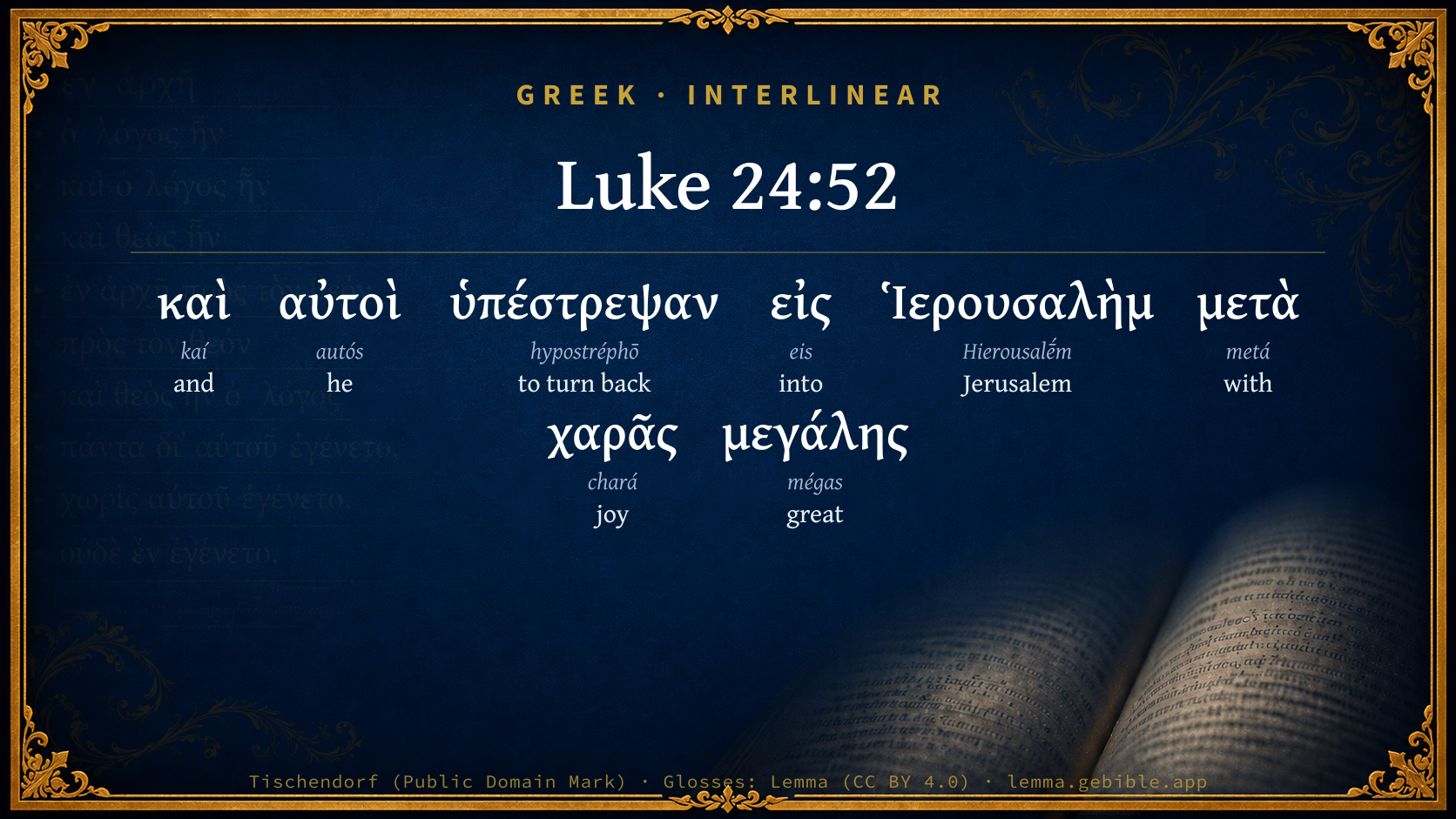
Greek (Tischendorf 8th ed.) Luke 24:52 appears in the Greek New Testament. The text above is from the Tischendorf 8th edition. Each word links to its Strong’s number and a concise gloss. Click any word for its full Thayer’s Greek Lexicon entry.
Download image
Cite this verse

Luke 24:52 (World English Bible). Public Domain. Lemma interlinear Bible study tool, https://lemma.gebible.app/v/luke/24/52.

Show BibTeX & RIS
BibTeX
RIS
English Translation
They worshiped him, and returned to Jerusalem with great joy,
World English Bible · Public Domain
Download a study sheet

One document with this verse’s original text, its word-by-word gloss line, the meaning frame, cross-references with their text, attributed commentary, and full source and license credits — printable, and it pastes into notes with its structure intact.

This verse Autodidact and up

Study sheet (.html) Plain text (.txt)

A passage Seminary Student

Up to 50 verses in one chapter. A passage sheet keeps up to 6 commentary sources and 12 cross-references per verse, in the order this page ranks them, and says so on the sheet whenever that leaves anything out. Ask for a single verse and you get the Autodidact verse sheet above.

Everything on this page stays free to read, with no account — the sheet is a download of what is already on screen, not access to it.

Want to remove ads? Support Godless Engineer
Compare translations 3

The same verse in 3 English versions, stacked beneath the original-language interlinear above. Click any original word for its lexicon entry.

Each is an independent rendering of the whole verse — the interlinear is not word-aligned to these translations.

Highlighted words mark where these versions differ — a whole-verse word diff, not a word-by-word alignment.

  • World English Bible Public Domain
    They worshiped him, and returned to Jerusalem with great joy,
  • King James Version Public Domain
    And they worshipped him, and returned to Jerusalem with great joy:
  • unfoldingWord Literal Text CC BY-SA 4.0
    And they, having worshiped him, returned to Jerusalem with great joy,

unfoldingWord Literal Text — © unfoldingWord, licensed CC BY-SA 4.0. Word-aligned USFM3 via Door43 (git.door43.org/unfoldingWord/en_ult).

Versions to compare (up to 4)

3 of 4 selected

Show all 19 translations

Every available English version of this verse, each an independent rendering of the whole verse.

  • World English Bible Public Domain
    They worshiped him, and returned to Jerusalem with great joy,
  • Berean Standard Bible Public Domain
    And they worshiped Him and returned to Jerusalem with great joy,
  • Majority Standard Bible Public Domain
    And they worshiped Him and returned to Jerusalem with great joy,
  • King James Version Public Domain
    And they worshipped him, and returned to Jerusalem with great joy:
  • American Standard Version (1901) Public Domain
    And they worshipped him, and returned to Jerusalem with great joy:
  • Revised Version (1885) Public Domain
    And they worshipped him, and returned to Jerusalem with great joy:
  • Geneva Bible (1599) Public Domain
    And they worshipped him, and returned to Hierusalem with great ioy,
  • Douay-Rheims (1899) Public Domain
    And they adoring went back into Jerusalem with great joy.
  • Young's Literal Translation Public Domain
    and they, having bowed before him, did turn back to Jerusalem with great joy,
  • Literal Standard Version CC BY-SA 4.0
    and they, having worshiped Him, turned back to Jerusalem with great joy,
  • Unlocked Literal Bible CC BY-SA 4.0
    So they worshiped him, and returned to Jerusalem with great joy.
  • unfoldingWord Literal Text CC BY-SA 4.0
    And they, having worshiped him, returned to Jerusalem with great joy,
  • Darby Bible Public Domain
    And *they*, having done him homage, returned to Jerusalem with great joy,
  • World Messianic Bible Public Domain
    They worshiped him and returned to Jerusalem with great joy,
  • Webster's Bible Public Domain
    And they worshiped him, and returned to Jerusalem with great joy:
  • Free Bible Version CC BY-SA 4.0
    They worshiped him, and then they returned to Jerusalem full of joy.
  • Bible in Basic English Public Domain
    And they gave him worship and went back to Jerusalem with great joy.
  • Text-Critical English NT CC BY 4.0
    So they worshiped him and returned to Jerusalem with great joy.
  • Tyndale New Testament (1534) Public Domain
    And they worshipped him and returned to Ierusalem with greate ioye

Literal Standard Version (2020), Covenant Press — licensed CC BY-SA 4.0. Text via the HelloAO Bible API (eBible.org). Unlocked Literal Bible (unfoldingWord) — licensed CC BY-SA 4.0. Text via the HelloAO Bible API (eBible.org). unfoldingWord Literal Text — © unfoldingWord, licensed CC BY-SA 4.0. Word-aligned USFM3 via Door43 (git.door43.org/unfoldingWord/en_ult). Free Bible Version, Dr. Jonathan Gallagher — licensed CC BY-SA 4.0. Text via the HelloAO Bible API (eBible.org).

Word by word

More ways to search: Search by grammar → Find every occurrence → Compare this word →

Practice this passage: Drill this verse → Learn its vocabulary →

About this verse

These counts appear in no published source. They are computed here, from the morphology-tagged text and Lemma’s own curated glosses. What Lemma adds →

8
words
8
distinct lemmas
Gospels
section

Shared distinctive vocabulary

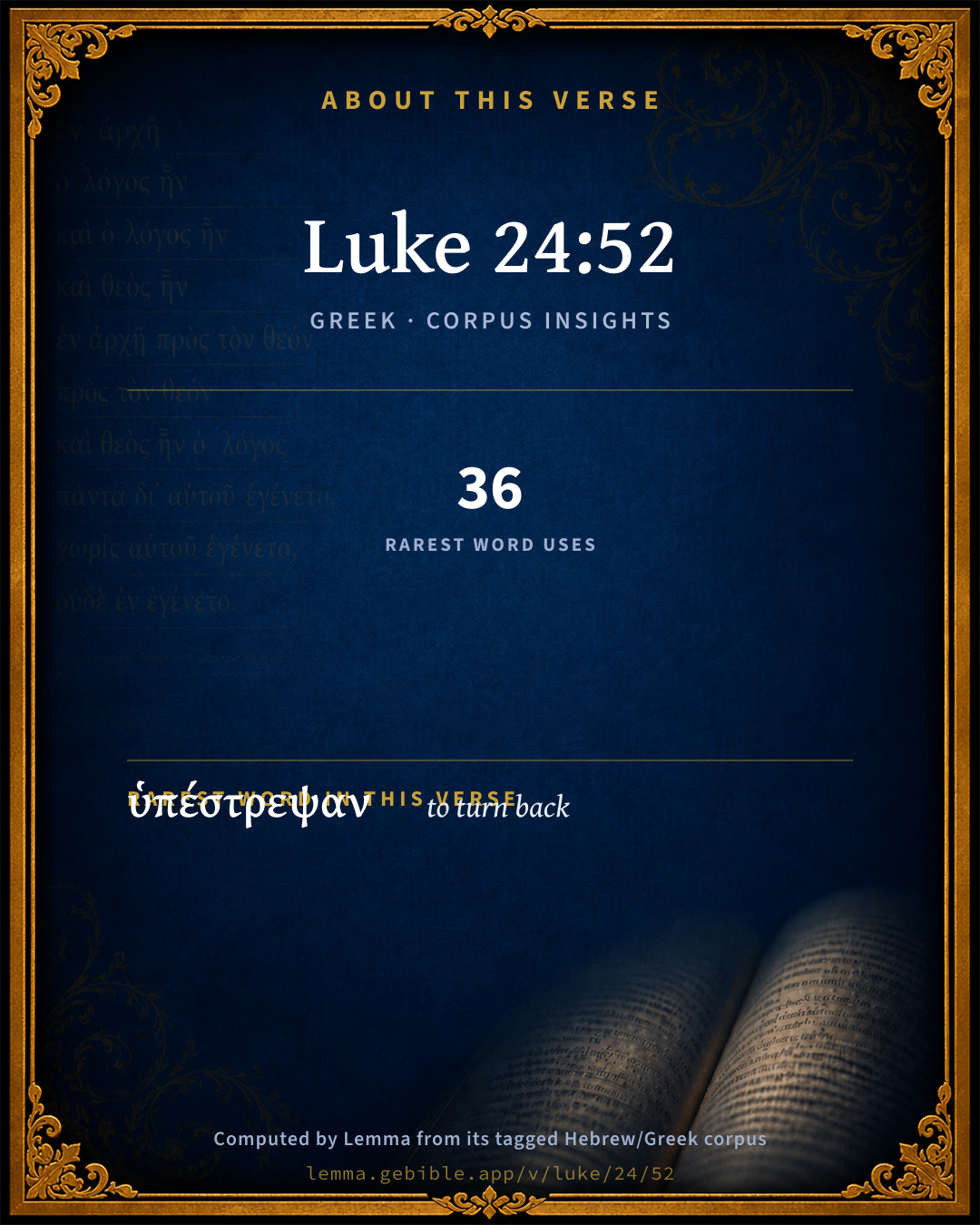
ὑπέστρεψαν to turn back G5290 occurs in 36 verses of the Greek New Testament. Also found in:

Cross-references

8

Topical passages linked to Luke 24:52 in the Treasury of Scripture Knowledge — connected by theme and wording, ordered by reader-vote popularity; previews shown in the World English Bible.

  • Matthew 28:9 As they went to tell his disciples, behold, Jesus met them, saying, "Rejoice!" They came and took hold of his feet, and worshiped him.
  • Psalms 30:11 You have turned my mourning into dancing for me. You have removed my sackcloth, and clothed me with gladness,
  • John 16:22 Therefore you now have sorrow, but I will see you again, and your heart will rejoice, and no one will take your joy away from you.
  • John 20:28 Thomas answered him, "My Lord and my God!"
  • 1 Peter 1:8 whom not having known you love; in whom, though now you don't see him, yet believing, you rejoice greatly with joy unspeakable and full of glory--
  • Matthew 28:17 When they saw him, they bowed down to him, but some doubted.
  • John 14:28 You heard how I told you, 'I go away, and I come to you.' If you loved me, you would have rejoiced, because I said 'I am going to my Father;' for the Father is greater than I.
  • John 16:7 Nevertheless I tell you the truth: It is to your advantage that I go away, for if I don't go away, the Counselor won't come to you. But if I go, I will send him to you.

Cross-references courtesy of OpenBible.info (CC BY 4.0).

Commentary

Notes on Luke 24:52 from classic Christian and Jewish commentators (each source and its license shown beneath its notes). The classic Christian expositions comment on the surrounding passage and are grouped to its opening verse, so a note may address several verses; the Jewish commentaries on the Tanakh (Rashi and others) are per-verse, so they appear only where the commentator wrote on this verse.

Lemma curates 59 commentaries, every one of them public domain or Creative Commons licensed, each selected and text-cleaned for this edition rather than reprinted as found. About our sources →

Bengel's Gnomon

Johann Albrecht Bengel

Luk 24:52. Προσκυνήσαντες, having worshipped Him) In that attitude, which is described in Act 1:11 [“Looked stedfastly toward heaven—Stand ye gazing up into heaven”]. Therefore Christ must be God.—χαρᾶς, with joy) No longer now were they missing with sad regret the sight of the Lord. This was a prelude to Pentecost. Joh 14:28 [“If ye loved Me, ye would rejoice, because I said, I go unto the Father”]. [No doubt they rejoiced both concerning what was passed, and concerning what was promised in time to come.—Harm., p. 613.] So it is recorded of the Eunuch and Philip, Act 8:39 [“The Spirit of the Lord caught away Philip: and he (the eunuch) went on his way rejoicing”].

Bengel's Gnomon of the New Testament — English translation (T&T Clark, Edinburgh, 1860) — public domain. Text from a community e-Sword module.

Meyer's Critical & Exegetical Commentary

Heinrich August Wilhelm Meyer

Luk_24:52. Καὶ αὐτοί] and they on their part, after the Lord was separated from them (and was taken up into heaven). To the ἀνεφέρετο εἰς τ. οὐρ. corresponds in this place the equally suspicious προσκυν. αὐτόν (see the critical remarks on Luk_24:51 f.), which is referred to Him who was exalted to heavenly dominion.

μετὰ χαρᾶς μεγάλ.] at this final blessed perfecting of their Lord Himself (Joh_14:28), and at the blessing which they had just received from Him. Praeludia Pentecostes, Bengel. Corpus suum intulit coelo, majestatem suam non abstulit mundo, Augustine.

Meyer — Critical and Exegetical Commentary on the New Testament — English translation by Peter Christie, edited by Frederick Crombie (T&T Clark, 1880) — public domain. Text from a community e-Sword module.

Expositor's Greek Testament

ed. W. Robertson Nicoll

Luk 24:52 . μετὰ χαρᾶς μεγάλης , with great joy, the joy of men convinced that their Lord was risen and gone up to glory, and that great events were impending in connection with the promise of the Spirit.

The Expositor's Greek Testament, edited by W. Robertson Nicoll (1897–1910) — public domain. Text from a community e-Sword module.

Jamieson, Fausset & Brown

Robert Jamieson, A. R. Fausset & David Brown

worshipped him--certainly in the strictest sense of adoration.

returned to Jerusalem--as instructed to do: but not till after gazing, as if entranced, up into the blue vault in which He had disappeared, they were gently checked by two shining ones, who assured them He would come again to them in the like manner as He had gone into heaven. (See on Act 1:10-11). This made them return, not with disappointment at His removal, but "with great joy."

Jamieson, Fausset & Brown — Commentary Critical and Explanatory on the Whole Bible (1871) — public domain (CC PDM 1.0). Text via the HelloAO Bible API.

Adam Clarke's Commentary

Verse 52. They worshipped him] Let it be observed that this worship was not given by way of civil respect, for it was after he was parted from them, and carried back into heaven, that they offered it to him; but acts of civil respect are always performed in the presence of the person. They adored him as their God, and were certainly too much enlightened to be capable of any species of idolatry.

Returned to Jerusalem with great joy] Having the fullest proof that Jesus was the promised Messiah; and that they had a full commission to preach repentance and remission of sin to mankind, and that they should be Divinely qualified for this great work by receiving the promise of the Father, Lu 24:49.

Adam Clarke's Commentary on the Bible (1810–1826) — public domain. Text from a community e-Sword/MySword module.

Ellicott's Commentary for English Readers

(52) They worshipped him.—These words also are absent from most of the best MSS. If they stand as part of the text, we must remember that they describe the attitude of prostrate adoration.

With great joy.—Now, at last, the disciples found the fulfilment of their Lord’s promise that “their sorrow should be turned into joy,” and that joy—the joy of knowing that their Lord and their Friend was at the right hand of the Father—was one which no man could take from them (Joh_16:20; Joh_16:22).

A Bible Commentary for English Readers, edited by Charles John Ellicott (1878–1897) — public domain. Text from a community e-Sword module.

The Cambridge Bible for Schools and Colleges

gen. ed. J. J. S. Perowne

52. returned to Jerusalem] For fuller details see Act_1:3-12.

with great joy] as Jesus had promised (Joh_16:20; Joh_16:22). It is remarkable that they shewed great joy now that they were losing for ever the earthly presence of their Lord. It shews their faith in the promise that His spiritual presence should be even nearer and more precious (Joh_14:28; Joh_16:7).

The Cambridge Bible for Schools and Colleges (gen. ed. J. J. S. Perowne; Cambridge University Press, 1878–1918) — public domain. Text from a community e-Sword module.

Trapp's Complete Commentary

John Trapp

52 And they worshipped him, and returned to Jerusalem with great joy:

Ver. 52. With great joy] Yet could they not hear of his ascending to the Father without great sorrow, Joh 14:1-31; Joh 16:1-33. We grieve for that sometimes which we have great cause to take comfort in; such is our weakness and waywardness.

John Trapp, A Commentary or Exposition upon All the Books of the Old and New Testament (1647–1656) — public domain. Text from a community e-Sword module.

Albert Barnes' Notes on the Bible

They worshipped him - The word “worship” does not “always” denote religious homage. See the notes at Mat 2:11. Compare Luk 14:10. But here it is to be remarked,

That they offered this worship to an “absent” Saviour. It was “after” he left them and had vanished out of their sight. It was, therefore, an act of religion, and was the “first” religious homage that was paid to Jesus after he had left the world. If “they” worshipped an absent Saviour - a Saviour unseen by the bodily eye, it is right for “us” to do it. It was an example which we “may and should” follow. If worship may be rendered to Jesus, he is divine. See Exo 20:4-5.

Albert Barnes' Notes on the Bible (1834–1885) — public domain. Text from a community e-Sword/MySword module.

Matthew Poole's English Annotations

We never before read of any act of adoration which the disciples performed to Christ. Their faith was now come to the highest pitch. They did no longer look upon him only as one sent of God, a great Prophet, nor only as the Son of David, the promised Messiah; in the mean time not rightly taking the notion of the Messiah, but looking upon him as one who should be a temporal saviour, and deliverer of his people; they now believe him to be the eternal Son of God, being so manifested by his resurrection from the dead, and ascension into heaven before their eyes. According to his commandment, they return to Jerusalem, full of joy:

and were continually in the temple, praising and blessing God. Amen. It is said, Act 1:13,14, that being returned they went into an upper room, and continued in prayer and supplication. Some think that this upper room was appendant to the temple. But continually here may reasonably be interpreted often, or ordinarily, or at temple hours of prayer; as the morning and evening sacrifice are called the continual burnt offering, Exo 29:42; Num 28:3. Their work was to praise and bless God. It is not said for what, but easily understood: as for other mercies, so more especially for his sending the Messiah for our redemption, and the confirmation and perfecting their faith in him.

Matthew Poole's English Annotations on the Holy Bible (1683–1685) — public domain. Text from a community e-Sword/MySword module.

Whedon's Commentary on the Bible

Daniel D. Whedon

52. Worshipped him—Not merely reverence to a present superior, but adoration of an absent Supreme.

Daniel D. Whedon (gen. ed.), Commentary on the Old and New Testaments (1874–1909) — public domain. Text from a community e-Sword module.

The Pulpit Commentary

And they worshipped him, and returned to Jerusalem with great joy. This "great joy," on first thoughts, is singular till we read between the lines, and see how perfectly they now grasped the new mode of the Lord"s connection with his own. They knew that henceforth, not for a little time as before the cross, not fitfully as since the Resurrection, but that for ever, though their eyes might not see him, would they feel his blessed presence near. (see Joh_14:28 Joh_16:7) One question more connected with the Ascension presses for an answer. Much modern criticism regards this last scene simply as one of the ordinary disappearances of the forty days, and declines to admit any external, visible fact in which the Ascension was manifested. But St. Luke"s description. both in his Gospel and in the Acts, is plainly too circumstantial to admit of any hypothesis which limits the Ascension to a purely spiritual elevation. At the end of his earthly ministry, the evening before the cress, Jesus asked back his glory: "Now, O Father, glorify thou me with thine own sell, with the glory which I had with thee before the world was". (Joh_17:5) The Ascension and consequent session at the right hand was the answer to the prayer of Christ. It was necessary for the training of the first teachers of Christianity that the great fact should be represented in some outward and visible form. "The physical elevation," writes Dr. Westcott, "was a speaking parable, an eloquent symbol, but not the truth to which it pointed, or the reality which it foreshadowed, The change which Christ revealed by the Ascension was not a change of place, but a change of state; not local, but spiritual. Still, from the necessities of our human condition, the spiritual change was represented sacramentally, so to speak, in an outward form He passed beyond the sphere of man"s sensible existence to the open presence of God" ("Tim Revelation of the Risen Lord"). The session at the right hand of God (Mar_16:19) cannot designate any particular place. The ascension, then, of Jesus is not the exchange of one locality, earth, merely for another we term heaven. It is a change of state; it is a passing from all confinement within the limits of space to omnipresence.

The Pulpit Commentary (1880–1919), ed. H.D.M. Spence-Jones & Joseph S. Exell — public domain. Text from a community e-Sword module.

MacLaren's Expositions of Holy Scripture

Alexander MacLaren

Luke

THE TRIUMPHANT END

Luk 24:36 - Luk 24:53.

There are no marks of time in this passage, and, for anything that appears, the narrative is continuous, and the Ascension might have occurred on the evening of the Resurrection. But neither is there anything to forbid interpreting this close of Luke’s Gospel by the fuller details contained in the beginning of his other treatise, the Acts, where the space of forty days interposes between the Resurrection and the Ascension. It is but reasonable to suppose that an author’s two books agree, when he gives no hint of change of opinion, and it is reasonable to regard the narrative in this passage as a summary of the whole period of forty days. If so, it contains three things,-the first appearance of the risen Lord to the assembled disciples {Luk 24:36 - Luk 24:43}, a condensed summary of the teachings of the risen Lord {Luk 24:44 - Luk 24:49}, and an equally compressed record of the Ascension {Luk 24:50 - Luk 24:53}.

I. The proofs of the Resurrection graciously granted to incredulous love {Luk 24:36 - Luk 24:43}.

The disciples were probably assembled in the upper room, where the Lord’s Supper had been instituted, and which became their ordinary meeting-place {Act 1:1 - Act 1:26} up till Pentecost. What sights that room saw! There, when night had come, they were discussing the strange reports of the Resurrection, when, all suddenly, they saw Jesus, not coming or moving, but standing in the midst. Had He come in unnoticed by them in their eager talk? The doors were shut. How had this calm Presence become visible all at once?

So little were they the enthusiastic, credulous people whom modern theories which explain away the Resurrection assume them to have been, that even His familiar voice in His familiar salutation, tenfold more significant now than ever before, did not wake belief that it was verily He. They fled to the ready refuge of supposing that they saw ‘a spirit.’ Our Lord has no rebukes for their incredulity, but patiently resumes His old task of instruction, and condescends to let them have the evidence of two senses, not shrinking from their investigating touch. When even these proofs were seen by Him to be insufficient, He added the yet more cogent one of ‘eating before them.’ Then they were convinced.

Now their incredulity is important, and the acknowledgment shows the simple historical good faith of the narrator. A witness who at first disbelieved is all the more trustworthy. These hopeless mourners who had forgotten all Christ’s prophecies of His Resurrection, and were so fixed in their despair that the two from Emmaus could not so far kindle a gleam of hope as to make them believe that their Lord stood before them, were not the kind of people in whom hallucination would operate, as modern deniers of the Resurrection make them out to have been. What changed their mood? A fancy? Surely nothing less than a solid fact. Hallucination may lay hold on a solitary, morbid mind, but it does not attack a company, and it scarcely reaches to fancying touch and the sight of eating.

Note Luke’s explanation of the persistent incredulity, as being ‘for joy.’ It is like his notice that the three in Gethsemane ‘slept for sorrow.’ Great emotion sometimes produces effects opposite to what might have been expected. Who can wonder that the mighty fact which turned the black smoke of despair into bright flame should have seemed too good to be true? The little notice brings the disciples near to our experience and sympathy. Christ’s loving forbearance and condescending affording of more than sufficient evidence show how little changed He was by Death and Resurrection. He is as little changed by sitting at the right hand of God. Still He is patient with our slow hearts. Still He meets our hesitating faith with lavish assurances. Still He lets us touch Him, if not with the hand of sense, with the truer contact of spirit, and we may have as firm personal experience of the reality of His life and Presence as had that wondering company in the upper room.

II. Luk 24:44 - Luk 24:49 are best taken as a summary of the forty days’ teaching.

They fall into stages which are distinctly separated. First we have {ver. 44} the reiteration of Christ’s earlier teaching, which had been dark when delivered, and now flashed up into light when explained by the event. ‘These are my words which I spake,’ and which you did not understand or note. Jesus asserts that He is the theme of all the ancient revelation. If we suppose that the present arrangement of the Old Testament existed then, its present three divisions are named; namely, Law, Prophets, and Hagiographa, as represented by its chief member. But, in any case, He lays His hand on the whole book, and declares that He, and His Death as sacrifice, are inwrought into its substance. ‘The testimony of Jesus is the spirit of prophecy.’ Whatever views we hold as to the date and manner of origin of the Old Testament books, we miss the most pregnant fact about them if we fail to recognise that they all point onwards to Him.

Another stage is marked by that remarkable expression, ‘He opened their mind.’ His teaching was not, like ours, from without only. He gave not merely instruction, but inspiration. It was not enough to spread truth before the disciples. He did more; He made them able to receive it. He gives no lesser gifts from the throne than He gave in the upper room, and we may receive, if our minds are kept expectant and in touch with Him, the same inward eye to see wondrous things out of the Word.

Luk 24:46, by its repetition of ‘and He said,’ seems to point to another stage, in which the teaching as to the meaning of the Old Testament passes into instructions for the future. Already Jesus had hinted at the cessation of the old close intercourse in that pathetic ‘while I was yet with you,’ and now He goes on to outline the functions and equipment of the disciples in the future period of His absence. As to the past sufferings, He indicates a double necessity for them,-one based on their having been predicted; another, deeper, based on the fitness of things. These sufferings made the preaching of repentance and forgiveness possible, and imposed on His followers the obligation of preaching His name to all the world. Without the Cross His servants would have no gospel. Having the Cross, His servants are bound to publish it everywhere.

The universal reach of His atonement is implied in the commission. The sacrifice for the world’s sin is the sole ground of remission of sin, and is to be proclaimed to every creature. Mark that here the same word is employed in connection with proclaiming Christ’s Death as in John’s version of this saying {Joh 20:23}, which is misused as a fortress of the priestly power of absolution. The plain inference is that the servant’s power of remission is exercised by preaching the Master’s death of expiation.

The ultimate reach of the message is to be to all nations; the beginning of the universal gospel is to be at Jerusalem. The whole history of the world and the Church lies between these two. By that command to begin at Jerusalem, the connection of the Old with the New is preserved, the Jewish prerogative honoured, the path made easier for the disciples, the development of the Church brought into unison with their natural sentiments and capacities.

The spirit of the commandment remains still imperative. ‘The eyes of a fool are in the ends of the earth.’ A wise and Christlike beneficence will not gaze far afield, and neglect things close at our doors. The scoff at the supporters of foreign missions, as if they quixotically went abroad when they should work at home, has no point even as regards Christian practice, for it is the people who work for the distant heathen who also toil for home ones; but it has still less ground in regard to Christian conceptions of duty, for the Lord of the harvest has bidden the reapers begin with the fields nearest them.

The equipment for work is investiture with divine power. A partial bestowment of the Spirit, which is the Father’s promise, took place while Jesus spoke. ‘I send’ refers to something done at the moment; but the fuller clothing with that garment of power was to be waited for in expectancy and desire. No man can do the Christian work of witnessing for and of Christ without that clothing with power. It was granted as an abiding gift on Pentecost. It needs perpetual renewal. We may all have it. Without it, eloquence, learning, and all else, are but as sounding brass and a tinkling cymbal.

III. Luk 24:50 give us the transcendent miracle which closes the earthly life of Jesus.

We cannot here enter on the large questions which it raises, but must content ourselves with simply pointing to the salient features of Luke’s condensed account. The mention of the place as ‘over against Bethany’ recalls the many memories of that village where Jesus had found His nearest approach to a home, where He had exercised His stupendous life-giving power, whence He had set out to the upper room and the near Cross. His last act was to bless His followers. He is the High-priest for ever, and these uplifted hands meant a sacreder thing than the affectionate good wishes of a departing friend. He gives the blessings which He invokes. His wish is a conveyance of good.

The hands remained in the attitude of benediction while He ascended, and the last sight of Him, as the cloud wrapped Him round, showed Him shedding blessing from them. He continues that attitude and act till He comes again. Two separate motions are described in verse 51. He was parted from them,-that is, withdrew some little distance on the mountain, that all might see, and none might hinder, His departure; and ‘was carried up into heaven’ by a slow upward movement, as the word implies. Contrast this with Elijah’s rapture. There was no need of fiery chariot or whirlwind to lift Jesus to the heavens. He went up where He was before, returning to the glory which He had with the Father before the world was. The end matches the beginning. The supernatural birth corresponds with the supernatural departure.

We have to think of that Ascension as the entrance of corporeal humanity into the divine glory, as the beginning of His heavenly activity for the world, as the token of His work being triumphantly completed, as the prophecy and pledge of immortal life like His own for all who love Him. Therefore we may share the joy which flooded the lately sorrowful disciples’ hearts, and, like them, should make all life sacred, and be continually in the Temple, blessing God, and have the deep roots of our lives hid with Christ in the glory.

Alexander MacLaren, Expositions of Holy Scripture (1904–1910) — public domain. Text from a community e-Sword module.

unfoldingWord translationNotes

Door43 World Missions Community

General Information:

These verses tell us about the ongoing actions of the disciples as the story ends. (See: End of Story)

they worshiped him

"the disciples worshiped Jesus"

and returned

"and then returned"

continually in the temple

This is an exaggeration to express that they went into the temple courtyard every day. (See: Hyperbole and Generalization)

in the temple

Only priests were allowed into the temple building. AT: "in the temple courtyard" (See: Assumed Knowledge and Implicit Information)

blessing God

"praising God"

translationWords

worship

Jerusalem

joy

temple

bless

God

unfoldingWord translationNotes — © Distant Shores Media and the Door43 World Missions Community, licensed CC BY-SA 4.0. Source: git.door43.org/Door43/en_tn.

Cambridge Greek Testament for Schools and Colleges

52. προσκυνήσαντες αὐτόν. אABC. Omitted in D.

52. εἰς Ἱερουσαλήμ. For fuller details see Act 1:3-12.

μετὰ χαρᾶς μεγάλης. As Jesus had promised (Joh 16:20; Joh 16:22). It is remarkable that they shewed great joy now that they were losing for ever the earthly presence of the Lord. It shews their faith in the promise that His spiritual presence should be even nearer and more precious (Joh 14:28; Joh 16:7).

Cambridge Greek Testament for Schools and Colleges (Cambridge University Press, 1896; 21 vols, various authors incl. Carr, Maclear, Plummer, Farrar, Lumby, Moule, M. R. James, Simcox) — public domain. Text from a community e-Sword module.

Alford’s Greek Testament

Henry Alford

52. προσκ.] This had been done before by the women, Mat 28:9, and by the disciples on the mountain in Galilee. This however was a more solemn act of worship, now paid to Him as exalted to God’s right hand.

Henry Alford, The Greek Testament (1849–1861) — public domain. Text from a community e-Sword module.

Lesson kit

Teaching starters — assembled from the data on this page, not authored interpretation. Every prompt links to the verse data it draws on. Edit before teaching.

Luke, in the Gospels, opens this verse with 8 words (8 distinct Greek lemmas). Its most distinctive word is hypostréphō (“to turn back”). A historical commentator’s framing appears above. Read the whole chapter for the surrounding context.

Discussion questions

  1. What does “to turn back” (hypostréphō) contribute to the verse as a whole?
  2. Mark 14:40 shares the word «to turn back» with this verse. How do the two illuminate each other?
  3. The translations on this page render this verse differently — a whole-verse word diff, not a word-by-word alignment. What might account for the different wordings?
  4. Reading how Bengel's Gnomon and Meyer's Critical & Exegetical Commentary read this verse, where do the two commentators agree and where do they part?

Things to notice

Reading settings

Reading text

Shown beneath each verse's original-language words.

Old Testament
Old Testament edition

Read the OT as the Masoretic Hebrew (MT) or the Greek Septuagint (LXX).

English shown for the Greek Septuagint (in the Hebrew ↔ Greek comparison).

Comparing translations? Open the Compare panel on any verse page to stack up to four side by side.