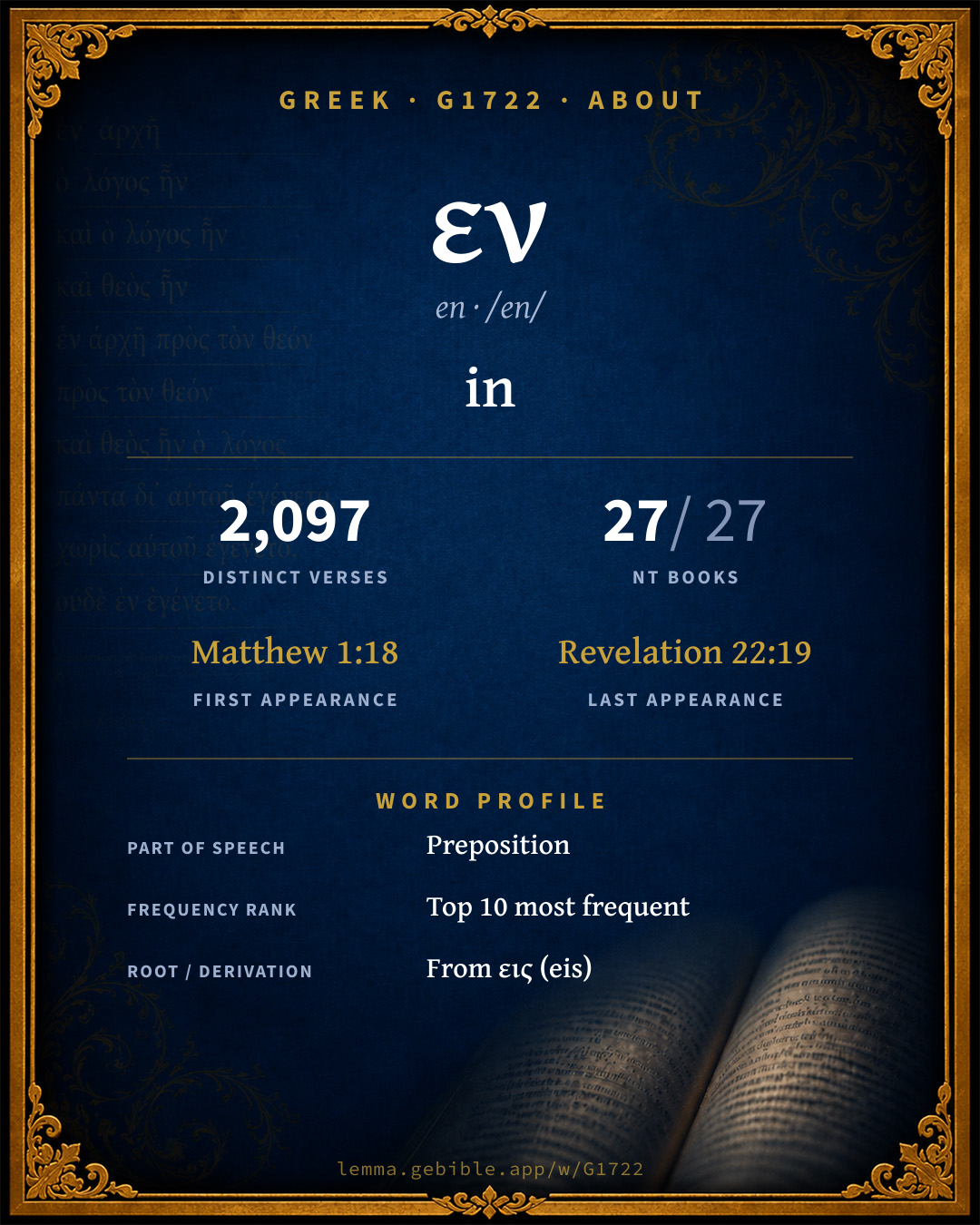
ἐν
in
Full lexicon entry — Thayer's Greek Lexicon
From Thayer's Greek Lexicon
Where this word appears
Grammar key — what these labels mean
Part of speech
- Preposition
- A relational word governing a noun in a particular case.
Page 1 of 11 — showing verses 1–200 of 2,097 distinct verses where G1722 appears, across 27 books. Click any verse to open its interlinear word-by-word view. Verse text shown in the World English Bible for context — . Each verse’s Greek form is shown with its reference; the English is not keyword-highlighted, since the data carries no word-level English alignment. Use “Compare translations” on any verse to read it across multiple English versions. This concordance covers the Greek New Testament; Septuagint (Greek Old Testament) occurrences of this word are not indexed here.
Matthew 233 verses
- Matthew 1:18 ἐν prep Now the birth of Jesus Christ was like this; for after his mother, Mary, was engaged to Joseph, before they came together, she was found pregnant by the Holy Spirit.
- Matthew 1:20 ἐν prep But when he thought about these things, behold, an angel of the Lord appeared to him in a dream, saying, "Joseph, son of David, don't be afraid to take to yourself Mary, your wife, for that which is conceived in her is of the Holy Spirit.
- Matthew 1:23 ἐν prep "Behold, the virgin shall be with child, And shall bring forth a son. They shall call his name Immanuel;" Which is, being interpreted, "God with us."
- Matthew 2:1 ἐν ἐν prep prep Now when Jesus was born in Bethlehem of Judea in the days of Herod the king, behold, wise men from the east came to Jerusalem, saying,
- Matthew 2:2 ἐν prep "Where is he who is born King of the Jews? For we saw his star in the east, and have come to worship him."
- Matthew 2:5 ἐν prep They said to him, "In Bethlehem of Judea, for thus it is written through the prophet,
- Matthew 2:6 ἐν prep 'You Bethlehem, land of Judah, Are in no way least among the princes of Judah: For out of you shall come forth a governor, Who shall shepherd my people, Israel.'"
- Matthew 2:9 ἐν prep They, having heard the king, went their way; and behold, the star, which they saw in the east, went before them, until it came and stood over where the young child was.
- Matthew 2:16 ἐν ἐν prep prep Then Herod, when he saw that he was mocked by the wise men, was exceedingly angry, and sent out, and killed all the male children who were in Bethlehem and in all the surrounding countryside, from two years old and under, according to the exact time which he had learned from the wise men.
- Matthew 2:18 ἐν prep "A voice was heard in Ramah, Lamentation, weeping and great mourning, Rachel weeping for her children; She wouldn't be comforted, Because they are no more."
- Matthew 2:19 ἐν prep But when Herod was dead, behold, an angel of the Lord appeared in a dream to Joseph in Egypt, saying,
- Matthew 3:1 Ἐν ἐν prep prep In those days, John the Baptizer came, preaching in the wilderness of Judea, saying,
- Matthew 3:3 ἐν prep For this is he who was spoken of by Isaiah the prophet, saying, "The voice of one crying in the wilderness, Make ready the way of the Lord, Make his paths straight."
- Matthew 3:6 ἐν prep They were baptized by him in the Jordan, confessing their sins.
- Matthew 3:9 ἐν prep Don't think to yourselves, 'We have Abraham for our father,' for I tell you that God is able to raise up children to Abraham from these stones.
- Matthew 3:11 ἐν ἐν prep prep I indeed baptize you in water for repentance, but he who comes after me is mightier than I, whose shoes I am not worthy to carry. He will baptize you in the Holy Spirit.
- Matthew 3:12 ἐν prep His winnowing fork is in his hand, and he will thoroughly cleanse his threshing floor. He will gather his wheat into the barn, but the chaff he will burn up with unquenchable fire."
- Matthew 3:17 ἐν prep Behold, a voice out of the heavens said, "This is my beloved Son, with whom I am well pleased."
- Matthew 4:13 ἐν prep Leaving Nazareth, he came and lived in Capernaum, which is by the sea, in the region of Zebulun and Naphtali,
- Matthew 4:16 ἐν ἐν prep prep The people who sat in darkness saw a great light, To those who sat in the region and shadow of death, To them light has dawned."
- Matthew 4:21 ἐν prep Going on from there, he saw two other brothers, James the son of Zebedee, and John his brother, in the boat with Zebedee their father, mending their nets. He called them.
- Matthew 4:23 ἐν ἐν ἐν prep prep prep Jesus went about in all Galilee, teaching in their synagogues, preaching the Gospel of the Kingdom, and healing every disease and every sickness among the people.
- Matthew 5:12 ἐν prep Rejoice, and be exceedingly glad, for great is your reward in heaven. For that is how they persecuted the prophets who were before you.
- Matthew 5:13 ἐν prep "You are the salt of the earth, but if the salt has lost its flavor, with what will it be salted? It is then good for nothing, but to be cast out and trodden under the feet of men.
- Matthew 5:15 ἐν prep Neither do you light a lamp, and put it under a measuring basket, but on a stand; and it shines to all who are in the house.
- Matthew 5:16 ἐν prep Even so, let your light shine before men; that they may see your good works, and glorify your Father who is in heaven.
- Matthew 5:19 ἐν ἐν prep prep Whoever, therefore, shall break one of these least commandments, and teach others to do so, shall be called least in the Kingdom of Heaven; but whoever shall do and teach them shall be called great in the Kingdom of Heaven.
- Matthew 5:25 ἐν prep Agree with your adversary quickly, while you are with him in the way; lest perhaps the prosecutor deliver you to the judge, and the judge deliver you to the officer, and you be cast into prison.
- Matthew 5:28 ἐν prep but I tell you that everyone who gazes at a woman to lust after her has committed adultery with her already in his heart.
- Matthew 5:34 ἐν prep but I tell you, don't swear at all: neither by heaven, for it is the throne of God;
- Matthew 5:35 ἐν prep nor by the earth, for it is the footstool of his feet; nor by Jerusalem, for it is the city of the great King.
- Matthew 5:36 ἐν prep Neither shall you swear by your head, for you can't make one hair white or black.
- Matthew 5:45 ἐν prep that you may be children of your Father who is in heaven. For he makes his sun to rise on the evil and the good, and sends rain on the just and the unjust.
- Matthew 6:1 ἐν prep "Be careful that you don't do your charitable giving before men, to be seen by them, or else you have no reward from your Father who is in heaven.
- Matthew 6:2 ἐν ἐν prep prep Therefore when you do merciful deeds, don't sound a trumpet before yourself, as the hypocrites do in the synagogues and in the streets, that they may get glory from men. Most assuredly I tell you, they have received their reward.
- Matthew 6:4 ἐν ἐν prep prep so that your merciful deeds may be in secret, then your Father who sees in secret will reward you openly.
- Matthew 6:5 ἐν ἐν prep prep "When you pray, you shall not be as the hypocrites, for they love to stand and pray in the synagogues and in the corners of the streets, that they may be seen by men. Most assuredly, I tell you, they have received their reward.
- Matthew 6:6 ἐν ἐν prep prep But you, when you pray, enter into your inner chamber, and having shut your door, pray to your Father who is in secret, and your Father who sees in secret will reward you openly.
- Matthew 6:7 ἐν prep In praying, don't use vain repetitions, as the Gentiles do; for they think that they will be heard for their much speaking.
- Matthew 6:9 ἐν prep Pray like this: 'Our Father in heaven, may your name be kept holy.
- Matthew 6:10 ἐν prep Let your Kingdom come. Let your will be done, as in heaven, so on earth.
- Matthew 6:18 ἐν ἐν prep prep so that you are not seen by men to be fasting, but by your Father who is in secret, and your Father, who sees in secret, will reward you.
- Matthew 6:20 ἐν prep but lay up for yourselves treasures in heaven, where neither moth nor rust consume, and where thieves don't break through and steal;
- Matthew 6:23 ἐν prep But if your eye is evil, your whole body will be full of darkness. If therefore the light that is in you is darkness, how great is the darkness!
- Matthew 6:29 ἐν prep yet I tell you that even Solomon in all his glory was not dressed like one of these.
- Matthew 7:2 ἐν ἐν prep prep For with whatever judgment you judge, you will be judged; and with whatever measure you measure, it will be measured to you.
- Matthew 7:3 ἐν ἐν prep prep Why do you see the speck that is in your brother's eye, but don't consider the beam that is in your own eye?
- Matthew 7:4 ἐν prep Or how will you tell your brother, 'Let me remove the speck from your eye;' and behold, the beam is in your own eye?
- Matthew 7:6 ἐν prep "Don't give that which is holy to the dogs, neither throw your pearls before the pigs, lest perhaps they trample them under their feet, and turn and tear you to pieces.
- Matthew 7:11 ἐν prep If you then, being evil, know how to give good gifts to your children, how much more will your Father who is in heaven give good things to those who ask him!
- Matthew 7:15 ἐν prep "Beware of false prophets, who come to you in sheep's clothing, but inwardly are ravening wolves.
- Matthew 7:21 ἐν prep Not everyone who says to me, 'Lord, Lord,' will enter into the Kingdom of Heaven; but he who does the will of my Father who is in heaven.
- Matthew 7:22 ἐν prep Many will tell me in that day, 'Lord, Lord, didn't we prophesy in your name, in your name cast out demons, and in your name do many mighty works?'
- Matthew 8:6 ἐν prep and saying, "Lord, my servant lies in the house paralyzed, grievously tormented."
- Matthew 8:10 ἐν prep When Jesus heard it, he marveled, and said to those who followed, "Most assuredly I tell you, I haven't found so great a faith, not even in Israel.
- Matthew 8:11 ἐν prep I tell you that many will come from the east and the west, and will sit down with Abraham, Isaac, and Jacob in the Kingdom of Heaven,
- Matthew 8:13 ἐν prep Jesus said to the centurion, "Go your way. Let it be done for you as you have believed." His servant was healed in that hour.
- Matthew 8:24 ἐν prep Behold, a great tempest arose in the sea, so much that the boat was covered with the waves, but he was asleep.
- Matthew 8:32 ἐν prep He said to them, "Go!" They came out, and went into the herd of pigs: and behold, the whole herd of pigs rushed down the cliff into the sea, and died in the water.
- Matthew 9:3 ἐν prep Behold, some of the scribes said to themselves, "This man blasphemes."
- Matthew 9:4 ἐν prep Jesus, knowing their thoughts, said, "Why do you think evil in your hearts?
- Matthew 9:10 ἐν prep It happened as he sat in the house, behold, many tax collectors and sinners came and sat down with Jesus and his disciples.
- Matthew 9:21 ἐν prep for she said within herself, "If I just touch his garment, I will be made well."
- Matthew 9:31 ἐν prep But they went out and spread abroad his fame in all that land.
- Matthew 9:33 ἐν prep When the demon was cast out, the mute man spoke. The multitudes marveled, saying, "Nothing like this has ever been seen in Israel!"
- Matthew 9:34 ἐν prep But the Pharisees said, "By the prince of the demons, he casts out demons."
- Matthew 9:35 ἐν prep Jesus went about all the cities and the villages, teaching in their synagogues, and preaching the Gospel of the Kingdom, and healing every disease and every sickness among the people.
- Matthew 10:11 ἐν prep Into whatever city or village you enter, find out who in it is worthy; and stay there until you go on.
- Matthew 10:15 ἐν prep Most assuredly I tell you, it will be more tolerable for the land of Sodom and Gomorrah in the day of judgment than for that city.
- Matthew 10:16 ἐν prep "Behold, I send you out as sheep in the midst of wolves. Therefore be wise as serpents, and harmless as doves.
- Matthew 10:17 ἐν prep But beware of men: for they will deliver you up to councils, and in their synagogues they will scourge you.
- Matthew 10:19 ἐν prep But when they deliver you up, don't be anxious how or what you will say, for it will be given you in that hour what you will say.
- Matthew 10:20 ἐν prep For it is not you who speak, but the Spirit of your Father who speaks in you.
- Matthew 10:23 ἐν prep But when they persecute you in this city, flee into the next, for most assuredly I tell you, you will not have gone through the cities of Israel, until the Son of Man has come.
- Matthew 10:27 ἐν ἐν prep prep What I tell you in the darkness, speak in the light; and what you hear whispered in the ear, proclaim on the housetops.
- Matthew 10:28 ἐν prep Don't be afraid of those who kill the body, but are not able to kill the soul. Rather, fear him who is able to destroy both soul and body in Gehenna.
- Matthew 10:32 ἐν ἐν ἐν prep prep prep Everyone therefore who confesses me before men, him I will also confess before my Father who is in heaven.
- Matthew 10:33 ἐν prep But whoever denies me before men, him I will also deny before my Father who is in heaven.
- Matthew 11:1 ἐν prep It happened that when Jesus had finished directing his twelve disciples, he departed from there to teach and preach in their cities.
- Matthew 11:2 ἐν prep Now when John heard in the prison the works of Christ, he sent two of his disciples
- Matthew 11:6 ἐν prep Blessed is he who finds no occasion for stumbling in me."
- Matthew 11:8 ἐν ἐν prep prep But what did you go out to see? A man in soft clothing? Behold, those who wear soft clothing are in king's houses.
- Matthew 11:11 ἐν ἐν prep prep Most assuredly I tell you, among those who are born of women there has not arisen anyone greater than John the Baptizer; yet he who is least in the Kingdom of Heaven is greater than he.
- Matthew 11:16 ἐν prep "But to what shall I compare this generation? It is like children sitting in the marketplaces, who call to their companions
- Matthew 11:20 ἐν prep Then he began to denounce the cities in which most of his mighty works had been done, because they didn't repent.
- Matthew 11:21 ἐν ἐν ἐν prep prep prep "Woe to you, Chorazin! Woe to you, Bethsaida! For if the mighty works had been done in Tyre and Sidon which were done in you, they would have repented long ago in sackcloth and ashes.
- Matthew 11:22 ἐν prep But I tell you, it will be more tolerable for Tyre and Sidon on the day of judgment than for you.
- Matthew 11:23 ἐν ἐν prep prep You, Capernaum, who are exalted to Heaven, you will go down to Hades. For if the mighty works had been done in Sodom which were done in you, it would have remained until this day.
- Matthew 11:24 ἐν prep But I tell you that it will be more tolerable for the land of Sodom, on the day of judgment, than for you."
- Matthew 11:25 Ἐν prep At that time, Jesus answered, "I thank you, Father, Lord of heaven and earth, that you hid these things from the wise and understanding, and revealed them to infants.
- Matthew 12:1 Ἐν prep At that time, Jesus went on the Sabbath day through the grain fields. His disciples were hungry and began to pluck heads of grain and to eat.
- Matthew 12:2 ἐν prep But the Pharisees, when they saw it, said to him, "Behold, your disciples do what is not lawful to do on the Sabbath."
- Matthew 12:5 ἐν ἐν prep prep Or have you not read in the law, that on the Sabbath day, the priests in the temple profane the Sabbath, and are guiltless?
- Matthew 12:19 ἐν prep He will not strive, nor shout; Neither will anyone hear his voice in the streets.
- Matthew 12:24 ἐν prep But when the Pharisees heard it, they said, "This man does not cast out demons, except by Beelzebul, the prince of the demons."
- Matthew 12:27 ἐν ἐν prep prep If I by Beelzebul cast out demons, by whom do your children cast them out? Therefore they will be your judges.
- Matthew 12:28 ἐν prep But if I by the Spirit of God cast out demons, then the Kingdom of God has come upon you.
- Matthew 12:32 ἐν ἐν prep prep Whoever speaks a word against the Son of Man, it will be forgiven him; but whoever speaks against the Holy Spirit, it will not be forgiven him, neither in this age, nor in that which is to come.
- Matthew 12:36 ἐν prep I tell you that every idle word that men speak, they will give account of it in the day of judgment.
- Matthew 12:40 ἐν ἐν prep prep For as Jonah was three days and three nights in the belly of the whale, so will the Son of Man be three days and three nights in the heart of the earth.
- Matthew 12:41 ἐν prep The men of Nineveh will stand up in the judgment with this generation, and will condemn it, for they repented at the preaching of Jonah; and behold, someone greater than Jonah is here.
- Matthew 12:42 ἐν prep The queen of the south will rise up in the judgment with this generation, and will condemn it, for she came from the ends of the earth to hear the wisdom of Solomon; and behold, someone greater than Solomon is here.
- Matthew 12:50 ἐν prep For whoever does the will of my Father who is in heaven, he is my brother, and sister, and mother."
- Matthew 13:1 Ἐν prep On that day Jesus went out of the house, and sat by the seaside.
- Matthew 13:3 ἐν prep He spoke to them many things in parables, saying, "Behold, a farmer went out to sow.
- Matthew 13:4 ἐν prep As he sowed, some seeds fell by the roadside, and the birds came and devoured them.
- Matthew 13:10 ἐν prep The disciples came, and said to him, "Why do you speak to them in parables?"
- Matthew 13:13 ἐν prep Therefore I speak to them in parables, because seeing they don't see, and hearing, they don't hear, neither do they understand.
- Matthew 13:19 ἐν prep When anyone hears the word of the Kingdom, and doesn't understand it, the evil one comes, and snatches away that which has been sown in his heart. This is what was sown by the roadside.
- Matthew 13:21 ἐν prep yet he has no root in himself, but endures for a while. When oppression or persecution arises because of the word, immediately he stumbles.
- Matthew 13:24 ἐν prep He set another parable before them, saying, "The Kingdom of Heaven is like a man who sowed good seed in his field,
- Matthew 13:25 ἐν prep but while people slept, his enemy came and sowed darnel also among the wheat, and went away.
- Matthew 13:27 ἐν prep The servants of the householder came and said to him, 'Sir, didn't you sow good seed in your field? Where did this darnel come from?'
- Matthew 13:30 ἐν prep Let both grow together until the harvest, and in the harvest time I will tell the reapers, "First, gather up the darnel, and bind them in bundles to burn them; but gather the wheat into my barn."'"
- Matthew 13:31 ἐν prep He set another parable before them, saying, "The Kingdom of Heaven is like a grain of mustard seed, which a man took, and sowed in his field;
- Matthew 13:32 ἐν prep which indeed is smaller than all seeds. But when it is grown, it is greater than the herbs, and becomes a tree, so that the birds of the air come and lodge in its branches."
- Matthew 13:34 ἐν prep Jesus spoke all these things in parables to the multitudes; and without a parable, he didn't speak to them,
- Matthew 13:35 ἐν prep that it might be fulfilled which was spoken through the prophet, saying, "I will open my mouth in parables; I will utter things hidden from the foundation of the world."
- Matthew 13:40 ἐν prep As therefore the darnel is gathered up and burned with fire; so will it be at the end of this age.
- Matthew 13:43 ἐν prep Then the righteous will shine forth like the sun in the Kingdom of their Father. He who has ears to hear, let him hear.
- Matthew 13:44 ἐν prep "Again, the Kingdom of Heaven is like a treasure hidden in the field, which a man found, and hid. In his joy, he goes and sells all that he has, and buys that field.
- Matthew 13:49 ἐν prep So will it be in the end of the world. The angels will come forth, and separate the wicked from among the righteous,
- Matthew 13:54 ἐν prep Coming into his own country, he taught them in their synagogue, so that they were astonished, and said, "Where did this man get this wisdom, and these mighty works?
- Matthew 13:57 ἐν ἐν ἐν prep prep prep They were offended by him. But Jesus said to them, "A prophet is not without honor, except in his own country, and in his own house."
- Matthew 14:1 Ἐν prep At that time, Herod the tetrarch heard the report concerning Jesus,
- Matthew 14:2 ἐν prep and said to his servants, "This is John the Baptizer. He is risen from the dead. That is why these powers work in him."
- Matthew 14:3 ἐν prep For Herod had laid hold of John, and bound him, and put him in prison for the sake of Herodias, his brother Philip's wife.
- Matthew 14:6 ἐν prep But when Herod's birthday came, the daughter of Herodias danced among them and pleased Herod.
- Matthew 14:10 ἐν prep and he sent and beheaded John in the prison.
- Matthew 14:13 ἐν prep Now when Jesus heard this, he withdrew from there in a boat, to a deserted place apart. When the multitudes heard it, they followed him on foot from the cities.
- Matthew 14:33 ἐν prep Those who were in the boat came and worshiped him, saying, "You are truly the Son of God!"
- Matthew 15:32 ἐν prep Jesus summoned his disciples and said, "I have compassion on the multitude, because they continue with me now three days and have nothing to eat. I don't want to send them away fasting, or they might faint on the way."
- Matthew 15:33 ἐν prep The disciples said to him, "Where should we get so many loaves in a deserted place as to satisfy so great a multitude?"
- Matthew 16:7 ἐν prep They reasoned among themselves, saying, "We brought no bread."
- Matthew 16:8 ἐν prep Jesus, perceiving it, said, "Why do you reason among yourselves, you of little faith, 'because you have brought no bread?'
- Matthew 16:17 ἐν prep Jesus answered him, "Blessed are you, Simon Bar Jonah, for flesh and blood has not revealed this to you, but my Father who is in heaven.
- Matthew 16:19 ἐν ἐν prep prep I will give to you the keys of the Kingdom of Heaven, and whatever you bind on earth will be bound in heaven; and whatever you release on earth will be released in heaven."
- Matthew 16:27 ἐν prep For the Son of Man will come in the glory of his Father with his angels, and then he will render to everyone according to his deeds.
- Matthew 16:28 ἐν prep Most assuredly I tell you, there are some standing here who will in no way taste of death, until they see the Son of Man coming in his Kingdom."
- Matthew 17:5 ἐν prep While he was still speaking, behold, a bright cloud overshadowed them. Behold, a voice came out of the cloud, saying, "This is my beloved Son, in whom I am well pleased. Listen to him."
- Matthew 17:12 ἐν prep but I tell you that Elijah has come already, and they didn't recognize him, but did to him whatever they wanted to. Even so the Son of Man will also suffer by them."
- Matthew 17:22 ἐν prep While they were staying in Galilee, Jesus said to them, "The Son of Man is about to be delivered up into the hands of men,
- Matthew 18:1 Ἐν ἐν prep prep In that hour the disciples came to Jesus, saying, "Who then is greatest in the Kingdom of Heaven?"
- Matthew 18:2 ἐν prep Jesus called a little child to himself, and set him in the midst of them,
- Matthew 18:4 ἐν prep Whoever therefore humbles himself as this little child, the same is the greatest in the Kingdom of Heaven.
- Matthew 18:6 ἐν prep but whoever causes one of these little ones who believe in me to stumble, it would be better for him that a huge millstone should be hung around his neck, and that he should be sunk in the depths of the sea.
- Matthew 18:10 ἐν ἐν prep prep See that you don't despise one of these little ones, for I tell you that in heaven their angels always see the face of my Father who is in heaven.
- Matthew 18:14 ἐν prep Even so it is not the will of your Father who is in heaven that one of these little ones should perish.
- Matthew 18:18 ἐν ἐν prep prep Most assuredly I tell you, whatever things you will bind on earth will be bound in heaven, and whatever things you will release on earth will be released in heaven.
- Matthew 18:19 ἐν prep Again, assuredly I tell you, that if two of you will agree on earth concerning anything that they will ask, it will be done for them by my Father who is in heaven.
- Matthew 18:20 ἐν prep For where two or three are gathered together in my name, there I am in the midst of them."
- Matthew 19:21 ἐν prep Jesus said to him, "If you want to be perfect, go, sell what you have, and give to the poor, and you will have treasure in heaven; and come, follow me."
- Matthew 19:28 ἐν prep Jesus said to them, "Most assuredly I tell you that you who have followed me, in the regeneration when the Son of Man will sit on the throne of his glory, you also will sit on twelve thrones, judging the twelve tribes of Israel.
- Matthew 20:3 ἐν prep He went out about the third hour, and saw others standing idle in the marketplace.
- Matthew 20:15 ἐν prep Isn't it lawful for me to do what I want to with what I own? Or is your eye evil, because I am good?'
- Matthew 20:17 ἐν prep As Jesus was going up to Jerusalem, he took the twelve disciples aside, and on the way he said to them,
- Matthew 20:21 ἐν prep He said to her, "What do you want?" She said to him, "Command that these, my two sons, may sit, one on your right hand, and one on your left hand, in your Kingdom."
- Matthew 20:26 ἐν ἐν prep prep It shall not be so among you, but whoever desires to become great among you shall be your servant.
- Matthew 20:27 ἐν prep Whoever desires to be first among you shall be your bondservant,
- Matthew 21:8 ἐν ἐν prep prep A very great multitude spread their clothes on the road. Others cut branches from the trees, and spread them on the road.
- Matthew 21:9 ἐν ἐν prep prep The multitudes who went before him, and who followed kept shouting, "Hosanna to the son of David! Blessed is he who comes in the name of the Lord! Hosanna in the highest!"
- Matthew 21:12 ἐν prep Jesus entered into the temple of God, and drove out all of those who sold and bought in the temple, and overthrew the money-changers' tables and the seats of those who sold the doves.
- Matthew 21:14 ἐν prep The blind and the lame came to him in the temple, and he healed them.
- Matthew 21:15 ἐν prep But when the chief priests and the scribes saw the wonderful things that he did, and the children who were crying in the temple and saying, "Hosanna to the son of David!" they were indignant,
- Matthew 21:19 ἐν prep Seeing a fig tree by the road, he came to it, and found nothing on it but leaves. He said to it, "Let there be no fruit from you forever!" Immediately the fig tree withered away.
- Matthew 21:22 ἐν prep All things, whatever you ask in prayer, believing, you will receive."
- Matthew 21:23 ἐν prep When he had come into the temple, the chief priests and the elders of the people came to him as he was teaching, and said, "By what authority do you do these things? Who gave you this authority?"
- Matthew 21:24 ἐν prep Jesus answered them, "I also will ask you one question, which if you tell me, I likewise will tell you by what authority I do these things.
- Matthew 21:27 ἐν prep They answered Jesus, and said, "We don't know." He also said to them, "Neither will I tell you by what authority I do these things.
- Matthew 21:28 ἐν prep But what do you think? A man had two sons, and he came to the first, and said, 'Son, go work today in my vineyard.'
- Matthew 21:32 ἐν prep For John came to you in the way of righteousness, and you didn't believe him, but the tax collectors and the prostitutes believed him. When you saw it, you didn't even repent afterward, that you might believe him.
- Matthew 21:33 ἐν prep "Hear another parable. There was a man who was a master of a household, who planted a vineyard, set a hedge about it, dug a winepress in it, built a tower, leased it out to farmers, and went into another country.
- Matthew 21:38 ἐν prep But the farmers, when they saw the son, said among themselves, 'This is the heir. Come, let's kill him, and seize his inheritance.'
- Matthew 21:41 ἐν prep They told him, "He will miserably destroy those miserable men, and will lease out the vineyard to other farmers, who will give him the fruit in its season."
- Matthew 21:42 ἐν ἐν prep prep Jesus said to them, "Did you never read in the Scriptures, 'The stone which the builders rejected, The same was made the head of the corner. This was from the Lord. It is marvelous in our eyes?'
- Matthew 22:1 ἐν prep Jesus answered and spoke again in parables to them, saying,
- Matthew 22:15 ἐν prep Then the Pharisees went and took counsel how they might entrap him in his talk.
- Matthew 22:16 ἐν prep They sent their disciples to him, along with the Herodians, saying, "Teacher, we know that you are honest, and teach the way of God in truth, no matter who you teach, for you aren't partial to anyone.
- Matthew 22:23 Ἐν prep On that day Sadducees (those who say that there is no resurrection) came to him. They asked him,
- Matthew 22:28 ἐν prep In the resurrection therefore, whose wife will she be of the seven? For they all had her."
- Matthew 22:30 ἐν ἐν prep prep For in the resurrection they neither marry, nor are given in marriage, but are like God's angels in heaven.
- Matthew 22:36 ἐν prep "Teacher, which is the greatest commandment in the law?"
- Matthew 22:37 ἐν ἐν ἐν prep prep prep Jesus said to him, "'You shall love the Lord your God with all your heart, and with all your soul, and with all your mind.'
- Matthew 22:40 ἐν prep The whole law and the prophets depend on these two commandments."
- Matthew 22:43 ἐν prep He said to them, "How then does David in the Spirit call him Lord, saying,
- Matthew 23:6 ἐν ἐν prep prep and love the place of honor at feasts, the best seats in the synagogues,
- Matthew 23:7 ἐν prep the salutations in the marketplaces, and to be called 'Rabbi, Rabbi' by men.
- Matthew 23:16 ἐν ἐν prep prep "Woe to you, you blind guides, who say, 'Whoever swears by the temple, it is nothing; but whoever swears by the gold of the temple, he is obligated.'
- Matthew 23:18 ἐν ἐν prep prep 'Whoever swears by the altar, it is nothing; but whoever swears by the gift that is on it, he is obligated.'
- Matthew 23:20 ἐν ἐν ἐν prep prep prep He therefore who swears by the altar, swears by it, and by everything on it.
- Matthew 23:21 ἐν ἐν ἐν prep prep prep He who swears by the temple, swears by it, and by him who was living in it.
- Matthew 23:22 ἐν ἐν ἐν prep prep prep He who swears by heaven, swears by the throne of God, and by him who sits on it.
- Matthew 23:30 ἐν ἐν prep prep and say, 'If we had lived in the days of our fathers, we wouldn't have been partakers with them in the blood of the prophets.'
- Matthew 23:34 ἐν prep Therefore, behold, I send to you prophets, wise men, and scribes. Some of them you will kill and crucify; and some of them you will scourge in your synagogues, and persecute from city to city;
- Matthew 23:39 ἐν prep For I tell you, you will not see me from now on, until you say, 'Blessed is he who comes in the name of the Lord!'"
- Matthew 24:14 ἐν prep This Gospel of the Kingdom will be preached in the whole world for a testimony to all the nations, and then the end will come.
- Matthew 24:15 ἐν prep "When, therefore, you see the abomination of desolation, which was spoken of through Daniel the prophet, standing in the holy place (let the reader understand),
- Matthew 24:16 ἐν prep then let those who are in Judea flee to the mountains.
- Matthew 24:18 ἐν prep Let him who is in the field not return back to get his clothes.
- Matthew 24:19 ἐν ἐν prep prep But woe to those who are with child and to nursing mothers in those days!
About this entry
At a glance — auto-summarized from this page’s data, not written by a person. Every figure links to its source below. This summary describes the numbers; it doesn’t interpret them.
At its core, εν (en) means “in.” First canonically at Matthew 1:18, it enters the text early. With 2,097 verses in 27 books, it is one of the most common word in the Greek New Testament. From the same root come εις, εισαγω and εισακουω. Dig into 2,097-verse concordance and the renderings breakdown below.
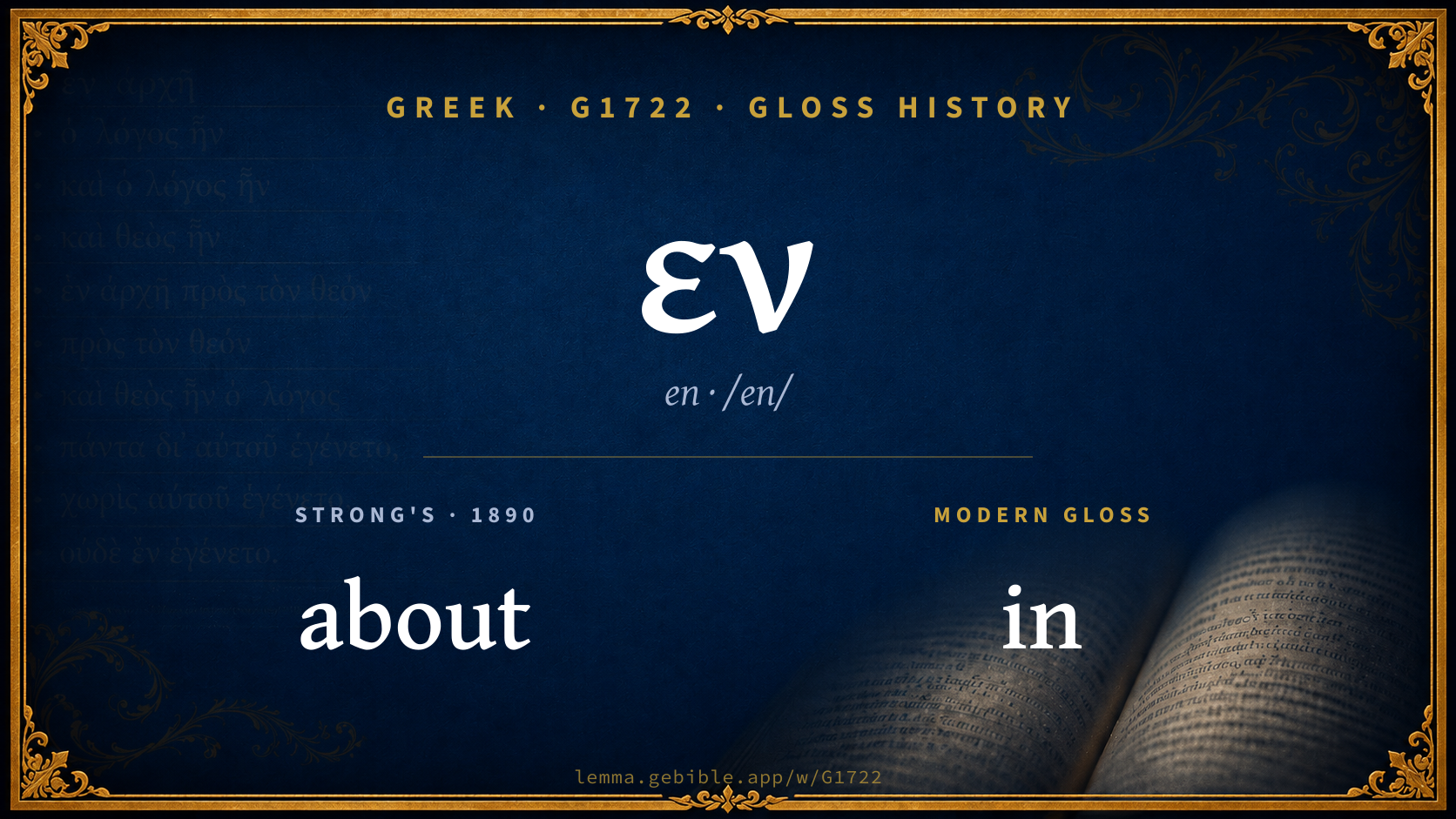
Gloss history
Strong's 1890 vs modern scholarship
About this word
Strong's G1722 catalogs a Greek word from the Greek New Testament.
These counts are not copied from any lexicon or concordance. They are computed here, from the morphology-tagged Greek New Testament. What Lemma adds →
- 2,097
- distinct verses
- The word appears in 2,097 distinct verses.
- 27 / 27
- NT books
- The word appears in 27 of 27 New Testament books.
- #5
- by frequency
- Top 10 most frequent Greek words (rank 5 of 5,347 Greek words by occurrence).
View all 2,097 occurrences in the concordance →
By section of the New Testament
By traditional corpus
Conventional, traditional groupings — biblical authorship is debated, so this is a traditional corpus grouping, not an authorship claim. Some books belong to more than one corpus (Luke is in both the Gospels and the Lukan corpus, and so on), so these shares overlap and need not total 100%. Each figure is a share of the word’s 2,097 distinct verses.
- Gospels 808 verses · 39%
- Pauline corpus 722 verses · 34%
- Lukan (Luke–Acts) 510 verses · 24%
- Johannine 352 verses · 17%
- General (Catholic) Epistles 167 verses · 8%
- Revelation 123 verses · 6%
- Hebrews 55 verses · 3%
How translations render this word
Counts come from each version’s own published word-to-Strong’s tagging or interlinear alignment — an approximate guide to how each version renders this word, not a word-level alignment the data otherwise carries. Because each total is that version’s own tagged count, the per-version totals vary from one another and need not match the appearance or distinct-verse counts above. These counts may also differ from a printed concordance because Lemma counts each distinctly tagged rendering and does not collapse phrase taggings into a single head-word total. This is a fixed set of word-tagged versions (KJV, ASV, BSB, ULT) and does not change with the reading translation you choose elsewhere. Each version’s license is shown beside its name below (and on Sources).
- King James Version: In 1,748×, By 142×, With 135×
- American Standard Version: In 1,856×, With 116×, Among 97×
- Berean Standard Bible: In 1,512×, By 152×, With 144×
- unfoldingWord Literal Text: In 2,007×, With 135×, Among 125×
King James Version Public Domain
Renders G1722 across 2,770 tagged occurrences — most commonly:
Plus other, less common renderings. Plus 91 renderings that appear only once — usually multi-word phrases or single function words the recovered tagging swept in, not distinct renderings. Not rendered by a distinct English word in 30 further occurrences.
American Standard Version Public Domain
Renders G1722 across 2,612 tagged occurrences — most commonly:
Plus other, less common renderings. Plus 133 renderings that appear only once — usually multi-word phrases or single function words the recovered tagging swept in, not distinct renderings. Not rendered by a distinct English word in 6 further occurrences.
Berean Standard Bible Public Domain
Renders G1722 across 2,394 tagged occurrences — most commonly:
Plus other, less common renderings. Plus 53 renderings that appear only once — usually multi-word phrases or single function words the recovered tagging swept in, not distinct renderings. Not rendered by a distinct English word in 224 further occurrences.
unfoldingWord Literal Text CC BY-SA 4.0
Renders G1722 across 2,754 tagged occurrences — most commonly:
Plus other, less common renderings. Plus 36 renderings that appear only once — usually multi-word phrases or single function words the recovered tagging swept in, not distinct renderings.
Senses in Thayer's
The 1 sense Thayer's distinguishes for this word, in lexicon order (not ranked by frequency or importance). The full entry — with sub-senses — is in the Lexicon Entry tab.
- in, by, with etc.
Word origin
Derived from εις (eis) (G1519) — into.
A primary preposition denoting (fixed) position (in place time or state) and (by implication) instrumentality (medially or constructively) that is a relation of rest (intermediate between G1519 and G1537 ); in at (up-) on by etc. : - about after against + almost X altogether among X as at before between (here-) by (+ all means) for (... sake of) + give self wholly to (here-) in (-to -wardly) X mightily (because) of (up-) on [open-] ly X outwardly one X quickly X shortly [speedi-] ly X that X there (-in -on) through (-out) (un-) to(-ward) under when where (-with) while with (-in). Often used in compounds with substantially the same import; rarely with verbs of motion and then not to indicate direction except (elliptically) by a separate (and different) prep.
— Strong’s Exhaustive Concordance (1890), public domain.
Forms in the corpus
The 5 distinct written forms G1722 takes in the Greek New Testament, most frequent first — each parse links to that case’s occurrences in the concordance.
| Form | Parsing | Example | Uses |
|---|---|---|---|
| ἐν en | Preposition | Matthew 1:18 | 2,703 |
| Ἐν En | Preposition | Matthew 3:1 | 25 |
| ἔν én | Preposition | Luke 18:2 | 8 |
| ἓν hèn | Preposition | Mark 4:20 | 3 |
| [ἐν en | Preposition | Ephesians 1:1 | 1 |
Same root — word family
Other Thayer's entries built from the same root as G1722, grouped by Strong’s listed origin. These share a root / origin per the lexicon — not necessarily a shared meaning. Each links to that word’s own entry.
Derives from
Shares the same root
- εισαγω eiságō G1521 to bring in
- εισακουω eisakoúō G1522 to obey
- εισδεχομαι eisdéchomai G1523 to receive
- εισειμι eíseimi G1524 to go in
- εισερχομαι eisérchomai G1525 to enter
- εισκαλεω eiskaléō G1528 to invite
- εισοδος eísodos G1529 entrance
- εισπηδαω eispēdáō G1530 to rush in
- εισπορευομαι eisporeúomai G1531 to enter
- ειστρεχω eistréchō G1532 to run in
- εισφερω eisphérō G1533 to bring in
- εσοπτρον ésoptron G2072 mirror
- εσω ésō G2080 within
- σκυβαλον skýbalon G4657 refuse
Derived from this word
- εγγραφω engráphō G1449 to inscribe
- εγγυος éngyos G1450 surety
- εγκαθετος enkáthetos G1455 to spy
- εγκαινια enkaínia G1456 dedication
- εγκαλεω enkaléō G1458 to accuse
- εγκαταλειπω enkataleípō G1459 to abandon
- εγκατοικεω enkatoikéō G1460 to dwell
- εγκεντριζω enkentrízō G1461 to graft
- εγκομβοομαι enkombóomai G1463 band
- εγκοπτω enkóptō G1465 to hinder
- εγκρατης enkratḗs G1468 strong
- εγκρινω enkrínō G1469 to judge worthy
- εγκρυπτω enkrýptō G1470 to conceal
- εγκυος énkyos G1471 pregnant
- εγχριω enchríō G1472 to anoint
- ελλογεω ellogéō G1677 impute
- εμβαινω embaínō G1684 to enter
- εμβαλλω embállō G1685 to cast in
- εμβαπτω embáptō G1686 to dip in
- εμβατευω embateúō G1687 to enter
- εμβιβαζω embibázō G1688 to lead in
- εμβλεπω emblépō G1689 to look at
- εμβριμαομαι embrimáomai G1690 to warn sternly
- εμμαινομαι emmaínomai G1693 to rage against
+59 more words derive from G1722 (not shown).
Compare all same-root words → Showing 4 of 99 — not the complete family. They share a root, not necessarily a meaning.
Septuagint usage
The same Greek word εν appears 11,235 times in the Greek Old Testament (Septuagint), across 7,742 verses in 38 books.
- 11,235
- LXX occurrences
- Tagged occurrences of this Greek word in the Septuagint.
- 7,742
- verses
- Distinct Septuagint verses containing this word.
- 38 / 39
- OT books
- The word appears in 38 of the 39 Old Testament books.
Sample Septuagint occurrences
- Genesis 1:1 ἐν
- Exodus 1:5 ἐν
- Leviticus 2:4 ἐν
- Numbers 1:1 ἐν
- Deuteronomy 1:1 ἐν
- Joshua 1:5 ἐν
- Judges 1:2 ἐν
- Ruth 1:1 ἐν
- 1 Samuel 1:1 ἐν
- 2 Samuel 1:1 ἐν
- 1 Kings 1:17 ἐν
- 2 Kings 1:1 ἐν
Septuagint occurrences (same lexeme)
Every verse where the same Strong’s number (G1722) appears in the Greek Septuagint — showing the first 50 of 7,742. Verse text shown in the World English Bible for context; the Greek form is the matched word — the English is not keyword-highlighted.
- Genesis 1:1 ἐν In the beginning God created the heavens and the earth.
- Genesis 1:6 ἐν God said, "Let there be an expanse in the midst of the waters, and let it divide the waters from the waters."
- Genesis 1:11 ἐν God said, "Let the earth put forth grass, herbs yielding seed, and fruit trees bearing fruit after their kind, with its seed in it, on the earth," and it was so.
- Genesis 1:12 ἐν The earth brought forth grass, herbs yielding seed after their kind, and trees bearing fruit, with its seed in it, after their kind: and God saw that it was good.
- Genesis 1:14 ἐν God said, "Let there be lights in the expanse of sky to divide the day from the night; and let them be for signs, and for seasons, and for days and years;
- Genesis 1:15 ἐν and let them be for lights in the expanse of sky to give light on the earth," and it was so.
- Genesis 1:17 ἐν God set them in the expanse of sky to give light to the earth,
- Genesis 1:22 ἐν God blessed them, saying, "Be fruitful, and multiply, and fill the waters in the seas, and let birds multiply on the earth."
- Genesis 1:29 ἐν God said, "Behold, I have given you every herb yielding seed, which is on the surface of all the earth, and every tree, which bears fruit yielding seed. It will be your food.
- Genesis 1:30 ἐν To every animal of the earth, and to every bird of the sky, and to everything that creeps on the earth, in which there is life, I have given every green herb for food." And it was so.
- Genesis 2:2 ἐν On the seventh day God finished his work which he had made; and he rested on the seventh day from all his work which he had made.
- Genesis 2:3 ἐν God blessed the seventh day, and made it holy, because he rested in it from all his work which he had created and made.
- Genesis 2:8 ἐν Yahweh God planted a garden eastward, in Eden, and there he put the man whom he had formed.
- Genesis 2:9 ἐν Out of the ground Yahweh God made every tree to grow that is pleasant to the sight, and good for food; the tree of life also in the midst of the garden, and the tree of the knowledge of good and evil.
- Genesis 2:15 ἐν Yahweh God took the man, and put him into the garden of Eden to dress it and to keep it.
- Genesis 2:16 ἐν Yahweh God commanded the man, saying, "Of every tree of the garden you may freely eat:
- Genesis 3:1 ἐν Now the serpent was more subtle than any animal of the field which Yahweh God had made. He said to the woman, "Yes, has God said, 'You shall not eat of any tree of the garden?'"
- Genesis 3:3 ἐν but of the fruit of the tree which is in the midst of the garden, God has said, 'You shall not eat of it, neither shall you touch it, lest you die.'"
- Genesis 3:5 ἐν for God knows that in the day you eat it, your eyes will be opened, and you will be like God, knowing good and evil."
- Genesis 3:8 ἐν They heard the voice of Yahweh God walking in the garden in the cool of the day, and the man and his wife hid themselves from the presence of Yahweh God among the trees of the garden.
- Genesis 3:10 ἐν The man said, "I heard your voice in the garden, and I was afraid, because I was naked; and I hid myself."
- Genesis 3:16 ἐν To the woman he said, "I will greatly multiply your pain in childbirth. In pain you will bring forth children. Your desire will be for your husband, and he will rule over you."
- Genesis 3:17 ἐν To Adam he said, "Because you have listened to your wife's voice, and have eaten of the tree, of which I commanded you, saying, 'You shall not eat of it,' cursed is the ground for your sake. In toil you will eat of it all the days of your life.
- Genesis 3:19 ἐν By the sweat of your face will you eat bread until you return to the ground, for out of it you were taken. For you are dust, and to dust you shall return."
- Genesis 4:8 ἐν Cain said to Abel, his brother, "Let's go into the field." It happened, when they were in the field, that Cain rose up against Abel, his brother, and killed him.
- Genesis 4:16 ἐν Cain went out from Yahweh's presence, and dwelt in the land of Nod, on the east of Eden.
- Genesis 4:20 ἐν Adah gave birth to Jabal, who was the father of those who dwell in tents and have cattle.
- Genesis 6:3 ἐν Yahweh said, "My Spirit will not strive with man forever, because he also is flesh; yet will his days be one hundred twenty years."
- Genesis 6:4 ἐν The Nephilim were in the earth in those days, and also after that, when God's sons came to men's daughters. They bore children to them: the same were the mighty men who were of old, men of renown.
- Genesis 6:5 ἐν Yahweh saw that the wickedness of man was great in the earth, and that every imagination of the thoughts of his heart was only evil continually.
- Genesis 6:9 ἐν This is the history of the generations of Noah. Noah was a righteous man, blameless among the people of his time. Noah walked with God.
- Genesis 6:17 ἐν I, even, I do bring the flood of waters on this earth, to destroy all flesh having the breath of life from under the sky. Everything that is in the earth will die.
- Genesis 7:1 ἐν Yahweh said to Noah, "Come with all of your household into the ark, for I have seen your righteousness before me in this generation.
- Genesis 7:11 ἐν In the six hundredth year of Noah's life, in the second month, on the seventeenth day of the month, on the same day all the fountains of the great deep were burst open, and the sky's windows were opened.
- Genesis 7:13 ἐν In the same day Noah, and Shem, Ham, and Japheth, the sons of Noah, and Noah's wife, and the three wives of his sons with them, entered into the ark;
- Genesis 7:15 ἐν They went to Noah into the ark, by pairs of all flesh with the breath of life in them.
- Genesis 7:23 ἐν Every living thing was destroyed that was on the surface of the ground, including man, cattle, creeping things, and birds of the sky. They were destroyed from the earth. Only Noah was left, and those who were with him in the ark.
- Genesis 8:1 ἐν God remembered Noah, all the animals, and all the cattle that were with him in the ark; and God made a wind to pass over the earth. The waters subsided.
- Genesis 8:4 ἐν The ark rested in the seventh month, on the seventeenth day of the month, on Ararat's mountains.
- Genesis 8:5 ἐν The waters receded continually until the tenth month. In the tenth month, on the first day of the month, the tops of the mountains were seen.
- Genesis 8:11 ἐν The dove came back to him at evening, and, behold, in her mouth was an olive leaf plucked off. So Noah knew that the waters were abated from off the earth.
- Genesis 8:13 ἐν It happened in the six hundred first year, in the first month, the first day of the month, the waters were dried up from off the earth. Noah removed the covering of the ark, and looked. He saw that the surface of the ground was dried.
- Genesis 8:14 ἐν In the second month, on the twenty-seventh day of the month, the earth was dry.
- Genesis 9:4 ἐν But flesh with the life of it, the blood of it, you shall not eat.
- Genesis 9:6 ἐν Whoever sheds man's blood, by man will his blood be shed, for in the image of God made he man.
- Genesis 9:13 ἐν I set my rainbow in the cloud, and it will be for a sign of a covenant between me and the earth.
- Genesis 9:14 ἐν It will happen, when I bring a cloud over the earth, that the rainbow will be seen in the cloud,
- Genesis 9:15 ἐν and I will remember my covenant, which is between me and you and every living creature of all flesh, and the waters will no more become a flood to destroy all flesh.
- Genesis 9:16 ἐν The rainbow will be in the cloud. I will look at it, that I may remember the everlasting covenant between God and every living creature of all flesh that is on the earth."
- Genesis 9:21 ἐν He drank of the wine, and got drunk. He was uncovered within his tent.
These are occurrences of the same Greek lexeme (G1722) in the Septuagint — not a translation of any one Hebrew word. The store carries no word-level Hebrew↔Greek alignment, so no Hebrew original is asserted here. Counts come from the recovered LXX Strong's tagging — high-frequency vocabulary is well covered, while rare or late forms may be untagged — so they reflect tagged occurrences and may slightly undercount.