
Luke 2:51

Greek (Tischendorf 8th ed.) Luke 2:51 appears in the Greek New Testament. The text above is from the Tischendorf 8th edition. Each word links to its Strong’s number and a concise gloss. Click any word for its full Thayer’s Greek Lexicon entry.
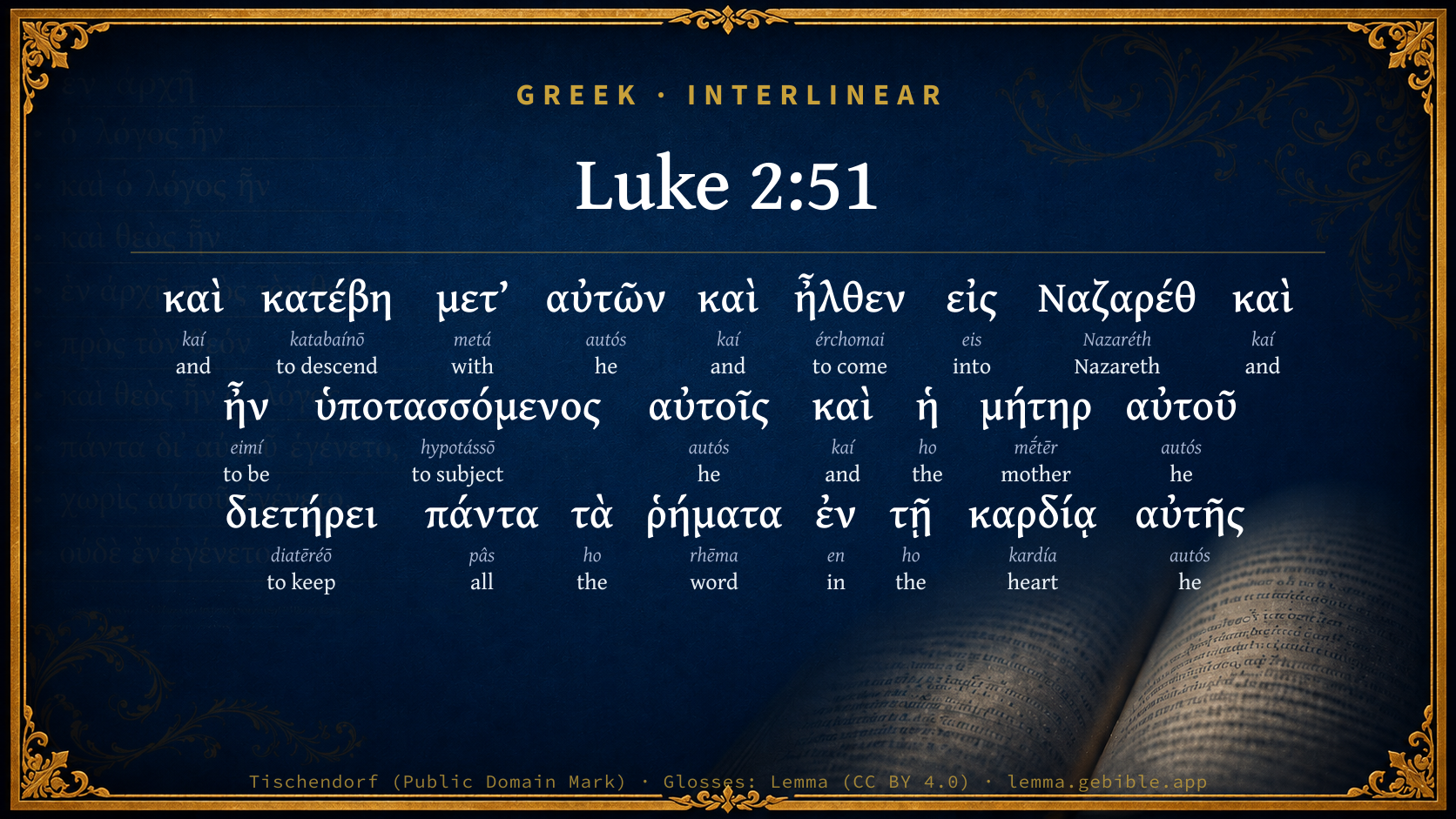
Download image
Cite this verse

Luke 2:51 (World English Bible). Public Domain. Lemma interlinear Bible study tool, https://lemma.gebible.app/v/luke/2/51.

Show BibTeX & RIS
BibTeX
RIS
English Translation
And he went down with them, and came to Nazareth. He was subject to them, and his mother kept all these sayings in her heart.
World English Bible · Public Domain
Highlights
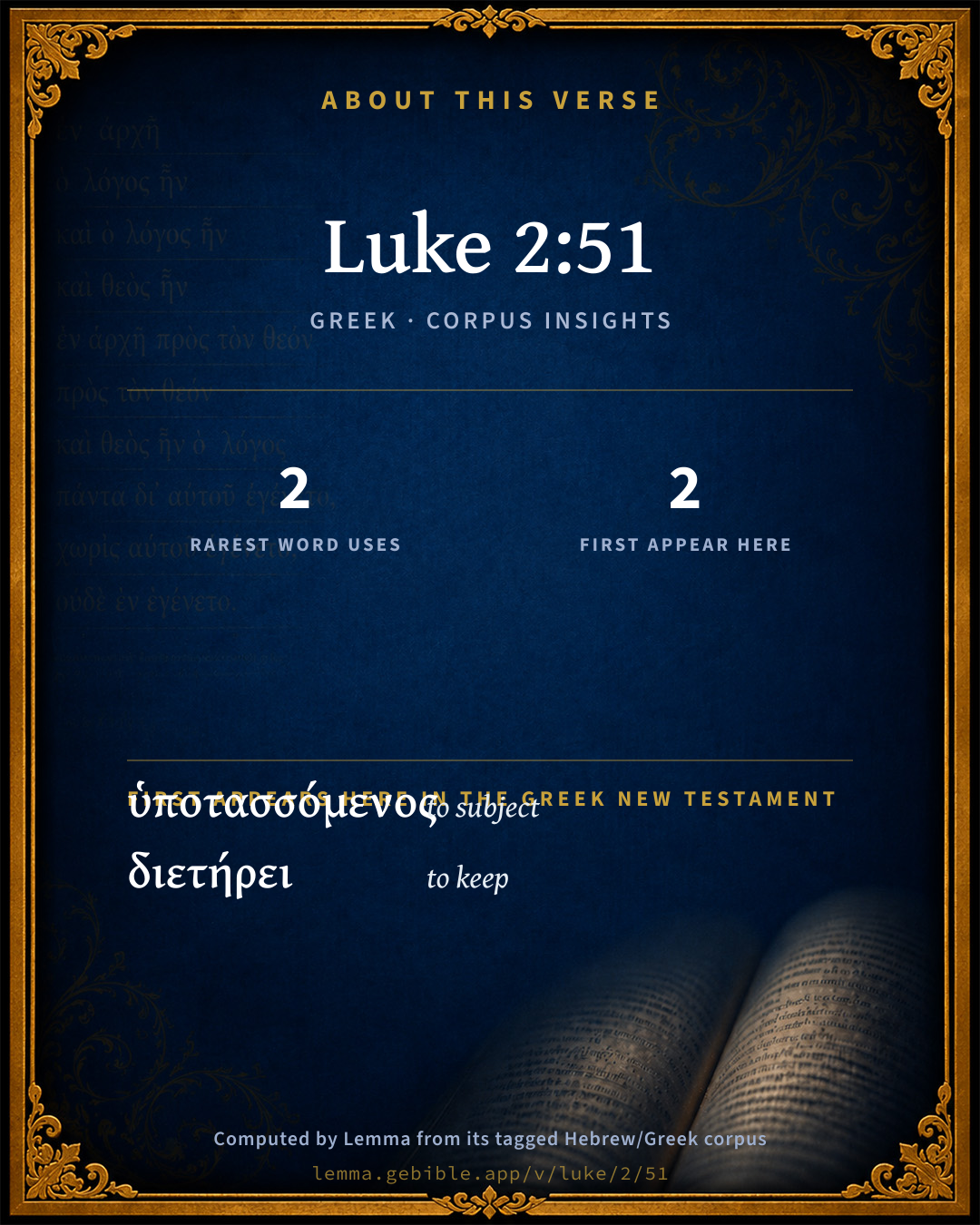
  • 2 first appearances in the Greek New Testament
Full analysis ↓
Download a study sheet

One document with this verse’s original text, its word-by-word gloss line, the meaning frame, cross-references with their text, attributed commentary, and full source and license credits — printable, and it pastes into notes with its structure intact.

This verse Autodidact and up

Study sheet (.html) Plain text (.txt)

A passage Seminary Student

Up to 50 verses in one chapter. A passage sheet keeps up to 6 commentary sources and 12 cross-references per verse, in the order this page ranks them, and says so on the sheet whenever that leaves anything out. Ask for a single verse and you get the Autodidact verse sheet above.

Everything on this page stays free to read, with no account — the sheet is a download of what is already on screen, not access to it.

Want to remove ads? Support Godless Engineer
Compare translations 3

The same verse in 3 English versions, stacked beneath the original-language interlinear above. Click any original word for its lexicon entry.

Each is an independent rendering of the whole verse — the interlinear is not word-aligned to these translations.

Highlighted words mark where these versions differ — a whole-verse word diff, not a word-by-word alignment.

  • World English Bible Public Domain
    And he went down with them, and came to Nazareth. He was subject to them, and his mother kept all these sayings in her heart.
  • King James Version Public Domain
    And he went down with them, and came to Nazareth, and was subject unto them: but his mother kept all these sayings in her heart.
  • unfoldingWord Literal Text CC BY-SA 4.0
    Then he went down with them and came to Nazareth and was subjected to them. But his mother kept all these things in her heart.

unfoldingWord Literal Text — © unfoldingWord, licensed CC BY-SA 4.0. Word-aligned USFM3 via Door43 (git.door43.org/unfoldingWord/en_ult).

Versions to compare (up to 4)

3 of 4 selected

Show all 19 translations

Every available English version of this verse, each an independent rendering of the whole verse.

  • World English Bible Public Domain
    And he went down with them, and came to Nazareth. He was subject to them, and his mother kept all these sayings in her heart.
  • Berean Standard Bible Public Domain
    Then He went down to Nazareth with them and was obedient to them. But His mother treasured up all these things in her heart.
  • Majority Standard Bible Public Domain
    Then He went down to Nazareth with them and was obedient to them. But His mother treasured up all these things in her heart.
  • King James Version Public Domain
    And he went down with them, and came to Nazareth, and was subject unto them: but his mother kept all these sayings in her heart.
  • American Standard Version (1901) Public Domain
    And he went down with them, and came to Nazareth; and he was subject unto them: and his mother kept all `these' sayings in her heart.
  • Revised Version (1885) Public Domain
    And he went down with them, and came to Nazareth; and he was subject unto them: and his mother kept all these sayings in her heart.
  • Geneva Bible (1599) Public Domain
    Then hee went downe with them, and came to Nazareth, and was subiect to them: and his mother kept all these sayings in her heart.
  • Douay-Rheims (1899) Public Domain
    And he went down with them, and came to Nazareth, and was subject to them. And his mother kept all these words in her heart.
  • Young's Literal Translation Public Domain
    and he went down with them, and came to Nazareth, and he was subject to them, and his mother was keeping all these sayings in her heart,
  • Literal Standard Version CC BY-SA 4.0
    and He went down with them, and came to Nazareth, and He was subject to them, and His mother was keeping all these sayings in her heart,
  • Unlocked Literal Bible CC BY-SA 4.0
    Then he went back home with them to Nazareth and was obedient to them. His mother treasured all these things in her heart.
  • unfoldingWord Literal Text CC BY-SA 4.0
    Then he went down with them and came to Nazareth and was subjected to them. But his mother kept all these things in her heart.
  • Darby Bible Public Domain
    And he went down with them and came to Nazareth, and he was in subjection to them. And his mother kept all these things in her heart.
  • World Messianic Bible Public Domain
    And he went down with them and came to Nazareth. He was subject to them, and his mother kept all these sayings in her heart.
  • Webster's Bible Public Domain
    And he went down with them, and came to Nazareth, and was subject to them: but his mother kept all these sayings in her heart.
  • Free Bible Version CC BY-SA 4.0
    Then he went back with them to Nazareth, and did what he was told. His mother kept a careful note of everything that happened.
  • Bible in Basic English Public Domain
    And he went down with them and came to Nazareth; and did as he was ordered: and his mother kept all these words in her heart.
  • Text-Critical English NT CC BY 4.0
    Then he went down with them and came to Nazareth and was obedient to them. And his mother kept all these things in her heart.
  • Tyndale New Testament (1534) Public Domain
    And he went with them and came to Nazareth and was obedient to the. But his mother kept all these thinges in her hert.

Literal Standard Version (2020), Covenant Press — licensed CC BY-SA 4.0. Text via the HelloAO Bible API (eBible.org). Unlocked Literal Bible (unfoldingWord) — licensed CC BY-SA 4.0. Text via the HelloAO Bible API (eBible.org). unfoldingWord Literal Text — © unfoldingWord, licensed CC BY-SA 4.0. Word-aligned USFM3 via Door43 (git.door43.org/unfoldingWord/en_ult). Free Bible Version, Dr. Jonathan Gallagher — licensed CC BY-SA 4.0. Text via the HelloAO Bible API (eBible.org).

Word by word

More ways to search: Search by grammar → Find every occurrence → Compare this word →

Practice this passage: Drill this verse → Learn its vocabulary →

διετήρει
diatēréō
G1301
“to keep”
Verb, Imperfect, Active, Indicative, 3rd person, Singular
Part of Speech
Verb
Tense
Imperfect
Voice
Active
Mood
Indicative
Person
3rd person
Number
Singular
Full Thayer's Definition

Origin: from G1223 and G5083

TDNT: 10:31,1

1. to keep continually or carefully
  1. καὶ kaí G2532 “and” Conjunction
  2. κατέβη katabaínō G2597 “to descend” Verb, Aorist, Active, Indicative, 3rd person, Singular
  3. μετ’ metá G3326 “with” Preposition
  4. αὐτῶν autós G846 “he” Personal pronoun, Genitive, Plural, Masculine
  5. καὶ kaí G2532 “and” Conjunction
  6. ἦλθεν érchomai G2064 “to come” Verb, Aorist, Active, Indicative, 3rd person, Singular
  7. εἰς eis G1519 “into” Preposition
  8. Ναζαρέθ Nazaréth G3478 “Nazareth” Noun, Proper, indeclinable
  9. καὶ kaí G2532 “and” Conjunction
  10. ἦν eimí G1510 “to be” Verb, Imperfect, Active, Indicative, 3rd person, Singular
  11. ὑποτασσόμενος hypotássō G5293 “to subject” Verb, Present, Passive, Participle, Nominative, Singular, Masculine
  12. αὐτοῖς autós G846 “he” Personal pronoun, Dative, Plural, Masculine
  13. καὶ kaí G2532 “and” Conjunction
  14. ἡ ho G3588 “the” Article, Nominative, Singular, Feminine
  15. μήτηρ mḗtēr G3384 “mother” Noun, Nominative, Singular, Feminine
  16. αὐτοῦ autós G846 “he” Personal pronoun, Genitive, Singular, Masculine
  17. πάντα pâs G3956 “all” Adjective, Accusative, Plural, Neuter
  18. τὰ ho G3588 “the” Article, Accusative, Plural, Neuter
  19. ῥήματα rhēma G4487 “word” Noun, Accusative, Plural, Neuter
  20. ἐν en G1722 “in” Preposition
  21. τῇ ho G3588 “the” Article, Dative, Singular, Feminine
  22. καρδίᾳ kardía G2588 “heart” Noun, Dative, Singular, Feminine
  23. αὐτῆς autós G846 “he” Personal pronoun, Genitive, Singular, Feminine

About this verse

These counts appear in no published source. They are computed here, from the morphology-tagged text and Lemma’s own curated glosses. What Lemma adds →

24
words
16
distinct lemmas
Gospels
section

Notable vocabulary

The rarest word here is διετήρει to keep G1301 — appearing just 2 times in the whole Greek New Testament.

First appearance in Scripture

These words make their first canonical appearance in the Greek New Testament here:

  • ὑποτασσόμενος to subject G5293
  • διετήρει to keep G1301

Shared distinctive vocabulary

διετήρει to keep G1301 occurs in 2 verses of the Greek New Testament. Also found in:
Repetition

Words recur within this verse:

Cross-references

9

Topical passages linked to Luke 2:51 in the Treasury of Scripture Knowledge — connected by theme and wording, ordered by reader-vote popularity; previews shown in the World English Bible.

  • Luke 2:19 But Mary kept all these sayings, pondering them in her heart.
  • Genesis 37:11 His brothers envied him; but his father kept this saying in mind.
  • Daniel 7:28 Here is the end of the matter. As for me, Daniel, my thoughts much troubled me, and my face was changed in me: but I kept the matter in my heart.
  • Mark 6:3 Isn't this the carpenter, the son of Mary, and brother of James, Joses, Judas, and Simon? Aren't his sisters here with us?" They were offended at him.
  • Matthew 3:15 But Jesus, answering, said to him, "Allow it now, for this is the fitting way for us to fulfill all righteousness." Then he allowed him.
  • Ephesians 5:21 subjecting yourselves one to another in the fear of Christ.
  • Ephesians 6:1–2 Children, obey your parents in the Lord, for this is right.
  • 1 Peter 2:21 For to this you were called, because Christ also suffered for us, leaving you an example, that you should follow his steps,
  • Luke 2:39 When they had accomplished all things that were according to the law of the Lord, they returned into Galilee, to their own city, Nazareth.

Cross-references courtesy of OpenBible.info (CC BY 4.0).

Commentary

Notes on Luke 2:51 from classic Christian and Jewish commentators (each source and its license shown beneath its notes). The classic Christian expositions comment on the surrounding passage and are grouped to its opening verse, so a note may address several verses; the Jewish commentaries on the Tanakh (Rashi and others) are per-verse, so they appear only where the commentator wrote on this verse.

Lemma curates 59 commentaries, every one of them public domain or Creative Commons licensed, each selected and text-cleaned for this edition rather than reprinted as found. About our sources →

Joseph Benson's Commentary

Luk 2:51. And he went down with them to Nazareth — That he might not seem to encourage disobedience in children, by withdrawing himself in that weak age from under the government of his parents, he very willingly retired with them into the obscure city of Nazareth, where for many years he was, as it were, buried alive. Doubtless he came up to Jerusalem to worship at the feast three times a year: but whether he ever went again into the temple to dispute with the doctors there, we are not told; it is, however, not improbable that he might. But we learn here, what it is more important that all children should know, namely, that he was subject to his parents. Though his parents were poor and mean, though his father, so called, was only his supposed father; yet he was subject to them; though he was strong in spirit and filled with wisdom, nay, though he was in a peculiar and proper sense the Son of God most high, yet he was subject to his human parents: how then will they answer it to God who, though ignorant, foolish, weak, and wretched, yet are disobedient to their parents? But his mother kept all these sayings in her heart — She was deeply impressed with them, and thought much upon them, though she did not perfectly understand them. Doubtless she expected that hereafter they would be explained to her, and she should not only fully comprehend their meaning, but derive important instruction from them.

Joseph Benson's Commentary on the Old and New Testaments (1811–1818) — public domain. Text from a community e-Sword module.

Tyndale Open Study Notes

Tyndale Open Resources

2:51 Although Jesus recognized his relationship to his heavenly Father, he was obedient to his earthly parents.

Tyndale Open Study Notes — © Tyndale Open Resources, licensed CC BY-SA 4.0. Text via the HelloAO Bible API.

Bengel's Gnomon

Johann Albrecht Bengel

Luk 2:51. [Εἰς Ναζαρὲτ, to Nazareth) In that place, wherein men were supposing that nothing good resided, He who was the only good man was now staying.—V. g.]—ὑποτασσόμενος, subject) of His own free will. Marvellous was the subjection of Him, to whom all things are subject. Even previously He had been subject to them; but this is expressly mentioned now, when it might seem that He could have by this time exempted Himself from their control. There was not even vouchsafed to the angels such an honour as was vouchsafed to the parents of Jesus.—αὐτοῖς, unto them) After this passage there is no mention of Joseph; so that it is probable that Joseph died a short while after, and that Jesus experienced the trials to which orphans are subjected. See Mar 6:2; Joh 2:12. The Theol. du Cæur, Part i. pp. 9, 10, has marvellous things respecting S. Joseph.—διετήρει) So the LXX. Gen 37:11, διετήρησε τὸ ῥῆμα.

Bengel's Gnomon of the New Testament — English translation (T&T Clark, Edinburgh, 1860) — public domain. Text from a community e-Sword module.

Expositor's Greek Testament

ed. W. Robertson Nicoll

Luk 2:51 . κατέβη , He went down with them, gentle, affectionate, habitually obedient ( ὑποτασσόμενος ), yet tar away in thought, and solitary. διετήρει : she did not forget, though she did not understand.

The Expositor's Greek Testament, edited by W. Robertson Nicoll (1897–1910) — public domain. Text from a community e-Sword module.

Godet's Commentaries

Frédéric Louis Godet

3. The residence at Nazareth: Luk 2:51-52.

From this moment Jesus possesses within Him this ideal of a life entirely devoted to the kingdom of God, which had just flashed before His eyes. For eighteen years He applied Himself in silence to the business of His earthly father at Nazareth, where He is called the carpenter (Mar 6:3). The analytical form ἦν ὑποτασσόμενος indicates the permanence of this submission; and the pres. partic. mid., submitting Himself, its spontaneous and deliberate character. In this simple word, submitting Himself, Luke has summed up the entire work of Jesus until His baptism.

But why did not God permit the child to remain in the temple of Jerusalem, which during the feastdays had been His Eden? The answer is not difficult. He must inevitably have been thrown too early into the theologico-political discussions which agitated the capital; and after having excited the admiration of the doctors, He would have provoked their hatred by His original and independent turn of thought. If the spiritual atmosphere of Nazareth was heavy, it was at least calm; and the labours of the workshop, in the retirement of this peaceful valley, under the eye of the Father, was a more favourable sphere for the development of Jesus than the ritualism of the temple and the Rabbinical discussions of Jerusalem.

The remark at the end of Luk 2:51 is similar to that at Luk 2:19; only for the verb συντηρεῖν, which denoted the grouping of a great number of circumstances, to collect and combine them, Luke substitutes here another compound, διατηρεῖν. This δια denotes the permanence of the recollection, notwithstanding circumstances which might have effaced it, particularly the inability to understand recorded in Luk 2:50. She carefully kept in her possession this profound saying as an unexplained mystery.

The fifty-second verse describes the youth of Jesus, as the fortieth verse had depicted His childhood; and these two brief sketches correspond with the two analogous pictures of John the Baptist (Luk 1:66; Luk 1:80). Each of these general remarks, if it stood alone, might be regarded, as Schleiermacher has suggested, as the close of a small document. But their relation to each other, and their periodical recurrence, demonstrate the unity of our writing. This form is met with again in the book of the Acts.—῾Ηλικία does not here denote age, which would yield no meaning at all, but height, stature, just as Luk 19:3. This term embraces the entire physical development, all the external advantages; σοφία, wisdom, refers to the intellectual and moral development. The third term, favour with God and men, completes the other two. Over the person of this young man there was spread a charm at once external and spiritual; it proceeded from the favour of God, and conciliated towards Him the favour of men. This perfectly normal human being was the beginning of a reconciliation between heaven and earth. The term wisdom refers rather to with God; the word stature to with men. The last words, with men, establish a contrast between Jesus and John the Baptist, who at this very time was growing up in the solitude of the desert; and this contrast is the prelude to that which later on was to be exhibited in their respective ministries.

There is no notion for the forgetfulness or denial of which theology pays more dearly than that of a development in pure goodness. This positive notion is derived by biblical Christianity from this verse. With it the humanity of Jesus may be accepted, as it is here presented by Luke, in all its reality.

Frédéric Louis Godet — Commentaries on Luke, John, Romans, and 1 Corinthians — English translation (T&T Clark, Edinburgh, 1870s–1890s) — public domain. Text from a community e-Sword module.

Geneva Bible (1599)

Geneva Bible translators

Christ very man is made like unto us in all things, except sin.

Geneva Bible (1599) marginal notes — public domain. Text via Bolls.life.

Adam Clarke's Commentary

Verse 51. Was subject unto them] Behaved towards them with all dutiful submission. Probably his working with his hands at his reputed father's business, is here also implied: See Clarke on Lu 2:41. No child among the Jews was ever brought up in idleness. Is not this the carpenter? was a saying of those Jews who appear to have had a proper knowledge of his employment while in Joseph's house. See Clarke on Mt 13:55.

Adam Clarke's Commentary on the Bible (1810–1826) — public domain. Text from a community e-Sword/MySword module.

Ellicott's Commentary for English Readers

(51) Was subject unto them.—There was, therefore, in the years that followed, no premature assumption of authority—nothing but the pattern of a life perfect in all its home-relationships. In such a household as that of the carpenter of Nazareth, this subjection must, in the nature of things, have involved much manual and menial work—a share in the toil alike of the workshop and the house.

His mother kept all these sayings.—The repetition of words like those of Luk_2:19 is significant. The twelve years that had passed had not changed the character of the Virgin Mother. It was still conspicuous, more even than that of Joseph, for the faith which accepted what it could not understand, and waited patiently for the solution of its perplexities.

A Bible Commentary for English Readers, edited by Charles John Ellicott (1878–1897) — public domain. Text from a community e-Sword module.

The Cambridge Bible for Schools and Colleges

gen. ed. J. J. S. Perowne

51. with them] We may infer from the subsequent omission of Joseph’s name, and from the traditional belief of his age, that he died shortly after this event, as the Apocryphal Gospels assert.

to Nazareth] In many respects there was a divine fitness in this spot for the human growth of Jesus—“as a tender plant and a root out of the dry ground.” Apart from the obscurity and evil fame of Nazareth which were meant to teach lessons similar to those of which we have just spoken, we may notice (i) its seclusion. It lies in a narrow cleft in the limestone hills which form the boundary of Zabulon entirely out of the ordinary roads of commerce, so that none could say that our Lord had learnt either from Gentiles or from Rabbis. (ii) Its beauty and peacefulness. The flowers of Nazareth are famous, and the appearance of its inhabitants shews its healthiness. It was a home of humble peace and plenty. The fields of its green valley are fruitful, and the view from the hill which overshadows it is one of the loveliest and most historically striking in all Palestine.

was subject unto them] “He made Himself of no reputation, and took upon Him the form of a servant,” Php_2:7; Isa_53:2. With the exception of these two verses, the Gospels preserve but one single word to throw light on the Life of our Lord, between His infancy and His baptism. That word is “the carpenter” in Mar_6:3, altered in some MSS. out of irreverent and mistaken reverence into “the son of the carpenter.” They shew that (i) our Lord’s life was spent in poverty but not in pauperism; (ii) that He sanctified labour as a pure and noble thing; (iii) that God looks on the heart, and that the dignity or humility, the fame or obscurity, of the outer lot is of no moment in His eyes. Rom_14:17-18.

The Cambridge Bible for Schools and Colleges (gen. ed. J. J. S. Perowne; Cambridge University Press, 1878–1918) — public domain. Text from a community e-Sword module.

John Gill's Exposition

And Jesus increased in wisdom,.... As man; for neither his divine wisdom, nor the treasures of wisdom and knowledge in him, as mediator, could admit of any increase; but as he grew in body, the faculties of his soul opened, and received gradually large measures of wisdom and knowledge, in things natural and spiritual, through the in dwelling of his divine nature in him, and the Holy Spirit that was, without measure, on him:

and stature: the word signifies age also; and so the Vulgate Latin has rendered it: but that is not the meaning of it here, since it would have been entirely unnecessary to have observed, that he increased in age, which must be unavoidable: but the sense is, that as he increased in the wisdom and knowledge of his human soul, so he likewise increased in the stature of his body: and in favour with God and man: he appeared by the grace that was in him, and the gifts bestowed on him, to be high in the love and favour of God; and had a large share in the esteem and affections of all good men, who had the honour and happiness of knowing him, and of being acquainted with him.

Next: Luke Chapter 3

John Gill's Exposition of the Whole Bible (1746–1763) — public domain (CC PDM 1.0). Text via the HelloAO Bible API.

Trapp's Complete Commentary

John Trapp

51 And he went down with them, and came to Nazareth, and was subject unto them: but his mother kept all these sayings in her heart.

Ver. 51. And was subject unto them] Labouring with his hands, &c., Mar 6:5.

John Trapp, A Commentary or Exposition upon All the Books of the Old and New Testament (1647–1656) — public domain. Text from a community e-Sword module.

Albert Barnes' Notes on the Bible

Went down with them - Down from Jerusalem, which was in a high, mountainous region.

Was subject unto them - Performed the duty of a faithful and obedient child, and not improbably was engaged in the trade of Joseph - that of a carpenter. Every Jew was required to learn some trade, and there is every reason to think that our Saviour followed that of his reputed father. And from this we learn:

1. That obedience to parents is a duty. Jesus has set an example in this that all children should follow. Though he was the Son of God, and on proper occasions was engaged in the great work of redemption, yet he was also the “son of Mary,” and he loved and obeyed his mother, and was “subject” to her.

2. It is no dishonor to be a mechanic, or to be brought up in an obscure employment. Jesus has conferred honor on virtuous industry, and no man should be ashamed of industrious parents, though poor, or of a condition of life that is far from ease and affluence. Industry is honorable, and virtuous poverty should not be regarded as a matter of reproach. The only thing to be ashamed of, in regard to this matter, is when people are idle, or when children are too proud to hear or speak of the occupation of their parents, or to follow the same occupation.

Albert Barnes' Notes on the Bible (1834–1885) — public domain. Text from a community e-Sword/MySword module.

Haydock's Catholic Bible Commentary

Was subject to them. Astonishing humility! which the Son of God was pleased to teach by his example, as also obedience to parents. (Witham) --- The evangelist relates nothing of our Saviour from the age of twelve till the age of thirty, except that he was subject to St. Joseph and the blessed Virgin. The divine Spirit shewing by this, that nothing is so great and amiable in Christians, as ready obedience to the directions of their superiors. (Barradius) --- All children are hereby taught what subjection and obedience is due from them to their parents.

George Leo Haydock (1774–1849), Haydock's Catholic Family Bible and Commentary, 1859 edition — public domain. Excludes Psalms (Douay-Rheims chapter numbering differs from Protestant) and Deuterocanonical books (Catholic canon only).

Matthew Poole's English Annotations

We left him at Nazareth, after Mary’s purification, Luk 2:39; we find him at Nazareth now at twelve years old. We shall now read no more of him till Luk 3:23, when he came to be about thirty years of age. What he did in the mean time is a business of too much curiosity for us to inquire, and of very little significance to us if we knew. Some think he wrought with his father upon his trade. As I cannot tell how to prove it, so I know nothing against it. It is not likely he was sent to any of the schools of their prophets, as he who could argue with the doctors pertinently at twelve years of age, and to whom the Spirit was given not by measure, had no need of their instructions: so their academies were not such as we can reasonably think that Joseph and Mary should seek any education for him in them; and I know no reason why we should think, that he who abhorred not the womb of the virgin, nor a stable, nor a manger, should abhor the works of an honest vocation, and not much more abhor an idle life. But we dispute about these things in vain, being such as to which we can never be satisfied (God having hidden them from our knowledge); what is for our instruction is told us, he was subject unto his parents. This teacheth the greatest and highest mortals to honour their fathers and mothers; which (saith the apostle) is the first commandment with promise. Solomon honoured his mother, and behold a greater than Solomon is here, paying his homage also both to the womb that bare him, and to his (supposed) father that provided for him, and protected him.

But his mother kept all these sayings in her heart. Mary was no forgetful hearer, some things she did not yet clearly understand, but she kept them in her heart; and those who do so as to God’s word shall in time understand them.

Matthew Poole's English Annotations on the Holy Bible (1683–1685) — public domain. Text from a community e-Sword/MySword module.

Whedon's Commentary on the Bible

Daniel D. Whedon

51. Was subject unto them—And thus from the very divinity of his nature he was able to give the most wonderful example of filial obedience known or conceivable.

Kept all these sayings—Who should remember them but that mother? And from whom could Luke, or whoever was the writer of this account, derive it but from her lips?

Daniel D. Whedon (gen. ed.), Commentary on the Old and New Testaments (1874–1909) — public domain. Text from a community e-Sword module.

The Pulpit Commentary

And he went down with them, and came to Nazareth. The question of Mary, and the quiet grave answer of the Child Jesus, were all that seems to have taken place. It served, no doubt, to bring back to Mary"s mind what had long passed, and the memory of which for her was beginning somewhat to fade. This was, no doubt, one of the uses of the temple scene, but it had other and deeper purposes to serve. It was then, perhaps, as we have already reverently surmised, in the gradual development and growth of the Redeemer, that consciousness who he really was first dawned upon "the Child Jesus." And was subject unto them. This recital of the temple scene, the meeting with the great rabbis there, the few words of surprise addressed by the Boy to Mary and Joseph when they sought him "sorrowing if it were possible," to use Stier"s expression, for "him to be in wrong or in danger this recital alone breaks the deep silence which shrouds the first thirty years of "the Life." For some eighteen years after that visit to Jerusalem Jesus appears to have lived and toiled as a carpenter at Nazareth, with Joseph and Mary while they both lived, with Mary and his half-sisters and brothers when Joseph was dead. Justin Martyr, living a century and a half later, speaks of the ploughs and yokes the Master"s own hands had fashioned during float long quiet pause in his life. Why, it is often asked, were not these years spent in Jerusalem and in the temple neighborhood, in the center of busy life and active Jewish thought? Godet suggests an answer which, if not exhaustive, is at least satisfactory: "If the spiritual atmosphere of Nazareth was heavy, it was at least calm; and the labors of the workshop, in the retirement of this peaceful valley, under the eye of the Father, was a more favorable sphere for the development of Jesus than the ritualism of the temple and the rabbinical discussions of Jerusalem." Joseph is never again mentioned in the gospel story; the probability is that he died some time in that period of eighteen years. But his mother kept all these sayings in her heart. As twelve years before, Mary pondering in her heart had treasured up the rough adoration of the shepherds and their strange story of what the angels said to them about her Child (ver. 19), as doubtless she had done too when the Magi laid their costly gifts before the Babe at Bethlehem, and when Simeon and Anna in the temple spoke their prophetic utterances over the Infant; so now the mother, in quiet humble faith, stored up again her Son"s sayings in her heart, waiting with brave and constant patience for the hour when her God should grant her to see face to face the mysterious things she had hitherto seen only "in a glass darkly.

Vers. 51, 52. Growth, our Lord"s and our own.

The growth of Jesus Christ his subjection to his parents teach us some things respecting him, and they suggest some things for our own guidance.

I THE GROWTH OF JESUS CHRIST.

1. The fullness of his condescension. We find this in his stooping so far as

(1) to make it becoming that he should "be subject to" his parents, and

(2) to make it possible that he should grow.

How the Infinite One could so bereave himself of his infinitude as to be able to increase in wisdom, we cannot understand. But we cannot understand infinitude at all, and we act wisely when we do not draw hard-and-fast deductions from it. We stand on far firmer ground when we take the statement of the historian in its natural sense, and open our mind to the fact that Jesus Christ, "our Lord and our God," did stoop so far that it was possible for him to increase in knowledge and in favor with God and with man. We do not question the reality of his growth in body; why should we doubt, or receive with any reserve, the affirmation that he grew also in mind?

2. The harmoniousness of his growth. He grew

(1) in bodily stature, and, of course, in all bodily strength and skill;

(2) in mental equipment in technical knowledge, or in the "education" of his time, in appreciation of nature, in knowledge of mankind, in apprehension of Divine truth, in general intellectual enlargement;

(3) in spiritual beauty and nobility favor with God and man." Not that he was at any time faulty or lacking in any excellency which it behoved him at that time to show, but that, as his faculties expanded and his opportunities of manifesting character were multiplied, he developed all that was admirable in the sight of man and of God. There is a far greater possibility of spiritual beauty and nobility in a young man with matured faculty and widening relationships than in the very little child, restricted, as he must be, in powers and in surroundings. So, as Jesus increased in years and grew in wisdom, there was in him an unfolding of moral and spiritual worth which attracted the eyes of men and which satisfied the Spirit of the Holy One himself.

II OUR HUMAN GROWTH.

1. Unlike our Lord, there is no element of condescension implied in our growth. We did not stoop to infancy; our course had then its commencement; and in the youngest child, with all its helplessness, but with all its latent capacities, there is a great gift from the hand of God. Whatever it means, in its humiliations and in its practical illimitableness, it is so much more than we could claim.

2. As with our Lord, our growth should be harmonious. All the three elements in our compound nature should undergo simultaneous and proportionate development. This is at first a parental question, but subsequently it is one that affects every one capable of growth.

(1) Training of the body; its nurture and culture, so that it shall be continually advancing in strength and skill and symmetry.

(2) Discipline of the mind; its instruction and exercise, so that it will be ever increasing in knowledge and enlarging in faculty.

(3) Culture of the character; its guidance and formation, so that there shall be

(a) attractiveness in the sight of man, and

(b) worthiness in the judgment of God.

It is, indeed, true that we may not give pleasure to men in proportion as we grow in moral and spiritual worth, for, as with our Master, our purity and devotion may be an offense unto them. It is also to be remembered that we may gain God"s distinct approval long before we have reached the point of irreproachableness; for that which he delights to see in his children is an earnest effort after, and a constant growth towards, that which is true and pure and generous. C.

The Pulpit Commentary (1880–1919), ed. H.D.M. Spence-Jones & Joseph S. Exell — public domain. Text from a community e-Sword module.

Kretzmann's Popular Commentary

Paul E. Kretzmann

The return to Nazareth:

v. 51 And He went down with them and came to Nazareth, and was subject unto them; but His mother kept all these sayings in her heart.

v. 52. And Jesus increased in wisdom and stature, and in favor with God and man.

A period of approximately eighteen years is covered in this simple statement of the evangelist. Although He had given His parents evidence of a greater and higher calling, He yet went with them as an obedient son. He was subject to them. In His complete fulfillment of the Law for our sakes He willingly subjected Himself to every commandment and rendered a perfect obedience, in order to atone, also in this respect, for the sins of the children. Note: Mary’s method of keeping the words she could not understand, of mulling over them continually, of preserving them fresh in her memory, deserves a wide imitation. Meanwhile it is recorded that the growth of Jesus was normal, both mentally and physically. His state of humiliation was so perfect that not only His body was subject to the general rule of nature, but also His mind. He continued His studies eagerly and gladly, He stored up a large fund of knowledge. Note: There was no sowing of wild oats in the sinless Christ. But the best and most excellent growth was that in spiritual matters. He grew in the favor, in the good will of both God and men. He lived His life in full accordance with the precepts which He learned, He put His full trust in His heavenly Father and gave evidence of this in a life of love, the most perfect example for the young men and women of all times.

Summary.Jesus is born at Bethlehem, visited by the shepherds, given the name Jesus at His circumcision, presented to the Lord in the Temple, where Simeon sings his beautiful hymn, seconded by the prophetess Anna, and visits Jerusalem at the age of twelve years.

Paul E. Kretzmann, Popular Commentary of the Bible (1921–1924) — public domain. Text from a community e-Sword module.

The People's New Testament

B. W. Johnson

51. He went down with them. If his heart drew him to the temple, the voice of duty called him back to Galilee, for the law required obedience to parents.

B. W. Johnson's The People's New Testament with Notes (1889–1891) — public domain. Electronic text from the Christian Classics Ethereal Library (CCEL) ThML edition.

unfoldingWord translationNotes

Door43 World Missions Community

he went back home with them

"Jesus went back home with Mary and Joseph"

was obedient to them

"obeyed them" or "was always obeying them"

treasured all these things in her heart

Here "heart" is a metonym for a person's mind or inner being. AT: "carefully remembered all these things" (See: Metonymy)

grow in wisdom and stature

"become wiser and stronger." These refer to mental and physical growth.

increased in favor with God and people

This refers to spiritual and social growth. These could be stated separately. AT: "God blessed him more and more, and people liked him more and more"

translationWords

Nazareth

obey

heart

wise

favor

God

unfoldingWord translationNotes — © Distant Shores Media and the Door43 World Missions Community, licensed CC BY-SA 4.0. Source: git.door43.org/Door43/en_tn.

Cambridge Greek Testament for Schools and Colleges

51. μετ’ αὐτῶν. We may infer from the subsequent omission of Joseph’s name, and from the traditional belief about his age, that he died shortly after this event, as the Apocryphal Gospels assert.

εἰς Ναζαρέθ. In many respects there was a divine fitness in this spot for the human growth of Jesus—“as a tender plant and a root out of the dry ground.” Apart from the obscurity and evil fame of Nazareth which were meant to teach lessons similar to those of which we have just spoken, we may notice (i) Its seclusion. It lies in a narrow cleft in the limestone hills which form the boundary of Zabulon entirely out of the ordinary roads of commerce, so that none could say that our Lord had learnt either from Gentiles or from Rabbis. (ii) Its beauty and peacefulness. The flowers of Nazareth are famous, and the appearance of its inhabitants shews its healthiness. It was a home of humble peace and plenty. The fields of its green valley are fruitful, and the view from the hill which overshadows it is one of the loveliest and most historically striking in all Palestine.

ἦν ὑποτασσόμενος αὐτοῖς. See note on Luk 1:10. “He made Himself of no reputation, and took upon Him the form of a servant,” Php 2:7; Isa 53:2. With the exception of these two verses, the Gospels preserve but one single word to throw light on the Life of our Lord, between His infancy and His baptism. That word is “the carpenter” in Mar 6:3, altered in some MSS. out of irreverent and mistaken reverence into “the son of the carpenter.” They shew that (i) our Lord’s life was spent in poverty but not in pauperism; (ii) that He sanctified labour as a pure and noble thing; (iii) that God looks on the heart, and that the dignity or humility, the fame or obscurity, of the outer lot is of no moment in His eyes. Rom 14:17-18.

Cambridge Greek Testament for Schools and Colleges (Cambridge University Press, 1896; 21 vols, various authors incl. Carr, Maclear, Plummer, Farrar, Lumby, Moule, M. R. James, Simcox) — public domain. Text from a community e-Sword module.

Alford’s Greek Testament

Henry Alford

51.] The high consciousness which had manifested itself in ver. 49 did not interfere with His self-humiliation, nor render Him independent of his parents. This voluntary subjection probably shewed itself in working at his reputed father’s trade: see Mar 6:2 and note.

From this time we have no more mention of Joseph (ch. 4:22 is not to the point): the next we hear is of His mother and brethren (Joh 2:12): whence it is inferred that, between this time and the commencement of our Lord’s public life, Joseph died.

καὶ ἡ μήτ.] These words tend to confirm the common belief that these opening chapters, or at least this narrative, may have been derived from the testimony of the mother of the Lord herself. She kept them, as in wonderful coincidence with the remarkable circumstances of His birth, and its announcement, and His presentation in the temple, and the offerings of the Magi; but in what way, or by what one great revelation all these things were to be gathered in one, did not yet appear, but was doubtless manifested to her afterwards: see Act 1:14; Act 2:1.

Henry Alford, The Greek Testament (1849–1861) — public domain. Text from a community e-Sword module.

International Critical Commentary

51. ἦν ὑποτασσόμενος. This sums up the condition of the Messiah during the next seventeen years. The analytical tense gives prominence to the continuance of the subjection: comp. 1:18, 20, 21. For ὑποτάσσειν comp. 10:17, 20.

αὐτοις The last mention of Joseph. He was almost certainly dead before Christ’s public ministry began; but this statement of continued subjection to him and Mary probably covers some years. The main object of the statement, however, may be to remove the impression that in His reply (ver. 49) Jesus resents, or henceforward repudiates, their authority over Him. Comp. Ign. Magn. xiii.

διετήρει. Expresses careful and continual keeping. Gen 37:11 is a close parallel: comp. Act 15:29. We must not confine πάντα τὰ ῥήματα to vv. 48, 49; the phrase is probably used in the Hebraistic sense of “things spoken of.” Comp. 1:65, 2:19; Act 5:32: but in all these cases “sayings” is more possible than here. Still more so in Dan 7:28: τὸ ῥῆμα ἐν τῇ καρδίᾳ μου διετήρησα [? συνετήρησα]. Syr-Sin. omits “in her heart.”

International Critical Commentary — older volumes (1896–1929), various authors — public domain. Text from a community e-Sword module.

Vincent's Word Studies in the New Testament

Marvin R. Vincent

Was subject [ην υποτασσομενος] . The participle and finite verb, denoting habitual, continuous subjection. "Even before, he had been subject to them; but this is mentioned now, when it might seem that he could by this time have exempted himself. Not even to the angels fell such an honor as to the parents of Jesus" (Bengel). Compare Heb 1:4 - 8. Kept [διετηρει] . Only here and Act 14:29. The preposition dia, through, indicated close, faithful, persistent keeping, through all the circumstances which might have weakened the impression of the events. Compare Gen 37:11.

Marvin R. Vincent, Word Studies in the New Testament (1887–1900) — public domain. Text from a community e-Sword/MySword module.

Lesson kit

Teaching starters — assembled from the data on this page, not authored interpretation. Every prompt links to the verse data it draws on. Edit before teaching.

Luke, in the Gospels, opens this verse with 24 words (16 distinct Greek lemmas). Its most distinctive word is diatēréō (“to keep”). A historical commentator’s framing appears above. Read the whole chapter for the surrounding context.

Discussion questions

  1. What does “to keep” (diatēréō) contribute to the verse as a whole?
  2. 2 words make their first appearance in Scripture here. What does this debut establish?
  3. How does Acts 15:29, which shares the word «to keep», read alongside this verse?
  4. What does the repetition of “and” (4× in this one verse) do in this verse?
  5. The translations on this page render this verse differently — a whole-verse word diff, not a word-by-word alignment. What might account for the different wordings?
  6. Compare how Joseph Benson's Commentary and Tyndale Open Study Notes read this verse. Where do they agree or differ?

Things to notice

  • 2 words make their first canonical appearance in Scripture here.
  • These translations choose different wording for 4 words in this verse.
  • “and” occurs 4× in this single verse.
  • 16 distinct Greek lemmas span 24 words in this verse.

Reading settings

Reading text

Shown beneath each verse's original-language words.

Old Testament
Old Testament edition

Read the OT as the Masoretic Hebrew (MT) or the Greek Septuagint (LXX).

English shown for the Greek Septuagint (in the Hebrew ↔ Greek comparison).

Comparing translations? Open the Compare panel on any verse page to stack up to four side by side.