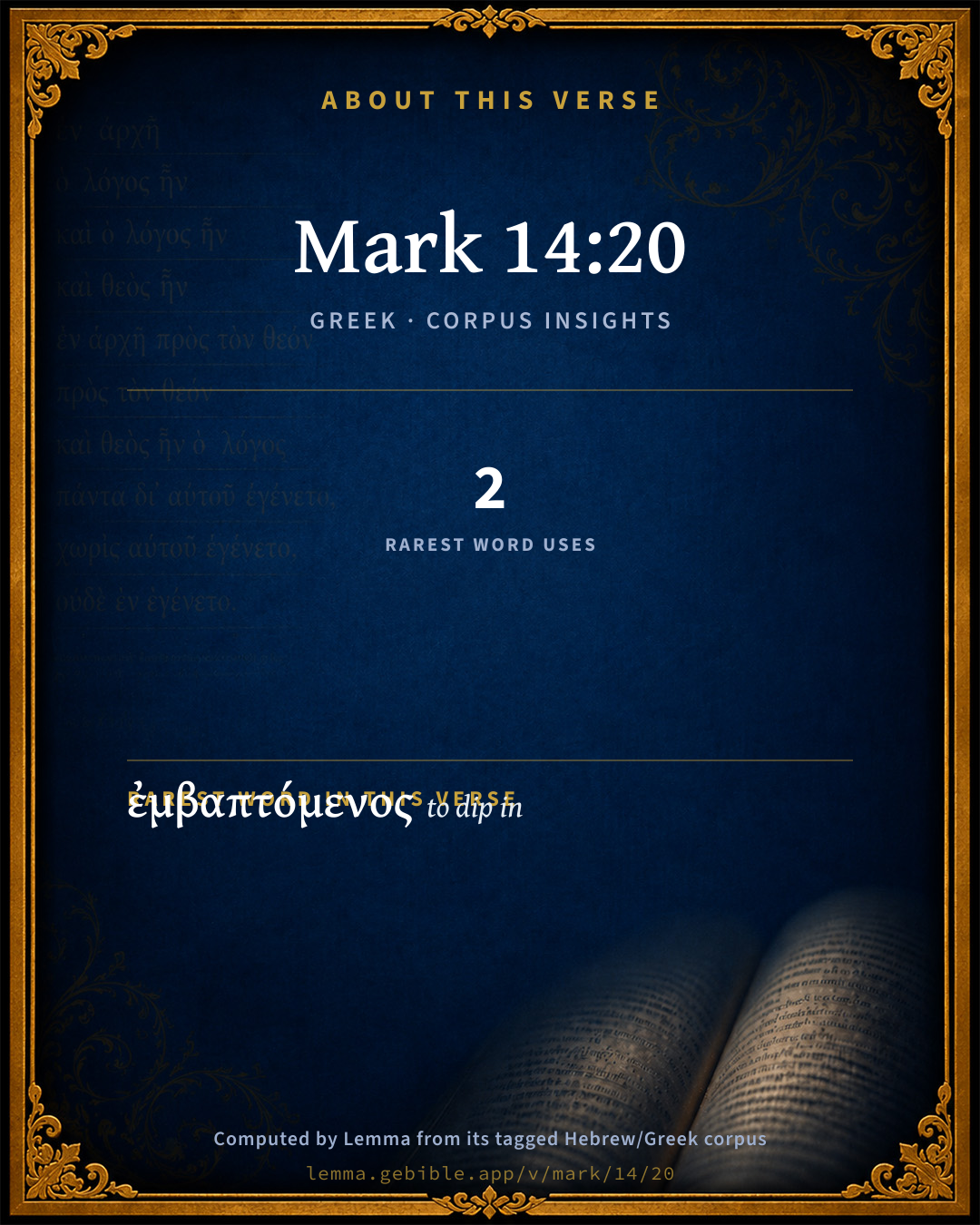
Mark 14:20

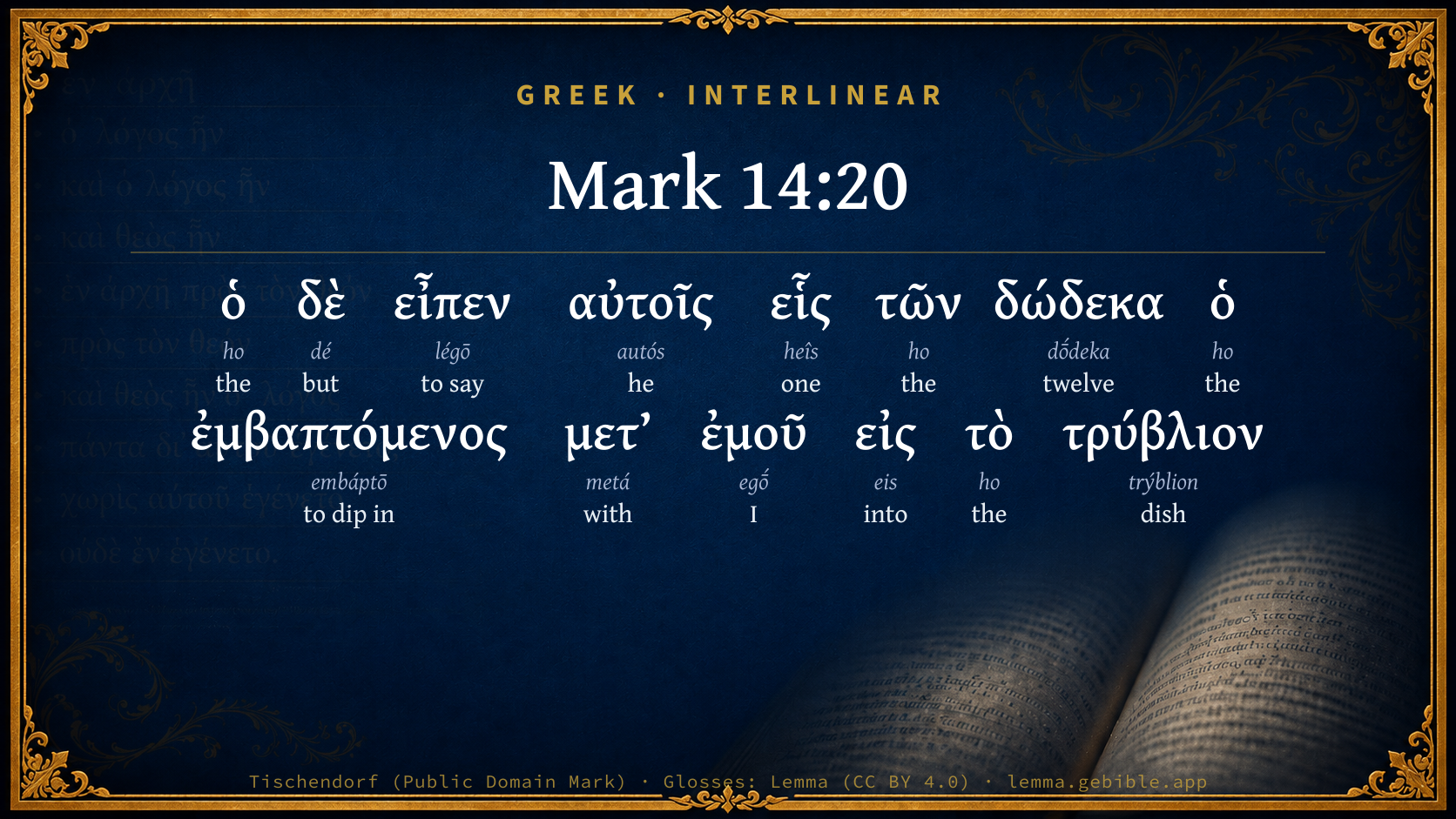
Greek (Tischendorf 8th ed.) Mark 14:20 appears in the Greek New Testament. The text above is from the Tischendorf 8th edition. Each word links to its Strong’s number and a concise gloss. Click any word for its full Thayer’s Greek Lexicon entry.
Download image
Cite this verse

Mark 14:20 (World English Bible). Public Domain. Lemma interlinear Bible study tool, https://lemma.gebible.app/v/mark/14/20.

Show BibTeX & RIS
BibTeX
RIS
English Translation
He answered them, "It is one of the twelve, he who dips with me in the dish.
World English Bible · Public Domain
Download a study sheet

One document with this verse’s original text, its word-by-word gloss line, the meaning frame, cross-references with their text, attributed commentary, and full source and license credits — printable, and it pastes into notes with its structure intact.

This verse Autodidact and up

Study sheet (.html) Plain text (.txt)

A passage Seminary Student

Up to 50 verses in one chapter. A passage sheet keeps up to 6 commentary sources and 12 cross-references per verse, in the order this page ranks them, and says so on the sheet whenever that leaves anything out. Ask for a single verse and you get the Autodidact verse sheet above.

Everything on this page stays free to read, with no account — the sheet is a download of what is already on screen, not access to it.

Want to remove ads? Support Godless Engineer
Compare translations 3

The same verse in 3 English versions, stacked beneath the original-language interlinear above. Click any original word for its lexicon entry.

Each is an independent rendering of the whole verse — the interlinear is not word-aligned to these translations.

Highlighted words mark where these versions differ — a whole-verse word diff, not a word-by-word alignment.

  • World English Bible Public Domain
    He answered them, "It is one of the twelve, he who dips with me in the dish.
  • King James Version Public Domain
    And he answered and said unto them, It is one of the twelve, that dippeth with me in the dish.
  • unfoldingWord Literal Text CC BY-SA 4.0
    And he said to them, “ one of the Twelve, the one dipping with me into the bowl.

unfoldingWord Literal Text — © unfoldingWord, licensed CC BY-SA 4.0. Word-aligned USFM3 via Door43 (git.door43.org/unfoldingWord/en_ult).

Versions to compare (up to 4)

3 of 4 selected

Show all 19 translations

Every available English version of this verse, each an independent rendering of the whole verse.

  • World English Bible Public Domain
    He answered them, "It is one of the twelve, he who dips with me in the dish.
  • Berean Standard Bible Public Domain
    He answered, “It is one of the Twelve—the one who is dipping his hand into the bowl with Me.
  • Majority Standard Bible Public Domain
    He answered, “It is one of the Twelve—the one who is dipping his hand into the bowl with Me.
  • King James Version Public Domain
    And he answered and said unto them, It is one of the twelve, that dippeth with me in the dish.
  • American Standard Version (1901) Public Domain
    And he said unto them, `It is' one of the twelve, he that dippeth with me in the dish.
  • Revised Version (1885) Public Domain
    And he said unto them, It is one of the twelve, he that dippeth with me in the dish.
  • Geneva Bible (1599) Public Domain
    And he answered and sayde vnto them, It is one of the twelue that dippeth with mee in the platter.
  • Douay-Rheims (1899) Public Domain
    Who saith to them: One of the twelve, who dippeth with me his hand in the dish.
  • Young's Literal Translation Public Domain
    And he answering said to them, `One of the twelve who is dipping with me in the dish;
  • Literal Standard Version CC BY-SA 4.0
    And He answering said to them, “One of the Twelve who is dipping with Me in the dish;
  • Unlocked Literal Bible CC BY-SA 4.0
    Jesus answered and said to them, “It is one of the twelve, the one now dipping bread with me in the bowl.
  • unfoldingWord Literal Text CC BY-SA 4.0
    And he said to them, “ one of the Twelve, the one dipping with me into the bowl.
  • Darby Bible Public Domain
    But he answered and said to them, One of the twelve, he who dips with me in the dish.
  • World Messianic Bible Public Domain
    He answered them, “It is one of the twelve, he who dips with me in the dish.
  • Webster's Bible Public Domain
    And he answered and said to them, It is one of the twelve that dippeth with me in the dish.
  • Free Bible Version CC BY-SA 4.0
    “It's one of the Twelve, one of you sharing this food with me,” he replied.
  • Bible in Basic English Public Domain
    And he said to them, It is one of the twelve, one who is putting his bread with me into the same plate.
  • Text-Critical English NT CC BY 4.0
    Jesus answered them, “It is one of the twelve, one who is dipping bread with me into the dish.
  • Tyndale New Testament (1534) Public Domain
    He answered and sayde vnto them: It ys one of the.xii. and the same deppeth with me in the platter.

Literal Standard Version (2020), Covenant Press — licensed CC BY-SA 4.0. Text via the HelloAO Bible API (eBible.org). Unlocked Literal Bible (unfoldingWord) — licensed CC BY-SA 4.0. Text via the HelloAO Bible API (eBible.org). unfoldingWord Literal Text — © unfoldingWord, licensed CC BY-SA 4.0. Word-aligned USFM3 via Door43 (git.door43.org/unfoldingWord/en_ult). Free Bible Version, Dr. Jonathan Gallagher — licensed CC BY-SA 4.0. Text via the HelloAO Bible API (eBible.org).

Word by word

More ways to search: Search by grammar → Find every occurrence → Compare this word →

Practice this passage: Drill this verse → Learn its vocabulary →

ἐμβαπτόμενος
embáptō
G1686
“to dip in”
Verb, Present, Middle, Participle, Nominative, Singular, Masculine
Part of Speech
Verb
Tense
Present
Voice
Middle
Mood
Participle
Case
Nominative
Number
Singular
Gender
Masculine
Full Thayer's Definition

Origin: from G1722 and G911

TDNT: None

1. to dip in
  1. ὁ ho G3588 “the” Article, Nominative, Singular, Masculine
  2. δὲ dé G1161 “but” Conjunction
  3. εἶπεν légō G3004 “to say” Verb, Aorist, Active, Indicative, 3rd person, Singular
  4. αὐτοῖς autós G846 “he” Personal pronoun, Dative, Plural, Masculine
  5. εἷς heîs G1520 “one” Adjective, Nominative, Singular, Masculine
  6. τῶν ho G3588 “the” Article, Genitive, Plural, Masculine
  7. δώδεκα dṓdeka G1427 “twelve” Adjective, Numeral (indeclinable)
  8. ὁ ho G3588 “the” Article, Nominative, Singular, Masculine
  9. μετ’ metá G3326 “with” Preposition
  10. ἐμοῦ egṓ G1473 “I” Personal pronoun, 1st person, Genitive, Singular
  11. εἰς eis G1519 “into” Preposition
  12. τὸ ho G3588 “the” Article, Accusative, Singular, Neuter
  13. τρύβλιον trýblion G5165 “dish” Noun, Accusative, Singular, Neuter

About this verse

These counts appear in no published source. They are computed here, from the morphology-tagged text and Lemma’s own curated glosses. What Lemma adds →

14
words
11
distinct lemmas
Gospels
section

Notable vocabulary

The rarest word here is ἐμβαπτόμενος to dip in G1686 — appearing just 2 times in the whole Greek New Testament.

Shared distinctive vocabulary

ἐμβαπτόμενος to dip in G1686 occurs in 2 verses of the Greek New Testament. Also found in:

Repetition

A word recurs within this verse:

Cross-references

6

Topical passages linked to Mark 14:20 in the Treasury of Scripture Knowledge — connected by theme and wording, ordered by reader-vote popularity; previews shown in the World English Bible.

  • John 13:26 Jesus therefore answered, "It is he to whom I will give this piece of bread when I have dipped it." So when he had dipped the piece of bread, he gave it to Judas, the son of Simon Iscariot.
  • Matthew 26:23 He answered, "He who dipped his hand with me in the dish, the same will betray me.
  • Matthew 26:47 While he was still speaking, behold, Judas, one of the twelve, came, and with him a great multitude with swords and clubs, from the chief priest and elders of the people.
  • Mark 14:43 Immediately, while he was still speaking, Judas, one of the twelve, came--and with him a multitude with swords and clubs, from the chief priests, the scribes, and the elders.
  • Luke 22:47 While he was still speaking, behold, a multitude, and he who was called Judas, one of the twelve, was leading them. He came near to Jesus to kiss him.
  • John 6:71 Now he spoke of Judas, the son of Simon Iscariot, for it was he who would betray him, being one of the twelve.

Cross-references courtesy of OpenBible.info (CC BY 4.0).

Where the printed editions differ

1 variant

Places in this verse where the major printed Greek editions disagree on the wording in a way that affects the translation — a comparison of editions, not a manuscript-by-manuscript collation. The editions are the modern critical texts (Nestlé-Aland 28/27, SBL, Westcott-Hort, Tregelles, Tyndale House) and the traditional texts behind the KJV (the Textus Receptus and the Byzantine/Majority text). It is not a claim about which reading is original.

  1. Extra text
    ἓν

    “one”

    In WH Not in NA28NA27TynSBLTregTRByz

    ἓν (hen) 'one' is only in a few manuscripts (WH)

Textual data: Translators Amalgamated Greek New Testament (STEPBible TAGNT) · CC BY 4.0.

Commentary

Notes on Mark 14:20 from classic Christian and Jewish commentators (each source and its license shown beneath its notes). The classic Christian expositions comment on the surrounding passage and are grouped to its opening verse, so a note may address several verses; the Jewish commentaries on the Tanakh (Rashi and others) are per-verse, so they appear only where the commentator wrote on this verse.

Lemma curates 59 commentaries, every one of them public domain or Creative Commons licensed, each selected and text-cleaned for this edition rather than reprinted as found. About our sources →

Bengel's Gnomon

Johann Albrecht Bengel

Mar 14:20. Ἐμβαπτόμενος, that teas dipping [but Eng. Vers., that dippeth in]) With his own hand; this is the force of the middle voice. The participle is in the imperfect tense, as ὢν is used in Joh 9:25, and ἐρχόμενος in 2 John v. 7.

Bengel's Gnomon of the New Testament — English translation (T&T Clark, Edinburgh, 1860) — public domain. Text from a community e-Sword module.

Expositor's Greek Testament

ed. W. Robertson Nicoll

Mar 14:20 . To the anxious questioning of the disciples Mk. makes Jesus reply: one of the Twelve ; he who dippeth with me in the dish . A repetition of the original declaration with variations: the Twelve for you , and dipping in the dish for eating ; the former bringing out the gravity of the fact, the Twelve chosen to be Apostles of the faith, one of them the traitor of its Author; the latter narrowing the circle within which the traitor is to be found. Twelve ate with Jesus, only three or four would dip with Him. ἐμβαπτόμενος , middle, dipping with his own hand: “haec vis medii verbi,” Bengel.

The Expositor's Greek Testament, edited by W. Robertson Nicoll (1897–1910) — public domain. Text from a community e-Sword module.

Geneva Bible (1599)

Geneva Bible translators

That useth to eat meat with me.

Geneva Bible (1599) marginal notes — public domain. Text via Bolls.life.

Adam Clarke's Commentary

Verse 20. That dippeth with me in the dish.] In the east, persons never eat together from one dish, except when a strong attachment subsists between two or more persons of the same caste; in such a case one invites another to come and sit by him and eat from the same dish. This custom seems to have existed among the Jews; and the sacred historian mentions this notice of our Lord's, It is one of the twelve, that dippeth with me in the dish, to mark more strongly the perfidy of the character of Judas.

Adam Clarke's Commentary on the Bible (1810–1826) — public domain. Text from a community e-Sword/MySword module.

The Cambridge Bible for Schools and Colleges

gen. ed. J. J. S. Perowne

20. he answered and said unto them] “Answered” is omitted in the best MSS. The intimation was made privately to St John, to whom St Peter had made a sign that he should ask who could be so base (Joh_13:23-26).

one of the twelve] One of His own “familiar friends” (Psa_41:9).

that dippeth with me] “He who is just about to dip with Me a piece of the unleavened cakes into the charoseth”—a sauce consisting of a mixture of vinegar, figs, dates, almonds, and spice, provided at the Passover—“and to whom I shall give some of it presently” (Joh_13:26). To this day at the summit of Gerizim the Samaritans on the occasion of the Passover hand to the stranger a little olive-shaped morsel of unleavened bread enclosing a green fragment of wild endive or some other bitter herb, which may resemble, except that it is not dipped in the dish, the very ‘sop’ which Judas received at the hands of Christ.” Farrar, Life, ii. p. 290.

The Cambridge Bible for Schools and Colleges (gen. ed. J. J. S. Perowne; Cambridge University Press, 1878–1918) — public domain. Text from a community e-Sword module.

John Gill's Exposition

The son of man indeed goeth,.... Out of this world by death,

as it is written; both in the book of God's decrees, and in the Scriptures of the Old Testament;

but woe to that man by whom the son of man is betrayed! whose sin will not be excused, nor lessened by fulfilling the decrees of God, and by accomplishing the prophecies of the Bible:

good were it for that man if he had never been born; so aggravating will be his crime, so dreadful his punishment; See Gill on Mat 26:24.

John Gill's Exposition of the Whole Bible (1746–1763) — public domain (CC PDM 1.0). Text via the HelloAO Bible API.

Trapp's Complete Commentary

John Trapp

20 And he answered and said unto them, It is one of the twelve, that dippeth with me in the dish.

Ver. 20. {See Trapp on "Mat 26:23"}

John Trapp, A Commentary or Exposition upon All the Books of the Old and New Testament (1647–1656) — public domain. Text from a community e-Sword module.

The Pulpit Commentary

And he said unto them, It is one of the twelve, he that dippeth with me in the dish. St. Mark here uses the present participle (oo embaptomenov), bringing the action close to the time when he was speaking. St. Matthew (Mat_26:23) has (o embaqav) "he that dipped his hand," using the aorist form. St. Mark"s form is the more graphic. The dish probably contained a sauce called charoseth, into which they dipped their food before eating it. The following appears to have been the order of the events: First, our Lord, before he instituted the Holy Sacrament of the Eucharist, foretold that he would be betrayed by one of his disciples but only in general terms. Then came the eager question from them, "Is it I?" Then Christ answered that the traitor was he who should dip his hand together with him in the dish. But this did not bring it home to the individual, because several who sat near to him were able to dip with him in the dish. So that our Lord had as yet only obscurely and indefinitely pointed out the traitor. Then he proceeded to institute "the Lord"s Supper;" after which he again intimated (Luk_22:21) that "the hand of him that betrayed him was with him on the table." Upon this. St. Peter hinted to St. John, who was "reclining in Jesus" besom," that he should ask him to say definitely and by name who it was that should betray him. Our Lord then said to St. John, "He it is, for whom I shall dip the sop, and give it him". (Joh_13:26) Our Lord then dipped the sop, and gave it to Judas Iscariot. Then it was that our Lord said to Judas, "That thou doest, do quickly" ( o poieiv poihson tacion). (Joh_13:27) Then Judas went straightway to the house of Caiaphas, and procured the band of men and officers for the completion of his horrible design.

The Pulpit Commentary (1880–1919), ed. H.D.M. Spence-Jones & Joseph S. Exell — public domain. Text from a community e-Sword module.

MacLaren's Expositions of Holy Scripture

Alexander MacLaren

Mark

THE NEW PASSOVER

Mar 14:12 - Mar 14:26.

This passage falls into three sections-the secret preparation for the Passover {Mar 14:12 - Mar 14:17}, the sad announcement of the betrayer {Mar 14:18 - Mar 14:21}, and the institution of the Lord’s Supper {Mar 14:22 - Mar 14:26}. It may be interesting to notice that in the two former of these Mark’s account approximates to Luke’s, while in the third he is nearer Matthew’s. A comparison of the three accounts, noting the slight, but often significant, variations, should be made. Nothing in the Gospels is trivial. ‘The dust of that land is gold.’

I. The secret preparation for the Passover.

The three Evangelists all give the disciples’ question, but only Luke tells us that it was in answer to our Lord’s command to Peter and John to go and prepare the Passover. They very naturally said ‘Where?’ as they were all strangers in Jerusalem. Matthew may not have known of our Lord’s initiative; but if Mark were, as he is, with apparent correctness, said to have been, Peter’s mouthpiece in his Gospel, the reticence as to the prominence of that Apostle is natural, and explains the omission of all but the bare fact of the despatch of the two. The curiously roundabout way in which they are directed to the ‘upper room’ is only explicable on the supposition that it was intended to keep them in the dark till the last moment, so that no hint might leak from them to Judas. Whether the token of the man with the waterpot was a preconcerted signal or an instance of our Lord’s supernatural knowledge and sovereign sway, his employment as a silent and probably unconscious guide testifies to Christ’s wish for that last hour to be undisturbed. A man carrying a water-pot, which was woman’s special task, would be a conspicuous figure even in the festival crowds. The message to the householder implies that he recognised ‘the Master’ as his Master, and was ready to give up at His requisition even the chamber which he had prepared for his own family celebration of the feast.

Thus instructed, the two trusted Apostles left Bethany, early in the day, without a clue of their destination reaching Judas’s hungry watchfulness. Evidently they did not return, and in the evening Jesus led the others straight to the place. Mark says that He came ‘with the twelve’; but he does not mean thereby to specify the number, but to define the class, of His attendants.

Each figure in this preparatory scene yields important lessons. Our Lord’s earnest desire to secure that still hour before pushing out into the storm speaks pathetically of His felt need of companionship and strengthening, as well as of His self-forgetting purpose to help His handful of bewildered followers and His human longing to live in faithful memories. His careful arrangements bring vividly into sight the limitations of His manhood, in that He, ‘by whom all things consist,’ had to contrive and plan in order to baffle for a moment His pursuers. And, side by side with the lowliness, as ever, is the majesty; for while He stoops to arrange, He sees with superhuman certitude what will happen, moves unconscious feet with secret and sovereign sway, and in royal tones claims possession of His servant’s possessions.

The two messengers, sent out with instructions which would only guide them half-way to their destination, and obliged, if they were to move at all, to trust absolutely to His knowledge, present specimens of the obedience still required. He sends us out still on a road full of sharp turnings round which we cannot see. We get light enough for the first stage; and when it is traversed, the second will be plainer.

The man with the water-pot reminds us how little we may be aware of the Hand which guides us, or of our uses in His plans. ‘I girded thee, though thou hast not known Me,’-how little the poor water-bearer knew who were following, or dreamed that he and his load would be remembered for ever! The householder responded at once, and gladly, to the authoritative message, which does not ask a favour, but demands a right. Probably he had intended to celebrate the Passover with his own family, in the large chamber on the roof, with the cool evening air about it, and the moonlight sleeping around. But he gladly gives it up. Are we as ready to surrender our cherished possessions for His use?

II. The sad announcement of the traitor {Mar 14:18 - Mar 14:21}.

As the Revised Version indicates more clearly than the Authorised, the purport of the announcement was not merely that the betrayer was an Apostle, but that he was to be known by his dipping his hand into the common dish at the same moment as our Lord. The prophetic psalm would have been abundantly fulfilled though Judas’s fingers had never touched Christ’s; but the minute accomplishment should teach us that Jewish prophecy was the voice of divine foreknowledge, and embraced small details as well as large tendencies. Many hands dipped with Christ’s, and so the sign was not unmistakably indicative, and hence was privately supplemented, as John tells us, by the giving of ‘the sop.’ The uncertainty as to the indication given by the token is reflected by the reiterated questions of the Apostles, which, in the Greek, are cast in a form that anticipates a negative answer: ‘Surely not I?’ Mark omits the audacious hypocrisy of Judas’s question in the same form, and Christ’s curt, sad answer which Matthew gives. His brief and vivid sketch is meant to fix attention on the unanimous shuddering horror of these faithful hearts at the thought that they could be thus guilty-a horror which was not the child of presumptuous self-confidence, but of hearty, honest love. They thought it impossible, as they felt the throbbing of their own hearts-and yet-and yet-might it not be? As they probed their hearts deeper, they became dimly aware of dark gulfs of possible unfaithfulness half visible there, and so betook themselves to their Master, and strengthened their loyalty by the question, which breathed at once detestation of the treason and humble distrust of themselves. It is well to feel and speak the strong recoil from sin of a heart loyal to Jesus. It is better to recognise the sleeping snakes, the possibilities of evil in ourselves, and to take to Christ our ignorance and self-distrust. It is wiser to cry ‘Is it I?’ than to boast, ‘Although all shall be offended, yet will not I.’ ‘Hold Thou me up, and I shall be safe.’

Our Lord answers the questions by a still more emphatic repetition of the distinctive mark, and then, in Mar 14:21, speaks deep words of mingled pathos, dignity, and submission. The voluntariness of His death, and its uniqueness as His own act of return to His eternal home, are contained in that majestic ‘goeth,’ which asserts the impotence of the betrayer and his employers, without the Lord’s own consent. On the other hand, the necessity to which He willingly bowed is set forth in that ‘as it is written of Him.’ And what sadness and lofty consciousness of His own sacred personality and judicial authority are blended in the awful sentence on the traitor! What was He that treachery to Him should be a crime so transcendent? What right had He thus calmly to pronounce condemnation? Did He see into the future? Is it the voice of a Divine Judge, or of a man judging in his own cause, which speaks this passionless sentence? Surely none of His sayings are more fully charged with His claims to pre-existence, divinity, and judicial authority, than this which He spoke at the very moment when the traitor’s plot was on the verge of success.

III. The institution of the Lord’s Supper {Mar 14:22 - Mar 14:26}.

Mark’s account is the briefest of the three, and his version of Christ’s words the most compressed. It omits the affecting ‘Do this for remembering Me,’ which is pre-supposed by the very act of instituting the ordinance, since it is nothing if not memorial; and it makes prominent two things-the significance of the elements, and the command to partake of them. To these must be added Christ’s attitude in ‘blessing’ the bread and cup, and His distribution of them among the disciples. The Passover was to Israel the commemoration of their redemption from captivity and their birth as a nation. Jesus puts aside this divinely appointed and venerable festival to set in its stead the remembrance of Himself. That night, ‘to be much remembered of the children of Israel,’ is to be forgotten, and come no more into the number of the months; and its empty place is to be filled by the memory of the hours then passing. Surely His act was either arrogance or the calm consciousness of the unique significance and power of His death. Think of any mere teacher or prophet doing the like! The world would meet the preposterous claim implied with deserved and inextinguishable laughter. Why does it not do so with Christ’s act? Christ’s view of His death is written unmistakably on the Lord’s Supper. It is not merely that He wishes it rather than His life, His miracles, or words, to be kept in thankful remembrance, but that He desires one aspect of it to be held high and clear above all others. He is the true ‘Passover Lamb,’ whose shed and sprinkled blood establishes new bonds of amity and new relations, with tender and wonderful reciprocal obligations, between God and the ‘many’ who truly partake of that sacrifice. The key-words of Judaism-’sacrifice,’ ‘covenant,’ ‘sprinkling with blood’-are taken over into Christianity, and the ideas they represent are set in its centre, to be cherished as its life. The Lord’s Supper is the conclusive answer to the allegation that Christ did not teach the sacrificial character and atoning power of His death. What, then, did He teach when He said, ‘This is My blood of the covenant, which is shed for many’? The Passover was a family festival, and that characteristic passes over to the Lord’s Supper. Christ is not only the food on which we feed, but the Head of the family and distributor of the banquet. He is the feast and the Governor of the feast, and all who sit at that table are ‘brethren.’ One life is in them all, and they are one as partakers of One.

The Lord’s Supper is a visible symbol of the Christian life, which should not only be all lived in remembrance of Him, but consists in partaking by faith of His life, and incorporating it in ours, until we come to the measure of perfect men, which, in one aspect, we reach when we can say, ‘I live; yet not I, but Christ liveth in me.’

There is a prophetic element, as well as a commemorative and symbolic, in the Lord’s Supper, which is prominent in Christ’s closing words. He does not partake of the symbols which He gives; but there comes a time, in that perfected form of the kingdom, when perfect love shall make all the citizens perfectly conformed to the perfect will of God. Then, whatsoever associations of joy, of invigoration, of festal fellowship, clustered round the wine-cup here, shall be heightened, purified, and perpetuated in the calm raptures of the heavenly feast, in which He will be Partaker, as well as Giver and Food. ‘Thou shalt make them drink of the river of Thy pleasures.’ The King’s lips will touch the golden cup filled with un-foaming wine, ere He commends it to His guests. And from that feast they will ‘go no more out,’ neither shall the triumphant music of its great ‘hymn’ be followed by any Olivet or Gethsemane, or any denial, or any Calvary; but there shall be ‘no more sorrow, nor sin, nor death’; for ‘the former things are passed away,’ and He has made ‘all things new.’

Alexander MacLaren, Expositions of Holy Scripture (1904–1910) — public domain. Text from a community e-Sword module.

unfoldingWord translationNotes

Door43 World Missions Community

It is one of the twelve, the one now

"He is one of the twelve of you, the one now"

dipping bread with me in the bowl

In Jesus' culture, people would often eat bread, dipping it in a shared bowl of sauce or of oil mixed with herbs.

For the Son of Man will go the way that the scripture says about him

Here Jesus refers to the scriptures prophesying about his death. If you have a polite way to talk about death in your language, use it here. AT: "For the Son of Man will die in the way that the scriptures say"

through whom the Son of Man is betrayed

This can be stated more directly. AT: "who betrays the Son of Man" (See: Assumed Knowledge and Implicit Information)

translationWords

Jesus

the twelve

Son of Man

word of God

woe

betray

unfoldingWord translationNotes — © Distant Shores Media and the Door43 World Missions Community, licensed CC BY-SA 4.0. Source: git.door43.org/Door43/en_tn.

Cambridge Greek Testament for Schools and Colleges

20. Εἷς τῶν δώδεκα. This also is peculiar to Mk, as is the probably genuine ἕν ([3322][3323][3324] before τρύβλιον. All three points serve to bring out the enormity of the crime. The traitor is one of the Twelve, eating with Him whom he is about to deliver up to His enemies, and even dipping his morsel in one and the same dish with Him. The τρύβλιον was perhaps the bowl of sauce into which pieces of unleavened bread were dipped. This declaration does not make known who is the guilty one. Later in the meal Christ’s giving a dipped morsel to Judas lets John know who is the traitor.

[3322] Codex Vaticanus. 4th cent., but perhaps a little later than א. In the Vatican Library almost since its foundation by Pope Nicolas V., and one of its greatest treasures. The whole Gospel, ending at Mar 16:8. Photographic facsimile, 1889.

[3323] Codex Ephraemi. 5th cent. A palimpsest: the original writing has been partially rubbed out, and the works of Ephraem the Syrian have been written over it; but a great deal of the original writing has been recovered; of Mark we have Mar 1:17 to Mar 6:31, Mar 8:5 to Mar 12:29, Mar 13:19 to Mar 16:20. In the National Library at Paris.

[3324] An asterisk denotes that the word is not found elsewhere in N.T., and such words are included in the index, even if there is no note on them in the commentary.

Cambridge Greek Testament for Schools and Colleges (Cambridge University Press, 1896; 21 vols, various authors incl. Carr, Maclear, Plummer, Farrar, Lumby, Moule, M. R. James, Simcox) — public domain. Text from a community e-Sword module.

Alford’s Greek Testament

Henry Alford

20.] This description of the traitor here again does not seem to designate one especially, nor to describe an action at that moment proceeding, but, as before, pathetically to describe the near relation of the betrayer to the Betrayed. Now however the relation pointed out is still closer than before—it is that of one dipping in the same dish—one of those nearest and most trusted.

Henry Alford, The Greek Testament (1849–1861) — public domain. Text from a community e-Sword module.

International Critical Commentary

20. Ὁ δὲ εἶπεν αὐτοῖς, Εἷς τῶν δώδεκα, ὁ ἐμβαπτόμενος μετʼ ἐμοῦ εἰς τὸ τρυβλίον4—And he said to them, One of the twelve, who dips with me in the dish. This comes nearer to pointing out the betrayer than the preceding ὁ ἐσθίων μετʼ ἐμοῦ, as this would be shared in only by those in his immediate vicinity. It adds to the sitting at table with him, nearness to him at the table. Mk. and Lk. do not relate that the traitor was more closely indicated than this. Mt., on the other hand, says that Judas was told himself that he was the betrayer. And in Mt., the ὁ ἐμβάψας … οὗτος is evidently intended to point him out to the rest, by indicating the one who dipped his hand into the dish with Jesus at a particular time. This difference between the two accounts is evidently intentional. Mk. does not mean to indicate the traitor, but only to emphasize the treachery of the act. Mt. means to relate the discovery of the betrayer. The individual handling of common material is evident. τρυβλίον is the dish containing the sauce of figs, dates, almonds, spice and vinegar, which is called in the Mishna חֲרוֹסֶתְ, charoseth.

Omit ἀποκριθείς, answering, Tisch. Treg. WH. RV. א BCDL, mss. Lat. Vet. Egyptt. Pesh. Omit ἐκ before τῶν δώδεκα, Tisch. (Treg. marg.) WH. א BCL 38, 60, 78, 127, Egyptt.

International Critical Commentary — older volumes (1896–1929), various authors — public domain. Text from a community e-Sword module.

Vincent's Word Studies in the New Testament

Marvin R. Vincent

Dish [τρυβλιον] . See on Mt 26:23.

Marvin R. Vincent, Word Studies in the New Testament (1887–1900) — public domain. Text from a community e-Sword/MySword module.

Lesson kit

Teaching starters — assembled from the data on this page, not authored interpretation. Every prompt links to the verse data it draws on. Edit before teaching.

Mark, in the Gospels, opens this verse with 14 words (11 distinct Greek lemmas). Its most distinctive word is embáptō (“to dip in”). A historical commentator’s framing appears above. Read the whole chapter for the surrounding context.

Discussion questions

  1. How does “to dip in” (embáptō) shape what this verse is saying?
  2. Matthew 26:23 shares the word «to dip in» with this verse. How do the two illuminate each other?
  3. “the” occurs 4× in this one verse. What is the effect of the repetition?
  4. The translations on this page render this verse differently — a whole-verse word diff, not a word-by-word alignment. What might account for the different wordings?
  5. Reading how Bengel's Gnomon and Expositor's Greek Testament read this verse, where do the two commentators agree and where do they part?

Things to notice

Reading settings

Reading text

Shown beneath each verse's original-language words.

Old Testament
Old Testament edition

Read the OT as the Masoretic Hebrew (MT) or the Greek Septuagint (LXX).

English shown for the Greek Septuagint (in the Hebrew ↔ Greek comparison).

Comparing translations? Open the Compare panel on any verse page to stack up to four side by side.