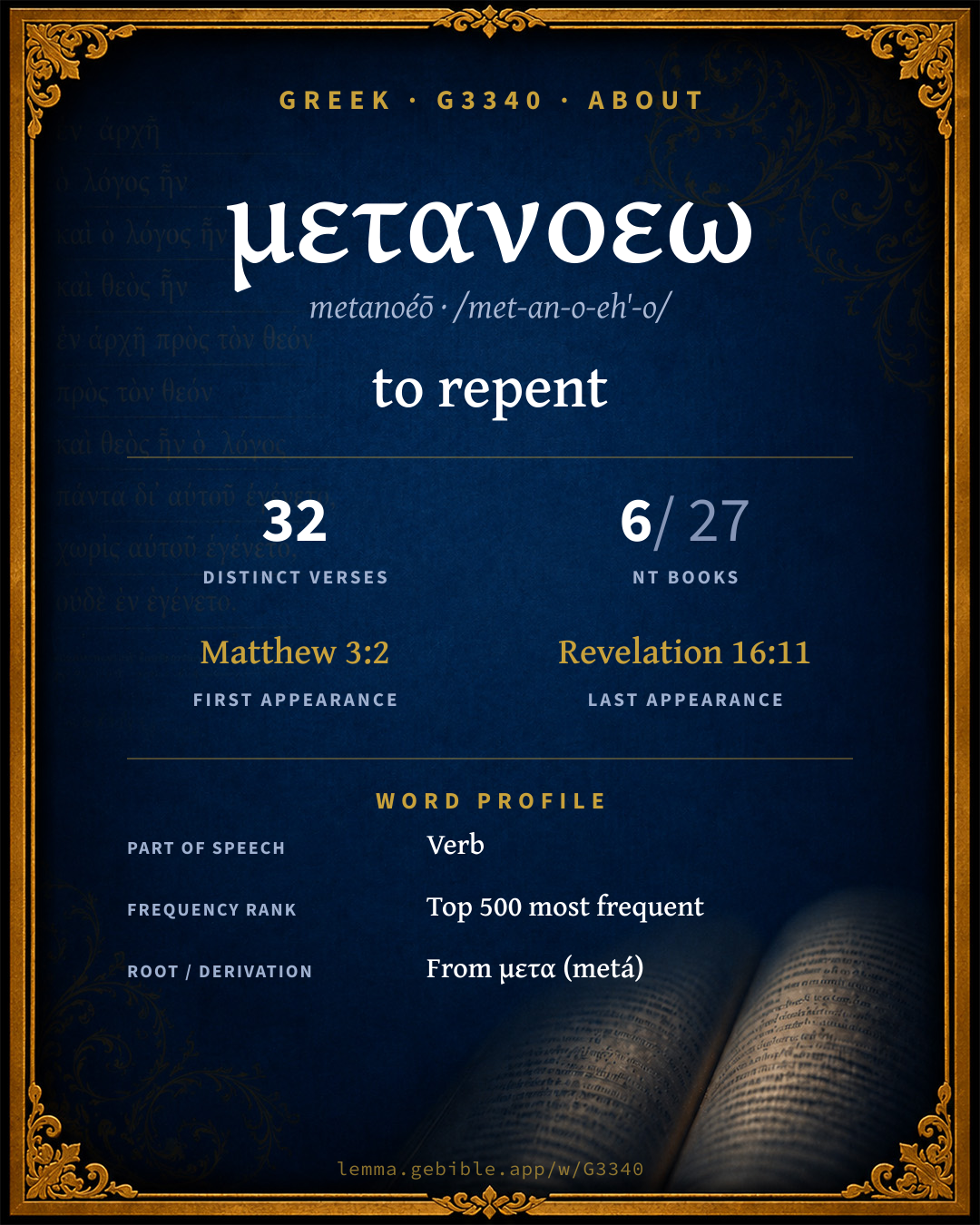
μετανοέω
to repent
‘to repent’ is one of 2 main senses fuller range ↓
Full lexicon entry — Thayer's Greek Lexicon
From Thayer's Greek Lexicon
Where this word appears
See every Aorist-tense verb in the Greek New Testament →
Grammar key — what these labels mean
Part of speech
- Verb
- An action or state-of-being word.
Tense
- Aorist
- Action viewed as a simple whole, without regard to duration — often past (perfective aspect).
- Present
- Ongoing or general action in present time (imperfective aspect).
- Future
- Action expected in future time.
Voice
- Active
- The subject performs the action.
Mood
- Indicative
- States a fact or asks a factual question (the mood of reality).
- Imperative
- Expresses a command or request.
- Subjunctive
- Expresses probability, purpose, or possibility (the mood of contingency).
- Infinitive
- A verbal noun (“to write”), unmarked for person or number.
- Participle
- A verbal adjective (“writing,” “having written”).
Case
- Dative
- The case of the indirect object, means, or location — “to / for / with / in.”
- Genitive
- The case of source, possession, or “of” — answers “whose / from what.”
Person
- 3rd person
- The one spoken about (“he / she / it / they”).
- 2nd person
- The one addressed (“you”).
- 1st person
- The speaker (“I / we”).
Gender
- Masculine
- Grammatically masculine.
Number
- Plural
- More than one.
- Singular
- One.
Grammatical forms 15 distinct
- Verb, Aorist, Active, Indicative, 3rd person, Plural 9 times (26%)
- Verb, Aorist, Active, Imperative, 2nd person, Singular 5 times (15%)
- Verb, Present, Active, Imperative, 2nd person, Plural 3 times (9%)
- Verb, Aorist, Active, Imperative, 2nd person, Plural 2 times (6%)
- Verb, Aorist, Active, Subjunctive, 3rd person, Singular 2 times (6%)
- Verb, Future, Active, Indicative, 3rd person, Plural 2 times (6%)
- Verb, Present, Active, Infinitive 2 times (6%)
- Verb, Present, Active, Participle, Dative, Singular, Masculine 2 times (6%)
+7 more forms (7 occurrences)
Parsed forms decoded from the imported morphology (Robinson–Tischendorf, public domain), counted across 34 parsed occurrences — not distinct verses.
Every verse where G3340 appears — 32 distinct verses across 6 books. Click any verse to open its interlinear word-by-word view. Verse text shown in the World English Bible for context — . Each verse’s Greek form is shown with its reference; the English is not keyword-highlighted, since the data carries no word-level English alignment. Use “Compare translations” on any verse to read it across multiple English versions. This concordance covers the Greek New Testament; Septuagint (Greek Old Testament) occurrences of this word are not indexed here.
Matthew 5 verses
- Matthew 3:2 μετανοεῖτε pres act impv 2pl "Repent, for the Kingdom of Heaven is at hand!"
- Matthew 4:17 μετανοεῖτε pres act impv 2pl From that time, Jesus began to preach, and to say, "Repent! For the Kingdom of Heaven is at hand."
- Matthew 11:20 μετενόησαν aor act ind 3pl Then he began to denounce the cities in which most of his mighty works had been done, because they didn't repent.
- Matthew 11:21 μετενόησαν aor act ind 3pl "Woe to you, Chorazin! Woe to you, Bethsaida! For if the mighty works had been done in Tyre and Sidon which were done in you, they would have repented long ago in sackcloth and ashes.
- Matthew 12:41 μετενόησαν aor act ind 3pl The men of Nineveh will stand up in the judgment with this generation, and will condemn it, for they repented at the preaching of Jonah; and behold, someone greater than Jonah is here.
Mark 2 verses
Luke 9 verses
- Luke 10:13 μετενόησαν aor act ind 3pl "Woe to you, Chorazin! Woe to you, Bethsaida! For if the mighty works had been done in Tyre and Sidon which were done in you, they would have repented long ago, sitting in sackcloth and ashes.
- Luke 11:32 μετενόησαν aor act ind 3pl The men of Nineveh will stand up in the judgment with this generation, and will condemn it: for they repented at the preaching of Jonah, and behold, one greater than Jonah is here.
- Luke 13:3 μετανοῆτε pres act subj 2pl I tell you, no, but, unless you repent, you will all perish in the same way.
- Luke 13:5 μετανοήσητε aor act subj 2pl I tell you, no, but, unless you repent, you will all perish in the same way."
- Luke 15:7 μετανοοῦντι pres act ptcp dat sg masc I tell you that even so there will be more joy in heaven over one sinner who repents, than over ninety-nine righteous people who need no repentance.
- Luke 15:10 μετανοοῦντι pres act ptcp dat sg masc Even so, I tell you, there is joy in the presence of the angels of God over one sinner repenting."
- Luke 16:30 μετανοήσουσιν fut act ind 3pl "He said, 'No, father Abraham, but if one goes to them from the dead, they will repent.'
- Luke 17:3 μετανοήσῃ aor act subj 3sg Be careful. If your brother sins against you, rebuke him. If he repents, forgive him.
- Luke 17:4 μετανοῶ pres act ind 1sg If he sins against you seven times in the day, and seven times returns, saying, 'I repent,' you shall forgive him."
Acts 5 verses
- Acts 2:38 μετανοήσατε aor act impv 2pl Peter said to them, "Repent, and be baptized, everyone of you, in the name of Jesus Christ for the forgiveness of sins, and you will receive the gift of the Holy Spirit.
- Acts 3:19 μετανοήσατε aor act impv 2pl "Repent therefore, and turn again, that your sins may be blotted out, so that there may come times of refreshing from the presence of the Lord,
- Acts 8:22 μετανόησον aor act impv 2sg Repent therefore of this, your wickedness, and ask God if perhaps the thought of your heart may be forgiven you.
- Acts 17:30 μετανοεῖν pres act inf The times of ignorance therefore God overlooked. But now he commands that all people everywhere should repent,
- Acts 26:20 μετανοεῖν pres act inf but declared first to them of Damascus, at Jerusalem, and throughout all the country of Judea, and also to the Gentiles, that they should repent and turn to God, doing works worthy of repentance.
2 Corinthians 1 verse
Revelation 10 verses
- Revelation 2:5 μετανόησον μετανοήσῃς aor act impv 2sg aor act subj 2sg Remember therefore from where you have fallen, and repent and do the first works; or else I am coming to you swiftly, and will move your lampstand out of its place, unless you repent.
- Revelation 2:16 μετανόησον aor act impv 2sg Repent therefore, or else I am coming to you quickly, and I will make war against them with the sword of my mouth.
- Revelation 2:21 μετανοήσῃ μετανοῆσαι aor act subj 3sg aor act inf I gave her time to repent, but she refuses to repent of her sexual immorality.
- Revelation 2:22 μετανοήσουσιν fut act ind 3pl Behold, I will throw her into a bed, and those who commit adultery with her into great oppression, unless they repent of her works.
- Revelation 3:3 μετανόησον aor act impv 2sg Remember therefore how you have received and heard. Keep it, and repent. If therefore you won't watch, I will come as a thief, and you won't know what hour I will come upon you.
- Revelation 3:19 μετανόησον aor act impv 2sg As many as I love, I reprove and chasten. Be zealous therefore, and repent.
- Revelation 9:20 μετενόησαν aor act ind 3pl The rest of mankind, who were not killed with these plagues, didn't repent of the works of their hands, that they wouldn't worship demons, and the idols of gold, and of silver, and of brass, and of stone, and of wood; which can neither see, nor hear, nor walk.
- Revelation 9:21 μετενόησαν aor act ind 3pl They didn't repent of their murders, nor of their sorceries, nor of their sexual immorality, nor of their thefts.
- Revelation 16:9 μετενόησαν aor act ind 3pl People were scorched with great heat, and people blasphemed the name of God who has the power over these plagues. They didn't repent and give him glory.
- Revelation 16:11 μετενόησαν aor act ind 3pl and they blasphemed the God of heaven because of their pains and their sores. They didn't repent of their works.
About this entry
At a glance — auto-summarized from this page’s data, not written by a person. Every figure links to its source below. This summary describes the numbers; it doesn’t interpret them.
μετανοεω — transliterated metanoéō — is a Greek verb carrying the sense “to repent.” Debuting at Matthew 3:2, it then recurs through the corpus. With 32 verses in 6 books, it is a moderately common word in the Greek New Testament. Its uses concentrate in Revelation (31% of all occurrences). Thayer's distinguishes 2 senses for it. See the sense tree, 32-verse concordance, and the renderings breakdown below.
Gloss history
Strong's 1890 vs modern scholarship
About this word
Strong's G3340 catalogs a Greek word from the Greek New Testament.
These counts are not copied from any lexicon or concordance. They are computed here, from the morphology-tagged Greek New Testament. What Lemma adds →
- 32
- distinct verses
- The word appears in 32 distinct verses.
- 6 / 27
- NT books
- The word appears in 6 of 27 New Testament books.
- #424
- by frequency
- Top 500 most frequent Greek words (rank 424 of 5,347 Greek words by occurrence).
View all 32 occurrences in the concordance →
Most concentrated in
- Revelation 10 verses 31%
- Luke 9 verses 28%
- Matthew 5 verses 16%
By section of the New Testament
By traditional corpus
Conventional, traditional groupings — biblical authorship is debated, so this is a traditional corpus grouping, not an authorship claim. Some books belong to more than one corpus (Luke is in both the Gospels and the Lukan corpus, and so on), so these shares overlap and need not total 100%. Each figure is a share of the word’s 32 distinct verses.
- Gospels 16 verses · 50%
- Lukan (Luke–Acts) 14 verses · 44%
- Johannine 10 verses · 31%
- Revelation 10 verses · 31%
- Pauline corpus 1 verse · 3%
How translations render this word
Counts come from each version’s own published word-to-Strong’s tagging or interlinear alignment — an approximate guide to how each version renders this word, not a word-level alignment the data otherwise carries. Because each total is that version’s own tagged count, the per-version totals vary from one another and need not match the appearance or distinct-verse counts above. These counts may also differ from a printed concordance because Lemma counts each distinctly tagged rendering and does not collapse phrase taggings into a single head-word total. This is a fixed set of word-tagged versions (KJV, ASV, BSB, ULT) and does not change with the reading translation you choose elsewhere. Each version’s license is shown beside its name below (and on Sources).
- King James Version: Repent 9×, Repented 4×, They repented 4×
- American Standard Version: Repent 10×, They repented 5×, Repented 4×
- Berean Standard Bible: Repent 12×, They did not repent 4×, Repents 2×
- unfoldingWord Literal Text: Repent 21×, They did 3×, You do 3×
King James Version Public Domain
Renders G3340 across 36 tagged occurrences — most commonly:
Plus 12 renderings that appear only once — usually multi-word phrases or single function words the recovered tagging swept in, not distinct renderings.
American Standard Version Public Domain
Renders G3340 across 37 tagged occurrences — most commonly:
Plus 8 renderings that appear only once — usually multi-word phrases or single function words the recovered tagging swept in, not distinct renderings.
Berean Standard Bible Public Domain
Renders G3340 across 33 tagged occurrences — most commonly:
Plus 9 renderings that appear only once — usually multi-word phrases or single function words the recovered tagging swept in, not distinct renderings. Not rendered by a distinct English word in 1 further occurrence.
unfoldingWord Literal Text CC BY-SA 4.0
Renders G3340 across 43 tagged occurrences — most commonly:
Plus 10 renderings that appear only once — usually multi-word phrases or single function words the recovered tagging swept in, not distinct renderings.
Senses in Thayer's
The 2 senses Thayer's distinguishes for this word, in lexicon order (not ranked by frequency or importance). The full entry — with sub-senses — is in the Lexicon Entry tab.
- to change one's mind, i.e. to repent
- to change one's mind for better, heartily to amend with abhorrence of one's past sins
Word origin
Derived from μετα (metá) (G3326) — with.
Forms in the corpus
The 15 distinct written forms G3340 takes in the Greek New Testament, most frequent first — each parse links to that tense’s occurrences in the concordance.
Same root — word family
Other Thayer's entries built from the same root as G3340, grouped by Strong’s listed origin. These share a root / origin per the lexicon — not necessarily a shared meaning. Each links to that word’s own entry.
Derives from
Shares the same root
- μεθερμηνευω methermēneúō G3177 to interpret
- μεθιστημι methístēmi G3179 to transfer
- μεθοδεια methodeía G3180 deceit
- μεθοριος methórios G3181 border
- μεσος mésos G3319 middle
- μεταβαινω metabaínō G3327 to pass over
- μεταβαλλω metabállō G3328 to turn around
- μεταγω metágō G3329 to transfer
- μεταδιδωμι metadídōmi G3330 to impart
- μεταιρω metaírō G3332 to remove
- μετακαλεω metakaléō G3333 to summon
- μετακινεω metakinéō G3334 to move away
- μεταλαμβανω metalambánō G3335 to partake
- μεταλλασσω metallássō G3337 to exchange
- μεταμελλομαι metaméllomai G3338 it is a care
- μεταμορφοω metamorphóō G3339 to transform
- μεταξυ metaxý G3342 between
- μεταπεμπω metapémpō G3343 to send for
- μεταστρεφω metastréphō G3344 to turn around
- μετασχηματιζω metaschēmatízō G3345 to transform
- μετατιθημι metatíthēmi G3346 to transpose
- μετεπειτα metépeita G3347 afterwards
- μετεχω metéchō G3348 to partake
- μετεωριζω meteōrízō G3349 to be puffed up
+2 more words share this root (not shown).
Derived from this word
Compare all same-root words → Showing 4 of 29 — not the complete family. They share a root, not necessarily a meaning.
Septuagint usage
The same Greek word μετανοεω appears 18 times in the Greek Old Testament (Septuagint), across 17 verses in 8 books.
- 18
- LXX occurrences
- Tagged occurrences of this Greek word in the Septuagint.
- 17
- verses
- Distinct Septuagint verses containing this word.
- 8 / 39
- OT books
- The word appears in 8 of the 39 Old Testament books.
Sample Septuagint occurrences
- 1 Samuel 15:29 μετανοέω
- Proverbs 20:16 μετανοέω
- Isaiah 46:8 μετανοέω
- Jeremiah 4:28 μετανοέω
- Joel 2:13 μετανοέω
- Amos 7:3 μετανοέω
- Jonah 3:9 μετανοέω
- Zechariah 8:14 μετανοέω
Septuagint occurrences (same lexeme)
Every verse where the same Strong’s number (G3340) appears in the Greek Septuagint. Verse text shown in the World English Bible for context; the Greek form is the matched word — the English is not keyword-highlighted.
- 1 Samuel 15:29 μετανοέω Also the Strength of Israel will not lie nor repent; for he is not a man, that he should repent.
- Proverbs 20:16 μετανοέω Take the garment of one who puts up collateral for a stranger; And hold him in pledge for a wayward woman.
- Proverbs 24:32 μετανοέω Then I saw, and considered well. I saw, and received instruction:
- Proverbs 30:1 μετανοέω The words of Agur the son of Jakeh, the oracle: The man says to Ithiel, To Ithiel and Ucal:
- Isaiah 46:8 μετανοέω Remember this, and show yourselves men; bring it again to mind, you transgressors.
- Jeremiah 4:28 μετανοέω For this shall the earth mourn, and the heavens above be black; because I have spoken it, I have purposed it, and I have not repented, neither will I turn back from it.
- Jeremiah 8:6 μετανοέω I listened and heard, but they didn't speak aright: no man repents him of his wickedness, saying, What have I done? everyone turns to his course, as a horse that rushes headlong in the battle.
- Jeremiah 18:8 μετανοέω if that nation, concerning which I have spoken, turn from their evil, I will repent of the evil that I thought to do to them.
- Jeremiah 18:10 μετανοέω if they do that which is evil in my sight, that they not obey my voice, then I will repent of the good, with which I said I would benefit them.
- Jeremiah 38:19 μετανοέω Zedekiah the king said to Jeremiah, I am afraid of the Jews who are fallen away to the Chaldeans, lest they deliver me into their hand, and they mock me.
- Joel 2:13 μετανοέω Tear your heart, and not your garments, And turn to Yahweh, your God; For he is gracious and merciful, Slow to anger, and abundant in loving kindness, And relents from sending calamity.
- Joel 2:14 μετανοέω Who knows? He may turn and relent, And leave a blessing behind him, Even a meal offering and a drink offering to Yahweh, your God.
- Amos 7:3 μετανοέω Yahweh relented concerning this. "It shall not be," says Yahweh.
- Amos 7:6 μετανοέω Yahweh relented concerning this. "This also shall not be," says the Lord Yahweh.
- Jonah 3:9 μετανοέω Who knows whether God will not turn and repent, and turn away from his fierce anger, so that we might not perish?"
- Jonah 3:10 μετανοέω God saw their works, that they turned from their evil way. God repented of the evil which he said he would do to them, and he didn't do it.
- Zechariah 8:14 μετανοέω For thus says Yahweh of hosts: "As I thought to do evil to you, when your fathers provoked me to wrath," says Yahweh of Hosts, "and I didn't repent;
These are occurrences of the same Greek lexeme (G3340) in the Septuagint — not a translation of any one Hebrew word. The store carries no word-level Hebrew↔Greek alignment, so no Hebrew original is asserted here. Counts come from the recovered LXX Strong's tagging — high-frequency vocabulary is well covered, while rare or late forms may be untagged — so they reflect tagged occurrences and may slightly undercount.