

Mark 9:2
Greek (Tischendorf 8th ed.) Mark 9:2 appears in the Greek New Testament. The text above is from the Tischendorf 8th edition. Each word links to its Strong’s number and a concise gloss. Click any word for its full Thayer’s Greek Lexicon entry.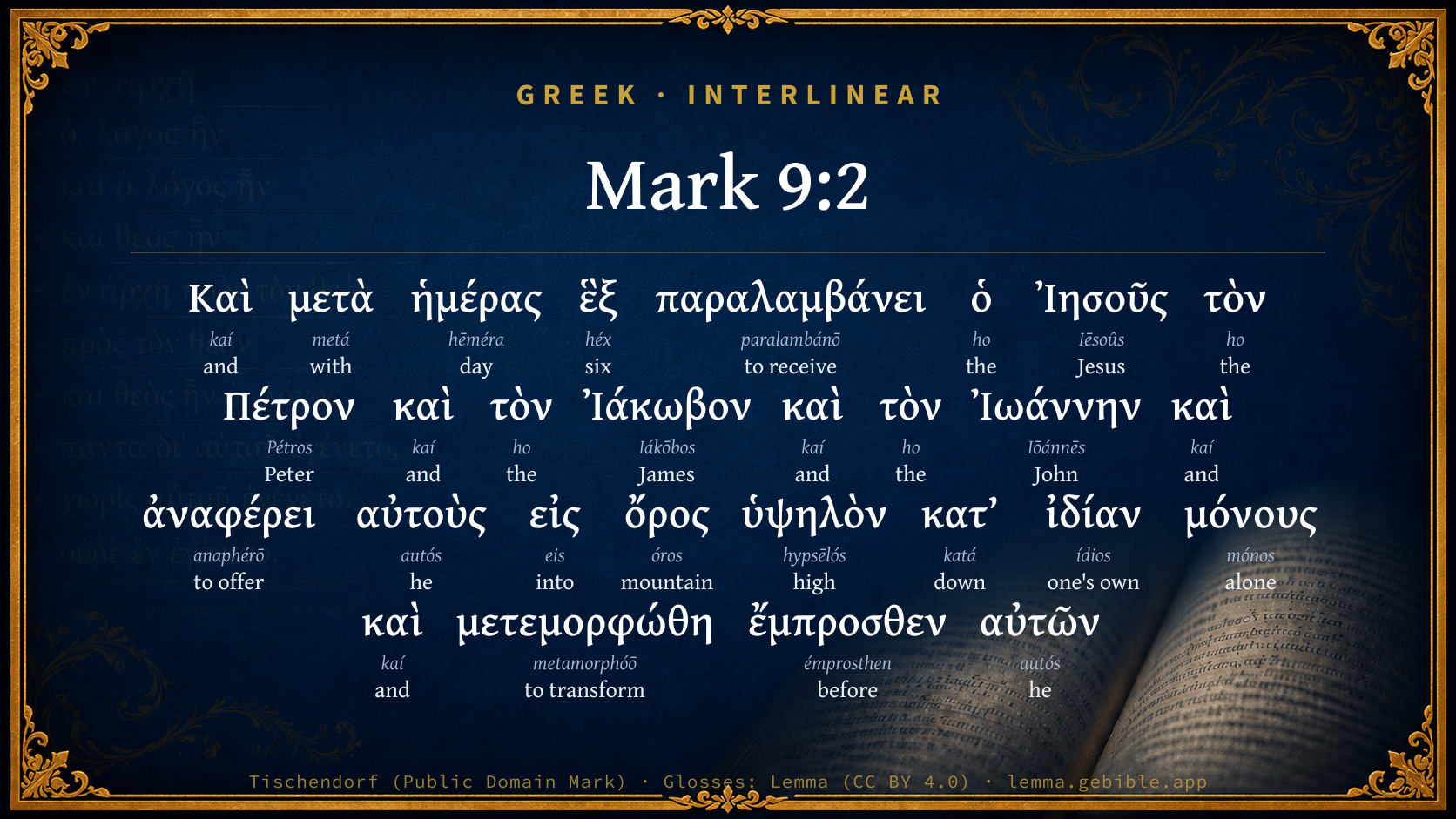
After six days Jesus took with him Peter, James, and John, and brought them up onto a high mountain privately by themselves, and he was changed into another form in front of them.
Download a study sheet
One document with this verse’s original text, its word-by-word gloss line, the meaning frame, cross-references with their text, attributed commentary, and full source and license credits — printable, and it pastes into notes with its structure intact.
This verse Autodidact and up
A passage Seminary Student
Up to 50 verses in one chapter. A passage sheet keeps up to 6 commentary sources and 12 cross-references per verse, in the order this page ranks them, and says so on the sheet whenever that leaves anything out. Ask for a single verse and you get the Autodidact verse sheet above.
Everything on this page stays free to read, with no account — the sheet is a download of what is already on screen, not access to it.
Compare translations 3
The same verse in 3 English versions, stacked beneath the original-language interlinear above. Click any original word for its lexicon entry.
Each is an independent rendering of the whole verse — the interlinear is not word-aligned to these translations.
Highlighted words mark where these versions differ — a whole-verse word diff, not a word-by-word alignment.
-
World English Bible Public Domain
After six days Jesus took with him Peter, James, and John, and brought them up onto a high mountain privately by themselves, and he was changed into another form in front of them.
-
King James Version Public Domain
And after six days Jesus taketh with him Peter, and James, and John, and leadeth them up into an high mountain apart by themselves: and he was transfigured before them.
-
unfoldingWord Literal Text CC BY-SA 4.0
And after six days, Jesus takes along Peter and James and John and brings them up onto a high mountain by themselves, alone, and he was transfigured before them.
unfoldingWord Literal Text — © unfoldingWord, licensed CC BY-SA 4.0. Word-aligned USFM3 via Door43 (git.door43.org/unfoldingWord/en_ult).
Show all 19 translations
Every available English version of this verse, each an independent rendering of the whole verse.
-
World English Bible Public Domain
After six days Jesus took with him Peter, James, and John, and brought them up onto a high mountain privately by themselves, and he was changed into another form in front of them.
-
Berean Standard Bible Public Domain
After six days Jesus took with Him Peter, James, and John, and led them up a high mountain by themselves. There He was transfigured before them.
-
Majority Standard Bible Public Domain
After six days Jesus took with Him Peter, James, and John, and led them up a high mountain by themselves. There He was transfigured before them.
-
King James Version Public Domain
And after six days Jesus taketh with him Peter, and James, and John, and leadeth them up into an high mountain apart by themselves: and he was transfigured before them.
-
American Standard Version (1901) Public Domain
And after six days Jesus taketh with him Peter, and James, and John, and bringeth them up into a high mountain apart by themselves: and he was transfigured before them;
-
Revised Version (1885) Public Domain
And after six days Jesus taketh with him Peter, and James, and John, and bringeth them up into a high mountain apart by themselves: and he was transfigured before them:
-
Geneva Bible (1599) Public Domain
And sixe dayes after, Iesus taketh vnto him Peter, and Iames, and Iohn, and carieth them vp into an hie mountaine out of the way alone, and his shape was changed before them.
-
Douay-Rheims (1899) Public Domain
And his garments became shining and exceeding white as snow, so as no fuller upon earth can make white.
-
Young's Literal Translation Public Domain
And after six days doth Jesus take Peter, and James, and John, and bringeth them up to a high mount by themselves, alone, and he was transfigured before them,
-
Literal Standard Version CC BY-SA 4.0
And after six days Jesus takes Peter, and James, and John, and brings them up to a high mountain by themselves, alone, and He was transfigured before them,
-
Unlocked Literal Bible CC BY-SA 4.0
Six days later, Jesus took Peter and James and John with him up a high mountain, alone by themselves. Then he was transfigured before them.
-
unfoldingWord Literal Text CC BY-SA 4.0
And after six days, Jesus takes along Peter and James and John and brings them up onto a high mountain by themselves, alone, and he was transfigured before them.
-
Darby Bible Public Domain
And after six days Jesus takes with [him] Peter and James and John, and takes them up on a high mountain by themselves apart. And he was transfigured before them:
-
World Messianic Bible Public Domain
After six days Yeshua took with him Peter, Jacob, and Yochanan, and brought them up onto a high mountain privately by themselves, and he was changed into another form in front of them.
-
Webster's Bible Public Domain
And after six days, Jesus taketh with him Peter, and James, and John, and leadeth them up upon a high mountain apart by themselves; and he was transfigured before them.
-
Free Bible Version CC BY-SA 4.0
Six days later Jesus took Peter, James, and John with him, and led them up a high mountain to be by themselves. His appearance totally changed.
-
Bible in Basic English Public Domain
And after six days Jesus took with him Peter and James and John, and made them go up with him into a high mountain by themselves: and he was changed in form before them:
-
Text-Critical English NT CC BY 4.0
After six days Jesus took Peter, James, and John, and led them up on a high mountain by themselves. There he was transfigured before them.
-
Tyndale New Testament (1534) Public Domain
And after.vi. dayes Iesus toke Peter Iames and Iohn and leede them vp into an hye mountayne out of the waye alone and he was transfigured before them.
Literal Standard Version (2020), Covenant Press — licensed CC BY-SA 4.0. Text via the HelloAO Bible API (eBible.org). Unlocked Literal Bible (unfoldingWord) — licensed CC BY-SA 4.0. Text via the HelloAO Bible API (eBible.org). unfoldingWord Literal Text — © unfoldingWord, licensed CC BY-SA 4.0. Word-aligned USFM3 via Door43 (git.door43.org/unfoldingWord/en_ult). Free Bible Version, Dr. Jonathan Gallagher — licensed CC BY-SA 4.0. Text via the HelloAO Bible API (eBible.org).
Word by word
More ways to search: Search by grammar → Find every occurrence → Compare this word →
Practice this passage: Drill this verse → Learn its vocabulary →
- Appears 4× in the Greek New Testament
- First appears at Matthew 17:2
- Part of Speech
- Verb
- Tense
- Aorist
- Voice
- Passive
- Mood
- Indicative
- Person
- 3rd person
- Number
- Singular
Full Thayer's Definition
- Καὶ kaí G2532 “and” Conjunction
- μετὰ metá G3326 “with” Preposition
- ἡμέρας hēméra G2250 “day” Noun, Accusative, Plural, Feminine
- ἓξ héx G1803 “six” Adjective, Numeral (indeclinable)
- παραλαμβάνει paralambánō G3880 “to receive” Verb, Present, Active, Indicative, 3rd person, Singular
- ὁ ho G3588 “the” Article, Nominative, Singular, Masculine
- Ἰησοῦς Iēsoûs G2424 “Jesus” Noun, Nominative, Singular, Masculine
- τὸν ho G3588 “the” Article, Accusative, Singular, Masculine
- Πέτρον Pétros G4074 “Peter” Noun, Accusative, Singular, Masculine
- καὶ kaí G2532 “and” Conjunction
- τὸν ho G3588 “the” Article, Accusative, Singular, Masculine
- Ἰάκωβον Iákōbos G2385 “James” Noun, Accusative, Singular, Masculine
- καὶ kaí G2532 “and” Conjunction
- τὸν ho G3588 “the” Article, Accusative, Singular, Masculine
- Ἰωάννην Iōánnēs G2491 “John” Noun, Accusative, Singular, Masculine
- καὶ kaí G2532 “and” Conjunction
- ἀναφέρει anaphérō G399 “to offer” Verb, Present, Active, Indicative, 3rd person, Singular
- αὐτοὺς autós G846 “he” Personal pronoun, Accusative, Plural, Masculine
- εἰς eis G1519 “into” Preposition
- ὄρος óros G3735 “mountain” Noun, Accusative, Singular, Neuter
- ὑψηλὸν hypsēlós G5308 “high” Adjective, Accusative, Singular, Neuter
- κατ’ katá G2596 “down” Preposition
- ἰδίαν ídios G2398 “one's own” Adjective, Accusative, Singular, Feminine
- μόνους mónos G3441 “alone” Adjective, Accusative, Plural, Masculine
- καὶ kaí G2532 “and” Conjunction
- μετεμορφώθη metamorphóō G3339 “to transform” Verb, Aorist, Passive, Indicative, 3rd person, Singular
- ἔμπροσθεν émprosthen G1715 “before” Preposition
- αὐτῶν autós G846 “he” Personal pronoun, Genitive, Plural, Masculine
About this verse
These counts appear in no published source. They are computed here, from the morphology-tagged text and Lemma’s own curated glosses. What Lemma adds →
- 28
- words
- 20
- distinct lemmas
- Gospels
- section
Cross-references
23Topical passages linked to Mark 9:2 in the Treasury of Scripture Knowledge — connected by theme and wording, ordered by reader-vote popularity; previews shown in the World English Bible.
- Luke 9:28–36 It happened about eight days after these sayings, that he took with him Peter, John, and James, and went up onto the mountain to pray.
- Matthew 17:1–8 After six days, Jesus took with him Peter, James, and John his brother, and brought them up into a high mountain by themselves.
- Isaiah 33:17 Your eyes shall see the king in his beauty: they shall see a land that reaches afar.
- Mark 5:37 He allowed no one to follow him, except Peter, James, and John the brother of James.
- Mark 14:33 He took with him Peter, James, and John, and began to be greatly troubled and distressed.
- Exodus 24:13 Moses rose up with Joshua, his servant, and Moses went up onto God's Mountain.
- 2 Corinthians 13:1 This is the third time I am coming to you. "At the mouth of two or three witnesses shall every word established."
- Exodus 34:29–35 It happened, when Moses came down from Mount Sinai with the two tablets of the testimony in Moses' hand, when he came down from the mountain, that Moses didn't know that the skin of his face shone by reason of his speaking with him.
- 1 Kings 18:42 So Ahab went up to eat and to drink. Elijah went up to the top of Carmel; and he bowed himself down on the earth, and put his face between his knees.
- Isaiah 53:2 For he grew up before him as a tender plant, and as a root out of a dry ground: he has no form nor comeliness; and when we see him, there is no beauty that we should desire him.
- Matthew 17:11–13 Jesus answered them, "Elijah indeed comes first, and will restore all things,
- Mark 16:12 After these things he was revealed in another form to two of them, as they walked, on their way into the country.
- Romans 12:2 Don't be conformed to this world, but be transformed by the renewing of your mind, so that you may prove what is the good, well-pleasing, and perfect will of God.
- Philippians 3:21 who will change the body of our humiliation to be conformed to the body of his glory, according to the working by which he is able even to subject all things to himself.
- Revelation 20:11 I saw a great white throne, and him who sat on it, from whose face the earth and the heaven fled away. There was found no place for them.
- 1 Kings 18:33 He put the wood in order, and cut the bull in pieces, and laid it on the wood. He said, Fill four jars with water, and pour it on the burnt offering, and on the wood.
- Matthew 14:13 Now when Jesus heard this, he withdrew from there in a boat, to a deserted place apart. When the multitudes heard it, they followed him on foot from the cities.
- Luke 6:12 It happened in these days, that he went out to the mountain to pray, and he continued all night in prayer to God.
- John 1:14 The Word became flesh, and lived among us. We saw his glory, such glory as of the one and only Son of the Father, full of grace and truth.
- 2 Corinthians 3:7–10 But if the service of death, written engraved on stones, came with glory, so that the children of Israel could not look steadfastly on the face of Moses for the glory of his face; which was passing away:
- Philippians 2:6–8 who, existing in the form of God, didn't consider it robbery to be equal with God,
- Revelation 1:13–17 And among the lampstands was one like a son of man, clothed with a robe reaching down to his feet, and with a golden sash around his chest.
- 2 Peter 1:16–18 For we did not follow cunningly devised fables, when we made known to you the power and coming of our Lord Jesus Christ, but we were eyewitnesses of his majesty.
Cross-references courtesy of OpenBible.info (CC BY 4.0).
Lesson kit
Teaching starters — assembled from the data on this page, not authored interpretation. Every prompt links to the verse data it draws on. Edit before teaching.
Mark, in the Gospels, opens this verse with 28 words (20 distinct Greek lemmas). Its most distinctive word is metamorphóō (“to transform”). A historical commentator’s framing appears above. Read the whole chapter for the surrounding context.
Discussion questions
- How does “to transform” (metamorphóō) shape what this verse is saying?
- Matthew 17:2 shares the word «to transform» with this verse. How do the two illuminate each other?
- “and” occurs 5× in this one verse. What is the effect of the repetition?
- These translations render this verse differently. What is at stake in choosing one wording over another?
- Reading how The Cambridge Bible for Schools and Colleges and Joseph Benson's Commentary read this verse, where do the two commentators agree and where do they part?
Things to notice
- These translations choose different wording for 19 words in this verse.
- “and” occurs 5× in this single verse.
- 20 distinct Greek lemmas span 28 words in this verse.
Commentary
Notes on Mark 9:2 from classic Christian and Jewish commentators (each source and its license shown beneath its notes). The classic Christian expositions comment on the surrounding passage and are grouped to its opening verse, so a note may address several verses; the Jewish commentaries on the Tanakh (Rashi and others) are per-verse, so they appear only where the commentator wrote on this verse.
Lemma curates 59 commentaries, every one of them public domain or Creative Commons licensed, each selected and text-cleaned for this edition rather than reprinted as found. About our sources →
The Cambridge Bible for Schools and Colleges
gen. ed. J. J. S. Perowne
The Cambridge Bible for Schools and Colleges (gen. ed. J. J. S. Perowne; Cambridge University Press, 1878–1918) — public domain. Text from a community e-Sword module.
Joseph Benson's Commentary
Joseph Benson's Commentary on the Old and New Testaments (1811–1818) — public domain. Text from a community e-Sword module.
Whedon's Commentary on the Bible
Daniel D. Whedon
Daniel D. Whedon (gen. ed.), Commentary on the Old and New Testaments (1874–1909) — public domain. Text from a community e-Sword module.
The Preacher's Complete Homiletical Commentary
Joseph S. Exell (gen. ed.)
The Preacher's Complete Homiletical Commentary (gen. ed. Joseph S. Exell; Funk & Wagnalls, c. 1892) — public domain (pre-1929). A full-Bible homiletical/sermon-outline anthology covering 65 of 66 books (2 John is absent from the source module). Text from a community e-Sword module.
Lange's Commentary on the Holy Scriptures
Lange's Commentary on the Holy Scriptures (Critical, Doctrinal, and Homiletical), ed. John Peter Lange, English translation edited by Philip Schaff (1864–1880) — public domain. Text from a community e-Sword module.
MacLaren's Expositions of Holy Scripture
Alexander MacLaren
Alexander MacLaren, Expositions of Holy Scripture (1904–1910) — public domain. Text from a community e-Sword module.
Godbey's Commentary on the New Testament
William B. Godbey
William B. Godbey, Commentary on the New Testament (1896–1900) — public domain. Text from a community e-Sword module.
The Expositor's Bible
William Robertson Nicoll, ed., The Expositor's Bible (London: Hodder & Stoughton, 1887–1910) — public domain. 65 of 66 books (1 Corinthians is not separately keyed, as that volume carries no machine-parseable verse references); section-level commentary keyed to the opening verse. Introductory and overview sections not keyed to a specific passage are excluded.
Tyndale Open Study Notes
Tyndale Open Resources
Tyndale Open Study Notes — © Tyndale Open Resources, licensed CC BY-SA 4.0. Text via the HelloAO Bible API.
Bengel's Gnomon
Johann Albrecht Bengel
Bengel's Gnomon of the New Testament — English translation (T&T Clark, Edinburgh, 1860) — public domain. Text from a community e-Sword module.
Meyer's Critical & Exegetical Commentary
Heinrich August Wilhelm Meyer
Meyer — Critical and Exegetical Commentary on the New Testament — English translation by Peter Christie, edited by Frederick Crombie (T&T Clark, 1880) — public domain. Text from a community e-Sword module.
Expositor's Greek Testament
ed. W. Robertson Nicoll
The Expositor's Greek Testament, edited by W. Robertson Nicoll (1897–1910) — public domain. Text from a community e-Sword module.
Cambridge Greek Testament for Schools and Colleges
Cambridge Greek Testament for Schools and Colleges (Cambridge University Press, 1896; 21 vols, various authors incl. Carr, Maclear, Plummer, Farrar, Lumby, Moule, M. R. James, Simcox) — public domain. Text from a community e-Sword module.
Geneva Bible (1599)
Geneva Bible translators
Geneva Bible (1599) marginal notes — public domain. Text via Bolls.life.
Adam Clarke's Commentary
Adam Clarke's Commentary on the Bible (1810–1826) — public domain. Text from a community e-Sword/MySword module.
Ellicott's Commentary for English Readers
A Bible Commentary for English Readers, edited by Charles John Ellicott (1878–1897) — public domain. Text from a community e-Sword module.
John Gill's Exposition
John Gill's Exposition of the Whole Bible (1746–1763) — public domain (CC PDM 1.0). Text via the HelloAO Bible API.
Trapp's Complete Commentary
John Trapp
John Trapp, A Commentary or Exposition upon All the Books of the Old and New Testament (1647–1656) — public domain. Text from a community e-Sword module.
Albert Barnes' Notes on the Bible
Albert Barnes' Notes on the Bible (1834–1885) — public domain. Text from a community e-Sword/MySword module.
Matthew Poole's English Annotations
Matthew Poole's English Annotations on the Holy Bible (1683–1685) — public domain. Text from a community e-Sword/MySword module.
The Pulpit Commentary
The Pulpit Commentary (1880–1919), ed. H.D.M. Spence-Jones & Joseph S. Exell — public domain. Text from a community e-Sword module.
John Wesley's Explanatory Notes
John Wesley, Explanatory Notes Upon the Whole Bible (1754–1765) — public domain. Text via the GEBible commentary corpus.
Scofield Reference Notes
C. I. Scofield
The Scofield Reference Bible (1917 edition), notes by C. I. Scofield — public domain. Text from a community e-Sword module.
Kretzmann's Popular Commentary
Paul E. Kretzmann
Paul E. Kretzmann, Popular Commentary of the Bible (1921–1924) — public domain. Text from a community e-Sword module.
Burkitt's Expository Notes on the New Testament
William Burkitt
William Burkitt's Expository Notes on the New Testament (1700–1703) — public domain. Text from a community e-Sword module.
McGarvey & Pendleton's Commentaries
J. W. McGarvey
J. W. McGarvey (with Philip Y. Pendleton), Commentaries on the New Testament (The Fourfold Gospel, 1914; Acts; and the epistles) — public domain. Text from a community e-Sword/MySword module.
The People's New Testament
B. W. Johnson
B. W. Johnson's The People's New Testament with Notes (1889–1891) — public domain. Electronic text from the Christian Classics Ethereal Library (CCEL) ThML edition.
Alford’s Greek Testament
Henry Alford
Henry Alford, The Greek Testament (1849–1861) — public domain. Text from a community e-Sword module.
International Critical Commentary
International Critical Commentary — older volumes (1896–1929), various authors — public domain. Text from a community e-Sword module.
Vincent's Word Studies in the New Testament
Marvin R. Vincent
Marvin R. Vincent, Word Studies in the New Testament (1887–1900) — public domain. Text from a community e-Sword/MySword module.