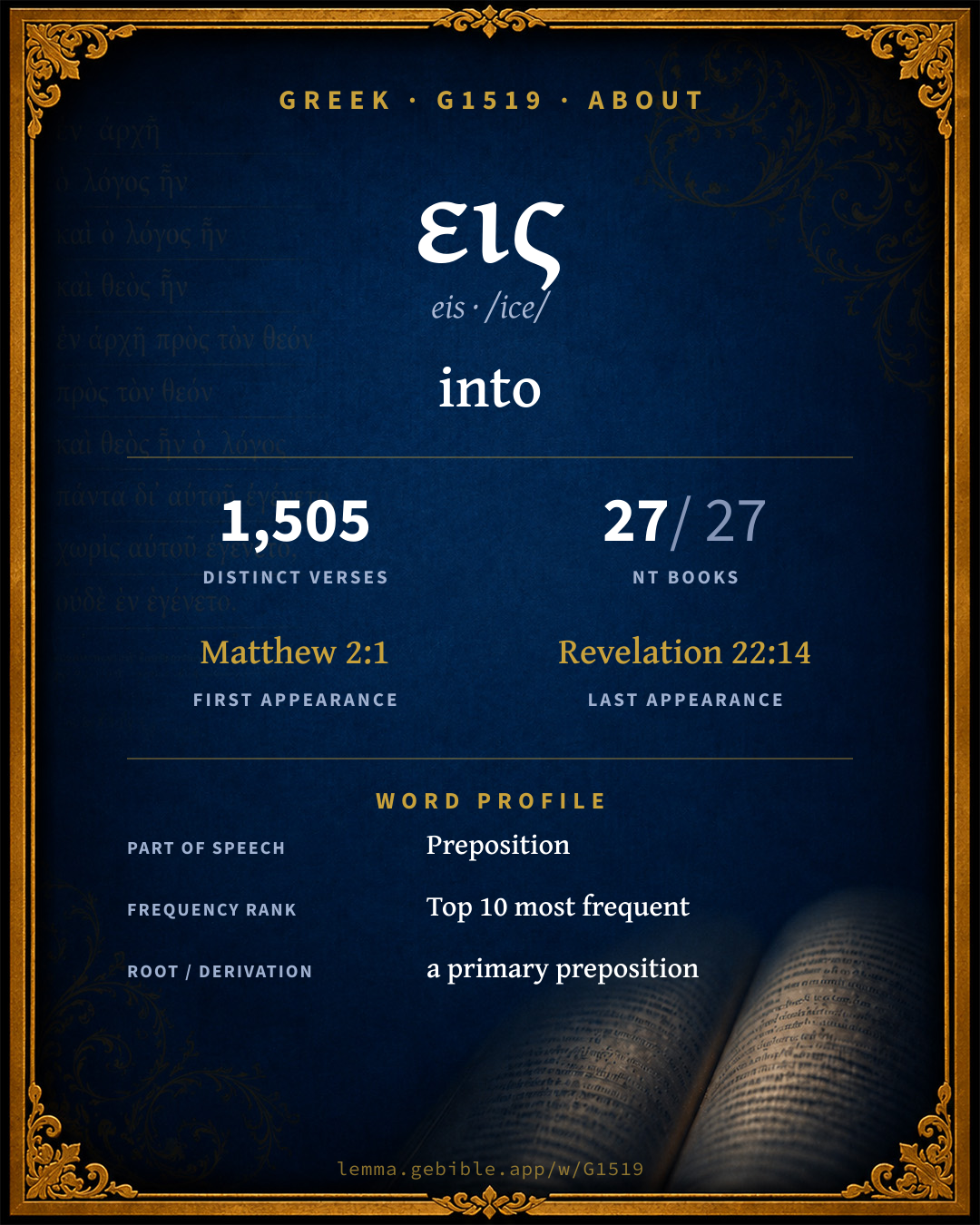
εἰς
into
Full lexicon entry — Thayer's Greek Lexicon
From Thayer's Greek Lexicon
Where this word appears
Grammar key — what these labels mean
Part of speech
- Preposition
- A relational word governing a noun in a particular case.
Page 1 of 8 — showing verses 1–200 of 1,505 distinct verses where G1519 appears, across 27 books. Click any verse to open its interlinear word-by-word view. Verse text shown in the World English Bible for context — . Each verse’s Greek form is shown with its reference; the English is not keyword-highlighted, since the data carries no word-level English alignment. Use “Compare translations” on any verse to read it across multiple English versions. This concordance covers the Greek New Testament; Septuagint (Greek Old Testament) occurrences of this word are not indexed here.
Matthew 196 verses
- Matthew 2:1 εἰς prep Now when Jesus was born in Bethlehem of Judea in the days of Herod the king, behold, wise men from the east came to Jerusalem, saying,
- Matthew 2:8 εἰς prep He sent them to Bethlehem, and said, "Go and search diligently for the young child. When you have found him, bring me word, so that I also may come and worship him."
- Matthew 2:11 εἰς prep They came into the house and saw the young child with Mary, his mother, and they fell down and worshiped him. Opening their treasures, they offered to him gifts: gold, frankincense, and myrrh.
- Matthew 2:12 εἰς prep Being warned in a dream that they shouldn't return to Herod, they went back to their own country another way.
- Matthew 2:13 εἰς prep Now when they had departed, behold, an angel of the Lord appeared to Joseph in a dream, saying, "Arise and take the young child and his mother, and flee into Egypt, and stay there until I tell you, for Herod will seek the young child to destroy him."
- Matthew 2:14 εἰς prep He arose and took the young child and his mother by night, and departed into Egypt,
- Matthew 2:20 εἰς prep "Arise and take the young child and his mother, and go into the land of Israel, for those who sought the young child's life are dead."
- Matthew 2:21 εἰς prep He arose and took the young child and his mother, and came into the land of Israel.
- Matthew 2:22 εἰς prep But when he heard that Archelaus was reigning over Judea in the place of his father, Herod, he was afraid to go there. Being warned in a dream, he withdrew into the region of Galilee,
- Matthew 2:23 εἰς prep and came and lived in a city called Nazareth; that it might be fulfilled which was spoken through the prophets: "He will be called a Nazarene."
- Matthew 3:10 εἰς prep "Even now the axe lies at the root of the trees. Therefore, every tree that doesn't bring forth good fruit is cut down, and cast into the fire.
- Matthew 3:11 εἰς prep I indeed baptize you in water for repentance, but he who comes after me is mightier than I, whose shoes I am not worthy to carry. He will baptize you in the Holy Spirit.
- Matthew 3:12 εἰς prep His winnowing fork is in his hand, and he will thoroughly cleanse his threshing floor. He will gather his wheat into the barn, but the chaff he will burn up with unquenchable fire."
- Matthew 4:1 εἰς prep Then Jesus was led up by the Spirit into the wilderness to be tempted by the devil.
- Matthew 4:5 εἰς prep Then the devil took him into the holy city. He set him on the pinnacle of the temple,
- Matthew 4:8 εἰς prep Again, the devil took him to an exceedingly high mountain, and showed him all the kingdoms of the world, and their glory.
- Matthew 4:12 εἰς prep Now when Jesus heard that John was delivered up, he withdrew into Galilee.
- Matthew 4:13 εἰς prep Leaving Nazareth, he came and lived in Capernaum, which is by the sea, in the region of Zebulun and Naphtali,
- Matthew 4:18 εἰς prep Walking by the sea of Galilee, he saw two brothers: Simon, who is called Peter, and Andrew, his brother, casting a net into the sea; for they were fishermen.
- Matthew 4:24 εἰς prep The report about him went out into all Syria. They brought to him all who were sick, afflicted with various diseases and torments, possessed with demons, epileptics, and paralytics; and he healed them.
- Matthew 5:1 εἰς prep Seeing the multitudes, he went up onto the mountain. When he had sat down, his disciples came to him.
- Matthew 5:13 εἰς prep "You are the salt of the earth, but if the salt has lost its flavor, with what will it be salted? It is then good for nothing, but to be cast out and trodden under the feet of men.
- Matthew 5:20 εἰς prep For I tell you that unless your righteousness exceeds that of the scribes and Pharisees, there is no way you will enter into the Kingdom of Heaven.
- Matthew 5:22 εἰς prep But I tell you, that everyone who is angry with his brother without a cause shall be in danger of the judgment; and whoever shall say to his brother, 'Raca!' shall be in danger of the council; and whoever shall say, 'You fool!' shall be in danger of the fire of Gehenna.
- Matthew 5:25 εἰς prep Agree with your adversary quickly, while you are with him in the way; lest perhaps the prosecutor deliver you to the judge, and the judge deliver you to the officer, and you be cast into prison.
- Matthew 5:29 εἰς prep If your right eye causes you to stumble, pluck it out and throw it away from you. For it is more profitable for you that one of your members should perish, than for your whole body to be cast into Gehenna.
- Matthew 5:30 εἰς prep If your right hand causes you to stumble, cut it off, and throw it away from you: for it is profitable for you that one of your members should perish, and not your whole body be thrown into Gehenna.
- Matthew 5:35 εἰς prep nor by the earth, for it is the footstool of his feet; nor by Jerusalem, for it is the city of the great King.
- Matthew 5:39 εἰς prep But I tell you, don't resist him who is evil; but whoever strikes you on your right cheek, turn to him the other also.
- Matthew 6:6 εἰς prep But you, when you pray, enter into your inner chamber, and having shut your door, pray to your Father who is in secret, and your Father who sees in secret will reward you openly.
- Matthew 6:13 εἰς prep Bring us not into temptation, but deliver us from the evil one. For yours is the Kingdom, the power, and the glory forever. Amen.'
- Matthew 6:26 εἰς εἰς prep prep See the birds of the sky, that they don't sow, neither do they reap, nor gather into barns. Your heavenly Father feeds them. Aren't you of much more value than they?
- Matthew 6:30 εἰς prep But if God so clothes the grass of the field, which today exists, and tomorrow is thrown into the oven, won't he much more clothe you, you of little faith?
- Matthew 6:34 εἰς prep Therefore don't be anxious for tomorrow, for tomorrow will be anxious for itself. Each day's own evil is sufficient.
- Matthew 7:13 εἰς prep "Enter in by the narrow gate; for wide is the gate and broad is the way that leads to destruction, and many are those who enter in by it.
- Matthew 7:14 εἰς prep How narrow is the gate, and restricted is the way that leads to life! Few are those who find it.
- Matthew 7:19 εἰς prep Every tree that doesn't grow good fruit is cut down, and thrown into the fire.
- Matthew 7:21 εἰς prep Not everyone who says to me, 'Lord, Lord,' will enter into the Kingdom of Heaven; but he who does the will of my Father who is in heaven.
- Matthew 8:4 εἰς prep Jesus said to him, "See that you tell nobody, but go, show yourself to the priest, and offer the gift that Moses commanded, as a testimony to them."
- Matthew 8:5 εἰς prep When he came into Capernaum, a centurion came to him, asking him,
- Matthew 8:12 εἰς prep but the children of the Kingdom will be thrown out into the outer darkness. There will be weeping and the gnashing of teeth."
- Matthew 8:14 εἰς prep When Jesus came into Peter's house, he saw his wife's mother lying sick with a fever.
- Matthew 8:18 εἰς prep Now when Jesus saw great multitudes around him, he gave the order to depart to the other side.
- Matthew 8:23 εἰς prep When he got into a boat, his disciples followed him.
- Matthew 8:28 εἰς εἰς prep prep When he came to the other side, into the country of the Gergesenes, two people possessed by demons met him there, coming out of the tombs, exceedingly fierce, so that nobody could pass by that way.
- Matthew 8:31 εἰς prep The demons begged him, saying, "If you cast us out, permit us to go away into the herd of pigs."
- Matthew 8:32 εἰς εἰς prep prep He said to them, "Go!" They came out, and went into the herd of pigs: and behold, the whole herd of pigs rushed down the cliff into the sea, and died in the water.
- Matthew 8:33 εἰς prep Those who fed them fled, and went away into the city, and told everything, including what happened to those who were possessed with demons.
- Matthew 8:34 εἰς prep Behold, all the city came out to meet Jesus. When they saw him, they begged that he would depart from their borders.
- Matthew 9:1 εἰς εἰς prep prep He entered into a boat, and crossed over, and came into his own city.
- Matthew 9:6 εἰς prep But that you may know that the Son of Man has authority on earth to forgive sins..." (then he said to the paralytic), "Get up, and take up your mat, and go up to your house."
- Matthew 9:7 εἰς prep He arose and departed to his house.
- Matthew 9:17 εἰς εἰς prep prep Neither do people put new wine into old wineskins, or else the skins would burst, and the wine be spilled, and the skins ruined. No, they put new wine into fresh wineskins, and both are preserved."
- Matthew 9:23 εἰς prep When Jesus came into the ruler's house, and saw the flute players, and the crowd in noisy disorder,
- Matthew 9:26 εἰς prep The report of this went out into all that land.
- Matthew 9:28 εἰς prep When he had come into the house, the blind men came to him. Jesus said to them, "Do you believe that I am able to do this?" They told him, "Yes, Lord."
- Matthew 9:38 εἰς prep Pray therefore that the Lord of the harvest will send out laborers into his harvest."
- Matthew 10:5 εἰς εἰς prep prep Jesus sent these twelve out, and charged them, saying, "Don't go among the Gentiles, and don't enter into any city of the Samaritans.
- Matthew 10:9 εἰς prep Don't take any gold, nor silver, nor brass in your money belts.
- Matthew 10:10 εἰς prep Take no bag for your journey, neither two coats, nor shoes, nor staff: for the laborer is worthy of his food.
- Matthew 10:11 εἰς prep Into whatever city or village you enter, find out who in it is worthy; and stay there until you go on.
- Matthew 10:12 εἰς prep As you enter into the household, greet it.
- Matthew 10:17 εἰς prep But beware of men: for they will deliver you up to councils, and in their synagogues they will scourge you.
- Matthew 10:18 εἰς prep Yes, and you will be brought before governors and kings for my sake, for a testimony to them and to the Gentiles.
- Matthew 10:21 εἰς prep "Brother will deliver up brother to death, and the father his child. Children will rise up against parents, and cause them to be put to death.
- Matthew 10:22 εἰς prep You will be hated by all men for my name's sake, but he who endures to the end will be saved.
- Matthew 10:23 εἰς prep But when they persecute you in this city, flee into the next, for most assuredly I tell you, you will not have gone through the cities of Israel, until the Son of Man has come.
- Matthew 10:27 εἰς prep What I tell you in the darkness, speak in the light; and what you hear whispered in the ear, proclaim on the housetops.
- Matthew 10:41 εἰς εἰς prep prep He who receives a prophet in the name of a prophet will receive a prophet's reward: and he who receives a righteous man in the name of a righteous man will receive a righteous man's reward.
- Matthew 10:42 εἰς prep Whoever gives one of these little ones just a cup of cold water to drink in the name of a disciple, most assuredly I tell you he will in no way lose his reward."
- Matthew 11:7 εἰς prep As these went their way, Jesus began to say to the multitudes concerning John, "What did you go out into the wilderness to see? A reed shaken by the wind?
- Matthew 12:4 εἰς prep how he entered into the house of God, and ate the show bread, which was not lawful for him to eat, neither for those who were with him, but only for the priests?
- Matthew 12:9 εἰς prep He departed there, and went into their synagogue.
- Matthew 12:11 εἰς prep He said to them, "What man is there among you, who has one sheep, and if this one falls into a pit on the Sabbath day, won't he grab on to it, and lift it out?
- Matthew 12:18 εἰς prep "Behold, my servant whom I have chosen; My beloved in whom my soul is well pleased: I will put my Spirit on him. He will proclaim justice to the Gentiles.
- Matthew 12:20 εἰς prep He won't break a bruised reed. He won't quench a smoking flax, Until he leads justice to victory.
- Matthew 12:29 εἰς prep Or how can one enter into the house of the strong man, and plunder his goods, unless he first bind the strong man? Then he will plunder his house.
- Matthew 12:41 εἰς prep The men of Nineveh will stand up in the judgment with this generation, and will condemn it, for they repented at the preaching of Jonah; and behold, someone greater than Jonah is here.
- Matthew 12:44 εἰς prep Then he says, 'I will return into my house from which I came out,' and when he has come back, he finds it empty, swept, and put in order.
- Matthew 13:2 εἰς prep Great multitudes gathered to him, so that he entered into a boat, and sat, and all the multitude stood on the beach.
- Matthew 13:22 εἰς prep What was sown among the thorns, this is he who hears the word, but the cares of this age and the deceitfulness of riches choke the word, and he becomes unfruitful.
- Matthew 13:30 εἰς εἰς prep prep Let both grow together until the harvest, and in the harvest time I will tell the reapers, "First, gather up the darnel, and bind them in bundles to burn them; but gather the wheat into my barn."'"
- Matthew 13:33 εἰς prep He spoke another parable to them. "The Kingdom of Heaven is like yeast, which a woman took, and hid in three measures of meal, until it was all leavened."
- Matthew 13:36 εἰς prep Then Jesus sent the multitudes away, and went into the house. His disciples came to him, saying, "Explain to us the parable of the darnel of the field."
- Matthew 13:42 εἰς prep and will cast them into the furnace of fire. There will be weeping and the gnashing of teeth.
- Matthew 13:47 εἰς prep "Again, the Kingdom of Heaven is like a dragnet, that was cast into the sea, and gathered some fish of every kind,
- Matthew 13:48 εἰς prep which, when it was filled, they drew up on the beach. They sat down, and gathered the good into containers, but the bad they threw away.
- Matthew 13:50 εἰς prep and will cast them into the furnace of fire. There will be the weeping and the gnashing of teeth."
- Matthew 13:54 εἰς prep Coming into his own country, he taught them in their synagogue, so that they were astonished, and said, "Where did this man get this wisdom, and these mighty works?
- Matthew 14:13 εἰς prep Now when Jesus heard this, he withdrew from there in a boat, to a deserted place apart. When the multitudes heard it, they followed him on foot from the cities.
- Matthew 14:15 εἰς prep When evening had come, his disciples came to him, saying, "This place is deserted, and the hour is already late. Send the multitudes away, that they may go into the villages, and buy themselves food."
- Matthew 14:19 εἰς prep He commanded the multitudes to sit down on the grass; and he took the five loaves and the two fish, and looking up to heaven, he blessed, broke and gave the loaves to the disciples, and the disciples gave to the multitudes.
- Matthew 14:22 εἰς εἰς prep prep Immediately Jesus made the disciples get into the boat, and to go ahead of him to the other side, while he sent the multitudes away.
- Matthew 14:23 εἰς prep After he had sent the multitudes away, he went up into the mountain by himself to pray. When evening had come, he was there alone.
- Matthew 14:31 εἰς prep Immediately Jesus stretched out his hand, took hold of him, and said to him, "You of little faith, why did you doubt?"
- Matthew 14:32 εἰς prep When they got up into the boat, the wind ceased.
- Matthew 14:34 εἰς prep When they had crossed over, they came to the land of Gennesaret.
- Matthew 14:35 εἰς prep When the men of that place recognized him, they sent into all that surrounding region, and brought to him all who were sick,
- Matthew 15:11 εἰς prep That which enters into the mouth doesn't defile the man; but that which proceeds out of the mouth, this defiles the man."
- Matthew 15:14 εἰς prep Leave them alone. They are blind guides of the blind. If the blind guide the blind, both will fall into a pit."
- Matthew 15:17 εἰς εἰς εἰς prep prep prep Don't you understand that whatever goes into the mouth passes into the belly, and then out of the body?
- Matthew 15:21 εἰς prep Jesus went out from there, and withdrew into the region of Tyre and Sidon.
- Matthew 15:24 εἰς prep But he answered, "I wasn't sent to anyone but the lost sheep of the house of Israel."
- Matthew 15:29 εἰς prep Jesus departed there, and came near to the sea of Galilee; and he went up into the mountain, and sat there.
- Matthew 15:39 εἰς εἰς prep prep Then he sent away the multitudes, got into the boat, and came into the borders of Magdala.
- Matthew 16:5 εἰς prep The disciples came to the other side and had forgotten to take bread.
- Matthew 16:13 εἰς prep Now when Jesus came into the parts of Caesarea Philippi, he asked his disciples, saying, "Who do men say that I, the Son of Man, am?"
- Matthew 16:21 εἰς prep From that time, Jesus began to show his disciples that he must go to Jerusalem and suffer many things from the elders, chief priests, and scribes, and be killed, and the third day be raised up.
- Matthew 17:1 εἰς prep After six days, Jesus took with him Peter, James, and John his brother, and brought them up into a high mountain by themselves.
- Matthew 17:15 εἰς εἰς prep prep "Lord, have mercy on my son, for he is epileptic, and suffers grievously; for he often falls into the fire, and often into the water.
- Matthew 17:22 εἰς prep While they were staying in Galilee, Jesus said to them, "The Son of Man is about to be delivered up into the hands of men,
- Matthew 17:24 εἰς prep When they had come to Capernaum, those who collected the didrachma coins came to Peter, and said, "Doesn't your teacher pay the didrachma?"
- Matthew 17:25 εἰς prep He said, "Yes." When he came into the house, Jesus anticipated him, saying, "What do you think, Simon? From whom do the kings of the earth receive toll or tribute? From their children, or from strangers?"
- Matthew 17:27 εἰς prep But, lest we cause them to stumble, go to the sea, and cast a hook, and take up the first fish that comes up. When you have opened its mouth, you will find a stater coin. Take that, and give it to them for me and you."
- Matthew 18:3 εἰς prep and said, "Most assuredly I tell you, unless you turn, and become as little children, you will in no way enter into the Kingdom of Heaven.
- Matthew 18:6 εἰς prep but whoever causes one of these little ones who believe in me to stumble, it would be better for him that a huge millstone should be hung around his neck, and that he should be sunk in the depths of the sea.
- Matthew 18:8 εἰς εἰς prep prep If your hand or your foot causes you to stumble, cut it off, and cast it from you. It is better for you to enter into life maimed or crippled, rather than having two hands or two feet to be cast into the eternal fire.
- Matthew 18:9 εἰς εἰς prep prep If your eye causes you to stumble, pluck it out, and cast it from you. It is better for you to enter into life with one eye, rather than having two eyes to be cast into the Gehenna of fire.
- Matthew 18:20 εἰς prep For where two or three are gathered together in my name, there I am in the midst of them."
- Matthew 18:21 εἰς prep Then Peter came and said to him, "Lord, how often shall my brother sin against me, and I forgive him? Until seven times?"
- Matthew 18:30 εἰς prep He would not, but went and cast him into prison, until he should pay back that which was due.
- Matthew 19:1 εἰς prep It happened when Jesus had finished these words, he departed from Galilee, and came into the borders of Judea beyond the Jordan.
- Matthew 19:5 εἰς prep and said, 'For this cause a man shall leave his father and mother, and shall join to his wife; and the two shall become one flesh?'
- Matthew 19:17 εἰς prep He said to him, "Why do you call me good? No one is good but one, that is, God. But if you want to enter into life, keep the commandments."
- Matthew 19:23 εἰς prep Jesus said to his disciples, "Most assuredly I say to you, a rich man will enter into the Kingdom of Heaven with difficulty.
- Matthew 19:24 εἰς prep Again I tell you, it is easier for a camel to go through a needle's eye, than for a rich man to enter into the Kingdom of God."
- Matthew 20:1 εἰς prep "For the Kingdom of Heaven is like a man who was the master of a household, who went out early in the morning to hire laborers for his vineyard.
- Matthew 20:2 εἰς prep When he had agreed with the laborers for a denarius a day, he sent them into his vineyard.
- Matthew 20:4 εἰς prep To them he said, 'You also go into the vineyard, and whatever is right I will give you.' So they went their way.
- Matthew 20:7 εἰς prep "They said to him, 'Because no one has hired us.' "He said to them, 'You also go into the vineyard, and you will receive whatever is right.'
- Matthew 20:17 εἰς prep As Jesus was going up to Jerusalem, he took the twelve disciples aside, and on the way he said to them,
- Matthew 20:18 εἰς εἰς prep prep "Behold, we are going up to Jerusalem, and the Son of Man will be delivered to the chief priests and scribes, and they will condemn him to death,
- Matthew 20:19 εἰς prep and will hand him over to the Gentiles to mock, to scourge, and to crucify; and the third day he will be raised up."
- Matthew 21:1 εἰς εἰς εἰς prep prep prep When they drew near to Jerusalem, and came to Bethsphage, to the Mount of Olives, then Jesus sent two disciples,
- Matthew 21:2 εἰς prep saying to them, "Go into the village that is opposite you, and immediately you will find a donkey tied, and a colt with her. Untie them, and bring them to me.
- Matthew 21:10 εἰς prep When he had come into Jerusalem, all the city was stirred up, saying, "Who is this?"
- Matthew 21:12 εἰς prep Jesus entered into the temple of God, and drove out all of those who sold and bought in the temple, and overthrew the money-changers' tables and the seats of those who sold the doves.
- Matthew 21:17 εἰς prep He left them, and went out of the city to Bethany, and lodged there.
- Matthew 21:18 εἰς prep Now in the morning, as he returned to the city, he was hungry.
- Matthew 21:19 εἰς prep Seeing a fig tree by the road, he came to it, and found nothing on it but leaves. He said to it, "Let there be no fruit from you forever!" Immediately the fig tree withered away.
- Matthew 21:21 εἰς prep Jesus answered them, "Most assuredly I tell you, if you have faith, and don't doubt, you will not only do what is done to the fig tree, but even if you told this mountain, 'Be taken up and cast into the sea,' it would be done.
- Matthew 21:23 εἰς prep When he had come into the temple, the chief priests and the elders of the people came to him as he was teaching, and said, "By what authority do you do these things? Who gave you this authority?"
- Matthew 21:31 εἰς prep Which of the two did the will of his father?" They said to him, "The first." Jesus said to them, "Most assuredly I tell you that the tax collectors and the prostitutes are entering into the Kingdom of God before you.
- Matthew 21:42 εἰς prep Jesus said to them, "Did you never read in the Scriptures, 'The stone which the builders rejected, The same was made the head of the corner. This was from the Lord. It is marvelous in our eyes?'
- Matthew 21:46 εἰς prep When they sought to seize him, they feared the multitudes, because they considered him to be a prophet.
- Matthew 22:3 εἰς prep and sent out his servants to call those who were invited to the marriage feast, but they would not come.
- Matthew 22:4 εἰς prep Again he sent out other servants, saying, 'Tell those who are invited, "Behold, I have made ready my dinner. My oxen and my fatlings are killed, and all things are ready. Come to the marriage feast!"'
- Matthew 22:5 εἰς prep But they made light of it, and went their ways, one to his own farm, another to his merchandise,
- Matthew 22:9 εἰς prep Go therefore to the intersections of the highways, and as many as you may find, invite to the marriage feast.'
- Matthew 22:10 εἰς prep Those servants went out into the highways, and gathered together as many as they found, both bad and good. The wedding was filled with guests.
- Matthew 22:13 εἰς prep Then the king said to the servants, 'Bind him hand and foot, take him away, and throw him into the outer darkness; there is where the weeping and grinding of teeth will be.'
- Matthew 22:16 εἰς prep They sent their disciples to him, along with the Herodians, saying, "Teacher, we know that you are honest, and teach the way of God in truth, no matter who you teach, for you aren't partial to anyone.
- Matthew 23:34 εἰς prep Therefore, behold, I send to you prophets, wise men, and scribes. Some of them you will kill and crucify; and some of them you will scourge in your synagogues, and persecute from city to city;
- Matthew 24:9 εἰς prep Then they will deliver you up to oppression, and will kill you. You will be hated by all of the nations for my name's sake.
- Matthew 24:13 εἰς prep But he who endures to the end, the same will be saved.
- Matthew 24:14 εἰς prep This Gospel of the Kingdom will be preached in the whole world for a testimony to all the nations, and then the end will come.
- Matthew 24:38 εἰς prep For as in those days which were before the flood they were eating and drinking, marrying and giving in marriage, until the day that Noah entered into the ark,
- Matthew 25:1 εἰς prep "Then the Kingdom of Heaven will be like ten virgins, who took their lamps, and went out to meet the bridegroom.
- Matthew 25:6 εἰς prep But at midnight there was a cry, 'Behold! The bridegroom is coming! Come out to meet him!'
- Matthew 25:10 εἰς prep While they went away to buy, the bridegroom came, and those who were ready went in with him to the marriage feast, and the door was shut.
- Matthew 25:21 εἰς prep "His lord said to him, 'Well done, good and faithful servant. You have been faithful over a few things, I will set you over many things. Enter into the joy of your lord.'
- Matthew 25:23 εἰς prep "His lord said to him, 'Well done, good and faithful servant. You have been faithful over a few things, I will set you over many things. Enter into the joy of your lord.'
- Matthew 25:30 εἰς prep Throw out the unprofitable servant into the outer darkness, where there will be weeping and gnashing of teeth.'
- Matthew 25:41 εἰς prep Then he will say also to those on the left hand, 'Depart from me, you cursed, into the eternal fire which is prepared for the devil and his angels;
- Matthew 25:46 εἰς εἰς prep prep These will go away into eternal punishment, but the righteous into eternal life."
- Matthew 26:2 εἰς prep "You know that after two days the Passover is coming, and the Son of Man will be delivered up to be crucified."
- Matthew 26:3 εἰς prep Then the chief priests, the scribes, and the elders of the people were gathered together in the court of the high priest, who was called Caiaphas.
- Matthew 26:8 εἰς prep But when his disciples saw this, they were indignant, saying, "Why this waste?
- Matthew 26:10 εἰς prep But Jesus, knowing this, said to them, "Why do you trouble the woman? Because she has done a good work for me.
- Matthew 26:13 εἰς prep Most assuredly I tell you, wherever this Gospel is preached in the whole world, what this woman has done will also be spoken of as a memorial of her."
- Matthew 26:18 εἰς prep He said, "Go into the city to a certain person, and tell him, 'The Teacher says, "My time is at hand. I will keep the Passover at your house with my disciples."'"
- Matthew 26:28 εἰς prep for this is my blood of the new covenant, which is poured out for many for the remission of sins.
- Matthew 26:30 εἰς prep When they had sung a hymn, they went out to the Mount of Olives.
- Matthew 26:32 εἰς prep But after I am raised up, I will go before you into Galilee."
- Matthew 26:36 εἰς prep Then Jesus came with them to a place called Gethsemane, and said to his disciples, "Sit here, while I go there and pray."
- Matthew 26:41 εἰς prep Watch and pray, that you don't enter into temptation. The spirit indeed is willing, but the flesh is weak."
- Matthew 26:45 εἰς prep Then he came to his disciples, and said to them, "Sleep on now, and take your rest. Behold, the hour is at hand, and the Son of Man is betrayed into the hands of sinners.
- Matthew 26:52 εἰς prep Then Jesus said to him, "Put your sword back into its place, for all those who take the sword will die by the sword.
- Matthew 26:67 εἰς prep Then they spit in his face and beat him with their fists, and some slapped him,
- Matthew 26:71 εἰς prep When he had gone out onto the porch, someone else saw him, and said to those who were there, "This man also was with Jesus of Nazareth."
- Matthew 27:5 εἰς prep He threw down the pieces of silver in the sanctuary, and departed. He went away and hanged himself.
- Matthew 27:6 εἰς prep The chief priests took the pieces of silver, and said, "It's not lawful to put them into the treasury, since it is the price of blood."
- Matthew 27:7 εἰς prep They took counsel, and bought the potter's field with them, to bury strangers in.
- Matthew 27:10 εἰς prep And they gave them for the potter's field, As the Lord commanded me."
- Matthew 27:27 εἰς prep Then the governor's soldiers took Jesus into the Praetorium, and gathered the whole garrison together against him.
- Matthew 27:30 εἰς εἰς prep prep They spat on him, and took the reed and struck him on the head.
- Matthew 27:31 εἰς prep When they had mocked him, they took the robe off of him, and put his clothes on him, and led him away to crucify him.
- Matthew 27:33 εἰς prep They came to a place called "Golgotha," that is to say, "The place of a skull."
- Matthew 27:51 εἰς prep Behold, the veil of the temple was torn in two from the top to the bottom. The earth quaked and the rocks were split.
- Matthew 27:53 εἰς prep and coming out of the tombs after his resurrection, they entered into the holy city and appeared to many.
- Matthew 28:1 εἰς prep Now after the Sabbath, as it began to dawn on the first day of the week, Mary Magdalene and the other Mary came to see the tomb.
- Matthew 28:7 εἰς prep Go quickly and tell his disciples, 'He has risen from the dead, and behold, he goes before you into Galilee; there you will see him.' Behold, I have told you."
- Matthew 28:10 εἰς prep Then Jesus said to them, "Don't be afraid. Go tell my brothers that they should go into Galilee, and there they will see me."
- Matthew 28:11 εἰς prep Now while they were going, behold, some of the guards came into the city, and told the chief priests all the things that had happened.
- Matthew 28:16 εἰς εἰς prep prep But the eleven disciples went into Galilee, to the mountain where Jesus had sent them.
- Matthew 28:19 εἰς prep Therefore go, and make disciples of all nations, baptizing them in the name of the Father and of the Son and of the Holy Spirit,
Mark 135 verses
- Mark 1:4 εἰς prep John came baptizing in the wilderness and preaching the baptism of repentance for forgiveness of sins.
- Mark 1:9 εἰς prep It happened in those days, that Jesus came from Nazareth of Galilee, and was baptized by John in the Jordan.
- Mark 1:10 εἰς prep Immediately coming up from the water, he saw the heavens parting, and the Spirit descending on him like a dove.
- Mark 1:12 εἰς prep Immediately the Spirit drove him out into the wilderness.
About this entry
At a glance — auto-summarized from this page’s data, not written by a person. Every figure links to its source below. This summary describes the numbers; it doesn’t interpret them.
εις (eis) is a Greek preposition most often rendered “into.” It first appears in Matthew 2:1. Spanning 1,505 verses in 27 books, it ranks among the most common words of the Greek New Testament. Related forms include εισαγω, εισακουω and εισδεχομαι. For the data behind this summary, explore the sense tree and the renderings breakdown below.
Gloss history
Strong's 1890 vs modern scholarship

About this word
Strong's G1519 catalogs a Greek word from the Greek New Testament.
These counts are not copied from any lexicon or concordance. They are computed here, from the morphology-tagged Greek New Testament. What Lemma adds →
- 1,505
- distinct verses
- The word appears in 1,505 distinct verses.
- 27 / 27
- NT books
- The word appears in 27 of 27 New Testament books.
- #9
- by frequency
- Top 10 most frequent Greek words (rank 9 of 5,347 Greek words by occurrence).
View all 1,505 occurrences in the concordance →
By section of the New Testament
By traditional corpus
Conventional, traditional groupings — biblical authorship is debated, so this is a traditional corpus grouping, not an authorship claim. Some books belong to more than one corpus (Luke is in both the Gospels and the Lukan corpus, and so on), so these shares overlap and need not total 100%. Each figure is a share of the word’s 1,505 distinct verses.
- Gospels 695 verses · 46%
- Lukan (Luke–Acts) 455 verses · 30%
- Pauline corpus 350 verses · 23%
- Johannine 242 verses · 16%
- General (Catholic) Epistles 75 verses · 5%
- Revelation 67 verses · 4%
- Hebrews 64 verses · 4%
How translations render this word
Counts come from each version’s own published word-to-Strong’s tagging or interlinear alignment — an approximate guide to how each version renders this word, not a word-level alignment the data otherwise carries. Because each total is that version’s own tagged count, the per-version totals vary from one another and need not match the appearance or distinct-verse counts above. These counts may also differ from a printed concordance because Lemma counts each distinctly tagged rendering and does not collapse phrase taggings into a single head-word total. This is a fixed set of word-tagged versions (KJV, ASV, BSB, ULT) and does not change with the reading translation you choose elsewhere. Each version’s license is shown beside its name below (and on Sources).
- King James Version: Into 568×, To 324×, Unto 202×
- American Standard Version: Into 525×, To 289×, Unto 244×
- Berean Standard Bible: To 483×, Into 304×, In 179×
- unfoldingWord Literal Text: To 576×, Into 509×, For 205×
King James Version Public Domain
Renders G1519 across 1,742 tagged occurrences — most commonly:
Plus other, less common renderings. Plus 79 renderings that appear only once — usually multi-word phrases or single function words the recovered tagging swept in, not distinct renderings. Not rendered by a distinct English word in 33 further occurrences.
American Standard Version Public Domain
Renders G1519 across 1,681 tagged occurrences — most commonly:
Plus other, less common renderings. Plus 121 renderings that appear only once — usually multi-word phrases or single function words the recovered tagging swept in, not distinct renderings. Not rendered by a distinct English word in 2 further occurrences.
Berean Standard Bible Public Domain
Renders G1519 across 1,383 tagged occurrences — most commonly:
Plus other, less common renderings. Plus 45 renderings that appear only once — usually multi-word phrases or single function words the recovered tagging swept in, not distinct renderings. Not rendered by a distinct English word in 289 further occurrences.
unfoldingWord Literal Text CC BY-SA 4.0
Renders G1519 across 1,780 tagged occurrences — most commonly:
Plus other, less common renderings. Plus 70 renderings that appear only once — usually multi-word phrases or single function words the recovered tagging swept in, not distinct renderings.
Senses in Thayer's
The 1 sense Thayer's distinguishes for this word, in lexicon order (not ranked by frequency or importance). The full entry — with sub-senses — is in the Lexicon Entry tab.
- into, unto, to, towards, for, among "For" (as used in Acts 2:38 "for the forgiveness...") could have twomeanings. If you…
Word origin
Origin: a primary preposition
A primary preposition; to or into (indicating the point reached or entered) of place time or (figuratively) purpose (result etc.); also in adverbial phrases. : - [abundant-] ly against among as at [back-] ward before by concerning + continual + far more exceeding for [intent purpose] fore + forth in (among at unto -so much that -to) to the intent that + of one mind + never of (up-) on + perish + set at one again (so) that therefore (-unto) throughout till to (be the end -ward) (here-) until (-to)... ward [where-] fore with. Often used in composition with the same general import but only with verbs (etc.) expressing motion (literallyor figuratively.
— Strong’s Exhaustive Concordance (1890), public domain.
Forms in the corpus
The 4 distinct written forms G1519 takes in the Greek New Testament, most frequent first — each parse links to that case’s occurrences in the concordance.
| Form | Parsing | Example | Uses |
|---|---|---|---|
| εἰς eis | Preposition | Matthew 2:1 | 1,760 |
| εἴς eís | Preposition | Mark 2:13 | 2 |
| Εἰς Eis | Preposition | 2 Thessalonians 1:11 | 1 |
| εις eis | Preposition | John 7:53 | 1 |
Same root — word family
Other Thayer's entries built from the same root as G1519, grouped by Strong’s listed origin. These share a root / origin per the lexicon — not necessarily a shared meaning. Each links to that word’s own entry.
Derived from this word
- εισαγω eiságō G1521 to bring in
- εισακουω eisakoúō G1522 to obey
- εισδεχομαι eisdéchomai G1523 to receive
- εισειμι eíseimi G1524 to go in
- εισερχομαι eisérchomai G1525 to enter
- εισκαλεω eiskaléō G1528 to invite
- εισοδος eísodos G1529 entrance
- εισπηδαω eispēdáō G1530 to rush in
- εισπορευομαι eisporeúomai G1531 to enter
- ειστρεχω eistréchō G1532 to run in
- εισφερω eisphérō G1533 to bring in
- εν en G1722 in
- εσοπτρον ésoptron G2072 mirror
- εσω ésō G2080 within
- σκυβαλον skýbalon G4657 refuse
Compare all same-root words → Showing 4 of 16 — not the complete family. They share a root, not necessarily a meaning.
Septuagint usage
The same Greek word εις appears 5,627 times in the Greek Old Testament (Septuagint), across 4,462 verses in 38 books.
- 5,627
- LXX occurrences
- Tagged occurrences of this Greek word in the Septuagint.
- 4,462
- verses
- Distinct Septuagint verses containing this word.
- 38 / 39
- OT books
- The word appears in 38 of the 39 Old Testament books.
Sample Septuagint occurrences
- Genesis 1:9 εἰς
- Exodus 1:1 εἰς
- Leviticus 1:10 εἰς
- Numbers 3:38 εἰς
- Deuteronomy 1:7 εἰς
- Joshua 1:2 εἰς
- Judges 1:4 εἰς
- Ruth 1:2 εἰς
- 1 Samuel 1:3 εἰς
- 2 Samuel 1:22 εἰς
- 1 Kings 1:15 εἰς
- 2 Kings 1:3 εἰς
Septuagint occurrences (same lexeme)
Every verse where the same Strong’s number (G1519) appears in the Greek Septuagint — showing the first 50 of 4,462. Verse text shown in the World English Bible for context; the Greek form is the matched word — the English is not keyword-highlighted.
- Genesis 1:9 εἰς God said, "Let the waters under the sky be gathered together to one place, and let the dry land appear," and it was so.
- Genesis 1:14 εἰς God said, "Let there be lights in the expanse of sky to divide the day from the night; and let them be for signs, and for seasons, and for days and years;
- Genesis 1:15 εἰς and let them be for lights in the expanse of sky to give light on the earth," and it was so.
- Genesis 1:16 εἰς God made the two great lights: the greater light to rule the day, and the lesser light to rule the night. He also made the stars.
- Genesis 1:29 εἰς God said, "Behold, I have given you every herb yielding seed, which is on the surface of all the earth, and every tree, which bears fruit yielding seed. It will be your food.
- Genesis 1:30 εἰς To every animal of the earth, and to every bird of the sky, and to everything that creeps on the earth, in which there is life, I have given every green herb for food." And it was so.
- Genesis 2:7 εἰς Yahweh God formed man from the dust of the ground, and breathed into his nostrils the breath of life; and man became a living soul.
- Genesis 2:9 εἰς Out of the ground Yahweh God made every tree to grow that is pleasant to the sight, and good for food; the tree of life also in the midst of the garden, and the tree of the knowledge of good and evil.
- Genesis 2:10 εἰς A river went out of Eden to water the garden; and from there it was parted, and became four heads.
- Genesis 2:22 εἰς He made the rib, which Yahweh God had taken from the man, into a woman, and brought her to the man.
- Genesis 2:24 εἰς Therefore a man will leave his father and his mother, and will join with his wife, and they will be one flesh.
- Genesis 3:6 εἰς When the woman saw that the tree was good for food, and that it was a delight to the eyes, and that the tree was to be desired to make one wise, she took of the fruit of it, and ate; and she gave some to her husband with her, and he ate.
- Genesis 3:19 εἰς By the sweat of your face will you eat bread until you return to the ground, for out of it you were taken. For you are dust, and to dust you shall return."
- Genesis 3:22 εἰς Yahweh God said, "Behold, the man has become like one of us, knowing good and evil. Now, lest he put forth his hand, and also take of the tree of life, and eat, and live forever..."
- Genesis 4:8 εἰς Cain said to Abel, his brother, "Let's go into the field." It happened, when they were in the field, that Cain rose up against Abel, his brother, and killed him.
- Genesis 4:23 εἰς Lamech said to his wives, "Adah and Zillah, Hear my voice, You wives of Lamech, listen to my speech, For I have slain a man for wounding me, A young man for bruising me.
- Genesis 6:3 εἰς Yahweh said, "My Spirit will not strive with man forever, because he also is flesh; yet will his days be one hundred twenty years."
- Genesis 6:16 εἰς You shall make a roof in the ark, and to a cubit shall you finish it upward. You shall set the door of the ark in the side of it. You shall make it with lower, second, and third levels.
- Genesis 6:18 εἰς But I will establish my covenant with you. You shall come into the ark, you, your sons, your wife, and your sons' wives with you.
- Genesis 6:19 εἰς Of every living thing of all flesh, you shall bring two of every sort into the ark, to keep them alive with you. They shall be male and female.
- Genesis 7:1 εἰς Yahweh said to Noah, "Come with all of your household into the ark, for I have seen your righteousness before me in this generation.
- Genesis 7:7 εἰς Noah went into the ark with his sons, his wife, and his sons' wives, because of the waters of the flood.
- Genesis 7:9 εἰς went by pairs to Noah into the ark, male and female, as God commanded Noah.
- Genesis 7:13 εἰς In the same day Noah, and Shem, Ham, and Japheth, the sons of Noah, and Noah's wife, and the three wives of his sons with them, entered into the ark;
- Genesis 7:15 εἰς They went to Noah into the ark, by pairs of all flesh with the breath of life in them.
- Genesis 8:9 εἰς but the dove found no place to rest her foot, and she returned to him into the ark; for the waters were on the surface of the whole earth. He put forth his hand, and took her, and brought her to him into the ark.
- Genesis 9:3 εἰς Every moving thing that lives will be food for you. As the green herb, I have given everything to you.
- Genesis 9:12 εἰς God said, "This is the token of the covenant which I make between me and you and every living creature that is with you, for perpetual generations:
- Genesis 9:13 εἰς I set my rainbow in the cloud, and it will be for a sign of a covenant between me and the earth.
- Genesis 9:15 εἰς and I will remember my covenant, which is between me and you and every living creature of all flesh, and the waters will no more become a flood to destroy all flesh.
- Genesis 10:19 εἰς The border of the Canaanites was from Sidon, as you go toward Gerar, to Gaza; as you go toward Sodom, Gomorrah, Admah, and Zeboiim, to Lasha.
- Genesis 10:30 εἰς Their dwelling was from Mesha, as you go toward Sephar, the mountain of the east.
- Genesis 11:3 εἰς They said one to another, "Come, let's make brick, and burn them thoroughly." They had brick for stone, and they used tar for mortar.
- Genesis 11:31 εἰς Terah took Abram his son, Lot the son of Haran, his son's son, and Sarai his daughter-in-law, his son Abram's wife. They went forth from Ur of the Chaldees, to go into the land of Canaan. They came to Haran, and lived there.
- Genesis 12:1 εἰς Now Yahweh said to Abram, "Get out of your country, and from your relatives, and from your father's house, to the land that I will show you.
- Genesis 12:2 εἰς I will make of you a great nation. I will bless you, and make your name great. You will be a blessing.
- Genesis 12:5 εἰς Abram took Sarai his wife, Lot his brother's son, all their substance that they had gathered, and the souls who they had gotten in Haran; and they went forth to go into the land of Canaan. Into the land of Canaan they came.
- Genesis 12:6 εἰς Abram passed through the land to the place of Shechem, to the oak of Moreh. The Canaanite was then in the land.
- Genesis 12:8 εἰς He left from there to the mountain on the east of Bethel, and pitched his tent, having Bethel on the west, and Ai on the east. There he built an altar to Yahweh, and called on the name of Yahweh.
- Genesis 12:10 εἰς There was a famine in the land. Abram went down into Egypt to live as a foreigner there, for the famine was sore in the land.
- Genesis 12:11 εἰς It happened, when he was come near to enter into Egypt, that he said to Sarai his wife, "See now, I know that you are a beautiful woman to look on.
- Genesis 12:14 εἰς It happened that when Abram had come into Egypt, the Egyptians saw that the woman was very beautiful.
- Genesis 12:15 εἰς The princes of Pharaoh saw her, and praised her to Pharaoh; and the woman was taken into Pharaoh's house.
- Genesis 12:19 εἰς Why did you say, 'She is my sister,' so that I took her to be my wife? Now therefore, see your wife, take her, and go your way."
- Genesis 13:1 εἰς Abram went up out of Egypt: he, his wife, all that he had, and Lot with him, into the South.
- Genesis 13:3 εἰς He went on his journeys from the South even to Bethel, to the place where his tent had been at the beginning, between Bethel and Ai,
- Genesis 13:4 εἰς to the place of the altar, which he had made there at the first. There Abram called on the name of Yahweh.
- Genesis 13:9 εἰς Isn't the whole land before you? Please separate yourself from me. If you go to the left hand, then I will go to the right. Or if you go to the right hand, then I will go to the left."
- Genesis 13:10 εἰς Lot lifted up his eyes, and saw all the plain of the Jordan, that it was well watered every where, before Yahweh destroyed Sodom and Gomorrah, like the garden of Yahweh, like the land of Egypt, as you go to Zoar.
- Genesis 13:17 εἰς Arise, walk through the land in the length of it and in the breadth of it; for I will give it to you."
These are occurrences of the same Greek lexeme (G1519) in the Septuagint — not a translation of any one Hebrew word. The store carries no word-level Hebrew↔Greek alignment, so no Hebrew original is asserted here. Counts come from the recovered LXX Strong's tagging — high-frequency vocabulary is well covered, while rare or late forms may be untagged — so they reflect tagged occurrences and may slightly undercount.