
Luke 12:58

Greek (Tischendorf 8th ed.) Luke 12:58 appears in the Greek New Testament. The text above is from the Tischendorf 8th edition. Each word links to its Strong’s number and a concise gloss. Click any word for its full Thayer’s Greek Lexicon entry.

Download image
Cite this verse

Luke 12:58 (World English Bible). Public Domain. Lemma interlinear Bible study tool, https://lemma.gebible.app/v/luke/12/58.

Show BibTeX & RIS
BibTeX
RIS
English Translation
For when you are going with your adversary before the magistrate, try diligently on the way to be released from him, lest perhaps he drag you to the judge, and the judge deliver you to the officer, and the officer throw you into prison.
World English Bible · Public Domain
Highlights
  • 1 hapax legomenon — only here in the Greek New Testament
  • 4 first appearances in the Greek New Testament
Full analysis ↓
Download a study sheet

One document with this verse’s original text, its word-by-word gloss line, the meaning frame, cross-references with their text, attributed commentary, and full source and license credits — printable, and it pastes into notes with its structure intact.

This verse Autodidact and up

Study sheet (.html) Plain text (.txt)

A passage Seminary Student

Up to 50 verses in one chapter. A passage sheet keeps up to 6 commentary sources and 12 cross-references per verse, in the order this page ranks them, and says so on the sheet whenever that leaves anything out. Ask for a single verse and you get the Autodidact verse sheet above.

Everything on this page stays free to read, with no account — the sheet is a download of what is already on screen, not access to it.

Want to remove ads? Support Godless Engineer
Compare translations 3

The same verse in 3 English versions, stacked beneath the original-language interlinear above. Click any original word for its lexicon entry.

Each is an independent rendering of the whole verse — the interlinear is not word-aligned to these translations.

Highlighted words mark where these versions differ — a whole-verse word diff, not a word-by-word alignment.

  • World English Bible Public Domain
    For when you are going with your adversary before the magistrate, try diligently on the way to be released from him, lest perhaps he drag you to the judge, and the judge deliver you to the officer, and the officer throw you into prison.
  • King James Version Public Domain
    When thou goest with thine adversary to the magistrate, as thou art in the way, give diligence that thou mayest be delivered from him; lest he hale thee to the judge, and the judge deliver thee to the officer, and the officer cast thee into prison.
  • unfoldingWord Literal Text CC BY-SA 4.0
    For as you are going with your adversary to a magistrate, make an effort on the way to be released from him so that he might not drag you to the judge, and the judge hand you over to the officer, and the officer throw you into prison.

unfoldingWord Literal Text — © unfoldingWord, licensed CC BY-SA 4.0. Word-aligned USFM3 via Door43 (git.door43.org/unfoldingWord/en_ult).

Versions to compare (up to 4)

3 of 4 selected

Show all 19 translations

Every available English version of this verse, each an independent rendering of the whole verse.

  • World English Bible Public Domain
    For when you are going with your adversary before the magistrate, try diligently on the way to be released from him, lest perhaps he drag you to the judge, and the judge deliver you to the officer, and the officer throw you into prison.
  • Berean Standard Bible Public Domain
    Make every effort to reconcile with your adversary while you are on your way to the magistrate. Otherwise, he may drag you off to the judge, and the judge may hand you over to the officer, and the officer may throw you into prison.
  • Majority Standard Bible Public Domain
    Make every effort to reconcile with your adversary while you are on your way to the magistrate. Otherwise, he may drag you off to the judge, and the judge may hand you over to the officer, and the officer may throw you into prison.
  • King James Version Public Domain
    When thou goest with thine adversary to the magistrate, as thou art in the way, give diligence that thou mayest be delivered from him; lest he hale thee to the judge, and the judge deliver thee to the officer, and the officer cast thee into prison.
  • American Standard Version (1901) Public Domain
    For as thou art going with thine adversary before the magistrate, on the way give diligence to be quit of him; lest haply he drag thee unto the judge, and the judge shall deliver thee to the officer, and the officer shall cast thee into prison.
  • Revised Version (1885) Public Domain
    For as thou art going with thine adversary before the magistrate, on the way give diligence to be quit of him; lest haply he hale thee unto the judge, and the judge shall deliver thee to the officer, and the officer shall cast thee into prison.
  • Geneva Bible (1599) Public Domain
    While thou goest with thine aduersarie to the ruler, as thou art in the way, giue diligence in the way, that thou mayest be deliuered from him, least he drawe thee to the iudge, and the iudge deliuer thee to the iayler, and the iayler cast thee into prison.
  • Douay-Rheims (1899) Public Domain
    And when thou goest with thy adversary to the prince, whilst thou art in the way, endeavour to be delivered from him: lest perhaps he draw thee to the judge, and the judge deliver thee to the exacter, and the exacter cast thee into prison.
  • Young's Literal Translation Public Domain
    for, as thou art going away with thy opponent to the ruler, in the way give diligence to be released from him, lest he may drag thee unto the judge, and the judge may deliver thee to the officer, and the officer may cast thee into prison;
  • Literal Standard Version CC BY-SA 4.0
    For as you are going away with your opponent to the ruler, in the way give diligence to be released from him, lest he may drag you to the judge, and the judge may deliver you to the officer, and the officer may cast you into prison;
  • Unlocked Literal Bible CC BY-SA 4.0
    For when you go with your adversary before the magistrate, on the way make an effort to settle the matter with him so that he does not drag you to the judge, and so that the judge does not deliver you to the officer, and the officer does not throw you into prison.
  • unfoldingWord Literal Text CC BY-SA 4.0
    For as you are going with your adversary to a magistrate, make an effort on the way to be released from him so that he might not drag you to the judge, and the judge hand you over to the officer, and the officer throw you into prison.
  • Darby Bible Public Domain
    For as thou goest with thine adverse party before a magistrate, strive in the way to be reconciled with him, lest he drag thee away to the judge, and the judge shall deliver thee to the officer, and the officer cast thee into prison.
  • World Messianic Bible Public Domain
    For when you are going with your adversary before the magistrate, try diligently on the way to be released from him, lest perhaps he drag you to the judge, and the judge deliver you to the officer, and the officer throw you into prison.
  • Webster's Bible Public Domain
    When thou goest with thy adversary to the magistrate, as thou art in the way, give diligence that thou mayest be delivered from him; lest he draw thee before the judge, and the judge deliver thee to the officer, and the officer cast thee into prison.
  • Free Bible Version CC BY-SA 4.0
    As you go with your accuser to the magistrate, on the way you should be working on a settlement. Otherwise you may be dragged before the judge, and the judge hand you over to the officer, and the officer throw you into prison.
  • Bible in Basic English Public Domain
    For if anyone has a cause at law against you, and you are going with him before the ruler, make an attempt, on the way, to come to an agreement with him, for if you do not, he may take you before the judge and the judge will give you up to the police, and they will put you in prison.
  • Text-Critical English NT CC BY 4.0
    As yoʋ are going with yoʋr adversary before the magistrate, make an effort to settle with him on the way, lest he drag yoʋ to the judge, and the judge hand yoʋ over to the officer, and the officer throw yoʋ into prison.
  • Tyndale New Testament (1534) Public Domain
    Whill thou goest with thyne adversary to the ruler: as thou arte in the waye geve diligence that thou mayst be delivered from him least he bringe the to the iudge and the iudge delyver the to the iaylar and the iaylar cast the in to preson.

Literal Standard Version (2020), Covenant Press — licensed CC BY-SA 4.0. Text via the HelloAO Bible API (eBible.org). Unlocked Literal Bible (unfoldingWord) — licensed CC BY-SA 4.0. Text via the HelloAO Bible API (eBible.org). unfoldingWord Literal Text — © unfoldingWord, licensed CC BY-SA 4.0. Word-aligned USFM3 via Door43 (git.door43.org/unfoldingWord/en_ult). Free Bible Version, Dr. Jonathan Gallagher — licensed CC BY-SA 4.0. Text via the HelloAO Bible API (eBible.org).

Word by word

More ways to search: Search by grammar → Find every occurrence → Compare this word →

Practice this passage: Drill this verse → Learn its vocabulary →

κατασύρῃ
katasýrō
G2694
“to drag down”
Verb, Aorist, Active, Subjunctive, 3rd person, Singular
Part of Speech
Verb
Tense
Aorist
Voice
Active
Mood
Subjunctive
Person
3rd person
Number
Singular
Full Thayer's Definition

Origin: from G2596 and G4951

TDNT: None

1. to draw down, pull down 2. to draw along, drag forcibly
  1. ὡς hōs G5613 “as” Adverb
  2. γὰρ gár G1063 “for” Conjunction
  3. ὑπάγεις hypágō G5217 “to depart” Verb, Present, Active, Indicative, 2nd person, Singular
  4. μετὰ metá G3326 “with” Preposition
  5. τοῦ ho G3588 “the” Article, Genitive, Singular, Masculine
  6. ἀντιδίκου antídikos G476 “opponent” Noun, Genitive, Singular, Masculine
  7. σου sý G4771 “you” Personal pronoun, 2nd person, Genitive, Singular
  8. ἐπ’ epí G1909 “upon” Preposition
  9. ἄρχοντα árchōn G758 “ruler” Noun, Accusative, Singular, Masculine
  10. ἐν en G1722 “in” Preposition
  11. τῇ ho G3588 “the” Article, Dative, Singular, Feminine
  12. ὁδῷ hodós G3598 “way” Noun, Dative, Singular, Feminine
  13. δὸς dídōmi G1325 “to give” Verb, Aorist, Active, Imperative, 2nd person, Singular
  14. ἐργασίαν ergasía G2039 “work” Noun, Accusative, Singular, Feminine
  15. ἀπηλλάχθαι apallássō G525 “to depart” Verb, Perfect, Passive, Infinitive
  16. ἀπ’ apó G575 “from” Preposition
  17. αὐτοῦ autós G846 “he” Personal pronoun, Genitive, Singular, Masculine
  18. μήποτε mḗpote G3379 “lest” Adverb, Negative
  19. σε sý G4771 “you” Personal pronoun, 2nd person, Accusative, Singular
  20. πρὸς prós G4314 “to” Preposition
  21. τὸν ho G3588 “the” Article, Accusative, Singular, Masculine
  22. κριτήν kritḗs G2923 “judge” Noun, Accusative, Singular, Masculine
  23. καὶ kaí G2532 “and” Conjunction
  24. ὁ ho G3588 “the” Article, Nominative, Singular, Masculine
  25. κριτής kritḗs G2923 “judge” Noun, Nominative, Singular, Masculine
  26. σε sý G4771 “you” Personal pronoun, 2nd person, Accusative, Singular
  27. παραδώσει paradídōmi G3860 “to deliver” Verb, Future, Active, Indicative, 3rd person, Singular
  28. τῷ ho G3588 “the” Article, Dative, Singular, Masculine
  29. πράκτορι práktōr G4233 “doer” Noun, Dative, Singular, Masculine
  30. καὶ kaí G2532 “and” Conjunction
  31. ὁ ho G3588 “the” Article, Nominative, Singular, Masculine
  32. πράκτωρ práktōr G4233 “doer” Noun, Nominative, Singular, Masculine
  33. σε sý G4771 “you” Personal pronoun, 2nd person, Accusative, Singular
  34. βαλεῖ bállō G906 “to throw” Verb, Future, Active, Indicative, 3rd person, Singular
  35. εἰς eis G1519 “into” Preposition
  36. φυλακήν phylakḗ G5438 “guard” Noun, Accusative, Singular, Feminine

About this verse

These counts appear in no published source. They are computed here, from the morphology-tagged text and Lemma’s own curated glosses. What Lemma adds →

37
words
26
distinct lemmas
Gospels
section

Notable vocabulary

1 hapax legomenon — a word that appears only here in the entire Greek New Testament:

  • κατασύρῃ to drag down G2694

First appearance in Scripture

These words make their first canonical appearance in the Greek New Testament here:
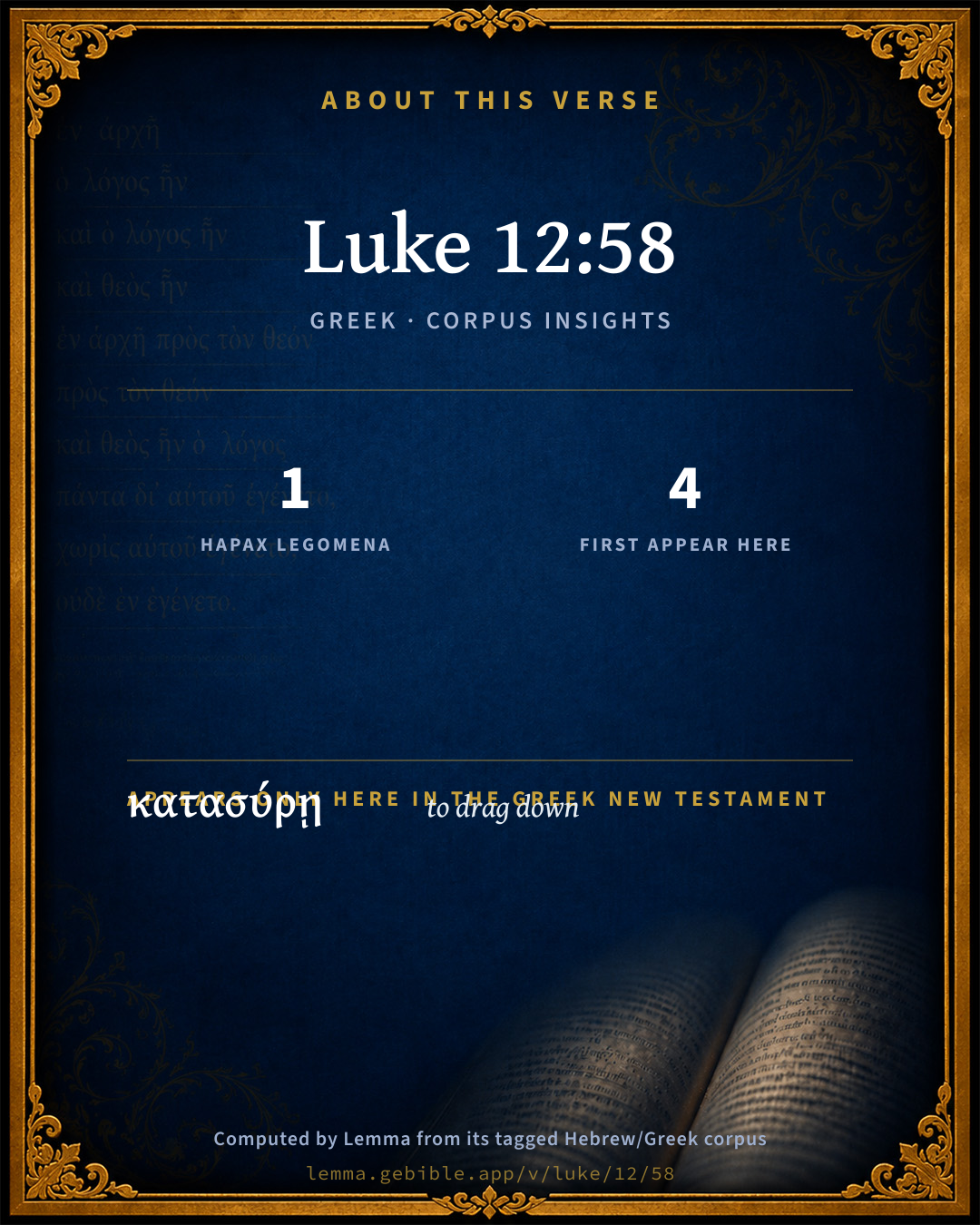
  • ἐργασίαν work G2039
  • ἀπηλλάχθαι to depart G525
  • κατασύρῃ to drag down G2694
  • πράκτορι doer G4233

Repetition

Words recur within this verse:

  • κριτήν judge G2923 ×2
  • πράκτορι doer G4233 ×2
  • τοῦ the G3588 ×6
  • σου you G4771 ×4
  • καὶ and G2532 ×2

Cross-references

18

Topical passages linked to Luke 12:58 in the Treasury of Scripture Knowledge — connected by theme and wording, ordered by reader-vote popularity; previews shown in the World English Bible.

  • Matthew 5:23–26 "If therefore you are offering your gift at the altar, and there remember that your brother has anything against you,
  • Job 23:7 There the upright might reason with him, So I should be delivered forever from my judge.
  • Proverbs 25:8–9 Don't be hasty in bringing charges to court. What will you do in the end when your neighbor shames you?
  • Isaiah 55:6 Seek you Yahweh while he may be found; call you on him while he is near:
  • Luke 13:24–28 "Strive to enter in by the narrow door, for many, I tell you, will seek to enter in, and will not be able.
  • Genesis 32:3–28 Jacob sent messengers in front of him to Esau, his brother, to the land of Seir, the field of Edom.
  • 1 Samuel 25:18–35 Then Abigail made haste, and took two hundred loaves, and two bottles of wine, and five sheep ready dressed, and five measures of parched grain, and one hundred clusters of raisins, and two hundred cakes of figs, and laid them on donkeys.
  • Job 22:21 "Acquaint yourself with him, now, and be at peace. Thereby good shall come to you.
  • Psalms 32:6 For this, let everyone who is godly pray to you in a time when you may be found. Surely when the great waters overflow, they shall not reach to him.
  • Psalms 50:22 "Now consider this, you who forget God, Lest I tear you into pieces, and there be none to deliver.
  • Proverbs 6:1–5 My son, if you have become collateral for your neighbor, If you have struck your hands in pledge for a stranger;
  • Matthew 18:30 He would not, but went and cast him into prison, until he should pay back that which was due.
  • Luke 14:31–32 Or what king, as he goes to encounter another king in war, will not sit down first and consider whether he is able with ten thousand to meet him who comes against him with twenty thousand?
  • 2 Corinthians 6:2 for he says, "At an acceptable time I listened to you, In a day of salvation I helped you." Behold, now is the acceptable time. Behold, now is the day of salvation.
  • Hebrews 3:7–13 Therefore, even as the Holy Spirit says, "Today if you will hear his voice,
  • Job 36:17–18 "But you are full of the judgment of the wicked. Judgment and justice take hold of you.
  • 1 Peter 3:19 in which he also went and preached to the spirits in prison,
  • Revelation 20:7 And after the thousand years, Satan will be released from his prison,

Cross-references courtesy of OpenBible.info (CC BY 4.0).

Commentary

Notes on Luke 12:58 from classic Christian and Jewish commentators (each source and its license shown beneath its notes). The classic Christian expositions comment on the surrounding passage and are grouped to its opening verse, so a note may address several verses; the Jewish commentaries on the Tanakh (Rashi and others) are per-verse, so they appear only where the commentator wrote on this verse.

Lemma curates 59 commentaries, every one of them public domain or Creative Commons licensed, each selected and text-cleaned for this edition rather than reprinted as found. About our sources →

The Biblical Illustrator

Joseph S. Exell

Luk_12:58-59

When thou goest with thine adversary

Agreeing with the adversary

This solemn exhortation of our Lords may be viewed in different points of light, as intended to subserve various purposes, both in civil and religious life.

1. It may refer to the case of debtor and creditor If in a way of trade, or for the support of ourselves and families, we owe anything to any man, the debt ought to be honourably paid, or at least compounded to the satisfaction of the creditor, lest, if he proceed to extremities, we suffer by our delays, and fall victims to our own stubbornness and obstinacy. The apostles command is, that we Should owe no man anything, but love one another, and render to all their dues.

2. The text may refer to persons offended and injured, and those especially on whom the offence or injury may justly be charged.

3. If not originally intended, the text may at least be applied to the case of a sinner, who is exposed to the displeasure of an offended and justly incensed God.

I. Observe WHAT IS IMPLIED IN OUR AGREEING WITH OUR OFFENDED MAKER, CONSIDERED UNDER THE IDEA OF AN ADVERSARY.

1. In order to our coming to an agreement with our holy and righteous Adversary, we must be thoroughly sensible of our alienation from God, of the enmity of our hearts against Him, and be led to view with deep distress the breach and the separation which sin has made. Mourning and humiliation are the forerunners of joy and exaltation, and a lively hope arises out of holy despair.

2. Being thus awakened and convinced, the eye of faith must be directed to the Saviour, who is the great peace-maker betwixt God and us. Jesus is both the wisdom of God, and the power of God, the man of His right hand, whom He hath made strong for Himself. Hence the language of God to the sinner is, Let him take hold of My strength, that he may make peace with Me; and he shall make peace with Me (Isa_27:5).

3. The eye of faith being fixed upon the Saviour, as the only medium of reconciliation, we must next implore forgiveness and acceptance in the sight of God.

II. CONSIDER THE TIME AND MANNER IN WHICH WE ARE REQUIRED TO AGREE WITH OUR ALMIGHTY AND RIGHTEOUS ADVERSARY.

1. It must be done quickly, without delay, and whilst thou art in the way with Him. The utmost solicitude is required in a matter of such high importance.

2. Reconciliation with God must be sought immediately; because the present opportunity is the most favourable. Now thou art in the way with Him, in the way of obtaining mercy, and of finding favour in His sight. Now that He affords us means of grace, and especially when He gives us a disposition to improve them, it becomes us to hearken to the first calls of His Word, and fall in with the first motions of His Spirit.

III. Briefly notice THE MOTIVES BY WHICH THE EXHORTATION IS ENFORCED.

1. If this agreement be not speedily effected; He that was an adversary will remain an adversary still; and of all enemies God is the most powerful, and the most dreadful. In His favour is life, and His loving-kindness is better than life; His displeasure therefore is worse than death, even in its most hideous and terrific forms.

2. This awful Adversary will deliver over the incorrigible to the Judge, to whom all judgment is committed, and whose office it is to pass the final and irrevocable sentence. Before Him shall be gathered all nations, and we must all appear before the judgment-seat of Christ, to receive according to the deeds done in the body, whether they be good or whether they be evil. Our God shall come, and shall not keep silence: a fire shall devour before Him, and it shall be very tempestuous round about Him.

3. The Judge having passed sentence on the offender, will deliver him to the officer whose business it is to carry the sentence into full effect. In the last great day the angels will be employed in gathering together the elect from the four winds of heaven, in gathering the wheat into the garner, and binding up the tares in bundles to burn them with unquenchable fire.

4. The officer will cast into prison, where the evil angels are already reserved in chains of darkness unto the judgment of the great day, and where the disembodied spirits of wicked men are still waiting their final Jud_1:6; 1Pe_3:19). (B. Beddome, M. A.)

The controversy between man and God

Here is a high controversy between man and God. This is not one of those disputes in which plaintiff and defendant are working one against the other with all those subtleties and chicaneries which, in the hands of ingenious advocates, can place the best rights in peril. The court is one in which every one of us is quite sure of justice, and nevertheless in which every one of us is quite sure of condemnation. Come, and let us weigh well the excellence of the counsel which would urge us to an immediate endeavour to the settlement of our quarrel, and that, too, on the principle that if our adversary once bring us before the judge there will be no alternative to our being cast into prison, and our remaining there till we have paid the last mite. Now, when you have once given a spiritual character to the passage before us--when, that is, you have abstracted your thoughts from litigation in a mere human court, and settled that our Lord was speaking of a controversy between man and God--it will become evident that our text announces the chief truths both of the law and of the gospel; of the law which brings us in as guilty, of the gospel which proposes to us a method of deliverance from our adversary whilst we are yet in the way. The position of every one of us--whether he be duly alive to it or not--is that position which gives him God for his adversary. But, still further, he is actually on the way with this adversary--on the road with him, to bring the cause before the magistrate. For this of which we affirm that it could hardly take place, except the party were all awake to his condition of having some cause about to come on at a human tribunal, holds good of every living man who (whether he heed it or not) is daily drawing nearer to the judgment-seat of Christ. So that there is the most thorough accuracy in the description of our text, when applied without exception to every child of man. It is not in this life that he will be brought to that trial by which his state for eternity shall be unalterably fixed; but he is on his way to the trial. Let him walk what path he will out of the many which present themselves to the steps of wandering man, it is a path which inevitably conducts him direct to the court and to the bar. He may swerve from all that is right; he may change the precise line, and be continually deviating to the one side or the other; but he is always advancing to the dreaded tribunal, where on His throne of light sits the anointed Judge of humankind; for there is no escape from this universal enactment--It is appointed unto men once to die, but after this the judgment. Neither in all these wanderings--wanderings which must lead to the same termination--is there any escaping, even for a solitary moment, from the adversary whom our sins have called up. Go what winding or intricate way you may towards the court in which you have been cited to appear, as though it were your own shadow inseparable from you whilst there is nothing to interrupt the fierce blaze of the sun, the adversary is with you that you may not suddenly make your way to the bar, and there find no accuser. Oh, awful condition of every one of us l And we cannot forbear from dwelling for a moment on one peculiar word in the text, the peculiarity of which may have escaped your attention; that is, the word hale. Lest he hale thee to the judge. The word implies the being dragged violently, by main force. Up to this word the description is almost that of two parties, who though they have a dispute are walking quietly together, as if they had agreed to refer it to the judge, and to abstain in the meanwhile from any altercation. There is no evidence of anything like struggle between the two; the accuser is using no violence with the accused. But at this word there passes a total change over the picture; as though on the very threshold of the judgment-hall, just when the two were about to enter, the accused drew affrightedly back--made desperate resistance--but seized as in an iron grasp by his accuser, were thrown down before the judge. May not this indicate what otherwise we have no means of positively asserting--that often at the very last moment of a life of worldliness and indifference; aye, and when, so far as bystanders can judge, the departing man is going off the scene without a fear and without a struggle, there is an awful trepidation and repugnance--the soul being roused into a sense of its tremendous position, shrinking back as though it would find some mode of escape, and passionately pleading if but for an hours delay. Such an expression would seem to admit us as spectators of the final fearful struggle, exhibit to us, whilst there is externally every appearance of quietness, that shuddering attempt at retreat when retreat is impossible, which must prove beyond all power of description, what a tremendous thing it would be the being found unprepared to die. If anything can make you dread the being unprepared to die, it is that. If anything can scatter the delusion which is often caused by the apparent composedness of the dying, though they have lived careless of religion, it is that. You may not mind the having your adversary always at your side; you may walk as unconcerned as though you were not thus compassed, until--ah! until the foot is on the threshold of the court, and then--O God, look graciously upon us, and spare us the ever knowing the grief, the strife, the more than mortal agony, which make up the one expression hale thee to the judge. But is there, then, no possibility of escape for the accused, if he once come with his accuser before the judgment-seat? Evidently not. The whole stress of our Lords representation lies upon this. Without giving any reasons for the fact, it is assumed as incontrovertible. You are exhorted, you observe, to give diligence as thou art in the way; it being most distinctly implied that there is no place for diligence afterwards. But how long shall we be in the way ? I know not where this mysterious threshold is; I know only that it may be everywhere. The man who is standing at my side one instant may have crossed it the next. One finds it in the crowded street; another on the solitary mountain; a third upon the waters. This man reaches it after years and years of painful walking; that whilst his step has lost nothing of its youthful spring. Where is this mysterious threshold; where the precincts of this terrible court? Anywhere-everywhere! Then is only for this one moment that we can pronounce ourselves in the way. (H. Melvill, B. D.)

Lessons

Note here--

1. That God and man were once friends.

2. That God and man are now adversaries.

3. That man, and not God, is averse to reconciliation and agreement.

4. That it is the wisdom, the duty, and interest of fallen man, speedily to accept of terms of peace and reconciliation with God.

5. That an eternal prison will be their portion who die in their enmity against God. (W. Burkitt.)

Fatal result of delaying to come to agreement

William III. made proclamation when there was a revolution in the north of Scotland, that all who came and took the oath of allegiance by the 31st of December should be pardoned. Mac Inn, a chieftain of a prominent clan, resolved to return with the rest of the rebels, but had some pride in being the very last one that should take the oath. He consequently postponed starting for this purpose until two days before the expiration of the term. A snow-storm impeded his way, and before he got up to take the oath and receive a pardon from the throne, the time was up and past. While the others were set free, Mac Inn was miserably put to death. In like manner, some of you are in prospect of losing for ever the amnesty of the gospel. He started too late and arrived too late. Many of you are going to be for ever too late. Remember the mistake of Mac Inn! (Dr. Talmage.)

.

The Biblical Illustrator, edited by Joseph S. Exell (c. 1880s–1900s) — public domain. Text from a community e-Sword module.

Joseph Benson's Commentary

Luk 12:58-59. When thou goest with thine adversary, &c. — The evils which befall obstinate sinners, he here illustrates by the punishment which, in ordinary cases, is inflicted upon the man who obstinately refuses to make compensation for the injuries he has done; but, even while his adversary is haling him to the judge, he will not agree the matter with him. He is therefore brought by force to the bar. The judge condemns him. The officer seizes him. He is cast into prison, and lies there till he has paid the very last mite. See on Mat 5:25-26. Thus, as if Christ had said, If you persist to be regardless of the proposals of God’s mercy while the day of life and grace continues, nothing is to be expected from the tribunal of his justice but a severe sentence, which will end in everlasting confinement and punishment. Reader, may we learn from these warnings of our Lord to be so wise at all times as to discern the evidences, and comply with the purposes, of the gospel; otherwise our knowledge in natural things, should it extend not only to the most common, but to the most curious appearances on the face of the earth or the heavens, will turn to no other account but to shame and condemn us. And if we have any reasons to fear that through our impenitence, the blessed God is still an adversary to us, let us make it our first care, by an humble submission of soul to him, and obedient faith in Christ and his gospel, to seek that reconciliation with him which will prevent that strict scrutiny of his justice, and that sentence of his wrath, which would otherwise plunge us into endless ruin and misery; for when could we pretend to have paid the last farthing of this debt of ten thousand talents which we have been daily contracting, and which is charged to our account in the book of his remembrance?

Joseph Benson's Commentary on the Old and New Testaments (1811–1818) — public domain. Text from a community e-Sword module.

Whedon's Commentary on the Bible

Daniel D. Whedon

IX. Importance of decision in view of the final judgment decision, Luk_12:58-59.

See notes on Mat_5:25-26.

Let the reader grasp as an entire unit the Sermon to the Myriads, (embracing this whole chapter,) and he will find one thought pervading it: namely, decision for Christ, as against his adversaries and in view of the judgment day.

Daniel D. Whedon (gen. ed.), Commentary on the Old and New Testaments (1874–1909) — public domain. Text from a community e-Sword module.

Tyndale Open Study Notes

Tyndale Open Resources

12:58 on the way to court: This lawsuit over an unpaid debt would result in debtor’s prison. The officer is the bailiff of the court or the warden of the prison. It is advisable to negotiate accounts with your accuser, if possible, before reaching the courtroom. It is also best to reckon with God before the final day of judgment.

Tyndale Open Study Notes — © Tyndale Open Resources, licensed CC BY-SA 4.0. Text via the HelloAO Bible API.

Expositor's Greek Testament

ed. W. Robertson Nicoll

Luk 12:58 . ὡς γὰρ : introducing a legal scene from natural life to illustrate a similar situation in the moral world. It is implied that if they had the necessary moral discernment they would see that a judgment day was at hand, and understand that the duty of the hour was to come to terms with their adversary by timely repentance. That is hew they would all act if it were an ordinary case of debtor and creditor. δὸς ἐργασίαν (phrase here only): usually interpreted give diligence, give thine endeavour = da operam , a Latinism. Theophylact renders it: give interest (of the sum owed); Hofmann, offer work, labour, in place of money. κατασύρῃ (here only in N.T.), lest he drag thee to the judge, stronger than Mt.’s παραδῷ (Luk 5:25 ), realistic and not exaggerated. τῷ πράκτορι , the man whose business it was to collect the debts after the judge had decreed payment, or to put the debtor in prison till the debt was paid. Kypke defines πράκτορες : “exactores qui mulctas violatorum legum a judice irrogatas exigunt,” citing an instance of its use from Demosthenes.

The Expositor's Greek Testament, edited by W. Robertson Nicoll (1897–1910) — public domain. Text from a community e-Sword module.

Geneva Bible (1599)

Geneva Bible translators

To him that had to demand and gather the amerciaments which they were condemned unto that had wrongfully troubled men: moreover, the magistrate’s officers make them which are condemned, pay that, that they owe, yea, and oftentimes if they be obstinate, they do not only take the cost and charge of them, but also imprison them.

Geneva Bible (1599) marginal notes — public domain. Text via Bolls.life.

Jamieson, Fausset & Brown

Robert Jamieson, A. R. Fausset & David Brown

When thou goest, &c.--(See on Mat 5:25-26). The urgency of the case with them, and the necessity, for their own safety, of immediate decision, was the object of these striking words.

Next: Luke Chapter 13

Jamieson, Fausset & Brown — Commentary Critical and Explanatory on the Whole Bible (1871) — public domain (CC PDM 1.0). Text via the HelloAO Bible API.

Adam Clarke's Commentary

Verse 58. When thou goest with thine adversary] This and the next verse are a part of our Lord's sermon upon the mount. See them explained Mt 5:25-26. St. Luke is very particular in collecting and relating every word and action of our blessed Lord, but seldom gives them in the order of time in which they were spoken or done. See the Preface to this Gospel.

Give diligence] δος ερασιαν, Give labour, do every thing in thy power to get free before a suit commences.

The officer] πρακτωρ properly signifies such an officer as was appointed to levy the fines imposed by the law for a violation of any of its precepts. See Kypke.

Adam Clarke's Commentary on the Bible (1810–1826) — public domain. Text from a community e-Sword/MySword module.

Ellicott's Commentary for English Readers

(58) When thou goest with thine adversary. . . .—Better, with all the MSS., For as thou goest. . . . The conjunction would seem to have been omitted by the translators because they did not see the sequence of thought implied in it. There is, indeed, something at first strangely abrupt in this reproduction of what had appeared in the Sermon on the Mount as part of our Lord’s teaching as to the true meaning of the command “Thou shalt not kill.” (See Note on Mat_5:25.) There the words are spoken at once of earthly adversaries and magistrates and of the great Judge of all. Is it so in this place also? Is this the “just judgment” to which Luk_12:57 referred, in contrast with the prevailing bitterness and hardness of men in the quarrels brought on chiefly by their greed of gain? The answer to the question is found in accepting, as before, both the literal meaning and that of which it becomes a parable, with, perhaps, a greater stress than before on the spiritual aspect of the words. Our Lord is speaking to the people; there has been no immediate reference, as before, to the Sixth Commandment. His teaching has taken a wider range, and the old words, as it were, come back, with every point of the parable brought into full clearness. The “adversary” is the Law that accuses them (Joh_5:45); the judge is none other than the Judge of all the earth; and then all follows in due order as before.

A Bible Commentary for English Readers, edited by Charles John Ellicott (1878–1897) — public domain. Text from a community e-Sword module.

The Cambridge Bible for Schools and Colleges

gen. ed. J. J. S. Perowne

58. When thou goest] Rather, For as thou goest. Our translators omitted the “for” probably because they could not see the connexion. It seems however to be this. ‘For this is your clear duty,—to reconcile yourselves with God, as you would with one whom you had alienated, before the otherwise inevitable consequences ensue.’

with thine adversary] This is a parable. If you had wronged a man it would be obviously wise to avert the consequences of your wrongdoing before it became too late. Even so must you act towards God. To press the details is obviously false theology. “Theologia parabolica non est argumentativa.” Here again St Matthew quotes the parable in a slightly different connexion (Luk_5:25-26) to teach that love and forgiveness to man are an indispensable condition of forgiveness from God.

give diligence] A curious Latinism, da operam.

to the officer] i.e. the jailor, literally the exactor (πράκτορι). “God is here shadowed forth as at once the adversary, the judge, and the officer; the first by His holiness, the second by His justice, the third by His power.” Godet.

The Cambridge Bible for Schools and Colleges (gen. ed. J. J. S. Perowne; Cambridge University Press, 1878–1918) — public domain. Text from a community e-Sword module.

Trapp's Complete Commentary

John Trapp

58 When thou goest with thine adversary to the magistrate, as thou art in the way, give diligence that thou mayest be delivered from him; lest he hale thee to the judge, and the judge deliver thee to the officer, and the officer cast thee into prison.

Ver. 58. Give diligence] δος εργασιαν, Purus Putus Latinismus, saith Drusius. Da operam Id eat, festina, et labora, omnesque modos cogita quomodo ab eo libereris, as Theophylact expounds it. Be at utmost pains to get freed from him.

John Trapp, A Commentary or Exposition upon All the Books of the Old and New Testament (1647–1656) — public domain. Text from a community e-Sword module.

Albert Barnes' Notes on the Bible

See the notes at Mat 5:25-26.

Albert Barnes' Notes on the Bible (1834–1885) — public domain. Text from a community e-Sword/MySword module.

The Pulpit Commentary

Vers. 58, 59. When thou goest with thine adversary to the magistrate, as thou art in the way, give diligence that thou mayest be delivered from him; lest he hale thee to the judge, and the judge deliver thee to the officer, and the officer cast thee into prison. I tell thee, thou shalt not depart thence, till thou hast paid the very last mite. And then the Master passed into one of those parable illustrations with which his hearers were now familiar, and which in a homely way taught the crowd the same grave truth which he had been dwelling upon the impending terrible judgment which was coming on the people. The lesson, "be reconciled to God while it is yet time," is, of course, applicable to all lives, precarious and hanging seemingly on a thread as they all are, but it was especially spoken to that generation in view of the awful ruin which he knew was so soon to fall on every Jewish home. The genera] meaning of the parable illustration was obvious; no hearer could fail to understand the Lord"s meaning. It is before arriving at the judgment-seat that you must be reconciled, with the one who accuses you, otherwise it will be too late, and nothing would remain for the guilty accused but the eternal prison-house. At that moment, when the Master was speaking, individual or nation might have turned to the Lord and lived. There was no time, however, for hesitation. The sands in the hour-glass, which marked the duration of God"s longsuffering with Israel, were just running out. Theologians in different ages and of varied schools have made much of the concluding sentence (ver. 59). Roman Catholic divines see in it a strong argument in favor of the doctrine of purgatory, arguing that after death condemnation would be followed by liberation, when a certain payment had been made by the guilty soul; strange ways of paying this debt by means of others we know have been devised by the school of divines who teach this doctrine of purgatory. But the Lord"s words here are terribly plain, and utterly exclude any payment of the debt of the soul by others. The Master emphatically says, "till thou hast paid the very last mite." The advocate who pleads for universal redemption, and shrinks from a punishment to the duration of which he can see no term, thinks that in the words, "till thou hast paid," he can discern the germ at least of eternal hope. But the impenetrable veil which hangs between us and the endless hereafter prevents us, surely, from even suggesting that any suffering which the soul may endure in the unseen world will ever pay "the very last mite," and so lead to pardon and peace.

Vers. 58, 59. The inexorable.

From the lips of such a parabolic teacher as Jesus Christ we expect to have some striking illustration of a general principle, our duty being to detect that principle and to make our own practical applications of it. Here the great Teacher adduces an illustration drawn from the legal practice of his time; the general truth underlying it is evidently this that law is a rigorous thing, a broken law a terribly exacting thing; that, if we are in any danger of coming under its power, we should refrain from so doing with the greatest carefulness; that, if we do not act thus prudently, we must be prepared to pay a very heavy penalty a little way on. The principle applies to

I A BREACH OF THE LAW OF PEACE. We are here in this world to sustain toward one another interesting and important relationships. It is the will of God that, in all of these, we should be actuated by the spirit and be ruled by the law of love, of kindness, of charity, of peace. But in this world of sin the Divine Law is continually broken, and the broken Law exacts a terrible penalty. What wretched homes it makes! what lamentable feuds in families! what miserable ruptures of friendship! what deplorable contentions even in Christian Churches! what social dissensions! what national and international strife! The violated law of love exacts "the uttermost farthing" from those who break it. Christ"s word of wisdom is this Look to it at once; do not lose a day; fill up that little crack; tear up that small root; let everything, even devotion itself, (Mat_5:24) give place to the sacred work of reconciliation; do your best, your quickest, your utmost, to heal the breach before it widens into a gulf, or the slight difference, the small suspicion, the trivial offense will grow and deepen, and hearts that once were the home of trust and love will become the haunts of doubt and enmity. Therefore agree with thine adversary quickly. The same principle applies to

II A BREACH OF THE LAW OF VIRTUE. We owe it to ourselves to be temperate, truthful, pure, industrious; we owe it to others to be just, fair, kind, considerate; we are under law to be all this the sacred Law of God. This Law we break, and it becomes our "adversary;" it arraigns us as its debtors, and it makes us pay the penalty that is due. And what a penalty! In the body disease, pain, weakness, shattered nerves, death; in circumstances loss , poverty, beggary; in reputation humiliation and disgrace; in heart compunction, agony of soul; in character deterioration, baseness, ruin. Christ says, "Beware of the first step; if tempted to violate any law of virtue of any kind, consider what you will have to pay a little further on; think how that broken law will rise against you and condemn you, and you will not escape until the last farthing has been paid." If there should be any breach, however minute it may be, hasten to repair it.

III A BREACH OF THE LAW OF PRIVILEGE. Privilege and peril, opportunity and obligation go together, like substance and shadow; they cannot be dissociated. From those to whom much is given will much be required (see vers. 47, 48). It is a constant law, and its violation will be rigorously attended with penalty. If we neglect our privilege, if we abuse our opportunity, we must expect "many stripes," the uttermost farthing of condemnation and retribution. We are the firstborn children of privilege; ours is the dispensation, the period, the land, the home of privilege. Ill will it fare with us if we pass on to the last tribunal and stand before the great Judge, not having repaired this breach, not having sought and found forgiveness for this great transgression. C.

The Pulpit Commentary (1880–1919), ed. H.D.M. Spence-Jones & Joseph S. Exell — public domain. Text from a community e-Sword module.

John Wesley's Explanatory Notes

When thou art going - As if he had said, And ye have not a moment to lose. For the executioners of God's vengeance are at hand. And when he hath once delivered you over to them, ye are undone forever. Matt. v, 25.

John Wesley, Explanatory Notes Upon the Whole Bible (1754–1765) — public domain. Text via the GEBible commentary corpus.

The People's New Testament

B. W. Johnson

58, 59. As thou art going with thine adversary. See notes on Matt. 5:25, 26.

B. W. Johnson's The People's New Testament with Notes (1889–1891) — public domain. Electronic text from the Christian Classics Ethereal Library (CCEL) ThML edition.

Cambridge Greek Testament for Schools and Colleges

58. ὡς γὰρ ὑπάγεις. ‘For as thou goest.’ Our translators omitted the ‘for’ probably because they could not see the connexion. It seems however to be this. ‘For this is your clear duty,—to reconcile yourselves with God, as you would with one whom you had alienated, before the otherwise inevitable consequences ensue.’ Euthymius therefore is mistaken in saying that the subject is here suddenly changed (ἐφ’ ἕτερον μετέβη λόγον).

μετὰ τοῦ ἀντιδίκου σου. This is a parable. If you had wronged a man it would be obviously wise to avert the consequences of your wrongdoing before it became too late. Even so must you act towards God. To press the details is obviously false theology. “Theologia parabolica non est argumentativa.” Here again St Matthew quotes the parable in a slightly different connexion (Luk 5:25-26) to teach that love and forgiveness to man are an indispensable condition of forgiveness from God.

δὸς ἐργασίαν. A curious Latinism, da operam.

τῷ πράκτορι. ‘To the jailor,’ literally ‘the exactor.’ “God is here shadowed forth as at once the adversary, the judge, and the officer; the first by His holiness, the second by His justice, the third by His power.” Godet.

Cambridge Greek Testament for Schools and Colleges (Cambridge University Press, 1896; 21 vols, various authors incl. Carr, Maclear, Plummer, Farrar, Lumby, Moule, M. R. James, Simcox) — public domain. Text from a community e-Sword module.

International Critical Commentary

58. ὡς γὰρ ὑπάεις. γὰρ sæpe ponitur, ubi propositionem excipit tractatio. Here ειν τῇ ὁδῷ stands first with emphasis; no time is to be lost. And the Latinism δὸς ειργασίαν, da operam, occurs here only. Wetst. quotes Heremogenes, De Inventione, iii. 5, 7. Excepting Eph 4:19, ἐργασία in N.T. is peculiar to Lk. (Act 16:16, Act 16:19, Act 16:19:24, Act 16:25). Hobart regards it as medical (p. 243), but it is very freq. in LXX. Note ὡς = “when.”

ἀπηλλάχθαι. “To he quit of him” by coming to terms with him. Christ is perhaps taking the the case of the two brothers (vv. 13, 14) as an illustration. The ὰπό before the αὐτοῦ is omitted in B, but is certainly right Act 19:12. In class. Grk. both constructions are found, but the simple gen. is more common. Plat. Leg. 868 D; Xen. Mem. ii. 9, 6.

κατασύρῃ. Here only in N.T. and only once in LXX of ruining or demolishing: ὅτι ἐγὼ κατέσυρα τὸν Ἠσαῦ (Jer 49:10). In Lat. detraho is used of dragging into court. For examples see Wetst. Mt. has παραδῷ τῷ κπιτῇ.

παραδώσει τῷ πράκτορι καὶ ὁ πράκτωρ σε βαλεῖ εἰς φυλακήν. Tradat te exactori et exactor mittat to in carcerem (Vulg.). For exactor Cod. Palat (e) has the strange word pignerarius. No where else in bibl. Grk. does πράκτωρ occur. At Athens the magistrate who imposed a fine gave notice to the πράκτορες, who entered it as due from the person fined; but they did not enforce payment, if the fine was not paid. They merely kept the record. See D. of Ant.2 art. Practores. For πράκτορι Mt. has ὑπηρέτῃ.

International Critical Commentary — older volumes (1896–1929), various authors — public domain. Text from a community e-Sword module.

Vincent's Word Studies in the New Testament

Marvin R. Vincent

When thou goest [ως γαρ υπαγεις] . The A. V. does not translate gar, for. Rev., correctly, for as thou art going. Their own judgment should show them the necessity of repentance toward God; and this duty is urged under the figure of a debtor who meets his creditor in the way, and whose best policy it is to make terms on the spot.

As thou art in the way. Emphatic, standing first in the Greek order : "On the way give diligence."

Hale [κατασυρη] . Drag. Compare haul. Only here in New Testament.

Officer [πρακτορι] . From prassw, to effect or accomplish; to bring things to an issue, and hence to exact. The name praktor was given at Athens to an officer charged with the collection of taxes; hence an exactor, as Rev., in margin. Only here in New Testament.

Mite [λεπτον] . See on Mr 12:42.

Marvin R. Vincent, Word Studies in the New Testament (1887–1900) — public domain. Text from a community e-Sword/MySword module.

Lesson kit

Teaching starters — assembled from the data on this page, not authored interpretation. Every prompt links to the verse data it draws on. Edit before teaching.

Luke, in the Gospels, opens this verse with 37 words (26 distinct Greek lemmas). Its most distinctive word is katasýrō (“to drag down”). A historical commentator’s framing appears above. Read the whole chapter for the surrounding context.

Discussion questions

  1. How does “to drag down” (katasýrō) shape what this verse is saying?
  2. 1 word here appears nowhere else in the Greek New Testament. Why might the author reach for such rare wording?
  3. 4 words make their first appearance in Scripture here. What does this debut establish?
  4. How does Matthew 5:23–26, which shares this passage’s theme, read alongside this verse?
  5. What does the repetition of “judge” (2× in this one verse) do in this verse?
  6. The translations on this page render this verse differently — a whole-verse word diff, not a word-by-word alignment. What might account for the different wordings?
  7. Compare how The Biblical Illustrator and Joseph Benson's Commentary read this verse. Where do they agree or differ?

Things to notice

  • 1 word in this verse appears nowhere else in the Greek New Testament.
  • 4 words make their first canonical appearance in Scripture here.
  • These translations choose different wording for 24 words in this verse.
  • “judge” occurs 2× in this single verse.
  • 26 distinct Greek lemmas span 37 words in this verse.

Reading settings

Reading text

Shown beneath each verse's original-language words.

Old Testament
Old Testament edition

Read the OT as the Masoretic Hebrew (MT) or the Greek Septuagint (LXX).

English shown for the Greek Septuagint (in the Hebrew ↔ Greek comparison).

Comparing translations? Open the Compare panel on any verse page to stack up to four side by side.