
Deuteronomy 1:4

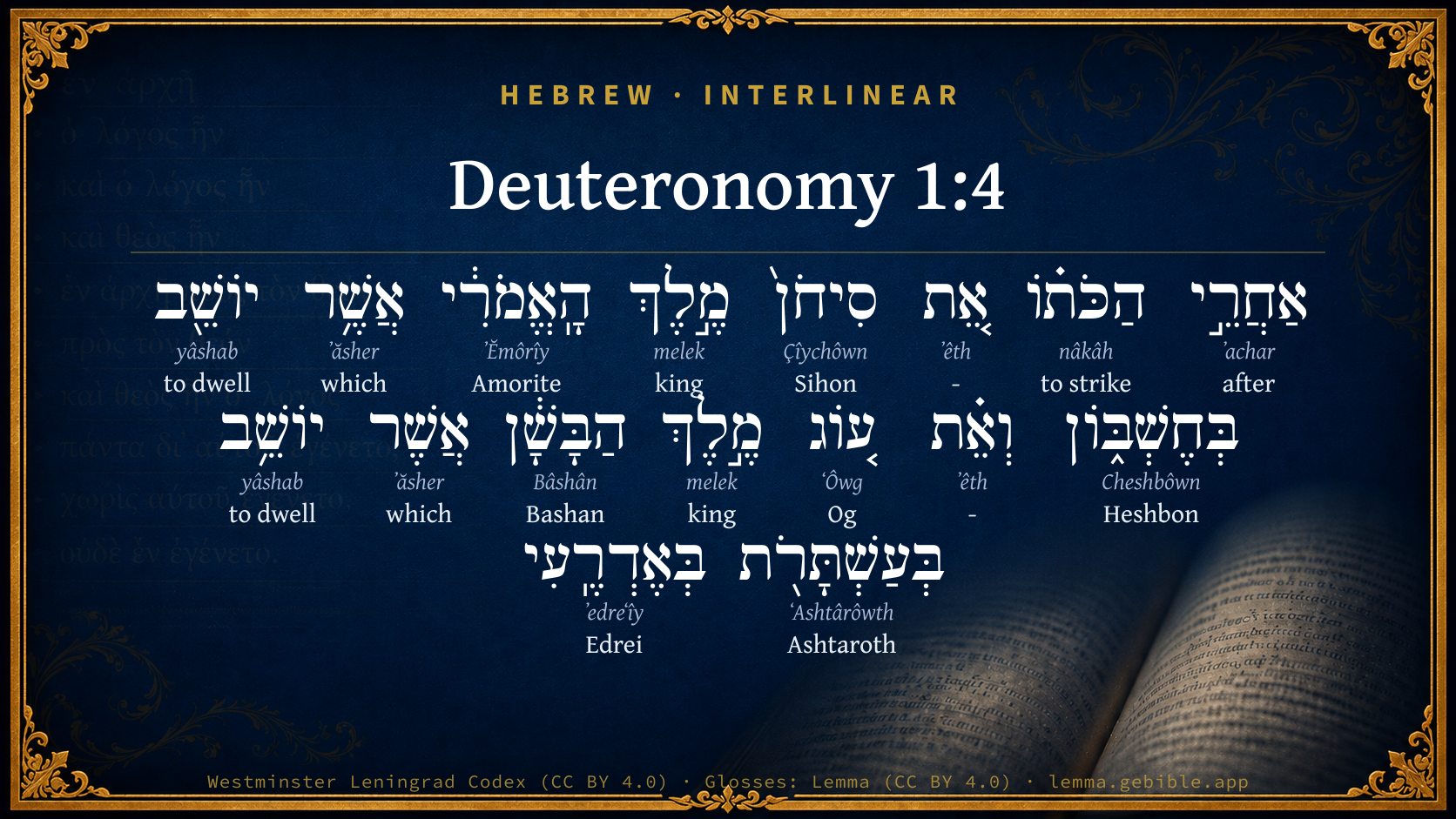
Hebrew (Westminster Leningrad Codex) Deuteronomy 1:4 appears in the Hebrew Old Testament. The text above is from the Westminster Leningrad Codex. Each word links to its Strong’s number, a concise gloss, and parsing drawn from the Open Scriptures Hebrew Bible morphology. Click any word for its full Brown-Driver-Briggs (BDB) entry.
Download image
Cite this verse

Deuteronomy 1:4 (World English Bible). Public Domain. Lemma interlinear Bible study tool, https://lemma.gebible.app/v/deuteronomy/1/4.

Show BibTeX & RIS
BibTeX
RIS
English Translation
after he had struck Sihon the king of the Amorites, who lived in Heshbon, and Og the king of Bashan, who lived in Ashtaroth, at Edrei.
World English Bible · Public Domain
Highlights
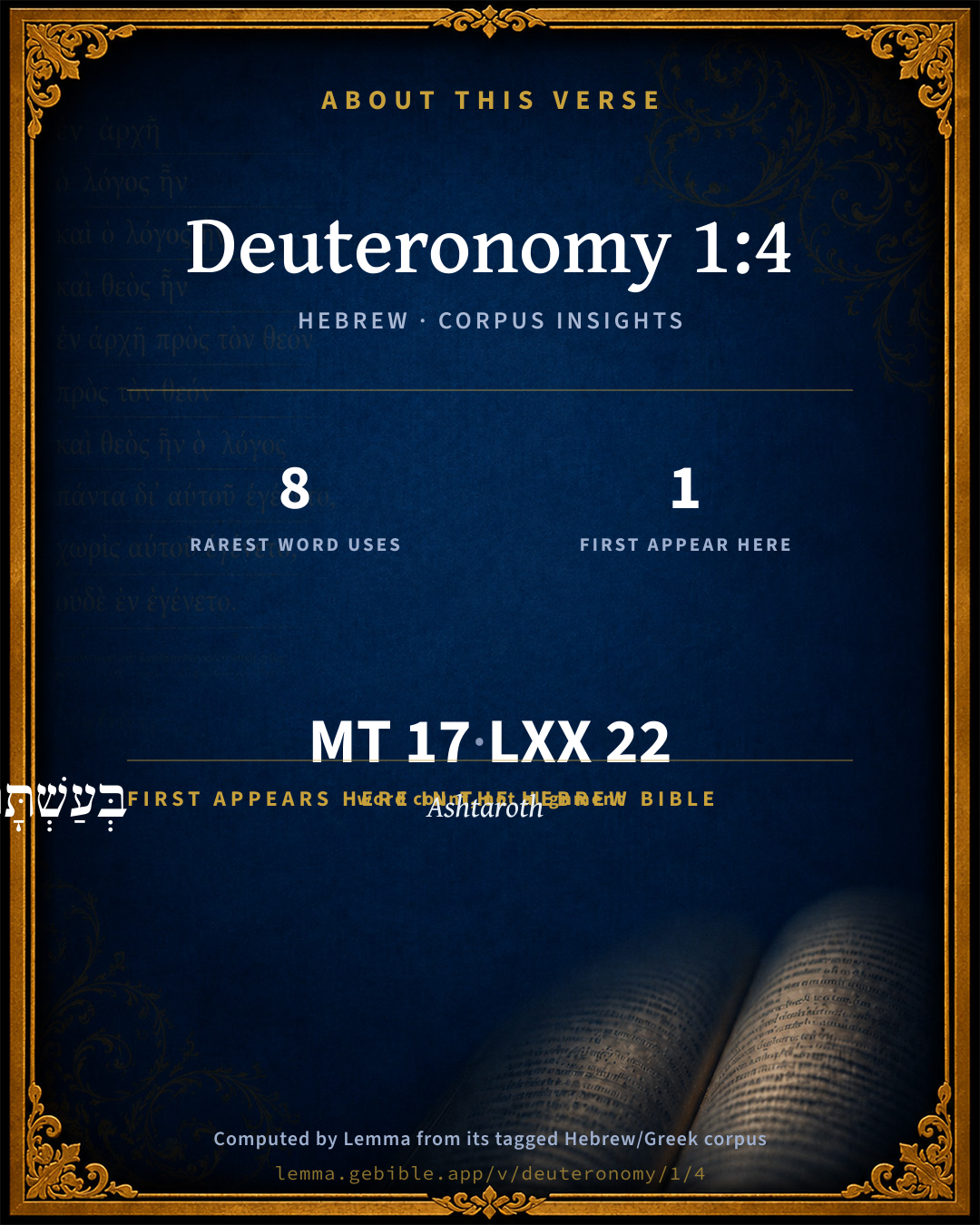
  • 1 first appearance in the Hebrew Bible
Full analysis ↓
Download a study sheet

One document with this verse’s original text, its word-by-word gloss line, the meaning frame, cross-references with their text, attributed commentary, and full source and license credits — printable, and it pastes into notes with its structure intact.

This verse Autodidact and up

Study sheet (.html) Plain text (.txt)

A passage Seminary Student

Up to 50 verses in one chapter. A passage sheet keeps up to 6 commentary sources and 12 cross-references per verse, in the order this page ranks them, and says so on the sheet whenever that leaves anything out. Ask for a single verse and you get the Autodidact verse sheet above.

Everything on this page stays free to read, with no account — the sheet is a download of what is already on screen, not access to it.

Want to remove ads? Support Godless Engineer
Compare translations 3

The same verse in 3 English versions, stacked beneath the original-language interlinear above. Click any original word for its lexicon entry.

Each is an independent rendering of the whole verse — the interlinear is not word-aligned to these translations.

Highlighted words mark where these versions differ — a whole-verse word diff, not a word-by-word alignment.

  • World English Bible Public Domain
    after he had struck Sihon the king of the Amorites, who lived in Heshbon, and Og the king of Bashan, who lived in Ashtaroth, at Edrei.
  • King James Version Public Domain
    After he had slain Sihon the king of the Amorites, which dwelt in Heshbon, and Og the king of Bashan, which dwelt at Astaroth in Edrei:
  • unfoldingWord Literal Text CC BY-SA 4.0
    after he defeated Sihon, the king of the Amorites, who lived in Heshbon, and Og, the king of Bashan, who lived in Ashtaroth, in Edrei.

unfoldingWord Literal Text — © unfoldingWord, licensed CC BY-SA 4.0. Word-aligned USFM3 via Door43 (git.door43.org/unfoldingWord/en_ult).

Versions to compare (up to 4)

3 of 4 selected

Show all 18 translations

Every available English version of this verse, each an independent rendering of the whole verse.

  • World English Bible Public Domain
    after he had struck Sihon the king of the Amorites, who lived in Heshbon, and Og the king of Bashan, who lived in Ashtaroth, at Edrei.
  • Berean Standard Bible Public Domain
    This was after he had defeated Sihon king of the Amorites, who lived in Heshbon, and then at Edrei had defeated Og king of Bashan, who lived in Ashtaroth.
  • Majority Standard Bible Public Domain
    This was after he had defeated Sihon king of the Amorites, who lived in Heshbon, and then at Edrei had defeated Og king of Bashan, who lived in Ashtaroth.
  • King James Version Public Domain
    After he had slain Sihon the king of the Amorites, which dwelt in Heshbon, and Og the king of Bashan, which dwelt at Astaroth in Edrei:
  • American Standard Version (1901) Public Domain
    after he had smitten Sihon the king of the Amorites, who dwelt in Heshbon, and Og the king of Bashan, who dwelt in Ashtaroth, at Edrei.
  • Revised Version (1885) Public Domain
    after he had smitten Sihon the king of the Amorites, which dwelt in Heshbon, and Og the king of Bashan, which dwelt in Ashtaroth, at Edrei:
  • Geneva Bible (1599) Public Domain
    After that he had slaine Sihon the king of the Amorites which dwelt in Heshbon, and Og king of Bashan, which dwelt at Ashtaroth in Edrei.
  • Douay-Rheims (1899) Public Domain
    After that he had slain Sehon king of the Amorrhites, who dwelt in Hesebon: and Og king of Basan who abode in Astaroth, and in Edrai,
  • Young's Literal Translation Public Domain
    after his smiting Sihon king of the Amorite who is dwelling in Heshbon, and Og king of Bashan who is dwelling in Ashtaroth in Edrei,
  • Literal Standard Version CC BY-SA 4.0
    after his striking Sihon king of the Amorite who is dwelling in Heshbon, and Og king of Bashan who is dwelling in Ashtaroth in Edrei.
  • Unlocked Literal Bible CC BY-SA 4.0
    This was after Yahweh had attacked Sihon the king of the Amorites, who lived in Heshbon, and Og the king of Bashan, who lived in Ashtaroth at Edrei.
  • unfoldingWord Literal Text CC BY-SA 4.0
    after he defeated Sihon, the king of the Amorites, who lived in Heshbon, and Og, the king of Bashan, who lived in Ashtaroth, in Edrei.
  • Darby Bible Public Domain
    after he had smitten Sihon the king of the Amorites, who dwelt at Heshbon, and Og the king of Bashan, who dwelt at Ashtaroth [and] at Edrei.
  • World Messianic Bible Public Domain
    after he had struck Sihon the king of the Amorites who lived in Heshbon, and Og the king of Bashan who lived in Ashtaroth, at Edrei.
  • Webster's Bible Public Domain
    After he had slain Sihon the king of the Amorites, who dwelt in Heshbon, and Og the king of Bashan, who dwelt at Astaroth in Edrei:
  • Free Bible Version CC BY-SA 4.0
    This happened after he defeated Sihon king of the Amorites, who ruled in Heshbon, and then at Edrei after he defeated Og king of Bashan, who ruled in Ashtaroth.
  • Bible in Basic English Public Domain
    After he had overcome Sihon, king of the Amorites, ruling in Heshbon, and Og, king of Bashan, ruling in Ashtaroth, at Edrei:
  • JPS Tanakh (1917) Public Domain
    after he had smitten Sihon the king of the Amorites, who dwelt in Heshbon, and Og the king of Bashan, who dwelt in Ashtaroth, at Edrei;

Literal Standard Version (2020), Covenant Press — licensed CC BY-SA 4.0. Text via the HelloAO Bible API (eBible.org). Unlocked Literal Bible (unfoldingWord) — licensed CC BY-SA 4.0. Text via the HelloAO Bible API (eBible.org). unfoldingWord Literal Text — © unfoldingWord, licensed CC BY-SA 4.0. Word-aligned USFM3 via Door43 (git.door43.org/unfoldingWord/en_ult). Free Bible Version, Dr. Jonathan Gallagher — licensed CC BY-SA 4.0. Text via the HelloAO Bible API (eBible.org).

Word by word

More ways to search: Search by grammar → Find every occurrence → Compare this word →

Practice this passage: Drill this verse → Learn its vocabulary →

בְּאֶדְרֶֽעִי
ʼedreʻîy
H154
“in/at · Edrei”
Preposition + Noun, Proper
Part of Speech
Preposition + Noun
Type
Proper
Full BDB Definition

Origin: from the equivalent of H153

TWOT: None

Edrei = "goodly pasture" - a chief city of Bashan, north of Jabbok river
  1. אַחֲרֵ֣י ʼachar H310 “after” Preposition
  2. הַכֹּת֗וֹ nâkâh H5221 “to strike · him” Verb, Hiphil, Infinitive Construct + Suffix, Personal, 3rd Person, Masculine, Singular
  3. אֵ֚ת ʼêth H853 “-” Particle, Direct Object
  4. סִיחֹן֙ Çîychôwn H5511 “Sihon” Noun, Proper
  5. מֶ֣לֶךְ melek H4428 “king of” Noun, Common, Masculine, Singular, Construct
  6. הָֽאֱמֹרִ֔י ʼĔmôrîy H567 “the · Amorite” Particle, Definite Article + Noun, Gentilic, Masculine, Singular, Absolute
  7. אֲשֶׁ֥ר ʼăsher H834 “which” Particle, Relative
  8. יוֹשֵׁ֖ב yâshab H3427 “dwelling” Verb, Qal, Participle Active, Masculine, Singular, Absolute
  9. בְּחֶשְׁבּ֑וֹן Cheshbôwn H2809 “in/at · Heshbon” Preposition + Noun, Proper
  10. וְאֵ֗ת ʼêth H853 “and · -” Conjunction + Particle, Direct Object
  11. ע֚וֹג ʻÔwg H5747 “Og” Noun, Proper
  12. מֶ֣לֶךְ melek H4428 “king of” Noun, Common, Masculine, Singular, Construct
  13. הַבָּשָׁ֔ן Bâshân H1316 “the · Bashan” Particle, Definite Article + Noun, Proper
  14. אֲשֶׁר ʼăsher H834 “which” Particle, Relative
  15. יוֹשֵׁ֥ב yâshab H3427 “dwelling” Verb, Qal, Participle Active, Masculine, Singular, Absolute
  16. בְּעַשְׁתָּרֹ֖ת ʻAshtârôwth H6252 “in/at · Ashtaroth” Preposition + Noun, Proper

About this verse

These counts appear in no published source. They are computed here, from the morphology-tagged text and Lemma’s own curated glosses. What Lemma adds →

17
words
13
distinct lemmas
Pentateuch
section

Notable vocabulary

The rarest word here is בְּאֶדְרֶֽעִי Edrei H154 — appearing just 8 times in the whole Hebrew Bible.

First appearance in Scripture

This word makes its first canonical appearance in the Hebrew Bible here:

  • בְּעַשְׁתָּרֹ֖ת Ashtaroth H6252

Shared distinctive vocabulary

בְּאֶדְרֶֽעִי Edrei H154 occurs in 8 verses of the Hebrew Bible. Also found in:

Grammatical profile

  • 3 verbs
  • 9 nouns
  • 1 preposition
  • 4 particles

Verb forms

  • הַכֹּת֗וֹ Hiphil · Infinitive Construct
  • יוֹשֵׁ֖ב Qal · Participle Active
  • יוֹשֵׁ֥ב Qal · Participle Active

Repetition

Words recur within this verse — often emphatic in Hebrew:

  • מֶ֣לֶךְ king H4428 ×2
  • יוֹשֵׁ֖ב to dwell H3427 ×2
  • אֲשֶׁ֥ר which H834 ×2

Hebrew & Septuagint length

In English translation the verse runs 26 words from the Hebrew and 26 from the Septuagint (LXX English) — the same length.

A rough comparison of the two English renderings, which tokenize alike — not a word-level alignment.

Word counts can differ between the Hebrew and the Greek without any difference in meaning — e.g. the Hebrew direct-object marker אֵת has no separate Greek word, and Greek often adds the article ὁ.

In the original languages it is 17 Hebrew tokens and 22 Greek tokens — but the two are counted differently (Hebrew bundles its prefixes and suffixes into one token; the Greek is in lemma form), so that isn’t a like-for-like length.

Cross-references

7

Topical passages linked to Deuteronomy 1:4 in the Treasury of Scripture Knowledge — connected by theme and wording, ordered by reader-vote popularity; previews shown in the World English Bible.

  • Numbers 21:21–35 Israel sent messengers to Sihon king of the Amorites, saying,
  • Deuteronomy 2:26–3:11 I sent messengers out of the wilderness of Kedemoth to Sihon king of Heshbon with words of peace, saying,
  • Joshua 12:2–6 Sihon king of the Amorites, who lived in Heshbon, and ruled from Aroer, which is on the edge of the valley of the Arnon, and [the city that is in] the middle of the valley, and half Gilead, even to the river Jabbok, the border of the children of Ammon;
  • Joshua 13:10–12 and all the cities of Sihon king of the Amorites, who reigned in Heshbon, to the border of the children of Ammon;
  • Nehemiah 9:22 Moreover you gave them kingdoms and peoples, which you did allot after their portions: so they possessed the land of Sihon, even the land of the king of Heshbon, and the land of Og king of Bashan.
  • Psalms 135:11 Sihon king of the Amorites, Og king of Bashan, And all the kingdoms of Canaan,
  • Psalms 136:19–20 Sihon king of the Amorites; For his loving kindness endures forever;

Cross-references courtesy of OpenBible.info (CC BY 4.0).

Hebrew and Greek witnesses Masoretic Hebrew ↔ Greek Septuagint

The same verse in the two great witnesses to the Old Testament, shown verse-for-verse.

These are two independent witnesses, not word-aligned to each other, and the Septuagint is shown in lemma (dictionary) form.

Hebrew Deuteronomy 1:4 Masoretic · Westminster Leningrad Codex

אַחֲרֵ֣י הַכֹּת֗וֹ אֵ֚ת סִיחֹן֙ מֶ֣לֶךְ הָֽאֱמֹרִ֔י אֲשֶׁ֥ר יוֹשֵׁ֖ב בְּחֶשְׁבּ֑וֹן וְאֵ֗ת ע֚וֹג מֶ֣לֶךְ הַבָּשָׁ֔ן אֲשֶׁר יוֹשֵׁ֥ב בְּעַשְׁתָּרֹ֖ת בְּאֶדְרֶֽעִי

after he had struck Sihon the king of the Amorites, who lived in Heshbon, and Og the king of Bashan, who lived in Ashtaroth, at Edrei.

World English Bible · Public Domain

Greek LXX Deuteronomy 1:4 Septuagint · lemma form

μετά ὁ πατάσσω σηων βασιλεύς ἀμορραῖος ὁ καταοἰκέω ἐν εσεβων καί ωγ βασιλεύς ὁ βασαν ὁ καταοἰκέω ἐν ασταρωθ καί ἐν εδραϊν

after he had struck Seon king of the Amorites who lived in Esebon, and Og the king of Basan who lived in Astaroth and in Edrain;

LXX2012 (modern English Septuagint) · Public Domain

On this verse, The Cambridge Bible for Schools and Colleges discusses the Septuagint’s reading. Read the note in Commentary ↓

Hebrew: Westminster Leningrad Codex (CC BY 4.0). Greek: Septuagint (public domain); English from LXX2012 (modern English Septuagint) (Public Domain). How the Septuagint differs from the Hebrew →

Targum (Aramaic paraphrase)

2

The Targum is the ancient Jewish Aramaic paraphrase of the Hebrew Scriptures — an interpretive translation, not the Hebrew text itself. Onkelos (literal) and Pseudo-Jonathan (expansive) render the Torah, and Jonathan the Prophets. Coverage is partial: where no permissively-licensed English translation exists for a verse, only the Aramaic is shown. This is verse-level text, not a word-by-word alignment to the Hebrew.

  1. Targum Onkelos Torah (Genesis–Deuteronomy)
    בָּתַר דִמְחָא יָת סִיחוֹן מַלְכָּא דֶאֱמוֹרָאָה דְיָתֵב בְּחֶשְׁבּוֹן וְיָת עוֹג מַלְכָּא דְמַתְנָן דְיָתֵב בְּעַשְׁתָּרוֹת בְּאֶדְרֶעִי

    (no public-domain English translation for this verse)

    Targum Onkelos — Aramaic: “Onkelos Genesis” (public domain); “Onkelos Exodus” (public domain); “Onkelos Leviticus” (public domain); “Onkelos Numbers” (public domain); “Onkelos Deuteronomy” (public domain). English: “Sefaria Community Translation” (CC0 1.0 (public-domain dedication)); “J.W. Etheridge. The Targums of Onkelos and Jonathan Ben Uzziel on the Pentateuch. London: Longmans, Green, 1862” (public domain). Text via Sefaria.

  2. Targum Pseudo-Jonathan Torah (Genesis–Deuteronomy)
    מִן בָּתַר דִּמְחָא יַת סִיחוֹן מַלְכָּא דֶאֱמוֹרָאָה דִיתֵיב בְּחֶשְׁבּוֹן וְיַת עוֹג מַלְכָּא דְמַתְנַן דִּיתֵיב בְּעַשְׁתַּרְוָותָא בְּאֶדְרֶעָת

    After He had smitten Sihon king of the Amorites, who dwelt in Heshbon, and Og the king of Mathnan, who dwelt at Astarvata in Edrehath,

    Targum Pseudo-Jonathan — Aramaic: “Targum Jonathan on Genesis” (public domain); “Targum Jonathan on Exodus” (public domain); “Targum Jonathan on Leviticus” (public domain); “Targum Jonathan on Numbers” (public domain); “Targum Jonathan on Deuteronomy” (public domain). English: “The Targum of Jonathan ben Uzziel, trans. J. W. Etheridge, London, 1862” (public domain). Text via Sefaria.

Commentary

Notes on Deuteronomy 1:4 from classic Christian and Jewish commentators (each source and its license shown beneath its notes). The classic Christian expositions comment on the surrounding passage and are grouped to its opening verse, so a note may address several verses; the Jewish commentaries on the Tanakh (Rashi and others) are per-verse, so they appear only where the commentator wrote on this verse.

Lemma curates 59 commentaries, every one of them public domain or Creative Commons licensed, each selected and text-cleaned for this edition rather than reprinted as found. About our sources →

Trapp's Complete Commentary

John Trapp

Deu 1:4 After he had slain Sihon the king of the Amorites, which dwelt in Heshbon, and Og the king of Bashan, which dwelt at Astaroth in Edrei:

Ver. 4. After he had slain Sihon.] If Samson had not turned aside to see the lion, that not long before he had slain, he had not found the honey in the carcass. {Jdg 14:8} So, if we recognise not our dangers, deliverances, and achievements, we shall neither taste how sweet the Lord is, nor return him his due praises. To true thankfulness is required, (1.) Recognition; (2.) Estimation; (3.) Retribution. See them all in Psa 116:3; Psa 116:7; Psa 116:12.

John Trapp, A Commentary or Exposition upon All the Books of the Old and New Testament (1647–1656) — public domain. Text from a community e-Sword module.

Tyndale Open Study Notes

Tyndale Open Resources

1:4 The Amorites were a Semitic people, linguistically related to the Canaanites. They originally lived in what is now north-central Syria, but they had migrated into Canaan to settle on both sides of the Jordan River, primarily in the hill country. At the time of Israel’s conquest, many Amorites lived in Transjordan (east of the Jordan), north of the Arnon River, with their capital at Heshbon (see also study note on Num 21:13). The Israelites had already displaced many of them before this time (Num 22:21-35). • Bashan was also an Amorite area, located north of the Yarmuk River and east of the Sea of Galilee. It was known for its prized livestock (cp. Ps 22:12; Ezek 39:18; Amos 4:1 and study note). Its capital was Ashtaroth. • The kings Sihon and Og are not known outside the Bible (see Num 21:21-35).

Tyndale Open Study Notes — © Tyndale Open Resources, licensed CC BY-SA 4.0. Text via the HelloAO Bible API.

Geneva Bible (1599)

Geneva Bible translators

By these examples of God’s favor, their minds are prepared to receive the Law.

Geneva Bible (1599) marginal notes — public domain. Text via Bolls.life.

Jamieson, Fausset & Brown

Robert Jamieson, A. R. Fausset & David Brown

Ashtaroth--the royal residence of Og, so called from Astarte ("the moon"), the tutelary goddess of the Syrians. Og was slain at

Edrei--now Edhra, the ruins of which are fourteen miles in circumference [BURCKHARDT]; its general breadth is about two leagues.

Jamieson, Fausset & Brown — Commentary Critical and Explanatory on the Whole Bible (1871) — public domain (CC PDM 1.0). Text via the HelloAO Bible API.

The Cambridge Bible for Schools and Colleges

gen. ed. J. J. S. Perowne

4. Sihon … and Og] See below on Deu_2:26-37, and Deu_3:1 ff.

at Edrei] LXX Syr. and Vulg. have and in Edrei, as if ‘Ôg reigned there as well as at ‘Ashteroth Ḳarnaim, but the Heb. indicating, though awkwardly, the scene of ‘Ôg’s defeat, is confirmed by the Sam.

The Cambridge Bible for Schools and Colleges (gen. ed. J. J. S. Perowne; Cambridge University Press, 1878–1918) — public domain. Text from a community e-Sword module.

John Gill's Exposition

After he had slain Sihon the king of the Amorites, which dwelt in Heshbon,.... Either Moses, speaking of himself in the third person, or rather the Lord, to whom Moses ascribes the victory; of this king, and his palace, and the slaughter of him, see Num 21:24,

and Og the king of Bashan, which dwelt at Ashtaroth in Edrei; or near Edrei; for Edrei was not the name of a country, in which Ashtaroth was, but of a city at some distance from it, about six miles, as Jerom says (g); hither Og came from Ashtaroth his palace to fight with Israel, and where he was slain, see Num 21:33. Ashtaroth was an ancient city formerly called Ashtaroth Karnaim, and was the seat of the Rephaim, or giants, from whom Og sprung; see Gill on Gen 14:5, see also Deu 3:11. Jerom says (h) in his time there were two castles in Batanea (or Bashan) called by this name, nine miles distant from one another, between Adara (the same with Edrei) and Abila; and in another place he says (i) Carnaim Ashtaroth is now a large village in a corner of Batanea, and is called Carnea, beyond the plains of Jordan; and it is a tradition that there was the house of Job.

(g) De loc. Heb. fol. 87. I. (h) lbid. E. (i) De loc. Heb. fol. 89. M.

John Gill's Exposition of the Whole Bible (1746–1763) — public domain (CC PDM 1.0). Text via the HelloAO Bible API.

Albert Barnes' Notes on the Bible

Astaroth - On this place compare Gen 14:5 and note.

In Edrei - These words should, to render the sense clear, come next after “slain.” The battle in which Sihon and Og were defeated took place at Edrei.

Albert Barnes' Notes on the Bible (1834–1885) — public domain. Text from a community e-Sword/MySword module.

Haydock's Catholic Bible Commentary

Astaroth signifies "sheep," particularly ewes, with their dugs distended with milk. Hence the Sidonians formed the idea of their Astarte, 1 Kings xi. 5. (Haydock) --- The Rabbins say, that Astaroth denotes large mountains, generally covered with sheep. Astaroth-Carnaim was the city. (Eusebius) --- Here the famous Og resided, though he was defeated at Edrai, as the Hebrew intimates. (Calmet)

George Leo Haydock (1774–1849), Haydock's Catholic Family Bible and Commentary, 1859 edition — public domain. Excludes Psalms (Douay-Rheims chapter numbering differs from Protestant) and Deuterocanonical books (Catholic canon only).

Matthew Poole's English Annotations

His palace or mansion-house was at

Astaroth, and he was slain at

Edrei, Num 21:33; of both these places, see Gen 14:5; Jos 13:31.

Matthew Poole's English Annotations on the Holy Bible (1683–1685) — public domain. Text from a community e-Sword/MySword module.

John Wesley's Explanatory Notes

Og - His palace or mansion-house was at Astaroth, and he was slain at Edrei.

John Wesley, Explanatory Notes Upon the Whole Bible (1754–1765) — public domain. Text via the GEBible commentary corpus.

Rashi

Rabbi Shlomo Yitzchaki (Rashi)

אחרי הכתו AFTER HE HAD SMITTEN [SIHON] — Moses said: If I reprove them before they enter at least a part of the land, they will say, “What claim has this man upon us? What good has he ever conferred upon us? He only comes (his purpose is only) to vex us and to discover some pretext for leaving us in the wilderness, for he really has not the power to bring us into the land” On this account he waited until he had defeated Sihon and Og before them and had given them possession of their land — and only after that did he reprove them (Sifrei Devarim 3:2).

סיחן … אשר יושב בחשבון [AFTER HE HAD SMITTEN] SIHON … WHO DWELT IN HESHBON — Even if Sihon himself had not been difficult to defeat, but had resided at Heshbon, he would have been difficult to defeat, because the city was a difficult one to capture: and if it had been a matter of some other city, but Sihon had resided in it, it would have been difficult to capture, because its king, at least, would have been difficult to defeat. How much more was this so now when the king was difficult to defeat and the land difficult to capture (Sifrei Devarim 3:3; cf. Rashi on Numbers 21:23).

אשר יושב בעשתרת [AND OG] WHO DWELT AT ASHTAROTH — here, too, the king was difficult to defeat and the city difficult to capture (Sifrei Devarim 3:4).

עשתרת — This is an expression denoting rocks and anything hard, just as (Genesis 14:5) “Ashtaroth Karnaim”, (i.e. the hard rocks of Karnaim) (Sifrei Devarim 3:5)). And indeed this Ashtaroth is identical with Ashtaroth Karnaim where the Rephaim (the giants) were, whom Amraphel smote, as it is said, (Genesis 14:5) “And they smote the Rephaim in Ashtaroth Karnaim". Og, alone, escaped of them, and that is the meaning of what is stated, (Genesis 14:13; cf. Rashi) "And the one who escaped (הפליט) came", for it further states, (Deuteronomy 3:11) "For only Og, king of Bashan, remained of the remnant of the Rephaim",

באדרעי IN EDREI — the name of the royal city.

Rashi on the Tanakh — English translations: “The Judaica Press complete Tanach with Rashi, translated by A. J. Rosenberg” (CC BY 4.0); “Pentateuch with Rashi's commentary by M. Rosenbaum and A.M. Silbermann, 1929-1934” (public domain); “The Metsudah Tanach series, Lakewood, N.J” (CC BY 4.0); and “The Book of Joshua, Metsudah Publications, 1997” (CC BY 4.0). Text via Sefaria.

Ramban (Nachmanides)

Rabbi Moshe ben Nachman (Ramban / Nachmanides)

AFTER HE HAD SMITTEN SIHON, THE KING OF THE AMORITES, WHO ‘DWELT’ IN HESHBON — for Heshbon was not his, but he conquered it from the king of Moab and he built it to be his royal capital. Similarly, and Og the king of Bashan, who ‘dwelt’ in Ashtaroth, at Edrei means that it was previously the land of Rephaim [and then it was occupied by the king of the Amorites] as I will explain, 2:10; 3:11. with the help of G-d. And because Scripture states, who dwelt in Ashtaroth, at Edrei, it indicates that Ashtaroth is the name of a place in which Edrei is located [as will be explained further]. The text of the Sifre is as follows: 3. “‘B’ashtaroth’ — it was as hard as ashtaroth. ‘B’edrei’ — this was the seat of the government [i.e., the royal city].” Rashi wrote: “Ashtaroth — is an expression denoting rocks and hardness. Ashtaroth is Ashteroth-karnaim where the Rephaim were, as it is said, and they smote the Rephaim in Ashteroth-karnaim. ‘B’edrei’ — this was the name of the kingdom [indicating that the kingdom of Edrei was located in Ashteroth-karnaim]. And so it is written, ‘ashteroth’ of thy sheep, meaning, as Targum [Onkelos] rendered it [‘the flocks of thy sheep’]. And our Rabbis have said: Why is the name ashtaroth given to them [i.e., flocks of sheep]? It is because they ‘enrich’ [from the Hebrew word ashir — rich] their owners and strengthen them like these ashtaroth which are strong rocks.” [This is Rashi’s language].Now the Rabbi [Rashi] incorporated into the word [ashtaroth] two meanings [strength and riches], but we do not know from what source the Rabbi inferred that ashtaroth is a name for rocks and stones. But it is possible for us to say that ashtaroth is a term for flocks of sheep, from the word ashir (rich) as in the words of the Sages [quoted above: “Why is their name ashtaroth? It is because they enrich their owners”]. Ashteroth-karnaim was a place of high mountains upon which there were strongholds of stone, these being likened by Scripture to “the horns of cattle,” just as Scripture likens them to “teeth,” as it says upon ‘the crag’ [literally: “the tooth”] of the rock, and the stronghold. Similarly, upon ‘the horns’ of the altar. So also, ‘b’keren’ ben shamen [literally: “in a fruitful ‘horn'”] which the Targum [Yonathan ben Uziel] renders: “On a high hill, in a fruitful land.” There, [upon these high hills,] the flocks of sheep ascend, the he-goats, the she-goats, and the wild-goats. and their like; and therefore the place is called Ashteroth-karnaim [because the flocks which “enrich” their owners (ashtaroth) ascend to the “horns” of the mountain (karnaim)]. So also, and they served Baal and the Ashtaroth — ‘Ashtaroth’ because the idol was made in the form of a sheep in order to protect them [the flocks of sheep], in accordance with their foolish belief. [This is in line with our explanation of the word ashtaroth as a synonym for sheep.] Now at the foot of the mountain they built a city whose name was Edrei, this being intimated in the verse which states, and Og the king of Bashan came out against us, he and all his people, unto battle at Edrei, denoting that he gathered his entire army to the city where the palace of the king and the throne of the kingdom were. And this is the purport of the [following] Midrashic text [which seems to agree with Rashi’s interpretation], wherein the Rabbis, of blessed memory, have stated: “Who dwelt in Ashtaroth, at Edrei. Even if Og himself had not been difficult to defeat but had resided in Ashtaroth, he would have been difficult to defeat, because the city was a difficult one to capture etc.” Therefore they interpreted, Ashtaroth to mean that it was “as hard as Ashtaroth,” here does not indicate something hard. But because Og’s royal city Edrei was well fortified, the Sifre compares it to Ashteroth-karnaim where the Rephaim lived and from where Og originated. [the phrase from which Rashi, quoted above, deduced that the word ashtaroth is defined as “hard”], as if to say that his residence was like the fortified city of Ashteroth-karnaim from which he and his family originated; for at that time he was not residing in Ashtaroth, but was residing in the land of the Amorites. And “the place of the government” [mentioned in the Sifre above] means that the city where he lived was Edrei but Bashan was the name of the land of his kingdom.

Ramban (Nachmanides) on the Tanakh — English translation: “Commentary on the Torah by Ramban (Nachmanides). Translated and annotated by Charles B. Chavel. New York, Shilo Pub. House, 1971-1976” (CC BY 4.0). Text via Sefaria.

Lesson kit

Teaching starters — assembled from the data on this page, not authored interpretation. Every prompt links to the verse data it draws on. Edit before teaching.

Deuteronomy, in the Pentateuch, opens this verse with 17 words (13 distinct Hebrew lemmas). Its most distinctive word is ʼedreʻîy (“Edrei”). A historical commentator’s framing appears above. Read the whole chapter for the surrounding context.

Discussion questions

  1. The word ʼedreʻîy carries the sense “Edrei.” How does it shape the verse?
  2. The word “Ashtaroth” first appears here in Scripture. What is being introduced at this debut?
  3. Numbers 21:33 shares the word «Edrei» with this verse. How do the two illuminate each other?
  4. “king” occurs 2× in this one verse. What is the effect of the repetition?
  5. These translations render this verse differently; the difference is in the English rendering, not the original. What questions does that raise?
  6. The verb «הַכֹּת֗וֹ» is Hiphil Infinitive Construct. How does its form color the action?
  7. Reading how Trapp's Complete Commentary and Tyndale Open Study Notes read this verse, where do the two commentators agree and where do they part?

Things to notice

Reading settings

Reading text

Shown beneath each verse's original-language words.

Old Testament
Old Testament edition

Read the OT as the Masoretic Hebrew (MT) or the Greek Septuagint (LXX).

English shown for the Greek Septuagint (in the Hebrew ↔ Greek comparison).

Comparing translations? Open the Compare panel on any verse page to stack up to four side by side.