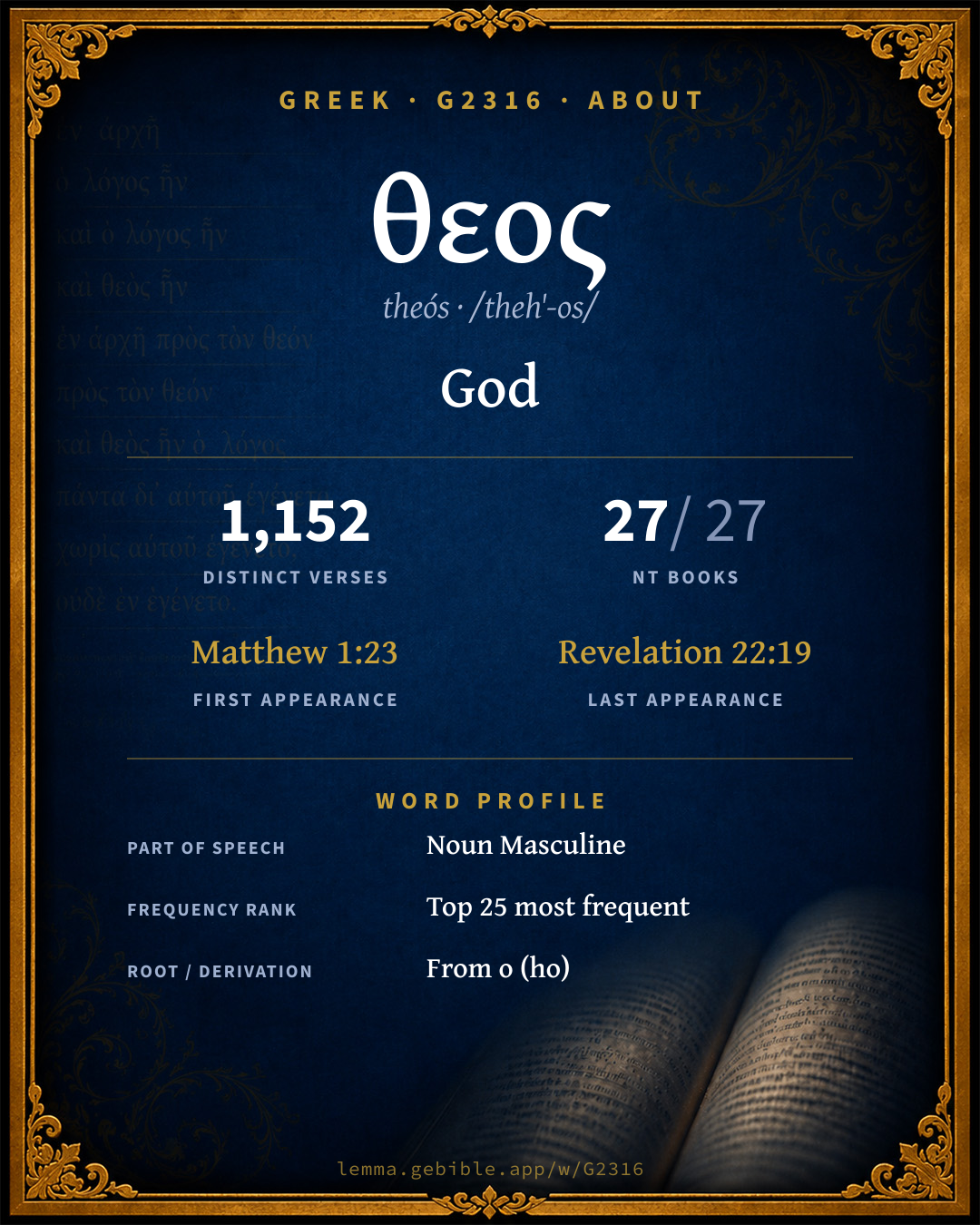
θεός
God
‘God’ is one of 6 main senses fuller range ↓
Full lexicon entry — Thayer's Greek Lexicon
From Thayer's Greek Lexicon
Where this word appears
See every Genitive-case word in the Greek New Testament →
Grammar key — what these labels mean
Part of speech
- Noun
- A naming word — a person, place, thing, or idea.
Case
- Genitive
- The case of source, possession, or “of” — answers “whose / from what.”
- Nominative
- The case of the subject (and the predicate nominative).
- Dative
- The case of the indirect object, means, or location — “to / for / with / in.”
- Accusative
- The case of the direct object and of extent.
- Vocative
- The case of direct address (“O Lord”).
Gender
- Masculine
- Grammatically masculine.
- Feminine
- Grammatically feminine.
Number
- Singular
- One.
- Plural
- More than one.
Page 2 of 4 — showing verses 201–400 of 639 distinct verses where G2316 appears in the Genitive case, across 27 books. Filtered view — show all forms. Click any verse to open its interlinear word-by-word view. Verse text shown in the World English Bible for context — . Each verse’s Greek form is shown with its reference; the English is not keyword-highlighted, since the data carries no word-level English alignment. Use “Compare translations” on any verse to read it across multiple English versions. This concordance covers the Greek New Testament; Septuagint (Greek Old Testament) occurrences of this word are not indexed here.
Acts 55 verses
- Acts 12:24 θεοῦ n gen sg masc But the word of God grew and multiplied.
- Acts 13:5 θεοῦ n gen sg masc When they were at Salamis, they proclaimed the word of God in the synagogues of the Jews. They had also John as their attendant.
- Acts 13:7 θεοῦ n gen sg masc who was with the proconsul, Sergius Paulus, a man of understanding. This man summoned Barnabas and Saul, and sought to hear the word of God.
- Acts 13:36 θεοῦ n gen sg masc For David, after he had in his own generation served the counsel of God, fell asleep, and was laid with his fathers, and saw decay.
- Acts 13:43 θεοῦ n gen sg masc Now when the synagogue broke up, many of the Jews and of the devout proselytes followed Paul and Barnabas; who, speaking to them, urged them to continue in the grace of God.
- Acts 13:46 θεοῦ n gen sg masc Paul and Barnabas spoke out boldly, and said, "It was necessary that God's word should be spoken to you first. Since indeed you thrust it from you, and judge yourselves unworthy of eternal life, behold, we turn to the Gentiles.
- Acts 14:22 θεοῦ n gen sg masc confirming the souls of the disciples, exhorting them to continue in the faith, and that through many afflictions we must enter into the Kingdom of God.
- Acts 14:26 θεοῦ n gen sg masc From there they sailed to Antioch, from where they had been committed to the grace of God for the work which they had fulfilled.
- Acts 16:17 θεοῦ n gen sg masc Following Paul and us, she cried out, "These men are servants of the Most High God, who proclaim to us the way of salvation!"
- Acts 17:13 θεοῦ n gen sg masc But when the Jews of Thessalonica had knowledge that the word of God was proclaimed by Paul at Beroea also, they came there likewise, agitating the multitudes.
- Acts 17:29 θεοῦ n gen sg masc Being then the offspring of God, we ought not to think that the Divine Nature is like gold, or silver, or stone, engraved by art and design of man.
- Acts 18:11 θεοῦ n gen sg masc He lived there a year and six months, teaching the word of God among them.
- Acts 18:21 θεοῦ n gen sg masc but taking his leave of them, and saying, "I must by all means keep this coming feast in Jerusalem, but I will return again to you if God wills," he set sail from Ephesus.
- Acts 18:26 θεοῦ n gen sg masc He began to speak boldly in the synagogue. But when Priscilla and Aquila heard him, they took him aside, and explained to him the way of God more accurately.
- Acts 19:8 θεοῦ n gen sg masc He entered into the synagogue, and spoke boldly for a period of three months, reasoning and persuading about the things concerning the Kingdom of God.
- Acts 20:24 θεοῦ n gen sg masc But these things don't count; nor do I hold my life dear to myself, so that I may finish my race with joy, and the ministry which I received from the Lord Jesus, to fully testify to the Gospel of the grace of God.
- Acts 20:27 θεοῦ n gen sg masc for I didn't shrink from declaring to you the whole counsel of God.
- Acts 22:3 θεοῦ n gen sg masc "I am indeed a Jew, born in Tarsus of Cilicia, but brought up in this city at the feet of Gamaliel, instructed according to the strict manner of the law of our fathers, being zealous for God, even as you all are this day.
- Acts 23:4 θεοῦ n gen sg masc Those who stood by said, "Do you malign God's high priest?"
- Acts 26:6 θεοῦ n gen sg masc Now I stand here to be judged for the hope of the promise made by God to our fathers,
- Acts 26:22 θεοῦ n gen sg masc Having therefore obtained the help that is from God, I stand to this day testifying both to small and great, saying nothing but what the prophets and Moses said would happen,
- Acts 27:23 θεοῦ n gen sg masc For there stood by me this night an angel, belonging to the God whose I am and whom I serve,
- Acts 28:23 θεοῦ n gen sg masc When they had appointed him a day, many people came to him at his lodging. He explained to them, testifying about the Kingdom of God, and persuading them concerning Jesus, both from the law of Moses and from the prophets, from morning until evening.
- Acts 28:28 θεοῦ n gen sg masc "Be it known therefore to you, that the salvation of God is sent to the Gentiles. They will also listen."
- Acts 28:31 θεοῦ n gen sg masc preaching the Kingdom of God, and teaching the things concerning the Lord Jesus Christ with all boldness, without hinderance.
Romans 71 verses
- Romans 1:1 θεοῦ n gen sg masc Paul, a servant of Jesus Christ, called to be an apostle, set apart for the Gospel of God,
- Romans 1:4 θεοῦ n gen sg masc who was declared to be the Son of God with power, according to the Spirit of holiness, by the resurrection from the dead, Jesus Christ our Lord,
- Romans 1:7 θεοῦ θεοῦ n gen sg masc n gen sg masc to all who are in Rome, beloved of God, called to be saints: Grace to you and peace from God our Father and the Lord Jesus Christ.
- Romans 1:10 θεοῦ n gen sg masc requesting, if by any means now at last I may be prospered by the will of God to come to you.
- Romans 1:16 θεοῦ n gen sg masc For I am not ashamed of the Gospel of Christ, for it is the power of God for salvation for everyone who believes; for the Jew first, and also for the Greek.
- Romans 1:17 θεοῦ n gen sg masc For in it is revealed God's righteousness from faith to faith. As it is written, "But the righteous shall live by faith."
- Romans 1:18 θεοῦ n gen sg masc For the wrath of God is revealed from heaven against all ungodliness and unrighteousness of men, who suppress the truth in unrighteousness,
- Romans 1:19 θεοῦ θεὸς n gen sg masc n nom sg masc because that which is known of God is revealed in them, for God revealed it to them.
- Romans 1:23 θεοῦ n gen sg masc and traded the glory of the incorruptible God for the likeness of an image of corruptible man, and of birds, and four-footed animals, and creeping things.
- Romans 1:25 θεοῦ n gen sg masc who exchanged the truth of God for a lie, and worshiped and served the creature rather than the Creator, who is blessed forever. Amen.
- Romans 1:32 θεοῦ n gen sg masc who, knowing the ordinance of God, that those who practice such things are worthy of death, not only do the same, but also approve of those who practice them.
- Romans 2:2 θεοῦ n gen sg masc We know that the judgment of God is according to truth against those who practice such things.
- Romans 2:3 θεοῦ n gen sg masc Do you think this, O man who judges those who practice such things, and do the same, that you will escape the judgment of God?
- Romans 2:4 θεοῦ n gen sg masc Or do you despise the riches of his goodness, forbearance, and patience, not knowing that the goodness of God leads you to repentance?
- Romans 2:5 θεοῦ n gen sg masc But according to your hardness and unrepentant heart you are treasuring up for yourself wrath in the day of wrath, revelation, and of the righteous judgment of God;
- Romans 2:24 θεοῦ n gen sg masc For "the name of God is blasphemed among the Gentiles because of you," just as it is written.
- Romans 2:29 θεοῦ n gen sg masc but he is a Jew who is one inwardly, and circumcision is that of the heart, in the spirit not in the letter; whose praise is not from men, but from God.
- Romans 3:2 θεοῦ n gen sg masc Much in every way! Because first of all, they were entrusted with the oracles of God.
- Romans 3:3 θεοῦ n gen sg masc For what if some were without faith? Will their lack of faith nullify the faithfulness of God?
- Romans 3:5 θεοῦ θεὸς n gen sg masc n nom sg masc But if our unrighteousness commends the righteousness of God, what will we say? Is God unrighteous who inflicts wrath? I speak like men do.
- Romans 3:7 θεοῦ n gen sg masc For if the truth of God through my lie abounded to his glory, why am I also still judged as a sinner?
- Romans 3:18 θεοῦ n gen sg masc "There is no fear of God before their eyes."
- Romans 3:21 θεοῦ n gen sg masc But now apart from the law, a righteousness of God has been revealed, being testified by the law and the prophets;
- Romans 3:22 θεοῦ n gen sg masc even the righteousness of God through faith in Jesus Christ to all and on all those who believe. For there is no distinction,
- Romans 3:23 θεοῦ n gen sg masc for all have sinned, and fall short of the glory of God;
- Romans 3:26 θεοῦ n gen sg masc to demonstrate his righteousness at this present time; that he might himself be just, and the justifier of him who has faith in Jesus.
- Romans 4:17 θεοῦ n gen sg masc As it is written, "I have made you a father of many nations." This is in the presence of him whom he believed: God, who gives life to the dead, and calls the things that are not, as though they were.
- Romans 4:20 θεοῦ θεῷ n gen sg masc n dat sg masc Yet, looking to the promise of God, he didn't waver through unbelief, but grew strong through faith, giving glory to God,
- Romans 5:2 θεοῦ n gen sg masc through whom we also have our access by faith into this grace in which we stand. We rejoice in hope of the glory of God.
- Romans 5:5 θεοῦ n gen sg masc and hope doesn't disappoint us, because God's love has been poured out into our hearts through the Holy Spirit who was given to us.
- Romans 5:15 θεοῦ n gen sg masc But the free gift isn't like the trespass. For if by the trespass of the one the many died, much more did the grace of God, and the gift by the grace of the one man, Jesus Christ, abound to the many.
- Romans 6:23 θεοῦ n gen sg masc For the wages of sin is death, but the free gift of God is eternal life in Christ Jesus our Lord.
- Romans 7:22 θεοῦ n gen sg masc For I delight in God's law after the inward man,
- Romans 7:25 θεῷ θεοῦ n dat sg masc n gen sg masc I thank God through Jesus Christ, our Lord! So then with the mind, I myself serve God's law, but with the flesh, the sin's law.
- Romans 8:7 θεόν θεοῦ n acc sg masc n gen sg masc because the mind of the flesh is hostile towards God; for it is not subject to God's law, neither indeed can it be.
- Romans 8:9 θεοῦ n gen sg masc But you are not in the flesh but in the Spirit, if it is so that the Spirit of God dwells in you. But if any man doesn't have the Spirit of Christ, he is not his.
- Romans 8:14 θεοῦ θεοῦ n gen sg masc n gen sg masc For as many as are led by the Spirit of God, these are children of God.
- Romans 8:16 θεοῦ n gen sg masc The Spirit himself testifies with our spirit that we are children of God;
- Romans 8:17 θεοῦ n gen sg masc and if children, then heirs; heirs of God, and joint-heirs with Christ; if indeed we suffer with him, that we may also be glorified with him.
- Romans 8:19 θεοῦ n gen sg masc For the creation waits with eager expectation for the children of God to be revealed.
- Romans 8:21 θεοῦ n gen sg masc that the creation itself also will be delivered from the bondage of decay into the liberty of the glory of the children of God.
- Romans 8:33 θεοῦ θεὸς n gen sg masc n nom sg masc Who could bring a charge against God's chosen ones? It is God who justifies.
- Romans 8:34 θεοῦ n gen sg masc Who is he who condemns? It is Christ who died, yes rather, who was raised from the dead, who is at the right hand of God, who also makes intercession for us.
- Romans 8:39 θεοῦ n gen sg masc nor height, nor depth, nor any other created thing, will be able to separate us from the love of God, which is in Christ Jesus our Lord.
- Romans 9:6 θεοῦ n gen sg masc But it is not as though the word of God has come to nothing. For they are not all Israel, that are of Israel.
- Romans 9:8 θεοῦ n gen sg masc That is, it is not the children of the flesh who are children of God, but the children of the promise are counted as a seed.
- Romans 9:11 θεοῦ n gen sg masc For being not yet born, neither having done anything good or bad, that the purpose of God according to election might stand, not of works, but of him who calls,
- Romans 9:16 θεοῦ n gen sg masc So then it is not of him who wills, nor of him who runs, but of God who has mercy.
- Romans 9:26 θεοῦ n gen sg masc "It will be that in the place where it was said to them, 'You are not my people,' There they will be called 'children of the living God.'"
- Romans 10:2 θεοῦ n gen sg masc For I testify about them that they have a zeal for God, but not according to knowledge.
- Romans 10:3 θεοῦ θεοῦ n gen sg masc n gen sg masc For being ignorant of God's righteousness, and seeking to establish their own righteousness, they didn't subject themselves to the righteousness of God.
- Romans 11:22 θεοῦ θεοῦ n gen sg masc n gen sg masc See then the goodness and severity of God. Toward those who fell, severity; but toward you, goodness, if you continue in his goodness; otherwise you also will be cut off.
- Romans 11:29 θεοῦ n gen sg masc For the gifts and the calling of God are irrevocable.
- Romans 11:33 θεοῦ n gen sg masc Oh the depth of the riches both of the wisdom and the knowledge of God! How unsearchable are his judgments, and his ways past tracing out!
- Romans 12:1 θεοῦ θεῷ n gen sg masc n dat sg masc Therefore I urge you, brothers, by the mercies of God, to present your bodies a living sacrifice, holy, acceptable to God, which is your spiritual service.
- Romans 12:2 θεοῦ n gen sg masc Don't be conformed to this world, but be transformed by the renewing of your mind, so that you may prove what is the good, well-pleasing, and perfect will of God.
- Romans 13:1 θεοῦ θεοῦ n gen sg masc n gen sg masc Let every soul be in subjection to the higher authorities, for there is no authority except from God, and those who exist are ordained by God.
- Romans 13:2 θεοῦ n gen sg masc Therefore he who resists the authority, withstands the ordinance of God; and those who withstand will receive to themselves judgment.
- Romans 13:4 θεοῦ θεοῦ n gen sg masc n gen sg masc for he is a servant of God to you for good. But if you do that which is evil, be afraid, for he doesn't bear the sword in vain; for he is a minister of God, an avenger for wrath to him who does evil.
- Romans 13:6 θεοῦ n gen sg masc For this reason you also pay taxes, for they are ministers of God's service, attending continually on this very thing.
- Romans 14:10 θεοῦ n gen sg masc But you, why do you judge your brother? Or you again, why do you despise your brother? For we will all stand before the judgment seat of Christ.
- Romans 14:17 θεοῦ n gen sg masc for the Kingdom of God is not eating and drinking, but righteousness, peace, and joy in the Holy Spirit.
- Romans 14:20 θεοῦ n gen sg masc Don't overthrow God's work for food's sake. All things indeed are clean, however it is evil for that man who creates a stumbling block by eating.
- Romans 14:22 θεοῦ n gen sg masc Do you have faith? Have it to yourself before God. Happy is he who doesn't judge himself in that which he approves.
- Romans 15:7 θεοῦ n gen sg masc Therefore receive one another, even as Christ also received you, to the glory of God.
- Romans 15:8 θεοῦ n gen sg masc Now I say that Christ has been made a minister of the circumcision for the truth of God, that he might confirm the promises given to the fathers,
- Romans 15:15 θεοῦ n gen sg masc But I write the more boldly to you in part, as reminding you, because of the grace that was given to me by God,
- Romans 15:16 θεοῦ n gen sg masc that I should be a servant of Christ Jesus to the Gentiles, ministering as a priest the Gospel of God, that the offering up of the Gentiles might be made acceptable, sanctified by the Holy Spirit.
- Romans 15:19 θεοῦ n gen sg masc in the power of signs and wonders, in the power of God's Spirit; so that from Jerusalem, and around as far as to Illyricum, I have fully preached the Gospel of Christ;
- Romans 15:32 θεοῦ n gen sg masc that I may come to you in joy through the will of God, and together with you, find rest.
- Romans 16:26 θεοῦ n gen sg masc
1 Corinthians 46 verses
- 1 Corinthians 1:1 θεοῦ n gen sg masc Paul, called to be an apostle of Jesus Christ through the will of God, and our brother Sosthenes,
- 1 Corinthians 1:2 θεοῦ n gen sg masc to the assembly of God which is at Corinth; those who are sanctified in Christ Jesus, called to be saints, with all who call on the name of our Lord Jesus Christ in every place, both theirs and ours:
- 1 Corinthians 1:3 θεοῦ n gen sg masc Grace to you and peace from God our Father and the Lord Jesus Christ.
- 1 Corinthians 1:4 θεῷ θεοῦ n dat sg masc n gen sg masc I always thank my God concerning you, for the grace of God which was given you in Christ Jesus;
- 1 Corinthians 1:18 θεοῦ n gen sg masc For the word of the cross is foolishness to those who are dying, but to us who are saved it is the power of God.
- 1 Corinthians 1:21 θεοῦ θεόν θεὸς n gen sg masc n acc sg masc n nom sg masc For seeing that in the wisdom of God, the world through its wisdom didn't know God, it was God's good pleasure through the foolishness of the preaching to save those who believe.
- 1 Corinthians 1:24 θεοῦ θεοῦ n gen sg masc n gen sg masc but to those who are called, both Jews and Greeks, Christ is the power of God and the wisdom of God.
- 1 Corinthians 1:25 θεοῦ θεοῦ n gen sg masc n gen sg masc Because the foolishness of God is wiser than men, and the weakness of God is stronger than men.
- 1 Corinthians 1:29 θεοῦ n gen sg masc that no flesh should boast before God.
- 1 Corinthians 1:30 θεοῦ n gen sg masc But of him, you are in Christ Jesus, who was made to us wisdom from God, and righteousness and sanctification, and redemption:
- 1 Corinthians 2:1 θεοῦ n gen sg masc When I came to you, brothers, I didn't come with excellence of speech or of wisdom, proclaiming to you the testimony of God.
- 1 Corinthians 2:5 θεοῦ n gen sg masc that your faith wouldn't stand in the wisdom of men, but in the power of God.
- 1 Corinthians 2:7 θεοῦ θεὸς n gen sg masc n nom sg masc But we speak God's wisdom in a mystery, the wisdom that has been hidden, which God foreordained before the worlds for our glory,
- 1 Corinthians 2:10 θεὸς θεοῦ n nom sg masc n gen sg masc But to us, God revealed them through the Spirit. For the Spirit searches all things, yes, the deep things of God.
- 1 Corinthians 2:11 θεοῦ θεοῦ n gen sg masc n gen sg masc For who among men knows the things of a man, except the spirit of the man, which is in him? Even so, no one knows the things of God, except God's Spirit.
- 1 Corinthians 2:12 θεοῦ θεοῦ n gen sg masc n gen sg masc But we received, not the spirit of the world, but the Spirit which is from God, that we might know the things that were freely given to us by God.
- 1 Corinthians 2:14 θεοῦ n gen sg masc Now the natural man doesn't receive the things of God's Spirit, for they are foolishness to him, and he can't know them, because they are spiritually discerned.
- 1 Corinthians 3:9 θεοῦ θεοῦ θεοῦ n gen sg masc n gen sg masc n gen sg masc For we are God's fellow workers. You are God's farming, God's building.
- 1 Corinthians 3:10 θεοῦ n gen sg masc According to the grace of God which was given to me, as a wise master builder I laid a foundation, and another builds on it. But let each man be careful how he builds on it.
- 1 Corinthians 3:16 θεοῦ θεοῦ n gen sg masc n gen sg masc Don't you know that you are a temple of God, and that God's Spirit lives in you?
- 1 Corinthians 3:17 θεοῦ θεός θεοῦ n gen sg masc n nom sg masc n gen sg masc If anyone destroys the temple of God, God will destroy him; for God's temple is holy, which you are.
- 1 Corinthians 3:23 θεοῦ n gen sg masc and you are Christ's, and Christ is God's.
- 1 Corinthians 4:1 θεοῦ n gen sg masc So let a man think of us as Christ's servants, and stewards of God's mysteries.
- 1 Corinthians 4:5 θεοῦ n gen sg masc Therefore judge nothing before the time, until the Lord comes, who will both bring to light the hidden things of darkness, and reveal the counsels of the hearts. Then each man will get his praise from God.
- 1 Corinthians 4:20 θεοῦ n gen sg masc For the Kingdom of God is not in word, but in power.
- 1 Corinthians 6:9 θεοῦ n gen sg masc Or don't you know that the unrighteous will not inherit the Kingdom of God? Don't be deceived. Neither the sexually immoral, nor idolaters, nor adulterers, nor male prostitutes, nor homosexuals,
- 1 Corinthians 6:10 θεοῦ n gen sg masc nor thieves, nor covetous, nor drunkards, nor slanderers, nor extortioners, will inherit the Kingdom of God.
- 1 Corinthians 6:11 θεοῦ n gen sg masc Such were some of you, but you were washed. But you were sanctified. But you were justified in the name of the Lord Jesus, and in the Spirit of our God.
- 1 Corinthians 6:19 θεοῦ n gen sg masc Or don't you know that your body is a temple of the Holy Spirit which is in you, which you have from God? You are not your own,
- 1 Corinthians 7:7 θεοῦ n gen sg masc Yet I wish that all men were like me. However each man has his own gift from God, one of this kind, and another of that kind.
- 1 Corinthians 7:19 θεοῦ n gen sg masc Circumcision is nothing, and uncircumcision is nothing, but the keeping of the commandments of God.
- 1 Corinthians 7:40 θεοῦ n gen sg masc But she is happier if she stays as she is, in my judgment, and I think that I also have God's Spirit.
- 1 Corinthians 9:21 θεοῦ n gen sg masc to those who are without law, as without law (not being without law toward God, but under law toward Christ), that I might win those who are without law.
- 1 Corinthians 10:31 θεοῦ n gen sg masc Whether therefore you eat, or drink, or whatever you do, do all to the glory of God.
- 1 Corinthians 10:32 θεοῦ n gen sg masc Give no occasions for stumbling, either to Jews, or to Greeks, or to the assembly of God;
- 1 Corinthians 11:7 θεοῦ n gen sg masc For a man indeed ought not to have his head covered, because he is the image and glory of God, but the woman is the glory of the man.
- 1 Corinthians 11:12 θεοῦ n gen sg masc For as woman came from man, so a man also comes through a woman; but all things are from God.
- 1 Corinthians 11:16 θεοῦ n gen sg masc But if any man seems to be contentious, we have no such custom, neither do God's assemblies.
- 1 Corinthians 11:22 θεοῦ n gen sg masc What, don't you have houses to eat and to drink in? Or do you despise God's assembly, and put them to shame who don't have? What shall I tell you? Shall I praise you? In this I don't praise you.
- 1 Corinthians 12:3 θεοῦ n gen sg masc Therefore I make known to you that no man speaking by God's Spirit says, "Jesus is accursed." No one can say, "Jesus is Lord," but by the Holy Spirit.
- 1 Corinthians 14:36 θεοῦ n gen sg masc What? Was it from you that the word of God went out? Or did it come to you alone?
- 1 Corinthians 15:9 θεοῦ n gen sg masc For I am the least of the apostles, who is not worthy to be called an apostle, because I persecuted the assembly of God.
- 1 Corinthians 15:10 θεοῦ θεοῦ n gen sg masc n gen sg masc But by the grace of God I am what I am. His grace which was bestowed on me was not futile, but I worked more than all of them; yet not I, but the grace of God which was with me.
- 1 Corinthians 15:15 θεοῦ θεοῦ n gen sg masc n gen sg masc Yes, we are found false witnesses of God, because we testified about God that he raised up Christ, whom he didn't raise up, if it is so that the dead are not raised.
- 1 Corinthians 15:34 θεοῦ n gen sg masc Wake up righteously, and don't sin, for some have no knowledge of God. I say this to your shame.
- 1 Corinthians 15:50 θεοῦ n gen sg masc Now I say this, brothers, that flesh and blood can't inherit the Kingdom of God; neither does corruption inherit incorruption.
2 Corinthians 33 verses
- 2 Corinthians 1:1 θεοῦ θεοῦ n gen sg masc n gen sg masc Paul, an apostle of Christ Jesus through the will of God, and Timothy our brother, to the assembly of God which is at Corinth, with all the saints who are in the whole of Achaia:
- 2 Corinthians 1:2 θεοῦ n gen sg masc Grace to you and peace from God our Father and the Lord Jesus Christ.
- 2 Corinthians 1:4 θεοῦ n gen sg masc who comforts us in all our affliction, that we may be able to comfort those who are in any affliction, through the comfort with which we ourselves are comforted by God.
- 2 Corinthians 1:12 θεοῦ θεοῦ n gen sg masc n gen sg masc For our boasting is this: the testimony of our conscience, that in holiness and sincerity of God, not in fleshly wisdom but in the grace of God we behaved ourselves in the world, and more abundantly toward you.
- 2 Corinthians 1:19 θεοῦ n gen sg masc For the Son of God, Jesus Christ, who was preached among you by us, by me, Silvanus, and Timothy, was not "Yes and no," but in him is "Yes."
- 2 Corinthians 1:20 θεοῦ θεῷ n gen sg masc n dat sg masc For however many are the promises of God, in him is the "Yes." Therefore also through him is the "Amen," to the glory of God through us.
- 2 Corinthians 2:17 θεοῦ θεοῦ θεοῦ n gen sg masc n gen sg masc n gen sg masc For we are not as so many, peddling the word of God. But as of sincerity, but as of God, in the sight of God, we speak in Christ.
- 2 Corinthians 3:3 θεοῦ n gen sg masc being revealed that you are a letter of Christ, ministered by us, written not with ink, but with the Spirit of the living God; not in tablets of stone, but in tablets that are hearts of flesh.
- 2 Corinthians 3:5 θεοῦ n gen sg masc not that we are sufficient of ourselves, to account anything as from ourselves; but our sufficiency is from God;
- 2 Corinthians 4:2 θεοῦ θεοῦ n gen sg masc n gen sg masc But we have renounced the hidden things of shame, not walking in craftiness, nor handling the word of God deceitfully; but by the manifestation of the truth commending ourselves to every man's conscience in the sight of God.
- 2 Corinthians 4:4 θεὸς θεοῦ n nom sg masc n gen sg masc in whom the god of this world has blinded the minds of the unbelieving, that the light of the Gospel of the glory of Christ, who is the image of God, should not dawn on them.
- 2 Corinthians 4:6 θεὸς θεοῦ n nom sg masc n gen sg masc seeing it is God who said, "Light will shine out of darkness," who has shone in our hearts, to give the light of the knowledge of the glory of God in the face of Jesus Christ.
- 2 Corinthians 4:7 θεοῦ n gen sg masc But we have this treasure in clay vessels, that the exceeding greatness of the power may be of God, and not from ourselves.
- 2 Corinthians 4:15 θεοῦ n gen sg masc For all things are for your sakes, that the grace, being multiplied through the many, may cause the thanksgiving to abound to the glory of God.
- 2 Corinthians 5:1 θεοῦ n gen sg masc For we know that if the earthly house of our tent is dissolved, we have a building from God, a house not made with hands, eternal, in the heavens.
- 2 Corinthians 5:18 θεοῦ n gen sg masc But all things are of God, who reconciled us to himself through Jesus Christ, and gave to us the ministry of reconciliation;
- 2 Corinthians 5:20 θεοῦ θεῷ n gen sg masc n dat sg masc We are therefore ambassadors on behalf of Christ, as though God were entreating by us. We beg you on behalf of Christ, be reconciled to God.
- 2 Corinthians 5:21 θεοῦ n gen sg masc For him who knew no sin he made to be sin on our behalf; so that in him we might become the righteousness of God.
- 2 Corinthians 6:1 θεοῦ n gen sg masc Working together, we entreat also that you not receive the grace of God in vain,
- 2 Corinthians 6:4 θεοῦ n gen sg masc but in everything commending ourselves, as servants of God, in great endurance, in afflictions, in hardships, in distresses,
- 2 Corinthians 6:7 θεοῦ n gen sg masc in the word of truth, in the power of God; by the armor of righteousness on the right hand and on the left,
- 2 Corinthians 6:16 θεοῦ θεοῦ θεὸς θεός n gen sg masc n gen sg masc n nom sg masc n nom sg masc What agreement has a temple of God with idols? For you are a temple of the living God. Even as God said, "I will dwell in them, and walk in them; and I will be their God, and they will be my people."
- 2 Corinthians 7:1 θεοῦ n gen sg masc Having therefore these promises, beloved, let us cleanse ourselves from all defilement of flesh and spirit, perfecting holiness in the fear of God.
- 2 Corinthians 7:12 θεοῦ n gen sg masc So although I wrote to you, I wrote not for his cause that did the wrong, nor for his cause that suffered the wrong, but that your earnest care for us might be revealed in you in the sight of God.
- 2 Corinthians 8:1 θεοῦ n gen sg masc Moreover, brothers, we make known to you the grace of God which has been given in the assemblies of Macedonia;
- 2 Corinthians 8:5 θεοῦ n gen sg masc This was not as we had hoped, but first they gave their own selves to the Lord, and to us through the will of God.
- 2 Corinthians 9:14 θεοῦ n gen sg masc while they themselves also, with supplication on your behalf, yearn for you by reason of the exceeding grace of God in you.
- 2 Corinthians 10:5 θεοῦ n gen sg masc throwing down imaginations and every high thing that is exalted against the knowledge of God, and bringing every thought into captivity to the obedience of Christ;
- 2 Corinthians 11:2 θεοῦ n gen sg masc For I am jealous over you with a godly jealousy. For I married you to one husband, that I might present you as a pure virgin to Christ.
- 2 Corinthians 11:7 θεοῦ n gen sg masc Or did I commit a sin in humbling myself that you might be exalted, because I preached to you God's Gospel free of charge?
- 2 Corinthians 12:19 θεοῦ n gen sg masc Again, do you think that we are excusing ourselves to you? In the sight of God we speak in Christ. But all things, beloved, are for your edifying.
- 2 Corinthians 13:4 θεοῦ θεοῦ n gen sg masc n gen sg masc For he was crucified through weakness, yet he lives through the power of God. For we also are weak in him, but we will live with him through the power of God toward you.
- 2 Corinthians 13:13 θεοῦ n gen sg masc All the saints greet you.
Galatians 15 verses
- Galatians 1:1 θεοῦ n gen sg masc Paul, an apostle (not from men, neither through man, but through Jesus Christ, and God the Father, who raised him from the dead),
- Galatians 1:3 θεοῦ n gen sg masc Grace to you and peace from God the Father, and our Lord Jesus Christ,
- Galatians 1:4 θεοῦ n gen sg masc who gave himself for our sins, that he might deliver us out of this present evil age, according to the will of our God and Father--
- Galatians 1:13 θεοῦ n gen sg masc For you have heard of my way of living in time past in the Jews' religion, how that beyond measure I persecuted the assembly of God, and ravaged it.
- Galatians 1:20 θεοῦ n gen sg masc Now about the things which I write to you, behold, before God, I'm not lying.
- Galatians 2:20 θεοῦ n gen sg masc I have been crucified with Christ, and it is no longer I that live, but Christ living in me. That life which I now live in the flesh, I live by faith in the Son of God, who loved me, and gave himself up for me.
- Galatians 2:21 θεοῦ n gen sg masc I don't make void the grace of God. For if righteousness is through the law, then Christ died for nothing!"
- Galatians 3:17 θεοῦ n gen sg masc Now I say this. A covenant confirmed beforehand by God in Christ, the law, which came four hundred thirty years after, does not annul, so as to make the promise of no effect.
- Galatians 3:21 θεοῦ n gen sg masc Is the law then against the promises of God? Certainly not! For if there had been a law given which could make alive, most assuredly righteousness would have been of the law.
- Galatians 3:26 θεοῦ n gen sg masc For you are all children of God, through faith in Christ Jesus.
- Galatians 4:7 θεοῦ n gen sg masc So you are no longer a bondservant, but a son; and if a son, then an heir of God through Christ.
- Galatians 4:9 θεόν θεοῦ n acc sg masc n gen sg masc But now that you have come to know God, or rather to be known by God, why do you turn back again to the weak and miserable elements, to which you desire to be in bondage all over again?
- Galatians 4:14 θεοῦ n gen sg masc That which was a temptation to you in my flesh, you didn't despise nor reject; but you received me as an angel of God, even as Christ Jesus.
- Galatians 5:21 θεοῦ n gen sg masc envyings, murders, drunkenness, orgies, and things like these; of which I forewarn you, even as I also forewarned you, that those who practice such things will not inherit the Kingdom of God.
- Galatians 6:16 θεοῦ n gen sg masc As many as walk by this rule, peace and mercy be on them, and on God's Israel.
Ephesians 20 verses
- Ephesians 1:1 θεοῦ n gen sg masc Paul, an apostle of Christ Jesus through the will of God, to the saints who are at Ephesus, and the faithful in Christ Jesus:
- Ephesians 1:2 θεοῦ n gen sg masc Grace to you and peace from God our Father and the Lord Jesus Christ.
- Ephesians 2:8 θεοῦ n gen sg masc for by grace you have been saved through faith, and that not of yourselves; it is the gift of God,
- Ephesians 2:19 θεοῦ n gen sg masc So then you are no longer strangers and foreigners, but you are fellow citizens with the saints, and of the household of God,
- Ephesians 2:22 θεοῦ n gen sg masc in whom you also are built together for a habitation of God in the Spirit.
- Ephesians 3:2 θεοῦ n gen sg masc if it is so that you have heard of the administration of that grace of God which was given me toward you;
- Ephesians 3:7 θεοῦ n gen sg masc of which I was made a servant, according to the gift of that grace of God which was given me according to the working of his power.
- Ephesians 3:10 θεοῦ n gen sg masc to the intent that now through the assembly the manifold wisdom of God might be made known to the principalities and the powers in the heavenly places,
- Ephesians 3:19 θεοῦ n gen sg masc and to know Christ's love which surpasses knowledge, that you may be filled with all the fullness of God.
- Ephesians 4:13 θεοῦ n gen sg masc until we all attain to the unity of the faith, and of the knowledge of the Son of God, to a full grown man, to the measure of the stature of the fullness of Christ;
About this entry
At a glance — auto-summarized from this page’s data, not written by a person. Every figure links to its source below. This summary describes the numbers; it doesn’t interpret them.
The Greek name θεος centers on the idea of “God.” Its earliest occurrence is Matthew 1:23. It appears 1,152 verses across 27 books of the Greek New Testament, among its most common vocabulary. For the data behind this summary, explore 1,152-verse concordance and the renderings breakdown below.
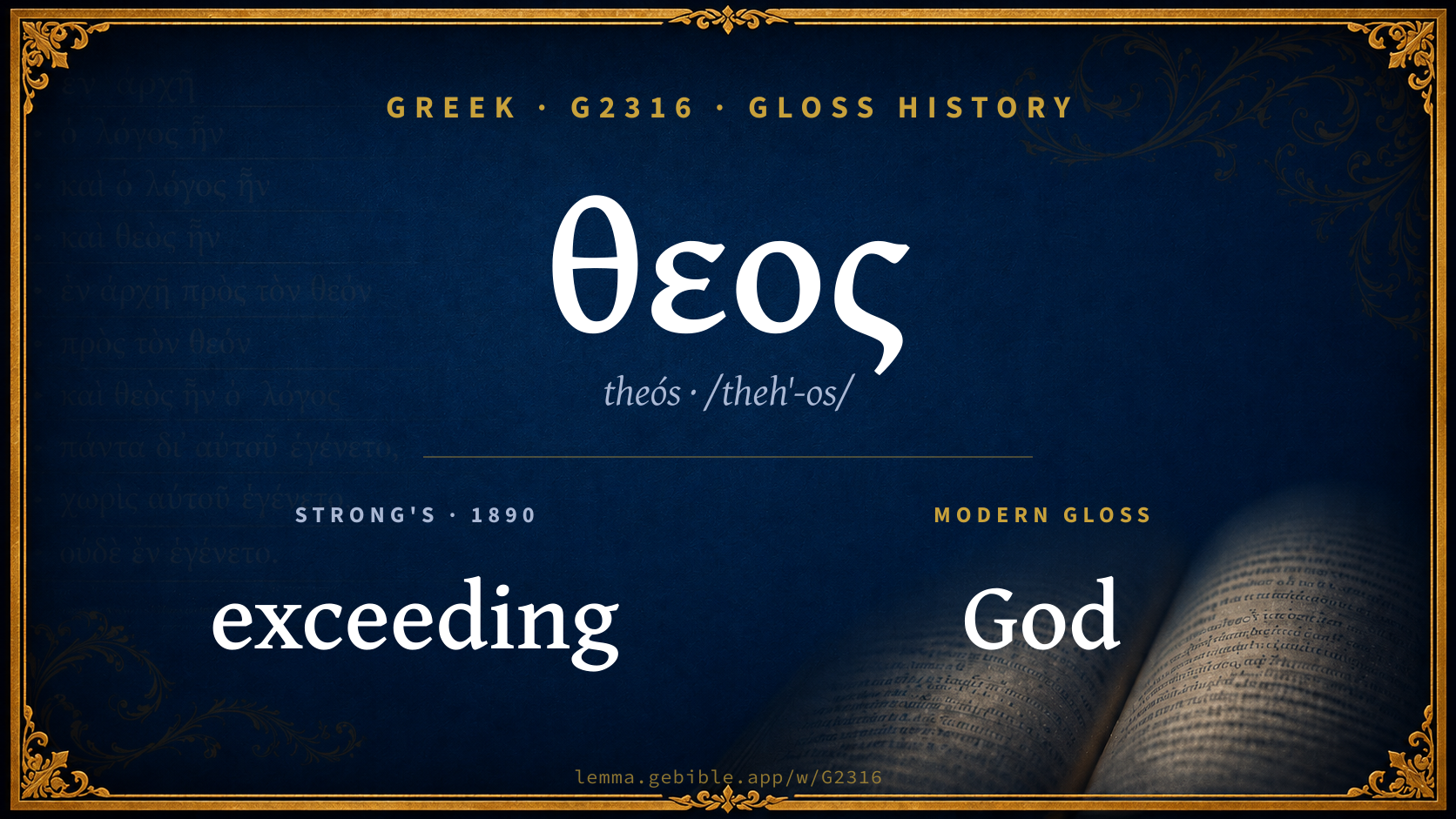
Gloss history
Strong's 1890 vs modern scholarship
About this word
Strong's G2316 catalogs a Greek word from the Greek New Testament.
These counts are not copied from any lexicon or concordance. They are computed here, from the morphology-tagged Greek New Testament. What Lemma adds →
- 1,152
- distinct verses
- The word appears in 1,152 distinct verses.
- 27 / 27
- NT books
- The word appears in 27 of 27 New Testament books.
- #14
- by frequency
- Top 25 most frequent Greek words (rank 14 of 5,347 Greek words by occurrence).
View all 1,152 occurrences in the concordance →
By section of the New Testament
By traditional corpus
Conventional, traditional groupings — biblical authorship is debated, so this is a traditional corpus grouping, not an authorship claim. Some books belong to more than one corpus (Luke is in both the Gospels and the Lukan corpus, and so on), so these shares overlap and need not total 100%. Each figure is a share of the word’s 1,152 distinct verses.
- Pauline corpus 479 verses · 42%
- Lukan (Luke–Acts) 269 verses · 23%
- Gospels 266 verses · 23%
- Johannine 199 verses · 17%
- General (Catholic) Epistles 102 verses · 9%
- Revelation 87 verses · 8%
- Hebrews 63 verses · 5%
How translations render this word
Counts come from each version’s own published word-to-Strong’s tagging or interlinear alignment — an approximate guide to how each version renders this word, not a word-level alignment the data otherwise carries. Because each total is that version’s own tagged count, the per-version totals vary from one another and need not match the appearance or distinct-verse counts above. These counts may also differ from a printed concordance because Lemma counts each distinctly tagged rendering and does not collapse phrase taggings into a single head-word total. This is a fixed set of word-tagged versions (KJV, ASV, BSB, ULT) and does not change with the reading translation you choose elsewhere. Each version’s license is shown beside its name below (and on Sources).
- King James Version: God 1,272×, God's 13×, Is god 10×
- American Standard Version: God 1,211×, Is god 9×, Gods 8×
- Berean Standard Bible: God 1,175×, God’s 87×, Gods 8×
- unfoldingWord Literal Text: God 1,285×, The 20×, Of 19×
King James Version Public Domain
Renders G2316 across 1,342 tagged occurrences — most commonly:
Plus 20 renderings that appear only once — usually multi-word phrases or single function words the recovered tagging swept in, not distinct renderings. Not rendered by a distinct English word in 1 further occurrence.
American Standard Version Public Domain
Renders G2316 across 1,315 tagged occurrences — most commonly:
Plus other, less common renderings. Plus 36 renderings that appear only once — usually multi-word phrases or single function words the recovered tagging swept in, not distinct renderings. Not rendered by a distinct English word in 5 further occurrences.
Berean Standard Bible Public Domain
Renders G2316 across 1,292 tagged occurrences — most commonly:
Plus 9 renderings that appear only once — usually multi-word phrases or single function words the recovered tagging swept in, not distinct renderings. Not rendered by a distinct English word in 26 further occurrences.
unfoldingWord Literal Text CC BY-SA 4.0
Renders G2316 across 1,361 tagged occurrences — most commonly:
Plus 15 renderings that appear only once — usually multi-word phrases or single function words the recovered tagging swept in, not distinct renderings.
Senses in Thayer's
The 6 senses Thayer's distinguishes for this word, in lexicon order (not ranked by frequency or importance). The full entry — with sub-senses — is in the Lexicon Entry tab.
- a god or goddess, a general name of deities or divinities
- God the Father, the first person in the trinity
- Christ, the second person of the trinity
- Holy Spirit, the third person in the trinity
- spoken of the only and true God
- whatever can in any respect be likened unto God, or resemble him in any way
Word origin
Derived from ο (ho) (G3588).
Of uncertain affinity; a deity especially (with G3588 ) the supreme Divinity ; figuratively a magistrate ; by hebraism very : - X exceeding God god [-ly -ward].
— Strong’s Exhaustive Concordance (1890), public domain.
Forms in the corpus
The 13 distinct written forms G2316 takes in the Greek New Testament, most frequent first — each parse links to that case’s occurrences in the concordance.
| Form | Parsing | Example | Uses |
|---|---|---|---|
| θεοῦ theoû | Noun, Genitive, Singular, Masculine | Matthew 3:16 | 688 |
| θεὸς theòs | Noun, Nominative, Singular, Masculine | Matthew 3:9 | 241 |
| θεῷ theō̂ | Noun, Dative, Singular, Masculine | Matthew 6:24 | 158 |
| θεόν theón | Noun, Accusative, Singular, Masculine | Matthew 4:7 | 75 |
| θεὸν theòn | Noun, Accusative, Singular, Masculine | Matthew 5:8 | 74 |
| θεός theós | Noun, Nominative, Singular, Masculine | Matthew 1:23 | 65 |
| θεοὶ theoì | Noun, Nominative, Plural, Masculine | Acts 14:11 | 4 |
| θεέ theé | Noun, Vocative, Singular, Masculine | Matthew 27:46 | 2 |
| θεοί theoí | Noun, Nominative, Plural, Masculine | John 10:34 | 1 |
| θεούς theoús | Noun, Accusative, Plural, Masculine | John 10:35 | 1 |
| θεοὺς theoùs | Noun, Accusative, Plural, Masculine | Acts 7:40 | 1 |
| θεοῖς theoîs | Noun, Dative, Plural, Masculine | Galatians 4:8 | 1 |
| θεῶ theō̂ | Noun, Dative, Singular, Masculine | Romans 1:8 | 1 |
Same root — word family
Other Thayer's entries built from the same root as G2316, grouped by Strong’s listed origin. These share a root / origin per the lexicon — not necessarily a shared meaning. Each links to that word’s own entry.
Derives from
Shares the same root
- τανυν tanŷn G3569 present
- οδε hóde G3592 this
- οιος hoîos G3634 what sort of
- ος hós G3739 who
- ουτος hoûtos G3778 this
- σημερον sḗmeron G4594 this day
- ταυτα tautá G5024 thus
- τηλικουτος tēlikoûtos G5082 of such size
- τοι toí G5104 truly
- τοσουτος tosoûtos G5118 so great
- τοτε tóte G5119 then
- του toû G5120 his
- τουναντιον tounantíon G5121 on the contrary
- τουνομα toúnoma G5122 by name
Derived from this word
- θεα theá G2299 goddess
- θεοδιδακτος theodídaktos G2312 taught of God
- θεομαχος theomáchos G2314 resisting God
- θεοπνευστος theópneustos G2315 inspired by God
- θεοσεβης theosebḗs G2318 pious
- θεοστυγης theostygḗs G2319 hateful to God
- θεοτης theótēs G2320 deity
Proper names from this root
People and places named from this root — a name, not an additional meaning of the word.
- ο ων και ο ην και ο ερχομενος ho ṑn kaí ho ēn kaí ho erchómenos G3801 He who is
- θειος theîos G2304 God
- Θεοφιλος Theóphilos G2321 Theophilus
Compare all same-root words → Showing 4 of 26 — not the complete family. 3 of the same-root words are proper names (people or places). They share a root, not necessarily a meaning.
Bible dictionary
Public-domain dictionary articles matched to this entry by name (God). A biblical name can be shared by more than one person or place, so an article may treat several.
Easton's Bible Dictionary · M. G. Easton, 1897
(A.S. and Dutch God; Dan. Gud; Ger. Gott), the name of the Divine Being. It is the rendering (1) of the Hebrew 'El, from a word meaning to be strong; (2) of 'Eloah_, plural _'Elohim. The singular form, Eloah, is used only in poetry. The plural form is more commonly used in all parts of the Bible, The Hebrew word Jehovah (q.v.), the only other word generally employed to denote the Supreme Being, is uniformly rendered in the Authorized Version by "LORD," printed in small capitals. The existence of God is taken for granted in the Bible. There is nowhere any argument to prove it. He who disbelieves this truth is spoken of as one devoid of understanding (Ps. 14:1).
The arguments generally adduced by theologians in proof of the being of God are:
(1.) The a priori argument, which is the testimony afforded by reason.
(2.) The a posteriori argument, by which we proceed logically from the facts of experience to causes. These arguments are,
(a) The cosmological, by which it is proved that there must be a First Cause of all things, for every effect must have a cause.
(b) The teleological, or the argument from design. We see everywhere the operations of an intelligent Cause in nature.
(c) The moral argument, called also the anthropological argument, based on the moral consciousness and the history of mankind, which exhibits a moral order and purpose which can only be explained on the supposition of the existence of God. Conscience and human history testify that "verily there is a God that judgeth in the earth."
The attributes of God are set forth in order by Moses in Ex. 34:6, 7. (see also Deut. 6:4; 10:17; Num. 16:22; Ex. 15:11; 33:19; Isa. 44:6; Hab. 3:6; Ps. 102:26; Job 34:12.) They are also systematically classified in Rev. 5:12 and 7:12.
God's attributes are spoken of by some as absolute, i.e., such as belong to his essence as Jehovah, Jah, etc.; and relative, i.e., such as are ascribed to him with relation to his creatures. Others distinguish them into communicable, i.e., those which can be imparted in degree to his creatures: goodness, holiness, wisdom, etc.; and incommunicable, which cannot be so imparted: independence, immutability, immensity, and eternity. They are by some also divided into natural attributes, eternity, immensity, etc.; and moral, holiness, goodness, etc.
Smith's Bible Dictionary · William Smith, 1863
(good). Throughout the Hebrew Scriptures two chief names are used for the one true divine Being--ELOHIM, commonly translated God in our version, and Jehovah, translated Lord . Elohim is the plural of Eloah (in Arabic Allah); it is often used in the short form EL (a word signifying strength, as in EL-SHADDAI, God Almighty, the name by which God was specially known to the patriarchs. (Genesis 17:1; 28:3; Exodus 6:3) The etymology is uncertain, but it is generally agreed that the primary idea is that of strength, power of effect, and that it properly describes God in that character in which he is exhibited to all men in his works, as the creator, sustainer and supreme governor of the world. The plural form of Elohim has given rise to much discussion. The fanciful idea that it referred to the trinity of persons in the Godhead hardly finds now a supporter among scholars. It is either what grammarians call the plural of majesty, or it denotes the fullness of divine strength, the sum of the powers displayed by God. Jehovah denotes specifically the one true God, whose people the Jews were, and who made them the guardians of his truth. The name is never applied to a false god, nor to any other being except one, the ANGEL-JEHOVAH who is thereby marked as one with God, and who appears again in the New Covenant as "God manifested in the flesh." Thus much is clear; but all else is beset with difficulties. At a time too early to be traced, the Jews abstained from pronouncing the name, for fear of its irreverent use. The custom is said to have been founded on a strained interpretation of (Leviticus 24:16) and the phrase there used, "THE NAME" (Shema), is substituted by the rabbis for the unutterable word. In reading the Scriptures they substituted for it the word ADONAI (Lord), from the translation of which by Kurios in the LXX., followed by the Vulgate, which uses Dominus, we have the Lord of our version. The substitution of the word Lord is most unhappy, for it in no way represents the meaning of the sacred name. The key to the meaning of the name is unquestionably given in God's revelation of himself to Moses by the phrase "I AM THAT I AM," (Exodus 3:14; 6:3) We must connect the name Jehovah with the Hebrew substantive verb to be, with the inference that it expresses the essential, eternal, unchangeable being of Jehovah. But more, it is not the expression only, or chiefly, of an absolute truth: it is a practical revelation of God, in his essential, unchangeable relation to this chosen people, the basis of his covenant.
Classic public-domain reference works; full attribution on Sources.
Septuagint usage
The same Greek word θεος appears 3,139 times in the Greek Old Testament (Septuagint), across 2,639 verses in 36 books.
- 3,139
- LXX occurrences
- Tagged occurrences of this Greek word in the Septuagint.
- 2,639
- verses
- Distinct Septuagint verses containing this word.
- 36 / 39
- OT books
- The word appears in 36 of the 39 Old Testament books.
Sample Septuagint occurrences
- Genesis 1:1 θεός
- Exodus 1:17 θεός
- Leviticus 2:13 θεός
- Numbers 6:7 θεός
- Deuteronomy 1:6 θεός
- Joshua 1:9 θεός
- Judges 1:7 θεός
- Ruth 1:15 θεός
- 1 Samuel 1:3 θεός
- 2 Samuel 3:9 θεός
- 1 Kings 1:17 θεός
- 2 Kings 1:2 θεός
Septuagint occurrences (same lexeme)
Every verse where the same Strong’s number (G2316) appears in the Greek Septuagint — showing the first 50 of 2,639. Verse text shown in the World English Bible for context; the Greek form is the matched word — the English is not keyword-highlighted.
- Genesis 1:1 θεός In the beginning God created the heavens and the earth.
- Genesis 1:2 θεός Now the earth was formless and empty. Darkness was on the surface of the deep. God's Spirit was hovering over the surface of the waters.
- Genesis 1:3 θεός God said, "Let there be light," and there was light.
- Genesis 1:4 θεός God saw the light, and saw that it was good. God divided the light from the darkness.
- Genesis 1:5 θεός God called the light Day, and the darkness he called Night. There was evening and there was morning, one day.
- Genesis 1:6 θεός God said, "Let there be an expanse in the midst of the waters, and let it divide the waters from the waters."
- Genesis 1:7 θεός God made the expanse, and divided the waters which were under the expanse from the waters which were above the expanse, and it was so.
- Genesis 1:8 θεός God called the expanse sky. There was evening and there was morning, a second day.
- Genesis 1:9 θεός God said, "Let the waters under the sky be gathered together to one place, and let the dry land appear," and it was so.
- Genesis 1:10 θεός God called the dry land Earth, and the gathering together of the waters he called Seas. God saw that it was good.
- Genesis 1:11 θεός God said, "Let the earth put forth grass, herbs yielding seed, and fruit trees bearing fruit after their kind, with its seed in it, on the earth," and it was so.
- Genesis 1:12 θεός The earth brought forth grass, herbs yielding seed after their kind, and trees bearing fruit, with its seed in it, after their kind: and God saw that it was good.
- Genesis 1:14 θεός God said, "Let there be lights in the expanse of sky to divide the day from the night; and let them be for signs, and for seasons, and for days and years;
- Genesis 1:16 θεός God made the two great lights: the greater light to rule the day, and the lesser light to rule the night. He also made the stars.
- Genesis 1:17 θεός God set them in the expanse of sky to give light to the earth,
- Genesis 1:18 θεός and to rule over the day and over the night, and to divide the light from the darkness. God saw that it was good.
- Genesis 1:20 θεός God said, "Let the waters swarm with swarms of living creatures, and let birds fly above the earth in the open expanse of sky."
- Genesis 1:21 θεός God created the large sea creatures, and every living creature that moves, with which the waters swarmed, after their kind, and every winged bird after its kind. God saw that it was good.
- Genesis 1:22 θεός God blessed them, saying, "Be fruitful, and multiply, and fill the waters in the seas, and let birds multiply on the earth."
- Genesis 1:24 θεός God said, "Let the earth bring forth living creatures after their kind, cattle, creeping things, and animals of the earth after their kind," and it was so.
- Genesis 1:25 θεός God made the animals of the earth after their kind, and the cattle after their kind, and everything that creeps on the ground after its kind. God saw that it was good.
- Genesis 1:26 θεός God said, "Let us make man in our image, after our likeness: and let them have dominion over the fish of the sea, and over the birds of the sky, and over the cattle, and over all the earth, and over every creeping thing that creeps on the earth."
- Genesis 1:27 θεός God created man in his own image. In God's image he created him; male and female he created them.
- Genesis 1:28 θεός God blessed them. God said to them, "Be fruitful, multiply, fill the earth, and subdue it. Have dominion over the fish of the sea, over the birds of the sky, and over every living thing that moves on the earth."
- Genesis 1:29 θεός God said, "Behold, I have given you every herb yielding seed, which is on the surface of all the earth, and every tree, which bears fruit yielding seed. It will be your food.
- Genesis 1:31 θεός God saw everything that he had made, and, behold, it was very good. There was evening and there was morning, the sixth day.
- Genesis 2:2 θεός On the seventh day God finished his work which he had made; and he rested on the seventh day from all his work which he had made.
- Genesis 2:3 θεός God blessed the seventh day, and made it holy, because he rested in it from all his work which he had created and made.
- Genesis 2:4 θεός This is the history of the generations of the heavens and of the earth when they were created, in the day that Yahweh God made earth and the heavens.
- Genesis 2:5 θεός No plant of the field was yet in the earth, and no herb of the field had yet sprung up; for Yahweh God had not caused it to rain on the earth. There was not a man to till the ground,
- Genesis 2:7 θεός Yahweh God formed man from the dust of the ground, and breathed into his nostrils the breath of life; and man became a living soul.
- Genesis 2:8 θεός Yahweh God planted a garden eastward, in Eden, and there he put the man whom he had formed.
- Genesis 2:9 θεός Out of the ground Yahweh God made every tree to grow that is pleasant to the sight, and good for food; the tree of life also in the midst of the garden, and the tree of the knowledge of good and evil.
- Genesis 2:15 θεός Yahweh God took the man, and put him into the garden of Eden to dress it and to keep it.
- Genesis 2:16 θεός Yahweh God commanded the man, saying, "Of every tree of the garden you may freely eat:
- Genesis 2:18 θεός Yahweh God said, "It is not good that the man should be alone; I will make him a helper suitable for him."
- Genesis 2:19 θεός Out of the ground Yahweh God formed every animal of the field, and every bird of the sky, and brought them to the man to see what he would call them. Whatever the man called every living creature, that was its name.
- Genesis 2:21 θεός Yahweh God caused a deep sleep to fall on the man, and he slept; and he took one of his ribs, and closed up the flesh in its place.
- Genesis 2:22 θεός He made the rib, which Yahweh God had taken from the man, into a woman, and brought her to the man.
- Genesis 3:1 θεός Now the serpent was more subtle than any animal of the field which Yahweh God had made. He said to the woman, "Yes, has God said, 'You shall not eat of any tree of the garden?'"
- Genesis 3:3 θεός but of the fruit of the tree which is in the midst of the garden, God has said, 'You shall not eat of it, neither shall you touch it, lest you die.'"
- Genesis 3:5 θεός for God knows that in the day you eat it, your eyes will be opened, and you will be like God, knowing good and evil."
- Genesis 3:8 θεός They heard the voice of Yahweh God walking in the garden in the cool of the day, and the man and his wife hid themselves from the presence of Yahweh God among the trees of the garden.
- Genesis 3:9 θεός Yahweh God called to the man, and said to him, "Where are you?"
- Genesis 3:13 θεός Yahweh God said to the woman, "What is this you have done?" The woman said, "The serpent deceived me, and I ate."
- Genesis 3:14 θεός Yahweh God said to the serpent, "Because you have done this, cursed are you above all cattle, and above every animal of the field. On your belly shall you go, and you shall eat dust all the days of your life.
- Genesis 3:21 θεός Yahweh God made coats of skins for Adam and for his wife, and clothed them.
- Genesis 3:22 θεός Yahweh God said, "Behold, the man has become like one of us, knowing good and evil. Now, lest he put forth his hand, and also take of the tree of life, and eat, and live forever..."
- Genesis 3:23 θεός Therefore Yahweh God sent him forth from the garden of Eden, to till the ground from whence he was taken.
- Genesis 4:1 θεός The man knew Eve his wife. She conceived, and gave birth to Cain, and said, "I have gotten a man with Yahweh's help."
These are occurrences of the same Greek lexeme (G2316) in the Septuagint — not a translation of any one Hebrew word. The store carries no word-level Hebrew↔Greek alignment, so no Hebrew original is asserted here. Counts come from the recovered LXX Strong's tagging — high-frequency vocabulary is well covered, while rare or late forms may be untagged — so they reflect tagged occurrences and may slightly undercount.