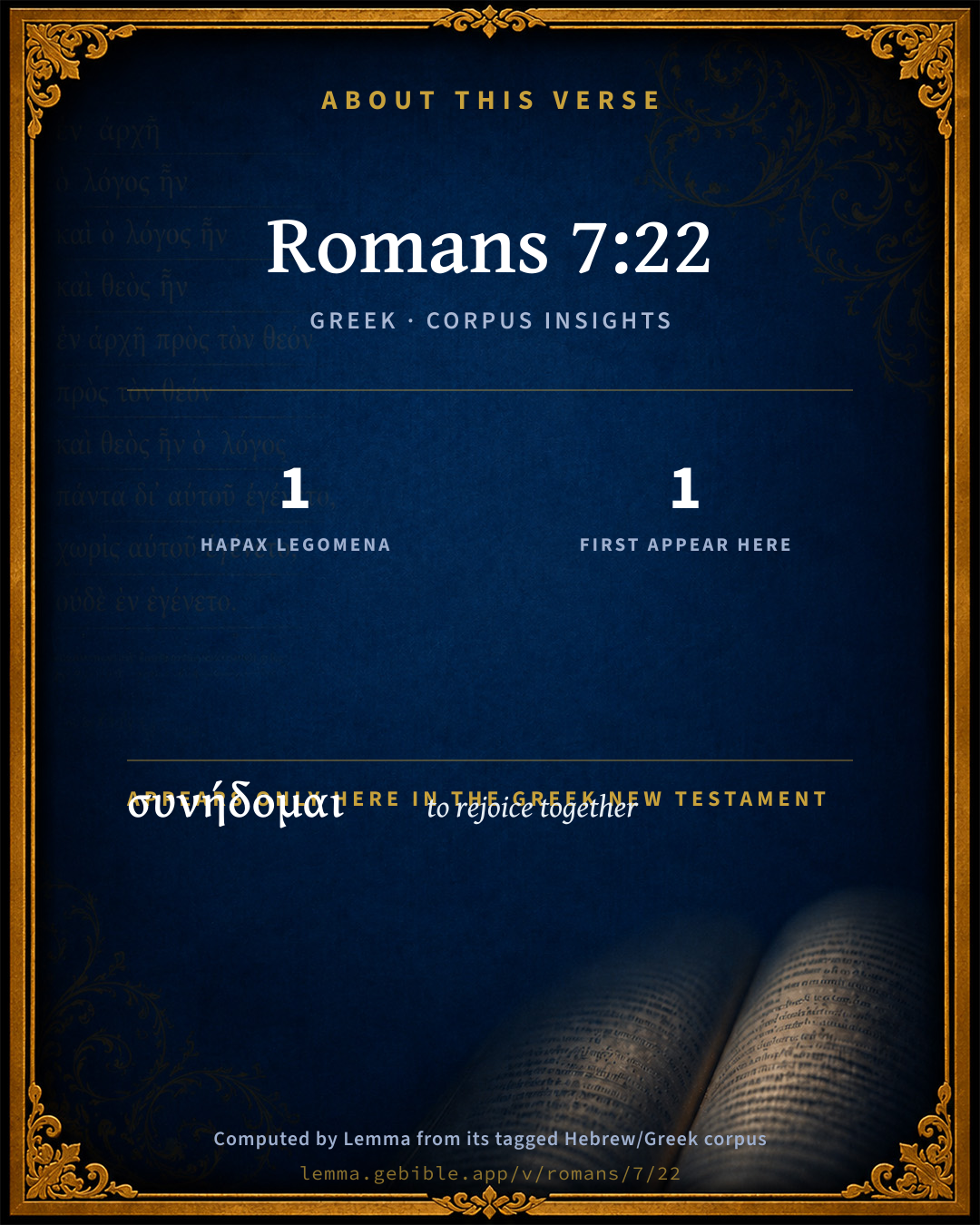
Romans 7:22

Greek (Tischendorf 8th ed.) Romans 7:22 appears in the Greek New Testament. The text above is from the Tischendorf 8th edition. Each word links to its Strong’s number and a concise gloss. Click any word for its full Thayer’s Greek Lexicon entry.
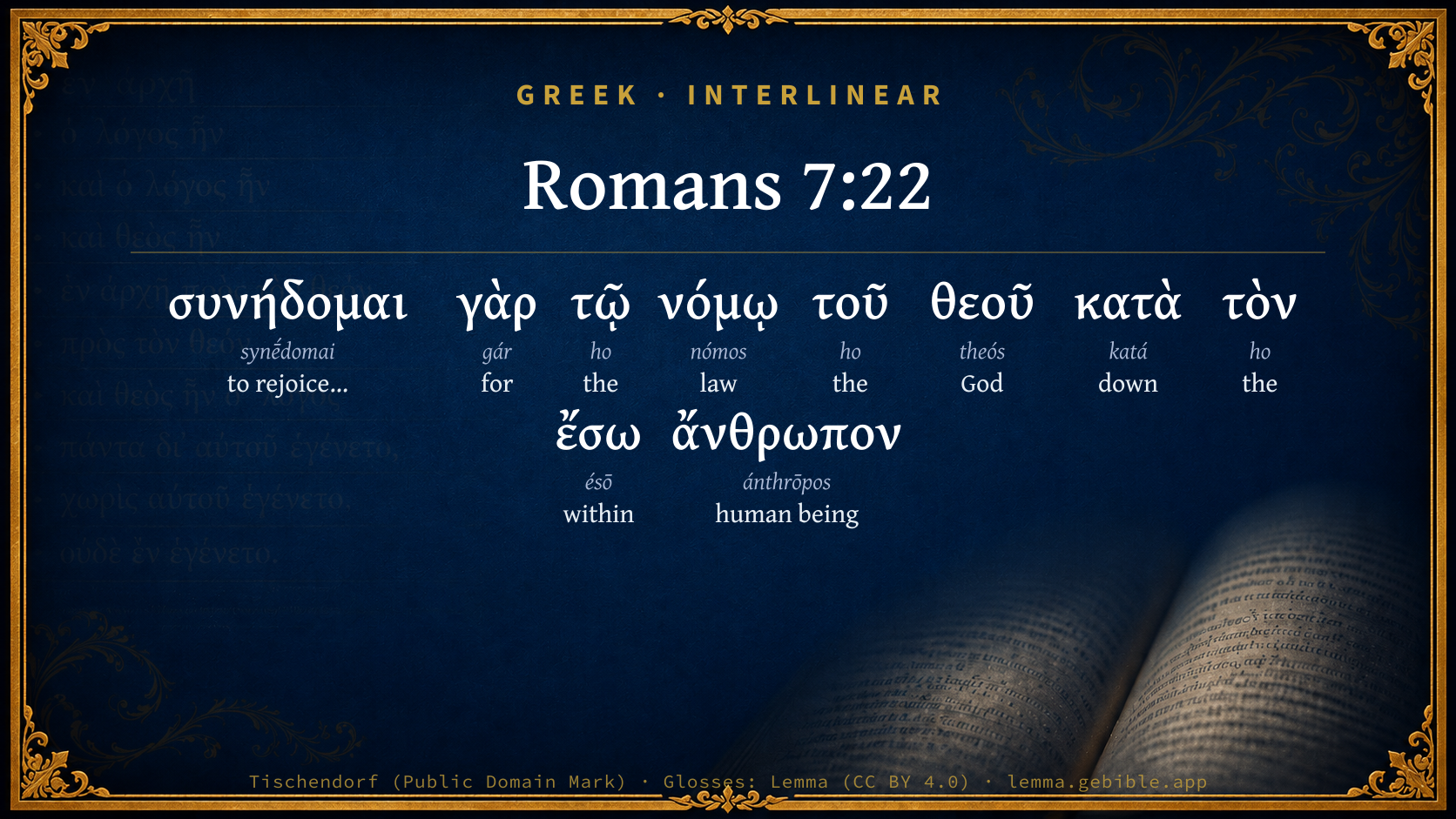
Download image
Cite this verse

Romans 7:22 (World English Bible). Public Domain. Lemma interlinear Bible study tool, https://lemma.gebible.app/v/romans/7/22.

Show BibTeX & RIS
BibTeX
RIS
English Translation
For I delight in God's law after the inward man,
World English Bible · Public Domain
Highlights
  • 1 hapax legomenon — only here in the Greek New Testament
  • 1 first appearance in the Greek New Testament
Full analysis ↓
Download a study sheet

One document with this verse’s original text, its word-by-word gloss line, the meaning frame, cross-references with their text, attributed commentary, and full source and license credits — printable, and it pastes into notes with its structure intact.

This verse Autodidact and up

Study sheet (.html) Plain text (.txt)

A passage Seminary Student

Up to 50 verses in one chapter. A passage sheet keeps up to 6 commentary sources and 12 cross-references per verse, in the order this page ranks them, and says so on the sheet whenever that leaves anything out. Ask for a single verse and you get the Autodidact verse sheet above.

Everything on this page stays free to read, with no account — the sheet is a download of what is already on screen, not access to it.

Want to remove ads? Support Godless Engineer
Compare translations 3

The same verse in 3 English versions, stacked beneath the original-language interlinear above. Click any original word for its lexicon entry.

Each is an independent rendering of the whole verse — the interlinear is not word-aligned to these translations.

Highlighted words mark where these versions differ — a whole-verse word diff, not a word-by-word alignment.

  • World English Bible Public Domain
    For I delight in God's law after the inward man,
  • King James Version Public Domain
    For I delight in the law of God after the inward man:
  • unfoldingWord Literal Text CC BY-SA 4.0
    For I delight in the law of God with the inner man.

unfoldingWord Literal Text — © unfoldingWord, licensed CC BY-SA 4.0. Word-aligned USFM3 via Door43 (git.door43.org/unfoldingWord/en_ult).

Versions to compare (up to 4)

3 of 4 selected

Show all 19 translations

Every available English version of this verse, each an independent rendering of the whole verse.

  • World English Bible Public Domain
    For I delight in God's law after the inward man,
  • Berean Standard Bible Public Domain
    For in my inner being I delight in God’s law.
  • Majority Standard Bible Public Domain
    For in my inner being I delight in God’s law.
  • King James Version Public Domain
    For I delight in the law of God after the inward man:
  • American Standard Version (1901) Public Domain
    For I delight in the law of God after the inward man:
  • Revised Version (1885) Public Domain
    For I delight in the law of God after the inward man:
  • Geneva Bible (1599) Public Domain
    For I delite in the Law of God, concerning the inner man:
  • Douay-Rheims (1899) Public Domain
    For I am delighted with the law of God, according to the inward man:
  • Young's Literal Translation Public Domain
    for I delight in the law of God according to the inward man,
  • Literal Standard Version CC BY-SA 4.0
    for I delight in the Law of God according to the inward man,
  • Unlocked Literal Bible CC BY-SA 4.0
    For I rejoice in the law of God with the inner man.
  • unfoldingWord Literal Text CC BY-SA 4.0
    For I delight in the law of God with the inner man.
  • Darby Bible Public Domain
    For I delight in the law of God according to the inward man:
  • World Messianic Bible Public Domain
    For I delight in God’s Torah after the inward person,
  • Webster's Bible Public Domain
    For I delight in the law of God, after the inward man:
  • Free Bible Version CC BY-SA 4.0
    My inner self is delighted with God's law,
  • Bible in Basic English Public Domain
    In my heart I take pleasure in the law of God,
  • Text-Critical English NT CC BY 4.0
    For I delight in the law of God in my inner being,
  • Tyndale New Testament (1534) Public Domain
    I delite in the lawe of God concerninge the inner man.

Literal Standard Version (2020), Covenant Press — licensed CC BY-SA 4.0. Text via the HelloAO Bible API (eBible.org). Unlocked Literal Bible (unfoldingWord) — licensed CC BY-SA 4.0. Text via the HelloAO Bible API (eBible.org). unfoldingWord Literal Text — © unfoldingWord, licensed CC BY-SA 4.0. Word-aligned USFM3 via Door43 (git.door43.org/unfoldingWord/en_ult). Free Bible Version, Dr. Jonathan Gallagher — licensed CC BY-SA 4.0. Text via the HelloAO Bible API (eBible.org).

Word by word

More ways to search: Search by grammar → Find every occurrence → Compare this word →

Practice this passage: Drill this verse → Learn its vocabulary →

About this verse

These counts appear in no published source. They are computed here, from the morphology-tagged text and Lemma’s own curated glosses. What Lemma adds →

10
words
8
distinct lemmas
Pauline Epistles
section

Notable vocabulary

1 hapax legomenon — a word that appears only here in the entire Greek New Testament:

  • συνήδομαι to rejoice together G4913

First appearance in Scripture

This word makes its first canonical appearance in the Greek New Testament here:

  • συνήδομαι to rejoice together G4913

Shared distinctive vocabulary

ἔσω within G2080 occurs in 9 verses of the Greek New Testament. Also found in:

Repetition

A word recurs within this verse:

Cross-references

25

Topical passages linked to Romans 7:22 in the Treasury of Scripture Knowledge — connected by theme and wording, ordered by reader-vote popularity; previews shown in the World English Bible.

  • Psalms 1:2 But his delight is in Yahweh's law; On his law he meditates day and night.
  • Psalms 40:8 I delight to do your will, my God. Yes, your law is within my heart."
  • Psalms 119:35 Direct me in the path of your commandments, For I delight in them.
  • Psalms 119:47–48 I will delight myself in your commandments, Because I love them.
  • Job 23:12 I haven't gone back from the commandment of his lips. I have treasured up the words of his mouth more than my necessary food.
  • Hebrews 8:10 "For this is the covenant that I will make with the house of Israel. After those days," says the Lord; "I will put my laws into their mind, I will also write them on their heart. I will be to them a God, And they will be to me a people.
  • Psalms 119:97–104 How love I your law! It is my meditation all day.
  • 2 Corinthians 4:16 Therefore we don't faint, but though our outward man is decaying, yet our inward man is renewed day by day.
  • Psalms 119:92 Unless your law had been my delight, I would have perished in my affliction.
  • Psalms 119:16 I will delight myself in your statutes. I will not forget your word.
  • Psalms 19:8–10 Yahweh's precepts are right, rejoicing the heart. Yahweh's commandment is pure, enlightening the eyes.
  • Psalms 119:167 My soul has observed your testimonies. I love them exceedingly.
  • Psalms 119:174 I have longed for your salvation, Yahweh. Your law is my delight.
  • Romans 8:7 because the mind of the flesh is hostile towards God; for it is not subject to God's law, neither indeed can it be.
  • Ephesians 3:16 that he would grant you, according to the riches of his glory, that you may be strengthened with power through his Spirit in the inward man;
  • 1 Peter 3:4 but in the hidden person of the heart, in the incorruptible adornment of a gentle and quiet spirit, which is in the sight of God very precious.
  • Psalms 119:24 Indeed your statutes are my delight, And my counselors.
  • Psalms 119:72 The law of your mouth is better to me than thousands of pieces of gold and silver.
  • Psalms 119:111 I have taken your testimonies as a heritage forever, For they are the joy of my heart.
  • Psalms 119:113 I hate double-minded men, But I love your law.
  • Psalms 119:127 Therefore I love your commandments more than gold, Yes, more than pure gold.
  • Isaiah 51:7 Listen to me, you who know righteousness, the people in whose heart is my law; don't you fear the reproach of men, neither be you dismayed at their insults.
  • John 4:34 Jesus said to them, "My food is to do the will of him who sent me, and to accomplish his work.
  • Colossians 3:9 Don't lie to one another, seeing that you have put off the old man with his doings,
  • Romans 2:29 but he is a Jew who is one inwardly, and circumcision is that of the heart, in the spirit not in the letter; whose praise is not from men, but from God.

Cross-references courtesy of OpenBible.info (CC BY 4.0).

Commentary

Notes on Romans 7:22 from classic Christian and Jewish commentators (each source and its license shown beneath its notes). The classic Christian expositions comment on the surrounding passage and are grouped to its opening verse, so a note may address several verses; the Jewish commentaries on the Tanakh (Rashi and others) are per-verse, so they appear only where the commentator wrote on this verse.

Lemma curates 59 commentaries, every one of them public domain or Creative Commons licensed, each selected and text-cleaned for this edition rather than reprinted as found. About our sources →

Adam Clarke's Commentary

Verse 22. I delight in the law of God after the inward man] Every Jew, and every unregenerate man, who receives the Old Testament as a revelation from God, must acknowledge the great purity, excellence and utility of its maxims, c., though he will ever find that without the grace of our Lord Jesus he can never act according to those heavenly maxims and without the mercy of God, can never be redeemed from the curse entailed upon him for his past transgressions. To say that the inward man means the regenerate part of the soul, is supportable by no argument. Ὁ εσω ανθρωπος, and ὁ εντος ανθρωπος, especially the latter, are expressions frequently in use among the purest Greek ethic writers, to signify the soul or rational part of man, in opposition to the body of flesh. See the quotations in Wetstein from Plato and Plotinus. The Jews have the same form of expression; so in Yalcut Rubeni, fol. 10, 3, it is said: The flesh is the inward garment of the man; but the SPIRIT is the INWARD man, the garment of which is the body; and St. Paul uses the phrase in precisely the same sense in 2Co 4:16, and Eph 3:16. If it be said that it is impossible for an unregenerate man to delight in the law of God, the experience of millions contradicts the assertion. Every true penitent admires the moral law, longs most earnestly for a conformity to it, and feels that he can never be satisfied till he awakes up after this Divine likeness; and he hates himself, because he feels that he has broken it, and that his evil passions are still in a state of hostility to it. (Ro 7:22-25 (note))

The following observations of a pious and sensible writer on this subject cannot be unacceptable: "The inward man always signifies the mind; which either may, or may not, be the subject of grace. That which is asserted of either the inward or outward man is often performed by one member or power, and not with the whole. If any member of the body perform an action, we are said to do it with the body, although the other members be not employed. In like manner, if any power or faculty of the mind be employed about any action, the soul is said to act. This expression, therefore, I delight in the law of God after the inward man, can mean no more than this, that there are some inward faculties in the soul which delight in the law of God. This expression is particularly adapted to the principles of the Pharisees, of whom St. Paul was one before his conversion. They received the law as the oracles of God, and confessed that it deserved the most serious regard. Their veneration was inspired by a sense of its original, and a full conviction that it was true. To some parts of it they paid the most superstitious regard. They had it written upon their phylacteries, which they carried about with them at all times. It was often read and expounded in their synagogues: and they took delight in studying its precepts. On that account, both the prophets and our Lord agree in saying that they delighted in the law of God, though they regarded not its chief and most essential precepts." See farther observations on this point at the end of the chapter.

So far, then, is it from being true that none but a REGENERATE man can delight in the law of God, we find that even a proud, unhumbled PHARISEE can do it; and much more a poor sinner, who is humbled under a sense of his sin, and sees, in the light of God, not only the spirituality, but the excellence of the Divine law.

Adam Clarke's Commentary on the Bible (1810–1826) — public domain. Text from a community e-Sword/MySword module.

Joseph Benson's Commentary

Rom 7:22. For I delight in the law of God — On this verse, chiefly, rests the opinion that the apostle, in the latter part of this chapter, is describing the character of a regenerate man. Its votaries think they find in this verse all the marks of a Christian. In general they assert, “to have our inward man, our mind and heart, delighted in the law of God, is to have our souls delighted in a conformity to him; it is to love God himself, to love to be like him in the inward man, having his law written on our hearts, which they say is the sum of all religion.” This is not reasoning, it is mere assertion; it is not to be inferred from this passage, and is plainly contradicted by the context. All judicious commentators will allow, that if any passage of the Scriptures appears obscure or susceptible of two senses, it must be explained in a consistency with what precedes and follows, and that interpretation must be chosen which agrees best therewith. Therefore, though it be true, in the fullest sense, that regenerated persons delight in the law of God after the inward man; yet, since the general scope of the paragraph, and the connection of this sentence with the context, show that Paul is here speaking of his unconverted state, our interpretation of it must be regulated by its connection with the whole passage. Those who maintain that Paul is here speaking of his state after his conversion, assert, that by the inward man is meant, the new man, or man of grace, spoken of Eph 4:24; Col 3:10. Did the context lead to that sense, it might be admitted. But the general sense of the whole passage leads us to understand the expression of the rational part of man, in opposition to the animal, which is its usual signification, as has been shown by several authors. The phrase occurs in two other passages of the New Testament, namely, 2Co 4:16; Eph 3:16; in the former, the apostle’s words are, We faint not, though our outward man perish, yet the inward man is renewed day by day; where the inward man must signify the mind or soul, which is renewed, or created anew in its faculties, in proportion as it grows in grace. In the other passage the apostle prays for the Ephesians that they might be strengthened with might, not in the outward man, the body, which was not a matter of much importance, but in the inward man, the soul; that it might become strong in faith, fervent in love, and conformed to the divine image; and that Christ, by his Spirit, might dwell in it. “The inward man, therefore, always signifies the mind, which either may or may not be the subject of grace. That which is asserted of either the inward or outward man, is often performed by one member or power, and not with the whole man. If any member of the body perform an action, we are said to do it with the body, although the other members be not employed. In like manner, if any power or faculty of the mind be employed about any action, the soul is said to act: [and with still greater propriety, as] our souls are not, like our bodies, made of many members; they are pure spirits, and indivisible. If the mind wills, it is the spirit willing; if it hates, it is the soul hating; if it loves, it is the soul loving; if conscience reprove or excuse, it is the inward man accusing or excusing. This expression, therefore, I delight in the law of God after the inward man, can mean no more than this, that there are some inward faculties in the soul which delight in the law of God. The expression is particularly adapted to the principles of the Pharisees, of whom Paul was one before his conversion. They received the law as the oracles of God, and confessed that it deserved the most serious regard. Their veneration was inspired by a sense of its original, and a full conviction that it was right. To some parts of it they paid the most superstitious regard. They had it written upon their phylacteries, and carried these about with them at all times. It was often read and expounded in their synagogues, and they took some degree of pleasure in studying its precepts. On that account, the prophets and our Saviour agree in saying, that they delighted in the law of God, though they regarded not its chief and most essential precepts.” — Smith, On the Carnal Man’s Character.

Joseph Benson's Commentary on the Old and New Testaments (1811–1818) — public domain. Text from a community e-Sword module.

Tyndale Open Study Notes

Tyndale Open Resources

7:22 with all my heart (literally in my inner person): The Greeks used this phrase to denote the spiritual or immortal side of human beings (cp. 2 Cor 4:16; Eph 3:16).

Tyndale Open Study Notes — © Tyndale Open Resources, licensed CC BY-SA 4.0. Text via the HelloAO Bible API.

Bengel's Gnomon

Johann Albrecht Bengel

Rom 7:22. Συνήδομαι, I delight) This too is already a further step in advance than σύμφημι, I consent, Rom 7:16.—τὸν ἔσω, the inward) He already upholds the name and character of the inward, but not yet however of the new man; so also in Rom 7:25 he says, “with my mind,” not, with my spirit.

Bengel's Gnomon of the New Testament — English translation (T&T Clark, Edinburgh, 1860) — public domain. Text from a community e-Sword module.

Meyer's Critical & Exegetical Commentary

Heinrich August Wilhelm Meyer

Rom_7:22-23. Antithetical illustration of Rom_7:21.

συνήδομαι τ. νόμῳ τ. Θεοῦ] The compound nature of the verb is neither to be overlooked (as by Beza and others, including Rückert and Reiche), nor to be taken as a strengthening of it (Köllner), or as apud animum meum laetor (Fritzsche, Baumgarten-Crusius, de Wette, Tholuck, and Philippi). It means: I rejoice with, which sense alone consists with linguistic usage (Plat. Rep. p. 462 E; Dem. 519. 10, 579. 19; Soph. Oed. C. 1398; Eur. Med. 136; Sturz, Lex. Xen. IV. p. 184; Reisig, Enarr. Soph. Oed. C. 1398). By this, however, we are not to understand the joy over the law, shared with others (van Hengel and others)an idea here foreign to the connection; nor yet the joyful nature of taking part in the law (Hofmann), whereby the necessary conception of joy in common falls away; but rather: I rejoice with the law of God, so that its joy (the law being personified) is also mine. It is the agreement of moral sympathy in regard to what is good. Comp. on σύμφημι in Rom_7:16. So also συμπενθεῖν τινι, συναλγεῖν τινι, κ.τ.λ.; similarly συλλυπούμενος, Mar_3:5. Rightly given in the Vulgate: condelector legi (not lege) Dei. Comp. 1Co_13:6 : συγχαίρει τῇ ἀληθείᾳ. The Mosaic law is described as νόμος Θεοῦ (genit. auctoris) in contrast to the ἕτερος νόμος, which is the law opposed to God.

κατὰ τ. ἔσω ἄνθρ.] The rational and moral nature of man, determined by conscience (Rom_2:15), is, as the inward man, distinguished from the outward man that appears in the body and its members. ὁ νοῦς in its contrast to σάρξ designates the same thing a potiori; see on Eph_3:16, 2Co_4:16; also 1Pe_3:4, and Huther in loc. Philo (p. 533, Mang.) terms it ἄνθρωπος ἐν ἀνθρώπῳ.

βλέπω] Here also Paul represents himself as a spectator of his own personality, and as such he sees, etc.

ἕτερον] a law of another nature, not ἄλλον. Comp. Rom_7:4, and on Gal_1:6.

ἐν τοῖς μέλεσί μου] sc. ὄντα, correlative, even by its position, with κατὰ τὸν ἔσω ἄνθρωπον. Fritzsche and Hofmann join ἐν τοῖς μέλ. μου ἀντιστρατ., whereby, however, the importance of the added elements ἀντιστρατ. κ.τ.λ. is more subordinated to the ἘΝ Τ. ΜΈΛ. ΜΟΥ, and the symmetry of the discourse unnecessarily disturbed; comp. below, Τῷ ὌΝΤΙ ἘΝ ΤΟῖς ΜΈΛ. ΜΟΥ. The members, as the instruments of activity of the σάρξ, are, seeing that the ΣΆΡΞ itself is ruled by sin (Rom_7:18; Rom_7:25), that in which the power of sin (the dictate of the sin-principle, Ὁ ΝΌΜΟς Τῆς ἉΜΑΡΤ.) pursues its doings. This activity in hand, eye, etc. (comp. Rom_6:13; Rom_6:19), is directed against the dictate of the moral reason, and that with the result of victory; hence the figures drawn from war, ἈΝΤΙΣΤΡΑΤ. and also ΑἸΧΜΑΛΩΤ.

The ΝΌΜΟς ΤΟῦ ΝΟΌςin which the genitive is neither to be taken as that of the subject (Fritzsche: quam mens mea constituit; comp. Hofmann, which man gives to himself), nor epexegetically (Th. Schott), but locally, corresponding to the ἐν τοῖς μέλ. μουis not identical with the ΝΌΜΟς Τ. ΘΕΟῦ in Rom_7:22 (Usteri, Köllner, Olshausen, and others), just because the latter is the positive law of God, the law of Moses; but it is the regulator of the συνήδεσθαι τῷ νόμῳ τοῦ Θεοῦ (Rom_7:22), implied in the moral reason anal immanent in the νοῦς. As to ΝΟῦς, which is here, in accordance with the connection, the reason in its practical activity, the power of knowledge in its moral quality as operating to determine the moral will, see Stirm in the Tüb. Zeitschr. 1834, 3, p. 46 ff.; Beck, bibl. Seelenl. p. 49 ff.; Delitzsch, p. 179; Kluge in the Jahrb. f. D. Th. 1871, p. 327. The form νοός belongs to the later Greek. See Lobeck ad Phryn. p. 453.

καὶ αἰχμαλ. κ.τ.λ.] and makes me prisoner-of-war to the law of sin (makes me subject to the power of the sin-principle) which is in my members. The με does not denote the inner man, the νοῦς (Olshausen), for it, regarded in itself, continues in the service of the law of God (Rom_7:25); but the apparent man, who would follow the leading of the νοῦς. He it is, for the control of whom the law of sin contends with the moral law. The former conquers, and thereby, while the moral law has lost its influence over him, makes him its prisoner-of-war (Luk_21:24; 2Co_10:5); so that he is nowto express the same idea by another figure

πεπραμένος ὑπὸ τ. ἁμαρτίαν, Rom_7:14,a trait of the gloomy picture, which likewise does not apply to the condition of the redeemed, Rom_8:2.

τῷ νόμῳ τῆς ἁμαρτ.] is identical with the νόμος that was previously, without more precise definition, called ἕτερος νόμος. Instead, namely, of saying: and made me its prisoner, Paul characterizesas he could not avoid doing in order to complete the antithesisthe victorious law, not previously characterized, as that which it is, and says: αἰχμαλ. με τ. νόμῳ ἁμαρτ. Here τ. ἁμαρτ. is the genitivus auctoris; τ. νόμῳ, however, is not instrumental (Chrysostom, Theodoret, Theophylact), but can only be taken as the dative of reference (commodi). The observation τῷ ὄντι ἐν τοῖς μέλεσί μου, emphatically added to make the disgrace more palpably felt, obviates the misconception that a power different from the ἕτερος νόμος was meant. We must dismiss, therefore, the distinctions unsupported by evidence that (following Origen, Jerome, and Oecumenius, but not Ambrosiaster) have been attempted; e.g. recently by Köllner, who thinks that the ἕτερος νόμος means the demands of the sensuous nature, so far as they manifest themselves in individual cases as bodily lusts, while the νόμος τ. ἁμαρτ. is the sensuous nature itself conceived as a sinful principle; or by de Wette, who thinks that the former is the proneness to sin which expresses itself in the determinableness of the will by the sensuous nature, while the latter is the same proneness, so far as it conflicts with the law of God, and by the completed resolution actually enters into antagonism thereto (comp. Umbreit); or by Ewald (comp. also Grotius and van Hengel), who thinks that Paul here distinguishes two pairs of kindred laws: (1) the eternal law of God, and alongside of it, but too weak in itself, the law of reason; and (2) the law of desire, and along with it, as still mightier, the law of sin. Similarly also Delitzsch, Reithmayr, and Hofmann. The latter distinguishes the law of sin from the law in the members, in such a way that the former is prescribed by sin, as the lawgiver, to all those who are subject to it; the latter, on the contrary, rules in the bodily nature of the individual, as soon as the desire arises in him.

αἰχμαλωτίζω belongs to the age of Diodorus, Josephus, etc. (ΑἸΧΜΑΛΩΤΕΎΩ is still later). See Thom. Mag. p. 23; Lobeck ad Phryn. p. 442.

Meyer — Critical and Exegetical Commentary on the New Testament — English translation by Peter Christie, edited by Frederick Crombie (T&T Clark, 1880) — public domain. Text from a community e-Sword module.

Expositor's Greek Testament

ed. W. Robertson Nicoll

Rom 7:22 f. Further explanation: the incongruity between inclination and action has its roots in a division within man’s nature. The law of God legislates for him, and in the inner man (Eph 3:16 ) he delights in it. The inner man is not equivalent to the new or regenerate man; it is that side of every man’s nature which is akin to God, and is the point of attachment, so to speak, for the regenerating spirit. It is called inward because it is not seen. What is seen is described in Rom 7:23 . Here also νόμος is not used in the modern physical sense, but imaginatively: “I see that a power to legislate, of a different kind (different from the law of God), asserts itself in my members, making war on the law of my mind”. The law of my mind is practically identical with the law of God in Rom 7:22 : and the νοῦς itself, if not identical with ὁ ἔσω ἄνθρωπος , is its chief organ. Paul does not see in his nature two normal modes in which certain forces operate; he sees two authorities saying to him, Do this, and the higher succumbing to the lower. As the lower prevails, it leads him captive to the law of Sin which is in his members, or in other words to itself; “of whom a man is overcome, of the same is he brought in bondage”. The end therefore is that man, as a creature of flesh, living under law, does what Sin enjoins. It is the law of Sin to which he gives obedience.

The Expositor's Greek Testament, edited by W. Robertson Nicoll (1897–1910) — public domain. Text from a community e-Sword module.

Hodge's Commentary on Romans, Ephesians & First Corinthians

Charles Hodge

Rom_7:22

For I delight in the law of God after the inward man. This is both an explanation and confirmation of what precedes. The inward conflict referred to in Rom_7:21, is here stated more fully. Paul had said that although he purposed to do good evil was present with him: For I delight in the law of God after the inner man; but I find a law in my members bringing me into captivity to the law of sin. I delight in the law, συνήδομαι γὰρ τῷ νόμῳ, I rejoice with; not however with others, to whom the context suggests and allows no reference, but intus, apud animum meum. As we say, to rejoice with the whole heart. Compare σύνοιδα, I am conscious, i.e., I know with myself. As the apostle recognized in the new man two conflicting principles, he speaks as though there were within him two persons, both represented by I. The one is I, i.e. my flesh; the other is I, i.e. my inner man. By the inner man is to be understood the new man; either the renewed principle in itself considered, or the soul considered or viewed as renewed. That this is the true meaning of the phrase is evident:

1. From its origin. It is a term descriptive of excellence. As the soul is better than the body, so the inner man is better than the outward man. When the contrast is simply between the external and internal, then the inner man means the soul; but when the contrast is, as here, between two conflicting principles within the soul, then by the inward man must be meant the higher or better principle within us That this higher principle is not any natural faculty, anything belonging to us in our unrenewed state, is plain from what is predicated of this inner man. Everything is said of it that can be said of what is characteristic of the true children of God.

2. This interpretation is confirmed by a comparison with those passages where the same phrase occurs. In 2Co_4:6, and Eph_3:16, by inward man is meant the soul as renewed. It is equivalent to the inner, or divine life, which is daily renewed or strengthened by the communications of the Spirit.

3. The analogous phrases, the new man, as opposed to the old man, Rom_6:6; Eph_4:2; Col_3:9, and hidden man of the heart, 1Pe_3:4, serve to illustrate and confirm this interpretation. As the new man is the soul as made new, so the inward man, of which the same things are predicated, means the renewed nature, or nature as renewed.

4. The use of the terms inward man, law of the mind, the Spirit, the spiritual man, as opposed to the law in the members, the old man, the flesh, the natural man, shows that the former all indicate the soul as regenerated, or as the seat of the Spirits influences, and the latter the soul as unrenewed.

5. The decision of the question as to what is here meant by the inward man, depends on what is elsewhere taught in the Scriptures concerning the natural state of man. If men, since the fall, are only partially depraved; if sin affects only our lower faculties, leaving the reason undisturbed in its original purity, then by the inward man, we must understand our rational, as opposed to our sensuous nature. But if the Bible teaches that the whole man is defiled by sin, and that the principle of spiritual life is something supernatural, then it follows that the conflict here depicted is not that between sense and reason, but that between the new and old man, the soul as renewed and indwelling sin.

Interior igitur homo, says Calvin, non auima simpliciter dicitur, sed spiritualis ejus pars, quae a Deo regenerata est: membrorum vocabulum residuam alteram partem significat. Nam ut anima est pars excellentior hominis, corpus inferior; ita spiritus superior est carne. Hac ergo ratione, quia Spiritus locum animae tenet in hornine, caro autem, id est corrupta et vitiata anima, corporis, ille interioris hominis, hcec membrorum nomen obtinet. So also Melancthon says, Interior homo significat hominem, quatenus renovatus est Spiritu sancto. And Luthers marginal note is, Inwendiger Mensch heisst hier der Geist aus Gnaden geboren, welcher in den Heiligen streitet wider den äusserlichen, dass ist, Vernunft, Sinn und alles was Natur am Menschen ist. And this conflict between the flesh and Spirit, he says, in his preface to this epistle, continues in us so long as we live, in some more, and in others less, according as the one or the other principle is the stronger. Yet the whole man is both flesh and Spirit, and contends with himself until he is completely spiritual.

Charles Hodge — Commentary on Romans (1835), First Corinthians (1857), and Ephesians (1856) — public domain. Text from a community e-Sword module.

Geneva Bible (1599)

Geneva Bible translators

The inner man, and the new man are all one, and are answerable and set as contrary to the old man: neither doth this word, Inner man, signify man’s mind and reason, and the old man, the powers that are under them, as the Philosophers imagine, but by the outward man is meant whatsoever is either without or within a man, from top to toe, so long as that man is not born anew by the grace of God.

Geneva Bible (1599) marginal notes — public domain. Text via Bolls.life.

Jamieson, Fausset & Brown

Robert Jamieson, A. R. Fausset & David Brown

For I delight in the law of God after the inward man--"from the bottom of my heart." The word here rendered "delight" is indeed stronger than "consent" in Rom 7:16; but both express a state of mind and heart to which the unregenerate man is a stranger.

Jamieson, Fausset & Brown — Commentary Critical and Explanatory on the Whole Bible (1871) — public domain (CC PDM 1.0). Text via the HelloAO Bible API.

John Calvin's Commentaries

22. For I consent to the law of God, etc. Here then you see what sort of division there is in pious souls, from which arises that contest between the spirit and the flesh, which Augustine in some place calls the Christian struggle (luctam Christianam.) The law calls man to the rule of righteousness; iniquity, which is, as it were, the tyrannical law of Satan, instigates him to wickedness: the Spirit leads him to render obedience to the divine law; the flesh draws him back to what is of an opposite character. Man, thus impelled by contrary desires, is now in a manner a twofold being; but as the Spirit ought to possess the sovereignty, he deems and judges himself to be especially on that side. Paul says, that he was bound a captive by his flesh for this reason, because as he was still tempted and incited by evil lusts; he deemed this a coercion with respect to the spiritual desire, which was wholly opposed to them.

But we ought to notice carefully the meaning of the inner man and of the members; which many have not rightly understood, and have therefore stumbled at this stone. The inner man then is not simply the soul, but that spiritual part which has been regenerated by God; and the members signify the other remaining part; for as the soul is the superior, and the body the inferior part of man, so the spirit is superior to the flesh. Then as the spirit takes the place of the soul in man, and the flesh, which is the corrupt and polluted soul, that of the body, the former has the name of the inner man, and the latter has the name of members. The inner man has indeed a different meaning in 2 Corinthians 4:16; but the circumstances of this passage require the interpretation which I have given: and it is called the inner by way of excellency; for it possesses the heart and the secret feelings, while the desires of the flesh are vagrant, and are, as it were, on the outside of man. Doubtless it is the same thing as though one compared heaven to earth; for Paul by way of contempt designates whatever appears to be in man by the term members, that he might clearly show that the hidden renovation is concealed from and escapes our observation, except it be apprehended by faith.

Now since the law of the mind undoubtedly means a principle rightly formed, it is evident that this passage is very absurdly applied to men not yet regenerated; for such, as Paul teaches us, are destitute of mind, inasmuch as their soul has become degenerated from reason.

John Calvin's Commentaries (1540-1563) — public domain. Text from the Calvin Translation Society English edition (1840s-50s) via the Christian Classics Ethereal Library (ccel.org). Calvin's coverage is partial (roughly two-thirds of the Bible); uncommented books and verses are honest gaps, never fabricated. The 19th-century editor's footnotes and remarks are omitted so the notes are faithfully Calvin's own voice.

Ellicott's Commentary for English Readers

(22) I delight.—“I delight in (and with) the Law of God.” I sympathise with and approve of it after the inward man, i.e., in the higher part of my being. “The inward man” corresponds nearly, though not quite, to the “law of my mind,” in the next verse. It stands rather midway between it and the spirit. The mind is the moral and rational faculties considered as moral and rational. “The inward man” is the higher part of man’s nature considered as capable of receiving the divine grace. The “spirit” is the same when actually brought into communion with God.

A Bible Commentary for English Readers, edited by Charles John Ellicott (1878–1897) — public domain. Text from a community e-Sword module.

The Cambridge Bible for Schools and Colleges

gen. ed. J. J. S. Perowne

22. I delight in] Lit. I delight with. The Law, as the will of God, is quasi-personified, and the regenerate soul “rejoices with it” in its delight in holiness and truth. The Law’s loves and hatreds are those also of the soul. Cp. 1Co_13:6, where render, “rejoiceth with the Truth.”

the inward man] The regenerate Self. Not that the phrase necessarily means the regenerate self, as does the phrase “the new man” (Eph_2:10; Eph_4:24). In itself it may mean (as Meyer holds) no more than “the rational and moral element in human nature.” But surely this does not, according to St Paul, “delight”—with the delight of the will—“with the Law,” until grace has rectified its fall. See Col_1:21, where “the mind” is the seat of “enmity.” The phrase in this context therefore points to the regenerate state; the self as it is by grace, distinguished from “the flesh.”—A fit illustration of this verse is Psalms 119, where the inspired Saint indeed “delights with,” and in, the Law, and yet continually makes confession and entreaty as a sinner.

The Cambridge Bible for Schools and Colleges (gen. ed. J. J. S. Perowne; Cambridge University Press, 1878–1918) — public domain. Text from a community e-Sword module.

John Gill's Exposition

But I see another law in my members,.... That is, he saw, he perceived it by experience; he felt the force and power of inbred corruption working in him, and as a law demanding obedience to it; and which he might well call "another law", it being not only distinct from, but opposite to the law of God he delighted in; the one is good, the other evil; this other law is a transgression of the law of God, and which he observed to be "in his members", i.e. in the members of his body; not that it had its seat only, or chiefly in his body, and the parts of it, but because it exerted itself by them, it made use of them to fulfil its lusts: the same phrase is used in the Targum on Psa 38:3; which renders the words there thus, there is no peace, "in my members" because of my sin: now this law was, says he,

warring against the law of my mind; by the "law of his mind" is meant, either the law of God written on his mind in conversion, and which he delighted in, and served with his mind, as renewed by the Spirit of God; or the new nature in him, the principle of grace wrought in his mind, called "the law" of it, because it was the governing principle there; which reigns, and will reign in every regenerate person through righteousness, unto eternal life, though the law of sin opposes all its force and power against it; that is not only contrary to it, lusts against it, but wars, and commits acts of hostility against it: the state of regenerate persons is a warfare, they have many enemies to combat with, as Satan and the world; but those of their own household, within themselves, in their own hearts, are the worst of all; there is a civil war in them, as it were a company of two armies, flesh and spirit, sin and grace, combating together; and so it will be as long as this life lasts; so true is that saying of the Jews (m), in which they agree with the apostle,

"as long as the righteous live, , "they are at war with the corruption of their nature"; when they die they are at rest:''

hence we read of , "the war of the evil imagination" (n): but what is worst of all, this is sometimes

bringing them into captivity to the law of sin, which is in their members; that is, to itself; for the law in the members, and the law of sin in the members, must be the same: and it may be said to bring into captivity to itself, when it only endeavours to do it, though it does not effect it; for sometimes words which express an effect only design the endeavour to effect, but not that itself; see Eze 24:13. But admitting that this phrase intends the real and actual effecting of it, it is to be understood of a captivity to sin, different from that an unregenerate man is in; who is a voluntary captive to sin and Satan, gives up himself to such slavery and bondage, and rather goes, than is brought or carried into it; whereas a regenerate man is, through the force of sin, and power of temptation, violently drawn and carried into captivity; in which he is held against his will, and to his great uneasiness: besides, this expression does not denote absolute dominion, which sin has not over a regenerate man; nor is it utterly inconsistent with his character as such; for as a subject of one nation may be taken a prisoner, and be carried captive into another nation, and yet remain a subject where he was, and does not become one of that country of which he is carried captive; so a regenerate man, being carried captive by sin, does not come under the absolute dominion of sin, or cease to be a subject of the kingdom of grace, or in other words, a regenerate person: moreover, the very phrase of "bringing into captivity" supposes that the person before was not a captive; whereas every unregenerate man one, was always so, and never otherwise: add to all this, that this captivity was very distressing and uneasy to the person, and makes him cry out, "O wretched man", &c. whereas the captivity of an unregenerate person is very agreeable to him; he likes his prison, he loves his chains, and do not choose to be in any other state and condition; though, as the Jews (o) say, there is no captivity , "like the captivity of the soul"; and nothing so grieving and afflictive to a good man as that is. The apostle uses much such language as his countrymen do, who frequently represent man as having two principles in him, the one good, the other bad; the one they call , "the evil imagination", or corruption of nature; the other they call , "the good imagination", or principle of grace and goodness; which they say (p), are at continual war with each other, and the one is sometimes "carried captive" by the other. The good imagination, they say (q), is like to one that , "is bound in a prison"; as it is said, "out of prison he cometh to reign"; to which agrees what they say (r),

"how shall I serve my Creator whilst I am , "a captive to my corruption", and a servant to my lust?''

(m) Bereshit Rabba, Parash. 9. fol. 7. 4. (n) Tzeror Hammer, fol. 93. 3. & 113. 3. & 115. 2. & 144. 4. & 145. 1, 2. (o) Caphtor, fol. 14. 2. (p) Zohar in Gen. fol. 56. 3. (q) Pirke Abot R. Nathan, c. 16. fol. 5. 2. (r) Machzor Jud. Hispan. apud L. Capell. in Rom. vi. 16.

John Gill's Exposition of the Whole Bible (1746–1763) — public domain (CC PDM 1.0). Text via the HelloAO Bible API.

Trapp's Complete Commentary

John Trapp

22 For I delight in the law of God after the inward man:

Ver. 22. I delight] Germanicus reigned in the Romans’ hearts, but Tiberius in the provinces. So here.

John Trapp, A Commentary or Exposition upon All the Books of the Old and New Testament (1647–1656) — public domain. Text from a community e-Sword module.

Albert Barnes' Notes on the Bible

For I delight - The word used here Συνήδομαι Sunēdomai, occurs no where else in the New Testament. It properly means to rejoice with anyone; and expresses not only approbation of the understanding, as the expression, “I consent unto the law,” in Rom 7:16, but more than that it denotes sensible pleasure in the heart. It indicates not only intellectual assent, but emotion, an emotion of pleasure in the contemplation of the Law. And this shows that the apostle is not speaking of an unrenewed man. Of such a man it might be said that his conscience approved the Law; that his understanding was convinced that the Law was good; but never yet did it occur that an impenitent sinner found emotions of pleasure in the contemplation of the pure and spiritual Law of God. If this expression can be applied to an unrenewed man, there is, perhaps, not a single mark of a pious mind which may not with equal propriety be so applied. It is the natural, obvious, and usual mode of denoting the feelings of piety, an assent to the divine Law followed with emotions of sensible delight in the contemplation. Compare Psa 119:97, “O how love I thy law; it is my meditation all the day.” Psa 1:2, “but his delight is in the law of the Lord.” Psa 19:7-11; Job 23:12.

In the law of God - The word “law” here is used in a large sense, to denote all the communications which God had made to control man. The sense is, that the apostle was pleased with the whole. One mark of genuine piety is to be pleased with the whole of the divine requirements.

After the inward man - In respect to the inward man. The expression “the inward man” is used sometimes to denote the rational part of man as opposed to the sensual; sometimes the mind as opposed to the body (compare 2Co 4:16; 1Pe 3:4). It is thus used by the Greek classic writers. Here it is used evidently in opposition to a carnal and corrupt nature; to the evil passions and desires of the soul in an unrenewed state; to what is called elsewhere “the old man which is corrupt according to the deceitful lusts.” Eph 4:22. The “inward man” is called elsewhere “the new man” Eph 4:24; and denotes not the mere intellect, or conscience, but is a personification of the principles of action by which a Christian is governed; the new nature; the holy disposition; the inclination of the heart that is renewed.

Albert Barnes' Notes on the Bible (1834–1885) — public domain. Text from a community e-Sword/MySword module.

Haydock's Catholic Bible Commentary

I am delighted with the law of God according to the inward man. As long as the inward man, or man’s interior, is right, all is right. --- (I perceive another law in my members, fighting, and different from the law of my mind: this is true in any man just striving against and resisting temptations, but not of the sinner, whose mind also and will consent to them. A man can never lose God’s favour and grace, unless his mind and interior consent. --- These hold me as it were captive in the law of sin, or sinful inclinations, but which are in the members only. I cry out, who shall deliver me from the body of this death, from this mortal body with its sinful lusts, which if consented to would bring death to the soul? Nothing but the grace of Jesus Christ can secure me from such temptations, and by freeing me from this body, can make me perfectly happy; which cannot be hoped for in this life. But I have still this greatest of consolations, that I myself, with my mind and will, still serve God, and remain firm in obedience to his laws; but with the flesh, or in the flesh, I am subject to the law of sin, i.e. of sinful inclinations. --- We must avoid here two heretical errors; that of those late pretended reformers, who denying man’s free will, hold the commandments of God impossible, even to a just man. See also the first heretical proposition of Jansenius. Next we must detest the late abominable error of those called Quietists, who blushed not to say that a man might yield and abandon himself to the most shameful disorders of the flesh, pretending that it was not they themselves, but sin and the devil that caused the abominations in their flesh. St. Augustine foresaw this frivolous excuse: (lib. i. de. nup. and Concup. chap. xxviii.) "That man (saith he) is in a grievous mistake, who, consenting to the concupiscence of the flesh, and to do what the flesh prompts him to, thinks he can still say: it is not I that do that," &c. (Witham)

====================

George Leo Haydock (1774–1849), Haydock's Catholic Family Bible and Commentary, 1859 edition — public domain. Excludes Psalms (Douay-Rheims chapter numbering differs from Protestant) and Deuterocanonical books (Catholic canon only).

Matthew Poole's English Annotations

This shows yet more expressly that the apostle speaketh in the person of a regenerate man, or of himself as regenerate. Certainly, to

delight in the law of God is an inseparable property of such a one: see Psa 1:2, and Psa 119:77,111.

The inward man; i.e. the new man, or regenerate part within me: this is called

the hidden man of the heart, 1Pe 3:4; see Rom 2:29; 2Co 4:16.

Matthew Poole's English Annotations on the Holy Bible (1683–1685) — public domain. Text from a community e-Sword/MySword module.

Whedon's Commentary on the Bible

Daniel D. Whedon

22. Delight—Rather, regard with complacency. The ordinary conscience even of the natural man, as all moral philosophers maintain, feels an emotion of gratification in seeing right and justice done.

The inward man—the ethical nature.

Daniel D. Whedon (gen. ed.), Commentary on the Old and New Testaments (1874–1909) — public domain. Text from a community e-Sword module.

The Pulpit Commentary

Vers. 22, 23. The inner warfare.

Even prior to their self-dedication to the service of God, men are conscious of the two opposing laws of which the text speaks. The conflict is intensified and its issue rendered certain by the saving knowledge of the truth, but it is not entirely abolished. All men can therefore echo in some degree the utterance of the apostle.

I OBEDIENCE TO THE LAW OF GOD MEANS A VICTORY WON OVER A PART OF SELF. There is a dualism in man; the lower appetites strive to subjugate the higher and nobler desires. However powerful the "law of the members," it cannot obliterate the remembrance of a superior Law. But the carnal inclinations may be so readily followed that there is hardly any fighting at all. Howbeit, when the "inward man" asserts his sway, and the fleshy impulse is denied, this implies that a battle has been waged. It is not natural to us nor easy to do fight and to conquer evil. Sin struggles hard; the spirit may be willing to comply with the Divine dictate, but the flesh is weak unto good, and often refuses to follow the lead of the spirit. Recall the temptation and conflict of Jesus Christ in Gethsemane. The law of the members, our corporeal frame, often pleads speciously for the indulgence of a longing legitimate enough at another time or place, and this fact augments the severity of the warfare.

II CONSIDERATIONS ADAPTED TO STRENGTHEN THE COMBATANT AGAINST SURRENDER TO THE LOWER PRINCIPLE.

1. The Law of God has authority on its side. The law of the mind is the genuine law; the other is a usurped dominion, promulgating an unlawful edict. Obedience to properly constituted authorities is the path of safety and honour for communities and individuals. Recollect, therefore, that what you are urged to do by the law of the members is flat rebellion against your King. Its force has no sovereignty behind it.

2. To succumb to the law of the members is to yield to sin and death. Reflect on the consequence of a defeat of the higher self. It implies slavery and destruction. None but the conquerors can taste life here and receive its crown hereafter.

3. Only the Law of God can excite true delight. It is called "the law of the mind," because it is that which the clarified vision discerns as beautiful, and to which the purified judgment yields complete and lasting assent. To allow the body to govern the soul is to mar the plan of our being. For the sake of ease and pleasure to gratify a present inclination is to prefer the temporal to the eternal, and shadows to the substance. Subsequent reaction testifies to the short-lived gratification of sensual appetites. This is true of every case in which ignoble pursuits and aims have overridden the suggestions of a lofty self-sacrificing career.

4. The God who has written his Law on the pages of Scripture, and graven it on the tablets of the mind, assures us of his unfailing support in the warfare. He has given us his Son as the Captain of our salvation. "By death he death"s dark king defeated," and by his triumph and exaltation exhibited the superiority of goodness to every other method of obtaining solid peace and honour. We may fight with confidence, for our emancipation from evil is sure. He turns our folly into wisdom and our weakness into strength through his indwelling Spirit, the ever-present Christ. S.R.A.

The Pulpit Commentary (1880–1919), ed. H.D.M. Spence-Jones & Joseph S. Exell — public domain. Text from a community e-Sword module.

John Wesley's Explanatory Notes

For I delight in the law of God - This is more than "I consent to," ver. 16. The day of liberty draws near. The inward man - Called the mind, ver. 23, 25.

John Wesley, Explanatory Notes Upon the Whole Bible (1754–1765) — public domain. Text via the GEBible commentary corpus.

Burkitt's Expository Notes on the New Testament

William Burkitt

If by the inward man we understand the mind and understanding of a man only, then the unregenerate person may be said to delight in the all of God, with Ezekiel’s hearers, Eze 33:32; with Herod, Mar 6:20; with the stony ground, Mat 13:20. That is, they delight and satisfy themselves with the bare hearing of the word, and with a notional and speculative knowledge of their duty; either the eloquence of the preacher whom they hear, or the pleasingness of some truths which they hear, affect them with a sudden joy: they delight to hear the word, but they take no delight to do it. It is neither a spiritual delight, nor an abiding delight, that such men take in the law of God.

If by the inward man we understand that which St. Peter calls the hidden man of the heart, the new man, or the regnerate part in man, as being seated in the inward powers and faculties of the soul; then, to delight in the law of God, is to love it for its purity and spirituality, becausse it makes holiness our duty; to take pleasure in the knowledge of the law, in meditating upon it, and in practising every good duty contained in it, and enjoined by it.

Thus David did delight to do the will of God, because the law of God was within his heart. Where there is lex in corde, there will be cor in lege; where the law of God is in the heart, there the heart will be engaged in that obedience which is by the law required, and by the Christians performed. He delights in the law, and the law is delighted by him.

William Burkitt's Expository Notes on the New Testament (1700–1703) — public domain. Text from a community e-Sword module.

Godbey's Commentary on the New Testament

William B. Godbey

22. “For I delight in the law of God according to the inward man.” This inspired affirmation sweeps from the field all who would identify this chapter with a sinner’s experience, from the simple and undeniable fact, patent to all Bible readers, that the sinner has no “inward man,” which is none other than the “new creature” created in the heart by the Holy Ghost in regeneration. A sinner is but an incarnate devil, and utterly destitute of the “new creation’, which the Holy Ghost never imparts till the condemnation is removed by free justification, transplanting him from the kingdom of Satan into the kingdom of God. Hence you see the utter untenability of the dogma which would identify the testimony of this chapter with a sinner. I do not wonder that Clarke, Wesley, and other noble spirits of bygone ages, so construed, because they did not have the corrected Greek, the Sinaitic manuscript, a copy of which I hold in my hand, and which has thrown a flood of light on New Testament exegesis, not having been discovered until A. D. 1859, when Dr. Tischendorf, the great German, after forty years of earnest search in the Bible lands for everything that could throw light on the Holy Scriptures, providentially discovered it in the Convent of St.

Catherine on Mt. Sinai, which had been erected in the second century, and in whose archives God has kept this complete copy of the New Testament from the apostolic age, lying hidden and secure during the long roll of the Dark Ages. While a thousand years of Satan’s midnight passed over the world, during which not one man in a thousand could read or write, while blood and barbarism ran riot in every land, and the vandals especially did their utmost to destroy, not only all the Bibles, but all other books, obliterating the last spark of light and civilization from the earth, God, in great mercy, hid away this copy of the New Testament, and thus preserved it from the errors and interpolations incident to that long period of darkness and ignorance, bringing it to light A. D. 1859, just in time to shine out the morning star and felicitous harbinger of the present Holiness Movement, which is, I know, none other than the John the Baptist preceding the second coming of our glorious King to girdle the globe with His Millennial Theocracy and reign forever.

William B. Godbey, Commentary on the New Testament (1896–1900) — public domain. Text from a community e-Sword module.

McGarvey & Pendleton's Commentaries

J. W. McGarvey

For I delight in the law of God after the inward man :

J. W. McGarvey (with Philip Y. Pendleton), Commentaries on the New Testament (The Fourfold Gospel, 1914; Acts; and the epistles) — public domain. Text from a community e-Sword/MySword module.

The People's New Testament

B. W. Johnson

22. For I delight in the law of God. The inner man, the better nature, our spiritual being, approves of and delights in the law of God. This is the part of our being that “wills to do good,” spoken of in verse 21, but is overcome by evil.

B. W. Johnson's The People's New Testament with Notes (1889–1891) — public domain. Electronic text from the Christian Classics Ethereal Library (CCEL) ThML edition.

unfoldingWord translationNotes

Door43 World Missions Community

the inner man

This is the newly-revived spirit of a person who trusts in Christ. (See: Metaphor)

But I see a different principle in my body parts. It fights against that new principle in my mind. It takes me captive

"I am able only to do what my old nature tells me to do, not to live the new way the Spirit shows me"

new principle

This is the new spiritually alive nature.

a different principle in my body parts

This is the old nature, the way people are when they are born.

the principle of sin that is in my body parts

"my sinful nature"

translationWords

joy

law

law, laws

sin

body

unfoldingWord translationNotes — © Distant Shores Media and the Door43 World Missions Community, licensed CC BY-SA 4.0. Source: git.door43.org/Door43/en_tn.

Cambridge Greek Testament for Schools and Colleges

22. τῷ νόμῳ τοῦ θεοῦ. The law of GOD, however revealed, but always in the form of positive command.

τὸν ἔσω ἄνθρωπον describes the inner core of personality, including mind and will. Cf. Rom 6:6 n.

Cambridge Greek Testament for Schools and Colleges (Cambridge University Press, 1896; 21 vols, various authors incl. Carr, Maclear, Plummer, Farrar, Lumby, Moule, M. R. James, Simcox) — public domain. Text from a community e-Sword module.

International Critical Commentary

22. συνήδομαι τῷ νόμῳ τοῦ Θεοῦ: what it approves, I gladly and cordially approve.

κατὰ τὸν ἔσω ἄνθρωπον. St. Paul, as we have seen (on 6:6), makes great use of this phrase ἄνθρωπος, which goes back as far as Plato. Now he contrasts the ‘old’ with the ‘new man’ (or, as we should say, the ‘old’ with the ‘new self’); now he contrasts the ‘outer man,’ or the body (ὁ ἔξω ἄνθρωπος 2Co 4:16), with the ‘inner man,’ the conscience or reason (2Co 4:16; Eph 3:16).

International Critical Commentary — older volumes (1896–1929), various authors — public domain. Text from a community e-Sword module.

Vincent's Word Studies in the New Testament

Marvin R. Vincent

I delight in [συνηδομαι] . Lit., I rejoice with. Stronger than I consent unto (ver., 16). It is the agreement of moral sympathy.

The inward man [τον εσω ανθρωπον] . The rational and moral I, the essence of the man which is conscious of itself as an ethical personality. Not to be confounded with the new man (Eph 4:24; Col 3:10). 41 It is substantially the same with the mind (ver. 23).

Marvin R. Vincent, Word Studies in the New Testament (1887–1900) — public domain. Text from a community e-Sword/MySword module.

Godet's Commentaries

Frédéric Louis Godet

Vv. 22, 23. “For I applaud the law of God after the inward man: but I see another law in my members, warring against the law of my mind, and bringing me into captivity to the law of sin which is in my members.”

The verb συνήδομαι strictly signifies: I rejoice with. Does it mean, as van Hengel thinks: with other persons, who like me take pleasure in the law? Or as Meyer understands it, with the law itself, which as well as myself takes pleasure in the good it prescribes? The first idea is not supported by the context, and the second is unnatural; for the law is not the subject, but the object of συνήδεσθαι, of the feeling of joy spoken of by the apostle. We must therefore apply the σύν, with, to the inwardness of the feeling experienced: I rejoice in and with myself, that is to say, in the inmost chamber of my being. This term is still stronger than the σύμφημι, to agree with, of Rom 7:16. The latter merely signified: “What the law declares good, I declare good along with it,” while here we have an eager and even delighted adherence.

The complement of God, added to the law, brings out the moral elevation of the rule, and so justifies the assent indicated by the verb συνήδομαι, I applaud.

The last words: after the inward man, expressly remind us that it is only to a part of his being that we must apply what Paul here says of himself. We must beware of confounding the inward man with the new man (καινὸς ἄνθρωπος). Paul means to speak only of that which he calls, Rom 7:23; Rom 7:25, the understanding, the νοῦς, the organ with which the human soul is endowed to perceive the true and good, and to distinguish them from the bad and false. Here especially is the action of the moral consciousness, that faculty which has little more than a theoretic character, and which in practice exercises no control over the will sufficient to constrain it to do what it approves. The outward man, the acting phenomenal personality, remains under the dominion of another power which draws it on the other side (Rom 7:23). Again, in 2Co 4:16 we come upon the contrast between the inward and the outward man, but modified by the context. The first in this passage denotes the whole man morally regarded, the will as well as the understanding, and the second, physical man only.

We have already shown, on occasion of the expressions used, Rom 7:16, that nothing affirmed by Paul here passes in the least beyond what Jesus Christ Himself ascribes to man unconverted, but desirous of goodness and placed under the influence of the divine law and of the prevenient grace which always accompanies it; comp. Joh 3:21. St. Paul in chap. 2 had already recognized not only the existence of moral conscience in the Gentiles, but the comparative rightness with which they often apply this divine rule in the practice of life.

Frédéric Louis Godet — Commentaries on Luke, John, Romans, and 1 Corinthians — English translation (T&T Clark, Edinburgh, 1870s–1890s) — public domain. Text from a community e-Sword module.

Lesson kit

Teaching starters — assembled from the data on this page, not authored interpretation. Every prompt links to the verse data it draws on. Edit before teaching.

Romans, in the Pauline Epistles, opens this verse with 10 words (8 distinct Greek lemmas). Its most distinctive word is synḗdomai (“to rejoice together”). A historical commentator’s framing appears above. Read the whole chapter for the surrounding context.

Discussion questions

  1. How does “to rejoice together” (synḗdomai) shape what this verse is saying?
  2. 1 word here appears nowhere else in the Greek New Testament. Why might the author reach for such rare wording?
  3. This is the first place “to rejoice together” appears in Scripture (first appears here). What does its debut here establish?
  4. How does Matthew 26:58, which shares the word «within», read alongside this verse?
  5. What does the repetition of “the” (3× in this one verse) do in this verse?
  6. These translations render this verse differently. What is at stake in choosing one wording over another?
  7. Compare how Adam Clarke's Commentary and Joseph Benson's Commentary read this verse. Where do they agree or differ?

Things to notice

  • 1 word in this verse appears nowhere else in the Greek New Testament.
  • 1 word makes its first canonical appearance in Scripture here.
  • These translations choose different wording for 5 words in this verse.
  • “the” occurs 3× in this single verse.
  • 8 distinct Greek lemmas span 10 words in this verse.

Reading settings

Reading text

Shown beneath each verse's original-language words.

Old Testament
Old Testament edition

Read the OT as the Masoretic Hebrew (MT) or the Greek Septuagint (LXX).

English shown for the Greek Septuagint (in the Hebrew ↔ Greek comparison).

Comparing translations? Open the Compare panel on any verse page to stack up to four side by side.