Romans 1:10

Greek (Tischendorf 8th ed.) Romans 1:10 appears in the Greek New Testament. The text above is from the Tischendorf 8th edition. Each word links to its Strong’s number and a concise gloss. Click any word for its full Thayer’s Greek Lexicon entry.

Download image
Cite this verse

Romans 1:10 (World English Bible). Public Domain. Lemma interlinear Bible study tool, https://lemma.gebible.app/v/romans/1/10.

Show BibTeX & RIS
BibTeX
RIS
English Translation
requesting, if by any means now at last I may be prospered by the will of God to come to you.
World English Bible · Public Domain
Highlights
  • 1 first appearance in the Greek New Testament
Full analysis ↓
Download a study sheet

One document with this verse’s original text, its word-by-word gloss line, the meaning frame, cross-references with their text, attributed commentary, and full source and license credits — printable, and it pastes into notes with its structure intact.

This verse Autodidact and up

Study sheet (.html) Plain text (.txt)

A passage Seminary Student

Up to 50 verses in one chapter. A passage sheet keeps up to 6 commentary sources and 12 cross-references per verse, in the order this page ranks them, and says so on the sheet whenever that leaves anything out. Ask for a single verse and you get the Autodidact verse sheet above.

Everything on this page stays free to read, with no account — the sheet is a download of what is already on screen, not access to it.

Want to remove ads? Support Godless Engineer
Compare translations 3

The same verse in 3 English versions, stacked beneath the original-language interlinear above. Click any original word for its lexicon entry.

Each is an independent rendering of the whole verse — the interlinear is not word-aligned to these translations.

Highlighted words mark where these versions differ — a whole-verse word diff, not a word-by-word alignment.

  • World English Bible Public Domain
    requesting, if by any means now at last I may be prospered by the will of God to come to you.
  • King James Version Public Domain
    Making request, if by any means now at length I might have a prosperous journey by the will of God to come unto you.
  • unfoldingWord Literal Text CC BY-SA 4.0
    always requesting in my prayers if somehow now at last I will be successful by the will of God to come to you.

unfoldingWord Literal Text — © unfoldingWord, licensed CC BY-SA 4.0. Word-aligned USFM3 via Door43 (git.door43.org/unfoldingWord/en_ult).

Versions to compare (up to 4)

3 of 4 selected

Show all 19 translations

Every available English version of this verse, each an independent rendering of the whole verse.

  • World English Bible Public Domain
    requesting, if by any means now at last I may be prospered by the will of God to come to you.
  • Berean Standard Bible Public Domain
    in my prayers at all times, asking that now at last by God’s will I may succeed in coming to you.
  • Majority Standard Bible Public Domain
    in my prayers at all times, asking that now at last by God’s will I may succeed in coming to you.
  • King James Version Public Domain
    Making request, if by any means now at length I might have a prosperous journey by the will of God to come unto you.
  • American Standard Version (1901) Public Domain
    making request, if by any means now at length I may be prospered by the will of God to come unto you.
  • Revised Version (1885) Public Domain
    making request, if by any means now at length I may be prospered by the will of God to come unto you.
  • Geneva Bible (1599) Public Domain
    Alwayes in my prayers, beseeching that by some meanes, one time or other I might haue a prosperous iourney by the will of God, to come vnto you.
  • Douay-Rheims (1899) Public Domain
    Always in my prayers making request, if by any means now at length I may have a prosperous journey, by the will of God, to come unto you.
  • Young's Literal Translation Public Domain
    always in my prayers beseeching, if by any means now at length I shall have a prosperous journey, by the will of God, to come unto you,
  • Literal Standard Version CC BY-SA 4.0
    always in my prayers imploring, if by any means now at length I will have a prosperous journey, by the will of God, to come to you,
  • Unlocked Literal Bible CC BY-SA 4.0
    I always request in my prayers that by any means I may at last be successful now by the will of God in coming to you.
  • unfoldingWord Literal Text CC BY-SA 4.0
    always requesting in my prayers if somehow now at last I will be successful by the will of God to come to you.
  • Darby Bible Public Domain
    always beseeching at my prayers, if any way now at least I may be prospered by the will of God to come to you.
  • World Messianic Bible Public Domain
    requesting, if by any means now at last I may be prospered by the will of God to come to you.
  • Webster's Bible Public Domain
    Making request (if by any means now at length I may have a prosperous journey by the will of God) to come to you.
  • Free Bible Version CC BY-SA 4.0
    In my prayers I'm always asking that I might eventually come and see you, if that's what God wants.
  • Bible in Basic English Public Domain
    And that I am ever making prayers that God will give me a good journey to you.
  • Text-Critical English NT CC BY 4.0
    always pleading in my prayers that somehow by God's will I may now at last succeed in coming to you.
  • Tyndale New Testament (1534) Public Domain
    besechinge that at one tyme or another a prosperous iorney (by the will of god) myght fortune me to come vnto you.

Literal Standard Version (2020), Covenant Press — licensed CC BY-SA 4.0. Text via the HelloAO Bible API (eBible.org). Unlocked Literal Bible (unfoldingWord) — licensed CC BY-SA 4.0. Text via the HelloAO Bible API (eBible.org). unfoldingWord Literal Text — © unfoldingWord, licensed CC BY-SA 4.0. Word-aligned USFM3 via Door43 (git.door43.org/unfoldingWord/en_ult). Free Bible Version, Dr. Jonathan Gallagher — licensed CC BY-SA 4.0. Text via the HelloAO Bible API (eBible.org).

Word by word

More ways to search: Search by grammar → Find every occurrence → Compare this word →

Practice this passage: Drill this verse → Learn its vocabulary →

εἴπως
eí pōs
G1513
“if indeed”
Conditional
Part of Speech
Conditional
Full Thayer's Definition

Origin: from G1487 and G4458

TDNT: None

1. if indeed, since, if after all
  1. πάντοτε pántote G3842 “always” Adverb
  2. ἐπὶ epí G1909 “upon” Preposition
  3. τῶν ho G3588 “the” Article, Genitive, Plural, Feminine
  4. προσευχῶν proseuchḗ G4335 “prayer” Noun, Genitive, Plural, Feminine
  5. μου egṓ G1473 “I” Personal pronoun, 1st person, Genitive, Singular
  6. δεόμενος déomai G1189 “to ask” Verb, Present, Middle or Passive deponent, Participle, Nominative, Singular, Masculine
  7. ἤδη ḗdē G2235 “already” Adverb
  8. ποτὲ poté G4218 “formerly” Particle
  9. εὐοδωθήσομαι euodóō G2137 “to prosper” Verb, Future, Passive, Indicative, 1st person, Singular
  10. ἐν en G1722 “in” Preposition
  11. τῷ ho G3588 “the” Article, Dative, Singular, Neuter
  12. θελήματι thélēma G2307 “will” Noun, Dative, Singular, Neuter
  13. τοῦ ho G3588 “the” Article, Genitive, Singular, Masculine
  14. θεοῦ theós G2316 “God” Noun, Genitive, Singular, Masculine
  15. ἐλθεῖν érchomai G2064 “to come” Verb, Aorist, Active, Infinitive
  16. πρὸς prós G4314 “to” Preposition
  17. ὑμᾶς hymeîs G5210 “you” Personal pronoun, 2nd person, Accusative, Plural

About this verse

These counts appear in no published source. They are computed here, from the morphology-tagged text and Lemma’s own curated glosses. What Lemma adds →

18
words
16
distinct lemmas
Pauline Epistles
section

Notable vocabulary

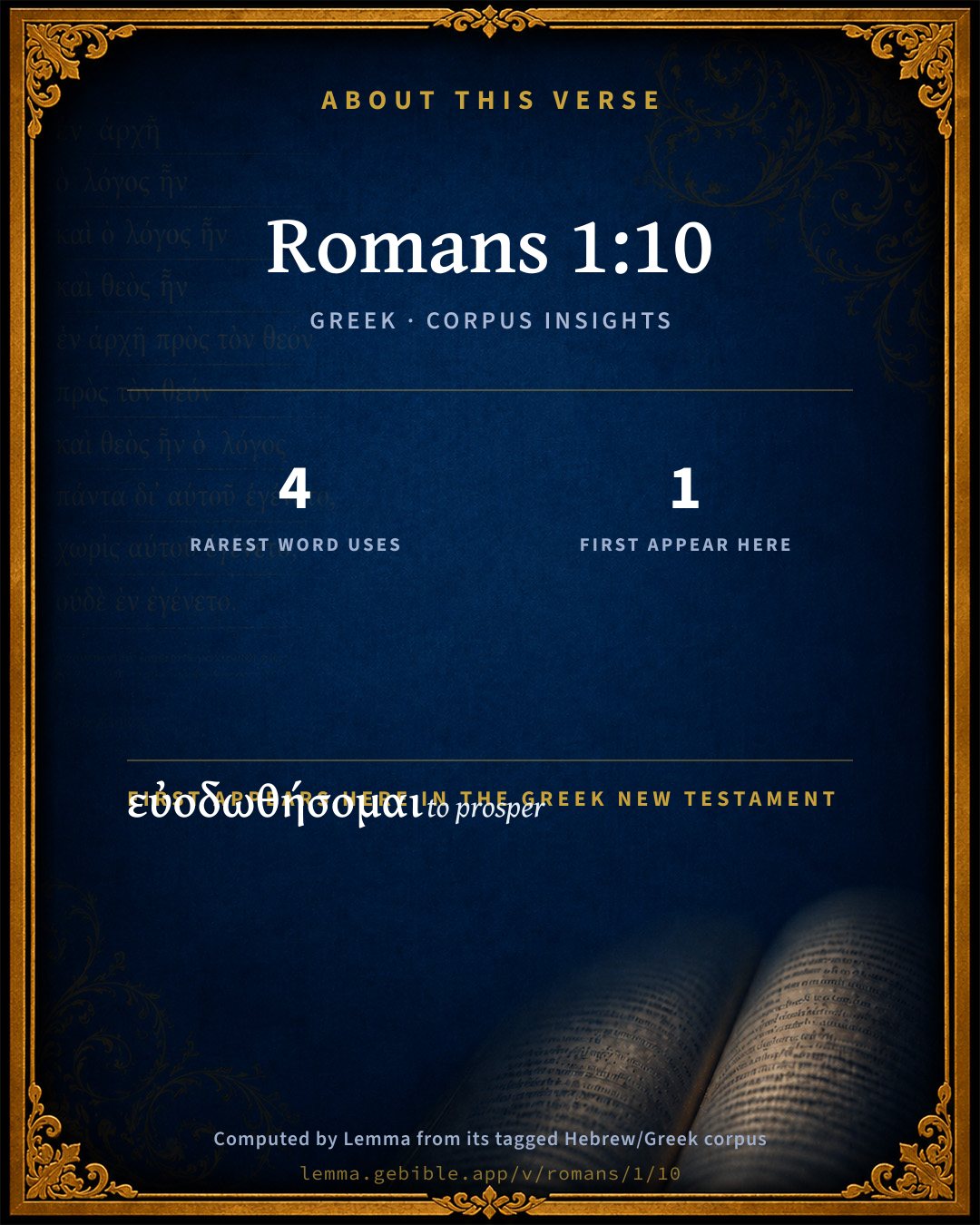
The rarest word here is εἴπως if indeed G1513 — appearing just 4 times in the whole Greek New Testament.

First appearance in Scripture

This word makes its first canonical appearance in the Greek New Testament here:

  • εὐοδωθήσομαι to prosper G2137

Shared distinctive vocabulary

εἴπως if indeed G1513 occurs in 4 verses of the Greek New Testament. Also found in:

Repetition

A word recurs within this verse:

Cross-references

13

Topical passages linked to Romans 1:10 in the Treasury of Scripture Knowledge — connected by theme and wording, ordered by reader-vote popularity; previews shown in the World English Bible.

  • Romans 15:30–32 Now I beg you, brothers, by our Lord Jesus Christ, and by the love of the Spirit, that you strive together with me in your prayers to God for me,
  • Acts 18:21 but taking his leave of them, and saying, "I must by all means keep this coming feast in Jerusalem, but I will return again to you if God wills," he set sail from Ephesus.
  • Philemon 1:22 Also, prepare a guest room for me, for I hope that through your prayers I will be restored to you.
  • James 4:15 For you ought to say, "If the Lord wills, we will both live, and do this or that."
  • 1 Thessalonians 2:18 because we wanted to come to you--indeed, I, Paul, once and again-- but Satan hindered us.
  • 1 Thessalonians 3:10–11 night and day praying exceedingly that we may see your face, and may perfect that which is lacking in your faith?
  • Acts 19:21 Now after these things had ended, Paul determined in the spirit, when he had passed through Macedonia and Achaia, to go to Jerusalem, saying, "After I have been there, I must also see Rome."
  • Romans 15:22–24 Therefore also I was hindered these many times from coming to you,
  • Philippians 4:6 In nothing be anxious, but in everything, by prayer and petition with thanksgiving, let your requests be made known to God.
  • Hebrews 13:19 I strongly urge you to do this, that I may be restored to you sooner.
  • Acts 21:14 When he would not be persuaded, we ceased, saying, "The Lord's will be done."
  • 1 Corinthians 4:19 But I will come to you shortly, if the Lord is willing. And I will know, not the word of those who are puffed up, but the power.
  • Acts 27:1–28 When it was determined that we should sail for Italy, they delivered Paul and certain other prisoners to a centurion named Julius, of the Augustan band.

Cross-references courtesy of OpenBible.info (CC BY 4.0).

Commentary

Notes on Romans 1:10 from classic Christian and Jewish commentators (each source and its license shown beneath its notes). The classic Christian expositions comment on the surrounding passage and are grouped to its opening verse, so a note may address several verses; the Jewish commentaries on the Tanakh (Rashi and others) are per-verse, so they appear only where the commentator wrote on this verse.

Lemma curates 59 commentaries, every one of them public domain or Creative Commons licensed, each selected and text-cleaned for this edition rather than reprinted as found. About our sources →

The Biblical Illustrator

Joseph S. Exell

Rom_1:10-12

Making request, if by any means … I might have a prosperous journey.

Prosperous journey

What is necessary to render a journey, or a voyage, prosperous in the estimation of a real Christian? Is he satisfied if by it his temporal interests are advanced, if he enjoys worldly pleasure, if he meets with kind friends, if he be preserved from calamity, and return home with invigorated health? These are blessings which require his grateful acknowledgments to God. With these he ought to be contented, if this world were his home. But when he remembers that heaven is his true country, and religion his great business, he must feel that something more is necessary.

I. We should seek more affecting and admiring views of the Creator, as displayed in His works. When our minds are employed upon the works of nature, it is generally only to make them subservient to our worldly interest, or to administer to our earthly gratification; and not to warm our hearts by the contemplation of that infinite power, wisdom, and goodness, which appear in the formation of them. If such conduct at all times is inexcusable and ungrateful, it is doubly so in our journeys, in which the works of God are presented to us in rapid succession.

II. We should acquire a more deep and grateful sense of the goodness and care of that Providence on which we depend. Though in God we live, and move, and have our being, yet the majority of mankind think but little of this guardian providence. And even Christians, when nothing occurs to interrupt the regular course of their lives, are too apt to forget their dependence; but surely in our journeys we must, from their unseen dangers, feel that we need each moment to be shielded by the power of God.

III. It should deepen our conviction of the value and uniformity of the religion of Jesus. The various objects presented to him will be calculated to produce this conviction. Far from home we meet with the disciples of the Redeemer.

IV. We should embrace opportunities of acquiring and doing good. Sometimes even believers, during their journeys, have found their graces withering, because they neglected these means of spiritual improvement. Carefully guard against this. Let the Word of God not be disregarded. Let nothing interfere with prayer, Sabbath duties, etc. Be not ashamed to avow your attachment to the blessed Saviour. A word spoken in season may be the means of saving a soul.

V. Remember that our whole life is a journey towards eternity. Frequently think, when far from home, that you are only sojourners upon earth; that heaven is your country. (S. Davies, D. D.)

A prosperous journey

I. Depends upon the will of God.

II. Supposes Gods care, direction, and blessing.

III. Can only be secured by earnest prayer. (J. Lyth, D. D.)

By the will of God

Or in the will, etc.

Paul seemed to regard the will of God as a straight course, in which he was desirous of sailing; or as a circle, outside of whose radius he would not steer, through selfishness, impatience, and self-judgment. The track marked out on Gods chart must be followed, for out of it were shoals and rocks, where he would founder and make shipwreck of his faith. (C. Nell, M. A.)

Prayer and the will of God

There is nothing with which Christians should be more habitually impressed than that God is the disposer of events. They should look to His will in the smallest concerns of life, as well as in affairs of the greatest moment. Even a prosperous voyage is from the Lord. In this way they glorify God by acknowledging His providence in all things, and have the greatest confidence and happiness in walking before Him. Here we also learn that, while the will of God concerning any event is not ascertained, we have liberty to desire and pray for what we wish, provided our prayers and desires are conformed to His holiness. We also learn in this place that, since all events depend on the will of God, we ought to acquiesce in them, however contrary they may be to our wishes; and likewise that in those things in which the will of God is not apparent, we should always accompany our prayers and our desires with this condition if it be pleasing to God, and to be ready to renounce our desires as soon as they appear not to be conformed to His will. O how sweet a thing, as one has well observed, were it for us to learn to make our burdens light by framing our hearts to the burthen, and making the Lords will our law! (J. Haldane.)

For I long to see you that I may impart unto you some spiritual gift.--

Pauls desire to see the Roman Christians

Note--

I. The longing of an earnest mind for engagement in Christs service. Paul wished to see them--

1. That he might impart some spiritual gift. Some suppose reference is made to those supernatural gifts in which the Church at Corinth was so rich, and were they still in the Church some would be tempted to say, Give me this power, with a view to usefulness. But why do you not use those you already have? It is not that our Churches come behind in gifts, but that so many are unemployed. Everyone has some gift--use it. Some mistake their gifts and hinder. If you have no gift for public prayer, pray in silence. But all have the gift of tongues. Everyone can speak a word in season to them that are weary. Pray that they may be baptized with fire. That will purge from detraction, etc., and make meet for the Masters use.

2. That he and they might be comforted by the faith of each. There is a law pervading Gods works by which the giver becomes the receiver. The seed comes back in the harvest; the ocean receives the rain it gives off in evaporation. Nothing is so injurious as selfishness; nothing so remunerative as benevolence. No prayer is so profitable as intercession for others; no Bible knowledge so rich as that derived from exposition to others. How many have been recompensed for efforts made to attend the prayer meeting!

II. The delays often met with in the accomplishment of our work. Do not suppose that because your motive is pure your end will be achieved at once. Paul planned long ago to visit Rome, but found his plans set aside by God. In all your undertakings do what he did--pray to, and then wait for, God to make the way plain. The opportunity will come in His, i.e., the best time.

III. Our desire for employment in Christs work may be realised in a way least expected. The spirit, rather than the letter, of the prayer is answered. How little Paul thought that he would enter Rome a prisoner; but the sequel shows that God was right. What a rich experience Paul brought with him, and accumulated for the benefit of the Church of all ages. How invaluable is the record of his shipwreck! We could ill have spared the incidents of his history even for more sermons and epistles. Then he tells us how that all fell out for the furtherance of the end he had in view (Php_1:1-30).

IV. To accomplish Christs work we must have a powerful conviction--

1. Of our personal indebtedness.

2. Of the glory and power of the gospel. (J. S. Pearsall.)

Personal intercourse

I. Its advantages. It accomplishes more than a letter--hence reading the Word at home does not supersede the necessity of the living ministry.

II. Its objects.

1. The communication of some spiritual good.

2. Mutual edification.

III. Its attractions.

1. Mutual love.

2. Love to Christ. (J. Lyth, D. D.)

Pastoral visitation

1. Supposes personal communication about Divine things.

2. Contributes to the development, increase, and communion of faith.

3. Secures mutual comfort--the minister needs it--can impart it.

4. Promotes unity of affection and effort. (J. Lyth, D. D.)

The bond and purpose of the ministry

I. Notice the manly expression of Christian affection which the apostle allows himself here. Very few Christian teachers could or should venture to talk so much about themselves as Paul did. The strong infusion of the personal element in all his letters is so transparently simple, so free from affectation or unctuous sentiment, that it attracts rather than repels. He had never been in Rome when he spoke these words; he had no personal relations with any of the believers there; but still his heart went out towards them, and he was not ashamed to show it. I long to see you.

II. Note the lofty consciousness of the purpose of their meeting. The word he employs here, gift, is never used in the New Testament for a thing that one man can give to another, but is always employed for the concrete results of the grace of God bestowed upon men. The very expression, then, shows that Paul thought of him self, not as the original giver, but simply as a channel through which was communicated what God had given. In the same direction points the adjective which accompanies the noun--a spiritual gift--which probably describes the origin of the gift as being the Spirit of God, rather than defines the seat of it when received as being the spirit of the receiver. Notice, too, as bearing on the limits of Pauls part in She gift, the delicacy of the language in his statement of the ultimate purpose of the gift. He does not say, that I may strengthen you, which may have been too egotistical, but he says, that ye may be strengthened, for the true strengthener is not Paul, but the Spirit of God. And now, what are the lessons that I take from this?

1. No Christian teacher has any business to open his mouth unless he is sure that he has got something to impart to men as a gift from the Divine Spirit. And no Christian organisation has any right to exist unless it recognises the communication and farther spreading of this spiritual gift as its great function. That is the one lesson, and the other one is this--

2. Have you received the gift that I have, under the limitations already spoken of, to bestow? That is, have you taken Christ, and have you faith in Him. The purpose of the Church, and the purpose of the ministry, is that spiritual gifts may be imparted. And if that purpose be not accomplished, all other purposes that are accomplished are worse than nothing.

III. Note the lowly consciousness that much was to be received as well as much to be given. The apostle corrects himself after he has said, that I may impart unto you some spiritual gift, by adding, that is, that I may be comforted (or rather, encouraged) together with you by the mutual faith both of you and me. If his language were not so transparently sincere, and springing from deep interest into the relationship between himself and these people, we should say it was exquisite courtesy and beautiful delicacy. But it moves in a region far more real than the region of courtesy, and it speaks the inmost truth about the conditions on which the Roman Christians should receive, viz., that they should also give. There is only one giver who is only a giver, and that is God. All other givers are also receivers. Pauls was a richly-complicated nature--firm as a rock in the will, tremulously sensitive in its sympathies; like some strongly rooted tree with its stable stem and a green cloud of fluttering foliage that moves in the lightest air. So his spirit rose and fell according to the reception that he met from his brethren, and the manifestation of their faith quickened and strengthened his. And he is but one instance of a universal law. All teachers, the more genuine they are, the more sympathetic they are, are the more sensitive of their environment. The hearer reacts on the speaker quite as much as the speaker does on the hearer. If you have got ice in the pews, that brings down the temperature up here. And the unbelief and low-toned religion of a congregation is always pulling down the faith and the fervour of their minister, if he be better and holier, as they expect him to be, than they are. On the other hand, the true encouragement to give a man when he is trying to do Gods will, to preach Christs gospel, is not to pat him on the back and say, What a remarkable sermon that was of yours! What a genius; what an orator! not to go about praising it; but to come and say, Thy words have led me to Christ; and from these I have taken the gift of gifts. (A. Maclaren, D. D.)

Sharing happiness

Men of the noblest disposition think themselves happiest when others share with them in their happiness. (Jeremy Taylor.)

To the end ye may be established.--

Christian establishment

I. The object which we all should have in view--that we may be established.

1. In knowledge. This kind of knowledge Paul terms the full assurance of understanding to the acknowledgment of the mystery of God, etc. When we attain this, comprehend the gospel of Christ so completely that we see its adaptation to all our wants, it becomes its own evidence; doubt vanishes, the heart and the mind are both at rest.

2. In holiness (1Th_3:12-13) So that we get a fixed abhorrence of evil, and love good for its own sake, and be like God and those holy beings who minister to Him perpetually.

3. In all those external habits which flow from holiness. The holiness of the Christians heart must be manifest in his daily habits and conduct, in every good word and work.

II. The means which may be employed to further that object. God Himself is the source of the establishment of His people, but the Word of God is explicit as to the part which men should take in the same. While, therefore, it is frequently a prayer of the apostle that the Churches might be established in the faith, this is no less the subject of exhortation (1Co_15:58). While we are using the prescribed means, we may look to Him for His needful blessing; the grace of God cooperates with the energy to which He brings His people. And among these means which God has provided are--

1. The ministry of the gospel. This is perhaps a less important means than it once was, because of the accessibility of the Word of God to all; and now each parent, each master, may become a minister of Christ in his own household. Yet still ministers have been appointed by Christ as instruments in the building up of their fellow Christians.

2. The summoning into activity all the individual powers. If you have any earnestness, decision, promptitude, courage, in prosecuting any common business, try the sincerity of your spirits by seeking whether they are manifest in seeking your spiritual progress daily.

3. Prayer. (Baptist Noel, M. A.)

That I may be comforted together with you.--

Christians mutual helpers

The relations of Christians to each other are like the several flowers in a garden that have upon each the dew of heaven, which being shaken with the wind, they let fall the dew at each others roots, whereby they are jointly nourished, and become nourishers of one another. (J. Bunyan.)

The joy of imparting joy

And I might add that service in itself, through the blessing of the Holy Spirit, is always a means of comfort, because of the blessedness which it yields to a generous heart to be doing good to others. Oh! you little know how much pleasure you would derive from the kindly endeavours to impart joy to others. I passed a brother yesterday whose eyes sparkled, and his cheerful face was lit up with smiles. Though I did not know the man, I seemed to read his character in his countenance. Surely, thought I, he is a busy one who is trying to dispense some blessings to the needy. Again this morning I fell in with him, and this time I made his acquaintance. His cordial greeting pleased me, and his lively manner induced me to ask on what good errand he had been. Well, said he, I have just been visiting some poor people, and talking with some sick ones, and I have had a sweet time with them. Yes; that is the way to get sweet times. (C. H. Spurgeon.)

The communion of saints

As in the case of fire, if anyone gather together many lights, it is a bright flame that he kindles; thus also does it naturally happen with the faithful. For when we be by ourselves, torn away from others, we are somehow in worse spirits. But when we see one another, and are entwined with the members of our own selves, great is the comfort we receive. (Chrysostom.)

By the mutual faith both of you and me.--

Mutual faith

Faith is the all-inspiring element of work everywhere! No man long pursues any work which he does not believe in. No man invests his money in something he does not believe in. Faith is not misty imagination, nor is it a mere mystical meditation about God; it is built upon what God is and what God has said and what God has done. But then there comes in this other consideration; faith is a thing of degree. Here, then, it touches the point of mutuality! If you and I engage in a commercial enterprise, I find my faith weakened or strengthened. I say I wish you knew a little more about that enterprise. If we do business with a great firm, the doubt of others affects us. It was a terrible thing when the crew of Columbus said, We do not believe. The heroism of that man is seen in the fact that he found the land in spite of the mutinous crew! But where there is this element of mutuality in faith, there is wonderful strength.

I. Successful enterprises need the faith of every one of us. The unbeliever is a weakness wherever he is. Do you believe that yourself? Masses are not strong in and of themselves. The unity of the spirit in the bond of faith--that is strength.

1. Men who are engaged on gospel enterprises can only do it in proportion as they believe in Christ, and in each other as true men in Christ.

2. If you are mated to another, take care your friend believes with you, or, young woman, you will regret it. You cannot row to heaven with one oar comfortably; both must row together. It is a terrible revelation to some. I am yoked to an unbelievers.

3. The enterprises of home-life demand mutual faith.

II. The best faith needs refreshment. Even Paul gained strength by anothers faith. The rivulet feeds the sea, as well as the mountain feeds the river! The little child feeds my faith--I cannot hear a childs prayer without being helped. The increase of faith is made up of quiet influences! When you went to the seaside out of health, you wonder how it was you got better. You breathed the pure oxygen; you looked up to the broad heavens and forgot meaner things; your nature was influenced by a million little touches along the nerves. So you may be in an atmosphere of faith; and Paul wanted to see them to be in such an atmosphere and to contribute to it.

III. Faith brings comfort. When we voyage to America, Do you believe in the captain, too? Then, when evening comes, Good night, and we are all comforted. The vessel is safe in which we voyage to heaven. All believe in the same Divine Lord over the storm. You are going home without trepidation tonight, but if you had lived in some parts of Italy some time ago we might have asked, Are you afraid of being stabbed tonight? Which way are you going? We will walk together! We are comforted by mutual faith in each other. The same thing holds good in regard to religion. What a glorious triumph over fear the early Christians enjoyed.

IV. Faith gives courage. There were a few people inside Rome who believed in Jesus, and the apostle took courage from the thought that he should not be alone, but be surrounded by a loyal few. In the army everyone helps the others courage. There is no talk about danger, but only of taking the battlements! So wherever you are, by the exercise of your faith you are sustaining that poor fellow there who has the same battle to fight as you have.

V. Faith means prayer. Making request, etc. You cannot work yourself up into love or faith! It must be something that comes to you. Every good gift comes from God. What we want to make request for is faith, and if we have it as a possession, may God enlarge it. (W. M. Statham.)

The Biblical Illustrator, edited by Joseph S. Exell (c. 1880s–1900s) — public domain. Text from a community e-Sword module.

Bengel's Gnomon

Johann Albrecht Bengel

Rom 1:10. Ἔιπως ἤδη ποτέ, The accumulation of the particles intimates the strength of the desire.

Bengel's Gnomon of the New Testament — English translation (T&T Clark, Edinburgh, 1860) — public domain. Text from a community e-Sword module.

Meyer's Critical & Exegetical Commentary

Heinrich August Wilhelm Meyer

Rom_1:10. Πάντοτε … δεόμενος] annexes to ὡς ἀδιαλ. the more precise definition: in that (so that) I always (each time) in my prayers request. ἐπί, which is to be referred to the idea of definition of time (Bernhardy p. 246), indicates the form of action which takes place. Comp 1Th_1:2; Eph_1:16; Phm_1:4; Winer, p. 352 [E. T. 470].

εἴπως ἤδη ποτέ] if perhaps at length on some occasion. For examples of ἥδη, already (Baeumlein, Part. p. 138 ff.), which, comparing another time with the present, conveys by the reference to something long hoped for but delayed the idea at length, see Hartung, Partikel. I. p. 238; Klotz, a[359] Devar. p. 607; comp Php_4:10, and the passages in Kypke. Th. Schott incorrectly renders πάντοτε, under all circumstances, which it never means, and ἥδη πότε as if it were ἤδη νῦν or ἄρτι. The mode of expression by εἴπως implies somewhat of modest fear, arising from the thought of possible hindrances.[361]

εὐοδωθήσομαι] I shall have the good fortune. The active εὐοδοῦν is seldom used in its proper signification, to lead well, expeditum iter praebere, as in Soph. O. C. 1437; Theophr. de caus. pl. v. 6, 7; LXX. Gen_24:27; Gen_24:48; the passive, however, never means via recta incedere, expeditum iter habere, but invariably (even in Pro_17:8) metaphorically: prospero successu gaudere. See Herod. vi. 73; 1Co_16:2; 3Jn_1:2; LXX. 2Ch_13:12; Psa_1:3, and frequently; Sir_11:16; Sir_41:1; Tob_4:19; Tob_5:16; Test. XII. Patr. p. 684. Therefore the explanation of a prosperous journey, which besides amounts only to an accessory modal idea (Beza, Estius, Wolf, and many others following the Vulgate and Oecumenius; including van Hengel and Hofmann), must be rejected, and not combined with ours (Umbreit).

ἐν τῷ θελ. τ. Θεοῦ] in virtue of the will of God; on this will the ευοδωθ. causally depend.

[359] d refers to the note of the commentator or editor named on the particular passage.

[361] Comp. Rom_11:14; and on Php_3:11; 1Ma_4:10.

Meyer — Critical and Exegetical Commentary on the New Testament — English translation by Peter Christie, edited by Frederick Crombie (T&T Clark, 1880) — public domain. Text from a community e-Sword module.

Hodge's Commentary on Romans, Ephesians & First Corinthians

Charles Hodge

Rom_1:10

I make mention of you, always in my prayers praying (εἴ πως) if possibly, if it may be, expressing the submission to the will of God with which the apostle urged his request. ἤδη ποτέ, now at last, as though he had long looked forward with desire to what there was now a prospect of his seeing accomplished. I may be so happy, by the will of God, to come to you. Εὐοδοῦν is, to lead in the right way, to prosper ones journey, Gen_24:48, and figuratively, to prosper, 1Co_16:2; 3Jo_1:2. In the passive voice, it is, to be prospered, successful, favored. In the present case, as Paul had neither commenced his journey, nor formed any immediate purpose to undertake it, see Rom_15:25-29, his prayer was not that his journey might be prosperous, but that he might be permitted to undertake it; that his circumstances should be so favorably ordered that he might be able to execute his long cherished purpose of visiting Rome. Knowing, however, that all things are ordered of God, and feeling that his own wishes should be subordinated to the Divine will, he adds, by the will of God; which is equivalent to, If it be the will of God. Praying continually, that, if it be the will of God, I may be prospered to come unto you.

Charles Hodge — Commentary on Romans (1835), First Corinthians (1857), and Ephesians (1856) — public domain. Text from a community e-Sword module.

Jamieson, Fausset & Brown

Robert Jamieson, A. R. Fausset & David Brown

Making request, if by any means now at length I may have a prosperous journey by the will of God, to come to you--Though long anxious to visit the capital, he met with a number of providential hindrances (Rom 1:13; Rom 15:22; and see on Act 19:21; Act 23:11; Act 28:15); insomuch that nearly a quarter of a century elapsed, after his conversion, ere his desire was accomplished, and that only as "a prisoner of Jesus Christ." Thus taught that his whole future was in the hands of God, he makes it his continual prayer that at length the obstacles to a happy and prosperous meeting might be removed.

Jamieson, Fausset & Brown — Commentary Critical and Explanatory on the Whole Bible (1871) — public domain (CC PDM 1.0). Text via the HelloAO Bible API.

Adam Clarke's Commentary

Verse 10. Making request, c.] By this we see how earnestly the apostle longed to see Rome. It had long been a subject of continual prayer to God, that he might have a prosperous journey to, or rather meeting with, them, for so we should understand the word ευοδωθησμαι: that he had a prosperous meeting with them we cannot doubt that he had a disastrous journey to them the 27th of the Acts fully proves.

Adam Clarke's Commentary on the Bible (1810–1826) — public domain. Text from a community e-Sword/MySword module.

John Calvin's Commentaries

10. Requesting, if by any means, etc. As it is not probable that we from the heart study his benefit, whom we are not ready to assist by our labors, he now adds, after having said that he was anxious for their welfare, that he showed by another proof his love to them, as before God, even by requesting that he might be able to advance their interest. That you may, therefore, perceive the full meaning, read the words as though the word also were inserted, requesting also, if by any means, etc. By saying, A prosperous journey by the will of God he shows, not only that he looked to the Lord’s favor for success in his journey, but that he deemed his journey prosperous, if it was approved by the Lord. According to this model ought all our wishes to be formed.

John Calvin's Commentaries (1540-1563) — public domain. Text from the Calvin Translation Society English edition (1840s-50s) via the Christian Classics Ethereal Library (ccel.org). Calvin's coverage is partial (roughly two-thirds of the Bible); uncommented books and verses are honest gaps, never fabricated. The 19th-century editor's footnotes and remarks are omitted so the notes are faithfully Calvin's own voice.

Ellicott's Commentary for English Readers

(10) If by any means now at length.—Note this accumulation of particles, denoting the earnestness of his desire. “All this time I have been longing to come to you, and now at last I hope that it may be put in my power.”

A Bible Commentary for English Readers, edited by Charles John Ellicott (1878–1897) — public domain. Text from a community e-Sword module.

The Cambridge Bible for Schools and Colleges

gen. ed. J. J. S. Perowne

10. making request] Connect this with the previous verse, and read without ceasing I make mention of you, always in my prayers making request, if by any means, &c. The special “request made known to God” was that the Apostle might, after long delays, be allowed to visit the Roman Christians. Cp. Act_19:21, where the phrase “I must see Rome” probably indicates a Divine purpose revealed.

might have a prosperous journey] Perhaps more briefly, might be prospered, might have the way smoothed. Little did he foresee how this was at last to be. See Rom_15:23-24; Rom_15:32; and cp. Act_27:24.

by the will of God] Lit. in the will of God. See on Rom_1:9. If the construction is to be pressed, the implied thought is that the visit to Rome would be within the limits of God’s will; guided by its lines. The Gr. of Heb_10:10 presents the only close parallel in N. T.

The Cambridge Bible for Schools and Colleges (gen. ed. J. J. S. Perowne; Cambridge University Press, 1878–1918) — public domain. Text from a community e-Sword module.

John Gill's Exposition

Making request, if by any means now at length,.... A principal thing, which be incessantly and importunately requested at the throne of grace, was, that he might have an opportunity of coming to them; that God in his providence would open a way for him; and that he might have a safe and comfortable journey in a very little time; all which he submits to the will of God, as a good man ought to do; and which he thus expresses,

I might have a prosperous journey by the will of God, to come unto you; see Jam 4:13.

John Gill's Exposition of the Whole Bible (1746–1763) — public domain (CC PDM 1.0). Text via the HelloAO Bible API.

Trapp's Complete Commentary

John Trapp

10 Making request, if by any means now at length I might have a prosperous journey by the will of God to come unto you.

Ver. 10. I might have a prosperous journey] This he prayed, and this he had by such a way as he little dreamed of. Little thought Paul, that when he was bound at Jerusalem, and posted from one prison to another, that God was now sending him to Rome; yet he sent him, and very safe with a great convoy. God goes often another way to work for our good than we could imagine.

John Trapp, A Commentary or Exposition upon All the Books of the Old and New Testament (1647–1656) — public domain. Text from a community e-Sword module.

Albert Barnes' Notes on the Bible

Making request - It was his earnest desire to see them, and he presented the subject before God.

If by any means - This shows the earnest desire which he had to see them, and implies that be had designed it, and had been hindered; see Rom 1:13.

Now at length - He had purposed it a long time, but had been hindered. He doubtless cherished this purpose for years. The expressions in the Greek imply an earnest wish that this long-cherished purpose might be accomplished before long.

A prosperous journey - A safe, pleasant journey. It is right to regard all success in traveling as depending on God, and to pray for success and safety from danger. Yet all such prayers are not answered according to the letter of the petition. The prayer of Paul that be might see the Romans was granted, but in a remarkable way. He was persecuted by the Jews, and arraigned before King Agrippa. He appealed to the Roman emperor, and was taken there in chains as a prisoner. Yet the journey might in this way have a more deep effect on the Romans, than if he had gone in any other way. In so mysterious a manner does God often hear the prayers of his people; and though their prayers are answered, yet it is in his own time and way; see the last chapters of the Acts .

By the will of God - If God shall grant it; if God will by his mercy grant me the great favor of my coming to you. This is a proper model of a prayer; and is in accordance with the direction of the Bible; see Jam 4:14-15.

Albert Barnes' Notes on the Bible (1834–1885) — public domain. Text from a community e-Sword/MySword module.

Matthew Poole's English Annotations

Making request; this was one thing he requested of God, that what he had long desired and designed might happily (if it seemed good in God’s sight) be at last accomplished, that he might come in person to them. This desire of Paul to see the Romans might be one cause of that appeal which he made to Rome, Act 25:10,11,

By the will of God; he adds this, because, in publishing the gospel, he followed the order which God, by his Spirit, prescribed him: see Act 16:7,9,10.

Matthew Poole's English Annotations on the Holy Bible (1683–1685) — public domain. Text from a community e-Sword/MySword module.

Whedon's Commentary on the Bible

Daniel D. Whedon

10. Request—His prayers for them were twofold: for their spiritual prosperity, and for divine permission to visit them.

Prosperous journey—He journeyed to Rome at last, but by what few would call a prosperous trip. (Acts 28.)

Daniel D. Whedon (gen. ed.), Commentary on the Old and New Testaments (1874–1909) — public domain. Text from a community e-Sword module.

The Pulpit Commentary

Always (to be connected with deomenov following, not, as in the Authorized Version, with the preceding mneian poioumai) in my prayers making request, if by any means now at length (in some way at length some day) I may be prospered to come unto you. The word euodwyhsomai , translated in the Authorized Version, "have a prosperous journey," though rightly so rendered with regard to its etymology and original meaning, does not necessarily imply being prospered in a journey. It was commonly used to denote being prospered generally. (cf. 1Co_16:2 3Jn_1:2)

The Pulpit Commentary (1880–1919), ed. H.D.M. Spence-Jones & Joseph S. Exell — public domain. Text from a community e-Sword module.

John Wesley's Explanatory Notes

Always - In all my solemn addresses to God. If by any means now at length - This accumulation of particles declares the strength of his desire.

John Wesley, Explanatory Notes Upon the Whole Bible (1754–1765) — public domain. Text via the GEBible commentary corpus.

Godbey's Commentary on the New Testament

William B. Godbey

10. “Supplicating, if possible indeed at some time I shall be pleased in the will of God to come unto you.” Paul had been preaching twenty eight years when he wrote this letter, all the time desiring and praying that it might be his glorious privilege, in the will of God, to visit the world’s metropolis and there preach the gospel in the capital of all the nations beneath the skies.

William B. Godbey, Commentary on the New Testament (1896–1900) — public domain. Text from a community e-Sword module.

McGarvey & Pendleton's Commentaries

J. W. McGarvey

making request, if by any means now at length I may be prospered by the will of God to come unto you . [Since he could call no other witness as to the substance or contents of his secret prayers, he reverently appeals to God to verify his words, that he had continually remembered the Romans in his petitions, and had requested that, having been so long denied it, the privilege of visiting the church at Rome might now at last be granted to him. Paul's appeals to God to verify his words are quite common ( 2Co_1:23 ; 2Co_11:31 ; Gal_1:20 ; etc.). He describes God as one whom he serves not only outwardly but inwardly, publishing the gospel of his Son with hearty zeal, devotion and joy. He had traveled widely and constantly; his failure, therefore, to visit Rome might look like indifference, and his impending departure from Corinth, not toward Rome, which was now comparatively near, but in the opposite direction, might suggest that he was ashamed to appear or preach in the imperial city. The apostle replies to all this by simply stating, and asking God to verify the statement, that God had not yet prospered him in his plans or efforts to go to Rome.]

J. W. McGarvey (with Philip Y. Pendleton), Commentaries on the New Testament (The Fourfold Gospel, 1914; Acts; and the epistles) — public domain. Text from a community e-Sword/MySword module.

The People's New Testament

B. W. Johnson

10. Making request. One of his petitions was that God might permit him to visit the church at Rome. While at Ephesus he had said (Acts 19:21), “I must also see Rome.” His prayers were granted, but not in the way that he now expected. When he went to Rome it was as “the prisoner of the Lord.”

B. W. Johnson's The People's New Testament with Notes (1889–1891) — public domain. Electronic text from the Christian Classics Ethereal Library (CCEL) ThML edition.

Cambridge Greek Testament for Schools and Colleges

10. ἐπὶ, at. δεόμενος εἴ πως. Cf. Act 8:22; cf. Blass, p. 216. ἤδη ποτὲ, at long last.

εὐοδωθήσομαι, “in passive always tropical; to prosper, be successful,” Thayer; 1Co 16:2; 3Jn 1:2; but cf. Sept., Jdg 18:5; Tob 5:21; Tob 11:5; so S. H. adopt early English vv., “I have a spedi way.”

Cambridge Greek Testament for Schools and Colleges (Cambridge University Press, 1896; 21 vols, various authors incl. Carr, Maclear, Plummer, Farrar, Lumby, Moule, M. R. James, Simcox) — public domain. Text from a community e-Sword module.

Alford’s Greek Testament

Henry Alford

10. εἴ πως] if by any means. No subject of δεόμενος is expressed, but it is left to be gathered from this clause, as in Simon’s entreaty, Act 8:24, δεήθητε ὑμεῖς ὑπὲρ ἐμοῦ.… ὅπως μηδὲν ἐπέλθῃ ἐπʼ ἐμὲ ὧν εἰρήκατε, where ὅπως κ.τ.λ. is not the contents of the prayer, but the end aimed at by it.

ἤδη ποτέ] before long:—lit., ‘at last, some day or other.’

εὐοδωθήσομαι] I shall be allowed, prospered: see reff., and Deu 28:29: and cf. Umbreit’s note. The rendering, ‘I might have a prosperous journey’ (Vulg. and E.V.), is etymologically incorrect; the passive of ὁδόω, ‘to shew the way,’ ‘to bring into the way,’ must be ‘to be shewn the way,’ or ‘brought into the way.’ So Herod. vi. 73, ὡς τῷ Κλεομενεϊ εὐωδώθη τὸ ἐς τὸν Δημάρητον πρῆγμα.

ἐν τῷ θελ. τοῦ θεοῦ] In the course of,—by, the will of God. ἐλθεῖν belongs to εὐοδωθήσομαι, not to δεόμενος.

Henry Alford, The Greek Testament (1849–1861) — public domain. Text from a community e-Sword module.

International Critical Commentary

10. εἴπως. On the construction see Burton, Moods and Tenses, § 276.

ἤδη ποτέ: a difficult expression to render in English; ‘now at length’ (AV. and RV.) omits ποτέ, just as ‘in ony maner sumtyme’ (Wic.) omits ἤδη; ‘sometime at the length’ (Rhem.) is more accurate, ‘some near day at last.’ In contrast with νῦν (which denotes present time simply) ἤδη denotes the present or near future in relation to the process by which it has been reached, and with a certain suggestion of surprise or relief that it has been reached so soon as it has. So here ἤδη = ‘now, after all this waiting’: ποτέ makes the moment more indefinite. On ἤδη see Bäumlein, Griech. Partikeln, p. 138 ff.

εὐοδωθήσομαι. The word has usually dropped the idea of ὁδός and means ‘to be prospered’ in any way (e. g. 1Co 16:2 ὅ τι ἂν εὐοδῶται, where it is used of profits gained in trade; similarly in LXX and Test. XII. Patr. Jud 1:1, Gad 7); and so here Mey. Gif. RV., &c. It does not, however, follow that because a metaphor is often dropped, it may not be recalled where it is directly suggested by the context. We are thus tempted to render with the earlier English Versions and Vulg. prosperum iter habeam (‘I have a spedi wey’ Wic.).

ἐν τῷ θελήματι τοῦ Θεοῦ. St. Paul has a special reason for laying stress on the fact that all his movements are in the hands of God. He has a strong sense of the risks which he incurs in going up to Jerusalem (Rom 15:30 f.), and he is very doubtful whether anything that he intends will be accomplished (Hort, Rom. and Eph. p. 42 ff.).

ἐλθεῖν: probably for ὥστε ἐλθεῖν (Burton, § 371 c).

International Critical Commentary — older volumes (1896–1929), various authors — public domain. Text from a community e-Sword module.

Vincent's Word Studies in the New Testament

Marvin R. Vincent

I might have a prosperous journey [ευοδωθησομαι] . Rev., I may be prospered. The A. V. brings out the etymological force of the word. See on 3Jo 1:2.

Marvin R. Vincent, Word Studies in the New Testament (1887–1900) — public domain. Text from a community e-Sword/MySword module.

Godet's Commentaries

Frédéric Louis Godet

Vv. 10. With the thanksgiving there is connected, as a second matter which he has to communicate to them, his not less unwearied prayer that he might be able soon to visit them. The words: always in my prayers, refer certainly to the following participle: making request, and not to what precedes, a sense which would lead to a pleonasm. Not one of the intimate dealings of the apostle with his God, in which this subject does not find a place.—᾿Επί, strictly speaking, on occasion of. The conjunction εἴπως, if perhaps, indicates the calculation of chances; and the adverbs now, at length, the sort of impatience which he puts into his calculation. The term εὐοδοῦν strictly signifies: to cause one to journey prosperously, whence in general: to make one succeed in a business; comp. 1Co 16:2. As in this context the subject in question is precisely the success of a journey, it is difficult not to see in the choice of the term an allusion to its strict meaning: “if at length I shall not be guided prosperously in my journey to you.” By whom? The words: by the will of God, tell us; favorable circumstances are the work of that all-powerful hand. Rom 1:11-12 indicate the most immediate motive of this ardent desire.

Frédéric Louis Godet — Commentaries on Luke, John, Romans, and 1 Corinthians — English translation (T&T Clark, Edinburgh, 1870s–1890s) — public domain. Text from a community e-Sword module.

Lesson kit

Teaching starters — assembled from the data on this page, not authored interpretation. Every prompt links to the verse data it draws on. Edit before teaching.

Romans, in the Pauline Epistles, opens this verse with 18 words (16 distinct Greek lemmas). Its most distinctive word is eí pōs (“if indeed”). A historical commentator’s framing appears above. Read the whole chapter for the surrounding context.

Discussion questions

  1. What does “if indeed” (eí pōs) contribute to the verse as a whole?
  2. The word “to prosper” first appears here in Scripture. What is being introduced at this debut?
  3. Acts 27:12 shares the word «if indeed» with this verse. How do the two illuminate each other?
  4. “the” occurs 3× in this one verse. What is the effect of the repetition?
  5. These translations render this verse differently; the difference is in the English rendering, not the original. What questions does that raise?
  6. Reading how The Biblical Illustrator and Bengel's Gnomon read this verse, where do the two commentators agree and where do they part?

Things to notice

  • 1 word makes its first canonical appearance in Scripture here.
  • These translations choose different wording for 17 words in this verse.
  • “the” occurs 3× in this single verse.
  • 16 distinct Greek lemmas span 18 words in this verse.

Reading settings

Reading text

Shown beneath each verse's original-language words.

Old Testament
Old Testament edition

Read the OT as the Masoretic Hebrew (MT) or the Greek Septuagint (LXX).

English shown for the Greek Septuagint (in the Hebrew ↔ Greek comparison).

Comparing translations? Open the Compare panel on any verse page to stack up to four side by side.