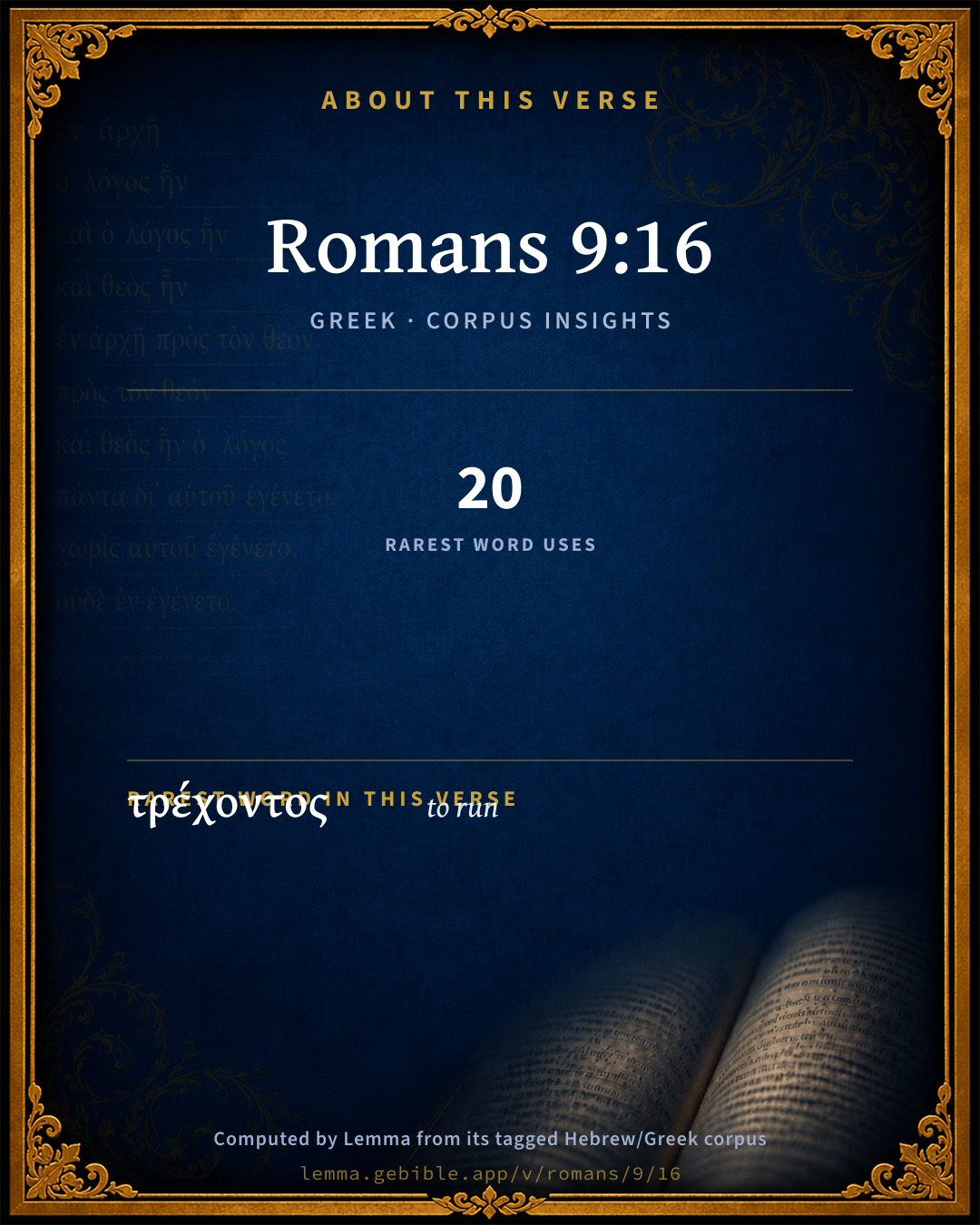
Romans 9:16

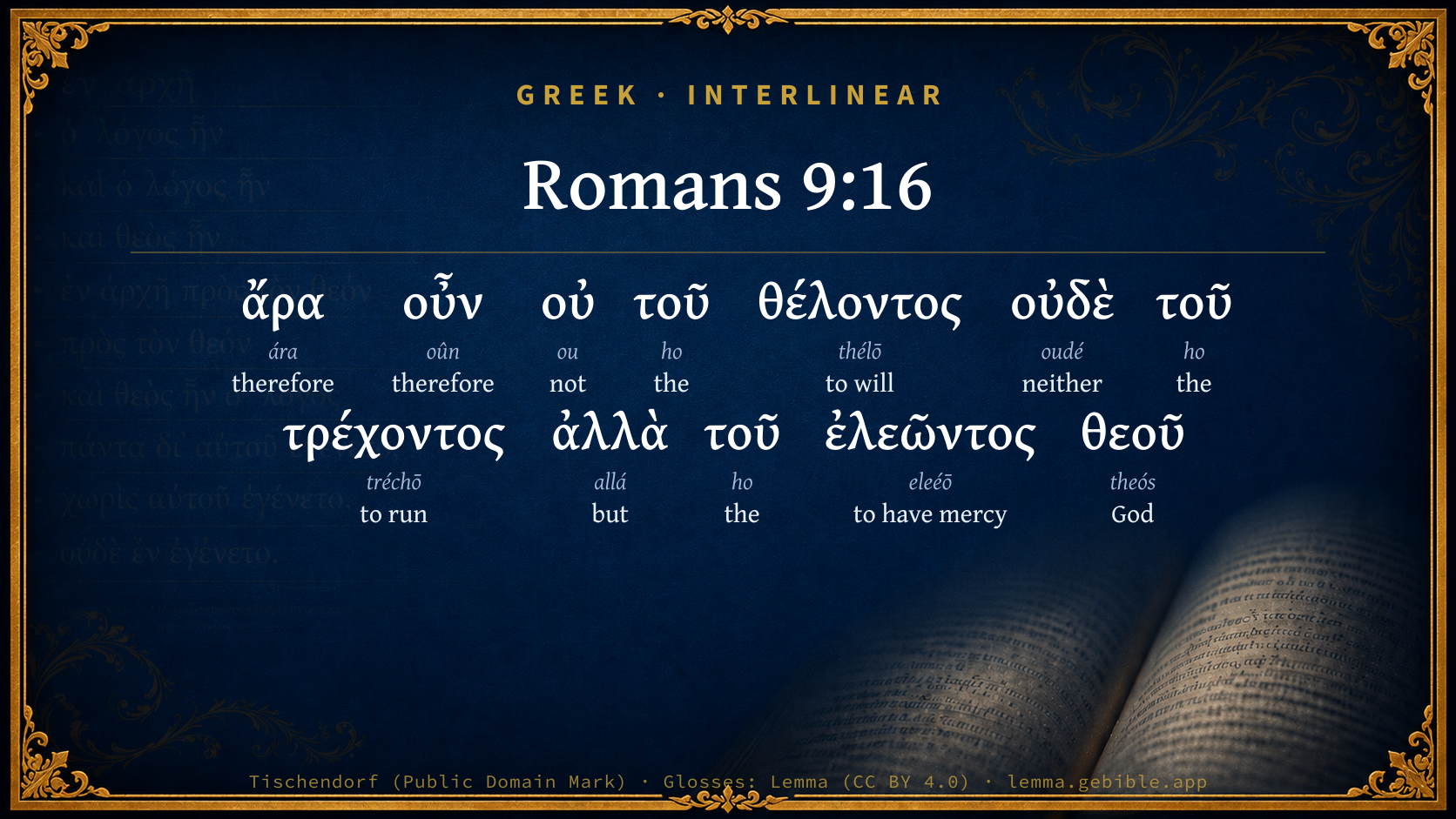
Greek (Tischendorf 8th ed.) Romans 9:16 appears in the Greek New Testament. The text above is from the Tischendorf 8th edition. Each word links to its Strong’s number and a concise gloss. Click any word for its full Thayer’s Greek Lexicon entry.
Download image
Cite this verse

Romans 9:16 (World English Bible). Public Domain. Lemma interlinear Bible study tool, https://lemma.gebible.app/v/romans/9/16.

Show BibTeX & RIS
BibTeX
RIS
English Translation
So then it is not of him who wills, nor of him who runs, but of God who has mercy.
World English Bible · Public Domain
Download a study sheet

One document with this verse’s original text, its word-by-word gloss line, the meaning frame, cross-references with their text, attributed commentary, and full source and license credits — printable, and it pastes into notes with its structure intact.

This verse Autodidact and up

Study sheet (.html) Plain text (.txt)

A passage Seminary Student

Up to 50 verses in one chapter. A passage sheet keeps up to 6 commentary sources and 12 cross-references per verse, in the order this page ranks them, and says so on the sheet whenever that leaves anything out. Ask for a single verse and you get the Autodidact verse sheet above.

Everything on this page stays free to read, with no account — the sheet is a download of what is already on screen, not access to it.

Want to remove ads? Support Godless Engineer
Compare translations 3

The same verse in 3 English versions, stacked beneath the original-language interlinear above. Click any original word for its lexicon entry.

Each is an independent rendering of the whole verse — the interlinear is not word-aligned to these translations.

Highlighted words mark where these versions differ — a whole-verse word diff, not a word-by-word alignment.

  • World English Bible Public Domain
    So then it is not of him who wills, nor of him who runs, but of God who has mercy.
  • King James Version Public Domain
    So then it is not of him that willeth, nor of him that runneth, but of God that sheweth mercy.
  • unfoldingWord Literal Text CC BY-SA 4.0
    So then, not of the one willing, nor of the one running, but of God, the one having mercy.

unfoldingWord Literal Text — © unfoldingWord, licensed CC BY-SA 4.0. Word-aligned USFM3 via Door43 (git.door43.org/unfoldingWord/en_ult).

Versions to compare (up to 4)

3 of 4 selected

Show all 19 translations

Every available English version of this verse, each an independent rendering of the whole verse.

  • World English Bible Public Domain
    So then it is not of him who wills, nor of him who runs, but of God who has mercy.
  • Berean Standard Bible Public Domain
    So then, it does not depend on man’s desire or effort, but on God’s mercy.
  • Majority Standard Bible Public Domain
    So then, it does not depend on man’s desire or effort, but on God’s mercy.
  • King James Version Public Domain
    So then it is not of him that willeth, nor of him that runneth, but of God that sheweth mercy.
  • American Standard Version (1901) Public Domain
    So then it is not of him that willeth, nor of him that runneth, but of God that hath mercy.
  • Revised Version (1885) Public Domain
    So then it is not of him that willeth, nor of him that runneth, but of God that hath mercy.
  • Geneva Bible (1599) Public Domain
    So then it is not in him that willeth, nor in him that runneth, but in God that sheweth mercy.
  • Douay-Rheims (1899) Public Domain
    So then it is not of him that willeth, nor of him that runneth, but of God that sheweth mercy.
  • Young's Literal Translation Public Domain
    so, then -- not of him who is willing, nor of him who is running, but of God who is doing kindness:
  • Literal Standard Version CC BY-SA 4.0
    so then—not of him who is willing, nor of him who is running, but of God who is doing kindness;
  • Unlocked Literal Bible CC BY-SA 4.0
    So then, it is not because of him who wills, nor because of him who runs, but because of God, who shows mercy.
  • unfoldingWord Literal Text CC BY-SA 4.0
    So then, not of the one willing, nor of the one running, but of God, the one having mercy.
  • Darby Bible Public Domain
    So then [it is] not of him that wills, nor of him that runs, but of God that shews mercy.
  • World Messianic Bible Public Domain
    So then it is not of him who wills, nor of him who runs, but of God who has mercy.
  • Webster's Bible Public Domain
    So then, it is not of him that willeth, nor of him that runneth, but of God that showeth mercy.
  • Free Bible Version CC BY-SA 4.0
    So it does not depend on what we want, or our own efforts, but the merciful nature of God.
  • Bible in Basic English Public Domain
    So then, it is not by the desire or by the attempt of man, but by the mercy of God.
  • Text-Critical English NT CC BY 4.0
    So then, it does not depend on human will or effort, but on God's mercy.
  • Tyndale New Testament (1534) Public Domain
    So lieth it not then in a mans will or cunnynge but in the mercye of god.

Literal Standard Version (2020), Covenant Press — licensed CC BY-SA 4.0. Text via the HelloAO Bible API (eBible.org). Unlocked Literal Bible (unfoldingWord) — licensed CC BY-SA 4.0. Text via the HelloAO Bible API (eBible.org). unfoldingWord Literal Text — © unfoldingWord, licensed CC BY-SA 4.0. Word-aligned USFM3 via Door43 (git.door43.org/unfoldingWord/en_ult). Free Bible Version, Dr. Jonathan Gallagher — licensed CC BY-SA 4.0. Text via the HelloAO Bible API (eBible.org).

Word by word

More ways to search: Search by grammar → Find every occurrence → Compare this word →

Practice this passage: Drill this verse → Learn its vocabulary →

τρέχοντος
tréchō
G5143
“to run”
Verb, Present, Active, Participle, Genitive, Singular, Masculine
Part of Speech
Verb
Tense
Present
Voice
Active
Mood
Participle
Case
Genitive
Number
Singular
Gender
Masculine
Full Thayer's Definition

Origin: apparently a primary verb (properly, threcho, cf G2359 ), which uses dremo drem'-o (the base of G1408 ) as alternate in certain tenses

TDNT: 11:46,1

1. to run a. of persons in haste b. of those who run in a race course 2. metaph. a. of doctrine rapidly propagated b. by a metaphor taken from runners in a race, to exert one's self, strive hard c. to spend one's strength in performing or attaining something d. word occurs in Greek writings denoting to incur extreme peril, which it requires the exertion of all one's effort to overcome
  1. ἄρα ára G686 “therefore” Particle
  2. οὖν oûn G3767 “therefore” Conjunction
  3. οὐ ou G3756 “not” Particle, Negative
  4. τοῦ ho G3588 “the” Article, Genitive, Singular, Masculine
  5. θέλοντος thélō G2309 “to will” Verb, Present, Active, Participle, Genitive, Singular, Masculine
  6. οὐδὲ oudé G3761 “neither” Conjunction, Negative
  7. τοῦ ho G3588 “the” Article, Genitive, Singular, Masculine
  8. ἀλλὰ allá G235 “but” Conjunction
  9. τοῦ ho G3588 “the” Article, Genitive, Singular, Masculine
  10. ἐλεῶντος eleéō G1653 “to have mercy” Verb, Present, Active, Participle, Genitive, Singular, Masculine
  11. θεοῦ theós G2316 “God” Noun, Genitive, Singular, Masculine

About this verse

These counts appear in no published source. They are computed here, from the morphology-tagged text and Lemma’s own curated glosses. What Lemma adds →

12
words
10
distinct lemmas
Pauline Epistles
section

Notable vocabulary

The rarest word here is τρέχοντος to run G5143 — appearing just 20 times in the whole Greek New Testament.

Shared distinctive vocabulary

τρέχοντος to run G5143 occurs in 17 verses of the Greek New Testament. Also found in:

Repetition

A word recurs within this verse:

Cross-references

14

Topical passages linked to Romans 9:16 in the Treasury of Scripture Knowledge — connected by theme and wording, ordered by reader-vote popularity; previews shown in the World English Bible.

  • Ephesians 2:8 for by grace you have been saved through faith, and that not of yourselves; it is the gift of God,
  • Matthew 11:25–26 At that time, Jesus answered, "I thank you, Father, Lord of heaven and earth, that you hid these things from the wise and understanding, and revealed them to infants.
  • Philippians 2:13 For it is God who works in you both to will and to work, for his good pleasure.
  • Ephesians 2:4–5 But God, being rich in mercy, for his great love with which he loved us,
  • 1 Peter 2:9–10 But you are a chosen race, a royal priesthood, a holy nation, a people for God's own possession, that you may show forth the excellencies of him who called you out of darkness into his marvelous light:
  • Titus 3:3–5 For we were also once foolish, disobedient, deceived, serving various lusts and pleasures, living in malice and envy, hateful, and hating one another.
  • Romans 9:11 For being not yet born, neither having done anything good or bad, that the purpose of God according to election might stand, not of works, but of him who calls,
  • 1 Corinthians 1:26–31 For you see your calling, brothers, that not many are wise according to the flesh, not many mighty, and not many noble;
  • Luke 10:21 In that same hour Jesus rejoiced in the Holy Spirit, and said, "I thank you, O Father, Lord of heaven and earth, that you have hidden these things from the wise and understanding, and revealed them to little children. Yes, Father, for so it was well-pleasing in your sight."
  • James 1:18 Of his own will he brought us forth by the word of truth, that we should be a kind of first fruits of his creatures.
  • Isaiah 65:1 I am inquired of by those who didn't ask; I am found by those who didn't seek me: I said, See me, see me, to a nation that was not called by my name.
  • 2 Thessalonians 2:13–14 But we are bound to always give thanks to God for you, brothers loved by the Lord, because God chose you from the beginning for salvation through sanctification of the Spirit and belief in the truth;
  • John 1:12–13 But as many as received him, to them he gave the right to become God's children, to those who believe in his name:
  • John 3:8 The wind blows where it wants to, and you hear its sound, but don't know where it comes from and where it is going. So is everyone who is born of the Spirit."

Cross-references courtesy of OpenBible.info (CC BY 4.0).

Commentary

Notes on Romans 9:16 from classic Christian and Jewish commentators (each source and its license shown beneath its notes). The classic Christian expositions comment on the surrounding passage and are grouped to its opening verse, so a note may address several verses; the Jewish commentaries on the Tanakh (Rashi and others) are per-verse, so they appear only where the commentator wrote on this verse.

Lemma curates 59 commentaries, every one of them public domain or Creative Commons licensed, each selected and text-cleaned for this edition rather than reprinted as found. About our sources →

Ellicott's Commentary for English Readers

(16) Of him that runneth.—A metaphor taken from the foot-races as St. Paul may very possibly have seen them practised at Corinth. (Comp. Rom_9:16; Gal_2:2; Gal_5:7; Php_2:16.) The meaning is that the prize does not depend on human will or human effort, but on the grace of God.

A Bible Commentary for English Readers, edited by Charles John Ellicott (1878–1897) — public domain. Text from a community e-Sword module.

John Gill's Exposition

For the Scripture saith unto Pharaoh,.... , "The Scripture saith", is a Talmudic (l) way of speaking, used when any point is proved from Scripture; and is of the same signification with , "the merciful God says"; and so the sense of it here is, God said to Pharaoh; the testimony here cited, stands in Exo 9:16; where it is read thus, "for this cause have I raised thee up", or "made thee stand", "for to show in thee my power, and that my name may be declared throughout all the earth"; and is produced by the apostle in proof of the other branch of predestination, called reprobation, and to vindicate it from the charge of unrighteousness: in which may be observed, that the act of raising up of Pharaoh is God's act,

even for this same purpose have I raised thee up; which may be understood in every sense that is put upon that phrase, unless that which some Jewish (m) writers have annexed to it, namely, that God raised Pharaoh from the dead; otherwise, I say, all the rest may well enough be thought to be comprised in it; as that God ordained and appointed him from eternity, by certain means to this end; that he made him to exist in time, or brought him into being; that he raised him to the throne, promoted him to that high honour and dignity; that he preserved him, and did not cut him off as yet; that he strengthened and hardened his heart, irritated, provoked, and stirred him up against his people Israel; and suffered him to go all the lengths he did, in his obstinacy and rebellion: all which was done,

that I might shew my power in thee; his superior power to him, his almighty power in destroying him and his host in the Red sea, when the Israelites were saved: and the ultimate end which God had in view in this was,

that my name might be declared throughout all the earth; that he himself might be glorified, and that the glory of his perfections, particularly of his wisdom, power, and justice, might be celebrated throughout the world. The sum of it is, that this man was raised up by God in every sense, for God to show his power in his destruction, that he might be glorified; from whence the apostle deduces the following conclusion.

(l) T. Bab. Pesachim, fol. 82. 2. & 84. 1. Bava Metzia, fol. 47. 1. Zebachim, fol. 4. 1, 2. & passim. (m) Pirke Eliezer, c. 42.

John Gill's Exposition of the Whole Bible (1746–1763) — public domain (CC PDM 1.0). Text via the HelloAO Bible API.

Bengel's Gnomon

Johann Albrecht Bengel

Rom 9:16. Ἄρα οὖν, therefore) so also Rom 9:18. The inference of Paul here is not drawn from the particle ὃν ἂν, whomsoever, but from the words ἐλεῶ and οἰκτείρω, I have mercy, and I have compassion.—οὐ τοῦ) not of the man that willeth, nor of him that runneth, supply it is, the business, or, will, course [the race is not of him that runneth, etc.]; not that it is in vain to will rightly, and, what is of greater importance, to run, or strive rightly, 1Co 9:26; Php 3:14: but because to will and to run produce none of the things aimed at by those, who trust to their works. The human will is opposed to divine grace, and the course [the run] of human conduct to divine operation.—Comp. Rom 9:30-31.

Bengel's Gnomon of the New Testament — English translation (T&T Clark, Edinburgh, 1860) — public domain. Text from a community e-Sword module.

Meyer's Critical & Exegetical Commentary

Heinrich August Wilhelm Meyer

Rom_9:16. Paul now infers from this divine word the doctrine implied in it of the causality of the divine redemption.

οὐ τοῦ θέλοντος] sc. ἐστί. Accordingly, therefore, it (the participation in that which has just been designated in the divine utterance as ἔλεος and οἰκτιρμός) is not of him that wills, nor of him that runs, but of God who is merciful; it depends not on the striving and urgent endeavour of man, but on the will of the merciful God. The relation of the genitive is: penes. See Bernhardy, p. 165; Kühner, II. 1, p. 316 f.

τρέχειν, a figurative designation of strenuously active endeavour, borrowed originally from the competitive races (1Co_9:24). Comp. Gal_2:2; Gal_5:7; Php_2:16; also in the classical writers. Incorrectly, Reiche (following Locke and others) thinks that θέλοντος was probably chosen with reference to the wish of Abraham to instal Ishmael, and of Isaac to instal Esau, in the heirship; and τρέχ. with reference to the fruitless running in of Esau from the chase (Theophylact understands it of his running off to the chase). For Paul, in fact, draws an inference with his ἄρα οὖν only from the divine utterance issued to Moses; and hence we are not even to conjecture, with van Hengel, a reference to Pharaohs hasty pursuit of the Israelites. Not on the runner himself depends the successful struggle for the prize (in opposition to Reiches objection), but he, whom God has chosen to obtain it, now on his part so runs that he does obtain it. Consequently the conception is, that man by his τρέχειν never meritoriously acquires the divine favour; but, fulfilling the predetermination of God, he, in the power of the grace already received, demeans himself conformably to it; hence Paul, in another place, where the context suggests it, exhorts to the τρέχειν (1Co_9:24). Becks opinion, that θέλειν and τρέχειν are here intended not in the moral sense, but metaphysically and juridically, is nothing but an exegetically groundless deviation from the simple and clear meaning of the words.

τ. ἐλεοῦντος Θεοῦ] to be taken together. Had Paul intended τ. ἐλεοῦντος as independent, and Θεοῦ as an apposition, he would have only weakened the antithetic emphasis by the very superfluously added Θεοῦ (in opposition to Hofmann).

Meyer — Critical and Exegetical Commentary on the New Testament — English translation by Peter Christie, edited by Frederick Crombie (T&T Clark, 1880) — public domain. Text from a community e-Sword module.

Expositor's Greek Testament

ed. W. Robertson Nicoll

Rom 9:16 . Conclusion from this word of God. It (namely, the experience of God’s mercy) does not depend on man’s resolve or effort (for τρέχειν cf. 1Co 9:24 ff.), but on God’s merciful act. This, of course, merely repeats Rom 9:12-13 , buttressing the principle of God’s sovereign freedom in the exercise of mercy by reference to His own word in Exo 33:19 .

The Expositor's Greek Testament, edited by W. Robertson Nicoll (1897–1910) — public domain. Text from a community e-Sword module.

Hodge's Commentary on Romans, Ephesians & First Corinthians

Charles Hodge

Rom_9:16

So, then, it is not of him that willeth, nor of him that runneth, etc. If the ground of the decision or choice of the objects of mercy be in God, as asserted in Rom_9:15, then that it is not in man, is a conclusion which flows of course from the previous declarations. The word it refers to the result contemplated in the context, viz., the attainment of the divine favor, or more definitely, admission into the Messiahs kingdom. This result, when attained, is to be attributed not to the wishes or efforts of man, but to the mercy of God. That one, therefore, is taken, and another left, that one is introduced into this kingdom and another not, is to be referred to the fact asserted in the preceding verse, that God will have mercy on whom he will have mercy. This seems plainly to have been the apostles meaning. It is said, however, that the efforts here declared to be vain are those to the self-righteous; that Paul intends to say that the Jews, by the works of the law, could not attain the favor of God, etc. But no such sentiment is expressed by the apostle; it is all supplied by the commentator. The sentiment, moreover, is not only not expressed, but it is in direct contradiction to the language and design of the apostle. He says the ground of choice, or of admission into the kingdom of Christ, is not in us; this interpretation says it is in us. Paul says it is in God; this interpretation says, it is not in God. It is neither the will nor the efforts of men which determines their admission into Christs kingdom. It depends on the sovereign will of God. Neque in voluntate nostra, neque in conatu esse situm, ut inter electos censeamur: sed totum id divinae bonitais, quae nec volentes, nec conantes, ac ne cogitantes quidem ultro assumit. Calvin. This is not an interpretation peculiar to Augustinians. It is, as has been shown, the view of the passage adopted by commentators of every shade of doctrine. Also ists (nämlich Gottes Erbarmen und Huld zu empfangen) nicht von dem wollenden noch von dem Laufenden abhängig, sondern von dem barmherzig scienden Gotte. Meyer.

Charles Hodge — Commentary on Romans (1835), First Corinthians (1857), and Ephesians (1856) — public domain. Text from a community e-Sword module.

Geneva Bible (1599)

Geneva Bible translators

The conclusion of the answer: Therefore God is not unjust in choosing and saving of his free goodness, such as it pleaseth him: as he also answered Moses, when he prayed for all the people.

By will, he meaneth the thought and endeavor of heart, and by running, good works: to neither of which he giveth the praise, but only to the mercy of God.

Geneva Bible (1599) marginal notes — public domain. Text via Bolls.life.

Jamieson, Fausset & Brown

Robert Jamieson, A. R. Fausset & David Brown

So then it is not of him that willeth--hath the inward desire

nor of him that runneth--maketh active effort (compare Co1 9:24, Co1 9:26; Phi 2:16; Phi 3:14). Both these are indispensable to salvation, yet salvation is owing to neither, but is purely "of God that showeth mercy." See on Phi 2:12-13, "Work out your own salvation with fear and trembling: for it is God which, out of His own good pleasure, worketh in you both to will and to do."

Jamieson, Fausset & Brown — Commentary Critical and Explanatory on the Whole Bible (1871) — public domain (CC PDM 1.0). Text via the HelloAO Bible API.

Adam Clarke's Commentary

Verse 16. So then it is not of him that willeth, c.] I conclude, therefore, from these several instances, that the making or continuing any body of men the peculiar people of God, is righteously determined not by the judgment, hopes, or wishes of men, but by the will and wisdom of God alone. For Abraham judged that the blessing ought, and he willed, desired, that it might be given to Ishmael; and Isaac also willed, designed, it for his first-born, Esau: and Esau, wishing and hoping that it might be his, readily went, ran a hunting for venison, that he might have the blessing regularly conveyed to him: but they were all disappointed-Abraham and Isaac, who willed, and Esau who ran: for God had originally intended that the blessing of being a great nation and distinguished people should, of his mere good pleasure, be given to Isaac and Jacob, and be confirmed in their posterity; and to them it was given. And when by their apostasy they had forfeited this privilege, it was not Moses' willing, nor any prior obligation God was under, but his own sovereign mercy, which continued it to them.

Adam Clarke's Commentary on the Bible (1810–1826) — public domain. Text from a community e-Sword/MySword module.

John Calvin's Commentaries

16. It is not then of him who wills, etc. From the testimony adduced he draws this inference, that beyond all controversy our election is not to be ascribed to our diligence, nor to our striving, nor to our efforts, but that it is wholly to be referred to the counsel of God. That none of you may think that they who are elected are elected because they are deserving, or because they had in any way procured for themselves the favor of God, or, in short, because they had in them a particle of worthiness by which God might be moved, take simply this view of the matter, that it is neither by our will nor efforts, (for he has put running for striving or endeavour,) that we are counted among the elect, but that it wholly depends on the divine goodness, which of itself chooses those who neither will, nor strive, nor even think of such a thing. And they who reason from this passage, that there is in us some power to strive, but that it effects nothing of itself unless assisted by God’s mercy, maintain what is absurd; for the Apostle shows not what is in us, but excludes all our efforts. It is therefore a mere sophistry to say that we will and run, because Paul denies that it is of him who wills or runs, since he meant nothing else than that neither willing nor running can do anything.

They are, however, to be condemned who remain secure and idle on the pretence of giving place to the grace of God; for though nothing is done by their own striving, yet that effort which is influenced by God is not ineffectual. These things, then, are not said that we may quench the Spirit of God, while kindling sparks within us, by our waywardness and sloth; but that we may understand that everything we have is from him, and that we may hence learn to ask all things of him, to hope for all things from him, and to ascribe all things to him, while we are prosecuting the work of our salvation with fear and trembling.

Pelagius has attempted by another sophistical and worthless cavil to evade this declaration of Paul, that it is not only of him who wills and runs, because the mercy of God assists. But Augustine, not less solidly than acutely, thus refuted him, “If the will of man is denied to be the cause of election, because it is not the sole cause, but only in part; so also we may say that it is not of mercy but of him who wills and runs, for where there is a mutual cooperation, there ought to be a reciprocal commendation: but unquestionably the latter sentiment falls through its own absurdity.” Let us then feel assured that the salvation of those whom God is pleased to save, is thus ascribed to his mercy, that nothing may remain to the contrivance of man.

Nor is there much more colour for what some advance, who think that these things are said in the person of the ungodly; for how can it be right to turn passages of Scripture in which the justice of God is asserted, for the purpose of reproaching him with tyranny? and then is it probable that Paul, when the refutation was at hand and easy, would have suffered the Scripture to be treated with gross mockery? But such subterfuges have they laid hold on, who absurdly measured this incomparable mystery of God by their own judgment. To their delicate and tender ears this doctrine was more grating than that they could think it worthy of an Apostle. But they ought rather to have bent their own stubbornness to the obedience of the Spirit, that they might not surrender themselves up to their gross inventions.

John Calvin's Commentaries (1540-1563) — public domain. Text from the Calvin Translation Society English edition (1840s-50s) via the Christian Classics Ethereal Library (ccel.org). Calvin's coverage is partial (roughly two-thirds of the Bible); uncommented books and verses are honest gaps, never fabricated. The 19th-century editor's footnotes and remarks are omitted so the notes are faithfully Calvin's own voice.

The Cambridge Bible for Schools and Colleges

gen. ed. J. J. S. Perowne

16. of him that willeth] Not that human willing and running are illusions; but they are not the cause of mercy. They follow it; they may even be the channel of its present action; but they are not the cause. Its origin is not “of” them. Cp. Php_2:13.

runneth] The idea is of one actively moving in the path of right His energy may tempt him to think that he originated the motion; but he did not.—The word “runneth” belongs to St Paul’s favourite metaphor of the foot-race. See 1Co_9:24-26; Gal_2:2; Gal_5:7; Php_2:16.

The Cambridge Bible for Schools and Colleges (gen. ed. J. J. S. Perowne; Cambridge University Press, 1878–1918) — public domain. Text from a community e-Sword module.

Trapp's Complete Commentary

John Trapp

16 So then it is not of him that willeth, nor of him that runneth, but of God that sheweth mercy.

Ver. 16. So then it is not, &c.] Nec volentis, nec volantis (as a nobleman gave it for his motto), though a man could run as fast as a bird can fly.

John Trapp, A Commentary or Exposition upon All the Books of the Old and New Testament (1647–1656) — public domain. Text from a community e-Sword module.

Albert Barnes' Notes on the Bible

So then - It follows as a consequence from this statement of God to Moses. Or it is a doctrine established by that statement.

Not of him that willeth - This does not mean that he that becomes a Christian, and is saved, does not choose eternal life; or is not made willing; or that he is compelled to enter heaven against his own choice. It is true that people by nature have no desire of holiness, and do not choose eternal life. But the effect of the influences of God’s Spirit on the heart is to make it “willing in the day of his power;” Psa 110:3. The meaning here is evidently, that eternal life is not bestowed because man had any original willingness or disposition to be saved; it is not because he commences the work, and is himself disposed to it; but it is because God inclines him to it, and disposes him to seek for mercy, and then confers it in his own way. The word “willeth” here denotes wish or desire.

Nor of him that runneth - This denotes “strenuous, intense effort,” as when a man is anxious to obtain an object, or hastens from danger. The meaning is not that the sinner does not make an effort to be saved; nor that all who become Christians do not “in fact” strive to enter into the kingdom, or earnestly desire salvation, for the Scriptures teach the contrary; Luk 16:16; Luk 13:24. There is no effort more intense and persevering, no struggle more arduous or agonizing, than when a sinner seeks eternal life. Nor does it mean that they who strive in a proper way, and with proper effort, shall not obtain eternal life; Mat 7:7. But the sense is,

That the sinner would not put forth any effort himself. If left to his own course, he would never seek to be saved.

(2)That he is pardoned, not “on account” of his effort; not because he makes an exertion; but because God chooses to pardon him.

There is no merit in his anxiety, and prayers, and agony, on account of which God would forgive him; but he is still dependent on the mere mercy of God to save or destroy him at his will. The sinner, however anxious he may be, and however much or long he may strive, does not bring God under an obligation to pardon him any more than the condemned criminal, trembling with the fear of execution, and the consciousness of crime, lays the judge or the jury under an obligation to acquit him. This fact, it is of great importance for an awakened sinner to know. Deeply anxious he should be, but there is no merit in his distress. Pray he should, but there is no merit in his prayers. Weep and strive he may, but in this there is no ground of claim on God for pardon; and, after all, he is dependent on his mere sovereign mercy, as a lost, ruined, and helpless sinner, to be saved or lost at his will.

But of God that showeth mercy - Salvation in its beginning, its progress, and its close, is of him. He has a right, therefore, to bestow it when and where he pleases. All our mercies flow from his mere love and compassion, and not from our deserts. The essential idea here is, that God is the original fountain of all the blessings of salvation.

Albert Barnes' Notes on the Bible (1834–1885) — public domain. Text from a community e-Sword/MySword module.

Matthew Poole's English Annotations

q.d. God’s election is not of Jacob’s, or of any other man’s, willing or running; i.e. it is not from his good desires or deeds, his good inclinations or actions, or from the foresight thereof; but it is of God’s mere mercy and good pleasure. This text wounds Pelagianism under the fifth rib. Nec volenti, nec volanti, was the motto of a noble personage.

Matthew Poole's English Annotations on the Holy Bible (1683–1685) — public domain. Text from a community e-Sword/MySword module.

John Wesley's Explanatory Notes

It - The blessing. Therefore is not of him that willeth, nor of him that runneth - It is not the effect either of the will or the works of man, but of the grace and power of God. The will of man is here opposed to the grace of God, and man's running, to the divine operation. And this general declaration respects not only Isaac and Jacob, and the Israelites in the time of Moses, but likewise all the spiritual children of Abraham, even to the end of the world.

John Wesley, Explanatory Notes Upon the Whole Bible (1754–1765) — public domain. Text via the GEBible commentary corpus.

Burkitt's Expository Notes on the New Testament

William Burkitt

As if the apostle had said, "The foregoing instances abundantly show, That it is not of him that willeth; for Abraham willed that Ishmael might live to be partaker of the blessing promised to his seed, when he said, O that Ishmael might live before thee! Gen 17:18 Nor is it of him that runneth: for when Esau ran to fetch venison for his father, that he might receive the blessing, Gen 25:28 the wisdom of God saw fit to have it otherwise, and to confer the blessing upon Jacob; but it is of God that showeth mercy, that any one is chosen to be the seed to which the promise made to Abraham belongs, and so to be his church and people."

Learn hence, That it is of God’s mere grace and mercy, that any sinners are called and admitted to the privilege of justification and adoption, upon any terms and conditions whatsoever. The reason why the sinful and unworthy Gentiles were called to be a people who were not a people, while the Jews were left out, and cast off for their obstinate unbelief, was not because the Gentiles were either more worthy or more willing, but from God’s discriminating grace and mercy: It is not of him that willeth, but of God that sheweth mercy.

William Burkitt's Expository Notes on the New Testament (1700–1703) — public domain. Text from a community e-Sword module.

Godbey's Commentary on the New Testament

William B. Godbey

16. “Then therefore it is not of him that willeth nor him that runneth, but of God who showeth mercy.” This progenitorship, the greatest blessing this side of heaven, was bestowed on Abraham and his seed by the sovereign discriminating mercy of God. Yet while it was special to Abraham and his seed, instead of excluding all others from the kingdom of grace and glory, it was the provision of God’s redeeming love for the whole human race.

William B. Godbey, Commentary on the New Testament (1896–1900) — public domain. Text from a community e-Sword module.

McGarvey & Pendleton's Commentaries

J. W. McGarvey

So then [With these words Paul introduces the answer to the question in Rom_9:14 ; as inferred or deduced from the citation in Rom_9:15 ; as though he said, "As a conclusion from what I have cited, it is proven that as to the obtaining of God's favor"] it is not [the accomplishment] of him that willeth [of him that wants it], nor of him that runneth [of him that ardently strives, or offers works for it; as a runner does for his prize], but of God that hath mercy . [Many expositors, following Theophylact, refer this "willing" to Isaac, who sought to bless Esau against God's choice in Jacob, and refer the running to that of Esau, who ran to get the venison. But that running of Esau was too literal; it lacked in that moral effort Godward which Paul's argument implies. Others, as Meyer, Godet, etc., confine the willing and running to Moses, but this, too, is objectionable, as too narrow a base for so broad a principle. Paul includes Abraham, Isaac, Ishmael, Jacob, Esau, Moses, and all like them. No man is chosen of God because he chooses or strives to be chosen till God has first chosen him ( Joh_15:16-19 ). The first choice rests in the will of God. If God did not call all ( Joh_3:16 ; Tit_2:11 ; Rev_22:17 ) and choose all who respond by sincerely wishing and striving to be chosen, the dark side of Calvinism might indeed be true. Originally there was no curb to the freedom of God in dealing with fallen man save the unspeakable mercy and goodness of God. Justice at that time afforded no curb; for man was a sinner without means of propitiation or atonement, and stood condemned by justice. The verbal form "runneth," though it comes in abruptly, is not of special, but of general, reference ("him" being equivalent to "any one"), and indicates strenuous moral effect toward God, or salvation ( Psa_119:32 ). It is part of the old and familiar figure wherein life is regarded as a race or "course," moral effort being a "running" therein (see comment, Rom_9:31-32 ). This figure is so well known that it is customarily introduced thus abruptly ( Act_13:25 ; Act_20:24 ; 2Ti_4:6-7 ). The use of the verb "to run" is as common as the noun "course," and is also brought in abruptly, as needing no gloss ( Gal_2:2 ; Gal_5:7 ; Phi_2:16 ; Heb_12:1 . Comp. Phi_3:11-14 and 1Co_9:24-26 ; where the apostle elaborates the figure). These very references to Paul's use of this figure afford abundant proof that after God chooses us (and he has now chosen us all, for he would not that any should perish, but that all men be saved, and come into the knowledge of the truth-- 2Pe_3:9 ; 1Ti_2:4 ; Rom_2:4 ; Tit_2:11 : Eze_18:23 ; Eze_18:32 ; Eze_33:11 ), then everything depends upon our "willing" ( Luk_13:34 ; Act_13:46 ) and "running," for we ourselves having obtained of God's free will and grace a calling and election, must of ourselves make that calling and election sure ( 2Pe_1:10-11 ); yea, we must work out our own salvation with fear and trembling and the aid of God ( Phi_2:12 ), and must so "run" that we may obtain. Paul is here proving the unfettered freedom of the Almighty before he gave the gospel. A freedom which permitted him to give it when, how, where and to whom he chose, save as he had gradually limited himself, slightly, from time to time, by his promises. This freedom permitted him at last to give such a gospel that the self-righteous Jews saw fit to reject it and become castaways. Paul in all his argument says never a word about God's limitations in the gospel after the gospel was given; for they have nothing to do with his argument which relates to God's freedom when preparing the gospel and before the gospel was given. Failure to note this simple, obvious distinction has brought forth that abortive system of inexorable logic called Calvinism, which has gone near to attribute both the sins of man and the iniquities of the devil to God himself. God was free, but in his goodness he chose to provide salvation to those who would accept it on his conditions. Thus the Lord, being free, chose to be bound by his covenants and promises, even as the Lord Jesus, being rich, chose to be poor ( 2Co_8:9 ). Paul proves God's past freedom; no one save the Jew of his day ever denied it; but to say that Paul establishes a present freedom and absolute sovereignty in God, which robs man of his freedom to do right, or wrong: repent, or continue in sin; accept Christ, or reject him, etc., is to dynamite the gospel, and blast to shivers the entire rock of New Testament Scripture. Calvinism denies to God the possibility of making a covenant, or giving a promise, for each of these is a forfeiture of freedom, a limitation of liberty. According to Calvinism, God is absolutely free; according to the Scripture, he is free save where he has pledged himself to man in the gospel.]

J. W. McGarvey (with Philip Y. Pendleton), Commentaries on the New Testament (The Fourfold Gospel, 1914; Acts; and the epistles) — public domain. Text from a community e-Sword/MySword module.

The People's New Testament

B. W. Johnson

16. So then it is not of him that willeth. When God is gracious, it is not because a human will (him that willeth), or a human work (him that runneth) lays him under obligation, and forces him to give, but the gift is of him, due to his mercy, which he has the right to bestow where he will. Isaac willed to bestow the blessing on Esau, and the latter run to obtain the venison (Gen. 27:5), but Jacob had been chosen to become the founder of the chosen people, and received the blessing, which promised that he should be the father of a great nation.

B. W. Johnson's The People's New Testament with Notes (1889–1891) — public domain. Electronic text from the Christian Classics Ethereal Library (CCEL) ThML edition.

Cambridge Greek Testament for Schools and Colleges

16. ἄρα οὖν. It follows therefore on a consideration of the whole circumstances—a combination very frequent in Rom. (8) and once each in Gal., Ephesians , 1 and 2 Thes. only.

οὐ τοῦ θέλοντος κ.τ.λ. Sc. ἡ ἐκλογή ἐστιν: the choice for the particular service depends not on man’s will or effort, but on GOD’S mercy.

τρέχειν. Metaph. only in S. Paul and Heb 12:1. Cf. περιπατεῖν.

Cambridge Greek Testament for Schools and Colleges (Cambridge University Press, 1896; 21 vols, various authors incl. Carr, Maclear, Plummer, Farrar, Lumby, Moule, M. R. James, Simcox) — public domain. Text from a community e-Sword module.

Alford’s Greek Testament

Henry Alford

16.] So then (inference from the citation) it is not of (God’s mercy ‘does not belong to,’—‘is not in the power of,’ see reff.) him that willeth (any man willing it) nor of him that runneth (any man contending for it, see reff. and Php 3:14. There hardly can be any allusion to Abraham’s wish for Ishmael, Gen 17:18, and Esau’s running to hunt for venison, as Stuart, Burton, al.), but of God that hath mercy. I must pause again here to remind the student, that I purposely do not enter on the disquisitions so abundant in some commentaries on this part of Scripture, by which it is endeavoured to reconcile the sovereign election of God with our free will. We shall find that free will asserted strongly enough for all edifying purposes by this Apostle, when the time comes. At present, he is employed wholly in asserting the divine Sovereignty, the glorious vision of which it ill becomes us to distract by continual downward looks on this earth. I must also protest against all endeavours to make it appear, that no inference lies from this passage as to the salvation of individuals. It is most true (see remarks at the beginning of this chapter) that the immediate subject is the national rejection of the Jews: but we must consent to hold our reason in abeyance, if we do not recognize the inference, that the sovereign power and free election here proved to belong to God extend to every exercise of His mercy—whether temporal or spiritual—whether in Providence or in Grace—whether national or individual. It is in parts of Scripture like this, that we must be especially careful not to fall short of what is written: not to allow of any compromise of the plain and awful words of God’s Spirit, for the sake of a caution which He Himself does not teach us.

Henry Alford, The Greek Testament (1849–1861) — public domain. Text from a community e-Sword module.

International Critical Commentary

16. ἄρα οὖν introduces as an inference from the special instance given the general principle of God’s method of action. Cf. ver. 8 τοῦτʼ ἔστιν, ver. 11 ἵνα, where the logical method in each case is the same although the form of expression is different.τοῦ θέλοντος, κ. τ. λ. ‘God’s mercy is in the power not of human desire or human effort, but of the Divine compassion itself.’ The genitives are dependent on the idea of mercy deduced from the previous verse. With θέλοντος may be compared Job 1:12, Job 1:13 ἔδωκεν αὐτοῖς ἐξουσίαν τέκνα Θεοῦ γενέσθαι … οἳ οὐκ ἐξ αἰμάτων, οὐδὲ ἐκ θελήματος σαρκός, οὐδὲ ἐκ θελήματος ἀνδρός, ἀλλʼ ἐκ Θεοῦ ἐγεννήθησαν. The metaphor of τοῦ τρέχοντος is a favourite one with St. Paul (1Co 9:24, 1Co 9:26; Php 2:16; Gal 2:2; Gal 5:7).

In vv. 7-13 St. Paul might seem to be dealing with families or groups of people; here however he is distinctly dealing with individuals and lays down the principle that God’s grace does not necessarily depend upon anything but God’s will. ‘Not that I have not reasons to do it, but that I need not, in distributing of mercies which have no foundation in the merits of men. render any other reason or motive but mine own will, whereby I may do what I will with mine own.’ Hammond.

The MSS, vary curiously in the orthography of ἐλεέω, ἐλεάω. In ver. 16 א A B D E F G support ἐλεάω (ἐλεῶντος), B3 K &c. ἐλεέω (ἐλεοῦντος); in ver. 18 the position is reversed, ἐλεάω (ἐλεᾶ) having only D F G in its favour; in Jud 1:22 ἐλεάω (ἐλεᾶτε) is supported by א B alone. See WH Introd. ii. App. p. 166.

International Critical Commentary — older volumes (1896–1929), various authors — public domain. Text from a community e-Sword module.

Vincent's Word Studies in the New Testament

Marvin R. Vincent

It is not of him that willeth nor of him that runneth. It, the participation in God 's mercy. Of him, i e., dependent upon. Runneth, denoting strenuous effort. The metaphor from the foot - race is a favorite one with Paul. See 1Co 9:24, 26; Gal 2:2; Gal 5:7; Phi 2:16; 2Th 3:1. God is laid under no obligation by a human will or a human work.

Marvin R. Vincent, Word Studies in the New Testament (1887–1900) — public domain. Text from a community e-Sword/MySword module.

Lesson kit

Teaching starters — assembled from the data on this page, not authored interpretation. Every prompt links to the verse data it draws on. Edit before teaching.

Romans, in the Pauline Epistles, opens this verse with 12 words (10 distinct Greek lemmas). Its most distinctive word is tréchō (“to run”). A historical commentator’s framing appears above. Read the whole chapter for the surrounding context.

Discussion questions

  1. What does “to run” (tréchō) contribute to the verse as a whole?
  2. Matthew 27:48 shares the word «to run» with this verse. How do the two illuminate each other?
  3. “the” occurs 3× in this one verse. What is the effect of the repetition?
  4. These translations render this verse differently. What is at stake in choosing one wording over another?
  5. Reading how Ellicott's Commentary for English Readers and John Gill's Exposition read this verse, where do the two commentators agree and where do they part?

Things to notice

Reading settings

Reading text

Shown beneath each verse's original-language words.

Old Testament
Old Testament edition

Read the OT as the Masoretic Hebrew (MT) or the Greek Septuagint (LXX).

English shown for the Greek Septuagint (in the Hebrew ↔ Greek comparison).

Comparing translations? Open the Compare panel on any verse page to stack up to four side by side.