
Romans 13:4

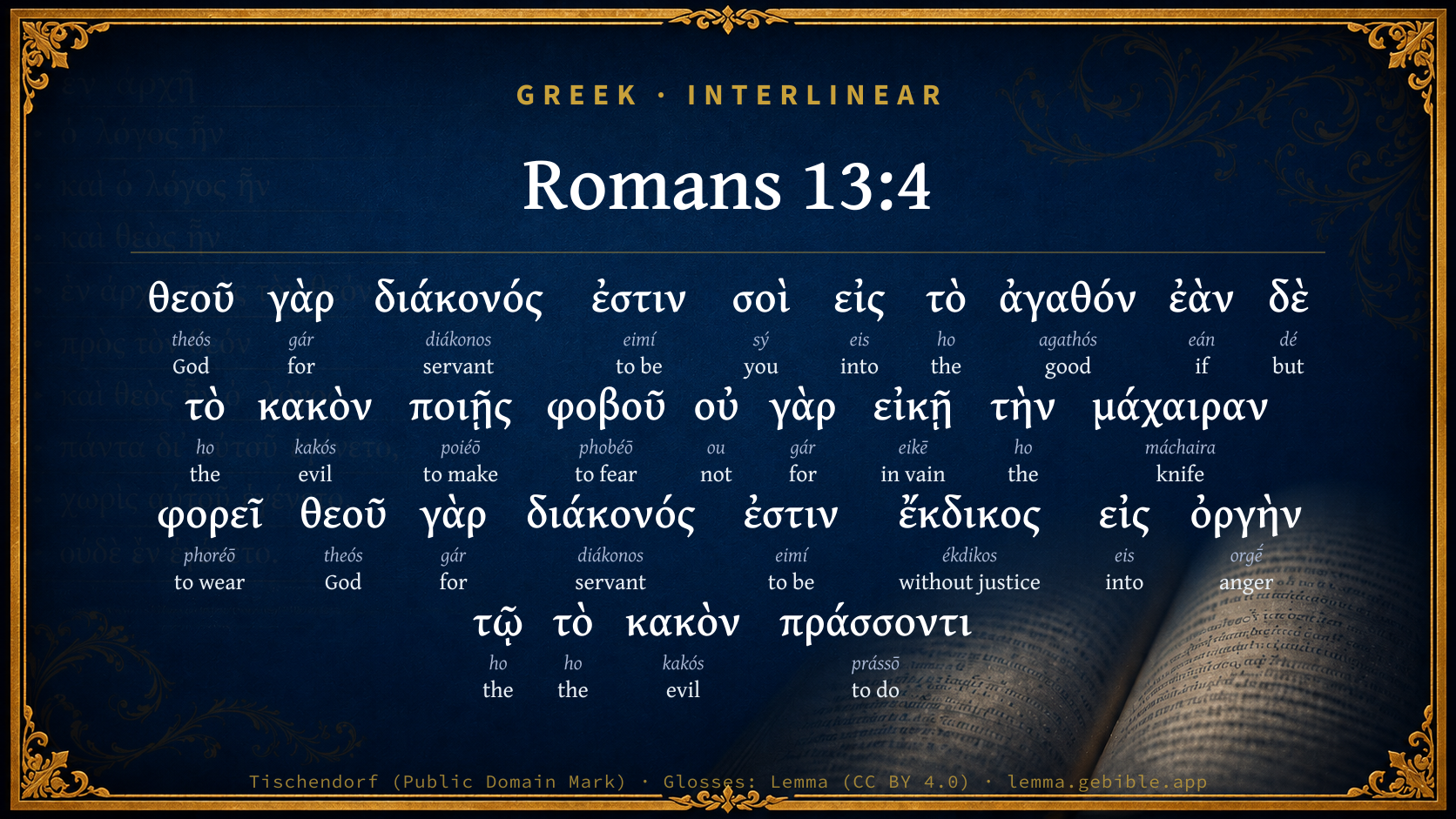
Greek (Tischendorf 8th ed.) Romans 13:4 appears in the Greek New Testament. The text above is from the Tischendorf 8th edition. Each word links to its Strong’s number and a concise gloss. Click any word for its full Thayer’s Greek Lexicon entry.
Download image
Cite this verse

Romans 13:4 (World English Bible). Public Domain. Lemma interlinear Bible study tool, https://lemma.gebible.app/v/romans/13/4.

Show BibTeX & RIS
BibTeX
RIS
English Translation
for he is a servant of God to you for good. But if you do that which is evil, be afraid, for he doesn't bear the sword in vain; for he is a minister of God, an avenger for wrath to him who does evil.
World English Bible · Public Domain
Highlights
  • 2 first appearances in the Greek New Testament
Full analysis ↓
Download a study sheet

One document with this verse’s original text, its word-by-word gloss line, the meaning frame, cross-references with their text, attributed commentary, and full source and license credits — printable, and it pastes into notes with its structure intact.

This verse Autodidact and up

Study sheet (.html) Plain text (.txt)

A passage Seminary Student

Up to 50 verses in one chapter. A passage sheet keeps up to 6 commentary sources and 12 cross-references per verse, in the order this page ranks them, and says so on the sheet whenever that leaves anything out. Ask for a single verse and you get the Autodidact verse sheet above.

Everything on this page stays free to read, with no account — the sheet is a download of what is already on screen, not access to it.

Want to remove ads? Support Godless Engineer
Compare translations 3

The same verse in 3 English versions, stacked beneath the original-language interlinear above. Click any original word for its lexicon entry.

Each is an independent rendering of the whole verse — the interlinear is not word-aligned to these translations.

Highlighted words mark where these versions differ — a whole-verse word diff, not a word-by-word alignment.

  • World English Bible Public Domain
    for he is a servant of God to you for good. But if you do that which is evil, be afraid, for he doesn't bear the sword in vain; for he is a minister of God, an avenger for wrath to him who does evil.
  • King James Version Public Domain
    For he is the minister of God to thee for good. But if thou do that which is evil, be afraid; for he beareth not the sword in vain: for he is the minister of God, a revenger to execute wrath upon him that doeth evil.
  • unfoldingWord Literal Text CC BY-SA 4.0
    for he is a servant of God to you for the good. But if you do the evil, fear; for he does not carry the sword in vain, for he is a servant of God, an avenger for wrath on the one practicing the evil.

unfoldingWord Literal Text — © unfoldingWord, licensed CC BY-SA 4.0. Word-aligned USFM3 via Door43 (git.door43.org/unfoldingWord/en_ult).

Versions to compare (up to 4)

3 of 4 selected

Show all 19 translations

Every available English version of this verse, each an independent rendering of the whole verse.

  • World English Bible Public Domain
    for he is a servant of God to you for good. But if you do that which is evil, be afraid, for he doesn't bear the sword in vain; for he is a minister of God, an avenger for wrath to him who does evil.
  • Berean Standard Bible Public Domain
    For he is God’s servant for your good. But if you do wrong, be afraid, for he does not carry the sword in vain. He is God’s servant, an agent of retribution to the wrongdoer.
  • Majority Standard Bible Public Domain
    For he is God’s servant for your good. But if you do wrong, be afraid, for he does not carry the sword in vain. He is God’s servant, an agent of retribution to the wrongdoer.
  • King James Version Public Domain
    For he is the minister of God to thee for good. But if thou do that which is evil, be afraid; for he beareth not the sword in vain: for he is the minister of God, a revenger to execute wrath upon him that doeth evil.
  • American Standard Version (1901) Public Domain
    for he is a minister of God to thee for good. But if thou do that which is evil, be afraid; for he beareth not the sword in vain: for he is a minister of God, an avenger for wrath to him that doeth evil.
  • Revised Version (1885) Public Domain
    for he is a minister of God to thee for good. But if thou do that which is evil, be afraid; for he beareth not the sword in vain: for he is a minister of God, an avenger for wrath to him that doeth evil.
  • Geneva Bible (1599) Public Domain
    For he is ye minister of God for thy wealth, but if thou do euill, feare: for he beareth not the sworde for nought: for he is the minister of God to take vengeance on him that doeth euill.
  • Douay-Rheims (1899) Public Domain
    For he is God's minister to thee, for good. But if thou do that which is evil, fear: for he beareth not the sword in vain. For he is God's minister: an avenger to execute wrath upon him that doth evil.
  • Young's Literal Translation Public Domain
    for of God it is a ministrant to thee for good; and if that which is evil thou mayest do, be fearing, for not in vain doth it bear the sword; for of God it is a ministrant, an avenger for wrath to him who is doing that which is evil.
  • Literal Standard Version CC BY-SA 4.0
    for it is a servant of God to you for good; and if you may do that which is evil, be fearing, for it does not bear the sword in vain; for it is a servant of God, an avenger for wrath to him who is doing that which is evil.
  • Unlocked Literal Bible CC BY-SA 4.0
    For he is a servant of God to you for good. But if you do what is evil, be afraid; for he does not carry the sword for no reason. For he is a servant of God, an avenger for wrath on the one who does evil.
  • unfoldingWord Literal Text CC BY-SA 4.0
    for he is a servant of God to you for the good. But if you do the evil, fear; for he does not carry the sword in vain, for he is a servant of God, an avenger for wrath on the one practicing the evil.
  • Darby Bible Public Domain
    for it is God's minister to thee for good. But if thou practisest evil, fear; for it bears not the sword in vain; for it is God's minister, an avenger for wrath to him that does evil.
  • World Messianic Bible Public Domain
    for he is a servant of God to you for good. But if you do that which is evil, be afraid, for he doesn’t bear the sword in vain; for he is a servant of God, an avenger for wrath to him who does evil.
  • Webster's Bible Public Domain
    For he is the minister of God to thee for good. But if thou doest that which is evil, be afraid; for he beareth not the sword in vain: for he is the minister of God, an avenger to execute wrath upon him that doeth evil.
  • Free Bible Version CC BY-SA 4.0
    Those in power are God's servants, put there for your own good. If you do wrong, you should be frightened—it's not without reason that authorities have the power to punish! They are God's servants, punishing offenders.
  • Bible in Basic English Public Domain
    For he is the servant of God to you for good. But if you do evil, have fear; for the sword is not in his hand for nothing: he is God's servant, making God's punishment come on the evil-doer.
  • Text-Critical English NT CC BY 4.0
    For he is God's servant for your good. But if yoʋ do evil, be afraid, for he does not bear the sword in vain. As God's servant, he is an avenger who executes wrath on the one who does evil.
  • Tyndale New Testament (1534) Public Domain
    For he is the minister of God for thy welth. But and yf thou do evyll then feare: for he beareth not a swearde for nought: but is the minister of God to take vengeaunce on them that do evyll.

Literal Standard Version (2020), Covenant Press — licensed CC BY-SA 4.0. Text via the HelloAO Bible API (eBible.org). Unlocked Literal Bible (unfoldingWord) — licensed CC BY-SA 4.0. Text via the HelloAO Bible API (eBible.org). unfoldingWord Literal Text — © unfoldingWord, licensed CC BY-SA 4.0. Word-aligned USFM3 via Door43 (git.door43.org/unfoldingWord/en_ult). Free Bible Version, Dr. Jonathan Gallagher — licensed CC BY-SA 4.0. Text via the HelloAO Bible API (eBible.org).

Word by word

More ways to search: Search by grammar → Find every occurrence → Compare this word →

Practice this passage: Drill this verse → Learn its vocabulary →

ἔκδικος
ékdikos
G1558
“without justice”
Adjective, Nominative, Singular, Masculine
Part of Speech
Adjective
Case
Nominative
Number
Singular
Gender
Masculine
Full Thayer's Definition

Origin: from G1537 and G1349

TDNT: 09:24,2

1. without law and justice 2. exacting penalty from one a. an avenger, punisher
  1. θεοῦ theós G2316 “God” Noun, Genitive, Singular, Masculine
  2. γὰρ gár G1063 “for” Conjunction
  3. διάκονός diákonos G1249 “servant” Noun, Nominative, Singular, Masculine
  4. ἐστιν eimí G1510 “to be” Verb, Present, Active, Indicative, 3rd person, Singular
  5. σοὶ sý G4771 “you” Personal pronoun, 2nd person, Dative, Singular
  6. εἰς eis G1519 “into” Preposition
  7. τὸ ho G3588 “the” Article, Accusative, Singular, Neuter
  8. ἀγαθόν agathós G18 “good” Adjective, Accusative, Singular, Neuter
  9. ἐὰν eán G1437 “if” Conditional
  10. δὲ dé G1161 “but” Conjunction
  11. τὸ ho G3588 “the” Article, Accusative, Singular, Neuter
  12. κακὸν kakós G2556 “evil” Adjective, Accusative, Singular, Neuter
  13. ποιῇς poiéō G4160 “to make” Verb, Present, Active, Subjunctive, 2nd person, Singular
  14. φοβοῦ phobéō G5399 “to fear” Verb, Present, Middle or Passive deponent, Imperative, 2nd person, Singular
  15. οὐ ou G3756 “not” Particle, Negative
  16. γὰρ gár G1063 “for” Conjunction
  17. εἰκῇ eikē G1500 “in vain” Adverb
  18. τὴν ho G3588 “the” Article, Accusative, Singular, Feminine
  19. μάχαιραν máchaira G3162 “knife” Noun, Accusative, Singular, Feminine
  20. φορεῖ phoréō G5409 “to wear” Verb, Present, Active, Indicative, 3rd person, Singular
  21. θεοῦ theós G2316 “God” Noun, Genitive, Singular, Masculine
  22. γὰρ gár G1063 “for” Conjunction
  23. διάκονός diákonos G1249 “servant” Noun, Nominative, Singular, Masculine
  24. ἐστιν eimí G1510 “to be” Verb, Present, Active, Indicative, 3rd person, Singular
  25. εἰς eis G1519 “into” Preposition
  26. ὀργὴν orgḗ G3709 “anger” Noun, Accusative, Singular, Feminine
  27. τῷ ho G3588 “the” Article, Dative, Singular, Masculine
  28. τὸ ho G3588 “the” Article, Accusative, Singular, Neuter
  29. κακὸν kakós G2556 “evil” Adjective, Accusative, Singular, Neuter
  30. πράσσοντι prássō G4238 “to do” Verb, Present, Active, Participle, Dative, Singular, Masculine

About this verse

These counts appear in no published source. They are computed here, from the morphology-tagged text and Lemma’s own curated glosses. What Lemma adds →

31
words
20
distinct lemmas
Pauline Epistles
section

Notable vocabulary

The rarest word here is ἔκδικος without justice G1558 — appearing just 2 times in the whole Greek New Testament.

First appearance in Scripture

These words make their first canonical appearance in the Greek New Testament here:

  • εἰκῇ in vain G1500
  • ἔκδικος without justice G1558

Shared distinctive vocabulary

ἔκδικος without justice G1558 occurs in 2 verses of the Greek New Testament. Also found in:
Repetition

Words recur within this verse:

  • θεοῦ God G2316 ×2
  • διάκονός servant G1249 ×2
  • ἐστιν to be G1510 ×2
  • εἰς into G1519 ×2
  • κακὸν evil G2556 ×2
  • τὸ the G3588 ×5
  • γὰρ for G1063 ×3

Cross-references

22

Topical passages linked to Romans 13:4 in the Treasury of Scripture Knowledge — connected by theme and wording, ordered by reader-vote popularity; previews shown in the World English Bible.

  • Romans 12:19 Don't seek revenge yourselves, beloved, but give place to God's wrath. For it is written, "Vengeance belongs to me; I will repay, says the Lord."
  • 2 Chronicles 19:6 and said to the judges, Consider what you do: for you don't judge for man, but for Yahweh; and [he is] with you in the judgment.
  • Proverbs 16:14 The king's wrath is a messenger of death, But a wise man will pacify it.
  • Proverbs 20:2 The terror of a king is like the roaring of a lion: He who provokes him to anger forfeits his own life.
  • Proverbs 24:23–24 These also are sayings of the wise. To show partiality in judgment is not good.
  • Psalms 82:2–4 "How long will you judge unjustly, And show partiality to the wicked?" Selah.
  • Isaiah 1:17 Learn to do well. Seek justice, Relieve the oppressed, Judge the fatherless, Plead for the widow."
  • Romans 13:6 For this reason you also pay taxes, for they are ministers of God's service, attending continually on this very thing.
  • 1 Thessalonians 4:6 that no one should take advantage of and wrong a brother or sister in this matter; because the Lord is an avenger in all these things, as also we forewarned you and testified.
  • Jeremiah 5:28 They are grew fat, they shine: yes, they overpass in deeds of wickedness; they don't plead the cause, the cause of the fatherless, that they may prosper; and the right of the needy they don't judge.
  • Ezekiel 22:27 Her princes in the midst of it are like wolves ravening the prey, to shed blood, [and] to destroy souls, that they may get dishonest gain.
  • Ezekiel 25:14 I will lay my vengeance on Edom by the hand of my people Israel; and they shall do in Edom according to my anger and according to my wrath; and they shall know my vengeance, says the Lord Yahweh.
  • Micah 3:1–4 I said, "Please listen, you heads of Jacob, And rulers of the house of Israel: Isn't it for you to know justice?
  • Micah 3:9 Please listen to this, you heads of the house of Jacob, And rulers of the house of Israel, Who abhor justice, And pervert all equity.
  • Numbers 35:19–27 The avenger of blood shall himself put the murderer to death: when he meets him, he shall put him to death.
  • Joshua 20:9 These were the appointed cities for all the children of Israel, and for the stranger who sojourns among them, that whoever kills any person unwittingly might flee there, and not die by the hand of the avenger of blood, until he stood before the congregation.
  • 1 Kings 10:9 Blessed be Yahweh your God, who delighted in you, to set you on the throne of Israel: because Yahweh loved Israel forever, therefore made he you king, to do justice and righteousness.
  • Proverbs 20:8 A king who sits on the throne of judgment Scatters away all evil with his eyes.
  • Proverbs 20:26 A wise king winnows out the wicked, And drives the threshing wheel over them.
  • Proverbs 31:8–9 Open your mouth for the mute, In the cause of all who are left desolate.
  • Ecclesiastes 8:2–5 I say, "Keep the king's command!" because of the oath to God.
  • Joshua 20:5 If the avenger of blood pursue after him, then they shall not deliver up the manslayer into his hand; because he struck his neighbor unawares, and didn't hate him before.

Cross-references courtesy of OpenBible.info (CC BY 4.0).

Commentary

Notes on Romans 13:4 from classic Christian and Jewish commentators (each source and its license shown beneath its notes). The classic Christian expositions comment on the surrounding passage and are grouped to its opening verse, so a note may address several verses; the Jewish commentaries on the Tanakh (Rashi and others) are per-verse, so they appear only where the commentator wrote on this verse.

Lemma curates 59 commentaries, every one of them public domain or Creative Commons licensed, each selected and text-cleaned for this edition rather than reprinted as found. About our sources →

Tyndale Open Study Notes

Tyndale Open Resources

13:4 servants (Greek diakonos): The New Testament usually reserves this word to describe Christians who serve God in various capacities. However, it was also used in secular Greek to refer to a civic official. Whether they know it or not, governing authorities are serving God when they administer justice. • they have the power to punish you (literally they do not bear the sword in vain): The sword might simply be a metaphor for punishment of any kind, but some interpreters believe it suggests that human governments, under God’s authority, have the right to carry out capital punishment.

Tyndale Open Study Notes — © Tyndale Open Resources, licensed CC BY-SA 4.0. Text via the HelloAO Bible API.

Bengel's Gnomon

Johann Albrecht Bengel

Rom 13:4. Θεοῦ γὰρ, for of God) There is here an Anaphora or repetition of the same word at the beginning of different clauses. There is a trace of Divine providence in this, that even wicked men, appointed to the magistracy, give their support to what is good, and visit evil with punishment.[136]—σοι, to thee) This to thee is used with great elegance respecting him, that doeth well, but τῷ is used indefinitely respecting the evil-doer.—ΕἸς) so far as concerns what is good, what is for your advantage.—τὸ κακὸν, evil) Good is marked as in direct antithesis to this evil in Rom 13:3, not in Rom 13:4.—φορεῖ, wieldeth [beareth]), not merely φέρει, carries: [gestat, not gerit; wields] according to Divine appointment.

[136] Διάκονος ἐστιν, He is the minister) Paul uses the same words concerning the magistracy, as he uses to express on other occasions the ministry of the Gospel. So also ver. 6.—V. g.

Bengel's Gnomon of the New Testament — English translation (T&T Clark, Edinburgh, 1860) — public domain. Text from a community e-Sword module.

Meyer's Critical & Exegetical Commentary

Heinrich August Wilhelm Meyer

Rom_13:4. Θεοῦ … ἀγαθόν] Establishment of the preceding thoughtthat the well-doer has not to fear the magistrate, but to expect praise from himby indicating the relation of the magistracy to God, whose servant (διάκονος, feminine, as in Rom_16:1; Dem. 762. 4, and frequently) it is, and to the subjects, for whose benefit (defence, protection, blessing) it is so. The σοί is the ethical relation of the Θεοῦ διάκον. ἐστι, and εἰς τὸ ἀγαθόν adds the more precise definition.

οὐ γὰρ εἰκῆ] for not without corresponding reason (frequently so in classical Greek), but in order actually to use it, should the case require.

τὴν μάχαιρ. φορεῖ] What is meant is not the dagger, which the Roman emperors and the governing officials next to them were accustomed to wear as the token of their jus vitae et necis (Aurel. Vict. 13; Grotius and Wetstein in loc.); for μάχαιρα, although denoting dagger = παραξιφός in the classics (see Spitzner on Hom. Il. xviii. 597; Duncan, Lex. ed. Rost, p. 715), means in the N. T. always sword, viii. 35, according to Xen. r. eq. xii. 11 (but comp. Krüger, Xen. Anab. i. 8. 7), differing by its curved form from the straight ξίφος; and also among the Greeks the bearing of the sword (Philostr. Vit. Ap. vii. 16) is expressly used to represent that power of the magistrates. They bore it themselves, and in solemn processions it was borne before them. See Wolf, Cur. On the distinction between φορέω (the continued habit of bearing) and φέρω, see Lobeck, ad Phryn. p. 585.

Θεοῦ γὰρ διάκ. κ.τ.λ.] ground assigned for the assurance οὐκ εἰκῆ τ. μ. φ., in which the previously expressed proposition is repeated with emphasis, and now its penal reference is appended.

ἔκδικος εἰς ὀργὴν κ.τ.λ.] avenging (1Th_4:6; Wis_12:12; Sir_30:6; Herodian, vii. 4. 10; Aristaenet. i. 27) in behalf of wrath (for the execution of wrath) for him who does evil. This dative of reference is neither dependent on ἐστίν, the position of which is here different from the previous one (in opposition to Hofmann), nor on εἰς ὀργήν (Flatt); it belongs to ἔκδικος εἰς ὀργ. Εἰς ὀργήν is not superfluous and cumbrous (de Wette), but strengthens the idea.

We may add that our passage proves (comp. Act_25:11) that the abolition of the right of capital punishment deprives the magistracy of a power which is not merely given to it in the O. T., but is also decisively confirmed in the N. T., and which it (herein lies the sacred limitation and responsibility of this power) possesses as Gods minister; on which account its application is to be upheld as a principle with reference to those cases in law, where the actual satisfaction of the divine Nemesis absolutely demands it, while at the same time the right of pardon is still to be kept open for all concrete cases. The character of being unchristian, of barbarism, etc., does not adhere to the right itself, but to its abuse in legislation and practice.

Meyer — Critical and Exegetical Commentary on the New Testament — English translation by Peter Christie, edited by Frederick Crombie (T&T Clark, 1880) — public domain. Text from a community e-Sword module.

Expositor's Greek Testament

ed. W. Robertson Nicoll

Rom 13:4 . θεοῦ γὰρ διάκονός ἐστιν σοὶ εἰς τὸ ἀγαθόν . διάκονός is feminine agreeing with ἐξουσία , which is “almost personified” (Sanday and Headlam). The σοὶ is not immediately dependent on διάκονός , as if the State were conceived as directly serving the person; the State serves God, with good in view as the end to be secured by its ministry, viz. , the maintenance of the moral order in society; and this situation is one the benefit of which redounds to the individual. ἐὰν δὲ τὸ κακὸν ποιῇς , φοβοῦ : only when the individual does that which is contrary to the end set before the State by God commits τὸ κακὸν , which frustrates τὸ ἀγαθὸν need he fear: but then he must fear. οὐ γὰρ εἰκῇ : for not for nothing, but for serious use, does the ruler wear the sword. For εἰκῇ cf. 1Co 15:2 , Gal 3:4 . φορεῖ is wear, rather than bear: the sword was carried habitually, if not by, then before the higher magistrates, and symbolised the power of life and death which they had in their hands. “The Apostle in this passage,” says Gifford, “expressly vindicates the right of capital punishment as divinely entrusted to the magistrate”. But “expressly” is perhaps too much, and Paul could not deliberately vindicate what no one had assailed. He did, indeed, on a memorable occasion (later than this) express his readiness to die if his life had been forfeited to the law (Act 25:11 ); but to know that if an individual sets himself to subvert the moral order of the world, its representatives can proceed to extremities against him (on the ground, apparently, that it , as of God’s institution, is of priceless value to mankind, whereas he in his opposition to it is of no moral worth at all) is not to vindicate capital punishment as it exists in the law or practice of any given society. When the words θεοῦ γὰρ διάκονός ἐστιν are repeated, it is the punitive ministry of the magistrate which is alone in view. ἔκδικος εἰς ὀργὴν : an avenger for wrath. ὀργὴ in the N.T. almost always (as here) means the wrath of God. It occurs eleven times in Romans: always so. The exceptions are Eph 4:31 , Col 3:8 , 1Ti 2:8 , Jas 1:19 f. τῷ τὸ κακὸν πράσσοντι = to him who works at evil. The process is presented in πράσσειν rather than the result. Cf. Rom 1:32 .

The Expositor's Greek Testament, edited by W. Robertson Nicoll (1897–1910) — public domain. Text from a community e-Sword module.

Hodge's Commentary on Romans, Ephesians & First Corinthians

Charles Hodge

Rom_13:4

For he is the minister of God to thee for good, etc. This whole verse is but an amplification of the preceding. Government is a benevolent institution of God, designed for the benefit of men; and, therefore, should be respected and obeyed. As it has, however, the rightful authority to punish, it is to be feared by those that do evil. For good, i.e. to secure or promote your welfare. Magistrates or rulers are not appointed for their own honor or advantage, but for the benefit of society, and, therefore, while those in subjection are on this account to obey them, they themselves are taught, what those in power are so apt to forget, that they are the servants of the people as well as the servants of God, and that the welfare of society is the only legitimate object which they as rulers are at liberty to pursue.

But if thou do that which is evil, be afraid; for he beareth not the sword in vain: for he is the minister of God, a revenger to execute wrath (εἰς ὀργήν, i.e. for the purpose of punishment) upon him that doeth evil. As one part of the design of government is to protect the good, so the other is to punish the wicked. The existence of this delegated authority is, therefore, a reason why men should abstain from the commission of evil. He beareth not the sword in vain, i.e. it is not in vain that he is in vested with authority to punish. The reference is not to the dagger worn by the Roman emperors as a sign of office, μάχαιρα in the New Testament always means sword, which of old was the symbol of authority, and specially of the right of life and death. As the common method of inflicting capital punishment was by decapitation with a sword, that instrument is mentioned as the symbol of the right of punishment, and, as many infer from this passage, of the right of capital punishment. Insignis locus ad jus gladii comprobandum; nam si Dominus magistratum armando gladii quoque usum illi mandavit, quoties sontes capitali poena vindicat, exercendo Dei ultionem, ejus mandatis obsequitur. Contendunt igitur cum Deo qui sanguinem nocentium hominum effundi nefas esse putant. Calvin.

Charles Hodge — Commentary on Romans (1835), First Corinthians (1857), and Ephesians (1856) — public domain. Text from a community e-Sword module.

Geneva Bible (1599)

Geneva Bible translators

God hath armed the Magistrate even with a revenging sword.

By whom God revengeth the wicked.

Geneva Bible (1599) marginal notes — public domain. Text via Bolls.life.

Jamieson, Fausset & Brown

Robert Jamieson, A. R. Fausset & David Brown

he beareth not the sword in vain--that is, the symbol of the magistrate's authority to punish.

Jamieson, Fausset & Brown — Commentary Critical and Explanatory on the Whole Bible (1871) — public domain (CC PDM 1.0). Text via the HelloAO Bible API.

Adam Clarke's Commentary

Verse 4. For he is the minister of God to thee for good] Here the apostle puts the character of the ruler in the strongest possible light. He is the minister of God-the office is by Divine appointment: the man who is worthy of the office will act in conformity to the will of God: and as the eyes of the Lord are over the righteous, and his ears open to their cry, consequently the ruler will be the minister of God to them for good.

He beareth not the sword in vain] His power is delegated to him for the defence and encouragement of the good, and the punishment of the wicked; and he has authority to punish capitally, when the law so requires: this the term sword leads us to infer.

For he is the minister of God, a revenger] θεου διακονος εστιν εκδικος, For he is God's vindictive minister, to execute wrath; εις οργην, to inflict punishment upon the transgressors of the law; and this according to the statutes of that law; for God's civil ministers are never allowed to pronounce or inflict punishment according to their own minds or feeling, but according to the express declarations of the law.

Adam Clarke's Commentary on the Bible (1810–1826) — public domain. Text from a community e-Sword/MySword module.

John Calvin's Commentaries

4. For he is God’s minister for good, etc. Magistrates may hence learn what their vocation is, for they are not to rule for their own interest, but for the public good; nor are they endued with unbridled power, but what is restricted to the wellbeing of their subjects; in short, they are responsible to God and to men in the exercise of their power. For as they are deputed by God and do his business, they must give an account to him: and then the ministration which God has committed to them has a regard to the subjects, they are therefore debtors also to them. And private men are reminded, that it is through the divine goodness that they are defended by the sword of princes against injuries done by the wicked.

For they bear not the sword in vain, etc. It is another part of the office of magistrates, that they ought forcibly to repress the waywardness of evil men, who do not willingly suffer themselves to be governed by laws, and to inflict such punishment on their offenses as God’s judgment requires; for he expressly declares, that they are armed with the sword, not for an empty show, but that they may smite evil-doers.

And then he says, An avenger, to execute wrath, etc. This is the same as if it had been said, that he is an executioner of God’s wrath; and this he shows himself to be by having the sword, which the Lord has delivered into his hand. This is a remarkable passage for the purpose of proving the right of the sword; for if the Lord, by arming the magistrate, has also committed to him the use of the sword, whenever he visits the guilty with death, by executing God’s vengeance, he obeys his commands. Contend then do they with God who think it unlawful to shed the blood of wicked men.

John Calvin's Commentaries (1540-1563) — public domain. Text from the Calvin Translation Society English edition (1840s-50s) via the Christian Classics Ethereal Library (ccel.org). Calvin's coverage is partial (roughly two-thirds of the Bible); uncommented books and verses are honest gaps, never fabricated. The 19th-century editor's footnotes and remarks are omitted so the notes are faithfully Calvin's own voice.

Ellicott's Commentary for English Readers

(4) The sword.—Not apparently the dagger worn by the Roman emperors, but, in a strict sense, “the sword.” “To bear the sword” seems to be a recognised Greek phrase to express the power of the magistrates. It was carried before them in processions, and on other important occasions.

It is clear from this passage that capital punishment is sanctioned by Scripture. At the same time its abolition is not excluded, as the abolition of slavery was not excluded, if the gradual development of Christian principle should seem to demand it. Whether or not capital punishment ought to be abolished, is a question for jurists, publicists, and statesmen. The theologian, as such, has no decision to give either way.

A Bible Commentary for English Readers, edited by Charles John Ellicott (1878–1897) — public domain. Text from a community e-Sword module.

The Cambridge Bible for Schools and Colleges

gen. ed. J. J. S. Perowne

4. The passage by no means forbids Christians to take full advantage of existing authority and law; as St Paul himself took advantage of his civil rights. But its unmistakable drift is, what is always the drift of Scripture, (as it is not that of human nature), to emphasize the Christian’s duties far more than his rights.

4. he beareth] weareth. The Cæsars appear to have literally worn a sword or dagger as an emblem of imperatorial power. But the phrase here need be no more than figurative.

the sword] A distinct sanction is given by this word here to the ordinance of capital punishment.—Other and lower punishments are implied also, of course, in this mention of the highest and severest.—The word “sword” occurs in this Epistle only here and Rom_8:35, where no doubt the execution of martyrs is in view. The two passages are a suggestive contrast and mutual illustration.

in vain] i.e. without cause, without credentials. The Gr. word may equally mean “without cause” and “without effect;” but the latter meaning is out of place here. See the next clause, where the credentials are given: “he is God’s minister.”

to execute wrath] Lit. unto wrath; to inflict the consequences of the displeasure (of the ruler. See next note).

The Cambridge Bible for Schools and Colleges (gen. ed. J. J. S. Perowne; Cambridge University Press, 1878–1918) — public domain. Text from a community e-Sword module.

John Gill's Exposition

For he is the minister of God to thee for good,.... He is a minister of God's appointing and commissioning, that acts under him, and for him, is a kind of a vicegerent of his, and in some, sense represents him; and which is another reason why men ought to be subject to him; and especially since he is appointed for their "good", natural, moral, civil, and spiritual, as Pareus observes: for natural good, for the protection of men's natural lives, which otherwise would be in continual danger from wicked men; for moral good, for the restraining of vice, and encouragement of virtue; profaneness abounds exceedingly, as the case is, but what would it do if there were no laws to forbid it, or civil magistrates to put them in execution? for civil good, for the preservation of men's properties, estates, rights, and liberties, which would be continually invaded, and made a prey of by others; and for spiritual and religious good, as many princes and magistrates have been; a sensible experience of which we have under the present government of these kingdoms, allowing us a liberty to worship God according to our consciences, none making us afraid, and is a reason why we should yield a cheerful subjection to it:

but if thou do that which is evil, be afraid: of the punishment of such evil threatened by law, and to be inflicted by the civil magistrate;

for he beareth not the sword in vain. The "sword" is an emblem of the power of life and death, the civil magistrate is invested with, and includes all sorts of punishment he has a right to inflict; and this power is not lodged in him in vain; he may and ought to make use of it at proper times, and upon proper persons:

for he is the minister of God; as is said before, he has his mission, commission, power and authority from him; and is

a revenge to execute wrath upon him that doeth evil; he is a defender of the laws, a vindicator of divine justice, an avenger of the wrongs of men; and his business is to inflict proper punishment, which is meant by wrath, upon delinquents.

John Gill's Exposition of the Whole Bible (1746–1763) — public domain (CC PDM 1.0). Text via the HelloAO Bible API.

Trapp's Complete Commentary

John Trapp

4 For he is the minister of God to thee for good. But if thou do that which is evil, be afraid; for he beareth not the sword in vain: for he is the minister of God, a revenger to execute wrath upon him that doeth evil.

Ver. 4. For he is the minister] It was written upon the sword of Charles the Great, Decem praeceptorum custos Carolus, Charles is Lord Keeper of the Decalogue.

For he beareth not the sword in vain] Like St Paul in a glass window, or St George (as they call him) on a sign post.

A revenger to execute wrath] But now we see how every man almost will be a pope in his own cause, depose the magistrate, at least appeal from him to himself.

Upon him that doeth evil] Whether the evil be civil or religious; Non distinguendum, ubi scriptum non distinguit. Not distinquishing where the law does not distinquich, (See Mr Burroughs’ Heartdivisions.) Note this against those that hold that magistrates have nothing to do in matters of religion. See Deu 13:6; Ezr 7:26; Dan 3:29; 1Pe 2:13-14. Their laws bind the conscience per concomitantiam, by way of concomitancy; because they depend upon the law of God, and are agreeable to it; which primarily and per se bindeth. As the soul is said to be in a place per concomitantiam, because it is in the body; so here.

John Trapp, A Commentary or Exposition upon All the Books of the Old and New Testament (1647–1656) — public domain. Text from a community e-Sword module.

Albert Barnes' Notes on the Bible

The minister of God - The “servant” of God he is appointed by God to do his will, and to execute his purposes. “To thee.” For your benefit.

For good - That is, to protect you in your rights; to vindicate your name, person, or property; and to guard your liberty, and secure to you the results of your industry. The magistrate is not appointed directly to “reward” people, but they “practically” furnish a reward by protecting and defending them, and securing to them the interests of justice.

If thou do that ... - That is, if any citizen should do evil.

Be afraid - Fear the just vengeance of the laws.

For he beareth not the sword in vain - The “sword” is an instrument of punishment, as well as an emblem of war. Princes were accustomed to wear a sword as an emblem of their authority; and the “sword” was often used for the purpose of “beheading,” or otherwise punishing the guilty. The meaning of the apostle is, that he does not wear this badge of authority as an unmeaningful show, but that it will be used to execute the laws. As this is the design of the power intrusted to him, and as he will “exercise” his authority, people should be influenced “by fear” to keep the law, even if there were no better motive.

A revenger ... - In Rom 12:19, vengeance is said to belong to God. Yet he “executes” his vengeance by means of subordinate agents. It belongs to him to take vengeance by direct judgments, by the plague, famine, sickness, or earthquakes; by the appointment of magistrates; or by letting loose the passions of people to prey upon each other. When a magistrate inflicts punishment on the guilty, it is to be regarded as the act of God taking vengeance “by him;” and on this principle only is it right for a judge to condemn a man to death. It is not because one man has by nature any right over the life of another, or because “society” has any right collectively which it has not as individuals; but because “God” gave life, and because he has chosen to take it away when crime is committed by the appointment of magistrates, and not by coming forth himself visibly to execute the laws. Where “human” laws fail, however, he often takes vengeance into his own hands, and by the plague, or some signal judgments, sweeps the guilty into eternity.

To execute wrath - For an explanation of the word “wrath,” see the notes at Rom 1:18. It denotes here “punishment,” or the just execution of the laws. It may be remarked that this verse is an “incidental” proof of the propriety of “capital punishment.” The sword was undoubtedly an instrument for this purpose, and the apostle mentions its use without any remark of “disapprobation.” He enjoins subjection to those who “wear the sword,” that is, to those who execute the laws “by that;” and evidently intends to speak of the magistrate “with the sword,” or in inflicting capital punishment, as having received the appointment of God. The tendency of society now is “not” to too sanguinary laws. It is rather to forget that God has doomed the murderer to death; and though humanity should be consulted in the execution of the laws, yet there is no humanity in suffering the murderer to live to infest society, and endanger many lives, in the place of his own, which was forfeited to justice. Far better that one murderer should die, than that he should be suffered to live, to imbrue his hands perhaps in the blood of many who are innocent. But the authority of God has settled this question Gen 9:5-6, and it is neither right nor safe for a community to disregard his solemn decisions; see “Blackstone’s Commentaries,” vol. iv. p. 8, (9.)

Albert Barnes' Notes on the Bible (1834–1885) — public domain. Text from a community e-Sword/MySword module.

Matthew Poole's English Annotations

For he is the minister of God to thee for good: q.d. That is the end of his office, and for this reason God hath invested him with his authority. The Scripture applieth the same title to him that preacheth the word, and to him that beareth the sword; both are God’s ministers, and there is one common end of their ministry, which is the good and welfare of mankind.

But if thou do that which is evil, be afraid; for he beareth not the sword in vain: this is the reason why he that trangresseth the moral law of God, or the wholesome laws of the country where he lives, should be afraid of the magistrate, because

he beareth not the sword in vain. The sword is figuratively put for power and authority: he alludes to the custom of princes, who had certain officers going before them, bearing the ensigns of their authority: q.d. The magistrate hath not his authority for nothing, or for no purpose; but that he may punish the evil, as well as defend the good.

For he is the minister of God, a revenger to execute wrath upon him that doeth evil: here is another reason why evil-doers (as before) should be afraid of the magistrate; or rather, the same reason in other and plainer words; because he is God’s officer to execute wrath upon him that doeth evil; he is in God’s room upon earth, and doth the work which primarily belongeth unto him: see Rom 12:19. By wrath, here, understand punishment: so in Luk 21:23; Rom 2:8. The word execute is not in the text, but aptly enough supplied by our translators.

Matthew Poole's English Annotations on the Holy Bible (1683–1685) — public domain. Text from a community e-Sword/MySword module.

Whedon's Commentary on the Bible

Daniel D. Whedon

4. Minister of God—Though as pagan, antichristian, or worldly, the government is, according to Daniel, a beast, yet as a conservator of society required by the divinely established laws of human nature the governor is the minister of God.

The sword—The ensign of sovereignty. It is the emblem also of death. And as it is placed by God in the hands of the sovereign as the minister of God, so to him is delegated from God the power over life and death in order to secure the just peace of society. The sword is authorized by God to the government, to be used not only in just execution upon the domestic criminal, but in just war against a foreign foe. For one of these rights involves the other. The execution of the criminal is a lesser war upon a single foe. The difference is a difference only in numbers.

A revenger… doeth evil—According to the apostle the ruler is of God only as a revenger upon him that doeth evil. He is not a minister of God when he is the executioner of the good.

Daniel D. Whedon (gen. ed.), Commentary on the Old and New Testaments (1874–1909) — public domain. Text from a community e-Sword module.

John Wesley's Explanatory Notes

The sword - The instrument of capital punishment, which God authorizes him to inflict.

John Wesley, Explanatory Notes Upon the Whole Bible (1754–1765) — public domain. Text via the GEBible commentary corpus.

Burkitt's Expository Notes on the New Testament

William Burkitt

Here the apostle subjoins a reason, why a magistrate is not to be unduly dreaded and feared by his subjects who live well, for he is by his institution the minister of God to thee for good, if thou beest a doer of that which is good.

Learn hence, that the magistrate is the minister of God for the good of them over which he is set, especially of them that are virtuous and good: he is a shield to the godly, a husband to the widow, a father to the orphan, a patron to the poor, and a refuge to the oppressed.

Observe farther, How the magistrate is set forth with the ensign of terror to evil-doers: he has a sword put into his hand by God himself, a sword to wound; not a wooden dagger to scare offenders barely; and a sword, not rusting in the scabbard, but drawn and whetted; he must show it, and strike with it upon a just occasion, and make those feel it who are not awed with the sight of it: He beareth not the sword in vain.

Observe again, Though the magistrate is said to bear a sword, yet he is never called a sword, but a shield often; a shield is for defence, a sword for destruction; intimating, that the magistrate’s power is protection, not destruction; magistrates have swords, but they are shields, and not swords: they have a sword to cut off evil-doers; God help them to draw it upon atheism and blasphemy, upon vice and immorality. One hearty stroke of the magistrate’s sword would stun error and vice more than a thousand sermons.

Observe lastly, The magistrate is said not to snatch or take the sword, but to bear the sword. He doth not wrest it out of the hand of another, but it is put into his hand by God himself: the commission to bear the sword is from God; the magistrate doth not hold his authority by virtue of the sword, but he holds his sword by virtue of his authority. When he draweth the sword, it is not merely backed with an arm of flesh, but with a warrant and commission signed by God himself: He beareth the sword.

William Burkitt's Expository Notes on the New Testament (1700–1703) — public domain. Text from a community e-Sword module.

McGarvey & Pendleton's Commentaries

J. W. McGarvey

for he is a minister of God to thee for good . [The law-abiding have no fear of the laws, and have just reason to expect the recognition and consideration which are the rightful dues of honesty and probity. "Commendations by magistrates," says Lange, "in opposition to punishments, were common even in ancient times." "When Paul wrote these things," says Grotius, "rage did not riot against the Christians at Rome." Seneca and Burrhus were still in power, and good men were the objects of governmental protection. "How much to be regretted it is," observes Lard, "that rulers do not more generally recognize the fact here stated by the apostle. Instead of this, however, they appear seldom even to dream that they are placed in office merely as God's servants. Rather, they seem to think that they are placed there solely for their own benefit. The fear of God is often not before their eyes, nor yet the good of the people a tithe as much as their own. Too frequently they serve merely self, with no regard for God, and but little for any one else. Such rulers serve not God, but Satan."] But if thou do that which is evil, be afraid; for he beareth not the sword in vain: for he is a minister of God, an avenger for wrath to him that doeth evil . [As we understand it, the idea which the apostle is seeking to convey is that duties to God and duties to the state are parallel, rather than antagonistic. If the Christian is true to his religion, he need fear neither the state nor God, for God rules, generally speaking, in and through the state, as well as in his providences. If, on the other hand, we do evil, we have reason to fear both God and the state, for the state is merely one of the forms of God's administration. The Romans made much of the sword as symbol of the power of life and death. Her magistrates and officers, holding the power of capital punishment, caused the sword (and the ax) to be borne before them in their public processions. Thus Paul declares that the office-holder is a servant of God to foster the good by praise and commendation, and to suppress the evil as an avenger appointed to inflict wrath--i. e., punishment--upon it.]

J. W. McGarvey (with Philip Y. Pendleton), Commentaries on the New Testament (The Fourfold Gospel, 1914; Acts; and the epistles) — public domain. Text from a community e-Sword/MySword module.

The People's New Testament

B. W. Johnson

4. For he is the minister of God to thee for good. The ruler, the guardian of order and the preserver of peace is, as a rule, a blessing. He beareth not the sword in vain. Not only did the magistrate wear the sword, but one was borne before him in public processions as an emblem of his right to use it in the interests of order and justice.

B. W. Johnson's The People's New Testament with Notes (1889–1891) — public domain. Electronic text from the Christian Classics Ethereal Library (CCEL) ThML edition.

Cambridge Greek Testament for Schools and Colleges

4. ἔκδικος εἰς ὀργὴν. Cf. 1Th 4:6: for the execution of wrath; the wrath of offended authority.

Cambridge Greek Testament for Schools and Colleges (Cambridge University Press, 1896; 21 vols, various authors incl. Carr, Maclear, Plummer, Farrar, Lumby, Moule, M. R. James, Simcox) — public domain. Text from a community e-Sword module.

Alford’s Greek Testament

Henry Alford

4.] τὴν μάχαιραν, perhaps in allusion to the dagger worn by the Cæsars, which was regarded as a symbol of the power of life and death: so Tacitus, Hist. iii. 68, of Vitellius, “adsistenti Consuli exsolutum a latere pugionem, velut jus necis vitæque civium, reddebat.” Dio Cassius also, xlii. 27, mentions the wearing of τὸ ξίφος on all occasions by Antony, as a sign that he τὴν μοναρχίαν ἐνεδείκνυτο. In ancient and modern times, the sword has been carried before sovereigns. It betokens the power of capital punishment: and the reference to it here is among the many testimonies borne by Scripture against the attempt to abolish the infliction of the penalty of death for crime in Christian states.

εἰς ὀργήν seems to be inserted for the sake of parallelism with εἰς ἀγαθόν above: it betokens the character of the ἐκδίκησις,—that it issues in wrath. The ὀργή is referred to in τὴν ὀργήν, ver. 5.

Henry Alford, The Greek Testament (1849–1861) — public domain. Text from a community e-Sword module.

International Critical Commentary

4. Θεοῦ γὰρ διάκονός ἐστι. Fem. to agree with ἐξουσία, which throughout is almost personified. σοι, ‘for thee,’ ethical, for thy advantage. εἰς τὸ ἀγαθόν, ‘for the good,’ to promote good, existing for a good end.

τὴν μάχαιραν. The sword is the symbol of the executive and criminal jurisdiction of a magistrate, and is therefore used of the power of punishing inherent in the government. So Ulpian, Digest, i. 18. 6. § 8; Tac. Hist. iii. 68; Dio Cassius, xlii. 27.

ἔκδικος εἰς ὀργήν, ‘inflicting punishment or vengeance so as to exhibit wrath,’ namely the Divine wrath as administered by the ruler who is God’s agent (cf. ver. 2 and 12:19). The repetition of the phrase Θεοῦ διάκονος with both sides of the sentence emphasizes the double purpose of the state. It exists positively for the well-being of the community, negatively to check evil by the infliction of punishment, and both these functions are derived from God.

International Critical Commentary — older volumes (1896–1929), various authors — public domain. Text from a community e-Sword module.

Vincent's Word Studies in the New Testament

Marvin R. Vincent

Beareth [φορει] . Beareth and weareth. A frequentative form of ferw to bear.

Sword [μαχαιραν] . See on Rev 6:4. Borne as the symbol of the magistrate 's right to inflict capital punishment. Thus Ulpian : "They who rule whole provinces have the right of the sword (jus gladii)." The Emperor Trajan presented to a provincial governor, on starting for his province, a dagger, with the words, "For me. If I deserve it, in me."

Marvin R. Vincent, Word Studies in the New Testament (1887–1900) — public domain. Text from a community e-Sword/MySword module.

Lesson kit

Teaching starters — assembled from the data on this page, not authored interpretation. Every prompt links to the verse data it draws on. Edit before teaching.

Romans, in the Pauline Epistles, opens this verse with 31 words (20 distinct Greek lemmas). Its most distinctive word is ékdikos (“without justice”). A historical commentator’s framing appears above. Read the whole chapter for the surrounding context.

Discussion questions

  1. What does “without justice” (ékdikos) contribute to the verse as a whole?
  2. 2 words here appear for the first time in Scripture. What is being introduced at this debut?
  3. 1 Thessalonians 4:6 shares the word «without justice» with this verse. How do the two illuminate each other?
  4. “God” occurs 2× in this one verse. What is the effect of the repetition?
  5. The translations on this page render this verse differently — a whole-verse word diff, not a word-by-word alignment. What might account for the different wordings?
  6. Reading how Tyndale Open Study Notes and Bengel's Gnomon read this verse, where do the two commentators agree and where do they part?

Things to notice

  • 2 words make their first canonical appearance in Scripture here.
  • These translations choose different wording for 20 words in this verse.
  • “God” occurs 2× in this single verse.
  • 20 distinct Greek lemmas span 31 words in this verse.

Reading settings

Reading text

Shown beneath each verse's original-language words.

Old Testament
Old Testament edition

Read the OT as the Masoretic Hebrew (MT) or the Greek Septuagint (LXX).

English shown for the Greek Septuagint (in the Hebrew ↔ Greek comparison).

Comparing translations? Open the Compare panel on any verse page to stack up to four side by side.