Romans 14:20

Greek (Tischendorf 8th ed.) Romans 14:20 appears in the Greek New Testament. The text above is from the Tischendorf 8th edition. Each word links to its Strong’s number and a concise gloss. Click any word for its full Thayer’s Greek Lexicon entry.
Download image
Cite this verse

Romans 14:20 (World English Bible). Public Domain. Lemma interlinear Bible study tool, https://lemma.gebible.app/v/romans/14/20.

Show BibTeX & RIS
BibTeX
RIS
English Translation
Don't overthrow God's work for food's sake. All things indeed are clean, however it is evil for that man who creates a stumbling block by eating.
World English Bible · Public Domain
Download a study sheet

One document with this verse’s original text, its word-by-word gloss line, the meaning frame, cross-references with their text, attributed commentary, and full source and license credits — printable, and it pastes into notes with its structure intact.

This verse Autodidact and up

Study sheet (.html) Plain text (.txt)

A passage Seminary Student

Up to 50 verses in one chapter. A passage sheet keeps up to 6 commentary sources and 12 cross-references per verse, in the order this page ranks them, and says so on the sheet whenever that leaves anything out. Ask for a single verse and you get the Autodidact verse sheet above.

Everything on this page stays free to read, with no account — the sheet is a download of what is already on screen, not access to it.

Want to remove ads? Support Godless Engineer
Compare translations 3

The same verse in 3 English versions, stacked beneath the original-language interlinear above. Click any original word for its lexicon entry.

Each is an independent rendering of the whole verse — the interlinear is not word-aligned to these translations.

Highlighted words mark where these versions differ — a whole-verse word diff, not a word-by-word alignment.

  • World English Bible Public Domain
    Don't overthrow God's work for food's sake. All things indeed are clean, however it is evil for that man who creates a stumbling block by eating.
  • King James Version Public Domain
    For meat destroy not the work of God. All things indeed are pure; but it is evil for that man who eateth with offence.
  • unfoldingWord Literal Text CC BY-SA 4.0
    Do not tear down the work of God on account of food. All things indeed clean, but evil for the man who eats with a stumbling block.

unfoldingWord Literal Text — © unfoldingWord, licensed CC BY-SA 4.0. Word-aligned USFM3 via Door43 (git.door43.org/unfoldingWord/en_ult).

Versions to compare (up to 4)

3 of 4 selected

Show all 19 translations

Every available English version of this verse, each an independent rendering of the whole verse.

  • World English Bible Public Domain
    Don't overthrow God's work for food's sake. All things indeed are clean, however it is evil for that man who creates a stumbling block by eating.
  • Berean Standard Bible Public Domain
    Do not destroy the work of God for the sake of food. All food is clean, but it is wrong for a man to let his eating be a stumbling block.
  • Majority Standard Bible Public Domain
    Do not destroy the work of God for the sake of food. All food is clean, but it is wrong for a man to let his eating be a stumbling block.
  • King James Version Public Domain
    For meat destroy not the work of God. All things indeed are pure; but it is evil for that man who eateth with offence.
  • American Standard Version (1901) Public Domain
    Overthrow not for meat's sake the work of God. All things indeed are clean; howbeit it is evil for that man who eateth with offence.
  • Revised Version (1885) Public Domain
    Overthrow not for meat’s sake the work of God. All things indeed are clean; howbeit it is evil for that man who eateth with offence.
  • Geneva Bible (1599) Public Domain
    Destroy not the worke of God for meates sake: all things in deede are pure: but it is euill for the man which eateth with offence.
  • Douay-Rheims (1899) Public Domain
    Destroy not the work of God for meat. All things indeed are clean: but it is evil for that man who eateth with offence.
  • Young's Literal Translation Public Domain
    for the sake of victuals cast not down the work of God; all things, indeed, `are' pure, but evil `is' to the man who is eating through stumbling.
  • Literal Standard Version CC BY-SA 4.0
    Do not cast down the work of God for the sake of food; all things, indeed, [are] pure, but evil [is] to the man who is eating through stumbling.
  • Unlocked Literal Bible CC BY-SA 4.0
    Do not destroy the work of God because of food. All things are indeed clean, but it is evil for that person who eats and causes him to stumble.
  • unfoldingWord Literal Text CC BY-SA 4.0
    Do not tear down the work of God on account of food. All things indeed clean, but evil for the man who eats with a stumbling block.
  • Darby Bible Public Domain
    For the sake of meat do not destroy the work of God. All things indeed [are] pure; but [it is] evil to that man who eats while stumbling [in doing so].
  • World Messianic Bible Public Domain
    Don’t overthrow God’s work for food’s sake. All things indeed are clean, however it is evil for that man who creates a stumbling block by eating.
  • Webster's Bible Public Domain
    For the sake of food, destroy not the work of God. All things indeed are pure; but it is evil for that man who eateth with offense.
  • Free Bible Version CC BY-SA 4.0
    Don't destroy the work of God with arguments over food. Everything is clean—but it would be wrong to eat and offend others.
  • Bible in Basic English Public Domain
    Do not let the work of God come to nothing on account of food. All things are certainly clean; but it is evil for that man who by taking food makes it hard for another.
  • Text-Critical English NT CC BY 4.0
    Do not tear down the work of God for the sake of food. Everything is indeed clean, but it is wrong for a person to eat anything that causes another to stumble.
  • Tyndale New Testament (1534) Public Domain
    Destroye not the worke of god for a lytell meates sake. All thinges are pure: but it is evyll for that man which eateth with hurte of his conscience.

Literal Standard Version (2020), Covenant Press — licensed CC BY-SA 4.0. Text via the HelloAO Bible API (eBible.org). Unlocked Literal Bible (unfoldingWord) — licensed CC BY-SA 4.0. Text via the HelloAO Bible API (eBible.org). unfoldingWord Literal Text — © unfoldingWord, licensed CC BY-SA 4.0. Word-aligned USFM3 via Door43 (git.door43.org/unfoldingWord/en_ult). Free Bible Version, Dr. Jonathan Gallagher — licensed CC BY-SA 4.0. Text via the HelloAO Bible API (eBible.org).

Word by word

More ways to search: Search by grammar → Find every occurrence → Compare this word →

Practice this passage: Drill this verse → Learn its vocabulary →

προσκόμματος
próskomma
G4348
“stumbling block”
Noun, Genitive, Singular, Neuter
Part of Speech
Noun
Case
Genitive
Number
Singular
Gender
Neuter
Full Thayer's Definition

Origin: from G4350

TDNT: 18:25,9

1. a stumbling block a. an obstacle in the way which if one strikes his foot against he stumbles or falls b. that over which a soul stumbles i.e. by which is caused to sin
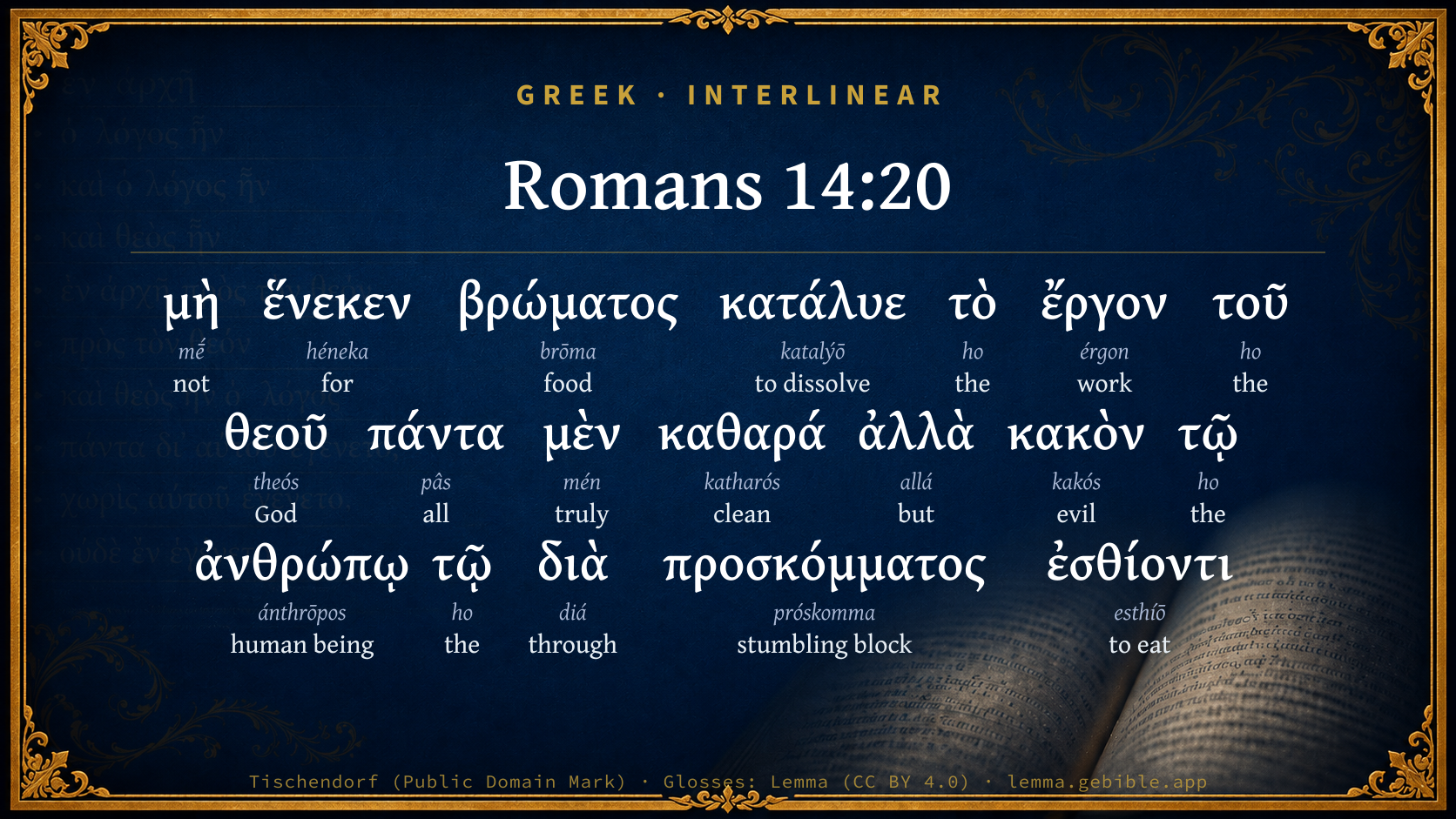
  1. μὴ mḗ G3361 “not” Particle, Negative
  2. ἕνεκεν héneka G1752 “for” Preposition
  3. βρώματος brōma G1033 “food” Noun, Genitive, Singular, Neuter
  4. κατάλυε katalýō G2647 “to dissolve” Verb, Present, Active, Imperative, 2nd person, Singular
  5. τὸ ho G3588 “the” Article, Accusative, Singular, Neuter
  6. ἔργον érgon G2041 “work” Noun, Accusative, Singular, Neuter
  7. τοῦ ho G3588 “the” Article, Genitive, Singular, Masculine
  8. θεοῦ theós G2316 “God” Noun, Genitive, Singular, Masculine
  9. πάντα pâs G3956 “all” Adjective, Nominative, Plural, Neuter
  10. μὲν mén G3303 “truly” Particle
  11. καθαρά katharós G2513 “clean” Adjective, Nominative, Plural, Neuter
  12. ἀλλὰ allá G235 “but” Conjunction
  13. κακὸν kakós G2556 “evil” Adjective, Nominative, Singular, Neuter
  14. τῷ ho G3588 “the” Article, Dative, Singular, Masculine
  15. ἀνθρώπῳ ánthrōpos G444 “human being” Noun, Dative, Singular, Masculine
  16. τῷ ho G3588 “the” Article, Dative, Singular, Masculine
  17. διὰ diá G1223 “through” Preposition
  18. ἐσθίοντι esthíō G2068 “to eat” Verb, Present, Active, Participle, Dative, Singular, Masculine

About this verse

These counts appear in no published source. They are computed here, from the morphology-tagged text and Lemma’s own curated glosses. What Lemma adds →

19
words
16
distinct lemmas
Pauline Epistles
section

Notable vocabulary

The rarest word here is προσκόμματος stumbling block G4348 — appearing just 6 times in the whole Greek New Testament.

Shared distinctive vocabulary

προσκόμματος stumbling block G4348 occurs in 6 verses of the Greek New Testament. Also found in:

Repetition

A word recurs within this verse:

Cross-references

12

Topical passages linked to Romans 14:20 in the Treasury of Scripture Knowledge — connected by theme and wording, ordered by reader-vote popularity; previews shown in the World English Bible.

  • Romans 14:14–15 I know, and am persuaded in the Lord Jesus, that nothing is unclean of itself; except that to him who considers anything to be unclean, to him it is unclean.
  • Matthew 18:6 but whoever causes one of these little ones who believe in me to stumble, it would be better for him that a huge millstone should be hung around his neck, and that he should be sunk in the depths of the sea.
  • Titus 1:15 To the pure, all things are pure; but to those who are defiled and unbelieving, nothing is pure; but both their mind and their conscience are defiled.
  • Acts 10:15 A voice came to him again the second time, "What God has cleansed, you must not call unclean."
  • 1 Corinthians 10:31–33 Whether therefore you eat, or drink, or whatever you do, do all to the glory of God.
  • Romans 14:21 It is good to not eat meat, drink wine, nor do anything by which your brother stumbles, is offended, or is made weak.
  • 1 Corinthians 6:12–13 "All things are lawful for me," but not all things are expedient. "All things are lawful for me," but I will not be brought under the power of anything.
  • Matthew 15:11 That which enters into the mouth doesn't defile the man; but that which proceeds out of the mouth, this defiles the man."
  • 1 Timothy 4:3–5 forbidding marriage and commanding to abstain from foods which God created to be received with thanksgiving by those who believe and know the truth.
  • 1 Corinthians 8:8–13 But food will not commend us to God. For neither, if we don't eat, are we the worse; nor, if we eat, are we the better.
  • Ephesians 2:10 For we are his workmanship, created in Christ Jesus for good works, which God prepared before that we would walk in them.
  • Philippians 1:6 being confident of this very thing, that he who began a good work in you will complete it until the day of Jesus Christ.

Cross-references courtesy of OpenBible.info (CC BY 4.0).

Commentary

Notes on Romans 14:20 from classic Christian and Jewish commentators (each source and its license shown beneath its notes). The classic Christian expositions comment on the surrounding passage and are grouped to its opening verse, so a note may address several verses; the Jewish commentaries on the Tanakh (Rashi and others) are per-verse, so they appear only where the commentator wrote on this verse.

Lemma curates 59 commentaries, every one of them public domain or Creative Commons licensed, each selected and text-cleaned for this edition rather than reprinted as found. About our sources →

Tyndale Open Study Notes

Tyndale Open Resources

14:20 The work of God refers both to the spiritual life of other Christians (14:15) and to the Christian community itself (14:19). The strong, with their dogged insistence on doing whatever they want, create division and disrupt God’s intention to build a healthy and united community of believers.

Tyndale Open Study Notes — © Tyndale Open Resources, licensed CC BY-SA 4.0. Text via the HelloAO Bible API.

Bengel's Gnomon

Johann Albrecht Bengel

Rom 14:20. Μὴ κατάλυε, do not destroy) The effects of even one sin may be distressing and important moreover, Rom 14:15.—ἓνεκεν βρώματος, on account of meat) a very small matter.—τὸ ἔργον τοῦ Θεοῦ, the work of God) a very great matter: the work, which God accomplishes within in the soul, by edification, and in the church by harmony [Faith is principally intended, Joh 6:29.—V. g.]—κακὸν, evil) the word to eat [is evil], is to be supplied from what follows: He does not say κακὰ, evils.—διὰ προσκόμματος, with offence) so that another may be offended by his eating.

Bengel's Gnomon of the New Testament — English translation (T&T Clark, Edinburgh, 1860) — public domain. Text from a community e-Sword module.

Meyer's Critical & Exegetical Commentary

Heinrich August Wilhelm Meyer

Rom_14:20. Prohibition of the opposite of τὰ τῆς οἰκοδομῆς τῆς εἰς ἀλλήλ.

κατάλυε] pull down. Comp. 2Co_5:1; Gal_2:18; Mat_26:61.

τὸ ἔργον τοῦ Θεοῦ] here, according to the context, the building of God, by which, however, is represented not what is mentioned in Rom_14:17 (the δικαιοσύνη κ.τ.λ., so Fritzsche, Baumgarten-Crusius); nor yet the faith of ones fellow-Christian (Theodoret, Reiche), or his eternal salvation (Chrysostom, Oecumenius, Theophylact); nor all blessings vouchsafed through Christ (Köllner, comp. Borger); but, according to Rom_14:15, the Christian as such, in so far as his Christian life, his Christian personality, is Gods work (Rom_8:29-30; 2Co_5:17; Eph_2:10). Aptly Estius says: fratrem, quem Deus fecit fidelem. Accordingly, what was expressed in Rom_14:15 by μὴ ἐκεῖνον ἀπόλλυε, ὑπὲρ οὗ Χ. ἀπέθανε, is here expressed by μὴ κατάλυε τὸ ἔργον τ. Θεοῦ; but it is differently conceived and presented, in such a way that the brother is thought of there in his relation of redemption to Christ, here in his relation of spiritual origin to God. The importance of the latter conception is rightly pointed out by Calovius: non levis est culpa, sed horribilis θεομαχία, opus Dei destruere.

πάντα μὲν καθαρὰ κ.τ.λ.] the same thought as in Rom_14:14, repeated in order to enter further into the μὴ ἕνεκεν βρώματος. All (all food) indeed is clean (not immoral to enjoy in and by itself), but it is sinful for the man who eats amidst offence, who nevertheless uses a food, although he experiences moral offence in the using itso that he thus against his conscience imitates the freer Christian. Comp. 1Co_8:9-10. This reference of the ethical dative τῷ ἀνθρώπῳ τῷ διὰ προσκ. ἐσθ. to the weak in faith (Chrysostom, Luther, Beza, Carpzov, Semler, and others, including Rückert, Köllner, Philippi, Tholuck, Hofmann) is confirmed by the parallel in Rom_14:13-14, and admirably suits the connection, inasmuch as ἀλλὰ κ.τ.λ. unfolds the way and manner in which ἕνεκεν βρώματος destruction may befall the work of God. Hence we must reject the explanation (Pelagius, Grotius, Bengel, and others, including Reiche, de Wette, Nielsen, Baumgarten-Crusius, Fritzsche, Reithmayr, Krehl, Umbreit, van Hengel) of the strong in faith, who acts wrongly in eating under offence given, i.e. although to the offence of the weak. For in that case we should have here no reference at all relevant to the κατάλυσις of the ἔργον τ. Θεοῦ, but only the vague remark that it is wrong to eat to the offence of others.

ἀλλὰ] after μέν; see Vigerus, ed. Herm. p. 536; Hartung, Partikell. II. p. 403 f.; Baeumlein, p. 170.

κακόν] not hurtful (Rückert), nor yet bad in the sense of what is not good for him (Hofmann), but sinful, the ethical contrast of καθαρά. The subject (it) is to be understood of itself from what precedes, namely τὸ καθαρόν, the pure in itself. Others supply πᾶν (Reiche), τὸ βρῶμα (Grotius), τὸ ἐσθίειν (Rückert), τὸ πάντα φαγεῖν (Fritzsche, Philippi). Hofmann also renders incorrectly, as though it ran, κακὸν τῷ ἀνθρώπῳ τὸ διὰ προσκόμματος ἐσθίειν.

διά] as in Rom_2:27.

Meyer — Critical and Exegetical Commentary on the New Testament — English translation by Peter Christie, edited by Frederick Crombie (T&T Clark, 1880) — public domain. Text from a community e-Sword module.

Expositor's Greek Testament

ed. W. Robertson Nicoll

Rom 14:20 . Paul repeats the rule of Rom 14:15 . μὴ κατάλυε : the opposite of οἰκοδομεῖν . See Mat 26:61 , Gal 2:18 . τὸ ἔργον τοῦ θεοῦ (1Co 3:9 ) what God has wrought, i.e. , the Christian Church (which is destroyed by such wanton conduct) or the Christian character and standing of an individual (which may be ruined in the same way). πάντα μὲν καθαρὰ : this is the principle of the strong, which Paul concedes ( μὲν ); the difficulty is to get the enlightened to understand that an abstract principle can never be the rule of Christian conduct. The Christian, of course, admits the principle, but he must act from love. To know that all things are clean does not (as is often assumed) settle what the Christian has to do in any given case. It does not define his duty, but only makes clear his responsibility. Acknowledging that principle, and looking with love at other Christians, and the effect of any given line of conduct on them, he has to define his duty for himself. All meat is clean, but not all eating. On the contrary ( ἀλλὰ ), κακὸν τῷ ἀνθρώπῳ τῷ διὰ προσκόμματος ἐσθίοντι ; sin is involved in the case of the man who eats with offence. Some take this as a warning to the weak; but the whole tone of the passage, which is rather a warning to the strong, and the verse immediately following, which surely continues the meaning and is also addressed to the strong, decide against this. The man who eats with offence is therefore the man by whose eating another is made to stumble. For διὰ προσκόμματος see Rom 2:27 , Winer, p. 475.

The Expositor's Greek Testament, edited by W. Robertson Nicoll (1897–1910) — public domain. Text from a community e-Sword module.

Hodge's Commentary on Romans, Ephesians & First Corinthians

Charles Hodge

Rom_14:20

For meat destroy not the work of God. This clause is, by De Brais and many other commentators, considered as a repetition of Rom_14:15. Destroy not him with thy meat, for whom Christ died. The work of God then means a Christian brother; see Eph_2:10. Others refer the passage to the immediately preceding verses, in which the nature of true religion is exhibited. The work of God, in that case, is piety, and the exhortation is, Do not, for the sake of indulgence in certain kinds of food, injure the cause of true religion, i.e. pull not down what God is building up. The figurative expression used by the apostle, μὴ κατάλυε, pull not down, carries out the figure involved in the preceding verse. Believers are to be edified, i.e. built up. They are the building of God, which is not to be dilapidated or injured by our want of love, or consideration for the weakness of our brethren.

All things (i.e., all kinds of food) are pure; but it is evil (κακόν, not merely hurtful, but sin, evil in a moral sense) for that man that eateth with offense. This last clause admits of two interpretations. It may mean, It is sinful to eat in such a way as to cause others to offend. The sin intended is that of one strong in faith who so uses his liberty as to injure his weaker brethren. This is the view commonly taken of the passage, and it agrees with the general drift of the context, and especially with the following verse, where causing a brother to stumble is the sin against which we are cautioned. A comparison, however, of this verse with Rom_14:14, where much the same sentiment is expressed, leads many interpreters to a different view of the passage. In Rom_14:14 it is said, Nothing is common of itself, but to him that esteemeth any thing to be unclean, to him it is unclean; and here, All things are pure, but it is evil to him who eateth with offense. To eat with offense, and, to eat what we esteem impure, are synonymous expressions. If this is so, then the sin referred to is that which the weak commit, who act against their own conscience. But throughout the whole context, to offend, to cause to stumble, offense, are used, not of a mans causing himself to offend his own conscience, but of one mans so acting as to cause others to stumble. And as this idea is insisted upon in the following verse, the common interpretation is to be preferred.

Charles Hodge — Commentary on Romans (1835), First Corinthians (1857), and Ephesians (1856) — public domain. Text from a community e-Sword module.

Jamieson, Fausset & Brown

Robert Jamieson, A. R. Fausset & David Brown

For--"For the sake of"

meat destroy not the work of God--(See on Rom 14:15). The apostle sees in whatever tends to violate a brother's conscience the incipient destruction of God's work (for every converted man is such)--on the same principle as "he that hateth his brother is a murderer" (Jo1 3:15).

All things indeed are pure--"clean"; the ritual distinctions being at an end.

but it is evil to that man--there is criminality in the man

who eateth with offence--that is, so as to stumble a weak brother.

Jamieson, Fausset & Brown — Commentary Critical and Explanatory on the Whole Bible (1871) — public domain (CC PDM 1.0). Text via the HelloAO Bible API.

Adam Clarke's Commentary

Verse 20. For meat destroy not the work of God] Do not hinder the progress of the Gospel either in your own souls or in those of others, by contending about lawful or unlawful meats. And do not destroy the soul of thy Christian brother, Ro 14:15, by offending him so as to induce him to apostatize.

All things indeed are pure] This is a repetition of the sentiment delivered, Ro 14:14, in different words. Nothing that is proper for aliment is unlawful to be eaten; but it is evil for that man who eateth with offence-the man who either eats contrary to his own conscience, or so as to grieve and stumble another, does an evil act; and however lawful the thing may be in itself, his conduct does not please God.

Adam Clarke's Commentary on the Bible (1810–1826) — public domain. Text from a community e-Sword/MySword module.

John Calvin's Commentaries

20. All things are indeed pure, etc. By saying, that all things are pure, he makes a general declaration; and by adding, that it is evil for man to eat with offense, he makes an exception; as though he had said, — “Meat is indeed good, but to give offense is bad.” Now meat has been given to us, that we may eat it, provided love be observed: he then pollutes the use of pure meat, who by it violates love. Hence he concludes, that it is good to abstain from all things which tend to give offense to our brethren.

He mentions three things in order, to fall, to stumble, to be weakened: the meaning seems to be this, — “Let no cause of falling, no, nor of stumbling, no, nor of weakening, be given to the brethren.” For to be weakened is less than to stumble, and to stumble is less than to fall. He may be said to be weakened whose conscience wavers with doubt, — to stumble when the conscience is disturbed by some greater perplexity, and to fall when the individual is in a manner alienated from his attention to religion.

John Calvin's Commentaries (1540-1563) — public domain. Text from the Calvin Translation Society English edition (1840s-50s) via the Christian Classics Ethereal Library (ccel.org). Calvin's coverage is partial (roughly two-thirds of the Bible); uncommented books and verses are honest gaps, never fabricated. The 19th-century editor's footnotes and remarks are omitted so the notes are faithfully Calvin's own voice.

Ellicott's Commentary for English Readers

(20) Destroy not.—A different word from that employed in Rom_14:15. It is the correlative and opposite of “edify,” and means to “unbuild” or “pull down.”

The work of God.—The fabric which the grace of God has begun, and which the edification of Christians by each other may help to raise in the soul; the gradual formation of a truly Christian character, both spiritual and moral.

For that man who eateth with offence.—It seems, on the whole, best (though the other view is taken) to refer the “eating” here to the strong in faith, and the “offence” to that which his eating causes to the weaker brethren. The force of the preposition is that his eating is attended with offence.

A Bible Commentary for English Readers, edited by Charles John Ellicott (1878–1897) — public domain. Text from a community e-Sword module.

The Cambridge Bible for Schools and Colleges

gen. ed. J. J. S. Perowne

20. destroy not] Lit. loosen, dissolve, pull down. The word is used in contrast to the idea of building up in the previous words.—Same word as e.g. Mat_26:61; Mat_27:40; Act_6:14; 2Co_5:1; Gal_2:18.

the work of God] i.e. His building, the Church of His redeemed.

All things indeed are pure] As regards eating or abstinence.

with offence] Lit. by means of a stumbling-block; i.e. induced to do so by force of mere example, while his conscience is adverse or undecided.

The Cambridge Bible for Schools and Colleges (gen. ed. J. J. S. Perowne; Cambridge University Press, 1878–1918) — public domain. Text from a community e-Sword module.

John Gill's Exposition

It is good neither to eat flesh,.... Any sort of flesh, even that which is not forbidden in the law, rather than offend a weak brother; and the apostle determines for himself, that he would not, where there was any danger of doing this, Co1 8:13.

Nor to drink wine; not only the wine of libations to Heathen deities, but wine in common; which was not prohibited by the law of Moses, but in the case of a Nazarite, and of vows:

nor anything, be it what it will,

whereby thy brother stumbleth. The Syriac version reads, "our brother"; anyone that stands in such a spiritual relation to any of us; and for which reason care should be taken, that no stumblingblock, or occasion to fall, should be put in his way; particularly that Christian liberty in things indifferent be not unseasonably and imprudently used, and so become a means of stumbling and staggering to weak minds:

or is offended; to that degree, as to censure and judge him that eats, as an impious person, and a transgressor of the law; with whom he cannot keep his communion, but withdraws himself from it, and is even tempted to drop his profession of the Christian religion entirely, being ready to think it is not right, since contrary to the law of Moses:

or is made weak; more weak in the faith than he was before, and his love is weakened and grows very cold and indifferent to his Christian brethren, that can take and use a liberty which he cannot. These two last phrases are not in the Syriac and Ethiopic versions, nor in the Alexandrian copy, though in others, and are used for the sake of explanation and amplification.

John Gill's Exposition of the Whole Bible (1746–1763) — public domain (CC PDM 1.0). Text via the HelloAO Bible API.

Trapp's Complete Commentary

John Trapp

20 For meat destroy not the work of God. All things indeed are pure; but it is evil for that man who eateth with offence.

Ver. 20. The work of God] That work of faith, 1Th 1:3, wrought by the mighty power of God, Eph 1:19, who puts not forth great power but for great purposes.

John Trapp, A Commentary or Exposition upon All the Books of the Old and New Testament (1647–1656) — public domain. Text from a community e-Sword module.

Albert Barnes' Notes on the Bible

For meat - By your obstinate, pertinacious attachment to your own opinions about the distinctions of meat and drinks, do not pursue such a course as to lead a brother into sin, and ruin his soul. Here is a new argument presented why Christians should pursue a course of charity - that the opposite would tend to the ruin of the brother’s soul.

Destroy not - The word here is what properly is applied to pulling down an edifice; and the apostle continues the figure which he used in the previous verse. Do not pull down or destroy the “temple” which God is rearing.

The work of God - The work of God is what God does, and here especially refers to his work in rearing “his church.” The “Christian” is regarded specially as the work of God, as God renews his heart and makes him what he is. Hence, he is called God’s “building” 1Co 3:9, and his “workmanship, created in Christ Jesus unto good works” Eph 2:10, and is denominated “a new creature;” 2Co 5:17. The meaning is, “Do not so conduct yourself, in regard to the distinction of meats into clean and unclean, as to cause your brother to sin, and to impair or ruin the work of religion which God is carrying on in his soul.” The expression does not refer to “man” as being the work of God, but to the “piety” of the Christian; to what God, by his Spirit, is producing in the heart of the believer.

All things are indeed pure - Compare Rom 14:14. This is a concession to those whom he was exhorting to peace. All things under the Christian dispensation are lawful to be eaten. The distinctions of the Levitical law are not binding on Christians.

But it is evil - Though pure in itself, yet it may become an occasion of sin, if another is grieved by it. It is evil to the man who pursues a course that will give offence to a brother; that will pain him, or tend to drive him off from the church, or lead him any way into sin.

With offence - So as to offend a brother, such as he esteems to be sin, and by which he will be grieved.

Albert Barnes' Notes on the Bible (1834–1885) — public domain. Text from a community e-Sword/MySword module.

Haydock's Catholic Bible Commentary

Destroy not the work of God for meat. That is, do not hinder your brother’s salvation, for whom, whoever he be, Christ died, who may be so offended at the liberty which you take, as to quit the Christian religion; or you may make him sin against God, by eating by your example against his weak conscience. (Witham)

George Leo Haydock (1774–1849), Haydock's Catholic Family Bible and Commentary, 1859 edition — public domain. Excludes Psalms (Douay-Rheims chapter numbering differs from Protestant) and Deuterocanonical books (Catholic canon only).

Matthew Poole's English Annotations

For meat destroy not the work of God: here you have a further argument against scandals: q.d. For so inconsiderable a matter as eating a little meat, or for the use of an indifferent thing, do not destroy the work of God. By

the work of God, some understand the soul of a brother; that is styled God’s work by way of eminency: it was one of the chiefest works of the creation, and made, as it were, with the consultation of the whole Trinity; the image of God, after a sort, was engraven therein: and if this be the sense, it is a repetition of the argument in Rom 14:15. But by

the work of God, in this place, other things may be understood; e.g. the unity and peace which God worketh amongst believers of different persuasions in in different things; or else the work of grace, or faith, which God hath wrought by his mighty power in the hearts of men: see Joh 6:29; 1Th 1:3.

The work of God, in either of these senses, may be disturbed or hindered by the abuse of Christian liberty; and he that scandalizeth his brother, goes about, as much as in him lieth, to dissolve and demolish that which hath God alone for its author and worker.

All things indeed are pure; but it is evil for that man who eateth with offence: here you have a concession and an exception: he granteth, that all things are pure and clean; i.e. in themselves, or in their own nature; see Rom 14:14; 1Co 6:12; Tit 1:15; but then he addeth, that it is evil for, or to, that man who eateth with offence, or that offends another with his eating: it is not evil simply in itself, but accidentally, by reason of scandal.

Matthew Poole's English Annotations on the Holy Bible (1683–1685) — public domain. Text from a community e-Sword/MySword module.

Whedon's Commentary on the Bible

Daniel D. Whedon

20. The work of God—The Christian who, however weak, is God’s building, and so must not be destroyed or demolished.

All… pure—Free alike from that impurity which Orientalism ascribes to all matter, (note on Act_8:9;) from the old patriarchal and Mosaic distinction of certain things as unclean, and from any imaginary contamination from idols which are just nothing at all in the world.

It is evil—Literally, evil to the man. Although all things are pure from evil in themselves, yet there is evil to the man who eats with damage to his brother.

Daniel D. Whedon (gen. ed.), Commentary on the Old and New Testaments (1874–1909) — public domain. Text from a community e-Sword module.

John Wesley's Explanatory Notes

The work of God - Which he builds in the soul by faith, and in the church by concord. It is evil to that man who eateth with offense - So as to offend another thereby.

John Wesley, Explanatory Notes Upon the Whole Bible (1754–1765) — public domain. Text via the GEBible commentary corpus.

Burkitt's Expository Notes on the New Testament

William Burkitt

That is, for meat destroy not thou the work of God. Do not thou, for so inconsiderable a matter as eating is, endanger the Christianity of thy brother, or hazard the peace of the church, and cause any through scandal to fall off from their Christian profession. If any of you say, that all meats are clean, and therefore lawful; in answer, they are certainly so in themselves, but yet it is your sin if you use them to the scandal and offence of others, that are not satisfied in the lawfulness of them." It is most certianly the duty of Christians to deny themselves the use of their Christian liberty in some things, when by making use of it they may endanger any of their brethren, by causing them to fall from their own stedfastness.

William Burkitt's Expository Notes on the New Testament (1700–1703) — public domain. Text from a community e-Sword module.

McGarvey & Pendleton's Commentaries

J. W. McGarvey

Overthrow not for meat's sake the work of God. All things indeed are clean; howbeit it is evil for that man who eateth with offence .

J. W. McGarvey (with Philip Y. Pendleton), Commentaries on the New Testament (The Fourfold Gospel, 1914; Acts; and the epistles) — public domain. Text from a community e-Sword/MySword module.

The People's New Testament

B. W. Johnson

20. For meat destroy not. A rigid insistence on eating the meat so offensive to some of the brethren may rend the church. All things indeed are pure. All kinds of food are morally clean. See verse 14. But it is evil. It is morally unclean to him who eateth with hurt to his conscience.

B. W. Johnson's The People's New Testament with Notes (1889–1891) — public domain. Electronic text from the Christian Classics Ethereal Library (CCEL) ThML edition.

unfoldingWord translationNotes

Door43 World Missions Community

Do not destroy the work of God because of food

You can make explicit the full meaning of this sentence. AT: "Do not undo what God has done for a fellow believer just because you want to eat a certain kind of food" (See: Assumed Knowledge and Implicit Information)

but it is evil for that person who eats and causes him to stumble

Here anything that "causes him to stumble" means it causes a weaker brother to do something that is against his conscience. AT: "but it would be a sin for someone to eat food, which another brother thinks is wrong to eat, if by eating this causes the weaker brother to do something that is against his conscience" (See: Assumed Knowledge and Implicit Information)

It is good not to eat meat, nor to drink wine, nor anything by which your brother takes offense

"It is better not to eat meat or drink wine or do anything else that might cause your brother to sin"

brother

Here this means a fellow Christian, male or female.

your

This refers to the strong in faith and "brother" refers to the weak in faith.

translationWords

God

clean

evil

stumble

wine

brother

unfoldingWord translationNotes — © Distant Shores Media and the Door43 World Missions Community, licensed CC BY-SA 4.0. Source: git.door43.org/Door43/en_tn.

Cambridge Greek Testament for Schools and Colleges

20. κατάλυε τὸ ἔργον τοῦ θεοῦ. The οἰκ., the duty of Christian to Christian, is GOD’s own work; cf. 1Co 3:9; Act 20:32. καταλ. is suggested by the metaphor of building; cf. Mar 15:29; Gal 2:18; 2Co 13:10.

πάντα μὲν καθαρά. The admission of Rom 14:14 is repeated, to bring out more explicitly the harm which may be done by insisting on rights; 1Co 10:23; 1Co 8:9.

ἀλλὰ κακὸν, sc. your use of this principle, τὸ τῇ ἐξουσίᾳ χρῆσθαι. The assumption, as throughout, is that the weak brother may be led to act against his conscience by the example of the strong.

διὰ προσκόμματος. Under conditions which will make him fall. διὰ w. gen. expresses the conditions of an action; cf. Rom 2:27, Rom 8:25; 2Co 2:4; Blass, p. 132 f.

Cambridge Greek Testament for Schools and Colleges (Cambridge University Press, 1896; 21 vols, various authors incl. Carr, Maclear, Plummer, Farrar, Lumby, Moule, M. R. James, Simcox) — public domain. Text from a community e-Sword module.

Alford’s Greek Testament

Henry Alford

20.] τὸ ἔργον τ. θεοῦ has been variously understood: by Fritz. and Baumg.-Crusius, as = δικαιος. εἰρήνη, κ. χαρά: by Meyer and Krehl, as = the Christian status of the offended brother, so as to be parallel to ver. 15: by Theodoret and Reiche, as = the faith of thy fellow-Christian: by Morus, Rosenm., al., as = ἡ βασιλεία τοῦ θ., ‘the spread of the Gospel.’ But I believe the expression οἰκοδομή having just preceded is the clue to the right meaning: and that τὸ ἔργον = τὴν οἰκοδομήν in the Apostle’s mind. He calls Christians in 1Co 3:9, θεοῦ γεώργιον, θεοῦ οἰκοδομή. Thus it will mean, thy fellow-Christian, as a plant of God’s planting, a building of God’s raising. So, nearly, De Wette and Tholuck. All things indeed are pure, but (it is) evil to the man (‘there is criminality in the man;’ Meyer supplies τὸ καθαρόν, Grot. τὸ βρῶμα, Fritz. τὸ πάντα φαγεῖν: but nothing need be supplied, any more than to καλόν) who eats with offence (i.e. giving offence to his weak brother, as Theodoret, Calv., Beza, Grot., Estius, Bengel, Thol., De Wette, al. That this is the right interpretation is shewn by the sentence standing between two others both addressed to the strong who is in danger of offending the weak. But Chrys., Theophyl., Œ, Meyer, al., take the sense of ‘receiving offence,’ and understand it of the weak).

Henry Alford, The Greek Testament (1849–1861) — public domain. Text from a community e-Sword module.

International Critical Commentary

20. κατάλυε … ἔργον keeps up the metaphor suggested by οἰκοδομῆς. ‘Build up, do not destroy, that Christian community which God has founded in Christ.’ Cf. 1Co 3:9 Θεοῦ γάρ ἐσμεν συνεργοί. Θεοῦ γεώργιον, Θεοῦ οἰκοδομή ἐστε. The words εἰρήνη and οἰκοδομή both point to the community rather than the individual Christian.

πάντα μὲν καθαρά: cf. 1Co 10:23 πάντα ἔξεστιν, ἀλλʼ οὐ πάντα συμφέρει. πάντα ἔξεστιν, ἀλλʼ οὐ πάντα οἰκοδομεῖ.

ἀλλὰ κακόν: the subject to this must be supplied from πάντα. It is a nice question to decide to whom these words refer. (1) Are they addressed to the strong, those who by eating are likely to give offence to others (so Va. Oltr., and the majority of commentaries)? or (2) are they addressed to the weak, those who by eating what they think it wrong to eat injure their own consciences (so Gif. Mey.-W.. and others)? In the former case διὰ προσκόμματος (on the διά cf. 2:27, 4:11) means ‘so as to cause offence,’ in the latter ‘so as to take offence’ (Tyndale, ‘who eateth with hurt of his conscience’). Perhaps the transition to ver. 21 is slightly better if we take (1).

International Critical Commentary — older volumes (1896–1929), various authors — public domain. Text from a community e-Sword module.

Vincent's Word Studies in the New Testament

Marvin R. Vincent

Destroy [καταλυε] . A different word from that In ver. 15. It means to loosen down, and is used of the destruction of buildings. Hence according with edification in ver. 19. See on Mr 13:2; Act 5:38.

Work of God. The christian brother, whose christian personality is God 's work. See 2Co 5:17; Eph 2:10; Jas 1:18.

With offense [δια προσκομματος] . Against his own conscientious scruple. Lit., through or amidst offense.

Marvin R. Vincent, Word Studies in the New Testament (1887–1900) — public domain. Text from a community e-Sword/MySword module.

Godet's Commentaries

Frédéric Louis Godet

Vv. 20. The asyndeton between Rom 14:19-20 proves how acutely the apostle is alive to the responsibility of the strong: destroy the work of God! In Rom 14:14, where it was personal pain, wounding, which was referred to, the apostle spoke of making the brother himself perish. Here, where the occasioning of a scandal is the matter in question, he does not speak any more of the person, but of the work of God in the person.

It matters not that food is free from uncleanness in itself; it is no longer so as soon as man uses it against his conscience. Rückert has taken the word κακόν, evil, as the attribute of a verb understood: “Eating becomes evil for the man who does it against his conscience.” Meyer prefers to take from the preceding proposition the understood subject τὸ καθαρόν, what is clean in itself: “Even the food which is clean of itself becomes evil when it is eaten thus.” But it seems to me simpler to make κακόν the subject: “There is evil (sin) for him who eateth in such circumstances.”—Διὰ προσκόμματος, in a state of scandal. On this use of the διά, comp. Rom 2:27. Is the reference to the strong man, who eats while occasioning scandal, or to the weak brother, who lets himself be drawn into eating by succumbing to the scandal? Evidently the second. Paul is not speaking here of the evil which the strong believer does to himself, but of that which he does to his brother carried away into sin.

We may be astonished to find the apostle regarding the salvation of the weak as compromised by this one trespass. But is not one voluntary sin interposing between Christ and the believer enough to disunite them, and if this sin is not blotted out, and the state is prolonged, to plunge him again in death?

Frédéric Louis Godet — Commentaries on Luke, John, Romans, and 1 Corinthians — English translation (T&T Clark, Edinburgh, 1870s–1890s) — public domain. Text from a community e-Sword module.

Lesson kit

Teaching starters — assembled from the data on this page, not authored interpretation. Every prompt links to the verse data it draws on. Edit before teaching.

Romans, in the Pauline Epistles, opens this verse with 19 words (16 distinct Greek lemmas). Its most distinctive word is próskomma (“stumbling block”). A historical commentator’s framing appears above. Read the whole chapter for the surrounding context.

Discussion questions

  1. How does “stumbling block” (próskomma) shape what this verse is saying?
  2. How does Romans 9:32, which shares the word «stumbling block», read alongside this verse?
  3. What does the repetition of “the” (4× in this one verse) do in this verse?
  4. The translations on this page render this verse differently — a whole-verse word diff, not a word-by-word alignment. What might account for the different wordings?
  5. Compare how Tyndale Open Study Notes and Bengel's Gnomon read this verse. Where do they agree or differ?

Things to notice

Reading settings

Reading text

Shown beneath each verse's original-language words.

Old Testament
Old Testament edition

Read the OT as the Masoretic Hebrew (MT) or the Greek Septuagint (LXX).

English shown for the Greek Septuagint (in the Hebrew ↔ Greek comparison).

Comparing translations? Open the Compare panel on any verse page to stack up to four side by side.