Acts 12:24

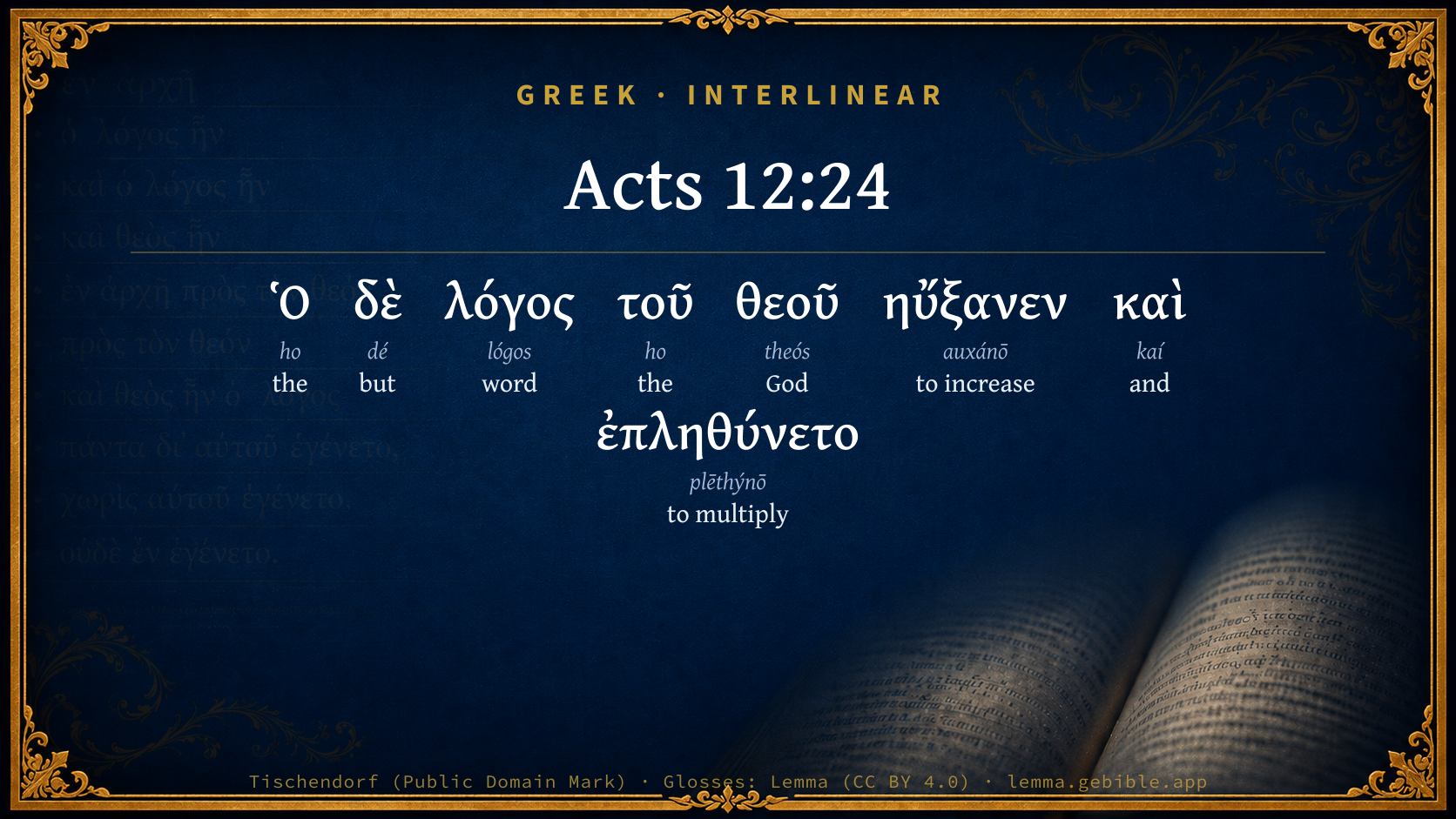
Greek (Tischendorf 8th ed.) Acts 12:24 appears in the Greek New Testament. The text above is from the Tischendorf 8th edition. Each word links to its Strong’s number and a concise gloss. Click any word for its full Thayer’s Greek Lexicon entry.
Download image
Cite this verse

Acts 12:24 (World English Bible). Public Domain. Lemma interlinear Bible study tool, https://lemma.gebible.app/v/acts/12/24.

Show BibTeX & RIS
BibTeX
RIS
English Translation
But the word of God grew and multiplied.
World English Bible · Public Domain
Download a study sheet

One document with this verse’s original text, its word-by-word gloss line, the meaning frame, cross-references with their text, attributed commentary, and full source and license credits — printable, and it pastes into notes with its structure intact.

This verse Autodidact and up

Study sheet (.html) Plain text (.txt)

A passage Seminary Student

Up to 50 verses in one chapter. A passage sheet keeps up to 6 commentary sources and 12 cross-references per verse, in the order this page ranks them, and says so on the sheet whenever that leaves anything out. Ask for a single verse and you get the Autodidact verse sheet above.

Everything on this page stays free to read, with no account — the sheet is a download of what is already on screen, not access to it.

Want to remove ads? Support Godless Engineer
Compare translations 3

The same verse in 3 English versions, stacked beneath the original-language interlinear above. Click any original word for its lexicon entry.

Each is an independent rendering of the whole verse — the interlinear is not word-aligned to these translations.

Highlighted words mark where these versions differ — a whole-verse word diff, not a word-by-word alignment.

  • World English Bible Public Domain
    But the word of God grew and multiplied.
  • King James Version Public Domain
    But the word of God grew and multiplied.
  • unfoldingWord Literal Text CC BY-SA 4.0
    But the word of God was increasing and was being multiplied.

unfoldingWord Literal Text — © unfoldingWord, licensed CC BY-SA 4.0. Word-aligned USFM3 via Door43 (git.door43.org/unfoldingWord/en_ult).

Versions to compare (up to 4)

3 of 4 selected

Show all 19 translations

Every available English version of this verse, each an independent rendering of the whole verse.

  • World English Bible Public Domain
    But the word of God grew and multiplied.
  • Berean Standard Bible Public Domain
    But the word of God continued to spread and multiply.
  • Majority Standard Bible Public Domain
    But the word of God continued to spread and multiply.
  • King James Version Public Domain
    But the word of God grew and multiplied.
  • American Standard Version (1901) Public Domain
    But the word of God grew and multiplied.
  • Revised Version (1885) Public Domain
    But the word of God grew and multiplied.
  • Geneva Bible (1599) Public Domain
    And the worde of God grewe, and multiplied.
  • Douay-Rheims (1899) Public Domain
    But the word of the Lord increased and multiplied.
  • Young's Literal Translation Public Domain
    And the word of God did grow and did multiply,
  • Literal Standard Version CC BY-SA 4.0
    And the word of God grew and multiplied,
  • Unlocked Literal Bible CC BY-SA 4.0
    But the word of God increased and multiplied.
  • unfoldingWord Literal Text CC BY-SA 4.0
    But the word of God was increasing and was being multiplied.
  • Darby Bible Public Domain
    But the word of God grew and spread itself.
  • World Messianic Bible Public Domain
    But the word of God grew and multiplied.
  • Webster's Bible Public Domain
    But the word of God grew and multiplied.
  • Free Bible Version CC BY-SA 4.0
    But the word of God spread, and more and more people believed.
  • Bible in Basic English Public Domain
    But the word of the Lord went on increasing.
  • Text-Critical English NT CC BY 4.0
    But the word of God increased and multiplied.
  • Tyndale New Testament (1534) Public Domain
    And the worde of God grewe and multiplied.

Literal Standard Version (2020), Covenant Press — licensed CC BY-SA 4.0. Text via the HelloAO Bible API (eBible.org). Unlocked Literal Bible (unfoldingWord) — licensed CC BY-SA 4.0. Text via the HelloAO Bible API (eBible.org). unfoldingWord Literal Text — © unfoldingWord, licensed CC BY-SA 4.0. Word-aligned USFM3 via Door43 (git.door43.org/unfoldingWord/en_ult). Free Bible Version, Dr. Jonathan Gallagher — licensed CC BY-SA 4.0. Text via the HelloAO Bible API (eBible.org).

Word by word

More ways to search: Search by grammar → Find every occurrence → Compare this word →

Practice this passage: Drill this verse → Learn its vocabulary →

About this verse

These counts appear in no published source. They are computed here, from the morphology-tagged text and Lemma’s own curated glosses. What Lemma adds →

8
words
7
distinct lemmas
Acts
section

Notable vocabulary

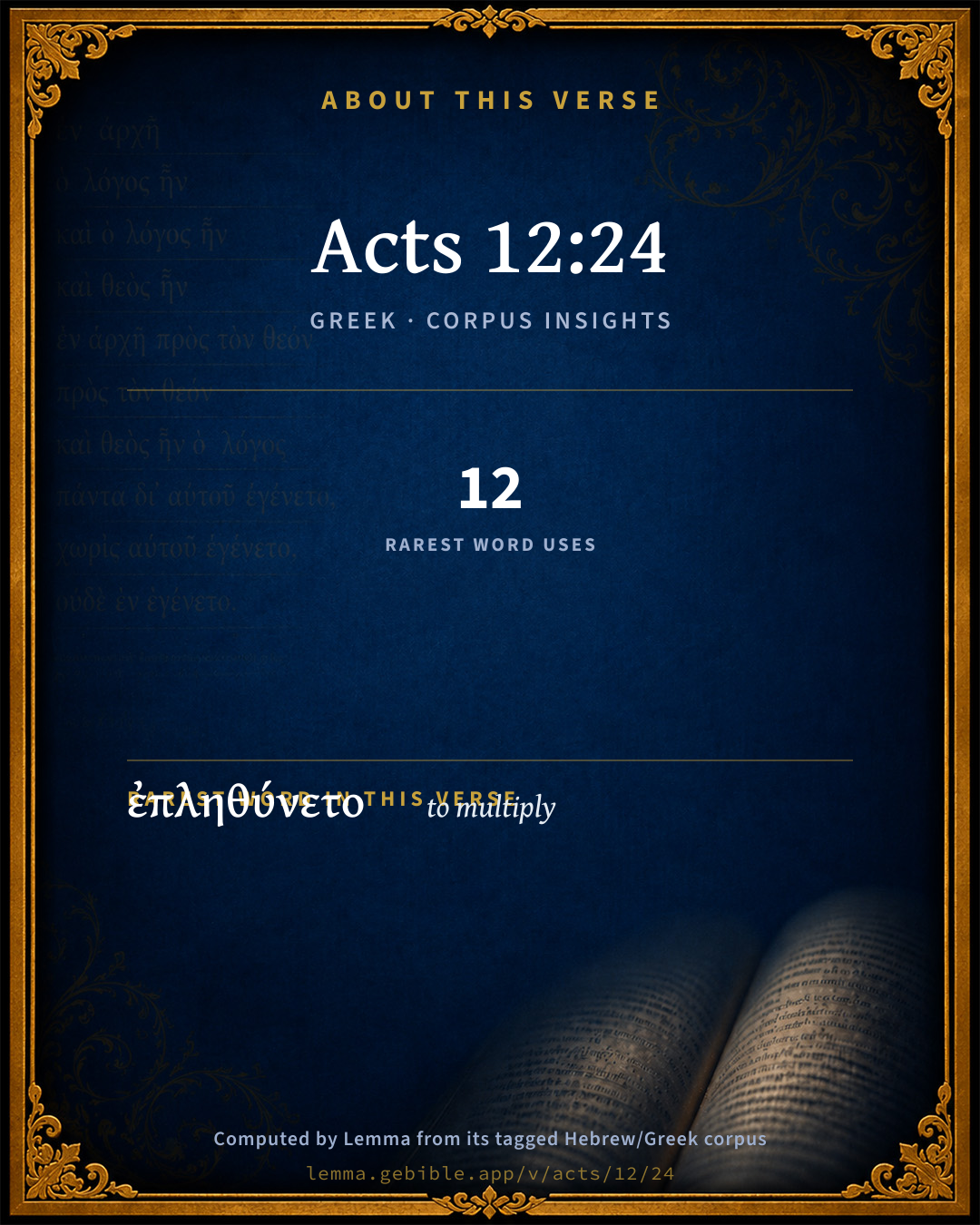
The rarest word here is ἐπληθύνετο to multiply G4129 — appearing just 12 times in the whole Greek New Testament.

Shared distinctive vocabulary

ἐπληθύνετο to multiply G4129 occurs in 11 verses of the Greek New Testament. Also found in:

Repetition

A word recurs within this verse:

Cross-references

13

Topical passages linked to Acts 12:24 in the Treasury of Scripture Knowledge — connected by theme and wording, ordered by reader-vote popularity; previews shown in the World English Bible.

  • Acts 6:7 The word of God increased and the number of the disciples multiplied in Jerusalem exceedingly. A great company of the priests were obedient to the faith.
  • Acts 19:20 So the word of the Lord was growing and becoming mighty.
  • 2 Thessalonians 3:1 Finally, brothers, pray for us, that the word of the Lord may spread rapidly and be glorified, even as also with you;
  • Matthew 16:18 I also tell you that you are Peter, and on this rock I will build my assembly, and the gates of Hades will not prevail against it.
  • Acts 11:21 The hand of the Lord was with them, and a great number believed and turned to the Lord.
  • Colossians 1:6 which has come to you; even as it is in all the world and is bearing fruit and growing, as it does in you also, since the day you heard and knew the grace of God in truth;
  • Proverbs 28:28 When the wicked rise, men hide themselves; But when they perish, the righteous thrive.
  • Isaiah 41:10–13 Don't you be afraid, for I am with you; don't be dismayed, for I am your God; I will strengthen you; yes, I will help you; yes, I will uphold you with the right hand of my righteousness.
  • Isaiah 54:14–17 In righteousness shall you be established: you shall be far from oppression, for you shall not be afraid; and from terror, for it shall not come near you.
  • Daniel 2:24 Therefore Daniel went in to Arioch, whom the king had appointed to destroy the wise men of Babylon; he went and said thus to him: Don't destroy the wise men of Babylon; bring me in before the king, and I will show to the king the interpretation.
  • Daniel 2:44 In the days of those kings shall the God of heaven set up a kingdom which shall never be destroyed, nor shall the sovereignty of it be left to another people; but it shall break in pieces and consume all these kingdoms, and it shall stand forever.
  • Acts 5:39 But if it is of God, you will not be able to overthrow it, and you would be found even to be fighting against God!"
  • Isaiah 55:10 For as the rain comes down and the snow from the sky, and doesn't return there, but waters the earth, and makes it bring forth and bud, and gives seed to the sower and bread to the eater;

Cross-references courtesy of OpenBible.info (CC BY 4.0).

Where the printed editions differ

1 variant

Places in this verse where the major printed Greek editions disagree on the wording in a way that affects the translation — a comparison of editions, not a manuscript-by-manuscript collation. The editions are the modern critical texts (Nestlé-Aland 28/27, SBL, Westcott-Hort, Tregelles, Tyndale House) and the traditional texts behind the KJV (the Textus Receptus and the Byzantine/Majority text). It is not a claim about which reading is original.

  1. Different wording
    θεοῦ

    “of God”

    In NA28NA27TynSBLTregTRByz Not in WH

    κυρίου (kuriou) 'Lord' occurs in a few manuscripts (WH) instead of θεοῦ (theou) 'of God' in older manuscripts (NA28+NA27+Tyn+SBL+Treg+TR+Byz)

Textual data: Translators Amalgamated Greek New Testament (STEPBible TAGNT) · CC BY 4.0.

Commentary

Notes on Acts 12:24 from classic Christian and Jewish commentators (each source and its license shown beneath its notes). The classic Christian expositions comment on the surrounding passage and are grouped to its opening verse, so a note may address several verses; the Jewish commentaries on the Tanakh (Rashi and others) are per-verse, so they appear only where the commentator wrote on this verse.

Lemma curates 59 commentaries, every one of them public domain or Creative Commons licensed, each selected and text-cleaned for this edition rather than reprinted as found. About our sources →

The Biblical Illustrator

Joseph S. Exell

Act_12:24-25

But the Word of God grew and multiplied.

The progress of Gods Word

This progress--growth and multiplication of Gods Word--was displayed--

I. In the men of that period.

1. The spirit of every age or movement of history is reflected in its leading characters. The Elizabethan age; the American Revolution; the age of Pericles.

2. Displayed in its leaders or exponents.

(1) In Barnabas we see tenderness and generosity.

(2) In Paul strength and genius.

(3) In John Mark imperfection, but eventual usefulness after failure.

3. In its enemies. It defied Herods craft and power, and its success was coincident with his doom.

II. In the march of events.

1. Happy is a land when it has no history, is true only of the old and false conceptions of history.

2. Gods Word did not return unto Him void.

(1) Gentile Christianity was launched on the stream of ages.

(2) Thus the policy of Christianity, of the Church as a missionary, world-evangelising movement, was fixed by whatever force lies in the example of the primitive Church.

III. Is the advance of ideas.

1. Pentecost did not end, but only began, the enlargement of mind to take in Gods thoughts.

2. The minds of the disciples gained that flexibility as to method and inflexibility as to principle by which they could go to every creature. All things to all men, so that I might by all means save some. We must obey God rather than men.

3. The New Testament itself--especially all of it except the four Gospels--shows how the minds of men were enlarged and inspired to apply the Word of God to human wants; and here, in an almost literal sense, it grew and multiplied.

Conclusion:

1. Thus it appears there is a sense in which the phrases, new theology, advanced thought, etc., may represent a state of things thoroughly satisfactory, upon which the Church and the world are to be congratulated.

2. It equally appears that all true progress in religious thought and action is made by men whose instrument is the Word of God, and whose power and guidance are supplied by the Holy Spirit. (J. P. Otis.)

The success of the gospel in the days of the apostles

I. The Word was opposed.

1. By the Word we may understand the gospel of God our Saviour.

2. Jewish prejudices opposed the gospel.

3. Heathenish superstitions were opposed to the Word.

4. Human learning was opposed to the Word of God. The Greeks and Romans excelled in learning; but that learning produced bad effects.

5. The devil opposed the gospel, by his influence and agency on the hearts of men.

6. In spreading the Word, the apostles had to endure many grievous afflictions, both from wicked men and evil spirits.

II. Opposition did not prevent the rapid success of the gospel; for the word grew and was multiplied.

1. The Word is fitly compared to good seed.

2. This seed was sown by the apostles in prepared hearts; and it cannot bring forth good fruit unless the heart be prepared.

3. When the Word sinks into the heart, and takes deep root, it produces holy tempers and holy actions; and when we abound in these, the Word grows in us, and our prayers go up to God with acceptance.

4. The Word is multiplied when many are converted to God by the instrumentality of converts.

III. But what were the principal causes of the extensive promulgation of the gospel in the age of the apostles?

1. The extraordinary gifts of the Spirit, conferred on the apostles, and on many in the Church, promoted the success of the gospel.

2. Another cause of the rapid spread of the gospel in those days was the burning zeal of the apostles and primitive Christians.

3. Divine power attended the Word.

4. The holy tempers, and the holy conduct of the apostles, and of the first believers, produced powerful effects on the hearts of the people.

5. The unity of the Church gave success to the Word.

6. Persecution promoted the cause of Christ, and gave success to the Word.

7. Judgments poured out on wicked men, and on persecutors, gave success to the gospel.

8. The united prayers of the Church gave success to the Word.

Inferences:

1. How widely different was the propagation of Christianity from that of Mohammedism! The one was by the force of truth and holy example; but the other was by the sword and acts of violence!

2. The effects of primitive times have reached us in these last days.

3. We lay no claim to apostolic gifts; but God has opened a wide door, in our day, for the spread of His gospel. (Theological Sketchbook.)

The success of the gospel

I. The Word was opposed by--

1. Jewish prejudices.

2. Heathen superstitions.

3. Human learning.

4. Kingly cruelty.

5. The devil, by his influence on the hearts of men.

II. This did not prevent its rapid success.

1. The Word is good seed.

2. This seed was sown by the apostles in prepared hearts.

3. When this seed takes root it produces holy tempers and actions.

III. The principal causes of this success.

1. The extraordinary gifts of the Spirit.

2. The burning zeal of the apostles.

3. Divine power.

4. Church unity.

5. Persecutions.

6. Prayer. (Pulpit Sketches.)

The success of the gospel

I. The Word of God grew in--

1. Convincing.

2. Converting.

3. Sanctifying.

4. Comforting.

5. Stimulating power.

II. The Word of God multiplied--

1. In the number of believers who embraced it.

2. In the number of preachers who proclaimed it.

3. In the extent of territory over which it spread (chap. 13:4, etc.).

III. The Word of God grew and multiplied notwithstanding--

1. The might that was arrayed against it.

(1) The tyranny of Herod.

(2) The pleasure of the Jews. State authority and sectarian bigotry were combined for the first time since the crucifixion to oppress the Church; how often since has this unholy alliance been made for the same end!

2. The persecution it endured.

(1) The vexation of Christians, espionage, loss of goods, etc.

(2) The martyrdom of James.

(3) The imprisonment of Peter.

IV. National prosperity was imperilled, but the Word of God grew and multiplied. There is more than appears in verse 20. Tyre and Sidon as purely commercial cities were largely dependent on the purely industrial interior for the supply of merchandise, and the interior was dependent on those cities for its very sustenance. The prosperity of both was threatened by a war which would further aggravate the situation. Tyrants may frown, and people may cringe, but the Word of God is independent of both.

V. Human glory was humbled, and kingly power was destroyed, but the Word of God grew and multiplied. Read verses 23 and 24 as one, and the intended contrast is clear. All flesh is grass … but the Word of God shall stand forever. The Roman, German, Italian, and English potentates who oppressed the Church are in their graves, but the Word of God grows and multiplies still.

VI. The Word of God grew and multiplied by means of--

1. Prayer--the normal condition of success throughout the ages.

2. Striking interpositions. These are exceptional, but are always at hand if need be. Here we see--

(1) The deliverance of Peter by an angel.

(2) The death of Herod by an angel.

3. Earnest evangelists (verses 25-13:3). (J. W. Burn.)

The invincibility of the Word

The truth of God is not only invulnerable, it is invincible. Smallest of all seeds dropped upon the gorgeous temple floor of the worlds heathendom, lo! it burst into fragments the starred mosaics, and split the monstrous idols till they fell and crushed their worshippers. The one main reason why the triumph of Christianity had from the first all the certainty of a law was this--God is in her, and therefore shall she not be moved. God shall help her, and that right early. (Archdeacon Farrar.)

The vitality of the Word

How strange, how providential has been its history! and how deep ought to be our attachment to a Book so mercifully made our inheritance! From the Churches of the primitive times it passed (as ecclesiastical tyranny grew strong, and would not brook a collateral authority) to the seclusion of the monasteries for many a long and barren century; but God was with it through the darkness, and He brought it forth in His own good time. It was like those seeds of which naturalists tell us, that lie for ages dormant and unfruitful in cells beneath the earth, but whose vitality has never been lost, and which, when brought upon the surface, shoot up with vigour into all the beauty of luxuriant vegetation. Such has been the story of the written Word. (Prof. Archer Butler.)

The enduring kingdom

We have here the kingdom of Herod and Agrippa, as a type of all earthly kingdoms, brought into contrast and collision with the enduring kingdom of Christ the Lord. In many points of view--in similarity and in opposition--the parallel is most peculiarly striking. The rise of both was unobserved. Herods had grown up from nothing. There had been a time when he was living as a mere hanger-on upon the court of Tiberius. He was gifted with those powers by which such men rise in such courts. As he ingratiated himself with Tiberius, the visions of greater things would begin to fill his earthly soul. He was the grandson of the great Herod; perhaps he might yet make himself a name greater than that of the prosperous founder of his house. But upon this early sunshine fell the blackness of a sudden frost, and nipped the opening bud of his greatness. He was accused of wishing the emperor dead, and so the rising Idumaean found himself in a dungeon, and not upon a throne. Then followed the tyrants death, and again Herod rose to favour. He was made king of Batanea and Trachonitis by Caligula; and by Claudius of Samaria and Judaea also. He was one of the few who thoroughly succeed, as it is called, in life; and he governed his kingdom with great splendour and success. He affected popularity; wished to reign in the hearts of his subjects; was a man who would stretch a point that he might do so. But all suddenly at noonday his sun sank in outer darkness. Puffed up with the applause of his subjects, he took to himself, as the great founder of his own fortunes, the honour which belonged to God only. An angel hand strikes him; and, as self-exaltation had been his master sin, so the circumstances of his death are made humiliating in their accidents as well as sudden in their issue: he was eaten by worms. His kingdom passed away; the cunning web which had been woven so successfully, the fruit of youthful enterprise, of mature experience, of long labours, of late and, as it seemed, complete success: all was torn away by the first counterblast which the Almighty sent forth to scatter it. But the Word of God grew and multiplied. Here is the contrast. Here is a kingdom which fadeth not away. With this, Herod had just come into collision; but now he himself was gone; and that despised kingdom grew and multiplied! The blood which he had shed to quench it, made but its flame burn brighter and spread around in wider circles. And the cause of this power of growth is suggested in its very title: it was the Word of God. It was not the mere creature of outside circumstance; it was not a kingdom formed by Caligulas passing favour, augmented by the goodwill of Claudius, and built up and widened by the policy of Herod; it had a life within, which was life for all men. Now from this contrast there flow one or two necessary consequences.

I. That this kingdom of the Word of God will at last subdue all opposition. That which we have seen in this chapter of the Acts has been going on ever since the day when the angel smote Herod. It is going on round about us now.

1. It is going on in the world of nations. Thrones have been built up since, higher than King Herods; the nations of the earth have gone out to wonder at their greatness. Caesar and Charlemagne, Clovis and Solyman, and how many more, have heard in their day the flattering cry, It is the voice of a god! And they have passed away, with their dynasties and their institutions: the great world stream has flowed on, and, as its waves have swept by, they have overwhelmed what was once so great, until their very record has departed. And still the Word of God has grown and multiplied. The outward forms of Christs kingdom abide, as fresh as they were in their earliest morning. Still does baptism admit into this kingdom; still does the simple breaking of bread, and the pouring out of wine, endure amongst us. And, if possible, yet more marvellous still, its inward power over countless multitudes is just what it was of old; still they tremble under the Word spoken; still soul after soul melts in contrition, kindles in love, rejoices in exultation, waits in hope, when the words which are the words of that kingdom of the unseen Lord sound in their ears; still in their trouble men gather together, as they did in the house where Rhoda went to the door at Peters knocking; and still deliverances are given in answer to those supplications, and angels from heaven bear to the saints of the King the succour they need. And now what does all this foreshadow? What but that this kingdom which alone has in it this principle of life shall endure forever? that it shall break in pieces all that are against it?

2. Ah! that which is thus plain in the worldwide history of nations is just as true in the detail of all private life. There, too, are the two kingdoms: the one full of show for vain men, the other full of strength for believing men. There are great promises of success, of rising in life, of acquiring a name, of a mans enjoying his pleasure; and there is an angel ever ready to strike at his noonday of seeming success every such worldly-minded man. There is a Thou fool, this night thy soul shall be required of thee; and then whose shall this be which thou hast stored up for thyself? And there are dungeons and chains on the other side, the following Christ in self-denial and self-sacrifice; and with these there is still, as of old, a portion in the Churchs prayers, angels visits, and a God and Father who sends them for our deliverance. Surely, then, it is plain which of these kingdoms will endure.

II. The blessedness of being engaged upon the side of this living power. We look into Gods Word, and we see the worthlessness of all outer things; the utter vanity of Herods pompous worm-eaten enthronement; the blessedness and the glory of Peters dungeon, of saints prayers, of martyrdom, of being the care of angels, and the children of the Highest; and our hearts are a little stirred, perhaps, and we have half resolved that we will seek this portion for ourselves; and then we look into the great world, and we are fooled again by the sounds of empire and greatness. Ay! and we look into our own little world; and do we not find it hard to remember and to feel how blessed it is, when God so orders it, for us to be disappointed and calumniated, and despised, and brought low, and afflicted? Do we not every one of us know how thoughts of ease and of comfort, how ambitious longings to be a little greater than we are, a little richer, a little higher in the worlds estimation--how this clings to us? Do we not every one of us know how the secret curse of the worlds measure and the worlds judgment creeps back upon us almost unawares? Do we not know how ready we are to forget in practice the blessedness of being of that little flock which shall yet possess the kingdom forever?

III. And then put these together. If there be this blessedness in being upon Gods side, and if there be this glory in bearing it truly in mind--may we not gather this further inference, that it is our wisdom to set ourselves diligently to act upon the truth that we confess? For it is only by acting upon it that we can make head against the temptation to forget it. This was the wisdom of the apostles remember how in their day, when the world threatened them, they went first unto their own, and lifted up their voice, and said. They made their cry to Almighty God, and then having made their prayer they went forth again into that evil world, and began directly to act for Christ; and in that union of retiring for secret prayer, to draw His strength down upon them, and then simply going forth to act in that strength, as though He was present with them, they were enabled to keep their own hearts firm and their own heads clear, amidst the dizzying and amazing circumstances of their daily life. And we must do the same, each one of us, if we would make head. There must be with us this mixture of prayer to God and of work for God. (Bp. S. Wilberforce.)

.

The Biblical Illustrator, edited by Joseph S. Exell (c. 1880s–1900s) — public domain. Text from a community e-Sword module.

Joseph Benson's Commentary

Act 12:24-25. But the word of God grew and multiplied — Became more successful; and in every place where it was preached, the number of disciples was considerably multiplied, and their faith greatly established. So that, after all the opposition of its enemies, who had endeavoured to extirpate it, the progress of Christianity was apparently promoted by the concurrence of the extraordinary events recorded in this chapter, namely, the deliverance of Peter, and the death of Herod, that cruel persecutor, under such heavy tokens of divine vengeance. And Barnabas and Saul returned — Namely, to Antioch, after a short abode at Jerusalem; when they had fulfilled their ministry — Had faithfully performed the charge committed to them: see Act 11:30; and took with them John, surnamed Mark — The son of Mary, (at whose house the disciples met to pray for Peter,) who was sister to Barnabas.

Joseph Benson's Commentary on the Old and New Testaments (1811–1818) — public domain. Text from a community e-Sword module.

Tyndale Open Study Notes

Tyndale Open Resources

12:24-25 Herod’s demise from a terrible illness (12:23) contrasts with the growth of the Christian church and the unhindered message of Good News (28:31).

Tyndale Open Study Notes — © Tyndale Open Resources, licensed CC BY-SA 4.0. Text via the HelloAO Bible API.

Meyer's Critical & Exegetical Commentary

Heinrich August Wilhelm Meyer

Act_12:24. A contrastfull of significance in its simplicityto the tragical end of the persecutor: the divine doctrine grew (in diffusion) and gained in number (of those professing it). Comp. Act_6:7, Act_19:20.

Meyer — Critical and Exegetical Commentary on the New Testament — English translation by Peter Christie, edited by Frederick Crombie (T&T Clark, 1880) — public domain. Text from a community e-Sword module.

Expositor's Greek Testament

ed. W. Robertson Nicoll

Act 12:24 . δὲ , marking the contrast, not only between the death of the persecutor and the growth of the Word, but also between the persecution and the vitality of the Church. ηὔξανε καὶ ἐπληθ . imperfects, marking the continuous growth in spite of all obstacles; cf. Luk 8:11 , Mat 13:32 , 2Co 9:10 .

The Expositor's Greek Testament, edited by W. Robertson Nicoll (1897–1910) — public domain. Text from a community e-Sword module.

Geneva Bible (1599)

Geneva Bible translators

Tyrants build up the Church by plucking it down.

They that heard the word of God.

Geneva Bible (1599) marginal notes — public domain. Text via Bolls.life.

Jamieson, Fausset & Brown

Robert Jamieson, A. R. Fausset & David Brown

But the word grew, &c.--that is, Not only was the royal representative ignominiously swept from the stage, while his intended victim was spared to the Church, but the cause which he and his Jewish instigators sought to crush was only furthered and glorified. How full of encouragement and consolation is all this to the Christian Church in every age!

Jamieson, Fausset & Brown — Commentary Critical and Explanatory on the Whole Bible (1871) — public domain (CC PDM 1.0). Text via the HelloAO Bible API.

Adam Clarke's Commentary

Verse 24. But the word of God] The Christian doctrine preached by the apostles grew and multiplied-became more evident, and had daily accessions; for the spirit of revelation rested on those men, and God was daily adding to that word as circumstances required, in order to complete that testimony of his which we now find contained in the New Testament. As there is in the original an allusion to the vegetation of grain, (ηυξανε, it grew, as corn grows, the stalk and the ear; και επληθυνετο, it was multiplied, as the corn is in the full ear,) there is probably a reference to the parable of the SOWER and his seed; for the seed is the word of God, and the doctrine of the kingdom. It was liberally sown; it grew vigorously, and became greatly multiplied. And why? Because it was the word, the doctrine of God-there was no corruption in it; and because God watered it with the dew of heaven from on high.

Adam Clarke's Commentary on the Bible (1810–1826) — public domain. Text from a community e-Sword/MySword module.

John Calvin's Commentaries

24. And the word of God. When the tyrant was once taken out of the way the Church was suddenly delivered, as it were, out of the jaws of the wolf. Therefore, though the faithful be accounted as sheep appointed to be slain, (Psalm 44:23,) yet the Church doth always overlive her enemies; and though the word of God seem oftentimes to be oppressed with the wicked tyranny of men, yet it getteth up the head again by and by, (Romans 8:37.) For Luke determined not only what had happened after that Herod was dead, but also by this example to encourage us, that we may be assured that God will do that, in all ages, which he then did, to the end the gospel may at length break through all impediments of the enemies, and that the more the Church is diminished, it may the more increase through the heavenly blessing.

John Calvin's Commentaries (1540-1563) — public domain. Text from the Calvin Translation Society English edition (1840s-50s) via the Christian Classics Ethereal Library (ccel.org). Calvin's coverage is partial (roughly two-thirds of the Bible); uncommented books and verses are honest gaps, never fabricated. The 19th-century editor's footnotes and remarks are omitted so the notes are faithfully Calvin's own voice.

Ellicott's Commentary for English Readers

(24) But the word of God grew and multiplied.—The words describe a continuous expansion. The death of the chief persecutor left free scope for the activity of the preachers of the gospel, of which they were not slow to avail themselves.

A Bible Commentary for English Readers, edited by Charles John Ellicott (1878–1897) — public domain. Text from a community e-Sword module.

The Cambridge Bible for Schools and Colleges

gen. ed. J. J. S. Perowne

24. But the word of God grew and multiplied] Cp. Act_6:7 and Act_19:20. “The seed is the word,” said Christ, and so the Christian historian tells us that the word was as seed, when it was cast forth diligently it waxed and brought forth fruit

The Cambridge Bible for Schools and Colleges (gen. ed. J. J. S. Perowne; Cambridge University Press, 1878–1918) — public domain. Text from a community e-Sword module.

John Gill's Exposition

But the word of God grew and multiplied. The number of those who were converted by it, and embraced and professed it, increased; otherwise the word is the same, whether the professors of it be more or fewer; and this it did, notwithstanding the persecution raised against it by Herod whilst he was living; and after his death, it still gained more ground, met with less opposition, and was more freely professed.

Acts 12:25

John Gill's Exposition of the Whole Bible (1746–1763) — public domain (CC PDM 1.0). Text via the HelloAO Bible API.

Trapp's Complete Commentary

John Trapp

24 But the word of God grew and multiplied.

Ver. 24. But the word of God] The Church is invincible; and truth may be oppressed a while, but not utterly suppressed. The Israelites never increased so as when Pharaoh kept them under. Fish thrive best in salt waters. The ground that is most harrowed is most fruitful. Camomile, the more you tread it the more you spread it, and the palm tree’s posy is, Nec premor nec perimor. Neither overwhelmed nor destroyed. All the power of the empire could not prevail against Luther.

John Trapp, A Commentary or Exposition upon All the Books of the Old and New Testament (1647–1656) — public domain. Text from a community e-Sword module.

Albert Barnes' Notes on the Bible

But the word of God grew ... - Great success attended it. The persecutions had now ceased; and notwithstanding all the attempts which had been made to crush it, stir the church increased and flourished. The liberation of Peter and the death of Herod would contribute to extend it. It was a new evidence of divine interposition in behalf of the church; it would augment the zeal of Christians; it would. humble their enemies, and would fill those with fear who had attempted to oppose and crush the church of God.

Albert Barnes' Notes on the Bible (1834–1885) — public domain. Text from a community e-Sword/MySword module.

Matthew Poole's English Annotations

Grew; the word of God is compared here to seed, as in our Saviour’s parable, Mat 13:19.

Multiplied; the number of believers multiplied through the word, which was sown, as seed is scattered abroad. So true it is, that persecutors, by their pulling down of the church, do but build it up.

Matthew Poole's English Annotations on the Holy Bible (1683–1685) — public domain. Text from a community e-Sword/MySword module.

The Pulpit Commentary

The word of God grew and multiplied in Jerusalem and the neighborhood, in spite of Agrippa"s persecution. The blood of the martyr James was the seed of the Church, and the speedy vengeance taken by God upon the persecuter doubtless gave fresh courage to his people to confess the Name of Jesus Christ. As regards the preceding account of Herod Agrippa"s death, it is corroborated in the most remarkable manner by the narrative in Josephus. ("Ant. Jud:," 19:8:2) He there tells that when he had been three years King of all Judaea (see ver. 1, note) he went to Caesarea. And that on occasion of a festival celebrated "for the safety of Caesar" (some think to celebrate his return from Britain, while others, as Wieseler, think that they were the ordinary Quinquennalia, celebrated in the provinces), he exhibited games and spectacles in honor of Claudius. On the second day of these games, when a vast number of people were assembled in the theatre, Agrippa can? m, clothed in a garment wholly made of silver, which reflected the rays of the morning sun with a most dazzling and awful brilliancy. Whereupon his flatterers cried out that he was a god, and offered prayer to him. The king, he adds, did not rebuke them nor reject their impious flattery, tie was presently seized with a violent pain in his bowels, which soon became so intense that he was carried out of the theatre to his palace, and expired after five days of excruciating pain. It is curious that in the above account Josephus says that Agrippa saw an owl sitting over his head, which he recognized as a messenger (aggelon) of evil to him. Eusebius, quoting Josephus Eccl. Hist.," 2. 10.), leaves out the owl, anti says that Agrippa saw an angel sitting over his head, whom he recognized as the cause of his sufferings. Whiston, in a note, seeks to exonerate Eusebius from unfairness in the quotation by suggesting that the manuscript of Eusebius is in this place corrupt; but Bede quotes Josephus just as Eusebius does, unless perchance he is quoting him at second hand from Eusebius.

Sanctified affliction.

"But the Word of God grew and multiplied.

I THE TROUBLES ARE BLESSINGS IN DISGUISE.

1. Drawing the believers together.

2. Revealing the weakness of enemies.

3. Calling out faith and prayerfulness.

4. Occasioning new manifestations of Divine power on behalf of the Church.

II THE KINGDOM OF GOD UNDER DIVINE CONTROL AND INDEPENDENT OF HUMAN AGENCY. A time of famine and persecution and mourning, but still a time of increase. The earthly rulers against the Word, but still it grows. The Church afflicted, but still speaking to the world, and its speech all the more powerful that it comes forth from the troubled depths of suffering hearts Instances. The blood of the martyrs the seed of the Church. Madagascar. When we are weak then are we strong. "Not by might, nor by power, hut by God"s Spirit. R.

The growings of the Word.

The terms used here indicate a continuous expansion. "Grew and multiplied" is a blending of figures, and does not easily fit into the term, "Word of God." Probably St. Luke associated the word with our Lord"s parable of the "sower;" and thought of it as seed, growing up and bringing forth its hundredfold. Two things are suggested by the sentence taken as a text.

1. St. Luke notices, as a remarkable thing, that, in spite of all the persecutions and hindrances of those evil times, the Word of God grew.

2. And that a sudden revival of zeal, earnestness, and success followed on the dreadful judgment and sudden removal of the Church"s great persecutor. It is to the first of these two points that we now direct attention.

I THE APPARENT HINDRANCES OF TROUBLOUS TIMES. The recent history of Madagascar Christianity provides most effective illustration; or instances may be found in the histories of Lollards, Waldenses, etc. Persecuting times seem to be ruinous; their influence is directed to

(1) the removal of the Christian leaders;

(2) the silencing of Christian teachers and writers;

(3) the stoppage of Christian worship;

(4) the destruction of Christian books, and especially of the Divine Word.

But it has never been found that physical violence has been more than apparent hindrance. The nearest approach ever made to success is probably the crushing of French Protestantism by the Massacre of St. Bartholomew. We are learning well the lesson that intellectual evils must be met by intellectual resistances and corrections, and that moral evils must be removed by moral agencies. "The weapons of our Christian warfare are not carnal, but spiritual," and it is vain work for any to oppose us with mere shield and sword and spear. Illustrate from the martyrdom of John Brown, the advocate of freedom for the slave. Persecution seemed to succeed, and

John Brown"s body lies a-mouldering in the grave, But his soul is marching on

marching on to triumph in the vast hinds of America, and marching on to another glorious victory in the newly found highlands of mighty Africa. Persecution cannot stop the onward progress of man"s thought or man"s love.

II THE REAL HELPFULNESS OF TROUBLOUS TIMES. The marvel is that the seed actually grows and multiplies in such times. We think the rainstorms hopelessly beat clown the young and tender blades. Nay, they really nourish the roots, and prepare for vigorous upspringing and richer fruitage. Moral harvests wave where martyrs" blood was shed. We may recognize the helpfulness of troublous times if we notice:

1. How they tend to bind men together. Differences of opinion and judgment are for a time forgotten. The common ground is fully recognized. Suffering throws each one upon the loving interest and care of the others, and lessons of the Christian brotherhood are then learned as they can be under no other circumstances. Prosperity and times of peace tend to bring prominently forward men"s diversities, and in such times sects are multiplied. Troublous times make men forget their peculiarities in facing a common foe and in sharing a common woe.

2. How they increase enthusiasm and develop energy; Nothing calls forth the latent powers of men like resistance to liberty of opinion. Let a scientific truth be opposed, and the whole energy of the discoverer is called forth for its maintenance, and to him that truth grows tenfold more important and more precious. So with the Christian verities, we "earnestly contend for the faith once delivered to the saints" only when that faith is being contended against.

3. How they bring men more fully to lean on the Divine power. They bring that sense of personal helplessness which makes us cling to the assurance, Greater is he who is with us than all who can be against us." We feel we may walk alone if it is all light about us. We must lean hard on God if it is night-time and stormy all about us.

4. How they draw public attention to the Christian workers. There is no advertising agent comparable for a moment in efficiency with persecution. Age after age Christ"s enemies have done Christ"s work, and witnessed among all lands for him, as they have martyred his servants and persecuted his Church. Suffering has a sacred power on human hearts everywhere, and Christ"s suffering Church wins men for Christ. R.T.

The Pulpit Commentary (1880–1919), ed. H.D.M. Spence-Jones & Joseph S. Exell — public domain. Text from a community e-Sword module.

Burkitt's Expository Notes on the New Testament

William Burkitt

Observe, Herod the tyrant and persecutor being dead, the gospel prospered, and was preached up and down with great success. Persecutors, by their weak endeavours to pull down the church, do build it up the stronger. The church in Egypt never grew so high as when Pharaoh laboured most to keep it low; the more he molested them, the more he multiplied them.

Thus here, after Herod’s death, and Peter’s deliverance, the word of God grew and multiplied: that is, the number of believers increased through the preaching of the word, as seed is multiplied by the scattering of the hand; the word preached is the seen sown in the furrows of the field; The ground was now harrowed by the hand of the persecutors, and the seed grew the better, and the fruits of faith and obedience did by every shower of persecution more and more abound.

The truth of God may for a time be oppressed, but it shall never be fully and finally suppressed: still "the word of God grew and multiplied."

William Burkitt's Expository Notes on the New Testament (1700–1703) — public domain. Text from a community e-Sword module.

McGarvey & Pendleton's Commentaries

J. W. McGarvey

24. It was impossible that this providential and sudden death of Herod, occurring so soon after the murders which he had committed in Jerusalem, should not seriously affect the public mind. We are not surprised, therefore, that Luke adds: (24) " But the word of the Lord grew and multiplied. " Once more the efforts of men to crush the cause of Christ resulted in the extension of its triumphs.

J. W. McGarvey (with Philip Y. Pendleton), Commentaries on the New Testament (The Fourfold Gospel, 1914; Acts; and the epistles) — public domain. Text from a community e-Sword/MySword module.

The People's New Testament

B. W. Johnson

24. But the word of God grew. Its influence kept extending, and all these exciting events.

B. W. Johnson's The People's New Testament with Notes (1889–1891) — public domain. Electronic text from the Christian Classics Ethereal Library (CCEL) ThML edition.

unfoldingWord translationNotes

Door43 World Missions Community

General Information:

This is information that gives an update on the spread of the word of God and on what Barnabas and Saul were doing. (See: End of Story)

the word of God increased and multiplied

The word of God is spoken of as if it was a living plant that was able to grow and reproduce. AT: "the message of God spread to more places and more people believed in him" (See: Metaphor)

the word of God

"the message God sent about Jesus"

completed their mission

This refers back to when they brought money from the believers at Antioch in Acts 11:29-30. AT: "delivered the money to the church leaders in Jerusalem" (See: Assumed Knowledge and Implicit Information)

they returned from Jerusalem

They went back to Antioch from Jerusalem. AT: "Barnabas and Saul returned to Antioch" (See: Assumed Knowledge and Implicit Information)

translationWords

word of God

Barnabas

Paul

Jerusalem

John Mark

unfoldingWord translationNotes — © Distant Shores Media and the Door43 World Missions Community, licensed CC BY-SA 4.0. Source: git.door43.org/Door43/en_tn.

Cambridge Greek Testament for Schools and Colleges

24. ὁ δὲ λόγος τοῦ θεοῦ ηὔξανεν καὶ ἐπληθύνετο, but the word of God grew and multiplied, Cf. Act 6:7 and Act 19:20. ‘The seed is the word,’ said Christ, and so the Christian historian tells us that the word was as seed,—when it was cast forth diligently it waxed and brought forth fruit.

Cambridge Greek Testament for Schools and Colleges (Cambridge University Press, 1896; 21 vols, various authors incl. Carr, Maclear, Plummer, Farrar, Lumby, Moule, M. R. James, Simcox) — public domain. Text from a community e-Sword module.

Alford’s Greek Testament

Henry Alford

24.] Similarly, ch. 5:12 ff.; 6:7; 9:31, a general statement of the progress and prosperity of the church of God forms the transition from one portion of the history to another.

Henry Alford, The Greek Testament (1849–1861) — public domain. Text from a community e-Sword module.

Lesson kit

Teaching starters — assembled from the data on this page, not authored interpretation. Every prompt links to the verse data it draws on. Edit before teaching.

Acts, in the Acts, opens this verse with 8 words (7 distinct Greek lemmas). Its most distinctive word is plēthýnō (“to multiply”). A historical commentator’s framing appears above. Read the whole chapter for the surrounding context.

Discussion questions

  1. How does “to multiply” (plēthýnō) shape what this verse is saying?
  2. Matthew 24:12 shares the word «to multiply» with this verse. How do the two illuminate each other?
  3. “the” occurs 2× in this one verse. What is the effect of the repetition?
  4. These translations render this verse differently; the difference is in the English rendering, not the original. What questions does that raise?
  5. Reading how The Biblical Illustrator and Joseph Benson's Commentary read this verse, where do the two commentators agree and where do they part?

Things to notice

  • These translations choose different wording for 3 words in this verse.
  • “the” occurs 2× in this single verse.
  • 7 distinct Greek lemmas span 8 words in this verse.

Reading settings

Reading text

Shown beneath each verse's original-language words.

Old Testament
Old Testament edition

Read the OT as the Masoretic Hebrew (MT) or the Greek Septuagint (LXX).

English shown for the Greek Septuagint (in the Hebrew ↔ Greek comparison).

Comparing translations? Open the Compare panel on any verse page to stack up to four side by side.