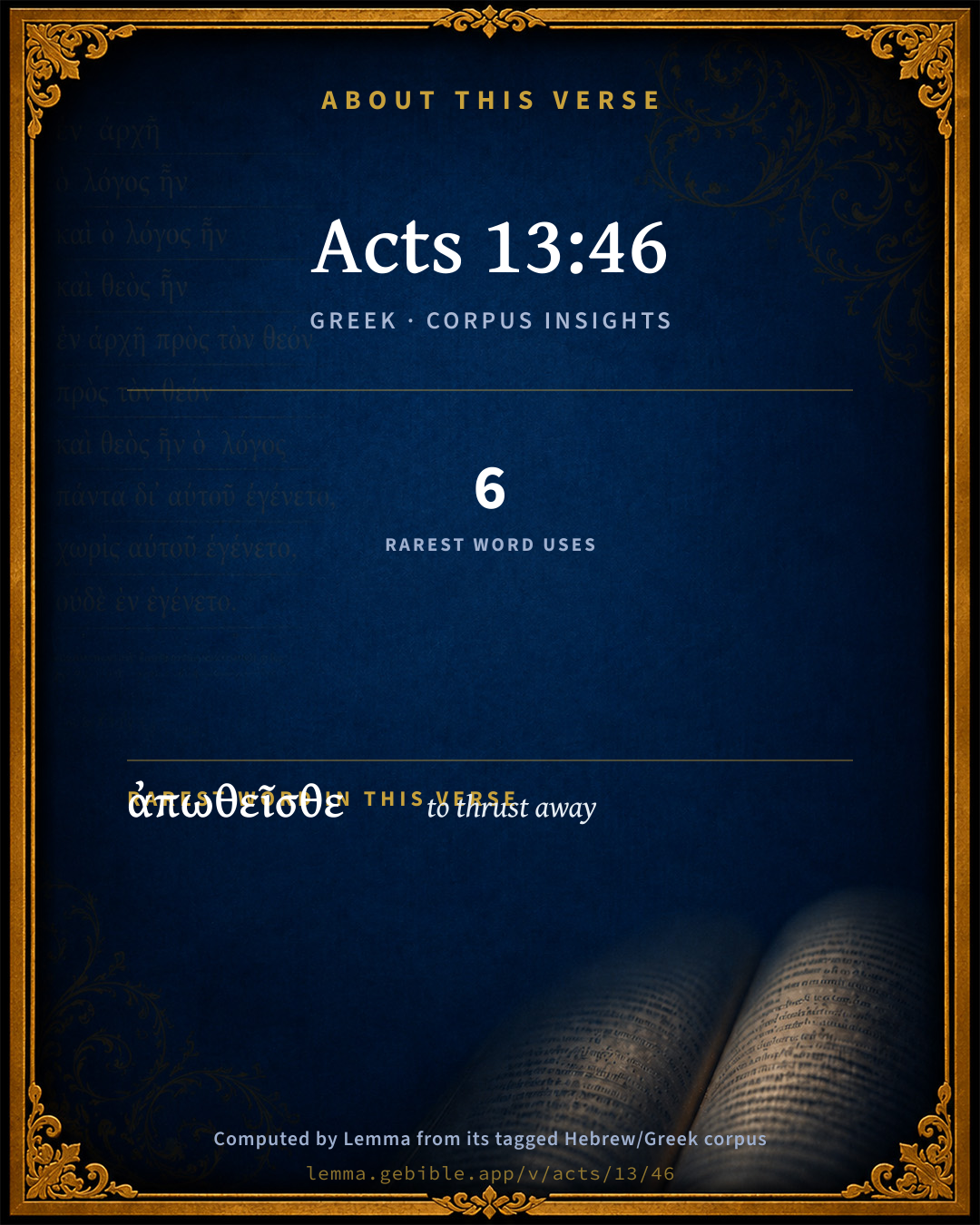
Acts 13:46

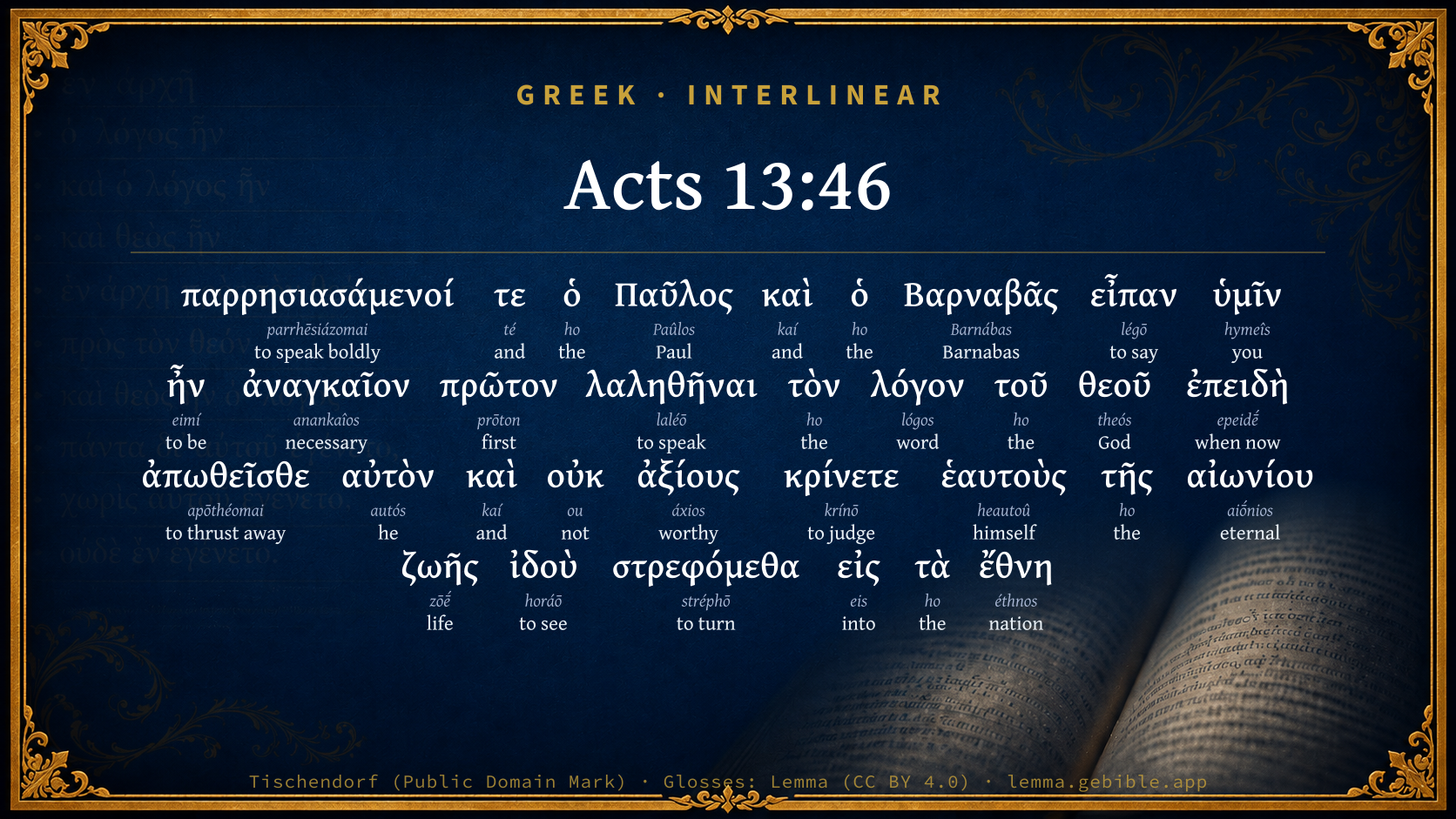
Greek (Tischendorf 8th ed.) Acts 13:46 appears in the Greek New Testament. The text above is from the Tischendorf 8th edition. Each word links to its Strong’s number and a concise gloss. Click any word for its full Thayer’s Greek Lexicon entry.
Download image
Cite this verse

Acts 13:46 (World English Bible). Public Domain. Lemma interlinear Bible study tool, https://lemma.gebible.app/v/acts/13/46.

Show BibTeX & RIS
BibTeX
RIS
English Translation
Paul and Barnabas spoke out boldly, and said, "It was necessary that God's word should be spoken to you first. Since indeed you thrust it from you, and judge yourselves unworthy of eternal life, behold, we turn to the Gentiles.
World English Bible · Public Domain
Download a study sheet

One document with this verse’s original text, its word-by-word gloss line, the meaning frame, cross-references with their text, attributed commentary, and full source and license credits — printable, and it pastes into notes with its structure intact.

This verse Autodidact and up

Study sheet (.html) Plain text (.txt)

A passage Seminary Student

Up to 50 verses in one chapter. A passage sheet keeps up to 6 commentary sources and 12 cross-references per verse, in the order this page ranks them, and says so on the sheet whenever that leaves anything out. Ask for a single verse and you get the Autodidact verse sheet above.

Everything on this page stays free to read, with no account — the sheet is a download of what is already on screen, not access to it.

Want to remove ads? Support Godless Engineer
Compare translations 3

The same verse in 3 English versions, stacked beneath the original-language interlinear above. Click any original word for its lexicon entry.

Each is an independent rendering of the whole verse — the interlinear is not word-aligned to these translations.

Highlighted words mark where these versions differ — a whole-verse word diff, not a word-by-word alignment.

  • World English Bible Public Domain
    Paul and Barnabas spoke out boldly, and said, "It was necessary that God's word should be spoken to you first. Since indeed you thrust it from you, and judge yourselves unworthy of eternal life, behold, we turn to the Gentiles.
  • King James Version Public Domain
    Then Paul and Barnabas waxed bold, and said, It was necessary that the word of God should first have been spoken to you: but seeing ye put it from you, and judge yourselves unworthy of everlasting life, lo, we turn to the Gentiles.
  • unfoldingWord Literal Text CC BY-SA 4.0
    And Paul and Barnabas, speaking boldly, said, “It was necessary for the word of God to be spoken to you first. Since you reject it and judge yourselves not worthy of eternal life, behold, we are turning to the Gentiles.

unfoldingWord Literal Text — © unfoldingWord, licensed CC BY-SA 4.0. Word-aligned USFM3 via Door43 (git.door43.org/unfoldingWord/en_ult).

Versions to compare (up to 4)

3 of 4 selected

Show all 19 translations

Every available English version of this verse, each an independent rendering of the whole verse.

  • World English Bible Public Domain
    Paul and Barnabas spoke out boldly, and said, "It was necessary that God's word should be spoken to you first. Since indeed you thrust it from you, and judge yourselves unworthy of eternal life, behold, we turn to the Gentiles.
  • Berean Standard Bible Public Domain
    Then Paul and Barnabas answered them boldly: “It was necessary to speak the word of God to you first. But since you reject it and do not consider yourselves worthy of eternal life, we now turn to the Gentiles.
  • Majority Standard Bible Public Domain
    Then Paul and Barnabas answered them boldly: “It was necessary to speak the word of God to you first. But since you reject it and do not consider yourselves worthy of eternal life, we now turn to the Gentiles.
  • King James Version Public Domain
    Then Paul and Barnabas waxed bold, and said, It was necessary that the word of God should first have been spoken to you: but seeing ye put it from you, and judge yourselves unworthy of everlasting life, lo, we turn to the Gentiles.
  • American Standard Version (1901) Public Domain
    And Paul and Barnabas spake out boldly, and said, It was necessary that the word of God should first be spoken to you. Seeing ye thrust it from you, and judge yourselves unworthy of eternal life, lo, we turn to the Gentiles.
  • Revised Version (1885) Public Domain
    And Paul and Barnabas spake out boldly, and said, It was necessary that the word of God should first be spoken to you. Seeing ye thrust it from you, and judge yourselves unworthy of eternal life, lo, we turn to the Gentiles.
  • Geneva Bible (1599) Public Domain
    Then Paul and Barnabas spake boldly, and sayde, It was necessarie that the woorde of God shoulde first haue beene spoken vnto you: but seeing yee put it from you, and iudge your selues vnworthie of euerlasting life, loe, we turne to the Gentiles.
  • Douay-Rheims (1899) Public Domain
    Then Paul and Barnabas said boldly: To you it behoved us first to speak the word of God: but because you reject it, and judge yourselves unworthy of eternal life, behold we turn to the Gentiles.
  • Young's Literal Translation Public Domain
    And speaking boldly, Paul and Barnabas said, `To you it was necessary that first the word of God be spoken, and seeing ye do thrust it away, and do not judge yourselves worthy of the life age-during, lo, we do turn to the nations;
  • Literal Standard Version CC BY-SA 4.0
    And speaking boldly, Paul and Barnabas said, “It was necessary that the word of God be first spoken to you, and seeing you thrust it away, and do not judge yourselves worthy of the continuous life, behold, we turn to the nations;
  • Unlocked Literal Bible CC BY-SA 4.0
    But Paul and Barnabas spoke out boldly and said, “It was necessary that the word of God should first be spoken to you. Seeing you push it away from yourselves and consider yourselves unworthy of eternal life, see, we will turn to the Gentiles.
  • unfoldingWord Literal Text CC BY-SA 4.0
    And Paul and Barnabas, speaking boldly, said, “It was necessary for the word of God to be spoken to you first. Since you reject it and judge yourselves not worthy of eternal life, behold, we are turning to the Gentiles.
  • Darby Bible Public Domain
    And Paul and Barnabas spoke boldly and said, It was necessary that the word of God should be first spoken to you; but, since ye thrust it from you, and judge yourselves unworthy of eternal life, lo, we turn to the nations;
  • World Messianic Bible Public Domain
    Paul and Barnabas spoke out boldly, and said, “It was necessary that God’s word should be spoken to you first. Since indeed you thrust it from yourselves, and judge yourselves unworthy of eternal life, behold, we turn to the Gentiles.
  • Webster's Bible Public Domain
    Then Paul and Barnabas became bold, and said, It was necessary that the word of God should first be spoken to you: but seeing ye reject it, and judge yourselves unworthy of everlasting life, lo, we turn to the Gentiles.
  • Free Bible Version CC BY-SA 4.0
    So Paul and Barnabas spoke out strongly, saying “We had to speak the word of God to you first. But now that you're rejecting it—you're deciding that you're not worthy of eternal life—well now we're turning to the foreigners.
  • Bible in Basic English Public Domain
    Then Paul and Barnabas without fear said, It was necessary for the word of God to be given to you first; but because you will have nothing to do with it, and have no desire for eternal life, it will now be offered to the Gentiles.
  • Text-Critical English NT CC BY 4.0
    But Paul and Barnabas spoke boldly, saying, “It was necessary for the word of God to be spoken first to you. But since you are rejecting it and do not judge yourselves to be worthy of eternal life, behold, we are turning to the Gentiles.
  • Tyndale New Testament (1534) Public Domain
    Then Paul and Barnabas wexed bolde and sayde: it was mete that the worde of God shulde fyrst have bene preached to you. But seinge ye put it from you and thinke youre selfes onworthy of everlastinge lyfe: lo we turne to the gentyls.

Literal Standard Version (2020), Covenant Press — licensed CC BY-SA 4.0. Text via the HelloAO Bible API (eBible.org). Unlocked Literal Bible (unfoldingWord) — licensed CC BY-SA 4.0. Text via the HelloAO Bible API (eBible.org). unfoldingWord Literal Text — © unfoldingWord, licensed CC BY-SA 4.0. Word-aligned USFM3 via Door43 (git.door43.org/unfoldingWord/en_ult). Free Bible Version, Dr. Jonathan Gallagher — licensed CC BY-SA 4.0. Text via the HelloAO Bible API (eBible.org).

Word by word

More ways to search: Search by grammar → Find every occurrence → Compare this word →

Practice this passage: Drill this verse → Learn its vocabulary →

ἀπωθεῖσθε
apōthéomai
G683
“to thrust away”
Verb, Present, Middle or Passive deponent, Indicative, 2nd person, Plural
Part of Speech
Verb
Tense
Present
Voice
Middle or Passive deponent
Mood
Indicative
Person
2nd person
Number
Plural
Full Thayer's Definition

Origin: from G575 and the middle voice of otheo or otho (to shove)

TDNT: 1:448,*

1. to thrust away, push away, repel 2. to thrust away from one's self, to drive away from one's self a. repudiate, reject, refuse
  1. παρρησιασάμενοί parrhēsiázomai G3955 “to speak boldly” Verb, Aorist, Middle deponent, Participle, Nominative, Plural, Masculine
  2. τε té G5037 “and” Particle
  3. ὁ ho G3588 “the” Article, Nominative, Singular, Masculine
  4. Παῦλος Paûlos G3972 “Paul” Noun, Nominative, Singular, Masculine
  5. καὶ kaí G2532 “and” Conjunction
  6. ὁ ho G3588 “the” Article, Nominative, Singular, Masculine
  7. Βαρναβᾶς Barnábas G921 “Barnabas” Noun, Nominative, Singular, Masculine
  8. εἶπαν légō G3004 “to say” Verb, Aorist, Active, Indicative, 3rd person, Plural
  9. ὑμῖν hymeîs G5210 “you” Personal pronoun, 2nd person, Dative, Plural
  10. ἦν eimí G1510 “to be” Verb, Imperfect, Active, Indicative, 3rd person, Singular
  11. ἀναγκαῖον anankaîos G316 “necessary” Adjective, Nominative, Singular, Neuter
  12. πρῶτον prōton G4412 “first” Adverb, Superlative
  13. λαληθῆναι laléō G2980 “to speak” Verb, Aorist, Passive, Infinitive
  14. τὸν ho G3588 “the” Article, Accusative, Singular, Masculine
  15. λόγον lógos G3056 “word” Noun, Accusative, Singular, Masculine
  16. τοῦ ho G3588 “the” Article, Genitive, Singular, Masculine
  17. θεοῦ theós G2316 “God” Noun, Genitive, Singular, Masculine
  18. ἐπειδὴ epeidḗ G1894 “when now” Conjunction
  19. αὐτὸν autós G846 “he” Personal pronoun, Accusative, Singular, Masculine
  20. καὶ kaí G2532 “and” Conjunction
  21. οὐκ ou G3756 “not” Particle, Negative
  22. ἀξίους áxios G514 “worthy” Adjective, Accusative, Plural, Masculine
  23. κρίνετε krínō G2919 “to judge” Verb, Present, Active, Indicative, 2nd person, Plural
  24. ἑαυτοὺς heautoû G1438 “himself” Reflexive pronoun, 2nd person, Accusative, Plural, Masculine
  25. τῆς ho G3588 “the” Article, Genitive, Singular, Feminine
  26. αἰωνίου aiṓnios G166 “eternal” Adjective, Genitive, Singular, Feminine
  27. ζωῆς zōḗ G2222 “life” Noun, Genitive, Singular, Feminine
  28. ἰδοὺ horáō G3708 “to see” Verb, Aorist, Middle, Imperative, 2nd person, Singular
  29. στρεφόμεθα stréphō G4762 “to turn” Verb, Present, Passive, Indicative, 1st person, Plural
  30. εἰς eis G1519 “into” Preposition
  31. τὰ ho G3588 “the” Article, Accusative, Plural, Neuter
  32. ἔθνη éthnos G1484 “nation” Noun, Accusative, Plural, Neuter

About this verse

These counts appear in no published source. They are computed here, from the morphology-tagged text and Lemma’s own curated glosses. What Lemma adds →

33
words
27
distinct lemmas
Acts
section

Notable vocabulary

The rarest word here is ἀπωθεῖσθε to thrust away G683 — appearing just 6 times in the whole Greek New Testament.

Shared distinctive vocabulary

ἀπωθεῖσθε to thrust away G683 occurs in 6 verses of the Greek New Testament. Also found in:

Repetition

Words recur within this verse:

Cross-references

31

Topical passages linked to Acts 13:46 in the Treasury of Scripture Knowledge — connected by theme and wording, ordered by reader-vote popularity; previews shown in the World English Bible.

  • Acts 28:28 "Be it known therefore to you, that the salvation of God is sent to the Gentiles. They will also listen."
  • Matthew 21:43 "Therefore I tell you, the Kingdom of God will be taken away from you, and will be given to a nation bringing forth its fruits.
  • Acts 18:5–6 But when Silas and Timothy came down from Macedonia, Paul was compelled by the Spirit, testifying to the Jews that Jesus was the Christ.
  • Acts 26:20 but declared first to them of Damascus, at Jerusalem, and throughout all the country of Judea, and also to the Gentiles, that they should repent and turn to God, doing works worthy of repentance.
  • Acts 3:26 God, having raised up his servant, Jesus, sent him to you first, to bless you, in turning away everyone of you from your wickedness."
  • Romans 2:10 But glory and honor and peace to every man who works good, to the Jew first, and also to the Greek.
  • Acts 13:26 Brothers, children of the stock of Abraham, and those among you who fear God, the word of this salvation is sent out to you.
  • Acts 22:21 "He said to me, 'Depart, for I will send you out far from here to the Gentiles.'"
  • Romans 1:16 For I am not ashamed of the Gospel of Christ, for it is the power of God for salvation for everyone who believes; for the Jew first, and also for the Greek.
  • Romans 11:11–13 I ask then, did they stumble that they might fall? May it never be! But by their fall salvation has come to the Gentiles, to provoke them to jealousy.
  • John 1:11 He came to his own, and those who were his own didn't receive him.
  • Acts 4:29–31 Now, Lord, look at their threats, and grant to your servants to speak your word with all boldness,
  • Romans 10:19–21 But I ask, didn't Israel know? First Moses says, "I will provoke you to jealousy with that which is no nation, With a nation void of understanding I will make you angry."
  • Isaiah 55:5 Behold, you shall call a nation that you don't know; and a nation that didn't know you shall run to you, because of Yahweh your God, and for the Holy One of Israel; for he has glorified you.
  • Luke 14:16–24 But he said to him, "A certain man made a great supper, and he invited many people.
  • Luke 24:47 and that repentance and remission of sins should be preached in his name to all the nations, beginning at Jerusalem.
  • Acts 7:51 "You stiff-necked and uncircumcised in heart and ears, you always resist the Holy Spirit! As your fathers did, so you do.
  • Exodus 32:9–10 Yahweh said to Moses, "I have seen these people, and, behold, they are a stiff-necked people.
  • Deuteronomy 32:21 They have moved me to jealousy with that which is not God; They have provoked me to anger with their vanities: I will move them to jealousy with those who are not a people; I will provoke them to anger with a foolish nation.
  • Isaiah 49:5–8 Now says Yahweh who formed me from the womb to be his servant, to bring Jacob again to him, and that Israel be gathered to him (for I am honorable in the eyes of Yahweh, and my God is become my strength);
  • Romans 9:4–5 who are Israelites; whose is the adoption, the glory, the covenants, the giving of the law, the service, and the promises;
  • Ephesians 6:19–20 on my behalf, that utterance may be given to me in opening my mouth, to make known with boldness the mystery of the Gospel,
  • Philippians 1:14 and that most of the brothers in the Lord, being confident through my bonds, are more abundantly bold to speak the word of God without fear.
  • Proverbs 28:1 The wicked flee when no one pursues; But the righteous are as bold as a lion.
  • Matthew 10:6 Rather, go to the lost sheep of the house of Israel.
  • Matthew 10:13–15 If the household is worthy, let your peace come on it, but if it isn't worthy, let your peace return to you.
  • Matthew 22:6–10 and the rest grabbed his servants, and treated them shamefully, and killed them.
  • John 4:22 You worship that which you don't know. We worship that which we know; for salvation is from the Jews.
  • Acts 4:13 Now when they saw the boldness of Peter and John, and had perceived that they were unlearned and ignorant men, they marveled. They recognized that they had been with Jesus.
  • Acts 13:5 When they were at Salamis, they proclaimed the word of God in the synagogues of the Jews. They had also John as their attendant.
  • Acts 13:14 But they, passing on from Perga, came to Antioch of Pisidia. They went into the synagogue on the Sabbath day, and sat down.

Cross-references courtesy of OpenBible.info (CC BY 4.0).

Commentary

Notes on Acts 13:46 from classic Christian and Jewish commentators (each source and its license shown beneath its notes). The classic Christian expositions comment on the surrounding passage and are grouped to its opening verse, so a note may address several verses; the Jewish commentaries on the Tanakh (Rashi and others) are per-verse, so they appear only where the commentator wrote on this verse.

Lemma curates 59 commentaries, every one of them public domain or Creative Commons licensed, each selected and text-cleaned for this edition rather than reprinted as found. About our sources →

Joseph Benson's Commentary

Act 13:46-47. Then Paul and Barnabas — Perceiving that no good impression could be made upon them; waxed bold — Used great freedom of speech; and said, It was necessary — According to the general instructions of our Divine Master; that the word of God should first be spoken to you — He shows that he had not preached to them from any confidence of their believing; but seeing ye put it from you, and — By that very action, in effect; judge yourselves unworthy of everlasting life — Persons unfit to have it offered to you. This text plainly shows that persons may be said to be self-condemned, who furnish out matter of condemnation from their own words, though they do not actually pass sentence on themselves: for nothing was further from the thoughts of these Jews than to declare themselves unworthy of eternal life, because they did not believe the gospel; for they rather expected that life by rejecting it. They, indeed, judged none but themselves worthy of it; yet their conduct in rejecting the gospel, was the same as saying, We are unworthy of eternal life; as it effectually precluded their obtaining it. Lo, we turn to the Gentiles — Not that they intended entirely to desist from preaching to the Jews, for we find they continued to address them first in other places wherever they came; but they now determined to lose no more time at Antioch on their ungrateful countrymen, but to employ themselves wholly in doing what they could for the conversion of the Gentiles there. For so hath the Lord commanded us — See Mat 28:19; Act 1:8; in consequence of that prediction which was uttered by Isaiah in the name of God; saying — To his Son, the Messiah; I have set thee to be a light to the Gentiles, &c.

Joseph Benson's Commentary on the Old and New Testaments (1811–1818) — public domain. Text from a community e-Sword module.

MacLaren's Expositions of Holy Scripture

Alexander MacLaren

Acts

JEWISH REJECTERS AND GENTILE RECEIVERS

UNWORTHY OF LIFE

Act 13:46.

So ended the first attempt on Paul’s great missionary journey to preach to the Jews. It is described at great length and the sermon given in full because it is the first. A wonderful sermon it was; touching all keys of feeling, now pleading almost with tears, now flashing with indignation, now calmly dealing with Scripture prophecies, now glowing as it tells the story of Christ’s death for men. It melted some of the hearers, but the most were wrought up to furious passion-and with characteristic vehemence, like their ancestors and their descendants through long dreary generations, fell to ‘contradicting and blaspheming.’ We can see the scene in the synagogue, the eager faces, the vehement gestures, the hubbub of tongues, the bitter words that stormed round the two in the midst, Barnabas like Jupiter, grave, majestic, and venerable; Paul like Mercury, agile, mobile, swift of speech. They bore the brunt of the fury till they saw it to be hopeless to try to calm it, and then departed with these remarkable words.

They are even more striking if we notice that ‘judge’ here may be used in its full legal sense. It is not merely equivalent to consider, for these Jews by no means thought themselves unworthy of eternal life, but it means, ‘ye adjudge and pass sentence on yourselves to be.’ Their rejection of the message was a self-pronounced sentence. It proved them to be, and made them, ‘unworthy of eternal life.’ There are two or three very striking thoughts to be gathered from these words which I would dwell on now.

I. What constitutes worthiness and unworthiness.

There are two meanings to the word ‘worthy’-deserving or fit. They run into each other and yet they may be kept quite apart. For instance you may say of a man that ‘he is worthy’ to be something or other, for which he is obviously qualified, not thinking at all whether he deserves it or not.

Now in the first of these senses-we are all unworthy of eternal life. That is just to state in other words the tragic truth of universal sinfulness. The natural outcome and issue of the course which all men follow is death. But yet there are men who are fit for and capable of eternal life. Who they are and what fitness is can only be ascertained when we rightly understand what eternal life is. It is not merely future blessedness or a synonym for a vulgar heaven. That is the common notion of its meaning. Men think of that future as a blessed state to which God can admit anybody if He will, and, as He is good, will admit pretty nearly everybody. But eternal life is a present possession as well as a future one, and passing by its deeper aspects, it includes-

Deliverance from evil habits and desires.

Purity, and love of all good and fair things.

Communion with God.

As well as forgiveness and removal of punishment.

What then are the qualifications making a man worthy of, in the sense of fit for, such a state?

{a} To know oneself to be unworthy.

He who judges himself to be worthy is unworthy. He who knows himself to be unworthy is worthy.

The first requisite is consciousness of sin, leading to repentance.

{b} To abandon striving to make oneself worthy.

By ourselves we never can do so. Many of us think that we must do our best, and then God will do the rest.

There must be the entire cessation of all attempt to work out by our own efforts characters that would entitle us to eternal life.

{c} To be willing to accept life on God’s terms.

As a mere gift.

{d} To desire it.

God cannot give it to any one who does not want it. He cannot force His gifts on us.

This then is the worthiness.

II. How we pass sentence on ourselves as unworthy.

It is quite clear that ‘judge’ here does not mean consider, for a sense of unworthiness is not the reason which keeps men away from the Gospel. Rather, as we have seen, a proud belief in our worthiness keeps very many away. But ‘judge’ here means ‘adjudicate’ or ‘pronounce sentence on,’ and worthy means fit, qualified.

Consider then-

{a} That our attitude to the Gospel is a revelation of our deepest selves.

The Gospel is a ‘discerner of thoughts and intents of the heart.’ It judges us here and now, and by their attitude to it ‘the thoughts of many hearts shall be revealed.’

{b} That our rejection of it plainly shows that we have not the qualifications for eternal life.

No doubt some men are kept from accepting Christ by intellectual doubts and difficulties, but even these would alter their whole attitude to Him if they had a profound consciousness of sin, and a desire for deliverance from it.

But with regard to the great bulk of its hearers, no doubt the hindrance is chiefly moral. Many causes may combine to produce the absence of qualification. The excuses in the parable’-farm, oxen, wife’-all amount to engrossment with this present world, and such absorption in the things seen and temporal deadens desire. So the Gospel preached excites no longings, and a man hears the offer of salvation without one motion of his heart towards it, and thus proclaims himself ‘unworthy of eternal life.’

But the great disqualification is the absence of all consciousness of sin. This is the very deepest reason which keeps men away from Christ.

How solemn a thing the preaching and hearing of this word is!

How possible for you to make yourselves fit!

How simple the qualification! We have but to know ourselves sinners and to trust Jesus and then we ‘shall be counted worthy to obtain that world and the resurrection from the dead.’ Then we shall be ‘worthy to escape and to stand before the Son of Man.’ Then shall we be ‘worthy of this calling,’ and the Judge himself shall say: ‘They shall walk with Me in white, for they are worthy.’

Alexander MacLaren, Expositions of Holy Scripture (1904–1910) — public domain. Text from a community e-Sword module.

Bengel's Gnomon

Johann Albrecht Bengel

Act 13:46. Παρρησιασάμενοι, having waxed bold [using freedom of speech]) They who impede others ought especially to be reproved in public.—ἀναγκαῖον, necessary) although ye were not worthy. He shows that he had not preached with the confident assurance of their obedience.—ἀπωθεῖσθε, ye repel it) The antithetical words are, to repel the word of GOD, and, to glorify the word of the Lord, Act 13:48.—οὐκ ἀξίους, not worthy) The Divine consideration [lit. “deeming worthy”] towards you is great; but ye are not worthy; Mat 22:8: and although ye think us unworthy of being heard, and esteem yourselves alone worthy of eternal life, yet ye yourselves of your own accord rush into this judgment, that ye are unworthy, and it is all the same as if you were to say, “We are unworthy;” There is therefore a Metonymy of the antecedent for the consequent. The antithesis is, they (the Gentiles) were glad, Act 13:48.—τῆς αἰωνίου ζωῆς, of everlasting life) ibid. “ordained to eternal life.”—ἰδοὺ, lo) This points out a thing present. A grand point of time; a great revolution.

Bengel's Gnomon of the New Testament — English translation (T&T Clark, Edinburgh, 1860) — public domain. Text from a community e-Sword module.

Meyer's Critical & Exegetical Commentary

Heinrich August Wilhelm Meyer

Act_13:46-47. Ἦν ἀναγκαῖον] namely, according to the counsel of God (see on Act_13:14) and our apostolic duty.

οὐκ ἀξίους κρίνετε κ.τ.λ.] This judgment of their unworthiness they, in point of fact, pronounced upon themselves by their zealous contradicting and blaspheming.

ἰδού] ingens articulus temporis magna revolutio, Bengel. As to the singular, comp. on Mat_10:16.

οὕτω γὰρ ἐντέταλται κ.τ.λ.] a proof that the στρεφόμεθα εἰς τὰ ἔθνη occurred not arbitrarily, but in the service of the divine counsel. Isa_49:6 (according to the LXX., with slight deviation), referring to the servant of God, is by Paul and Barnabas, according to the Messianic fulfilment which this divine word was to receive, recognised and asserted as ἐντολή for the apostolic office; for by means of this office it was to be brought about that the Messiah (σε) would actually become the light of the Gentiles (Luk_2:32), etc., for which, according to this oracle, God has destined Him.

τοῦ εἶναί σε κ.τ.λ.] the final purpose: in order that thou mayest be, etc.

Meyer — Critical and Exegetical Commentary on the New Testament — English translation by Peter Christie, edited by Frederick Crombie (T&T Clark, 1880) — public domain. Text from a community e-Sword module.

Expositor's Greek Testament

ed. W. Robertson Nicoll

Act 13:46 . παῤῥησιασάμενοι , see on Act 9:27 . ἦν ἀναγκαῖον , cf. on Act 13:14 . ἐπειδὴ δὲ , see critical notes. δέ marks the contrast, but its omission emphasises it even more vividly and sternly. ἀπωθεῖσθε : “ye thrust it from you,” R.V.; repellitis , Vulgate; only in Luke and Paul, cf. 1Ti 1:19 , Rom 11:1 , Act 7:27 ; Act 7:39 ; frequent in LXX, cf., e.g. , Ps. 93:14, Eze 43:9 , and 3Ma 3:22 ; 3Ma 6:32 , Mal 2:16Mal 2:16 . οὐκ ἀξίους , cf. Mat 22:8 .

The Expositor's Greek Testament, edited by W. Robertson Nicoll (1897–1910) — public domain. Text from a community e-Sword module.

Geneva Bible (1599)

Geneva Bible translators

By this your doing you do as it were, pronounce sentence against yourselves, and judge yourselves.

The Gospel is published to the Gentiles by the express commandment of God.

Geneva Bible (1599) marginal notes — public domain. Text via Bolls.life.

Jamieson, Fausset & Brown

Robert Jamieson, A. R. Fausset & David Brown

Then Paul and Barnabas waxed bold, and said, &c.--This is in the highest style of a last and solemn protestation.

It was necessary that the word should first have been spoken to you--See the direction of Christ in Luk 24:47; also Rom 1:16.

since ye judge yourselves unworthy of everlasting life--pass sentence upon yourselves.

Jamieson, Fausset & Brown — Commentary Critical and Explanatory on the Whole Bible (1871) — public domain (CC PDM 1.0). Text via the HelloAO Bible API.

Adam Clarke's Commentary

Verse 46. Waxed bold] παρρησιασαμενοι; Having great liberty of speech; a strong, persuasive, and overpowering eloquence. They had eternal truth for the basis of this discourse; a multitude of incontestable facts to support it; an all-persuading eloquence to illustrate and maintain what they had asserted.

Should first have been spoken to you] When our Lord gave his apostles their commission to go into all the world, and preach the Gospel to every creature, he told them they must begin first at Jerusalem, Mr 16:15; Lu 24:47. In obedience therefore to this command, the apostles (in every place where they preached) made their first offers of the Gospel to the Jews.

Ye put it from you] απωθεισθε αυτον, Ye disdain this doctrine, and consider it contemptible: so the word is frequently used.

And judge yourselves unworthy of everlasting life] Was this meant as a strong irony? "Ye have such humbling thoughts of yourselves, that ye think the blessings of the Gospel too good to be bestowed on such worthless wretches as ye are." Or did the apostle mean that, by their words and conduct on this occasion, they had passed sentence on themselves, and, in effect, had decided that they were unworthy of the grace of the Gospel; and God now ratifies that judgment by removing those blessings from them, and sending them to the Gentiles?

Adam Clarke's Commentary on the Bible (1810–1826) — public domain. Text from a community e-Sword/MySword module.

John Calvin's Commentaries

46. When they had taken liberty. Luke showeth that the servants of Christ were so far from being discouraged with the stubbornness of the enemies, that they began, therefore, to inveigh against them afresh more freely. For though they had sharply pricked them, yet they did yet spare them a little; but now, when they see Christ obstinately rejected by them, they excommunicate them and deprive them of the kingdom of God. And by this example are we taught that we must not use extreme severity, save only against those who are quite past hope. And the more bold the reprobate are to oppress the truth, the more courage ought we to take to ourselves. For the servants of God must be armed with invincible constancy of the Spirit, that they may never give place to the devil, nor to his ministers; as the Lord commandeth Jeremiah to encounter with the reprobate with a face of iron.

It was necessary. He accuseth them of unthankfulness, because, whereas they were chosen by God out of all people, that Christ might offer himself unto them, they refuse so great a benefit maliciously. And in the former member he setteth down the degree of honor and excellency whereunto God had exalted them; afterward followeth the upbraiding, because they do willingly cast from them so great grace; whereupon he concludeth that it is now time that the gospel be translated unto the Gentiles. In that he saith, that it was meet that it should first be preached to them, it doth properly appertain unto the time of Christ’s kingdom. For under the law, before Christ was given, the Jews were not only the first, but alone. Therefore was it that Moses called them a priestly kingdom, and the peculiar people of God, (Exodus 19:5, 6.) But the adoption of God rested then with them alone upon this condition, (the Gentiles being omitted,) that they should be preferred as yet before the Gentiles by the coming of Christ. For though Christ reconciled the world to his Father, yet they were former in order, who were already near unto God, and of his family. Therefore, that was the most lawful order, that the apostles should gather the Church first of the Jews, afterward of the Gentiles, as we saw in the first chapter, (Acts 1:18,) and in other places, so that the fellowship of the Gentiles did not take from the Jews the right of the first-begotten, but that they were always the chief in the Church of God. In this respect Paul saith, that the righteousness of God is made manifest in the gospel, first to the Jews, then to the Grecians, (Romans 1:16.) Such greatness of grace which God vouchsafed to bestow upon them, doth exaggerate and increase the greatness of their sin, whilst that they reject that which is so mercifully offered unto them. Therefore he addeth that they give judgment of themselves, that they are unworthy of eternal life. For seeing that the rejecting of the gospel is the denial of the righteousness of God, we need no other judge to condemn the unbelievers.

And after that ye reject. Paul seemeth to reason unfitly. For, first it was not of necessity that the Jews should be excluded, that the Gentiles might be admitted unto the hope of salvation; secondly, this was more convenient, that, after the Jews had embraced the gospel, they should grant the second place to the Gentiles. And Paul speaketh in like sort as if they could not grow together into one body, and as if the gospel could not come unto the Gentiles unless it were rejected of the Jews. And now was he not ordained to be the apostle of the Gentiles before he found such stubbornness in the Jews? I answer, that there is great force in the words we are turned For his meaning is, that he is now turned away from the Jews, that he may addict and give over himself wholly to the Gentiles. If they had remained in their degree such turning had not followed, but he should have drawn the Gentiles also with a continual course, after that the Jews were received into the bosom; and he should have embraced them both together, know, forasmuch as the Jews turn their backs, and withdraw themselves from his ministry, he cannot look upon them and the Gentiles both at once. Therefore, taking his leave of them, he is enforced to translate his care unto the Gentiles. Therefore, unless the Jews had estranged themselves from the Church, the calling of the Gentiles should have been such as is by the prophets described: “In that day shall seven strangers take hold of the cloak of a man that is a Jew, and shall say, we will walk with you; because God is with you.” But now the Gentiles are called after a new and accidental manner; because, when the Jews were rejected, they entered into the empty possession. They ought to have been gathered unto the Jews; but after that they fell away, and were driven out, they came in their place. So that their death was the life of the Gentiles, and the natural branches being cut off, the wild olives were ingrafted into the holy root, until God do at length restore them also unto life, being ingrafted into their former root, that the Israel of God being gathered together from all quarters may be saved.

John Calvin's Commentaries (1540-1563) — public domain. Text from the Calvin Translation Society English edition (1840s-50s) via the Christian Classics Ethereal Library (ccel.org). Calvin's coverage is partial (roughly two-thirds of the Bible); uncommented books and verses are honest gaps, never fabricated. The 19th-century editor's footnotes and remarks are omitted so the notes are faithfully Calvin's own voice.

Ellicott's Commentary for English Readers

(46) It was necessary.—The preachers recognised the necessity of following what they looked on as the divine plan in the education of mankind, and so they preached “to the Jew first, and also to the Gentile” (Rom_2:9-10). The former were offered, as the fulfilment of the promise made to Abraham, the high privilege of being the channel through which “all families of the earth should be blessed” by the knowledge of Christ (Gen_22:18). When they rejected that offer, it was made, without their intervention, to the Gentiles.

Judge yourselves unworthy of everlasting life.—There is a touch of righteous indignation, perhaps something like irony, in the words. The preacher had thought them “worthy” of the highest of all blessings, the life eternal which was in Christ Jesus, but they, in their boastful and envious pride, took what was really a lower estimate of themselves, and showed that they were “unworthy.” They passed sentence, ipso facto, on themselves.

Lo, we turn to the Gentiles.—We have to remember (1) that the words were as an echo of those which the Apostle had heard in his trance in the Temple at Jerusalem (Act_22:21); (2) that they would be heard, on the one hand, by the Gentiles with a joy hitherto unknown, and, on the other, by the Jews as a new cause of irritation.

A Bible Commentary for English Readers, edited by Charles John Ellicott (1878–1897) — public domain. Text from a community e-Sword module.

The Cambridge Bible for Schools and Colleges

gen. ed. J. J. S. Perowne

46. It was necessary that the word of God should first have been spoken to you] That, as Christ came first unto His own, so His messengers should declare their glad tidings first unto Jews, but if they received not the word, then it was to be proclaimed to all who would receive it.

judge yourselves unworthy] i.e. pronounce the sentence upon yourselves by your actions. Cp. Mat_22:8, “They that were bidden” to the marriage supper “were not worthy.” They had been deemed worthy by him who sent to call them, but had declared they were not so by their refusal to come.

The Cambridge Bible for Schools and Colleges (gen. ed. J. J. S. Perowne; Cambridge University Press, 1878–1918) — public domain. Text from a community e-Sword module.

John Gill's Exposition

And the word of the Lord was published throughout all the region. That is, of Pisidia, in which Antioch was; not by the Apostles Paul and Barnabas, who seem to go directly to Iconium, after they were expelled the city and suburbs of Antioch; but by some of those who were converted under their ministry, and had gifts bestowed on them, qualifying them to preach the Gospel to others, which they did with success. There were no doubt several churches planted in this country, and particularly there was one at Antioch, of which these new converts were the beginning, and which continued: in the "fourth" century, this church was a patriarchate, for it is said, under Valentinian and Theodosius, Optimus obtained the patriarchate of Antioch in Pisidia; in the "fifth" century, it was the metropolitan of Pisidia; in this age, mention is made of several bishops of this place; Candidianus, bishop of Antioch in Pisidia, was present at two synods, one at Constantinople against Eutyches, and another at Ephesus; Dionysius, bishop of the same place, assisted in the synod at Chalcedon, and Pergamius at that which was at Constantinople, under the Emperor Theodosius, and at another at Chalcedon, under the Emperor Marcianus: there were also in this century, bishops of other churches in Pisidia; as Severus, bishop of Sozopolis in Pisidia, who was present in the council at Ephesus, against Nestorius; and Olympius, bishop of Mount Hem in Pisidia, who was at the Chalcedon council; and Paulinus bishop of Apamea, Eortius bishop of Nicopolis, and Alexander bishop of Seleucia, and Longinus bishop of Talbondana, all in Pisidia: in the "sixth" century, there were churches in Pisidia embracing the truth of Christ; Bacchus was bishop of Antioch, and John of another place, who both were in the fifth synod at Constantinople: in the "seventh" century, we read of the church at Antioch, as the metropolitan of Pisidia, and of a bishop of it in the sixth council at Constantinople: in the eighth "century", Gregory, bishop of this place, condemned in a synod the worship of images, but afterwards recanted; and in the same century, this city was taken by the Turks, and spoiled (a); and after this, we read no more of its church state.

(a) Magdeburg. Hist. Eccles. cent. 4. c. 2. p. 3. cent. 5. c. 7. p. 418. & c. 10. p. 588. cent. 6. c. 2. p. 4. cent. 7. c. 2. p. 3. cent. 8. c. 10. p. 366. & c. 16. p. 515.

John Gill's Exposition of the Whole Bible (1746–1763) — public domain (CC PDM 1.0). Text via the HelloAO Bible API.

Trapp's Complete Commentary

John Trapp

46 Then Paul and Barnabas waxed bold, and said, It was necessary that the word of God should first have been spoken to you: but seeing ye put it from you, and judge yourselves unworthy of everlasting life, lo, we turn to the Gentiles.

Ver. 46. But seeing ye put it from you] Gr. απωεθισθε. Ye shove and thrust it from you, as it were with sides and shoulders; noting their desperate incredulity and obstinace. And this was the very period of that day of grace spoken of by our Saviour, Luk 19:42; "Oh, if thou hadst known, at the least in thy day," &c. Now that the offer was made so fully and clearly, how could they escape that neglected so great salvation?

John Trapp, A Commentary or Exposition upon All the Books of the Old and New Testament (1647–1656) — public domain. Text from a community e-Sword module.

Albert Barnes' Notes on the Bible

Waxed bold - Became bold; spake boldly and openly. They were not terrified by their strife, or alarmed by their opposition. The contradictions and blasphemies of sinners often show that their consciences are alarmed; that the truth has taken effect; and then is not the time to shrink, but to declare more fearlessly the truth.

It was necessary - It was so designed; so commanded. They regarded it as their duty to offer the gospel first to their own countrymen. See the notes on Luk 24:47.

Ye put it from you - You reject it.

And judge yourselves - By your conduct, by your rejecting it, you declare this. The word “judge” here does not mean they “expressed such an opinion,” or that “they regarded themselves” as unworthy of eternal life - for they thought just the reverse; but that by their conduct they condemned themselves. By such conduct they did, in fact, pass sentence on themselves, and show that they were unworthy of eternal life, and of having the offer of salvation any further made to them. Sinners by their conduct do, in fact, condemn themselves, and show that they are not only unfit to be saved, but that they have advanced so far in wickedness that there is no hope of their salvation, and no propriety in offering them, any further, eternal life. See the notes on Mat 7:6.

Unworthy ... - Unfit to be saved. They had deliberately and solemnly rejected the gospel, and thus shown that they were not suited to enter into everlasting life. We may remark here:

(1) When people, even but once, deliberately and solemnly reject the offers of God’s mercy, it greatly endangers their salvation. The probability is, that they then put the cup of salvation forever away from themselves.

(2) The gospel produces an effect wherever it is preached.

(3) When sinners are hardened, and spurn the gospel, it may often be the duty of ministers to turn their efforts toward others where they may have more prospect of success. A man will not long labor on a rocky, batten, sterile soil, when there is near him a rich and fertile valley that will abundantly reward the pains of cultivation.

Lo, we turn ... - We shall offer the gospel to them, and devote ourselves to seeking their salvation.

Albert Barnes' Notes on the Bible (1834–1885) — public domain. Text from a community e-Sword/MySword module.

Matthew Poole's English Annotations

Waxed bold; being nothing aftrighted with the reproaches and blasphemies they met with, which but increased their zeal, as a little water does the fire in the smith’s forge.

It was necessary; there was a necessity that the Word of God should be first preached to the Jews:

1. Because Christ was promised to the children and heirs of their ancestors.

2. Because Christ did command it to be thus preached, Mat 10:5,6; Lu 24:47; Act 1:8.

3. Christ himself thus preached it, declaring that he was not sent (comparatively)

but to the lost sheep of the house of lsrael, Mat 15:24.

And judge yourselves unworthy of everlasting life; by this their contradicting and blaspheming, they show as evidently that they are thus unworthy of everlasting life, as if a judge had determined so, or passed such a sentence upon his tribunal, or judgment seat.

Matthew Poole's English Annotations on the Holy Bible (1683–1685) — public domain. Text from a community e-Sword/MySword module.

Whedon's Commentary on the Bible

Daniel D. Whedon

46. Waxed bold—Rising above all useless altercation with the Jews.

Judge yourselves unworthy—Not that they literally believed themselves to be unworthy of life eternal. On the contrary, they believed themselves eminently, and even exclusively, the heirs of that inheritance. But they determined themselves to be such sort as truly is unworthy eternal life.

Everlasting life—Eternal life is not solely a future, but a present, possession. (See notes on Joh_4:14; Joh_5:24; Joh_6:40.) It is a possession commenced in this life to be perpetuated, in a life to come. There is a present as well as a future salvation. These Jews were indisposed to eternal life, and so rejected the Gospel; the Gentiles, in Act_13:48, as many as were disposed to eternal life, believed.

Daniel D. Whedon (gen. ed.), Commentary on the Old and New Testaments (1874–1909) — public domain. Text from a community e-Sword module.

The Pulpit Commentary

And for then, A.V. and T.R.; spake out boldly for waxed bold, A.V.; be for have been, A.V; seeing for but seeing, A.V. and T.R.; thrust for put, A.V.; eternal for everlasting, A.V. Spake out boldly. Observe that Barnabas as well as Paul resented the unseemly opposition of the Jews. It was necessary. The necessity arose from the command of Christ (Luk_24:47; Act_1:8 Act_3:26) It is in accordance with this purpose of God that St. Paul says of the gospel that "it is the power of God unto salvation to the Jew first, and also to the Greek". (Rom_1:16) Compare, too, our Lord"s saying (Mat_15:24) and the woman"s reply (ibid. 27). In point of fact, this had been the practice of Paul and Barnabas no less than of Peter, and was the very motive that had brought them to Antioch. Lo, we turn to the Gentiles. These were, indeed, bold words to speak in a Jewish synagogue; the speakers had doubtless sought courage from the Holy Ghost. (see Act_4:29)

Vers. 46, 47. Unexpected interpretations.

judge yourselves unworthy of everlasting life." The gentle, pitying character of the immense preponderance of the language of Jesus to men speaks and has ever spoken his condescending acquaintance with human nature, and his sympathetic acquaintance with those of the springs of human action that lie deep in feeling. His spirit in these respects was not altogether unworthily caught by his apostles, and notably by the one time disciple, now apostle, John. There came times and occasions, however, both in the converse of the Master himself with sinful men, and of his servants with their fellow-men, when words of kindness to the ear would be the very signal of unkindness to the soul and untruthfulness to its highest interests. And the plain and "bold" language of Paul and Barnabas now, needing no extenuation at our hands, and little enough of explanation, offers a forcible and most striking suggestion, how often, through all the coverings of gracious and forbearing language, the polished shaft of naked truth must be threatening to pierce, let the crash be what it may. The statement to which Paul now committed himself may be regarded as saying very significantly that,

I MEN NEVER MORE EFFECTUALLY PRONOUNCE JUDGMENT ON THEMSELVES THAN WHEN THEY ARE PRONOUNCING JUDGMENT ON CHRIST. This is true in two leading cases.

1. If men are pronouncing judgment unfavorable to Christ as, for instance, in supposed answer to such a question as his own, "What think ye of Christ? they are pronouncing nothing less than decisive condemnation of themselves.

2. If they are humbly and in the genuine spirit of trying to feel their way, giving out from time to time some testimony of their growing and growingly grateful appreciation of Christ and of his truth, they then are proving their own growth in likeness to him. They are unconsciously giving the measure of how far the "day dawns" with them, and how high the "day-star arises in their hearts," or even how far they have got on that path which is like "the shining light, which shineth more and more unto the perfect day.

II MEN"S PUTTING FROM THEM THE WORD OF GOD AS NOW GIVEN IN CHRIST IS DOING NOTHING LESS THAN PUTTING FROM THEM THE PROSPECT OF EVERLASTING LIFE.

1. The dogmatic tone of the apostle is to be noted. This is not the personal prerogative of Paul or of any one else; it is the claimed, asserted, demanded right of Christianity. Christianity gives its account of it, and a good and competent account. If this be not so, Christianity must go. But if it be so, he must go who will not have its reign over him.

2. Momentous and awful as is the issue to which Paul leaves now the refusing Jews, he lays the whole responsibility of it upon them. They were "filled with envy," they" spake against the things which were spoken by Paul," they "contradicted and blasphemed," they "put from" them the "Word of God;" and Paul rules that theirs is the undivided folly of forfeiting "everlasting life," as though they seriously "judged themselves unworthy of it.

III THE SIMPLEST FACTS OF SOME SORTS OF HUMAN CONDUCTS WHEN TRANSLATED INTO WORDS, SOUND LIKE THE PUREST, MOST UNDISGUISED SATIRE. Nothing could be further from the pride and presumption of a Jew, of the type of those who were now before Paul, than to think himself "unworthy of everlasting life," or indeed of any other thing whatsoever, either great or good, which could be had. Yet nothing could be truer than that his conduct amounted to that, ran a terrible risk of ending in it, and, unrepented, unaltered, could in fact end in nothing else. For it may be stated thus that

(1) the message of Christ,

(2) the credentials of every kind of Christ, and

(3) the deep, incontestable, universal needs of the heart and life of man, are such that, whether a man be Jew or Gentile, so only he be made fairly acquainted with Jesus and "the Word of God" in him, he is "inexcusable" if he "put these away from" him. The thing, it might be supposed, could rationally (though then not rightly) explain the conduct except it were the profoundest humility of a publican of the publicans. But this, we know, would forget the prayer of the publican, though it might commemorate his deepest humiliation of self-reproach and sense of "unworthiness." Yet is this too sadly often found the case with men in matters of religion. Without humility, they pursue a line of conduct which only the extreme of self-reproach could rationally and temporarily account for. Other reason, indeed, in very truth there may be, must be unutterable folly, blindest infatuation, amazing recklessness, and uncalculating force of passion and envy, and withal guilt"s own chosen particular type of hardness; these or their like must at the last be found answerable. But when they are summoned for their last answer, this will be the irony of their situation, that, furthest removed of all from pure and modest and self-upbraiding humility, they counterfeited it, and, in the name of that counterfeit, "would not come to Jesus that they might have life" everlasting. An inspired apostle gave this unexpected interpretation of the state of things in the instance before us; how many more such, alas! will "the day reveal"? B.

The Pulpit Commentary (1880–1919), ed. H.D.M. Spence-Jones & Joseph S. Exell — public domain. Text from a community e-Sword module.

John Wesley's Explanatory Notes

Then Paul and Barnabas speaking boldly, said - Those who hinder others must be publicly reproved. It was necessary - Though ye are not worthy: he shows that he had not preached to them, from any confidence of their believing, but seeing ye judge yourselves unworthy of eternal life - They indeed judged none but themselves worthy of it. Yet their rejecting of the Gospel was the same as saying, "We are unworthy of eternal life." Behold! - A thing now present! An astonishing revolution! We turn to the Gentiles - Not that they left off preaching to the Jews in other places. But they now determined to lose no more time at Antioch on their ungrateful countrymen, but to employ themselves wholly in doing what they could for the conversion of the Gentiles there.

John Wesley, Explanatory Notes Upon the Whole Bible (1754–1765) — public domain. Text via the GEBible commentary corpus.

McGarvey & Pendleton's Commentaries

J. W. McGarvey

46, 47. When men take a stand like this, nothing will satisfy them but an abandonment of the truth; and hence that conciliatory bearing which should mark our address to them up to this point, may, with propriety, be dismissed, and we may proceed without regard to their feelings. So the apostles acted. (46) " Then Paul and Barnabas, speaking boldly, said, It was necessary that the word of God should first be spoken to you; but since you put it from you, and judge yourselves unworthy of everlasting life, behold we turn to the Gentiles. (47) For thus has the Lord commanded us, I have placed thee as a light of the Gentiles, that thou mayest be for salvation to the extremity of the earth. "

The remark that it was necessary that the word of God should first be spoken to them, before turning to the Gentiles, shows that the apostles understood that the gospel was not only to begin in Jerusalem, but that, in every distinct community, it was to begin with the Jews. Hence the frequent occurrence, in Paul's style, of the expression, "To the Jew first, and also to the Gentile." The reason of this distinction has been discussed in the commentary on Acts 1:8 .

J. W. McGarvey (with Philip Y. Pendleton), Commentaries on the New Testament (The Fourfold Gospel, 1914; Acts; and the epistles) — public domain. Text from a community e-Sword/MySword module.

The People's New Testament

B. W. Johnson

46. It was necessary. The preachers met this attitude of the Jews by boldly stating their purpose to turn from them to the Gentiles. It was God's will that the Gospel should first be offered to the chosen people. See Acts 1:8; 3:26; Rom. 1:16. While the chosen people were to have the first opportunity, yet “God had put no difference” between Jew and Greek. As soon as the Jewish audiences manifested a self-willed, contradictory spirit, instead of engaging in idle disputation, the apostles were wont to turn to the Gentiles.

B. W. Johnson's The People's New Testament with Notes (1889–1891) — public domain. Electronic text from the Christian Classics Ethereal Library (CCEL) ThML edition.

unfoldingWord translationNotes

Door43 World Missions Community

General Information:

The first two instances of the word "you" are plural and refer to the Jews to whom Paul is speaking.

General Information:

Here the words "we" and "us" refers to Paul and Barnabas but not the crowd that was present. (See: Exclusive and Inclusive "We")

General Information:

Paul's quotation is from the prophet Isaiah in the Old Testament. In the original passage, the word "I" refers to God and the word "you" is singular and refers to the Messiah. Here, Paul and Barnabas seem to be saying that the quotation also refers to their ministry.

It was necessary

This implies that God had commanded this be done. AT: "God commanded" (See: Assumed Knowledge and Implicit Information)

that the word of God should first be spoken to you

This can be stated in active form. "Word of God" here is a synecdoche for "message from God." AT: "that we speak the message from God to you first" or "that we speak the word of God to you first" (See: Active or Passive and Synecdoche)

Seeing you push it away from yourselves

Their rejection of the word of God is spoken of as if it were something they pushed away. AT: "Since you reject the word of God" (See: Metaphor)

consider yourselves unworthy of eternal life

"have shown that you are not worthy of eternal life" or "act as though you are not worthy of eternal life"

we will turn to the Gentiles

"we will go to the Gentiles." Paul and Barnadas were implying that they would preach to the Gentiles. AT: "we will leave you and start preaching to the Gentiles" (See: Assumed Knowledge and Implicit Information)

as a light

Here the truth about Jesus that Paul was preaching is spoken of as if it were a light that allowed people to see. (See: Metaphor)

bring salvation to the uttermost parts of the earth

The abstract word "salvation" can be translated with the verb "to save." The phrase "uttermost parts" refers to everywhere. AT: "tell people everywhere in the world that I want to save them" (See: Abstract Nouns)

translationWords

word of God

eternity

worthy

turn

Gentile

lord

command

light

save

unfoldingWord translationNotes — © Distant Shores Media and the Door43 World Missions Community, licensed CC BY-SA 4.0. Source: git.door43.org/Door43/en_tn.

Cambridge Greek Testament for Schools and Colleges

46. ὑμῖν ἦν ἀναγκαῖον κ.τ.λ., it was necessary that the word of God should first have been spoken to you. That, as Christ came first unto His own, so His messengers should declare their glad tidings first unto Jews, but if they received not the word, then it was to be proclaimed to all who would receive it.

καὶ οὐκ ἀξίους κρίνετε ἑαυτούς, and adjudge yourselves unworthy, i.e. you pronounce a sentence upon yourselves by your actions. Cf. Mat 22:8, ‘They that were bidden’ to the marriage-supper were found in this fashion to be unworthy. He who sent to call them had deemed them worthy, but they made it clear they were not so by their refusal to come.

Cambridge Greek Testament for Schools and Colleges (Cambridge University Press, 1896; 21 vols, various authors incl. Carr, Maclear, Plummer, Farrar, Lumby, Moule, M. R. James, Simcox) — public domain. Text from a community e-Sword module.

Alford’s Greek Testament

Henry Alford

46. πρῶτον] See ch. 3:26; Rom 1:16.

Henry Alford, The Greek Testament (1849–1861) — public domain. Text from a community e-Sword module.

Vincent's Word Studies in the New Testament

Marvin R. Vincent

Put [απωθεισθε] . Not strong enough. Better, as Rev., thrust, denoting violent rejection.

Lo [ιδου] . Marking a crisis.

Marvin R. Vincent, Word Studies in the New Testament (1887–1900) — public domain. Text from a community e-Sword/MySword module.

Lesson kit

Teaching starters — assembled from the data on this page, not authored interpretation. Every prompt links to the verse data it draws on. Edit before teaching.

Acts, in the Acts, opens this verse with 33 words (27 distinct Greek lemmas). Its most distinctive word is apōthéomai (“to thrust away”). A historical commentator’s framing appears above. Read the whole chapter for the surrounding context.

Discussion questions

  1. How does “to thrust away” (apōthéomai) shape what this verse is saying?
  2. How does Acts 7:27, which shares the word «to thrust away», read alongside this verse?
  3. What does the repetition of “the” (6× in this one verse) do in this verse?
  4. These translations render this verse differently. What is at stake in choosing one wording over another?
  5. Compare how Joseph Benson's Commentary and MacLaren's Expositions of Holy Scripture read this verse. Where do they agree or differ?

Things to notice

Reading settings

Reading text

Shown beneath each verse's original-language words.

Old Testament
Old Testament edition

Read the OT as the Masoretic Hebrew (MT) or the Greek Septuagint (LXX).

English shown for the Greek Septuagint (in the Hebrew ↔ Greek comparison).

Comparing translations? Open the Compare panel on any verse page to stack up to four side by side.