Romans 9:26

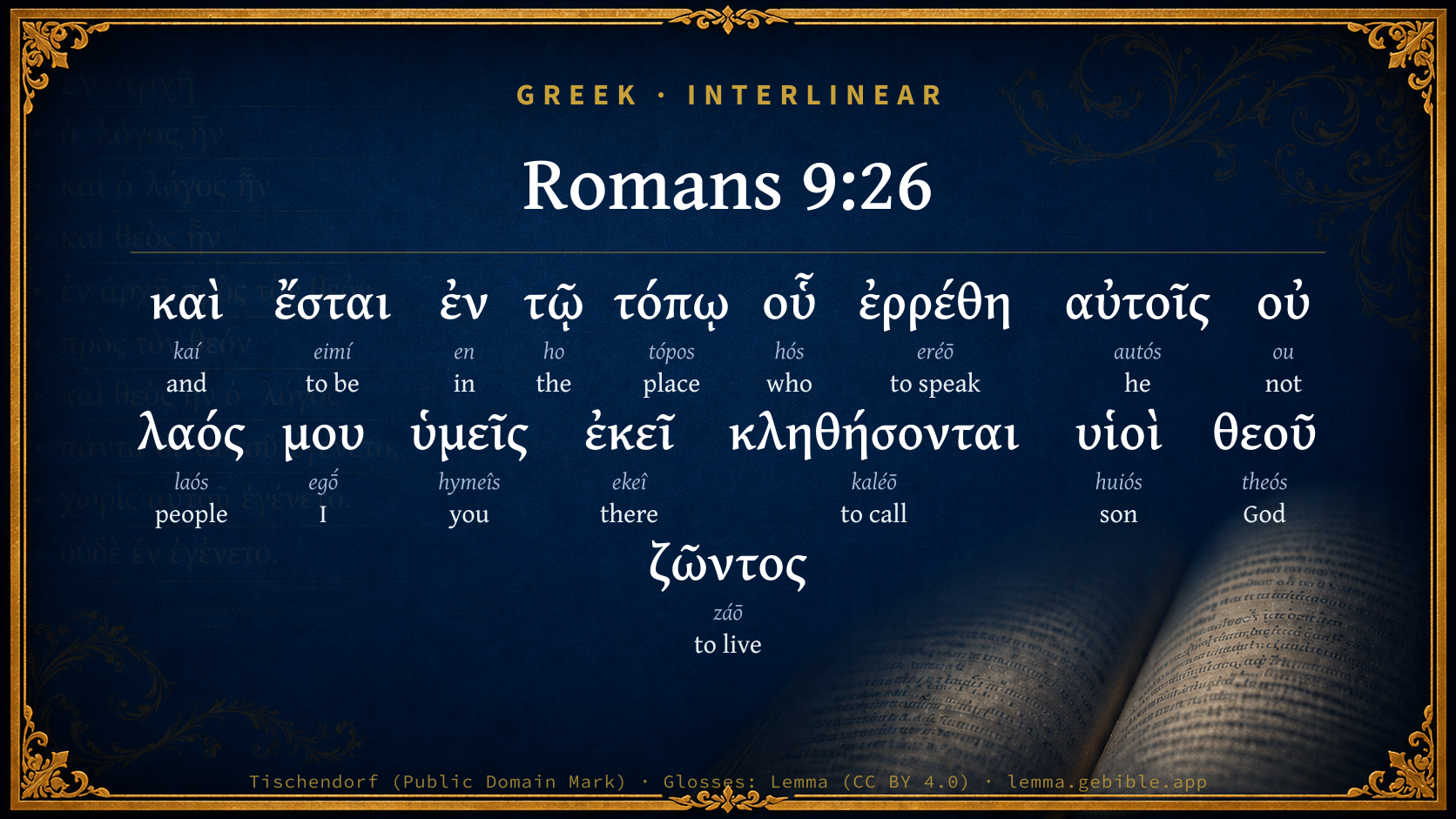
Greek (Tischendorf 8th ed.) Romans 9:26 appears in the Greek New Testament. The text above is from the Tischendorf 8th edition. Each word links to its Strong’s number and a concise gloss. Click any word for its full Thayer’s Greek Lexicon entry.
Download image
Cite this verse

Romans 9:26 (World English Bible). Public Domain. Lemma interlinear Bible study tool, https://lemma.gebible.app/v/romans/9/26.

Show BibTeX & RIS
BibTeX
RIS
English Translation
"It will be that in the place where it was said to them, 'You are not my people,' There they will be called 'children of the living God.'"
World English Bible · Public Domain
Download a study sheet

One document with this verse’s original text, its word-by-word gloss line, the meaning frame, cross-references with their text, attributed commentary, and full source and license credits — printable, and it pastes into notes with its structure intact.

This verse Autodidact and up

Study sheet (.html) Plain text (.txt)

A passage Seminary Student

Up to 50 verses in one chapter. A passage sheet keeps up to 6 commentary sources and 12 cross-references per verse, in the order this page ranks them, and says so on the sheet whenever that leaves anything out. Ask for a single verse and you get the Autodidact verse sheet above.

Everything on this page stays free to read, with no account — the sheet is a download of what is already on screen, not access to it.

Want to remove ads? Support Godless Engineer
Compare translations 3

The same verse in 3 English versions, stacked beneath the original-language interlinear above. Click any original word for its lexicon entry.

Each is an independent rendering of the whole verse — the interlinear is not word-aligned to these translations.

Highlighted words mark where these versions differ — a whole-verse word diff, not a word-by-word alignment.

  • World English Bible Public Domain
    "It will be that in the place where it was said to them, 'You are not my people,' There they will be called 'children of the living God.'"
  • King James Version Public Domain
    And it shall come to pass, that in the place where it was said unto them, Ye are not my people; there shall they be called the children of the living God.
  • unfoldingWord Literal Text CC BY-SA 4.0
    And it will be that in the place where it was said to them, ‘You not my people,’ there they will be called ‘sons of the living God.’”

unfoldingWord Literal Text — © unfoldingWord, licensed CC BY-SA 4.0. Word-aligned USFM3 via Door43 (git.door43.org/unfoldingWord/en_ult).

Versions to compare (up to 4)

3 of 4 selected

Show all 19 translations

Every available English version of this verse, each an independent rendering of the whole verse.

  • World English Bible Public Domain
    "It will be that in the place where it was said to them, 'You are not my people,' There they will be called 'children of the living God.'"
  • Berean Standard Bible Public Domain
    and, “It will happen that in the very place where it was said to them, ‘You are not My people,’ they will be called ‘sons of the living God.’”
  • Majority Standard Bible Public Domain
    and, “It will happen that in the very place where it was said to them, ‘You are not My people,’ they will be called ‘sons of the living God.’”
  • King James Version Public Domain
    And it shall come to pass, that in the place where it was said unto them, Ye are not my people; there shall they be called the children of the living God.
  • American Standard Version (1901) Public Domain
    And it shall be, `that' in the place where it was said unto them, Ye are not my people, There shall they be called sons of the living God.
  • Revised Version (1885) Public Domain
    And it shall be, that in the place where it was said unto them, Ye are not my people, There shall they be called sons of the living God.
  • Geneva Bible (1599) Public Domain
    And it shalbe in the place where it was said vnto them, Ye are not my people, that there they shalbe called, The children of the liuing God.
  • Douay-Rheims (1899) Public Domain
    And it shall be, in the place where it was said unto them, You are not my people; there they shall be called the sons of the living God.
  • Young's Literal Translation Public Domain
    and it shall be -- in the place where it was said to them, Ye `are' not My people; there they shall be called sons of the living God.'
  • Literal Standard Version CC BY-SA 4.0
    and it will be—in the place where it was said to them, You [are] not My people; there they will be called sons of the living God.”
  • Unlocked Literal Bible CC BY-SA 4.0
    Then it will be that where it was said to them, 'You are not my people,' there they will be called 'sons of the living God.'”
  • unfoldingWord Literal Text CC BY-SA 4.0
    And it will be that in the place where it was said to them, ‘You not my people,’ there they will be called ‘sons of the living God.’”
  • Darby Bible Public Domain
    And it shall be, in the place where it was said to them, *Ye* [are] not my people, there shall they be called Sons of [the] living God.
  • World Messianic Bible Public Domain
    “It will be that in the place where it was said to them, ‘You are not my people,’ there they will be called ‘children of the living God.’”
  • Webster's Bible Public Domain
    And it shall come to pass, that in the place where it was said to them, Ye are not my people; there shall they be called, The children of the living God.
  • Free Bible Version CC BY-SA 4.0
    and, “It will happen that at the place where they were told, ‘You're not my people,’ there they will be called the children of the living God.”
  • Bible in Basic English Public Domain
    And in the place where it was said to them, You are not my people, there they will be named the sons of the living God.
  • Text-Critical English NT CC BY 4.0
    And in the place where it was said to them, ‘You are not my people,’ there they will be called ‘sons of the living God.’ ”
  • Tyndale New Testament (1534) Public Domain
    And it shall come to passe in the place where it was sayd vnto them ye are not my people: that there shalbe called the chyldren of the lyvynge God.

Literal Standard Version (2020), Covenant Press — licensed CC BY-SA 4.0. Text via the HelloAO Bible API (eBible.org). Unlocked Literal Bible (unfoldingWord) — licensed CC BY-SA 4.0. Text via the HelloAO Bible API (eBible.org). unfoldingWord Literal Text — © unfoldingWord, licensed CC BY-SA 4.0. Word-aligned USFM3 via Door43 (git.door43.org/unfoldingWord/en_ult). Free Bible Version, Dr. Jonathan Gallagher — licensed CC BY-SA 4.0. Text via the HelloAO Bible API (eBible.org).

Word by word

More ways to search: Search by grammar → Find every occurrence → Compare this word →

Practice this passage: Drill this verse → Learn its vocabulary →

ἐκεῖ
ekeî
G1563
“there”
Adverb
Part of Speech
Adverb
Full Thayer's Definition

Origin: of uncertain affinity

TDNT: None

1. there, in or to that place
  1. καὶ kaí G2532 “and” Conjunction
  2. ἔσται eimí G1510 “to be” Verb, Future, Middle deponent, Indicative, 3rd person, Singular
  3. ἐν en G1722 “in” Preposition
  4. τῷ ho G3588 “the” Article, Dative, Singular, Masculine
  5. τόπῳ tópos G5117 “place” Noun, Dative, Singular, Masculine
  6. οὗ hós G3739 “who” Adverb
  7. ἐρρέθη eréō G2046 “to speak” Verb, Aorist, Passive, Indicative, 3rd person, Singular
  8. αὐτοῖς autós G846 “he” Personal pronoun, Dative, Plural, Masculine
  9. οὐ ou G3756 “not” Particle, Negative
  10. λαός laós G2992 “people” Noun, Nominative, Singular, Masculine
  11. μου egṓ G1473 “I” Personal pronoun, 1st person, Genitive, Singular
  12. ὑμεῖς hymeîs G5210 “you” Personal pronoun, 2nd person, Nominative, Plural
  13. κληθήσονται kaléō G2564 “to call” Verb, Future, Passive, Indicative, 3rd person, Plural
  14. υἱοὶ huiós G5207 “son” Noun, Nominative, Plural, Masculine
  15. θεοῦ theós G2316 “God” Noun, Genitive, Singular, Masculine
  16. ζῶντος záō G2198 “to live” Verb, Present, Active, Participle, Genitive, Singular, Masculine

About this verse

These counts appear in no published source. They are computed here, from the morphology-tagged text and Lemma’s own curated glosses. What Lemma adds →

17
words
17
distinct lemmas
Pauline Epistles
section

Cross-references

8

Topical passages linked to Romans 9:26 in the Treasury of Scripture Knowledge — connected by theme and wording, ordered by reader-vote popularity; previews shown in the World English Bible.

  • Hosea 1:9–10 He said, "Call his name Lo-Ammi; for you are not my people, and I will not be yours.
  • 1 John 3:1–3 Behold, how great a love the Father has bestowed on us, that we should be called children of God! For this cause the world doesn't know us, because it didn't know him.
  • Isaiah 43:6 I will tell the north, Give up; and to the south, Don't keep back; bring my sons from far, and my daughters from the end of the earth;
  • Romans 8:16 The Spirit himself testifies with our spirit that we are children of God;
  • Galatians 3:26 For you are all children of God, through faith in Christ Jesus.
  • 2 Corinthians 6:18 I will be to you a Father. You will be to me sons and daughters,' says the Lord Almighty."
  • Matthew 16:16 Simon Peter answered, "You are the Christ, the Son of the living God."
  • John 11:52 and not for the nation only, but that he might also gather together into one the children of God who are scattered abroad.

Cross-references courtesy of OpenBible.info (CC BY 4.0).

Commentary

Notes on Romans 9:26 from classic Christian and Jewish commentators (each source and its license shown beneath its notes). The classic Christian expositions comment on the surrounding passage and are grouped to its opening verse, so a note may address several verses; the Jewish commentaries on the Tanakh (Rashi and others) are per-verse, so they appear only where the commentator wrote on this verse.

Lemma curates 59 commentaries, every one of them public domain or Creative Commons licensed, each selected and text-cleaned for this edition rather than reprinted as found. About our sources →

McGarvey & Pendleton's Commentaries

J. W. McGarvey

And it shall be [shall come to pass], that in the place where it was said unto them, Ye are not my people, There shall they be called sons of the living God . [These verses originally apply to the to-be-returned-and-reinstated ten tribes, after the devastation and deportation inflicted by the Assyrians. To illustrate the stages in the rejection of Israel, Hosea was to take a wife and name his daughter by her Lo-ruhamah, which means, "that hath not obtained mercy" ( 1Pe_2:10 ), which Paul translates "not beloved"; and the son by her he was to name Lo-ammi; i. e., "not my people." This symbolic action is followed by the prophecy (not yet fulfilled) that the day should come when "Lo-ruhamah" would be changed to "Ruhamah," "that which hath obtained mercy" or "beloved"; and "Lo-ammi" would be changed to "Ammi," "my people." Some expositors have been at a loss to see how Paul could find in this prophecy concerning Israel a prediction relating to the call of the Gentiles. But the prophecy and the facts should make the matter plain. By calling them "not my people," God, through Hosea, reduced the ten tribes to the status of Gentiles, who were likewise rejected and cast off. Paul therefore reasons that if the restoration of the ten tribes would be the same as calling the Gentiles, the prophecy indicates the call of Gentiles. All this is borne out by the facts in the case. The "lost tribes" are to-day so completely Gentile, that, without special revelation from God, their call must be the same as calling Gentiles. The word "place" ( Rom_9:26 ) is significant. The land of the Gentiles, where the ten tribes are dispersed and rejected, and are become as Gentiles, is to be the place of their reinstatement and acceptance, and this acceptance shall resound among the Gentiles. This publishing on the part of the Gentiles is a strong indication of their interest, hence of their like conversion. Having shown by Hosea that the "no-people" or non-elect Gentiles are clearly marked in Scripture, as called and chosen, Paul now turns to Isaiah to show that of the elect, or Jewish people, only a remnant shall be saved. And this fact is the source of that grief which Paul mentions at the beginning of the chapter.]

J. W. McGarvey (with Philip Y. Pendleton), Commentaries on the New Testament (The Fourfold Gospel, 1914; Acts; and the epistles) — public domain. Text from a community e-Sword/MySword module.

Bengel's Gnomon

Johann Albrecht Bengel

Rom 9:26. καὶ—ἐκεῖ κληθήσονται—ζῶντος) Hos 2:1, LXX. καὶ—κληθήσονται καὶ αὐτοὶ—ζῶντος.—ἐκεῖ) there: So it is not necessary for them to change their country and betake themselves to Judaea, comp. Zep 2:11.

Bengel's Gnomon of the New Testament — English translation (T&T Clark, Edinburgh, 1860) — public domain. Text from a community e-Sword module.

Meyer's Critical & Exegetical Commentary

Heinrich August Wilhelm Meyer

Rom_9:26. Hos_2:1 (almost literally from the LXX., Rom_1:10) is joined to the former passage, so that both are regarded as forming one connected declaration. Often so in Rabbinical usage, even when the passages belong to different writers. See Surenhusius, καταλλ., p. 464. 45.

καὶ ἔσται] וְהָיָה, and it (the following) will come to pass. Comp. Act_2:21. These words are included in those of the prophecy (see also the LXX.), and therefore a colon is not to be placed after καί, as though they were the apostles (Hofmann and others).

These words also treat, in Hosea himself, of the theocratic restoration of the exiled people of the kingdom of Ephraim, so that ἐν τῷ τόπῳ οὗ denotes Palestine, whither the outcasts were to return (not the place of exile, as Hengstenberg, I. p. 248, and others think). But Paul recognises the antitypic fulfilment, as before at Rom_9:25, in the calling of the Gentiles, who, previously designated by God as not His people, become now, in consequence of the divine calling, sons of the living (true) God. See on Rom_9:25. But in this sense of Messianic fulfilment, according to Paul, the τόπος οὗ ἐῤῥέθη αὐτοῖς κ.τ.λ. cannot be Palestine, as it is in the historical sense of the prophet; nor yet is it the communion of saints (de Wette, comp. Baumgarten-Crusius: the ideal state, the divine kingdom), nor the coetus Christianorum, ubi diu dubitatum est, an recte gentiles reciperentur (Fritzsche); but simplyand this is also the ordinary explanationthe locality of the Gentiles, the Gentile lands. There, where they dwelt, there they, called by God to the salvation of the Messiah, were now named sons of the true God; and there, too, it had been before said to them: Ye are not my people! in so far, namely, as this utterance of rejection was the utterance of God, which, published to the Gentiles, is conceived, in the plastic spirit of poetry, as resounding in all Gentile lands. To suppose the locality without significance (Krehl), is inconsistent with its being so carefully designated. And to take ἐν τῷ τόπῳ οὗ, with Ewald, not in a local sense at all, but in that of instead that, even if it agree with the Hebrew (comp. Hitzig), cannot be made to agree with the Greek words. The LXX. understood and translated בִּמְקוֹם אֲשֶׁר locally, and rightly so.

Meyer — Critical and Exegetical Commentary on the New Testament — English translation by Peter Christie, edited by Frederick Crombie (T&T Clark, 1880) — public domain. Text from a community e-Sword module.

Hodge's Commentary on Romans, Ephesians & First Corinthians

Charles Hodge

Rom_9:26

And it shall come to pass, that in the place where it was said to them, Ye are not my people, etc. This quotation is more strictly conformed to the Hebrew than the preceding. It is from Hos_1:10. The sentiment is the same as before. The combination of two or more disconnected passages in one quotation, is not unusual in the New Testament, and was a common practice with the Jewish Rabbins, who, as Surenhusius says, Interdum plura loca sacrae Scripturae in unum contrahi solent ad efficaciorem rei demonstrationem. In the place where, ἐν τῷ τόπῳ ou[, is by many understood of Palestine. The prophet predicts the ten tribes should be restored, and that they should be again recognised as part of the people of God in the very place where they had been regarded as apostates and outcasts. Others think that the apostle refers to the church, in coetu Christianorum, ubi diu dubitatum est, an recte Gentiles reciperentur, ibi appellabantur filii Dei Fritzsche. Much the most common and natural explanation is, that the reference is indefinitely to the heathen world. Wherever, in every place, where the people had been regarded as aliens, they should be called the children of God. That is, those formerly not his people, should become his people.

Charles Hodge — Commentary on Romans (1835), First Corinthians (1857), and Ephesians (1856) — public domain. Text from a community e-Sword module.

Geneva Bible (1599)

Geneva Bible translators

Hos. 1:10

Geneva Bible (1599) marginal notes — public domain. Text via Bolls.life.

Jamieson, Fausset & Brown

Robert Jamieson, A. R. Fausset & David Brown

And--another quotation from Hos 1:10.

it shall come to pass, that in the place where it was said unto them, Ye are not my people; there shall they be called the children--"called sons"

of the living God--The expression, "in the place where . . . there," seems designed only to give greater emphasis to the gracious change here announced, from divine exclusion to divine admission to the privileges of the people of God.

Jamieson, Fausset & Brown — Commentary Critical and Explanatory on the Whole Bible (1871) — public domain (CC PDM 1.0). Text via the HelloAO Bible API.

Adam Clarke's Commentary

Verse 26. And it shall come to pass, c.] These quotations are taken out of Hosea, Ho 1:10, where (immediately after God had rejected the ten tribes, or kingdom of Israel, Ho 1:9, then saith God, Call his name Lo-ammi for ye are not my people, and I will not be your God,) he adds, yet the number of the children of Israel shall be as the sand of the sea, which cannot be measured nor numbered: and it shall come to pass, that in the place in which it was said unto them, Ye are not my people; there it shall be said unto them, Ye are the sons of the living God. As if he had said: The decrease of numbers in the Church, by God's utterly taking away the ten tribes, (Ho 1:6,) shall be well supplied by what shall afterwards come to pass, by calling the Gentiles into it. They, the rejected Jews, which had been the people of God, should become a Lo-ammi-not my people. On the contrary, they, the Gentiles, who had been a Lo-ammi-not my people, should become the children of the living God. Again, Ho 2:23: I will sow her (the Jewish Church) unto me in the earth, (alluding probably to the dispersion of the Jews over all the Roman empire; which proved a fruitful cause of preparing the Gentiles for the reception of the Gospel,) and, or moreover, I will have mercy upon her, the body of the believing Gentiles, that had not obtained mercy. See Taylor.

Adam Clarke's Commentary on the Bible (1810–1826) — public domain. Text from a community e-Sword/MySword module.

John Calvin's Commentaries

26. I will call them my people which are not a people This is said with respect to the divorce, which God had already made with the people, by depriving them of all honor, so that they did not excel other nations. Though they indeed, whom God in his eternal counsel has destined as sons to himself, are perpetually his sons, yet Scripture in many parts counts none to be God’s children but those the election of whom has been proved by their calling: and hence he teaches us not to judge, much less to decide, respecting God’s election, except as far as it manifests itself by its own evidences. Thus Paul, after having shown to the Ephesians that their election and adoption had been determined by God before the creation of the world, shortly after declares, that they were once alienated from God, (Ephesians 2:12,) that is, during that time when the Lord had not manifested his love towards them; though he had embraced them in his eternal mercy. Hence, in this passage, they are said not to be beloved, to whom God declares wrath rather than love: for until adoption reconciles men to God, we know that his wrath abides on them.

The feminine gender of the participle depends on the context of the prophet; for he had said, that a daughter had been born to him, to whom he gave this name, Not beloved, in order that the people might know that they were hated by God. Now as rejection was the reason for hatred, so the beginning of love, as the prophet teaches, is, when God adopts those who had been for a time strangers.

John Calvin's Commentaries (1540-1563) — public domain. Text from the Calvin Translation Society English edition (1840s-50s) via the Christian Classics Ethereal Library (ccel.org). Calvin's coverage is partial (roughly two-thirds of the Bible); uncommented books and verses are honest gaps, never fabricated. The 19th-century editor's footnotes and remarks are omitted so the notes are faithfully Calvin's own voice.

Ellicott's Commentary for English Readers

(26) And it shall come to pass.—This, too, was originally spoken of the restoration of the northern exiles to the land of Palestine. As applied to the conversion of the Gentiles, it would mean that the lands which had previously been heathen should become Christian. There is some doubt whether the Hebrew of Hosea should not rather be translated, “instead of calling them,” for “in her place where it was said unto them.” Instead of calling them “Ye are not my people,” they will be called “Sons of the living God.” So Ewald and Hitzig.

A Bible Commentary for English Readers, edited by Charles John Ellicott (1878–1897) — public domain. Text from a community e-Sword module.

The Cambridge Bible for Schools and Colleges

gen. ed. J. J. S. Perowne

26. And it shall come to pass, &c.] A new quotation, linked in one line with the last. Nearly verbatim with LXX. of Hos_1:10 (Rom_2:1 in the Heb.). For a first and second reference see last note but one.—“In the place where:”—this, in the first reference, may mean the Sanctuary from which the restored Israelite should no more be excluded; in the second, the Church and Family of the Promise, regarded as a locality in the figure. For the doctrine, cp. Eph_2:19-22.

the children] For comment, see Rom_8:14, &c.; Joh_1:12; 1Jn_3:1.

The Cambridge Bible for Schools and Colleges (gen. ed. J. J. S. Perowne; Cambridge University Press, 1878–1918) — public domain. Text from a community e-Sword module.

John Gill's Exposition

Esaias crieth concerning Israel,.... The apostle having produced proper testimonies in proof of the calling of the Gentiles, proceeds to mention others; showing, that some few of the Jews also were to be called, according to prophecy, founded upon divine predestination; which, though they are full proofs of the calling of some from among the Jews, yet at the same time suggest the casting off of the far greater number of them; and which is the apostle's view in citing them, as appears from what he says both here and in the two following chapters. The first testimony is taken out of Isa 10:22, and is prefaced or introduced with these words; which either express the great concern of mind and sorrow of heart, with which the prophet spoke them, even with strong crying and tears, seeing a remnant of them only was to be saved; or they show his heart's desire and prayer to God, "for Israel", as the words may be rendered, how that he cried to the Lord for them, entreated him with earnestness and importunity, and wrestled with him on their behalf; or they declare the presence of mind, the freedom of expression, the boldness and intrepidity with which he delivered this message to the Jews, which he knew must be ungrateful to them; in doing which, he run the risk of losing his interest in their affections, if not his life; and inasmuch very probably they did not choose to hear it, but turned away from him, he cried aloud, he spared not, he lift up his voice like a trumpet, as he is bid to do elsewhere, resolving they should hear what he had to say, from the Lord of hosts. This is a form of speech used by the Jews, in citing Scripture; thus, , "the prophet cries" (p), namely, in Isa 26:1, which is spoken of the same prophet as here; and again (q) the Holy Spirit "cries, and says", in some certain passage of Scripture; and in another place (r) the Holy Spirit "cried", saying, as in Joe 3:3, "they have cast lots for my people".

Though the number of the children of Israel be as the sand of the sea: this part of the testimony seems rather to be taken from Hos 1:10, which may easily be accounted for; since the apostle had just cited the words in Hosea, and so carrying them in his mind, transcribes this sentence from thence; it perfectly agreeing in sense with the passage in Isaiah he had in view, where it stands thus, "though thy people Israel be as the sand of the sea", Isa 10:22; that is, though the number of them be such as to be compared thereunto; though they are many as the sand of the sea, as the Targum, Kimchi, and Aben Ezra explain it. This was promised unto Abraham, and had its accomplishment in the days of Solomon, and in after times; they were for quantity, for number, as the sand of the sea, even innumerable; and for quality, being barren and unfruitful, a people laden with iniquity, a seed of evildoers:

a remnant shall be saved; that is, a few persons only; , "few are called a remnant", as Kimchi on the place observes; these are the remnant among the Jews, according to the election of grace; the few that were chosen, though many were called by the external ministry of Christ and his apostles; the little city, and few men in it, even the escaped of Israel, he that was left in Zion, and that remained in Jerusalem; the little flock among them, which were as sheep among wolves; the few that entered in at the strait gate, and found the way to eternal life; the few that shall be saved; and these shall certainly be saved, with a spiritual and eternal salvation. These, according to the prophecy, were to return to the mighty God, the Lord Jesus Christ, the promised Messiah; be converted to him, and so saved by him with an everlasting salvation: God had resolved upon it, whose counsel shall stand; he had promised it in covenant, which is ordered in all things and sure; he sent his Son to save these his people from their sins, who is become the author of eternal salvation to them; the grace of God is efficacious and powerful enough, to make them willing to be saved by Christ, and to bring them to him, to venture upon him, and commit their souls to him, to be saved by him; and almighty power is concerned, to keep them through faith unto salvation: so that this little remnant, through the Father's everlasting and unchangeable love, the Son's purchase, prayers, and preparations, and the spirits grace, which works them up for this selfsame thing, shall be certainly and completely saved; though with respect to the difficulties attending it, which could have been surmounted by none but Christ, and by reason of their discouragements arising from sin, temptations, and persecutions, they may be said to be scarcely saved.

(p) Tanchuma, fol. 17. 3. apud Surenhus. Biblos Katallages, p. 14. (q) Mechilta, fol. 15. 1. Ib. (r) Megillat Esther, fol. 93. 1.

John Gill's Exposition of the Whole Bible (1746–1763) — public domain (CC PDM 1.0). Text via the HelloAO Bible API.

Trapp's Complete Commentary

John Trapp

26 And it shall come to pass, that in the place where it was said unto them, Ye are not my people; there shall they be called the children of the living God.

Ver. 26. The children, &c.] This is such a royalty, Joh 1:12, as the apostle worthily wondereth at, and sets an Ecce Behold, upon it.

John Trapp, A Commentary or Exposition upon All the Books of the Old and New Testament (1647–1656) — public domain. Text from a community e-Sword module.

Albert Barnes' Notes on the Bible

And it shall come to pass - It shall happen, or take place. This is a continuation of the quotation from the prophet Hosea Hos 1:10, designed to confirm the doctrine which he was establishing. Both these quotations have the same design, and are introduced for the same end. In Hosea they did not refer to the calling of the Gentiles, but to the recalling the rejected Jews. God says, after the Jews had been rejected and scattered for their idolatry; after they had forfeited his favor, and been cast off as if they were not his people; he would recall them, and bestow on them again the appellation of sons. The apostle does not quote this as having original reference to the Gentiles, but for the following purposes:

(1) If God formerly purposed to recall to himself a people whom he had rejected; if he bestowed favors on his own people after they had forfeited his favor, and ceased to be entitled to the name of “his people:” then the same thing was not to be regarded as absurd if he dealt in a similar manner with the Gentiles - also a part of his original great family, the family of man, but long since rejected and deemed strangers.

(2) The dealings of God toward the Jews in the time of Hosea settled “a general principle of government.” His treatment of them in this manner was a part of his great plan of governing the world. On the same plan he now admitted the Gentiles to favor. And as this “general principle” was established; as the history of the Jews themselves was a precedent in the case, it ought not to be objected in the time of Paul that the “same principle” should be carried out to meet the case also of the Gentiles.

In the place - The place where they may be scattered, or where they may dwell. Or rather, perhaps, in those nations which were not regarded as the people of God, there shall be a people to whom this shall apply.

Where it was said unto them - Where the proper appellation of the people was, that they were not the people of God; where they were idolatrous, sinful, aliens, strangers; so that they had none of the marks of the children of God.

Ye are not my people - People in covenant with God; under his protection, as their Sovereign, and keeping his laws.

There shall they be called - That is, there they “shall be.” The verb to call in the Hebrew writings means often the same as “to be.” It denotes that this shall be the appellation which properly expresses their character. It is a figure perhaps almost unique to the Hebrews; and it gives additional interest to the case. Instead of saying coldly and abstractedly, “they are such,” it introduces also the idea that such is the “favorable judgment” of God in the case; see Mat 5:9, “Peace-makers ...shall be called the children of God;” see the note on that place; also Rom 9:19; Mat 21:13, “My house shall “be called” the house of prayer;” Mar 11:17; Luk 1:32, Luk 1:35, Luk 1:76; Isa 56:7.

The children of ... - Greek, Sons; see the note at Mat 1:1.

Living God - Called living God in opposition to dead idols; see the Mat 16:16 note; also Mat 26:63 note; Joh 6:69 note; Act 14:15 note; 1Th 1:1-10 is a most honorable and distinguished appellation. No higher favor can be conferred on mortals than “to be” the sons of the living God; members of his family; entitled to his protection; and secure of his watch and care. This was an object of the highest desire with the saints of old; see Psa 42:2; Psa 84:2,” My soul thirsteth for God, the living God;” “My heart and my flesh cry out for the living God.”

Albert Barnes' Notes on the Bible (1834–1885) — public domain. Text from a community e-Sword/MySword module.

Matthew Poole's English Annotations

This testimony is taken out of Hos 1:10; and it is as if he had said: This that I affirm concerning the conversion and calling of the Gentiles, is nothing else but what the prophet Hosea long ago did preach to our fathers. Some think, these places in Hosea do speak primarily of the Jews, and but secondarily, or by consequence, of the Gentiles. Others think, that they speak chiefly of the Gentiles; those terms (not beloved, and not a people) being in Scripture mostly used of them.

Matthew Poole's English Annotations on the Holy Bible (1683–1685) — public domain. Text from a community e-Sword/MySword module.

Whedon's Commentary on the Bible

Daniel D. Whedon

26. Come to pass—Hos_1:10. Both these passages describe the recovery of the Jews from their apostasy and from the Assyrian captivity.

Daniel D. Whedon (gen. ed.), Commentary on the Old and New Testaments (1874–1909) — public domain. Text from a community e-Sword module.

John Wesley's Explanatory Notes

There shall they be called the sons of God - So that they need not leave their own country and come to Judea. Hosea i, 10

John Wesley, Explanatory Notes Upon the Whole Bible (1754–1765) — public domain. Text via the GEBible commentary corpus.

Scofield Reference Notes

C. I. Scofield

children (Greek - τέκνον, sons).

(See Scofield "Eph 1:5")

God Hos 1:10

The Scofield Reference Bible (1917 edition), notes by C. I. Scofield — public domain. Text from a community e-Sword module.

Cambridge Greek Testament for Schools and Colleges

26. Hos 1:10 describes the reunion of Israel into one nation under one head: again S. Paul extends the reference.

ἐν τῷ τόπῳ = Palestine in Hosea: here = the countries of the Gentiles.

θεοῦ ζῶντος. Cf. Act 14:15; Westcott on Heb 3:12.

Cambridge Greek Testament for Schools and Colleges (Cambridge University Press, 1896; 21 vols, various authors incl. Carr, Maclear, Plummer, Farrar, Lumby, Moule, M. R. James, Simcox) — public domain. Text from a community e-Sword module.

Alford’s Greek Testament

Henry Alford

26.] It is difficult to ascertain in what sense the Apostle cites these two passages from Hosea as applicable to the Gentiles being called to be the people of God. That he does so, is manifest from the words themselves, and from the transition to the Jews in ver. 27. In the prophet they are spoken of Israel; see ch. 1:6-11, and ch. 2 throughout: who after being rejected and put away, was to be again received into favour by God. Two ways are open, by which their citation by the Apostle may be understood. Either (1) he brings them forward to shew that it is consonant with what we know of God’s dealings, to receive as His people, those who were formerly not His people—that this may now take place with regard to the Gentiles, as it was announced to happen with regard to Israel,—and even more,—that Israel in this as in so many other things was the prophetic mirror in which God foreshowed on a small scale His future dealings with mankind,—or (2) he adduces them from mere applicability to the subject in hand, implying, ‘It has been with us Gentiles, as with Israel in the prophet Hosea.’ I own I much prefer the former of these, as more consonant with the dignity of the argument, and as apparently justified by the καί,—as He saith also in Hosea, implying perhaps that the matter in hand was not that directly prophesied in the citation, but one analogous to it. Chrys. takes the same view: εἰ γὰρ ἐπὶ τῶν ἀγνωμονησάντων μετὰ πολλὰς εὐεργεσίας, καὶ ἀλλοτριωθέντων, καὶ τὸ λαὸς εἶναι ἀπολωλεκότων, τοσαύτη γέγονεν ἡ μεταβολή, τί ἐκώλυε καὶ τοὺς οὐ μετὰ τὴν οἰκείωσιν ἀλλοτριωθέντας, ἀλλʼ ἐξ ἀρχῆς ἀλλοτρίους ὄντας, κληθῆναι, κ. ὑπακούσαντας τῶν αὐτῶν ἀξιωθῆναι; Hom. xvi. p. 618.

The fem. τήν is used because the Jewish people was typified by the daughter of the prophet, Hos 1:6, who was called Lo-ruhamah, ‘not having obtained mercy.’ The sense, not the words of the LXX, is quoted.

By ἐν τῷ τόπῳ … ἐκεῖ must not I think be understood, in any particular place, as Judæa, nor among any peculiar people, as the Christian Church: but as a general assertion, that in every place where they were called ‘not His people,’ there they shall be called ‘His people.’

Henry Alford, The Greek Testament (1849–1861) — public domain. Text from a community e-Sword module.

International Critical Commentary

26. καὶ ἔσται, ἐν τῷ τόπῳ … ἐκεῖ κ.τ.λ. St. Paul adds a passage with a similar purport from another part of Hosea (1:10). The meaning is the same and the application to the present purpose based on exactly the same principles. The habit had probably arisen of quoting passages to prove the calling of the Gentiles; and these would become commonplaces, which at a not much later date might be collected together in writing, see Hatch, Essays in Biblical Greek, p. 103, and cf. Rom 3:10. The only difference between St. Paul’s quotation and the LXX is that he inserts ἐκεῖ: this insertion seems to emphasize the idea of the place, and it is somewhat difficult to understand what place is intended. (1) In the original the place referred to is clearly Palestine: and if that be St. Paul’s meaning he must be supposed to refer to the gathering of the nations at Jerusalem and the foundation of a Messianic kingdom there (cf. 11:26). St. Paul is often strongly influenced by the language and even the ideas of Jewish eschatology, although in his more spiritual passages he seems to be quite freed from it. (2) If we neglect the meaning of the original, we may interpret ἐκεῖ of the whole world. ‘Wheresoever on earth there may be Gentiles, who have had to endure there the reproach of being not God’s people, in that place they shall be called God’s people, for they will become members of His Church and it will be universal.’

International Critical Commentary — older volumes (1896–1929), various authors — public domain. Text from a community e-Sword module.

Godet's Commentaries

Frédéric Louis Godet

Vv. 26. The second saying quoted (Hos 1:10) is attached to the preceding as if it followed it immediately in the prophet. More than once in the following chapters we find this combination of originally distinct sayings. Some apply the expression in Hosea: in the place where, to the land of Samaria, in the meaning that God there pronounced the rejection of the people. In that case, Paul, in applying this saying to the Gentiles, would have perverted it entirely from its meaning. But is it not more natural to apply this word: the place where, to the strange land where the Jews were long captive, and as it were abandoned of God? Was it not there God said to them by the voice of fact during long ages: “Ye are not my people”? Is it not there that they will begin anew to feel the effects of grace when God shall visit them, and recall them as well as the Gentiles, with whom they are at present confounded?

Frédéric Louis Godet — Commentaries on Luke, John, Romans, and 1 Corinthians — English translation (T&T Clark, Edinburgh, 1870s–1890s) — public domain. Text from a community e-Sword module.

Lesson kit

Teaching starters — assembled from the data on this page, not authored interpretation. Every prompt links to the verse data it draws on. Edit before teaching.

Romans, in the Pauline Epistles, opens this verse with 17 words (17 distinct Greek lemmas). Its most distinctive word is ekeî (“there”). A historical commentator’s framing appears above. Read the whole chapter for the surrounding context.

Discussion questions

  1. How does “there” (ekeî) shape what this verse is saying?
  2. How does Hosea 1:9–10, which shares this passage’s theme, read alongside this verse?
  3. The translations on this page render this verse differently — a whole-verse word diff, not a word-by-word alignment. What might account for the different wordings?
  4. Compare how McGarvey & Pendleton's Commentaries and Bengel's Gnomon read this verse. Where do they agree or differ?

Things to notice

Reading settings

Reading text

Shown beneath each verse's original-language words.

Old Testament
Old Testament edition

Read the OT as the Masoretic Hebrew (MT) or the Greek Septuagint (LXX).

English shown for the Greek Septuagint (in the Hebrew ↔ Greek comparison).

Comparing translations? Open the Compare panel on any verse page to stack up to four side by side.