Romans 4:17

Greek (Tischendorf 8th ed.) Romans 4:17 appears in the Greek New Testament. The text above is from the Tischendorf 8th edition. Each word links to its Strong’s number and a concise gloss. Click any word for its full Thayer’s Greek Lexicon entry.
Download image
Cite this verse

Romans 4:17 (World English Bible). Public Domain. Lemma interlinear Bible study tool, https://lemma.gebible.app/v/romans/4/17.

Show BibTeX & RIS
BibTeX
RIS
English Translation
As it is written, "I have made you a father of many nations." This is in the presence of him whom he believed: God, who gives life to the dead, and calls the things that are not, as though they were.
World English Bible · Public Domain
Download a study sheet

One document with this verse’s original text, its word-by-word gloss line, the meaning frame, cross-references with their text, attributed commentary, and full source and license credits — printable, and it pastes into notes with its structure intact.

This verse Autodidact and up

Study sheet (.html) Plain text (.txt)

A passage Seminary Student

Up to 50 verses in one chapter. A passage sheet keeps up to 6 commentary sources and 12 cross-references per verse, in the order this page ranks them, and says so on the sheet whenever that leaves anything out. Ask for a single verse and you get the Autodidact verse sheet above.

Everything on this page stays free to read, with no account — the sheet is a download of what is already on screen, not access to it.

Want to remove ads? Support Godless Engineer
Compare translations 3

The same verse in 3 English versions, stacked beneath the original-language interlinear above. Click any original word for its lexicon entry.

Each is an independent rendering of the whole verse — the interlinear is not word-aligned to these translations.

Highlighted words mark where these versions differ — a whole-verse word diff, not a word-by-word alignment.

  • World English Bible Public Domain
    As it is written, "I have made you a father of many nations." This is in the presence of him whom he believed: God, who gives life to the dead, and calls the things that are not, as though they were.
  • King James Version Public Domain
    (As it is written, I have made thee a father of many nations,) before him whom he believed, even God, who quickeneth the dead, and calleth those things which be not as though they were.
  • unfoldingWord Literal Text CC BY-SA 4.0
    just as it is written, “I have appointed you the father of many nations,” in the presence of God whom he trusted, the one making the dead ones live and calling the things not existing as existing;

unfoldingWord Literal Text — © unfoldingWord, licensed CC BY-SA 4.0. Word-aligned USFM3 via Door43 (git.door43.org/unfoldingWord/en_ult).

Versions to compare (up to 4)

3 of 4 selected

Show all 19 translations

Every available English version of this verse, each an independent rendering of the whole verse.

  • World English Bible Public Domain
    As it is written, "I have made you a father of many nations." This is in the presence of him whom he believed: God, who gives life to the dead, and calls the things that are not, as though they were.
  • Berean Standard Bible Public Domain
    As it is written: “I have made you a father of many nations.” He is our father in the presence of God, in whom he believed, the God who gives life to the dead and calls into being what does not yet exist.
  • Majority Standard Bible Public Domain
    As it is written: “I have made you a father of many nations.” He is our father in the presence of God, in whom he believed, the God who gives life to the dead and calls into being what does not yet exist.
  • King James Version Public Domain
    (As it is written, I have made thee a father of many nations,) before him whom he believed, even God, who quickeneth the dead, and calleth those things which be not as though they were.
  • American Standard Version (1901) Public Domain
    (as it is written, A father of many nations have I made thee) before him whom he believed, `even' God, who giveth life to the dead, and calleth the things that are not, as though they were.
  • Revised Version (1885) Public Domain
    (as it is written, A father of many nations have I made thee) before him whom he believed, even God, who quickeneth the dead, and calleth the things that are not, as though they were.
  • Geneva Bible (1599) Public Domain
    (As it is written, I haue made thee a father of many nations) euen before God whom he beleeued, who quickeneth the dead, and calleth those thinges which be not, as though they were.
  • Douay-Rheims (1899) Public Domain
    (As it is written: I have made thee a father of many nations,) before God, whom he believed, who quickeneth the dead; and calleth those things that are not, as those that are.
  • Young's Literal Translation Public Domain
    who is father of us all (according as it hath been written -- `A father of many nations I have set thee,') before Him whom he did believe -- God, who is quickening the dead, and is calling the things that be not as being.
  • Literal Standard Version CC BY-SA 4.0
    who is father of us all (according as it has been written: “A father of many nations I have set you,”) before Him whom he believed—God, who is quickening the dead, and is calling the things that are not as being.
  • Unlocked Literal Bible CC BY-SA 4.0
    as it is written, “I have made you the father of many nations.” Abraham was in the presence of him whom he trusted, that is, God, who gives life to the dead and calls the things that do not exist into existence.
  • unfoldingWord Literal Text CC BY-SA 4.0
    just as it is written, “I have appointed you the father of many nations,” in the presence of God whom he trusted, the one making the dead ones live and calling the things not existing as existing;
  • Darby Bible Public Domain
    (according as it is written, I have made thee father of many nations,) before the God whom he believed, who quickens the dead, and calls the things which be not as being;
  • World Messianic Bible Public Domain
    As it is written, “I have made you a father of many nations.” This is in the presence of him whom he believed: God, who gives life to the dead, and calls the things that are not, as though they were.
  • Webster's Bible Public Domain
    (As it is written, I have made thee a father of many nations) before him whom he believed, even God, who reviveth the dead, and calleth those things which are not, as though they were.
  • Free Bible Version CC BY-SA 4.0
    As Scripture says, “I've made you the father of many nations.” For in the presence of God, Abraham trusted in the God who makes the dead alive and speaks into existence what didn't previously exist.
  • Bible in Basic English Public Domain
    (As it is said in the holy Writings, I have made you a father of a number of nations) before him in whom he had faith, that is, God, who gives life to the dead, and to whom the things which are not are as if they were.
  • Text-Critical English NT CC BY 4.0
    (just as it is written, “I have made yoʋ the father of many nations”). He is our father in the presence of the God in whom he believed, who gives life to the dead and calls into being what does not yet exist.
  • Tyndale New Testament (1534) Public Domain
    As it is wrytten: I have made the a father to many nacions even before god whom thou hast beleved which quyckeneth the deed and called those thinges which be not as though they were.

Literal Standard Version (2020), Covenant Press — licensed CC BY-SA 4.0. Text via the HelloAO Bible API (eBible.org). Unlocked Literal Bible (unfoldingWord) — licensed CC BY-SA 4.0. Text via the HelloAO Bible API (eBible.org). unfoldingWord Literal Text — © unfoldingWord, licensed CC BY-SA 4.0. Word-aligned USFM3 via Door43 (git.door43.org/unfoldingWord/en_ult). Free Bible Version, Dr. Jonathan Gallagher — licensed CC BY-SA 4.0. Text via the HelloAO Bible API (eBible.org).

Word by word

More ways to search: Search by grammar → Find every occurrence → Compare this word →

Practice this passage: Drill this verse → Learn its vocabulary →

κατέναντι
katénanti
G2713
“opposite”
Adverb
Part of Speech
Adverb
Full Thayer's Definition

Origin: from G2596 and G1725

TDNT: None

1. over against, opposite before 2. metaph. before one i.e. he being judge
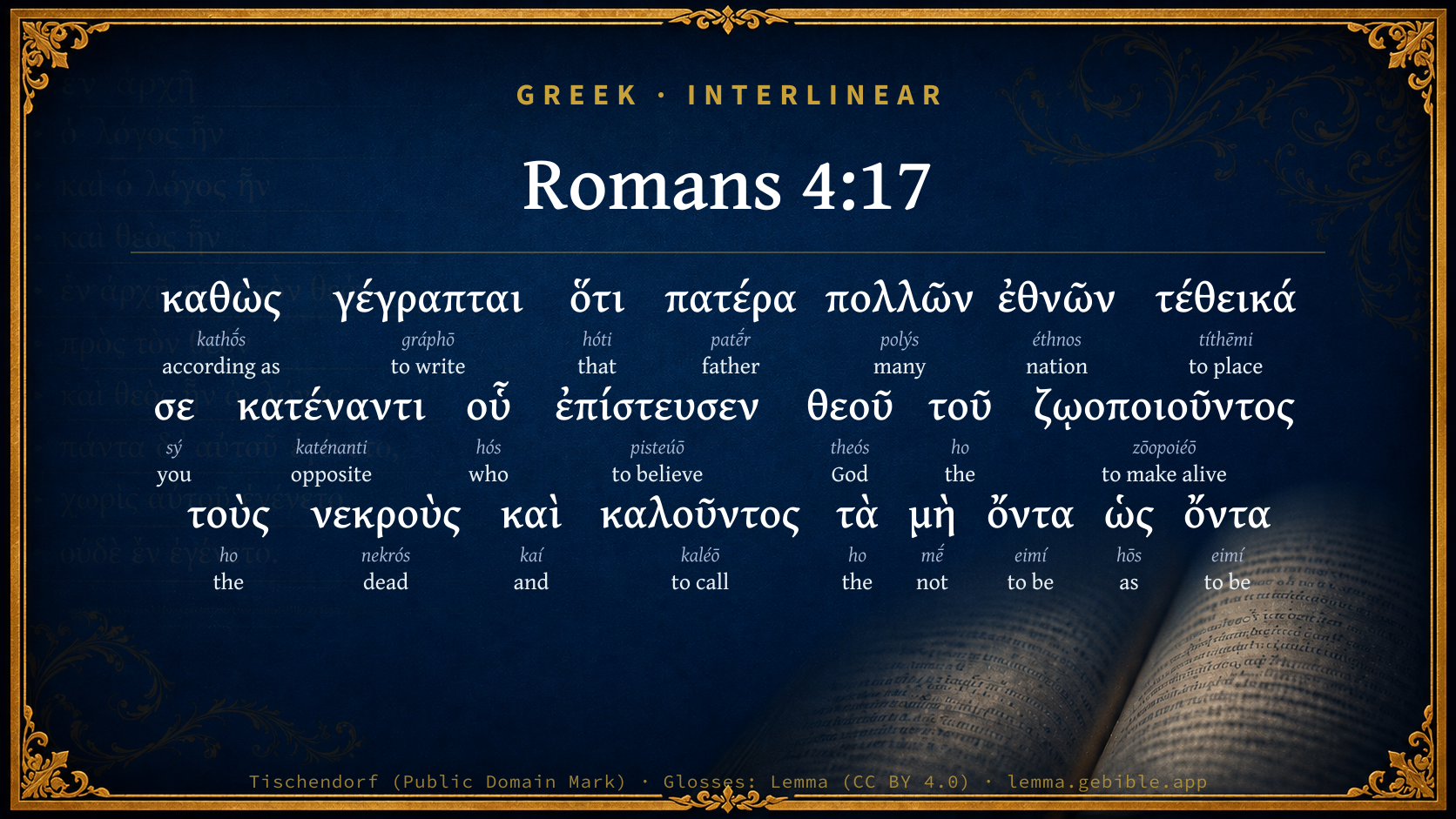
  1. καθὼς kathṓs G2531 “according as” Adverb
  2. γέγραπται gráphō G1125 “to write” Verb, Perfect, Passive, Indicative, 3rd person, Singular
  3. ὅτι hóti G3754 “that” Conjunction
  4. πατέρα patḗr G3962 “father” Noun, Accusative, Singular, Masculine
  5. πολλῶν polýs G4183 “many” Adjective, Genitive, Plural, Neuter
  6. ἐθνῶν éthnos G1484 “nation” Noun, Genitive, Plural, Neuter
  7. τέθεικά títhēmi G5087 “to place” Verb, Perfect, Active, Indicative, 1st person, Singular
  8. σε sý G4771 “you” Personal pronoun, 2nd person, Accusative, Singular
  9. οὗ hós G3739 “who” Relative pronoun, Genitive, Singular, Masculine
  10. ἐπίστευσεν pisteúō G4100 “to believe” Verb, Aorist, Active, Indicative, 3rd person, Singular
  11. θεοῦ theós G2316 “God” Noun, Genitive, Singular, Masculine
  12. τοῦ ho G3588 “the” Article, Genitive, Singular, Masculine
  13. ζῳοποιοῦντος zōopoiéō G2227 “to make alive” Verb, Present, Active, Participle, Genitive, Singular, Masculine
  14. τοὺς ho G3588 “the” Article, Accusative, Plural, Masculine
  15. νεκροὺς nekrós G3498 “dead” Adjective, Accusative, Plural, Masculine
  16. καὶ kaí G2532 “and” Conjunction
  17. καλοῦντος kaléō G2564 “to call” Verb, Present, Active, Participle, Genitive, Singular, Masculine
  18. τὰ ho G3588 “the” Article, Accusative, Plural, Neuter
  19. μὴ mḗ G3361 “not” Particle, Negative
  20. ὄντα eimí G1510 “to be” Verb, Present, Active, Participle, Accusative, Plural, Neuter
  21. ὡς hōs G5613 “as” Adverb
  22. ὄντα eimí G1510 “to be” Verb, Present, Active, Participle, Accusative, Plural, Neuter

About this verse

These counts appear in no published source. They are computed here, from the morphology-tagged text and Lemma’s own curated glosses. What Lemma adds →

23
words
20
distinct lemmas
Pauline Epistles
section

Notable vocabulary

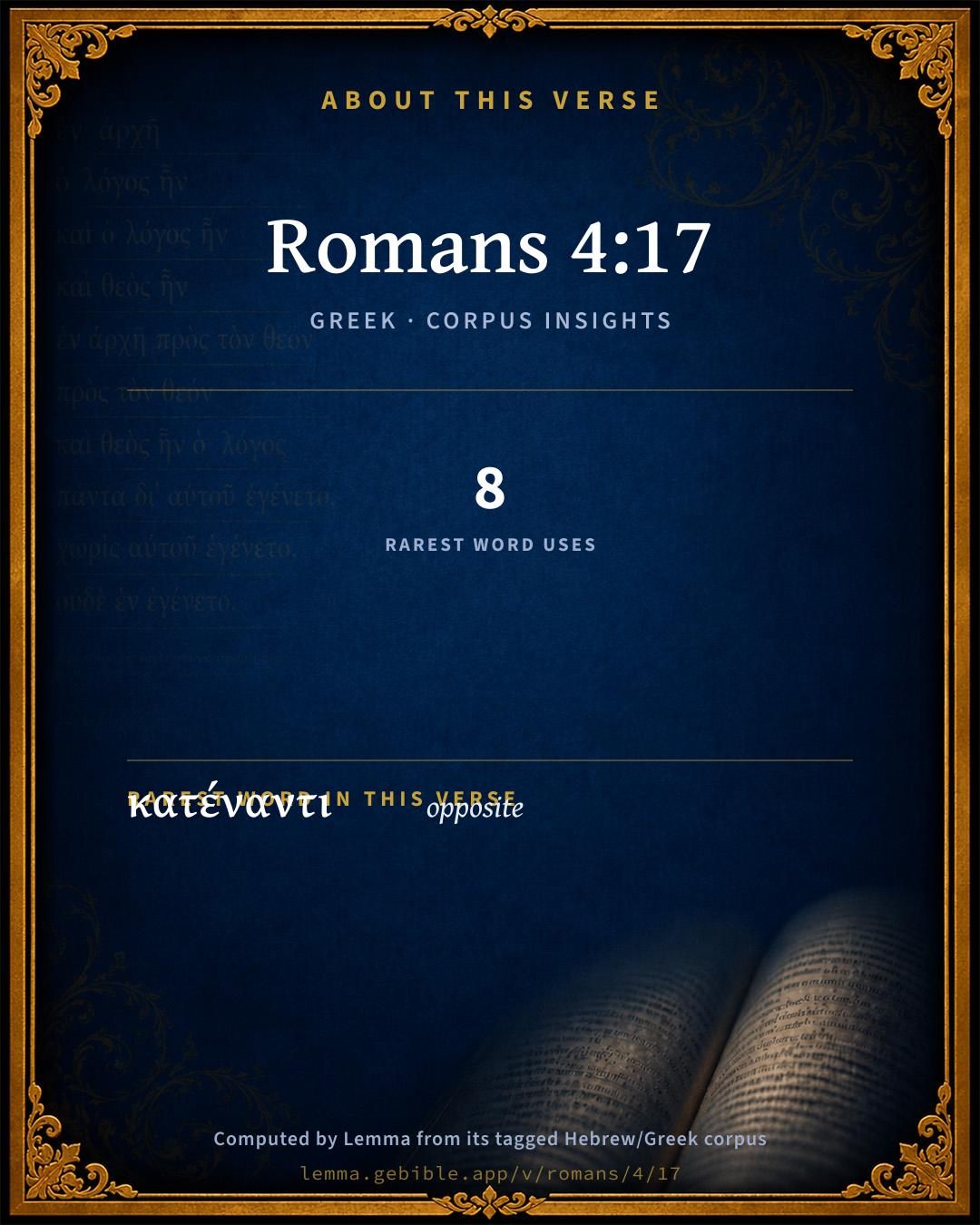
The rarest word here is κατέναντι opposite G2713 — appearing just 8 times in the whole Greek New Testament.

Shared distinctive vocabulary

κατέναντι opposite G2713 occurs in 8 verses of the Greek New Testament. Also found in:

Repetition

Words recur within this verse:

Cross-references

28

Topical passages linked to Romans 4:17 in the Treasury of Scripture Knowledge — connected by theme and wording, ordered by reader-vote popularity; previews shown in the World English Bible.

  • 1 Corinthians 1:28 and God chose the lowly things of the world, and the things that are despised, and the things that are not, that he might bring to nothing the things that are:
  • Genesis 17:4–5 "As for me, behold, my covenant is with you. You will be the father of a multitude of nations.
  • John 5:21 For as the Father raises the dead and gives them life, even so the Son also gives life to whom he desires.
  • Romans 8:29–30 For whom he foreknew, he also predestined to be conformed to the image of his Son, that he might be the firstborn among many brothers.
  • John 6:63 It is the spirit who gives life. The flesh profits nothing. The words that I speak to you are spirit, and are life.
  • 1 Peter 2:10 who in time past were no people, but now are God's people, who had not obtained mercy, but now have obtained mercy.
  • Ephesians 2:1–5 You were made alive when you were dead in transgressions and sins,
  • Romans 8:11 But if the Spirit of him who raised up Jesus from the dead dwells in you, he who raised up Christ Jesus from the dead will also give life to your mortal bodies through his Spirit who dwells in you.
  • John 5:25 Most assuredly, I tell you, the hour comes, and now is, when the dead will hear the Son of God's voice; and those who hear will live.
  • Isaiah 55:12 For you shall go out with joy, and be led forth with peace: the mountains and the hills shall break forth before you into singing; and all the trees of the fields shall clap their hands.
  • Romans 3:29 Or is God the God of Jews only? Isn't he the God of Gentiles also? Yes, of Gentiles also,
  • Hebrews 11:7 By faith, Noah, being warned about things not yet seen, moved with godly fear, prepared an ark for the saving of his house, through which he condemned the world, and became heir of the righteousness which is according to faith.
  • Hebrews 11:12 Therefore as many as the stars of the sky in multitude, and as innumerable as the sand which is by the sea shore, were fathered by one man, and him as good as dead.
  • Isaiah 44:7 Who, as I, shall call, and shall declare it, and set it in order for me, since I established the ancient people? and the things that are coming, and that shall happen, let them declare.
  • Isaiah 48:13 Yes, my hand has laid the foundation of the earth, and my right hand has spread out the heavens: when I call to them, they stand up together.
  • 2 Peter 3:8 But don't forget this one thing, beloved, that one day is with the Lord as a thousand years, and a thousand years as one day.
  • Genesis 17:16 I will bless her, and moreover I will give you a son by her. Yes, I will bless her, and she will be a mother of nations. Kings of peoples will come from her."
  • 1 Timothy 6:13 I charge you before God, who gives life to all things, and before Christ Jesus, who before Pontius Pilate testified the good confession,
  • Genesis 28:3 May God Almighty bless you, and make you fruitful, and multiply you, that you may be a company of peoples,
  • Isaiah 43:6 I will tell the north, Give up; and to the south, Don't keep back; bring my sons from far, and my daughters from the end of the earth;
  • Isaiah 49:12 Behold, these shall come from far; and, behold, these from the north and from the west; and these from the land of Sinim.
  • Romans 9:26 "It will be that in the place where it was said to them, 'You are not my people,' There they will be called 'children of the living God.'"
  • Genesis 25:1–34 Abraham took another wife, and her name was Keturah.
  • Matthew 3:9 Don't think to yourselves, 'We have Abraham for our father,' for I tell you that God is able to raise up children to Abraham from these stones.
  • Acts 15:18 All his works are known to God from eternity.'
  • Romans 4:2 For if Abraham was justified by works, he has something to boast about, but not toward God.
  • 1 Corinthians 15:45 So also it is written, "The first man, Adam, became a living soul." The last Adam became a life-giving spirit.
  • Genesis 17:20 As for Ishmael, I have heard you. Behold, I have blessed him, and will make him fruitful, and will multiply him exceedingly. He will become the father of twelve princes, and I will make him a great nation.

Cross-references courtesy of OpenBible.info (CC BY 4.0).

Commentary

Notes on Romans 4:17 from classic Christian and Jewish commentators (each source and its license shown beneath its notes). The classic Christian expositions comment on the surrounding passage and are grouped to its opening verse, so a note may address several verses; the Jewish commentaries on the Tanakh (Rashi and others) are per-verse, so they appear only where the commentator wrote on this verse.

Lemma curates 59 commentaries, every one of them public domain or Creative Commons licensed, each selected and text-cleaned for this edition rather than reprinted as found. About our sources →

The Biblical Illustrator

Joseph S. Exell

Rom_4:17-18

As it is written, I have made thee a father of many nations.

Gods promise to Abraham

I. Its grandeur and importance.

1. A spiritual seed.

2. A worldwide blessing.

II. The power by which it must be accomplished.

1. Almighty.

2. Life-giving.

3. Creative.

III. The means by which that power is enjoyed--faith. (J. Lyth, D. D.)

God, who … calleth those thugs which be not as though they were.--

The Divine conception of uncreated things

Those philosophers of old who held that man pre-existed before his birth into this world had just one element of truth in their doctrine. Man--body, soul, and spirit--pre-existed eternally in the mind and will of God, and as such was an object of Divine contemplation and compassion. Grand architectural fabrics pre-exist long before the ground is cleared, the materials are collected or prepared--yes, long before the plans are drawn. They pre-exist in the mind of the architect and in the will of the constructor. Many things, however, exist in the mind and will of man which, through his inability or caprice, fail to have any formal or substantial being whatever. Consequently it behoves us not to speak too confidently upon the execution and realisation of our conceptions. But with God, who is of infinite power and who changes not, the things in His mind and will are as sure and certain as if they were already ushered into life and activity (cf. Heb_11:3)

. (C. Neil, M. A.)

Who against hope believed in hope.--

Abrahams faith

I. Its basis the absolute promise of God.

II. Its measure.

1. Strong against hope.

2. Unwavering.

3. Confident.

III. Its issue.

1. Gods glory.

2. His own salvation. (J. Lyth, D. D.)

Undeterred by difficulties

Men differ among themselves. They differ as plainly in their relation to God. The differences appear in their lives. Blorn or Thorfinn will make a longer voyage than Eric, because they are bolder men. But Blorn will push his ship further south than Thorfinn if he has a stronger wind and a better chart. We need not fear our work, nor turn aside from our duty. The hungry multitude need not depart though we have but five loaves, if we are bidden to give them to eat. We might well attempt larger things. Few men have made proof of their ability. Life need not be spent in the valleys. Our way need not be shut in by hills. The promise is distinct, rational, effective. Dare anything which is duty. Believe in yourself because God believes in you, and accept the honour of high service. Leibnitz said that all difficult things are easy, and all easy things are difficult. If the hard thing drives us to God it becomes easy in the act. Farragut repeated Lord Collingwoods saying, that we are not to be afraid of doing too much. The weight of the universe presses on the shoulders of every man to hold him to his task. The only path of escape known in all the world of God is performance. You must do your work before you shall be released. How all things hold us up to God, and every thought of greatness puts us under bonds to trust and receive! Westminster Abbey holds no nobler dust than his who faced the darkness and desperation of Africa, and single-handed forced his way through its deadly gloom, and earned a place among Englands kings. Is there anything to stir the ambition, to nerve the arm, to empower the life, like the summons of our God, who throws the impossible at our feet and bids us take it up, and about His demands binds the cords of His promises? (A. McKenzie.)

Who, against hope, believed in hope

Where hope has a great object in view, there will always be fear. If not fear, there will always, however, be that sort of timorous fluctuation which distinguishes hope from assurance. It is thus in worldly affairs. When a great good is expected, but not yet possessed, there will always be an apprehension of losing it. It is thus, too, with every good man who views the Christian dispensation as he ought. When he contemplates the scheme of mans redemption in all its vastness--the wonderful means employed, and the immensity of the views it opens--he recoils at his own insignificance; and thinks it against hope to believe that such a creature as he feels himself can ever be the object of such Divine beneficence. On the other hand, when he considers the love of God to man in his creation, which could have no end but mans happiness--when he considers that the very act of his creation is an assurance of Gods future protection--when he reflects on the numerous promises of the gospel, of the truth of which he is clearly convinced by abundant evidence--his diffidence vanishes, and he cannot help, in the language of the text, against hope, believing in hope. (John Gilpin, M. A.)

Abrahams faith

I. Its ground. The promise of God.

1. The general promise (Gen_15:1), that God would take him into His protection and abundantly reward his obedience. The like promise is made to all the faithful (Psa_84:11).

2. The particular promise. When God had told Abraham that He would be his shield, etc., he replied, Lord, what wilt Thou give me, seeing I go childless; and again, Behold, Thou hast given me no seed: and, lo, one born in my house is mine heir (Gen_15:2-3). These words of Abraham imply some weakness of faith, though they also may be a revival of an old promise (Gen_12:3). And they say in effect, Lord, how can I take comfort in the promised reward, since I do not seek the fulfilling of Thy promise touching my seed? But now mark the Lords reply (Rom_4:4); and then God led him forth (Rom_4:5)--ocular demonstration leaveth a stronger impression upon the mind--upon this Abraham believed in the Lord, and He counted it to him for righteousness (Rom_4:6). He was a believer before, but now he commenceth a strong believer: He believed in hope against hope, etc.

I. Its excellency.

1. He believed in hope against hope. Spiritual hope can take place when natural hope faileth. Most mens faith is borne up by outward probabilities; they can trust God no further than they can see Him; but true faith dependeth upon Him when His way is in the dark, as Paul could give assurance when all hope was taken away (Act_27:20-22). I prove this--

(1) From the genius and nature of faith. There must be some difficulty in the thing to be believed or else it is not an object of faith (chap. 8:24).

(2) From the warrant of faith, which is the Word of God. We must believe God upon His bare word, though we know not what time or way He will take, or by what means the thing promised will be accomplished. In things future and invisible we believe against sense; in things incredible we believe against reason (Heb_11:1). It must not be, saith sense; it cannot be, saith natural reason; it both can and will be, saith faith.

(3) From the object of faith, God all-sufficient. We must gauge neither His goodness nor power by our measure. Not His goodness (Isa_55:8-9; Hos_11:9); nor His power (Zec_8:6).

2. He considered not the difficulties (Rom_4:19). Here we learn that we must not oppose natural impediments to the power and truth of God. Note--

(1) How we are or not to consider difficulties.

(a) In some sense it is our duty to consider them, that we may not go about the most serious work hand over head. Christ bids us sit down and count the charges (Luk_14:28). The saints are wont to put hard cases to themselves (Psa_3:6; Psa_23:4).

(b) Therefore the ends must be observed. We must consider them to weaken our security, but not to weaken our confidence in the promise. The difficulties of salvation must be sufficiently understood, otherwise we think to do the work of an age in a breath (Luk_8:24; Jos_24:19); for it is not so easy a matter as you take it to be.

(c) Difficulties must be thought on to quicken faith, not to weaken it. If they be pleaded against the promise they weaken faith; if they be pleaded to drive us to the promise they quicken faith.

(2) The inconveniences of this sinful considering the difficulties in all the parts of faith.

(a) As to assent. If you will not credit it unless the thing be evident in itself, you do not believe Christ but your own reason; and instead of being thankful for the revelation you quarrel with tits truth, because it is in some things above your capacity. You should be satisfied with the bare word of God, and captivate your understandings to the obedience of it.

(b) As to consent and acceptance. There are many things may be objected against entering into covenant with Christ. First, our great unworthiness. This is one reason why the instance of Abraham is proposed as a pattern of faith to the Gentiles. As Abraham considered not his natural incapacity to have children, so they not their unworthiness to be adopted into Gods covenant. If you be such a sinner, the more need of a saviour. You would laugh at him that would argue I am too cold to go to the fire, too sick to send for the physician, too poor to take alms, too filthy to go to the water to be washed. Celsus objected against Christianity that it was a sanctuary for men of a licentious life. Origen answered him that it was not a sanctuary to shelter them only, but an hospital to cure them. Secondly, the fickleness of the heart. You are afraid to bind yourselves to God. The truth is this consent implieth a delivery over of yourselves to Christ, and you must consider difficulties so as to fortify your resolution (Mat_16:24; Mat_20:22). And not to consider is to discourage your consent.

(c) For affiance. There seemeth to be an impossibility to sense and reason from first to last. If the difficulties of salvation were sufficiently understood, we should see it is the mere grace and power of God that carrieth it on in despite of men and devils (Eph_1:19). As for instance, the reconciling of a guilty soul to God (Eph_2:3); the changing of an obstinate heart (Jer_17:9); and the giving us an holy nature and life (Job_14:4); or to quicken us that were dead in trespasses and sins (Eph_2:1); to strengthen a feeble and weak creature (2Co_3:5).

3. He staggered not at the promise through unbelief. This may refer to three acts or parts of faith:

(1) Assent. If we have the word and promise of God we should believe anything as surely as if we had the greatest evidence in the world. Thus some of the disciples doubted of the truth of Christs resurrection (Mat_28:17; Luk_24:21). This argueth a weak faith; but faith is strong as it overcomes our speculative doubts, and settles our souls in the truth (Act_2:36).

(2) Consent. When the consent is weak and wavering faith is weak (Heb_10:23). But such a confirmed resolution as leaveth no room for wavering argueth a strong faith (Act_21:13).

(3) Dependence and trust (Jam_1:6-8).

4. He was fully persuaded that what God had promised He was fully able also to perform. A strong, steady, and full persuasion of the power of God argueth a great faith.

(1) There is no doubt of His will when we have His promise; but the ability of the promiser is that which is usually questioned. Unbelief stumbleth at His can (Psa_78:19; Luk_1:34; 2Ki_7:2). Nay; and the children of God themselves. Sarah was rebuked when she laughed (Gen_18:12-14).

(2) Gods power and all-sufficiency is to the saints the great support of faith in their greatest extremities. They are relieved by fixing their eye on Gods almightiness; as Abraham here. So Heb_11:19; so for perseverance (Jud_1:24); and for the resurrection (Php_3:21). In matters conditionally promised we must magnify His power, and refer the event to His will (Mat_8:2).

(3) There are two things to enlarge our thoughts and apprehensions about the power of God (verse 17). We have to do with a God who can say to the dead, Live. He that can quicken the dead can quicken those that are dead in trespasses and sins.

III. Its fruit and effect--an exact and constant obedience. In Isa_41:2 the righteous man is supposed to be Abraham, often designed by that character; and he was called to his foot, to go to and fro at Gods command, as the centurion said (Mat_8:9). There are two great instances of Abrahams obedience:

1. His self-denial in leaving his country (Heb_11:8). Such a total resignation there must be of ourselves to the will of God.

2. Another trial was Heb_11:17-18. Because God would make Abraham an example of faith to all future generations, therefore He puts him to this trial, to see whether he loved his Isaac more than God. (T. Manton, D. D.)

Hope built on faith

I. Our salvation appears impossible to human expectation and can only be hoped for on the ground of faith. After the Saviour had laid before His disciples that cherished riches were a hindrance to religion, they exclaimed, Who then can be saved? There are many other aspects of godliness which suggest the same doubt, and to which the same gracious answer applies, The things which are impossible with men are possible with God. The law of self-preservation in human nature would suggest the desirability of being saved, but the same law has no remedy to offer. Man is naturally hopeful, but within his own breast there are no grounds of salvation. God is just; man is guilty. To remove sin from the book of remembrance above and the book of conscience below, suggests insuperable difficulties to mans reason. The good hope through grace comes of faith. We have the Word of God for our foundation; on that we build our faith, and of faith springs our hope.

II. The extension of the kingdom of the messiah and the salvation of the world, is an expectation which rests, not on human probabilities, but on faith in Gods promise. There is no prayer more frequent than--Thy kingdom come. The whole heart of the Church is bound up in an intense desire to see mankind under its roof. But make a map of the world, and paint Christian countries white, and all the others black. You will see that the labours of eighteen centuries have only touched the fringe of the garment. The human aspect of the matter is discouraging, and we are ready to ask, Who hath believed our report? and to whom is the arm of the Lord revealed? The day of universal judgment is delayed to allow time for the spread of the gospel. We believe that the earth will be covered with a knowledge of the Lord; that the Saviour will see of the travail of His soul and be satisfied; then the heathen will be His inheritance, and the uttermost parts of the earth His possession. This is the hope of faith. (Weekly Baptist.)

The Biblical Illustrator, edited by Joseph S. Exell (c. 1880s–1900s) — public domain. Text from a community e-Sword module.

Whedon's Commentary on the Bible

Daniel D. Whedon

The Jewish Race-Church was born by Miracle from Abraham’s Faith, Rom_4:17-22.

It was a wonderful fact that not only Abraham’s spiritual seed, but even his bodily posterity, was born of his faith, and but for that faith had never existed.

In patriarchal times, as already remarked, great was a great paternity. To be a bountiful mother was the glory of a woman, (Gen_30:1;) to be father of a family the power of a man. To be father of a tribe was power; to be father of a nation was greatness; to be father of many nations was the greatest of greatness. What higher honour did man then know than to be hailed by nations as their progenitor and founder, the head of their multitudinous pedigree, all springing and diverging in magnificent lines from his own body! Hence the details of birth were thought of in their true wonderfulness with reverence. (Note on Luk_1:37.)

The great promise had, then, been given to Abraham that he should be father of many nations. The stars of the firmament indicated their number and prefigured their glory. But a direful stoppage was in the way. The multitudinous streams of generations were dry at the fountain head. The birth of the future Church and its Messiah was naturally impossible. But Abraham was no mere naturalist. He believed in a God above nature, a God of holiness and truth; he held fast to the divine promise, and left to the divine will the question of the How. And so by divine miracle was Israel born: a miracle dimly shadowing the miracle of the generation of Israel’s Messiah, and the miracle of the regeneration through the Messiah. (Note Rom_9:8.)

17. Written—Gen_17:5.

Quickeneth the dead—The deadness of his own and Sarah’s body, the type and equal of a resurrection power.

As though they were—God’s words, “I have made thee father of many nations,” concentrated the wonderful future into the present. It called things future as if they now were. As quickening the dead designates God’s omnipotence, so gathering things that are yet to be into a now designates God’s foreknowledge. Abraham, then, with a large-minded and high soaring faith, realized that it was a God, an Infinite Eternal, with whom he had to do.

As it is the base quality of unbelief to be earthward, materialistic, and grovelling, so it is the noble quality of faith to be high, large, heavenward, and Godward. By it man aspires and ascends, and the man and the race become susceptible of, and tending to, a heavenly elevation. And when that faith fastens upon the True and the Divine, the soul, individual and collective, mounts up toward all goodness and glory. And this shows how infidelity tends to wickedness, and true faith to excellence and goodness. Faith is a moral and holy ambition.

Daniel D. Whedon (gen. ed.), Commentary on the Old and New Testaments (1874–1909) — public domain. Text from a community e-Sword module.

Bengel's Gnomon

Johann Albrecht Bengel

Rom 4:17.[47] Ὅτι—ΤΈΘΕΙΚΆ ΣΕ) so the LXX., Gen 17:5. The construction, ΤΈΘΕΙΚΆ ΣΕ, ΚΑΤΈΝΑΝΤΙ—ΘΕΟ͂Υ, is like the following, ἽΥΑ ΕἸΔῆΤΕ, ἎΡΟΝ, Mat 9:6. Comp. Rom 15:3; Act 1:4.—ΚΑΤΈΝΑΝΤΙ—ΘΕΟ͂Υ, before God) since those nations did not yet exist before men.—οὗ), that is, ΚΑΤΈΝΑΝΤΙ ΘΕΟ͂Υ, ᾯ ἘΠΊΣΤΕΥΣΕ, before God, in whom he believed.—ζωοποιοῦντος, quickening) Heb 11:19, notes. The dead are not dead to God, and things which be not, are to God.—καλο͂υντος, calling) The seed of Abraham did not yet exist, nevertheless God said, So shall thy seed be. The multiplication of the seed presupposes the previous existence of the seed. For example, the centurion says to his servant, who was living and moving in the natural course of the world, Do this; but God says to the light, whilst it is not in existence, just as if it were, Come forth, γενοῦ, come into existence. Think of that often recurring and wonderful יהי, Genesis 1, it expresses the transition from non-existence to existence, which is produced by God calling, Eze 36:29.

[47] πατὴρ πάντων ἡμῶν, father of us all). Hence it is, that although Christ is said to be the Son of David, yet believers are not called the sons of David, but of Abraham.—V. g.

Bengel's Gnomon of the New Testament — English translation (T&T Clark, Edinburgh, 1860) — public domain. Text from a community e-Sword module.

Godet's Commentaries

Frédéric Louis Godet

3. Rom 4:17-21.

The birth of Isaac was the work of faith; the apostle proves it by the Scripture narrative, the memory of which was present to the mind of all his readers, and which was intended to be recalled to them by the declaration of Rom 4:3 relative to Abraham’s justification.

Vv. 17. “According as it is written, I have made thee a father of many nations, before God whom he believed, as him, that quickeneth the dead, and calleth those things which be not as though they were.”

This verse is directly connected with the end of Rom 4:12; for the last words of Rom 4:16 : who is the father of us all, are the reproduction of the last words of Rom 4:12 : the faith of our father Abraham. The development, Rom 4:13-16, had only been the answer to an anticipated objection. First of all, the general paternity of Abraham in relation to all believers, Jew or Gentile, so solemnly affirmed at the end of Rom 4:16, is proved by a positive text, the words of Gen 16:5. The expression: father of many nations, is applied by several commentators only to the Israelitish tribes. But why in this case not use the term Ammim rather than Gojim, which is the word chosen to denote the Gentiles in opposition to Israel? The promise: “Thy seed shall be as the stars of heaven for multitude,” can hardly be explained without holding that when God spoke thus His view extended beyond the limits of Israel. And how could it be otherwise, after His saying to the patriarch: “In thee shall all the families of the earth be blessed (or shall bless themselves)”? The full light of the Messianic day shone beforehand in all these promises.

But there was in this divine saying an expression which seemed to be positively contradicted by the reality: I have made thee. How can God speak of that which shall not be realized till so distant a future as if it were an already accomplished fact? The apostle uses this expression to penetrate to the very essence of Abraham’s faith. In the eyes of God, the patriarch is already what he shall become. Abraham plants himself at the instant on the viewpoint of the divine thought: he regards himself as being already in fact what God declares he will become. Such, if we mistake not, is the idea expressed in the following words which have been so differently explained: before God whom he believed. This before is frequently connected with the words preceding the biblical quotation: who is the father of us all. But this verb in the present: who is, was evidently meant in the context of Rom 4:16 to apply to the time when Paul was writing, which does not harmonize with the expression before, which transports us to the very moment when God conversed with Abraham. It seems to me, therefore, better to connect this preposition with the verb: I have made thee, understanding the words: “which was already true before the God whom”...; that is to say, in the eyes of the God who was speaking with Abraham, the latter was already made the father of those many nations. There are two ways of resolving the construction κατέναντι οὖ...Θεοῦ; either: κατέναντι τοῦ Θεοῦ κατέναντι οὖ ἐπίστευσε (before the God before whom he believed); or: κατέναντι τοῦ Θεοῦ ᾧ ἐπίστευσε (before the God whom he believed). Perhaps the first explanation of the attraction is most in keeping with usage (anyhow there is no need to cite in its favor, as Meyer does, Luk 1:4, which is better explained otherwise). But it does not give a very appropriate meaning. The more natural it is to state the fact that Abraham was there before God, the more superfluous it is to mention further that it was in God’s presence he believed. The second explanation, though less usual when the dative is in question, is not at variance with grammar; and the idea it expresses is much more simple and in keeping with the context; for the two following participles indicate precisely the two attributes which the faith of Abraham lays hold of: “before the God whom he believed as quickening...and calling.”

Two Mjj., F G, and the Peshito read ἐπίστευσας, thou didst believe. Erasmus had adopted this meaning in his first editions, and it passed into Luther’s translation. These words were thus meant to be a continuation of the quotation. It would be best in this case to explain the κατέναντι οὗ in the sense of ἀνθ᾿ οὗ: “in respect of the fact that thou didst believe.” But this meaning is without example, and the reading has not the shadow of probability.

The two divine attributes on which the faith of Abraham fastened at this decisive moment, were the power to quicken and the power to create. It was, indeed, in this twofold character that God presented Himself when He addressed to him the words quoted: I have made thee—here is the assurance of a resurrection—father of many nations—here is the promise of a creation. Faith imagines nothing arbitrarily; it limits itself to taking God as He offers Himself, but wholly.

The first attribute, the power to quicken (or raise again), has sometimes been explained in relation to facts which have no direct connection with the context, such as the resurrection of the dead, spiritually speaking (Orig. Olsh.), or the conversion of the Gentiles (Ewald), or even the sacrifice of Isaac (Er. Mangold)! But Rom 4:19 shows plainly enough what is the apostle’s meaning. It is in the patriarch’s own person, already a centenarian, and his wife almost as old as he, that a resurrection must take place if the divine promise is to be fulfilled.

In the explanation of the second predicate, the farfetched has also been sought for the obvious; there has been given to the word call a spiritual signification (calling to salvation), or it has even been applied to the primordial act of creation (καλεῖν, to call, and by this call to bring out of nothing). But how with this meaning are we to explain the words ὡς ὄντα, as being? Commentators have thus been led to give them the force of ὡς ἐσόμενα or εἰς τὸ εἶναι, as about to be, or in order to their being; which is of course impossible. The simple meaning of the word call: to invite one to appear, is fully sufficient. Man in this way calls beings which are; on the summons of the master the servant presents himself. But it belongs to God to call beings to appear which are not, as if they already were. And it is thus God speaks to Abraham of that multitude of future nations which are to form his posterity. He calls them up before his view as a multitude already present, as really existing as the starry heaven to which he compares them, and says: “I have made thee the father of this multitude.” The subjective negative μή before ὄντα expresses this idea: “He calls as being what he knows himself to be non-existent.” The two present participles, quickening and calling, express a permanent attribute, belonging to the essence of the subject. The passage thus understood admirably teaches wherein faith consists. God shows us by his promise not only what he wills to exist for us, but what he wills us to become and what we already are in his sight; and we abstracting from our real state, and by a sublime effort taking the position which the promise assigns us, answer: Yea, I will be so; I am so. Thus it is that Abraham’s faith corresponded to the promise of the God who was speaking to him face to face. It is this true notion of faith which the apostle seeks to make plain, by analyzing more profoundly what passed in the heart of the patriarch at the time when he performed that act on which there rested the foundation of the kingdom of God on the earth.

Frédéric Louis Godet — Commentaries on Luke, John, Romans, and 1 Corinthians — English translation (T&T Clark, Edinburgh, 1870s–1890s) — public domain. Text from a community e-Sword module.

Hodge's Commentary on Romans, Ephesians & First Corinthians

Charles Hodge

Rom_4:17

As it is written, I have made thee a father of many nations, Gen_17:5. This declaration, the apostle informs us, contains a great deal more than the assurance that the natural descendants of Abraham should be very numerous. Taken in connection with the promise, that in him all the nations of the earth should be blessed, it refers to his spiritual as well as his natural seed, and finds its full accomplishment in the extension of the blessing promised to him, to those of all nations who are his children by faith. This clause is very properly marked as a parenthesis, as the preceding one, who is the father of us all, must be connected immediately with the following words, before him whom he believed, even God, who quickeneth the dead, etc. The words κατέναντι ου ἐπίστευσεν Θεου~, admit of different explanations. They are commonly regarded as an example of the substantive being attracted to the case of the relative, instead of the relative to that of the substantive, Qeou~ being in the genitive, because οὗ is. The clause may therefore be resolved thus: κατέναντι Θεοῦ ᾧ ἐπίστευσεν, before God whom he believed. To this, however, it is objected, that this form of attraction with the dative is very unusual, and therefore Winer, §24, 2, b, and others, adopt the simple explanation κατέναντι Θεοῦ κατέναντι οὗ ἐπίστευσε, (before God, before whom he believed). The sense in either case is the same. Abraham is the father of us all, (κατέναντι), before, in the sight of that God in whom he believed. God looked upon him as such. He stood before his omniscient eye, surrounded by many nations of children.

It is not unusual for the apostle to attach to the name of God a descriptive periphrases, bringing into view some divine attribute or characteristic suited to the subject in hand. So here, when speaking of Gods promising to Abraham, a childless old man, a posterity as numerous as the stars of heaven, it was most appropriate to refer to the omnipotence of God, to whom nothing is impossible. Abraham believed, what to all human appearance never could happen, because God, who made the, promise, is he who quickeneth the dead, and calleth those things which be not, as though they were. To originate life is the prerogative of God. It requires almighty power, and is therefore in Scripture specified as one of Gods peculiar works; see Deu_32:39; 1Sa_2:6; 2Ki_5:7; Psa_68:20. The being who can call the dead to life, must be able to fulfill to one, although as good as dead, the promise of a numerous posterity. The other clause in this passage, (καὶ καλοῦντος τὰ μὴ ὄντα ὡς ὄντα) and calling things that be not, as being, is more doubtful. There are three interpretations of these words, founded on three different senses of the word (καλεῖν) to call.

1. To call, means to command, to control, to muster or dispose of. Thus the psalmist says, The mighty God, even the Lord hath spoken, and called the earth, from the rising of the sun unto the going down there of Psa_50:1. Isaiah, speaking of the stars, says, Who … bringeth out their host by number: he calleth them all by name, by the greatness of his might, Isa_40:26; also Psa_147:4; Isa_45:3; Isa_48:13. This gives a sense perfectly suited to the context. God is described as controlling with equal ease things which are not, and those which are. The actual and the possible are equally subject to his command. All things are present to his view, and all are under his control. This interpretation also is suited to the peculiar form of expression, who calls (τὰ μὴ ὄντα ὡς ὄντα,) things not being, as being. It gives ὡς its appropriate force.

2. To call, however, is often used to express the creating energy of God. See Isa_41:4; Isa_48:13. Compare Psa_29:3-9. Philo de Creat., τὰ μὴ ὄντα ἐκάλεσεν εἰς τὸ εἶναι. This also gives a good sense, as the omnipotence of God cannot be more forcibly expressed than by saying, He calls things not existing into existence. But the difficulty is, that ὡς ὄντα is not equivalent with εἰς τὸ εἶναι, nor with ἐσόμενα, nor with εἰς τὸ εἶναι ὡς ὄντα, as Köllner and De Wette explain it. This indeed is not an impossible meaning, inasmuch as ὄντα, as Fritzsche says, may be the accusative of the effect, as in Phi_3:21, He shall change our vile body (σύμμορφον) like unto his glorious body, i.e., so as to be like; see also 1Th_3:13. As, however, the former interpretation gives so good a sense, there is no need of resorting to these constrained explanations.

3. To call, is often used to express the effectual calling of men by the Holy Spirit. Hence some understand the apostle as here saying, God calls to be his children those who were not children.

But this is entirely foreign to the context. Paul is presenting the ground of Abrahams faith in God. He believed, because God was able to accomplish all things. Everything is obedient to his voice.

Doctrine

1. If the greatest and best men of the old dispensation had to renounce entirely dependence upon their works, and to accept of the favor of God as a gratuity, justification by, works must, for all men, be impossible, Rom_4:2, Rom_4:3.

2. No man can glory, that is, complacently rejoice in his own goodness in the sight of God. And this every man of an enlightened conscience feels. The doctrine of justification by works, therefore, is inconsistent with the inward testimony of conscience, and can never give true peace of mind, Rom_4:2.

3. The two methods of justification cannot be united. They are as inconsistent as wages and a free gift. If of works, it is not of grace; and if of grace, it is not of works, Rom_4:4, Rom_4:5.

4. As God justifies the ungodly, it cannot be on the ground of their own merit, but must be by the imputation of a righteousness which does not personally belong to them, and which they received by faith, Rom_4:5, Rom_4:6, Rom_4:11.

5. The blessings of the gospel, and the method of justification which it proposes, are suited to all men; and are not to be confined by sectarian limits, or bound down to ceremonial observances, Rom_4:9-11.

6. The sacraments and ceremonies of the Church, although in the highest degree useful when viewed in their proper light, become ruinous when perverted into grounds of confidence. What answers well as a sign, is a miserable substitute for the thing signified. Circumcision will not serve for righteousness, nor baptism for regeneration, Rom_4:10.

7. As Abraham is the father of all believers, all believers are brethren. There is neither Jew nor Gentile, bond nor free, among them as Christians, Rom_4:11, Rom_4:12.

8. The seed of Abraham, or true believers, with Jesus Christ their head, are the heirs of the world. To them it will ultimately belong; even the uttermost parts of the earth shall be their possession, Rom_4:13.

9. To speak of justification by obedience to a law which we have broken, is a solecism. That which condemns cannot justify, Rom_4:15.

10. Nothing is sure for sinners that is not gratuitous. A promise suspended on obedience, they could never render sure. One entirely gratuitous needs only to be accepted to become ours, ver 16.

11. It is the entire freeness of the gospel, and its requiring faith as the condition of acceptance, which renders it suited to all ages and nations, Rom_4:16.

12. The proper object of faith is the divine promise; or God considered as able and determined to accomplish his word, Rom_4:17.

Remarks

1. The renunciation of a legal self-righteous spirit is the first requisition of the gospel. This must be done, or the gospel cannot be accepted. He who works, i.e. who trusts in his works, refuses to be saved by grace, Rom_4:1-5.

2. The more intimately we are acquainted with our own hearts and with the character of God, the more ready shall we be to renounce our own righteousness, and to trust in his mercy, Rom_4:2, Rom_4:3.

3. Those only are truly happy and secure, who, under a sense of ill-desert and helplessness, cast themselves upon the grace and promise of God, Rom_4:7, Rom_4:8.

4. Nothing is more natural, and nothing has occurred more extensively in the Christian Church, than the perversion of the means of grace into grounds of dependence. Thus it was with circumcision, and thus it is with baptism and the Lords supper; thus too with prayer, fasting, etc. This is the rock on which millions have been shipwrecked, Rom_4:9-12.

5. There is no hope for those who, forsaking the grace of God, take refuge in a law which worketh wrath, Rom_4:15.

6. All things are ours if we are Christs; heirs of the life that now is, and of that which is to come, Rom_4:13.

7. As the God in whom believers trust is he to whom all things are known, and all things are subject, they should be strong in faith, giving glory to God, Rom_4:17.

Charles Hodge — Commentary on Romans (1835), First Corinthians (1857), and Ephesians (1856) — public domain. Text from a community e-Sword module.

Geneva Bible (1599)

Geneva Bible translators

Before God, that is, by a spiritual kindred, which had place before God, and maketh us acceptable to God.

With whom these things are already, which as yet are not in deed, as he that can with a word make what he will of nothing.

Who restored to life.

This fatherhood is spiritual, depending only upon the virtue of God, who made the promise.

Geneva Bible (1599) marginal notes — public domain. Text via Bolls.life.

Matthew Henry's Commentary

Having observed when Abraham was justified by faith, and why, for the honour of Abraham and for example to us who call him father, the apostle here describes and commends the faith of Abraham, where observe,

I. Whom he believed: God who quickeneth. It is God himself that faith fastens upon: other foundation can no man lay. Now observe what in God Abraham's faith had an eye t - o that, certainly, which would be most likely to confirm his faith concerning the things promised: - 1. God who quickeneth the dead. It was promised that he should be the father of many nations, when he and his wife were now as good as dead (Heb 11:11, Heb 11:12), and therefore he looks upon God as a God that could breathe life into dry bones. He that quickeneth the dead can do any thing, can give a child to Abraham when he is old, can bring the Gentiles, who are dead in trespasses and sins, to a divine and spiritual life, Eph 2:1. Compare Eph 1:19, Eph 1:20. 2. Who calleth things which are not as though they were; that is, creates all things by the word of his power, as in the beginning, Gen 1:3; Co2 4:6. The justification and salvation of sinners, the espousing of the Gentiles that had not been a people, were a gracious calling of things which are not as though they were, giving being to things that were not. This expresses the sovereignty of God and his absolute power and dominion, a mighty stay to faith when all other props sink and totter. It is the holy wisdom and policy of faith to fasten particularly on that in God which is accommodated to the difficulties wherewith it is to wrestle, and will most effectually answer the objections. It is faith indeed to build upon the all-sufficiency of God for the accomplishment of that which is impossible to anything but that all-sufficiency. Thus Abraham became the father of many nations before him whom he believed, that is, in the eye and account of God; or like him whom he believed; as God was a common Father, so was Abraham. It is by faith in God that we become accepted of him, and conformable to him.

II. How he believed. He here greatly magnifies the strength of Abraham's faith, in several expressions. 1. Against hope, he believed in hope, Rom 4:18. There was a hope against him, a natural hope. All the arguments of sense, and reason, and experience, which in such cases usually beget and support hope, were against him; no second causes smiled upon him, nor in the least favoured his hope. But, against all those inducements to the contrary, he believed; for he had a hope for him: He believed in hope, which arose, as his faith did, from the consideration of God's all-sufficiency. That he might become the father of many nations. Therefore God, by his almighty grace, enabled him thus to believe against hope, that he might pass for a pattern of great and strong faith to all generations. It was fit that he who was to be the father of the faithful should have something more than ordinary in his faith - that in him faith should be set in its highest elevation, and so the endeavours of all succeeding believers be directed, raised, and quickened. Or this is mentioned as the matter of the promise that he believed; and he refers to Gen 15:5, So shall thy seed be, as the stars of heaven, so innumerable, so illustrious. This was that which he believed, when it was counted to him for righteousness, Rom 4:6. And it is observable that this particular instance of his faith was against hope, against the surmises and suggestions of his unbelief. He had just before been concluding hardly that he should go childless, that one born in his house was his heir (Rom 4:2, Rom 4:3); and this unbelief was a foil to his faith, and bespeaks it a believing against hope. 2. Being not weak in faith, he considered not his own body, Rom 4:19. Observe, His own body was now dead - become utterly unlikely to beget a child, though the new life and vigour that God gave him continued after Sarah was dead, witness his children by Keturah. When God intends some special blessing, some child of promise, for his people, he commonly puts a sentence of death upon the blessing itself, and upon all the ways that lead to it. Joseph must be enslaved and imprisoned before he be advanced. But Abraham did not consider this, su katenoēse - he did not dwell in his thoughts upon it. He said indeed, Shall a child be born to him that is a hundred years old? Gen 17:17. But that was the language of his admiration and his desire to be further satisfied, not of his doubting and distrust; his faith passed by that consideration, and thought of nothing but the faithfulness of the promise, with the contemplation whereof he was swallowed up, and this kept up his faith. Being not weak in faith, he considered not. It is mere weakness of faith that makes a man lie poring upon the difficulties and seeming impossibilities that lie in the way of a promise. Though it may seem to be the wisdom and policy of carnal reason, yet it is the weakness of faith, to look into the bottom of all the difficulties that arise against the promise. 3. He staggered not at the promise of God through unbelief (Rom 4:20), and he therefore staggered not because he considered not the frowns and discouragements of second causes; su diekrithē - he disputed not; he did not hold any self-consultation about it, did not take time to consider whether he should close with it or no, did not hesitate nor stumble at it, but by a resolute and peremptory act of his soul, with a holy boldness, ventured all upon the promise. He took it not for a point that would admit of argument or debate, but presently determined it as a ruled case, did not at all hang in suspense about it: he staggered not through unbelief. Unbelief is at the bottom of all our staggerings at God's promises. It is not the promise that fails, but our faith that fails when we stagger. 4. He was strong in faith, giving glory to God, enedunamōthē - he was strengthened in faith, his faith got ground by exercise - crescit eundo. Though weak faith shall not be rejected, the bruised reed not broken, the smoking flax not quenched, yet strong faith shall be commended and honoured. The strength of his faith appeared in the victory it won over his fears. And hereby he gave glory to God; for, as unbelief dishonours God by making him a liar (Jo1 5:10), so faith honours God by setting to its seal that he is true, Joh 3:33. Abraham's faith gave God the glory of his wisdom, power, holiness, goodness, and especially of his faithfulness, resting upon the word that he had spoken. Among men we say, "He that trusts another, gives him credit, and honours him by taking his word;" thus Abraham gave glory to God by trusting him. We never hear our Lord Jesus commending any thing so much as great faith (Mat 8:10 and Mat 15:28): therefore God gives honour to faith, great faith, because faith, great faith, gives honour to God. 5. He was fully persuaded that what God had promised he was able to perform, plērophorētheis - was carried on with the greatest confidence and assurance; it is a metaphor taken from ships that come into the harbour with full sail. Abraham saw the storms of doubts, and fears, and temptations likely to rise against the promise, upon which many a one would have shrunk back, and lain by for fairer days, and waited a smiling gale of sense and reason. But Abraham, having taken God for his pilot, and the promise for his card and compass, resolves to weather his point, and like a bold adventurer sets up all his sails, breaks through all the difficulties, regards neither winds nor clouds, but trusts to the strength of his bottom and the wisdom and faithfulness of his pilot, and bravely makes to the harbour, and comes home an unspeakable gainer. Such was his full persuasion, and it was built on the omnipotence of God: He was able. Our waverings rise mainly from our distrust of the divine power; and therefore to fix us it is requisite we believe not only that he is faithful, but that he is able, that hath promised. And therefore it was imputed to him for righteousness, Rom 4:22. Because with such a confidence he ventured his all in the divine promise, God graciously accepted him, and not only answered, but out-did, his expectation. This way of glorifying God by a firm reliance on his bare promise was so very agreeable to God's design, and so very conducive to his honour, that he graciously accepted it as a righteousness, and justified him, though there was not that in the thing itself which could merit such an acceptance. This shows why faith is chosen to be the prime condition of our justification, because it is a grace that of all others gives glory to God.

Matthew Henry's Commentary on the Whole Bible (1708–1710) — public domain (CC PDM 1.0). Text via the HelloAO Bible API.

Jamieson, Fausset & Brown

Robert Jamieson, A. R. Fausset & David Brown

As it is written, &c.-- (Gen 17:5). This is quoted to justify his calling Abraham the "father of us all," and is to be viewed as a parenthesis.

before--that is, "in the reckoning of."

him whom he believed--that is, "Thus Abraham, in the reckoning of Him whom he believed, is the father of us all, in order that all may be assured, that doing as he did, they shall be treated as he was."

even God, quickeneth the dead--The nature and greatness of that faith of Abraham which we are to copy is here strikingly described. What he was required to believe being above nature, his faith had to fasten upon God's power to surmount physical incapacity, and call into being what did not then exist. But God having made the promise, Abraham believed Him in spite of those obstacles. This is still further illustrated in what follows.

Jamieson, Fausset & Brown — Commentary Critical and Explanatory on the Whole Bible (1871) — public domain (CC PDM 1.0). Text via the HelloAO Bible API.

Adam Clarke's Commentary

Verse 17. As it is written, I have made thee a father] That Abraham's being a father of many nations has relation to the covenant of God made with him, may be seen, Ge 17:4, Ge 17:5 : Behold my covenant is with thee, and thou shalt be a father of many nations: neither shall thy name any more be called Abram; but thy name shall be Abraham, for a father of many nations have I made thee, i.e. he was constituted the head of many nations, the Gentile world, by virtue of the covenant, which God made then with him.

God, who quickeneth the dead, c.] God is the most proper object of trust and dependence for being almighty, eternal, and unchangeable, he can even raise the dead to life, and call those things which be not as though they were. He is the Creator, he gave being when there was none; he can as infallibly assure the existence of those things which are not, as if they were already actually in being. And, on this account, he can never fail of accomplishing whatsoever he has promised.

Adam Clarke's Commentary on the Bible (1810–1826) — public domain. Text from a community e-Sword/MySword module.

John Calvin's Commentaries

17. Whom he believed, who quickens the dead, etc. In this circuitous form is expressed the very substance of Abraham’s faith, that by his example an opening might be made for the Gentiles. He had indeed to attain, in a wonderful way, the promise which he had heard from the Lord’s mouth, since there was then no token of it. A seed was promised to him as though he was in vigor and strength; but he was as it were dead. It was hence necessary for him to raise up his thoughts to the power of God, by which the dead are quickened. It was therefore not strange that the Gentiles, who were barren and dead, should be introduced into the same society. He then who denies them to be capable of grace, does wrong to Abraham, whose faith was sustained by this thought, — that it matters not whether he was dead or not who is called by the Lord; to whom it is an easy thing, even by a word, to raise the dead through his own power.

We have here also a type and a pattern of the call of us all, by which our beginning is set before our eyes, not as to our first birth, but as to the hope of future life, — that when we are called by the Lord we emerge from nothing; for whatever we may seem to be we have not, no, not a spark of anything good, which can render us fit for the kingdom of God. That we may indeed on the other hand be in a suitable state to hear the call of God, we must be altogether dead in ourselves. The character of the divine calling is, that they who are dead are raised by the Lord, that they who are nothing begin to be something through his power. The word call ought not to be confined to preaching, but it is to be taken, according to the usage of Scripture, for raising up; and it is intended to set forth more fully the power of God, who raises up, as it were by a nod only, whom he wills.

John Calvin's Commentaries (1540-1563) — public domain. Text from the Calvin Translation Society English edition (1840s-50s) via the Christian Classics Ethereal Library (ccel.org). Calvin's coverage is partial (roughly two-thirds of the Bible); uncommented books and verses are honest gaps, never fabricated. The 19th-century editor's footnotes and remarks are omitted so the notes are faithfully Calvin's own voice.

Ellicott's Commentary for English Readers

(17) Before him.—Rather, in the presence of. These words are to be connected closely with those which precede the parenthesis: “Who stands as the father of us all in the presence of that God in whom he believed.” Abraham is regarded as (so to speak) confronting the Almighty, as he had done when the promise was first given to him.

Who quickeneth.—“Who gives life to that which is dead, and issues His fiat to that which is not as though it were.” The words have reference, in the first instance, to the dealings of God with Abraham, described in the verses that follow—(1) to the overruling of the laws of nature indicated in Rom_4:19; (2) to the declaration, “So shall thy seed be.” There is, however, also an undercurrent of reference to the calling of the Gentiles: “I will call them My people which were not My people, and her beloved which was not beloved.”

A Bible Commentary for English Readers, edited by Charles John Ellicott (1878–1897) — public domain. Text from a community e-Sword module.

The Cambridge Bible for Schools and Colleges

gen. ed. J. J. S. Perowne

17. as it is written] Gen_17:5, when the name Abraham was given.—Cp. the remarkable phrase of Gal_3:8, where Scripture is, as it were, identified with its Inspirer, and the words of Genesis are distinctly claimed as a prophecy of the Gospel.—It is a shallow criticism that objects that Moses probably had no such design. Whether so or not, the Apostle, like his brethren (1Pe_1:11) and his Lord (Mat_22:43), claims that behind the knowledge, thought, and words of the prophets, lies everywhere the thought and purpose of Him “who spake by them.” And if indeed Jesus is the Eternal Son, is such a preparation for Him out of proportion?—The quotation here is lit. from LXX.

before him, &c.] More lit. in the presence (i.e. in the judgment) of the God whom he believed. The clause is connected with “who is the father of us all.” Q. d., “little as man may see in Abraham the forefather of believing Greeks and Scythians, God both ordained and acts upon such fatherhood.”

quickeneth] i.e. (as always in Bible-English) maketh alive. This noble description of Omnipotence has immediate reference to the miracle of the birth of Isaac in the childless old age of Abraham and Sarah (see Rom_4:19, and cp. Heb_11:11-12).

calleth] i.e., practically, treats as being. Cp. the quotation at Rom_9:25 for a similar use of the verb. The Almighty addresses (i.e. deals with) non-existent things, and even things which from man’s point of view cannot exist (e.g. a son of one who was “as good as dead”), as if existing, because soon to exist according to His purpose.

The Cambridge Bible for Schools and Colleges (gen. ed. J. J. S. Perowne; Cambridge University Press, 1878–1918) — public domain. Text from a community e-Sword module.

John Gill's Exposition

Who against hope believed in hope,.... Abraham believed the promise of God,

that he might become the father of many nations, being assisted by a supernatural aid: "in hope"; of the fulfilment of it by the grace and power of God: "against hope": against all visible, rational grounds of hope; Sarah's womb and his own body being dead, but inasmuch as God had said it, he believed:

according to that which is spoken, so shall thy seed be; his faith rested upon the word of God, which showed the nature of it, and that it was of the right kind.

John Gill's Exposition of the Whole Bible (1746–1763) — public domain (CC PDM 1.0). Text via the HelloAO Bible API.

Trapp's Complete Commentary

John Trapp

17 (As it is written, I have made thee a father of many nations,) before him whom he believed, even God, who quickeneth the dead, and calleth those things which be not as though they were.

Ver. 17. Who quickeneth the dead] As he doth when he maketh a man a believer, Eph 1:19; he fetcheth heart of oak out of a hollow tree, and a spiritual man out of a wild ass colt. See both these metaphors, Job 11:12.

John Trapp, A Commentary or Exposition upon All the Books of the Old and New Testament (1647–1656) — public domain. Text from a community e-Sword module.

Albert Barnes' Notes on the Bible

As it is written - Gen 17:5.

I have made thee - The word used here in the Hebrew Gen 17:5 means literally, to give, to grant; and also, to set, or constitute. This is also the meaning of the Greek word used both by the Septuagint and the apostle. The quotation is taken literally from the Septuagint. The argument of the apostle is founded in part on the fact that the past tense is used - I have made thee - and that God spoke of a thing as already done, which he had promised or purposed to do. The sense is, he had, in his mind or purpose, constituted him the father of many nations; and so certain was the fulfillment of the divine purposes, that he spoke of it as already accomplished.

Of many nations - The apostle evidently understands this promise as referring, not to his natural descendants only, but to the great multitude who should believe as he did.

Before him - In his view, or sight; that is, God regarded him as such a father.

Whom he believed - Whose promise he believed; or in whom he trusted.

Who quickeneth the dead - Who gives life to the dead, Eph 2:1, Eph 2:5. This expresses the power of God to give life. But why it is used here has been a subject of debate. I regard it as having reference to the strong natural improbability of the fulfillment of the prophecy when it was given, arising from the age of Abraham and Sarah, Rom 4:19. Abraham exercised power in the God who gives life, and who gives it as he pleases. It is one of his prerogatives to give life to the dead (νεκρους nekrous), to raise up those who are in their graves; and a power similar to that, or strongly reminding of that, was manifested in fulfilling the promise to Abraham. The giving of this promise, and its fulfillment, were such as strongly to remind us that God has power to give life to the dead.

And calleth ... - That is, those things which he foretels and promises are so certain, that he may speak of them as already in existence. Thus, in relation to Abraham, God, instead of simply promising that he would make him the father of many nations, speaks of it as already done, “I have made thee,” etc. In his own mind, or purpose, he had so constituted him, and it was so certain that it would take place, that he might speak of it as already done.

Albert Barnes' Notes on the Bible (1834–1885) — public domain. Text from a community e-Sword/MySword module.

Matthew Poole's English Annotations

Before him whom he believed; i.e. in the sight or esteem of God. He was not the

father of many nations by carnal generation in the sight of men, but by spiritual cognation in the sight of God. Or, as it may be read, like unto God, after his example; and then the meaning is, that God so honoured Abraham’s faith, that he made him a father, in some respects like himself. As God is a universal Father, not of one, but of all nations, so was Abraham. Again, as God is their spiritual Father, not by carnal generation, so was Abraham also.

Even God, who quickeneth the dead, and calleth those things which be not as though they were; i.e. Abraham believed in him as omnipotent. His omnipotency is described by two great effects of it. The one in making that to have a being again, which had ceased to be, as in the resurrection. The other, in causing that to be which never was; or to make all things of nothing, as in the creation: he expresseth this by calling things, to intimate the great facility of this work to God: he only spoke, and it was done; he commanded, and all was created. And as Abraham thus generally believed the power of God, so it is likely he made a particular application of it to his own state at present; as he believed that God could raise the dead, so, that he could raise him seed out of his own dead body, and Sarah’s dead womb. And as he believed that God could create things out of nothing, so, that he could give him seed that had none; yea, and make the Gentiles a people that were not a people.

Matthew Poole's English Annotations on the Holy Bible (1683–1685) — public domain. Text from a community e-Sword/MySword module.

John Wesley's Explanatory Notes

Before God - Though before men nothing of this appeared, those nations being then unborn. As quickening the dead - The dead are not dead to him and even the things that are not, are before God. And calling the things that are not - Summoning them to rise into being, and appear before him. The seed of Abraham did not then exist; yet God said, "So shall thy seed be." A man can say to his servant actually existing, Do this; and he doeth it: but God saith to the light, while it does not exist, Go forth; and it goeth. Gen. xvii, 5. 18-21. The Apostle shows the power and excellence of that faith to which he ascribes justification. Who against hope - Against all probability, believed and hoped in the promise. The same thing is apprehended both by faith and hope; by faith, as a thing which God has spoken; by hope, as a good thing which God has promised to us. So shall thy seed be - Both natural and spiritual, as the stars of heaven for multitude. Gen. xv, 5.

John Wesley, Explanatory Notes Upon the Whole Bible (1754–1765) — public domain. Text via the GEBible commentary corpus.

Kretzmann's Popular Commentary

Paul E. Kretzmann

The Scriptural proof:

v. 17. (As it is written, I have made thee a father of many nations,) before Him whom he believed, even God, who quickeneth the dead, and calleth those things which be not as though they were.

v. 18. Who against hope believed in hope, that he might become the father of many nations, according to that which was spoken, So shall thy seed be.

v. 19. And being not weak in faith, he considered not his own body now dead, when he was about an hundred years old, neither yet the deadness of Sarah’s womb;

v. 20. he staggered not at the promise of God through unbelief, but was strong in faith, giving glory to God,

v. 21. and being fully persuaded that what he had promised he was able also to perform.

v. 22. And therefore it was imputed to him for righteousness.

That Abraham is the father of all believers is in agreement with Scripture, Gen 17:5. Not only according to the inspired exposition of Paul, but also according to the evident understanding of the original text, the passage referred to must be understood of spiritual posterity. Now, in the time of the New Testament, Abraham is set as the father of many nations, of all the believers, of whatever race or nationality they may be. Before God, who had appeared to him, and before whom Abraham stood as the father of many nations, he also believed; his entire life, lived before the omniscient eye of God, was a life of faith. And this God possessed such attributes as would enable Him to fulfill His promise. He quickens the dead, He makes them alive; He calls that which is not as though it were. The conversion of the many nations to be the spiritual children of Abraham was a true raising from the dead, Eph 2:4 ff. ; Col 2:13. And God calls that which does not exist as being, Isa 48:13; Isa 41:4; Eph 2:10; the conversion of the heathen is an act of the creative power of God. Thus Abraham, although without children, stood before God and was declared by God to be the father of many nations; and the God who quickens the dead and calls into being that which before did not exist will in due time awaken the heathen world, at present dead in trespasses and sins, to a new spiritual life and call the children of Abraham into being by His powerful, creative Word. And this was the content and object of Abraham’s faith: he believed the Lord, he trusted in His promises, also to the degree in which they were later fulfilled. This faith of Abraham is now described more exactly. He against hope believed in hope. So far as nature was concerned, his faith was contrary to hope; and pet it rested on hope, confidently believing that God could do in his case what nature could not. So he maintained his trust against all human hope and reasonable expectation, in order that he might become a father of many nations. That was the end and aim of God with reference to the faith of Abraham, in itself His work, that people of many nations should follow in the footsteps of Abraham and thereby become the children of Abraham. For the patriarch trusted firmly in the word of the Lord: So shall thy seed be, Gen 17:6; Gen 15:5. That is the characteristic of faith at all times, that against hope it believes in hope, that against nature and apparently against reason it relies simply upon the Word of the Lord. There follows a further statement concerning the faith of Abraham in its practical proof. He was not weak in faith and therefore did not consider, did not take note of, his own body, which was long past the age for the begetting of children, since he was now about one hundred years old; neither did he consider the barrenness of Sarah, now long past the age for bearing children, since she was ninety years old. These circumstances, these physical hindrances, Abraham did not consider, he did not permit them to have weight and to influence him, he did not fix his mind on the apparent difficulties of the case as it presented itself to him. See Gen 17:1-27. He put the thought of his own physical condition and that of his wife entirely aside, and did not let nature, reason, feeling, perception, affect and weaken his faith. Rather, on the contrary, he, so far as the promise of God was concerned, did not doubt through unbelief, though there was an inward conflict with doubt in his mind, Gen 17:17. But he became strong in faith with reference to the promise of God. Because, like all true believers, he directed his attention altogether and alone upon the promise of God and not upon reasonable understanding and explanation, therefore he was strengthened; he strengthened himself by the steadfast gaze of faith, thus also giving all glory to God. Unbelief robs God of His glory, but faith with its absolute, simple trust in the Word of God and in His almighty power thereby gives to the Lord the worshipful appreciation which is due to Him at all times That is the characteristic of saving faith even today. The believer trusts God and knows that He will, in spite of all lack of merit and worthiness on the sinner’s part, give him what He has promised him in and through Christ: righteousness, life, salvation; and this faith redounds to the praise and honor of God. Thus Abraham was fully persuaded, altogether assured, that God is able to do what He has promised. He knew that the truth of God bound Him to fulfill His promise, and that His power enabled Him to do it. And for that reason His believing was imputed unto him for righteousness; for that reason God was graciously pleased to place his faith to his account for righteousness. Faith was not the ground, but the condition of his justification, "just as now we believe, and are accepted as righteous, not on account of any merit in our faith, but simply on the ground of the righteousness of Christ, which is imputed to us when we believe" (Hodge).

Paul E. Kretzmann, Popular Commentary of the Bible (1921–1924) — public domain. Text from a community e-Sword module.

Burkitt's Expository Notes on the New Testament

William Burkitt

Our apostle, in this and the following verses, enters upon an high commendation of Abraham’s faith, magnifying and extolling the same, for and upon account of sundry excellencies which are found in it.

And here, 1. He takes notice how Abraham’s faith was strongly acted and exercised on the Almighty power of God: He believed in God, who quickeneth the dead, and calleth those things which are not, as though they were: That is, The Lord having promised to make Abraham the father of many nations, which he had no seed, nor was ever likely to have any; he believed the thing to be both credible and possible, because God had spoken it, how improbable soever. And although with respect to generation, he looked upon Sarah’s body, and his own, as good as dead; for she was barren and past bearing, and he was an hundred years old, and past all hopes of having a child; yet he exercised his faith on the promise and power of God, who quickeneth the dead, that is, his own dead body, and Sarah’s barren womb; and called those things which be not, that is, the Gentiles which were not then a people, as if they were.

Learn hence, That it is a noble act and exercise of faith, to believe God on his bare word, and to assent to truth, though never so improbable. As whatever God doth is good, because he doth it; so whatever God says is true, because he speaks it: And accordingly, faith, which is an assent of the understanding to what God reveals, depends upon the veracity of God, for making good his own word, and fulfilling his own promise. Faith though never so improbable; it puts men upon duties, though seemingly unreasonable (witness Abraham’s offering up of Isaac); and it enable to sufferings, be they never so afflictive. But from believing plain contradictions and impossibilities, as the church of Rome would have us in the point of transubstantiation; Faith desires there to be excused.

Observe here, 2. That as Abraham’s faith exceedingly honoured God; so God highly honours Abraham’s faith, making him like himself, a father of many nations. As God is an universal Father, not of one, but of all nations, so was Abraham; as God is their spiritual father, not by carnal generation, so was Abraham: God made faithful Abraham like himself, a father, not of this or that nation only, but universally of all believers, among all nations, believing after his example. Thus Abraham’s faith honours God, and God honours Abraham’s faith, styling him the Father of the Faithful throughout all generations.

William Burkitt's Expository Notes on the New Testament (1700–1703) — public domain. Text from a community e-Sword module.

Godbey's Commentary on the New Testament

William B. Godbey

17. “As has been written, that I have made thee a father of many nations.” What a wonderful honor is the Abrahamic paternity! Just as God is the spiritual Father of all the saved of all ages and nations, i. e., all the elect who avail themselves of the redemption in Christ, so God renovated the mediatorial covenant with Abraham, which He made with Christ to redeem the world, before the Fall, thus honoring Abraham as His “friend,” making him the human representative in the covenant of redemption, complimenting him with the fatherhood of the faithful, i. e., the elect, the saved of all ages and nations. This transaction with Abraham is of infinite value to us all, because in his case we have an illustrative example, setting forth the human side of the gracious economy. What is it? Oh, how plain and simple! Wayfaring men, though fools, can not err therein.” We are saved by grace through faith alone. What is grace? It is the free gift of God in Christ, saving all who will receive Him. What is faith? It is the hand which you reach out and receive Christ, i. e., you just take God at His word and believe His wonderful promises. Is this all? Certainly it is all. Abraham is our illustrative example. We are to be saved precisely as he was, otherwise we have no interest in Christ (Gal 3:29). How was he justified? “He believed God, and it was counted unto him for righteousness, i. e., justification (Gen 15:6). This took place twenty-five years before he received circumcision, i. e., joined the church; but some one might think baptism, sacrament, or church membership had something to do with his salvation. It is true, long after he was saved by grace through faith alone, he became a paragon church member, which was all right in its place, i. e., the school of Christ, but never did have anything to do with personal salvation, which is the work of God alone, and consequently through faith alone. Grace being the divine and faith the human, they are counter hemispheres of the same globe of salvation! Hence, grace alone means faith alone. The devil rages over faith alone, because it knocks out the pope and the priest and smashes his arrangements generally, giving God all the glory. Whenever you poke in water baptism or anything else to help God save a soul, you offer Him a downright insult and plunge into idolatry, because He turns away with disgust and leaves you and the water god to work the matter out. The very insinuation that God needs any help to save a soul is a blasphemous insult to His majesty. “Before God whom he believed, who createth life in the dead and calleth things which are not as though they are.” When God made the covenant with Abraham, He saw every soul that would ever be saved standing before Him, and conferred on that patriarch the faithful paternity of that mighty host, assuring him, “In thy seed, i. e., Christ, shall the families of the earth be blessed.” That fulfillment is yet future, reserved for the millennium, when Satan will be cast out and Jesus reign in every home on the face of the whole earth, when Abraham’s family will girdle the globe, verifying God’s promise that he shall inherit the world. What a memorable transaction, when God revealed to Abraham his family enveloping the whole earth and possessing it without a rival! The Jews and Mohammedans, uncompromising rivals either to other, have fought, bled and died to appropriate the blessings of the Abrahamic covenant, which never were restricted to any race or church, but were always universal as the mercies of God covenanted in Christ, reaching every faithful soul in all ages and nations, regardless of creed, race, or color.

William B. Godbey, Commentary on the New Testament (1896–1900) — public domain. Text from a community e-Sword module.

McGarvey & Pendleton's Commentaries

J. W. McGarvey

(as it is written [ Gen_17:5 ], A father of many nations have I made thee) before him whom ye believed, even God, who giveth life to the dead, and calleth the things that are not, as though they were .

J. W. McGarvey (with Philip Y. Pendleton), Commentaries on the New Testament (The Fourfold Gospel, 1914; Acts; and the epistles) — public domain. Text from a community e-Sword/MySword module.

The People's New Testament

B. W. Johnson

17. As it is written. Gen. 17:5. A father of many nations. The name of the patriarch was changed from Abram (a father) to Abraham (father of a multitude). Before him whom he believed. This is to be joined with verse 16, “who is the father of us all … before … God.” Who quickeneth the dead. Abraham had to believe that the Divine power, which can give life to the dead, would give new life to his aged body and that of Sarah.

B. W. Johnson's The People's New Testament with Notes (1889–1891) — public domain. Electronic text from the Christian Classics Ethereal Library (CCEL) ThML edition.

Cambridge Greek Testament for Schools and Colleges

17. κατέναντι οὗ κ.τ.λ Cf. 2Co 2:17; 2Co 12:19; and esp. Act 8:21: = κατέναντι τοῦ θεοῦ ᾦ ἐπίστ. Ἀ

The clause is to be taken with the main sentence, not with the relative clause: the promise to Abraham is secure for the faith of Abraham, wherever it is found, because the promise comes from and the faith rests on the one and the same GOD who, then as now, now as then, quickens, etc. (Giff., S. H. take it with the relative clause: W. H. and Lft, ad loc[120], as above.)

[120] ad loc. ad locum

τοῦ ζ. τ. ν. As Rom 4:19, the type is the birth of Isaac: the antitype is the quickening of man under the action of GOD’S grace; cf. 1Ti 6:13; cf. Joh 5:21; Joh 5:25 (n. connexion between καλεῖν and ζωο.).

καλουντος τὰ μὴ ὄντα ὡς ὄντα. Cf. Hos 2:23; qu. Rom 9:25; not = calling into being things that are not (= εἰς τὸ εἶναι), but either ‘naming things that are not as though they were’ with reference to the imputed righteousness, or ‘summoning to His service things that are not as though they were,’ of the call of the descendants of Abraham in the lineage of faith. Then the making the unborn child the vehicle of the promise is typical of this. The context (ζωοπ.) points to the latter and fuller meaning, as also does S. Paul’s use of καλεῖν; cf. S. H.

It was on the creative power of GOD that Abraham rested, as is further emphasised in Rom 4:18.

Cambridge Greek Testament for Schools and Colleges (Cambridge University Press, 1896; 21 vols, various authors incl. Carr, Maclear, Plummer, Farrar, Lumby, Moule, M. R. James, Simcox) — public domain. Text from a community e-Sword module.

Alford’s Greek Testament

Henry Alford

17. καθὼς γέγρ.] The words (ref.) are spoken of the numerous progeny of Abraham according to the flesh: but not without a reference to that covenant, according to the terms of which all nations were to be blessed in him. The Apostle may here cite it as comparing his natural paternity of many nations with his spiritual one of all believers: but it seems more probable that he regards the prophecy as directly announcing a paternity far more extensive than mere physical fact substantiated.

These words are parenthetical, being merely a confirmation by Scripture testimony of ὅς ἐστιν πατ. πάντ. ἡμ., with which (see below) the following words are immediately connected.

κατέναντι οὖ ἐπίστευσεν θεοῦ] The meaning appears to be, ‘Abraham was the father of us all,—though not physically, nor in actuality, seeing that we were not as yet,—yet in the sight and estimation of God,—in his relation with God, with whom no obstacles of nature or time have force.’

The resolution of the attraction must be κατέναντι θεοῦ, κατέναντι οὗ ἐπίστευσεν, as in ref. Luke, before God, in whose sight he believed. (Chrysostom’s interpretation (and similarly Theodoret, al.),—ὥσπερ ὁ θεὸς οὐκ ἔστι μερικὸς θεός, ἀλλὰ πάντων πατήρ, οὕτω καὶ αὐτὸς.… τὸ γὰρ ‘κατέναντι’ ὁμοίως ἐστί,—does not fall in with the context, and is certainly a mistake.)

τοῦ ζωοπ. τ. νεκρ] Who quickens the dead,—a general description of God’s almighty creative power (see 1Ti 6:13), applied particularly to the matter in hand—the deadness of generative physical power in Abraham himself, which was quickened by God (but νεκρούς is a wider term than νενεκρωμένον, the genus, of which that is a species). The peculiar excellence of Abraham’s faith, that it overleaped the obstacles of physical incapacity, and nonentity, and believed implicitly God’s promise. Compare 2Co 1:9.

καὶ καλ. τὰ μὴ ὄντα ὡς ὄντα] Much difficulty has been found here: and principally owing to an idea that this clause must minutely correspond with the former, and furnish another instance of God’s creative Almightiness. Hence Commentators have given to καλεῖν the sense which it has in reff., ‘to summon into being,’ and have understood ὡς ὄντα as if it were εἰς τὸ εἶναι. Thus, more or less, and with various attempts to escape from the violence done to the construction, Chrys., Grot., Elsn., Wolf, Fritzsche, Tholuck, Stuart, De Wette, al. I see however in this latter clause not a repetition or expansion of the former, but a new attribute of God’s omnipotence and eternity, on which Abraham’s faith was fixed, Who calleth (nameth, speaketh of) the things that are not, as being (as if they were). This He did in the present case with regard to the seed of Abraham, which did not as yet exist:—the two key-texts to this word and clause being, ἐν Ἰσαὰκ κληθήσεταί σοι σπέρμα ch. 9:7 (see note there),—and Act 7:5, ἐπηγγείλατο δοῦναι αὐτῷ εἰς κατάσχεσιν αὐτὴν καὶ τῷ σπέρματι αὐτοῦ μετʼ αὐτόν, οὐκ ὄντος αὐτῷ τέκνου. These τέκνα, which were at present in the category of τὰ μὴ ὄντα, and the nations which should spring, physically or spiritually, from him, God ἐκάλει ὡς ὄντα, spoke of as having an existence, which word Abraham believed. And here, as in the other clause, the καλεῖν τὰ μὴ ὄντα ὡς ὄντα is not confined to the case in point, but is a general attribute of all God’s words concerning things of time, past, present, and future, being to His Omnipotence and Omniscience, all one. His purposes, when formed, are accomplished, save in so far as that evolution of secondary causes and effects intervenes, which is also His purpose. This also Abraham apprehended by his faith, which rested on God’s absolute power to do what He had promised (see below).

Henry Alford, The Greek Testament (1849–1861) — public domain. Text from a community e-Sword module.

International Critical Commentary

17. πατέρα, κ.τ.λ. Exactly from LXX of Gen 17:5. The LXX tones down somewhat the strongly figurative expression of the Heb., patrem frementis turbae, i.e. ingentis multitudinis populorum (Kautzsch, p. 25).

κατέναντι οὗ ἐπίστευσε Θεοῦ: attraction for κατέναντι Θεοῦ ᾧ ἐπίστενσε: κατέναντι describing the posture in which Abraham is represented as holding colloquy with God (Gen 17:1 ff.).

ζωοποιοῦντος: ‘maketh alive.’ St. Paul has in his mind the two acts which he compares and which are both embraced under this word, (1) the Birth of Isaac, (2) the Resurrection of Christ. On the Hellenistic use of the word see Hatch, Ess. in Bibl. Greek, p. 5.

καλοῦντος [τὰ μὴ ὄντα ὡς ὄντα]. There are four views: (i) καλ. = ‘to name, speak of, or describe, things non-existent as if they existed’ (Va.); (ii) = ‘to call into being, issue His creative fiat’ (most commentators); (iii) = ‘to call, or summon,’ ‘issue His commands to’ (Mey. Gif.); (iv) in the dogmatic sense = ‘to call, or invite to life and salvation’ (Fri.). Of these (iv) may be put on one side as too remote from the context; and (ii) as Mey. rightly points out, seems to be negatived by ὡς ὄντα. The choice remains between (i) and (iii). If the former seems the simplest, the latter is the more forcible rendering, and as such more in keeping with the imaginative grasp of the situation displayed by St. Paul. In favour of this view may also be quoted Apoc. Bar. xxi. O qui fecisti terram audi me … qui vocasti ab initio mundi quod nondum erat, et obediunt tibi. For the use of καλεῖν see also the note on 9:7 below.

International Critical Commentary — older volumes (1896–1929), various authors — public domain. Text from a community e-Sword module.

Vincent's Word Studies in the New Testament

Marvin R. Vincent

A father of many nations. See Gen 17:5. Originally his name was Abram, exalted father; afterward Abraham, father of a multitude.

Have I made [τεθεικα] . Appointed or constituted. For a similar sense see Mt 24:51; Joh 14:16, and note; Act 13:47; 1Ti 2:7. The verb shows that the paternity was the result of a special arrangement. It would not be used to denote the mere physical connection between father and son.

Who quickeneth the dead. This attribute of God is selected with special reference to the circumstances of Abraham as described in vers. 18, 21. As a formal attribute of God it occurs 1Sa 2:6; Joh 5:21; 2Co 1:9; 1Ti 6:13.

Calleth [καλουντος] . The verb is used in the following senses :

1 To give a name, with onoma name, Mt 1:21, 22, 25; Luk 1:13, 31; without onoma Luk 1:59, 60. To salute by a name, Mt 23:9; Mt 22:43, 45.

Rom 4:2Passive. To bear a name or title among men, Luk 1:35; Luk 22:25; 1Co 14:9. To be acknowledged or to pass as, Mt 5:9, 19; Jas 2:23.

Rom 4:3To invite, Mt 22:3, 9; Joh 2:2; 1Co 10:27. To summon, Mt 4:21; Act 4:18; Act 24:2. To call out from, Mt 2:15; Heb 11:8; 1Pe 2:9.

Rom 4:4To appoint. Select for an office, Gal 1:15; Heb 5:4; to salvation, Rom 9:11; Rom 8:30.

Rom 4:5Of God 's creative decree. To call forth from nothing, Isa 41:4; 2Ki 8:1.

In this last sense some explain the word here; but it can scarcely be said that God creates things that are not as actually existing. Others explain, God 's disposing decree. He disposes of things that are not as though existing. 31 The simplest explanation appears to be to give kalein the sense of nameth, speaketh of. Compare ch. 9 7; Act 7:5. The seed of Abraham "which were at present in the category of things which were not, and the nations which should spring physically or spiritually from him, God spoke of as having an existence, which word Abraham believed" (Alford). In this case there may properly be added the idea of the summons to the high destiny ordained for Abraham 's seed.

Marvin R. Vincent, Word Studies in the New Testament (1887–1900) — public domain. Text from a community e-Sword/MySword module.

Lesson kit

Teaching starters — assembled from the data on this page, not authored interpretation. Every prompt links to the verse data it draws on. Edit before teaching.

Romans, in the Pauline Epistles, opens this verse with 23 words (20 distinct Greek lemmas). Its most distinctive word is katénanti (“opposite”). A historical commentator’s framing appears above. Read the whole chapter for the surrounding context.

Discussion questions

  1. What does “opposite” (katénanti) contribute to the verse as a whole?
  2. Matthew 21:2 shares the word «opposite» with this verse. How do the two illuminate each other?
  3. “to be” occurs 2× in this one verse. What is the effect of the repetition?
  4. The translations on this page render this verse differently — a whole-verse word diff, not a word-by-word alignment. What might account for the different wordings?
  5. Reading how The Biblical Illustrator and Whedon's Commentary on the Bible read this verse, where do the two commentators agree and where do they part?

Things to notice

Reading settings

Reading text

Shown beneath each verse's original-language words.

Old Testament
Old Testament edition

Read the OT as the Masoretic Hebrew (MT) or the Greek Septuagint (LXX).

English shown for the Greek Septuagint (in the Hebrew ↔ Greek comparison).

Comparing translations? Open the Compare panel on any verse page to stack up to four side by side.